Why Single-Origin Coffee Is So Expensive: Where the Money in a $25 Bag Really Goes
A supermarket can of coffee costs around $9 a pound. A bag of single-origin beans from a specialty roaster often costs $30 a pound or more, and rare lots go far higher. Here's what you're actually paying for: the altitude, the hand picking, the sorting, the processing, the roasting, the shipping and the people at every step.
We choose products independently. We may earn a commission through links on this page; your price stays the same. Affiliate policy
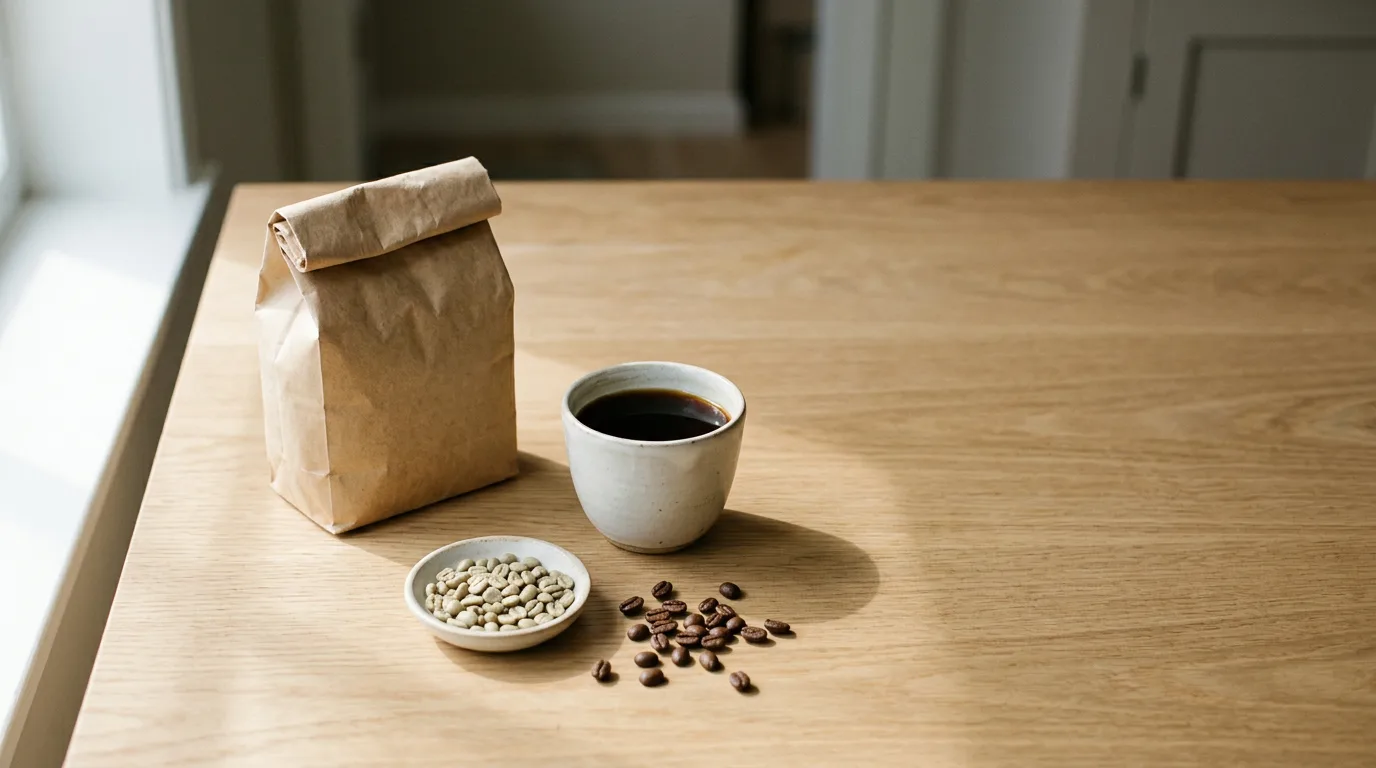
Single-origin coffee is expensive because it's grown, picked and handled in a way that costs far more per pound than commodity coffee. Most of it comes from high-altitude, often steep farms where trees grow slowly, yield less and must be picked by hand, one ripe cherry at a time.
The cherries are then sorted, processed, dried and graded with care, kept separate as small traceable lots, shipped in smaller volumes and roasted lightly and individually to show off their flavor. Every step adds labor and cost, and every defect removed along the way is coffee that can't be sold at the top price.
On top of that, good single origins are bought at a quality premium above the commodity price, rare lots are limited by nature, and the very best are sold at auction, where prices can reach thousands of dollars per pound.
The price gap between a can and a bag of single-origin beans
The first time I paid $24 for a 12-ounce bag of Kenyan coffee, I felt a bit silly. On the same shopping trip, a big can of supermarket coffee cost less than half that and weighed more than twice as much.
Then I brewed it. The cup tasted of blackcurrant, grapefruit and brown sugar. It was so different from the coffee I'd grown up drinking that I started asking the obvious question: why does this cost so much more?
Over the years I've visited roasteries, read farm reports, followed green coffee prices and tasted hundreds of coffees side by side at home. The answer turned out to be less about marketing and more about farming, labor and physics.
How big the gap really is
To put numbers on it, here are typical US prices per pound in late 2026:
| Type of coffee | Typical price per pound | What it usually is |
|---|---|---|
| Supermarket ground coffee | About $9 to $10 | Blend of many origins, often dark roasted |
| Supermarket "100% arabica" can | About $8 to $12 | Commodity-grade arabica blend |
| Specialty single origin | About $28 to $40 | Traceable lot from one country, region or farm |
| Rare micro-lots | $80 and up | Tiny lots, rare varieties, competition coffees |
| Top auction lots (green) | $1,000 to $13,705 | Prize-winning Panama Geisha and similar |
Retail figures are typical ranges I see in shops and online. Auction figures are for green, unroasted coffee.
Supermarket coffee has itself become much pricier. According to the Bureau of Labor Statistics, the average US price of ground coffee was about $5.89 a pound in 2022 and around $9.25 a pound by October 2026, after hitting record highs earlier in the year.
Even so, specialty single origins still cost roughly three times as much per pound. To understand why, you have to follow the coffee from the tree to your cup.
The six big cost drivers
- GeographyHigh-altitude, often steep farms with slow-growing trees and lower yields.
- LaborHand picking in several passes, plus hand sorting at almost every stage.
- Quality controlRemoving defects at each step, so a good part of the crop never reaches the top grade.
- ProcessingCareful washing, fermenting and drying that takes water, time and skilled hands.
- RoastingSmall batches profiled one lot at a time by experienced roasters.
- Supply chainSmall, separate lots, quality premiums, shipping, import costs and fair pay along the way.
What "single origin" actually means
Single-origin coffee comes from one specific place rather than being blended from several countries or regions.
That sounds clear, but there's no strict legal definition of the term. Depending on the roaster, "single origin" can mean very different things.
The three levels of single origin
- Single farm or estate. Coffee from one family farm or estate, sometimes called single estate or single producer. This is the most traceable level.
- Single washing station or cooperative. Coffee from one processing site that collects cherries from hundreds of nearby smallholder farmers. This is common in Kenya, Ethiopia and Rwanda.
- Single region or country. Coffee from a wider area, such as "Colombia Huila" or simply "Guatemala." It's still one origin, but much less specific.
Generally, the more specific the origin, the smaller the lot, and the higher the price. A bag that names the farm, the producer, the variety, the altitude and the processing method is usually telling you that someone kept that coffee separate from start to finish. That separation costs money.
Why people pay for it
People buy single-origin coffee because they want a specific, traceable flavor. A washed Kenyan tastes nothing like a natural Ethiopian, and neither tastes like a Brazilian from a low, flat farm.
Blends are designed to taste the same all year. Single origins are designed to taste like a place and a harvest. If you want the full comparison, I've covered it in my guide to single origin vs blend.
Our tip: On the bag, the more detail you see (farm or washing station, variety, altitude, process and harvest), the more likely the coffee is a true small lot rather than a broad regional label.
Altitude, soil and slow growth: the terroir behind the price
Like wine grapes, coffee tastes of where it's grown. Altitude, climate, soil and sun all shape the flavor.
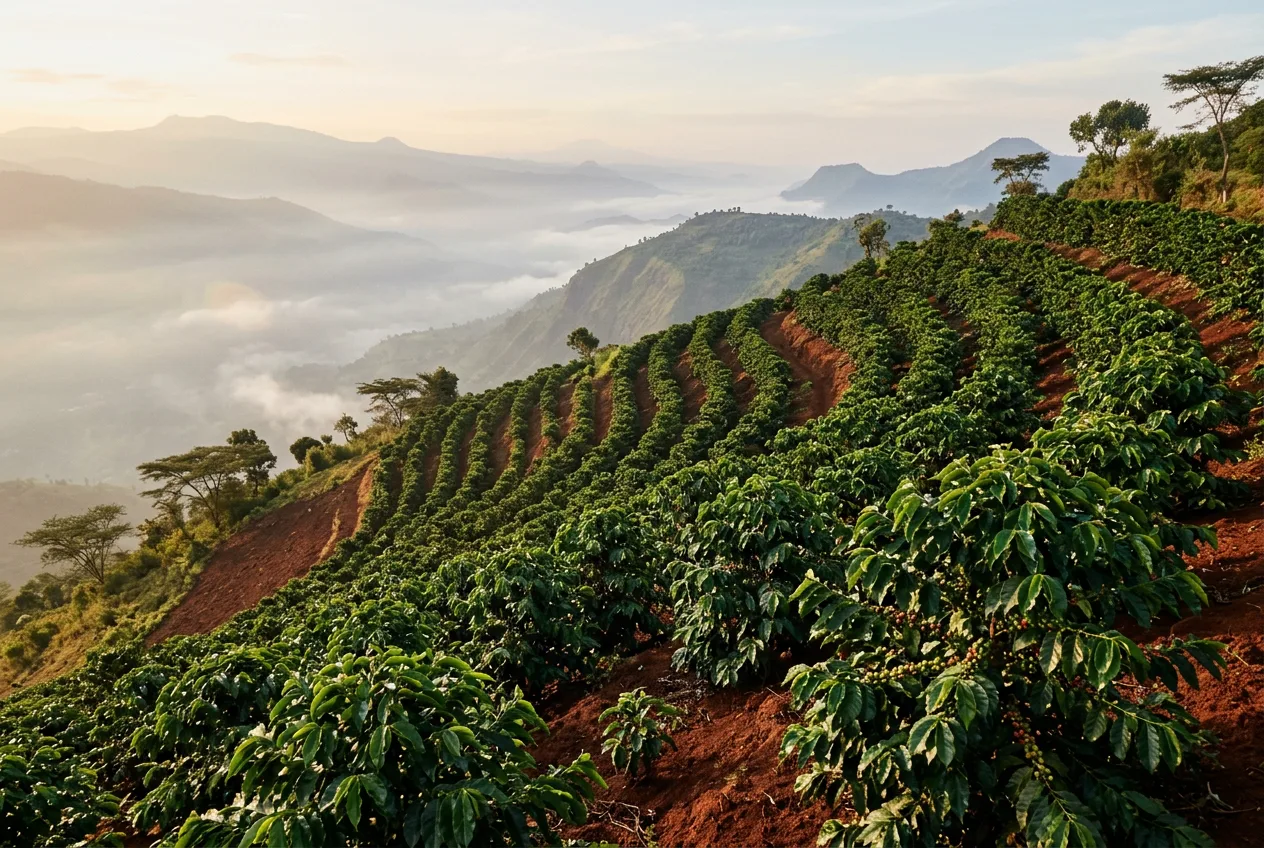
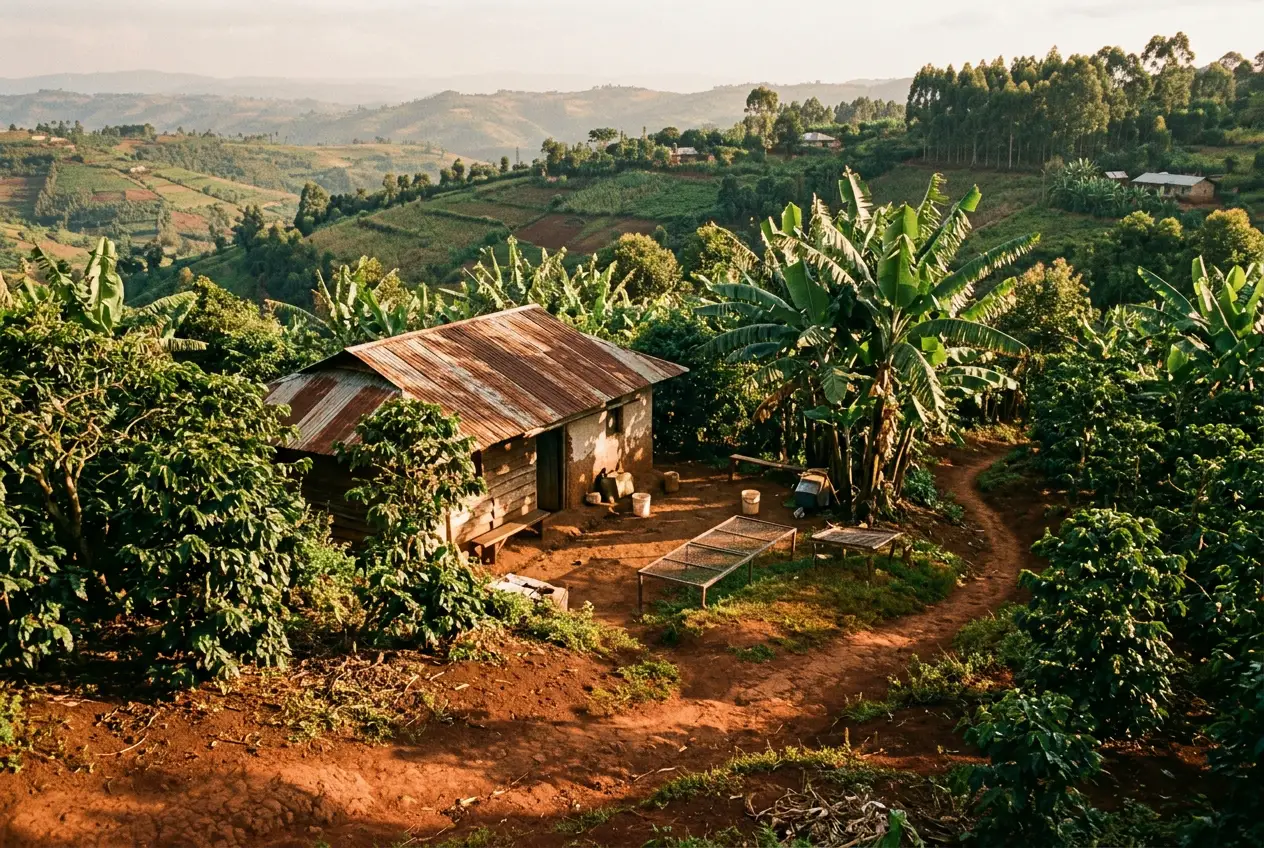
Many of the most sought-after single origins are grown high up. In Nyeri County in Kenya, for example, farms sit at around 5,500 feet or more, roughly a mile above sea level, on rich volcanic soil.
Why altitude matters
Higher up, the air is cooler. Cooler temperatures make coffee trees grow more slowly, and the cherries take much longer to ripen.
That slow ripening gives the seeds inside more time to build up sugars and organic acids. Those are the building blocks of the bright, fruity and floral flavors that specialty buyers pay for.
The beans also tend to be denser and harder, which makes them roast more evenly and hold more flavor.
The cost of growing high
The same conditions that make great coffee also make it more expensive to grow:
- Lower yields. Slow-growing trees on mountain farms usually produce less coffee per tree than trees on warm, flat land.
- Steep terrain. Machines often can't work the slopes, so nearly everything is done by hand.
- Harder logistics. Fertilizer, tools and harvested cherries have to be carried up and down hills, often on foot or by motorbike.
- Climate risk. Frost, heavy rain, drought and diseases like coffee leaf rust can wipe out a good part of a harvest.
Why one origin shows it best
When coffee from one high-altitude region is roasted and brewed on its own, those local flavors come through clearly. In a big blend from many countries, they tend to get muted or averaged out.
That's a big part of what you're paying for: a coffee that tastes of one particular place. My guide on coffee growing regions and flavor explains what the main origins taste like.
Why most single-origin coffee is picked by hand
If I had to name one reason single-origin coffee costs more, it would be labor. And most of that labor happens at harvest.
Cherries don't ripen at the same time
Coffee grows as small fruits called cherries. Each cherry usually holds two seeds, which become the beans we roast.
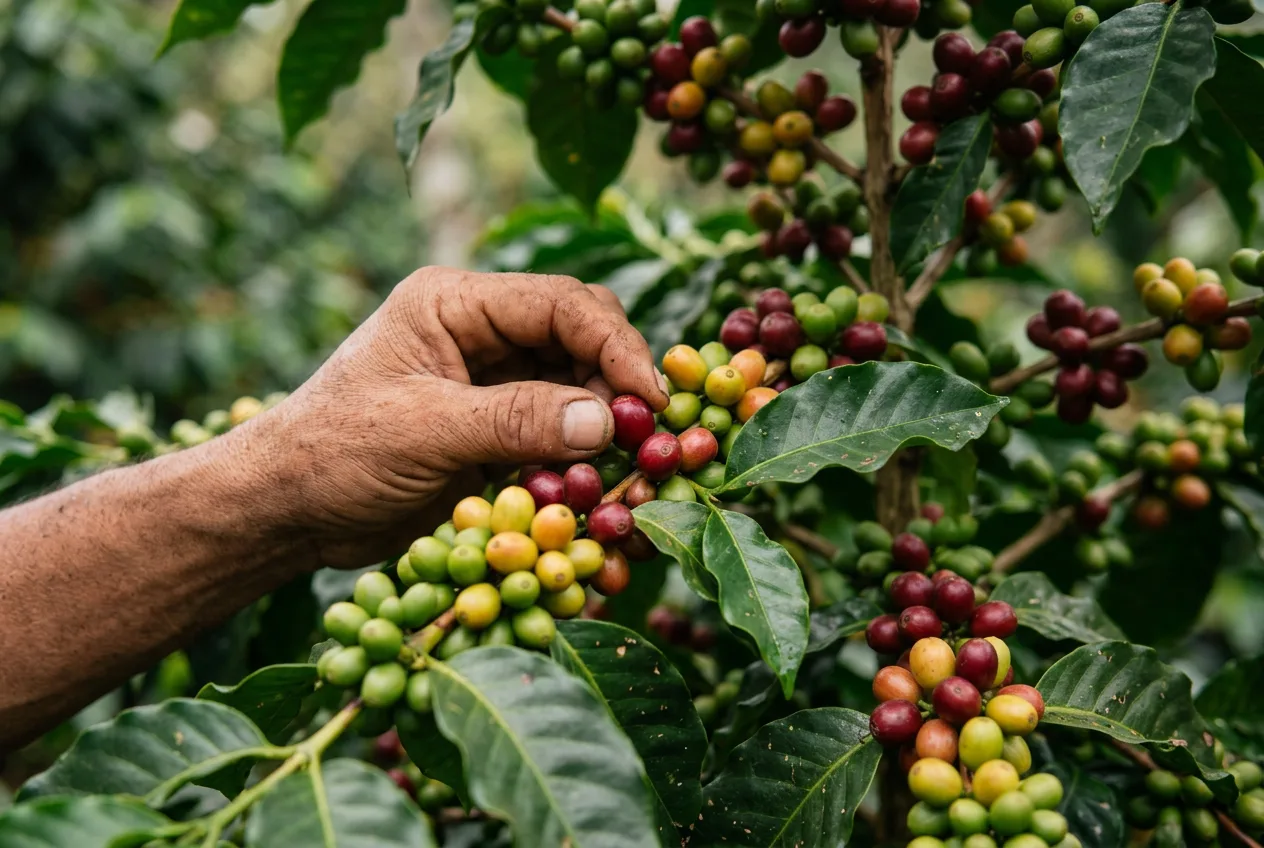
On a single branch, you'll often find green, yellow and deep red cherries at the same time. Only the deep red ones are fully ripe, and ripeness is the single biggest factor for sweetness and flavor.
So on specialty farms, pickers go over the same trees several times during the harvest season, picking only the ripe cherries and leaving the rest to ripen for the next pass. Some experienced pickers have been doing this for 25 years or more and can spot the right color in a split second.
How many cherries make a pound?
It takes more than 1,500 coffee cherries to make just one pound of roasted coffee. Each of those cherries is picked, carried, sorted and processed by people.
Roughly how much you start with to end up with 1 lb of roasted coffee
Cherries lose around 80% of their weight on the way to green coffee, then green coffee loses another 15 to 20% during roasting. Exact figures vary by farm and process.
Think about that next time you buy a 12-ounce bag. Somewhere, someone picked well over a thousand individual cherries by hand to fill it.
What hand picking costs
Hand picking is slow. A good picker on a steep farm might harvest a basket of cherries a day that ends up as only a few pounds of roasted coffee.
Selective picking in several passes means paying pickers over several weeks, not one quick sweep. Many farms also struggle to find enough workers at harvest, which pushes wages and costs up further.
Our tip: If a bag says "hand picked" or "selectively harvested," that's not just a romantic detail. It's one of the main reasons the coffee is sweeter and cleaner, and one of the main reasons it costs more.
How commodity coffee is grown and harvested
To see why single-origin coffee costs more, it helps to look at how cheap coffee is produced.
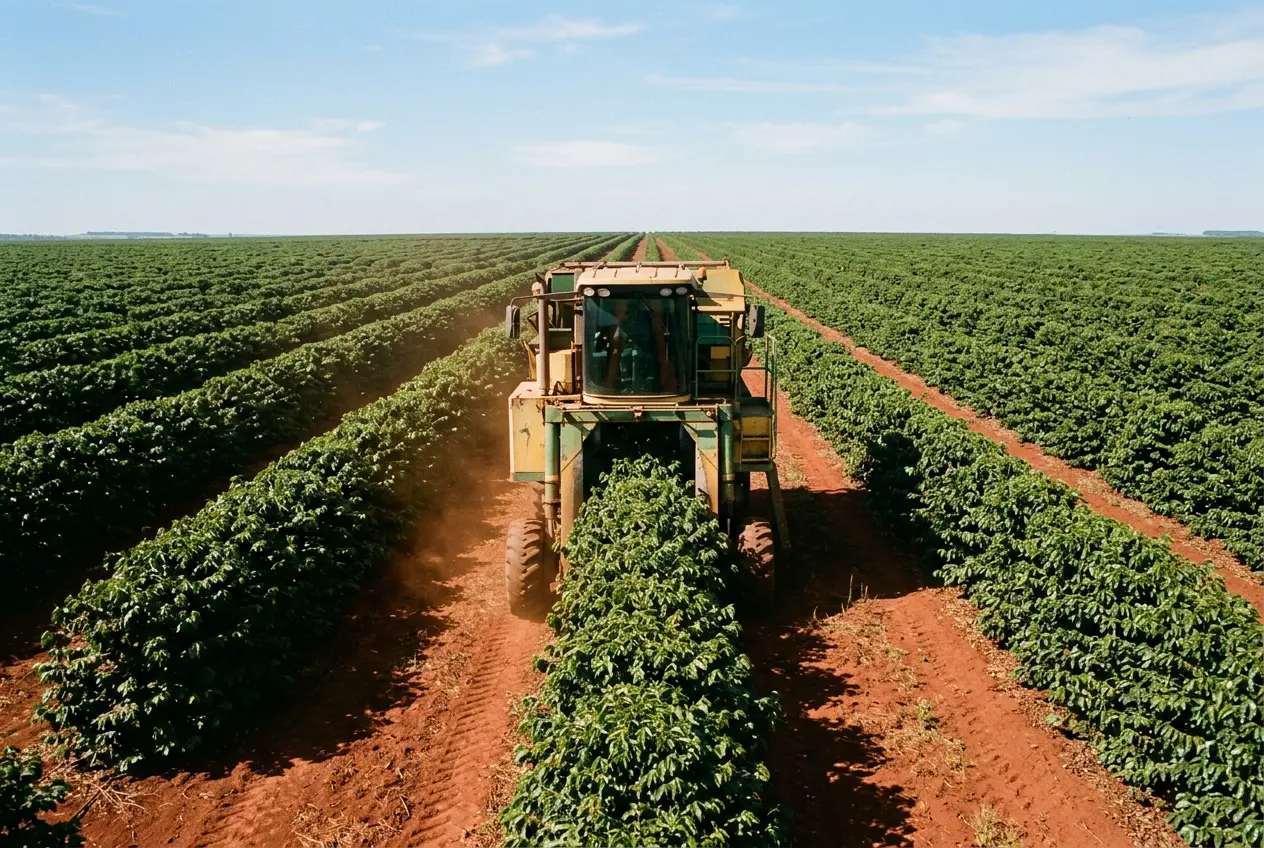
Brazil is the world's largest coffee producer, and much of its coffee comes from large farms on wide, gently rolling land at lower altitudes. There, coffee trees grow faster and produce bigger yields, and the terrain is perfect for machines.
Mechanical harvesting
On these farms, tractor-like harvesters drive along the rows and shake or strip the trees. Ripe, unripe and overripe cherries all come off together in one pass.
That's hugely efficient. One machine can do the work of many pickers, and the cost per pound drops dramatically.
The trade-off
The catch is quality control. When green and overripe cherries are mixed in with ripe ones, the coffee tastes less sweet and less clean.
Much of this coffee becomes commodity coffee. It goes into supermarket blends, instant coffee and food production, where it's bought and sold in huge volumes at low, volatile prices.
To be fair, Brazil also produces excellent specialty coffee, including carefully harvested and sorted lots that can be lovely. Some modern farms use selective machines and very careful sorting. I've written about this in my guide on how coffee is processed on Brazilian farms.
Commodity vs single origin, side by side
| Stage | Typical commodity coffee | Typical specialty single origin |
|---|---|---|
| Farm location | Lower, flatter land | Higher, often steep slopes |
| Yield per tree | Higher | Lower |
| Harvest | Machine strip picking, one pass | Hand picking, several passes |
| Sorting | Basic, mostly mechanical | Repeated hand and machine sorting |
| Lot size | Huge, mixed from many farms | Small, kept separate and traceable |
| Roast | Often dark, very fast, large batches | Light to medium, small profiled batches |
| Price basis | Commodity price | Commodity price plus a quality premium |
Same species, very different coffee: arabica and quality grades
Here's something that surprised me when I first learned it. Most expensive specialty coffee and a big share of cheap supermarket coffee come from the same plant species: Coffea arabica.
So "100% arabica" on a can doesn't mean much on its own. A supermarket can of 100% arabica can sell for around $8 to $10 a pound, while a micro-lot of 100% arabica from Panama has sold for thousands of dollars a pound at auction.
Genetics matter, but they're only part of the story. Variety, altitude, harvest, processing and roasting make a far bigger difference within the same species. For more on the species question, see my guide to arabica vs robusta.
Commodity grade vs specialty grade
In the trade, coffee is broadly split into two tiers:
- Commodity grade. Coffee traded in bulk on price, with some defects allowed and little attention to flavor beyond being acceptable.
- Specialty grade. The top tier, with no primary defects and distinct, desirable flavors. It's usually defined as scoring 80 points or more out of 100 on a standard tasting scale.
Who decides the score
Coffee quality is judged by trained tasters, many of them certified as Q Graders. They follow a standard protocol called cupping, tasting coffee brewed in small bowls and scoring it on fragrance, aroma, flavor, aftertaste, acidity, body, balance, sweetness, uniformity and clean cup.
Single-origin coffees often score near the top of the scale because their regional character is kept intact rather than blended away. In the specialty market, the pricing rule is simple: the better the flavor and the smaller the lot, the higher the price per pound.
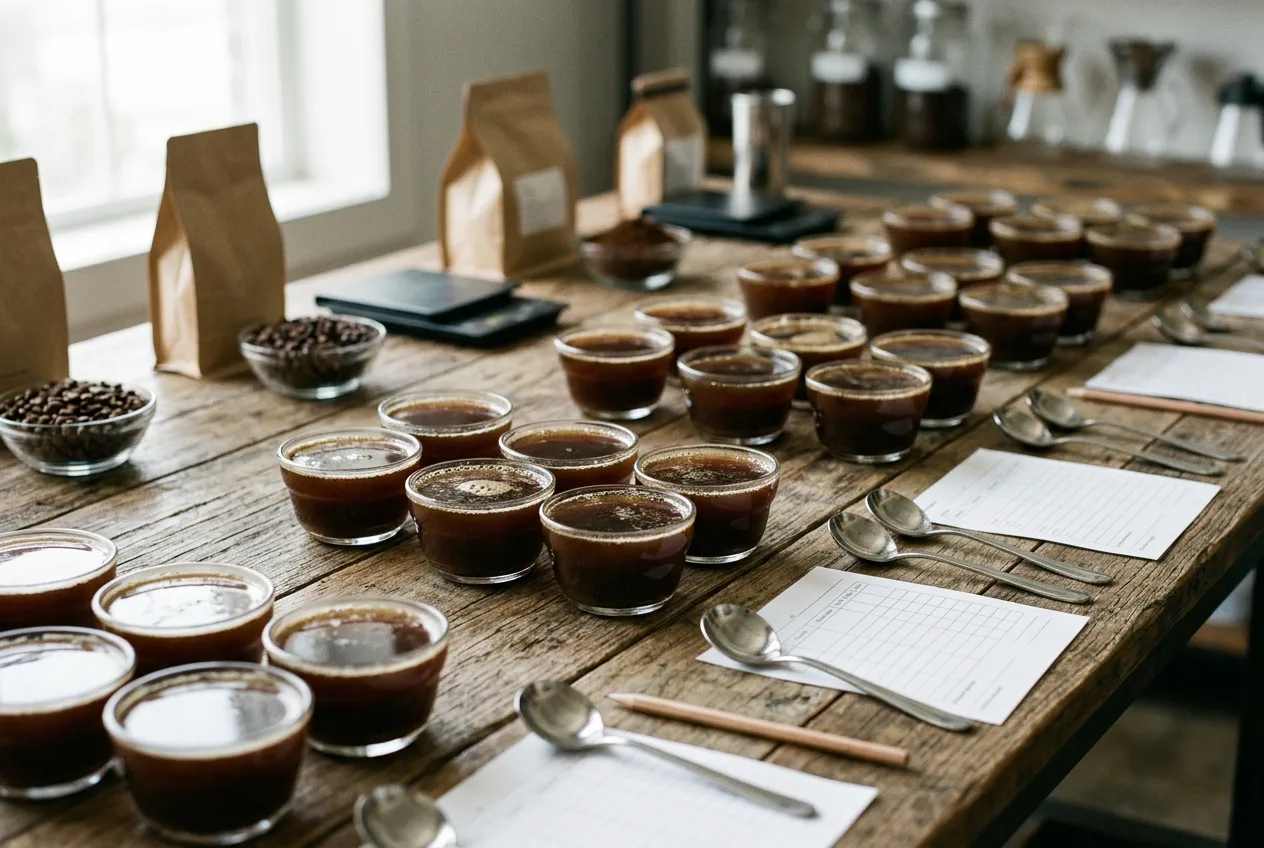
My guide to what specialty coffee is explains the 80-point standard in more detail.
Post-harvest processing: where quality is protected or lost
Once the cherries are picked, the clock starts ticking. What happens over the next few weeks decides whether the coffee keeps its quality or loses it.
The five stages from cherry to bag
- Red cherryThe freshly picked fruit, usually holding two seeds.
- Wet parchmentThe seeds after the skin and sticky fruit have been removed, still in a protective layer and full of moisture.
- Dry parchmentThe seeds after drying, when the protective layer has become brittle and papery.
- Green coffeeThe raw, unroasted beans after that dry layer has been milled off.
- Roasted coffeeThe brown, aromatic beans you buy, ready to grind and brew.
Sorting straight after picking
Right after the harvest, workers sort through the cherries by hand. They take out twigs, leaves, insect-damaged fruit and any unripe or overripe cherries that slipped through.
This matters more than you'd think. Even a small share of bad cherries can spoil the flavor of a whole batch and cut its value sharply.
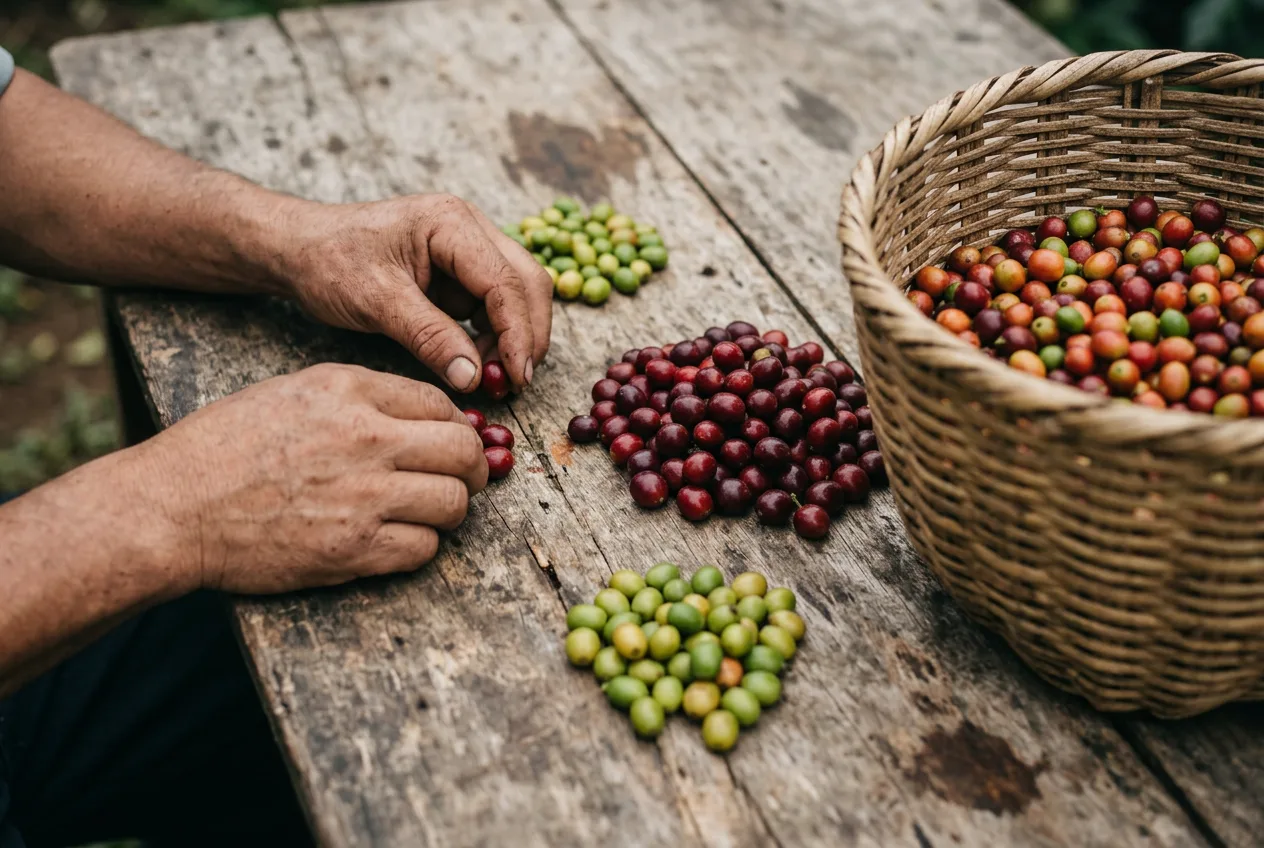
Speed matters too. Coffee cherries start to ferment and break down almost as soon as they're picked, so they have to be processed the same day.
Why smallholders share washing stations
There are more than 12.5 million coffee farms in the world, and about 95% of them are run by smallholders, often family farms of around an acre or a few acres passed down through generations.
These farmers can't afford their own processing machinery. In places like Kenya, they deliver their cherries to central washing stations, often called factories or wet mills. A single station can serve more than 1,000 local farmers, processing their daily deliveries together.
How the washed process works
There are several processing methods, including natural (dry) and honey processing. In Kenya, the washed process is the standard, and it's famous for clean, bright and complex coffees. I've covered the others in my guide to coffee processing methods.
Here's what happens at a typical Kenyan washing station:
- Weighing and inspectionFarmers deliver their cherries, which are weighed to calculate their pay and checked for ripeness.
- PulpingMachines strip off the red skin, leaving the seeds covered in a sticky, sugary fruit layer called mucilage.
- FermentationThe seeds rest in concrete tanks for about 12 to 14 hours while natural microbes break down the mucilage.
- Washing and density gradingWorkers push the coffee through long water channels with wooden paddles. Light, hollow or lower-quality beans float and are skimmed off.
- SoakingThe heavier, denser beans that sink are soaked in clean water to remove the last traces of mucilage and sharpen the flavor.
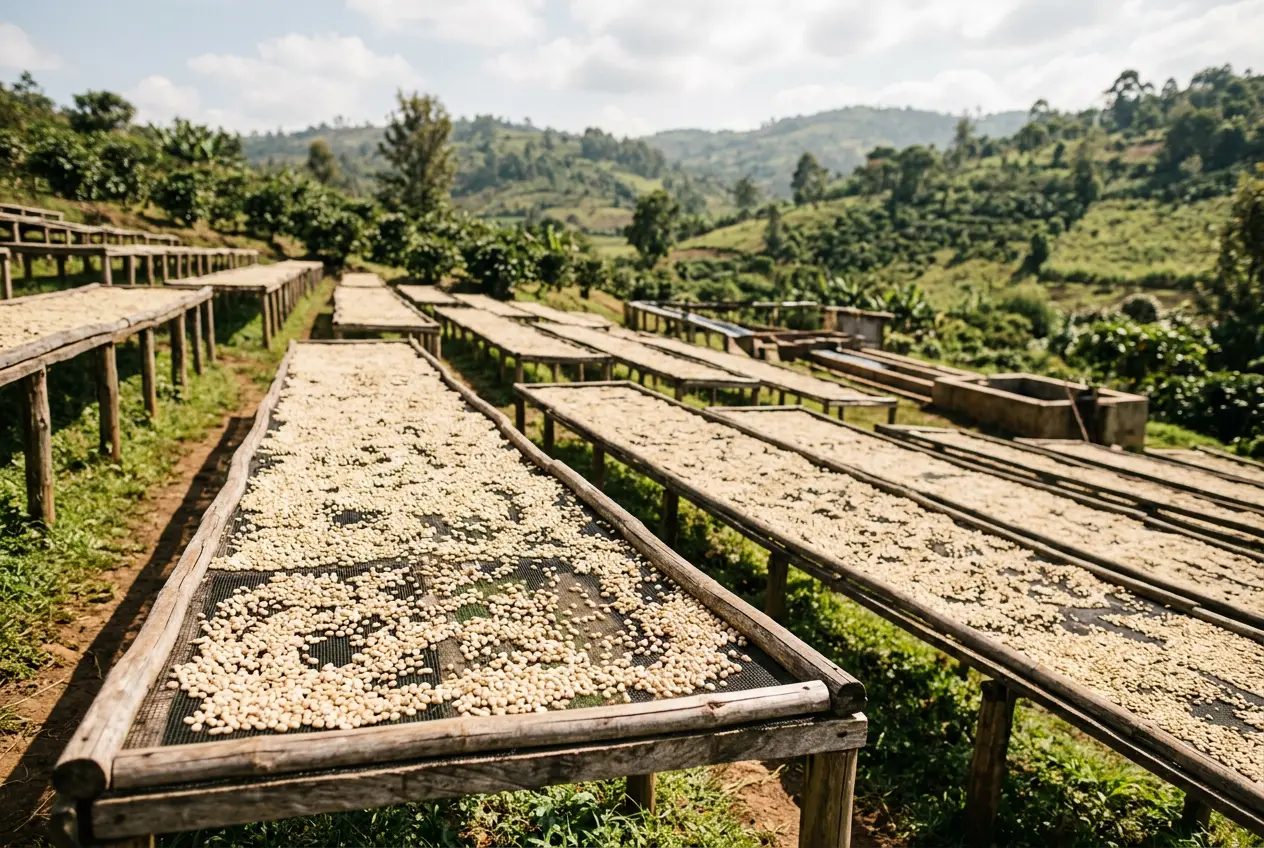
- DryingThe wet parchment is spread on raised drying beds and turned by hand for about 14 days, until moisture drops to 11 to 12%.
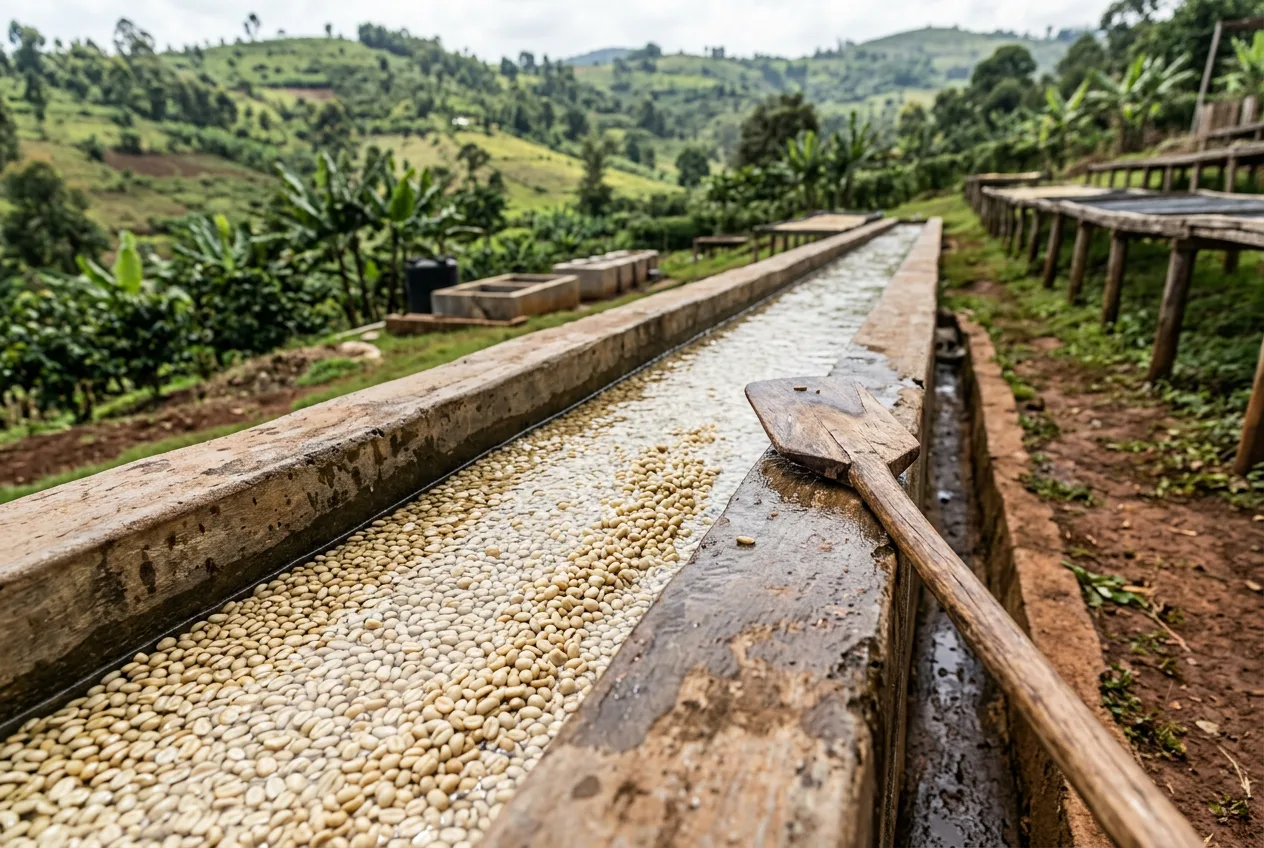
The floaters aren't thrown away. They're sold for much less, locally or into lower-grade blends, which still gives farmers some extra income. But they don't earn the top price, so they're one more reason the best lots cost more.
The hidden cost of water
Washed processing gives exceptional cups, but it's resource-heavy. It uses large amounts of fresh water to move, ferment and clean the coffee.
The leftover wastewater is full of fruit sugars and acids and has to be treated carefully so it doesn't pollute rivers. Many stations now invest in water recycling and filtration, which is good for the environment but adds to the cost of every pound.
Our tip: Each processing method gives a different style of cup. Washed coffees are usually cleaner and brighter; naturals are fruitier and heavier. If you're paying for a single origin, the process on the label tells you a lot about how it will taste.
Milling and grading: the last sort before export
Once the coffee is dry, it's called parchment coffee, because of the thin, papery hull still wrapped around each bean.
Before export, it goes to a dry mill. Machines remove that hull to reveal the raw green coffee inside.
Grading green coffee
Then comes another round of grading. Standards differ by country. In Kenya, beans are sorted mainly by size using screens with holes of set sizes, along with checks on shape, density and color.
- AA. The largest beans, which usually earn the highest export prices.
- AB. Slightly smaller beans, often excellent value.
- PB (peaberry). Single round beans from cherries that grew one seed instead of two.
- Lower grades. Smaller or broken beans, sold for less.
Bigger, denser beans tend to roast more evenly and often hold more flavor, which is why grades like Kenya AA command a premium. My guide to Kenyan coffee goes deeper into these grades.
Many sorts, fewer top beans
By the time a coffee reaches the top grade, it has been sorted at the tree, at the sorting table, in the washing channels, on the drying beds and at the mill. Some lots are sorted again by optical machines or by hand on a table.
Every sort removes coffee that can't be sold at the highest price. That's how quality is built, but it also means the beans that make the cut have to carry the cost of everything that was picked, processed and then rejected.
Roasting single origins: more skill, smaller batches
Most of the world's coffee is shipped green and roasted in the country where it's drunk. That's where specialty roasters come in, the bridge between farmers abroad and coffee drinkers at home.
Roasting is what turns hard, grassy-smelling green seeds into the aromatic brown beans we brew. Roasters don't add flavors. Every fruity, floral, chocolaty or nutty note was already locked in the bean, waiting to be developed with heat.
Light roasts for origin flavor
Specialty roasters usually roast single origins light to medium. Lighter roasts keep the delicate acids, natural sugars and origin flavors, such as citrus, berries or jasmine, that make the coffee worth buying in the first place.
Large commodity roasters often do the opposite. Roasting very dark burns away origin flavor and creates a uniform bitter, smoky taste.
For commodity coffee, that's partly the point. A dark roast hides defects from unripe or damaged beans and makes a blend of cheap coffees from many countries taste the same all year. Industrial roasters also tend to roast very hot and fast to maximize output, rushing through the stages that build sweetness and complexity.
My guide to coffee roast levels explains how each level changes the cup.
Nowhere to hide
To be clear, blends aren't automatically worse. A skilled roaster can make a beautiful, balanced blend, and a badly farmed or badly roasted single origin can taste flat.
But single-origin roasting leaves nowhere to hide. Any mistake in farming, processing or roasting shows up straight away in the cup. So roasters spend more time profiling each lot individually, and they throw out batches that don't taste right.
How a roaster tracks a batch
Good roasting takes years of practice. Roasters use temperature probes and software, but they also rely on their eyes and nose.
During a typical specialty roast of around 11 minutes, for example with a 20-pound batch of honey-processed Costa Rican coffee, the roaster keeps pulling small samples from the drum with a metal scoop called a trier. They watch the color change and smell the beans:
- Early phaseThe beans smell of hay, grass or damp leaves as moisture cooks off.
- Middle phaseAs browning reactions and caramelization start, the smell gets sweeter.
- Acidity peakAcids become volatile and the beans smell sharp, almost like vinegar.
- Finished developmentAs that sharpness fades, sweet fruit and baked notes appear. The roaster drops the beans into the cooling tray right then to stop the roast.
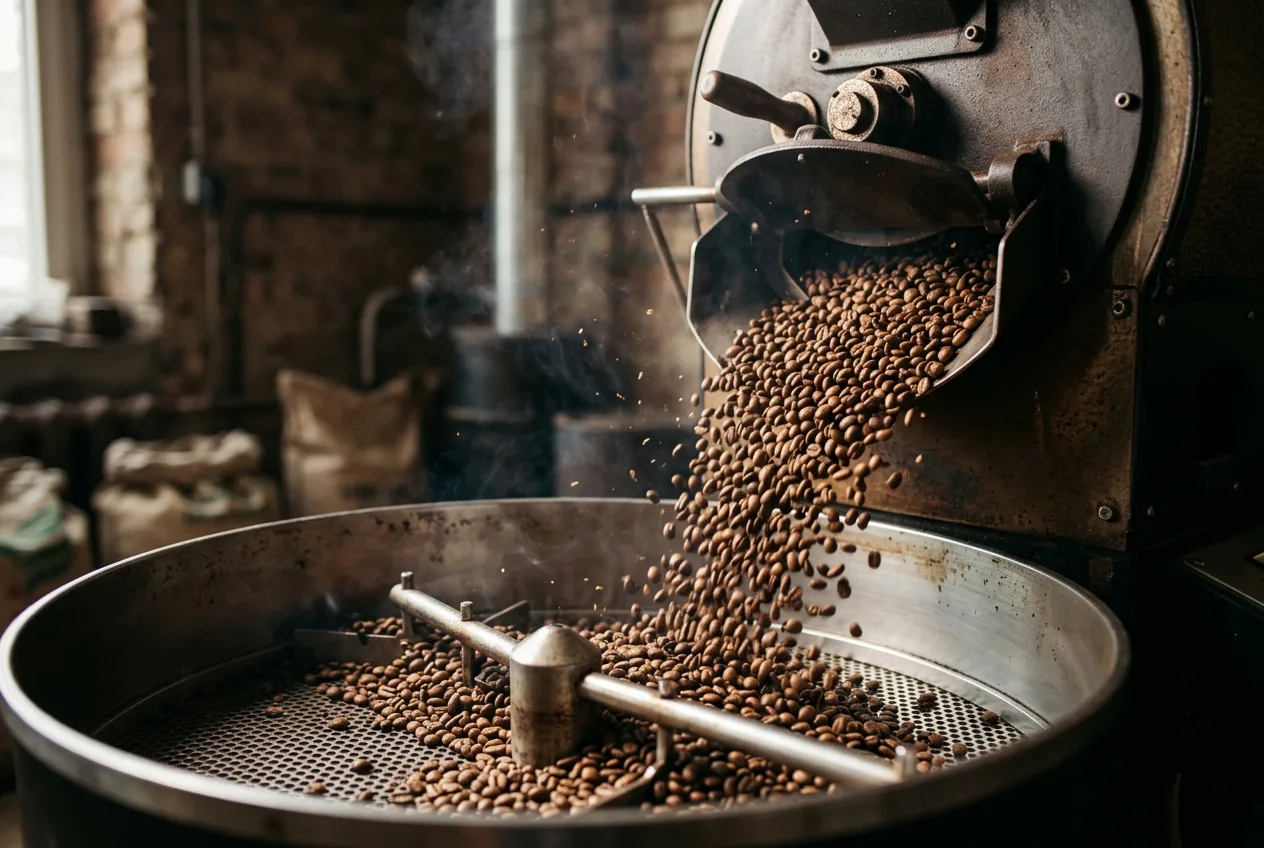
That kind of attention doesn't scale like a factory. Smaller batches, more skilled staff and more time per pound all show up in the price. If you want the full picture, see my guide on how coffee is roasted.
The C market and why cheap coffee is so cheap
To understand single-origin prices, you also need to understand the baseline they're measured against.
Across the global coffee trade, the benchmark price for arabica is set by the futures market in New York, known as the C market. It works a bit like a stock exchange. Traders buy and sell contracts based on expected supply and demand.
A price that ignores quality
The C market treats coffee as an interchangeable bulk commodity. It doesn't reward cup quality, the labor behind it or sustainable farming. It simply reflects how much coffee the world expects to have and how much traders think it's worth.
Wild swings
The C price is famously volatile:
- In 2019, it averaged about $1.02 a pound and dipped as low as $0.87, below what many farmers need just to cover costs.
- Adjusted for inflation and the rising cost of fertilizer, labor and equipment, prices in those years were close to levels last seen around 1980.
- In 2025, after poor harvests and supply worries, arabica futures shot above $4 a pound.
- By early November 2026, they had fallen back to around $2.80 a pound as Brazil's harvest outlook improved.
For a big trading company, that's a risk to hedge. For a family on an acre of coffee, it can decide whether the farm survives the year.
Arabica futures price, rough levels per pound
Futures prices for green arabica. Farmers usually receive less than this after local costs.
Why supermarket coffee jumped too
Those high futures prices are why supermarket coffee climbed to record levels in 2025 and 2026. When the commodity price doubles, cheap coffee feels it most, because the green coffee is a bigger share of its price.
Specialty single origins rose too, but by less in percentage terms. Much of their price is labor, processing, roasting and quality premiums that don't move with the futures market. That's one reason the gap between a supermarket can and a specialty bag has narrowed a little, though it's still large.
What coffee farmers actually earn
This is the part of the story that changed how I think about coffee prices.
The poverty problem
Because commodity prices often fall below the real cost of growing coffee, millions of farmers end up working at a loss. One 2019 industry estimate found that around 44% of smallholder coffee farmers were living below the poverty line.
Yields make a big difference. Smallholders whose trees produce less than about 11 pounds of cherries per tree often can't even cover their basic costs.
When prices stay low for long, farmers cut back on fertilizer and pruning, which lowers future quality. Some switch to other crops or leave farming altogether.
The specialty premium
Specialty single-origin coffee is bought at a premium above the commodity price, and for skilled producers that premium is a lifeline.
One Kenyan smallholder in Nyeri, for example, earned about $3.18 a pound for his coffee at a time when commodity prices were near $1. That's more than three times the commodity price.
Even so, he said that around $4.55 a pound would be needed to really sustain his farm, invest in it and support his family comfortably.
Still exposed
Specialty premiums don't fully protect farmers. Even when they keep their quality high, a global oversupply can drag down what they're paid from one year to the next.
There's also a transparency problem. Once coffee leaves the washing station, many smallholders never find out what exporters charge buyers overseas. They often can't tell whether they're getting a fair share of the final price.
Our tip: Some roasters publish the price they paid per pound, often listed as the FOB or farmgate price. If you care about where your money goes, those roasters make it easy to check.
From $3.18 at the farm to $30 a pound: where the money goes
So if a farmer gets around $3 a pound, why does a 12-ounce bag of single-origin Kenyan coffee sell for $22.50 or more? That works out to about $30 a pound.
At first glance, it looks like the farmer is getting about a tenth of the price. But comparing the farmer's green coffee price to the retail bag price leaves out a lot of real costs in between.
1. Weight loss along the way
Coffee gets lighter at every stage. Fresh cherries lose roughly 80% of their weight during pulping, drying and milling. Then green coffee loses another 15 to 20% during roasting as water evaporates.
So a pound of roasted coffee needs about 1.2 to 1.25 pounds of green coffee. At $3.18 a pound, the green coffee in a pound of roasted beans already costs the roaster close to $4 before anything else is added.
2. Milling, export and shipping
Between the farm and the roastery, there are many more costs:
- Running the washing station and the dry mill.
- Jute sacks and the airtight plastic liners used for specialty coffee.
- Trucking to the port, port fees and export paperwork.
- Ocean freight, insurance, import duties and warehousing.
- The importer's costs and margin for financing, storing and selling the coffee.
Many of these, especially freight and fuel, have gone up sharply in recent years. Small lots are also more expensive to move per pound than giant shipments.
3. Roasting overhead
The roaster then has its own costs: rent for a commercial space, an industrial roaster that can cost as much as a house, gas and electricity, skilled roasters, a quality lab for cupping, bags with one-way valves, boxes, shipping and marketing.
Specialty roasters are usually small businesses. They don't have the scale of a factory that roasts millions of pounds a year, so each pound carries more of those fixed costs.
4. Paying more on purpose
Ethical specialty roasters often pay well above the going rate for single-producer lots to reward quality and build long-term relationships with farmers. Those coffees tend to sell for around $21 to $26 a bag.
An illustrative breakdown
Every roaster's numbers are different, but here's a rough picture of how a $30 pound of single-origin coffee might break down:
Illustrative split of a $30 pound of single-origin coffee
My own rough estimate to show the scale of each cost. Real numbers vary a lot by roaster, lot, country and sales channel.
Looked at this way, the farmer's share is still small, and many people argue it should be bigger. But most of the rest isn't pure profit. It's the cost of turning a fruit grown on a mountain thousands of miles away into fresh, roasted coffee in your kitchen.
Direct trade and transparency
There's no guaranteed minimum premium for single-origin coffee. In bad years, some buyers can get specialty-grade coffee for close to commodity prices simply because farmers need cash quickly.
To push back against that, many specialty roasters work directly with farmers and cooperatives year after year, agreeing on stable, sustainable prices. Some print the farmgate or FOB price right on the bag.
Labels like Fairtrade take a different approach, with a guaranteed price floor and a premium. I've covered how that works in my guide to fair trade coffee.
The bottom line: unusually cheap coffee almost always means someone at the start of the chain, usually the farmer, is absorbing the real cost.
Rare lots and auctions: why some coffees cost hundreds or thousands
Most single origins sit in the $25 to $40 a pound range. But some go much, much higher.
Micro-lots
A micro-lot is a very small amount of coffee, sometimes just a few sacks, from one part of a farm, one variety or one picking day, kept completely separate. Producers create them when a particular plot or process tastes exceptional.
There's simply very little of it. When dozens of roasters around the world want the same few hundred pounds, the price climbs, and retail bags can go past $80 a pound.
Competition and auction coffees
At the very top are coffees sold at online auctions after national competitions, where expert judges score them. The best known is the Best of Panama auction, famous for Geisha coffee, a variety with intensely floral, tea-like flavors.
- 2019. A natural Geisha from Elida Estate became the first coffee to break $1,000 a pound at the Best of Panama auction, selling for $1,029 a pound.
- 2024. A natural Geisha from Elida set a new record at $10,013 per kilogram, about $4,540 a pound.
- 2025. A washed Geisha from Hacienda La Esmeralda scored 98 points and sold for $30,204 per kilogram, about $13,705 a pound. The whole 20-kilogram lot went for more than $600,000.
These prices are for green coffee. By the time it's roasted, shipped and served, a single cup can cost a small fortune.

Why auction coffee is so expensive
- Scarcity. Lots can be as small as 20 to 50 kilograms.
- Exceptional scores. Coffees scoring 95 points and up are extremely rare.
- Prestige. Buyers, often cafés and roasters in Asia and the Middle East, use these lots to build their reputation.
- Risky processing. Experimental fermentation and controlled drying can create amazing flavors, but a mistake can ruin a whole lot.
- Bidding wars. Hundreds of bids on one lot push prices far beyond production costs.
For everyday drinkers, these coffees aren't the point. But they do pull up the whole market. High auction prices show farmers that quality pays, which encourages better farming and processing across the region.
Is single-origin coffee worth the money?
That depends on what you want from your coffee, and how you drink it.
The cost per cup
Let's do the math. A pound of coffee makes roughly 30 cups at about 15 grams per cup.
| Coffee | Price per pound | Cost per cup (about 30 cups/lb) |
|---|---|---|
| Supermarket ground coffee | $9.25 | About 31¢ |
| Specialty single origin | $30 | About $1.00 |
| Premium micro-lot | $80 | About $2.65 |
| Café latte | - | Often $5 to $7 |
Rough figures based on a 15 g dose. Your numbers depend on your recipe and what you pay.
Put that way, a great single-origin coffee at home costs about a dollar a cup. That's a lot more than supermarket coffee, but still far less than most café drinks.
When it's worth it
- You drink it black. Pour-over, filter or straight espresso shows off origin flavors best.
- You enjoy tasting differences. Comparing a Kenyan with an Ethiopian is half the fun.
- You grind fresh. Single origins lose their best flavors quickly once ground.
- You care where it's from. Traceable coffee lets you support farms you know something about.
When it might not be
- You drink mostly lattes or sweet drinks. Milk and syrup cover a lot of delicate flavor. A good blend often works just as well.
- You like dark, bold coffee. Very dark roasts hide what makes single origins special.
- You buy pre-ground and keep it for weeks. The extra flavor fades before you get to enjoy it.
My honest view: for black coffee, a good single origin is one of the most affordable everyday luxuries there is. For milky drinks, I'd save the money and buy a well-roasted blend.
How to buy single-origin coffee without overpaying
A high price doesn't always mean a better coffee. Here's how I make sure I'm paying for real quality.
- Check the roast dateLook for beans roasted within the last few weeks. Old beans are a waste of money, however good they once were.
- Look for real detailFarm or washing station, region, variety, altitude and process. Vague labels usually mean a broader, cheaper lot.
- Start in the middleCoffees around $18 to $24 a bag are often the sweet spot. You don't need a rare micro-lot to taste the difference.
- Try value originsCoffees from Colombia, Peru, Honduras, Guatemala and Brazil often cost less than famous Kenyan or Ethiopian lots and can be excellent.
- Buy whole beansGrind just before brewing. It makes more difference than almost anything else.
- Buy small, buy oftenGet only what you'll use within two to four weeks so you drink it at its best.
- Look for price transparencyRoasters who share what they paid farmers are usually proud of it for good reason.
For a full guide to reading labels, see how to choose coffee beans.
Red flags
- No roast date, or only a "best before" date a year away.
- "Single origin" with no region, farm or process listed.
- Very dark, oily beans sold as a fruity single origin.
- Prices far above similar coffees with no clear reason, such as a rare variety or competition lot.
Our tip: Ask your roaster which of their coffees they drink at home. It's often a mid-priced single origin that tastes great without the hype.
How I brew single-origin coffee to get my money's worth
If you're paying more for great beans, it makes sense to brew them well. A few simple habits make a big difference.
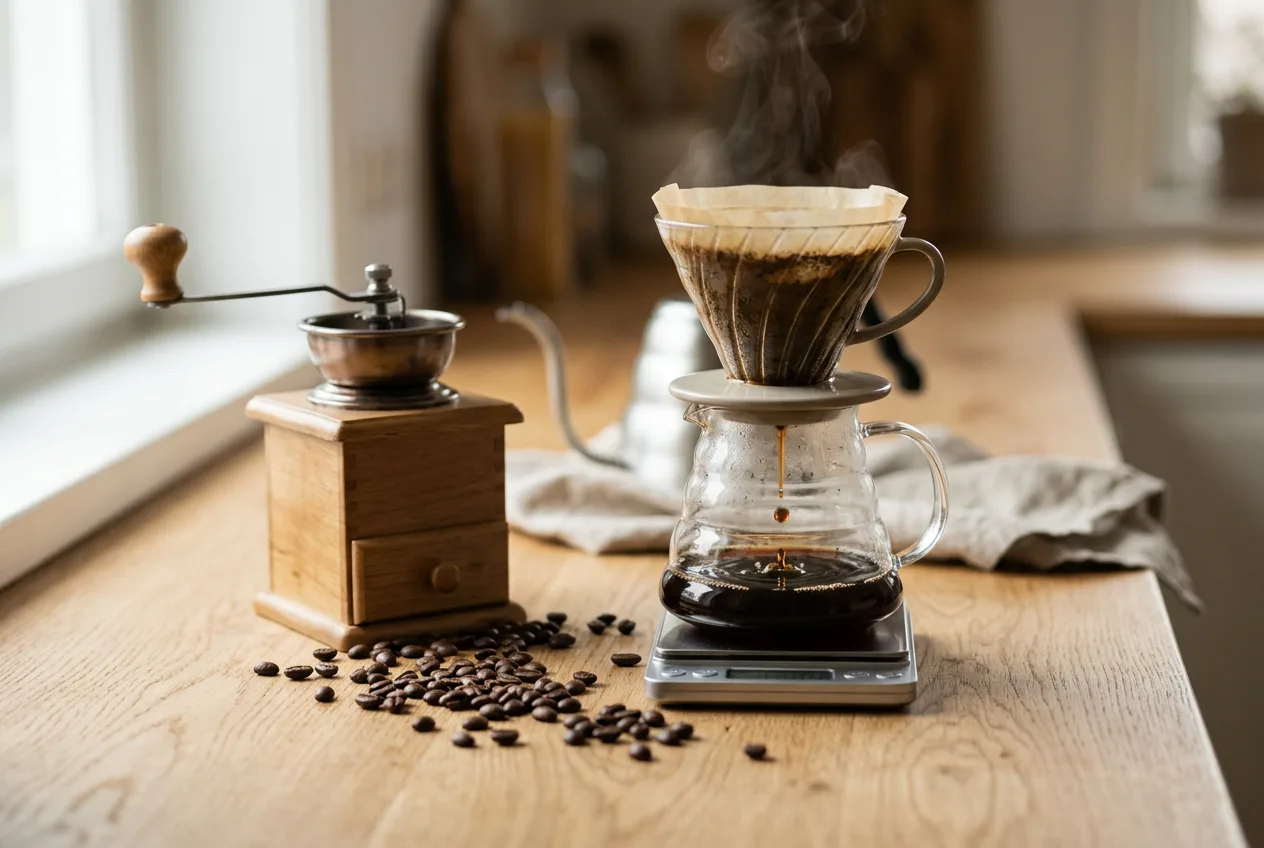
My everyday pour-over
- Ratio. 15 g coffee to 250 g water (about 1:16).
- Grind. Medium-fine, a bit like table salt.
- Water. Filtered, just off the boil, around 200 to 205°F.
- Bloom. Pour about 40 to 45 g of water, wait 30 to 45 seconds.
- Total time. About 3 minutes.
Let it rest
Very fresh light roasts can taste sharp or muted in the first few days. Most single origins taste best from about 5 to 21 days after roasting. My guide on coffee freshness and resting explains why.
Store it properly
Keep beans in an airtight, opaque container away from heat and light. Don't keep them in the fridge, and only freeze them in sealed portions. My guide on how to store coffee beans has the details.
Taste as it cools
Single origins change a lot as they cool. Fruit and acidity often come through more clearly once the cup drops a bit below hot. Some of my favorite moments with a good Kenyan come ten minutes after brewing.
Single-origin coffee myths
"Single origin is always better than a blend"
Not always. A great blend can beat a mediocre single origin. Single origin tells you where the coffee comes from, not how good it is.
"The high price is all marketing"
There's some branding in every bag, but most of the extra cost comes from hand labor, lower yields, sorting, careful processing, small lots and small-batch roasting.
"The farmer gets most of the money"
Usually not. Even at specialty prices, the farmer often gets only around 10 to 15% of the retail price, though that's still far more per pound than commodity coffee pays.
"100% arabica means premium"
Most supermarket coffee is arabica too. The species alone says little about quality.
"Expensive coffee should taste strong"
Specialty single origins are often lighter roasted and taste bright and fruity, not bitter and heavy. Strength comes from your recipe, not the price.
"Auction prices are what normal specialty coffee costs"
No. Record-breaking lots are rare exceptions. Most excellent single origins cost around $18 to $26 a bag.
Why single-origin coffee costs more, at a glance
| Cost driver | Why it adds to the price |
|---|---|
| Altitude and terroir | Slow growth, lower yields, harder farming |
| Hand picking | 1,500+ cherries per pound, picked in several passes |
| Sorting and grading | Defects removed at every stage, fewer top beans |
| Processing | Fermenting, washing and two weeks of hand-turned drying |
| Weight loss | About 6 lb of cherries for 1 lb of roasted coffee |
| Small lots | Kept separate and traceable, costlier to ship and handle |
| Roasting | Small, profiled batches by skilled roasters |
| Quality premium | Farmers paid well above the commodity price |
| Scarcity | Rare varieties and auction lots priced by demand |
My bottom line
Single-origin coffee isn't expensive because someone slapped a fancy label on it. It's expensive because good coffee is hard to grow, slow to pick, fussy to process and careful to roast, and because every step is done by people who deserve to be paid.
Cheap coffee is cheap because it cuts those corners, or because someone along the chain, usually the farmer, absorbs the cost.
You don't need to buy auction coffee to enjoy the difference. A fresh, well-roasted single origin at around a dollar a cup, brewed with care, is one of the best value upgrades you can make to your morning.
Frequently asked questions
Why is single-origin coffee so expensive?
It's usually grown at high altitude with lower yields, picked by hand in several passes, sorted repeatedly, processed carefully, kept in small traceable lots, roasted in small batches and bought at a quality premium above the commodity price.
How much does single-origin coffee cost?
Most specialty single origins cost around $18 to $26 for a 12-ounce bag, or roughly $25 to $40 a pound. Rare micro-lots can cost $80 a pound or more.
How much does a farmer get from a bag of single-origin coffee?
It varies, but farmers often earn around 10 to 15% of the retail price. For example, a farmer paid about $3.18 a pound for green coffee may see roughly $4 of a $30 retail pound.
Is single-origin coffee better than blends?
Not automatically. Single origins show the flavor of one place, while blends aim for balance and consistency. Quality depends on the beans and the roaster.
What is the most expensive coffee ever sold?
In 2025, a washed Geisha from Hacienda La Esmeralda in Panama sold at the Best of Panama auction for $30,204 per kilogram of green coffee, about $13,705 a pound.
Why is supermarket coffee getting more expensive too?
Arabica futures prices rose sharply in 2024 and 2025 due to poor harvests and supply worries, pushing the average US price of ground coffee to record highs above $9 a pound.
Is single-origin coffee worth it for lattes?
Often not. Milk masks delicate origin flavors, so a good espresso blend usually gives you better value for milk drinks.
Does single origin mean one farm?
Not necessarily. It can mean one farm, one washing station or cooperative, or a whole region or country. The label should tell you which.
How many coffee cherries are in a pound of coffee?
More than 1,500 cherries go into one pound of roasted coffee, which is roughly 6 pounds of fresh cherries.
How can I tell if single-origin coffee is good value?
Look for a recent roast date, detailed origin information, a light to medium roast and a roaster that's open about where the coffee comes from and what it paid.

- Michael Reynolds, notes from buying, cupping and brewing single-origin coffees at home
- Average Price: Coffee, 100%, Ground Roast, All Sizes, U.S. City Average, U.S. Bureau of Labor Statistics via FRED
- Coffee price inflation, BLS average price data, Official Data
- U.S. coffee prices hit highest level on record in January 2026, StoneX
- Arabica coffee futures hover at over 1-month lows, Trading Economics
- Best of Panama auction sees world-record price, Global Coffee Report
- A Panama Gesha broke price records (again), Sprudge
- Elida Estate natural Geisha makes Best of Panama auction history at US$1029 per pound, BeanScene
- Fairtrade strengthens safety net for coffee farmers, Fairtrade International
Related guides
Single origin vs blend What is specialty coffee Fair trade coffee explainedWritten by Michael Reynolds. Last updated November 17, 2026.