Coffee Roast Levels Explained: From Light to French Roast
Light, medium and dark sound like three neat flavor settings. They are not. Every roast level is really one decision: when the roaster stops the heat, measured against two sounds that happen inside the drum. In this guide I walk through all seven stops on the roast map, what each one tastes like, how to tell them apart by eye, and why the old "dark roast has more caffeine" idea is mostly a measuring mistake.
We choose products independently. We may earn a commission through links on this page; your price stays the same. Affiliate policy
Coffee roast levels describe how far the bean was taken past two audible milestones: first crack (around 385 to 400°F, when the last water escapes as steam) and second crack (around 435 to 450°F, when the bean's plant fiber starts to break).
Light roasts stop at or just after first crack and taste bright, fruity and acidic. Medium roasts stop well after first crack but before second crack and taste balanced and sweet. Dark roasts go into or past second crack and taste smoky, bittersweet and heavy.
The quickest way to know where a bag really sits: look at the beans. Dry and matte means the coffee never reached second crack. Shiny and oily means it did, whatever the label says.
The roast map at a glance
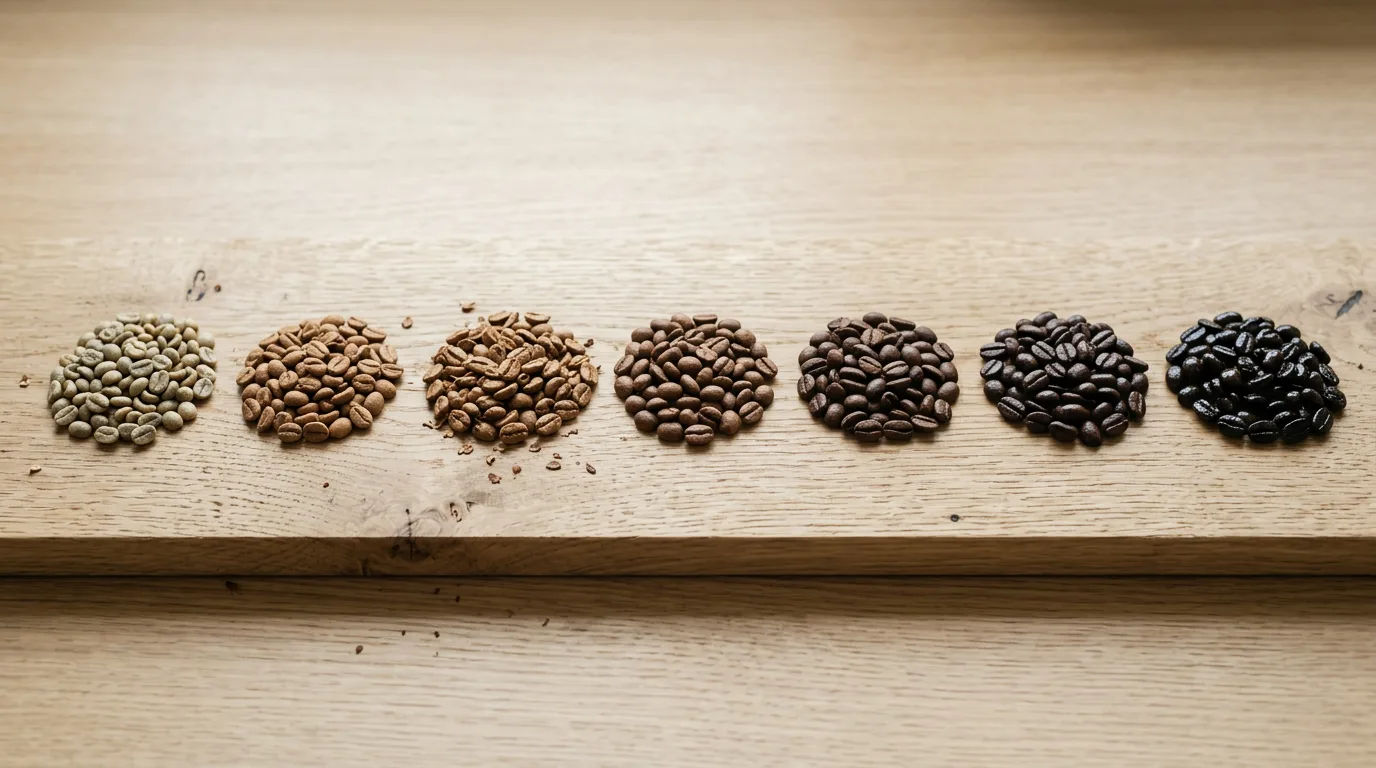
Before we get into the chemistry, here is the whole journey in one strip.
Read it left to right. Each block is a point where a roaster can decide to stop the heat and dump the beans into the cooling tray.
The seven stops on the coffee roast spectrum. Everything left of Vienna is dry and matte; Vienna and darker show surface oil.
I keep this picture in my head every time I pick up a bag of beans.
The words on the front of the bag change from brand to brand. The map underneath them does not.
Why light, medium and dark confuse people
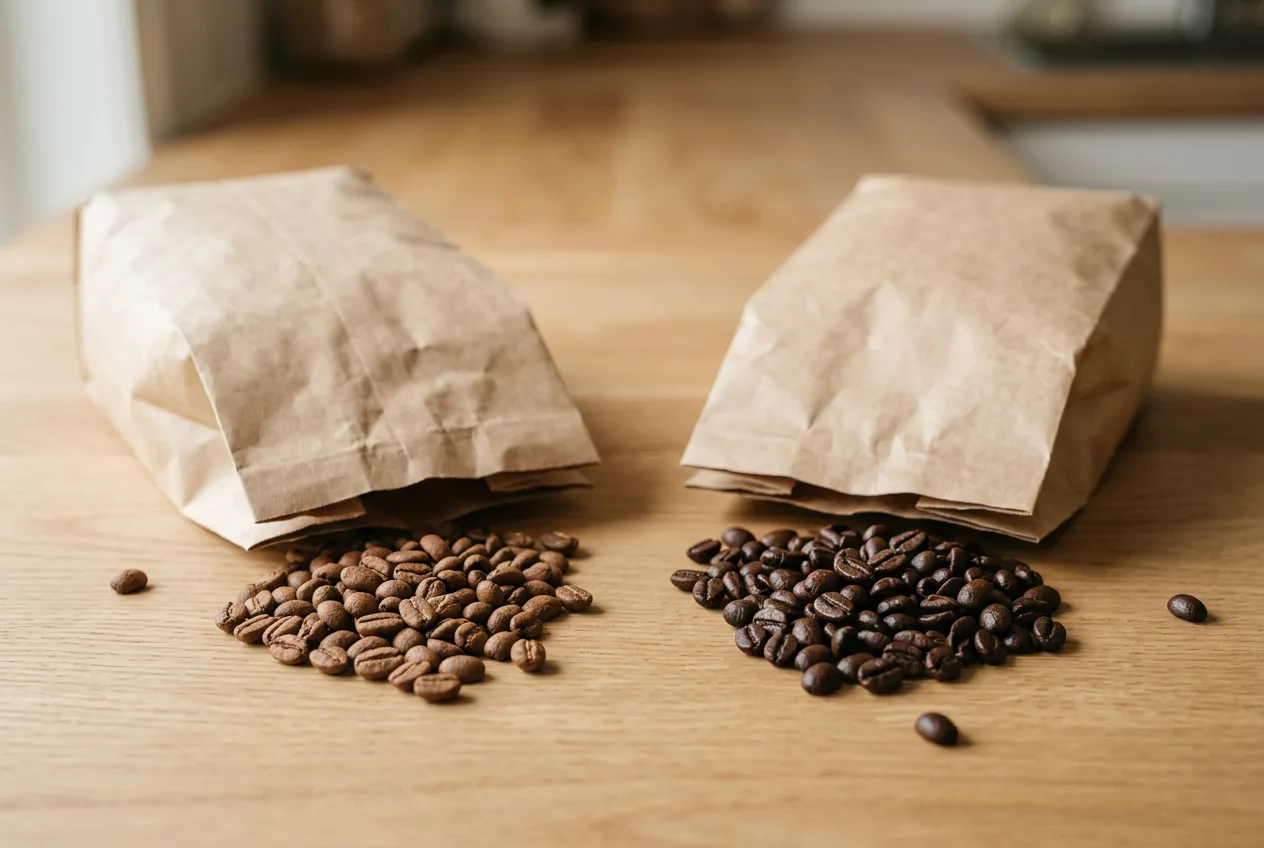
Almost every bag on a store shelf uses one of three words: light, medium or dark.
Most of us treat those as three fixed flavor categories, like mild, medium and hot salsa. In reality they are a rough simplification of a much more precise physical and chemical map.
There is no law or official standard behind the words. One roaster's "medium" can be another roaster's "medium-dark", and a big grocery brand's "light" can be darker than a small roaster's "medium".
I have bought two bags labeled medium in the same week and poured them side by side. One was cinnamon brown and dry. The other was dark chocolate brown with a few oily spots. Same word, completely different coffee.
What does stay constant is the physics. Every roast level is simply a decision about when to stop heating, measured against two sounds inside the roasting drum.
Once you understand those two sounds, the labels stop mattering so much. You can place any coffee on the map yourself.
Our tip: Treat the roast word on the front of a bag as a hint, not a measurement. The beans themselves, the roast date and the tasting notes tell you far more.
What happens inside the roasting drum
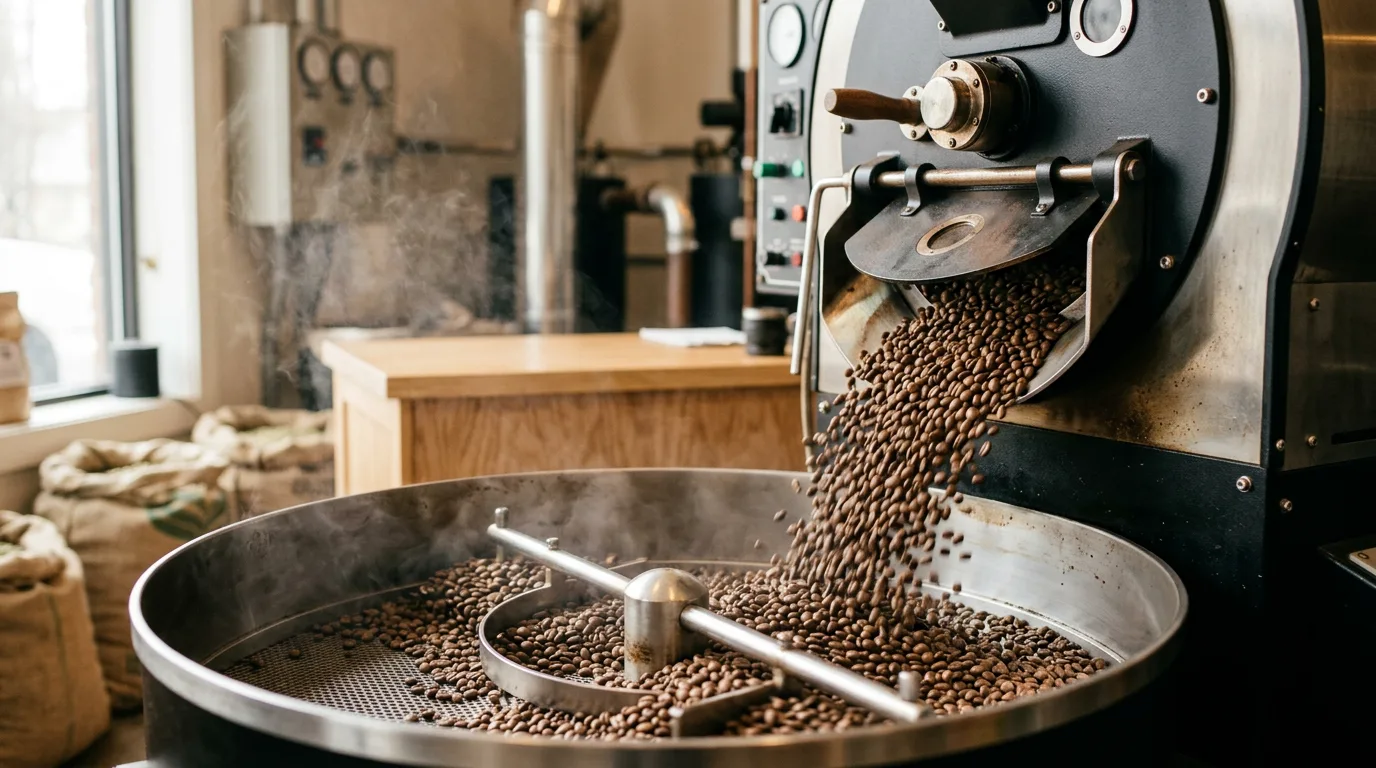
To understand roast levels, you first need to know what heat actually does to a coffee seed.
I find it easiest to think of it as a series of phases, each one building on the last.
The starting point: green coffee
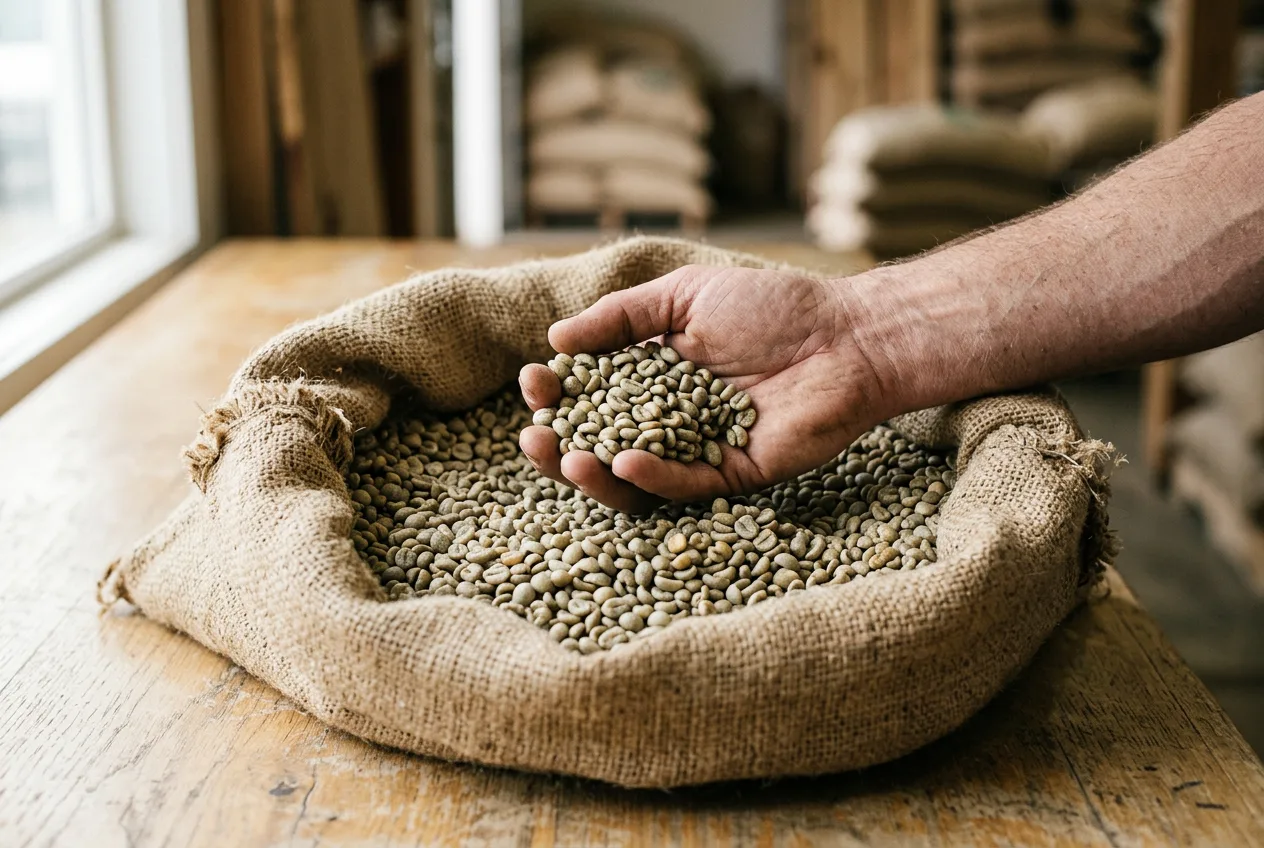
Roasting starts with a raw green coffee bean. It is a hard, dense, pale seed that holds roughly 10 to 12 percent water by weight.
Green coffee tastes like nothing you would recognize as coffee. If you chew one, it is woody and grassy, closer to a dried pea than to anything you would brew.
Every aroma you love in your morning cup is created later, by heat.
Phase 1: drying
As the pale seeds tumble in a hot metal drum, the first minutes look almost uneventful.
The main job here is evaporation. Heat drives off the free water, although some moisture stays sealed deep inside the bean's cells.
The bean stays pale through this phase, slowly shifting toward a light yellow and smelling a bit like hay or toasted grain.
Phase 2: the Maillard reaction (around 280°F)
Once the bean reaches roughly 280°F, the Maillard reaction kicks in.
Amino acids and reducing sugars inside the bean start reacting with each other. It is the same family of reactions that browns bread crust and sears a steak.
This is where the bean starts to smell like roasted coffee and begins its turn toward brown.
Phase 3: caramelization (around 340°F)
As the temperature climbs toward 340°F, the sugars begin to brown on their own through caramelization.
Caramelization adds depth, sweetness and richness. It is also where bitterness starts to build if the process keeps going.
This fairly quiet period sets the stage for the first big sound of the roast.
| Roast phase | Bean temperature | What you see and smell |
|---|---|---|
| Green | Room temp | Pale green, grassy, 10–12% moisture |
| Drying | Up to ~300°F | Pale to yellow, hay and grain |
| Maillard | ~280°F and up | Tan, bread and toast aromas |
| Caramelization | ~340°F and up | Light brown, sweet caramel smell |
| First crack | 385–400°F | Loud pops, beans expand, chaff flies |
| Second crack | 435–450°F | Quiet fast snaps, oil reaches the surface |
| Upper limit | ~470°F | Near black, glossy, smoky |
Typical bean temperatures for each phase. Exact numbers shift by 10 to 30°F depending on the machine and where the probe sits.
First crack and second crack: the two sounds that define every roast
If you only remember one thing from this article, make it this part.
The whole roast spectrum is anchored by two acoustic milestones. Every roast level is just a point before, during, between or after them.
First crack (385 to 400°F): the bean loses its water
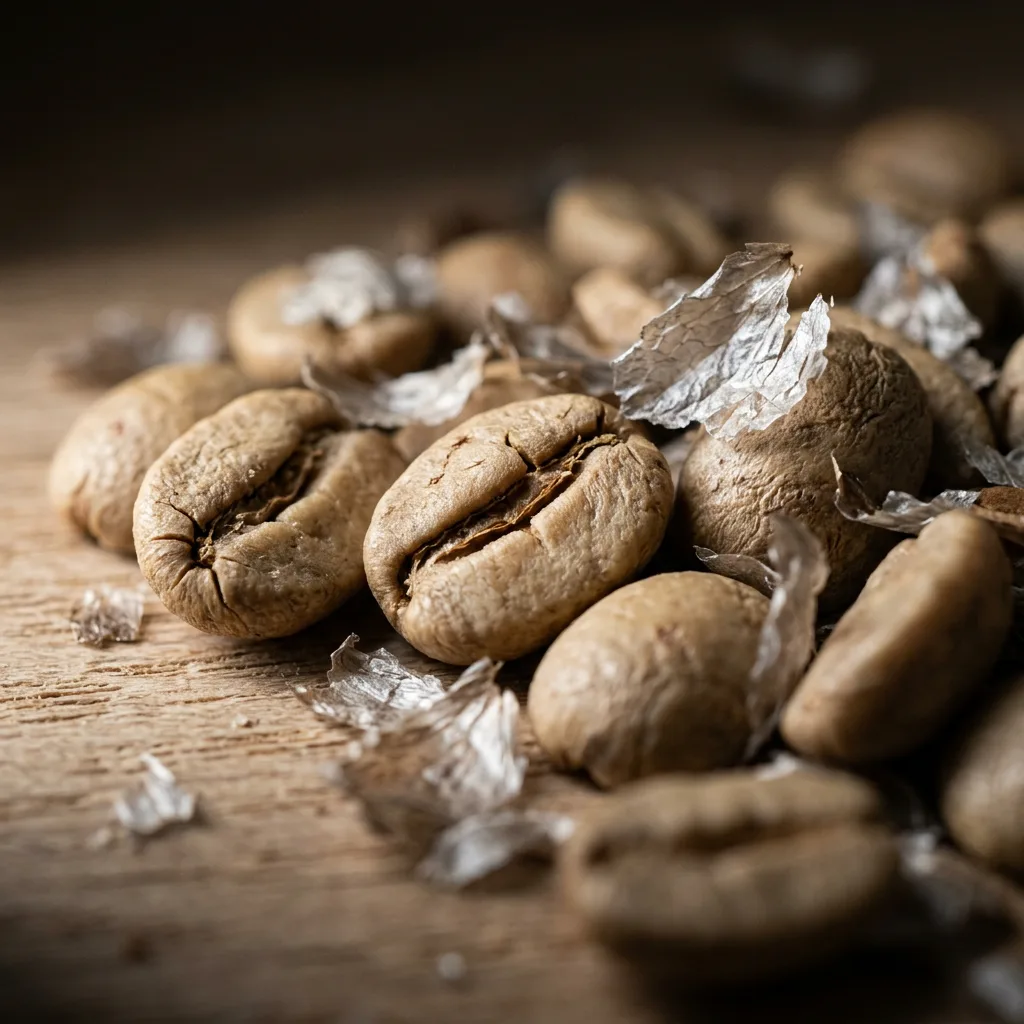
Between about 385 and 400°F, the moisture still sealed inside the bean turns to steam.
Gases like carbon dioxide are building up too. Because the bean's cell walls are rigid, pressure rises until the bean physically splits open from the inside.
You hear it as a sharp, distinct pop, a lot like popcorn. The first time I heard it standing next to a roaster, I was surprised how loud and clear it was.
Unlike popcorn, the bean does not puff into a fluffy mass. It cracks along the seam, swells a bit and vents steam and gas.
First crack also changes how the roast behaves. Up to this point the roaster has been pushing heat into the beans. After first crack the reactions inside the bean start generating heat of their own, so the roast speeds up and can run away from you within seconds.
Second crack (435 to 450°F): the bean loses its structure
If the roast keeps going, the beans eventually reach about 435 to 450°F and a second sound starts.
This one is not steam. The water is already gone. Second crack is the bean's cellulose fiber, the rigid framework that gives it its shape, starting to fracture.
It sounds quieter, faster and sharper than first crack. People often compare it to rice cereal crackling in milk.
Once that internal frame breaks, the natural oils inside are pushed out to the surface. That oil migration is the only reason dark roasted beans look glossy and wet.
Almost all coffee that people think of as "normal" sits in the first half of the map, before second crack.
The second half, from Vienna to French, is a deliberate style choice for people who want roast flavor to lead.
The core trade-off: origin character vs roast character
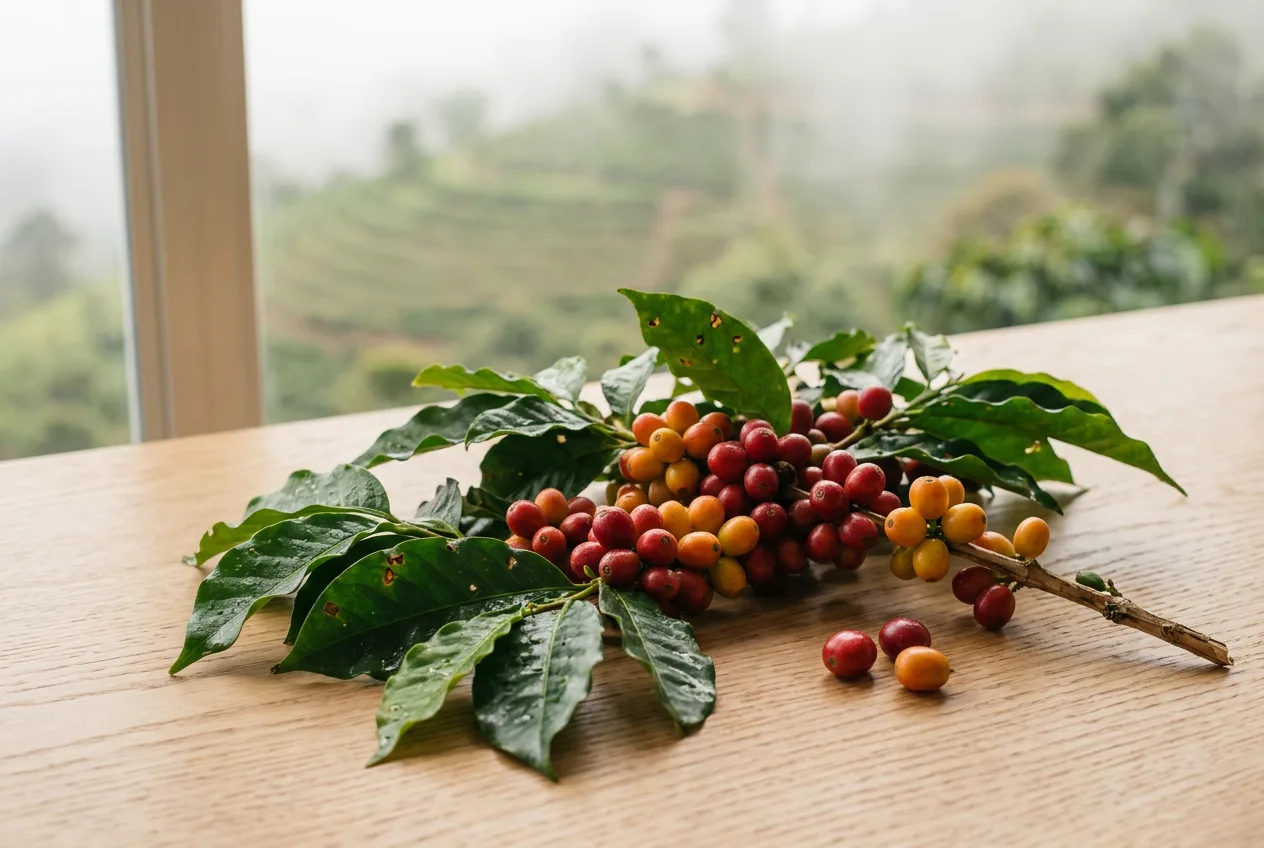
Every stop on the map is a trade between two sources of flavor.
Origin character comes from the farm: the plant's genetics, soil, altitude, climate and the way the fruit was processed after harvest. It shows up as notes like jasmine, blueberry, lemon, black tea or stone fruit.
Roast character comes from the drum: browning, caramelization and, at the dark end, smoke and char. It shows up as toast, caramel, chocolate, nuts, smoke and bittersweet notes.
The longer a bean stays in the heat, the more origin character it gives up in exchange for roast character.
Here is roughly how I think about the balance at each stop, based on my own tastings and what roasters describe.
How much of the flavor comes from the farm (origin share, my estimate)
An illustration, not a lab measurement: the share of flavor you can trace back to the farm falls steadily as roast character takes over.
This trade-off explains why single-origin coffees cost more and are usually roasted light to medium.
You are paying for flavors that came from one specific farm, estate or region. Roasting that bean past second crack burns away the very thing that justified the price.
It also explains a pattern I noticed early on. The darker I went, the more different coffees started to taste the same. Two dark roasts from opposite sides of the world can be hard to tell apart. Two light roasts from the same country can taste like different drinks.
Acidity and bitterness move in different ways along the map, too.
Bitterness climbs in a fairly straight line: more roast, more bitterness, like sugar taken too far in a pan.
Acidity behaves more like a hill. Perceived brightness rises early in the roast, peaks around light roast, then falls away as the bean darkens. That is why many people who dislike sharp coffee drift toward darker roasts.
How the three big taste traits move across the map
| Roast | Acidity | Sweetness | Bitterness | Body |
|---|---|---|---|---|
| Light | ●●●●● | ●● | ● | ●● |
| City | ●●●● | ●●● | ● | ●● |
| City+ | ●●● | ●●●● | ●● | ●●● |
| Full City | ●● | ●●●● | ●●● | ●●●● |
| Vienna | ● | ●●● | ●●●● | ●●●● |
| French | ● | ●● | ●●●●● | ●●●●● |
Relative intensity on a five-dot scale, from my own side-by-side tastings. Sweetness peaks in the middle of the map.
The seven stops on the coffee roast spectrum
Now for the map itself, stop by stop.
For each one I describe where it sits relative to the two cracks, what the beans look like, how it tastes and what I actually use it for.
Stop 1: Green (unroasted)
Green coffee is the raw agricultural baseline that every roast is measured from.
It tastes like nothing and you cannot brew it into anything resembling coffee. Its big advantage is shelf life: properly stored green beans keep for months, which is why home roasters buy them in bulk.
Stop 2: Light roast (Cinnamon, Half City, New England)
Light roast spends the least time in the heat of any drinkable coffee.
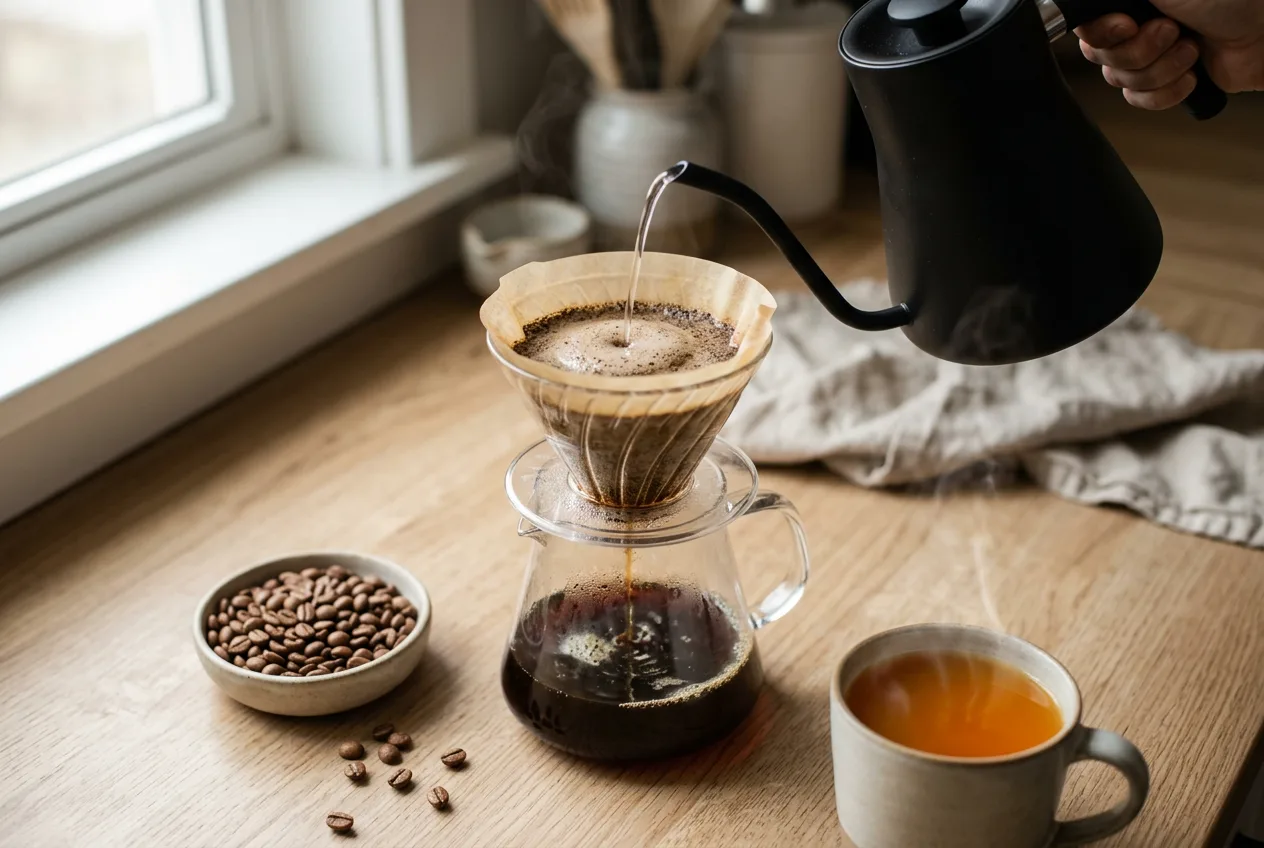
The beans stay dense, hard and heavy for their size. The surface is completely dry. When I grind a light roast, my grinder works noticeably harder than with a dark roast.
In the cup, light roast has the highest perceived acidity. You feel it along the sides of your tongue as a bright, often fruity or floral sharpness.
This is the origin at its peak. A light roast mostly tells you about the farm and the growing conditions, not about the roaster.
That is why I reach for light roasts with distinctive single origins, such as a washed Ethiopian with jasmine and lemon notes. Roasting a bean like that dark would throw away exactly what makes it special.
One catch: a light roast that was rushed or stopped too early can taste sour, grassy or like raw peanuts. Roasters call that underdeveloped. A good light roast should taste bright and sweet, not sharp and thin.
A note on "blonde": In many coffee chains, "blonde" is a marketing word for a light roast. It is a storefront label, not a separate stop on the roast scale, and a chain's blonde is often closer to a specialty medium.
Stop 3: City roast
City roast comes out of the drum once first crack has completely finished, while second crack is still a long way off.
The beans are dry and matte, a little larger and a little lighter in density than a Cinnamon or New England roast.
Flavor-wise, City keeps most of the farm character but smooths off the sharpest acidic edges. It is my favorite stop for everyday pour-over.
Here is a useful rule of thumb from my own buying: when a specialty bag says "medium" but brews a clean, vibrant and clearly fruity cup, it is usually a City roast.
Stop 4: City Plus roast (standard medium)
City Plus sits squarely in the middle of the map.
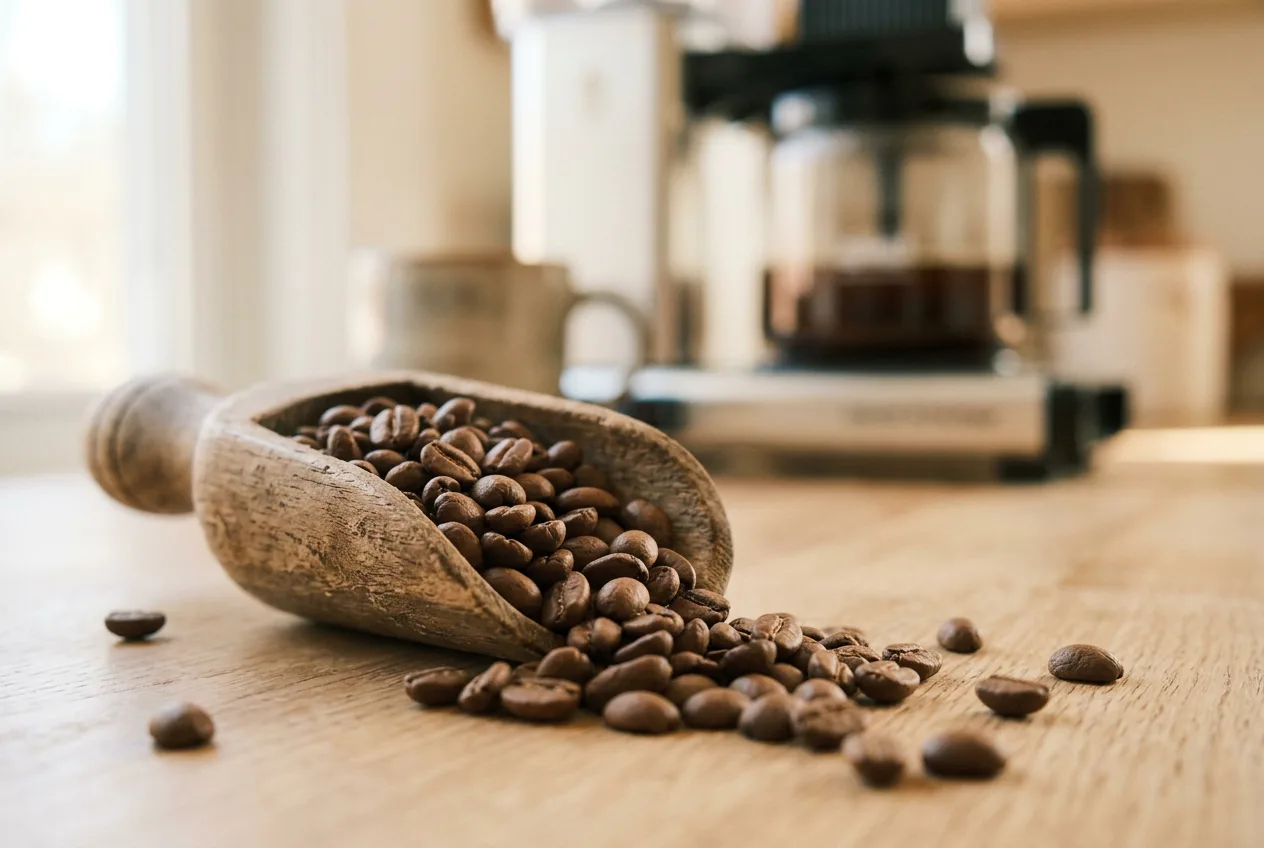
By this point the sugars have had plenty of time to caramelize. Bright acidity drops noticeably while sweetness and body rise.
Body is the weight or thickness of coffee on your palate. Think of the difference between skim milk and whole milk.
The bean still hints at where it came from, but the farm no longer leads. It shares the stage equally with roast sweetness.
For most people this is what "normal" coffee tastes like. It is balanced and crowd-pleasing, and it is the safest choice when I am brewing a bean I have never tried, or making a pot for guests whose taste I do not know.
Stop 5: Full City roast (medium-dark)
Full City is right on the edge of second crack. Some roasters let it catch the very first isolated snaps before dumping the beans.
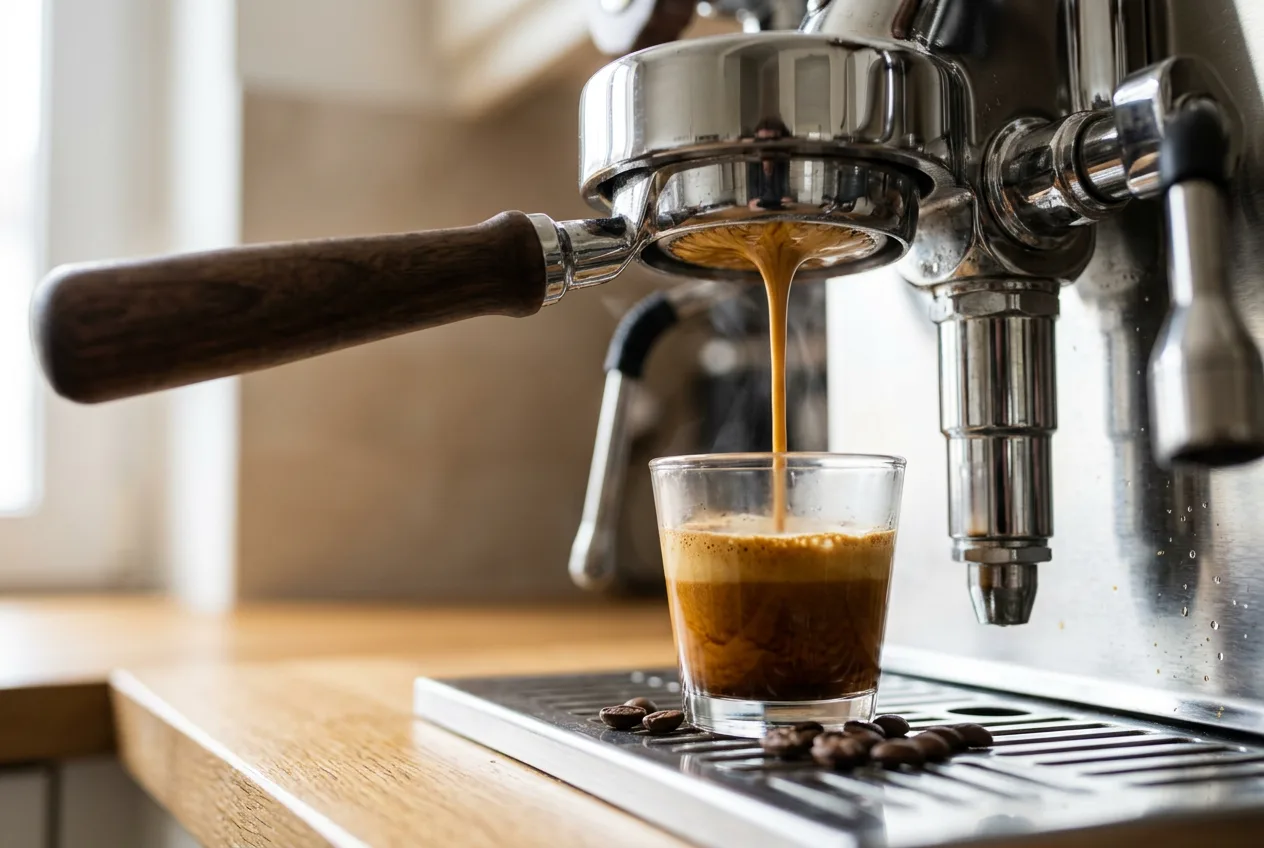
Because the bean's internal frame is starting to weaken, you may spot a few microscopic dots of oil. The bean is still mostly dry.
Most delicate farm notes are gone by now. In their place you get chocolate, deep caramel and a heavier body, sometimes with a faint hint of fruit underneath.
This is the classic medium-dark profile, and it is the one I use most for espresso at home. It pulls a forgiving shot with rich body that still tastes like more than just roast.
Stop 6: Vienna roast (standard dark)
Vienna crosses decisively into second crack.
The plant fiber has fractured, so oil has moved to the surface and the beans have a visible shine.
The cup is bittersweet, meaning bitterness and caramelized sweetness arrive together, with noticeable smoky undertones. Origin character is nearly erased. At this stop you taste the roasting process rather than the farm.
Vienna is the traditional espresso range. Specialty purists sometimes dismiss it, but I think that is unfair. It is an intentional culinary style that a lot of people genuinely love, not a mistake.
Stop 7: French roast (and Italian at the extreme)
French roast is pushed well beyond the end of second crack, close to the upper limit of coffee roasting at around 470°F.
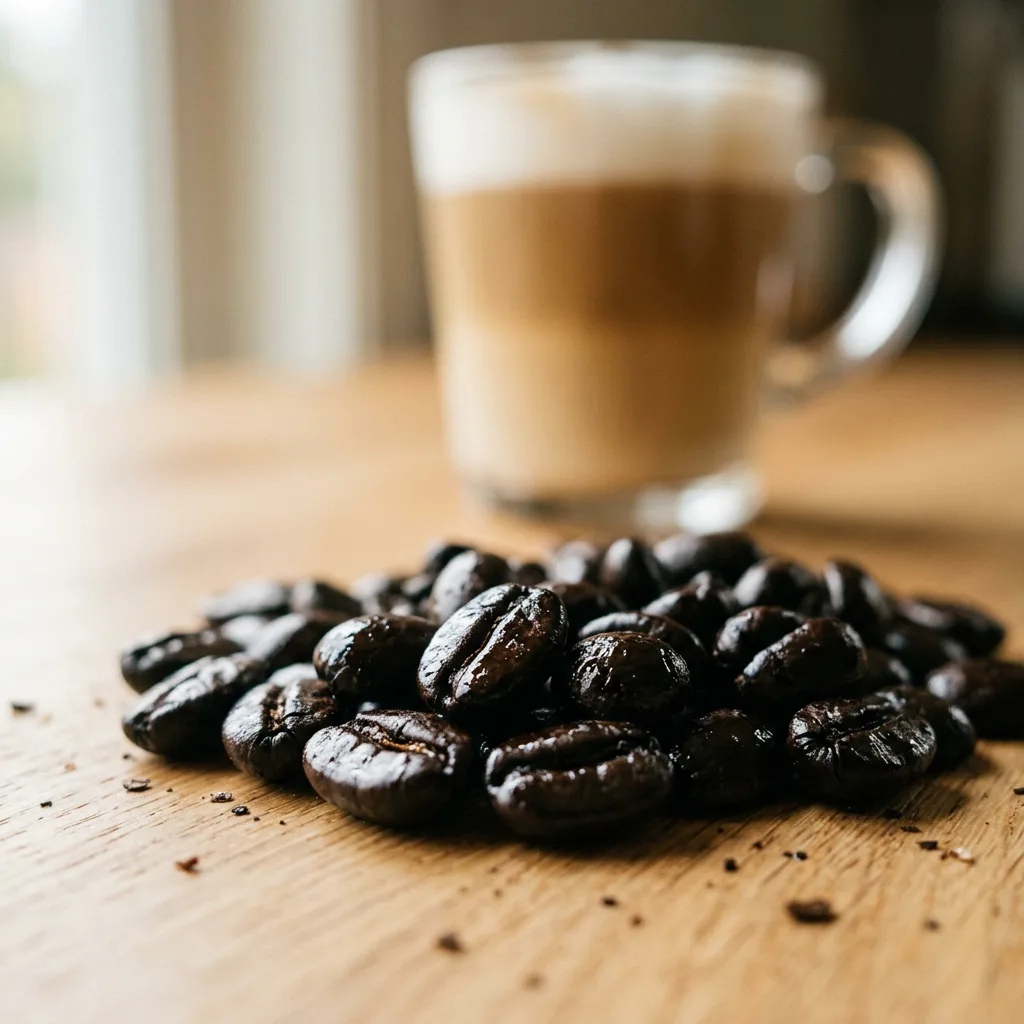
The beans are heavily coated in oil, glossy, nearly black, puffed up, brittle and light. Italian roast is the same idea taken even further.
The flavor is entirely roast: smoke, char and bittersweet notes. Nothing of the farm survives.
Where French roast earns its place is in milk. In a large latte, or coffee with heavy cream and sugar, a lighter roast can taste washed out. The intense smoky profile of a French roast punches through the dairy.
This is the honest limit of drinkable coffee. Keep going and you are making charcoal, and at that point the beans can become a fire risk inside the roaster. Professional roasters treat anything darker as burnt, ruined product.
Coffee roast level chart: temperatures, color numbers and weight loss
Roasters who want more than words use two objective measurements: color and weight loss.
Color is read with an optical meter on a scale called Agtron. The meter shines light on a sample, and the number goes down as the coffee gets darker. Roughly 95 is very light and 25 is extremely dark.
Weight loss tells you how much water and organic matter the roast drove off. Published roasting guides put it at about 11 to 24 percent, depending on roast level and how wet the green coffee was to start.
| Roast | End temp | Agtron (ground, approx.) | Weight loss | Surface | Typical taste |
|---|---|---|---|---|---|
| Light / Cinnamon | 385–405°F | 70–95 | 11–13% | Dry | Bright, floral, fruity |
| City | 405–415°F | 60–70 | 12–14% | Dry | Clean, fruity, sweet |
| City Plus | 425–435°F | 50–60 | 14–16% | Dry | Balanced, caramel |
| Full City | ~435°F | 45–50 | 16–18% | Mostly dry | Chocolate, heavier |
| Vienna | 435–450°F | 35–45 | 18–20% | Light sheen | Bittersweet, smoky |
| French / Italian | 450–470°F | 25–35 | 19–22%+ | Oily, glossy | Charred, smoky |
Ranges are approximate and overlap between roasters, machines and color meters. Use them to place a coffee on the map, not as hard rules.
Typical weight lost during roasting (middle of each range)
In practical terms: start with one pound of green coffee and a light roast leaves you with roughly 14 ounces of roasted beans. Take the same pound to French roast and you end up closer to 12.5 ounces.
In lighter roasts, most of that lost weight is water. In darker roasts, a growing share is organic matter turning into gas and smoke, which is part of why dark beans end up so light and airy.
Our tip: Some specialty roasters print an Agtron or color number on the bag. If you find one you love, note the number. It travels between roasters far better than the word "medium".
Roast names decoded
Over the years the industry has collected a pile of names, many of them regional or purely commercial.
Here is how the ones you will actually see on bags map onto the seven stops.
| Name on the bag | Where it usually sits | What to expect |
|---|---|---|
| Nordic / Scandinavian | Very light, right at first crack | Tea-like, very bright |
| Cinnamon | Light | Bright, light body |
| Half City / New England | Light | Bright, a little rounder |
| Blonde | Light to light-medium | Mild, gentle acidity |
| City / American | Light-medium | Fruity, clean |
| Breakfast | Light-medium to medium | Easy, bright-ish |
| City Plus / Medium | Medium | Balanced, caramel |
| Full City | Medium-dark | Chocolate, body |
| Espresso roast | Varies: medium-dark to dark | Built for espresso, not a fixed level |
| Vienna / Continental | Dark | Bittersweet, smoky |
| French | Very dark | Smoky, charred |
| Italian / Spanish | Darkest drinkable | Very smoky, thin on sweetness |
"Espresso roast" deserves a special mention because it confuses so many people.
It is not a roast level and not a type of bean. It means the roaster shaped the profile for espresso, usually by roasting a bit darker or a bit longer so the coffee dissolves more easily under pressure. You can absolutely brew it in a drip machine or a moka pot, and it often tastes great there.
Specialty vs supermarket: two different rulers
One more reason the labels confuse people: specialty roasters and large commercial brands use different rulers.
In specialty coffee, the whole scale is shifted toward the light end.
A specialty light roast starts shortly after first crack. Medium runs up to the moment before any oil appears. The instant a specialty roaster sees even a trace of surface oil, they call it dark, and few go much further.
Big commercial brands shift the scale darker.
Their light roast can run into what a specialty roaster would call medium. Their medium often shows a slight sheen. Their dark is deep brown to black and heavily oiled, often well past second crack.
| Label | Specialty roaster usually means | Supermarket brand usually means |
|---|---|---|
| Light | Light to City, very bright | City to City Plus |
| Medium | City Plus, dry, sweet | Full City, maybe slight sheen |
| Dark | Full City to early Vienna | Vienna to French, oily |
So if a specialty medium tastes surprisingly fruity to you, or a supermarket light tastes surprisingly roasty, neither bag is lying. They are just measuring with different rulers.
The visual test: read any bag without trusting the label
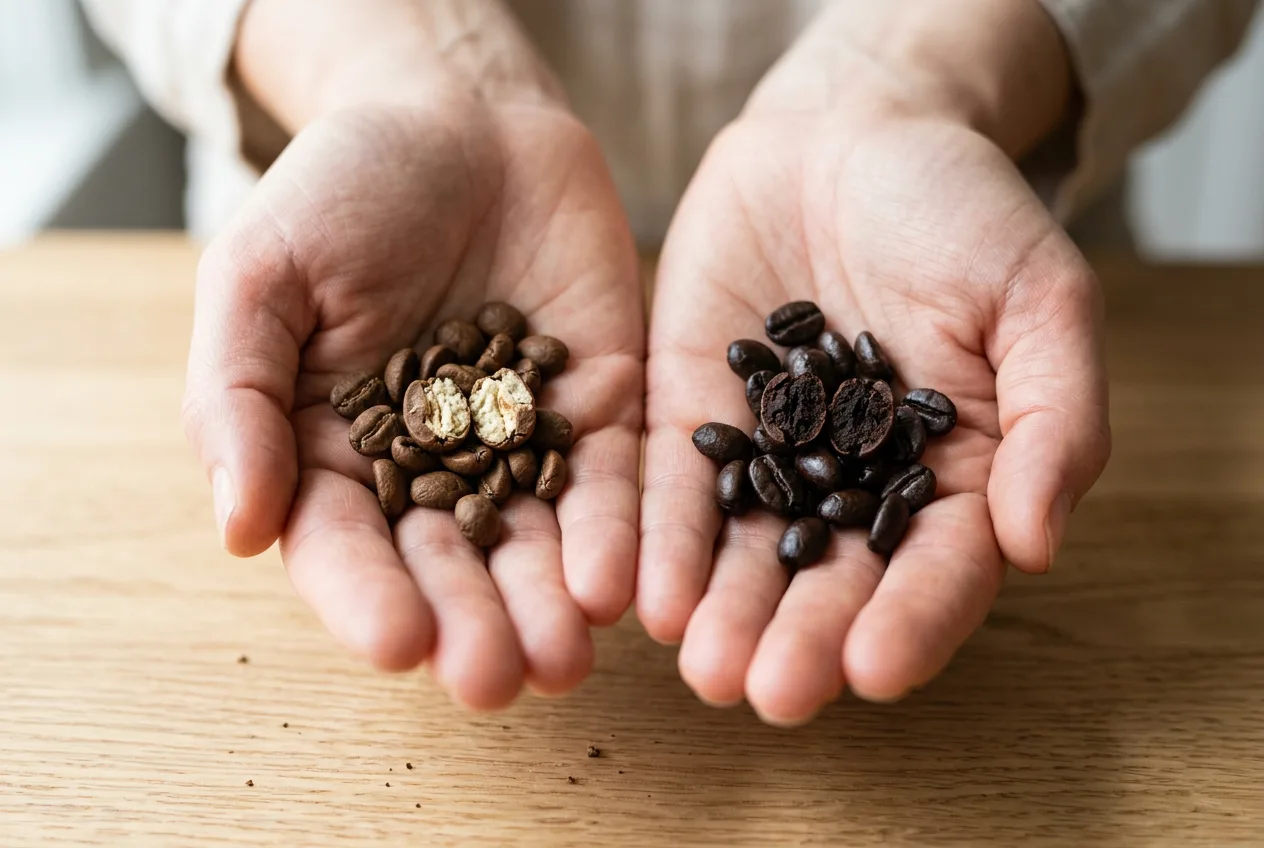
Because roast words follow habit rather than any standard, I rely on a simple visual test that needs no equipment.
It works because of the physics of second crack. Pour a few beans into your palm, or look through the clear window on the bag, under good light.
The bean never reached second crack. Its structure stayed intact and kept the oil locked inside.
That puts it in the first half of the map: Light, City, City Plus or Full City.
The bean entered or passed second crack. Its fiber broke and pushed oil outward.
That puts it in the second half: Vienna, French or Italian.
Within the dry half, color does the rest. Cinnamon brown is light. Milk chocolate is City or City Plus. A deep, even brown with the odd tiny dot of oil is Full City.
Two small caveats from my own experience.
First, a medium roast that has sat around for weeks can slowly sweat a little oil, so old beans can look darker than they are. Check the roast date.
Second, some coffees are naturally oilier than others, and decaf often looks darker than its true roast level because the decaf process changes the bean's color. When in doubt, compare a few beans rather than judging one.
Our tip: Inside the bean is just as telling. Break one in half: a light roast is paler inside than outside, while a dark roast is dark all the way through.
The caffeine myth: is dark roast stronger?
"Give me the dark roast, I need the extra caffeine." I hear this constantly, and it is one of the most persistent myths in coffee.
The myth survives not because of what happens in the roaster, but because of how we measure coffee at home.
Caffeine barely notices roasting
Caffeine is a very heat-stable compound.
Breaking it down in any meaningful amount takes temperatures above roughly 600°F. Commercial roasting almost never goes past 470°F. Roasting does not "burn off" caffeine.
Lab work backs this up. Studies comparing light and dark roasts of the same beans typically find caffeine levels within a few hundredths of a percent of each other.
By weight: practically a tie
Because caffeine survives the heat, light and dark beans hold almost the same caffeine per gram.
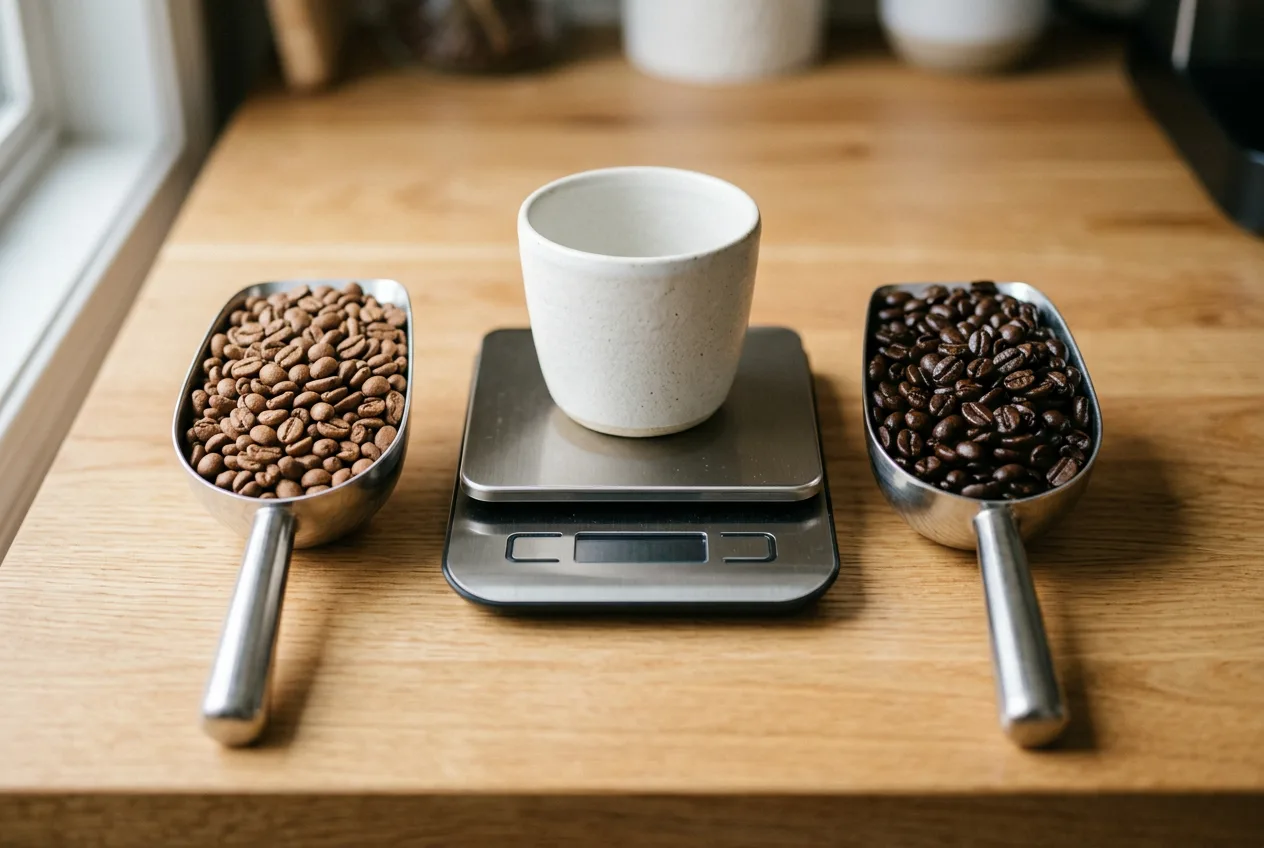
If you weigh out 20 grams of light roast and 20 grams of dark roast, both doses deliver essentially the same caffeine. With a kitchen scale, roast level stops mattering for your caffeine intake.
If anything, dark beans can carry a touch more caffeine per gram, because they lost more of their other mass in the roaster while the caffeine stayed put. The difference is small enough that you would never feel it.
By scoop: light roast wins
Most people do not weigh coffee. They use a scoop or a tablespoon, and that is where the real difference appears.
As beans roast longer, they lose weight and expand, a bit like popcorn. A dark bean is bigger, airier and much less dense than the same bean roasted light.
So a scoop of dark roast looks full and fluffy but actually holds less coffee by weight. Less coffee in the scoop means less caffeine in the cup.
Same scoop, different coffee mass (illustrative)
Illustrative numbers for a standard two-tablespoon scoop of whole beans. The exact gap depends on the bean and how dark it went, but dark roast reliably weighs less per scoop.
Flavor strength is not caffeine strength
When people call dark roast "strong", they are noticing something real: bold, bitter, smoky flavor.
That intensity comes from long caramelization and the breakdown at second crack. It has nothing to do with caffeine.
If you really want more caffeine, roast level is the wrong lever. Use a little more coffee, or look at the bean species. Robusta carries roughly twice the caffeine of Arabica, which matters far more than any roast decision.
Acidity, your stomach and the health angle
"Acidity" in coffee tasting does not mean sour or spoiled, and it does not refer to stomach acid. It describes a pleasant brightness, like biting into a fresh apple.
That said, many readers ask me whether roast level affects how coffee sits in the stomach. The research here is genuinely interesting.
Coffee chemists in Germany and Austria found that a compound called N-methylpyridinium, or NMP, forms during roasting and seems to dampen the stomach's acid response. The darker the roast, the more NMP forms.
In a small trial with healthy volunteers, a dark roast blend held about three times the NMP of a regular market blend, and it triggered less gastric acid secretion. Caffeine levels in the two coffees were similar.
At the same time, dark roasting breaks down most of the chlorogenic acids, the main group of natural antioxidants in green coffee and one of the compounds linked to stomach irritation.
Approximate share of green coffee's chlorogenic acids lost in roasting
Rounded figures drawn from published coffee chemistry reviews. Individual studies vary with bean, roaster and method.
So the trade-off cuts both ways.
Light roasts keep more chlorogenic acids, which some studies link to higher antioxidant activity. Dark roasts keep fewer of them but build more NMP, which may make them gentler on sensitive stomachs.
My practical takeaway: if light roast bothers your stomach, try a medium or medium-dark before giving up on coffee. And if you are choosing roast level purely for health reasons, the differences are modest. Pick the one you enjoy drinking.
I am a coffee writer, not a doctor. If coffee regularly gives you heartburn or reflux, talk to your physician.
Matching roast level to your brew method
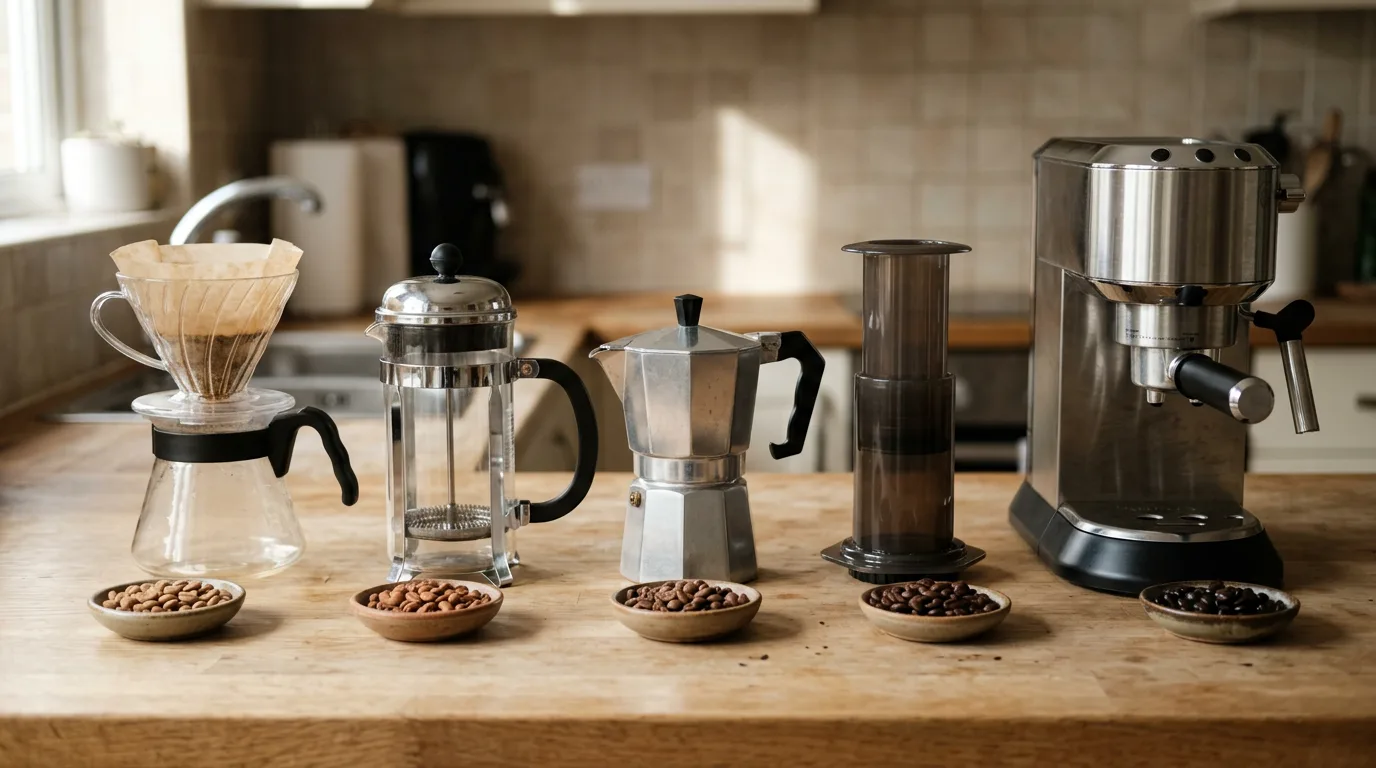
Roast level and brewing method work as a pair.
Darker beans are more porous and dissolve more easily. Lighter beans are dense and need more help to extract, through finer grinding, hotter water or longer contact time.
Espresso is the clearest example. It uses high pressure, a very fine grind, little water and well under a minute of contact. If the beans are too light and dense, the shot can come out sharp and sour. That is why espresso blends lean toward Full City and Vienna.
Filter methods use more water and three to five minutes of contact, which gives lighter roasts the time they need to open up.
| Brew method | Roast I reach for | Why |
|---|---|---|
| Pour-over (V60, Chemex) | Light to City | Clarity shows off origin notes |
| Automatic drip | City to City Plus | Balanced and forgiving |
| AeroPress | Any, City Plus is easiest | Very flexible recipe |
| French press | City Plus to Vienna | Body and sweetness shine |
| Cold brew | City Plus to Full City | Chocolate notes, low bite |
| Moka pot | Full City to Vienna | Rich, stands up to milk |
| Espresso, straight | Full City | Sweet body, some complexity |
| Espresso with lots of milk | Vienna to French | Cuts through dairy |
| Bean-to-cup machines | City Plus to Full City, dry beans | Oily beans can clog grinders |
That last row is worth repeating if you own a fully automatic espresso machine.
Very oily French and Italian roasts can leave a sticky film in the hopper and grinder over time. Most manufacturers recommend dry or only lightly oiled beans. I stick to medium and medium-dark beans in those machines and keep the shiny stuff for a manual grinder.
Our tip: Brewing a light roast and getting a sour cup? Grind a little finer or use hotter water, around 205°F. Brewing a dark roast and getting harsh bitterness? Grind a touch coarser and drop the water to about 195°F.
How I choose a roast level
When I am standing in front of a shelf, or scrolling a roaster's shop, this is the order I think in.
- Start with how you drink it.Black coffee leaves room for lighter roasts. Big milky drinks or cream and sugar point toward Full City and darker.
- Check the beans, not the word.Dry and matte means before second crack. Shiny means into or past it. This takes two seconds and beats any label.
- Match the roast to the price.If you are paying extra for a rare single origin, choose light to City Plus so you can actually taste it. For everyday blends, any level works.
- Read the tasting notes.Fruit and flower words suggest light. Caramel, nut and milk chocolate suggest medium. Dark chocolate, smoke and molasses suggest dark.
- Look for a roast date.A recent roast date matters more than the roast level. Coffee is best within a few weeks of roasting.
- When unsure, go City Plus.It is the safest, most balanced stop and the easiest to brew well on any equipment.
- Weigh your coffee.A small scale removes the density difference between roasts and gives you the same strength every morning.
Freshness: why roast level changes the timeline
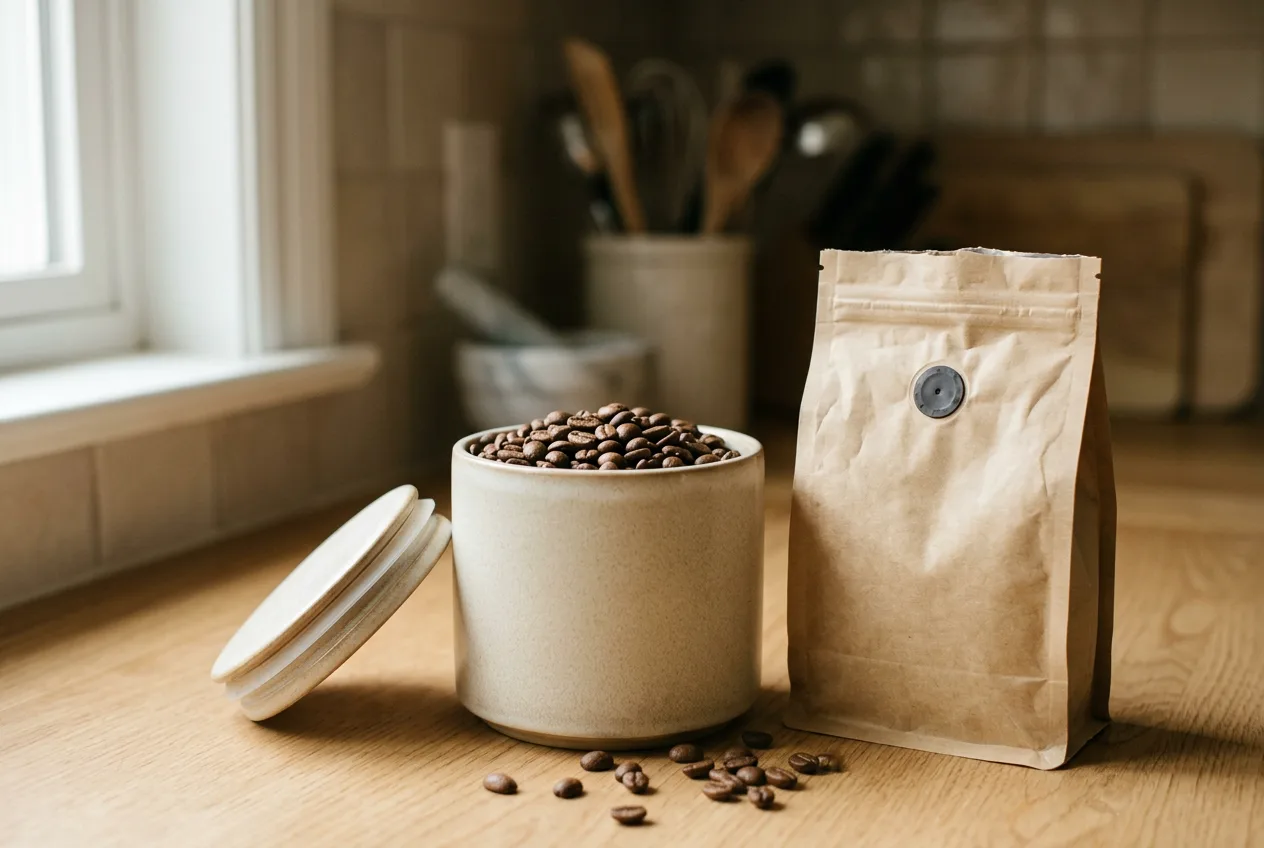
Fresh roasted coffee releases carbon dioxide for days after it leaves the drum. This is called degassing, and it affects how a coffee tastes in its first week.
Roast level changes that timeline.
Dark roasts are more porous, so they degas faster and are often ready to brew within a couple of days. They also go stale faster, because oxygen gets into the open structure easily and the surface oils can turn rancid.
Light roasts are dense and hold their gas longer. Many taste best after resting five to ten days, and they tend to stay vibrant for longer.
| Roast | Rest before brewing | Best within |
|---|---|---|
| Light | 5–10 days | About 3–5 weeks from roast |
| Medium | 3–7 days | About 3–4 weeks from roast |
| Dark | 1–3 days | About 2–3 weeks from roast |
General guidance for whole beans kept sealed, cool and dark. Ground coffee loses aroma within days at any roast level.
Whatever the roast, keep beans whole until you brew, in an opaque airtight container, away from heat and light. The fridge is not your friend, because moisture and fridge smells get in.
Frequently asked questions
What are the main coffee roast levels?
Most bags use light, medium and dark. Roasters use a finer map: Light (Cinnamon, New England), City, City Plus, Full City, Vienna and French or Italian, with green coffee as the unroasted starting point.
Which roast level has the most caffeine?
By weight they are nearly identical, because caffeine survives roasting. By scoop, light roast has slightly more because the beans are denser, so more coffee fits in the scoop.
Is dark roast stronger than light roast?
Dark roast tastes stronger because of its smoky, bitter roast flavors. It is not stronger in caffeine.
What is the difference between first crack and second crack?
First crack, around 385 to 400°F, is moisture turning to steam and splitting the bean. Second crack, around 435 to 450°F, is the bean's plant fiber breaking, which pushes oil to the surface.
Why are some coffee beans oily?
Oil appears when a roast reaches second crack and the bean's internal structure fractures. Shiny beans are Vienna roast or darker. Older medium roasts can also sweat a little oil over time.
Is medium roast the same as City Plus?
Often, yes. City Plus is the standard medium. But brands use "medium" loosely, so a specialty medium may be City and a supermarket medium may be Full City.
What is blonde roast?
Blonde is a marketing name for a light roast used by many coffee chains. It is not a separate technical roast level.
Which roast is best for espresso?
Full City and Vienna are the classic espresso range because they extract easily and give rich body. Lighter espresso is popular in specialty cafes but is harder to dial in at home.
Which roast is best for cold brew?
City Plus to Full City works well. Long, cold steeping brings out chocolate and caramel notes and keeps bitterness low.
Is dark roast less acidic?
Dark roast has lower perceived acidity and fewer chlorogenic acids, and it contains more N-methylpyridinium, a roasting compound linked to lower stomach acid response. Many people find it gentler on the stomach.
Does light roast have more antioxidants?
Light roast keeps more chlorogenic acids, the main antioxidants in green coffee. Darker roasting destroys most of them, though it also forms some new compounds. The practical difference in a normal diet is modest.
Can I use oily dark roast beans in a bean-to-cup machine?
Most manufacturers advise against very oily beans because the oil can build up in the grinder and hopper. Dry medium to medium-dark beans are the safer choice.
Is French roast burnt coffee?
No. French roast is the darkest commercially viable roast level and an intentional style. Anything darker than Italian roast is considered burnt.
How can I tell the roast level without a label?
Look at the surface. Dry and matte means it never reached second crack (Light to Full City). Shiny and oily means it reached or passed second crack (Vienna to French). Then use the color within each half.

- Michael Reynolds, personal tasting and roasting notes
- Coffee roasting: color and aroma-active sulfur compounds (incl. the Agtron-SCAA Roast Color Classification System), University of Florida dissertation
- A dark brown roast coffee blend is less effective at stimulating gastric acid secretion in healthy volunteers compared to a medium roast market blend, Molecular Nutrition & Food Research, 2014
- Brewing up a gentler java: dark-roasted coffee contains stomach-friendly ingredient, American Chemical Society, 2010
- Coffee: Emerging Health Effects and Disease Prevention (ch. 2, Coffee Constituents, A. Farah), Wiley-Blackwell, 2012
- Effect of roasting degree on coffee beans, espresso and drip coffee, peer-reviewed study, PubMed Central
- Effect of processing method and roasting degree on caffeine, chlorogenic acid and polyphenols in Coffea arabica, peer-reviewed study, PubMed Central
Related guides
Best Jura automatic coffee machines Best Miele coffee machine Breville Barista Express vs Barista ProWritten by Michael Reynolds. Last updated November 15, 2026.