How Coffee Is Roasted: From Green Seed to the Beans in Your Bag
Green coffee smells like hay and tastes like nothing. Fifteen minutes in a hot drum turns it into one of the most aromatic foods on earth. In this guide I follow a batch from raw seed to cooling tray: what happens in each phase, how roasters steer the heat, how they check quality, and what it all means for the bag on your counter.
We choose products independently. We may earn a commission through links on this page; your price stays the same. Affiliate policy
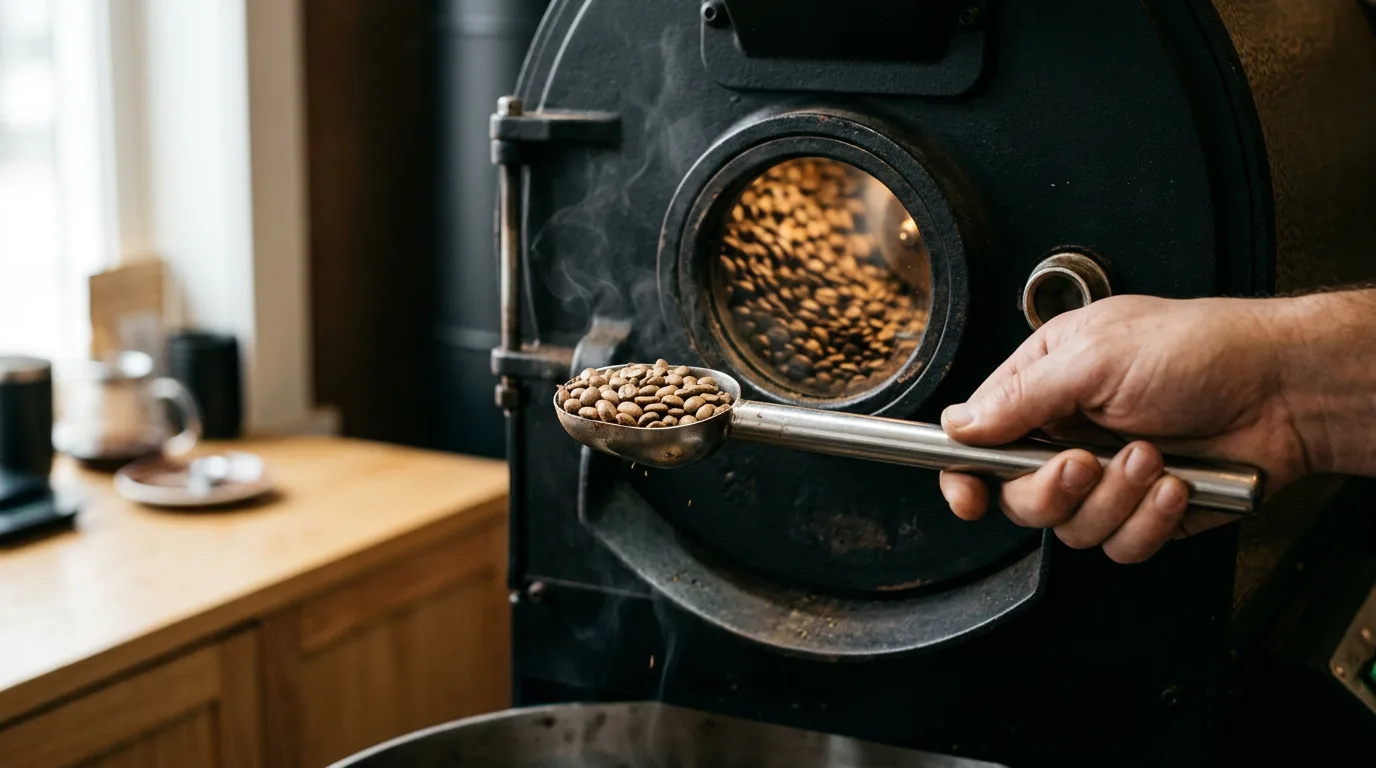
Coffee is roasted by tumbling raw green seeds in hot air and metal, usually for about 10 to 18 minutes. First the beans dry out, then they turn yellow and brown as the Maillard reaction and caramelization build aroma.
Around 385 to 400°F the beans pop open in first crack. Roasters can stop shortly after that for a light roast, or keep going toward second crack for darker roasts.
The finished beans are dropped into a cooling tray within seconds, rested so they can release carbon dioxide, and packed. How fast the heat climbs along the way, called the roast profile, shapes the flavor as much as how dark the beans end up.
Raw coffee and what heat does to it
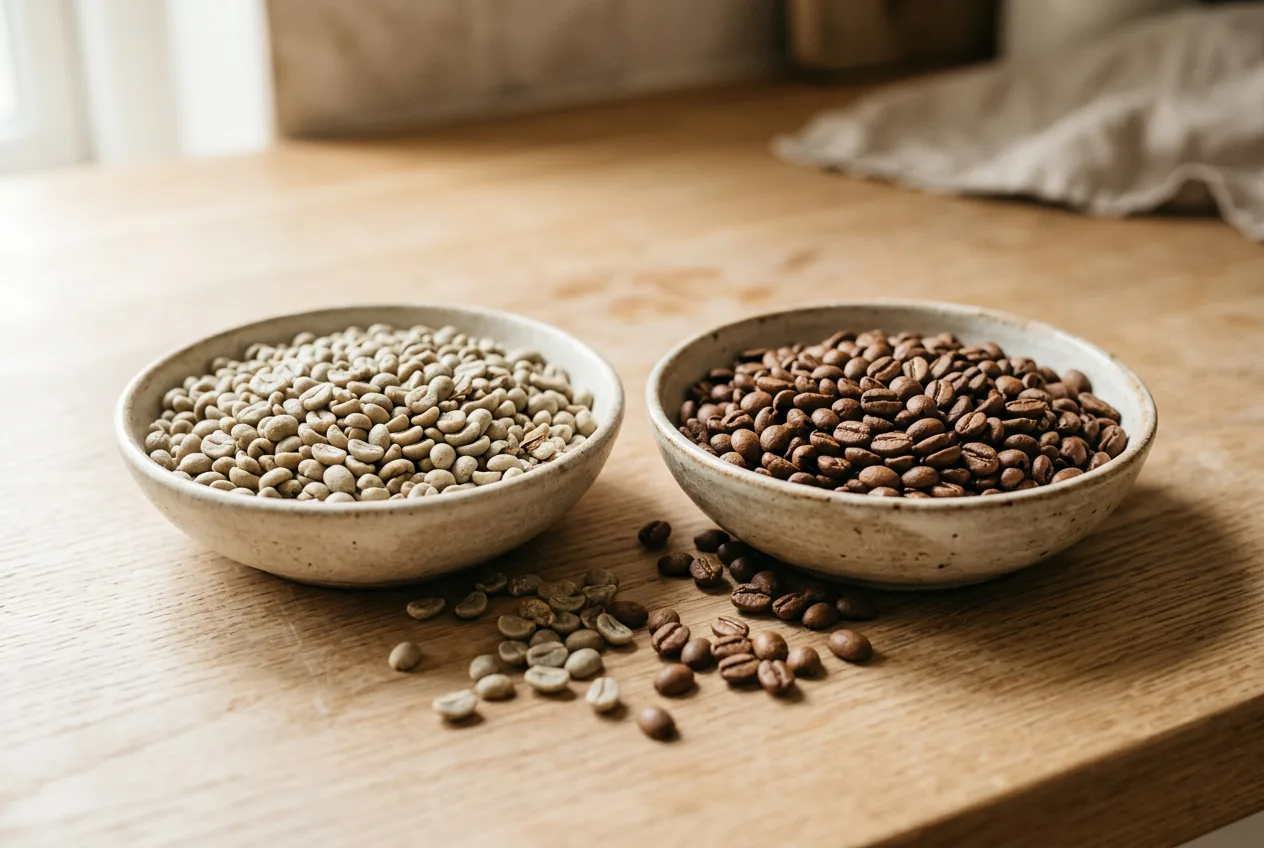
Every cup starts as green coffee. These are the dried seeds from the fruit of the coffee tree, usually two per cherry.
The first time I smelled a fresh sack of green beans, I was honestly disappointed. It smelled like hay, dried peas and a little like a garden shed. Nothing about it says coffee.
If you bite one, it is hard enough to hurt and tastes grassy and flat.
All the aromas we connect with coffee, from caramel and chocolate to jasmine and berries, are created in the roaster. Heat sets off hundreds of chemical reactions that build aroma compounds from the sugars, proteins and acids locked inside the seed.
So when you hear that a coffee tastes of blueberry, nobody added blueberry. The seed carried the building blocks, and the roast turned them into something you can smell.
Our tip: If you ever get the chance, smell green and roasted beans side by side. It is the quickest way to understand how much work the roaster really does.
The three taste traits roasting controls
Roasting changes hundreds of compounds, but I find it easiest to follow three traits: bitterness, acidity and origin character.
Bitterness: a straight line
Bitterness rises steadily the longer and darker a roast goes.
Think of caramel in a pan. A light caramel is sweet and complex. Push it too far and it turns dark and harsh. Coffee works the same way.
Acidity: a hill
In coffee, acidity means brightness, like biting into a crisp apple. It does not mean sour or spoiled.
Acidity does not move in a straight line. It rises early in the roast, peaks around light roast, then fades as the beans darken. That is why many people who dislike sharp coffee end up preferring darker roasts.
Origin character: slowly burned away
Origin character is the flavor that comes from where and how the coffee was grown: soil, climate, altitude, plant variety and the way the fruit was processed.
Early in the roast, heat develops these notes. Later, it starts burning them off. Keep going and coffees from completely different countries begin to taste alike.
That is why specialty roasters, who pay a premium for distinctive farms, mostly roast lighter. A side effect is that specialty coffee tends to keep more acidity.
| Trait | Early roast | Medium roast | Dark roast |
|---|---|---|---|
| Bitterness | Low | Moderate | High |
| Acidity | Rising to peak | Softening | Low |
| Origin character | Strongest | Shared with roast | Mostly gone |
| Sweetness | Building | Peak | Fading |
A roast, phase by phase
Let me follow a single batch from green to very dark. The times below are typical for a commercial drum roaster. A home machine or a fast hot air roaster will run shorter.
Phase 1: drying (roughly minutes 0 to 5)
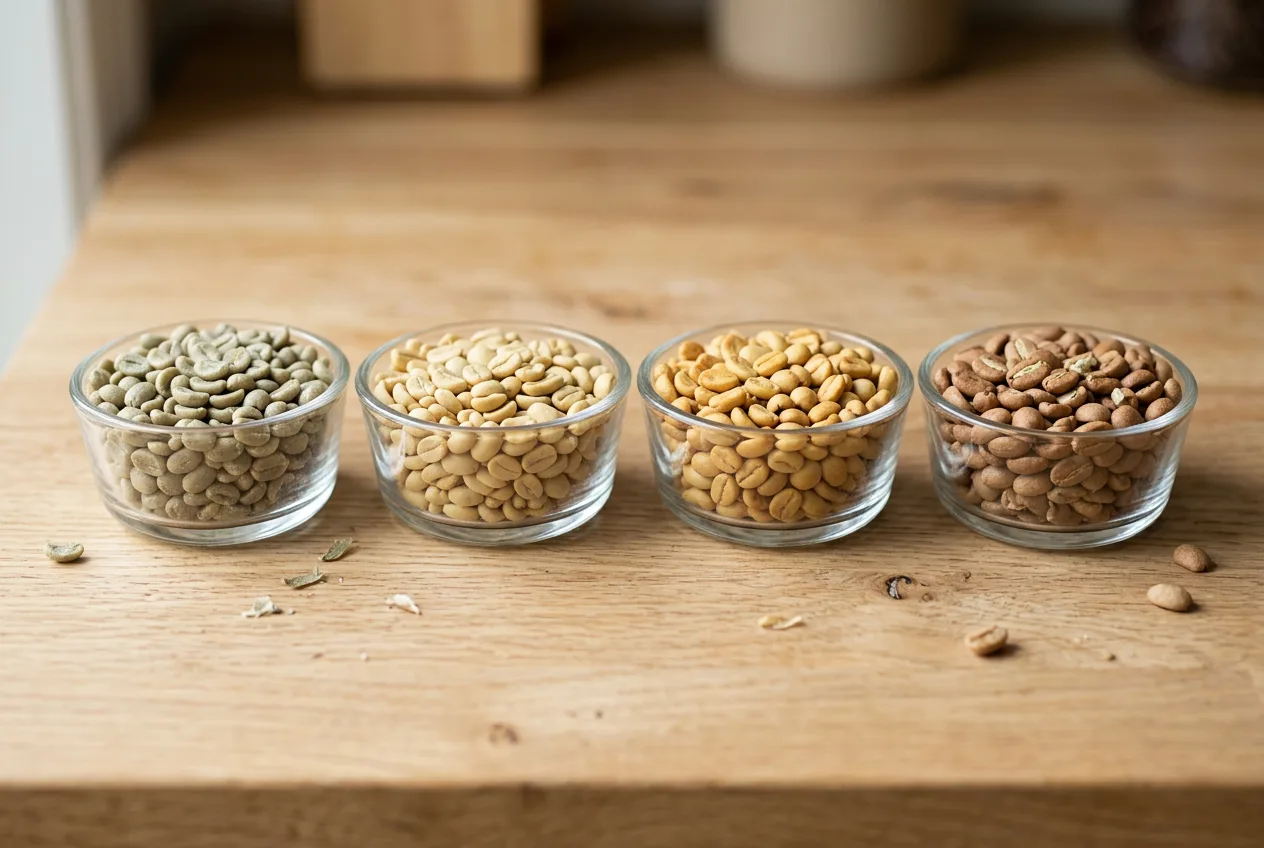
When green coffee hits the hot drum, almost nothing seems to happen at first.
The beans hold about 10 to 12 percent water, and that water has to go before real browning can start. Moisture acts like a brake: as long as there is water to boil off, the bean temperature cannot run away.
The beans fade from green to pale, then turn yellow. Around the yellow stage you start to smell toasted grain and bread. That is the first hint of browning.
Phase 2: browning (roughly minutes 5 to 9)
Now the Maillard reaction takes over. Amino acids and sugars react, building aroma and turning the beans tan, then light brown.
At the same time, gases are forming inside the bean, mostly carbon dioxide, along with steam from the last trapped moisture. The cell walls are rigid, so pressure builds.
Caramelization joins in as the beans approach about 340°F, adding sweetness and depth.
Phase 3: first crack (roughly minute 9 to 10)
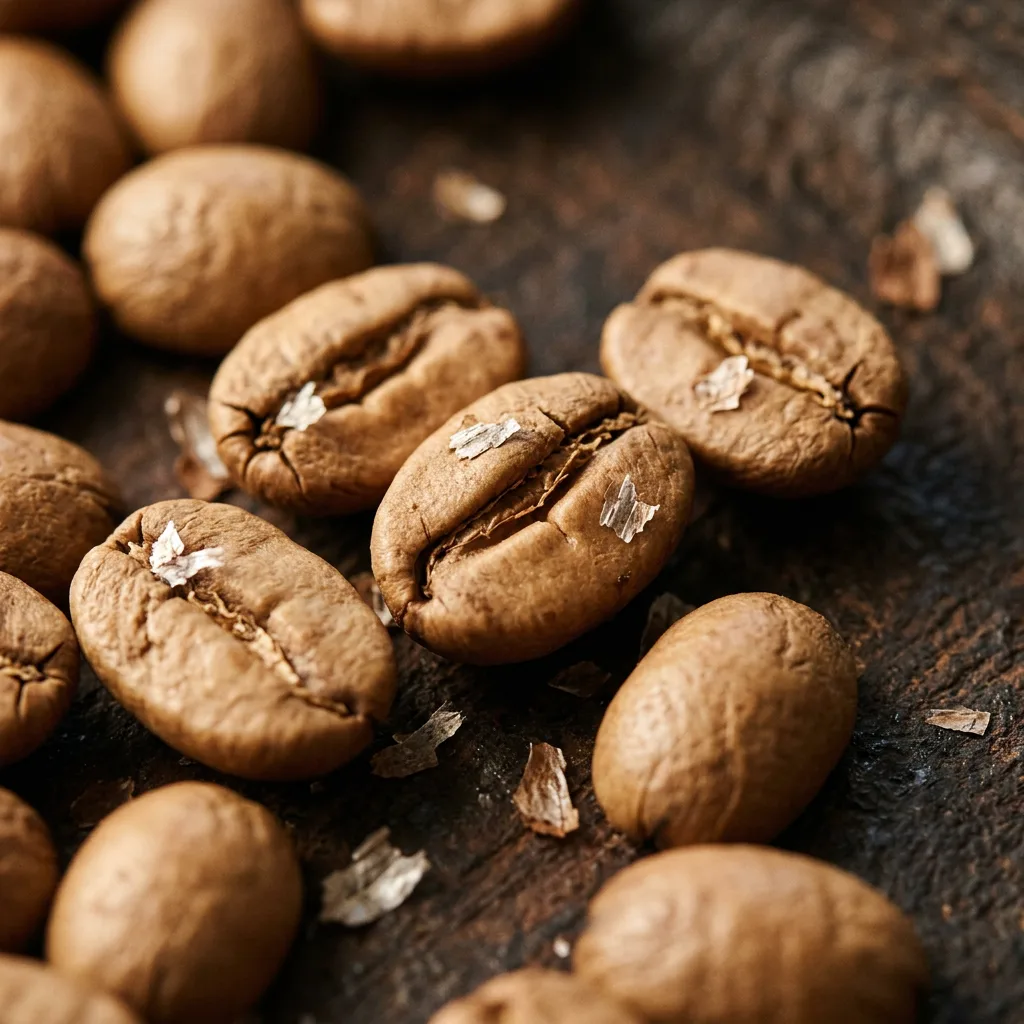
Eventually the internal pressure beats the strength of the bean. It cracks open along the seam to vent steam and gas.
You hear it as a clear popping sound, a lot like popcorn. Unlike popcorn, coffee does not puff into a fluffy ball. It just splits a little and swells.
Roasters watch first crack closely. From here the color changes only slowly, but the flavor shifts fast. The balance of acidity, sweetness and bitterness can change noticeably in 20 or 30 seconds.
A roaster can drop the beans soon after first crack and get a perfectly drinkable, vibrant light roast.
Phase 4: development and second crack (roughly minutes 10 to 14)
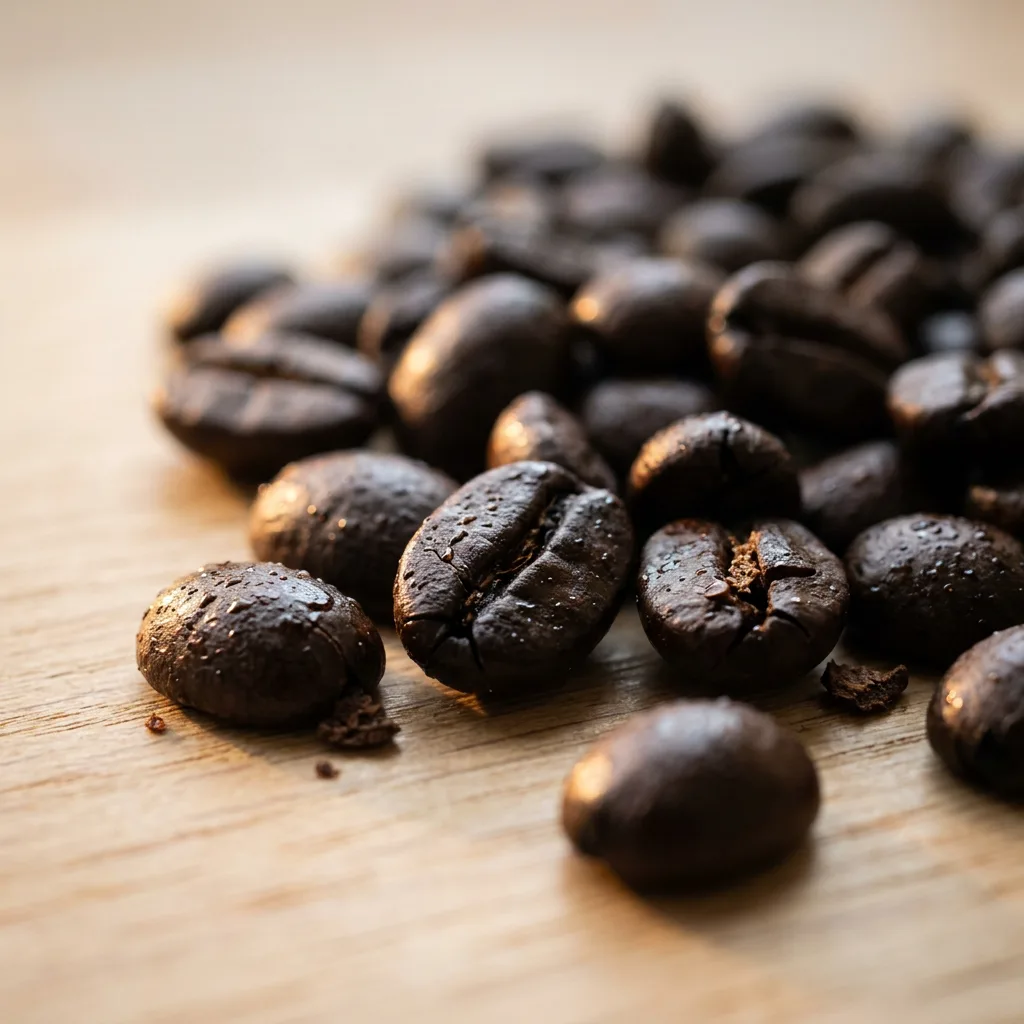
If the roast continues, the beans keep darkening and their wrinkled surface smooths out.
Push further and a second sound starts. Second crack is quieter, faster and sharper, more like rice cereal crackling in milk than popcorn.
This time the bean's structure itself is breaking. Oils are pushed out to the surface, so the beans turn glossy. Inside, the bean becomes much more porous. It swells in size while losing density.
Phase 5: very dark (up to around 17 or 18 minutes)
Past second crack, bitterness climbs while acidity and origin character drop toward zero. The cup gets heavy and syrupy, with smoky and ashy notes.
A very dark roast in a typical commercial cycle might finish around 17 or 18 minutes. Go much further and the beans turn to carbon and become a genuine fire risk inside the machine.
| Phase | Typical time | Bean temp | What you notice |
|---|---|---|---|
| Charge | 0:00 | Room temp | Green beans drop into hot drum |
| Drying | 0–5 min | Up to ~300°F | Pale, then yellow, grassy to bready |
| Browning | 5–9 min | ~300–385°F | Tan to brown, toast and caramel |
| First crack | ~9–10 min | 385–400°F | Loud pops, chaff flies off |
| Development | 10–13 min | 400–435°F | Smoother surface, sweeter aroma |
| Second crack | ~13–14 min | 435–450°F | Fast snaps, oil appears |
| Very dark | up to ~18 min | to ~470°F | Glossy, smoky, near black |
Typical drum roaster timings. Every machine, batch size and coffee shifts these numbers.
Development time: the minutes after first crack
Roasters have a name for the stretch between the start of first crack and the moment the beans leave the drum: development time.
Many express it as a share of the whole roast, called the development time ratio. If a roast lasts 10 minutes and first crack starts at 8:30, development is 15 percent.
Industry guides usually put typical development between about 15 and 25 percent of total roast time, though there is no single correct figure. The cup always has the final say.
How long the last stretch lasts in a 10-minute roast
Illustrative development shares. Rounded ranges from published roasting guidance.
Too little development and coffee can taste sour, grassy or like raw peanuts. Too much, and the bright notes flatten into a dull, roasty cup.
For you as a buyer, this explains why two bags with the same color can taste very different. Color tells you where a roast ended. It does not tell you how it got there.
Light, medium and dark: two different rulers
Roast labels are not regulated. What a roaster calls light or dark depends heavily on which part of the industry they work in.
Specialty roasters shift the whole scale lighter. For them, the first trace of oil on a bean already counts as dark, and few go far past it.
Large commercial brands shift it darker. Their light roast reaches into what a specialty roaster would call medium, and their dark roasts are often oily and well past second crack.
| Label | Specialty roaster | Commercial brand |
|---|---|---|
| Light | Shortly after first crack, dry, bright | Up to a specialty medium |
| Medium | Richer brown, still fully dry | Darker, may show slight sheen |
| Dark | First visible oil, rarely beyond | Oily, often past second crack |
If you want the full stop-by-stop map, I cover all seven roast levels in my guide to coffee roast levels.
Roast profiles: why the path matters as much as the color
Two batches can end up the exact same shade of brown and still taste completely different. The difference is the path they took to get there.
That path, bean temperature over time, is called the roast profile.
Why your oven makes poor coffee
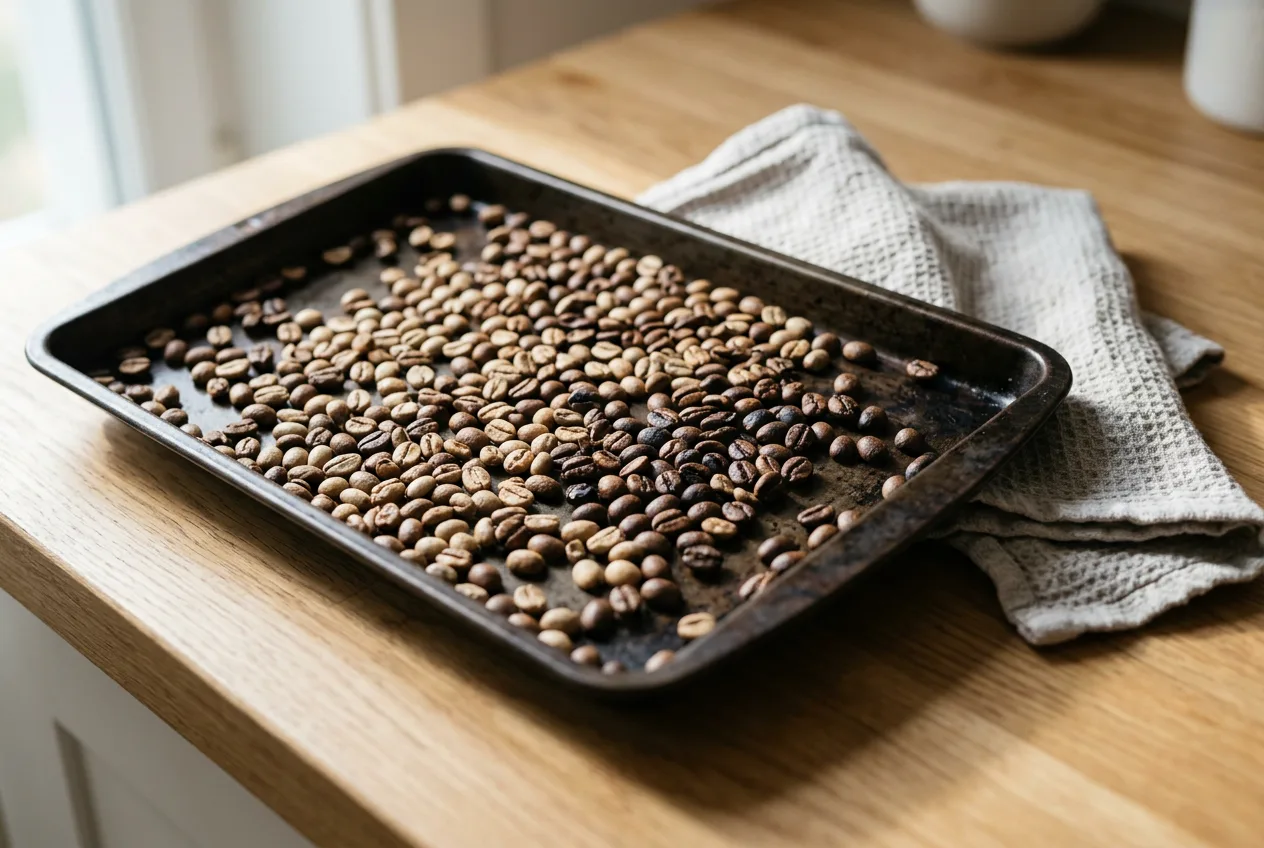
Spread green beans on a baking sheet, put them in a 390°F oven, and they will eventually turn brown. They will also taste disappointing, for two reasons.
First, the flat side resting on the hot metal soaks up too much conducted heat and scorches. You get beans that are burnt on one side and pale on the other.
Second, a fixed oven temperature cannot steer the chemistry. The bean temperature rises quickly at first, then crawls as it nears the oven temperature. There is no way to speed up or slow down a specific phase.
How roasters steer the curve
Professional roasters solve both problems. They keep the beans moving constantly so no side scorches, and they adjust the heat throughout the roast.
Every roaster, from vintage cast iron to computer-controlled machines, has temperature probes. The most important one, the bean probe, sits right in the tumbling mass of beans.
Software graphs that temperature live. A typical curve climbs steeply at first, then the rate of rise slows steadily through the middle and end of the roast.
- Charge.Green coffee drops into a preheated drum. The probe reading plunges as cold beans meet hot metal.
- Turning point.About a minute in, the reading bottoms out and starts to climb. From here the probe is tracking the beans.
- Drying and browning.The roaster sets gas and airflow so the temperature rises fast but steadily, without scorching the outside.
- Approach to first crack.Many roasters ease the heat here, because the bean is about to start releasing energy of its own.
- Development.The rate of rise keeps slowing. Small changes now have a big effect on sweetness, body and acidity.
- Drop.At the target time, temperature and color, the door opens and the beans fall into the cooling tray.
Speeding up or slowing down the middle of the roast changes sweetness, body and acidity dramatically, even if the end color stays the same.
Finding the right profile takes a lot of trial and error. It is also specific to both the coffee and the machine. A profile from one roaster cannot simply be copied to another and give the same cup.
How roasters check quality
Good roasters are not hunting for one perfect roast. They chase consistency: your favorite coffee should taste the same every week.
Tasting every batch, called cupping, is the most direct check. But fresh coffee needs to rest before it tastes right, and many customers expect coffee shipped the day it is roasted. So roasters also rely on numbers they can check immediately.
1. Profile adherence
The finished roast curve is laid over a reference curve. If the bean temperature strayed outside the allowed range at any point, the batch can be flagged.
2. Roast loss
Green coffee loses weight in the roaster, mostly water, plus organic matter that turns into gas. On a 22-pound batch, the loss usually runs from about 13 to 23 percent depending on how dark it goes.
Tracking that number is a sensitive check. If a coffee always loses 14.5 percent on its profile and one batch suddenly loses 15 percent, something changed: moisture in the green coffee, airflow or heat.
3. Color testing
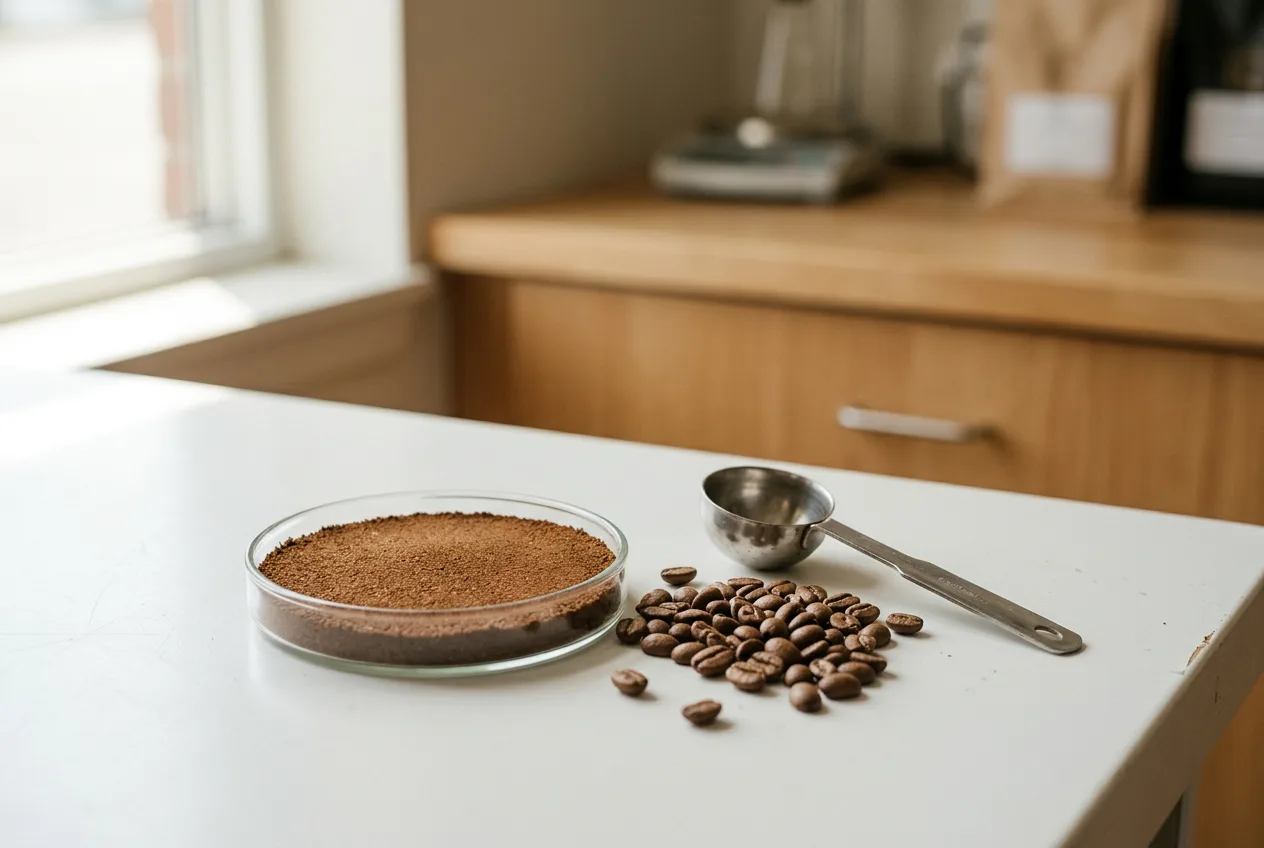
Roasters grind a small sample from each batch and read its color with an optical meter. A common scale is Agtron, where lower numbers mean darker coffee.
Color alone does not guarantee good flavor. But a tight color window catches batches that are underdeveloped or over-roasted before they ship.
4. Cupping
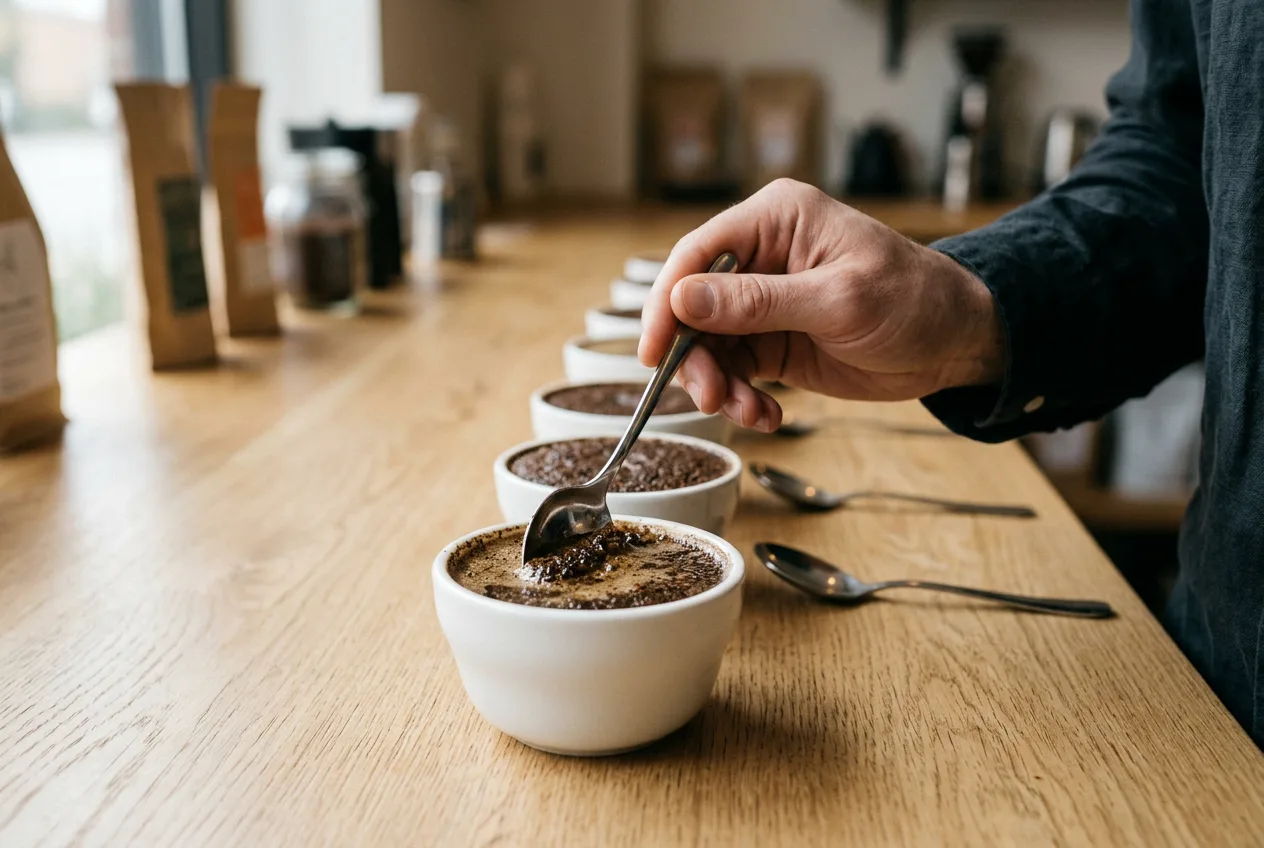
Cupping is a standardized tasting. Ground coffee steeps in small bowls, the crust is broken with a spoon, and tasters slurp and score each sample.
Even with all the numbers, this is where a roaster decides whether a coffee really tastes the way it should.
Roasting for filter vs espresso
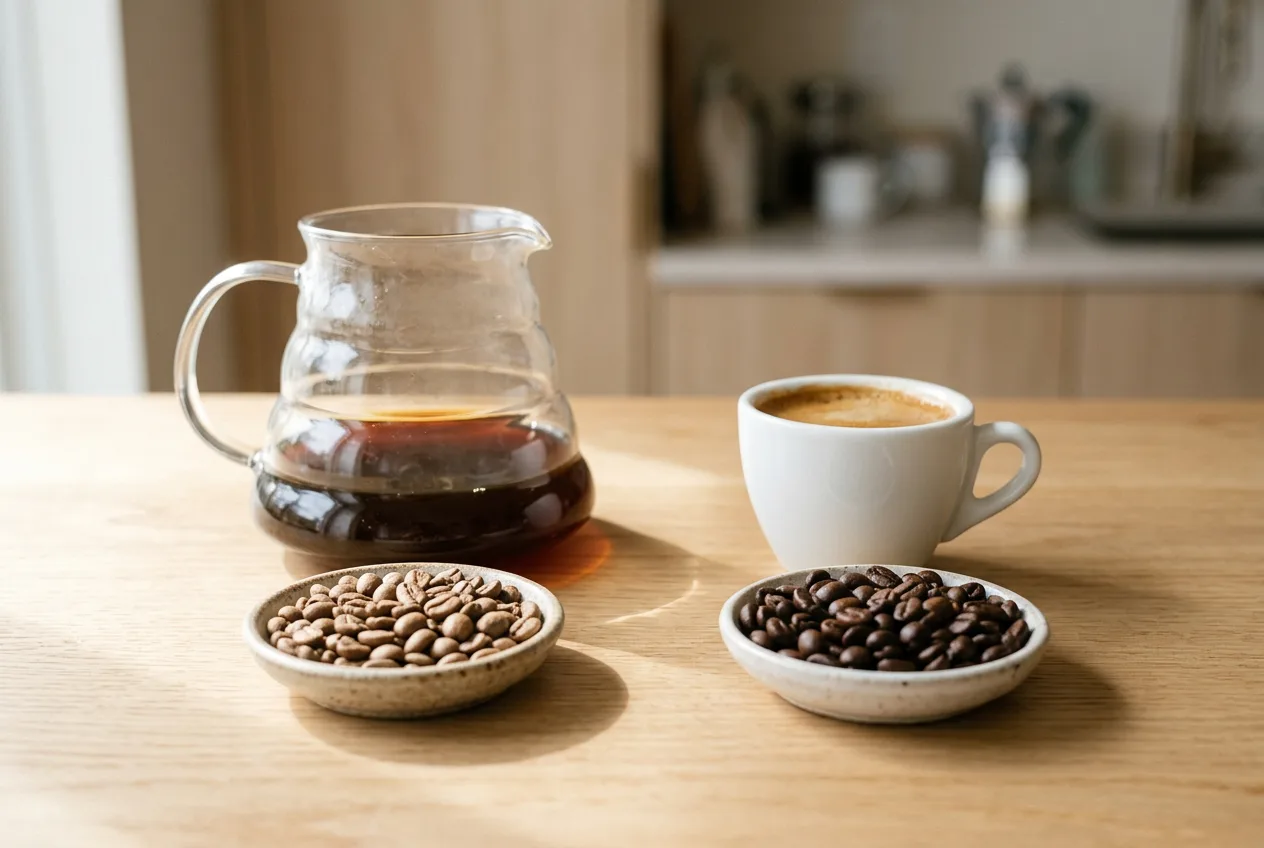
Bags labeled "for filter" or "for espresso" usually contain the same kind of beans. The difference is how they were roasted.
Espresso is a demanding brew. It uses high pressure, a very fine grind, little water and often under 30 seconds of contact. If the beans are too light and dense, the water cannot pull out enough sweetness and body, and the shot tastes sharp and sour.
So roasters often take espresso coffee slightly darker, or stretch the roast a little longer. That breaks down more of the bean's structure and makes it dissolve more easily.
Filter methods such as drip machines, pour-over and French press use much more water and three to five minutes of contact. That gives lighter, denser roasts the time they need.
| Filter roast | Espresso roast | |
|---|---|---|
| Typical color | Lighter | Slightly darker |
| Development | Shorter | Often longer |
| Brew contact time | 3–5 minutes | Under 30 seconds |
| Goal | Clarity and brightness | Sweetness and body under pressure |
These labels are guidelines, not rules. I regularly brew espresso roasts in a pour-over or moka pot, and they often make a rich, heavier cup.
Drum, hot air and hybrid roasters
Commercial roasters come in three main designs. Each mixes three kinds of heat in different amounts: convection (hot air), conduction (hot metal) and radiation (heat given off by hot surfaces).
Drum roasters
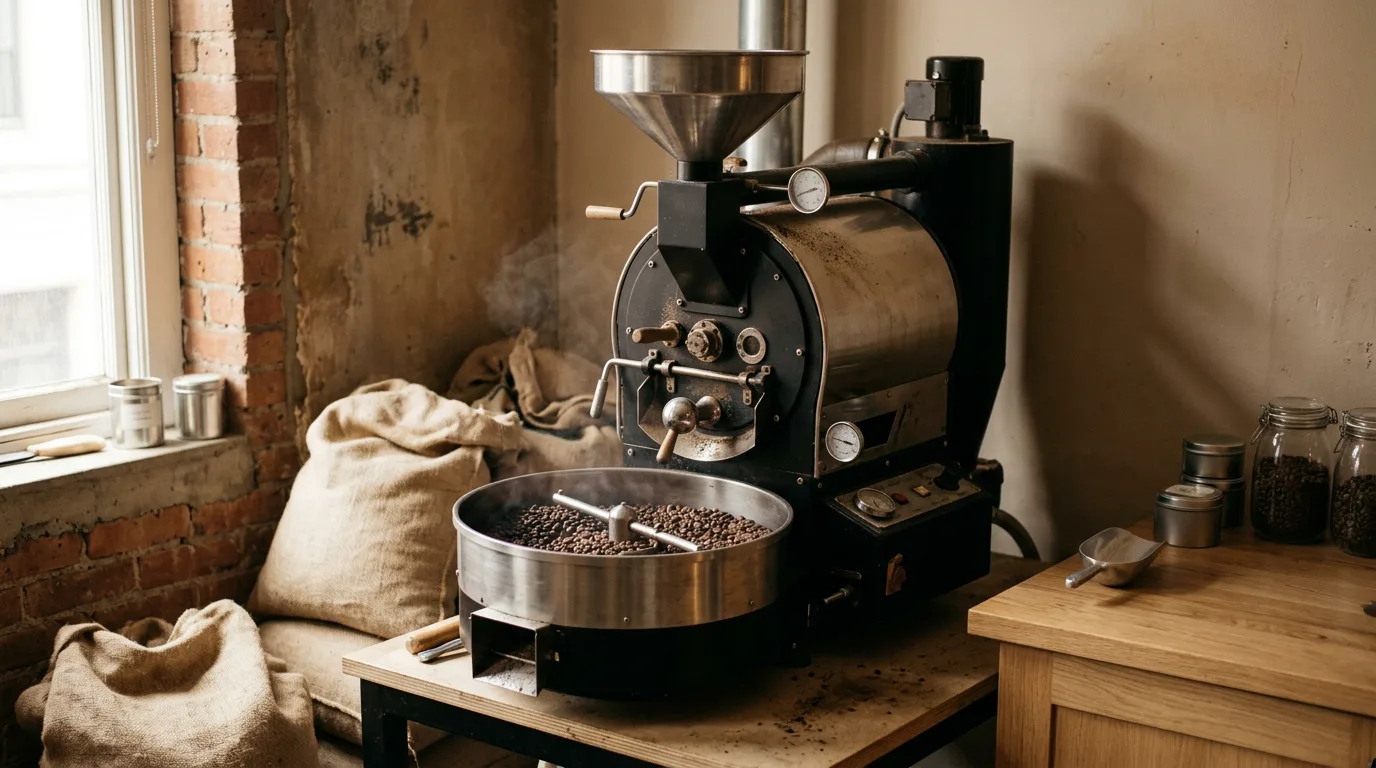
Drum roasters are the workhorses of specialty coffee. A thick cast iron or steel cylinder rotates horizontally, tumbling the beans like a clothes dryer, with a gas burner underneath.
A powerful fan pulls hot air through the drum and the beans, then out through the exhaust, often via an afterburner that burns off smoke and chaff. That airflow does most of the work.
The beans also pick up heat by touching the hot drum walls, a bit like searing in a cast iron pan, and from heat radiating off the metal.
Hot air (fluid bed) roasters
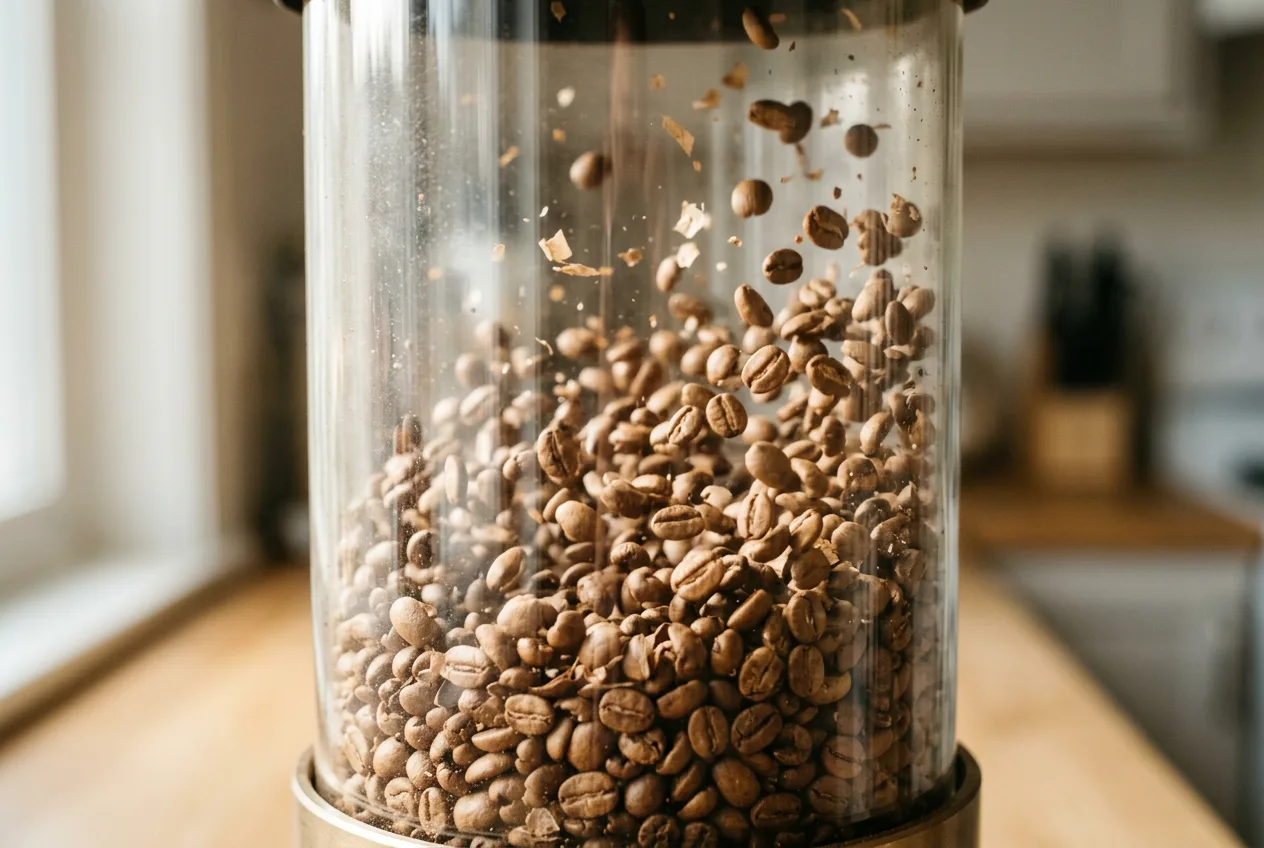
Hot air roasters have no rotating drum. Large volumes of very hot air blast up through the bottom of a fixed chamber.
That air both heats the beans and keeps them churning, so the beans float in a moving bed. There are almost no moving parts inside. The roaster controls the batch with air temperature and fan speed.
Hybrid air roasters
Hybrids keep a rotating drum for gentle mixing, but the flame is not under the drum. Air is heated in a separate chamber and blown in.
Because the drum metal is not heated directly, conduction almost disappears. Fans of hybrids like their efficiency and lower risk of scorching the bean surface.
| Roaster type | Main heat source | Agitation | Known for |
|---|---|---|---|
| Drum | Mostly convection, plus conduction and radiation | Rotating drum | Classic, very flexible |
| Hot air / fluid bed | Almost pure convection | The airflow itself | Even, fast, few moving parts |
| Hybrid | Convection from external heater | Rotating drum | Efficient, low scorch risk |
There is a common belief that drum roasters give one kind of flavor and air roasters another. In practice, a skilled roaster can get a wide range of results from any of them. No design is simply better. Each is a tool.
Cooling the beans
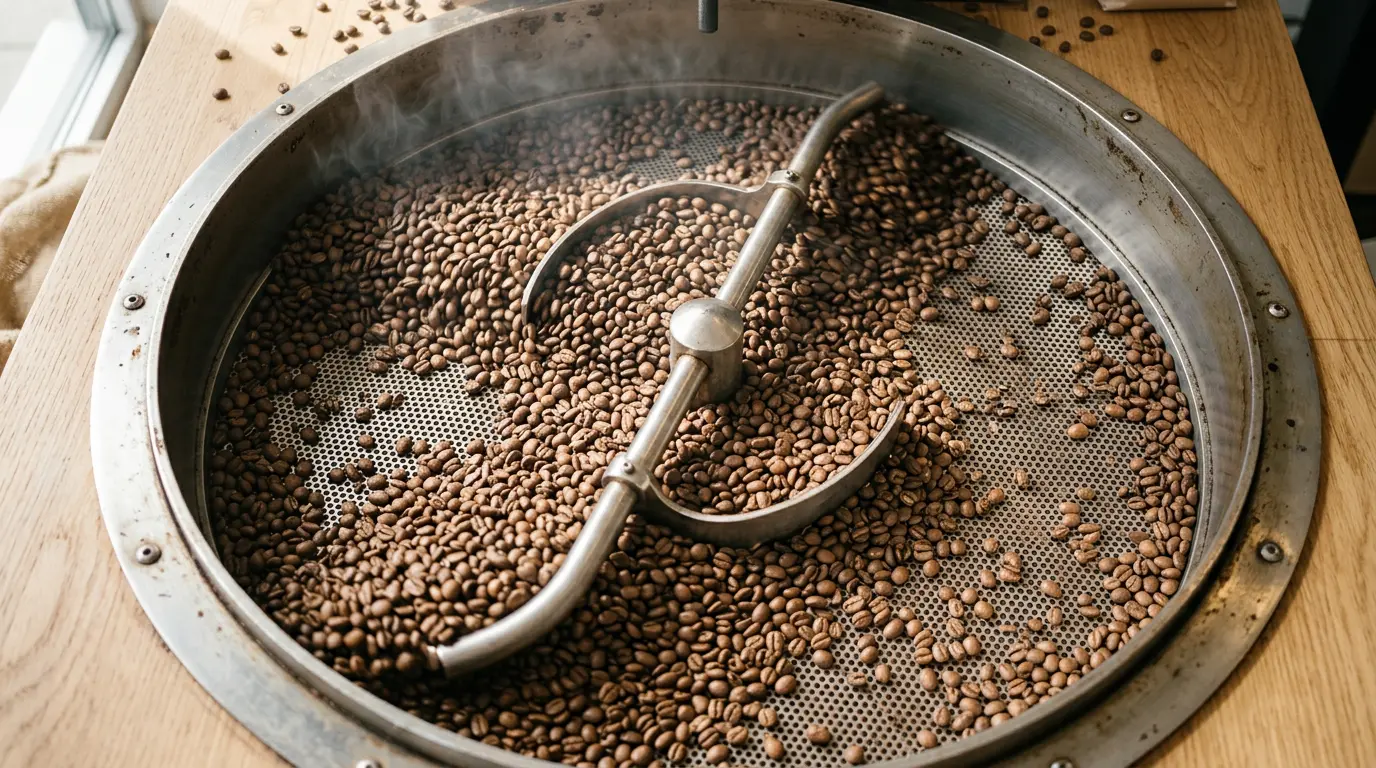
When a batch hits its target, it has to stop cooking right away. The beans leave the drum above 390°F. Left in a pile, they would keep roasting from their own heat, wreck the profile and could even catch fire.
Air cooling trays
Almost every roaster dumps the beans into a wide round tray with a perforated floor. Arms sweep the beans around while a strong fan pulls room air down through them. Within a few minutes they are at room temperature.
Water quenching
Very large industrial roasters, or machines with small cooling trays, cannot always shed heat fast enough with air alone.
They use quenching: nozzles spray a small, measured mist of water on the beans as they leave the drum. Because the beans are far above boiling point, the water flashes straight to steam and pulls heat out fast. The beans do not end up wet.
| Air cooling | Water quenching | |
|---|---|---|
| Used by | Nearly all roasters | Large industrial roasters |
| Speed | A few minutes | Faster |
| Effect on flavor | None | None when done right |
| Side effects | None | Shorter rest, stales slightly sooner |
After the roast: degassing and resting
Roasting does not end when the beans cool. The reactions inside them produced a lot of gas, mostly carbon dioxide, and much of it stays trapped in the porous bean.
That gas leaks out over days and weeks. Coffee researchers in Switzerland measured this by weighing beans as they degassed. They found dark roasts hold and release far more CO2 than light roasts.
CO2 released by whole beans after roasting (one study)
Measured over at least 400 hours. Faster roasts also released more gas than slower ones at the same roast level.
The release is fastest in the first 24 to 48 hours, then tapers off. Warmth speeds it up: industry research suggests a 10°C rise in storage temperature can roughly double the degassing rate.
Grinding is the big one. Studies have measured roughly 40 to 73 percent of the remaining trapped gas escaping within minutes of grinding. That is why ground coffee goes stale so much faster than whole beans.
Some degassing is a good thing. Coffee brewed too fresh can bubble wildly, extract unevenly and taste sharp. That is why many roasters suggest resting beans for a few days before brewing.
The one-way valve on a coffee bag lets this gas out without letting oxygen in. In a well-sealed bag, the escaping CO2 pushes out much of the oxygen, which helps slow staling.
Our tip: If a bag puffs up before you open it, that is a good sign. The coffee is fresh and still releasing gas.
Roasting by sight, sound and smell
Modern roasters lean on probes and software, but every good roaster I have watched still uses their senses constantly. If you ever roast at home, these are the cues that matter most.
Sight
Most drum roasters have a small trier, a scoop that slides into the drum and pulls out a sample of beans mid-roast. Roasters check it every minute or so.
They look for the shift from green to pale yellow, then to tan and cinnamon brown. They also watch the surface: wrinkled and dull early on, smoother as development goes on, and finally glossy if the roast reaches second crack.
Evenness matters as much as color. A sample with some pale beans and some dark ones points to uneven heat or a mix of bean sizes.
Sound
First crack is loud and unmistakable, a run of separate pops like popcorn. It usually starts with a few early pops, builds to a busy middle, then tails off.
Second crack is softer and faster, a crackle rather than a pop. Many roasters say they can hear the change in rhythm before they can see any oil.
On a home roaster, the cracks are your most reliable clock. Note the time when first crack starts and when you stop, and you already have your development time.
Smell
The smell coming off the roaster changes in a clear order. Early on it is grassy and like wet hay. During yellowing it turns bready and toasty, like baking bread or popcorn.
Around first crack it gets sweeter, with caramel and roasted nut notes. As the roast pushes toward second crack, the smoke becomes sharper and more pungent, and you start to smell dark chocolate and then char.
| Stage | Look | Sound | Smell |
|---|---|---|---|
| Drying | Green to pale yellow | Quiet rustle | Grass, hay |
| Browning | Tan, wrinkled | Quiet | Bread, toast |
| First crack | Light brown, seams opening | Loud pops | Caramel, nuts |
| Development | Smoother, even brown | Pops fading | Sweet, chocolate |
| Second crack | Dark, first oil | Fast crackle | Sharp smoke, dark chocolate |
Our tip: When you start roasting at home, write down the time of each change you notice. After a few batches, those notes become your own roast profile.
Common roast defects and how they taste
Once you know the phases, it gets easier to recognize when a roast went wrong. These are the defects I run into most often, and what causes them.
| Defect | What happened | How it tastes | How it looks |
|---|---|---|---|
| Underdeveloped | Dropped too soon after first crack, or rushed | Sour, grassy, raw peanut, thin | Pale center, wrinkly surface |
| Baked | Heat stalled or crept too slowly late in the roast | Flat, bready, papery, dull | Normal color, nothing obvious |
| Scorched | Too much heat early, beans touching hot metal too long | Smoky, burnt edges in a light roast | Dark patches on flat sides |
| Tipped | Too much heat too fast at the bean ends | Burnt, ashy notes | Small dark burn marks on the tips |
| Over-roasted | Taken far past the intended level | Bitter, charred, no sweetness | Very dark, oily, brittle |
Baked coffee is the sneaky one. It looks completely normal, yet tastes like cardboard and toast. It usually means the roast lost momentum in the second half, so the beans sat in the heat without developing properly.
Underdevelopment is the most common problem I find in very light roasts. A good light roast should taste bright and sweet. If it tastes like a lemon with grass in it, the roaster probably stopped too early.
Our tip: Break a bean in half. If the inside is much paler than the outside on a medium roast, the roast was likely rushed.
Roasting coffee at home
Home roasting is more approachable than most people think. Green coffee is cheaper than roasted coffee and keeps for months, so it is easy to experiment.
The options range from a pan on the stove to dedicated countertop roasters.
| Method | Batch size | Control | What to expect |
|---|---|---|---|
| Pan or wok on the stove | Small | Low | Uneven but fun; needs constant stirring |
| Oven on a tray | Medium | Very low | Scorched and uneven, not recommended |
| Popcorn-style air popper | Very small | Low to medium | Fast, even, very smoky and chaffy |
| Countertop fluid bed roaster | Small | Medium | Even roasts, simple controls |
| Countertop drum roaster | Small to medium | High | Closest to commercial roasting |
Whichever you choose, the same rules apply: keep the beans moving, listen for first crack, and cool them fast.
A few practical warnings from my own attempts. Roasting makes a lot of smoke, especially at darker levels, so work near an open window or outside. Papery chaff flies everywhere, so expect to vacuum. And never leave a roaster unattended. Beans can go from dark to burning faster than you would think.
To cool home-roasted beans quickly, pour them between two metal colanders for a minute or two, ideally outside or next to a fan. This also blows away most of the chaff.
Roasting myths I hear all the time
"Dark roast has more caffeine"
Caffeine is very heat-stable and barely changes at roasting temperatures. By weight, light and dark beans carry about the same caffeine.
If you measure with a scoop, light roast actually gives you slightly more, because the beans are denser and more coffee fits in the scoop.
"Oily beans are fresher"
Oil on the surface tells you the beans reached second crack. It says nothing about freshness.
In fact, a medium roast that has sat around for weeks can slowly sweat a bit of oil, and surface oil goes rancid faster. Check the roast date instead.
"Light roast is underdone coffee"
A good light roast is fully developed. It was simply stopped earlier on purpose to keep more of the farm's character.
Badly rushed light roasts exist, and they taste sour and grassy. But that is a roasting mistake, not a property of light roasts.
"Dark roast is burnt coffee"
Vienna and French roasts are deliberate styles with a long tradition, especially for espresso and milk drinks.
There is a line, though. Beyond Italian roast, the beans really do turn to charcoal, and professionals treat that as ruined.
"Freshest is always best"
Coffee brewed the same day it was roasted is often worse than coffee rested for a few days. The trapped gas fights the water and makes extraction uneven.
Fresh matters, but "fresh" means days to a few weeks after roasting, not hours.
"The roast level is printed on the bag, so I know what I'm getting"
Roast labels are not regulated. One roaster's medium is another's dark. The beans themselves are a better guide: dry and matte means they never reached second crack, shiny means they did.
A very short history of coffee roasting
For most of coffee's history, roasting happened at home or in small shops, in thin pans or long-handled cylinders turned over a fire.
By the 1800s, larger drum roasters heated by coal and later gas made roasting a commercial business. Pre-roasted, packaged coffee became normal, and roasts trended darker, partly because darker beans hid inconsistent quality.
The 20th century brought vacuum packaging and big brands, then a long era of dark, uniform supermarket coffee.
Specialty coffee pushed back. From the late 20th century onward, small roasters started buying from specific farms and roasting lighter to show off origin flavor. Bean probes, data logging and roast software turned roasting into something closer to a measured craft.
Today both worlds exist side by side, which is exactly why a "medium roast" can mean such different things depending on who roasted it.
What this means for the coffee you buy
Knowing how roasting works changes how I shop. Here is what I actually do with it.
- Look for a roast date.A "best by" date tells you little. A roast date tells you exactly where the coffee is in its degassing and freshness window.
- Give fresh beans a few days.Light roasts often taste best after about a week, dark roasts after a day or two.
- Match the roast to your brewer.Espresso roasts are easier to dial in on an espresso machine. Lighter filter roasts shine in pour-over and drip.
- Do not judge by color alone.Two bags of the same color can taste very different because of their roast profile. Read the tasting notes too.
- Buy whole beans and grind at home.Grinding releases much of the trapped gas and aroma within minutes, so grind right before brewing.
- Keep beans cool and sealed.Heat speeds up degassing and staling. A cool, dark cupboard in an airtight container works well.
Frequently asked questions
How long does it take to roast coffee?
In a commercial drum roaster, usually around 10 to 15 minutes for light to medium roasts, and up to about 17 or 18 minutes for very dark roasts. Hot air and home roasters can be faster.
At what temperature is coffee roasted?
The beans themselves typically finish between about 385°F for very light roasts and around 470°F for the darkest roasts. The air and drum are hotter than the beans.
What is first crack?
First crack is the popping sound when steam and gas pressure split the bean open, usually around 385 to 400°F. Coffee becomes drinkable from about this point.
What is second crack?
Second crack is a quieter, faster crackle around 435 to 450°F, when the bean's structure breaks down and oil moves to the surface. It marks the start of dark roasts.
Why does coffee lose weight when roasted?
Mostly because water evaporates. Some organic matter also breaks down into gas. Batches typically lose about 13 to 23 percent of their weight, more for darker roasts.
What is a roast profile?
A roast profile is the path the bean temperature follows over time. Two roasts with the same end color can taste different if they followed different profiles.
Can I roast coffee in my oven?
You can, but results are usually uneven because the beans scorch where they touch the tray and you cannot steer the heat. A pan you stir constantly, a popcorn-style air roaster or a small home roaster works better.
What is the difference between drum and air roasting?
Drum roasters tumble beans in a heated rotating cylinder and mix several kinds of heat. Hot air roasters float the beans in a stream of hot air and rely almost entirely on convection. Both can make excellent coffee.
Why should I wait before brewing freshly roasted coffee?
Fresh beans release a lot of carbon dioxide, which can make brewing uneven and the cup sharp. A rest of a few days lets the gas settle.
Is espresso roast a different bean?
No. It is usually the same kind of coffee roasted a little darker or longer so it dissolves more easily under espresso pressure.
What is quenching?
Quenching is spraying a small amount of water on very hot beans as they leave the roaster so they cool faster. Done properly it does not affect flavor.
Why do coffee bags have a valve?
The one-way valve lets carbon dioxide escape from fresh beans without letting oxygen in, so the bag does not burst and the coffee stays fresher.

- Michael Reynolds, personal notes from roastery visits and tastings
- Time-resolved gravimetric method to assess degassing of roasted coffee, Journal of Agricultural and Food Chemistry, 2017
- Preserving Freshness: A Race Against Time, Specialty Coffee Association, 25 Magazine
- Development Time Ratio, Scott Rao
- Coffee roasting: color and aroma-active sulfur compounds, University of Florida dissertation
- Effect of roasting degree on coffee beans, espresso and drip coffee, peer-reviewed study, PubMed Central
Related guides
Coffee roast levels explained Best Jura automatic coffee machines Breville Barista Express vs Barista ProWritten by Michael Reynolds. Last updated November 15, 2026.