Coffee Freshness, Resting and Degassing: How Long to Wait Before You Brew
Fresh coffee is good, but coffee that's too fresh can taste sour and pull wild espresso shots. Here's what actually happens inside a bean after roasting, why dark roasts are ready sooner than light roasts, and the resting times I use for filter and espresso.
We choose products independently. We may earn a commission through links on this page; your price stays the same. Affiliate policy
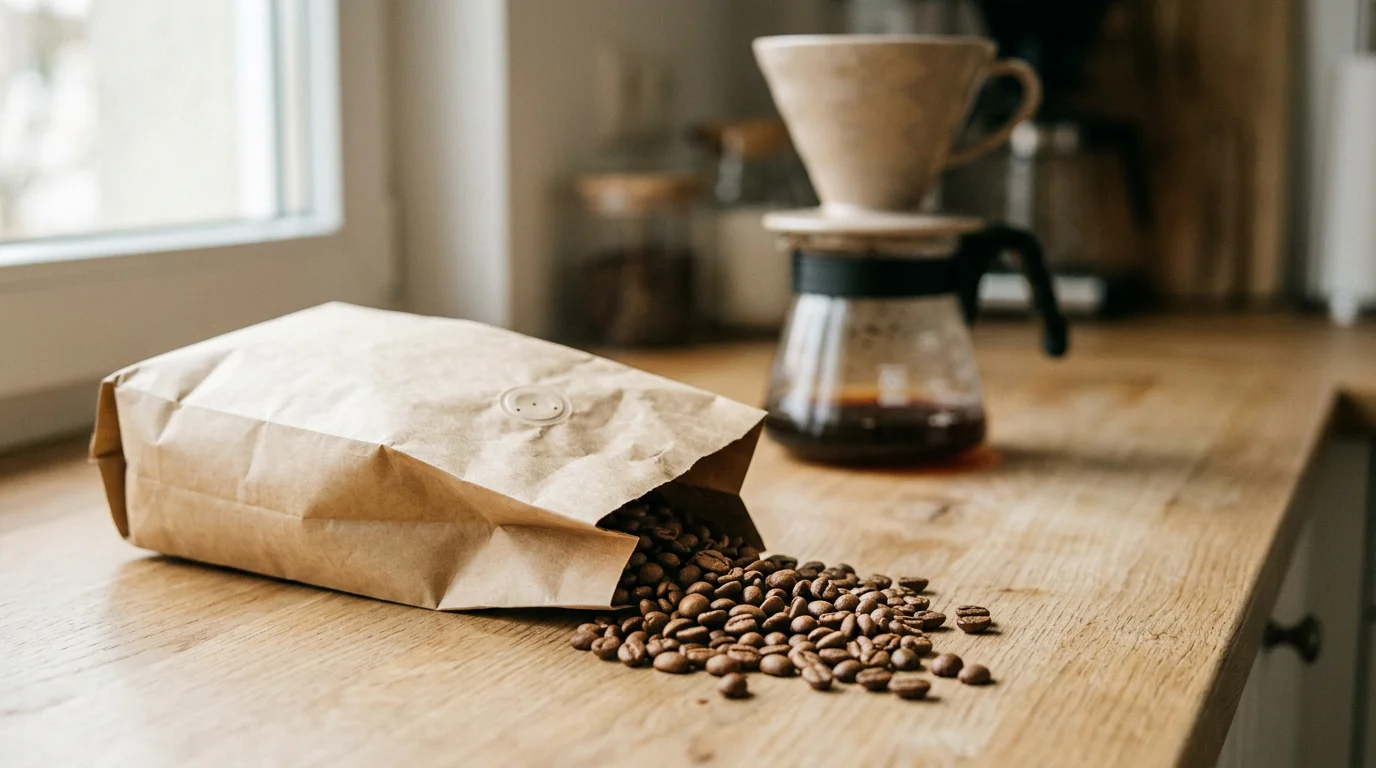
Freshly roasted coffee is full of carbon dioxide. Too much of it pushes water away from the grounds, adds a sharp, sour edge and makes espresso channel.
For filter coffee, rest dark roasts about 2 days, medium roasts 4–5 days and light roasts 5–10 days. For espresso, rest dark roasts 2–4 days, medium roasts 8–10 days and light roasts 10–14 days.
Lighter, denser and higher-grown beans need longer. Warm kitchens shorten resting, cool ones stretch it. Treat these as starting points and let your taste decide.
The freshness paradox
When I first got into specialty coffee, the rule seemed simple: fresh is good. So naturally, fresher had to be better.
I hunted down roasters who roasted to order and shipped the same day. Getting a bag roasted less than 24 hours earlier felt like I'd made it.
Then a barista friend told me to put the bag in the cupboard and wait a week. I was confused, and honestly a little annoyed.
That advice opens up a whole set of worries for home brewers:
- How long should coffee rest?
- Is there an exact peak day for flavor?
- Am I wasting expensive beans by brewing too soon?
- If I wait too long, will the best aromas disappear and leave me with a flat, stale cup?
I've seen people get genuinely anxious about this. They count days on a calendar and worry they've missed the perfect moment.
The way out of that anxiety isn't a stricter rule. It's understanding what's going on inside the bean after it leaves the roaster.
Your ideal resting time depends on your kitchen temperature, how you store beans, how fast you drink coffee and how you brew. Once you know the science, you can adjust for all of that yourself.
In this guide I'll explain where the gas comes from, why it causes trouble, how roast level and bean density change resting time, and the starting points I use. I'll also cover valves, vacuum canisters, freezing, water quenching and a resting test you can run at home.
Where the gas comes from
The need to rest coffee starts in the roaster.
Roasting green coffee sets off a long chain of heat-driven chemical reactions. The big ones are browning reactions, like the Maillard reaction and caramelization.
Almost all of those reactions produce carbon dioxide as a byproduct. And they produce a lot of it.
You'll often hear that roasting about two pounds of green coffee creates roughly two and a half gallons of CO2. It's a fun way to show the scale, but it's misleading as a fixed rule.
The real amount depends on the roast profile, and especially on how dark the coffee is roasted.
Dark roasts make more gas
The darker the roast, the longer the browning reactions keep going. They continue right up to the point where the coffee would start to burn.
So dark roasts generate much more carbon dioxide than light roasts.
Light roasts make less gas
Light roasts spend less time in those deep browning stages. The total amount of CO2 created is noticeably smaller.
Lab measurements back this up. Researchers who weighed the gas released from beans over time found that darker roasts released clearly more gas than lighter ones.
Where the gas goes
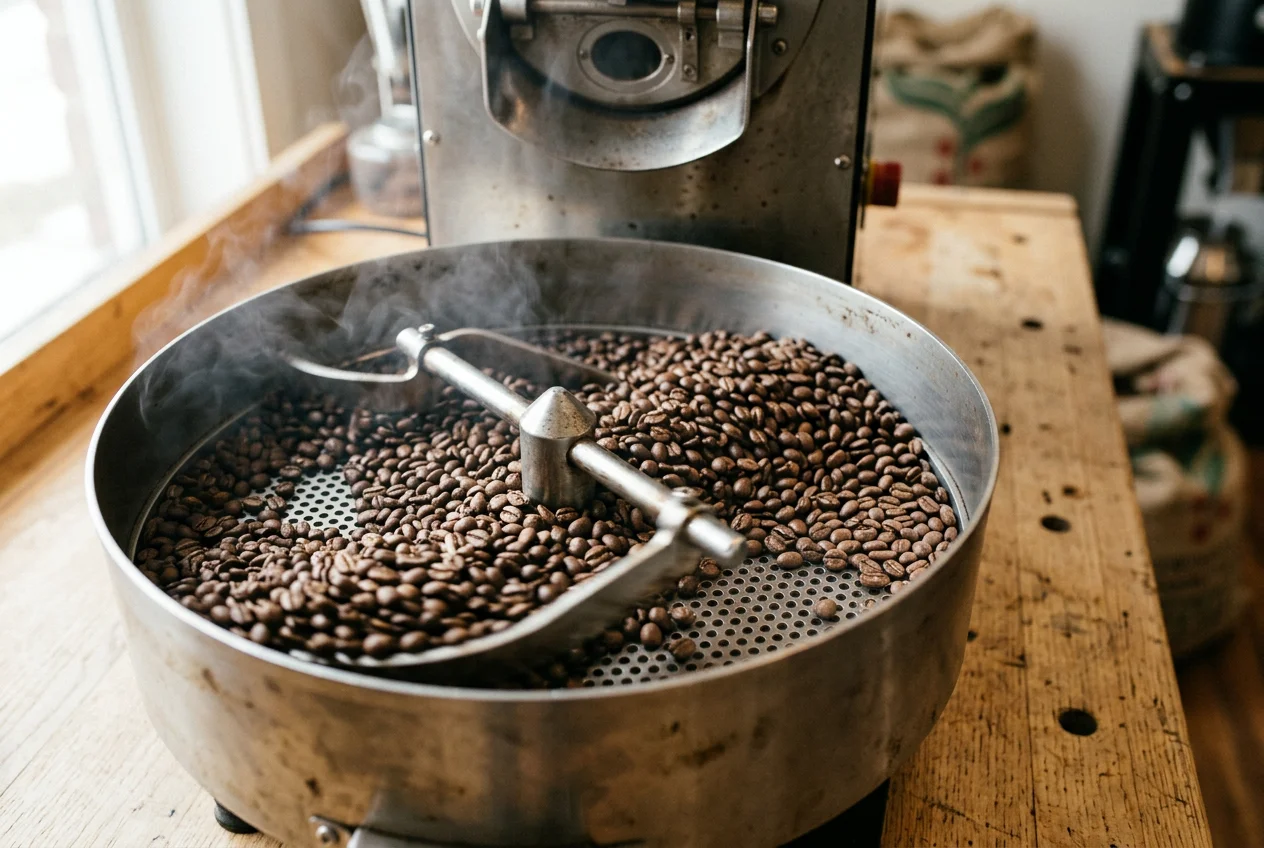
Most of the gas made during roasting escapes straight into the roaster's exhaust. But a lot stays trapped inside the cell structure of the roasted bean.
Once the beans cool and go into a bag, that trapped gas slowly leaks out. The coffee world calls this degassing, or outgassing.
Resting is simply giving the bean time to let enough of that gas go. If you want the full story of what happens in the drum, my guide on how coffee is roasted walks through each stage.
Why dark roasts degas faster than light roasts
Here's the part that surprises almost everyone.
If dark roasts contain more CO2, you'd expect them to need longer to rest. In practice, the opposite is true.
How fast the gas escapes matters as much as how much there is. And that comes down to the physical structure of the bean.
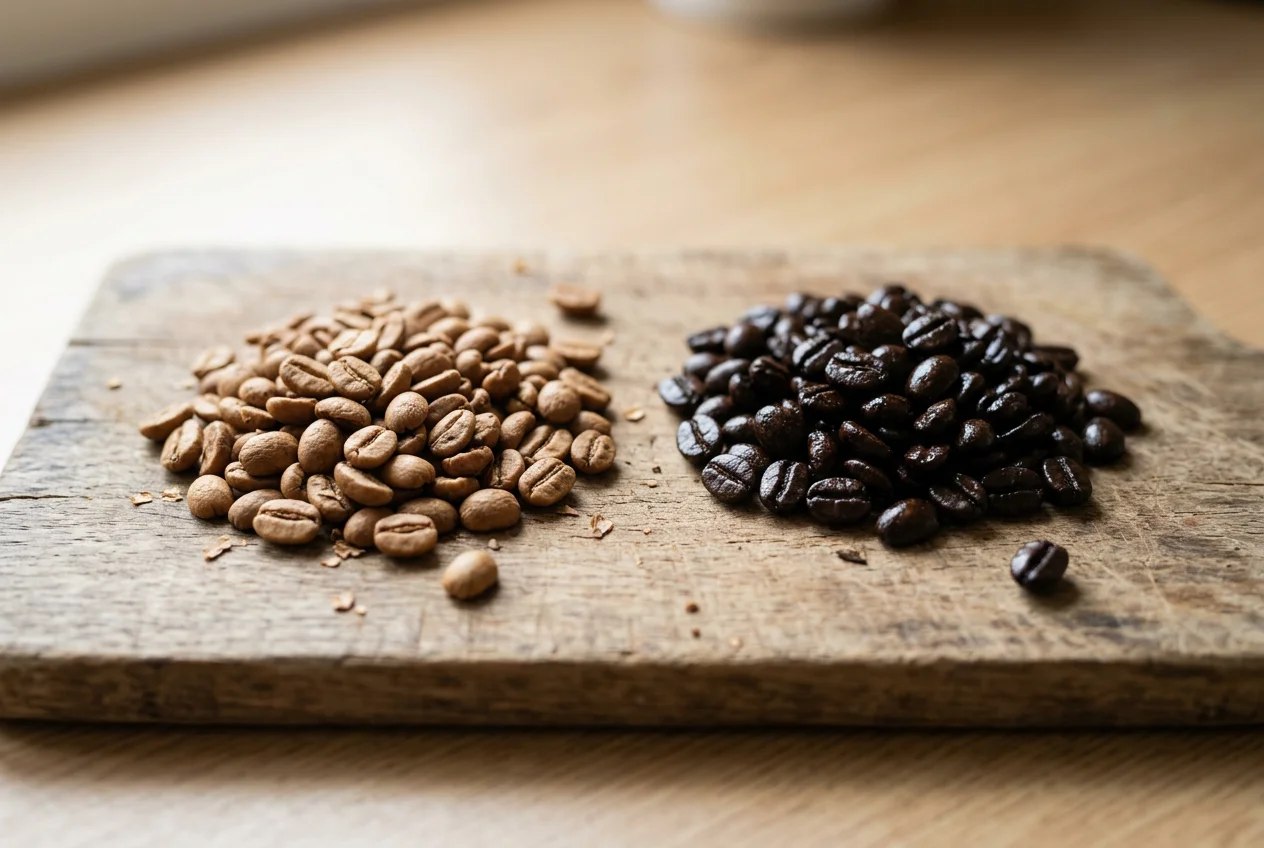
Dark roasts: puffed up and porous
The long, intense heat of a dark roast makes beans swell up and turn brittle. Cell walls break down and the bean becomes very porous.
With such an open, cracked structure, the bean can't hold on to its gas. It starts with a huge reservoir, but that gas pours out quickly.
Light roasts: dense and tight
Light roasts don't expand or break down nearly as much. The finished bean stays harder, tighter and much denser.
So even though a light roast holds less CO2 overall, its dense structure works like a seal. The gas has a hard time finding its way out, and degassing happens slowly.
One research thesis on coffee degassing found the same pattern: the degassing rate went up as the degree of roast increased.
Growing altitude changes things too
Roast level isn't the only factor. Where the coffee was grown matters as well.
Coffee grown at high altitude lives with cooler temperatures, so the cherries ripen more slowly. That slow growth produces harder, denser seeds.
After roasting, high-grown coffees stay denser than low-grown ones. They hold on to their CO2 longer and need more time to rest.
That's why a light-roasted coffee from a very high farm can need the longest rest of all. If you want to know more about how origin shapes beans, my guide to choosing coffee beans covers altitude and what it means in the cup.
| Bean | Total CO2 | Escapes | Resting need |
|---|---|---|---|
| Dark roast | High | Fast | Short |
| Medium roast | Medium | Medium | Medium |
| Light roast | Lower | Slow | Long |
| High-altitude light roast | Lower | Very slow | Longest |
| Low-grown coffee | Varies | Faster | Shorter |
How trapped CO2 ruins extraction
So why does a bit of trapped gas matter when you brew?
The trouble starts when hot water meets freshly ground coffee. Water speeds up the release of gas dramatically, pulling it out of the coffee particles all at once.
You can see it in the bloom
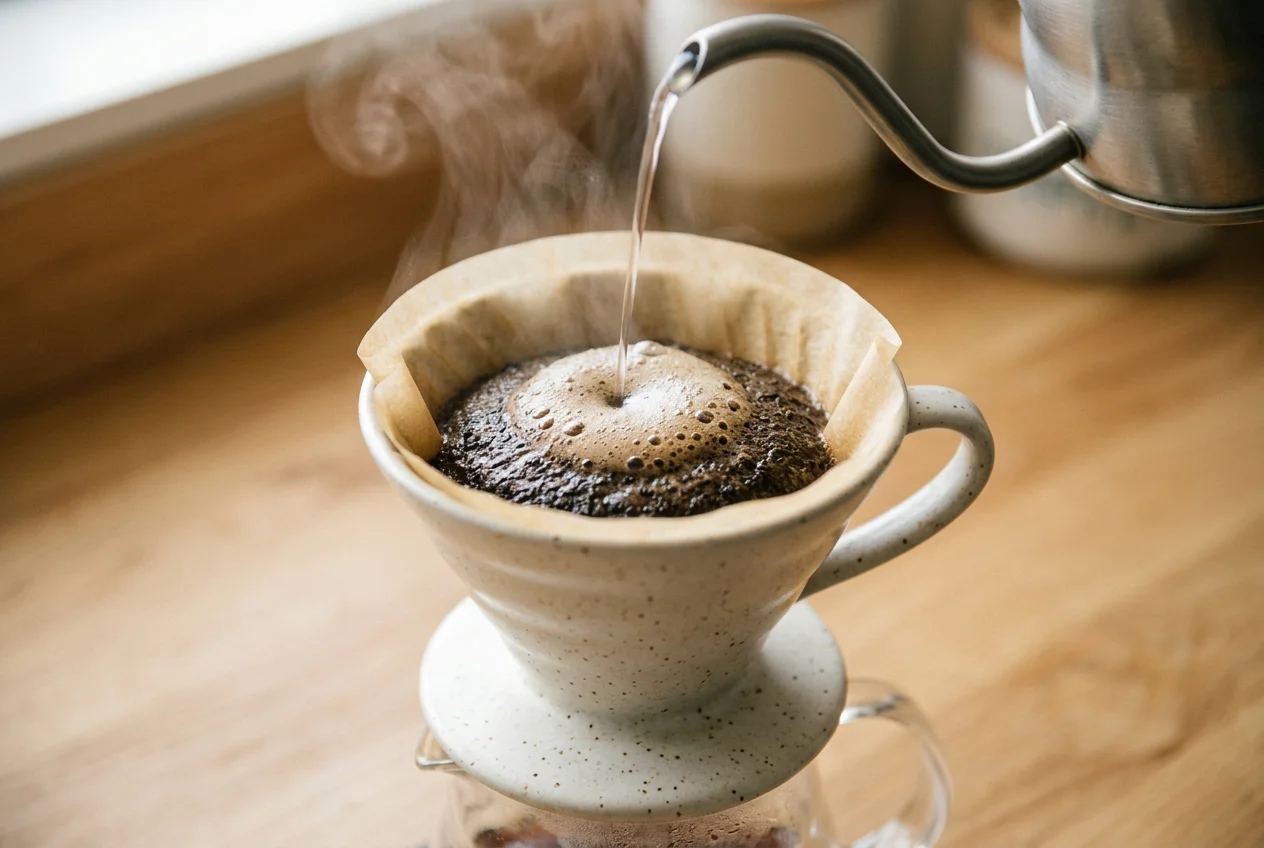
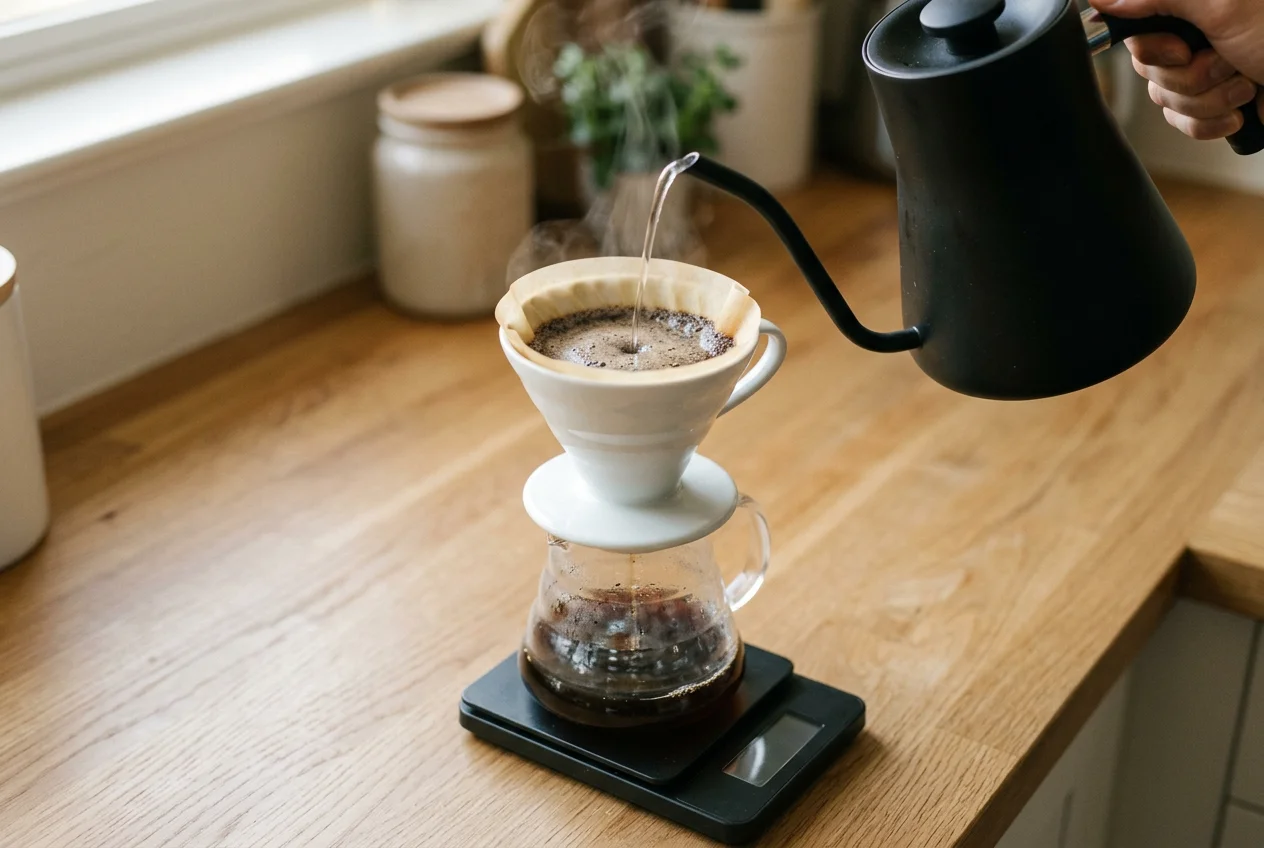
In pour-over, this is easy to see in the first pour, called the bloom. Hot water hits the grounds, gas rushes out, and the coffee bed swells, bubbles and rises.
A very fresh dark roast blooms like a volcano, because it's full of gas. A very fresh light roast blooms much more gently.
In pour-over this is easy to deal with. You just wait 30 to 45 seconds for the bloom to settle before you keep pouring.
But beyond the bloom, trapped gas causes three bigger problems.
Problem 1: gas pushes water away
As CO2 forces its way out of the tiny pores in each particle, it pushes back against the incoming water.
The bubbles act like a barrier. Water can't soak the grounds evenly, so it can't dissolve the flavors you actually want.
Problem 2: espresso gets chaotic
In filter coffee this is a nuisance. In espresso it's a real problem.
Espresso forces hot water at high pressure through a tightly packed puck of fine coffee. Espresso coffees also tend to be roasted a little more developed, so they carry plenty of gas.
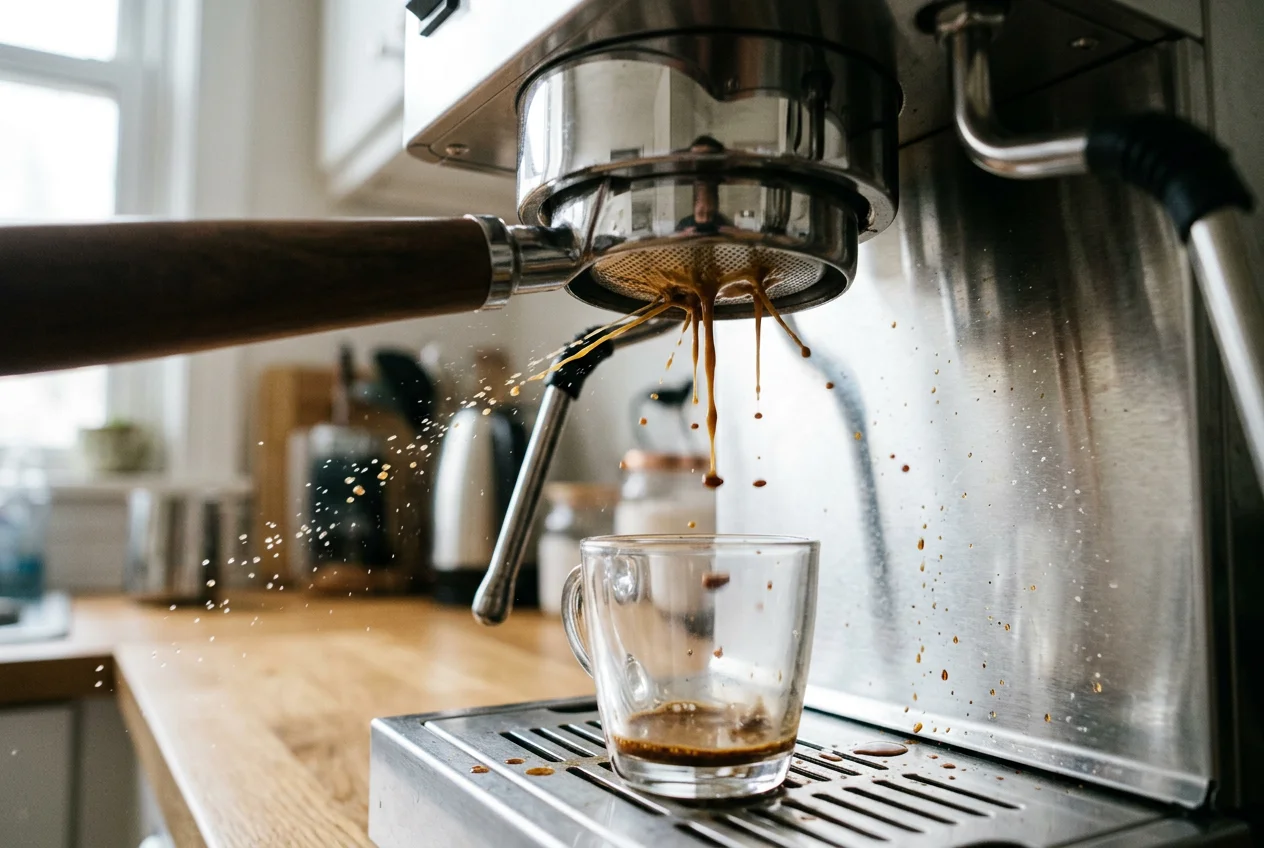
When the coffee is too fresh, that pressurized water triggers a burst of gas inside the puck. It creates channels, messes with the flow rate and extracts the coffee unevenly.
The result is shots that change wildly from one to the next. Dialing in becomes almost impossible.
Problem 3: sharp, sour flavors
Coffee with too much trapped gas usually ends up under-extracted. That alone can make it taste thin and sour.
On top of that, carbon dioxide dissolves in water to form carbonic acid. It's the same thing that gives sparkling water its sharp bite.
In coffee, it shows up as an unpleasant sourness and a tangy, drying finish. It hides the natural sweetness and complexity of the beans.
Very fresh coffee can also have a faint, acrid smokiness. In my experience, it fades once the beans have rested a few days.
The freshness window: resting vs staling
Resting is a balancing act between two processes that run at the same time.
On one side, gas is leaving the beans. That's good, up to a point, because it makes extraction easier and smoother.
On the other side, oxygen is slowly reacting with the oils and aromas. That's staling, and it only goes one way.
The goal is the sweet spot in between. You want enough of the disruptive gas gone for water to extract evenly, but you want to brew before oxygen flattens the flavor.
How I think about a medium roast for espresso (rough experience)
My own rough guide for an opened bag stored well. Roast level, storage and temperature shift these numbers.
Notice that the sweet spot is wide. It's a window of weeks, not a single perfect day.
That's the most reassuring thing I can tell you about resting. You don't have to hit a precise date to get great coffee.
Resting times for filter coffee
Filter brewing covers pour-over, drip machines and immersion brewers like the French press. It's very forgiving with fresh coffee.
Water flows through the grounds at normal air pressure, not under mechanical pressure. That makes excess gas much easier to handle, especially if you start with a proper bloom.
Brewing filter coffee the day after roasting won't give you the best possible cup. It might taste slightly sharp or under-extracted. But it'll still be perfectly drinkable and enjoyable.
Dark roasts: about 2 days
Dark roasts are porous and let go of their gas quickly. Waiting much longer than a few days doesn't help, it just brings you closer to staling.
Medium roasts: 4 to 5 days
That gives the denser bean enough time to release most of its disruptive gas. The cup turns sweeter and more balanced.
Light and ultra-light roasts: 5 to 10 days
Very dense, high-altitude coffees can need up to two weeks. Patience pays off here: the carbonic sourness disappears and the delicate floral and fruity notes come through.
How to brew coffee that's a bit too fresh
Sometimes you just want to try a new bag right away. That's fine. Here's how I get the best out of very fresh filter coffee.
- Bloom longer.Use about two to three times the coffee's weight in water and wait 45 seconds or a little more before the main pour.
- Stir or swirl the bloom.A gentle stir or swirl helps wet every particle and lets gas escape evenly.
- Grind a touch finer.A slightly finer grind can make up for gas pushing water away, as long as the drawdown doesn't stall.
- Pour in stages.Several smaller pours give gas more chances to escape than one big pour.
- Try immersion.A French press or other immersion brewer keeps the coffee and water together, so gas matters even less.
Our tip: For filter coffee, don't stress about hitting an exact day. If you brew well and bloom properly, start drinking a new bag whenever you're ready and enjoy how it changes over the days.
Resting times for espresso
Espresso is much less forgiving. Under nine bars of pressure, extra gas disrupts water flow, causes channeling and produces harsh, sour, uneven shots.
For smooth, predictable espresso, resting really matters.
Dark roasts: 2 to 4 days
Dark espresso roasts have oils on the surface and a fragile, porous structure. Their main enemy isn't gas, it's oxidation and staling.
Fresher is generally better here. I start brewing within a few days of the roast date.
Medium roasts: 8 to 10 days
Medium roasts hold a lot of CO2. Giving them just over a week lets the puck behave much more calmly under pressure.
Most of the classic espresso blends I buy fall in this group. I rest them for about a week and a half.
Light roasts: at least 10 to 14 days
Light roasts are very dense and lock their gas in tightly. Pull shots too early and you'll get frustrating fast, sour, channeling extractions.
Resting for ten days or more makes them dramatically easier to dial in. And it doesn't risk stale flavors, because dense light roasts stale slowly too.
What to expect from light-roast crema
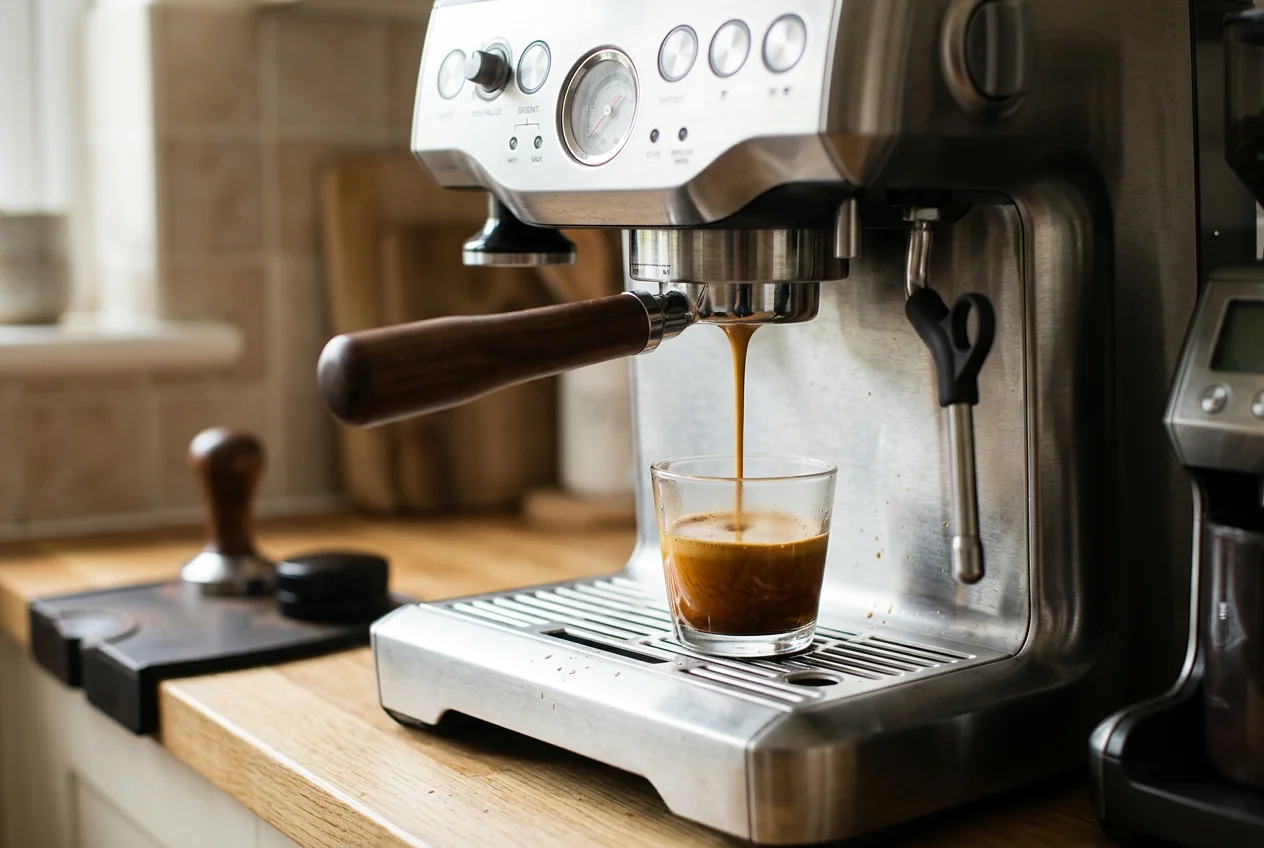
If you pull espresso with light roasts, the crema will look thinner and fade faster, even after proper resting.
That doesn't mean the coffee is old. Light roasts simply never produce enough CO2 to create the thick, heavy crema you see on a traditional dark Italian roast.
So judge light-roast espresso by taste and flow, not by crema. If it tastes sweet and the shot runs steadily, it's doing its job.

Dialing in while beans are still resting
If you have to use a bag that's a bit young, expect it to change quickly. Here's what I do.
- Expect fast shots.Young coffee often runs fast and spurts. A slightly finer grind can help, but don't chase every shot.
- Re-check every day or two.As gas leaves, the same setting will slowly run slower. Small grind tweaks keep you on track.
- Taste, don't just time.Sourness from gas can hide behind a "correct" shot time. Let flavor guide your adjustments.
- Use it in milk drinks first.Milk softens the sharp edge of very fresh coffee. Save straight espresso for when the beans settle.
Our tip: If you're always short on rested espresso beans, buy your next bag a week earlier than you think you need it. That one habit fixed most of my dialing-in headaches.
Resting chart: filter vs espresso
Here's everything above in one place. These are starting points for coffee stored at normal room temperature.
| Roast level | Filter coffee | Espresso |
|---|---|---|
| Dark | About 2 days | 2–4 days |
| Medium | 4–5 days | 8–10 days |
| Light | 5–10 days | 10–14 days |
| Very dense, high-grown light | Up to 2 weeks | 14 days or more |
Start here, then adjust for your kitchen temperature, bean density and taste.
If you're not sure what roast level you've got, my guide to coffee roast levels shows how to tell light, medium and dark apart.
The four factors to check for every new bag
When a new bag arrives, I run through four quick questions.
- How am I brewing it?Espresso needs much more rest than filter coffee.
- How dark is the roast?Lighter roasts need longer rest than darker roasts.
- How dense is the bean?High-altitude, dense coffees need longer than low-grown coffees.
- How warm is my home?Cooler homes need slightly longer rest, warmer homes slightly shorter.
Those four answers give me a sensible guess. Tasting the coffee over the next days does the rest.
How temperature and storage change resting
At home, the biggest thing controlling how fast coffee rests is temperature.
Chemical reactions, including degassing and staling, speed up when it's warm and slow down when it's cold.
A literature review from the Specialty Coffee Association cites research showing that whole-bean degassing gets about 1.5 times faster for every 10 degrees Celsius of extra warmth.
Warm storage
Coffee kept in a warm kitchen, near the stove or in a hot climate loses gas faster. That shortens the resting time you need.
But it also speeds up oxidation and staling. The peak window gets shorter at both ends.
Ideally, don't store coffee much warmer than normal room temperature, around 68 to 70°F (20–21°C). If you live somewhere hot and can't find a cooler spot, shorten your resting times.
Cool storage
A cool basement, cellar or pantry slows degassing. You'll need to rest beans a little longer, but they'll also stay at their best for longer.
I don't recommend the fridge for daily beans, though. It's humid and full of smells, and moving beans in and out causes condensation. My guide on how to store coffee beans explains why.
Freezing: rest first, then freeze
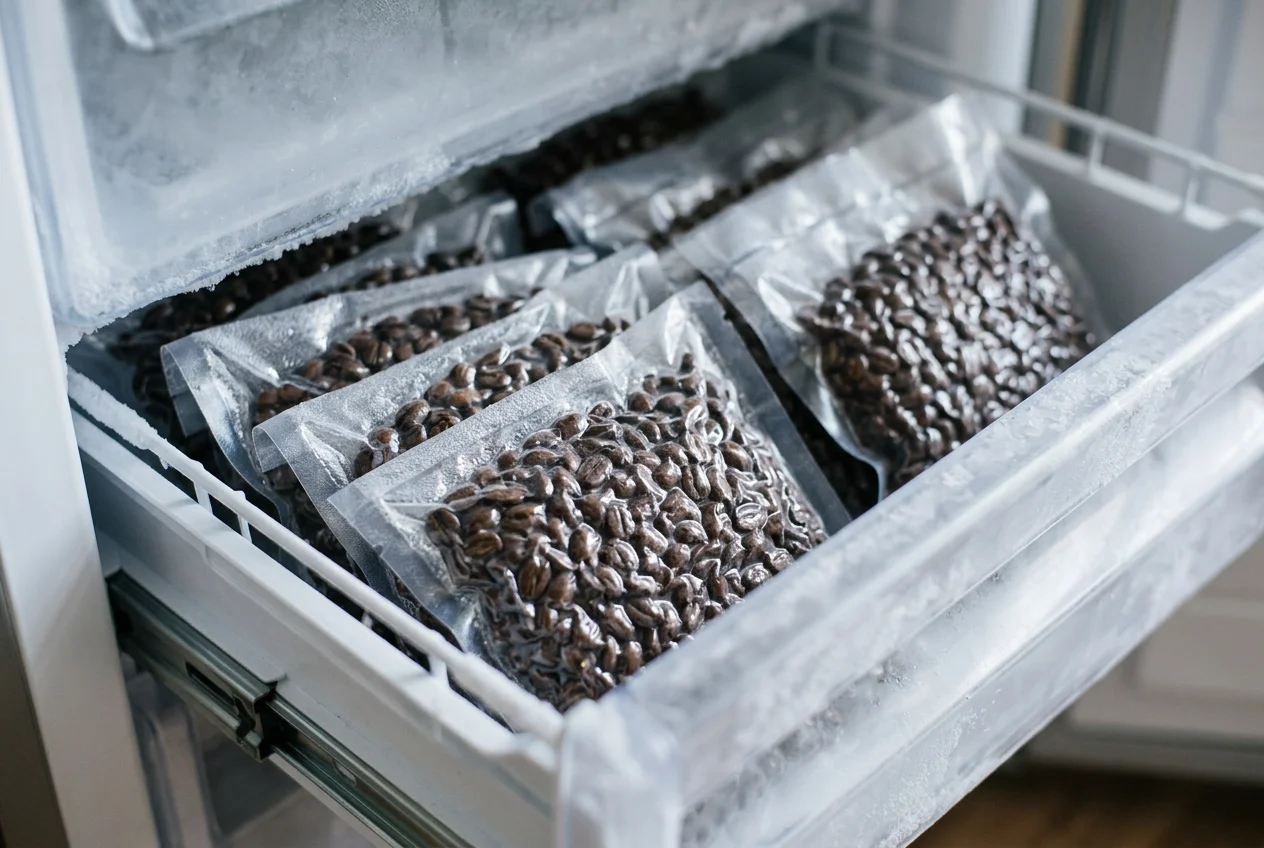
Freezing brings both aging and degassing almost to a stop.
That has a useful side effect. Because the gas stays trapped, coffee thawed months later still makes thick crema on espresso and brews as if it were freshly roasted.
But it also means the freezer doesn't rest your coffee for you. If you freeze beans on roast day, they'll come out just as gassy as they went in.
So if you plan to freeze coffee, rest it to your preferred point first. Then seal it in portions and freeze it.
| Where beans rest | Degassing | Staling | What to do |
|---|---|---|---|
| Warm kitchen | Faster | Faster | Shorten rest, buy less |
| Room temperature | Normal | Normal | Use the chart above |
| Cool pantry or cellar | Slower | Slower | Rest a little longer |
| Freezer | Almost stops | Almost stops | Rest first, then freeze |
Seasons make a difference
I notice this every year. In summer, when my kitchen is warm, the same coffee is ready a day or two sooner and fades a little faster.
In winter, with a cooler house, I add a couple of days to my resting times. It's a small thing, but it explains why a favorite coffee can seem to behave differently from one season to the next.
One-way valves and puffy bags
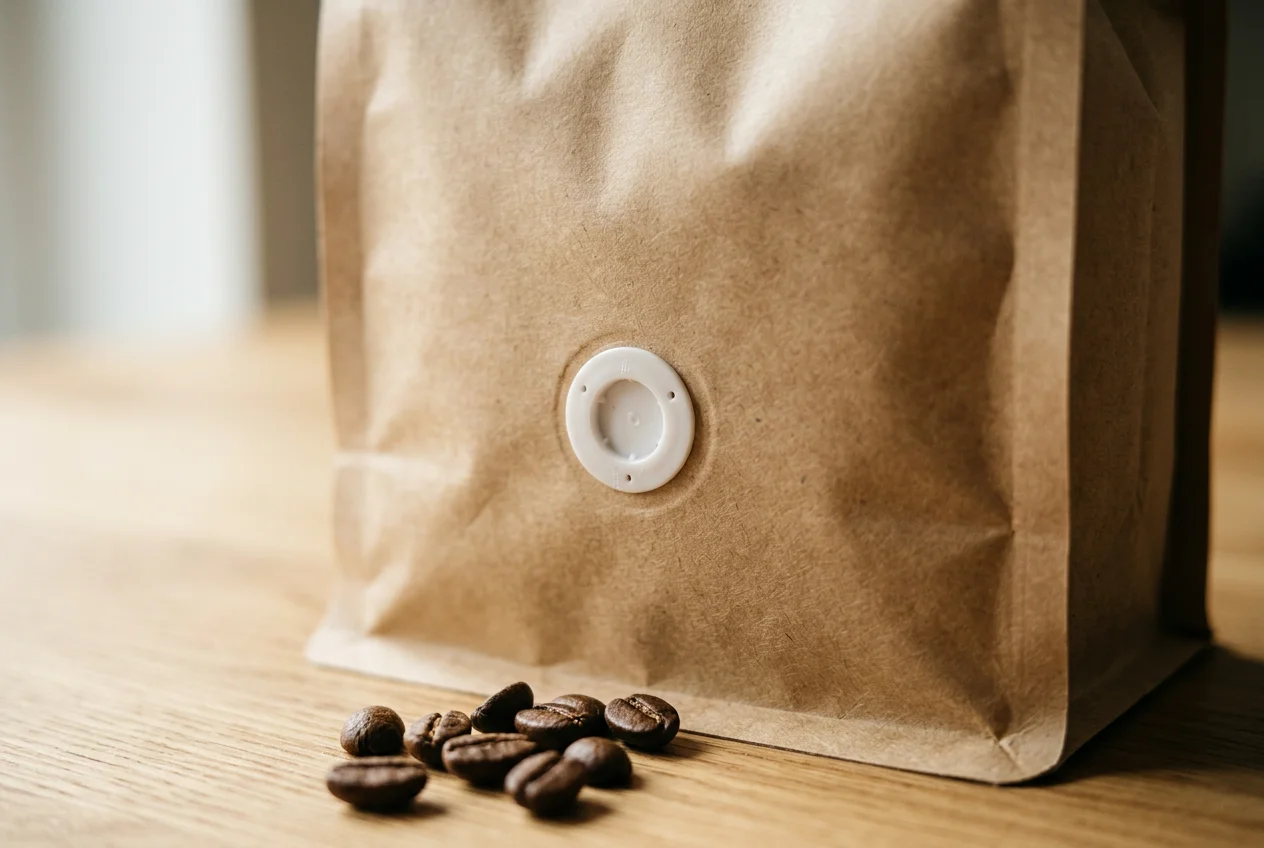
Most specialty coffee bags have a small round plastic valve on the front. It's a one-way degassing valve.
It lets built-up CO2 escape from the bag, while stopping outside air from getting in.
A common misconception
Many people believe that as coffee degasses in a valved bag, the CO2 pushes all the oxygen out, a bit like a gas flush.
That's not really how it works. The gas leaving through the valve takes air with it in roughly equal measure, so the share of oxygen inside the bag doesn't drop much.
The valve's real job is to stop the bag from inflating or bursting, while keeping fresh air from flowing back in. That's still very useful, but it's not a magic oxygen remover.
Why valves are essential for ground coffee
For whole beans, valves are helpful. For pre-ground coffee, they're a must.
Grinding massively increases the surface area of the coffee, which triggers an immediate, huge release of gas.
Seal freshly ground coffee in a bag without a valve and the pressure can build up enough to burst the seams.
What if my bag puffs up?
Now and then a valve sticks or fails, and a bag of whole beans inflates like a balloon. People often worry the coffee is ruined, or that it hasn't degassed properly.
In reality, the coffee is completely fine. It's degassing normally inside the bag. It might seem a touch fresher when you open it, but it's perfectly safe and delicious to brew.
The only small risk is with very dark roasts in a sealed, puffy bag. They can occasionally pop the seal.
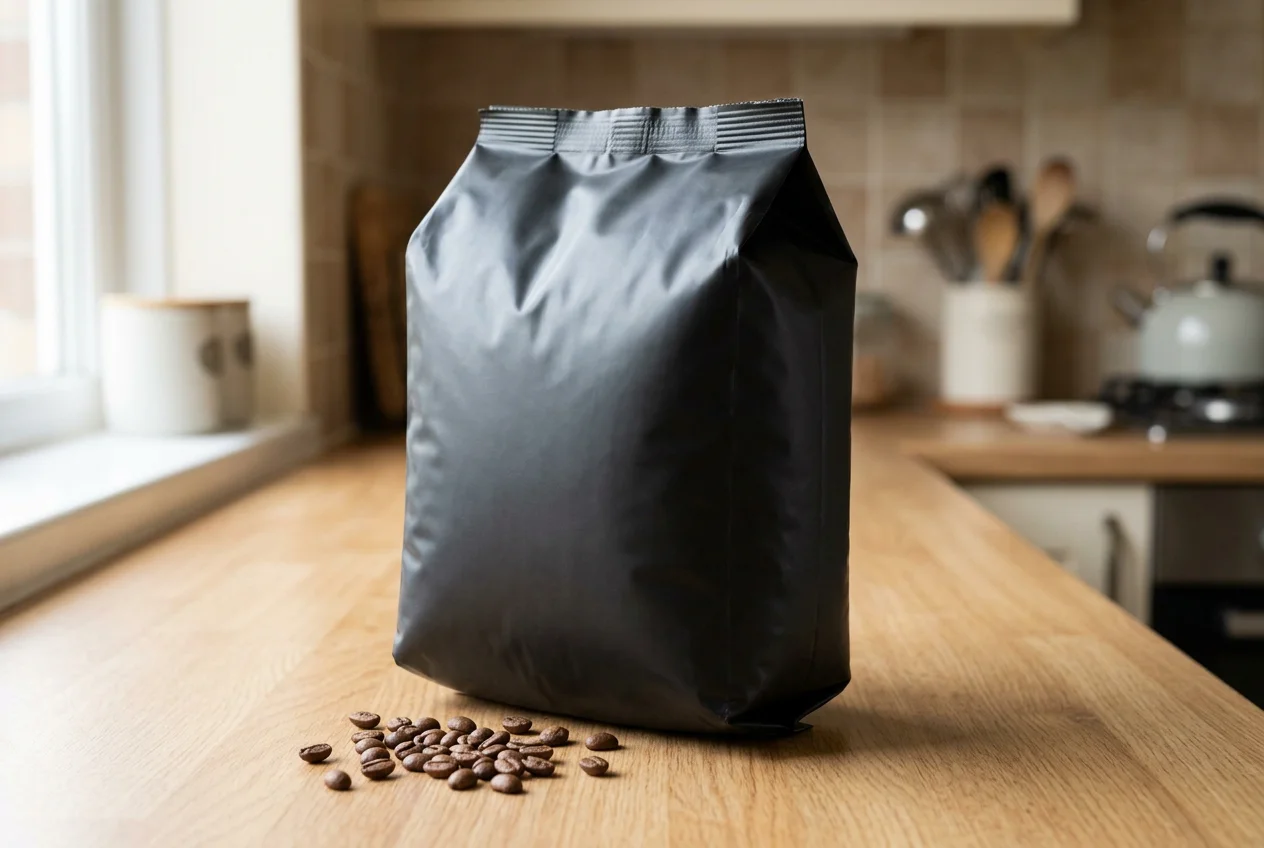
Our tip: If a bag puffs up and you're not ready to open it, just press gently on it to see if the valve releases. If it doesn't, the coffee can wait. Open it carefully when you're ready to brew.
Vacuum canisters that "leak"
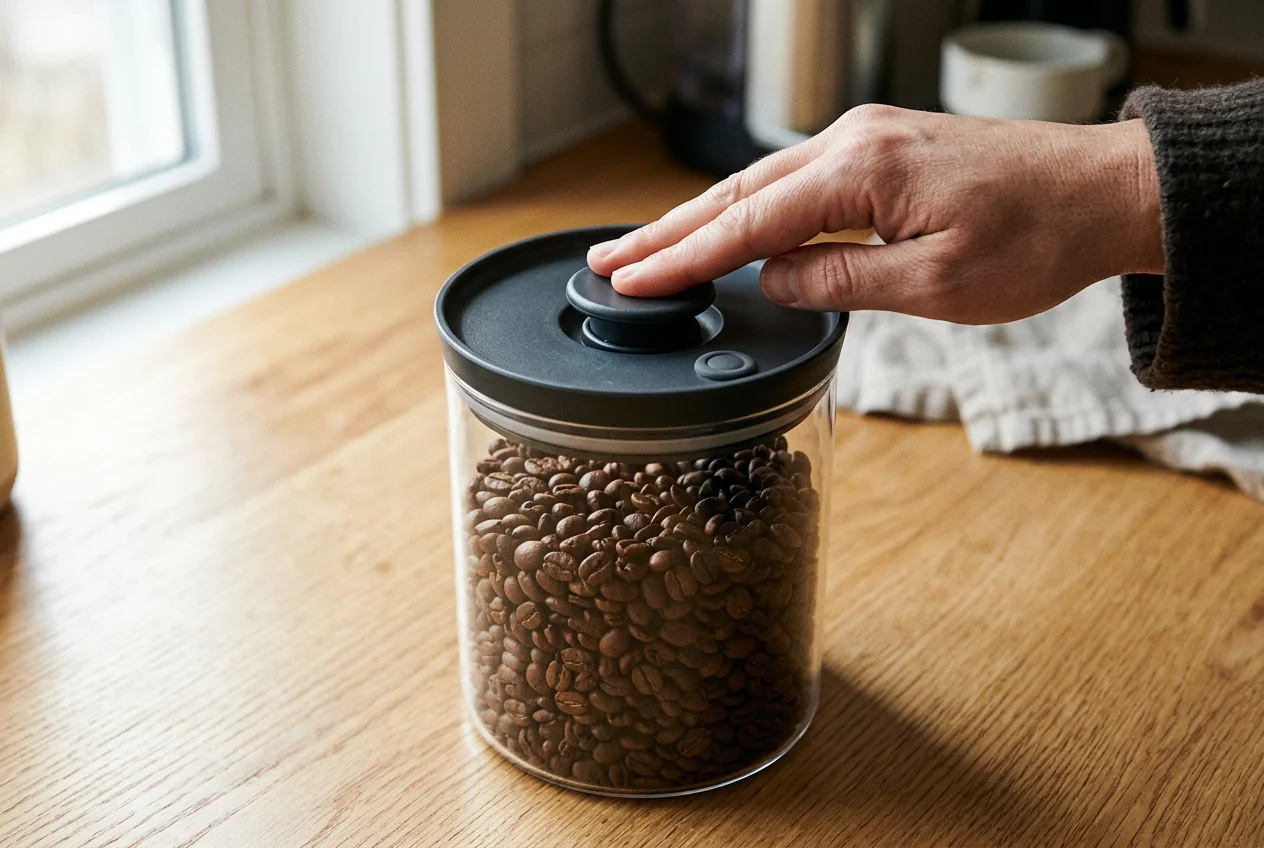
Lots of home brewers move their beans into canisters with a pump that pulls the air out.
With very fresh coffee, people often notice something odd. After a day or two, the vacuum indicator pops back up, and the canister seems to be leaking.
It isn't broken. It's physics.
Pumping out air removes oxygen and lowers the pressure inside. As the fresh beans keep degassing, they release CO2 into that empty space, and the pressure slowly rises until the indicator resets.
Pump it out a second time and it may take three or four days to equalize again. By then the heavy degassing phase is over, and the vacuum usually holds.
The important part: the canister hasn't filled up with fresh, staling oxygen. It's filled with harmless carbon dioxide from the beans themselves.
Can you speed up resting? Water quenching
Time is the usual way to degas coffee. But there's a way roasters can speed things up at the very end of the roast: water quenching.
How roasters cool coffee
In most specialty roasting, the hot beans drop out of the drum into a round, perforated cooling tray. A strong fan pulls room air through the beans and brings them down to room temperature in two or three minutes.
Large commercial batches are different. They hold so much heat that air alone can't cool them fast enough.
Without quick cooling, beans keep cooking in the tray. That can ruin the roast profile or even start a fire, especially with oily dark roasts.
What quenching does
To prevent that, large roasters use quenching. Right after the beans leave the roaster, a fine water mist is sprayed onto them while they're still above 400°F (about 205°C).
The water instantly turns into steam. That evaporation cools the beans almost immediately.
Coffee professionals have noticed that quenching also speeds up degassing a lot. Some roasters preparing beans on tight deadlines for barista competitions have used a light mist so espresso is ready in a couple of days instead of one or two weeks.
A study published in the Journal of Agricultural and Food Chemistry found the same thing: water-quenched coffees with higher moisture degassed faster than air-cooled ones.
The catches
- It stales faster. Quenched coffee loses its peak freshness sooner than air-cooled coffee.
- Every drop must evaporate. If any water stays in the beans, the coffee can taste flat and papery within days.
- It can be abused. Roasting removes roughly 15% of the coffee's weight. Two pounds of green coffee gives about 1.7 pounds of roasted beans. Some commercial roasters over-quench to add weight back, which means selling water at coffee prices. That coffee ages badly and tastes poor.
For home brewers, there's no safe way to copy this. Spraying water on your beans will only add moisture and speed up staling. Time is still your best tool.
Reading roast dates and best-before dates
All of this only works if you know when your coffee was roasted.
Roast date
Specialty roasters usually print the roast date on the bag. Count your resting days from that date, not from the day it arrived.
If your bag spent four days in the mail, a medium roast for filter may already be ready when you open the parcel.
Best-before date
Supermarket coffee often only shows a best-before date, sometimes a year or more after roasting. That tells you almost nothing about freshness.
Coffee like that is usually well past any resting window, so you can brew it straight away. Just don't expect the vibrant aromas of freshly roasted beans.
No date at all
If there's no roast date anywhere, assume it's old. Watch the bloom and taste it. A flat bloom and dull flavor tell you it's well past resting and into staling.
| Label shows | What it means | What I do |
|---|---|---|
| Roast date | You know exactly how old it is | Count rest days from it |
| Best-before only | Roast date unknown, often months ago | Brew right away |
| No date | Probably old | Check bloom and taste |
| Roasted to order | Very fresh on arrival | Rest before brewing |
Too fresh or too old? How to tell
Sour, thin coffee can come from beans that are too fresh, or from beans that are getting stale. The clues are different once you know what to look for.
| Clue | Too fresh | Well rested | Stale |
|---|---|---|---|
| Bloom | Huge, violent | Steady rise | Barely moves |
| Espresso flow | Erratic, spurting | Even, predictable | Fast and thin |
| Crema | Bubbly, foamy | Fine, lasting | Thin, pale |
| Aroma | Strong, a bit sharp | Sweet, complex | Faint, papery |
| Taste | Sour, tangy, smoky | Sweet, balanced | Flat, woody |
The quickest test is the bloom. A lively, foamy bloom plus sourness points to gas. A flat bloom plus dullness points to age.
Remember the light-roast exception. A properly rested light roast can still have modest bloom and thin crema, simply because it never had as much gas to begin with.
Find your own resting window
The best way to learn resting is to taste one coffee as it changes. It's simple and genuinely fun.
- Pick one bag.Choose a coffee with a clear roast date, ideally one you'll brew the same way every day.
- Keep the recipe fixed.Use the same dose, water, ratio and grind setting each time, so the only thing changing is the coffee's age.
- Brew on set days.Try it on day 2, 4, 7, 10, 14 and 21 after roast.
- Write down three things.Note the bloom or shot behavior, the sweetness and any sourness.
- Spot your peak.Look for when sourness drops away and sweetness rises, and when it starts to fade again.
- Use it next time.Apply what you learned to similar coffees from the same roaster.
A grinder that gives consistent particles makes this test much more reliable. If you're still using a blade grinder, my burr vs blade grinder guide explains why the switch matters.
Our tip: Freeze a few single portions on different days, then taste them side by side on the same morning. It's the easiest way to taste the effect of resting without relying on memory.
My own resting experiment
I ran the test above with a light-roasted washed coffee from a high-altitude farm, brewing both pour-over and espresso.
On day 2, the pour-over was bright but sharp, with a tangy finish. The espresso was a mess: fast, spurting shots that tasted sour no matter what I did.
By day 7, the pour-over had turned sweet and floral. That was the first cup I'd happily serve to friends. The espresso was better, but still a little sharp and hard to keep consistent.
Around day 12, the espresso finally settled. Shots ran evenly at the same setting and tasted like ripe fruit instead of lemon juice.
The pour-over stayed lovely right through week three. After about week four, I started to notice the aromas fading.
The lesson for me was clear. The same bag had two different "ready" dates depending on how I brewed it, and both windows were wide.
Planning your bags so coffee is always ready
Once you know your resting times, the real trick is planning. You want a rested bag ready when the current one runs out.
- Know your usage.Work out roughly how many days a bag lasts you.
- Order one bag ahead.Order the next bag when the current one is about half empty, or earlier for light-roast espresso.
- Leave new bags sealed.Keep the incoming bag sealed in a cool, dark cupboard while it rests.
- Freeze extras once rested.If you have more coffee than you'll use in a few weeks, freeze portions after they've rested.
- Use dark roasts sooner.Dark roasts are ready fast and fade fast. Don't let them sit for weeks.
With this little rhythm, I almost never have to brew coffee that's too young. And I rarely end up with a bag going stale at the back of the cupboard.
Resting mistakes I see all the time
Using one rule for every coffee
"Always wait a week" sounds tidy, but a week is too long for a dark roast and too short for light-roast espresso.
Freezing coffee on roast day
The freezer pauses degassing, so the coffee comes out just as gassy. Rest first, then freeze.
Blaming the grinder
Shots that drift slower every day with a new bag are often just degassing at work. Before you blame your grinder or machine, check the roast date.
Judging light roasts by crema
Thin crema on a light roast isn't a sign of old coffee. Taste it before you decide.
Resting dark roasts too long
Dark roasts don't get better with weeks of rest. Their oily surface oxidizes quickly, so drink them while they're fresh.
Opening the bag every day to "let it breathe"
Opening the bag lets gas out, but it lets oxygen in too. Keep it sealed. The valve handles the gas.
Spraying beans with water
Copying a roaster's quench at home just adds moisture. Your coffee will go stale faster without resting any better.
Coffee freshness myths
"The fresher, the better"
Up to a point. Coffee on roast day is too gassy to extract evenly, especially as espresso. Most coffee tastes best after some rest.
"Dark roasts need the longest rest because they have the most gas"
They do have the most gas, but it escapes fast because the beans are so porous. Light roasts need longer.
"The valve flushes all the oxygen out of the bag"
The escaping gas takes air out with it, so oxygen levels don't drop much. The valve mostly stops bursting and keeps fresh air out.
"A puffy bag means the coffee has gone bad"
It just means the valve didn't release. The coffee inside is fine.
"My vacuum canister is broken"
If the indicator pops up after a day or two, it's CO2 from the beans, not air leaking in.
"Thick crema means fresh coffee"
Crema shows gas, roast level and bean type. Very fresh coffee makes lots of bubbly crema, and light roasts make little even when rested.
"Resting will make cheap coffee taste amazing"
Resting smooths out harsh, gassy edges. It can't add flavor that isn't in the beans.
My summary checklist
- Check the roast date.Count resting days from roasting, not from delivery.
- Match rest to brew method.Espresso needs much more rest than filter coffee.
- Match rest to roast level.Dark roasts are ready soonest, light roasts need longest.
- Think about density.High-grown, dense coffees need a few extra days.
- Adjust for temperature.Warm homes shorten rest, cool homes stretch it.
- Rest before freezing.The freezer pauses degassing, it doesn't do it for you.
- Keep bags sealed while resting.Let the valve do its job in a cool, dark place.
- Let your taste decide.Use the numbers as a starting point, not a rule.
Above all, resting should never stop you from enjoying your daily cup. It's a practical tool that makes coffee easier to extract and smooths out harsh, gassy edges.
It isn't magic. It won't turn a poorly roasted or low-quality coffee into something extraordinary. And brewing a day or two early won't make you miss a life-changing flavor that wasn't already in the beans.
Use these timeframes as flexible guidelines, taste your coffee as it changes over the days, and let your own palate be the judge.
Frequently asked questions
What does degassing coffee mean?
Degassing is the slow release of carbon dioxide from roasted coffee. Roasting creates lots of CO2, and some stays trapped in the beans before leaking out over the following days and weeks.
How long should I rest coffee before brewing?
For filter coffee, about 2 days for dark roasts, 4–5 days for medium and 5–10 days for light. For espresso, about 2–4 days for dark, 8–10 days for medium and 10–14 days for light roasts.
Why does espresso need more rest than filter coffee?
Espresso forces water through the coffee at high pressure. Trapped gas then bursts out inside the puck, causing channeling, erratic flow and sour shots. Filter coffee handles gas easily with a bloom.
Why do light roasts need longer to rest?
Light roasts are denser and less porous, so their gas escapes slowly even though they contain less of it. Dark roasts are porous and release gas quickly.
Can I brew coffee the day after roasting?
Yes, especially for filter coffee. It may taste a bit sharp or under-extracted, but it's perfectly drinkable. Use a longer bloom and a gentle stir.
Does freezing coffee stop degassing?
Almost completely. That's why you should rest coffee to your preferred point before freezing it. Frozen beans come out with their gas still inside.
Is a puffy coffee bag safe?
Yes. A puffy bag usually means the valve didn't release. The coffee is degassing normally and is safe and good to brew.
Does the one-way valve remove oxygen from the bag?
Not really. The gas leaving the bag takes air with it, so the oxygen share inside doesn't drop much. The valve stops the bag bursting and keeps outside air from flowing in.
Why does my vacuum canister lose its vacuum?
Fresh beans keep releasing CO2 into the canister until the pressure equalizes. It's not air leaking in. After a second pump and a few days, the vacuum usually holds.
Why is the crema on my light roast espresso so thin?
Light roasts produce much less CO2 during roasting, so they never make thick crema. Thin crema on a light roast doesn't mean the coffee is old.
What is water quenching?
It's when roasters spray a fine mist of water on hot beans to cool them quickly. It speeds up degassing but also makes coffee go stale faster, and over-quenching adds water weight.
How do I know if my coffee is too fresh or stale?
Too-fresh coffee has a huge bloom, erratic espresso and sour, tangy flavors. Stale coffee has a flat bloom, thin crema and dull, papery flavors.

- Michael Reynolds, personal notes from home brewing and resting tests
- Time-resolved gravimetric method to assess degassing of roasted coffee, Journal of Agricultural and Food Chemistry
- Influence of water quench cooling on degassing and aroma stability of roasted coffee, Journal of Agricultural and Food Chemistry
- What is the shelf life of roasted coffee? A literature review on coffee staling, Specialty Coffee Association
Related guides
How to store coffee beans Coffee roast levels explained How coffee is roastedWritten by Michael Reynolds. Last updated November 16, 2026.