Moka Pot vs Espresso: Pressure, Taste, Crema and Which One You Should Use
A stovetop moka pot costs about the price of a bag of good coffee. A serious espresso machine can cost thousands. Both make small, strong coffee, but they work in completely different ways. I brewed the same beans in both, side by side, to show you exactly how they differ and how to get the best from a moka pot.
We choose products independently. We may earn a commission through links on this page; your price stays the same. Affiliate policy
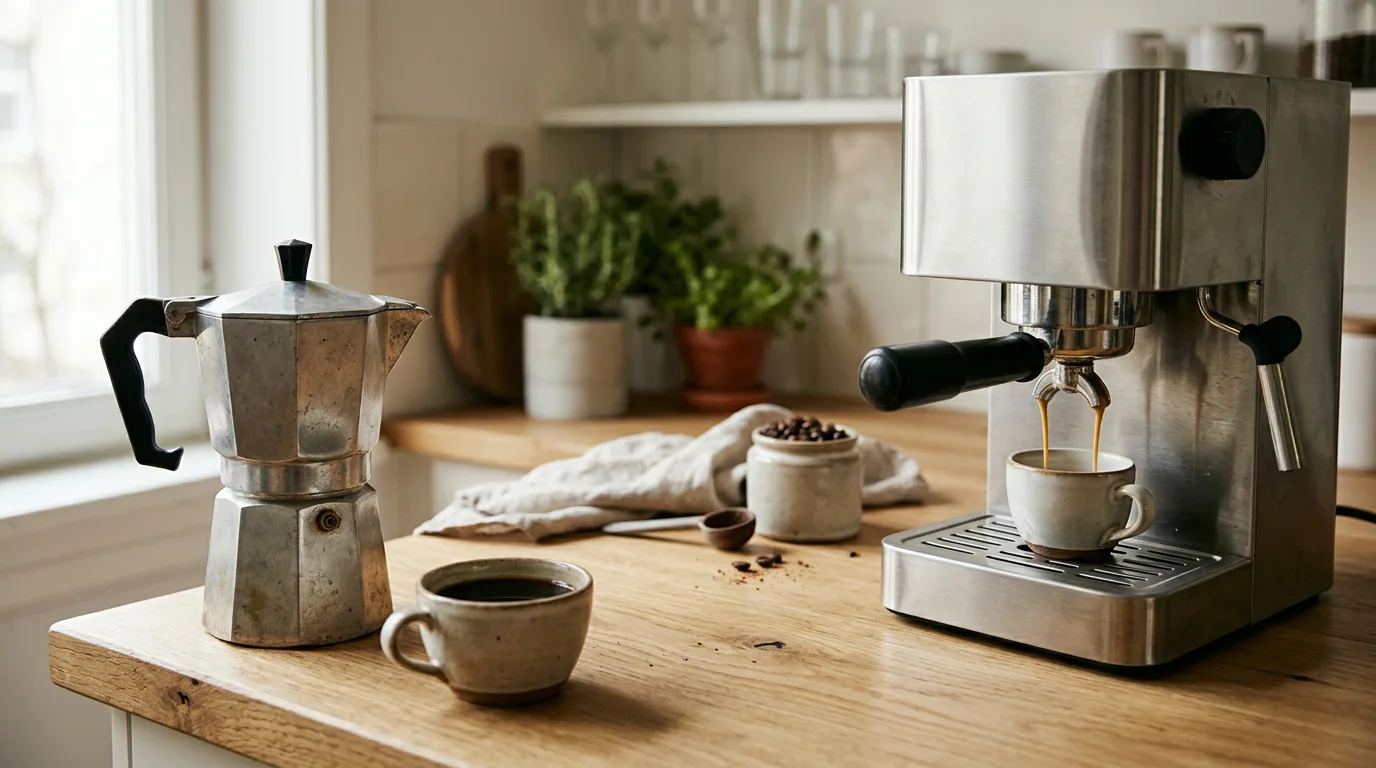
A moka pot uses steam pressure from a stovetop to push water through coffee at about 1 to 1.5 bar. An espresso machine uses a pump at around 9 bar. That's why espresso is thicker, more intense and topped with crema, while moka pot coffee is strong and rich but lighter-bodied, hotter and without real crema. Brewed carefully, with a medium-coarse grind, pre-heated water, no tamping and a quick stop when it starts to sputter, a moka pot makes smooth, non-bitter coffee that's excellent in milk drinks, for a tiny fraction of the cost.
Why I compared them
I've owned both for years. My espresso machine is the centerpiece of my kitchen. My moka pot lives in a drawer and comes out on camping trips, at friends' houses and on mornings when I can't be bothered to warm up the machine.
People constantly ask me whether a moka pot is "basically espresso" and whether they really need an expensive machine. The honest answer is more interesting than yes or no.
There's also a lot of confusing advice out there. Some guides tell you to pack the moka basket tightly, others say to use the finest grind you can, and many recipes start with cold water. In my experience, all three are the main reasons people end up hating their moka pot. I wanted to test the advice properly instead of repeating it.
So I brewed the same fresh medium-roast beans in both, side by side, black and with milk, and paid attention to every difference: pressure, grind, temperature, crema, aroma, body and bitterness. This guide is the result, plus the moka pot technique that made the biggest difference.
What you'll learn
- How each brewer works, and why that matters.
- Why moka pot coffee often tastes bitter, and how to fix it.
- A step-by-step moka pot method that really works.
- Side-by-side differences in crema, aroma, taste and body.
- Which one to choose for your budget and habits.
Moka pot vs espresso at a glance
| Metric | Espresso machine | Moka pot |
|---|---|---|
| Typical cost | Hundreds to thousands | Around $20-50 |
| Pressure source | Electric pump | Steam from stovetop heat |
| Pressure | ~9 bar (~130 PSI) | ~1-1.5 bar (~14-21 PSI) |
| Brew temperature | ~194°F, controlled | Close to 212°F |
| Grind | Very fine, like powdered sugar | Medium-coarse, like coarse salt |
| Tamping | Yes, firm and level | No, leave it loose |
| Crema | Thick, golden | Little to none |
| Aroma | Chocolate, bright, complex | Warm, toasted, nutty |
| Body | Syrupy, intense | Smooth, lighter |
| Best for | Straight shots and cafe drinks | Budget home brewing and lattes |
A short history of both
The espresso machine came first. In the early 1900s, Italian inventors in Turin and Milan developed machines that used steam pressure to brew coffee quickly, one cup at a time, for busy bars. After the Second World War, lever machines that pushed water through the coffee at much higher pressure created espresso as we know it today, with its layer of crema.
The moka pot arrived in between, in 1933, when Alfonso Bialetti's company introduced the octagonal aluminum stovetop brewer. It brought something like bar coffee into ordinary homes without needing an expensive machine. Its design has barely changed since, and it's estimated that the large majority of Italian households own one.
So the two grew up side by side: the espresso machine at the bar, the moka pot at home. That's still largely how Italians use them, an espresso at the counter and a moka pot on the stove. More in espresso crema explained.
How I tested
To make the comparison fair, I used the same fresh medium-roast beans, roasted about ten days earlier, for both methods. I ground them on the same burr grinder, finer for espresso and medium-coarse for the moka pot.
I brewed a double espresso at roughly 18 grams in and 36 grams out in about 28 seconds, and a 3-cup moka pot using the method in this guide. Then I made a second moka pot the "careless" way: cold water, high heat, tamped coffee and left to sputter. I tasted all three black, then again as cappuccinos with the same steamed milk.
I also asked three friends to taste the cappuccinos blind. That's where the most interesting result came from: two of the three couldn't reliably tell the moka cappuccino from the espresso one.
Is moka pot coffee espresso?
Technically, no. True espresso is defined by high-pressure extraction, typically around 9 bar from a pump. That pressure emulsifies coffee oils and creates a dense, concentrated shot topped with crema.
A moka pot works by thermal expansion and steam pressure on a stovetop. It reaches only a fraction of that pressure, so it can't produce true espresso.
But that doesn't make moka coffee second-rate. Brewed with care, it's rich, strong and smooth, closer to espresso than to filter coffee, and especially good as the base for milk drinks. In Italy, it's what most people drink at home every day. More on that in Italian coffee culture.
How a moka pot is built
A moka pot has three main parts.
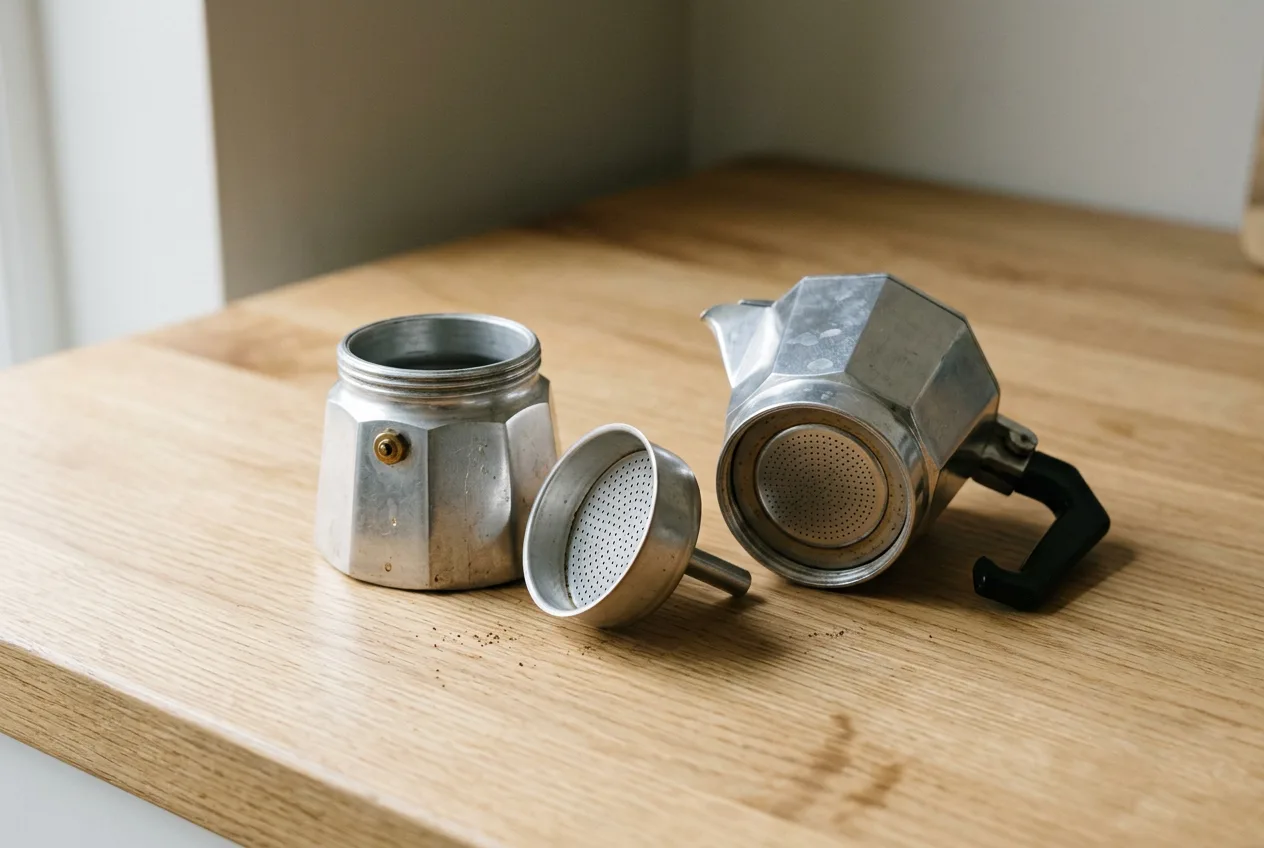
- The base (bottom chamber): holds the water. It has a pressure relief valve, a safety device that releases steam if pressure gets too high.
- The filter basket: a funnel-shaped metal basket that sits inside the base. Its hollow stem reaches down into the water; the perforated cup at the top holds the coffee.
- The upper chamber: where the finished coffee collects. Underneath, it has a rubber or silicone gasket and a metal filter screen. Screwed onto the base, the gasket creates an airtight seal.
How a moka pot works
As the water in the base heats up, some turns to steam. Because the pot is sealed, that steam builds up in the space above the water and presses down on it.
The only way out for the water is up the funnel stem. So the pressure forces hot water up through the coffee bed, through the upper filter screen and out of the central spout into the top chamber.
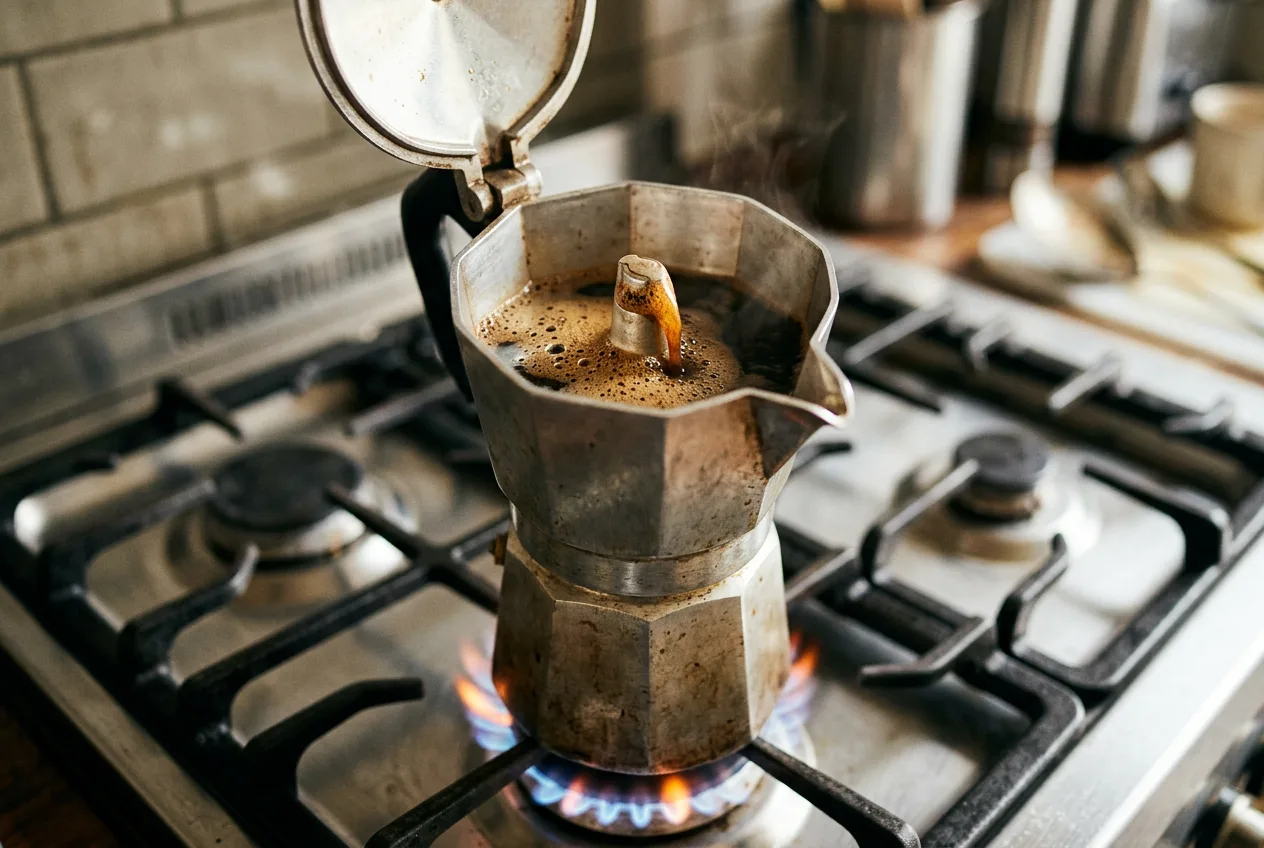
The flow isn't constant either. It starts slowly as pressure builds, flows steadily through the middle of the brew, and then speeds up and sputters at the end as the water runs out and steam takes over. That changing flow is one reason the first and last parts of a moka brew taste different, and why stirring the coffee in the top chamber before pouring gives a more balanced cup.
It's clever, simple and needs no electricity beyond your stove. But it also means the water is close to boiling, and the process keeps going as long as there's heat, which is where most moka pot problems come from.
Why moka pot coffee often tastes bitter
The most common complaint about moka pots is bitter, burnt or harsh coffee. In almost every case, it's over-extraction, caused by one or more of these:
- Too much heat: water is forced through too violently and the coffee scorches.
- Too long on the stove: the dry grounds and metal heat up for minutes before brewing starts.
- Too fine a grind: the bed clogs, flow stalls and extraction drags on.
- Tamping or overpacking: too much resistance for such low pressure.
- Letting it sputter: the final burst of steam drags harsh compounds through the spent grounds.
Fix those, and moka pot coffee changes completely. For more on bitterness in general, see why coffee tastes bitter or sour.
How to brew a great moka pot: step by step
Step 1: beans and grind
Start with fresh whole beans and grind just before brewing. Use a medium-coarse grind, noticeably coarser than espresso, roughly like coarse sea salt or fine sand.
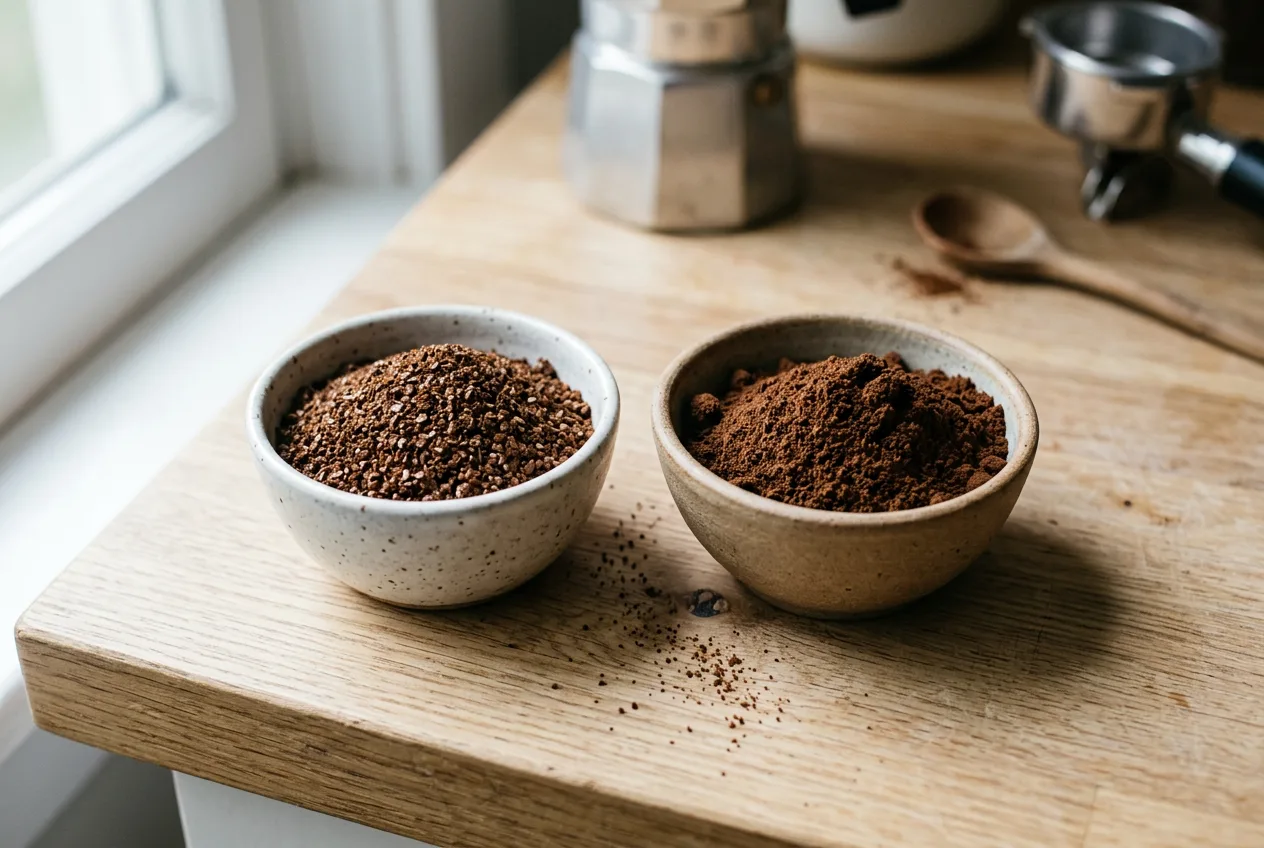
Too fine and the bed packs tightly, clogs the filter and the coffee scorches and over-extracts.
Step 2: pre-heat the water
Boil water in a kettle first, then pour it into the base up to just below the pressure relief valve. Never cover the valve.
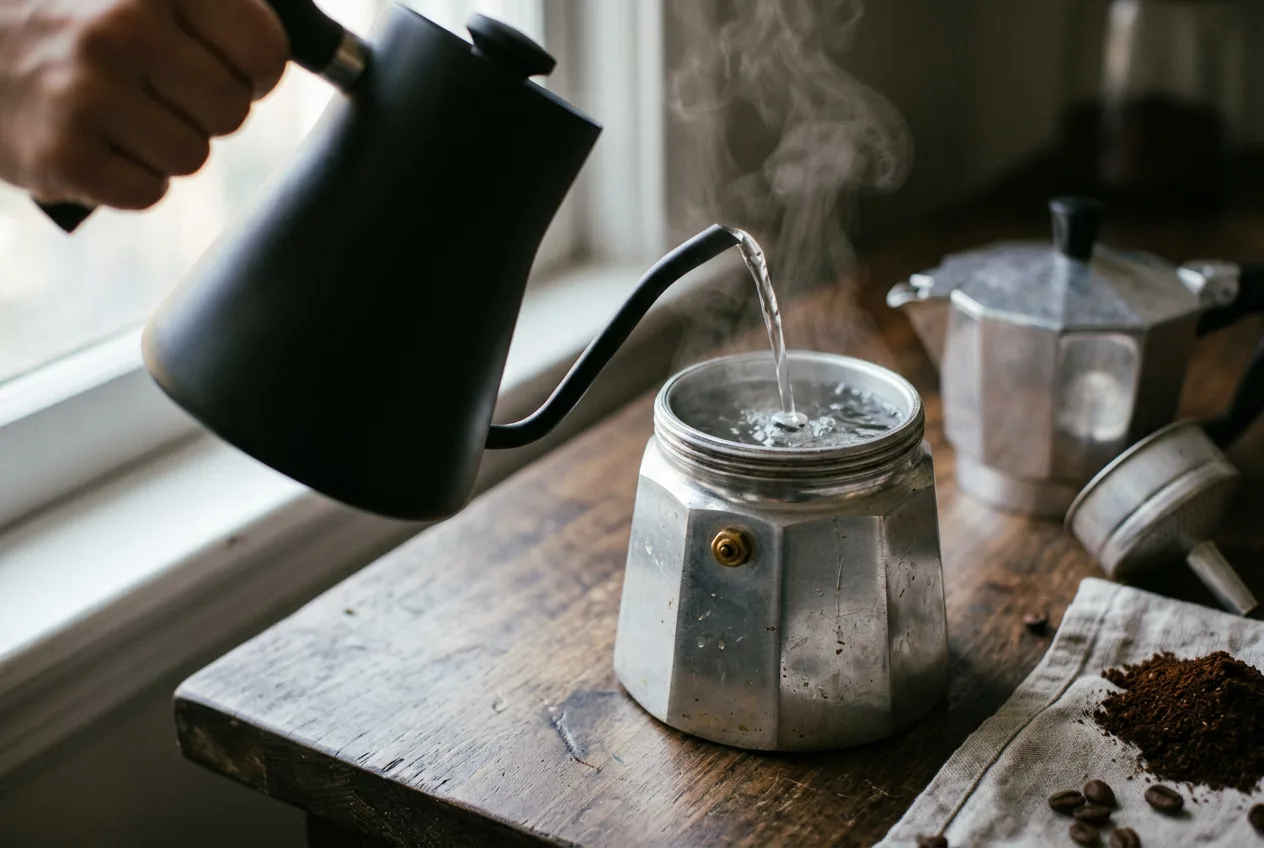
This is the single biggest improvement you can make. With cold water, the pot sits on the burner for several minutes before brewing even starts, effectively baking the dry grounds and giving a metallic, bitter taste. Hot water starts extraction almost right away, shortening contact time and keeping the sweetness.
Step 3: fill the basket, don't tamp
Using a towel or oven mitt (the base will be hot), put the filter basket in place and fill it to the rim with coffee. Level the top gently with a finger.
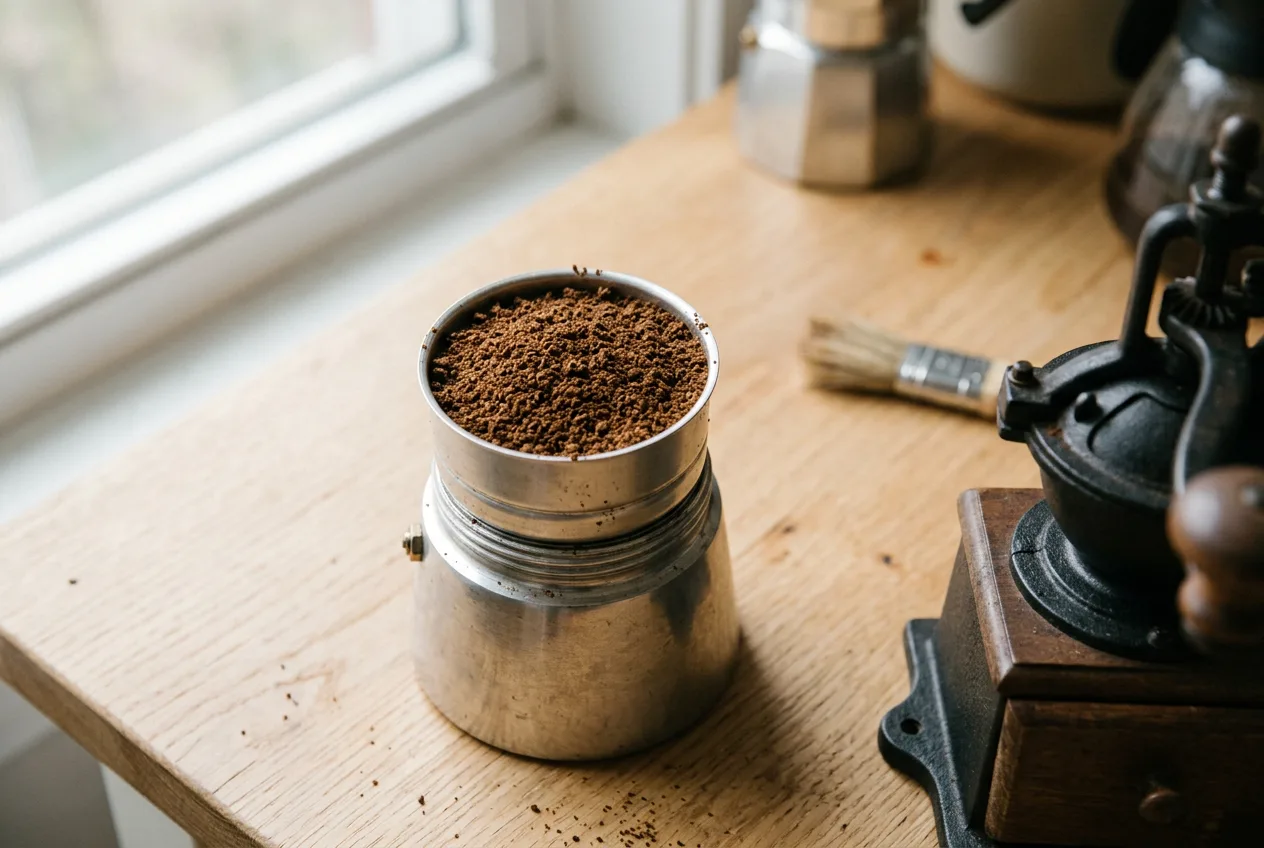
Do not press or tamp the coffee. A moka pot's low pressure can't push water through a compressed bed. Tamping causes stalled flow, extreme over-extraction and harsh bitterness.
Step 4: assemble and heat gently
Screw the top on firmly so the gasket seals. Put the pot on medium or medium-low heat; high heat forces water through too violently. Leave the lid open to watch.
Step 5: stop at the first sputter
Dark coffee will ooze steadily from the spout. When the base is nearly empty, air and steam mix with the last of the water and you'll hear a gurgling, sputtering or whistling sound.
The moment you hear it, take the pot off the heat. Then hold the base under cold running water for a few seconds. That rapidly cools the base, collapses the steam pressure and stops extraction instantly.
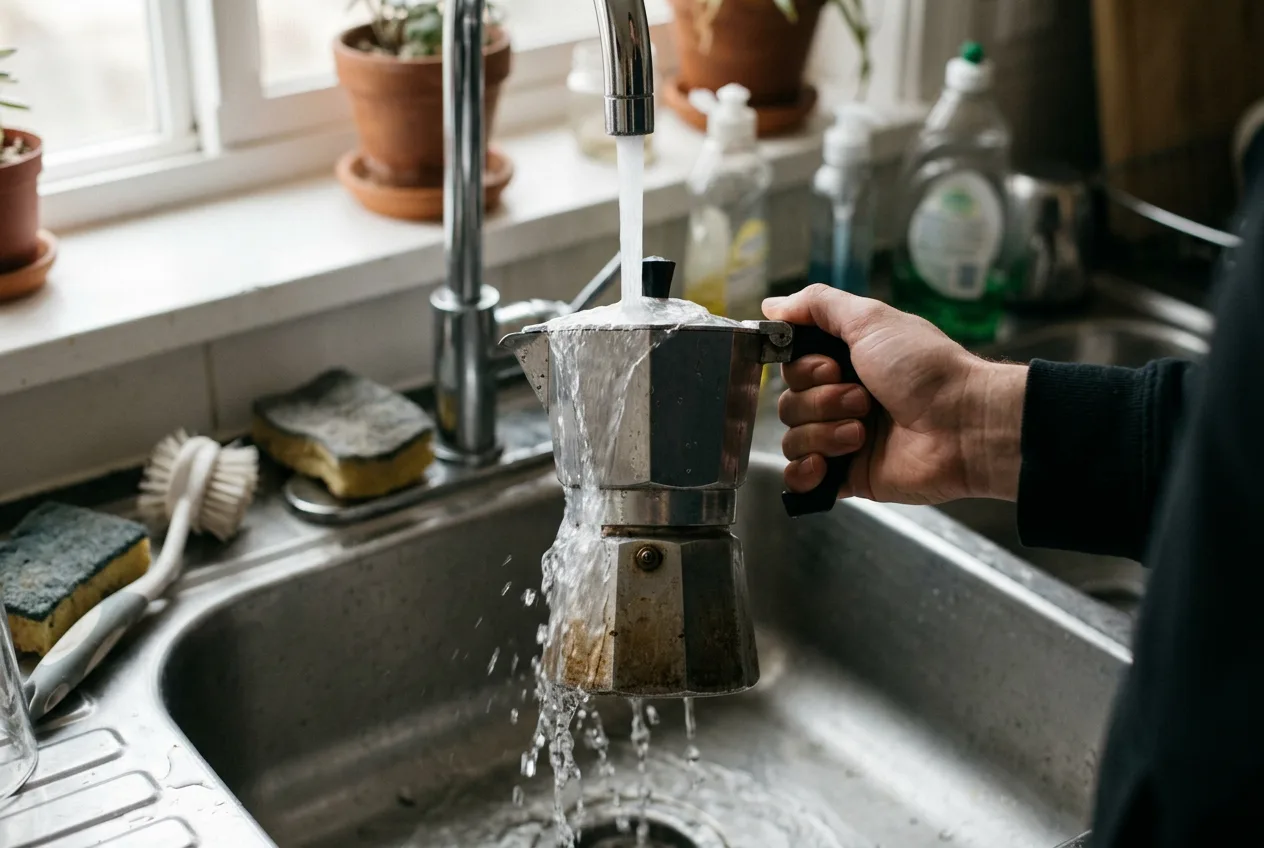
Step 6: serve
Stir the coffee in the top chamber, since the first and last parts of the brew taste different, and pour. Set the hot pot on a cork mat or trivet to protect your table.
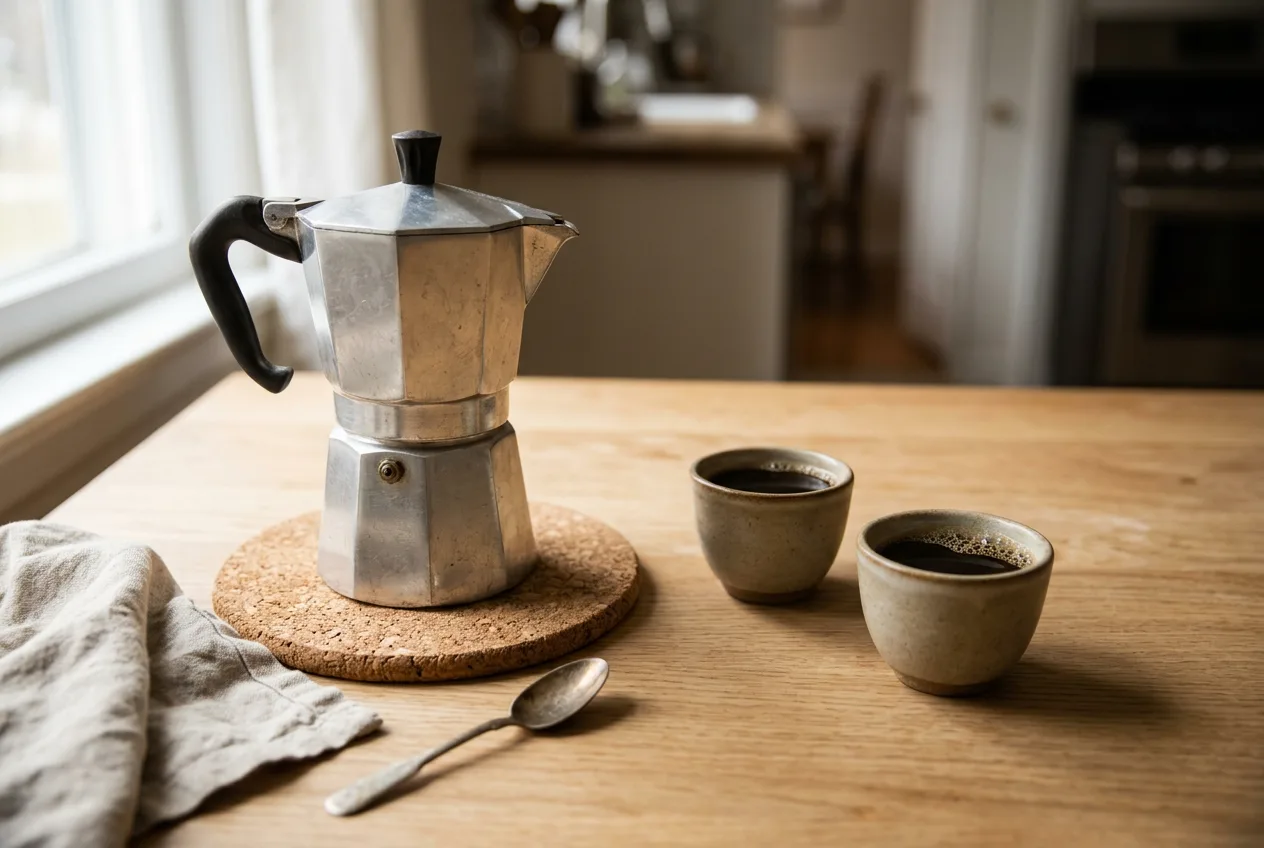
- Grind medium-coarseLike coarse sea salt.
- Pre-boil the waterFill to just below the valve.
- Fill the basket looselyLevel it; never tamp.
- Medium-low heat, lid openWatch the flow.
- Stop at the first gurgleThen cool the base under cold water.
- Stir and serveUse a trivet for the hot pot.
Our tip: If your coffee flows out pale and fast, the heat is too high or the grind is too coarse. If it barely trickles, the grind is too fine or the basket is overfilled.
How an espresso machine works
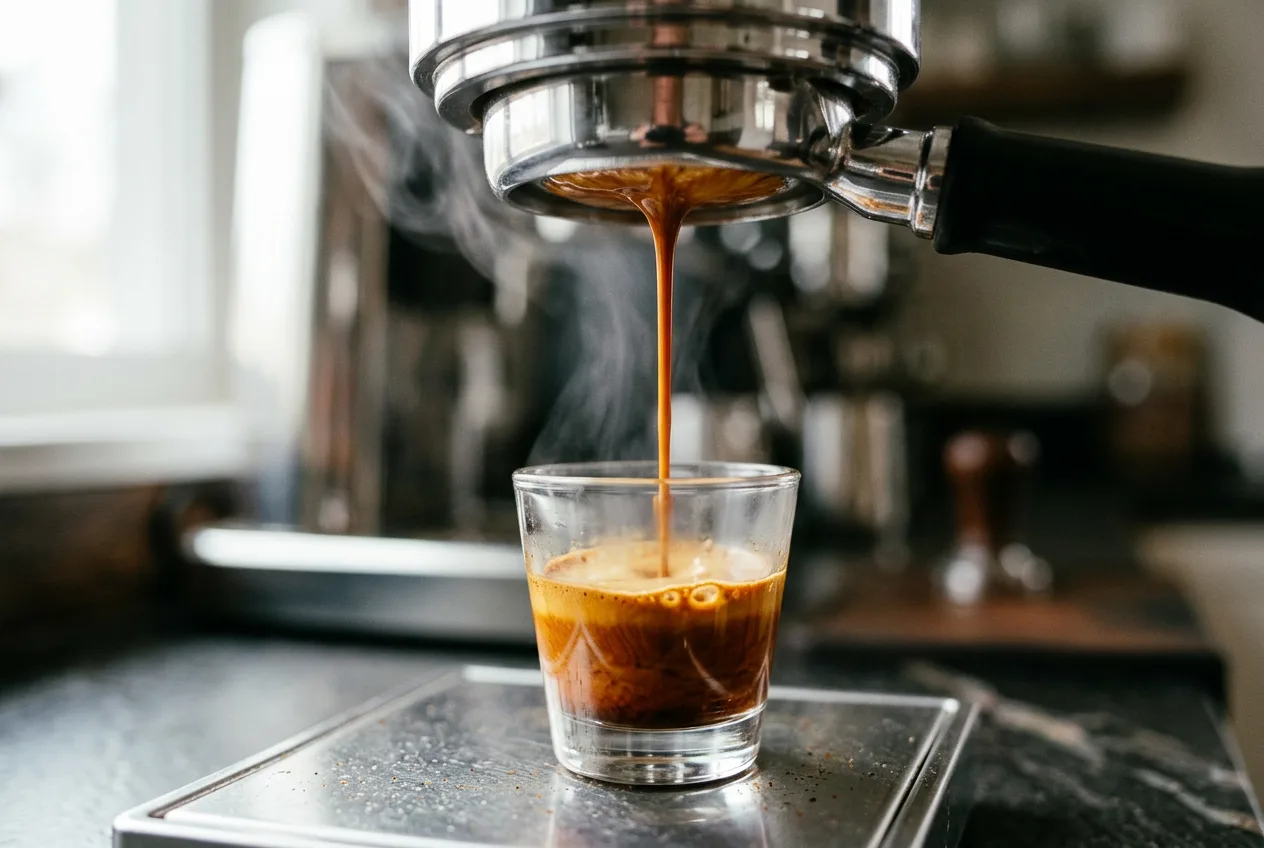
An espresso machine uses an electric pump, rotary or vibratory, to generate force. It heats water in a boiler or thermoblock to a precise, stable temperature, typically around 194°F, below boiling, and pushes it through the coffee at about 9 bar, roughly 130 PSI.
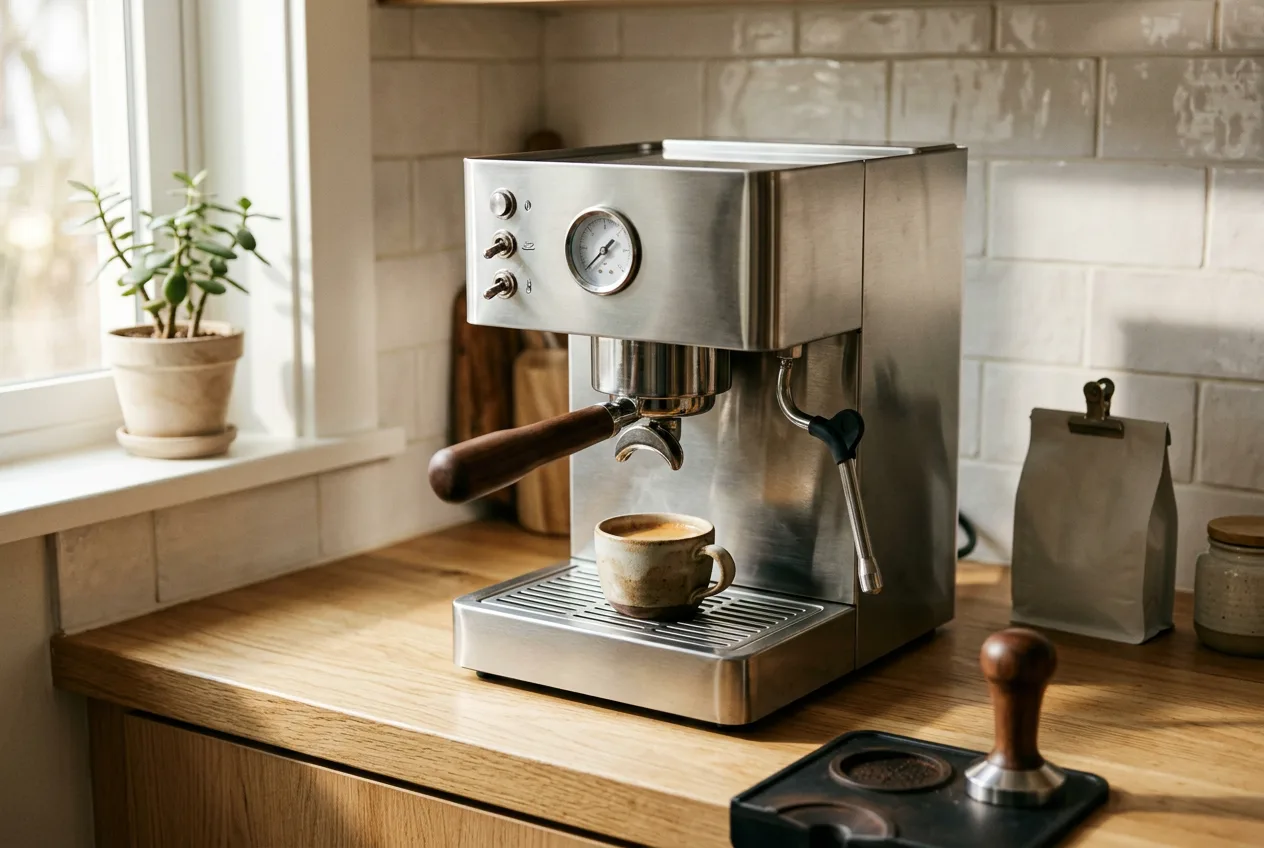
That combination of controlled temperature and high pressure is what makes espresso: a short, concentrated, syrupy shot in about 25 to 30 seconds. For more on shot styles, see ristretto vs espresso vs lungo.
Dialing in espresso: the basics
If you go the espresso machine route, expect a learning curve. "Dialing in" means adjusting until a shot tastes balanced. The three main levers are dose, yield and time.
- Pick a doseStart with about 18 grams of coffee in a double basket.
- Aim for a ratioAround 1:2, so about 36 grams of espresso in the cup.
- Time the shotLook for roughly 25 to 30 seconds from starting the pump.
- Taste and adjustSour and thin? Grind finer. Bitter and harsh? Grind coarser.
- Change one thing at a timeUsually the grind, so you know what made the difference.
A moka pot has far fewer variables: grind, heat and when you stop it. That simplicity is a big part of its appeal. For a deeper dive into how extraction works, see coffee extraction explained.
Pressure: the key difference
Brewing pressure compared
An espresso machine works at roughly six to nine times the pressure of a moka pot. That gap affects everything: how fine you grind, whether you tamp, how much is extracted and whether you get crema.
Grind size and tamping
With 9 bar of force, espresso needs a very fine grind, like powdered sugar or flour, to give enough resistance. Without it, water gushes through in seconds and the shot is weak and sour.
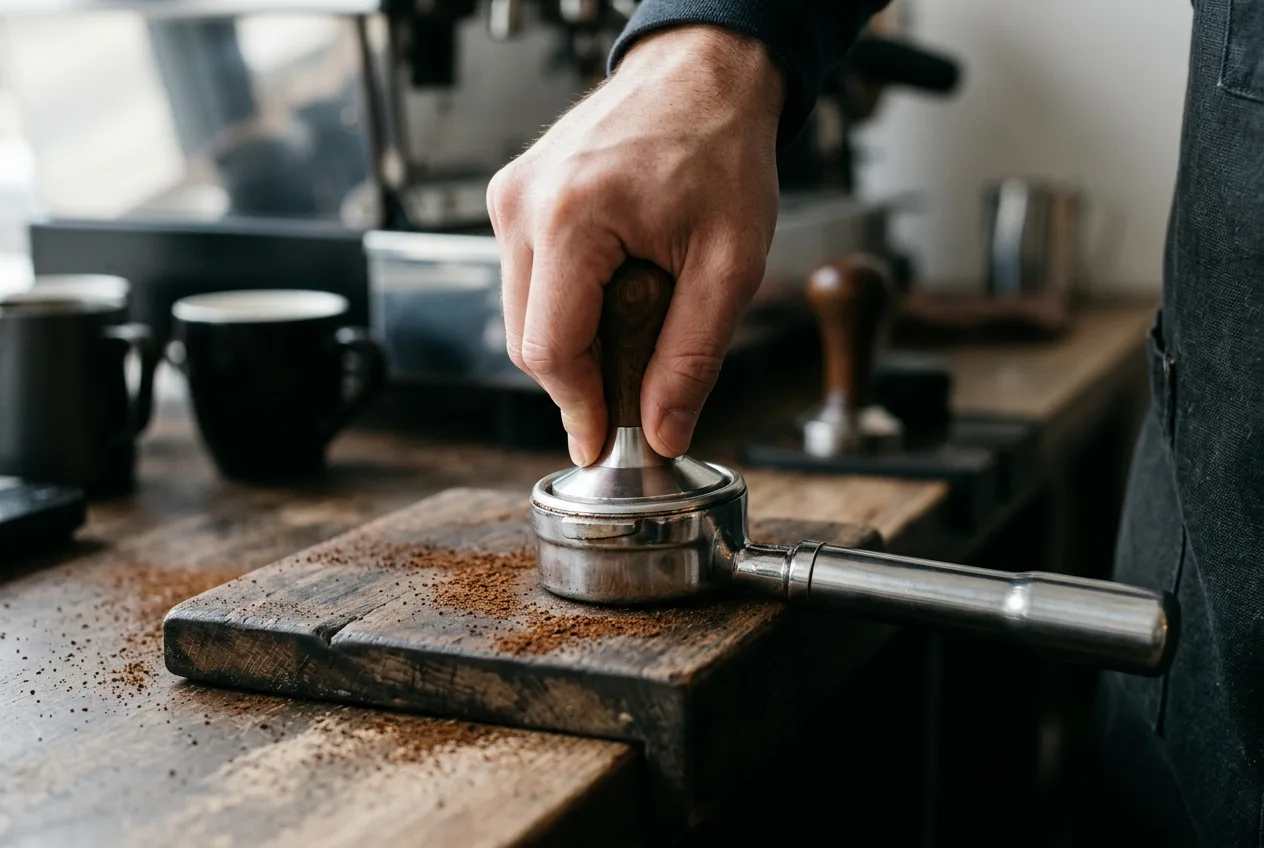
After dosing the basket, you tamp: press the grounds firmly and evenly into a dense, level puck. That removes air pockets so water flows evenly through every particle.
A moka pot is the opposite: coarser grind, no tamping. Use espresso-fine coffee and tamp it in a moka pot, and you'll get a stalled, burnt, bitter brew. Getting grind right is easier with a good burr grinder; see burr vs blade grinder.
Appearance and crema
Side by side, the difference is obvious before you take a sip.
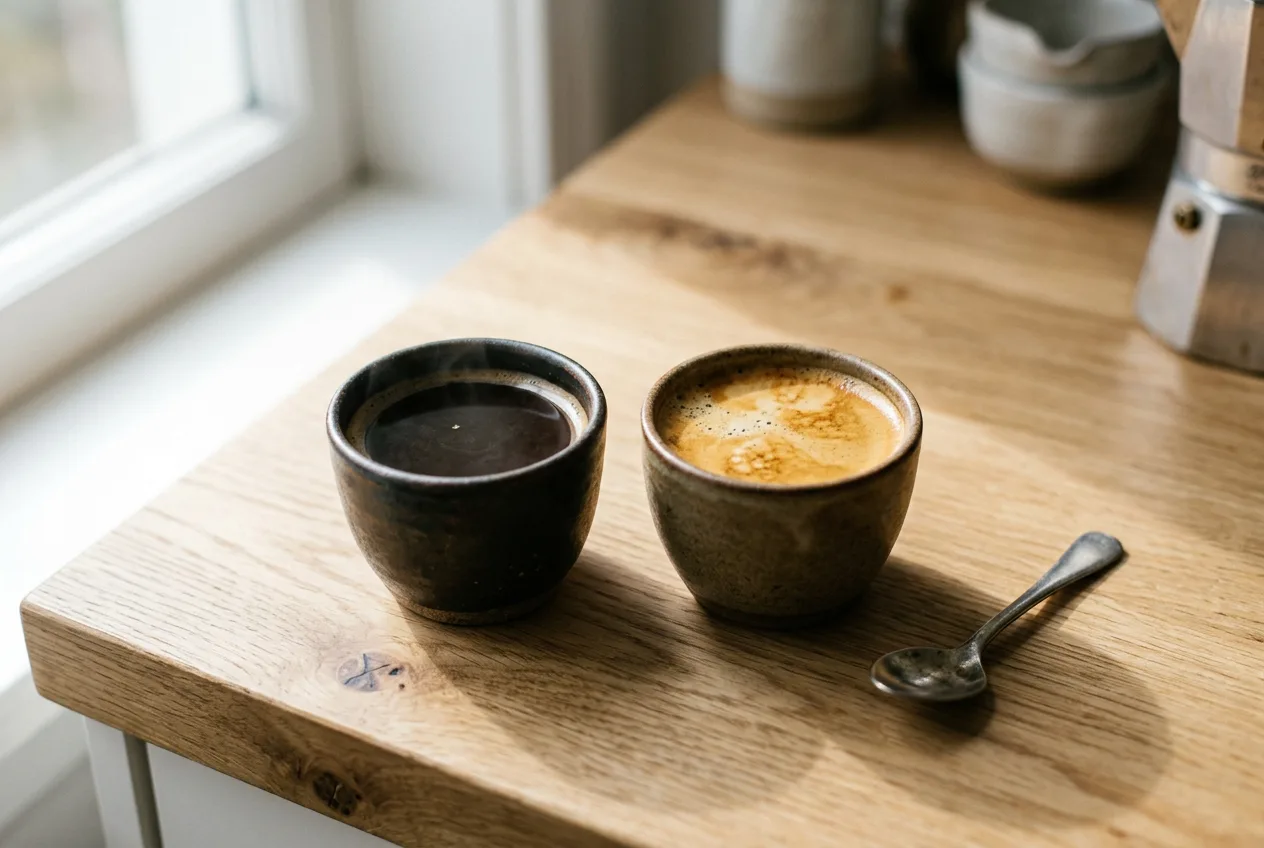
The espresso has a thick, tiger-striped layer of reddish-gold crema. Crema forms because high pressure forces carbon dioxide from freshly roasted beans to dissolve into the water. When the shot leaves the portafilter, the pressure drops, the gas expands into tiny bubbles, and they bind with emulsified coffee oils into a stable foam.
The moka coffee is dark and rich but has little or no crema. A few bubbles may appear as it leaves the spout, but 1 to 1.5 bar isn't enough to create a lasting foam. More in espresso crema explained.
Does the missing crema matter?
Less than you might think. Crema looks beautiful and adds a little texture and aroma, but on its own it tastes quite bitter, and many baristas stir it into the shot before tasting. Its presence mainly tells you the beans were fresh and the pressure was high. A moka pot simply can't make it, and once milk is added, nobody misses it.
Serving temperature
Espresso is brewed at around 194°F and comes out warm and immediately drinkable, preserving delicate, heat-sensitive aromas.
Moka pot coffee is noticeably hotter. The pot needs near-boiling water to make steam pressure, so the coffee leaves the spout close to 212°F. Give it a minute before tasting, or you'll miss much of the flavor, and maybe burn your tongue.
Aroma
With the same medium-roast beans, the espresso smelled of light chocolate with a pleasant, balanced roastiness. The aromas felt bright and layered.
The moka coffee smelled inviting too, but different: warmer, more toasted and nutty, less sweet chocolate. The higher temperature and lower pressure shift the aroma toward toasty notes.
Flavor, body and bitterness
The espresso had a syrupy, heavy body and maximum intensity. High pressure extracts more dissolved solids and carries more suspended oils, so the shot is punchy and multidimensional.
The moka coffee was lighter-bodied and less concentrated. It doesn't have espresso's syrupy richness. But brewed with the method above, it was completely free of unpleasant bitterness: smooth, clean and genuinely enjoyable on its own.
My side-by-side impressions (same beans)
That last comparison is the most important. The same moka pot, same beans, made carelessly with cold water on high heat, tasted harsh and metallic. Made properly, it was smooth. Technique matters more than the pot.
How strong is each, really?
Coffee professionals measure strength as total dissolved solids, or TDS: the percentage of the drink that's dissolved coffee. It's a useful way to see where moka coffee sits between espresso and filter.
Typical strength (TDS, approximate)
In other words, moka coffee is roughly two to four times as concentrated as filter coffee, but only around half as concentrated as espresso. That's why it tastes strong on its own, holds up well with milk and still feels lighter than a real shot.
It also explains why a moka pot latte can taste a little milder than an espresso latte made with the same amount of liquid. If you want it stronger, use a smaller amount of milk or a slightly larger pour of moka coffee.
With milk: the gap almost disappears
Tasted black, the differences are clear. Add steamed milk for a cappuccino, latte or flat white, and they shrink dramatically.
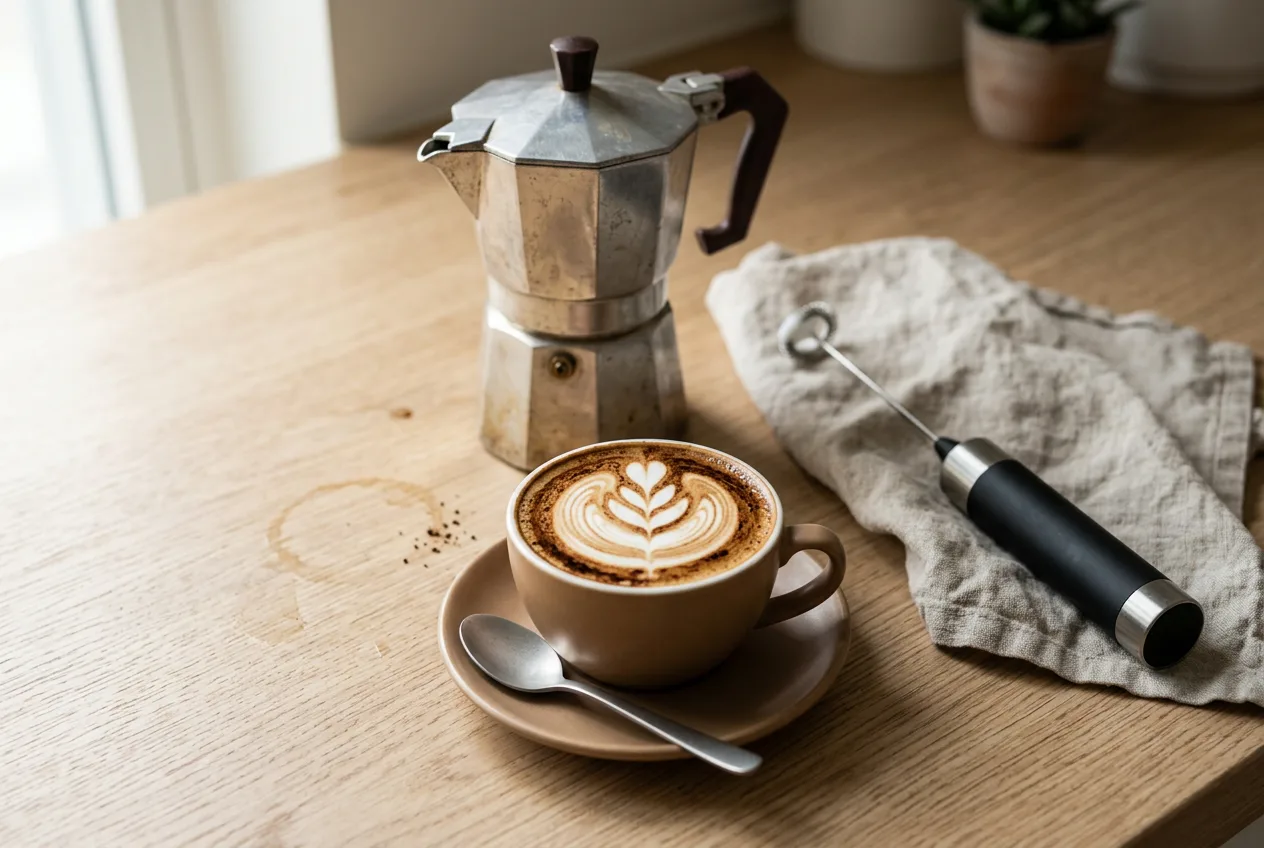
Properly brewed moka coffee has enough strength and body to stand up to milk, and its smooth, non-bitter profile works beautifully. In my tests, friends struggled to tell a moka-pot cappuccino from an espresso one.
The one area where an espresso machine still has a clear advantage with milk is the steam wand. It makes silky microfoam for latte art far more easily than a handheld frother. A stovetop or electric milk frother gets you most of the way there, though, and for everyday drinking at home, the texture difference is small. If you enjoy pouring hearts and rosettas, that wand may be worth the investment on its own.
If you mostly drink milk-based coffees, the gap between a moka pot and an expensive machine is much smaller than you'd think. A handheld frother or a stovetop milk frother completes the setup. For drink differences, see cappuccino vs latte vs flat white.
Best beans for each
- Moka pot: medium to medium-dark roasts work well, giving chocolate and nut notes. Very dark roasts can turn harsh at moka temperatures. Traditional Italian blends with a little robusta are classic.
- Espresso: almost any roast can work, but you'll need to dial in grind and dose. Medium roasts are the easiest starting point; lighter roasts reward precise machines.
- Both: freshness matters more than anything. Use beans roasted within the last few weeks and grind fresh.
For more on roast styles, see coffee roast levels explained.
Ratios, yield and caffeine
An espresso is usually brewed at around 1:2: for example, 18 grams of coffee for about 36 grams of liquid. It's small and very concentrated.
A moka pot is fixed by its size: you fill the basket and the base, so the ratio is roughly 1:7 to 1:10, depending on the pot. The coffee is less concentrated than espresso but much stronger than filter coffee.
| Drink | Typical ratio | Caffeine per serving (approx.) |
|---|---|---|
| Single espresso (1 oz) | ~1:2 | ~63 mg |
| Double espresso (2 oz) | ~1:2 | ~125 mg |
| Moka pot cup (~2 oz) | ~1:7 to 1:10 | ~80-110 mg |
| Filter coffee (8 oz) | ~1:16 | ~95 mg |
Caffeine varies with beans and brewing, but a cup of moka coffee is in the same ballpark as a double espresso. See coffee brewing ratios explained.
Drinks to make with a moka pot
Moka latte
Brew a 3-cup moka pot, pour about 2 ounces into a large cup and top with 6 to 8 ounces of steamed or frothed milk. It's rich, smooth and very close to a cafe latte.
Iced moka
Pour hot moka coffee over a glass full of ice, add cold milk and a little syrup if you like. The strong coffee holds up well to dilution.
Shakerato
Shake hot moka coffee with ice and a little sugar until frothy, then strain into a chilled glass for an Italian summer classic.
Sweet foam coffee
Whisk the first few drops of moka coffee hard with a spoonful of sugar until it forms a pale, thick foam, then pour the rest of the coffee on top. It's a style popular in Cuba and other places that use stovetop brewers, and it gives you a sweet "crema" without a machine.
For more milk-drink ideas, see iced coffee vs cold brew and cappuccino vs latte vs flat white.
Aluminum vs stainless steel moka pots
| Aluminum | Stainless steel | |
|---|---|---|
| Heat | Heats quickly and evenly | Heats a bit slower |
| Induction | No, unless adapter | Often yes |
| Cleaning | Rinse only; no dishwasher | More durable, easier to clean |
| Weight | Light | Heavier |
| Tradition | The classic Italian choice | Modern alternative |
A new aluminum moka pot can make metallic-tasting coffee at first. Many people "season" it by brewing two or three pots and throwing them away before drinking. Afterward, rinse it with water only and dry it fully to avoid stale flavors.
Other options between the two
- Pressurized-valve moka pots: some stovetop brewers add a weighted valve in the spout that builds a little more pressure for a hint of foam.
- Manual lever espresso makers: hand-powered devices that reach true espresso pressure without a pump, for a fraction of a machine's cost.
- Portable espresso makers: handheld pump devices for travel.
- Immersion-pressure brewers: plunger devices that make strong, concentrated coffee, though not true espresso.
These can be good choices if you want something stronger than a moka pot without the cost and counter space of a full machine.
Cost and value
This is where the moka pot shines. A good aluminum or stainless steel moka pot costs about as much as a couple of bags of specialty coffee and lasts for years, often decades. Replacement gaskets and filters are cheap.
There's also the running cost. A moka pot uses a little gas or electricity for a few minutes. An espresso machine uses more energy to heat its boiler, especially if you leave it on, and needs occasional descaling products, gaskets and maintenance. None of it is huge, but over the years it adds up.
A capable home espresso machine costs hundreds, and high-end machines with dual boilers and precise temperature control can cost thousands. You'll also need a good grinder, which can cost as much as an entry-level machine.
| Setup | Rough total cost | What you get |
|---|---|---|
| Moka pot + basic grinder | Low | Strong, smooth coffee; great lattes with a frother |
| Entry espresso machine + grinder | Medium | Real espresso, some crema, steam wand |
| High-end espresso setup | High | Cafe-level espresso and milk |
If you're on a budget or not sure how much you'll use it, a moka pot is a brilliant starting point. You can always upgrade later.
Convenience, speed and cleaning
| Espresso machine | Moka pot | |
|---|---|---|
| Warm-up | Seconds to 20+ minutes, depending on machine | None, but you boil water |
| Brew time | ~25-30 seconds per shot | ~3-5 minutes |
| Several cups at once | One or two shots at a time | Yes, depending on pot size |
| Cleaning | Backflushing, descaling, wand cleaning | Rinse with water, dry fully |
| Portability | Stays on the counter | Goes camping and traveling |
| Power | Needs electricity | Any stove; induction models exist |
For a moka pot, rinse all parts with hot water after each use and let them dry completely before reassembling. Many Italians avoid soap on aluminum pots. Replace the gasket when it hardens or leaks, usually every year or so with daily use.
Looking after each one
Moka pot care
- After each use: let it cool, unscrew, knock out the grounds and rinse all parts with hot water.
- Dry fully: leave the parts apart to air-dry before reassembling.
- Every few months: check the gasket and filter screen; replace the gasket if it's hard, cracked or leaking.
- Descale occasionally: if you have hard water, run a mild vinegar or citric acid solution through it, then rinse well.
Espresso machine care
- Daily: rinse the portafilter, wipe the group head and purge and wipe the steam wand after every use.
- Weekly: backflush with water, or with cleaner on machines that allow it.
- Monthly or as needed: descale according to your water hardness and the manufacturer's instructions.
- Yearly: replace the group gasket and shower screen if worn.
Maintenance is one of the hidden costs of an espresso machine. A moka pot asks for almost nothing. For water quality tips that help both, see water chemistry for coffee.
How I use both
In my kitchen, both earn their place. On weekday mornings when I want a quick flat white, the espresso machine wins: warm it up, pull a shot, steam milk, done. On weekends, I often pull out the 6-cup moka pot to make lattes for everyone at once, which is far faster than pulling shot after shot.
The moka pot also comes everywhere the espresso machine can't: holiday rentals, camping trips, a friend's cabin with only a gas stove. With a hand grinder and a small milk frother, I can make a genuinely good cappuccino anywhere with a flame.
If I could only keep one for straight espresso, it would be the machine. If I could only keep one for everyday milk drinks, travel and value, it would honestly be the moka pot.
Choosing a moka pot size
Moka pots are sold by "cups," but these are small espresso-sized cups of about 1.5 to 2 ounces, not mugs.
- 1-cup: a single small coffee.
- 3-cup: the most popular size for one person, or two small cups.
- 6-cup: good for two people or one large latte base.
- 9 to 12-cup: for families or entertaining.
Moka pots work best when filled completely, so buy the size you'll actually use. Underfilling the basket gives weak, uneven coffee.
Moka pot troubleshooting
| Problem | Likely cause | Fix |
|---|---|---|
| Bitter, burnt taste | Too much heat, too long, cold start | Pre-heat water, lower heat, stop at first gurgle |
| Metallic taste | Long heating with cold water, new pot | Use hot water; season a new pot with a few brews |
| Weak, watery coffee | Grind too coarse, basket underfilled | Grind finer, fill the basket |
| Barely flows | Grind too fine or tamped | Coarser grind, never tamp |
| Leaks at the seam | Worn gasket, loose thread, grounds on rim | Wipe the rim, tighten, replace gasket |
| Spurts violently | Heat too high | Lower the heat |
Moka pot safety
- Never fill water above the valve. The valve must stay clear to work.
- Never tamp or overfill the basket. Excess resistance increases pressure.
- Check the valve occasionally. Make sure it isn't blocked with scale.
- Use a towel or mitt. The base gets very hot, especially with pre-heated water.
- Don't open it while hot and pressurized. Cool the base first.
- Keep the handle away from the flame. Use a burner that fits the pot.
Moka pots around the world
The moka pot is an Italian icon, but it's loved far beyond Italy.
- Italy: the everyday home brewer, often a small aluminum pot used several times a day.
- Cuba and Miami: stovetop pots make the strong, sweet "cafecito," often with a whipped sugar foam on top.
- Spain and Portugal: common in homes alongside espresso at cafés.
- Latin America: widely used for strong home coffee, often with milk.
- Eastern Europe and the Middle East: popular as an affordable alternative to espresso machines.
Espresso machines, meanwhile, rule cafés everywhere and have become increasingly common in homes over the last two decades. The two styles coexist almost everywhere coffee is loved: a quick espresso when you're out, a moka pot when you're home. For a wider tour, see coffee culture around the world.
Which should you choose?
Myths about moka pots and espresso
- "A moka pot makes espresso." It makes strong, espresso-style coffee, but not true espresso.
- "You should pack the moka basket tightly." Never tamp; it causes bitterness and stalls.
- "Moka coffee is always bitter." Bitterness comes from technique, not the pot.
- "Crema means good espresso." Crema shows freshness and pressure, not necessarily flavor.
- "You need an expensive machine for good lattes." A moka pot and frother get you very close.
The verdict
An espresso machine and a moka pot both make small, strong coffee, but they're fundamentally different. The espresso machine's pump, about 9 bar of pressure and controlled temperature give you true espresso: syrupy, intense and crowned with crema. The moka pot's steam pressure gives you a hotter, lighter-bodied, toastier brew without real crema.
But the moka pot is not a poor substitute. With a medium-coarse grind, pre-heated water, no tamping and a quick stop at the first gurgle, it makes smooth, non-bitter coffee that's excellent black and outstanding with milk, for a fraction of the cost.
The most useful lesson from my side-by-side tests is that technique matters more than price. A carefully made moka pot beat a carelessly made one by a huge margin, and in milk drinks it came surprisingly close to a machine costing many times more. If you already own a moka pot and have been disappointed by bitter coffee, try the method in this guide before you spend money on new equipment.
If you want true espresso and love tinkering, buy a machine. If you mostly drink milk drinks, value simplicity or want to start cheaply, a moka pot may be all you ever need.
Frequently asked questions
Is moka pot coffee as strong as espresso?
It's strong, but less concentrated than espresso. Per cup, caffeine is roughly similar to a double espresso.
Can a moka pot make crema?
Not real crema. Its pressure is too low to create a lasting foam.
What grind should I use for a moka pot?
Medium-coarse, like coarse sea salt. Coarser than espresso, finer than French press.
Should I tamp coffee in a moka pot?
No. Fill the basket loosely and level it.
Why is my moka pot coffee bitter?
Usually too much heat, starting with cold water, too fine a grind, or letting it sputter. Use hot water, medium-low heat and stop at the first gurgle.
Can I make a latte with a moka pot?
Yes. Moka coffee with steamed or frothed milk makes an excellent latte or cappuccino.
What pressure does a moka pot reach?
About 1 to 1.5 bar, roughly 14 to 21 PSI, compared with about 9 bar for espresso.
Does a moka pot work on induction?
Only stainless steel or induction-compatible models, or with an induction adapter plate.

- Michael Reynolds, side-by-side brewing with a moka pot and a home espresso machine
- Moka pot, Wikipedia
- Espresso, Wikipedia
- Espresso machine, Wikipedia
Related guides
Espresso crema explained French press vs pour over Italian coffee cultureWritten by Michael Reynolds. Last updated November 20, 2026.