Cappuccino vs Latte vs Flat White: Milk, Foam, Size and Taste Compared
All three are espresso and steamed milk, so why do they taste so different? It comes down to how much milk you use, how much foam you make, and the size of the cup. Here's a clear breakdown, plus how to make each one at home.
We choose products independently. We may earn a commission through links on this page; your price stays the same. Affiliate policy

A cappuccino has the most foam, a latte has the most milk, and a flat white has the strongest coffee taste. A cappuccino is about 5 to 6 oz with a thick, airy foam cap. A latte is usually 8 to 12 oz or more, mostly steamed milk with a thin layer of foam. A flat white is small, around 5 to 6 oz, with a double shot and a thin, velvety layer of microfoam.
Why I wrote this
If you've ever stood at a café counter wondering whether you really want a cappuccino or a flat white, you're not alone. Even baristas don't agree on the exact definitions, and the same name can mean different drinks in different countries.
I steam milk on almost every espresso machine I test. Steam wands vary hugely, and the easiest way to judge one is to make all three of these drinks and see how well it handles each.
Along the way, I've learned that the differences are real, but simpler than menus make them look. It's mostly about ratio and texture.
To keep things fair, every comparison in this guide uses the same beans, the same double shot and the same whole milk unless I say otherwise. That way the only things changing are the amount of milk, the amount of air and the size of the cup, which is exactly what separates these three drinks.
I also include the café sizes you are likely to meet in the real world, because a cappuccino in a big chain and a cappuccino in a small Italian bar can be two very different things. Knowing the traditional versions makes it much easier to order exactly what you want, wherever you are.
What this guide covers
- The standard recipe for each drink, with sizes and ratios.
- The difference between foam and microfoam, which is the heart of it all.
- Taste, strength, caffeine and calories compared.
- How to steam milk and make each drink at home.
Cappuccino vs latte vs flat white at a glance
| Feature | Cappuccino | Latte | Flat white |
|---|---|---|---|
| Typical size | 5 to 6 oz | 8 to 12 oz or more | 5 to 6 oz |
| Espresso | Single or double | Single or double | Double, often ristretto |
| Milk | Moderate | A lot | Moderate |
| Foam layer | Thick, about 0.75 in or more | Thin, about 0.4 in | Very thin, about 0.2 in |
| Texture | Airy, light, foamy | Creamy, milky | Silky, velvety |
| Coffee taste | Medium | Mild | Strongest |
| Latte art | Possible, often simple | Easy | Fine and detailed |
Remember that these are typical versions. A large chain-store cappuccino can be 16 ounces, and a latte in some cafés is barely bigger than a flat white. When in doubt, look at the cup size and ask how much foam they use.
What's inside each cup
The easiest way to understand the difference is to picture a cross-section of each drink.
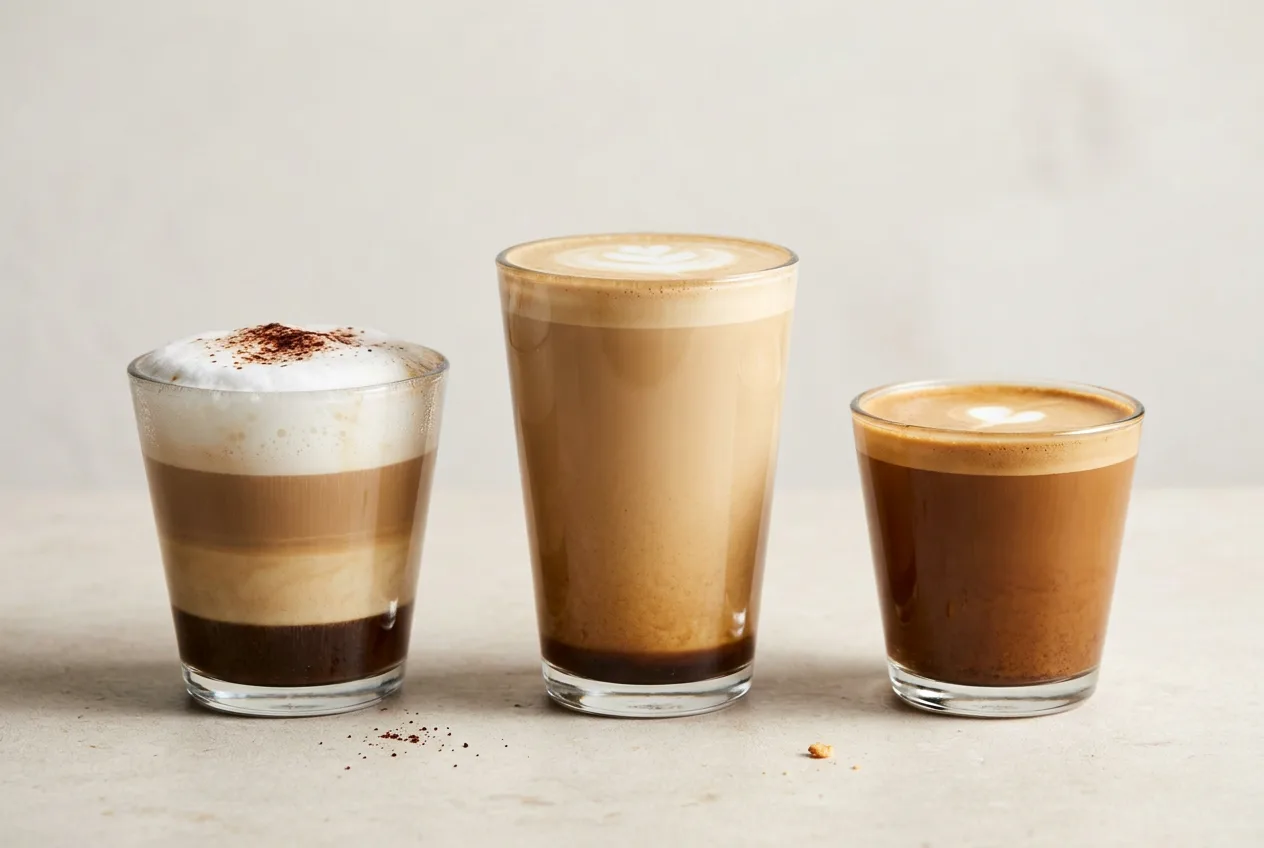
- Cappuccino: roughly a third espresso, a third steamed milk and a third foam in the classic description. In practice, modern cafés use a bit more milk and a little less foam, but the foam cap is still thick and obvious.
- Latte: espresso at the bottom, a large amount of steamed milk, and a thin layer of foam on top. Most of the cup is milk.
- Flat white: a double espresso with a smaller amount of milk, steamed to a very fine, glossy texture. The foam is so thin it's barely a separate layer.
Our tip: If you can't tell what you've been served, tip the cup slightly. A cappuccino's foam moves as a stiff cap. A flat white's surface moves with the liquid like wet paint.
What is a cappuccino?
The cappuccino is the classic Italian milk coffee. It's a small drink, traditionally served in a thick porcelain cup of about 5 to 6 ounces, with a single shot of espresso, steamed milk and a generous cap of foam.

The foam is the defining feature. It's lighter and airier than the milk in a latte or flat white, and it sits in a soft dome on top. Your first sip is mostly foam, then the warm coffee and milk come through underneath.
Outside Italy, cafés often use a double shot and sometimes dust the top with cocoa or cinnamon. Italians usually skip the dusting, but nobody will stop you.
Why the name?
The name is usually linked to the Capuchin friars, whose brown robes and hoods are said to resemble the color of the drink. Earlier versions in Vienna, called the "Kapuziner," were coffee with cream. The modern foamy version came with the espresso machine in the 20th century.
What is a latte?
A caffè latte is espresso with a lot of steamed milk and a thin layer of foam on top. It's the mildest and creamiest of the three, and usually the biggest.

A latte usually has one or two shots of espresso and 6 to 10 ounces or more of milk. The milk is steamed to a smooth texture with less air than a cappuccino, so it pours well and makes latte art easy.
Because there's so much milk, the coffee flavor is gentle. That makes the latte a great choice if you find espresso intense, and it's the base for most flavored drinks, from vanilla to seasonal specials.
Our tip: In Italy, "latte" just means milk. If you order "un latte," you'll get a glass of milk. Ask for "un caffè latte" or "un latte macchiato" instead.
What is a flat white?
The flat white comes from Australia and New Zealand. It's a small drink, about the size of a cappuccino, made with a double shot, often ristretto, and milk steamed to a thin, velvety microfoam.

"Flat" refers to the foam. Instead of a tall cap, there's a thin, glossy layer that's level with the rim of the cup. The milk is fully blended with the espresso, so every sip tastes of coffee and creamy milk together.
With a double shot and less milk than a latte, the flat white has the strongest coffee flavor of the three. It's my go-to milk drink when I want to actually taste the beans.
Foam vs microfoam: the real difference
If there's one idea that explains these three drinks, it's this: they use the same ingredients, but the milk is textured differently.
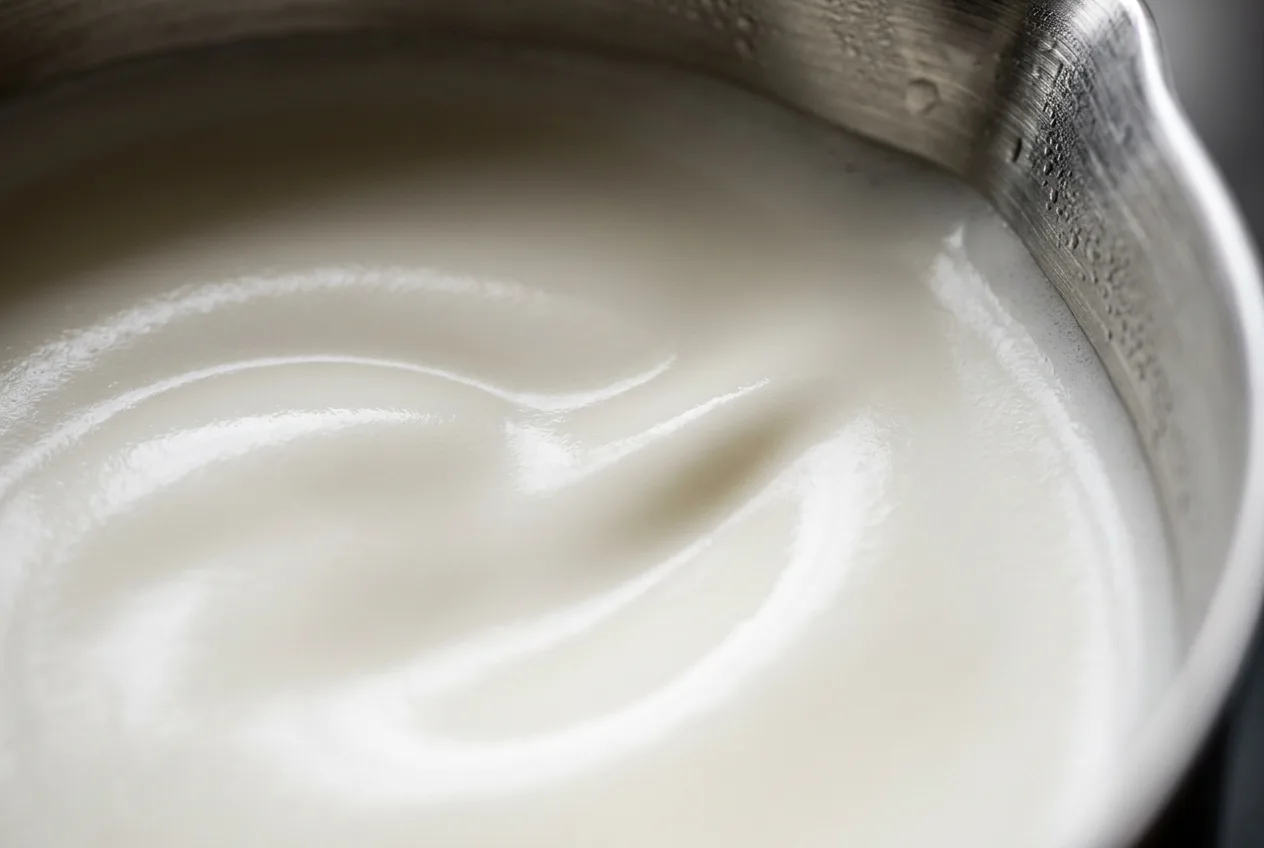
When you steam milk, you do two things. First you add air, which creates foam. Then you mix and heat it, which breaks big bubbles into tiny ones and makes the milk silky.
| Milk texture | How much air | Feels like | Used in |
|---|---|---|---|
| Dry foam | A lot | Light, stiff, spoonable | Dry cappuccino |
| Wet foam | Moderate | Soft, airy, pourable | Cappuccino |
| Microfoam | A little | Glossy, like wet paint | Latte, flat white |
| Thin microfoam | Very little | Silky, almost liquid | Flat white |
Good microfoam has no visible bubbles. It looks shiny and pours like melted ice cream. That's what makes latte art possible and gives a flat white its velvety feel.
How they taste side by side
I made all three with the same double shot of a medium-roast Colombian and whole milk. The differences were clearer than I expected.
| Trait | Cappuccino | Latte | Flat white |
|---|---|---|---|
| First sip | Light foam, then coffee | Creamy milk | Coffee and milk together |
| Coffee intensity | Medium | Low | High |
| Sweetness | Medium | High, from the milk | Medium to high |
| Mouthfeel | Airy | Smooth and heavy | Silky and dense |
| Stays hot | Well, under the foam | Cools slowly in a big cup | Cools fastest |
The flat white tasted like chocolate milk with a strong coffee backbone. The cappuccino was lighter and more playful, with the coffee hiding under the foam. The latte was comforting and sweet, but the coffee faded into the background.
Which is strongest, and which has the most caffeine?
Milk doesn't contain caffeine. So the caffeine in each drink depends only on how many shots go in.
- With a single shot: about 60 to 65 mg of caffeine.
- With a double shot: about 120 to 130 mg.
- Flat white: almost always a double, so about 120 to 130 mg.
- Large latte: often a double, sometimes a triple in big chain sizes.
"Strength" in taste is a different thing. Less milk means a stronger coffee flavor, so the flat white tastes strongest, then the cappuccino, then the latte. A latte and flat white with the same double shot have the same caffeine, but the latte tastes weaker because the coffee is spread through more milk.
Coffee flavor intensity, same double shot
A general guide. Cup size and the amount of milk change the result.
Calories and milk
Since milk is the main extra ingredient, the drink with the most milk has the most calories. Here are rough figures with whole milk and no sugar.
| Drink | Typical size | Approx. calories (whole milk) | With skim milk |
|---|---|---|---|
| Flat white | 5 to 6 oz | About 100 to 120 | About 50 to 70 |
| Cappuccino | 5 to 6 oz | About 80 to 120 | About 50 to 70 |
| Latte | 12 oz | About 180 to 220 | About 100 to 130 |
These are estimates. Sizes vary a lot, and syrups, sugar or whipped cream can easily double the total. A cappuccino has slightly fewer calories than a flat white of the same size, because some of its volume is air.
Where they come from
Cappuccino: Italy
Coffee with milk has been around for centuries, but the cappuccino as we know it took shape in Italy in the first half of the 20th century. Steam wands on espresso machines made it possible to foam milk quickly, and the foamy, brown-topped drink became a breakfast staple.
Latte: Italy, then America
Italians have long drunk caffè latte at home, often coffee and hot milk in a bowl for breakfast. The café latte as a large, foamy espresso drink grew in popularity in the United States in the 1980s and 1990s, especially in Seattle's coffee culture, before spreading worldwide.
Flat white: Australia and New Zealand
Both Sydney and Wellington claim to have invented the flat white in the 1980s, and the debate is still friendly but unresolved. It began as a reaction to overly foamy cappuccinos: customers wanted a coffee with milk that was "flat," without the big foam cap.
Australian and New Zealand baristas brought it to London in the 2000s, and from there it spread to cafés around the world.
How to steam milk at home
Steaming milk well is the most important skill for all three drinks. The technique is the same; only the amount of air changes.
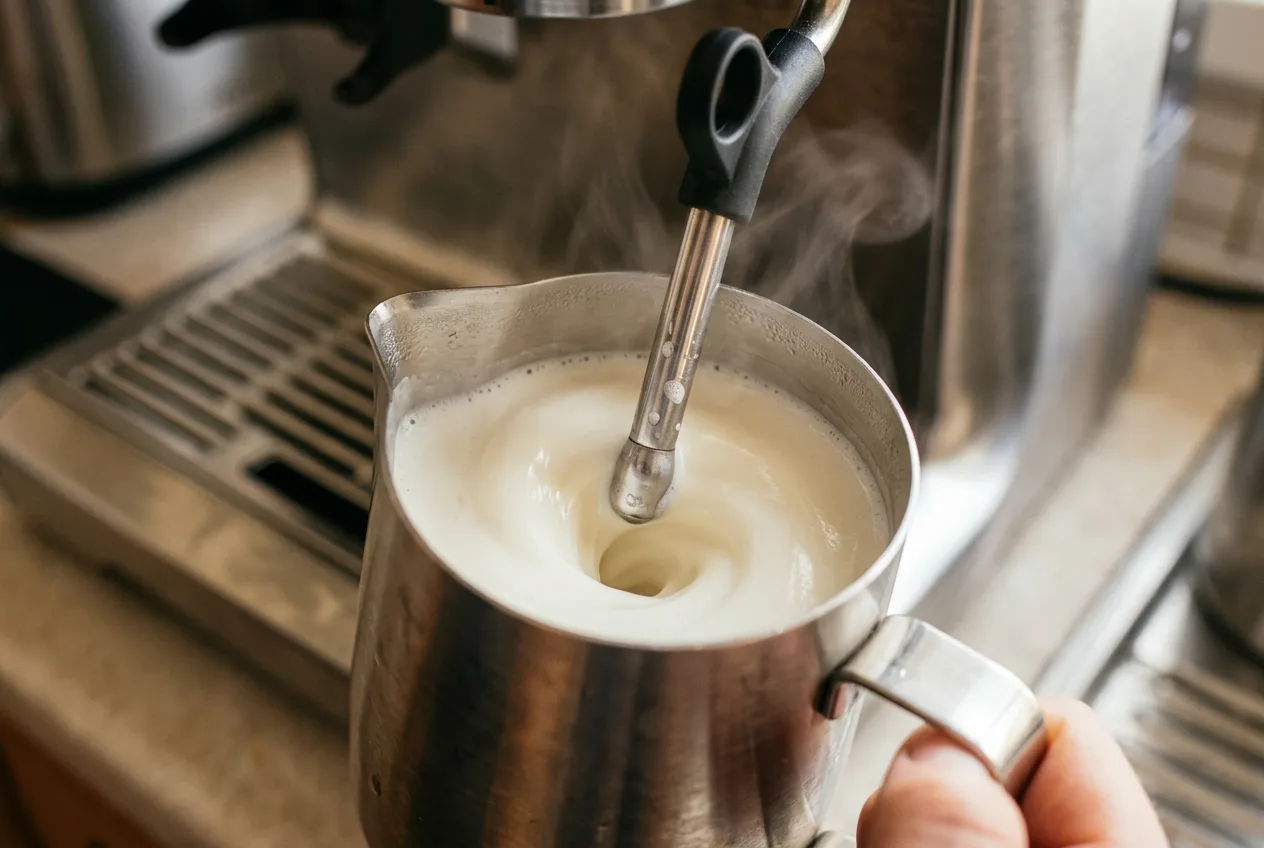
- Start with cold milkFill a cold stainless pitcher to just below the spout. Cold milk gives you more time to texture it.
- Purge the wandOpen the steam valve for a second to clear any water, then close it.
- Stretch: add airPut the wand tip just under the surface and open the steam fully. You'll hear a gentle tearing sound as air goes in. Lower the pitcher slightly as the milk rises.
- Texture: create a whirlpoolSink the tip a little deeper so the milk spins. This breaks big bubbles into fine microfoam and heats the milk evenly.
- Stop at the right temperatureStop when the pitcher is too hot to hold comfortably, about 130 to 150°F. Hotter than about 160°F and the milk starts tasting cooked and loses sweetness.
- Tap and swirlTap the pitcher on the counter to pop big bubbles, then swirl until the milk looks glossy.
Our tip: Practice with water and a drop of dish soap. It foams like milk, so you can learn the sound and the whirlpool without wasting a carton.
How to make a cappuccino
- Pull a shot into a 5 to 6 oz cupA single or double shot, depending on how strong you like it.
- Steam about 4 oz of milkAdd more air than for a latte, so the milk grows by about a third.
- Pour from a little heightPour into the center so the milk mixes with the espresso.
- Finish close and fastLower the pitcher and let the foam flow on top to form a dome.
How to make a latte
- Pull a double shot into a large cup or glassA 10 to 12 oz cup works well.
- Steam 7 to 9 oz of milkAdd only a little air. You want smooth milk with a thin layer of microfoam.
- Pour steadilyStart from a few inches up to mix the milk under the crema, then bring the pitcher close to finish with a thin white layer or a simple design.
How to make a flat white
- Pull a double ristretto into a 5 to 6 oz cupAbout 18 g of coffee to 25 to 30 g of espresso gives a sweet, strong base.
- Steam about 4 oz of milkAdd very little air. Focus on a fast whirlpool for a dense, glossy microfoam.
- Pour low and steadyKeep the pitcher close to the cup so the milk blends in and forms only a thin, flat top.
- Finish with a small designA small heart or rosetta is traditional. The foam should be level with the rim.
For the espresso itself, see ristretto vs espresso vs lungo.
A little milk science
Understanding what happens inside the pitcher makes steaming much easier. Milk is mostly water, with proteins, fat and a natural sugar called lactose.
Proteins are what make foam possible. When you add air, the proteins wrap around each bubble and hold it in place, a bit like the skin of a balloon. That's why skim milk, which has plenty of protein but little fat, makes lots of stiff foam.
Fat adds creaminess and body, but it also makes foam less stable. Whole milk makes a softer, silkier foam than skim, which is exactly what you want for a flat white or a latte.
Lactose tastes sweeter as milk warms. Most people find milk sweetest around 130 to 140°F. Go much hotter and the proteins start to break down, the foam collapses and a cooked, slightly sulfurous taste appears.
That's why cold, fresh milk works best. It gives you more time to add air and texture before it gets too hot, and fresh milk proteins foam better than milk that's been open for a week.
Our tip: Keep your milk pitcher in the fridge. Starting with a cold pitcher buys you a few extra seconds of texturing, which makes a noticeable difference with small amounts of milk.
The espresso base matters more than you think
It's easy to focus on milk, but the espresso decides how good the drink tastes. Milk dulls flavor, so a weak or sour shot gets lost and a bitter one turns muddy.
For milk drinks, I pull slightly shorter, richer shots than I would for straight espresso. A 1:1.5 to 1:2 ratio gives enough body and sweetness to stand up to milk. For flat whites, a ristretto is the classic choice.
Shot size should match cup size. A single shot is fine in a small cappuccino but disappears in a 12-ounce latte. If your latte tastes like warm milk, the fix is usually a double shot, not a different drink.
If the shot itself tastes off, sort that out first. My guide to why coffee tastes bitter or sour walks through the usual causes.
Beans that shine with milk
Milk changes which beans taste best. It softens bitterness and mutes acidity, so coffees with chocolate, caramel and nut notes usually work better than bright, citrusy ones.
- Medium to medium-dark roasts give a classic, chocolatey milk drink.
- Brazilian and Colombian coffees are reliable choices, with nutty, sweet profiles.
- Espresso blends are often designed with milk in mind.
- Very light, fruity roasts can taste sour or "yogurty" in milk. Try them as a flat white rather than a latte, where the coffee has more room to speak.
If you want to read more about how roast level affects flavor, see coffee roast levels explained.
No steam wand? How to froth milk anyway
You don't need an espresso machine with a steam wand to make a decent milk drink at home. These methods all work, with different results.
| Method | How it works | Best for |
|---|---|---|
| Electric milk frother | Heats and whisks milk in a jug at the press of a button | Cappuccinos and lattes, very consistent |
| Handheld whisk frother | Battery-powered whisk in warm milk | Foamy cappuccino-style milk |
| French press | Pump the plunger in warm milk 20 to 30 times | Surprisingly good microfoam |
| Jar and microwave | Shake cold milk in a jar, then heat briefly | Quick and basic |
The French press method is my favorite trick. Heat milk to about 140°F, pour it into the press so it's no more than a third full, and pump the plunger briskly. Then tap and swirl, just as you would with a steamed pitcher. It can even pour simple latte art.
Other milk drinks you'll see on the menu
Cappuccino, latte and flat white sit in a bigger family of espresso and milk drinks. Here's how the most common relatives compare.
| Drink | What it is | Size |
|---|---|---|
| Macchiato | Espresso "marked" with a spoon of foam | 2 to 3 oz |
| Cortado | Espresso with a similar amount of warm milk, little foam | 4 to 5 oz |
| Piccolo | A ristretto topped with steamed milk | 3 to 4 oz |
| Latte macchiato | Steamed milk with espresso poured in on top, in layers | 8 to 12 oz |
| Mocha | A latte with chocolate | 8 to 12 oz |
| Breve | A latte made with half-and-half instead of milk | 8 to 12 oz |
If you like a flat white but want something even smaller and stronger, try a cortado or a piccolo. If you like a latte but want it sweeter, a mocha is the natural next step.
Iced versions
The iced latte is one of the most popular coffee drinks in the world: espresso, cold milk and ice. It's simple and refreshing, and there's no steaming needed.
Iced cappuccinos are trickier, because hot foam melts on ice. Cafés usually top an iced latte with cold foam, made by frothing cold milk until it's thick, instead.
An iced flat white doesn't really exist in the traditional sense, since its whole point is warm, velvety microfoam. Some cafés serve one as a smaller, stronger iced latte with a double ristretto.
What I've learned testing steam wands
After steaming milk on dozens of home machines, a few patterns stand out.
- Panarello wands, the ones with a plastic or metal sleeve, add air automatically. They make cappuccino foam easily but struggle with fine microfoam for flat whites.
- Single-hole wands are slower and gentler, which makes them great for learning and good for small amounts of milk.
- Multi-hole professional-style wands are fast and powerful. They make excellent microfoam once you've learned the technique.
- Automatic milk systems on bean-to-cup machines are convenient and consistent, but you usually can't fine-tune the texture much.
If flat whites are your favorite drink, look for a machine with a proper single- or multi-hole wand rather than a panarello. It makes the biggest difference to texture.
Milk coffee around the world
Every coffee culture has its own version of espresso with milk, and the names don't always line up with what you expect.
- United States: lattes dominate, often in 12 to 20 ounce sizes. Cappuccinos tend to be larger and foamier than Italian ones. Flat whites became widely known in the 2010s.
- United Kingdom: all three are standard. Flat whites took off in London's independent cafés and are now on most menus.
- Australia and New Zealand: the flat white is king, alongside lattes served in glasses and cappuccinos with chocolate on top.
- Spain: café con leche, a strong coffee with plenty of hot milk, is the everyday choice. It's close to a latte with less foam.
- France: a café crème is espresso with steamed milk, similar to a small latte. Café au lait traditionally uses brewed coffee and hot milk.
- Germany and Austria: Milchkaffee is a large, milky coffee, and Vienna's Melange is close to a cappuccino, sometimes with whipped cream.
When traveling, it helps to look at what the people around you are drinking and how big the cups are. That tells you more than the name on the menu.
Try a side-by-side tasting
The best way to find your favorite is to make all three with the same beans and milk, then taste them together. Here's how I do it at home.
- Pull three identical double shotsSame beans, same recipe, into three different cups: a small one, a medium one and a large one.
- Steam one big pitcher of milkStretch it like a latte, with moderate air.
- Pour the flat white firstUse the silkiest milk from the bottom of the pitcher and keep the foam thin.
- Pour the latte secondFill the large cup with plenty of milk and a thin top layer.
- Spoon extra foam onto the cappuccinoFinish the small cup with the foamier milk left at the top of the pitcher.
Taste them in order of strength: flat white, cappuccino, then latte. Most people discover a clear favorite in a few sips, and it's not always the one they usually order.
Sugar, syrups and toppings
Well-steamed milk is naturally sweet, so many people find they need less sugar once their milk technique improves. Still, there's nothing wrong with sweetening your drink.
- Lattes are the best base for syrups, since there's enough milk to carry vanilla, caramel or hazelnut without the drink tasting artificial.
- Cappuccinos pair well with a light dusting of cocoa or cinnamon on the foam.
- Flat whites are usually drunk plain, to keep the focus on the coffee.
If you add syrup, put it in the cup with the espresso before the milk. It mixes evenly that way, and you won't spoil the foam on top.
A quick note on health
For most people, the milk is the main nutritional difference between these drinks. A small cappuccino or flat white is a modest snack's worth of calories, protein and calcium. A large latte is closer to a glass of milk.
Caffeine depends only on the shots, so if you want less caffeine but still enjoy a milk drink, ask for a single shot or a half-caf. For more on how much caffeine is sensible, see caffeine myths debunked.
Milk coffee myths, quickly
- "A latte has more caffeine than a cappuccino." Not if they use the same shots. Milk adds volume, not caffeine.
- "A flat white is just a latte with less foam." Close, but it's also smaller and usually made with a double or ristretto, so it tastes much stronger.
- "More foam means better milk." Foam quantity isn't quality. The best foam is fine, glossy and free of big bubbles, whatever the amount.
- "Hotter is better." Very hot milk tastes flat and less sweet. Around 140°F is the sweet spot for most people.
- "You need a café machine for good microfoam." Many home machines and even a French press can make excellent microfoam with practice.
When each drink is at its best
There's no wrong time for any of them, but each one has its moment. A cappuccino is a classic breakfast coffee: light, foamy and quick to drink while it's still warm under its cap.
A flat white is a great mid-morning coffee when you want flavor and focus in a small cup. It cools fastest, so it's best drunk within a few minutes.
A latte is the one to linger over. It's big enough to sip through a meeting or a slow afternoon, and the large volume of milk keeps it warm for longer.
Latte art basics
Latte art isn't required, but it's a good sign the milk was steamed well. You can only pour clear designs with smooth microfoam on a fresh layer of crema.

- Heart: pour into the center until the cup is about two thirds full, lower the pitcher, let a white circle form, then draw through it.
- Tulip: pour a series of small blobs, pushing each one into the last, then draw through the center.
- Rosetta: wiggle the pitcher gently side to side while moving backwards, then draw through.
Flat whites and lattes are the easiest canvases. Cappuccinos, with their thick foam, usually get simpler designs. If your crema is thin or broken, art will look muddy, so pour right after pulling the shot. More on that in espresso crema explained.
Plant-based milks
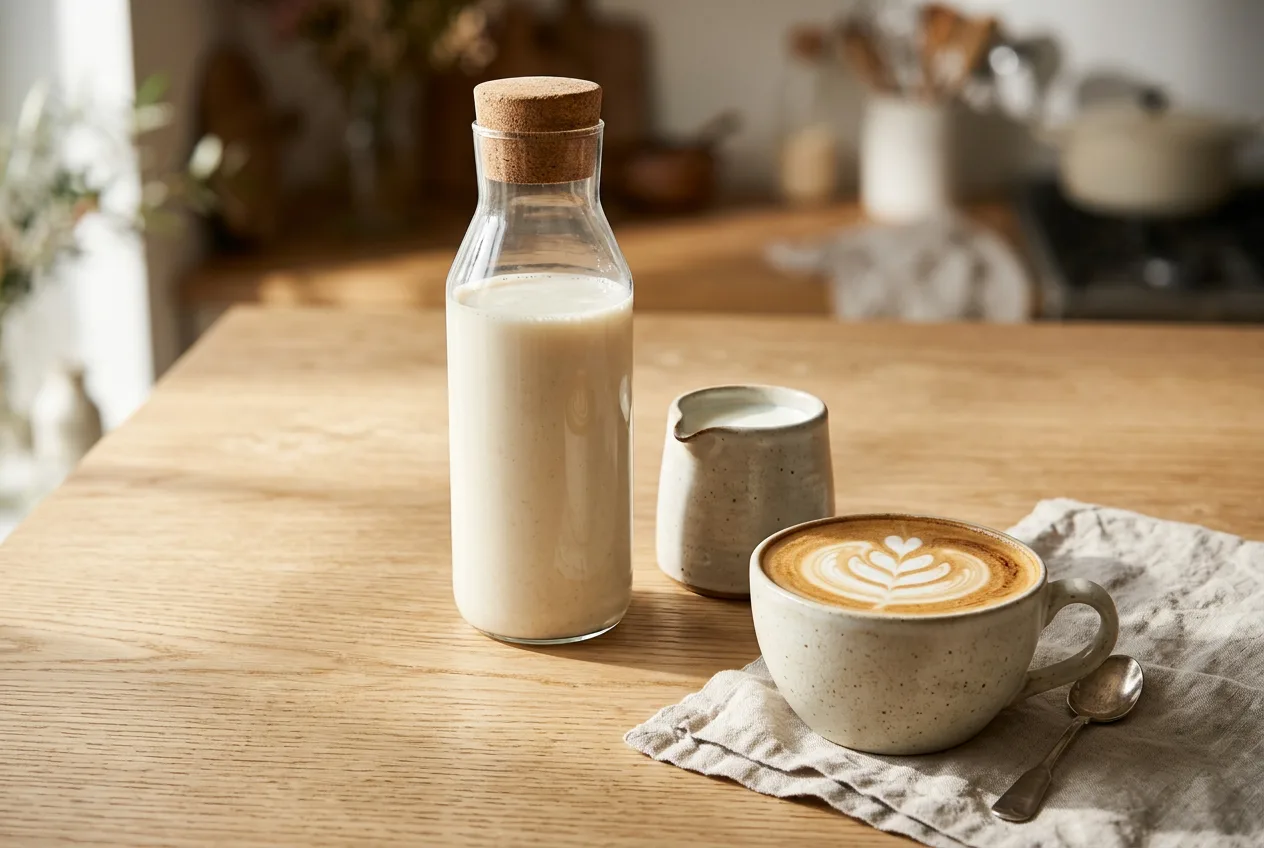
All three drinks can be made with plant-based milk, but some milks foam far better than others. Proteins and fats are what hold the bubbles together.
| Milk | Foam quality | Flavor | Best for |
|---|---|---|---|
| Whole dairy milk | Excellent | Sweet, creamy | All three |
| Skim milk | Lots of stiff foam | Thin, less sweet | Dry cappuccinos |
| Barista oat milk | Very good | Naturally sweet, cereal notes | Lattes, flat whites |
| Soy milk | Good | Beany, can curdle in acidic coffee | Cappuccinos |
| Almond milk | Fair, separates easily | Nutty, thin | Iced drinks |
| Coconut milk | Fair | Strong coconut flavor | Flavored lattes |
Look for "barista" versions of plant milks. They're formulated with a little extra fat and stabilizers so they steam and pour more like dairy.
Wet, dry and bone-dry cappuccinos
Some cafés let you choose how foamy your cappuccino is. The terms are simple once you know them.

A very wet cappuccino and a flat white can end up quite similar. The main difference is usually that a flat white uses a double shot and finer microfoam.
Ordering in Italy
Italy has a few unwritten rules around milk coffee, and knowing them helps you blend in.
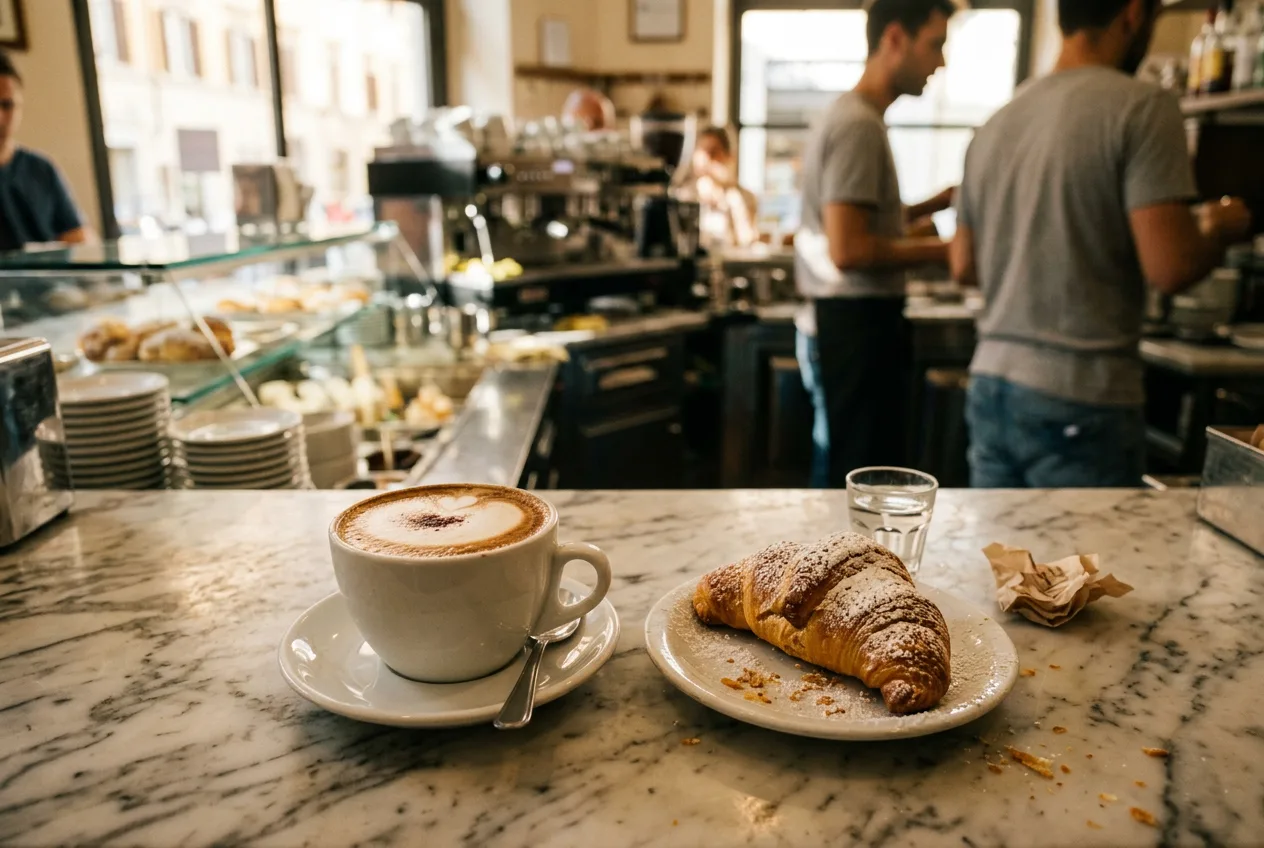
- Cappuccino is a morning drink. Many Italians drink it with breakfast, often with a pastry, and rarely after about 11 a.m. or after a meal. Tourists can order it any time, but you'll notice the locals switch to espresso.
- Ask for "caffè latte," not "latte." Otherwise you'll get plain milk.
- Try a "latte macchiato." It's hot milk "stained" with a shot of espresso, served in a tall glass with clear layers.
- Flat whites are rare. You'll find them in some specialty cafés in big cities, but they're not part of traditional Italian coffee culture.
Which should you choose?
My everyday order is a flat white. When I want something comforting on a cold afternoon, a latte with oat milk. And on holiday in Italy, a cappuccino and a cornetto at the bar, before 11 a.m., of course.
Common mistakes at home
- Overheating the milk: past about 160°F, milk loses sweetness and tastes flat or cooked.
- Too much air for a flat white: big bubbles turn it into a small cappuccino.
- Too little air for a cappuccino: you end up with a small latte.
- Letting milk sit: steamed milk separates within a minute. Pour right away and swirl first.
- Using a weak shot: milk hides flavor, so a thin shot gets lost. Use a double, or a ristretto.
- Reheating milk: re-steamed milk never foams as well. Steam only what you need.
Cup sizes and why they matter
The cup is almost part of the recipe. It limits how much milk you can add, which decides how strong the drink tastes.

| Drink | Traditional cup | Common café size |
|---|---|---|
| Flat white | 5 to 6 oz ceramic cup | 6 to 8 oz |
| Cappuccino | 5 to 6 oz thick porcelain cup | 6 to 12 oz |
| Latte | 8 to 10 oz cup or glass | 12 to 20 oz |
If you're served a 16-ounce "flat white," it's really a latte with a different name. A proper flat white is small on purpose.
The verdict
Cappuccinos, lattes and flat whites are three ways to balance espresso and milk. The cappuccino is small and foamy, the latte is large and creamy, and the flat white is small, silky and strong.
If you love coffee flavor, start with a flat white. If you love texture and a light, foamy top, choose a cappuccino. If you want something mild, comforting and big enough to linger over, a latte is hard to beat. At home, it all comes down to how much air you put into the milk.
If you are learning to steam milk, start with lattes. They are the most forgiving, because a little too much or too little air still makes a nice drink. Once you can make glossy latte milk every time, add a little more air for cappuccinos and a little less for flat whites. Within a week or two you will be able to make all three on demand, and you will know exactly which one you prefer and why.
Frequently asked questions
What is the difference between a cappuccino, latte and flat white?
A cappuccino is small with a thick layer of foam, a latte is larger with lots of steamed milk and a thin foam layer, and a flat white is small with a double shot and a thin, velvety microfoam.
Which is strongest: cappuccino, latte or flat white?
A flat white tastes strongest because it has a double shot and less milk. In caffeine, they're the same if they use the same number of shots.
Is a flat white just a small latte?
Not quite. A flat white is smaller, usually uses a double or ristretto shot, and has a thinner, silkier foam, so it tastes much more of coffee.
Which has the least milk?
A flat white and a cappuccino use similar amounts, but a cappuccino has more of its volume as foam. A latte has the most milk.
Which has the fewest calories?
A small cappuccino usually has the fewest, because part of the cup is air. A large latte has the most because it's mostly milk.
What temperature should steamed milk be?
About 130 to 150°F. Hotter milk loses sweetness and can taste cooked.
Can I make these drinks without an espresso machine?
You can make similar drinks with strong moka pot or capsule coffee and milk frothed with a handheld frother or French press. The texture won't be identical, but it can be very good.
Why do Italians not drink cappuccino after 11?
It's a cultural habit rather than a rule. Milk coffee is seen as a breakfast drink, and many Italians feel it's too heavy after a meal.

- Michael Reynolds, notes from milk steaming and espresso machine tests
- Cappuccino, Wikipedia
- Flat white, Wikipedia
Related guides
Ristretto vs espresso vs lungo Americano vs long black Espresso crema explained Caffeine myths debunked Why coffee tastes bitter or sourWritten by Michael Reynolds. Last updated November 19, 2026.