Water Chemistry for Coffee: Minerals, Alkalinity and the Best Water for Brewing
Your coffee is about 98% water, so the water you brew with can make or break the cup. Here's how calcium, magnesium and bicarbonate change flavor, how to find out what's in your tap water, and the simplest ways to make it better.
We choose products independently. We may earn a commission through links on this page; your price stays the same. Affiliate policy
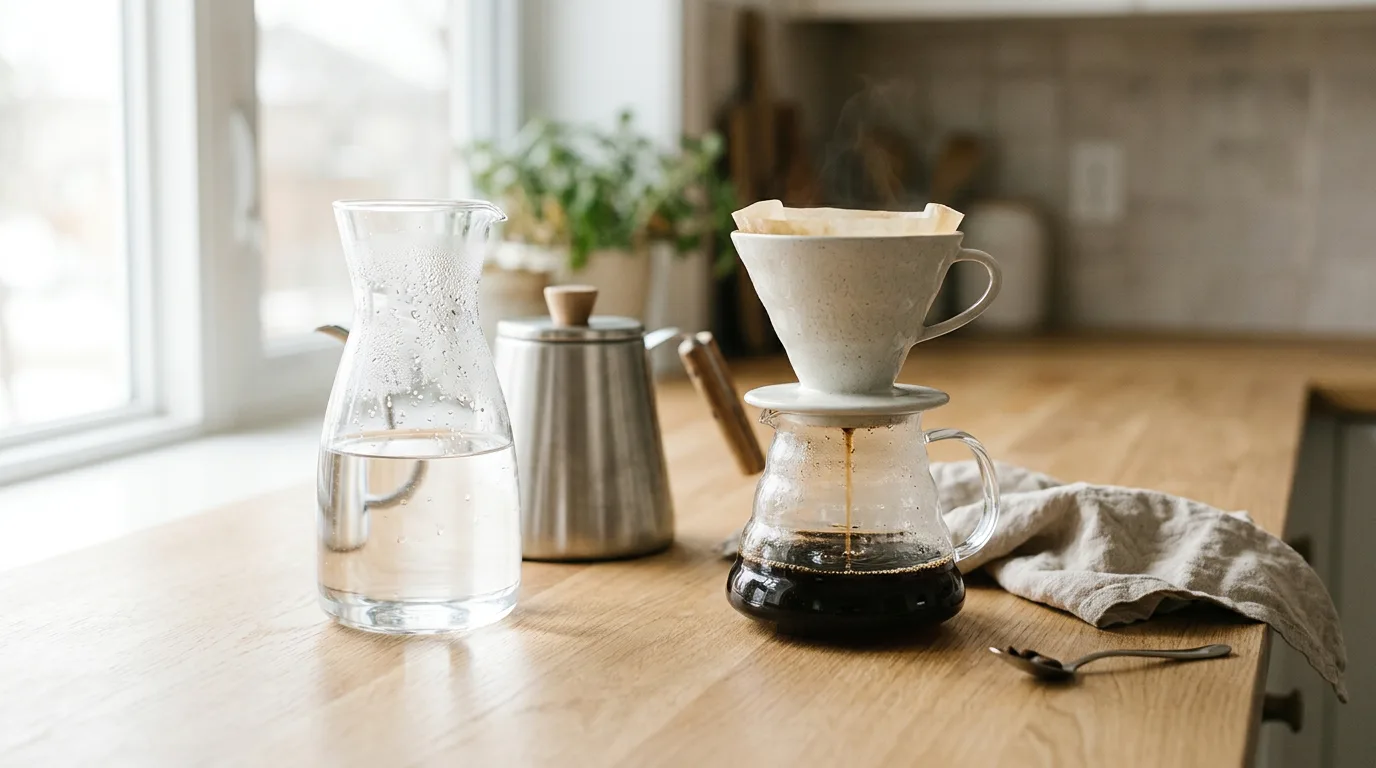
Good brewing water needs a balance of minerals and buffering. Calcium and magnesium help pull flavor out of the coffee. Bicarbonate (alkalinity) softens acidity.
A practical starting point: roughly 30 to 50 ppm calcium or 15 to 30 ppm magnesium, plus about 50 to 75 ppm alkalinity. Too little and coffee can taste sharp and harsh. Too much and it turns flat and dull, and your machine fills with scale.
Start by reading your local water quality report. Don't rely on a TDS meter alone. Then pick the simplest fix that works for you: a pitcher filter, the right bottled water, water from a cafe, or your own mineral recipe.
Why I wrote this
For years I obsessed over beans, grinders and brewers, and barely thought about water.
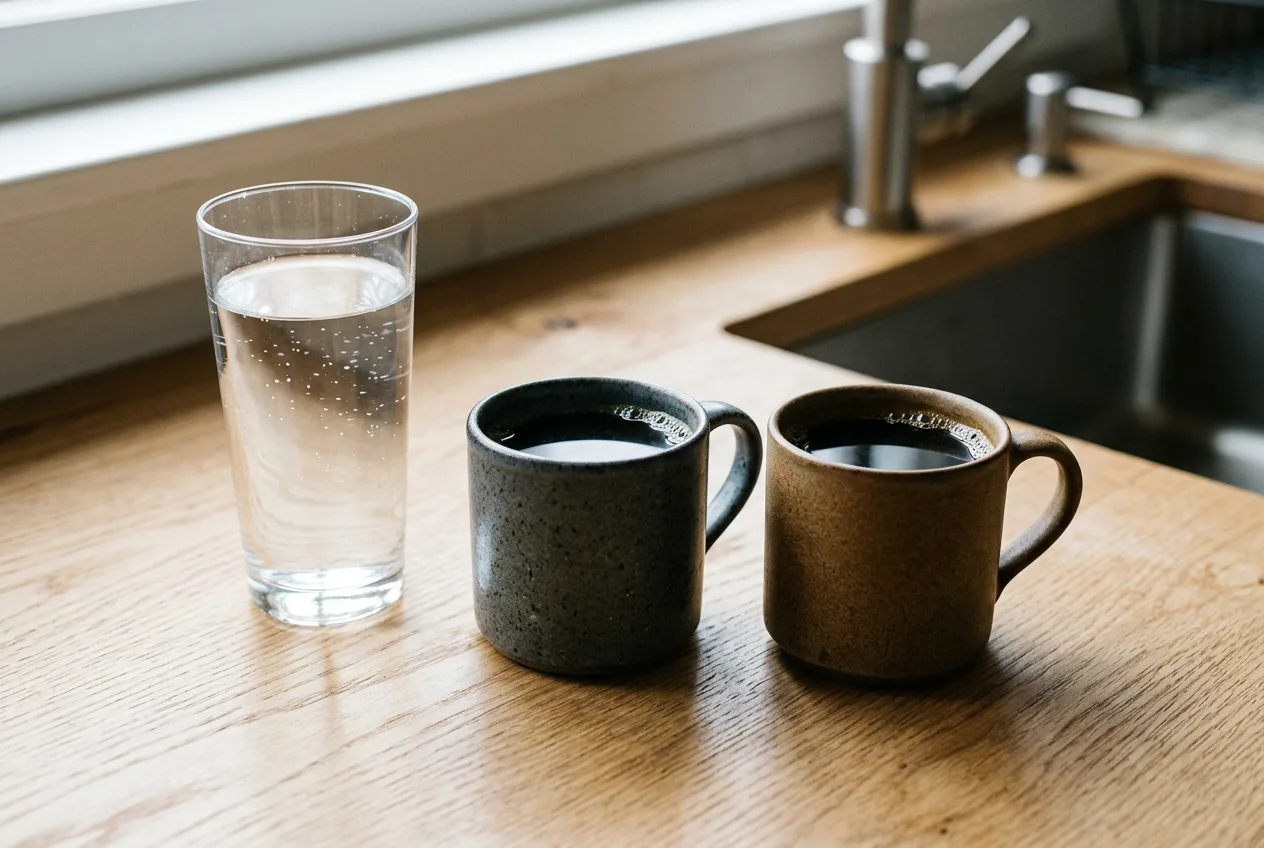
Then I took the same bag of coffee, ground it once, and brewed it twice: once with my tap water and once with a carefully mixed mineral water. Same dose, same grind, same kettle.
They tasted like two different coffees. The tap water cup was flat and a little chalky. The other one was bright, sweet and clearly fruity, exactly like the tasting notes on the bag.
That was the moment I realized water isn't a background detail. It's an ingredient, and for most people it's the biggest one they've never adjusted.
What you'll learn
- How calcium, magnesium and bicarbonate change the taste of coffee
- The target numbers that work as a starting point
- Why a TDS meter alone can mislead you
- How to find out what's actually in your tap water
- What pitcher filters, reverse osmosis and bottled water can and can't do
- How to protect your coffee machine from limescale
- How to make your own brewing water at home
Why water matters so much
Water is the main ingredient in coffee. Even excellent beans, ground and brewed perfectly with great equipment, can taste disappointing if the water is wrong.
Water affects coffee in two ways:
- ExtractionWater is a solvent. What's dissolved in it changes how much flavor it pulls out of the grounds, and which compounds it pulls out.
- PerceptionOnce the coffee is in the cup, minerals and buffers in the water change how you perceive acidity, sweetness and body.
Taste isn't enough to judge water
Here's the tricky part. Water that tastes clean and pleasant on its own can still make an unbalanced cup of coffee.
On the other hand, if your water has an obvious chlorine taste or another off-flavor, it will almost certainly show up in your coffee.
For coffee, two properties matter most:
Too little or too much of either can make coffee taste worse. Keep that word "balance" in mind. It comes up again and again.
Our tip: Try my experiment yourself. Brew the same coffee with your tap water and with a bottled water, side by side. It's the fastest way to find out whether water is holding your coffee back.
Minerals: calcium and magnesium
Calcium and magnesium are the two most useful minerals in brewing water. They help coffee compounds move from the grounds into the water during brewing.
Water with no minerals at all, like distilled water, extracts coffee differently from water with a suitable amount. Coffee brewed with pure distilled water often tastes hollow, sour or thin.
More isn't better
Adding more minerals doesn't automatically improve flavor. Too much mineral content can:
- Make coffee taste chalky, heavy or muted
- Leave an unpleasant mineral taste
- Build up limescale inside kettles and machines
The type of mineral matters just as much as the total amount.
Calcium and magnesium aren't interchangeable
Brewing with water containing a certain amount of calcium gives a different cup from water with the same amount of magnesium. Each has its own effect on extraction and flavor.
In my own tests, and in what many baristas report, the difference tends to look like this:
| Mineral | Useful starting range | Typical effect in the cup |
|---|---|---|
| Calcium-led water | About 30–50 ppm calcium | Rounder, heavier body, creamier texture |
| Magnesium-led water | About 15–30 ppm magnesium | Brighter, more fruity and clear flavors |
| Too little of either | Close to zero | Thin, hollow, sometimes sour |
| Too much of either | Well above these ranges | Chalky, muted, heavy, more scale |
These ranges aren't exact rules. They're practical starting points within a much wider set of possible water recipes.
Magnesium recipes usually use lower numbers because magnesium is lighter than calcium, so fewer milligrams give a similar amount of "hardness."
Alkalinity and bicarbonate: the acidity buffer
The second big factor is bicarbonate, which makes up most of the alkalinity in drinking water.
Alkalinity is water's ability to resist changes in pH. In practical terms, bicarbonate acts as a buffer.
How it changes the cup
Coffee contains lots of acids. That's where much of its brightness and fruitiness comes from.
When water contains bicarbonate, it neutralizes some of those acids. The more bicarbonate, the less acidity you'll taste in the finished cup.
How alkalinity shapes perceived acidity (simplified)
Bar length shows how much acidity you'd typically taste. A simplified illustration; every coffee responds differently.
Too little buffering
With very little bicarbonate, acidity can become sharp, uncontrolled and unbalanced. Light roasts especially can taste sour or harsh.
Too much buffering
With too much bicarbonate, acidity gets suppressed so strongly that coffee tastes dull, flat and generically "brown." The liveliness and character of the coffee disappear.
That's often what happens with very hard tap water. It's not that the beans are bad. The water is erasing them.
A useful starting range is about 50 to 75 ppm of alkalinity. Like the mineral ranges, it's a guideline, not a single right answer.
Our tip: If you love bright, fruity light roasts, aim toward the lower end of the alkalinity range. If you prefer chocolatey medium-dark roasts, a little more buffering usually tastes smoother.
Target numbers at a glance
Here's how my practical starting ranges sit next to the specialty coffee industry's widely used guidance.
| Measure | My starting point | Specialty coffee guidance | What it controls |
|---|---|---|---|
| Calcium | 30–50 ppm (if calcium-led) | Part of total hardness | Extraction, body |
| Magnesium | 15–30 ppm (if magnesium-led) | Part of total hardness | Extraction, brightness |
| Total hardness (as CaCO3) | About 50–120 | Roughly 50–175 ideal range | Overall mineral content |
| Alkalinity (as CaCO3) | 50–75 ppm | About 40–75 | Acidity buffering |
| pH | Around neutral | About 6.5–7.5 | General water balance |
| Chlorine | None | None | Off-flavors |
| Sodium | Low | Low, around 10 | Taste, avoid salty notes |
Don't panic if your water doesn't hit every number. The aim is to get close enough and then adjust by taste.
Making sense of the units
Water reports can be confusing because the same thing is described in different ways. Here's a quick decoder.
The most common mix-up is between a mineral's own weight and its value "as CaCO3."
For example, 20 ppm of magnesium ions is about 82 ppm of hardness as CaCO3. And 20 ppm of calcium ions is about 50 ppm as CaCO3. Always check which one a report or recipe is using.
Our tip: When you compare your water to a recipe, write both numbers in the same unit first. Most coffee water calculators use ppm as CaCO3 for hardness and alkalinity.
A closer look: how minerals pull flavor out of coffee
You don't need a chemistry degree to brew good coffee. But a basic picture of what's happening helps you make better decisions.
Water as a solvent
Roasted coffee contains hundreds of compounds: acids, sugars, oils, bitter compounds and aromatic molecules. Brewing is the process of dissolving the good ones into water while leaving the worst ones behind.
Pure water is already a decent solvent. But dissolved minerals change how it behaves.
Why minerals help
Calcium and magnesium ions carry a positive charge. Many flavor compounds in coffee are attracted to them, which helps those compounds leave the grounds and stay in the cup.
That's why the same grind and recipe can taste stronger and fuller with moderately mineralized water than with distilled water, even though the coffee and the brew time are identical.
Why the buffer works separately
Bicarbonate doesn't do much to extraction itself. Its main job happens afterwards, in the cup, where it reacts with acids and reduces how sour or bright the coffee tastes.
That's why you have to think about two separate dials:
Most tap water sets both dials for you, and rarely in the right place. Once you understand that, it's easy to see why simply "filtering" water doesn't always fix the taste.
My side-by-side water test
To show how much water matters, I brewed the same light-roast washed Ethiopian coffee five times as a pour-over. Same dose, same grind, same kettle temperature, same recipe. Only the water changed.
| Water | What it was like | How the coffee tasted | My score /10 |
|---|---|---|---|
| Hard tap water | High hardness, high alkalinity | Flat, muted, slightly chalky | 4 |
| Pitcher-filtered tap | Less chlorine, a bit softer | Cleaner, still a little dull | 6 |
| Distilled water | Almost no minerals | Thin, sour, hollow | 3 |
| Bottled mineral water | Moderate minerals, moderate bicarbonate | Sweet, balanced, pleasant | 7 |
| DIY recipe (~70 hardness, ~55 alkalinity) | Magnesium-led, balanced buffer | Bright, sweet, clear fruit notes | 9 |
The biggest surprise for most people is the distilled water result. "Purer" water made the worst-tasting cup of all.
The second surprise is how far a simple recipe moved the coffee. The difference between the hard tap water cup and the DIY cup was bigger than the difference I'd expect from upgrading my grinder.
Your results will depend on your own tap water and beans. But I'd bet the pattern looks similar.
Our tip: When you taste side by side, let the cups cool a little. Acidity and sweetness are much easier to judge once the coffee drops to warm rather than hot.
Matching water to the coffee you drink
There's no single water recipe that's perfect for every coffee. A light Ethiopian and a dark Brazilian blend often shine with slightly different water.
Copy your roaster's water
One of the smartest tricks is to find out what water your favorite roaster uses to taste and develop their coffees, if they share it.
Tasting notes on a bag are shaped by the beans, but also by the water the roaster used when they wrote them. If your water is very different, the same coffee can taste noticeably different at home.
Matching their water as closely as you reasonably can brings you closer to the cup the roaster intended.
Look at each mineral separately
Treat calcium and magnesium as separate ingredients, not one generic "mineral" number. Two waters with similar overall readings can brew quite different cups because their makeup differs.
And check bicarbonate too. Water with a sensible mineral level can still taste harsh if its buffering is too low.
How to check your water
You can't fix your water until you know what's in it. Here are the three main tools, from simplest to most useful.
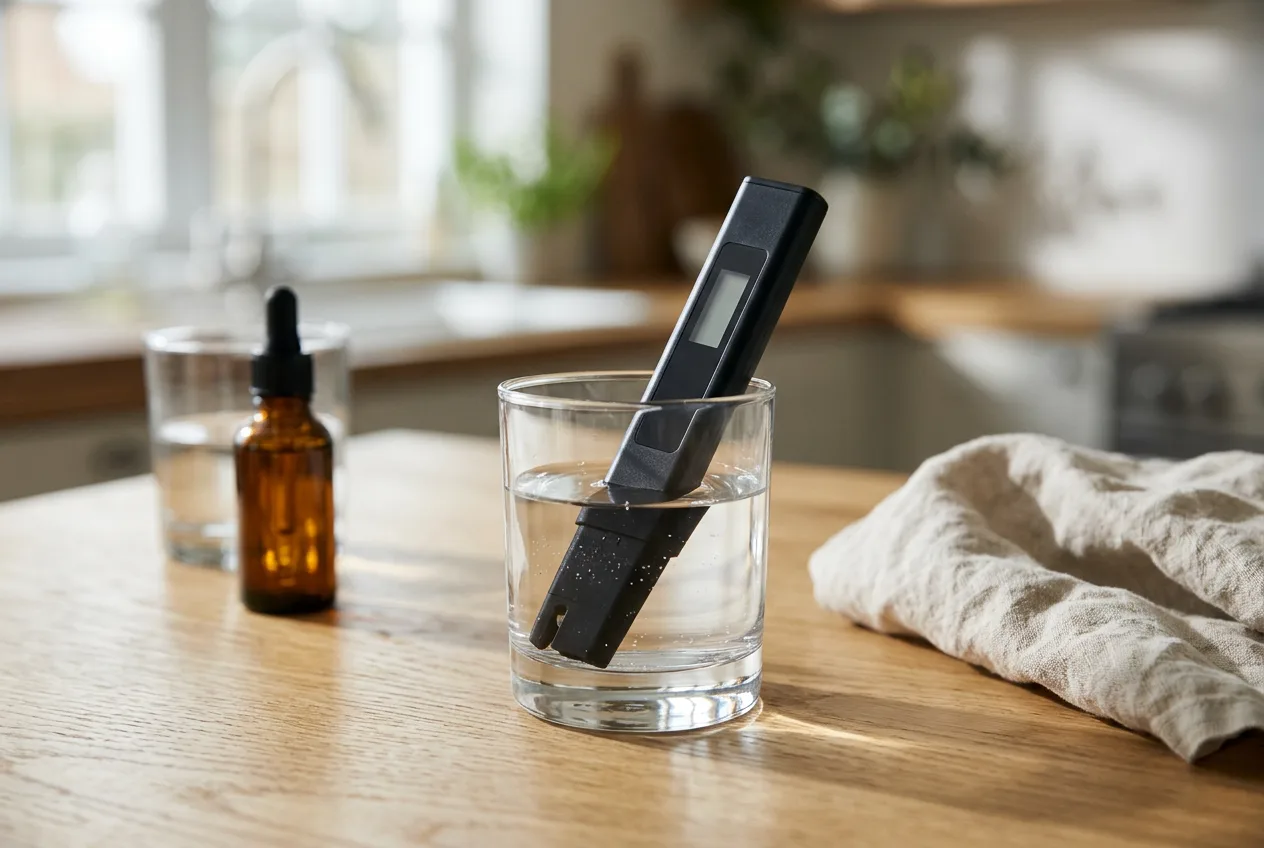
1. A TDS meter (useful, but limited)
A total dissolved solids meter, or TDS meter, is cheap and easy to use. It estimates how much material is dissolved in the water by measuring electrical conductivity.
That's a handy general reference. But it has one big limitation: it can't tell you what's dissolved.
A TDS reading can't distinguish calcium from magnesium, bicarbonate, sodium or anything else that conducts electricity. Two waters with the same TDS reading can brew very different coffee.
So use TDS as a quick check, never as your only measurement.
2. Your local water quality report (free and detailed)
If you're on city water, start here. In the US, community water systems publish an annual water quality report, often called a Consumer Confidence Report. Many utilities let you search by ZIP code or service area.
Look for these numbers:
- Calcium
- Magnesium
- Total hardness
- Alkalinity or bicarbonate
- Sodium
- Chlorine or chloramine
Not every report lists all of them, but most include hardness, and many include alkalinity.
3. A drop test kit (for treated water)
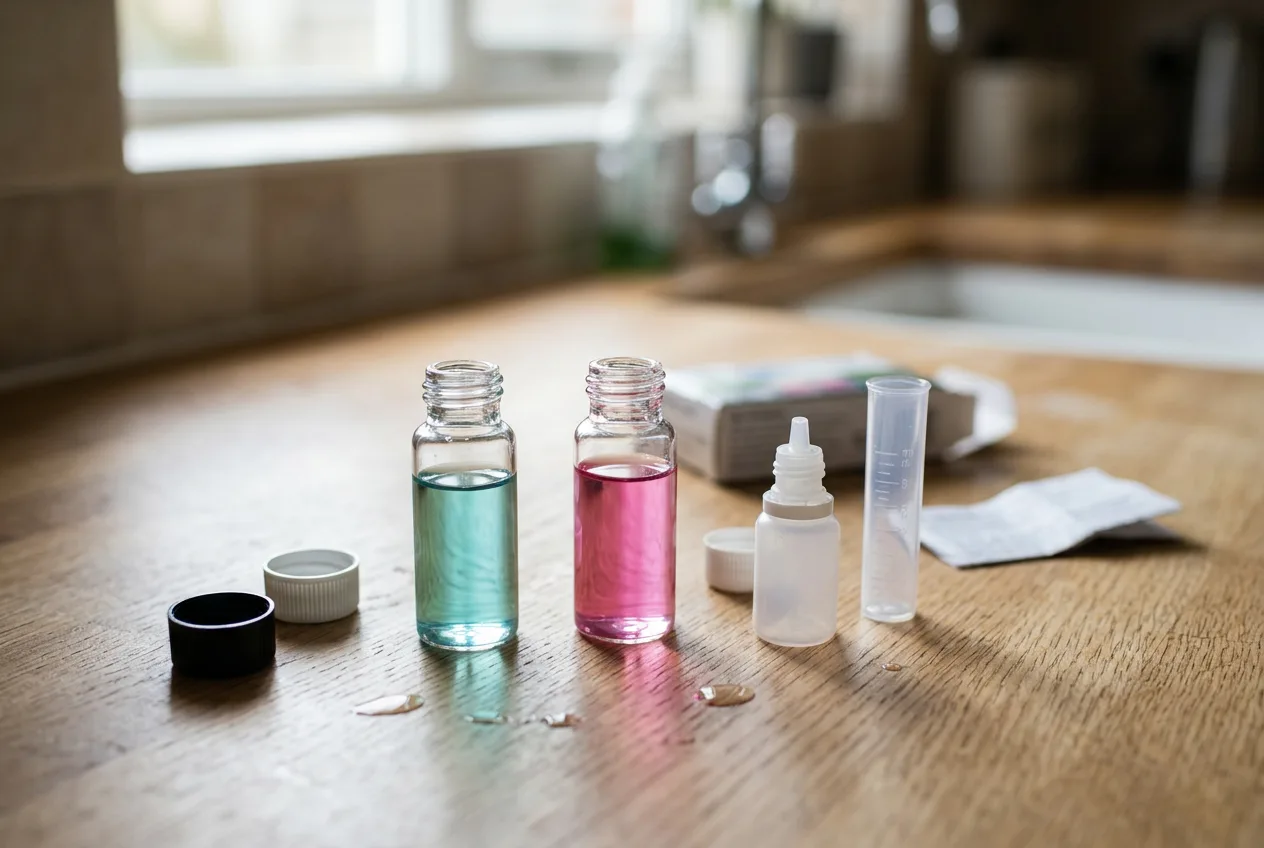
If your water is softened or filtered at home, the utility report no longer describes what comes out of your tap. In that case, test the water yourself.
Drop-based test kits, often sold for aquariums, are simple. You add drops to a measured sample until it changes color. The number of drops gives you an estimate of total hardness (GH) and carbonate hardness (KH, closely related to alkalinity).
They're not laboratory-precise, but they're good enough to make sensible decisions.
| Tool | Cost | Tells you | Doesn't tell you |
|---|---|---|---|
| TDS meter | Low | Total dissolved material | Which minerals, or alkalinity |
| Water quality report | Free | Detailed composition of city water | Effect of your home filter or softener |
| Drop test kit | Low | Hardness and alkalinity of your actual water | Exact calcium vs magnesium split |
Our tip: Always test the water you actually brew with. If it passes through a fridge filter, a pitcher or a softener, test it after that step, not straight from the main line.
Pitcher filters: what they can and can't do
Pitcher filters with activated carbon are the most common home water treatment. They're cheap, simple and often worth having.
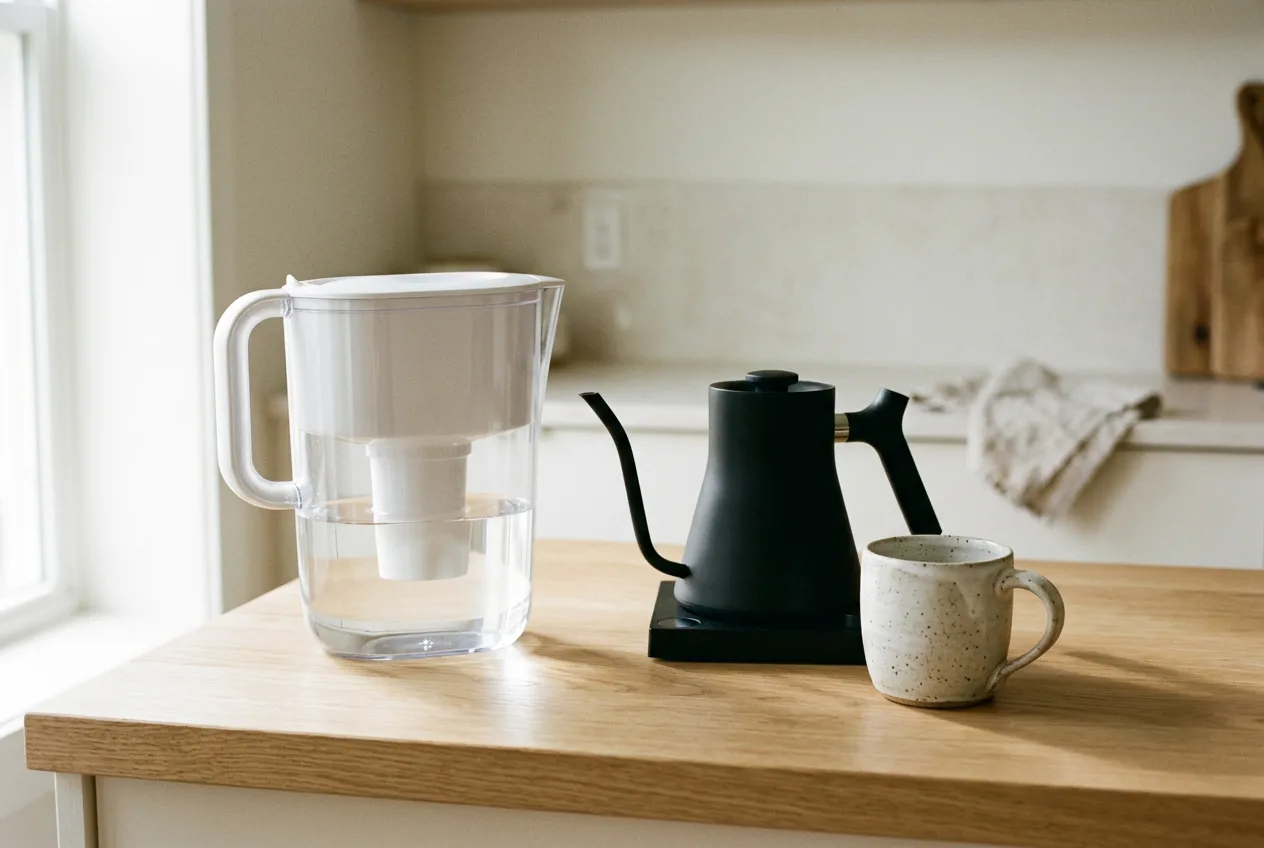
What's inside a typical cartridge
- A fine meshCatches small particles and sediment.
- Activated carbonRemoves many taste and odor compounds, especially chlorine. This alone can noticeably improve coffee.
- Ion-exchange resinReduces some hardness by swapping calcium for other ions.
Does ion exchange make water salty?
The resin grabs calcium and releases sodium (or in some filters, hydrogen) in its place. That isn't the same as adding table salt, and it doesn't usually make water taste salty.
It changes which ions are dissolved and can reduce the tendency to form limescale.
The limits
- The softening capacity is limited and fades as the resin gets used up
- They aren't very effective on very hard water, even when new
- They don't let you target specific mineral numbers
A pitcher filter can improve taste and soften water a little. Don't expect it to solve a serious hardness problem.
Our tip: Change the cartridge on schedule. An exhausted filter stops softening long before it stops removing chlorine taste, so your coffee can slowly get flatter without you noticing.
Limescale: why hard water hurts your machine
Hard water doesn't just affect flavor. It can damage your equipment.
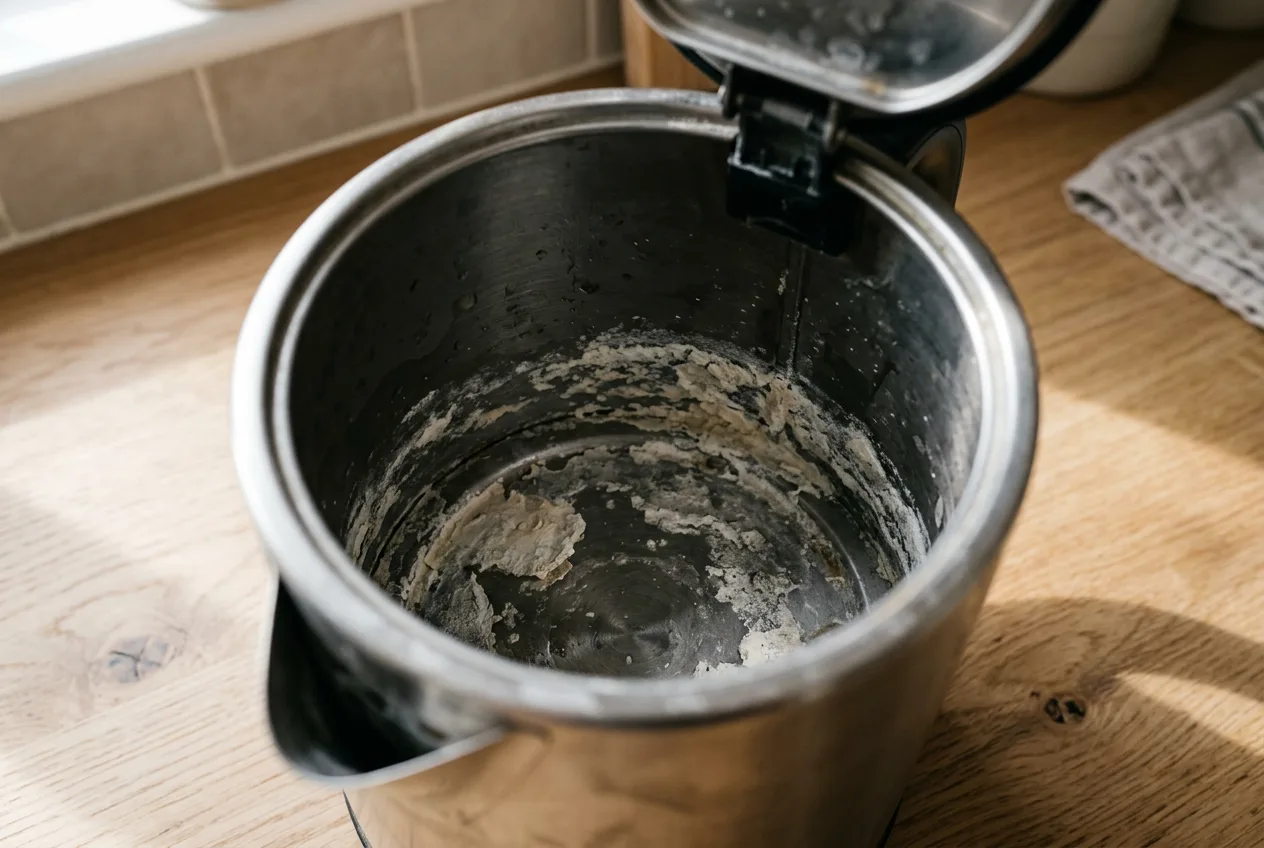
When hard water is heated, some of the dissolved minerals come out of solution and form limescale. It builds up inside coffee makers, espresso machines and kettles.
What scale does over time
- Restricts water flow through pipes and valves
- Insulates heating elements so they work harder and heat less evenly
- Clogs small parts like solenoid valves and shower screens
- Shortens the life of the machine and leads to expensive repairs
Espresso machines are especially vulnerable because they hold hot water for long periods and have narrow internal passages.
So choosing water is both a flavor decision and an equipment-care decision.
A filter that only fixes taste but doesn't reduce hardness leaves the scale problem untouched. The right treatment depends on what's in your water and what your machine needs.
Our tip: Descale on the schedule your machine's manual recommends, and sooner if you live in a hard water area. It's much easier to prevent scale than to remove years of it.
Bigger filters and reverse osmosis
Larger home filtration systems, under the sink or on the main line, often work on the same principles as pitcher filters, just on a bigger scale. They treat more water and can be more effective.
The trade-offs are upfront cost, installation, replacement cartridges and ongoing maintenance.
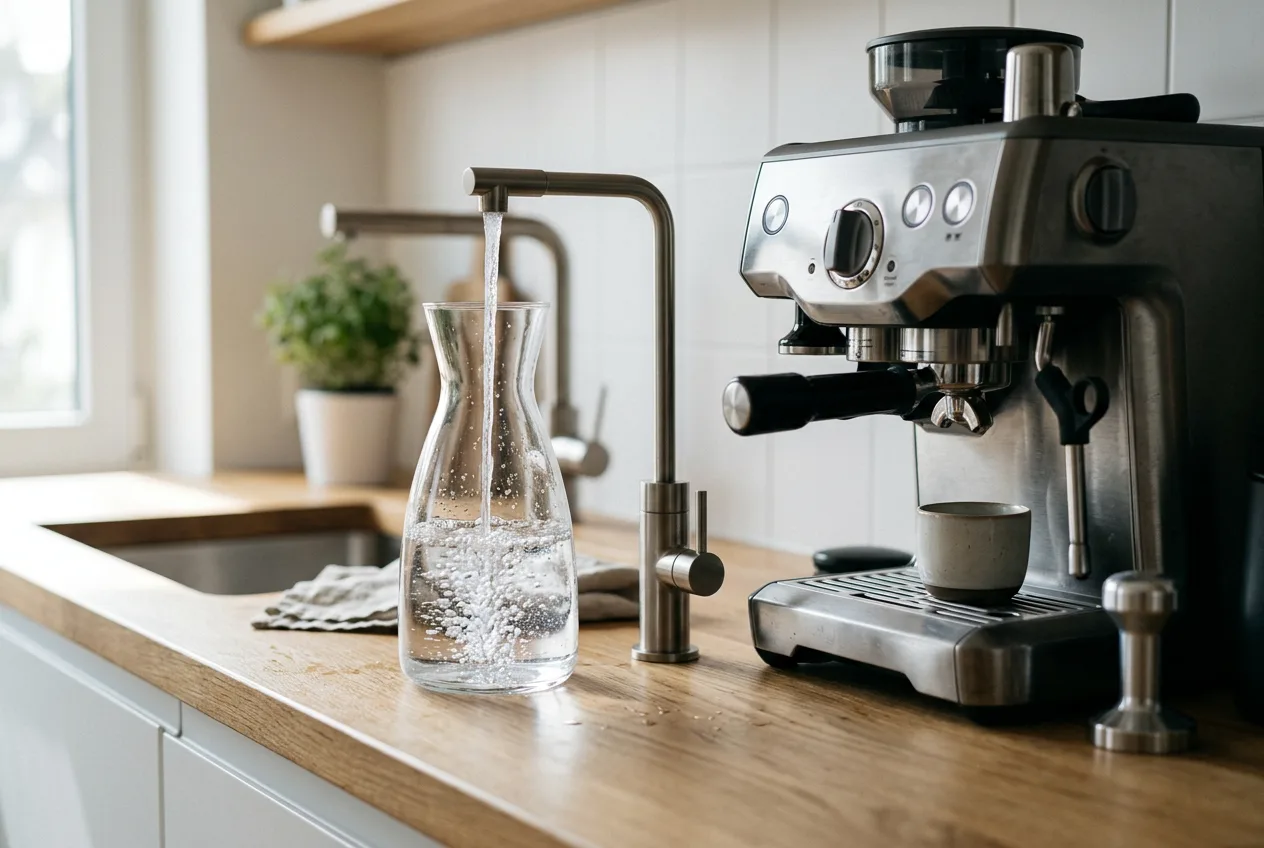
How reverse osmosis works
Reverse osmosis (RO) is a different approach. It pushes water through a very fine membrane under pressure. Water molecules pass through, while most dissolved minerals and other substances are rejected and flushed away in a waste stream.
The result is water with very low mineral content.
Why RO water isn't automatically great for coffee
RO is excellent when your source water has serious problems. But very low-mineral water often makes thin, sour or hollow coffee, because extraction benefits from some minerals.
Extremely low-mineral water can also be unsuitable for some equipment and may contribute to corrosion in certain conditions.
So the goal isn't to strip everything out. RO water usually needs to be remineralized before brewing, either with a remineralizing cartridge or your own mineral recipe.
| Your tap water | Simplest good option | Upgrade option |
|---|---|---|
| Soft, tastes fine | Use as is, maybe a carbon filter | Add a little mineral concentrate |
| Moderately hard | Pitcher filter | Under-sink softening filter |
| Very hard | Bottled water or water from a cafe | RO with remineralization, or DIY recipe |
| Chlorine taste | Carbon filter | Carbon plus mineral adjustment |
| Very soft or RO | Add minerals | Remineralizing cartridge or recipe |
Bottled mineral water
Bottled water can be a convenient way to get water with a known composition.
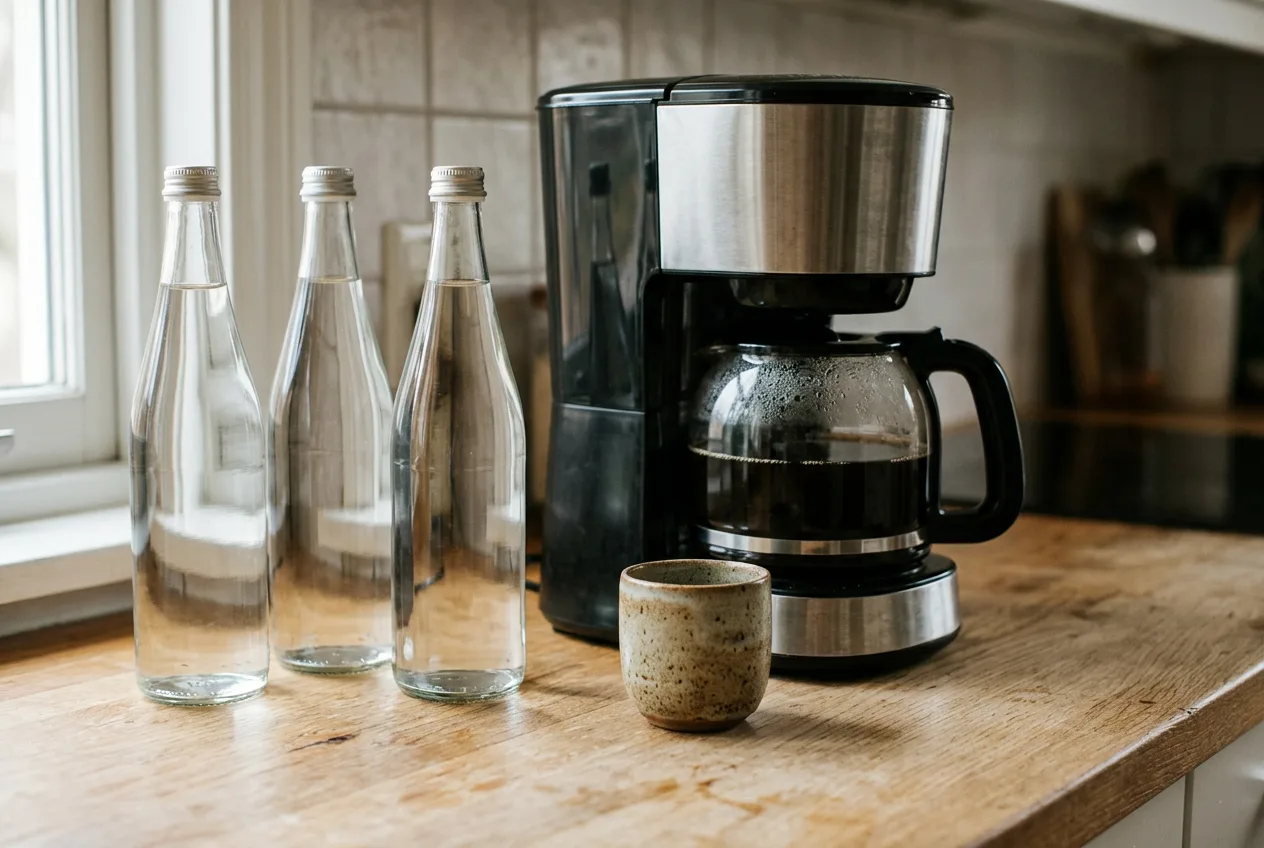
Where labels are required to list minerals, you'll often see calcium, magnesium, bicarbonate and other components in mg/L. That makes it possible to pick a water that suits coffee.
How to read the label
- Calcium and magnesium: look for moderate amounts, roughly in the ranges above
- Bicarbonate: not zero, but not very high either
- Sodium: lower is better
- Total dissolved solids: moderate rather than very high
Look at the full picture, not one number. A water with good mineral levels but almost no bicarbonate may make coffee taste too sharp. One with lots of bicarbonate can make it dull.
Note that bicarbonate on a label is listed as the ion itself. To compare it with alkalinity "as CaCO3," multiply by roughly 0.82.
The drawbacks
Bottled water is a fine short-term fix, or something to keep for special coffees. But buying and carrying it every day adds cost, packaging waste and environmental impact.
If you love the results, use it as a benchmark and then try to recreate it more sustainably.
Asking a local cafe or roaster
Many specialty cafes and roasters already treat their water to a good brewing profile. It's worth asking if they'd sell you some.
Treating water costs them money, so expect to pay rather than assuming they'll fill your containers for free. Not every cafe will offer it, but some are happy to help customers who want to brew similar coffee at home.
It's a simple option if you want better water without buying equipment or learning to mix minerals.
Making your own brewing water
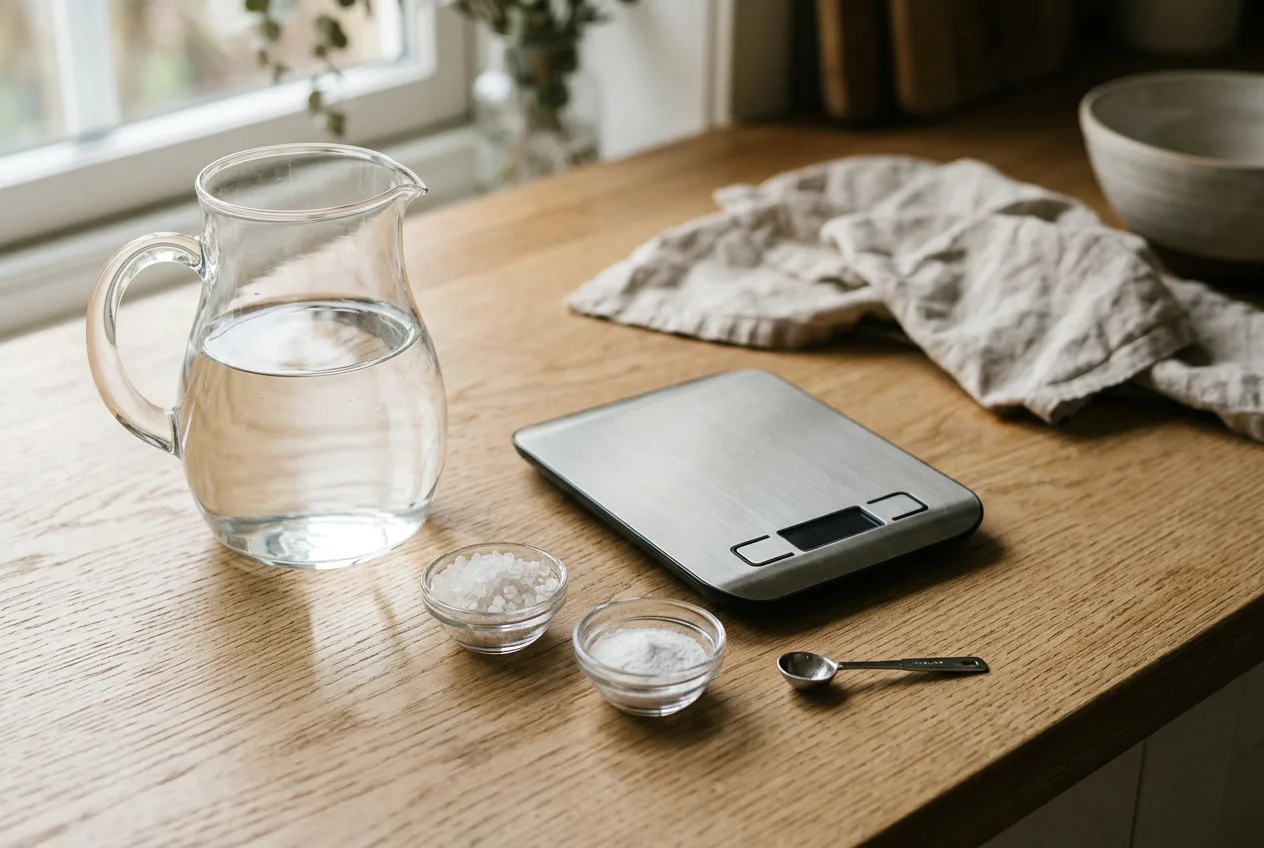
For the most control, start with distilled or demineralized water and add measured minerals. This gives you a repeatable recipe that tastes the same every time, wherever you live.
Option 1: mineral sachets
The easiest route is a commercial mineral sachet made for coffee. You add one sachet to a set amount of distilled water, usually a gallon, and you're done.
They're convenient and consistent, and they let people in different places brew with very similar water.
Option 2: your own concentrates
The more hands-on approach uses two simple ingredients:
Use plain, food-grade products with no added scents or ingredients. Bath-salt Epsom blends with fragrance are not suitable.
Because the amounts are tiny, the usual method is to make two concentrated solutions first, then dilute them into your brewing water. That's far more accurate than trying to weigh a few milligrams.
A simple two-concentrate method
- Make the hardness concentrateDissolve about 2.45 g of Epsom salt in 1 liter of distilled water. This gives roughly 1,000 ppm of hardness (as CaCO3).
- Make the buffer concentrateIn a separate bottle, dissolve about 1.68 g of baking soda in 1 liter of distilled water. This gives roughly 1,000 ppm of alkalinity (as CaCO3).
- Label and storeLabel both bottles clearly and keep them sealed in the fridge. They keep for weeks.
- Mix your brewing waterFor 1 liter of brewing water, put about 70 g of the hardness concentrate and 50 to 60 g of the buffer concentrate in a jug, then top up to 1,000 g with distilled water.
- Taste and adjustThat gives roughly 70 ppm hardness and 50 to 60 ppm alkalinity. Too sharp? Add a little more buffer. Too flat? Use less buffer or a bit more hardness.
Measure carefully with a scale that reads to 0.01 g for the concentrates. Guessing produces water that's too strong or badly balanced.
Specialty coffee resources also offer free online calculators that turn a target mineral profile into exact ingredient amounts. Some can even adjust very soft tap water by adding minerals.
Is it worth the effort?
It's more work than a pitcher filter or bottled water. You need supplies, a precise scale and a little patience.
But it gives you control and repeatability, and it's especially useful if your tap water is very hard. Once you've made the concentrates, mixing a jug takes about a minute.
Our tip: Make one batch of brewing water and use it for a week with the same coffee. You'll learn far more from a consistent baseline than from changing beans and water at the same time.
Espresso vs filter coffee: does water matter differently?
Water matters for every brew method, but espresso and filter coffee have slightly different needs.
| Filter and pour-over | Espresso machines | |
|---|---|---|
| Flavor priority | Clarity, sweetness, acidity | Balance, body, sweetness |
| Typical hardness | Lower to moderate | Moderate, kept low enough to limit scale |
| Alkalinity | Lower end for bright coffees | Often slightly higher to tame sourness |
| Scale risk | Mostly in your kettle | High, inside boilers and valves |
| Biggest mistake | Very hard, high-alkalinity tap water | Ignoring scale, or using pure distilled water |
If you own an espresso machine, check the manufacturer's water advice too. Some machines rely on a little mineral content for their water level sensors, and pure distilled or RO water can confuse them.
For pour-over, you have more freedom to experiment, because the only thing at risk is the taste of one cup.
Troubleshooting your coffee by taste
Water problems often hide behind other problems. Before you blame your grinder or beans, check whether your water could be the cause.
| What you taste | Possible water cause | What to try |
|---|---|---|
| Flat, dull, "brown" | Too much alkalinity, very hard water | Filter or dilute with distilled water |
| Sharp, sour, harsh | Too little alkalinity | Add a little bicarbonate |
| Thin, hollow, watery | Too few minerals | Add hardness (magnesium or calcium) |
| Chalky, heavy, muted | Too many minerals | Soften or dilute the water |
| Swimming pool, medicinal | Chlorine or chloramine | Use a carbon filter |
| Salty | High sodium | Try a different water source |
Change one thing at a time. If you change water, grind and beans all at once, you'll never know which change made the difference.
What to expect from tap water where you live
Tap water varies enormously from place to place, and even between neighborhoods in the same city. Still, some broad patterns help you guess what you're dealing with before you look up your report.
Soft water areas
Places that get their water from mountain snowmelt, granite bedrock or large surface reservoirs often have soft water. Parts of the Pacific Northwest, New England and areas fed by mountain reservoirs are good examples.
Soft water usually brews bright coffee but can lean thin or sharp. A small mineral addition, especially a little bicarbonate, often helps.
Hard water areas
Places that draw on groundwater from limestone or chalk tend to have hard, high-alkalinity water. Much of the Southwest, the Midwest, Texas and Florida fall into this group, as do many parts of Europe.
Hard water is the most common reason home coffee tastes flat compared with cafe coffee. It's also where limescale becomes a real maintenance issue.
Well water
Private wells aren't covered by city water reports, and their makeup can be very different from the public supply nearby. If you're on a well, a home test is the only way to know what you have.
| Water type | Typical coffee result | First thing to try |
|---|---|---|
| Soft, low alkalinity | Bright but sometimes sharp or thin | Add a little buffer and hardness |
| Moderate | Often fine | Carbon filter for chlorine |
| Hard, high alkalinity | Flat, chalky, dull | Pitcher filter or blend with distilled water |
| Private well | Unpredictable | Test before changing anything |
A quick shortcut for hard water: blend your tap water with distilled water. A 50/50 mix halves both the hardness and the alkalinity. It's not as precise as a recipe, but it's a surprisingly effective first experiment.
Our tip: If you're traveling and your coffee suddenly tastes very different, blame the water before your beans. Bringing a sachet of brewing minerals and buying distilled water locally keeps your coffee consistent on the road.
Common water myths
| Myth | Reality |
|---|---|
| "Purer water makes better coffee" | Water with no minerals often makes thin, sour coffee. You need some minerals. |
| "If it tastes fine, it's fine for coffee" | Pleasant drinking water can still have too much or too little buffering for coffee. |
| "A TDS reading tells you everything" | TDS can't tell calcium from sodium or bicarbonate. Two waters with equal TDS can brew very differently. |
| "Softened water is always better" | Salt-based home softeners swap hardness for sodium and leave alkalinity. Coffee can still taste flat. |
| "Boiling water removes minerals" | Boiling drops some hardness out as scale but concentrates the rest. It doesn't make water balanced. |
| "Water only matters for experts" | Anyone can taste the difference in a side-by-side test. It's often the cheapest upgrade you can make. |
Water for cold brew, tea and other drinks
The same principles apply beyond hot coffee, with a few twists.
Cold brew
Cold brew extracts much more slowly and pulls out fewer acids, so it's naturally less bright. Very high-alkalinity water can make it taste especially flat. A softer, moderately mineralized water usually keeps more sweetness and character.
Tea
Tea is even more sensitive to hard water than coffee. Hard water can leave a film on the surface of black tea and dull green tea's delicate flavor. If you drink both, water that suits light-roast coffee often suits tea too.
Milk drinks
In lattes and cappuccinos, milk hides a lot of water problems. But the espresso underneath still benefits from balanced water, and your machine will last longer if you keep scale under control.
A step-by-step plan for better brewing water
The best solution depends on your water, your coffee, your equipment and how much effort feels reasonable. Here's the order I'd go in.
- Read your water reportFind your local water quality report and note calcium, magnesium, hardness and alkalinity.
- Test treated waterIf your water passes through a softener or filter at home, test it after treatment with a drop kit.
- Don't rely on TDS aloneUse a TDS meter as a quick check, but remember it can't identify the minerals.
- Look at minerals and buffer separatelyConsider calcium, magnesium and bicarbonate as separate ingredients.
- Try a pitcher filter firstIf your water is only mildly hard or tastes of chlorine, see whether a pitcher improves flavor and scale.
- Step up for very hard waterConsider a better filtration system, a suitable bottled water, water from a cafe or your own mineral recipe.
- Remineralize RO or distilled waterDon't brew with pure demineralized water. Add minerals first.
- Taste and adjust slowlyCompare results in the cup and make small changes one at a time.
Once your water is sorted, small tweaks to grind size and roast level become much easier to judge, because you've removed one big hidden variable.
Key takeaways
- Water is the main ingredient in coffee, and it affects both extraction and how flavors taste.
- Calcium and magnesium help extract flavor. Starting points: about 30–50 ppm calcium or 15–30 ppm magnesium.
- Bicarbonate buffers acidity. Around 50–75 ppm alkalinity is a good start. Too little tastes harsh, too much tastes flat.
- Balance beats more. Excess minerals make coffee chalky and cause limescale.
- TDS meters can't identify minerals. Use your water report and a drop test kit.
- Pitcher filters fix taste and soften mildly hard water, but not very hard water.
- Reverse osmosis water usually needs minerals added back before brewing.
- Bottled water works short-term if you read the label carefully.
- DIY mineral water gives the most control and repeatability.
- Hard water areas can get a quick win by blending tap water 50/50 with distilled water.
- Change one thing at a time and taste side by side, so you know what actually made the difference.
If you only take one thing from this guide, make it this: before you spend money on a new grinder or brewer, spend ten minutes finding out what's in your water. For many home brewers, it's the single biggest and cheapest upgrade available.
Good water won't turn mediocre beans into great coffee. But bad water will absolutely hide how good great beans can be. Get the water right, and every other improvement you make becomes easier to taste.
Frequently asked questions
What is the best water for making coffee?
Clean, odor-free water with moderate minerals and moderate alkalinity. A useful starting point is about 30 to 50 ppm calcium or 15 to 30 ppm magnesium, with around 50 to 75 ppm alkalinity, and no chlorine.
Can I use distilled water for coffee?
Not on its own. Pure distilled water has almost no minerals, so coffee often tastes thin, sour or hollow. Some espresso machines also need a little mineral content to work properly. Add minerals to distilled water before brewing.
Is hard water bad for coffee?
Very hard water often makes coffee taste flat and chalky, because it carries lots of minerals and alkalinity that mute acidity. It also causes limescale in kettles and machines.
Does a Brita-style filter improve coffee?
Usually, yes. Carbon pitcher filters remove chlorine taste and soften water a little. They are less effective on very hard water and stop softening as the cartridge wears out.
What does a TDS meter tell me?
It estimates the total amount of dissolved material in water. It cannot tell you which minerals are present or how much alkalinity there is, so it should not be your only measurement.
Should I use bottled water for coffee?
It can work well if you choose one with moderate minerals and bicarbonate. Read the label for calcium, magnesium, bicarbonate and sodium. For daily use, filtering or making your own water is cheaper and less wasteful.
Why does my coffee taste sour even with good beans?
Your water may have too little alkalinity to buffer the acidity, or too few minerals for proper extraction. Grind size and brew time can also cause sourness, so change one variable at a time.
How often should I descale my coffee machine?
Follow your machine manual, and descale more often if you live in a hard water area. Using softened or properly mineralized water greatly reduces how often you need to descale.

- Michael Reynolds, side-by-side brewing water tests
- Specialty Coffee Association, Water Quality Handbook and brewing water standard
- US EPA: Consumer Confidence Reports (find your water quality report)
- Utah State University Extension: How to find your Consumer Confidence Report
Related guides
How to store coffee beans Burr vs blade grinder Coffee roast levels explainedWritten by Michael Reynolds. Last updated November 19, 2026.