Coffee Brewing Ratios Explained: How Much Coffee to Use for Pour-Over, French Press and More
How much coffee should you use? Here's the simple per-cup ratio I use every morning, why weighing beats scooping, how ratios differ between pour-over and French press, and how to adjust strength without ruining flavor.
We choose products independently. We may earn a commission through links on this page; your price stays the same. Affiliate policy
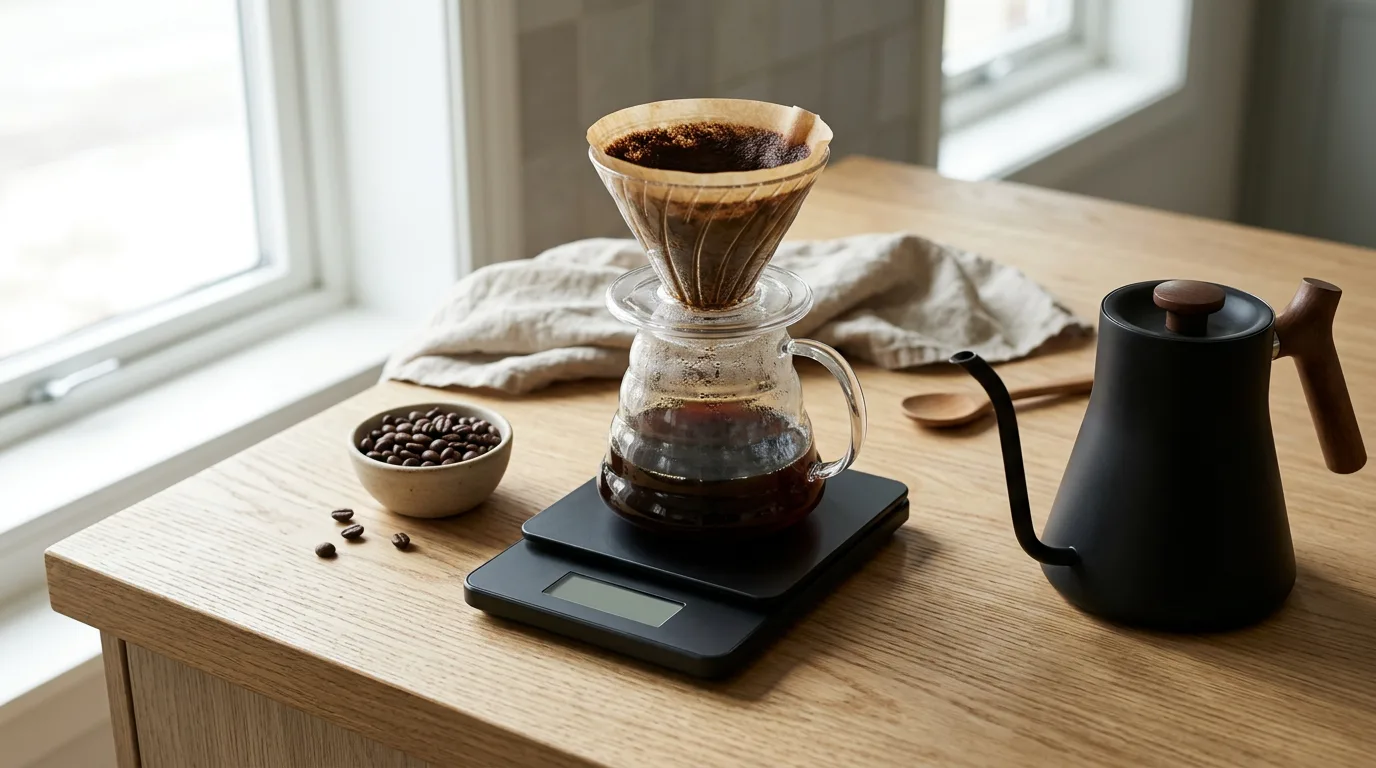
For pour-over and other drip methods, start with about 14 grams of coffee per 8 fluid ounces of water (roughly a 1:17 ratio). For French press and other immersion methods, start with about 18 grams per 8 fluid ounces (roughly 1:13).
Weigh your coffee instead of using a scoop. Scoops can vary by 15% or more depending on roast and grind.
Most importantly: ratio controls strength, not flavor. If your coffee tastes sour or hollow, fix the extraction first (usually grind finer or brew longer). Only once it tastes balanced should you use the ratio to make it stronger or lighter.
Why I wrote this
For years, I made coffee with "two heaping scoops" and wondered why it tasted great on Monday and thin on Wednesday.
Same beans. Same brewer. Same scoop. Different coffee.
When I finally put a cheap kitchen scale under my brewer, the answer was obvious. My "two scoops" ranged from about 13 to 17 grams depending on the beans and how sleepy I was. That's a huge difference in strength.
Getting the ratio under control was the single cheapest upgrade I've ever made to my coffee. This guide is everything I wish I'd known back then.
What you'll learn
- What a brewing ratio is and what it controls
- Why weighing coffee beats using scoops
- A simple per-8-ounce method that's easy to scale in your head
- Why ratio and extraction are different, and which to fix first
- Why French press usually needs more coffee than pour-over
- Ready-to-use recipes for 1 to 4 cups
- Ratios for espresso, cold brew and drip machines
A quick note: I use fluid ounces for water because that's how most American kitchens measure, and grams for coffee because that's what a scale reads. If you weigh your water too, 8 fluid ounces is about 237 grams.
What a brewing ratio is
A brewing ratio is simply the amount of ground coffee you use compared with the amount of water.
It's one of the main things that decides how strong your coffee is. More coffee for the same water makes a stronger cup. Less coffee makes a lighter one.
Why a consistent ratio helps
- You can repeat a good cupWhen a cup tastes great, you know exactly how you made it.
- You can adjust on purposeWant it a little stronger? Add a gram or two, rather than guessing.
- You can troubleshootIf one batch tastes different, you can rule out the ratio and look at other causes.
What a ratio doesn't do
Here's the part most guides skip. A ratio controls strength, but it doesn't guarantee good flavor.
A cup can taste weak, sour, bitter, harsh or unbalanced because of how the coffee was extracted, even if you measured the coffee and water perfectly.
That's why I treat ratio and extraction as two separate dials. I'll come back to this, because it's the key to fixing most bad coffee.
Our tip: Think of the ratio as the volume knob and extraction as the tuning knob. Turning up the volume on a badly tuned radio just gives you louder static.
Weigh your coffee, don't scoop it
Scoops and tablespoons are convenient. They're also surprisingly inconsistent.
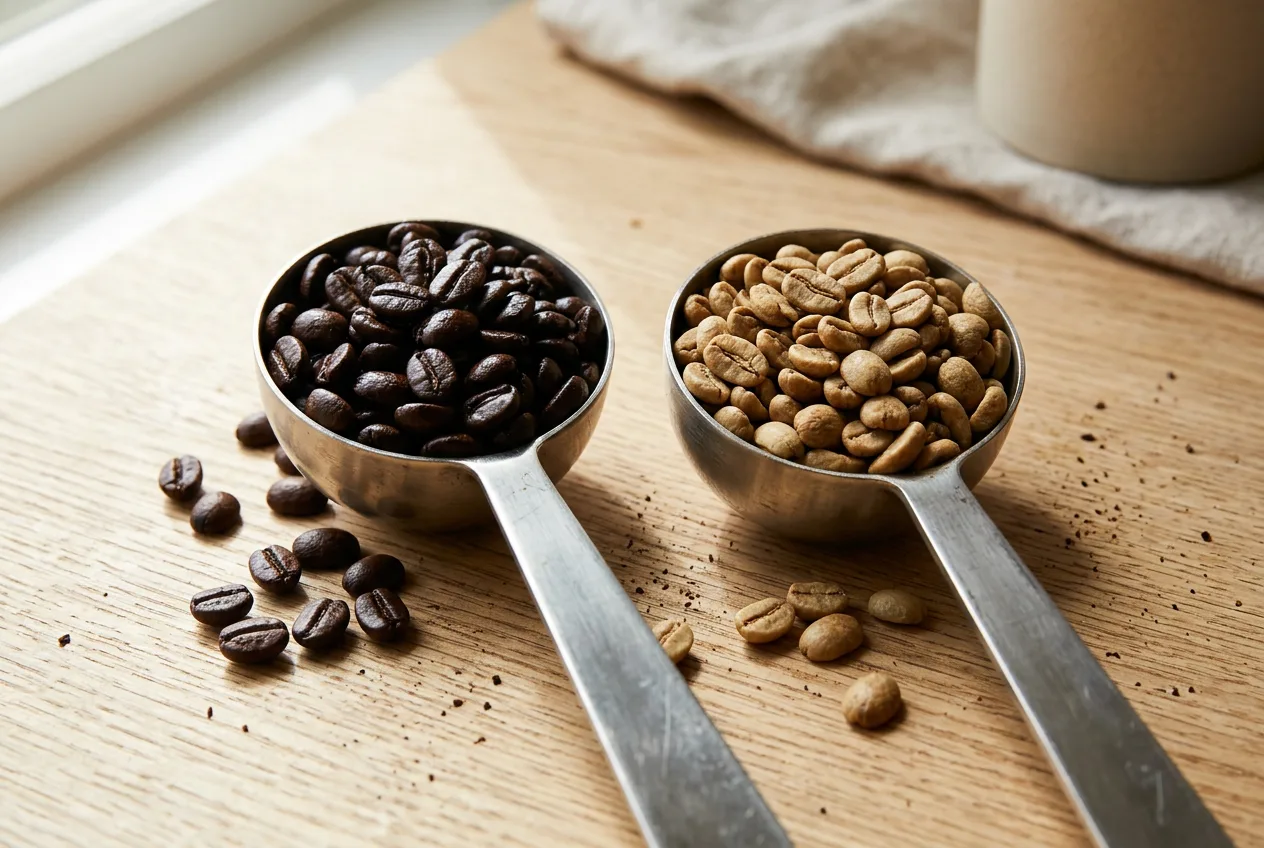
Why the same scoop holds different amounts
- Roast level: dark-roasted beans are less dense than light-roasted beans, so a scoop of dark roast weighs less.
- Grind size: fine grounds pack differently from coarse grounds.
- Bean shape and size: different coffees don't fill a scoop the same way.
- How you fill it: a loose scoop holds less than one that's tapped or shaken.
- Leveling: heaping versus flat makes a real difference.
How big is the difference?
In my tests, a level scoop of medium-ground dark roast weighed about 7 to 7.5 grams. The same scoop of finer-ground light roast weighed about 8 to 8.5 grams.
Weight of one level coffee scoop (my measurements)
Two scoops can easily differ by 2 grams or more, which is enough to noticeably change the strength of a mug.
That looks small. But with two scoops per mug, you're now 2 grams apart, and that's roughly the difference between "nice" and "a bit weak."
Small variations add up. Your coffee tastes stronger one day and weaker the next, even though you think you're doing the same thing.
The fix: a digital scale
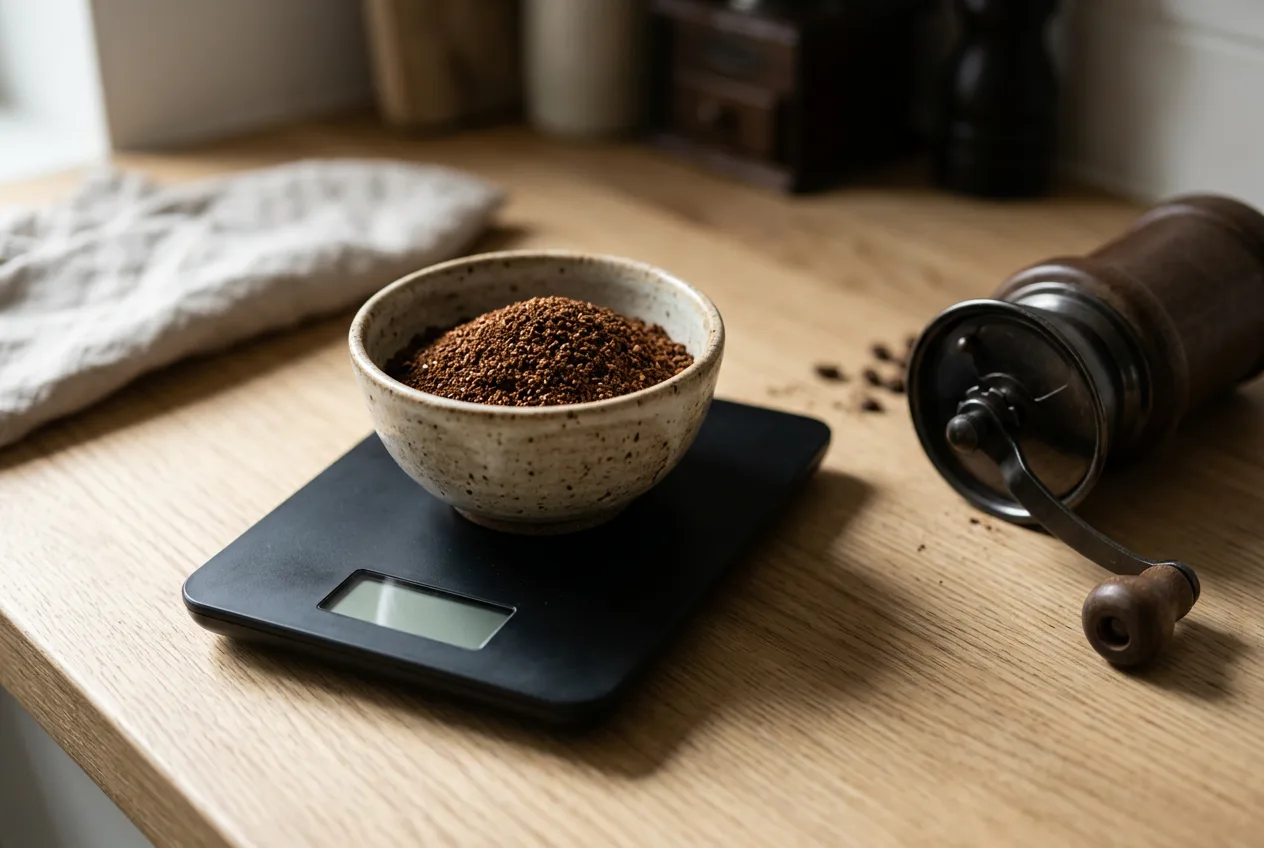
A basic digital kitchen scale that reads in 0.1 or 1 gram steps solves most of this. Weighing the coffee gives you a repeatable starting point.
Weighing the water too makes the recipe even more precise. Most people brew pour-over directly on the scale, adding water until it hits the target.
Our tip: You don't need an expensive coffee scale. Any kitchen scale that reads to 1 gram and has a tare button is enough to transform your consistency.
An easier way to write ratios
You'll often see ratios written as 1:15 or 1:16, meaning 1 gram of coffee for every 15 or 16 grams of water.
That's precise, but it's awkward when you already know how much coffee you want to drink. To make 16 fluid ounces at 1:15, you first convert ounces to grams, then divide by 15. Not something I want to do before my first cup.
Grams per 8 fluid ounces
I find it much easier to think in grams of coffee per 8 fluid ounces of water. Eight ounces is one standard cup, so it scales in your head.
At my pour-over starting point of about 14 grams per 8 ounces:
| Water | Coffee | Roughly makes |
|---|---|---|
| 8 fl oz | ~14 g | 1 standard cup |
| 16 fl oz | ~28 g | 1 large mug or 2 cups |
| 24 fl oz | ~43 g | 3 cups |
| 32 fl oz | ~57 g | 4 cups or a small carafe |
The math is simple: multiply the number of 8-ounce portions by about 14 grams. Three portions? About 42 grams.
That same baseline works out to about 60 grams of coffee per 4.23 US cups of water, or roughly 60 grams per liter.
Cup vs mug: watch out
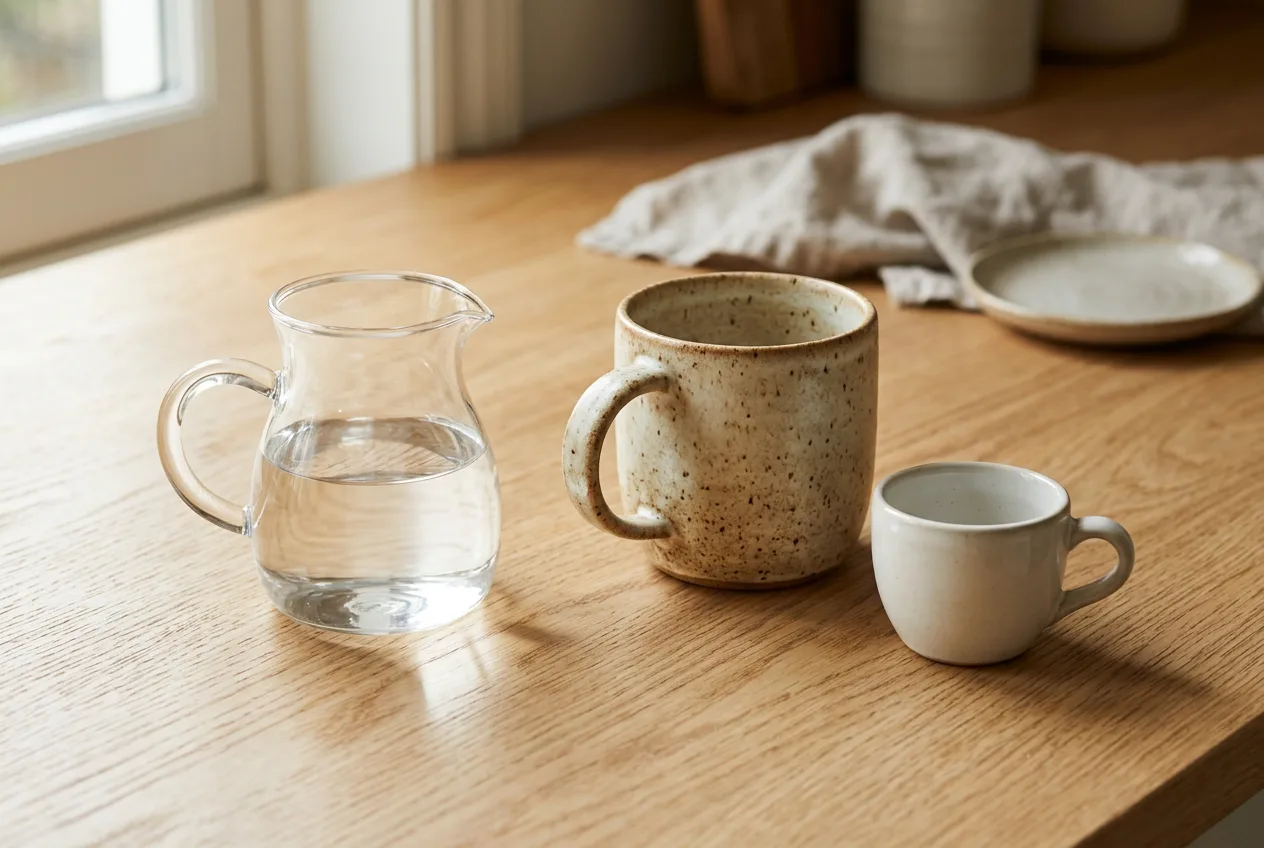
A "cup" in a recipe usually means an 8-ounce measuring cup. Your favorite mug probably holds 12 to 16 ounces.
Coffee makers make this even more confusing. Many machines count a "cup" as only 5 or 6 ounces. So a "12-cup" coffee maker may hold about 60 ounces, not 96.
Using fluid ounces, or better yet grams, avoids that confusion completely.
Our tip: Fill your usual mug with water and weigh it once. Now you know exactly how many 8-ounce portions you're brewing every morning, and how much coffee that needs.
Ratio conversion table
If you follow recipes that use the 1:X format, here's how they translate into grams per 8 fluid ounces (about 237 g of water).
| Ratio | Coffee per 8 fl oz | Coffee per liter | Strength |
|---|---|---|---|
| 1:12 | ~20 g | ~83 g | Very strong |
| 1:13 | ~18 g | ~77 g | Strong (immersion start) |
| 1:14 | ~17 g | ~71 g | Strong |
| 1:15 | ~16 g | ~67 g | Medium-strong |
| 1:16 | ~15 g | ~63 g | Medium |
| 1:17 | ~14 g | ~59 g | Medium (pour-over start) |
| 1:18 | ~13 g | ~56 g | Medium-light |
| 1:19 | ~12.5 g | ~53 g | Light |
Rounded for everyday use. "Strength" assumes a similar, well-extracted brew.
There's no single perfect ratio
The best ratio is the one that makes coffee you enjoy. There's no number every coffee drinker should use.
My 14 grams per 8 ounces is a starting point for pour-over. From there:
That assumes everything else about your brewing stays the same.
Small steps, not big jumps
If a cup is good but just a bit light, add a gram. If it's good but a bit intense, take one away.
Small changes make it much easier to tell what each adjustment actually did. Jump from 12 to 18 grams and you'll overshoot and lose track.
And don't follow a number just because it's popular online. Follow your taste.
Ratio vs extraction: the difference that matters
This is the most important idea in the whole guide.
What extraction is
Extraction is the process of water dissolving flavor compounds and other soluble material out of ground coffee.
Only part of a coffee bean can dissolve. Roughly a third of the grounds is soluble. The rest is insoluble plant material, mostly cellulose.
You don't want to dissolve everything that can dissolve. A balanced brew usually extracts about 20% of the coffee's weight, though some coffees and tastes suit a little more, around 22 to 23%.
Three different things
| Term | What it means | Main way to change it |
|---|---|---|
| Brewing ratio | Coffee compared with water | Use more or less coffee |
| Extraction | How much soluble material leaves the grounds | Grind size, time, agitation, temperature |
| Strength | How concentrated the finished drink is | Mostly ratio, partly extraction |
They're related, but they're not interchangeable.
You can use plenty of coffee and still get a cup that tastes weak and sour, because the water didn't extract enough. And you can extract perfectly and still find the cup too strong for your taste.
Signs of under-extraction
Under-extraction happens when water doesn't pull enough out of the grounds. The cup tastes weak, sour, sharp or unfinished, sometimes with a salty edge.
Common causes:
- Grind too coarse
- Contact time too short
- Not enough agitation or stirring
- Water not reaching all the grounds evenly
- Water not hot enough
Why adding coffee doesn't fix it
If your cup tastes weak and sour, it's tempting to add more coffee. But that makes the drink more concentrated without fixing the poor extraction. You get a stronger sour cup.
The better first step is to improve the brewing:
- Grind a little finerMore surface area lets the water extract more.
- Allow more contact timePour slower, or steep longer in immersion brewers.
- Add gentle agitationA stir or swirl helps water reach all the grounds.
- Check for even wettingDry clumps or channels mean some grounds barely brewed.
- Change one thing at a timeOtherwise you won't know which change helped.
I go much deeper on this in my guide to coffee extraction.
Fix the flavor first, then adjust strength
Here's the rule I follow every time I dial in a new bag of coffee: get the extraction tasting good, then use the ratio to fine-tune strength.
Two questions, in order
Answer the first question before you make big changes to the second.
Three common situations
| How it tastes | What it usually means | What to change |
|---|---|---|
| Balanced but a bit light | Good extraction, low strength | Add 1–2 g of coffee |
| Balanced but too intense | Good extraction, high strength | Remove 1–2 g of coffee |
| Sour, hollow, weak | Under-extracted | Grind finer or brew longer first |
| Bitter, harsh, drying | Over-extracted | Grind coarser or brew shorter first |
Once the flavor is balanced, the ratio becomes a great tool for personalizing strength. Before that, it mostly hides the real problem.
Our tip: Taste the coffee once it has cooled a little. Sourness and bitterness are much easier to spot when the cup is warm rather than very hot.
Two broad brewing categories: percolation and infusion
Most brewing methods fall into one of two groups. Knowing which one you're using explains why their ratios differ.
Percolation
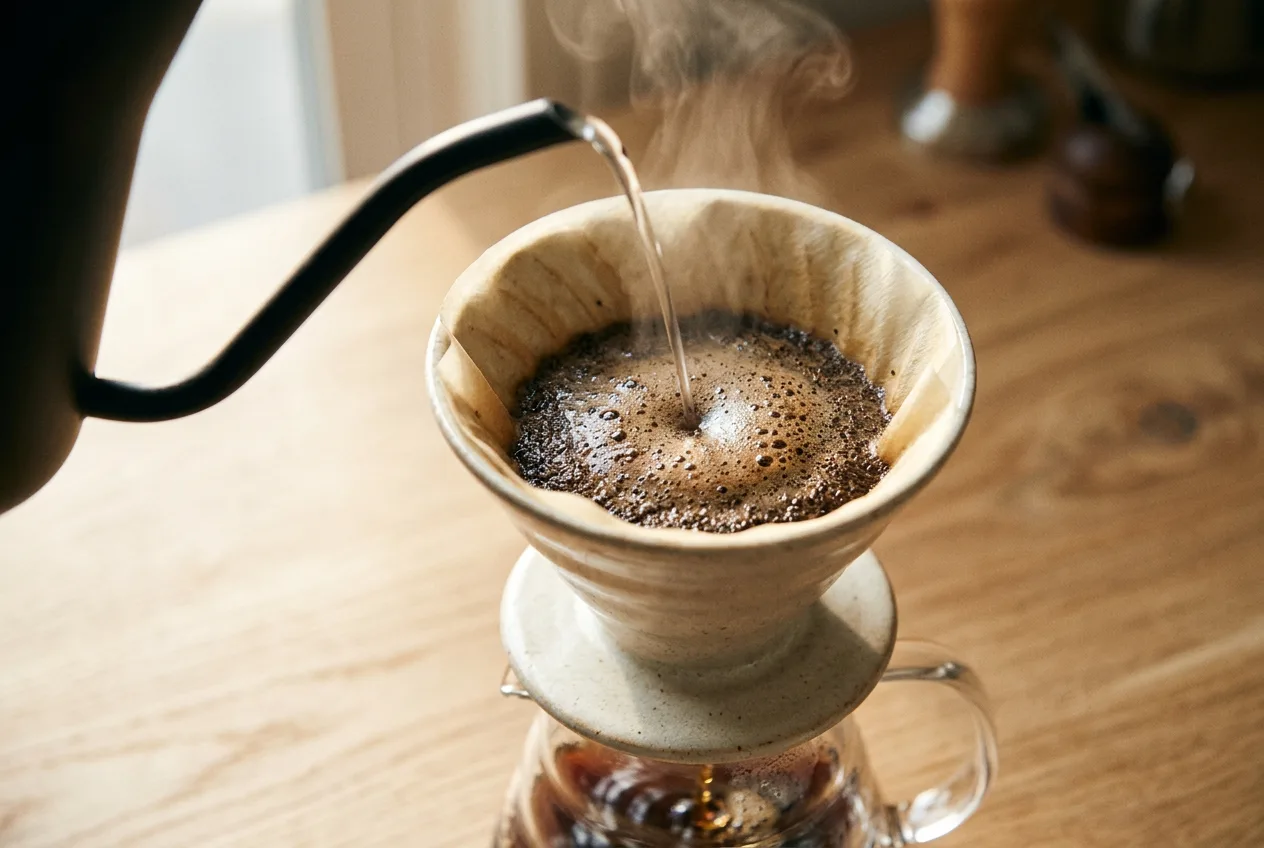
In percolation, water passes through a bed of ground coffee and drains out the bottom.
Pour-over is the classic example. You pour water on the grounds, it flows through, and coffee drips into the carafe or cup. Most automatic drip machines work the same way.
A key detail: some water never makes it into the cup. It stays trapped in the wet grounds. A common estimate is that the grounds hold back about 2 grams of water for every gram of dry coffee.
Infusion (immersion)
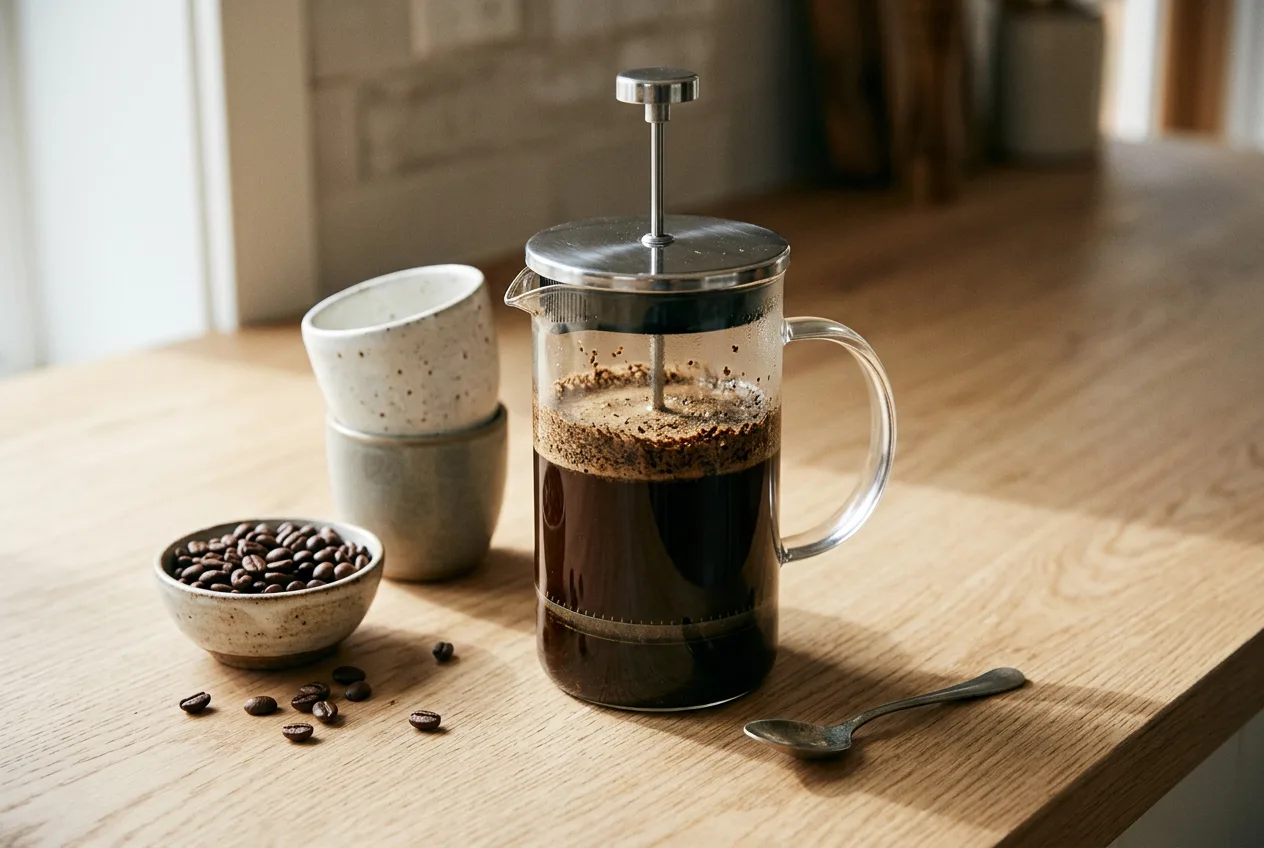
In infusion, the grounds and water sit together for the whole brew time.
The French press is the classic example: the grounds steep in the water, then you press the filter down and pour. Cold brew and cupping also work this way.
| Method | Category | Starting dose per 8 fl oz |
|---|---|---|
| Pour-over (cone, flat-bottom) | Percolation | ~14 g |
| Automatic drip machine | Percolation | ~14 g |
| French press | Infusion | ~18 g |
| AeroPress (steep then press) | Infusion stage | ~18 g |
| Clever-style immersion dripper | Infusion | ~18 g |
Why infusion methods need more coffee
This confused me for a long time. If the coffee and water are the same, why would a French press taste weaker than a pour-over?
It comes down to where the water ends up.
A worked example
Imagine you brew 14 grams of coffee with 8 fluid ounces of water, and about 20% of the coffee dissolves. That's roughly 2.8 grams of coffee material in the liquid.
- In pour-overThe 14 g of grounds hold back about 28 g of water, a little under 1 fluid ounce. So the 2.8 g of dissolved coffee ends up in only about 7 ounces of drink. It's more concentrated.
- In French pressAlmost all the water stays in contact with the grounds and most of it is poured out as the drink. The same 2.8 g is spread through nearly the full 8 ounces. It's less concentrated.
Same coffee, same water, different liquid in the cup (simplified)
The dissolved coffee is similar, but it's spread through more liquid in an infusion brew, so the cup tastes weaker.
Extraction can be similar, but the finished strength isn't. That's why infusion methods usually start with more coffee: about 18 grams per 8 ounces instead of 14.
These are starting points, not fixed rules. Equipment, grind, steep time, the coffee itself and your taste all shift the ideal number.
Where the AeroPress fits
The AeroPress is a bit of a hybrid, which is why people argue about it.
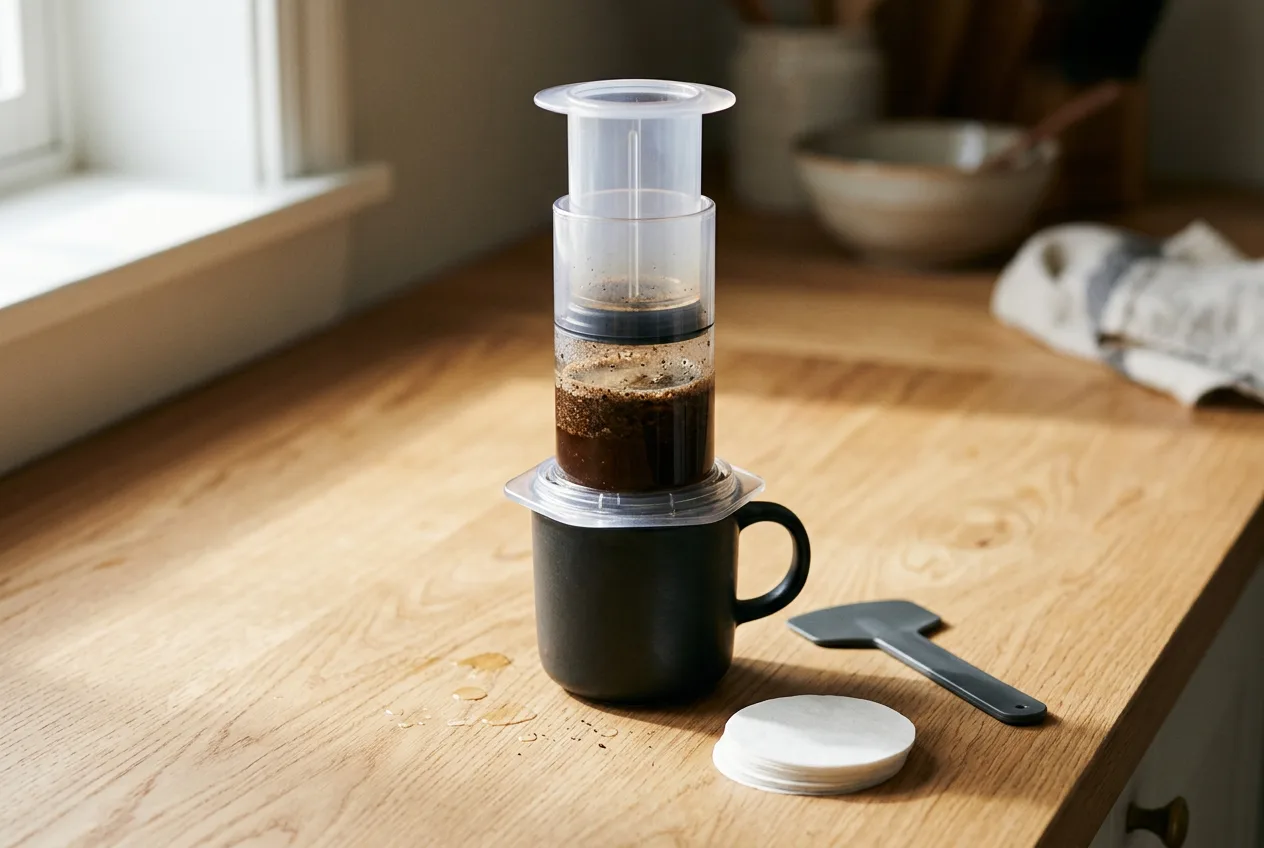
At the end, you press liquid through a bed of coffee, which sounds like percolation. But for most of the brew, the grounds sit steeping in the water.
The useful question isn't "does liquid pass through grounds at some point?" It's "how does most of the brewing contact happen?"
If the grounds are immersed in water for most of the brew time, treat it as an infusion and start with the higher immersion ratio.
This also explains why recipes for different devices use different doses, even for the same amount of coffee.
Strength explained simply: what "TDS" means
If you read coffee forums, you'll see people talk about "TDS." In brewed coffee, it stands for total dissolved solids, and it's simply a measure of strength.
It tells you what percentage of your drink is dissolved coffee, and what percentage is water. A typical pour-over is only about 1.2 to 1.5% coffee. The rest, more than 98%, is water.
That's why small changes in dose are so noticeable. Going from 14 to 16 grams per cup changes the strength by roughly 15%, which your tongue picks up immediately.
| Drink | Approximate strength (TDS) | How it feels |
|---|---|---|
| Light pour-over | ~1.1–1.2% | Delicate, tea-like |
| Typical pour-over or drip | ~1.2–1.45% | Balanced, everyday cup |
| Strong French press | ~1.4–1.6% | Rich, heavy |
| Espresso | ~8–12% | Very concentrated, syrupy |
You don't need a refractometer to brew great coffee. But knowing that strength is a percentage helps explain why ratio matters so much, and why espresso and drip coffee need such different recipes.
Starting ratios for popular brewers
Every brewer has its own personality. Here's where I'd start with the ones I use most, all expressed per 8 fluid ounces of water so they're easy to compare.
| Brewer | Type | Start per 8 fl oz | Grind | Why |
|---|---|---|---|---|
| Cone dripper | Percolation | 14 g | Medium-fine | Fast flow, bright cup |
| Flat-bottom dripper | Percolation | 14–15 g | Medium | Even bed, sweet and round |
| Thick-filter glass carafe brewer | Percolation | 14–15 g | Medium-coarse | Thick paper slows flow, very clean |
| Automatic drip machine | Percolation | 14 g | Medium | Same principle as pour-over |
| French press | Infusion | 18 g | Coarse | Full body, needs more coffee |
| Immersion dripper | Infusion | 16–18 g | Medium | Steeps, then drains through paper |
| Plunger press (AeroPress-style) | Infusion stage | 18 g | Medium-fine | Short steep, pressure finish |
| Stovetop moka pot | Pressure percolation | Fill the basket level | Fine | Basket size sets the dose |
For the moka pot, the basket decides the dose for you. Fill it level without tamping, and fill the water to just below the safety valve.
Our tip: When you switch brewers, start at the suggested ratio for that brewer, not the one you used before. A French press made with your pour-over ratio will taste weak, and you'll be tempted to blame the beans.
Brewing for a crowd
Ratios really earn their keep when you're making coffee for several people. Guessing scoops for a full carafe almost always ends up too weak or too strong.
Scale up, then check the brewer's limits
Multiply your per-8-ounce dose by the number of portions, as usual. For 64 fluid ounces (eight 8-ounce cups) of drip coffee, that's about 113 grams of coffee.
Then check that your brewer can actually hold it. Many home drip baskets struggle above 80 to 100 grams, and overfilling can cause overflow or uneven brewing.
Large batches extract a little differently
A deep bed of coffee slows the water down, so big batches usually extract more than small ones with the same grind. If a full carafe tastes bitter, grind slightly coarser for large batches than you would for a single cup.
| Batch | Water | Drip coffee (14 g / 8 oz) | French press (18 g / 8 oz) |
|---|---|---|---|
| 2 people | 16 fl oz | ~28 g | ~36 g |
| 4 people | 32 fl oz | ~57 g | ~71 g |
| 6 people | 48 fl oz | ~85 g | ~107 g |
| 8 people | 64 fl oz | ~113 g | ~142 g |
If you're hosting, brew slightly strong and offer hot water on the side. It's easy for guests to dilute a strong cup and impossible to fix a weak one.
My ratio experiment: same coffee, five doses
To show how much a few grams matter, I brewed the same medium-roast Colombian coffee as a pour-over five times. Same grind, same water, same pouring, 8 fluid ounces each time. Only the dose changed.
| Dose | Ratio | How it tasted |
|---|---|---|
| 11 g | ~1:21 | Thin and watery, a little hollow |
| 13 g | ~1:18 | Light and clean, gentle sweetness |
| 14 g | ~1:17 | Balanced, clear chocolate and caramel |
| 16 g | ~1:15 | Fuller and richer, still balanced |
| 18 g | ~1:13 | Heavy and intense, slightly muddy for pour-over |
My favorite was 14 grams, with 16 a close second on a cold morning. My partner preferred 13. Neither of us is wrong. That's exactly why a starting point is more useful than a rule.
Notice also that 18 grams, the French press starting point, felt too heavy as a pour-over. Same coffee, different method, different ideal ratio.
I repeated the test a week later with a light-roast Kenyan coffee. This time my favorite moved up to 15 grams, because the denser light roast needed a little more coffee to taste as sweet and full. It's a good reminder that your best ratio can shift slightly with every new bag, so it pays to taste and adjust each time you open one.
Starting recipes for 1 to 4 cups
Here are the two recipes I'd hand to anyone starting out. Water is in fluid ounces for easy kitchen measuring. Weigh it if you can.
Pour-over and drip: about 14 g per 8 fl oz
| Water | Water by weight | Coffee |
|---|---|---|
| 8 fl oz | ~237 g | ~14 g |
| 16 fl oz | ~473 g | ~28 g |
| 24 fl oz | ~710 g | ~43 g |
| 32 fl oz | ~946 g | ~57 g |
French press and immersion: about 18 g per 8 fl oz
| Water | Water by weight | Coffee |
|---|---|---|
| 8 fl oz | ~237 g | ~18 g |
| 16 fl oz | ~473 g | ~36 g |
| 24 fl oz | ~710 g | ~53 g |
| 32 fl oz | ~946 g | ~71 g |
These numbers scale in proportion. Once your extraction tastes good, adjust the coffee dose while keeping the water the same, and write down the new number.
A simple pour-over method
- Weigh and grindWeigh 28 g of coffee for 16 fl oz and grind it medium-fine, like coarse sand.
- Rinse and tareRinse the paper filter with hot water, discard the water, add the grounds and zero the scale.
- BloomPour about twice the coffee's weight in water (around 60 g) to wet all the grounds. Wait 30 to 45 seconds.
- Pour in stagesPour slowly in circles until the scale reads about 473 g.
- Let it drain and tasteTotal time is usually around 3 to 4 minutes. Then taste and adjust grind or dose next time.
A simple French press method
- Weigh and grindWeigh 36 g of coffee for 16 fl oz and grind it coarse, like sea salt.
- Add waterPour in 473 g of water just off the boil and make sure all the grounds are wet.
- SteepWait about 4 minutes. Give the crust a gentle stir.
- Press and pourPress slowly and pour all the coffee out right away so it doesn't keep extracting.
Our tip: Grind fresh right before brewing. Pre-ground coffee goes stale quickly, which makes dialing in your ratio much harder. My burr vs blade grinder guide explains why grind quality matters so much.
Ratios for espresso, cold brew and drip machines
My notes focus on pour-over and French press, but you'll probably want ballpark numbers for other methods too.
| Method | Typical starting ratio | Example | Notes |
|---|---|---|---|
| Espresso | About 1:2 (coffee to drink weight) | 18 g in, ~36 g out | Measured by output weight, not water in |
| Ristretto | About 1:1 to 1:1.5 | 18 g in, ~18–27 g out | Shorter, more intense |
| Lungo | About 1:3 | 18 g in, ~54 g out | Longer, lighter |
| Cold brew concentrate | About 1:4 to 1:8 | 100 g in ~600 g water | Diluted before drinking |
| Ready-to-drink cold brew | About 1:12 to 1:15 | 70 g in ~1 L water | Drink as is |
| Iced pour-over | About 1:16 total, with ice | 30 g, 300 g hot water, 180 g ice | Ice counts as part of the water |
| Automatic drip machine | About 1:16 to 1:17 | 57 g for 32 fl oz | Same as pour-over |
Espresso is the odd one out. Because so much water stays in the puck and the drink is tiny, baristas measure the weight of the espresso in the cup rather than the water going in.
For cold brew, a strong concentrate is handy because you can dilute it with water, milk or ice to taste.
Ratios for iced coffee and cold brew
Cold drinks need their own approach, because ice and long steeping change the math.
Flash-brewed iced coffee
The quickest way to make great iced coffee is to brew hot coffee directly onto ice. The trick is to count the ice as part of your water.
- Pick your total waterFor one large glass, use about 16 fl oz (473 g) in total.
- Split itPut about 40% of that weight as ice in the carafe, around 190 g, and use the remaining 60%, around 283 g, as hot brewing water.
- Use your normal doseUse about 28 g of coffee, the same as for 16 fl oz of hot coffee, and grind a little finer to make up for the smaller amount of hot water.
- Brew onto the iceThe hot coffee melts the ice and chills instantly, locking in aroma.
If you brew a normal hot pot and pour it over ice afterward, the melting ice dilutes it and it tastes watery. Counting the ice from the start fixes that.
Cold brew
Cold brew steeps coarse grounds in cold water for 12 to 24 hours. Because cold water extracts slowly, it needs much more coffee than hot brewing.
Concentrate is more flexible and takes up less fridge space. Ready-to-drink is simpler if you always drink it the same way.
Quick glossary of ratio terms
Build a consistent daily routine
Consistency is the most useful habit in coffee brewing. When you weigh coffee and water every time, you remove most of the guesswork.

My morning routine
- Choose the methodPour-over or French press decides your starting ratio.
- Weigh the coffeeWeigh the beans or grounds every time.
- Measure the waterUse fluid ounces, or weigh it for more precision.
- Keep the process consistentSame grind setting, same pouring style, same timing.
- TasteNotice strength first, then whether it's sour, bitter or balanced.
- Decide: extraction or strength?Sour or bitter means extraction. Too light or too strong means ratio.
- Change one variableOnly one adjustment per brew.
- Write it downRecord the recipe that works best.
Keep a simple coffee log
A notebook or a note on your phone is enough. Track:
- Coffee name and roast date
- Coffee dose and water amount
- Grind setting
- Brew time
- A few words on how it tasted
You don't need to record everything forever. A week of notes on a new bag is usually enough to find its sweet spot.
Quick decision guide
Common ratio mistakes (and how to fix them)
- Using scoops and expecting consistencyScoops vary with roast and grind. A scale fixes this in one step.
- Adding coffee to fix sournessSourness is usually under-extraction. Grind finer or brew longer first.
- Using the pour-over ratio in a French pressImmersion brews spread the coffee through more liquid. Start with more coffee.
- Trusting coffee maker "cups"Many machines count a cup as 5 or 6 ounces. Measure in ounces or grams instead.
- Changing everything at onceAdjust one variable per brew, or you'll never know what worked.
- Forgetting that beans changeA new bag, a different roast level or older beans can all need a slightly different recipe.
- Ignoring water qualityVery hard or very soft water changes extraction. My guide to water chemistry for coffee explains how.
How roast level and freshness affect your ratio
Even with a scale, the same ratio can taste different from one bag to the next. Two of the biggest reasons are roast level and freshness.
Light roasts
Light roasts are denser and harder to extract. They often taste best with a slightly finer grind, hotter water or a little more contact time.
Some people also like them a touch stronger, around 15 to 16 grams per 8 ounces, to bring out sweetness. But fix extraction first, as always.
Dark roasts
Dark roasts are more porous and extract easily. They can turn bitter quickly, so a slightly coarser grind or lower dose, around 13 grams per 8 ounces, often tastes smoother.
My guide to coffee roast levels goes into how roasting changes the bean.
Fresh vs older beans
Very fresh coffee releases lots of carbon dioxide, which can push water away from the grounds during the bloom. Older coffee has lost much of that gas and some aroma, and often tastes flatter.
As a bag ages over a few weeks, you may find you need to grind slightly finer or add a gram to keep the same intensity. Proper storage slows that change down.
| Coffee | Typical tweak from the 14 g starting point | Why |
|---|---|---|
| Light roast | Grind finer, or 15–16 g | Harder to extract |
| Medium roast | Start at 14 g | Balanced baseline |
| Dark roast | Grind coarser, or ~13 g | Extracts quickly, turns bitter |
| Very fresh beans | Longer bloom | More gas to release |
| Older beans | Grind finer, or +1 g | Less aroma and intensity |
Key takeaways
- Weigh coffee instead of using scoops or tablespoons, and measure water consistently.
- Think in grams per 8 fluid ounces. It's easy to scale for any amount.
- Pour-over start: about 14 g per 8 fl oz. French press start: about 18 g per 8 fl oz.
- No ratio is universally correct. Your taste decides.
- Ratio and extraction are different. Ratio controls strength. Extraction controls balance.
- Sour and weak usually means under-extracted. Adding coffee won't fix it.
- Fix extraction first, then fine-tune strength with the ratio.
- Make small changes and keep everything else the same.
- Write down the recipe that works so you can repeat it.
If you only change one thing after reading this, make it buying a simple kitchen scale. Weighing your coffee for one week will teach you more about what you like than years of guessing with a scoop.
Then work in order. Get the grind and brew time right so the cup tastes balanced and sweet. Only after that, nudge the dose up or down a gram at a time until the strength feels right for you. Write the winning recipe on a sticky note and put it inside the cupboard door.
Start with a measured recipe, pay attention to flavor, and adjust on purpose. Treat these numbers as practical starting points rather than strict rules. Once the extraction tastes balanced, your ratio becomes the easiest way to make the strength exactly how you like it.
Frequently asked questions
How much coffee should I use per cup?
A good starting point is about 14 grams of ground coffee per 8 fluid ounces of water for pour-over or drip coffee, and about 18 grams per 8 fluid ounces for French press. Adjust by 1 to 2 grams to taste.
What is the golden ratio for coffee?
The Specialty Coffee Association's Golden Cup guideline is about 55 grams of coffee per liter of water, roughly 1:18. Many home brewers prefer a little stronger, around 1:16 to 1:17, which is about 14 to 15 grams per 8 fluid ounces. Treat any of these as a starting point.
How many tablespoons of coffee per cup?
Roughly 2 level tablespoons of ground coffee per 8 fluid ounces, but tablespoons vary a lot by roast and grind. A scale is far more consistent.
Why does my French press coffee taste weaker than pour-over?
In immersion brewing, nearly all the water ends up in your cup, so the dissolved coffee is spread through more liquid. Use more coffee, about 18 grams per 8 fluid ounces, to get similar strength.
Should I add more coffee if my coffee tastes sour?
Usually not. Sour, weak coffee is typically under-extracted. Grind a little finer, brew a bit longer or add gentle agitation first, then adjust the dose if it is balanced but too light.
What ratio should I use for cold brew?
For a concentrate, about 1:4 to 1:8 coffee to water, diluted before drinking. For ready-to-drink cold brew, about 1:12 to 1:15.
What is the ratio for espresso?
Espresso is usually measured by output: about 1 part coffee to 2 parts liquid espresso by weight, for example 18 grams of coffee producing about 36 grams of espresso.
Do I need a coffee scale?
You do not need a special coffee scale, but any kitchen scale that reads to 1 gram with a tare button will make your coffee much more consistent than scoops.

- Michael Reynolds, scale-weighed brewing tests and daily brewing notes
- Specialty Coffee Association: Coffee Standards (PDF)
- Specialty Coffee Association: Heritage brewing standards, including the Golden Cup
Related guides
Burr vs blade grinder Water chemistry for coffee How to choose coffee beansWritten by Michael Reynolds. Last updated November 19, 2026.