Pour Over vs Drip Coffee: Taste, Extraction, Consistency and Which Brewer Suits You
Pour-over and drip coffee work on the same basic idea: hot water flows through ground coffee in a filter. Yet they taste different, fit different mornings and reward different kinds of people. I brewed the same beans both ways for weeks. Here's what actually separates them, from filter paper to water dispersion, and how to get the best cup out of each.
We choose products independently. We may earn a commission through links on this page; your price stays the same. Affiliate policy
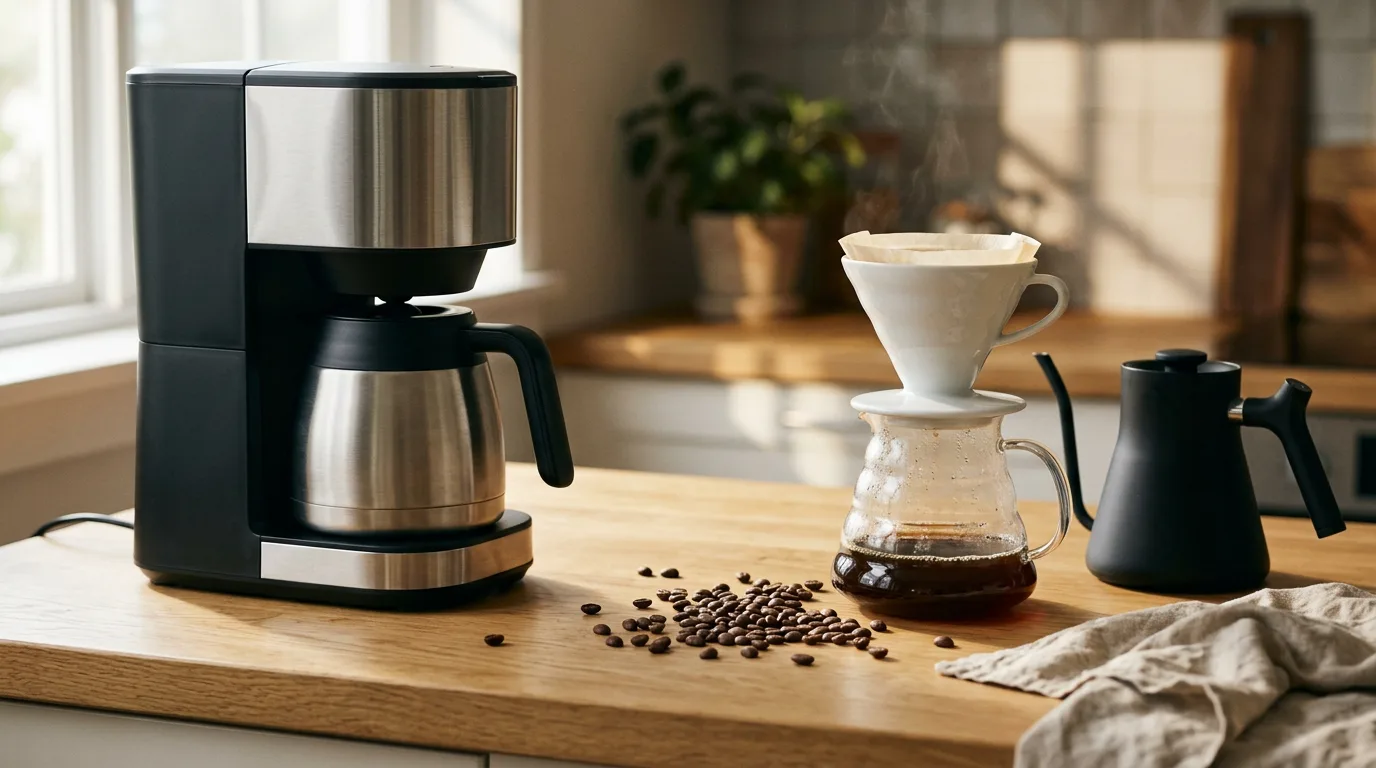
Choose a drip machine if you want several good cups at the push of a button, every morning, with the same result each time. Choose a pour-over if you brew one or two cups, enjoy a hands-on ritual and want the cleanest, brightest flavor. Both use gravity to pull water through coffee in a filter. The differences come from batch size, filter paper, how water is spread over the grounds and who controls it: a machine or your hand. Neither is better in itself. The person and the variables matter more than the brewer.
Why I compared them
"Pour-over or drip?" is probably the brewing question I get asked most often. It sounds simple, but the answers you usually hear are anything but balanced.
Coffee people tend to pick a side. Pour-over fans talk about drip machines as if they only make stale office coffee. Drip fans call pour-over a fussy ritual for people with too much time. Both camps have a point, and both miss a lot.
I've owned cheap drip machines, a good certified drip brewer and more pour-over drippers than I'd like to admit. So I set out to compare them properly: same beans, same water, same grinder, two methods.
I'll look at this on two levels. First the everyday view: how each method works, how convenient it is, how fresh the coffee stays and how it tastes. Then the technical view: extraction, water dispersion, agitation, the variables you can control, cost and consistency.
My conclusion up front: both brewers can make exceptional coffee, and both can make a disappointing cup. What decides the result is mostly how well you understand the variables, the quality of the equipment and how carefully you brew.
Pour-over vs drip coffee at a glance
| Feature | Drip coffee | Pour-over |
|---|---|---|
| Method | Automatic percolation | Manual percolation |
| Typical batch | 4-12 cups | 1-2 cups (8-16 oz) |
| Effort | Load and press a button | Active pouring for 3-4 minutes |
| Body | Fuller, heavier | Lighter, cleaner |
| Clarity and acidity | Rounder, bolder | Brighter, more defined |
| Best roasts | Medium-dark to dark | Light to medium |
| Control during brewing | Little to none | Full (pour, speed, height) |
| Consistency | Very high once dialed in | Depends on your hand |
| Cost for good control | High (certified machine) | Low (dripper, scale, kettle) |
| Keeping coffee hot | Carafe or hot plate | Drink right away |
How I tested
For several weeks, most of my morning coffee came from this comparison. I brewed the same washed Colombian and a natural Ethiopian, plus a darker house blend, both ways.
For drip I used two machines: a basic model with a single center spout and a hot plate, and a certified specialty brewer with a wide showerhead, bloom setting and thermal carafe.
For pour-over I used a ceramic cone dripper, a flat-bottom dripper and an hourglass glass brewer with thick bonded filters. Water was heated in a temperature-controlled gooseneck kettle.
I kept the ratio close to 1:16 and ground everything on the same burr grinder. I tasted each cup hot and again as it cooled, and I tasted drip coffee straight after brewing and after an hour in the carafe or on the hot plate.
Our tip: If you want to run your own comparison, change one thing at a time. Same beans, same ratio, same water. Otherwise you're comparing recipes, not brewers.
How a drip coffee machine works
Drip coffee, called batch brew in cafés, is built for volume. The coffee collects in a glass pot or an insulated thermal carafe, which makes it ideal for households with several coffee drinkers, offices or anyone who drinks a few cups through the morning.
The workflow is linear and automatic. Here's what happens inside the machine:
- Coffee goes in the basketGround coffee sits in a central brew basket lined with a paper or permanent mesh filter.
- Water goes in the reservoirYou pour cold water into the internal tank.
- The heater switches onWhen you start the machine, often with a simple on/off switch on basic models, a heating element brings the water up to temperature.
- Water rises to the topThermal expansion and a one-way valve push the hot water up a tube to a showerhead or spout above the basket.
- Water falls on the coffeeThe hot water is spread over the top of the grounds.
- Gravity finishes the jobWater drains through the coffee and filter into the carafe until the reservoir is empty.
The beauty is that none of this needs you. The weakness is that none of it can be adjusted once it starts, unless you've bought a machine designed to let you.
How pour-over works
Pour-over is a manual method for small batches, usually one or two cups, about 8 to 16 ounces at a time. Instead of internal plumbing, you heat water in a separate kettle and pour it over the grounds yourself.
The water saturates the coffee bed, pools a little depending on how fast the dripper drains and slowly flows through a paper filter into your mug or a server.
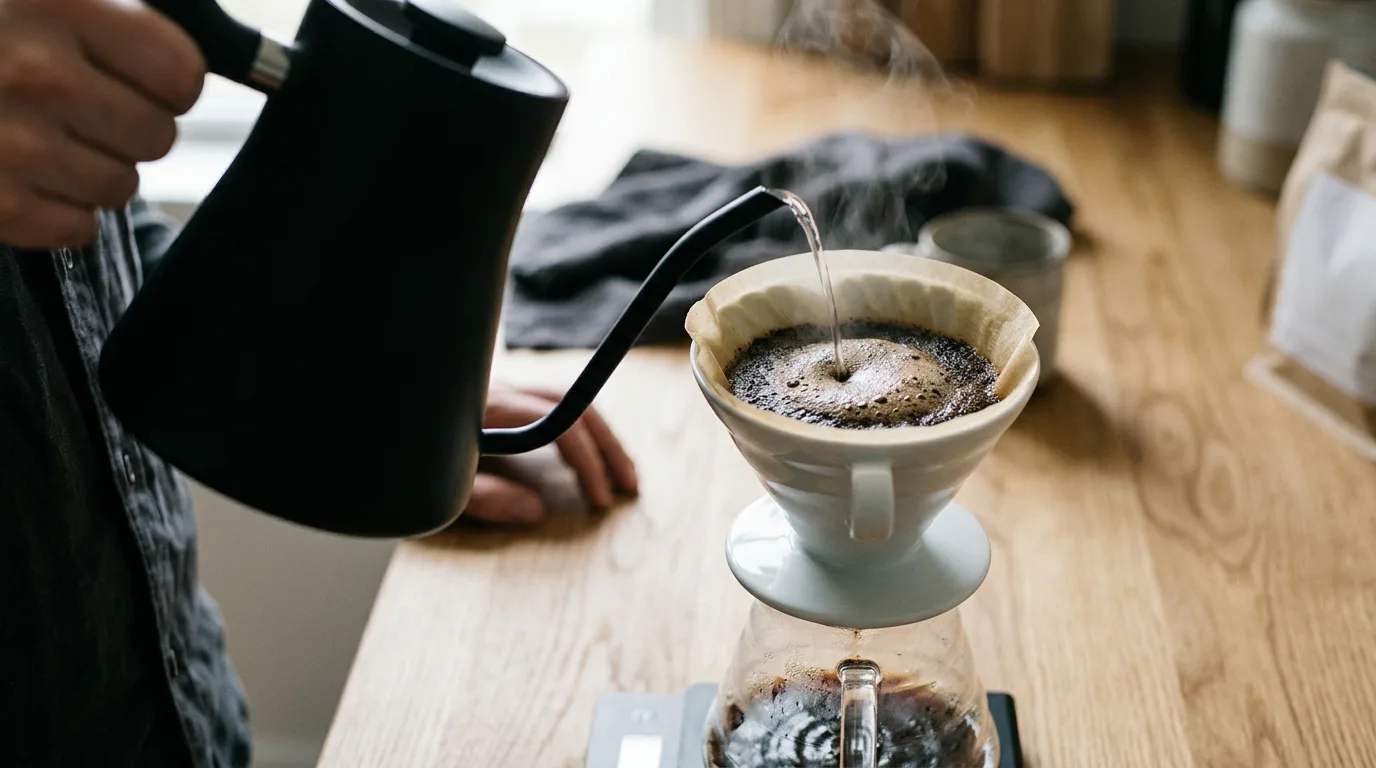
Because you hold the kettle, you decide where the water lands, how fast it arrives and how many pours you make. That control is the whole point of the method, and also its biggest demand.
Most people use a gooseneck kettle. Its long, thin spout gives a narrow, steady stream that's easy to aim, which a regular kettle can't really do.
Choosing a pour-over dripper
There's a whole world of drippers, and their shape, drain holes and inner ribs all change how fast water flows. Three classics cover most styles:
Hario V60
A cone with one large drain hole and spiral ribs on the inside walls. It drains quickly, so your pouring speed and grind size largely set the brew time. It rewards good technique with a very clean, bright cup.
Kalita Wave
A flat-bottomed dripper with three small holes and a wavy paper filter that barely touches the walls. The flat bed and slower drainage make it more forgiving and more even, which is why I recommend it to beginners.
Chemex
An hourglass glass vessel with a cone on top and its own thick bonded paper filters. It's great for brewing three or four cups at once and gives an exceptionally clean, tea-like cup.
Despite their differences, all three work the same way: you pour hot water over the grounds and gravity does the rest.
Our tip: If you're unsure, start with a flat-bottom dripper. It hides small pouring mistakes better than a fast cone, so your first cups taste good while you learn.
Convenience and daily workflow
For everyday drinkers, three practical things shape the experience: convenience, freshness and basic flavor. Convenience is the easy one.
Drip wins clearly. If you're brewing for a family, hosting guests or trying to get out the door, automation takes the work away. Load water and coffee, press a button and go make breakfast.
Many machines can even be programmed the night before, so coffee is ready when you wake up. I'd only do that with whole beans ground just before, though, which most programmable machines can't do on their own.
Pour-over needs you from start to finish. You weigh coffee and water, heat the kettle, rinse the filter and stand over the dripper for a few minutes, controlling the speed and pattern of your pour.
Many people, me included, find those minutes calming. It's a small morning ritual. But it's undeniably slower and more hands-on than pressing a button.
| Step | Drip | Pour-over |
|---|---|---|
| Prep | About 1 minute | 2-3 minutes |
| Active brewing | None | 3-4 minutes |
| Total for one person | 6-8 minutes, mostly hands-free | 6-8 minutes, hands-on |
| Total for six people | Same as for one | Several rounds |
| Cleanup | Basket, filter, carafe | Dripper, filter, server |
Freshness and holding conditions
Freshness depends on how the coffee is ground, brewed and held after brewing. Pour-over naturally encourages the best possible freshness.
Because you make one or two cups, you grind just before brewing and drink the coffee right away, at its aromatic peak. Nothing sits around waiting.
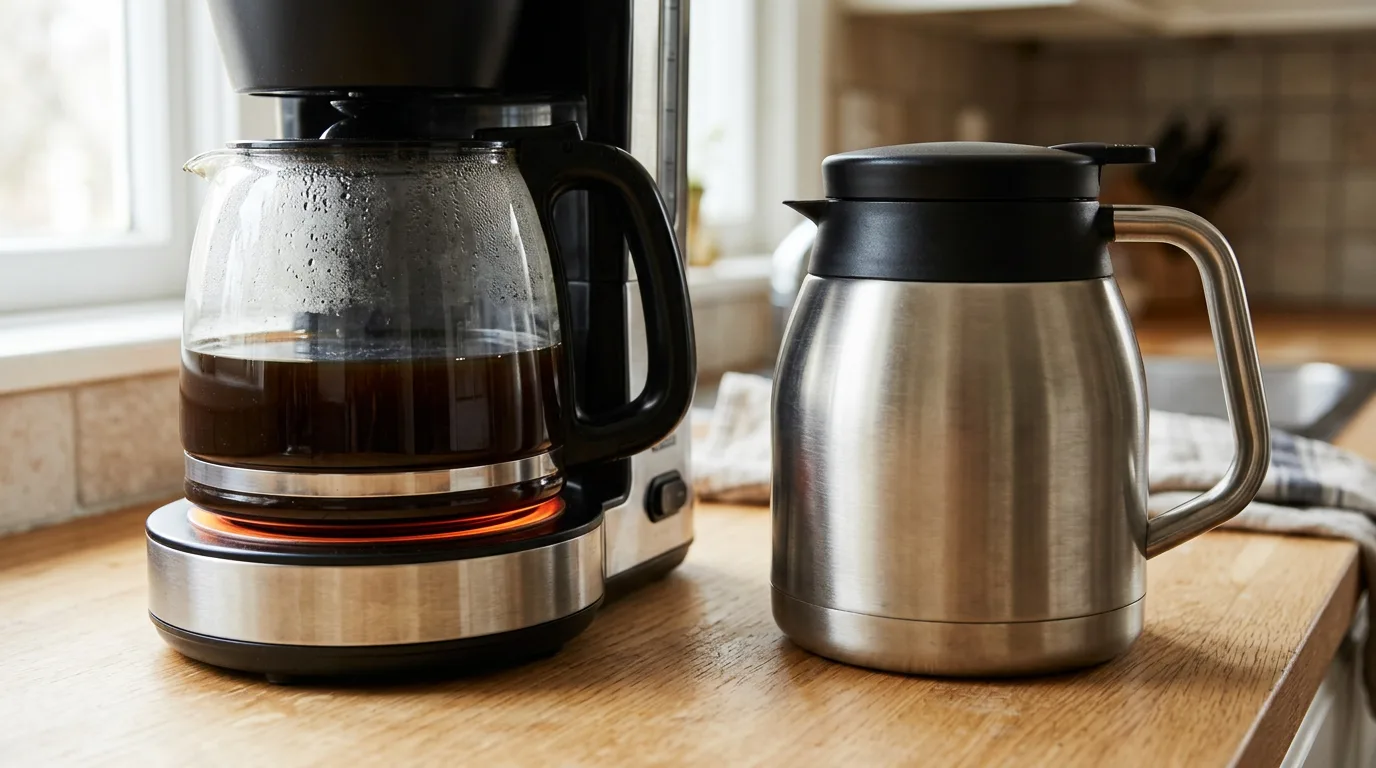
Drip coffee brings in a new variable: holding. Bigger batches mean the coffee often sits in the carafe for a while. On budget machines, two design flaws can slowly ruin it.
Oxygen exposure
Carafes with loose lids or open spouts let air circulate freely. Oxidation speeds up and the coffee turns flat and stale-tasting.
Hot plates
Basic machines keep coffee warm with a heating element under a glass pot. That constant direct heat effectively cooks the coffee, breaking down delicate compounds and producing harsh, bitter and burnt flavors.
In my test, coffee on the hot plate tasted noticeably duller after 20 minutes and plainly burnt after an hour. The same coffee in a sealed thermal carafe was still sweet and lively after two hours.
So drip coffee isn't inherently stale. On a good machine with a sealed thermal carafe, batch brew can stay vibrant, sweet and delicious for two or three hours.
Our tip: Stuck with a hot-plate machine? Switch the plate off after brewing and pour the coffee into a preheated vacuum flask. It's the cheapest upgrade you can make.
Freshness starts before brewing, too. Beans a week or two past roast, ground right before brewing, beat pre-ground coffee in either brewer. My guide to coffee freshness and degassing explains why.
Taste profiles: body vs clarity
In my side-by-side tastings, the two methods showed a clear pattern, and it matches what most professionals describe.
Drip coffee
Usually heavier and fuller in body, with a juicier mouthfeel and a bolder, rounder flavor. That weight pairs beautifully with medium-dark and dark roasts, bringing out chocolate, nut and caramel notes.
Pour-over
Usually lighter in body, cleaner and brighter, with more clarity and more noticeable fruity or floral acidity. That makes it a natural fit for light and medium roasts, where tasting the origin is the whole point.
My side-by-side impressions (same beans, same ratio)
There are plenty of theories about why. Brew time, temperature and agitation all play a part, and I'll cover those below. But one of the biggest factors is often overlooked: the filter paper.
Why the filter matters so much
Standard basket and cone filters for drip machines are fairly thin and porous. Their fibers are less dense, so more microscopic coffee fines (tiny insoluble particles) and natural coffee oils pass through into the cup.
Those suspended solids and oils add body and texture. They're a big reason drip coffee tastes heavier, richer and bolder.
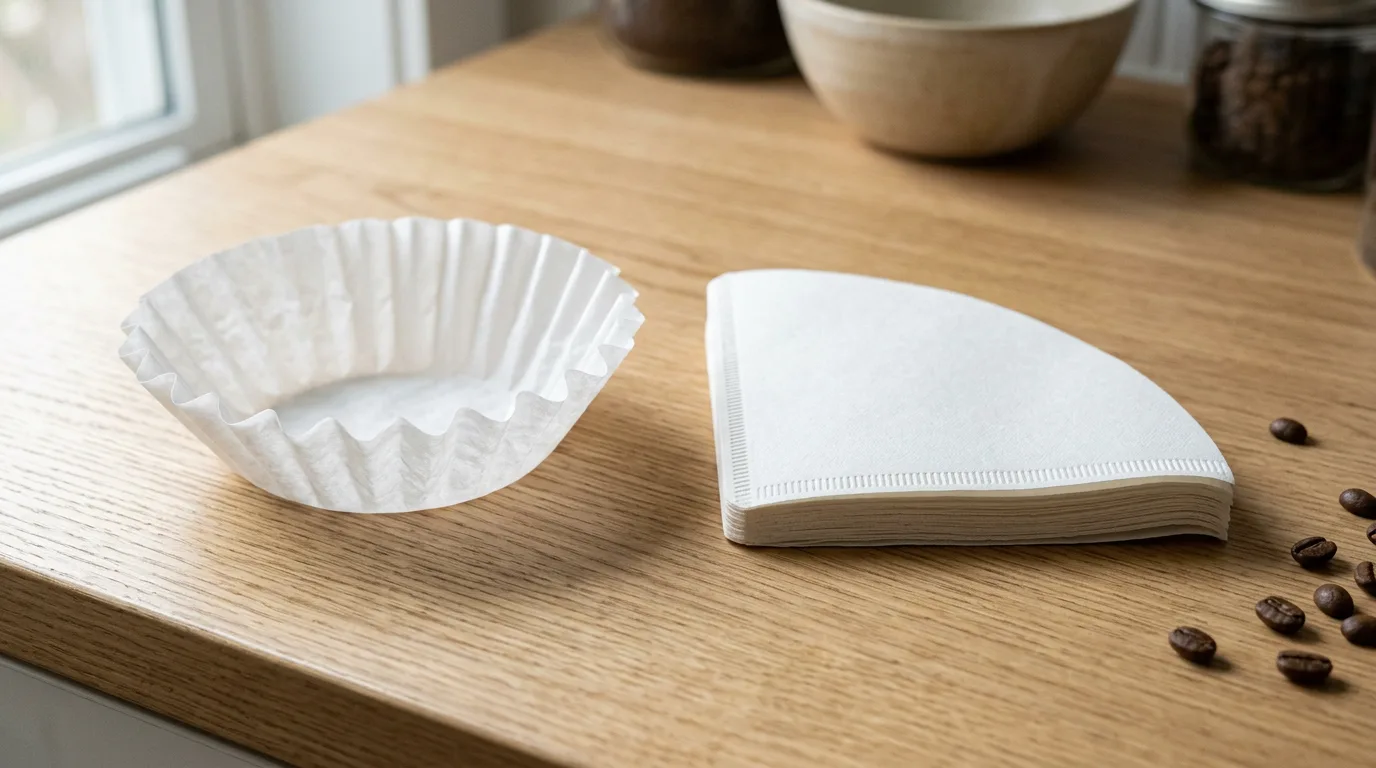
Specialty pour-over filters work differently. V60 papers, and especially the thick bonded Chemex filters, are made from much denser paper. They act like a finer sieve and trap more oils and sediment.
With fewer heavy elements in the cup, pour-over tastes crisp, transparent and clean. Delicate acidity and subtle tasting notes stand out more clearly.
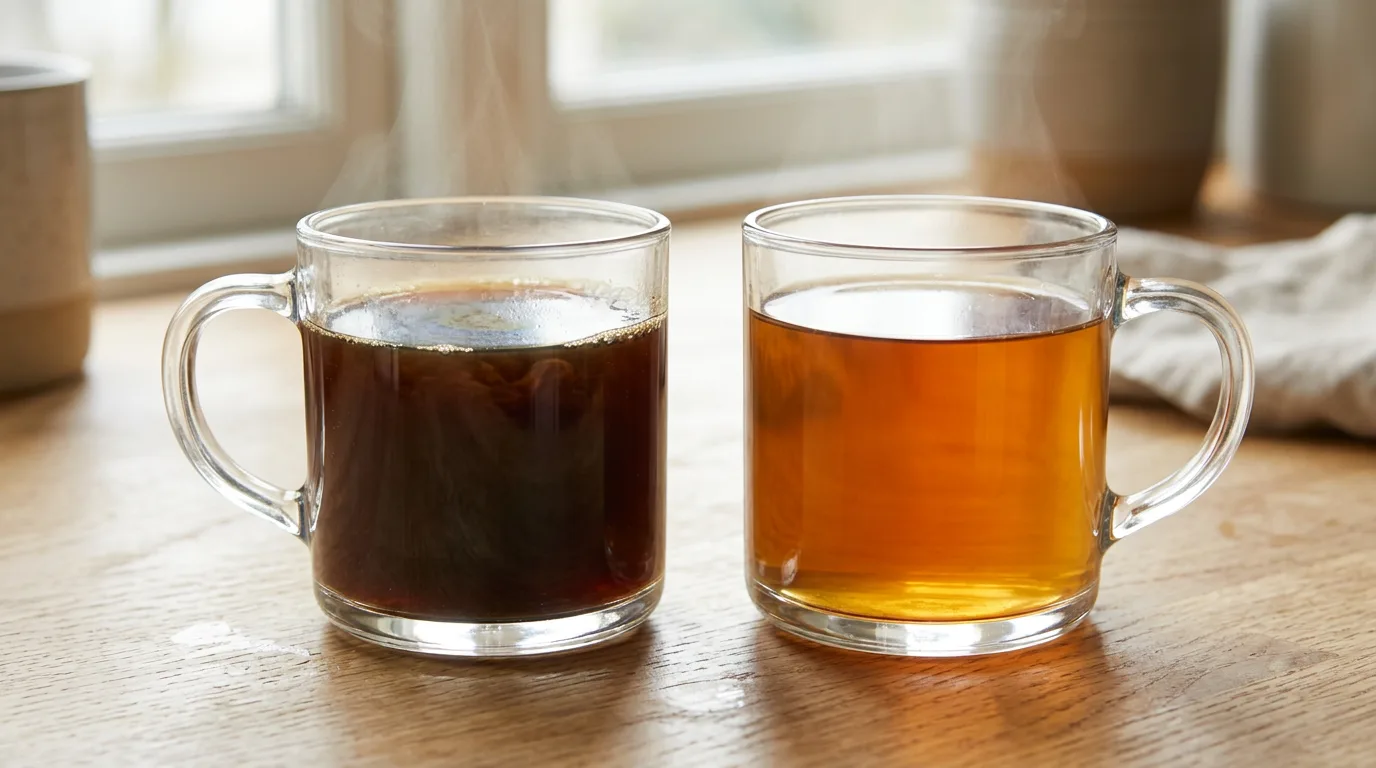
You can test this at home. Brew the same coffee through a thin basket filter and a thick bonded filter, then hold both cups up to the light. The difference in clarity is easy to see, and even easier to taste.
This also means you can shift each method toward the other. A metal mesh filter in a drip machine gives even more body. Thinner papers in a dripper bring a little more weight to a pour-over.
Our tip: Always rinse paper filters with hot water before adding coffee, in both brewers. It removes papery taste and preheats the dripper or basket.
The technical side: even extraction
Beyond convenience and general flavor, the real differences live in the physics and chemistry of extraction.
Whatever the brewer, the goal is even extraction. Ideally every particle of coffee in the bed contributes equally to the cup.
When water flows unevenly, some grounds get over-extracted and taste bitter, astringent and drying. Others stay under-extracted and taste sour, salty and thin. The cup ends up muddled, both bitter and sour at once.
If that sounds familiar, my guide to why coffee tastes bitter or sour walks through the fixes. Two things decide how evenly water moves through the bed: dispersion and agitation.
Water dispersion: where the water lands
Even extraction depends heavily on how water reaches the dry coffee at the start of the brew. In drip machines, this is one of the biggest differences between cheap and high-end models.
Many budget machines have a basic spout or a small cluster of holes right above the center of the basket. Water lands only in the middle.
The center grounds get most of the fresh water, while the coffee around the edges sits in stagnant, already-saturated water. It barely extracts.
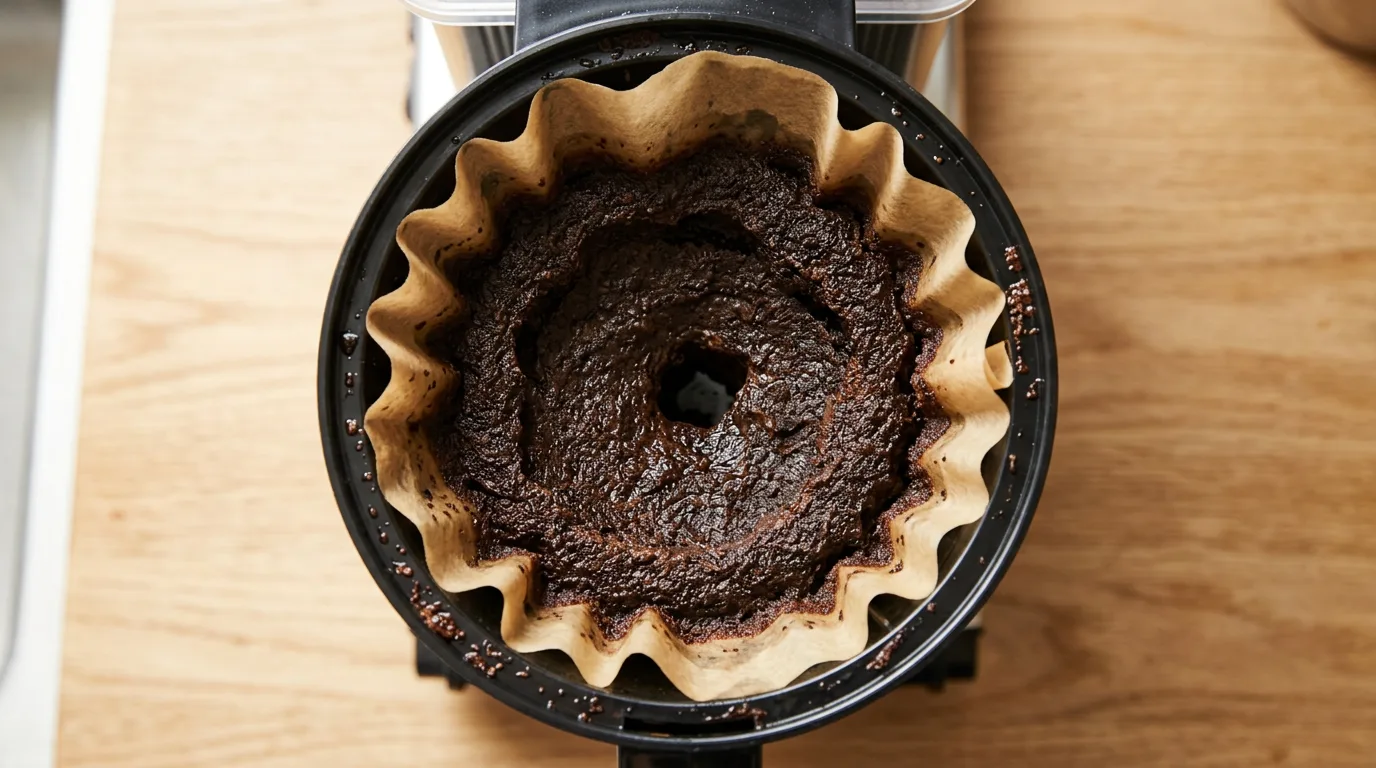
In the worst case, the concentrated stream drills a tunnel straight through the middle of the bed. That's called channeling. Once a channel forms, water takes the easy route through the hole, over-extracting the center and leaving the edges under-extracted.
My basic test machine left exactly that crater every time. Look inside your own basket after brewing: a deep hole in the middle and high, dry-looking walls are a clear sign.
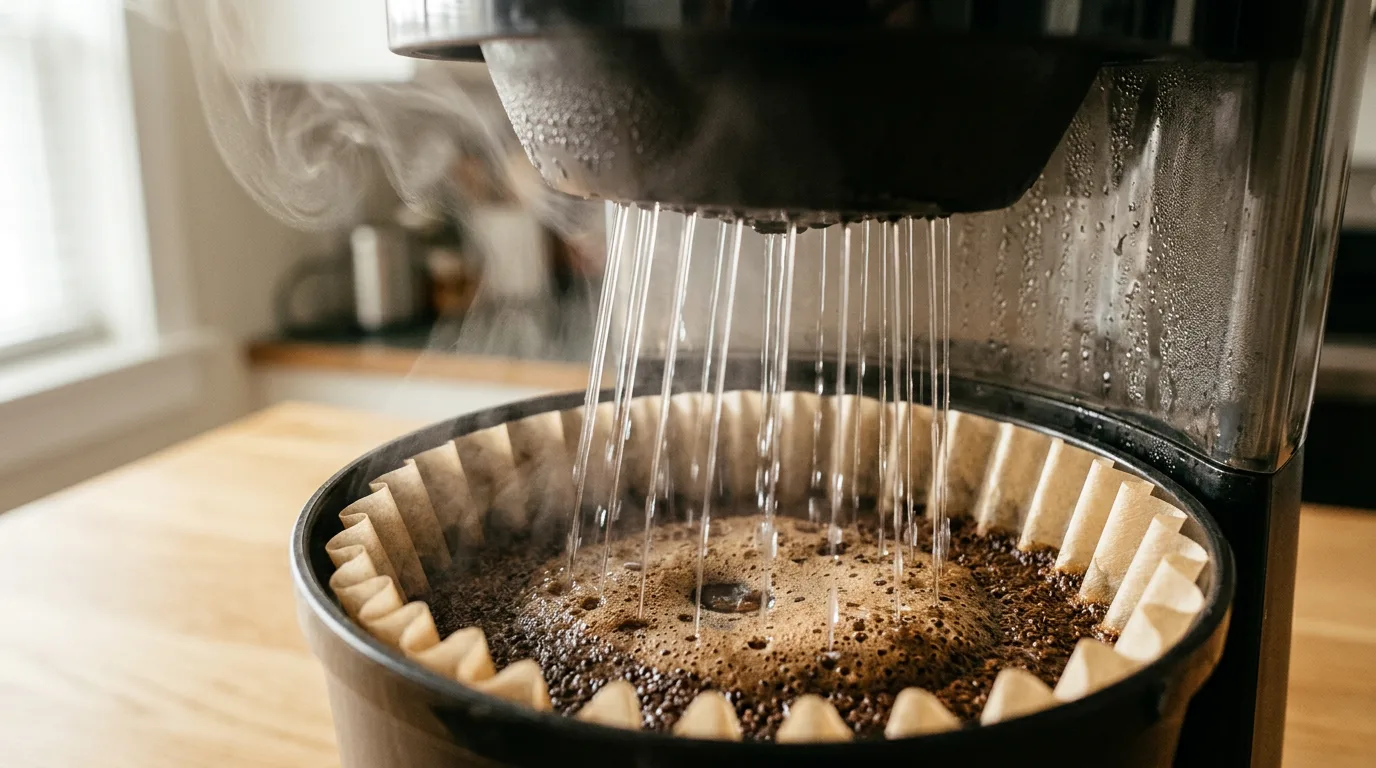
Better drip machines solve this with wide, multi-hole showerheads or pulse brewing that saturates the whole surface evenly. The spent bed on my certified brewer came out flat and even.
With pour-over, evenness is entirely up to you. You hold the kettle, so you can reach every part of the bed. Pour carefully from the first second, wetting all the grounds during the bloom, and you'll get far more even saturation than a cheap machine.
The flip side: poor technique causes the very same channeling in a pour-over cone. Pouring hard into one spot or along the filter walls lets water bypass the coffee.
Agitation and extraction speed
Agitation is closely tied to dispersion. It means any movement or turbulence in the slurry, the mix of coffee and water in the brewer.
More agitation speeds up extraction. It keeps refreshing the water around each particle and knocks loose trapped soluble compounds. It shows up in two ways:
- Stream turbulence. The energy of the water entering the bed. Pour height, speed and stream thickness decide how deep it penetrates and how much it stirs up settled grounds.
- Mechanical force. Deliberate intervention, like swirling a V60 mid-brew or stirring the slurry in a drip basket with a spoon.
A gooseneck kettle delivers a targeted, fairly fast stream. So pour-overs naturally create more local agitation than the slow, gentle dripping in most automatic machines.
That makes it easier to push extraction higher with pour-over, which helps light roasts taste sweet instead of sour.
You can also adjust agitation on the fly. Pour faster, higher or in more pulses to boost extraction. Pour gently and close to the surface to calm things down and tame bitterness.
Most drip machines give you no live control over this at all once the cycle starts.
Our tip: Gentle swirls help both methods. Give the dripper a light swirl after your last pour, or the drip basket a quick stir after the first minute, to flatten the bed and even out extraction.
The brewing variables you can control
To dial in a coffee means adjusting the recipe until the flavor is balanced. Every brewer relies on the same core variables:
| Variable | Basic drip machine | Certified drip machine | Pour-over |
|---|---|---|---|
| Coffee-to-water ratio | Yes | Yes | Yes |
| Grind size | Yes | Yes | Yes |
| Water temperature | No | Often | Yes, to the degree |
| Bloom / pre-infusion | No | Usually | Yes |
| Pour structure | No | Sometimes (pulse) | Yes |
| Flow rate | No | Sometimes | Yes |
| Agitation | Only by stirring | Only by stirring | Yes |
The ratio and grind are the two you'll adjust most. My guide to coffee brewing ratios covers starting points, and a decent burr grinder matters more than either brewer. Here's why burr beats blade.
Water quality is the quiet variable behind all of them. Very hard or very soft water can flatten either method. My guide to water chemistry for coffee explains what to look for.
Cost vs control: labor or capital
Looked at as control per dollar, pour-over is outstanding value. A plastic dripper, paper filters, a basic digital scale and a stovetop gooseneck kettle cost very little, often under 50 to 75 dollars all together.
For that, you get control over almost every variable:
- Water temperature. Heat to an exact degree, for example around 205°F (96°C) for light roasts and 195°F (90°C) for dark roasts.
- Pour structure. Split the water into a bloom and then two or three main pours to shape contact time and heat retention.
- Flow rate. Pour faster or slower to manage the slurry height and drain time.
Getting the same precision from a machine costs much more. Entry-level drip machines basically heat water and dump it until the tank is empty.
Adjustable temperature, programmable bloom and controlled flow come with certified, specialty-grade home brewers. These often cost several hundred dollars. The Specialty Coffee Association runs a certification program that tests machines for temperature, brew time and evenness.
So the trade-off is simple. Pour-over trades your effort for cheap, precise control. Drip trades a bigger upfront cost, for a good machine, for effortless automation.
| Setup | Rough cost | What you get |
|---|---|---|
| Basic drip machine | Low | Convenience, little control |
| Certified drip machine | Several hundred dollars | Convenience and good control |
| Pour-over starter kit | About 50-75 dollars | Full control, your effort |
| Burr grinder (both) | The best upgrade | Better cups in any brewer |
Getting more from a basic drip machine
Even with the cheapest machine, you're not powerless. Temperature and dispersion may be fixed, but the fundamentals of extraction are still yours to adjust.
- Adjust the dose. More coffee or less water changes the ratio, which changes strength and extraction.
- Change the grind. Finer means more surface area and slower flow, so more extraction. Coarser means less surface area and faster drainage, so less extraction.
A few more tricks made a real difference with my basic machine:
- Run a blank cycle firstBrew a tank of plain water to preheat the machine, basket and carafe, then refill with fresh water.
- Flatten the bedShake the basket gently after adding coffee so the grounds sit level.
- Stir onceAbout a minute into the brew, give the slurry a gentle stir with a spoon to break up dry pockets and fight channeling.
- Brew full batchesMany basic machines extract poorly on small batches. Fill closer to their rated capacity.
- Get it off the hot platePour finished coffee into a preheated flask or switch the plate off.
Our tip: If your drip coffee tastes thin and sour, grind finer before you buy a new machine. If it tastes harsh and bitter, grind coarser.
How to brew a great pour-over
This is the recipe I use most for one large mug: 20 grams of coffee (about 0.7 oz) to 320 grams of water, a ratio of 1:16.
- Heat the waterBring water to about 200-205°F (93-96°C) for light and medium roasts, a little cooler for dark roasts.
- Grind medium-fineAim for something like coarse sand or table salt.
- Rinse the filterPlace the paper in the dripper, rinse with hot water and discard the rinse water.
- Add coffee and zero the scaleLevel the bed with a gentle shake.
- BloomPour about 50 grams of water, enough to wet every ground, and wait 30-45 seconds while gas escapes.
- Main poursPour in slow spirals from the center outward, avoiding the walls, up to 200 grams, then to 320 grams in a second pour.
- Swirl and drainGive a light swirl to flatten the bed and let it drain. Aim to finish around 3 to 3.5 minutes.
If it drains much faster and tastes sour, grind finer. If it drains much slower and tastes bitter, grind coarser. That one adjustment fixes most pour-overs.
How to brew great drip coffee
For a full pot I use about 60 grams of coffee per liter of water, roughly 2 ounces per quart, and adjust from there.
- Use fresh, filtered waterFill the reservoir with cold, good-tasting water, not water left in the tank overnight.
- Grind mediumA bit coarser than pour-over, like regular sand. Flat-bottom baskets often like a slightly coarser grind than cone baskets.
- Rinse the paper filterRinse, then add the coffee and level the bed.
- Use the bloom settingIf your machine has one, turn it on. If not, a quick stir after the first minute helps.
- Serve or sealPour the first cups right away and keep the rest in a sealed thermal carafe.
- Clean regularlyWash the basket and carafe daily and descale every month or two, as oils and scale dull every pot.
Consistency: drip's secret weapon
Pour-over gets most of the love in specialty cafés and among home enthusiasts for its control and clarity. Yet many experienced coffee professionals actually prefer good batch brew when it comes to reliability.
The big advantage of a well-calibrated drip machine is repeatability. Once the dose, grind, water volume and dispersion are dialed in, a great pot only requires pressing a button.
The machine delivers the same water pattern, at the same flow rate and temperature, every single time.
Pour-over suffers from the unpredictability of human hands. Dozens of small variables shift from one brew to the next:
- A slightly different kettle height changes the impact of the water and the slurry temperature.
- A small change in pour speed alters agitation and total brew time.
- Different spiral patterns change how evenly the bed settles.
Two pour-overs made back to back with the same beans and water can taste noticeably different. I saw this in my own notes: my pour-overs were better at their best, but my drip pots were more consistent from day to day.
Coffee consultant and author Scott Rao has famously criticized café pour-overs on this point, arguing that most of them fall short of their potential because of human error and a lack of standardization.
Properly dialed-in batch brew, by contrast, delivers dependable quality cup after cup.
Tools that make pour-over more repeatable
Manufacturers and coffee inventors have noticed the struggle. A wave of accessories now aims to standardize water dispersion and reduce human error in manual brewing.
Most sit on top of a regular dripper and act as diffusers. They break the kettle's single stream into gentle, even droplets, essentially copying the showerhead of a high-end drip machine.
- Gabi Dripmaster A. A reservoir that sits over the dripper and releases water through a precise array of small holes.
- Melodrip. A handheld tool with a perforated disk that softens the water's impact, reducing agitation and preventing channeling.
- Tricolate. A zero-bypass, flat-bottom brewer with a built-in dispersion screen, so you don't even need a gooseneck kettle.
- Hario Drip Assist. A round plastic insert for the V60 with two rings of holes, one for fast and one for slow pouring, to regulate flow and distribution.
The rise of these tools at home and in cafés says a lot. Instead of relying on pure manual skill, modern brewers are borrowing the mechanical consistency of drip machines to make pour-over more reliable.
The two methods are slowly meeting in the middle. The best drip machines now offer bloom and pulse settings borrowed from pour-over, and the best pour-over tools copy the drip showerhead.
Our tip: Before buying a gadget, try weighing every brew and timing your pours. A scale with a built-in timer fixes most consistency problems on its own.
Best beans and roasts for each method
Because of the filter and agitation differences, each method has a natural match.
For drip
Medium-dark to dark roasts and balanced blends shine. The fuller body supports chocolate, caramel and nutty notes. Brazilian, Colombian and Central American coffees are easy, crowd-pleasing choices.
For pour-over
Light to medium roasts and single origins get the most out of the extra clarity. Washed Ethiopian and Kenyan coffees taste especially vivid, with floral, citrus and berry notes.
These are tendencies, not rules. A good drip machine can make a lovely light roast, and a dark roast can be pleasant in a pour-over with slightly cooler water. My guide to coffee roast levels explains how roast changes flavor and brewing.
Whatever you choose, buy whole beans and store them well. My guide on how to store coffee beans covers the basics.
Brewing for a crowd
This is where the batch-size difference matters most. Making six cups of pour-over means several rounds at the kettle while your guests wait.
A drip machine makes the whole pot in one go, and a thermal carafe keeps it good through a long brunch.
If you love pour-over but entertain often, a large Chemex can brew three or four cups in one go. Beyond that, drip is simply the better tool.
For one person who drinks a single cup, it flips. Many drip machines don't extract small batches well, while a pour-over is designed for exactly that.
Common mistakes with both methods
Drip mistakes
- Leaving coffee on the hot plate. It turns bitter and burnt within the hour.
- Using pre-ground coffee that's weeks old. The machine can't fix stale coffee.
- Guessing the dose with a scoop. Scoops vary wildly with grind and roast.
- Brewing tiny batches in a large machine. Water rushes through a shallow bed.
- Skipping cleaning and descaling. Old oils and scale make every pot taste flat.
Pour-over mistakes
- Skipping the bloom. Gas pushes water away from the grounds and extraction suffers.
- Pouring down the filter walls. Water bypasses the coffee entirely.
- Pouring too hard in one spot. It drills a channel, just like a cheap drip spout.
- Not using a scale. Small errors in dose or water make big differences in a small brew.
- Changing several things at once. You won't know which change helped.
Troubleshooting your cup
| Problem | Likely cause | Fix |
|---|---|---|
| Sour, thin | Under-extraction | Grind finer, hotter water, more agitation |
| Bitter, drying | Over-extraction | Grind coarser, gentler pour |
| Bitter and sour at once | Uneven extraction, channeling | Better dispersion, stir or swirl, level bed |
| Weak but not sour | Too little coffee | Increase the dose |
| Burnt, flat (drip) | Hot plate, old coffee | Thermal carafe, brew smaller pots |
| Pour-over drains too slowly | Grind too fine, too many fines | Grind coarser, better grinder |
| Every cup tastes different | Inconsistent technique | Weigh, time, use a dispersion tool |
For a deeper look at acids and bitter compounds, see my guide to acidity and bitterness in coffee.
Which should you choose?
Honestly, I use both. The drip machine runs on busy weekday mornings and when family visits. The pour-over comes out on quiet weekends, when I've bought a special light roast and want to taste every detail.
If you're weighing other manual brewers too, my French press vs pour-over comparison and my overview of coffee brewing methods may help.
Myths about pour-over and drip
"Drip coffee is always stale and bitter"
Not on a good machine. With even dispersion, the right temperature and a sealed thermal carafe, batch brew can be excellent for hours. Most bad drip coffee comes from hot plates, stale pre-ground coffee and dirty machines.
"Pour-over is always better"
A careless pour-over can be worse than good batch brew. Its ceiling is high, but so is its variability.
"Pour-over is stronger"
Strength comes from the ratio of coffee to water, not the method. Drip often feels stronger because of its fuller body.
"You need expensive gear for pour-over"
A plastic dripper, a scale and a basic gooseneck kettle are enough. The grinder is the one place worth spending more.
"Drip machines can't be adjusted"
Even a basic one lets you change the dose and grind, the two most important variables.
The verdict
Calling either pour-over or drip universally "better" misses how coffee brewing really works. Both can make exceptional coffee, and both can make poor coffee.
- Batch size and workflow: Drip excels at automatic, larger batches; pour-over at hands-on single cups.
- Freshness: Pour-over encourages drinking fresh coffee right away; drip needs a good thermal carafe to avoid oxidation and hot-plate damage.
- Filter and flavor: Thin drip filters let through more oils and fines for a bolder body; thick pour-over filters give a cleaner, brighter cup.
- Extraction and agitation: Cheap drip machines can suffer from center-only dispersion; pour-over gives full control over water placement and agitation, at the cost of effort.
- Control vs consistency: Pour-over gives lots of control cheaply but varies with your hand; drip costs more for advanced control but repeats itself perfectly.
What really decides the cup is the person brewing. Understand how water, grind, temperature and agitation interact, and know which one to change, and you'll make great coffee with either brewer.
Frequently asked questions
Is pour-over better than drip coffee?
Neither is better overall. Pour-over gives a cleaner, brighter cup and more control; drip gives fuller body, convenience and consistency.
Why does pour-over taste cleaner than drip?
Mostly because of the filter. Thick pour-over papers trap more oils and fine particles, while thinner drip filters let more through.
Is pour-over stronger than drip?
Not by itself. Strength depends on the coffee-to-water ratio. Drip can feel stronger because of its heavier body.
What grind size should I use?
Medium-fine for most pour-over cones and medium for drip machines. Adjust by taste and brew time.
Can a cheap drip machine make good coffee?
Yes, with fresh beans, a good grinder, the right dose, a stir early in the brew and no hot plate.
How long does drip coffee stay good?
About 20-30 minutes on a hot plate, and two to three hours in a sealed thermal carafe.
Do I need a gooseneck kettle for pour-over?
It helps a lot for control. Some flat-bottom brewers with dispersion screens work without one.
Which is better for light roasts?
Pour-over usually, thanks to its clarity and the higher agitation that helps extract light roasts fully.
Which is better for a family?
Drip. It brews many cups at once with no effort, and a thermal carafe keeps them fresh.

- Michael Reynolds, weeks of side-by-side home brewing
- Drip coffee, Wikipedia
- Coffeemaker, Wikipedia
- Coffee filter, Wikipedia
- Coffee preparation, Wikipedia
- Certified Home Brewer program, Specialty Coffee Association
Related guides
French press vs pour over Coffee extraction explained Coffee brewing ratios explainedWritten by Michael Reynolds. Last updated November 20, 2026.