Every Breville espresso machine compared: Barista vs Oracle lines
Breville sells two families of home espresso machines, and they look confusingly similar. The Barista line, from the Barista Express to the Barista Touch Impress, has you move the portafilter, and in most models tamp and steam yourself. The Oracle line, from the original Oracle to the Oracle Touch and Oracle Jet, grinds, doses and tamps into a 58 mm portafilter for you. I used eight of them as my daily machine for four weeks each, and lined up the data here.
We choose products independently. We may earn a commission through links on this page; your price stays the same. Affiliate policy
Jargon helpNew to espresso? Tap any dotted term to see what it means.
In this comparison
For most people, the best Breville is the Barista Touch Impress: lever tamping that checks your dose, a three-second ThermoJet, a guiding touchscreen and milk that works hands-free or by hand, and it scored 8.7 in my testing. If you want the machine to grind, dose and tamp for you and brew and steam at the same time, the Oracle Touch scored highest of all at 8.8. On a tighter budget, the Barista Pro is the best value, and the Barista Express is the classic way in.
My two top picks
Specs checked November 13, 2026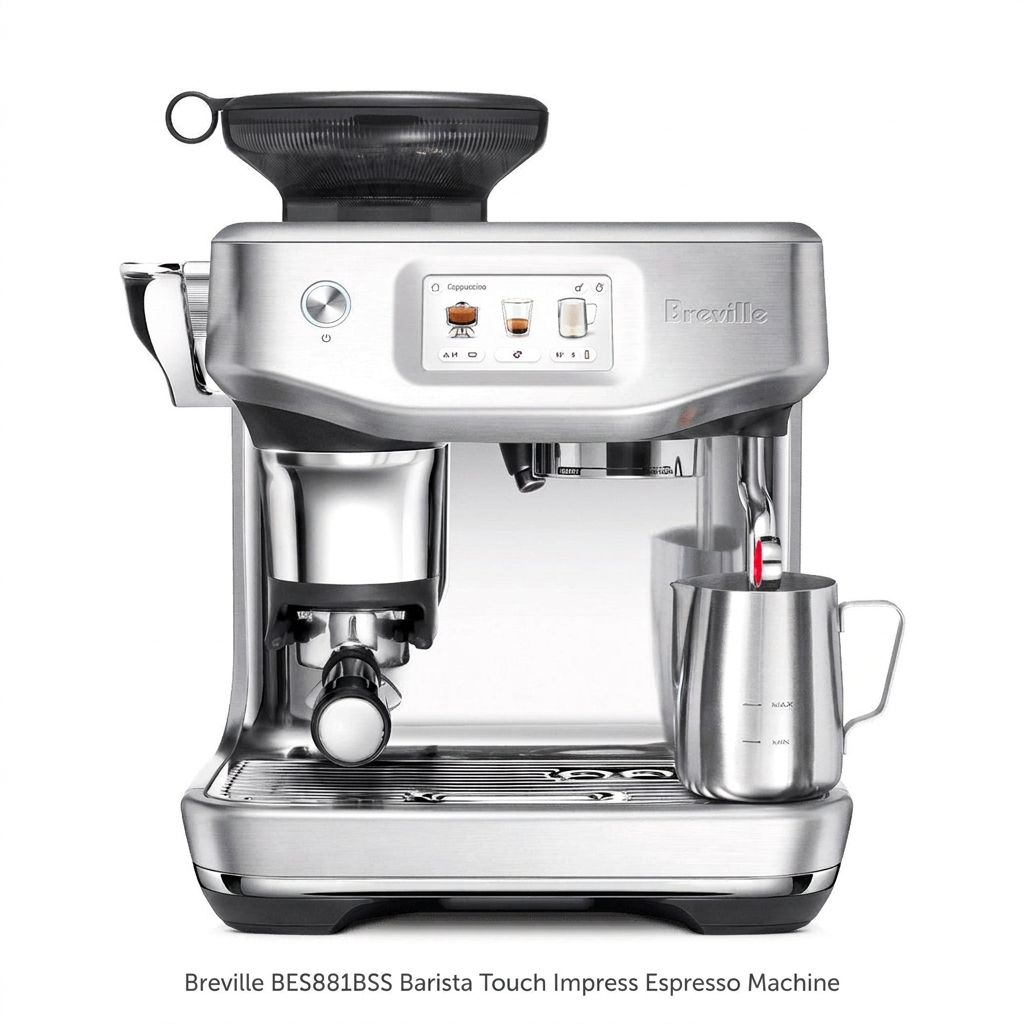
Lever tamping with dose feedback, a 4-inch guiding touchscreen, ThermoJet heat-up and milk that works automatically or by hand.
Check price on Amazon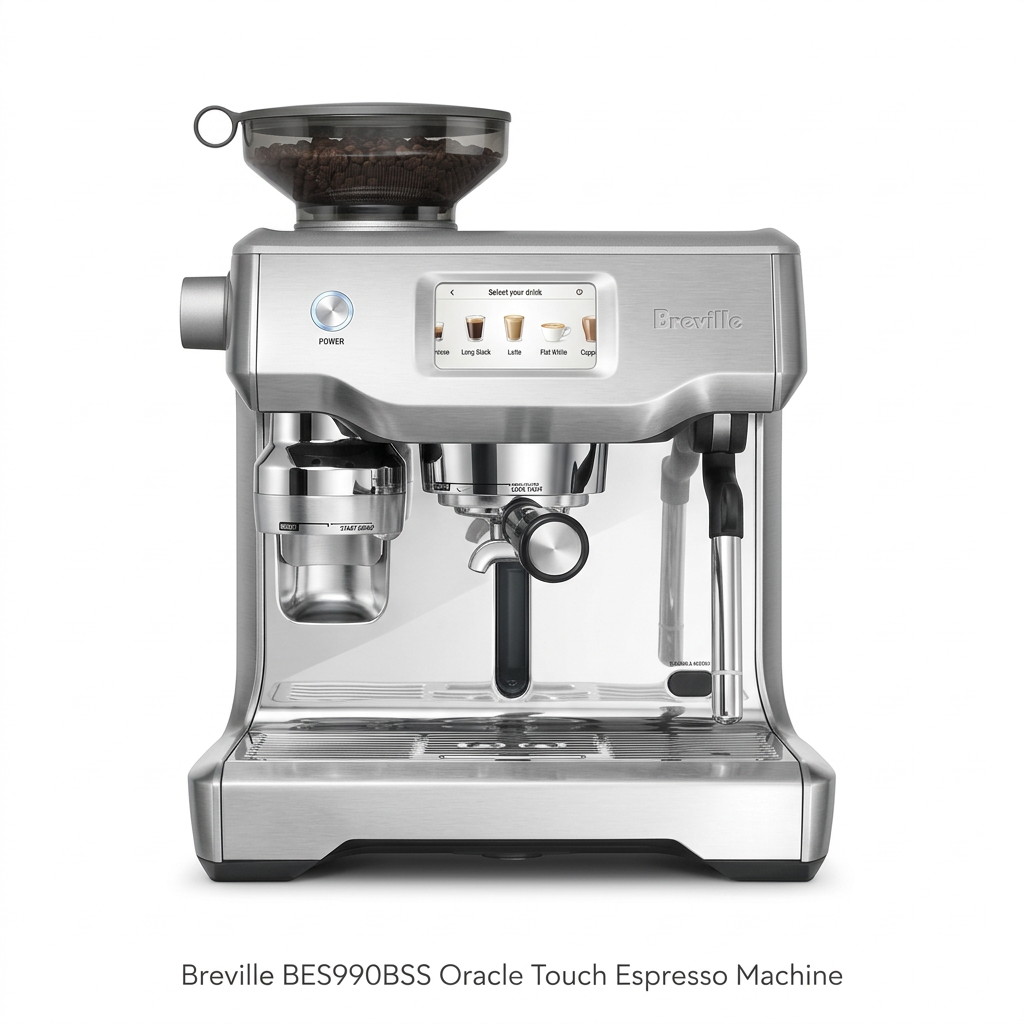
Automatic grind, dose and tamp into a 58 mm portafilter, two boilers that brew and steam at once, hands-free milk and eight saved drinks.
Reveal Today’s DealBreville espresso machines at a glance
- Barista models: you move the portafilter; tamping is manual, or assisted on the Impress models.
- Oracle models: grinding, dosing and tamping are automatic into a 58 mm portafilter.
- ThermoJet models heat in seconds; the original Oracle and Oracle Touch use two boilers and brew and steam at once.
- Pick by the step you least want to do yourself: tamping, steaming, or both.
Head to head
This table compares the two families as a whole, marking the better result in each row based on my four weeks with each machine. Individual models within each line differ, which I cover below.
The Oracle line wins most rows, but the Barista line wins on size, simplicity and how much it asks of your wallet and counter.
| Spec | Barista line | Oracle line |
|---|---|---|
| Grinding | Into the portafilter, you hold it | Automatic, hands-free ✓ Best |
| Tamping | Manual, or lever on Impress | Fully automatic with polish ✓ Best |
| Portafilter | 54 mm | 58 mm, commercial size ✓ Best |
| Brew and steam at once | No | Yes on dual-boiler Oracles ✓ Best |
| Heat-up | About 3 s on ThermoJet models ✓ Best | About 5 min on dual boilers, fast on Jet |
| Milk | Manual, or automatic on Touch models | Hands-free on all three ✓ Best |
| Grind settings | 16 to 30 | 45 on Oracle Touch and Jet ✓ Best |
| Footprint | About 12.5–14.2 in wide ✓ Best | About 14.5–16.1 in wide |
| Weight | About 20–24 lb ✓ Best | About 27–35 lb |
| Learning curve | A few days to a week | Minutes ✓ Best |
| Rows won | 3 | 7 |
Barista line vs Oracle line pros and cons
Breville Barista line
- Compact, lighter machines with real portafilter espresso
- ThermoJet models are ready in about three seconds
- Impress models make tamping foolproof
- You move the portafilter and, on most, tamp by hand
- 54 mm basket limits commercial accessories
- Can’t brew and steam at the same time
Breville Oracle line
- Grind, dose and tamp happen automatically
- 58 mm portafilter for café-style pucks
- Hands-free milk on every model
- Large and heavy: 27 to 35 lb
- Dual-boiler models take about 5 minutes to heat
- Oracle Jet’s automatic milk made bubbly foam
Who should buy which machine?
- People who want to learn espresso hands-on
- Smaller kitchens and tighter budgets
- Anyone who wants coffee seconds after switching on
- Households that want café drinks with no skill
- Anyone who wants to brew and steam at once
- Buyers who want a commercial-size 58 mm puck
All eight machines
Here is every Breville I tested for this comparison, with the one thing each does best and my overall score from its single review.
Read it as a ladder. As you move down, the machine takes over more of the work: first heat-up, then tamping, then milk, then everything except moving the portafilter.
| Machine | Line | Best at | My score |
|---|---|---|---|
| Barista Express | Barista | Learning with a pressure gauge | 8.0 |
| Barista Express Impress | Barista | Assisted tamping with a gauge | 8.3 |
| Barista Pro | Barista | Speed and steam power | 8.5 |
| Barista Touch | Barista | Hands-free milk on a touchscreen | 8.4 |
| Barista Touch Impress | Barista | Guided espresso and flexible milk | 8.7 |
| Oracle | Oracle | Automation with buttons and dials | 8.6 |
| Oracle Touch | Oracle | Automation on a touchscreen | 8.8 |
| Oracle Jet | Oracle | Best espresso, cold brew | 8.4 |
Overall scores
Highlighted bars are Barista models; plain bars are Oracle models.
The jumps between neighbors on that ladder are small, which is why buyers get stuck. The Express Impress is a Barista Express with a lever; the Barista Touch is a Barista Pro with a touchscreen and automatic milk; the Touch Impress combines both upgrades.
The Oracle line is a different idea rather than a bigger version. Grinding, dosing and tamping all happen without you, and the 58 mm portafilter and heated group head are borrowed from café machines.
So the first decision is not which model, but which line: do you want to stay hands-on with help, or hand those steps over completely?
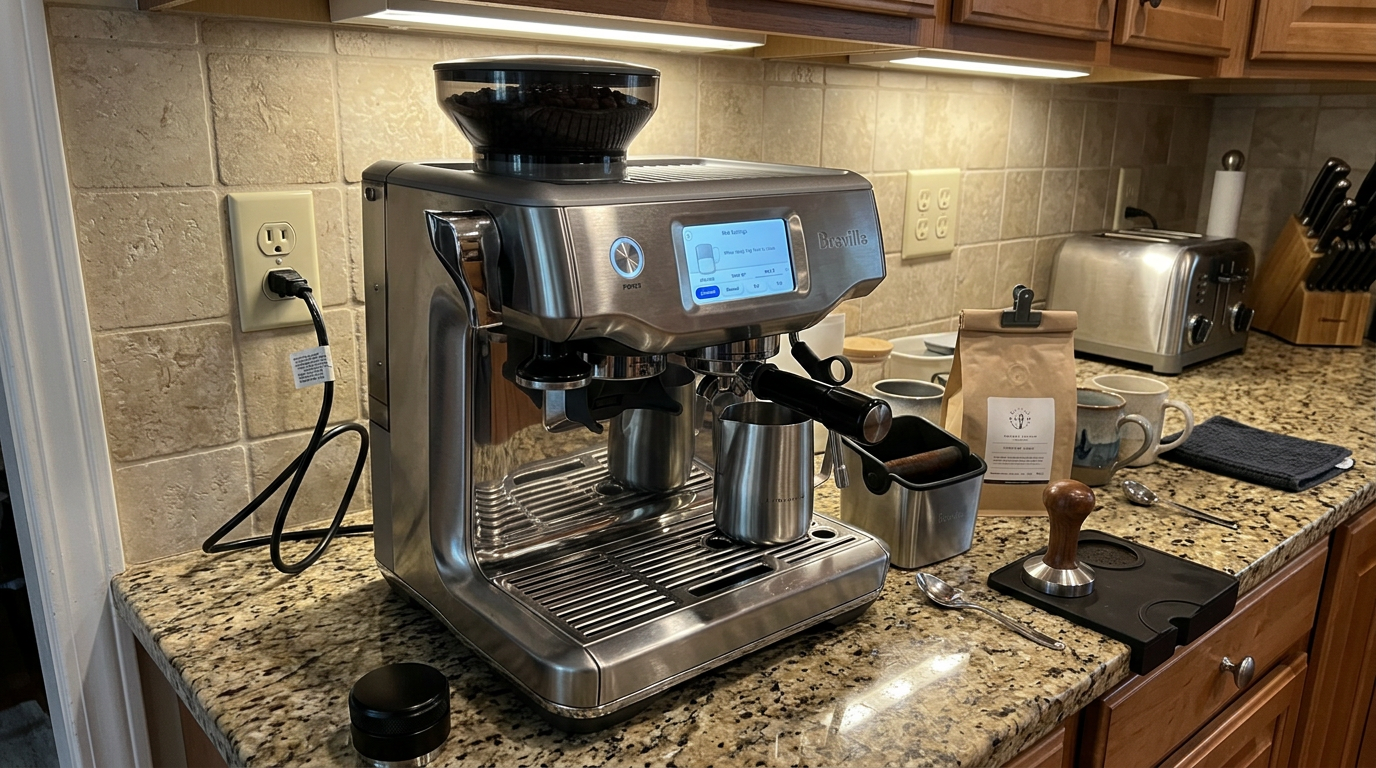
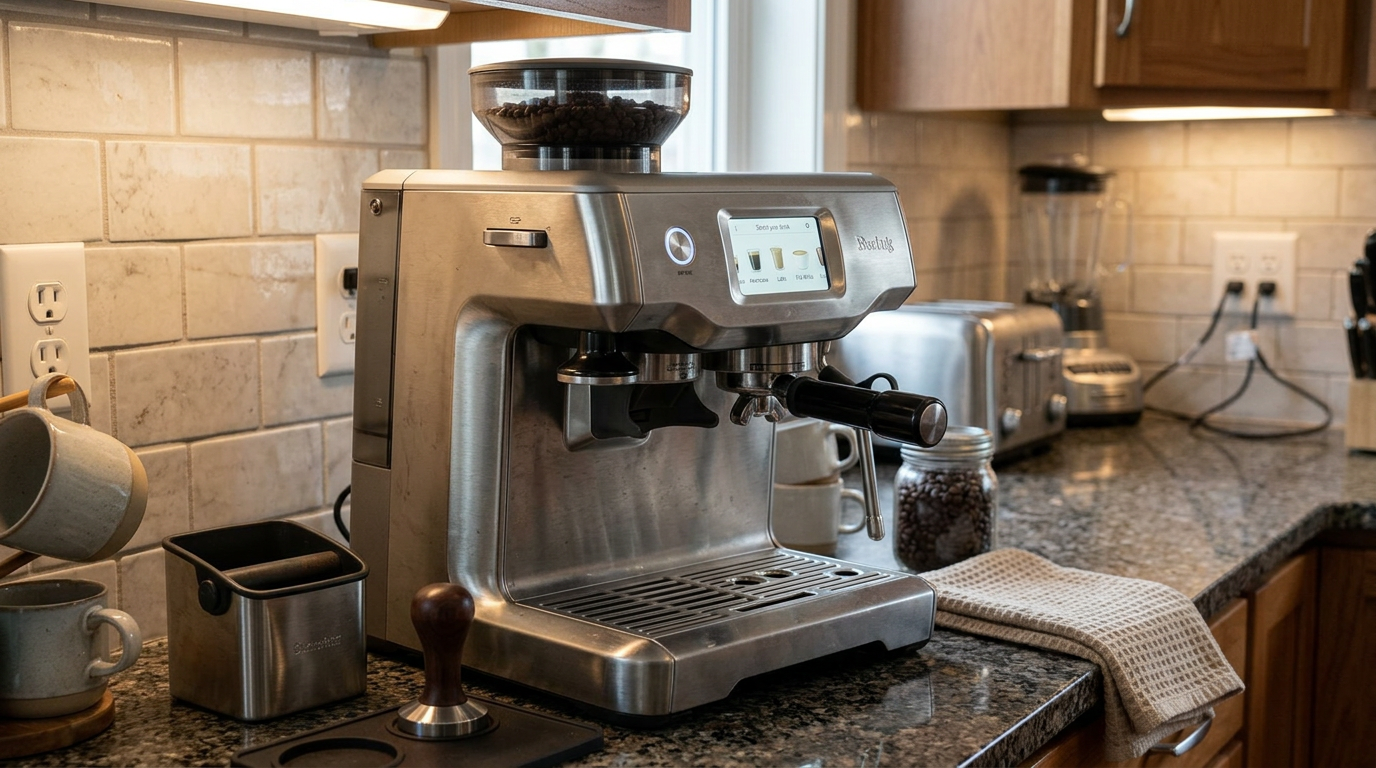
The Barista Touch Impress scored highest of the Barista line in my testing.
Heating systems: thermocoil, ThermoJet and dual boilers
Breville uses three heating systems across these eight machines, and they explain most of the differences in speed.
The Barista Express and Express Impress use a thermocoil✕ThermocoilA coiled metal tube with a heating element wrapped around it. Water heats as it flows through. Faster than a boiler, slower than a ThermoJet.. It takes about a minute to heat, and switching from brew to steam takes 15 to 20 seconds.
The Barista Pro, Barista Touch and Touch Impress use the ThermoJet✕ThermoJetBreville’s compact, low-mass heating block. It reaches brewing temperature in about three seconds and switches to steam almost instantly., ready in about three seconds, with steam in about five. The Oracle Jet uses dual ThermoJets with a heated group head.
The original Oracle and the Oracle Touch use two stainless steel boilers, one for brewing and one for steam, plus an actively heated 58 mm group head. They take about five minutes to heat from cold, but they brew and steam at the same time and the first shot tastes as good as the fifth.
Time from cold to ready
The Oracle Jet’s ThermoJets heat fast, but its portafilter tasted best after several flushes or 20+ minutes.
There is one catch on fast heaters: the group head and portafilter start cold. On every ThermoJet model, one or two blank shots of hot water fixed a thin first espresso. On the Oracle Jet, my first-shot score rose from 5.0 straight after switching on to 8.8 after three flushes.
The tamping ladder
Tamping is the step most beginners fear, and Breville gives you three ways to deal with it.
On the Barista Express, Barista Pro and Barista Touch, you tamp by hand. A tilted tamp leaves one side thinner, water rushes through it, and the shot turns sour; that is called channeling✕ChannelingWater finding a weak path through the coffee puck instead of flowing evenly through it. It is the most common cause of sour shots..
On the Express Impress and Touch Impress, a lever tamps with about 22 lb of force, a sensor measures the puck and the machine corrects the next grind. On all three Oracles, grinding, dosing and tamping happen automatically, with a polishing twist at the end.
Week-one shots in my target window
From my shot logs; by week four, almost every machine was between 84% and 94%.
| Tamping | Models | What you do |
|---|---|---|
| Manual | Barista Express, Pro, Touch | Weigh, stir, tamp level |
| Impress lever | Express Impress, Touch Impress | Pull a lever, top up if asked |
| Automatic | Oracle, Oracle Touch, Oracle Jet | Nothing; move the portafilter |
Our tip: On the Impress models, always pull the lever twice: once to tamp and measure, then again to polish the puck after any top-up.
Grinders
Every machine here has a built-in steel conical burr✕Conical burrsTwo cone-shaped grinding parts, one inside the other. Beans are crushed between them, and the gap sets how fine the coffee is. grinder, but they are not the same grinder.
The Barista Express has 16 steps on its side dial plus a hidden inner burr; mine had to move from 6 to 2 before the dial was useful. The Express Impress has 25 steps and its inner burr went from 5 to about 3.
The Barista Pro, Touch and Touch Impress have 30 settings with Baratza-designed burrs. The Oracle Touch and Oracle Jet have 45, and the Jet’s are stepless.
Grind settings by model
More settings mean smaller steps when dialing in.
Dosing follows the same ladder. The Barista Express, Pro and Touch dose by time, so a 0.1-gram scale is essential. The Impress models measure the puck and correct themselves. The Oracles dose automatically; on the Jet, my dose drifted from about 18.5 grams down to about 17 grams as the hopper emptied.
Our tip: On any Breville, only turn the grind dial while the grinder is running, because turning it finer on stopped burrs full of beans can jam them.
Espresso quality
Every one of these machines can make espresso that tastes like it came from a café. What changes is how quickly you get there and how high the ceiling is.
The Oracle Jet scored highest for espresso in my testing, 9.0, with rich, syrupy shots once the portafilter was warm. The Oracle and Oracle Touch both scored 8.9, with sweet, heavy shots of dark chocolate, caramel and a little dried fruit from their 58 mm baskets.
A 58 mm basket✕58 mm portafilterThe commercial standard size. For the same dose, it makes a wider, shallower puck than a 54 mm basket, so water travels a shorter path and is less likely to channel along the sides. makes a wider, shallower puck for the same dose, so water has a shorter path and is less likely to channel. That is a real advantage of the Oracle line.
On the Barista side, the Pro and Touch Impress both scored 8.7. Once dialed in, the Pro poured like syrup in 28 to 30 seconds, and the Touch Impress gave thick, elastic, hazelnut crema from 18 grams in and 36 out.
My espresso scores
My espresso scores out of 10 from each single review.
Research from the Technical University of Munich found that grind size, flow rate and temperature all change how quickly coffee extracts. The Oracles control more of those variables for you, which is why their floor is higher.
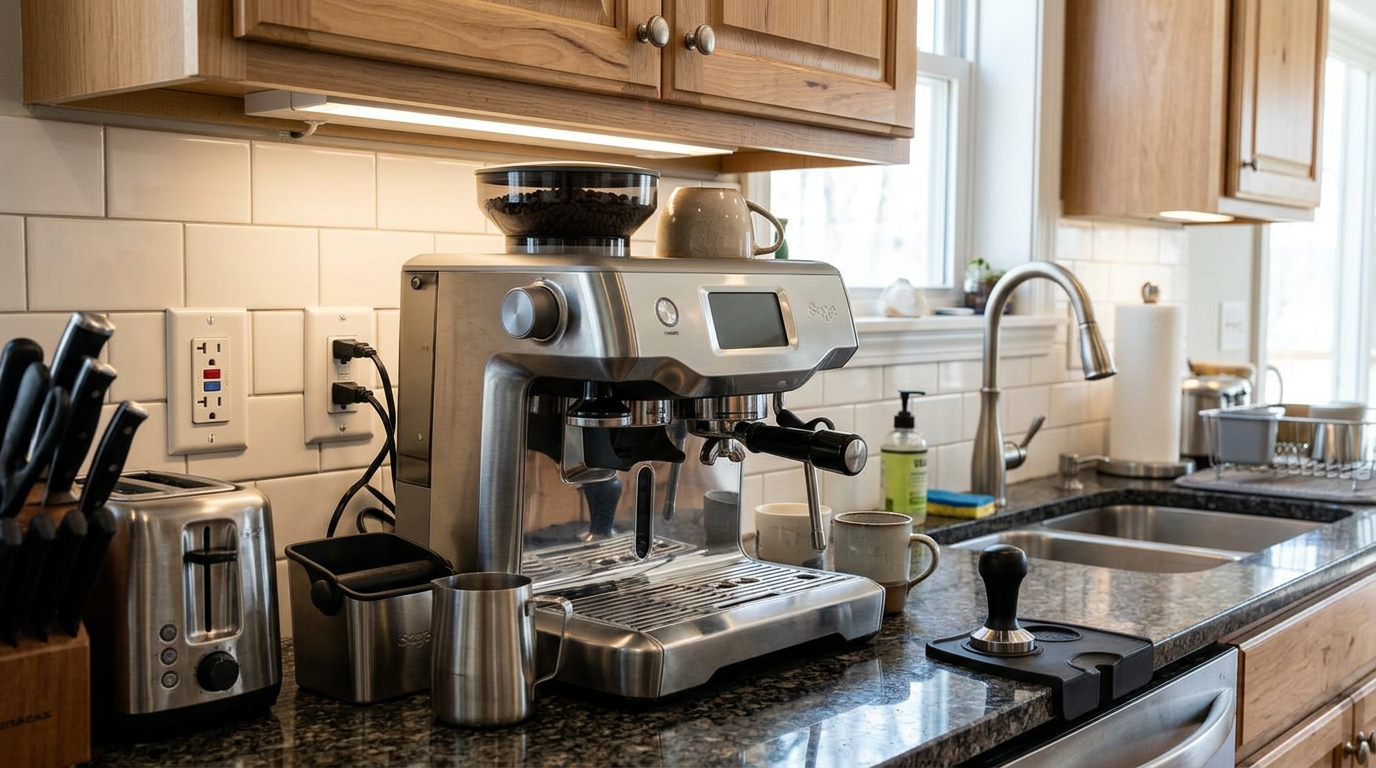
A 58 mm puck and two boilers give the Oracle Touch its consistent shots.
Milk systems
Breville offers three kinds of milk across these eight machines: fully manual, fully automatic and both.
The Barista Express, Express Impress and Barista Pro have manual wands. The Express’s single-hole tip took about 45 seconds for 6 ounces; the Pro’s four-hole tip took about 30 seconds and made glossy, latte-art microfoam✕MicrofoamMilk foam with bubbles so small you can barely see them. It feels silky and glossy, which is what latte art needs..
The Barista Touch has automatic milk with a temperature sensor in the drip tray and eight texture levels. The Touch Impress and all three Oracles have automatic milk plus a manual mode.
Automatic milk varied more than I expected. On the Barista Touch, level 3 at 140°F poured clean latte art. On the Oracle and Oracle Touch, the hands-free wand made real microfoam. On the Oracle Jet, automatic mode made coarse, bubbly foam in more than 50 test cycles, though its manual steam was superb.
Milk drink scores
My milk scores out of 10, weighing texture, temperature control and speed.
| Milk system | Models | Best for |
|---|---|---|
| Manual, single hole | Express, Express Impress | Learning latte art slowly |
| Manual, four holes | Barista Pro | Fast, powerful steaming |
| Automatic only | Barista Touch | Easy lattes, set temperature |
| Automatic plus manual | Touch Impress, Oracle, Oracle Touch, Oracle Jet | Weekday ease, weekend art |
Controls and screens
Breville’s controls fall into three styles. The Barista Express and Express Impress have dials, buttons and an analog pressure gauge that shows the shot building in real time.
The Barista Pro and original Oracle have buttons with an LCD; the Pro’s big shot clock made dialing in easy, and the Oracle’s rotary dials for milk temperature and texture were quick to use without looking.
The Barista Touch, Touch Impress, Oracle Touch and Oracle Jet have color touchscreens. The Touch models and Oracle Touch save eight custom drinks; the Oracle Jet saves more than 20.
| Machine | Controls | Saved drinks |
|---|---|---|
| Barista Express | Dials, buttons, pressure gauge | No |
| Express Impress | Dials, buttons, gauge, dose meter | No |
| Barista Pro | Buttons, LCD shot timer | No |
| Barista Touch | Touchscreen | 8 |
| Barista Touch Impress | 4-inch touchscreen with guidance | 8 |
| Oracle | Buttons, dials, LCD | No |
| Oracle Touch | Touchscreen | 8 plus 5 presets |
| Oracle Jet | Touchscreen with Barista Guidance | 20+ |
For households, saved drinks were the single most useful control feature. Naming each saved drink after a person meant nobody overwrote anyone else’s milk temperature or foam level.
Our tip: Name saved drinks after people rather than drinks, so everyone in the house keeps their own settings.
Speed and daily routine
On a ThermoJet Barista model, an espresso took me about two minutes and a flat white about three to four, including puck prep and wiping the wand.
On the dual-boiler Oracles, the shot and milk happen at the same time. On the Oracle Touch, brewing and steaming together took about 35 seconds, against about 65 seconds on a single-heater machine doing one after the other.
Time to brew a shot and steam milk
From my timings on the Oracle Touch review.
With the programmable auto-start set, the Oracle was always ready when I was, and two cappuccinos took about 90 seconds. On the Barista machines, the grinder speed matters too: the Touch Impress took 18 to 20 seconds to grind a double, which you notice when making four drinks.
| Drink | Barista Touch Impress | Oracle Jet |
|---|---|---|
| Espresso | ~1.5 min | ~1.5 min |
| Long black | ~2 min | About the same |
| Flat white | ~3 min automatic milk | ~3 min manual milk |
| Cold espresso over ice | No | ~1.7 min |
| Cold brew | No | ~3.5 min |
Cleaning
Daily care is broadly similar across the range: knock out the puck, wipe the basket, flush the group, wipe the wand straight after milk and let it purge, and backflush✕BackflushingRunning water backwards through the brew valve with a rubber disc and a cleaning tablet. It dissolves coffee oils that build up inside. with a tablet when prompted.
The Oracles and Impress models make far less counter mess, because grinding and tamping happen inside an enclosed collar or cradle.
Hands-on cleaning per day with milk drinks
My estimates from each single review.
A few model quirks matter. The Barista Touch’s compact drip tray filled fast; the Oracle Jet used a lot of water and needed frequent drip tray emptying; and the dual-boiler Oracles need a guided descale every six to twelve months depending on your water.
Our tip: Wipe the steam wand within ten seconds of steaming on any Breville, because milk that bakes onto hot steel takes minutes to remove later.
Size and weight
The Barista line is meaningfully smaller. The Barista Express is about 12.5 inches wide, the Barista Touch 12.6, the Barista Pro about 14 and the Touch Impress about 14.2.
The Oracles are bigger and heavier: about 14.5 inches wide for the Oracle Touch and Jet and 16.1 inches for the original Oracle, at 27 to 35 lb. The original Oracle has a roller wheel under the drip tray, and the Jet a roller mobility lever.
Weight by model
Approximate weights from my measurements and Breville specs.
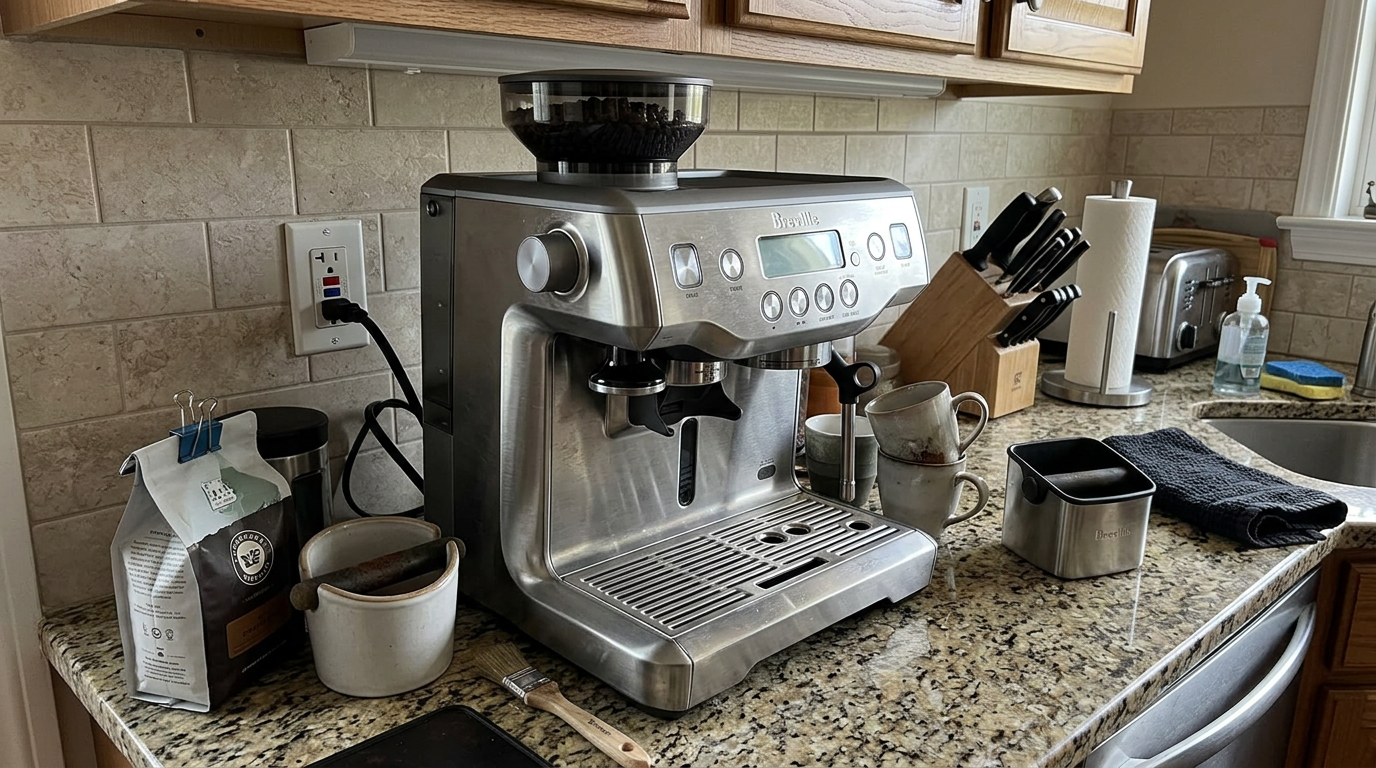
The original Oracle is the biggest of the eight, with a roller wheel to help move it.
Best pick by buyer
If you already know what kind of buyer you are, this table is the shortcut.
| If you are | Buy | Why |
|---|---|---|
| A beginner who wants to learn | Barista Express | Pressure gauge teaches you, lowest entry point |
| A beginner who fears tamping | Barista Express Impress | Lever tamping and dose correction |
| A latte lover who hates waiting | Barista Pro | 3 s heat-up, fastest manual steam |
| Someone who never wants to steam | Barista Touch | Automatic milk to the degree |
| A household stepping up from pods | Barista Touch Impress | Guided, assisted tamping, flexible milk |
| A fan of buttons and dials | Oracle | Automation without a touchscreen |
| A family wanting café drinks with no skill | Oracle Touch | Automation, two boilers, saved drinks |
| An espresso lover who steams by hand | Oracle Jet | Best espresso, cold brew, superb manual steam |
For deeper head-to-heads within the range, see my Barista Express vs Barista Pro, Barista Express vs Express Impress and Barista Pro vs Barista Touch comparisons.
Beans, water and accessories
Every Breville rewards fresh beans more than any setting. Coffee roasted within the last two to four weeks gave the thickest crema and the most even flow across all eight machines, and supermarket beans with no roast date ran fast and thin on all of them.
Medium and medium-dark roasts were easy everywhere. Light roasts needed a finer grind and a hotter brew temperature: High on the Barista Pro, 202 to 204°F on the Touch Impress and 198 to 200°F on the Oracle.
| Roast | Barista line | Oracle line |
|---|---|---|
| Light, dense | Finer grind, hotter setting | Finer, 198–200°F |
| Medium blend | Middle of the range, default | Around 195°F |
| Dark, oily | Coarser, cooler, clean burrs more | Coarser, 190–193°F |
| Pre-ground | Dual-wall baskets on Barista models | Single-wall only on Oracle Touch |
Water
Use filtered tap water and keep the filter in. Very hard water builds scale quickly in the narrow ThermoJet channels and in boilers, while pure distilled water makes flat coffee and can confuse sensors.
On the Oracle, a blend of roughly 80 percent distilled and 20 percent tap water gave balanced minerals and slower scaling. A good general target is around 120 to 150 ppm of total dissolved solids.
The accessories that matter
| Accessory | Who needs it | Why |
|---|---|---|
| 0.1 g scale | Express, Pro, Touch | They dose by time |
| Needle stirring tool | Express, Pro, Touch | Breaks clumps before tamping |
| Knock box | All eight | Fast, clean puck disposal |
| Two microfiber towels | All eight | One for the wand, one for the basket |
| Spare water filters | All eight | Fewer descales |
Our tip: Buy beans in bags you can finish within two to three weeks, so the grind setting you dialed in stays right to the last cup.
Our tip: Keep a damp towel only for the steam wand and a dry towel only for the basket, so milk never reaches your coffee and water never reaches your grounds.
Find Out the Price TodayWhat to check before you order
A few practical checks will save you from the most common Breville regrets.
First, measure your counter. The Oracles are 14.7 inches deep before you add the portafilter handle, and the bean hopper on every model needs a few inches of clearance above it for refilling.
Second, think about who will use it. If several people will make drinks, a model with saved drinks, the Touch, Touch Impress, Oracle Touch or Oracle Jet, avoids daily arguments over settings.
Third, be honest about milk. If you never want to learn to steam, skip the Express, Express Impress and Pro, or plan to practice for a week. If you love steaming by hand, the Pro’s four-hole wand and the Oracle Jet’s manual mode are the most rewarding.
Finally, check the warranty on the exact model you buy. In my testing, the Barista Express came with one year in the US and most newer models with two.
| Check | Why it matters |
|---|---|
| Counter depth and height | Oracles are deep and heavy; hoppers need clearance |
| Number of users | Saved drinks avoid overwriting settings |
| Milk preference | Manual, automatic or both |
| Bean style | Light roasts favor finer grinders and hot settings |
| Warranty | One to two years, depending on model |
Real-life scenarios
Specs only go so far. These are the situations where one Breville clearly pulled ahead during my testing.
Swipe to a drink, press start and move the portafilter. Nothing to tamp, nothing to steam.
The ThermoJet was ready almost before I had picked up the portafilter.
Eight saved drinks, guided steps and lever tamping meant anyone could use it.
Rich, syrupy shots once warm, scoring 9.0 in my testing.
The classic all-in-one, about 12.5 inches wide, with a teaching gauge.
Cold espresso in about a minute and cold brew in under three.
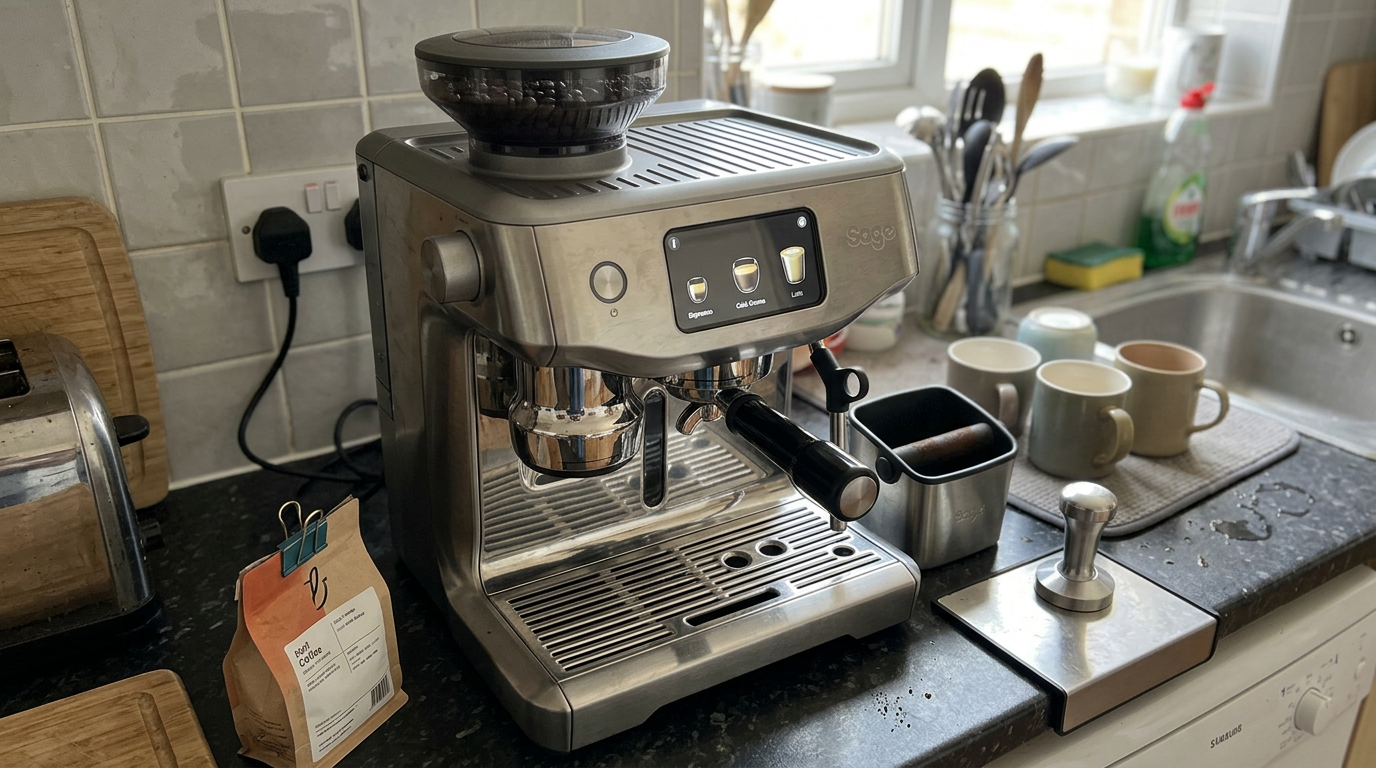
The Oracle Jet adds cold brew and cold espresso to the Oracle formula.
My scorecard
These are my category scores out of 10, taken straight from each machine’s single review.
| Machine | Espresso | Milk | Ease of use | Cleaning | Overall |
|---|---|---|---|---|---|
| Barista Express | 8.4 | 7.8 | 7.5 | 8.1 | 8.0 |
| Express Impress | 8.6 | 7.8 | 8.5 | 8.2 | 8.3 |
| Barista Pro | 8.7 | 8.6 | 8.2 | 8.4 | 8.5 |
| Barista Touch | 8.5 | 8.6 | 8.6 | 8.1 | 8.4 |
| Touch Impress | 8.7 | 8.8 | 9.0 | 8.3 | 8.7 |
| Oracle | 8.9 | 8.6 | 8.6 | 8.3 | 8.6 |
| Oracle Touch | 8.9 | 8.9 | 9.1 | 8.3 | 8.8 |
| Oracle Jet | 9.0 | 7.9 | 8.3 | 8.1 | 8.4 |
Line averages
The Oracle line leads on average, but the best Barista model, the Touch Impress, beats two of the three Oracles. The best machine for you depends far more on which steps you want to keep than on which line it belongs to.
See How Much You’ll SaveWhich one is right for you?
4 quick questionsWhich one should you buy?
It comes down to one question: which step do you least want to do yourself? If it is tamping, buy an Impress. If it is steaming, buy a Touch. If it is both, plus grinding, buy an Oracle.
For the full detail on each, read my reviews of the Barista Express, Express Impress, Barista Pro, Barista Touch, Touch Impress, Oracle, Oracle Touch and Oracle Jet.
For automated café drinks, the Oracle Touch scored highest of all eight.
- You want guided, real portafilter espresso
- You want lever tamping with dose feedback
- You want automatic and manual milk
- You need a smaller, lighter machine
- You want fully automatic grinding and tamping
- You want 58 mm accessories
- You make many drinks back to back
- You want café drinks with no skill
- You brew and steam for several people
- You want a 58 mm puck
- You have a deep, sturdy counter
- Your kitchen is small
- You want coffee seconds after switching on
- You want to tamp and steam by hand
On a tighter budget, the Barista Pro is the best value in the range, and the Barista Express remains the classic way in.
If I had to pick one Breville for most homes, it would be the Barista Touch Impress. It guides you through real portafilter espresso, takes the fear out of tamping, heats in seconds and gives you milk that works hands-free or by hand, all in a body that fits a normal kitchen.
If you want the machine to do almost everything and you have the counter space, the Oracle Touch scored highest of all eight. Its two boilers, automatic tamping and 58 mm puck make café drinks the easiest they get without going fully automatic.
Whichever Breville you choose, buy fresh beans, run a blank shot before your first espresso and keep the steam wand clean.
Breville espresso machine specifications
From manufacturer specifications and my own testing.
Barista line
| Express | Express Impress | Pro | Touch | Touch Impress | |
|---|---|---|---|---|---|
| Model | BES870XL | BES876BSS | BES878BSS | BES880BSS | BES881BSS |
| Heating | Thermocoil | Thermocoil | ThermoJet | ThermoJet | ThermoJet |
| Grinder | 16 + inner burr | 25 + inner burr | 30 | 30 | 30 |
| Tamping | Manual | Impress lever | Manual | Manual | Impress lever |
| Milk | Manual | Manual | Manual, 4-hole | Automatic | Auto and manual |
| Controls | Dials, gauge | Dials, gauge | LCD, buttons | Touchscreen | 4-in touchscreen |
| Water tank | 67 oz | 67 oz | 67 oz | 67 oz | 67.6 oz |
| Weight | ~22–23 lb | ~22–23 lb | ~20 lb | ~22 lb | ~24 lb |
| Warranty (US) | 1 year | 2 years | 2 years | 2 years | Check model |
Oracle line
| Oracle | Oracle Touch | Oracle Jet | |
|---|---|---|---|
| Model | BES980XL | BES990BSS | BES985BSS |
| Heating | Dual boilers, heated group | Dual boilers, PID | Dual ThermoJet, heated group |
| Portafilter | 58 mm | 58 mm | 58 mm |
| Grinder | Stepped conical burrs | 45 settings | 45, stepless |
| Tamping | Automatic, adjustable force | Automatic with polish | Auto distribute, tamp, polish |
| Milk | Hands-free, 130–170°F | Hands-free with sensor | Auto or manual |
| Cold drinks | No | No | Cold brew, cold espresso |
| Controls | Buttons, dials, LCD | Touchscreen, 8 saved | Touchscreen, 20+ saved |
| Water tank | 84 oz | 84 oz | 77 oz |
| Weight | ~35 lb | ~35 lb | ~27 lb |
How I tested and compared them
I used each of the eight Breville machines as my everyday coffee maker for four weeks, making espresso, americanos, long blacks, flat whites, lattes and cappuccinos, plus cold drinks on the Oracle Jet. Testing notes were written up together by Michael Reynolds and the HouseholdMe team.
I logged every double shot, weighed doses with a 0.1-gram scale, timed heat-up, grinding and steaming, measured milk temperatures and tested light, medium and dark roasts at different brew temperatures on every machine.
I followed every daily, prompted and guided cleaning routine, then compared my notes with Breville’s specifications and owner documentation and published espresso research.
- Coffee: dose, crema, body, flavor and consistency.
- Milk: foam texture, temperature, speed and drink range.
- Workflow: heat-up, controls, guidance and daily routine.
- Ownership: cleaning, water care, noise and footprint.
Breville espresso machine comparison FAQ
What is the difference between Breville Barista and Oracle machines?
On Barista machines you grind into a 54 mm portafilter and, on most models, tamp by hand; the Impress models add a tamping lever. On Oracle machines, grinding, dosing and tamping into a 58 mm portafilter are automatic, and the original Oracle and Oracle Touch have two boilers that brew and steam at once.
Which Breville espresso machine is best?
In my testing, the Oracle Touch scored highest at 8.8, followed by the Barista Touch Impress at 8.7. For most homes, I recommend the Touch Impress for its balance of guidance, size and flexibility.
Which Breville is best for beginners?
The Barista Touch Impress or Oracle Touch. Both guide you on a touchscreen, and neither needs you to tamp by hand.
Which Breville makes the best espresso?
The Oracle Jet scored 9.0 for espresso in my testing, just ahead of the Oracle and Oracle Touch at 8.9.
Which Breville heats up fastest?
The ThermoJet models: Barista Pro, Barista Touch and Barista Touch Impress, all ready in about three seconds.
Which Breville has the best milk?
The Oracle Touch scored 8.9 for milk drinks, with hands-free microfoam that hit the same temperature every time.
Is the Barista Express still worth buying?
Yes, as the lowest entry point with a teaching pressure gauge. Plan to move its inner burr and buy a scale.
Do Breville Oracle machines need a scale?
No. They dose automatically. The Barista Express, Pro and Touch dose by time and work best with a 0.1-gram scale.
Which Breville is smallest?
The Barista Express and Barista Touch, at about 12.5 to 12.6 inches wide. The Oracles are 14.5 to 16.1 inches wide and 27 to 35 lb.
Can any Breville make cold brew?
The Oracle Jet makes cold brew in under three minutes and cold espresso in about a minute.

- Our Breville Barista Express review
- Our Breville Barista Express Impress review
- Our Breville Barista Pro review
- Our Breville Barista Touch review
- Our Breville Barista Touch Impress review
- Our Breville Oracle review
- Our Breville Oracle Touch review
- Our Breville Oracle Jet review
- Influence of Flow Rate, Particle Size, and Temperature on Espresso Extraction Kinetics, Technical University of Munich, Foods (2023)