Breville Barista Express Impress review: assisted tamping, smart dosing and a pressure gauge with far less mess
The Breville BES876BSS Barista Express Impress Espresso Machine keeps the classic all-in-one layout, with a grinder, a pressure gauge and a steam wand, but adds a lever that tamps for you and a dose meter that learns from every puck. It makes consistent espresso with almost no mess, though the steam is gentle, there is no low-water warning and you can not stir the grounds before tamping.

Michael Reynolds
Hands-on review
Hands-on testing, research, specs
4 weeks
22 minutes
Jargon helpNew to espresso? Tap any dotted term to see what it means.
In this review
Yes, if the idea of tamping by hand puts you off real espresso. The Breville Barista Express Impress turns the hardest part of the routine into one pull of a lever, then tells you whether the dose was right and corrects the next one by itself. Shots were consistent from the first week, the pressure gauge still teaches you what is going on, and the counter stays clean. The steam wand is slower than newer models, the tank has no low-water sensor, and the 30-minute auto-off can not be extended.
Breville Barista Express Impress at a glance
Breville Barista Express Impress pros and cons
- Lever tamping makes even, level pucks every time
- Dose meter corrects the next grind automatically
- Very little coffee mess on the counter
- No low-water sensor on the tank
- Gentle steam takes a while for big jugs
- Auto-off after 30 minutes can not be changed
Who should buy the Breville Barista Express Impress?
- Beginners nervous about tamping
- People who want a tidy espresso routine
- Households where several people pull shots
- Latte drinkers making many drinks in a row
- Hobbyists who like to stir and level by hand
- Anyone who wants one-touch milk
First impressions of the Breville Barista Express Impress
Tamping is the step that scares most people away from real espresso.
How hard? How level? How do you know you got it right?
The Breville Barista Express Impress takes that worry away with a lever on the left side of the machine.
You grind into the portafilter, pull the lever down, and a built-in tamper presses the coffee for you.
Then a little meter on the front tells you whether the dose was right.
If it wasn't, the machine adjusts the next grind by itself.
On my first morning, I had a level, polished puck and a shot that sat right in the middle of the pressure gauge's espresso zone.
That rarely happens on day one with a manual machine.
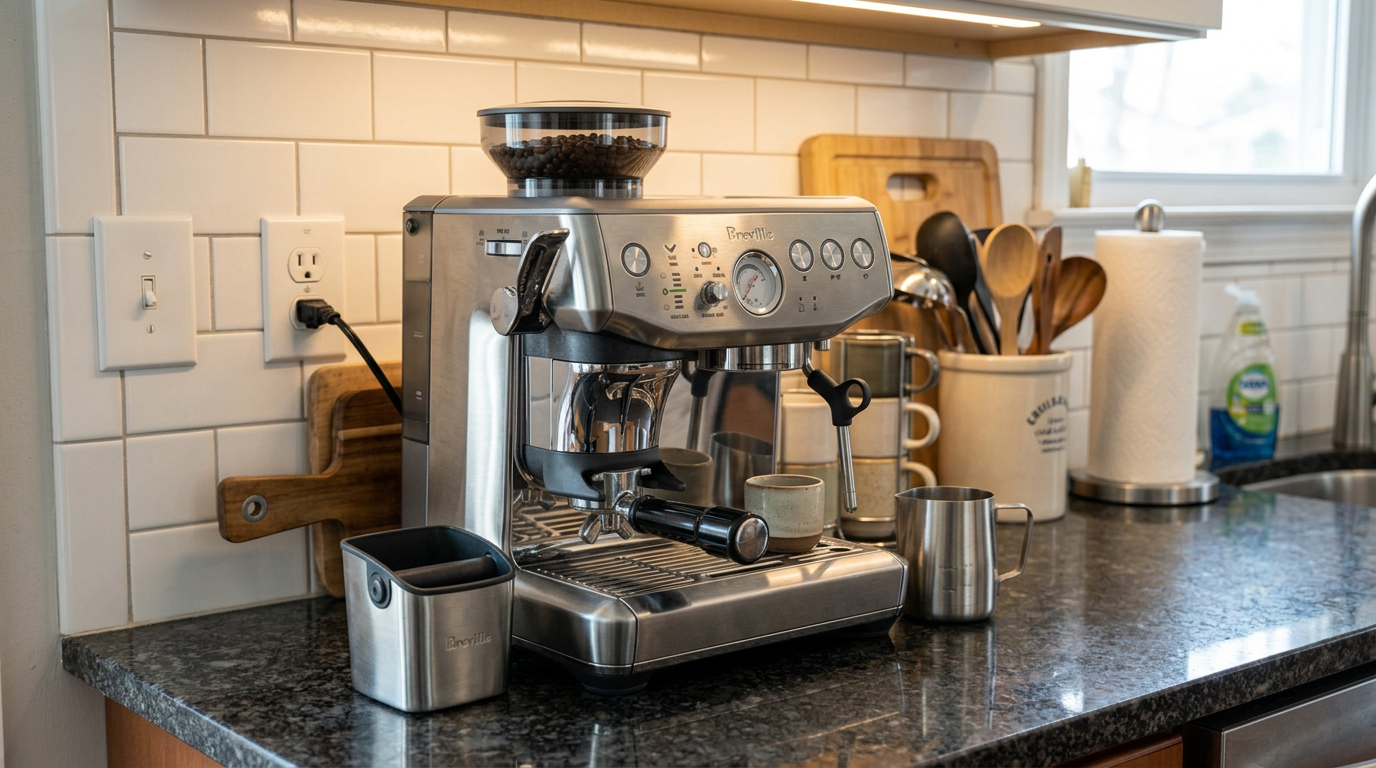
The rest of the machine will feel familiar if you know Breville's classic all-in-one.
There's a grinder on top, a round pressure gauge in the middle, a steam wand on the right and a brushed steel body.
The edges are smoother and rounder, which makes wiping it down quick.
It's also noticeably quiet, both when grinding and when brewing.
The tamping lever sits on the left side of the grinding cradle.
What the Breville Barista Express Impress actually is
The Barista Express Impress is a semi-automatic espresso machine.
The machine controls the water temperature, pressure and shot volume.
You control the coffee, but with a lot of help.
The headline feature is the Impress puck system✕Impress puck systemBreville's assisted tamping system. A lever presses a built-in tamper into the basket, measures how full it is and adjusts the next dose..
It combines a lever-assisted tamper with dose sensing and automatic correction.
Inside, a thermocoil✕ThermocoilA heater with a coiled water channel inside a metal block. Water heats as it flows through, so there's no big boiler to warm up. heats the water, with PID✕PID controlA digital thermostat that measures temperature constantly and makes small corrections to keep it steady. control to keep the temperature steady.
A 15-bar Italian pump pushes the water, and a gauge shows you the pressure during each shot.
The grinder has stainless steel conical burrs and 25 settings on a side wheel.
Our tip: Treat the dose meter as your coach: if it says low or high, believe it, and let it fix the next grind.
What comes in the box
The kit covers everything you need for the first few months.
The 54 mm portafilter has a handle with a central dimple, which helps you insert it straight into the grinding cradle and the group head.
It comes with the double-shot single-wall basket installed.
Baskets
You also get a single-shot single-wall basket and two dual-wall baskets✕Pressurized (dual-wall) basketA basket with a second floor and one tiny exit hole. It creates artificial back-pressure, so even pre-ground or older coffee makes crema. for pre-ground or older coffee.
The single-wall baskets give the best flavor with fresh beans.
The dual-wall baskets are a fallback that builds pressure artificially, so even stale coffee makes something like crema.
Tools
There's the Razor trimming tool, a stainless milk jug, a steam-tip cleaning pin, a group head brush, a rubber cleaning disc, cleaning tablets, descaling powder and a carbon water filter with holder.
| Basket | Type | Use it for |
|---|---|---|
| Double, single wall | Non-pressurized | Fresh beans, everyday double |
| Single, single wall | Non-pressurized | Fresh beans, one shot |
| Double, dual wall | Pressurized | Pre-ground or older coffee |
| Single, dual wall | Pressurized | Pre-ground, small cup |
Breville Barista Express Impress design and setup
The Barista Express Impress measures about 12.9 inches wide, 14.9 inches deep and 16.1 inches tall.
That's compact for a machine with a grinder and a tamping station.
Finish and shape
The body has smooth, continuous panels and rounded corners.
There are very few crevices for coffee dust to collect in, so one sweep with a damp cloth cleans most of it.
Besides brushed stainless steel, there are painted finishes, including a matte sea salt white with a subtle pearly sheen that looks lovely next to wood.
Setup
I soaked the water filter, snapped it into its holder and pushed it into the tank.
After filling the tank and seating it, I switched the machine on and ran hot water through the steam wand outlet to purge air and prime the pump.
Then I flushed the group head and was ready to grind.
Our tip: Prime the pump by running hot water through the outlet before your first shot, so there's no air in the lines.
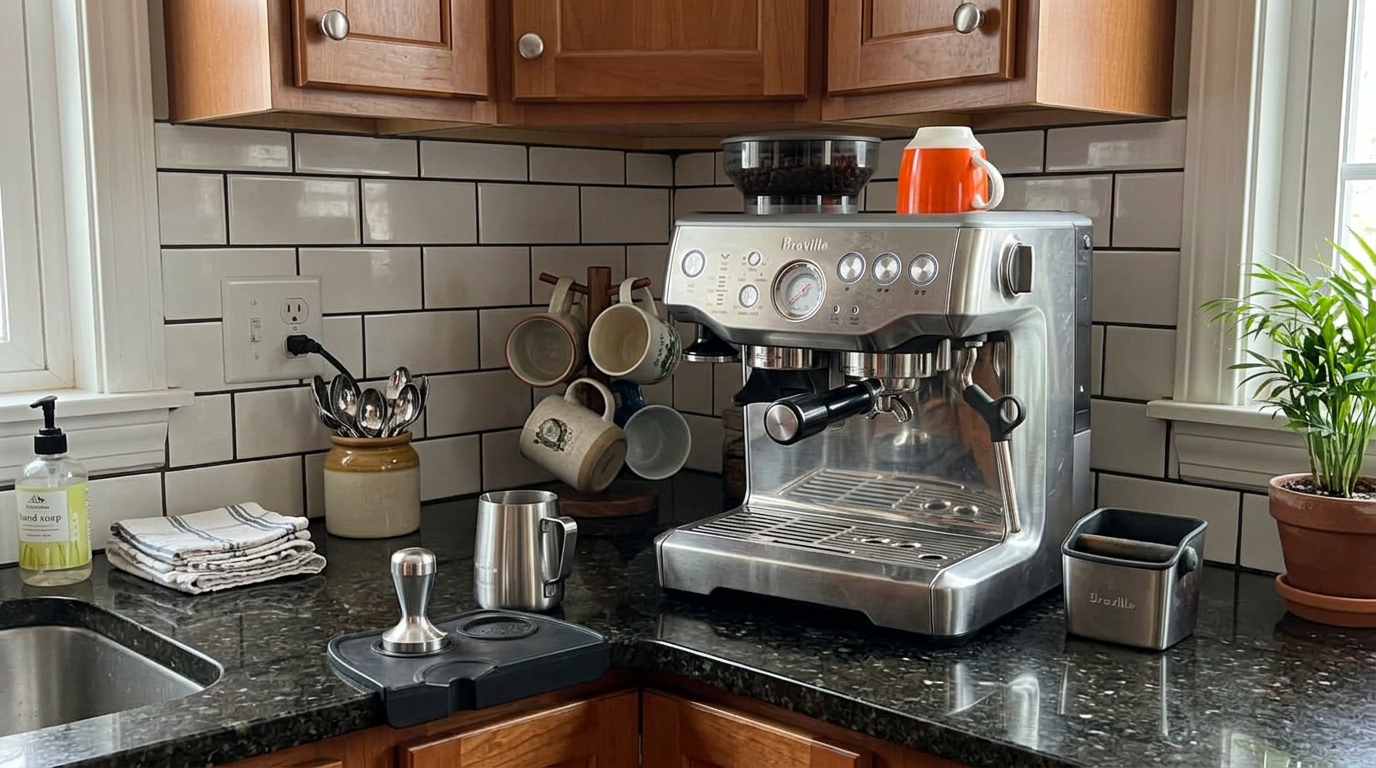
The rounded panels wipe clean in one sweep.
The grinder and the inner burr
The grinder has two levels of adjustment.
The side wheel has 25 settings for everyday changes.
Under the hopper, the upper burr can be moved to shift the whole range.
Moving the inner burr
From the factory, the upper burr was set to 5.
With fresh espresso beans, that left the grind too coarse to build proper pressure, even near the fine end of the wheel.
So I emptied and removed the hopper, lifted the upper burr out and moved it from 5 to 3.
After that, the side wheel had plenty of usable steps on both sides of my sweet spot.
Rough share of the side wheel that gave drinkable espresso with fresh medium-roast beans.
Starting point
After the inner burr change, I started around the middle of the wheel and moved finer until the gauge sat in the espresso zone.
Medium roasts ended up a few steps finer than the middle, and light roasts a few steps finer again.
Our tip: Always change the grind while the grinder is running, so beans can't jam between the burrs.
How the Impress puck system works
This is the heart of the machine, so it's worth understanding.
You lock the portafilter into the cradle and press the grind button for one or two cups.
The grinder runs for a set time and fills the basket.
Then you pull the lever on the left down.
The tamp
The lever drives a flat tamper straight down into the basket with constant pressure, about 22 pounds of force.
At the bottom of the stroke, the tamper gives a small twist across the surface of the coffee.
That twist polishes the top of the puck and helps the tamper lift away cleanly.
The measurement
While the tamper is at the bottom, a sensor measures how far it traveled.
That tells the machine how much coffee is in the basket.
The meter on the front then lights up to show if the dose was low, high or in the green zone.
| Meter shows | What it means | What the machine does |
|---|---|---|
| Low | Too little coffee in the basket | Press grind again for a small top-up |
| Green zone | Ideal dose | Keeps the same grind time |
| High | Too much coffee | Shortens the next grind automatically |
The learning
Every time you tamp, the machine compares the grind time with the fill level.
If the dose was off, it changes the grind time for the next shot.
After two or three shots, it was hitting the green zone almost every time.
Dosing range and puck prep
The tamper adapts to different amounts of coffee.
In the double basket, it handled anything from about 14 to 18 grams without me changing anything.
I settled on about 18 grams for my everyday double, which the meter showed as green.
No stirring before tamping
There's one trade-off.
Because tamping happens inside the cradle, you can't take the portafilter out first to stir or level the grounds.
If you try, the loose mound of coffee spills over the rim.
So WDT✕WDT (stirring)Stirring the ground coffee with thin needles to break up clumps before tamping. It helps prevent channeling. stirring, which many home baristas use, isn't really an option here.
Does it matter?
Less than I expected.
The grounds drop straight down into the center of the basket, and the flat tamper compresses them evenly.
With a bottomless portafilter, I watched the streams merge into a single steady flow in the middle of the basket, with no side sprays.
| Prep step | Manual machine | Express Impress |
|---|---|---|
| Dosing | Weigh by hand | Measured and auto-corrected |
| Distribution | Tap or stir | Falls into the center |
| Tamping | Your hand | Lever, constant pressure |
| Polish | Optional | Twist at the bottom |
| Mess | Grounds on the counter | Contained in the cradle |
Our tip: Always finish the tamp before removing the portafilter, or the loose grounds will spill over the tray.
Temperature control and warm-up
The machine lets you set the brew temperature in five steps.
Each step suits a different roast.
| Temperature | Best for | Effect |
|---|---|---|
| 91°C / 195.8°F | Dark roasts | Less bitterness |
| 92°C / 197.6°F | Medium-dark roasts | Smooth and rich |
| 93°C / 199.4°F | Default, most coffees | Balanced |
| 94°C / 201.2°F | Medium-light roasts | More sweetness |
| 95°C / 203°F | Light roasts | Brighter, more acidity |
Let the group head warm up
The heater is quick, but the heavy metal group head warms up more slowly.
It picks up heat from the heater over about 15 to 20 minutes of being switched on.
If you pull a shot straight after switching on, the cold metal steals heat from the water.
My first shot after a cold start was slightly sharp and astringent.
The second and third, pulled back to back, were balanced and sweet.
How my shots tasted after switching on, on a 10-point scale.
Our tip: If you're in a hurry, run one or two blank shots through the empty portafilter to warm the group head faster.
Breville Barista Express Impress espresso performance
The pressure gauge is front and center, and it's still the best teaching tool on the machine.
During pre-infusion✕Pre-infusionA short, gentle soak at low pressure before full pressure. It lets the puck swell so water flows evenly., the needle stays low while the coffee soaks.
Then it climbs steadily into the shaded espresso zone.
Shot control
The one-cup and two-cup buttons stop the pump at a programmed volume, so you don't have to watch the cup.
I programmed the two-cup button to about 36 grams of espresso from my 18-gram dose, a 1:2 ratio.
How it tasted
With a fresh medium roast, the shots ran in about 27 to 30 seconds.
The crema✕CremaThe golden-brown foam on top of an espresso, made when pressure pushes gases and oils out of fresh coffee. was dense and hazelnut-colored, and it held its shape well.
In the cup, I tasted mild fruit acidity, smooth cocoa and roasted nuts, without harsh bitterness.
A good puck every time
The consistency was the real win.
Because the tamp and dose were the same every time, my shots varied far less from day to day than on a hand-tamped machine.
| What you taste or see | Likely cause | First change |
|---|---|---|
| Sour, thin, needle low | Grind too coarse | One step finer |
| Bitter, needle high, slow drip | Grind too fine | One step coarser |
| Meter shows low | Not enough coffee | Press grind to top up |
| First shot sharp | Group head still cold | Blank shot or wait |
| Pale crema | Stale beans | Use fresher beans |
My four-week shot log
I logged the dose meter result, shot time and a taste note for every double espresso over four weeks.
The results show why the Impress system is such a big help for beginners.
Week one
In the first two days, the meter showed high or low a few times while the machine learned my beans.
By day three, nearly every tamp landed in the green zone.
Weeks two to four
From week two, almost every dose was green, and most shots ran between 26 and 30 seconds.
When I switched to a new bag, I reset the dose memory and moved the grind one step.
The meter was back in the green zone after two shots.
Share of tamps that landed in the green zone, by week.
On a manual machine, my week-one consistency is usually much lower than this.
The Impress system shortens the learning curve to a few days.
Our tip: Keep a note of the grind step for each coffee you buy, so you can go straight back to it next time.
Steam wand and milk drinks
The steam wand is manual, with a single-hole tip on a 360-degree swivel.
When you switch from brewing to steam, the thermocoil needs about 15 to 20 seconds to ramp up.
I used that time to pour the milk and purge the wand.
Steaming
I put the tip slightly below the surface in one off-center spot of the jug.
That angle got the milk spinning in a whirlpool, which breaks big bubbles into fine microfoam✕MicrofoamMilk foam with bubbles too small to see. It's glossy and silky and blends into the coffee..
After a few seconds of gentle hissing at the surface, I lowered the tip slightly and let it roll until the jug was hot.
The milk came out velvety, with tiny integrated bubbles.
Speed
The steam is gentler than on Breville's ThermoJet machines.
A small latte jug took about 45 seconds, and a big cappuccino jug for two took over a minute.
That's fine for one or two drinks, but slow for a crowd.
Seconds to steam about 6 oz of cold milk, from my tests.
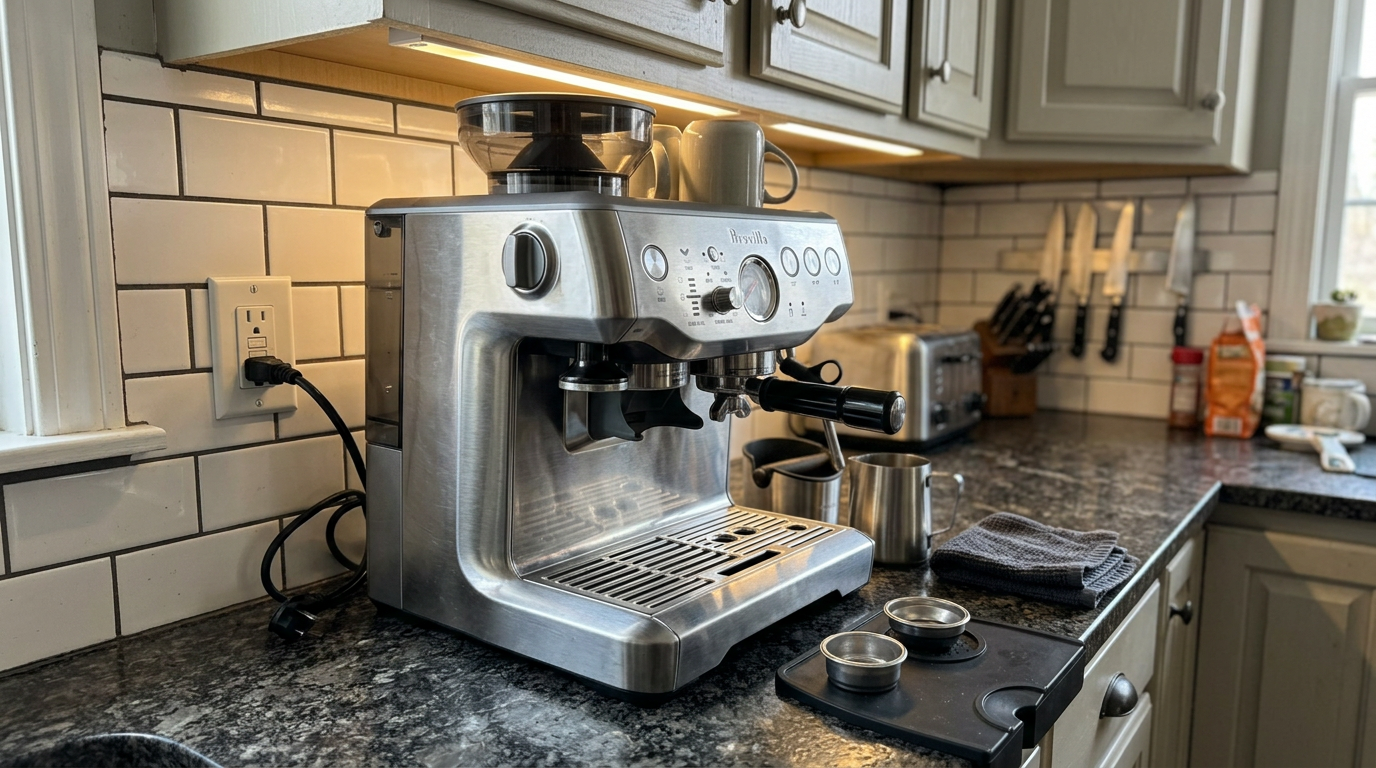
The single-hole steam tip gives beginners more time to find the whirlpool.
Latte art with a gentler wand
Gentler steam is actually helpful while you learn latte art.
It gives you more time to find the right tip position and to stop at the right moment.
By the end of week two, I was pouring hearts most mornings.
What helped
Cold whole milk in a small jug, filled to just below the spout, gave the most stable foam.
I stretched only for the first few seconds, then sank the tip and let it spin.
A quick swirl and a tap on the counter before pouring removed any stray bubbles.
| Problem | Cause | Fix |
|---|---|---|
| Big bubbles | Tip too high too long | Stretch for fewer seconds |
| No foam | Tip too deep | Start right at the surface |
| Milk too hot | Steamed too long | Stop when the jug is hot to hold |
| Foam separates | Waited before pouring | Swirl and pour straight away |
Our tip: Practice with a smaller jug, because the gentle steam heats a big jug slowly and unevenly.
Hot water and americanos
There's a dedicated hot water outlet next to the steam wand.
It's handy for americanos and tea.
The stream sputters a little as small pockets of steam come through, so I held the cup close to avoid splashes on the drip tray.
For a long black, I added the hot water first and pulled the shot on top, which kept more crema.
| Drink | How I made it |
|---|---|
| Americano | Double shot, then hot water |
| Long black | Hot water first, then the shot |
| Tea | Hot water straight into the cup |
| Cup warming | A splash of hot water, then discard |
Living with it as a household
The real test of an assisted-tamping machine is whether other people in the house can use it.
On a hand-tamped machine, I usually end up making everyone's coffee, because tamping is the step people find intimidating.
With the Express Impress, that changed within a couple of days.
My partner learned the routine in one go: lock in the portafilter, press grind, pull the lever, check the light.
The machine took care of the parts that normally need practice.
Different drinkers, one machine
Because the dose correction learns from every tamp, it didn't matter who used it last.
If someone ground a little too much, the meter showed high, and the next grind was shorter.
That self-correcting loop kept shots consistent across different people and different mornings.
Where people still needed help
Steaming milk was the step that still needed a lesson.
The wand is fully manual, so getting the whirlpool right takes a few tries.
I showed everyone the tip position once, and after a week the lattes were good enough that nobody asked me anymore.
Guests
Guests found the gauge fascinating.
Watching the needle climb into the espresso zone made the process feel understandable, which is something touchscreen machines can't quite replicate.
| Task | Learning time for a beginner | Help needed |
|---|---|---|
| Grinding and tamping | One try | Almost none |
| Reading the dose meter | One try | Explain the green zone |
| Pulling a shot | One try | Press one button |
| Steaming milk | About a week | A short demonstration |
| Cleaning the wand | One try | A reminder to wipe |
The drink recipes I settled on
After four weeks, I had a short list of recipes that worked every time on this machine.
They all start from the same 18-gram double shot, because the dose meter made that dose so easy to repeat.
Espresso
An 18-gram dose with about 36 grams out, in 27 to 30 seconds, was my everyday shot.
For a sweeter, denser espresso, I stopped it a little earlier, at around 30 grams.
Flat white
For a flat white, I used the slightly shorter shot and about five ounces of milk, stretched only briefly so the foam stayed thin and silky.
Latte
For a latte, I used the standard double and around eight ounces of milk with a little more foam.
Cappuccino
For a cappuccino, I stretched the milk longer to build a taller, airier foam, and poured it into a smaller cup.
| Drink | Espresso | Milk | Foam |
|---|---|---|---|
| Espresso | 18 g in, 36 g out | None | None |
| Ristretto-style | 18 g in, 30 g out | None | None |
| Flat white | 18 g in, 30 g out | About 5 oz | Thin and silky |
| Latte | 18 g in, 36 g out | About 8 oz | Light |
| Cappuccino | 18 g in, 36 g out | About 4 oz | Tall and airy |
| Americano | 18 g in, 36 g out | Hot water, 4 to 6 oz | None |
The beauty of this machine is that once you have a recipe, it repeats it reliably.
I never had to fight the grinder or my own tamp to make the same drink two days in a row.
Our tip: Program the two-cup button to your favorite yield, so the espresso stops at the same point every time without you watching the scale.
The drawbacks I ran into
No machine is perfect, and the Express Impress has a few quirks worth knowing.
No low-water sensor
The tank has no float sensor or indicator.
If it runs dry during a shot, the pump keeps going, the pitch changes and the shot is ruined.
I learned to check the tank before every session.
Can't inspect the coffee before tamping
Because tamping happens in the cradle, you can't see or level the loose coffee bed first.
Fixed auto-off
The machine switches itself off after 30 minutes of inactivity.
There's no menu setting to extend that to an hour or longer.
If you make coffee at spread-out times, you'll be waiting for the group head to warm up again.
Sputtering hot water
The hot water outlet spits a little steam, which can splash when filling small cups.
| Drawback | How much it bothered me | Workaround |
|---|---|---|
| No low-water sensor | Moderate | Check the tank first |
| Can't stir before tamping | Low | Even drop and tamp work well |
| 30-minute auto-off | Moderate | Run a blank shot after restarting |
| Sputtering hot water | Low | Hold the cup close |
Lever tamping vs hand tamping
I've used plenty of hand-tamped machines, so I wanted to know what the lever really changes.
What you gain
The biggest gain is consistency.
The lever presses with the same force every time, and it always presses straight down, so the puck is level.
Uneven tamping is one of the main causes of channeling✕ChannelingWhen water finds a weak spot in the puck and races through it, leaving the rest under-extracted. It causes sour, thin shots., so this removes a whole category of bad shots.
The second gain is cleanliness.
Grinding and tamping in one enclosed cradle means almost no grounds escape onto the counter or the drip tray.
The third gain is feedback.
The meter tells you if the dose was right, which is something a hand tamper can never do.
What you give up
You give up the ability to stir and level the grounds before tamping.
Experienced home baristas who like to fine-tune distribution may miss that.
You also give up some flexibility with very large or very small doses, though the 14 to 18 gram range covers almost every recipe.
My verdict on the lever
For beginners and busy households, the lever is a clear improvement.
For hobbyists who enjoy every step of puck prep, a hand-tamped machine still offers more to play with.
Lower bars mean more consistent shot times.
Cleaning and maintaining the Breville Barista Express Impress
The enclosed cradle means far fewer grounds on the counter.
Daily care is mostly the steam wand and the drip tray.
I wiped the wand after every milk drink and purged it into the tray.
After each shot, I knocked out the puck, rinsed the basket and flushed the group head.
Backflush and descale
When the machine prompts, put the rubber disc and a tablet in the single basket and run the backflush✕BackflushCleaning the group head by blocking the basket so water and cleaner are forced back through the valve. cycle.
Use the descaling powder when it's time, depending on your water hardness.
| When | Task | Why it matters |
|---|---|---|
| After milk drinks | Wipe and purge the wand | Stops milk drying in the tip |
| After each shot | Knock out, rinse, flush | Keeps oils from building up |
| Daily | Empty the drip tray | Avoids smells and overflow |
| Weekly | Brush the tamper face and cradle | Removes stuck coffee |
| When prompted | Backflush with a tablet | Clears oil from the valve |
| Every 2 to 3 months | Replace the filter | Slows down scale |
My estimate of hands-on cleaning time per day.
Warranty
Breville covers the Barista Express Impress with a two-year limited warranty in the US.
What daily use is really like
My routine was quick and almost mess-free.
Switch on, check the water, run a blank shot, grind, pull the lever, glance at the meter, brew and steam.
A flat white took about four minutes, including wiping the wand.
Water
The 67-ounce tank lasted two people about two days.
Rough maths from a 67 oz tank, allowing for flushes and purging.
Noise
This is one of the quieter all-in-one machines I've used.
The grinder runs with a low hum, and the pump is smooth during extraction.
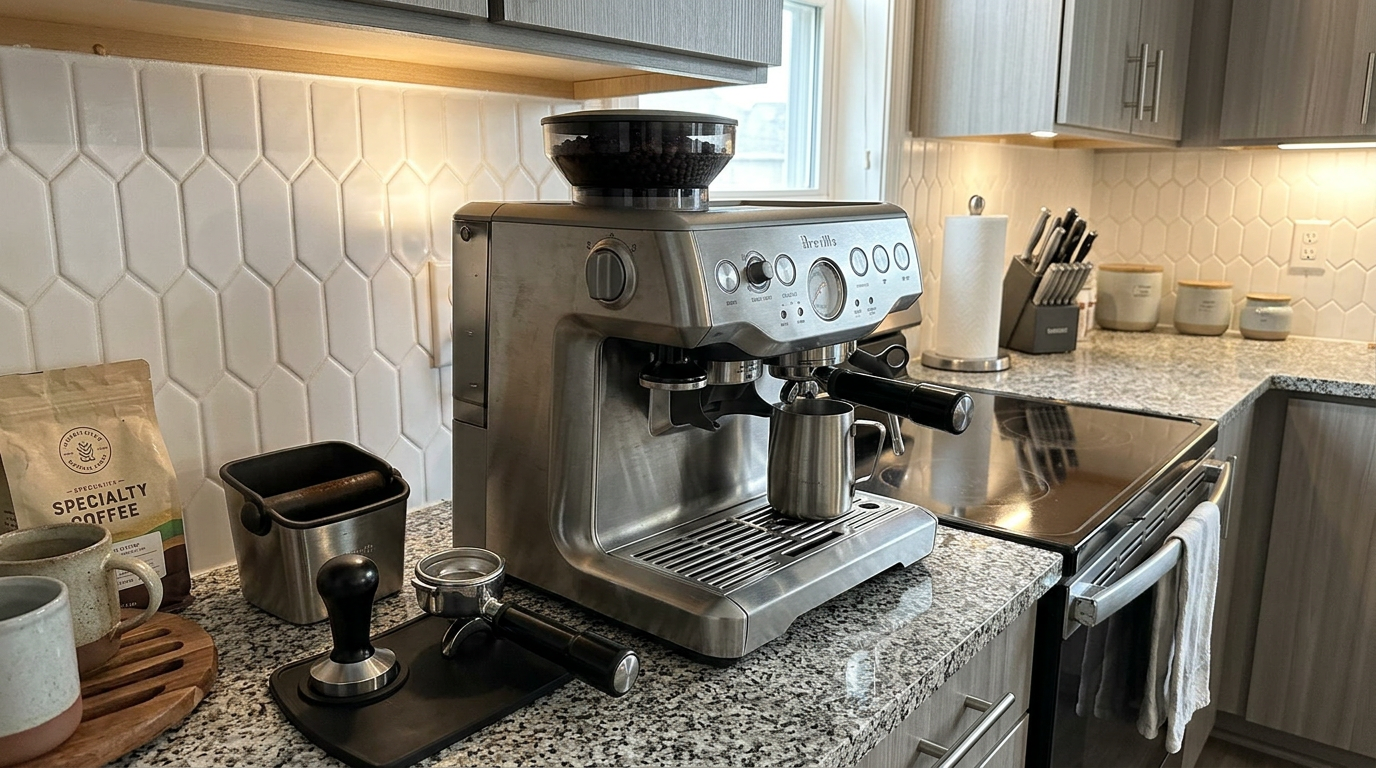
From the side, you can see the tamping lever and the bean hopper.
Our tip: Fill the tank the night before, because there's no warning when it runs low.
Beans, water and milk
For my testing, I used a fresh medium-to-dark roast blend with a little robusta, which built a stable crema and a full body.
I also tried an all-arabica medium roast and a light single origin.
Roast choice
Medium and medium-dark roasts were easiest on the default temperature.
Light roasts needed the highest temperature and a finer grind to avoid sourness.
Very dark roasts tasted best at the lowest temperature.
| Bean type | Temperature | Grind |
|---|---|---|
| Light roast | 95°C / 203°F | Finer |
| Medium roast | 93°C / 199.4°F | Middle |
| Medium-dark blend | 92°C / 197.6°F | Slightly coarser |
| Dark roast | 91°C / 195.8°F | Coarser |
Water
Use the carbon filter or filtered water.
Avoid pure distilled water, because coffee needs minerals to taste full.
Our tip: Freshly roasted beans make the dose meter more reliable, because very old beans compress differently.
Common mistakes to avoid
The Barista Express Impress is forgiving, but these habits make a difference.
| Mistake | What happens | Better habit |
|---|---|---|
| Leaving the inner burr at 5 | Grind too coarse for fresh beans | Move it to around 3 |
| Removing the portafilter before tamping | Grounds spill | Always tamp in the cradle |
| Ignoring the dose meter | Inconsistent shots | Top up or let it correct |
| Not resetting after a bean change | Overdosed first shots | Hold the filter button 3 seconds |
| Forgetting the tank | Shot ruined mid-pour | Check before brewing |
| Brewing straight from cold | Sharp first shot | Blank shot or wait |
Change one setting at a time and taste after each change.
What I would change
A low-water sensor is the obvious fix.
An adjustable auto-off would help anyone who makes coffee at different times of day.
And stronger steam would speed up milk drinks for families.
Is the Breville Barista Express Impress worth the money?
The Express Impress costs more than the classic hand-tamped all-in-one, so the question is whether the Impress system is worth it.
For most beginners, I think it is.
It removes the hardest skill to learn, cuts the mess and makes shots consistent from the first week.
You still learn the fundamentals, because you grind, read the gauge, program shots and steam milk yourself.
Ask yourself three questions.
Does tamping put you off espresso? Do several people in your house pull shots? And do you mostly make one or two milk drinks at a time?
If yes, it's an easy recommendation.
In Europe, the same machine is sold as the Sage Barista Express Impress.
It's also worth considering what you would otherwise spend on extra tools.
To get the same consistency on a hand-tamped machine, many people buy a calibrated tamper, a distribution tool and a dosing funnel.
The Express Impress builds that consistency in, and it keeps the counter far cleaner at the same time.
Check what's included where you buy, because finishes and bundles vary.
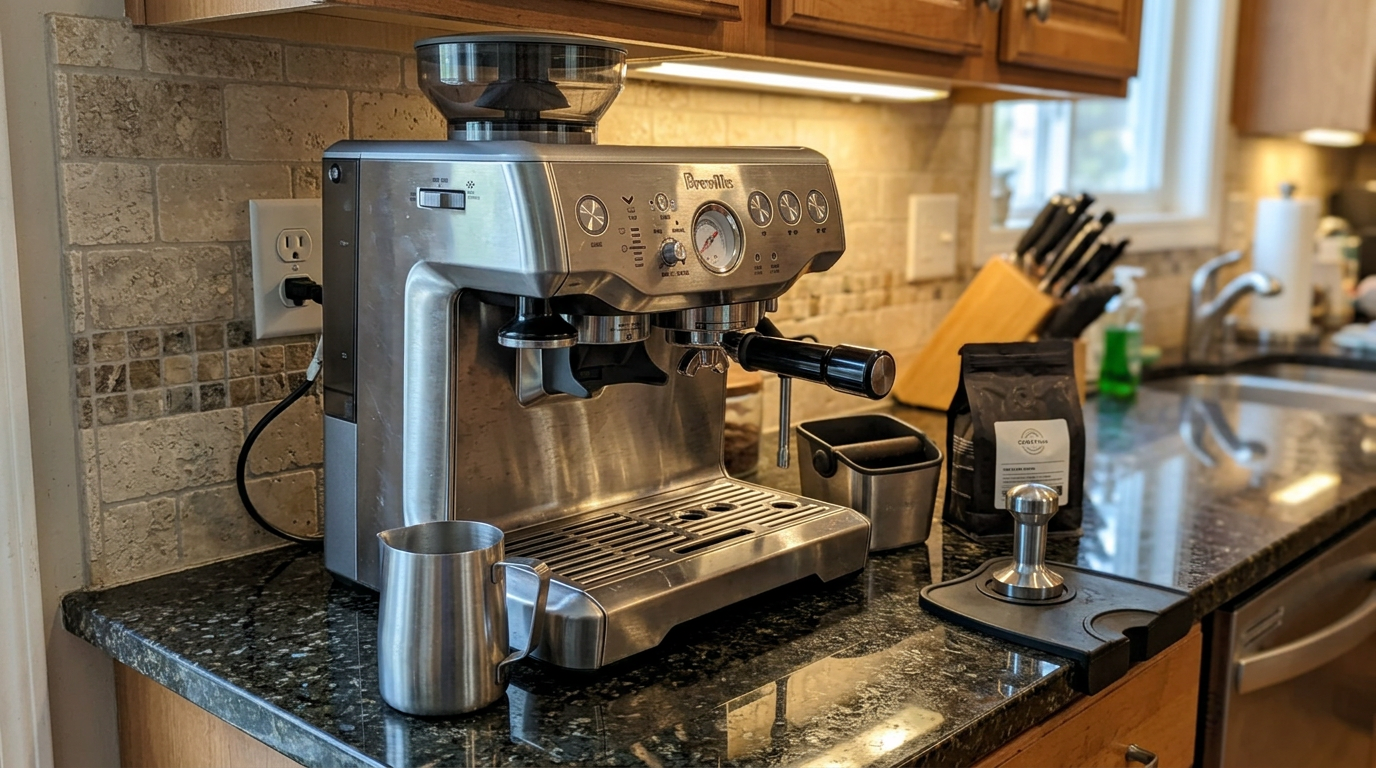
The Express Impress keeps the classic all-in-one look with a smarter grinding station.
How it compares with other espresso setups
The most useful comparison is with the setups you are likely choosing between.
The Breville Barista Express Impress stands out for its assisted tamping and dose correction.
| Feature | Express Impress | Hand-tamped all-in-one | Fully automatic machine |
|---|---|---|---|
| Tamping | Lever, constant pressure | By hand | Automatic, hidden |
| Dose correction | Automatic | None | Automatic |
| Pressure gauge | Yes | Yes | No |
| Mess | Very little | Some grounds | Very little |
| Milk | Manual wand | Manual wand | One-touch |
| Learning curve | Low | Moderate | Very low |
| Espresso quality | Very good, consistent | Very good, skill-dependent | Good |
A hand-tamped all-in-one costs less, but it takes longer to master and makes more mess.
A fully automatic machine is easier still, but it gives you less control and a different style of espresso.
The Express Impress keeps the real espresso process and removes most of the guesswork.
| You mostly drink | Is it a fit? | Why |
|---|---|---|
| Espresso | Very good | Consistent puck, gauge feedback |
| One or two lattes | Very good | Silky microfoam with practice |
| Many milk drinks in a row | Fair | Gentle steam, one task at a time |
| Americanos | Good | Hot water outlet |
| One-touch drinks | Poor | Milk is still manual |
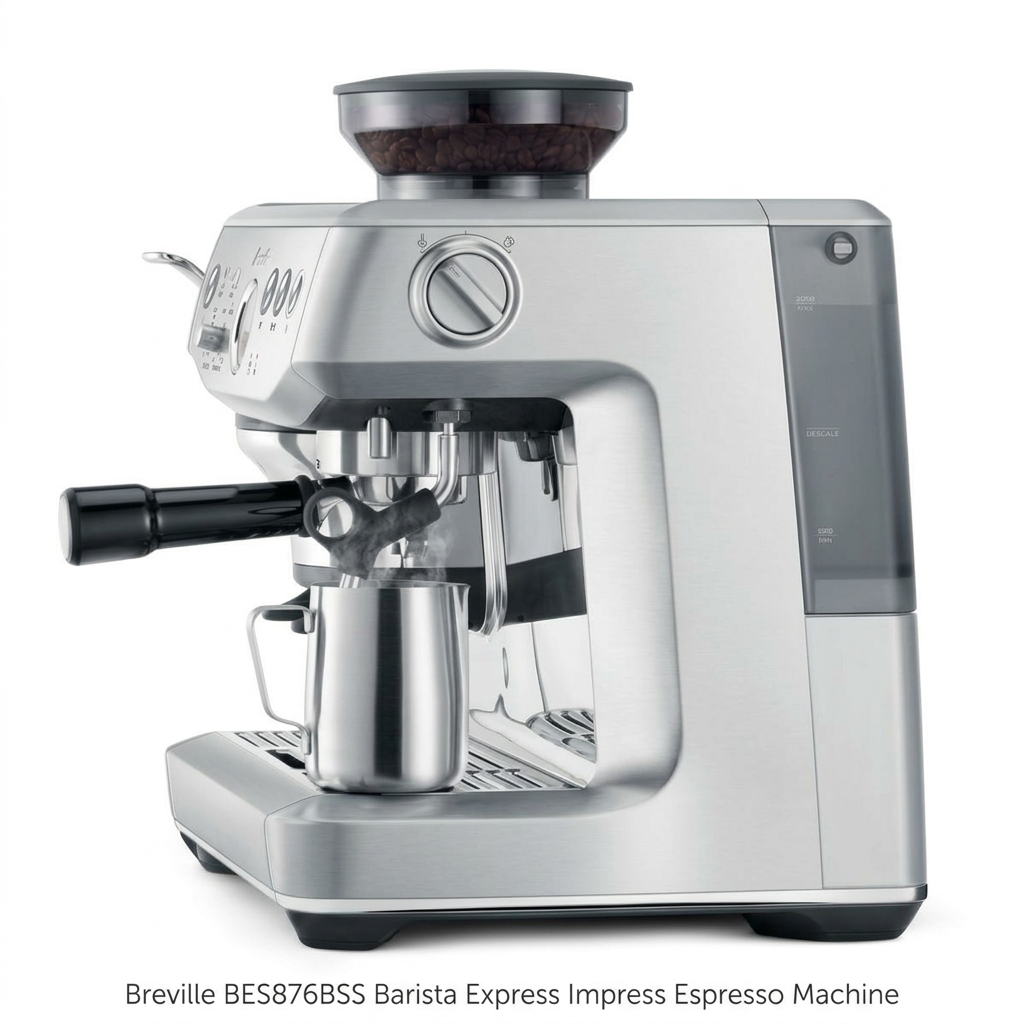
The portafilter locks into the cradle under the tamping lever.
Other Breville machines I tested
If you want the same Impress system with a touchscreen and hands-free milk, see my Barista Touch Impress review.
For the classic hand-tamped version, read my Breville Barista Express review.
For faster heat-up and stronger steam, see the Breville Barista Pro review.
Which one is right for you: is the Breville Barista Express Impress your match?
4 quick questionsBreville Barista Express Impress specifications
From manufacturer data and my own testing.
How I tested and scored the Breville Barista Express Impress
For four weeks, I used the Breville Barista Express Impress as my everyday espresso machine for espresso, americanos, long blacks, flat whites and lattes.
I moved the inner burr, mapped the grind wheel, logged every dose meter result and shot time, and tested all five temperatures with light, medium and dark roasts.
I used a bottomless portafilter to check flow, steamed whole, semi-skimmed and oat milk, and followed every daily and prompted cleaning routine.
I then checked my notes against Breville's specifications and owner documentation.
- Espresso (8.6): body, crema, flavor and day-to-day consistency.
- Milk drinks (7.8): microfoam texture, steam speed and latte art.
- Ease of use (8.5): tamping, dose correction, setup and workflow.
- Cleaning (8.2): counter mess, daily wiping, backflushing and descaling.
The overall score of 8.3 is an editorial rating that reflects those four areas.
Breville Barista Express Impress FAQ
Is the Breville Barista Express Impress good for beginners?
Yes. The lever tamps for you and the dose meter corrects the next grind, so it is much easier to learn than a hand-tamped machine.
How does the Impress tamping work?
You pull a lever that presses a built-in tamper into the basket with constant force, then twists to polish the puck. A sensor measures the fill level.
What does the dose meter do?
It shows whether the dose was low, high or ideal. If it was off, the machine adjusts the next grind time automatically.
How many grind settings does it have?
25 settings on the side wheel, plus an inner burr adjustment under the hopper that shifts the whole range.
Should I adjust the inner burr?
On my unit, moving the upper burr from 5 to 3 made the grind fine enough for fresh espresso beans and widened the usable range.
Does it have a pressure gauge?
Yes. The analog gauge shows extraction pressure during each shot.
Can I change the brew temperature?
Yes. There are five settings from about 195.8°F to 203°F, so you can match dark, medium and light roasts.
Does it warn you when the water is low?
No. There is no low-water sensor, so check the tank before you brew.
Can I stir the grounds before tamping?
Not easily. Tamping happens in the cradle, and removing the portafilter first spills the loose grounds.
How long is the auto-off?
The machine switches off after 30 minutes of inactivity, and this can not be changed.
Is the Sage Barista Express Impress the same?
Yes. The Sage version sold in Europe is the same machine.
Kitchen & coffee tester
Michael spent six years as a line cook in restaurants in Chicago and New York, and he has tested kitchen appliances for HouseholdMe since 2018, from air fryers to coffee makers. He holds an SCA certificate in barista skills and used the Breville Barista Express Impress as his everyday coffee machine for four weeks for this review, working from testing notes he compiled together with the HouseholdMe team.
- Four weeks of hands-on testing of the Breville BES876BSS Barista Express Impress
- Breville product specifications and owner documentation
- General espresso brewing, milk steaming and maintenance guidance