Barista Express vs Express Impress: is assisted tamping worth paying for?
Same 54 mm portafilter, same analog pressure gauge, same single-hole steam wand and the same 67-ounce tank. The difference is one lever. The Breville Barista Express asks you to dose, tamp and trim by hand, while the Breville Barista Express Impress tamps for you with constant pressure, measures the puck and corrects its next grind by itself. I used each one as my daily espresso machine for four weeks, logged every shot and lined up the data to find out whether that lever is worth the extra money.
We choose products independently. We may earn a commission through links on this page; your price stays the same. Affiliate policy
Jargon helpNew to espresso? Tap any dotted term to see what it means.
In this comparison
If tamping by hand is the step that puts you off real espresso, or several people in your house will pull shots, buy the Breville Barista Express Impress. In my logs, about 72 percent of its shots hit my target window in week one, against about 45 percent on the hand-tamped Express, and the counter stayed almost spotless. If you enjoy every step of puck prep, want to stir and level the grounds yourself, or want the cheaper way into Breville espresso, the Breville Barista Express still pulls sweet, syrupy shots once you have moved its inner burr and bought a scale.
The two machines
Specs checked November 13, 2026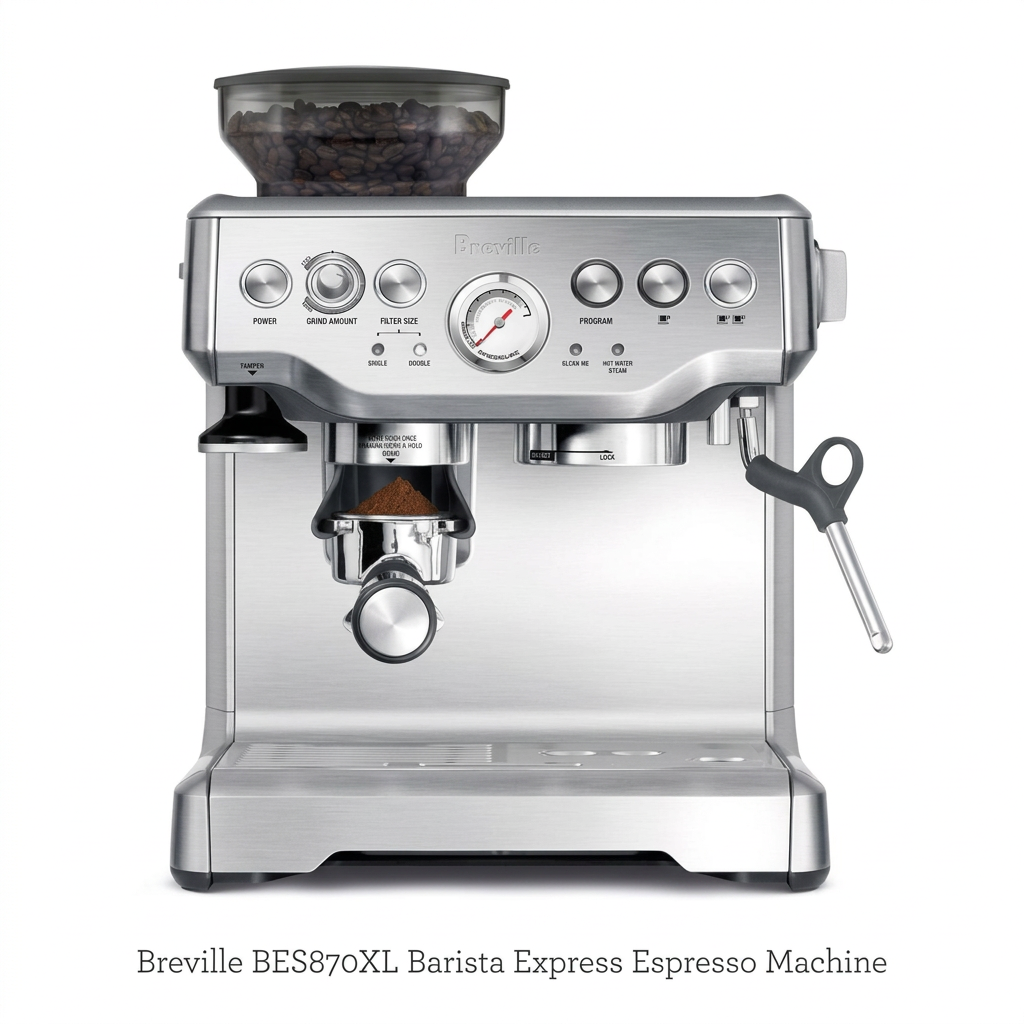
A conical burr grinder, an analog pressure gauge, a magnetic hand tamper, PID temperature and a manual steam wand: the classic all-in-one.
Check price on Amazon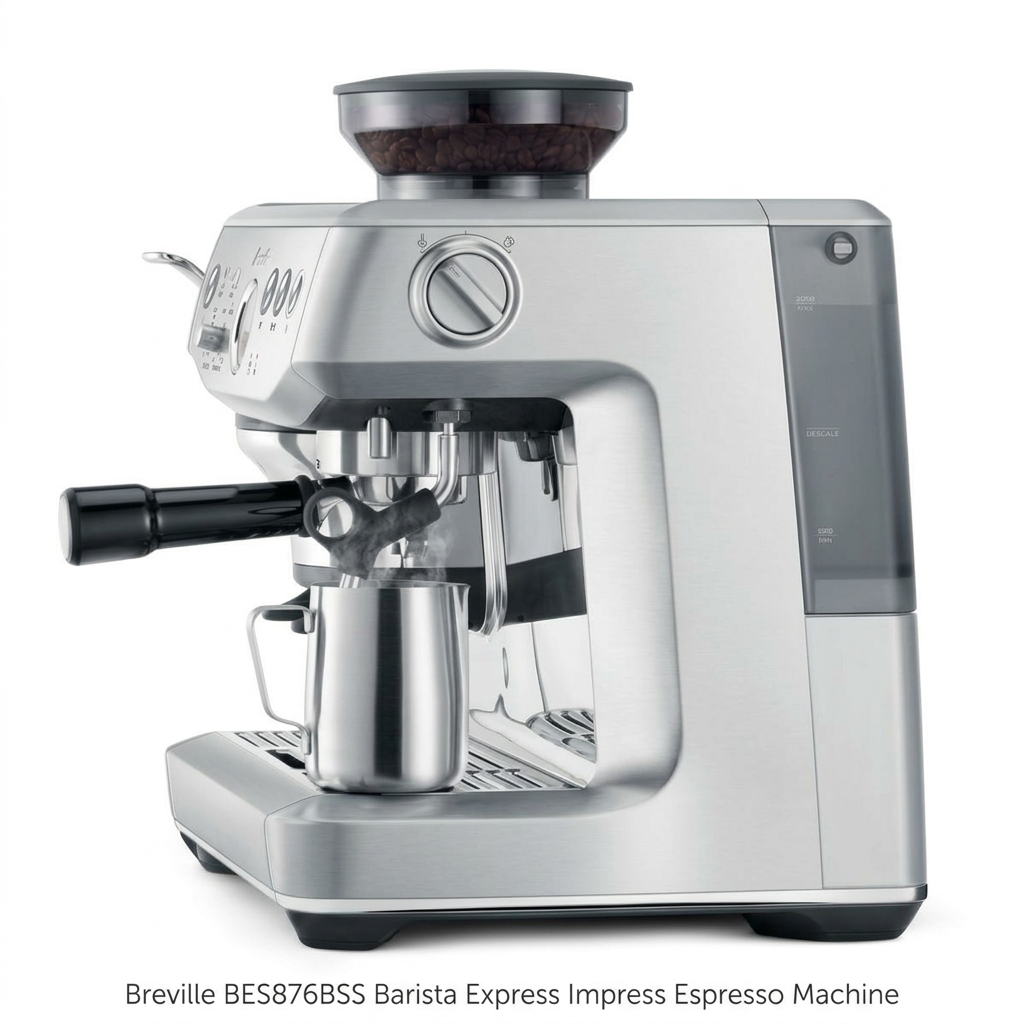
A lever that tamps with about 22 lb of force, a dose meter that self-corrects, 25 grind settings, five temperatures and the same pressure gauge.
Reveal Today’s DealBarista Express vs Express Impress at a glance
- Buy the Impress if you want consistent shots from week one with almost no mess or technique.
- Buy the Express if you enjoy hand tamping and stirring, or want the lower entry point.
- Both share the gauge, the gentle steam wand and the missing low-water sensor.
- By week four my logs were close; the Impress mainly saves you the learning curve.
Head to head
The better result in each row is marked, based on four weeks with each machine and Breville’s specs. Where the two are the same, there is no winner.
The tally favors the Impress, but it is not my verdict: some buyers specifically want the hand-tamped workflow the Express offers.
| Spec | Barista Express | Express Impress |
|---|---|---|
| Tamping | By hand | Lever, ~22 lb, with polishing twist ✓ Best |
| Dose control | Timed dial, check on a scale | Measured and auto-corrected ✓ Best |
| Stir or level before tamping | Yes ✓ Best | No |
| Week-one shots on targetmy log | ~45% | ~72% ✓ Best |
| Grind settingsside dial | 16, plus inner burr | 25, plus inner burr ✓ Best |
| Temperature control | Button combo | Five settings, 91–95°C ✓ Best |
| Counter mess | Some grounds | Very little ✓ Best |
| Pressure gauge | Yes | Yes |
| Steam wand | Single hole, ~45 s | Single hole, ~45 s |
| Low-water sensor | No | No |
| Auto-off | Switches off when idle | Fixed at 30 minutes |
| FootprintW x D x H | 12.5 x 13.8 x 15.9 in ✓ Best | 12.9 x 14.9 x 16.1 in |
| Warranty (US) | 1 year | 2 years ✓ Best |
| Rows won | 2 | 7 |
Barista Express vs Express Impress pros and cons
Breville Barista Express
- Sweet, syrupy espresso once dialed in
- Full control over dosing, stirring and tamping
- The lower entry point into Breville espresso
- Grinder needs an inner-burr tweak out of the box
- Tamping takes practice and makes some mess
- No low-water sensor on the tank
Breville Barista Express Impress
- Lever tamping makes even, level pucks every time
- Dose meter corrects the next grind automatically
- Very little coffee mess on the counter
- You cannot stir the grounds before tamping
- Gentle steam takes a while for big jugs
- No low-water sensor and a fixed 30-minute auto-off
Who should buy which machine?
- Hobbyists who enjoy every step of puck prep
- Buyers who want the lower entry point
- People happy to use a scale every few days
- Beginners nervous about tamping
- Households where several people pull shots
- Anyone who wants a tidy counter
Design, size and build
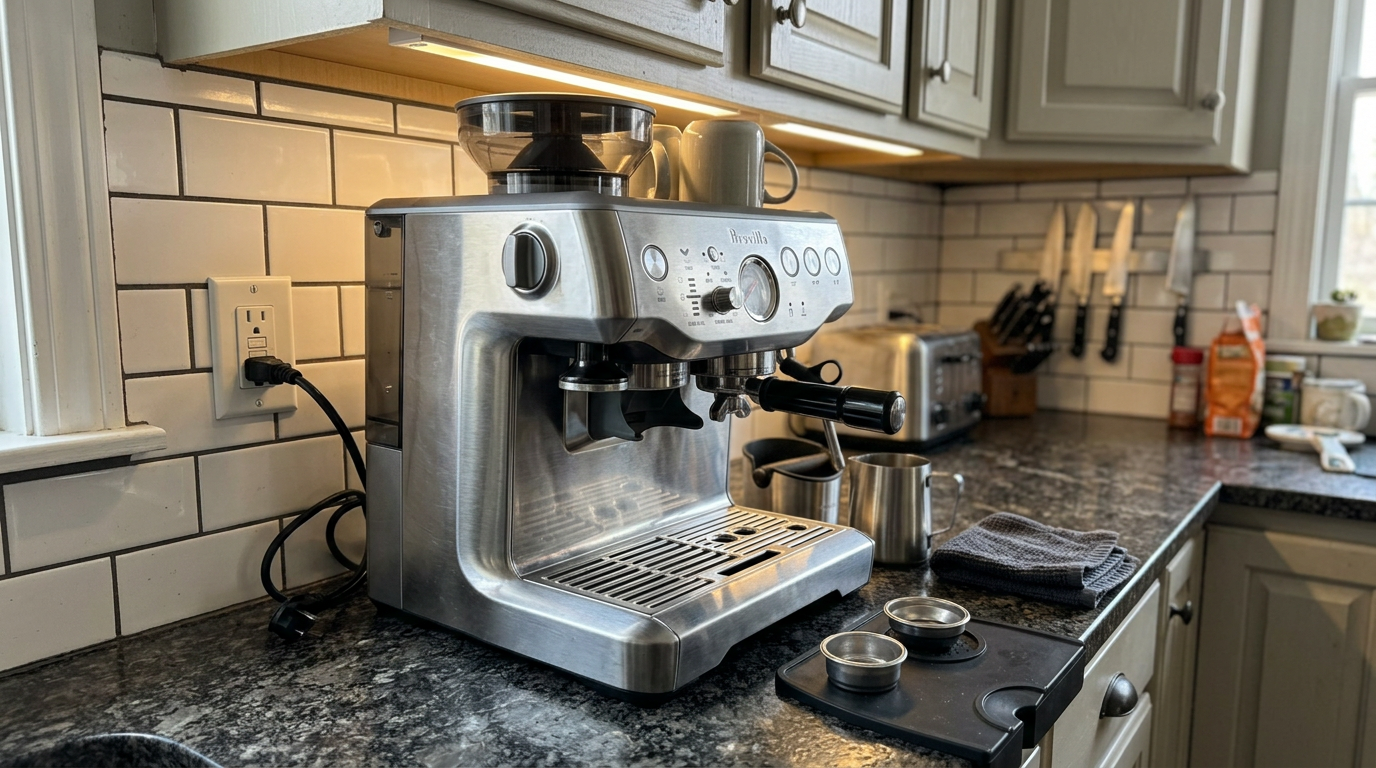
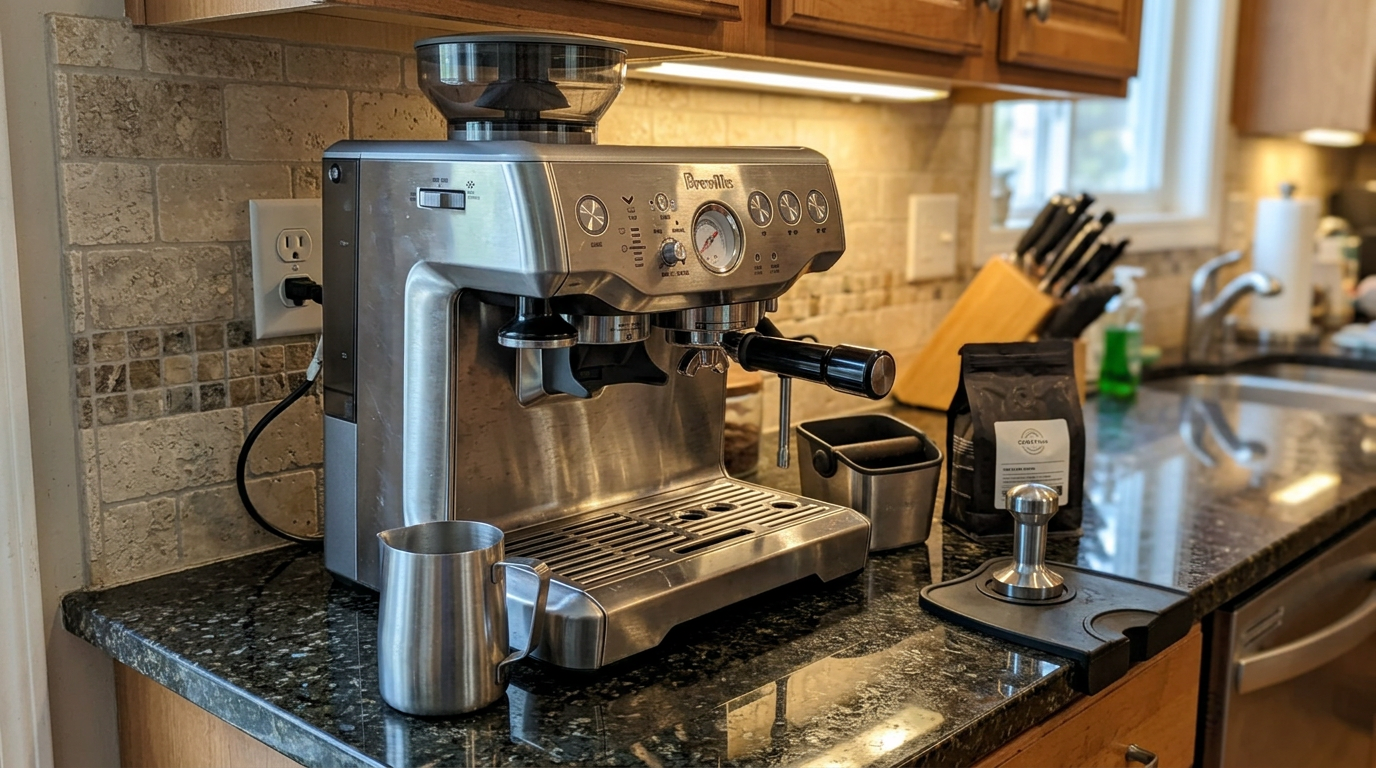
From across the room, these are clearly siblings. Both have a bean hopper on top, a round pressure gauge in the middle, a 54 mm portafilter and a steam wand on the right, all in brushed stainless steel.
The Impress adds a tamping lever on the left side of the grinding cradle and a small dose meter on the panel. Its body has smoother, more continuous panels with rounded corners, so there are fewer crevices for coffee dust.
It is also a little bigger: about 12.9 inches wide, 14.9 inches deep and 16.1 inches tall, against 12.5 by 13.8 by 15.9 inches for the Express. Both weigh about 22 to 23 lb.
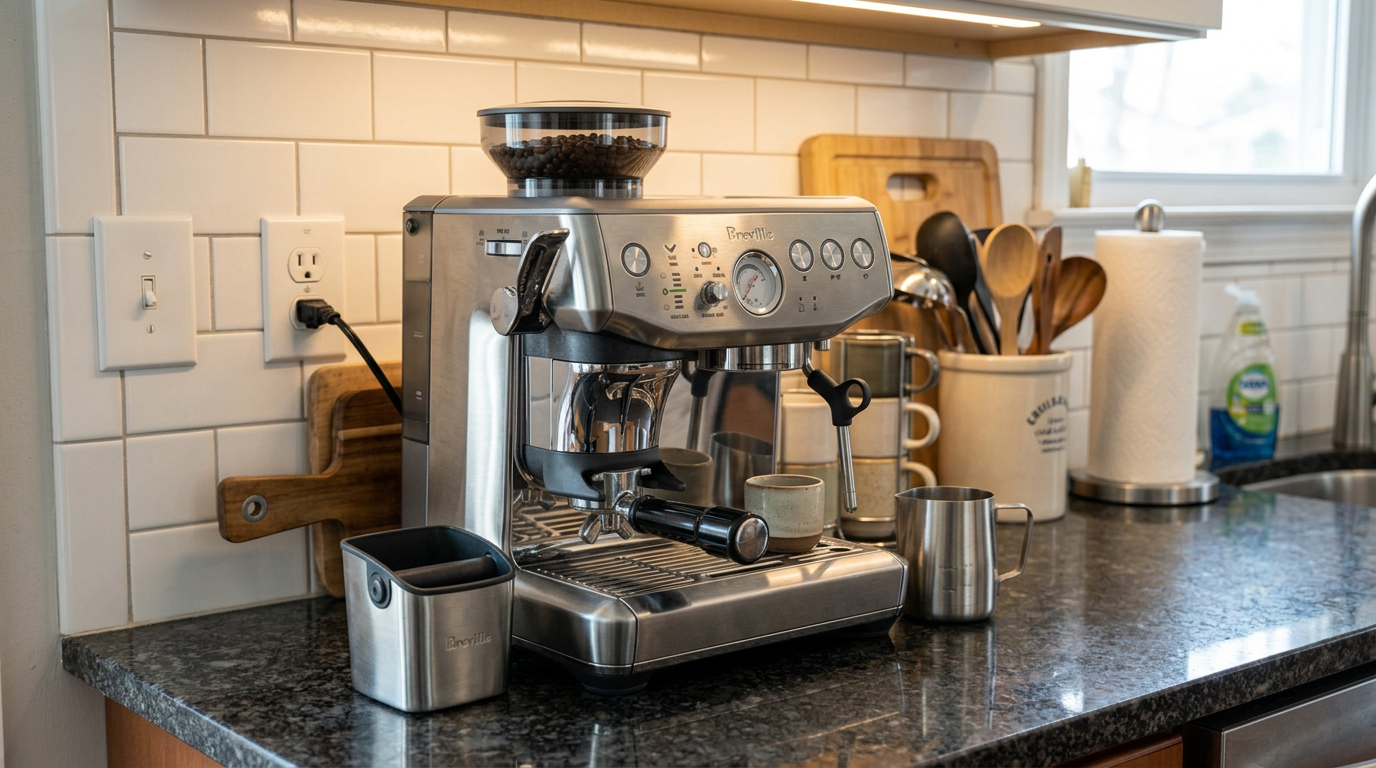
The Impress adds a tamping lever beside the grinding cradle; everything else looks familiar.
The Express has one tidy trick the Impress lacks: a hidden storage box behind the drip tray for spare baskets and cleaning tools. On the Impress, the extra baskets and Razor tool need a drawer.
Our tip: Measure the depth of your counter first, because the Impress is about an inch deeper than the Express.
Tamping: lever vs hand
This is the whole reason the Impress exists, so I spent the most time here.
On the Express, you grind into the basket, tap the portafilter to settle the grounds, press the magnetic tamper straight down until the coffee stops compressing, then trim the excess with the Razor tool. A tilted tamp leaves one side thinner, and water rushes through it, which is called channeling✕ChannelingWater finding a weak path through the coffee puck instead of flowing through it evenly. It is the most common cause of sour shots..
It took me about a week to tamp level without thinking about it. Until then, a few shots each day ran fast and tasted sour.
On the Impress, you grind into the portafilter while it sits in a cradle, then pull the lever. A flat tamper drives straight down with about 22 lb of force and gives a small polishing twist at the bottom.
Every puck came out level and evenly pressed. In my house, people who had never made espresso pulled a good shot on their first try.
| Prep step | Barista Express | Express Impress |
|---|---|---|
| Dosing | Timed dial, weigh by hand | Measured and auto-corrected |
| Distribution | Tap or stir by hand | Falls into the center |
| Tamping | Your hand | Lever, constant pressure |
| Polish | Optional | Twist at the bottom |
| Trimming | Razor tool | Rarely needed |
| Mess | Grounds on the counter | Contained in the cradle |
The trade-off nobody mentions
Because tamping happens in the cradle, you cannot take the portafilter out first to stir or level the grounds. Hobbyists who like a needle-stirring tool will miss that.
In practice it mattered less than I expected. The grounds drop straight into the center of the basket, and the flat tamper compresses them evenly.
Dosing and the dose meter
The Express doses by time. A front dial sets how long the motor runs, and my first attempt gave only about 8 grams in the double basket, so I weighed, adjusted and repeated until it gave about 15.4 grams every time.
That timed dose✕Timed dosingThe grinder runs for a set number of seconds rather than stopping at a set weight. The dose drifts slightly as beans age or the hopper empties. drifts as beans age or the hopper empties, so I checked it on a scale every few days.
The Impress also grinds by time, but then it checks its own work. While the tamper is at the bottom of its stroke, a sensor measures how far it traveled, which tells the machine how much coffee is in the basket.
If the dose was low, the meter says so and you press grind again for a small top-up. If it was high, the machine shortens the next grind automatically.
| Meter shows | What it means | What the Impress does |
|---|---|---|
| Low | Too little coffee | Press grind again to top up |
| Green zone | Ideal dose | Keeps the same grind time |
| High | Too much coffee | Shortens the next grind |
In the double basket, the Impress handled anything from about 14 to 18 grams without me changing anything. I settled on 18 grams, a little more than the 15.4 grams I used on the Express.
The meter also taught me something about my own habits. On the Express, I assumed my dose was steady, but weighing showed it drifting by a few tenths of a gram as the hopper emptied and the beans aged.
On the Impress, that drift simply never reached the cup, because each tamp told the machine to adjust the next grind. For a busy household, that self-correction is worth more than any spec on the box.
Our tip: When you change beans on the Impress, hold the filter size button for three seconds to reset the dose memory, so it does not overdose the first shots.
Grinder and the inner burr
Both machines use stainless steel conical burrs✕Conical burrsTwo cone-shaped grinding parts, one inside the other. Beans are crushed between them, and the gap sets how fine the coffee is. with two levels of adjustment: an outer dial or wheel, and a hidden inner burr under the hopper that shifts the whole range.
On my Express, the inner burr came set to 6, which left most of the 16-step dial too coarse for fresh beans. Moving it to 2 gave usable steps on both sides of my sweet spot at 7.
On the Impress, the inner burr came set to 5, with the same problem. Moving it to around 3 opened up its 25-step wheel, and medium roasts landed a few steps finer than the middle.
Usable espresso range on the outer dial
Rough share of each dial that gave drinkable espresso with fresh medium-roast beans.
The Impress wheel’s 25 steps make each change smaller, so dialing in felt more precise. Both grinders produce fluffy, fairly even grounds, with a little clumping at fine settings.
Our tip: Empty the hopper before you move the inner burr on either machine, or beans will drop straight into the burr chamber.
Temperature control and warm-up
Both machines use a 1600-watt thermocoil✕ThermocoilA coiled metal tube with a heating element wrapped around it. Water heats as it flows through the coil. with PID✕PID controlA small controller that constantly adjusts the heater to hold the water at one temperature, instead of letting it swing hot and cold. control, so brew temperature is steady through the shot.
The difference is access. On the Express, you nudge the temperature through a button combination in the manual. On the Impress, five settings from 91 to 95°C sit on the panel, and I changed them every time I changed roast.
| Impress setting | Best for | Effect |
|---|---|---|
| 91°C / 195.8°F | Dark roasts | Less bitterness |
| 92°C / 197.6°F | Medium-dark roasts | Smooth and rich |
| 93°C / 199.4°F | Default, most coffees | Balanced |
| 94°C / 201.2°F | Medium-light roasts | More sweetness |
| 95°C / 203°F | Light roasts | Brighter, more acidity |
Let the group head warm up
On both machines, the heater is quick but the heavy metal group head✕Group headThe round fitting the portafilter locks into. Hot water flows out of it and through your coffee. warms up slowly, picking up heat over about 15 to 20 minutes. Brewing straight from cold gave me a sharp first shot on both.
One or two blank shots of hot water through the empty portafilter fixed most of it. On the Impress, I scored the first shot about 5.5 out of 10 straight away, 7.5 after a blank shot and 9.0 after 15 to 20 minutes.
My first-shot taste scores on the Impress; the Express followed the same pattern.
The Impress has one annoyance here: it switches itself off after 30 minutes of inactivity, and there is no setting to extend that. On slow weekend mornings, I often had to restart it and run another blank shot.
Espresso quality
Once dialed in, both machines pull espresso that tastes like it came from a café. The difference is how often you get it.
On the Express, my target was about 15.4 grams in and 30 grams out in 25 to 30 seconds. After moving the inner burr and settling at step 7, the needle climbed into the middle of the espresso zone and the shot flowed like warm honey, sweet and creamy with balanced acidity.
On the Impress, I programmed the two-cup button to about 36 grams from an 18-gram dose, a classic 1:2 brew ratio✕Brew ratioThe weight of coffee in the basket compared with the weight of espresso in the cup. 18 g in and 36 g out is a 1:2 ratio.. With a fresh medium roast, shots ran in about 27 to 30 seconds with a dense, hazelnut-colored crema that held its shape.
Side by side with the same beans, I could not reliably tell a good Express shot from a good Impress shot. The Impress’s slightly bigger dose gave a touch more body, but only a touch.
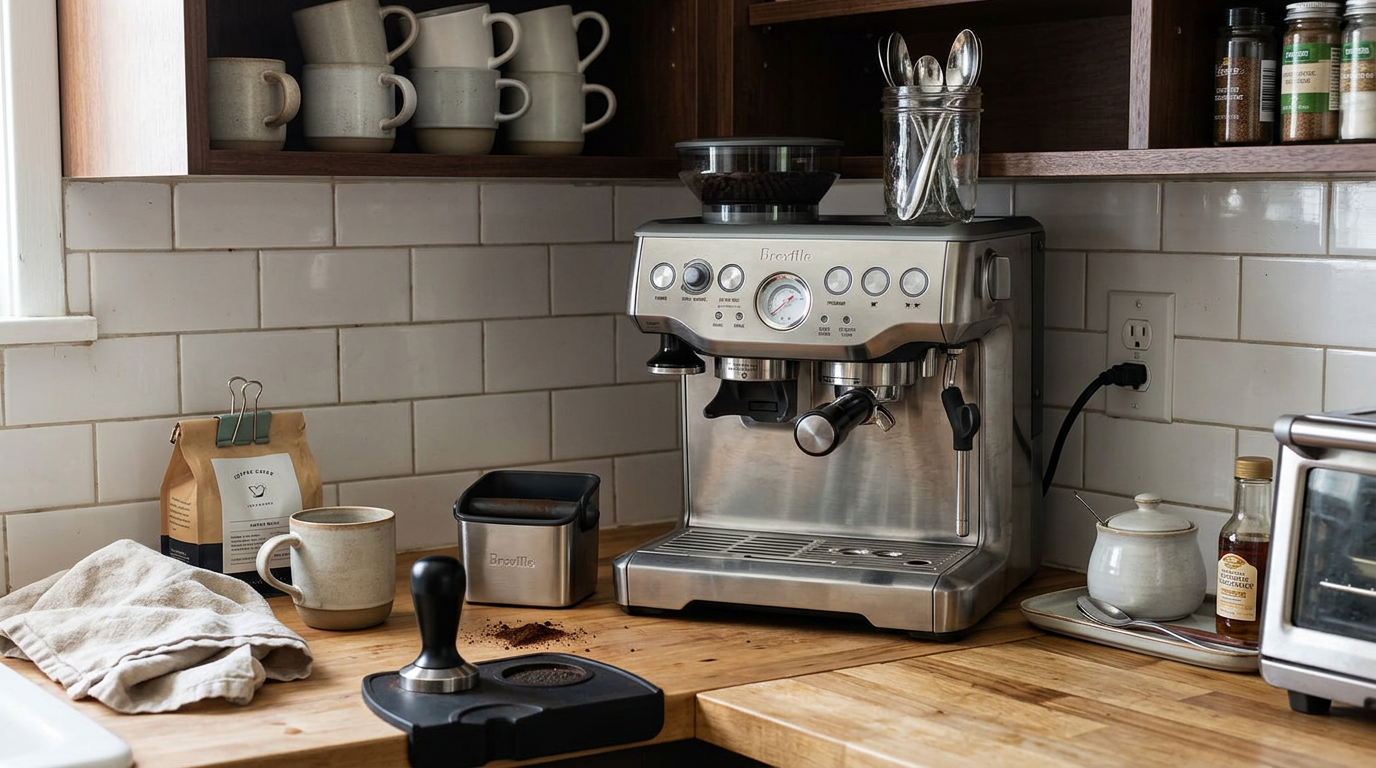
A dialed-in Express shot is every bit as good as the Impress; it just takes longer to get there.
| What you taste | Likely cause | First fix on either machine |
|---|---|---|
| Sour, thin, needle low | Under-extracted✕Under-extractionWhen water does not pull enough flavor out of the coffee. The shot tastes sour, thin and watery., grind too coarse | One step finer while grinding |
| Bitter, needle high, slow drip | Grind too fine | One step coarser |
| Sour on one side of the cup | Uneven tamp (Express) | Tamp level, or let the lever do it |
| First shot sharp | Cold group head | Blank shot, or wait 15 minutes |
| Pale crema | Stale beans | Use fresher beans |
Our tip: Program the two-cup button to your target yield on either machine, so the shot stops at the same point without you watching the scale.
See Today’s PriceFour-week shot logs
I logged every double espresso on both machines: dose, shot time and a quick taste note. The logs show exactly what the lever buys you.
On the Express, week one was messy. I was still moving the side dial, my tamping was uneven and the dose crept up and down as I adjusted the timer, so only about 45 percent of shots hit my 25-to-30-second window.
On the Impress, the meter showed high or low a few times in the first two days while it learned my beans. By day three, nearly every tamp landed in the green zone, and about 72 percent of week-one shots hit my window.
Share of shots in my target window, by week
From my shot logs on each machine with fresh medium-roast beans.
By week four, the gap had almost closed. So the honest summary is that the Impress does not make better espresso than a well-practiced Express; it gets a beginner there about three weeks sooner, and it keeps other people in the house consistent too.
Steam wand and milk drinks
Here the two machines are effectively identical. Both have a manual steam wand with a single-hole tip on a swivel joint, fed by the same thermocoil.
When you switch from brewing to steam, the heater needs about 15 to 20 seconds to ramp up. A small latte jug took about 45 seconds on both, and a big cappuccino jug for two took over a minute on the Impress.
That gentle steam is actually helpful while you learn. With the tip just under the surface and slightly off-center, the milk spins into a whirlpool that breaks big bubbles into silky microfoam✕MicrofoamMilk foam with bubbles so small you can barely see them. It feels silky and glossy, which is what latte art needs., and you have time to find the right position.
By week three on each machine, I could pour a heart most mornings and a simple rosetta on a good day.
Seconds to steam 6 oz of cold milk
Same single-hole tip and thermocoil, same result.
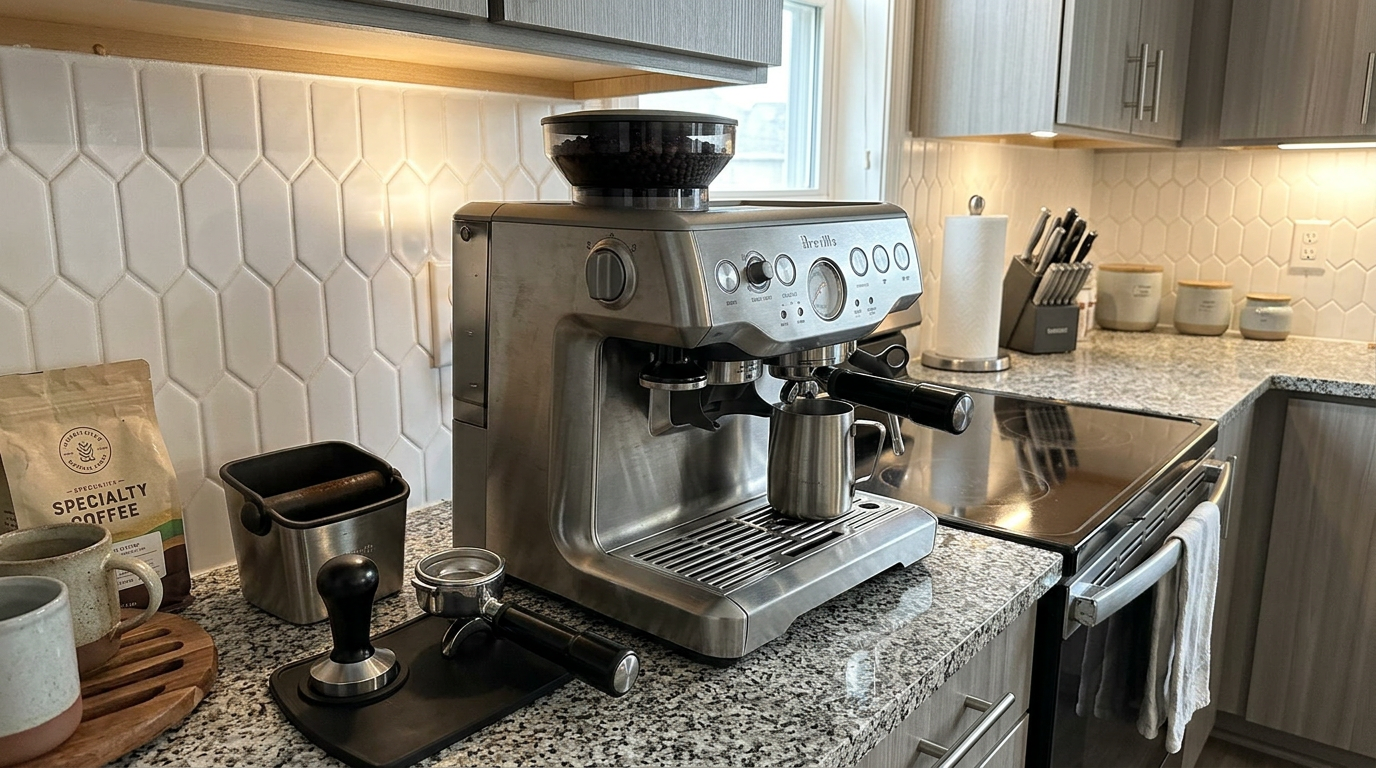
Both machines share the same gentle single-hole steam wand, good for learning latte art.
Neither machine can brew and steam at the same time. On both, I ground, tamped and pulled the shot first, then steamed, and the espresso was still fresh when the milk was ready.
| Drink | Espresso | Milk | Foam |
|---|---|---|---|
| Flat white | Slightly shorter double | About 5 oz | Thin and silky |
| Latte | Standard double | About 8 oz | Light |
| Cappuccino | Standard double | About 4 oz | Tall and airy |
| Cortado | Standard double | About 2 oz | Almost none |
Our tip: Use cold whole milk in a small jug filled to just below the spout, because it gives the gentle wand the most time to build microfoam.
Hot water and americanos
Both have a dedicated hot water outlet next to the steam wand, controlled by the same right-hand dial. That makes americanos✕AmericanoA shot of espresso topped up with hot water. The coffee is never over-extracted, unlike pushing a whole mug of water through the grounds. and tea easy.
For a smoother cup with better crema, I often made a long black: hot water first, then the shot on top. On the Impress, the outlet spat a little steam at the start, which could splash small cups, so I held the cup close.
| Drink | How I made it on both |
|---|---|
| Americano | Double shot, then 4–6 oz hot water |
| Long black | Hot water first, then the shot |
| Tea | Green and herbal, straight from the outlet |
| Cup warming | A splash of hot water, then discard |
Mess and cleaning
This is the Impress’s quiet second advantage. Because grinding and tamping happen inside an enclosed cradle, far fewer grounds end up on the counter, and one sweep with a damp cloth cleaned most of the body.
On the Express, some grounds sprayed onto the drip tray and counter while grinding and tamping, so a small brush lived next to it all month.
The rest of the routine is the same. After every shot, knock out the puck, rinse the basket and flush the group head. After every milk drink, wipe and purge the steam wand straight away.
When the machine prompts, backflush✕BackflushingRunning water backwards through the brew valve with a rubber disc and a cleaning tablet. It dissolves coffee oils that build up inside. with the rubber disc and a tablet, and descale with the included powder when it is time.
My hands-on cleaning time per day
My estimate, not counting automatic purges.
| When | Barista Express | Express Impress |
|---|---|---|
| After milk drinks | Wipe and purge the wand | Wipe and purge the wand |
| After each shot | Knock out, rinse, flush | Knock out, rinse, flush |
| Daily | Empty tray, brush counter | Empty the drip tray |
| Weekly | Brush gasket and grinder chute | Brush tamper face and cradle |
| When prompted | Backflush with a tablet | Backflush with a tablet |
| Every 2–3 months | Replace the water filter | Replace the water filter |
Our tip: Brush the Impress tamper face once a week, because a thin layer of stuck coffee can stop it sitting perfectly flat on the puck.
Daily use and quirks
My Express routine took four to five minutes for a latte: switch on, heat, blank shot, grind, weigh, tamp, trim, brew, steam and wipe. On the Impress, I skipped weighing and trimming, and it dropped to about three and a half to four minutes.
The bigger difference was who could use it. On the Express, I ended up making everyone’s coffee, because tamping was the step people found intimidating. On the Impress, others pulled their own shots and only needed a short demonstration for steaming.
Minutes from switch-on to a latte
Average across my weekday mornings.
Both machines share one real flaw: no low-water sensor. If the tank runs dry during a shot, the pump keeps going, the pitch changes and the shot is ruined. The 67-ounce tank lasted two people about two days on each, so I learned to check it every morning.
Noise was similar, with the Impress grinder humming slightly lower. Neither will surprise anyone used to espresso machines, but both can wake a light sleeper in an open-plan home.
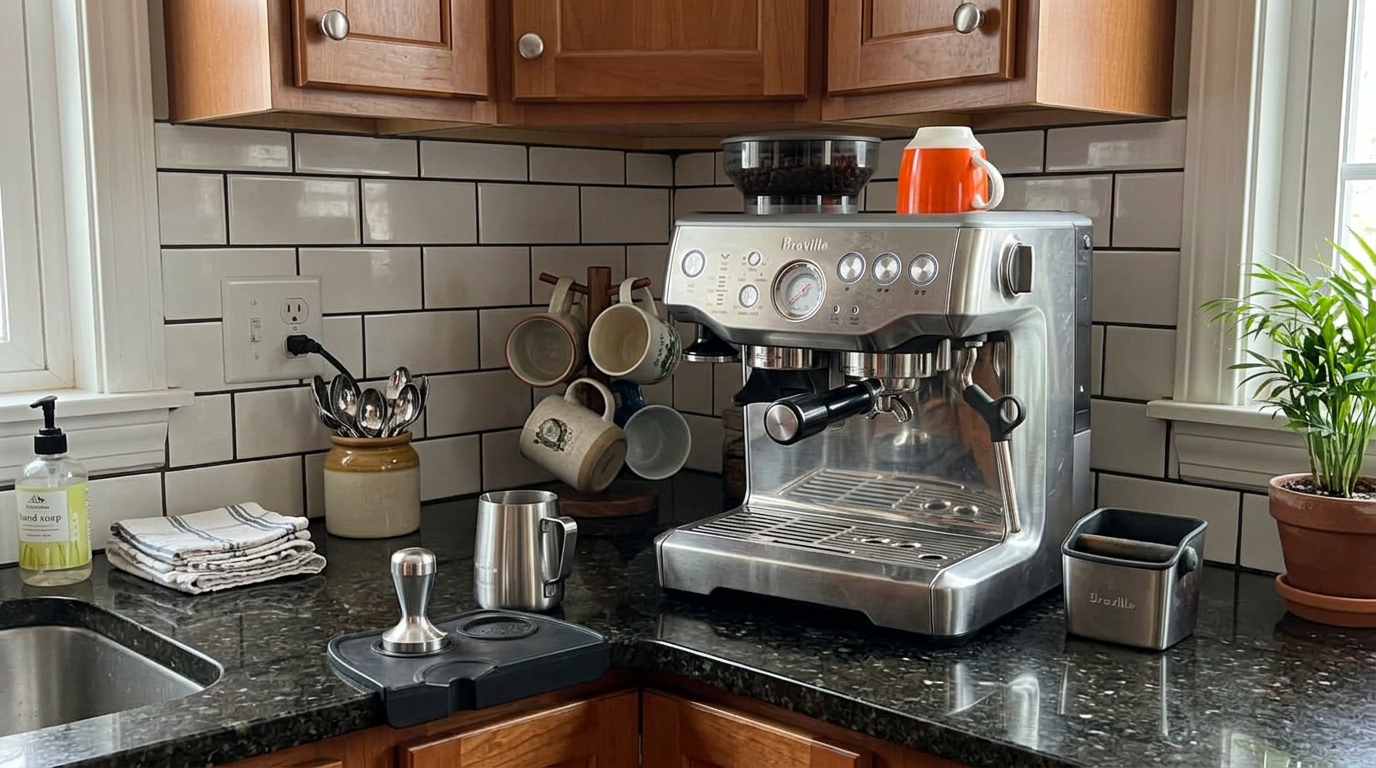
With the lever doing the tamping, other people in the house happily made their own coffee.
| Quirk | Barista Express | Express Impress |
|---|---|---|
| No low-water sensor | Yes, check the tank | Yes, check the tank |
| Inner burr needs moving | 6 to 2 | 5 to about 3 |
| Cannot stir before tamping | No, you can | Yes |
| Fixed auto-off | No | 30 minutes |
| Hot water spits at the start | A little | A little |
Beans and water
Both machines reward fresh beans more than almost anything else. Coffee roasted within the last two to four weeks gave the best crema and the most even flow, and on the Impress fresh beans also made the dose meter more reliable, because very old beans compress differently.
Medium and medium-dark roasts were easiest on both. Light roasts needed a finer grind and a higher temperature, which is a two-button job on the Impress and a manual lookup on the Express.
Use the included carbon filter or filtered water, and skip pure distilled water, because coffee needs some minerals to taste full. Research at the University of Oregon found that uneven extraction can waste up to 40% of the coffee in a puck, which is exactly what an even, level tamp helps prevent.
| Bean type | Barista Express | Express Impress |
|---|---|---|
| Medium-dark blend | Rich body, a step coarser | 92°C, slightly coarser |
| Medium roast | Side dial 6–8 | 93°C, middle of the wheel |
| Light roast | Finer, raise temperature by combo | 95°C, finer |
| Dark roast | Coarser | 91°C, coarser |
| Very dark, oily | Avoid | Avoid |
Our tip: Buy beans in bags you can finish in two to three weeks, so the grind setting and dose stay stable to the last cup.
Find Out the Price TodayReal-life scenarios
Specs only go so far. These are the situations where one machine clearly pulled ahead during my eight weeks of testing.
About 72% of my week-one shots hit the target, against about 45% on the hand-tamped Express.
The dose meter corrected whoever used it last, so nobody needed a lesson in tamping.
You can stir, level and tamp exactly how you like. The Impress tamps in a closed cradle.
The enclosed cradle kept almost every ground off the counter.
Same gentle single-hole wand on both; a big jug took over a minute either way.
The lower entry point, and by week four my shots were nearly as consistent.
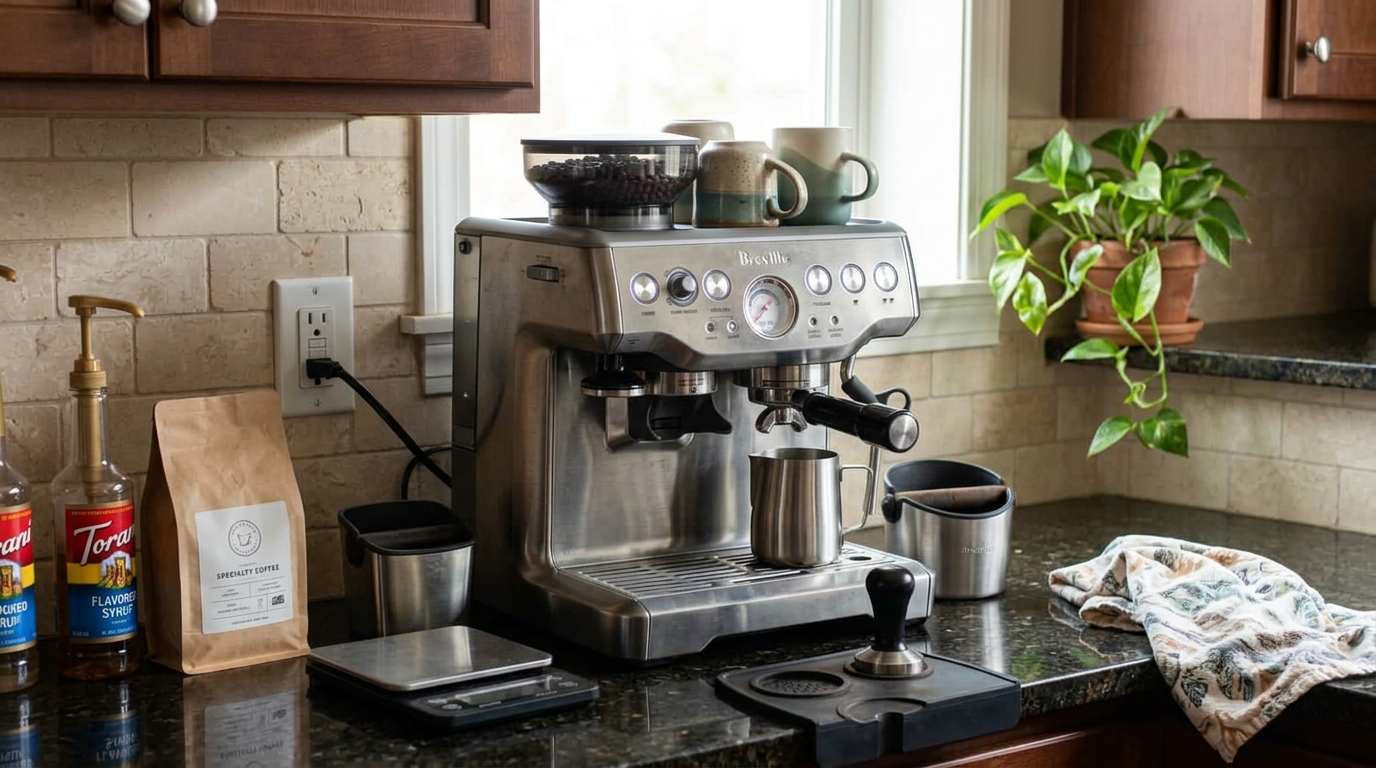
On the Express, a scale and a steady tamp do the job the Impress lever does for you.
My scorecard
These are my own scores out of 10. The first four come from my single reviews of each machine, and I added consistency for beginners and puck-prep control because they decide this matchup.
Breville Barista Express
Breville Barista Express Impress
Overall, I rate the Express 8.0 and the Impress 8.3. The Impress earns its extra points almost entirely in the first few weeks and in shared households; for an experienced, patient owner, the gap is small.
See How Much You’ll SaveWhich one is right for you?
4 quick questionsWhich one should you buy?
It comes down to one question: is tamping something you want to learn, or something you want gone? Answer that honestly and the choice is easy.
For more detail, read my Barista Express review and Barista Express Impress review, or see how the Express compares with the faster Barista Pro.
For beginners and shared kitchens, the Impress lever earns its place.
- You want to learn tamping properly
- You like to stir and level the grounds
- You want the lower entry point
- You already own a scale
- Several people will pull shots
- You hate a messy counter
- You want consistent shots from day one
- Tamping by hand puts you off
- Others in your house will use it
- You want a clean counter
- You want five easy temperature settings
- You love stirring and puck prep
- You need fast steam for many lattes
- You want a low-water warning
For most first-time buyers, my pick is the Breville Barista Express Impress. The lever and dose meter remove the hardest part of espresso, my shots were consistent from week one, and the counter stayed clean. Check the tank each morning and run a blank shot, and it is a very easy machine to live with.
The Breville Barista Express is the smarter buy if you want to learn the craft by hand or keep more money in your pocket. By week four, my Express shots were nearly as consistent, and it gives you more control over puck prep than the Impress ever will.
Whichever you choose, move the inner burr on day one, buy fresh whole beans and keep the steam wand clean. Both machines reward a little care with years of café-quality espresso.
Barista Express vs Express Impress specifications
From manufacturer specifications and my own testing.
| Barista Express | Express Impress | |
|---|---|---|
| Model | Breville BES870XL | Breville BES876BSS |
| Type | Semi-automatic with grinder | Semi-automatic with grinder and assisted tamping |
| Heating | 1600 W thermocoil, PID | Thermocoil, PID, five settings |
| Pump | 15 bar | 15 bar |
| Tamping | Manual, magnetic tamper | Impress lever, about 22 lb, polishing twist |
| Dosing | Timed dial | Timed with automatic correction |
| Grinder | Conical burrs, 16 settings plus inner burr | Conical burrs, 25 settings plus inner burr |
| Dose range | About 15.4 g (my dose) | About 14–18 g |
| Portafilter | 54 mm | 54 mm |
| Gauge | Analog pressure gauge | Analog pressure gauge |
| Steam | Manual wand, single hole | Manual wand, single hole, 360° swivel |
| Water tank | 67 oz, no level sensor | 67 oz, no level sensor |
| Dimensions (W x D x H) | 12.5 x 13.8 x 15.9 in | 12.9 x 14.9 x 16.1 in |
| Weight | About 22–23 lb | About 22–23 lb |
| Warranty (US) | 1 year limited | 2 years limited |
How I tested and compared them
I used each machine as my only espresso machine for four weeks, making espresso, americanos, long blacks, flat whites, lattes and cappuccinos. Testing notes were written up together by Michael Reynolds and the HouseholdMe team.
I moved both inner burrs, mapped both grind dials, logged dose, shot time and taste for every double, recorded every Impress dose-meter result and tested all five Impress temperatures with light, medium and dark roasts.
I followed every cleaning and backflush routine, timed steaming with a stopwatch, then checked my notes against Breville’s specifications and owner documentation.
- Coffee: dose, crema, body, flavor and consistency.
- Milk: foam texture, temperature, speed and drink range.
- Workflow: heat-up, controls, guidance and daily routine.
- Ownership: cleaning, water care, noise and footprint.
Barista Express vs Express Impress FAQ
Is the Barista Express Impress worth it over the Barista Express?
For most beginners, yes. The Impress lever tamps with constant pressure and the dose meter corrects the next grind, so about 72% of my week-one shots hit the target, against about 45% on the Express. If you enjoy hand tamping or want the lower entry point, the Express is still excellent.
What is the difference between the Barista Express and Express Impress?
The Impress adds a lever that tamps for you with about 22 lb of force, a dose meter that auto-corrects the grind, 25 grind settings instead of 16, five easy temperature settings and a two-year warranty. The gauge, steam wand, tank and portafilter are the same.
Does the Express Impress make better espresso?
Not once both are dialed in. By week four my logs were close, about 94% vs 90% of shots on target. The Impress gets you there faster and more consistently.
Can you stir the grounds on the Express Impress?
No. Tamping happens in the cradle, so you cannot remove the portafilter to stir first. In my testing, the grounds dropped evenly enough that it rarely mattered.
Do both need the inner burr adjusted?
In my testing, yes. The Express came set to 6 and I moved it to 2; the Impress came set to 5 and I moved it to about 3.
Do they have the same steam wand?
Yes. Both have a manual single-hole steam wand that took about 45 seconds for a small latte jug.
Does either have a low-water warning?
No. Neither has a level sensor, so check the 67-ounce tank before you brew.
Which one makes less mess?
The Express Impress. Grinding and tamping happen inside an enclosed cradle, so far fewer grounds reach the counter.
Can I change the Impress auto-off time?
No. It switches off after 30 minutes of inactivity, and there is no setting to extend it.
Which has the longer warranty?
In the US, the Express Impress has a two-year limited warranty and the Barista Express has one year.

- Our hands-on Breville Barista Express review
- Our hands-on Breville Barista Express Impress review
- Breville product specifications and owner documentation
- The perfect shot of espresso every time with chemistry, University of Oregon research
- General espresso brewing, milk steaming and maintenance guidance