Light vs Dark Roast Caffeine: Which Has More, and Is Espresso Really Stronger?
Ask ten coffee drinkers which has more caffeine, light or dark roast, and you'll get confident answers in both directions. The truth is that roasting barely changes the caffeine in a bean. What changes is how much a bean weighs, and that turns the whole question into one about how you measure. Here is how it really works, with worked examples, plus the espresso-versus-drip question.
We choose products independently. When you buy through links on HouseholdMe we may earn a commission, at no extra cost to you. Affiliate policy
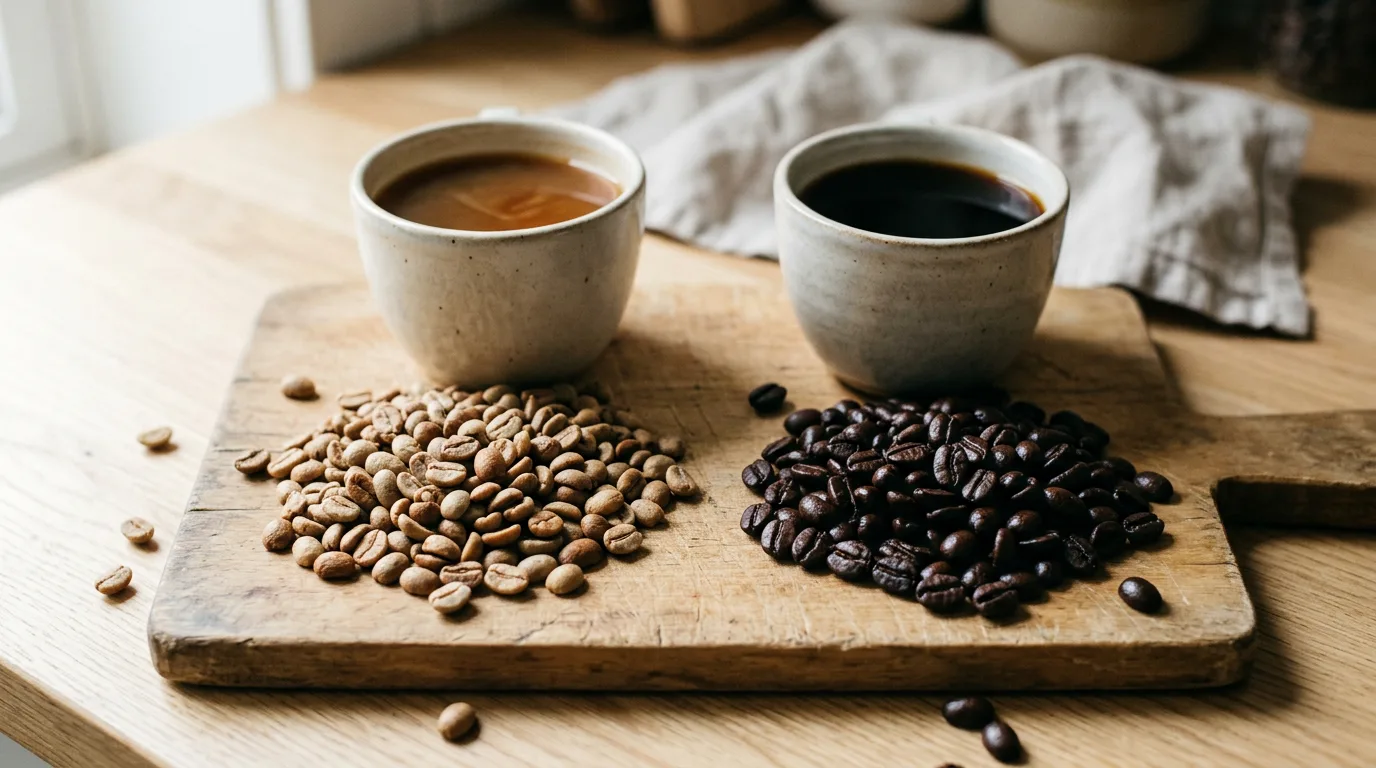
Roasting barely changes how much caffeine is in a coffee bean, so light and dark roasts have almost the same caffeine per bean. But dark beans lose more water and weigh less, so if you weigh your coffee, a dark roast can give you slightly more caffeine because more beans fit into the same weight. If you use a scoop, the difference mostly disappears. Much bigger factors are the species (Robusta has roughly twice the caffeine of Arabica) and how much coffee you use. Espresso is more concentrated, but a big mug of drip coffee often contains as much or more caffeine in total.
Why I wrote this
I've heard both versions of this myth for years. "Get the dark roast, it's stronger." And then: "Actually, light roast has more caffeine, because roasting burns it off."
Both sound convincing. Both are mostly wrong, or at least far too simple.
Because I weigh every dose when I test grinders and espresso machines, I've had plenty of chances to think about this properly. The answer comes down to a few simple ideas: what roasting does to a bean, how you measure your coffee, which species you buy and how much you use.
It matters more than it might seem. People choose a dark roast in the evening thinking it's gentler, or order a "strong" espresso before a long drive expecting a bigger kick than a mug of filter coffee. Sometimes they get the opposite of what they wanted.
Coffee shops don't always help. Menus describe drinks as bold, intense or smooth, which are flavor words, while customers hear them as caffeine words.
Once you see those pieces, you can work out the caffeine in almost any cup for yourself. It's also useful if you're trying to cut back, or need to know what you're serving to a caffeine-sensitive guest.
Three different ways to count caffeine
Most of the confusion comes from mixing up three different measurements:
Espresso wins on caffeine per ounce. A big mug of drip coffee often wins on caffeine per serving. And light and dark roasts are almost tied on caffeine per bean.
Keep those three apart, and most of the myths fall away. The caffeine in your cup depends far more on how much coffee you use, and what kind, than on the color of the roast or how strong it tastes.
Where the myths come from
It's easy to see why people believe dark roast is stronger. It looks darker, smells smokier and tastes more intense. Our brains naturally link "bold" with "powerful."
For decades, dark roasts were also marketed with words like "bold," "intense" and "extra strong," which sounded like statements about caffeine even when they were really about flavor. Many diner and office coffees were dark, bitter and served in big mugs, so people associated that taste with a big caffeine hit.
The opposite myth, that light roast has more caffeine, gained ground more recently, as specialty coffee shops pointed out that roasting changes beans. The kernel of truth is that roasting does change the bean, but it changes its weight and flavor far more than its caffeine.
There's also a measurement trap. If you scoop a light roast and a dark roast, then weigh them, the light scoop is heavier. That can make people think the light roast "has more coffee in it," which is true by weight but not by bean count.
Both myths contain a sliver of truth. Neither is the full story.
Does roasting reduce caffeine?
Very little. Green coffee beans contain caffeine before roasting, and most of it is still there afterwards.
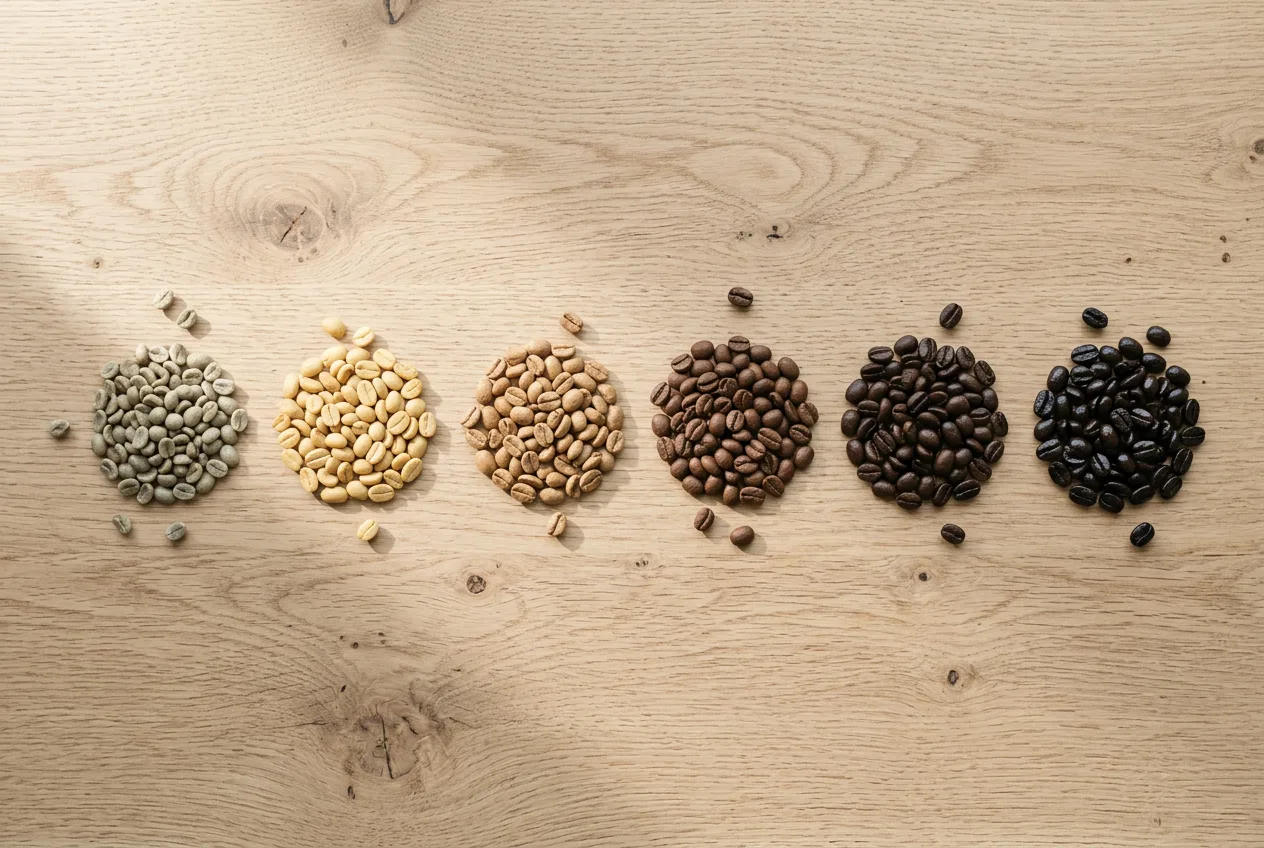
The idea that a dark roast "burns off" a lot of caffeine is one of the most widespread coffee misconceptions. Caffeine is a stable molecule, and normal roasting temperatures don't destroy much of it.
What roasting does change is everything else about the bean: its structure, moisture, density, size and flavor.
As beans roast longer, they lose water, expand and become more porous. Their inner cell structure breaks down. As a result, each bean gets lighter the darker it's roasted, even though it ends up physically a bit bigger.
| Property | Light roast | Dark roast |
|---|---|---|
| Caffeine per bean | About the same | About the same |
| Weight per bean | Heavier | Lighter |
| Size | Slightly smaller | Slightly larger, puffier |
| Density | Denser | Less dense |
| Moisture | More retained | More lost |
That weight difference is the whole key. The caffeine per bean stays about the same while the bean itself gets lighter. I go deeper into what happens in the roaster in how coffee is roasted.
Why dark roast can have more caffeine by weight
If each bean keeps roughly the same caffeine but dark beans weigh less, something interesting happens when you weigh your coffee.
To reach the same weight, you need more dark-roasted beans than light-roasted ones. More beans means more caffeine.
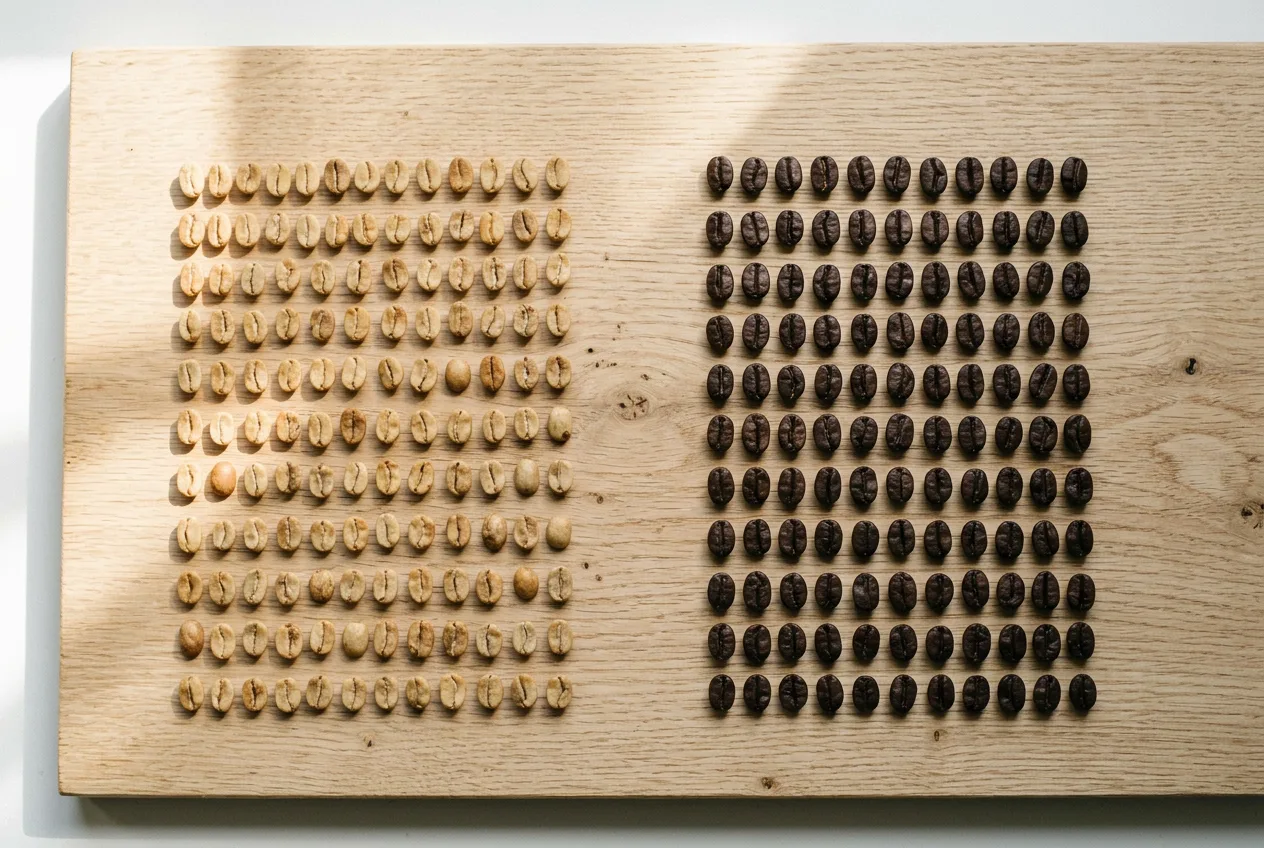
Here's an illustration using the same original coffee roasted three ways, with 10 grams (about 0.35 ounces) of each:
| Roast | Beans in 10 g (0.35 oz) | Relative caffeine |
|---|---|---|
| Light roast | About 55 | Baseline |
| Medium roast | About 60 | About 9% more |
| Dark roast | About 65–70 | About 18–27% more |
These numbers are illustrative, not universal. Real bean counts depend on bean size, variety, origin, processing and how each coffee is roasted. The relative caffeine column simply assumes each bean holds the same caffeine.
In practice the gap is usually smaller than the bean count suggests, because a little caffeine is lost in very dark roasts and beans vary. So the honest conclusion is that a dark roast may give slightly more caffeine than a light roast of the same coffee when both are weighed.
It's a modest difference, not a dramatic one. A dark roast doesn't become a high-caffeine coffee just because a few more beans fit into the same weight.
What changes when you use a scoop
Many people don't weigh their coffee. They use a scoop. And a scoop measures volume, not weight.
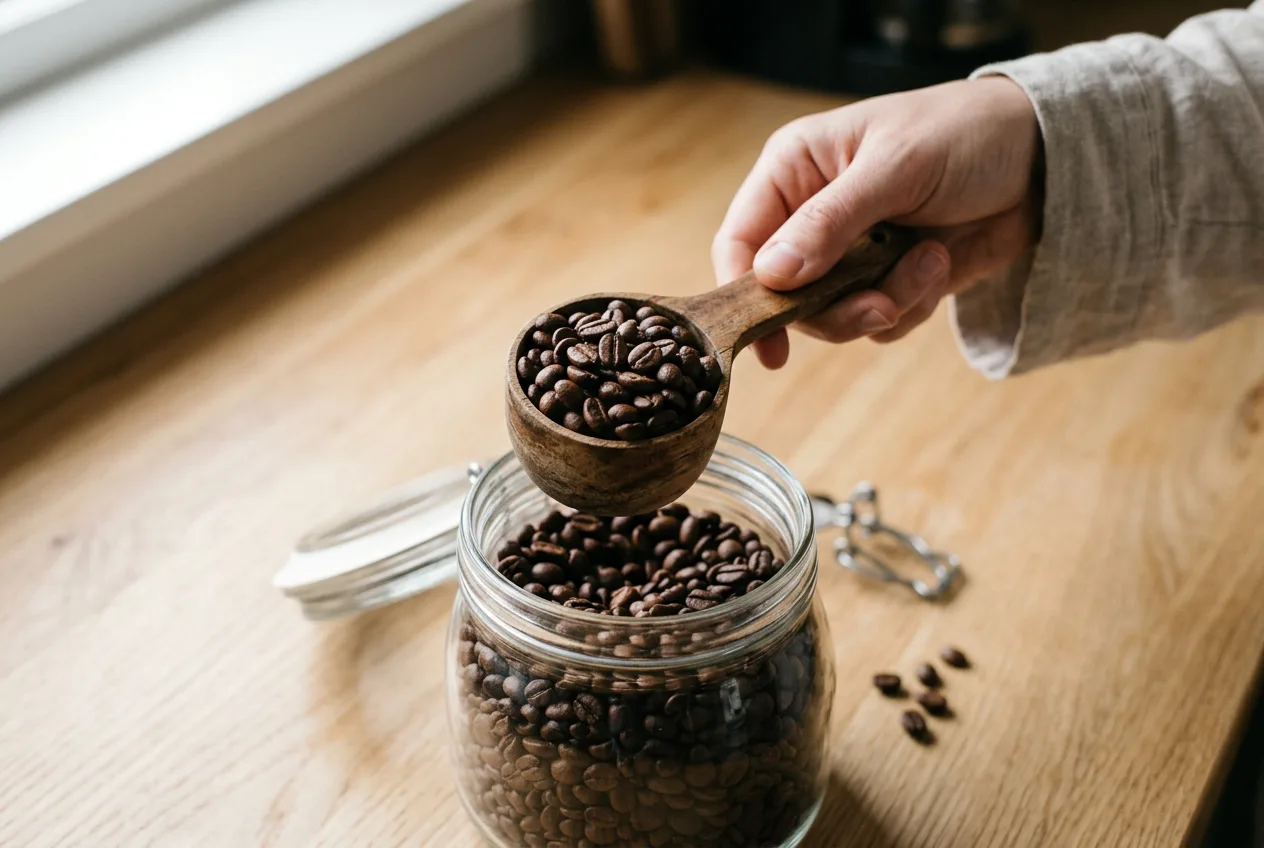
Because dark beans are puffier and less dense, a scoop of dark roast weighs less than a scoop of light roast. Similarly sized beans fill the scoop in similar numbers, whatever the roast.
If roughly the same number of beans fits in each scoop, and each bean has about the same caffeine, then a scoop of light and a scoop of dark contain roughly similar caffeine.
Scoops also vary a lot between brands and households. A "tablespoon" of coffee can mean anything from 5 to 10 grams depending on the scoop, the bean size and whether it's level or heaped. That variation alone can easily outweigh any roast difference.
So the "which has more caffeine" debate depends partly on how you measure. People who weigh and people who scoop can both be right about their own kitchens.
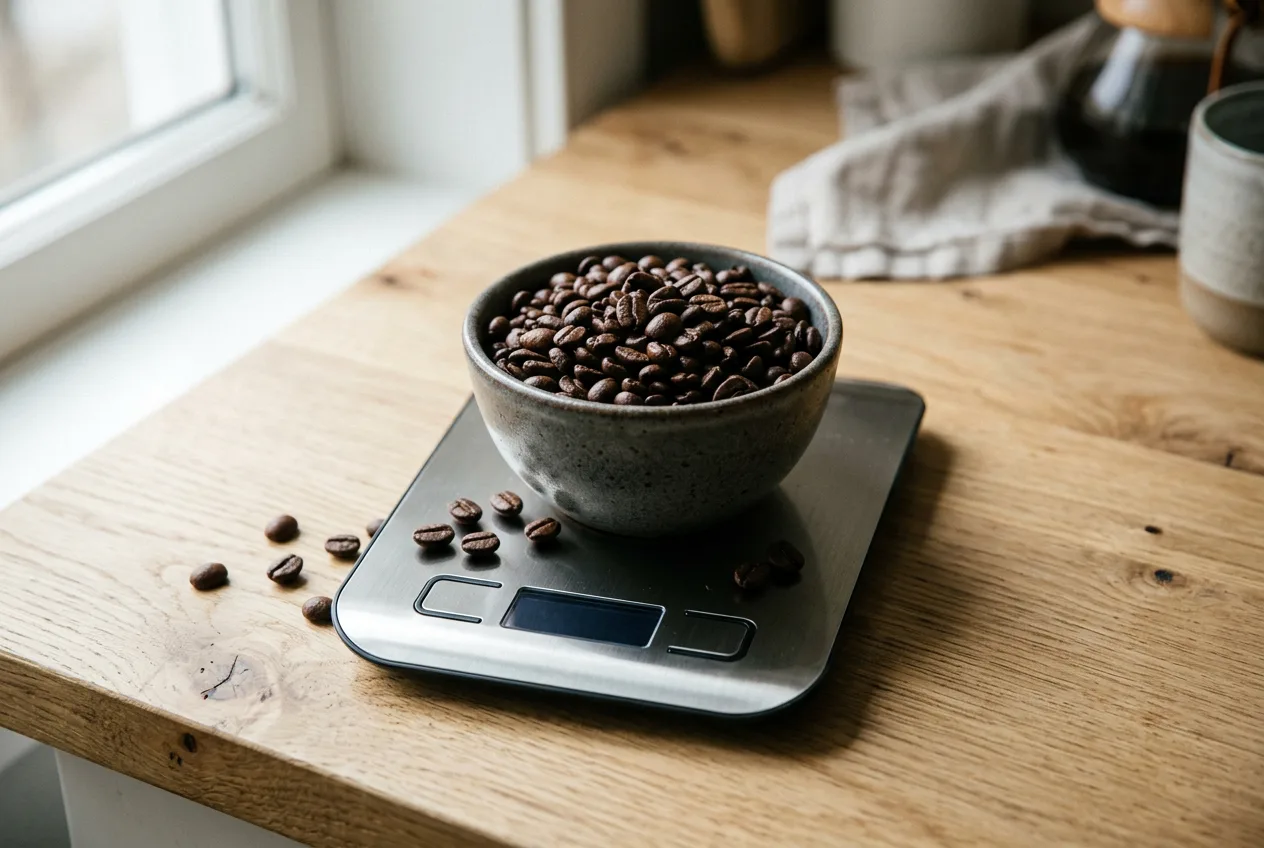
Our tip: For consistent coffee and predictable caffeine, weigh your coffee. A cheap kitchen scale removes the guesswork that scoops introduce, especially when you switch between roasts.
How much caffeine is in one bean?
It helps to put a rough number on a single bean. A typical roasted Arabica bean weighs somewhere around an eighth to a sixth of a gram, and Arabica is roughly 1.2 to 1.5 percent caffeine.
That works out to very roughly 1.5 to 2.5 milligrams of caffeine per Arabica bean. Robusta beans tend to be a little smaller but nearly twice as rich in caffeine, so each one can carry a bit more.
With those numbers, the light-versus-dark difference becomes easy to picture. Ten extra dark beans in a dose adds something like 15 to 25 milligrams of caffeine. That's real, but it's less than the difference between a small and a medium cup, or between an Arabica and a Robusta-heavy blend.
These are back-of-the-envelope figures, not lab measurements. Bean size and caffeine content vary a lot by variety and origin. But they show why dose and species dominate the caffeine question.
Does grind size change caffeine?
Grind size changes how quickly coffee extracts. Finer grinds expose more surface area, so compounds dissolve faster.
Because caffeine dissolves easily and early, grind size has a smaller effect on caffeine than on flavor. A coarse French press grind steeped for four minutes still pulls out most of the available caffeine. A very coarse grind in a quick brew might leave a bit more behind.
So grind is mainly a flavor tool. Too coarse and your coffee tastes sour and thin; too fine and it turns bitter and harsh. Caffeine follows dose much more closely than grind.
Why comparing different coffees is harder
Everything above compares the same coffee roasted to different levels. Comparing two completely different coffees is a different story.
Even at the same roast level, two coffees can have very different caffeine content because of:
- Species. Arabica and Robusta naturally differ a lot. Robusta has considerably more caffeine.
- Variety. Different varieties within the same species have different natural caffeine levels.
- Growing conditions. Climate, altitude, soil and farming practices affect the bean.
- Origin. Different regions produce beans with different genetics and environments.
- Processing. Washed, natural and honey processing change the bean's chemistry somewhat, though species and dose matter more for caffeine.
- Bean size and density. These change how many beans are in a given weight or volume.
- Roast profile. Different roasting curves change moisture, density and structure.
So you can't tell the caffeine content of two coffees just by looking at their color or reading "light" or "dark" on the bag.
A dark-roasted Arabica can easily have less caffeine than a light-roasted Robusta, even though the dark roast might pack slightly more beans per ounce. The type of bean matters far more than the roast.
Arabica vs Robusta: the biggest caffeine factor
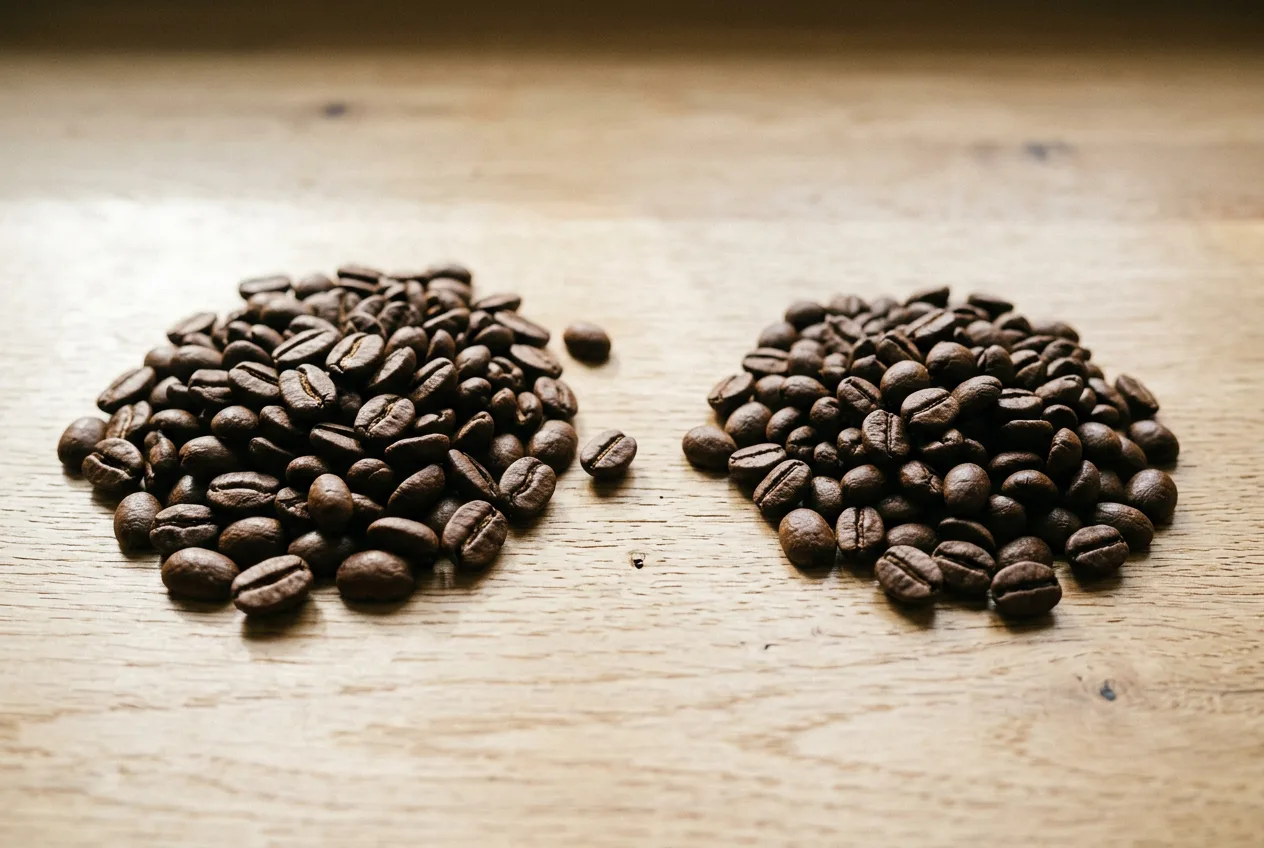
If you really want to know whether a coffee is high or low in caffeine, check the species before the roast.
| Species | Typical caffeine (by bean weight) | Where you find it |
|---|---|---|
| Arabica | About 1.2–1.5% | Most specialty and many supermarket coffees |
| Robusta | About 2.2–2.7% | Instant coffee, many espresso blends, budget ground coffee |
That's roughly double. A blend with a lot of Robusta will usually out-caffeinate an all-Arabica coffee whatever the roast. I compare the two species in detail in Arabica vs Robusta.
How caffeine gets into your cup
The next piece of the puzzle is extraction: how compounds move from the ground coffee into the water.
When water meets ground coffee, it dissolves caffeine, acids, sugars, aromatic compounds and much more. Together these make up the flavor and character of your drink.
Caffeine dissolves easily and comes out relatively early in brewing. That means a large share of the available caffeine ends up in the cup even when the overall extraction isn't very efficient.
In practice, that makes caffeine comparisons between brewing methods easier than comparing every flavor compound. A badly extracted cup can taste weak, sour or unbalanced and still contain a good amount of caffeine.
It's also why strength, flavor intensity and caffeine aren't the same thing. A bitter or strong-tasting coffee isn't automatically higher in caffeine. A smooth, mild one isn't necessarily lower.
Water temperature plays a part too. Hotter water extracts caffeine faster, which is why a hot brew reaches its caffeine level quickly while cold brew needs many hours. Contact time matters for the same reason: a four-minute French press or a three-minute pour-over gives water plenty of time to pick up most of the caffeine, while a 25-second espresso relies on fine grinding and pressure to do it quickly.
The amount of coffee you use is the most useful starting point for estimating the caffeine in any drink. If you want to understand extraction in more depth, see coffee extraction explained.
Espresso vs pour-over: same coffee, same dose
One of the most common caffeine questions is whether espresso has more than regular coffee.
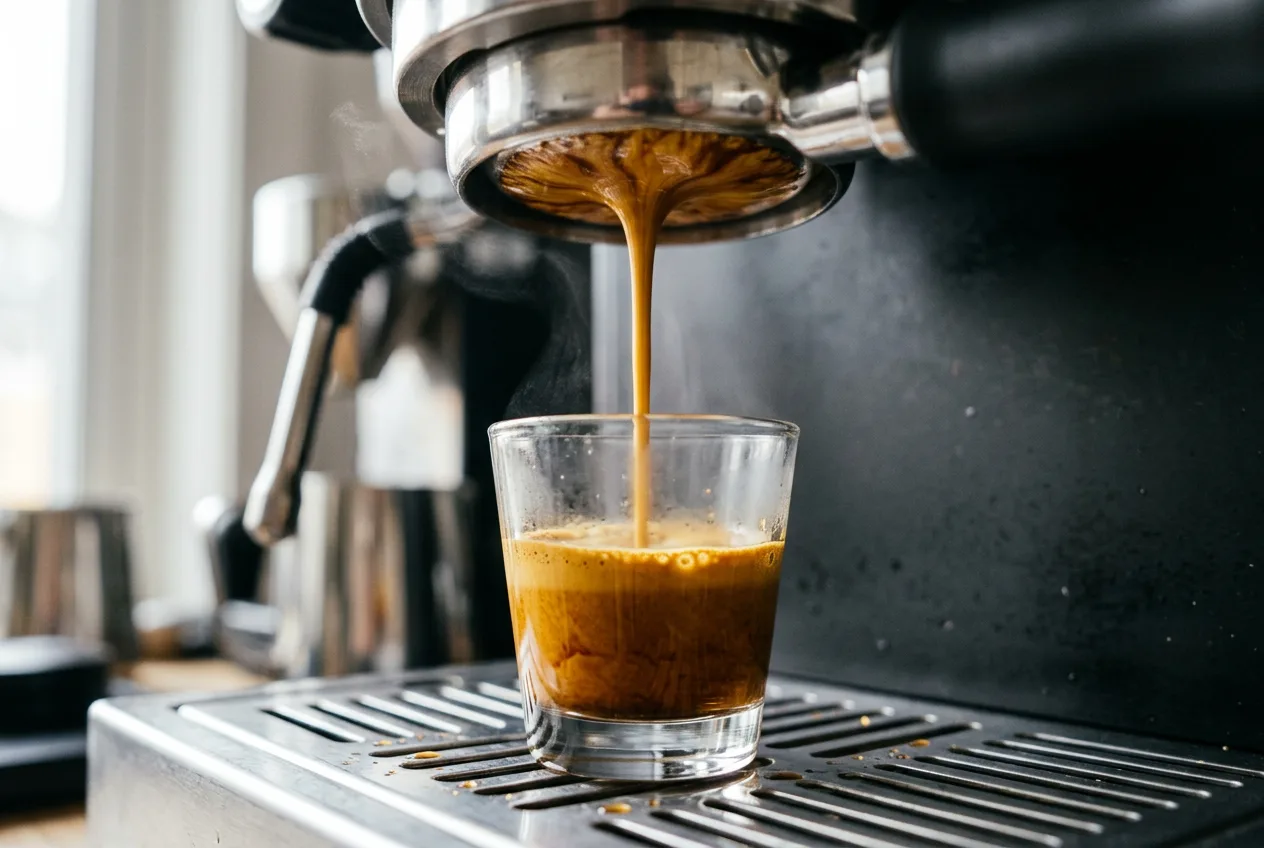
Espresso forces hot water through finely ground coffee under high pressure. Pour-over uses gravity to pass hot water through a bed of grounds, making a larger drink over a longer time.
The methods are very different, but the caffeine depends mostly on how much coffee goes in, and what kind.
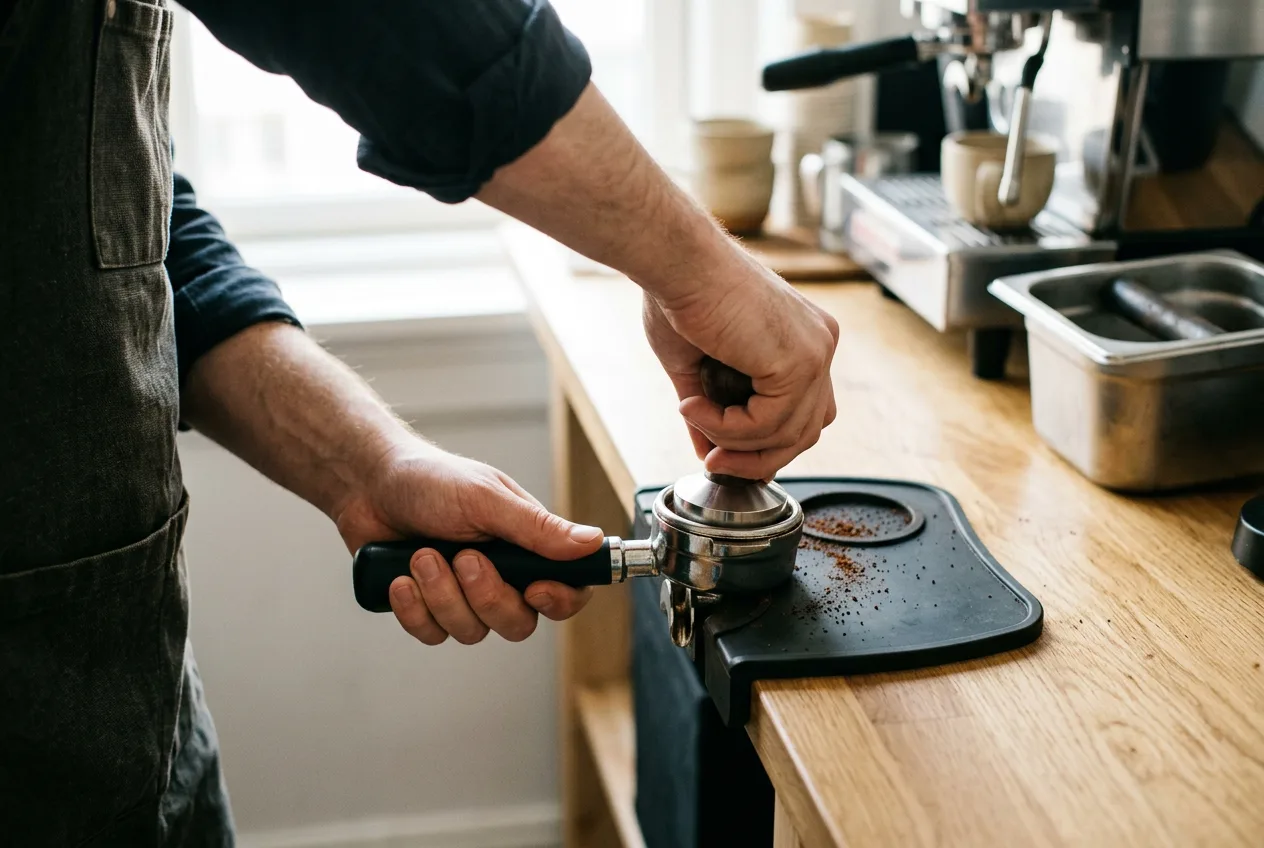
Imagine a café using the same medium roast for both. The espresso uses 18 grams (0.63 oz) of coffee. The pour-over also uses 18 grams.
Both start with roughly the same number of beans. Same beans, same roast, so the total available caffeine is broadly similar, assuming both extract well.
The drinks will be completely different in volume, concentration and flavor. But the total caffeine may be surprisingly close.
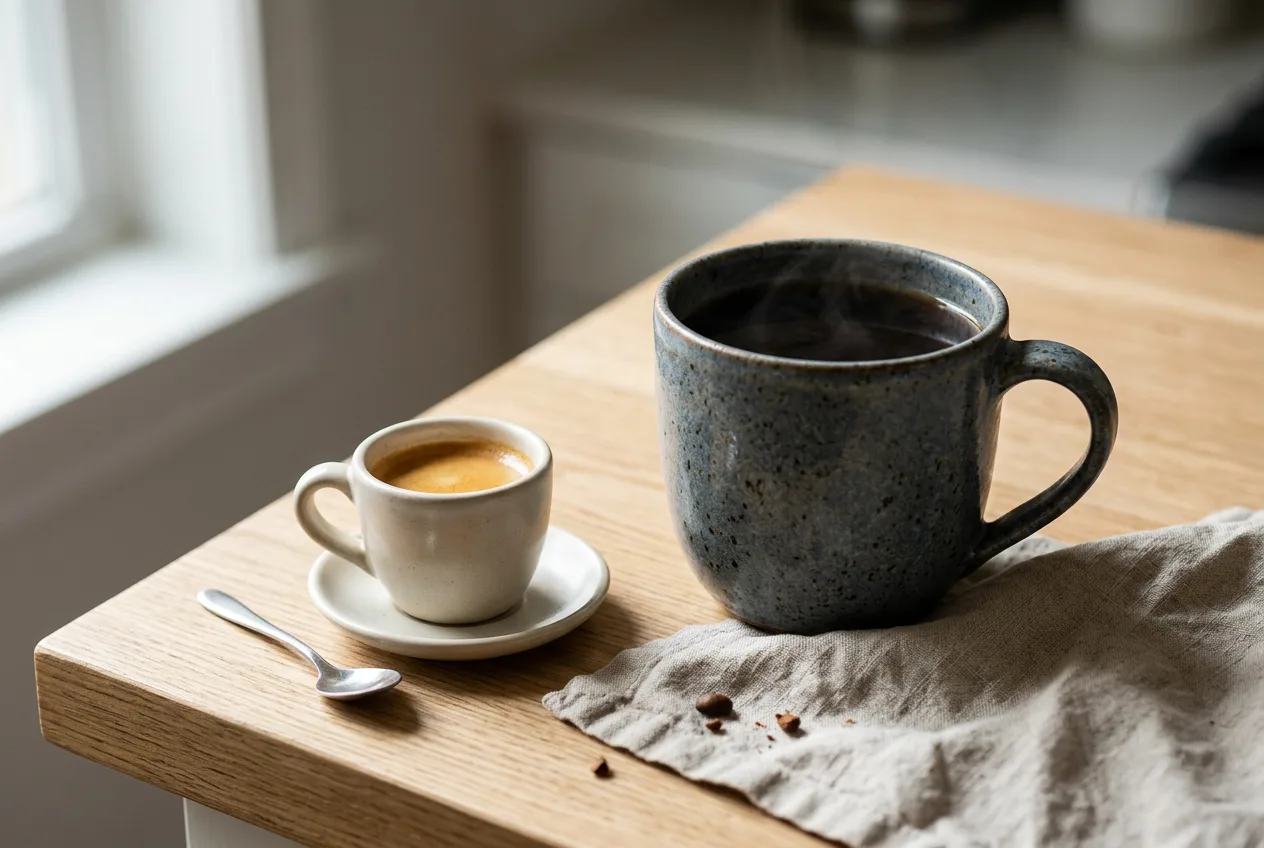
Espresso is more concentrated because very little water is used. The pour-over has much more water, so it's larger and less concentrated. But concentration isn't the same as total caffeine.
When espresso does have more caffeine
Espresso can contain more caffeine when it simply uses more coffee.
| Scenario | Espresso dose | Pour-over dose | Likely result |
|---|---|---|---|
| Same dose, same coffee | 18 g (0.63 oz) | 18 g (0.63 oz) | Broadly similar caffeine |
| Bigger espresso dose | 22 g (0.78 oz) | 18 g (0.63 oz) | Espresso has more |
With a 22-gram espresso dose, there are more beans and more caffeine available. Assuming similar beans and extraction, that espresso should contain more total caffeine than the 18-gram pour-over.
So it's wrong to assume espresso always has more caffeine because it tastes stronger. The amount of coffee used is a better guide than the brewing method.
Per fluid ounce, though, espresso is far more concentrated than drip coffee, even when the whole serving contains less caffeine. A single ounce of espresso can hold as much caffeine as a full small cup of drip.
Ristretto, espresso and lungo: does shot length matter?
Espresso shots come in different lengths. A ristretto uses less water, a lungo uses more, and a normale sits in between. People often assume the short, intense ristretto has the most caffeine.
In fact, with the same dose of coffee, a lungo usually extracts a little more caffeine, simply because more water passes through the grounds for longer. The ristretto stops early and leaves some caffeine behind. The differences are modest, but they run the opposite way to what the taste suggests.
So a ristretto is the most concentrated per sip, and a lungo carries slightly more total caffeine. If that sounds familiar, it's the same concentration-versus-total distinction again. I explain the three shots in ristretto vs espresso vs lungo.
Light-roast pour-over vs dark-roast espresso
Now let's mix roast and method, which is what you often find in a real café: light roast on the pour-over bar, darker roast in the espresso hopper.
Say both drinks use 18 grams. Because dark beans weigh less, 18 grams of dark roast contains more beans than 18 grams of light roast.
If both coffees came from the same original beans, the dark-roast espresso may contain slightly more caffeine.
That gap grows if the espresso dose is heavier. An espresso made with 20 or 22 grams of dark roast would generally contain more caffeine than an 18-gram light-roast pour-over of the same coffee.
But don't exaggerate it. The extra beans may only number a handful, and the caffeine difference could be too small for most people to notice. The reasonable conclusion is that the dark espresso probably has somewhat more caffeine in this case, with the exact amount depending on the coffee and the recipe.
What if the pour-over uses more coffee?
Here's an interesting twist. Suppose the light-roast pour-over uses more coffee than the dark-roast espresso:
- Light-roast pour-over: 22 grams (0.78 oz)
- Dark-roast espresso: 18 grams (0.63 oz)
The light roast has fewer beans per gram, but the pour-over uses more grams. The dark roast has more beans per gram, but a smaller dose.
Those two effects pull in opposite directions. Extra weight boosts the light roast's bean count; the smaller dose shrinks the dark roast's. The result: the two drinks may contain quite similar amounts of caffeine.
This is the clearest example of why you can't judge caffeine from roast level or brewing method alone. You need to consider the type of coffee, the roast and the total dose together.
Caffeine by drink: typical ranges
Putting it all together, these are typical caffeine ranges for common drinks. Real numbers vary widely with beans, dose and cup size.
| Drink | Typical coffee dose | Typical caffeine |
|---|---|---|
| Single espresso (1 oz) | 7–10 g | 60–75 mg |
| Double espresso (2 oz) | 16–20 g | 120–150 mg |
| Pour-over, 10 oz cup | 16–20 g | 120–180 mg |
| Drip coffee, 8 oz | 13–15 g | 80–100 mg |
| Large café drip, 16 oz | 25–30 g | 200–300 mg |
| French press, 12 oz | 20–24 g | 130–200 mg |
| Cold brew, 16 oz (diluted) | Varies widely | 150–250 mg |
| Decaf, 8 oz | 13–15 g | 2–15 mg |
Notice that the pour-over and the double espresso land in a similar range when the doses are similar, and that the big café drip easily beats both. Dose is doing most of the work.
Total caffeine per serving (typical midpoints)
Which cup has more? Everyday scenarios
Here's how the principles apply to situations you'll actually meet.
A double espresso vs a 12 oz drip coffee at the same café. The drip coffee probably uses more ground coffee overall, so it likely has a little more caffeine, even though the espresso tastes stronger.
A dark-roast latte vs a light-roast flat white. Both usually contain a double shot. Milk adds no caffeine. Caffeine will be very similar; the roast mostly changes the flavor.
Your usual two scoops of dark roast vs two scoops of light roast at home. About the same caffeine. The dark scoops weigh less but hold a similar number of beans.
A 100% Arabica dark roast vs an Italian-style espresso blend with Robusta. The Robusta blend likely wins on caffeine, whatever the roast of each.
A large cold brew vs a large hot drip. It depends heavily on the café's recipe and dilution. Cold brew is often stronger, but not always.
A single espresso after dinner vs a cup of black tea. The espresso has more, but not by a huge amount: roughly 60 to 75 mg vs 40 to 50 mg.
Decaf and half-caff
Decaf follows the same rules, just at a much lower level. Decaffeination removes about 97 percent or more of the caffeine from green beans before roasting, so a light or dark decaf both end up with only a few milligrams per cup.
Half-caff blends mix regular and decaf beans, usually 50/50, roughly halving the caffeine. Because the ratio is fixed, half-caff is one of the most predictable ways to drink less caffeine while keeping a normal dose and normal flavor.
Does stronger-tasting coffee have more caffeine?
Flavor is the source of a lot of caffeine myths.
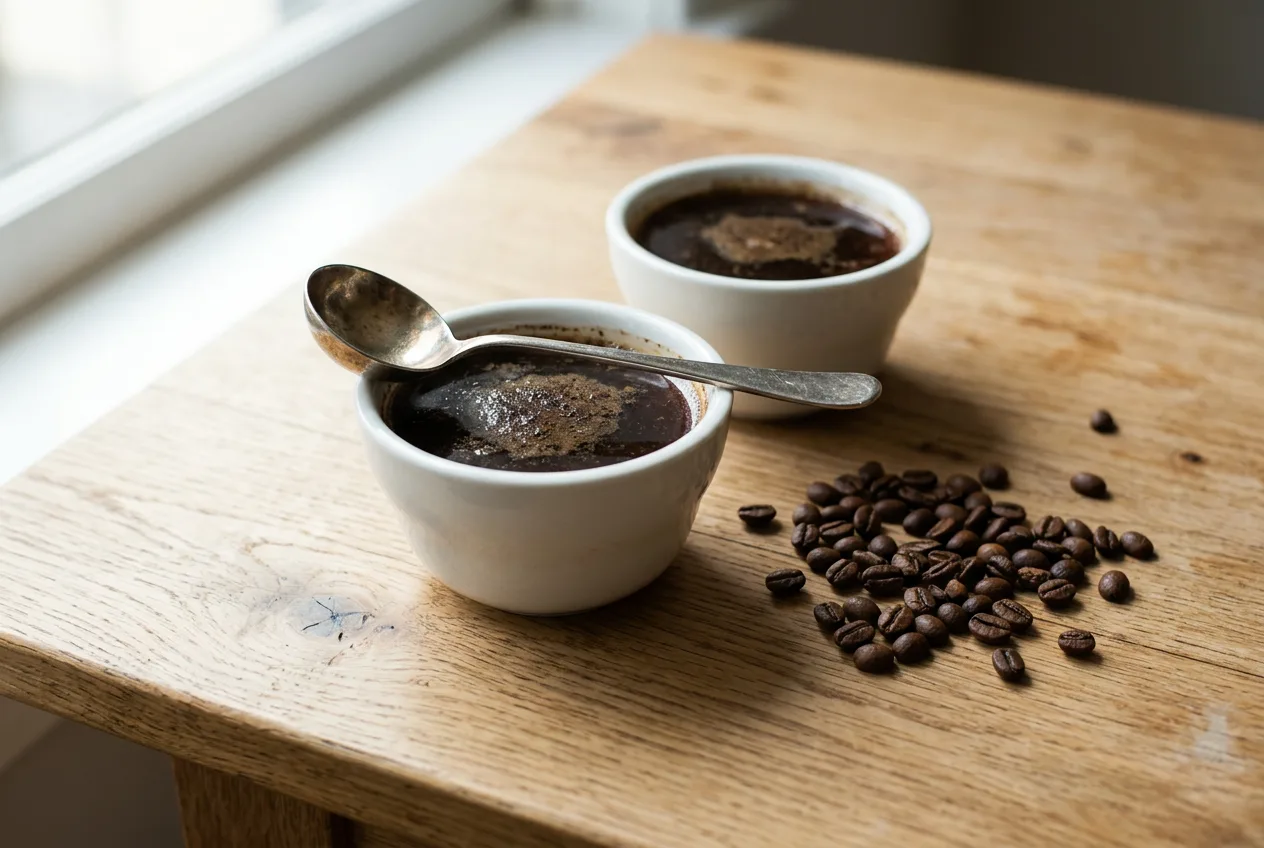
Dark roasts usually taste bolder and heavier, with smoky, toasty, bitter or chocolatey notes. Light roasts keep more of the bean's original character: bright acidity, floral aromas, fruity notes and a more delicate profile.
Because dark roasts taste more intense, people assume they're more caffeinated. But flavor intensity isn't a reliable guide to caffeine. Caffeine itself is only mildly bitter and accounts for a small part of coffee's bitterness.
A light roast can carry plenty of caffeine while tasting mild. A dark roast can taste powerful without containing much more caffeine.
The same goes for espresso. It tastes concentrated because so little water is used, not because the whole serving necessarily holds more caffeine than a mug of drip.
These are three different things. Keeping them separate is the single most useful idea in this whole article.
What about cold brew?
Cold brew deserves a mention because it confuses caffeine comparisons even further.
Cold brew is made by steeping coarse grounds in cold or room-temperature water for 12 to 24 hours. Cold water extracts caffeine more slowly than hot water, but the very long steep makes up for much of that.
Many cold brew recipes also use a lot of coffee, often making a concentrate that's diluted before serving. Depending on the ratio and dilution, a glass of cold brew can contain anywhere from a modest amount of caffeine to a lot more than a cup of hot coffee.
Roast matters little here too. Cold brew is often made with medium or dark roasts for their chocolatey, low-acid flavor, but the caffeine still comes down to dose, species and dilution. I compare cold methods in iced coffee vs cold brew.
Instant coffee and roast level
Instant coffee is usually made from Robusta or Robusta-heavy blends, often roasted fairly dark. That combination might suggest very high caffeine, but a typical teaspoon of instant contains only around 2 grams of coffee solids.
The result is that an 8 oz cup of instant usually lands around 60 to 80 mg of caffeine, a bit less than a typical cup of brewed coffee. Again, the dose decides, not the roast.
So choose your roast by taste
Since roast level makes only a small difference to caffeine, the best reason to choose a roast is flavor.
| Roast | Typical flavor | Often works well for |
|---|---|---|
| Light | Bright, fruity, floral, tea-like | Pour-over, drip, AeroPress |
| Medium | Balanced, sweet, nutty, caramel | Almost everything |
| Medium-dark | Chocolate, toffee, fuller body | Espresso, milk drinks, moka pot |
| Dark | Smoky, roasty, bittersweet | French press, cold brew, milky drinks |
If you want more or less caffeine, adjust the dose, the species or add decaf. If you want a different taste, change the roast. Mixing up those two decisions is how most people end up with coffee they don't love.
For a full guide to what each roast tastes like, see coffee roast levels explained.
How baristas think about it
Good baristas almost never talk about caffeine in terms of roast. They think in doses and ratios.
A typical café double espresso uses 18 to 20 grams of coffee. A typical pour-over uses about 15 to 22 grams for a 250 to 350 ml cup. Batch brew in a large urn might use 60 grams per liter.
If a customer asks for "something with less caffeine," a good barista will suggest a single shot, a smaller cup, a half-caff or decaf, not a different roast. And if someone asks for "the strongest coffee," the honest answer is usually the largest filter coffee on the menu, not the darkest espresso.
That's a useful way to think at home too. Ratios and doses are what you control. My guide to coffee brewing ratios has typical numbers for each method.
What "strong" on a coffee bag really means
Many supermarket coffees print a strength number or words like "extra strong" on the bag. In most cases, that describes the roast level and intensity of flavor, not caffeine.
A strength 5 coffee is usually just darker and bolder than a strength 3. It may contain slightly more Robusta, which would raise caffeine, but the number itself isn't a caffeine rating.
If caffeine matters to you, look for the species on the label (100% Arabica or an Arabica/Robusta blend) and control your dose, rather than relying on the strength scale.
How much caffeine is a lot?
For context, health authorities generally cite up to about 400 mg of caffeine a day as an amount not usually associated with harm for healthy adults, and around 200 mg a day during pregnancy.
Using the ranges above, 400 mg could be four or five small home cups, three double espressos, or just one or two large café filter coffees. That's why understanding dose matters far more than arguing about roast color.
Sensitivity varies a lot from person to person, so many people feel best well below that. My article on how caffeine affects the brain explains why.
How to reduce caffeine without giving up coffee
If you're sensitive to caffeine, there are better levers than roast color.
- Use less coffeeDose is tied directly to caffeine. Dropping from 20 g to 15 g cuts caffeine by about a quarter.
- Choose 100% ArabicaAvoid Robusta-heavy blends, which can have roughly twice the caffeine.
- Blend in decafMix regular and decaf beans in a measured ratio for a predictable reduction.
- Go fully decaf for later cupsDecaf removes about 97% or more of the caffeine.
- Pick a smaller servingA single espresso or small cup instead of a large mug.
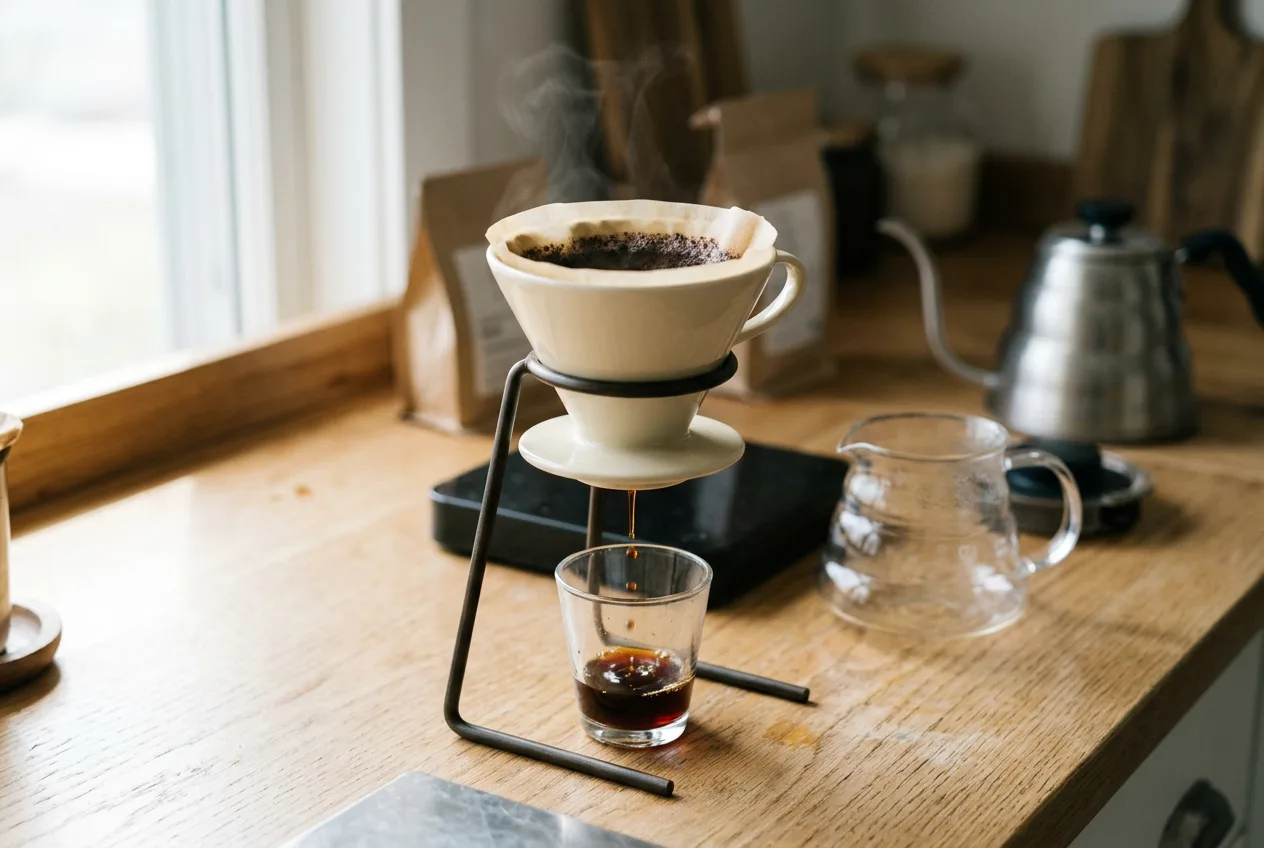
Some people try a pour-over trick: because caffeine dissolves early, they collect and discard the first part of the extraction to remove some caffeine.
It can lower caffeine a bit, but the reduction depends heavily on the coffee, grind, temperature and technique. It doesn't remove a reliable percentage and doesn't make a predictably low-caffeine drink. It also throws away flavor.
If you need a dependable reduction, decaf or a measured decaf blend is the better choice. My guide to how decaf coffee is made explains the options.
Try it yourself: the bean-counting test
You can see the weight effect for yourself in five minutes. All you need is two roasts of the same coffee (many roasters sell one origin at two roast levels), a kitchen scale and a scoop.
- Weigh 10 grams of each roastCount the beans in each pile.
- Fill a level scoop of eachWeigh each scoop, then count the beans in it.
- CompareLook at beans per 10 g and beans per scoop.
| What you'll typically see | Light roast | Dark roast |
|---|---|---|
| Beans in 10 g | Fewer | Around 10–25% more |
| Weight of a level scoop | Heavier | Noticeably lighter |
| Beans in a level scoop | Similar | Similar |
That's the whole debate in one small experiment. Weigh, and the dark roast edges ahead on bean count. Scoop, and the counts come out about even. Exact numbers depend on your beans, but the pattern is very consistent.
Our tip: This is a fun one to do with anyone who insists dark roast is "stronger." It settles the argument faster than any article.
Practical guidelines for choosing coffee by caffeine
- Don't pick dark roast to get less caffeine. Roasting doesn't remove most of it, and by weight a dark roast may even give a little more.
- Don't assume light roast has more caffeine either. It depends on how much you use and the bean's natural caffeine level.
- Check the species. Robusta has much more caffeine than Arabica.
- Mind the dose. More coffee means more caffeine, whatever the method.
- Separate concentration from total. Espresso is concentrated; a big drip mug often has more caffeine overall.
- Count every caffeinated drink. Tea, cola and energy drinks add to your total alongside coffee.
- Read the label. "Strong" and strength numbers usually describe flavor and roast, not caffeine.
- Use a scale. Weighing makes your dose, and your caffeine, repeatable.
Key takeaways
- Roasting from light to dark barely changes the caffeine in each bean.
- Dark beans lose more moisture and weigh less individually.
- Equal weights of dark roast contain more beans, and therefore slightly more caffeine.
- Measured by scoop, the difference between light and dark largely disappears.
- Species and variety matter far more than roast; Robusta has roughly twice Arabica's caffeine.
- Caffeine extracts early, so even an imperfect brew transfers much of it.
- Espresso is more concentrated, but not always higher in total caffeine.
- Same beans and same dose give espresso and pour-over broadly similar caffeine.
- A bigger espresso dose gives more caffeine than a smaller dose of the same coffee.
- A larger light-roast dose can match a smaller dark-roast dose.
- Bold flavor, bitterness and dark color don't reliably indicate caffeine.
- Using less coffee or choosing decaf are the most dependable ways to cut caffeine.
The most reliable way to think about caffeine is to consider the species, the number of beans, the total dose and the extraction together, rather than roast color or how strong the coffee tastes.
Frequently asked questions
Does dark roast have less caffeine than light roast?
Not really. Caffeine per bean is about the same. By weight, dark roast can have slightly more because more beans fit in the same weight; by scoop, they're roughly equal.
Does light roast have more caffeine?
Only when measured by scoop could it edge ahead slightly, and the difference is small. Dose and bean species matter much more.
Does roasting burn off caffeine?
Very little. Caffeine is stable at normal roasting temperatures; most of it survives even dark roasting.
Does espresso have more caffeine than drip coffee?
Per ounce, yes, by a lot. Per serving, often not: a single espresso has about 60–75 mg, while an 8 oz drip coffee has about 80–100 mg and large café cups much more.
Which coffee has the most caffeine?
Coffee made with Robusta beans and a large dose, such as a big mug of strong Robusta-heavy brew, will usually have the most.
Does stronger-tasting coffee have more caffeine?
No. Flavor strength, caffeine concentration and total caffeine are different things. Dark, bitter coffee isn't necessarily more caffeinated.
How can I reduce caffeine but keep drinking coffee?
Use less coffee, choose 100% Arabica, blend in decaf or switch to decaf for later cups.
Should I weigh or scoop my coffee?
Weigh it. A scale gives consistent doses and predictable caffeine, especially when you switch roasts.

- Michael Reynolds, home bean-counting and dosing tests
- Caffeine, Wikipedia
- Coffee roasting, Wikipedia
- Coffea canephora (Robusta), Wikipedia
- Spilling the Beans: How Much Caffeine Is Too Much?, US Food and Drug Administration
Related guides
Coffee roast levels explained Arabica vs robusta Ristretto vs espresso vs lungoWritten by Michael Reynolds. Last updated November 20, 2026.