How the Coffee Plant Grows: From Seed to Cherry (and How to Grow Your Own)
Every coffee bean starts as the seed of a tropical evergreen. Here's how a coffee plant grows from seed to flower to ripe cherry, what it needs to thrive, and a step-by-step guide to growing, harvesting, processing and even roasting your own coffee at home.
We choose products independently. We may earn a commission through links on this page; your price stays the same. Affiliate policy
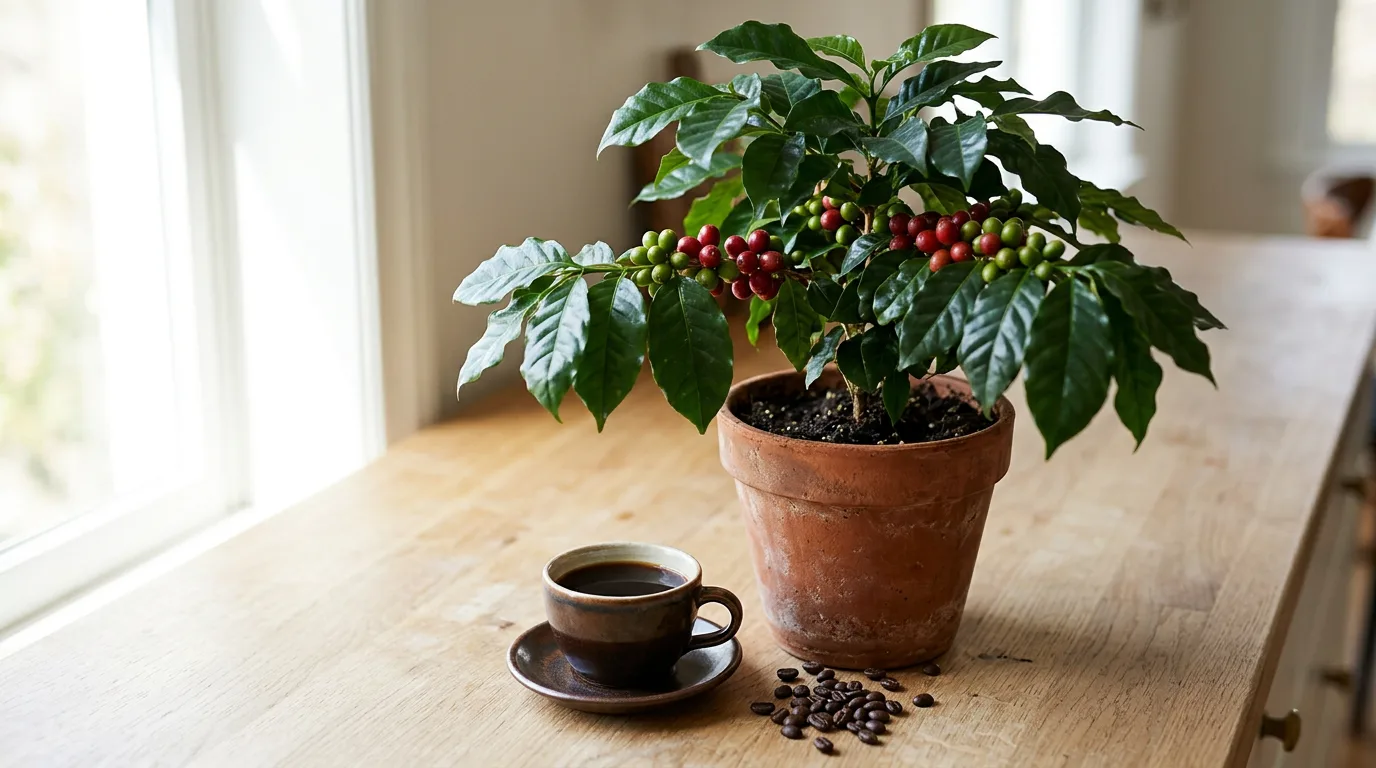
Coffee grows on a tropical evergreen shrub. A seed takes about 6 to 8 weeks to sprout. The plant usually needs 3 to 4 years before it flowers and fruits well.
After rain, it bursts into white, jasmine-scented flowers that turn into small green cherries. Over roughly 6 to 9 months they ripen through yellow and orange to deep red. Inside each cherry are usually two seeds: the coffee beans.
You can grow coffee at home as a houseplant. With warmth, steady moisture and patience, it can even give you enough cherries to process, dry, hull and roast your own beans in a frying pan.
Why I wrote this
A few years ago, a friend gave me a scraggly coffee seedling in a yogurt pot. I put it by the kitchen window, watered it when I remembered, and mostly forgot about it.
Three winters later, it flowered. The whole kitchen smelled like jasmine for two days. Months after that, I picked a small handful of deep red cherries.
I processed them by hand, dried them on the windowsill, cracked off the husks and roasted them in a frying pan. It made about two cups of coffee. They were not the best cups of coffee I've ever had. They were absolutely the most satisfying.
Along the way I made plenty of mistakes: too little light, a winter too close to cold glass, a batch of beans I didn't dry long enough. Each one taught me something about how coffee farmers work every day at a far bigger scale.
Growing that plant taught me more about coffee than any book. This guide covers how the coffee plant grows in nature and on farms, and how you can grow one yourself.
What you'll learn
- What kind of plant coffee is and how it grows
- The full life cycle, from seed to flower to cherry
- What's inside a coffee cherry
- What coffee needs to thrive, on a farm or in your home
- How to plant seeds and care for seedlings
- How to harvest, pulp, dry and hull your own beans
- How to roast them in a frying pan, then cool and rest them
What a coffee plant is
Coffee comes from plants in the genus Coffea, part of the same botanical family as gardenias. They're tropical evergreen shrubs or small trees with glossy, dark green leaves.
The two species that matter most are arabica and robusta. Most specialty coffee is arabica, and that's what I'll focus on here. If you're curious about the differences, see my guide to arabica vs robusta.
Arabica plants are self-pollinating, which means a single plant can produce fruit on its own. That's great news for home growers. Robusta generally needs pollen from other plants.
The coffee plant life cycle
Here's how a coffee plant goes from seed to cup, in nature, on a farm or on your windowsill.
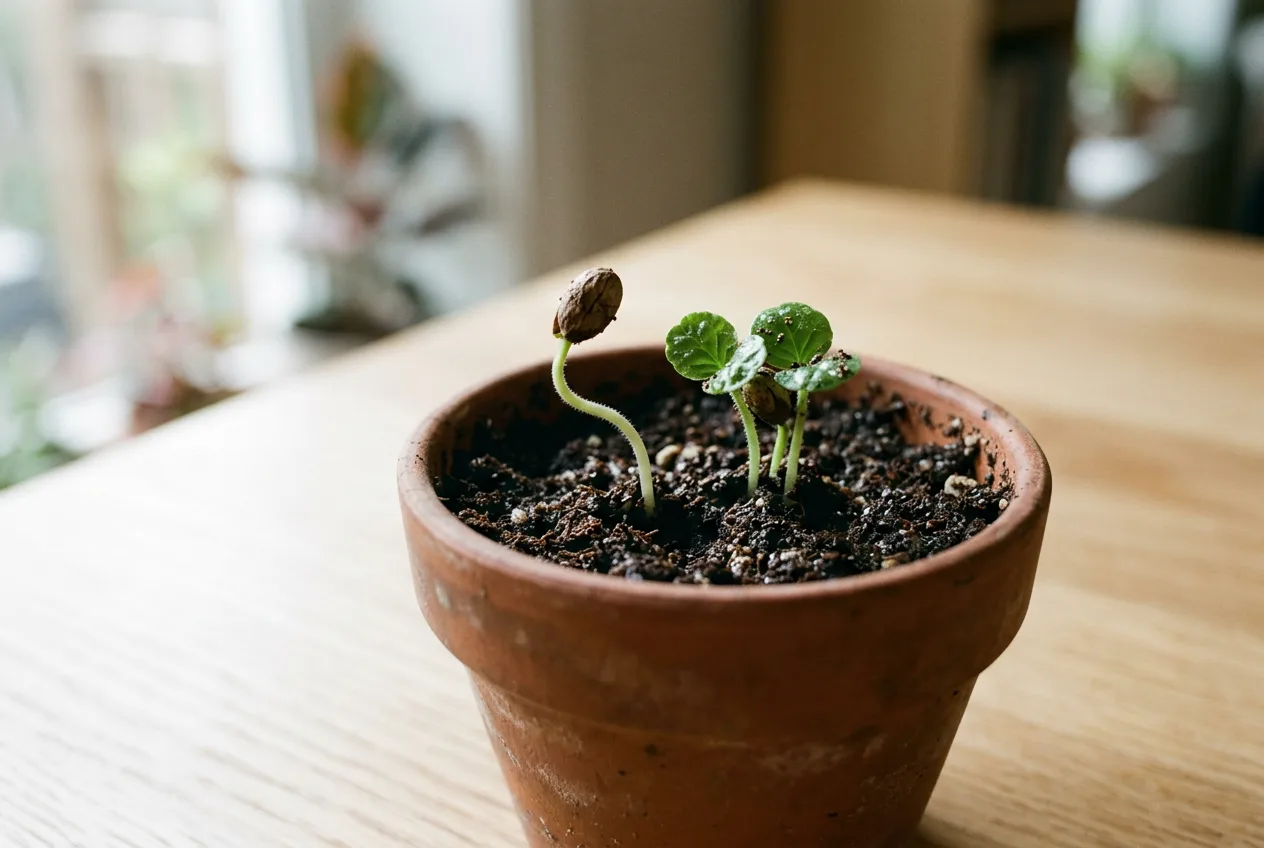
- Seed (week 0)A fresh, unroasted coffee seed is planted, often still in its papery parchment.
- Germination (6 to 8 weeks)A root pushes down and a thin stem pushes up, often carrying the seed on top like a little cap. Growers sometimes call this the "soldier" stage.
- First leaves (2 to 3 months)The seed casing falls away and two rounded seed leaves open. This is sometimes called the "butterfly" stage.
- Young plant (months 3 to 12)True leaves appear in pairs and the plant builds roots and a central stem.
- Maturing (years 1 to 3)Side branches grow. These horizontal branches are where future flowers and cherries will form.
- First flowering (around years 3 to 4)Once mature, the plant flowers, usually triggered by rain after a dry spell.
- Cherry development (6 to 9 months)Flowers become green cherries, which slowly swell and ripen to red.
- Harvest and repeatRipe cherries are picked, and the plant keeps producing for many years with good care.
Roughly how long each stage takes
Approximate. Variety, climate and care all change the timing.
In other words: from seed to your first cup takes around four years. Coffee is a lesson in patience, and a good reminder of why farmers think in decades rather than seasons.
What coffee needs to thrive
Arabica evolved in the cool, shaded highland forests of Ethiopia. It does best when you recreate a mild version of that environment.
| Need | On a farm | At home |
|---|---|---|
| Temperature | Mild, roughly 64–75°F average | Normal room temperature, away from cold drafts |
| Frost | Can be devastating | Keep indoors or protected in cold months |
| Light | Sun to partial shade, often under shade trees | Bright, indirect light near a window |
| Water | Regular rain with a drier season to trigger flowering | Keep soil evenly moist, never waterlogged |
| Soil | Rich, well-drained, often volcanic | Good potting mix with some sand or grit, drainage holes |
| Humidity | Moderate to high | Mist leaves or use a pebble tray in dry heated rooms |
| Altitude | Often 3,000 to 6,500 feet for arabica | Not relevant indoors |
Why altitude matters on farms
High altitude in the tropics gives cooler temperatures. Cooler nights slow cherry ripening, which gives the beans more time to develop sugars and acids. That's a big reason high-grown coffees often taste brighter and more complex.
My guide to coffee growing regions and flavor goes deeper into how place shapes taste.
Inside a coffee cherry
A coffee "bean" is actually the seed of a fruit. Cut a ripe cherry open and you'll find several layers wrapped around it.
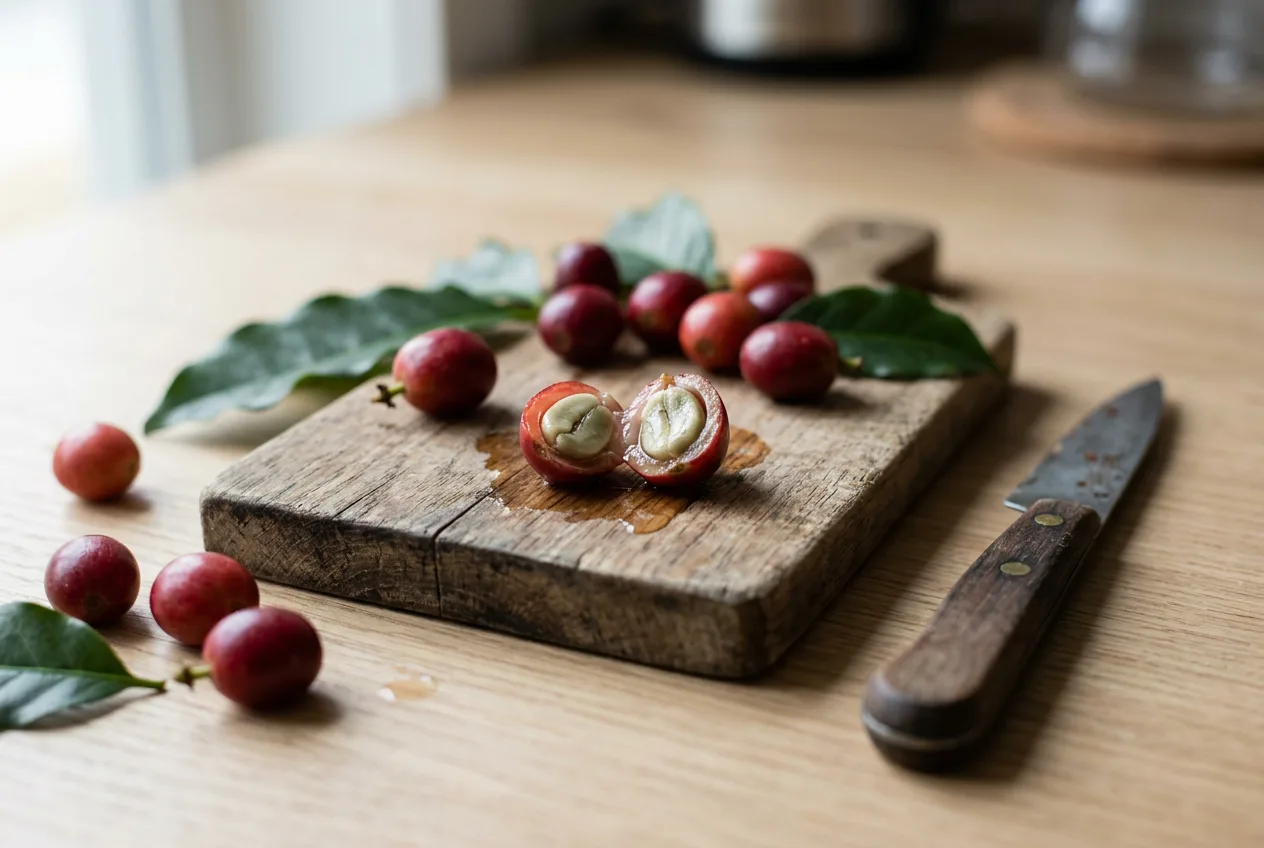
- SkinThe thin, glossy outer skin. Red when ripe in most varieties.
- PulpA thin layer of sweet fruit flesh. It's edible and tastes a little like hibiscus or red currant.
- MucilageA slippery, sticky, sugary layer clinging to the seeds.
- ParchmentA papery protective shell around each bean. Coffee dried in this shell is called parchment coffee.
- SilverskinA very thin, papery film right on the bean. Most of it flakes off as chaff during roasting.
- The beanThe seed itself, green or blue-green when raw. This is what gets roasted.
Peaberries
Most cherries contain two flat-sided beans facing each other. But sometimes only one seed develops, and it grows into a small, round bean called a peaberry. Some roasters sort and sell peaberries separately because they roast a little differently.
How these layers are removed, and when, is what coffee processing is all about. My guide to coffee processing methods explains washed, natural and honey processing.
How coffee farms grow coffee
Before we get to growing your own, here's how it works at scale.
- Nurseries: farmers raise seedlings in bags of soil, often under shade, for 6 to 12 months before planting them out.
- Planting: young plants go into rows, sometimes under shade trees, sometimes in full sun.
- Pruning: farmers keep trees at a manageable height so cherries can be picked by hand, and periodically cut old trees back to renew them.
- Flowering: in many regions, the first heavy rains after the dry season trigger a mass bloom.
- Harvest: because cherries on one branch ripen at different times, the best farms hand-pick only ripe cherries in several passes.
- Processing: cherries are processed within hours, then dried, rested and hulled before export.
A single coffee tree typically produces only around a pound or two of roasted coffee a year. Every bag you buy represents the yearly harvest of several trees.
Our tip: Next time you open a 12-ounce bag, picture the trees it took and the hands that picked every cherry one by one. It makes the price of good coffee feel a lot more reasonable.
Growing coffee at home: the full journey
Growing coffee at home lets you follow every step from seed to cup. It's slow, but many stages need nothing more than gardening basics and normal kitchen equipment.
Here's the whole process at a glance:
| Stage | What you do | Time |
|---|---|---|
| Plant | Sow fresh, unroasted seeds | Day 1 |
| Germinate | Keep warm and moist | 6–8 weeks |
| Grow | Repot and care for the plant | 3–4 years |
| Flower and fruit | Wait for flowers, then cherries | 6–9 months |
| Harvest | Pick deep red cherries | As they ripen |
| Pulp | Squeeze out the beans | An afternoon |
| Dry | Air or low-heat dry | Several days or more |
| Hull | Remove the parchment husk | An hour or two |
| Roast | Pan roast in small batches | 15–20 minutes |
| Rest and brew | Cool, store and rest | About 2 days |
Buying a coffee plant instead of seeds
If waiting months for seeds to sprout sounds too slow, buying a young plant is a perfectly good shortcut. Coffee plants are sold as houseplants at many garden centers and online plant shops.
What to look for
- Glossy, deep green leaves without brown edges, yellowing or spots
- A single healthy plant per pot, or be ready to separate them. Many shops plant several seedlings together, which crowds the roots.
- No pests on the undersides of leaves or along the stems
- Moist but not soggy soil, and a pot with drainage holes
A plant that's already a foot or two tall can save you a year or more. Just remember that many houseplant coffee plants are grown for their leaves, not their fruit. It will still likely flower once it matures, but give it light, space and time.
Our tip: If your new plant arrives as a cluster of seedlings in one pot, gently separate them into individual pots in spring. Each plant will grow faster and stronger with its own space.
Choosing seeds
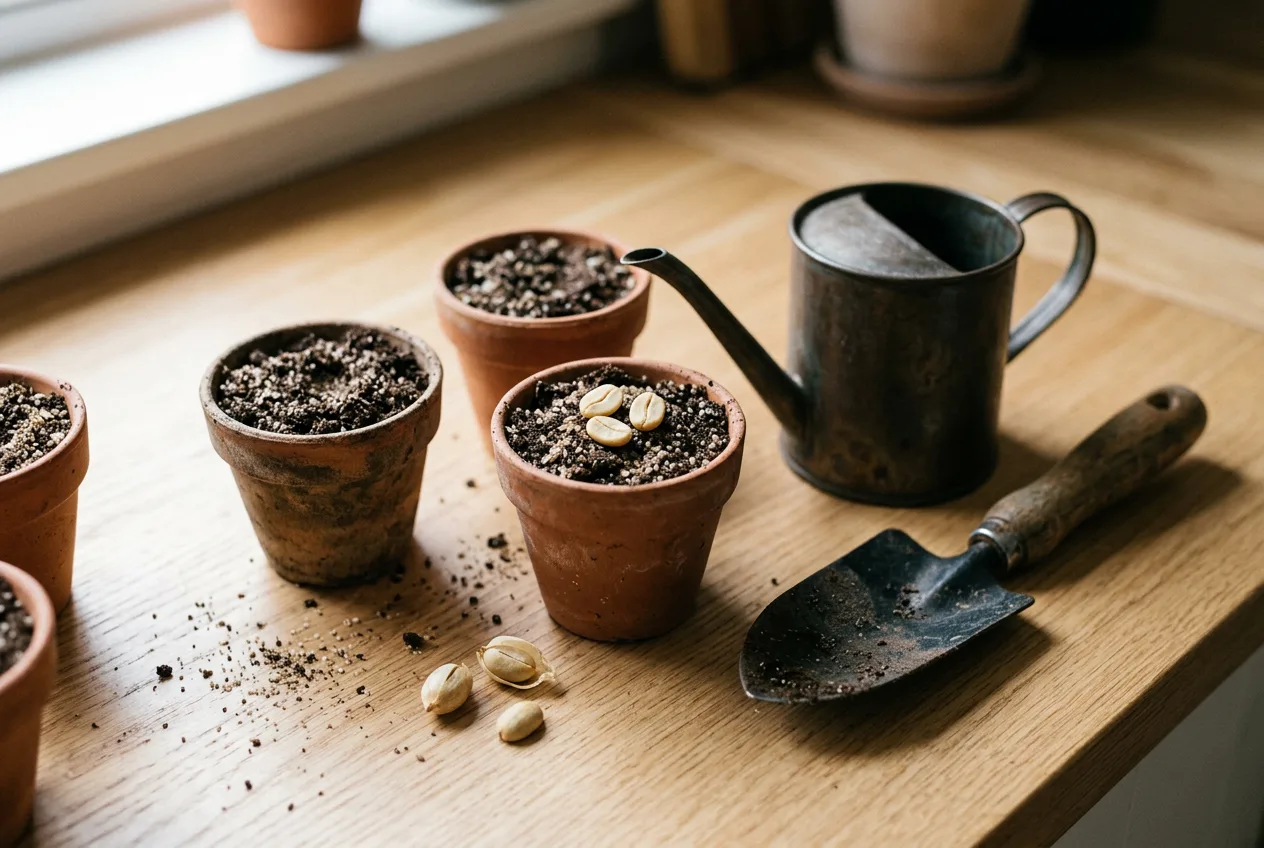
You can start coffee from:
- Fresh coffee cherries, with the fruit removed
- Dried coffee seeds still in their parchment husk
- Seeds sold specifically for planting
The key is that the seed must still be alive. Roasted coffee from the store will never grow, because roasting kills the seed. Even raw green coffee for home roasting has often been dried and stored too long to germinate reliably.
Fresh, unroasted seeds give you the best chance. Many people find it easier to start with a young plant from a garden center, which skips several months.
Our tip: If you start from seed, plant several. Not every seed will sprout, and you can give the extra seedlings to friends.
Planting and germination
Coffee likes soil that holds moisture but still drains well. Standard potting mix with a little sand works nicely.
- Choose a small containerA seed tray or small pot with drainage holes.
- Fill it halfwayUse ordinary potting mix.
- Add a little sandMix it evenly through the soil to improve drainage.
- Spread the seedsLay them on the surface, flat side down if they're out of the parchment.
- Cover lightlyAbout half an inch of soil, then a thin layer of sand on top.
- Water gentlyMoisten evenly without flooding.
- Keep warm and dampPlace somewhere warm indoors and don't let the soil dry out.
Don't bury seeds too deep. A thin cover lets the seedling push through easily.
Spring and summer are good times to start, since warmth helps. Germination usually takes about 6 to 8 weeks, depending on freshness and temperature. Then small green shoots appear.
Caring for seedlings and young plants
Once seedlings appear, they need light, warmth, moisture and space.
Repot as they grow
When seedlings have a couple of pairs of true leaves, move each one to its own pot with good potting mix. Increase the pot size gradually as the roots fill each container.
Daily care checklist
Coffee hates frost and long cold spells. In cooler climates, grow it indoors or in a greenhouse.
A healthy plant develops a strong central stem, shiny green leaves and side branches that spread outward. Those side branches are where flowers and cherries will appear one day.
Pots vs the garden
Coffee grows happily both in containers and in the ground, in the right climate.
| In a pot | In the ground | |
|---|---|---|
| Climate needed | Any, if kept indoors in winter | Frost-free, warm year-round |
| Size | Stays manageable | Can reach 8–10 feet |
| Moving | Easy to move to shelter | Fixed in place |
| Watering | Needs closer attention, dries faster | More forgiving |
| Harvest | Small but real | Potentially much larger |
A container-grown coffee plant can absolutely produce cherries once it matures. Just make sure the pot has drainage holes so water never pools around the roots.
Some plants grow a single main trunk. Others send up several stems from the base. Both are normal.
If you have cold winters, containers are the practical choice, because you can bring the plant inside.
Flowers and cherries
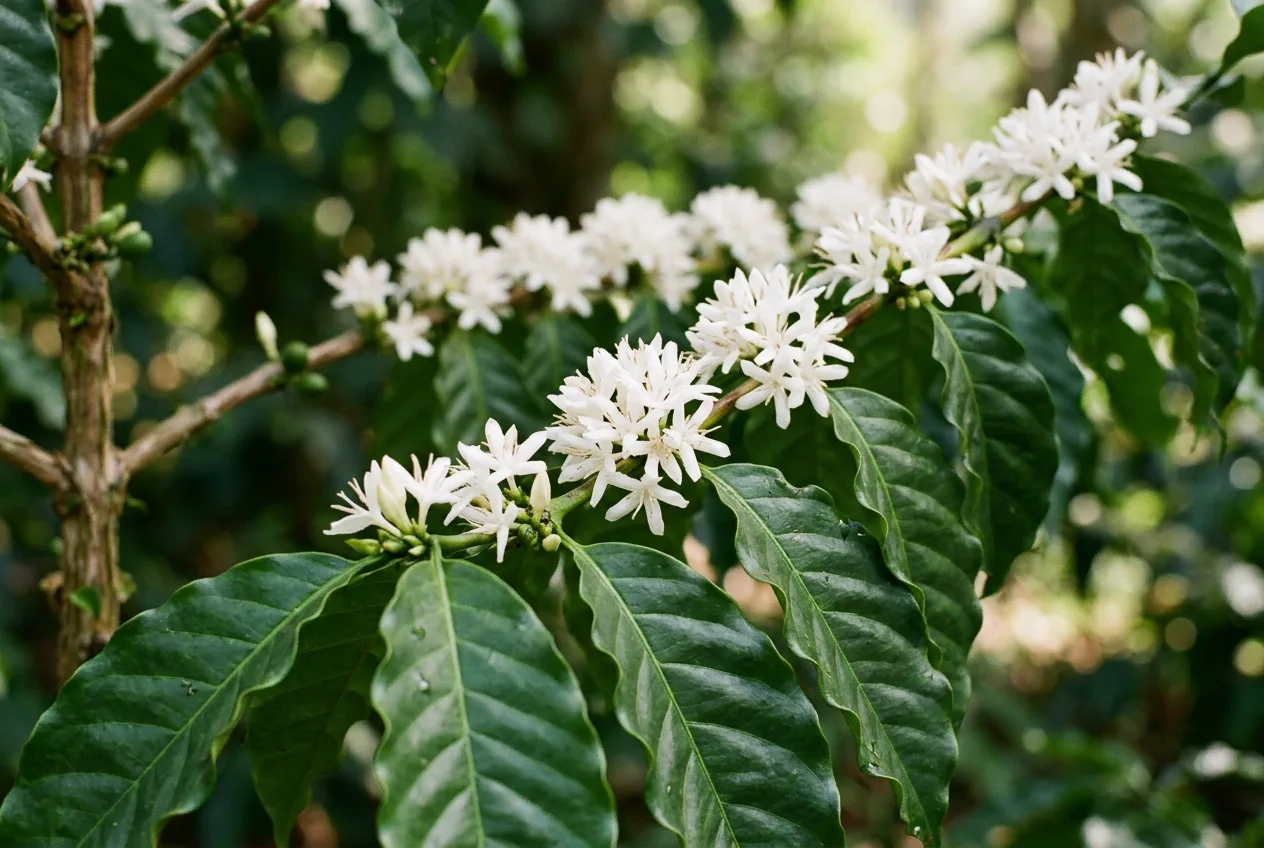
Once a coffee plant matures, it begins to flower. The blossoms are white, star-shaped and grow in clusters along the branches. They smell strongly of jasmine, and they only last a few days.
On farms, flowering is often triggered by the first good rain after a dry season. Indoors, flowering can be less predictable, but a mature, well-cared-for plant will usually bloom.
How cherries ripen
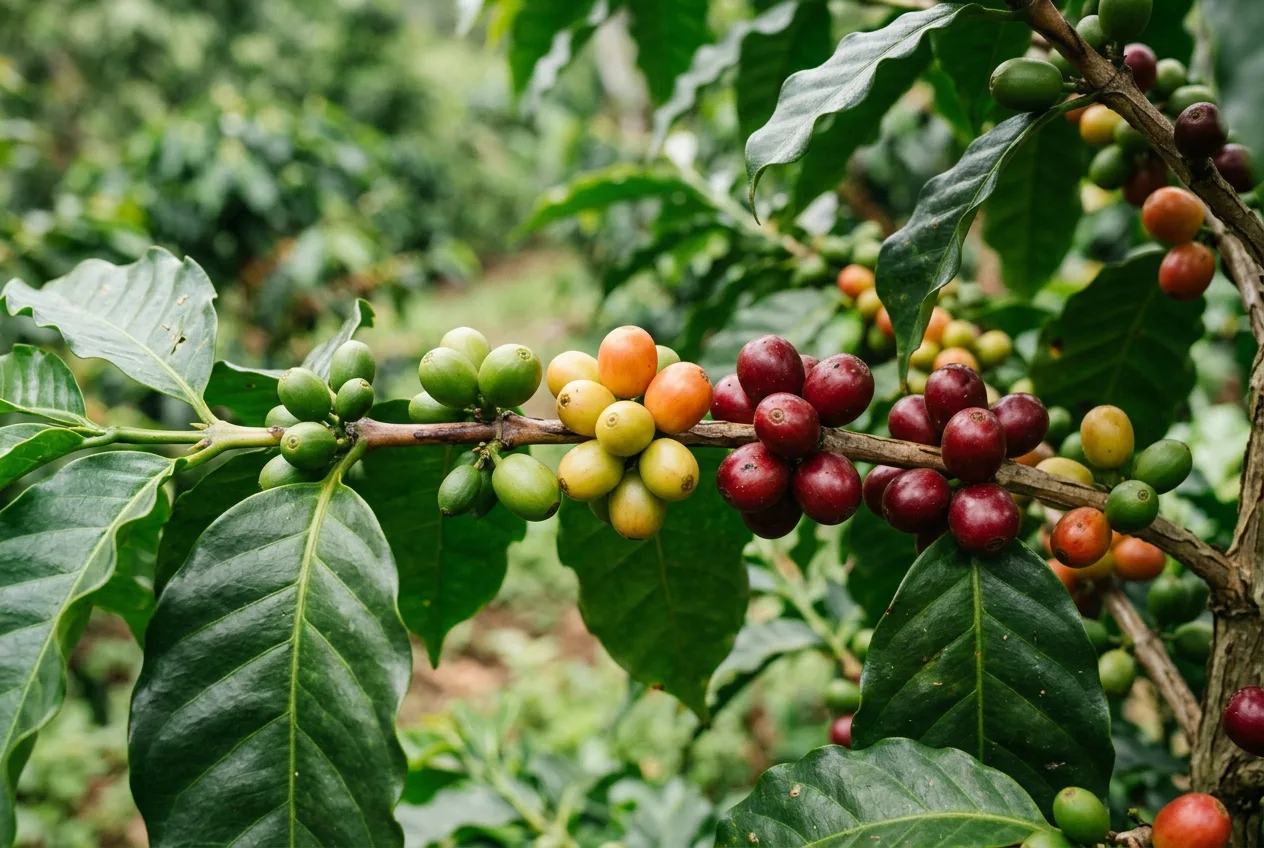
- Flowers fadeSmall green fruits form where the flowers were.
- Cherries swellThey slowly grow, staying hard and green for months.
- Color shiftsGreen fades to lighter shades, then yellowish or orange.
- Fully ripeCherries turn a deep red (or yellow in yellow varieties). This is the time to pick.
Cherries on the same branch rarely ripen together. You'll often see green, yellow and red cherries side by side.
The variety you grow affects the plant's look, how much fruit it produces and how the coffee tastes. Bourbon, for example, is a classic arabica named after Réunion, once called Bourbon Island. Some varieties even have distinctive curled leaves. My guide to coffee varieties covers the main ones.
Harvesting ripe cherries
Pick when cherries are a deep, full red. Leave green cherries on the plant to keep ripening.
- Check each branchLook for fully colored cherries.
- Test gentlyA ripe cherry usually comes away with a light pull.
- Pick into a clean bowlOnly take the ripe ones.
- SortRemove damaged, split or moldy fruit.
- Process soonFresh cherries are soft and easy to work with. Don't leave them for days.
Picking selectively, again and again over several weeks, is exactly what quality-focused farms do. Unripe cherries make sour, grassy coffee.
Our tip: Taste a ripe cherry. The thin layer of fruit is surprisingly sweet. It's the closest you'll get to tasting where coffee's fruity notes come from.
Removing the fruit (pulping)
Next, separate the beans from the fruit. This is called pulping or depulping.
The simple squeeze method
Squeeze each cherry gently between your fingers and the two beans will slide out, covered in slippery mucilage. Work over a bowl or tray, because they're hard to hold onto.
It works well for small amounts, though a big harvest takes a while.
Two ways to make it easier
For beans you plan to roast, gentle handling is best. Collect the slippery beans and get them ready to dry.
Drying the beans
Fresh beans are full of moisture and must be dried before you can remove the parchment. Proper drying also prevents mold.
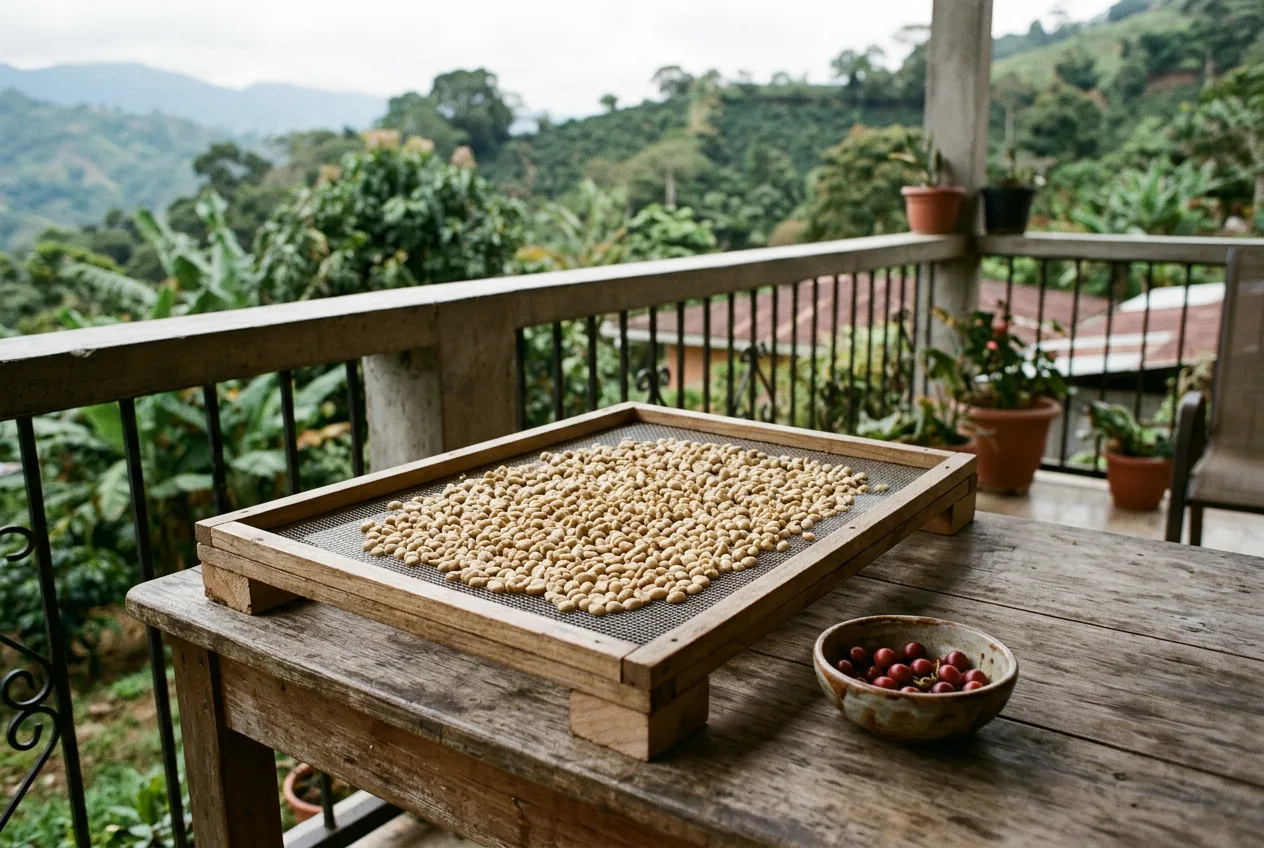
Air drying
Spread the beans in a thin layer on a mesh screen, drying rack or shade cloth so air can move around them. Protect them from rain, insects, pets and dust.
Turn them regularly so they dry evenly. Depending on weather and humidity, it can take several days to a couple of weeks.
Low-heat drying
A fan oven on its lowest setting, or a food dehydrator, can speed things up. The goal is to remove moisture, not cook or roast the beans. They should stay green.
Check them often and give them time.
How to tell they're dry
- The parchment feels crisp and papery
- The beans rattle inside the parchment when you shake a handful
- A bean bitten or cut feels hard, not soft or rubbery
Damp beans can grow mold in storage, so if in doubt, dry them a little longer. On farms, beans are dried to a precise moisture level before export. At home, the rattle test and a crisp, dry parchment are a good practical guide.
Removing the husk (hulling)
Dried beans still have their hard parchment shell. Removing it reveals the green coffee underneath.
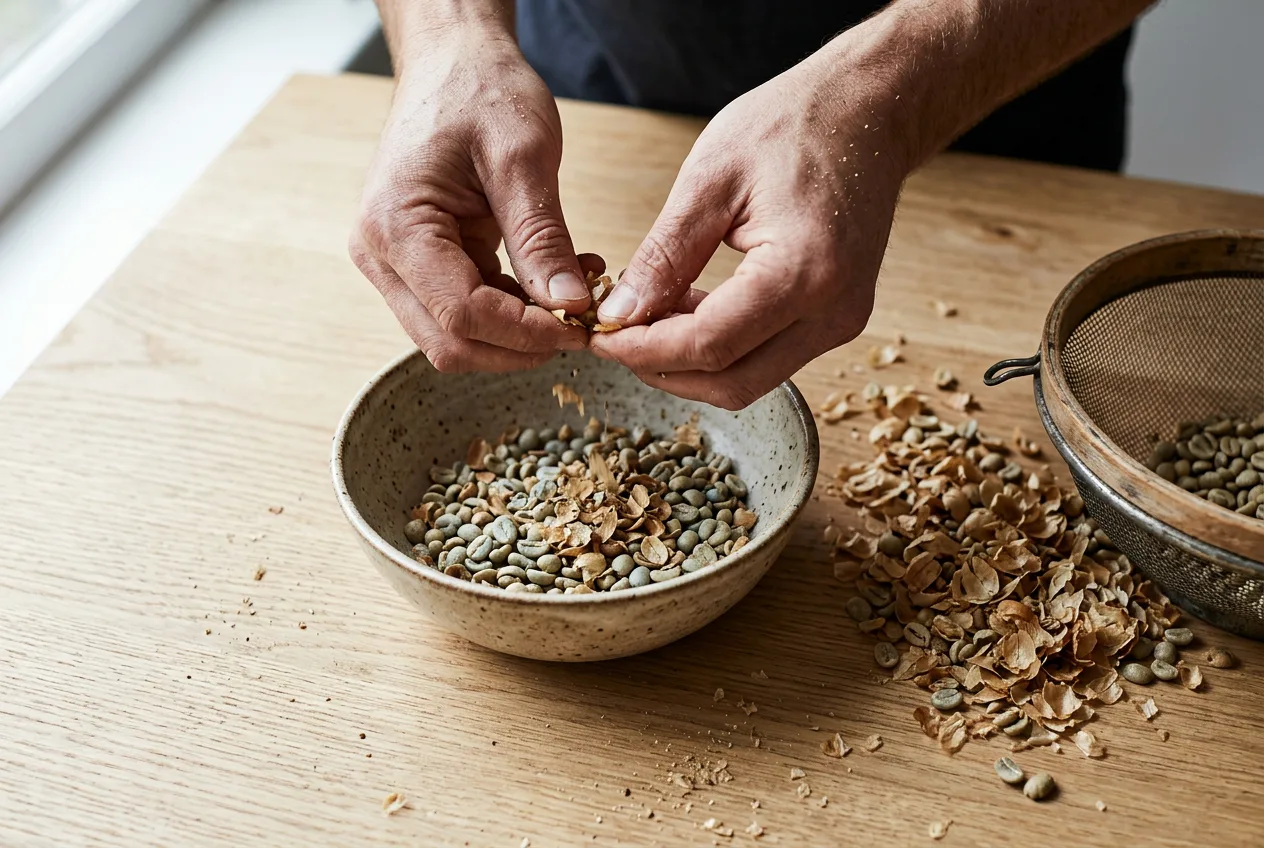
By hand
Crack each husk gently between your fingers or with light pressure from a rolling pin, and pick out the bean. It's slow but gentle on the beans.
A thin film called silverskin may stay on the beans. That's fine. It loosens and flakes off during roasting.
The faster blender method
- Pulse brieflyPut a small batch in a blender or food processor and use short pulses, not continuous blending. You want to crack husks, not grind beans.
- SieveShake the mix in a sieve to drop out small husk fragments.
- Winnow with airOutdoors, use a hairdryer on a cool, low setting to blow away the light husks while the heavier beans stay in the bowl.
- RepeatGo again until most of the husk is gone.
Some beans may chip or break. Whole beans roast more evenly, but broken pieces can still be roasted and ground.
Roasting your beans in a frying pan
You don't need a roaster to roast small batches. A heavy frying pan works.
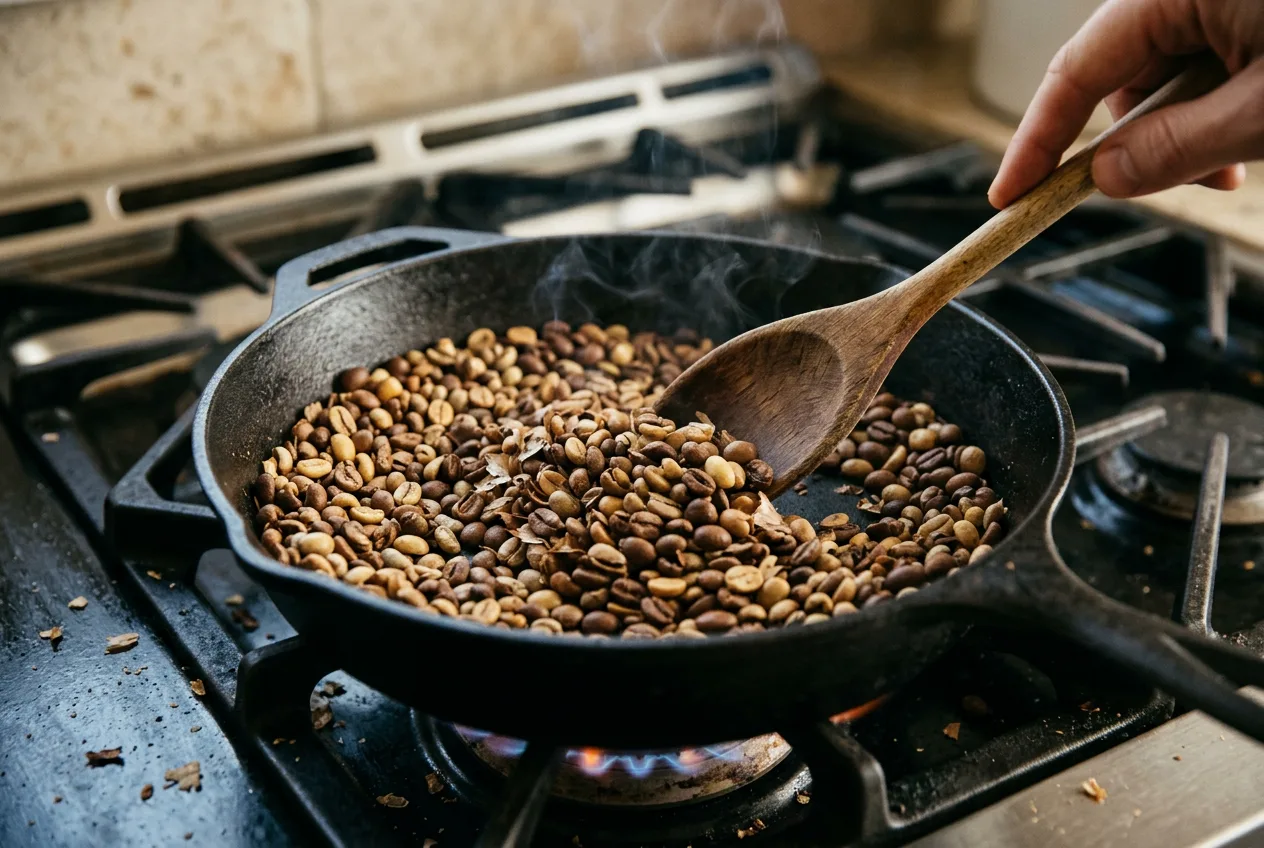
Before you start
- Turn on the range hood or open windows. Roasting makes smoke, chaff and strong smells.
- Use a clean, heavy pan, ideally cast iron.
- Have a wooden spoon or spatula for constant stirring.
- Set out a heat-resistant tray or metal colander for cooling.
- Keep the area clear and never leave the pan unattended.
Roasting outdoors on a camping stove or grill side burner is a great alternative if the weather allows.
The roast, step by step
- PreheatHeat the pan over medium heat for a few minutes.
- Add the beansUse a single layer. Small batches roast more evenly.
- Keep them movingStir constantly to spread the heat and avoid scorching.
- Watch the colorBeans go from green to yellow, light brown, medium brown and darker brown.
- Listen for first crackA popping sound, a bit like popcorn, as moisture escapes and the beans expand. It's your key reference point.
- Decide your roastFor light, stop shortly after first crack. For medium, give it a little longer. For dark, go further, watching closely.
- Stop slightly earlyBeans keep cooking after they leave the pan, so pull them just before your target color.
| Stage | Color | What you notice |
|---|---|---|
| Drying | Green to pale yellow | Grassy, hay-like smell |
| Browning | Tan to light brown | Bread or toast aroma |
| First crack | Light to medium brown | Popping sounds, chaff flies |
| Development | Medium brown | Caramel, sweet coffee aroma |
| Dark | Dark brown, oily surface | Smoky, roasty, more smoke |
Pan roasting won't be perfectly even, and that's okay. Lighter roasts keep more of the coffee's original character. Darker roasts bring heavier roasted flavors and can turn bitter or burnt quickly if left too long.
As beans darken, they turn shinier as oils move to the surface. For the full story of what happens inside the bean, see my guide on how coffee is roasted and coffee roast levels.
Our tip: Roast a small test batch first. Your first pan-roasted beans will probably be a bit uneven. Note the time and heat, and adjust for the next batch.
Cooling, resting and storing
Cool quickly
Beans left in a hot pan keep roasting. Tip them straight onto a cool tray or into a metal colander and spread them out.
Toss them, or use a fan, to speed up cooling. This is also the time to blow or shake away loose chaff.
Let them reach room temperature before storing. Sealing hot beans traps heat and moisture.
Let them rest
Freshly roasted coffee releases carbon dioxide for days. This is called degassing. Resting lets some of that gas escape and lets the flavor settle.
For small home batches, about two days is a good starting point. My guide to coffee freshness, resting and degassing explains more.
Store and grind
Keep cooled beans in a clean, dry, airtight container away from light, heat and moisture. Grind just before brewing, because whole beans stay fresh much longer than ground coffee.
And then, finally, brew a cup of coffee you grew, harvested, processed and roasted yourself.
Year-round care for an indoor coffee plant
Coffee plants don't follow our seasons exactly, but indoor growers in temperate climates will notice a rhythm. Here's how I care for mine through the year.
| Season | What the plant is doing | What to do |
|---|---|---|
| Spring | New growth, sometimes flowering | Repot if root-bound, start feeding, increase watering |
| Summer | Fastest growth, cherries developing | Water regularly, feed every few weeks, can go outside in a sheltered, shaded spot if nights stay warm |
| Autumn | Growth slows, cherries ripening | Bring indoors before nights get cool, reduce feeding, harvest ripe cherries |
| Winter | Rest period | Water a little less, no feeding, keep away from cold glass and heaters, boost humidity |
The biggest winter risks are cold windows and dry air from heating. A plant pushed right against frosty glass can drop leaves overnight.
How to encourage your plant to flower
Many home coffee plants grow happily for years without flowering. If yours is mature and still won't bloom, these usually help:
- Give it timePlants under about three years old rarely flower. Patience is the first ingredient.
- More lightLow light is the most common reason indoor coffee won't bloom. A bright window or a grow light makes a big difference.
- A gentle dry spellIn nature, flowering often follows rain after a dry period. Letting the soil dry a little more than usual for a few weeks, then watering thoroughly, can mimic that trigger.
- Don't over-feed nitrogenToo much nitrogen fertilizer encourages leaves rather than flowers. Switch to a balanced or bloom-focused feed once the plant is mature.
- Keep it slightly root-boundA pot that's comfortably snug, rather than huge, often encourages flowering.
When it does bloom, enjoy it. The jasmine-like scent is one of the best rewards of growing coffee, and arabica's self-pollinating flowers will usually set fruit without any help.
Pruning and shaping
Left alone, a coffee plant grows tall with long side branches. A little pruning keeps it compact and productive.
- Pinch the top once the plant reaches the height you want. This encourages bushier side growth.
- Keep horizontal side branches. These are the ones that flower and fruit.
- Remove dead, crossing or weak growth to keep air moving through the plant.
- Prune after harvest or in spring, not while the plant is flowering or full of cherries.
Farmers do the same thing on a larger scale, keeping trees at a height where cherries can be picked by hand.
Can you grow coffee outdoors?
Only in genuinely frost-free, warm climates. In the US, that mostly means places like Hawaii, Puerto Rico and the warmest parts of southern California and southern Florida.
Hawaii is the best-known US coffee region, with farms on volcanic slopes. Southern California has a small but growing number of coffee farms too.
Elsewhere, a summer vacation outdoors can be good for a potted plant, as long as you:
- Wait until nights stay comfortably warm
- Put it in bright shade, not full midday sun
- Shelter it from strong wind
- Bring it back inside well before the first cold nights
What does home-grown coffee taste like?
Honestly? It varies, and it usually won't match a great specialty coffee. And that's fine.
Commercial coffee benefits from ideal altitudes, careful selective picking at scale, controlled processing and expert roasting. A windowsill plant at sea level, hand-processed in a kitchen and pan-roasted, simply can't recreate all of that.
My own home-grown batches have tasted sweet and nutty with a soft, mellow acidity, a little uneven from the pan roast. Pleasant, a bit rustic, and completely unique.
Treat home-grown coffee as an experience, not a replacement for your daily beans. The first cup you brew from your own plant will be one you remember.
My own plant: a four-year diary
Here's roughly how my windowsill coffee plant progressed, from that yogurt pot to my first homemade cup.
| When | What happened | What I learned |
|---|---|---|
| Month 1 | Gifted seedling, about 3 inches tall | Moved it to a pot with drainage right away |
| Year 1 | Grew to about a foot, several leaf pairs | Brown leaf tips meant my heated room was too dry |
| Year 2 | First side branches, repotted once | A brighter window made growth much fuller |
| Year 3, winter | Dropped a few leaves after a cold snap | Never leave it touching frosty glass |
| Year 3, spring | First flowers, the kitchen smelled of jasmine | Flowers only lasted a couple of days |
| Year 3, autumn | Green cherries slowly swelling | Ripening takes far longer than you expect |
| Year 4 | First small harvest of red cherries | Enough for about two cups after processing |
The plant is still going, a bit taller each year and a little more generous with cherries each season. It has become one of my favorite things in the house.
Coffee plant myths
| Myth | Reality |
|---|---|
| "You can plant coffee beans from the store" | Roasted beans are dead seeds and will never sprout. |
| "Coffee needs full, blazing sun" | Arabica evolved under forest shade. Bright, indirect light suits it best indoors. |
| "You need two plants to get cherries" | Arabica pollinates itself. One plant is enough. |
| "Coffee beans grow like nuts on a tree" | They're the seeds inside a cherry, wrapped in fruit and several layers. |
| "A plant gives you lots of coffee" | Even on farms, one tree yields only around a pound or two of roasted coffee a year. |
Tips for success
| Tip | Why it matters |
|---|---|
| Use fresh, unroasted seeds | Roasted beans can never grow |
| Keep soil evenly moist, with drainage | Dry soil stalls growth, soggy soil rots roots |
| Provide warmth, avoid frost | Coffee is a tropical plant |
| Be patient | The first harvest can take several years |
| Pick only deep red cherries | Unripe cherries make sour, grassy coffee |
| Dry beans thoroughly | Prevents mold and spoilage |
| Hull gently | Whole beans roast more evenly |
| Ventilate when roasting | Roasting produces smoke and chaff |
| Pull the roast slightly early | Beans keep cooking after the pan |
| Rest about two days | Lets gas escape and flavor settle |
Common coffee plant problems
| Symptom | Likely cause | Fix |
|---|---|---|
| Brown, crispy leaf edges | Dry air or underwatering | Water more evenly, raise humidity |
| Yellowing lower leaves | Overwatering or lack of nutrients | Let the top inch dry, feed lightly |
| Black or brown leaf spots after cold | Cold damage | Move away from drafts and cold windows |
| Pale, scorched patches | Too much direct sun | Move to bright, indirect light |
| Leggy, sparse growth | Not enough light | Move closer to a window or add a grow light |
| Sticky leaves, tiny insects | Scale, aphids or mealybugs | Wipe leaves, use insecticidal soap |
| Orange powdery spots under leaves | Possibly coffee leaf rust (rare indoors) | Isolate and remove affected leaves |
Leaf rust is a serious disease on farms, but rare on houseplants. I cover it in depth in my guide to coffee leaf rust and other coffee diseases.
Key takeaways
- Coffee grows on a tropical evergreen shrub. Arabica is self-pollinating, so one plant can fruit alone.
- Seeds take about 6 to 8 weeks to sprout, and plants need around 3 to 4 years to fruit well.
- White, jasmine-scented flowers become cherries that ripen over 6 to 9 months, from green to deep red.
- Each cherry usually holds two seeds: skin, pulp, mucilage, parchment and silverskin surround them.
- At home: fresh seeds, warm moist soil with drainage, bright indirect light and protection from cold.
- Process your harvest by squeezing out the beans, drying them thoroughly and removing the parchment.
- Roast in a frying pan with good ventilation, stirring constantly and stopping slightly early.
- Cool quickly, rest about two days, store airtight and grind just before brewing.
If you only take one step today, start with the plant itself. Whether you sow a few fresh seeds or bring home a young plant from a garden center, give it a bright window, steady moisture and warmth, and it will quietly do the rest over the next few years.
Growing coffee at home is slow, hands-on and wonderfully rewarding. Even if your harvest only makes a couple of cups, you'll never look at a bag of coffee the same way again.
Frequently asked questions
How long does it take a coffee plant to produce beans?
Usually about 3 to 4 years from seed before a coffee plant flowers and fruits well. After flowering, cherries take roughly 6 to 9 months to ripen.
Can I grow coffee from store-bought beans?
Not from roasted beans, because roasting kills the seed. You need fresh, unroasted coffee seeds or cherries. Even green coffee sold for roasting is often too old to germinate reliably.
Can a coffee plant grow indoors?
Yes. Coffee is a popular houseplant. Give it bright indirect light, normal room temperatures, evenly moist well-drained soil and protection from cold drafts.
How tall does a coffee plant get?
Indoors in a pot it usually stays manageable. Planted in the ground in a warm climate it can reach about 8 to 10 feet, and wild trees can grow much taller.
Do coffee plants need two plants to produce fruit?
Arabica is self-pollinating, so a single plant can produce cherries. Robusta generally needs pollen from other plants.
What do coffee flowers smell like?
Coffee flowers are white and smell strongly of jasmine. They only last a few days.
How many coffee beans are in a cherry?
Usually two. Sometimes only one seed develops, forming a small round bean called a peaberry.
How much coffee does one plant produce?
A single tree on a farm typically produces only around one to two pounds of roasted coffee per year. A houseplant usually produces much less.

- Michael Reynolds, notes from growing coffee plants at home and farm visits
- World Coffee Research: Arabica coffee varieties
Related guides
Coffee processing methods How coffee is roasted Coffee varieties explainedWritten by Michael Reynolds. Last updated November 19, 2026.