The History of the Espresso Machine: From Moriondo's Steam Brewer to Gaggia's Lever and the FAEMA E61
Every part of a modern espresso machine, from the portafilter to the separate boilers, traces back to a chain of Italian inventors and entrepreneurs. Here's the story of how the espresso machine evolved from a steam-powered batch brewer in 1884 to the pump-driven machines that shaped modern café culture.
We choose products independently. We may earn a commission through links on this page; your price stays the same. Affiliate policy
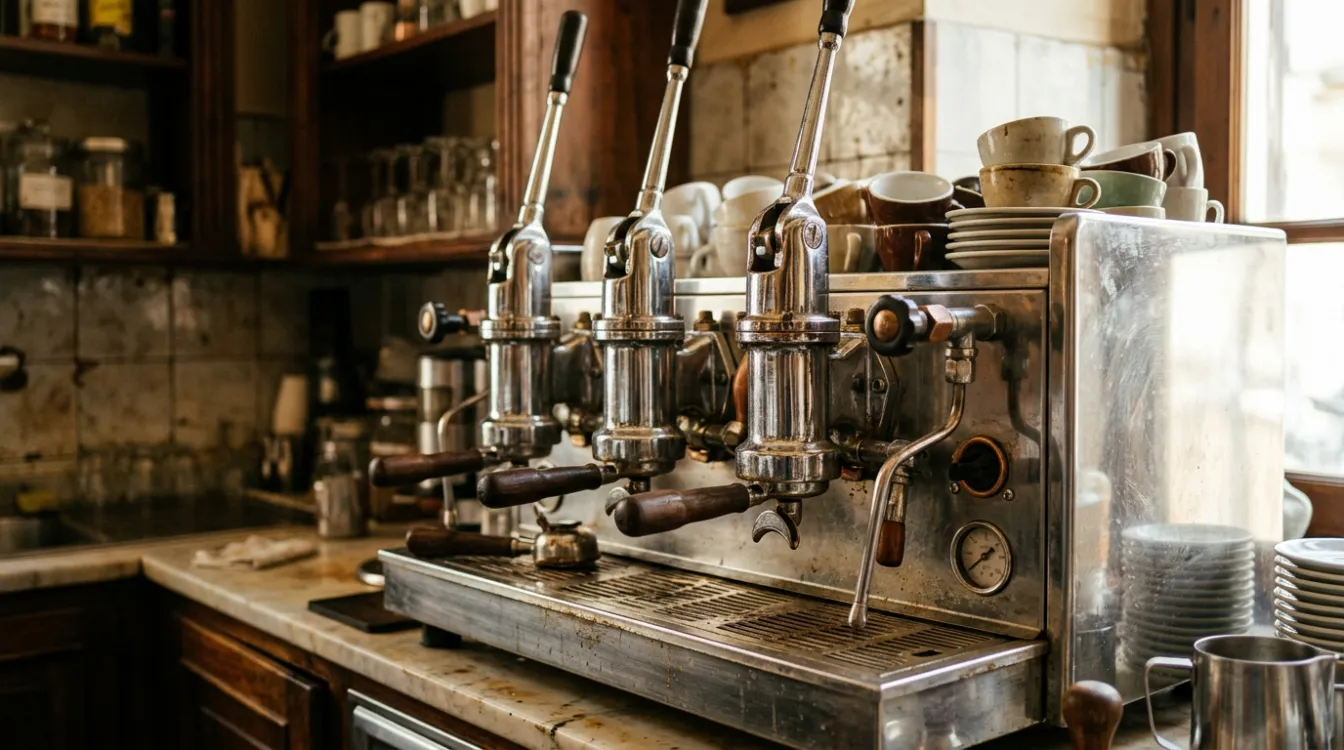
The espresso machine evolved over decades. Angelo Moriondo patented a steam-powered batch brewer in Turin in 1884. Luigi Bezzera introduced individual portafilters in 1901, and Desiderio Pavoni turned the design into a commercial success, showing the Ideale at the 1906 Milan Fair. Gaggia's spring-lever machine in the late 1940s created high-pressure espresso with crema. FAEMA then introduced pump-driven, dual-boiler machines in the 1950s, and the E61 in 1961 combined a pump, heat exchanger and thermosiphon group into a design still used today.
From steam engines to café counters
Every morning, I pull a shot on a machine that would have looked like science fiction to the inventors who started it all. Yet almost every part of it, from the portafilter to the separate boilers, traces back to a chain of Italian engineers, café owners and entrepreneurs working between the 1880s and the 1960s.
The espresso machine wasn't invented in one moment. It evolved through many small breakthroughs, each solving a problem left by the one before: how to make coffee faster, how to serve it one cup at a time, how to generate enough pressure, and how to control temperature.
In this guide I'll walk through the key people and machines in the history of espresso, from Angelo Moriondo's steam-powered batch brewer to Gaggia's spring lever and Faema's pump-driven designs, and explain why each step mattered for the coffee we drink today.
Espresso machine timeline at a glance
| Year | Milestone |
|---|---|
| 1884 | Angelo Moriondo patents a steam-powered coffee machine in Turin |
| 1901 | Luigi Bezzera patents a machine with group heads and portafilters |
| 1902 | Desiderio Pavoni buys Bezzera's patent |
| 1906 | Pavoni's Ideale is shown at the Milan Fair |
| 1909 | Luigi Giotto introduces the first known pump-operated machine |
| 1910 | Pierre Teresio Arduino patents a screw-piston group |
| 1942 | La San Marco introduces a horizontal-boiler machine |
| 1945 | FAEMA is co-founded by Ernesto Valente |
| 1947 | Gio Ponti designs a celebrated machine for La Pavoni |
| Late 1940s | Gaggia's spring-lever machine transforms espresso |
| 1957 | FAEMA Presidente lever machine with dual boilers |
| Late 1950s | FAEMA TR "Tartaruga" with rotary pump and dual boilers |
| 1961 | FAEMA E61 popularizes the pump-driven heat exchanger group |
1884: Angelo Moriondo and the first pressure machine
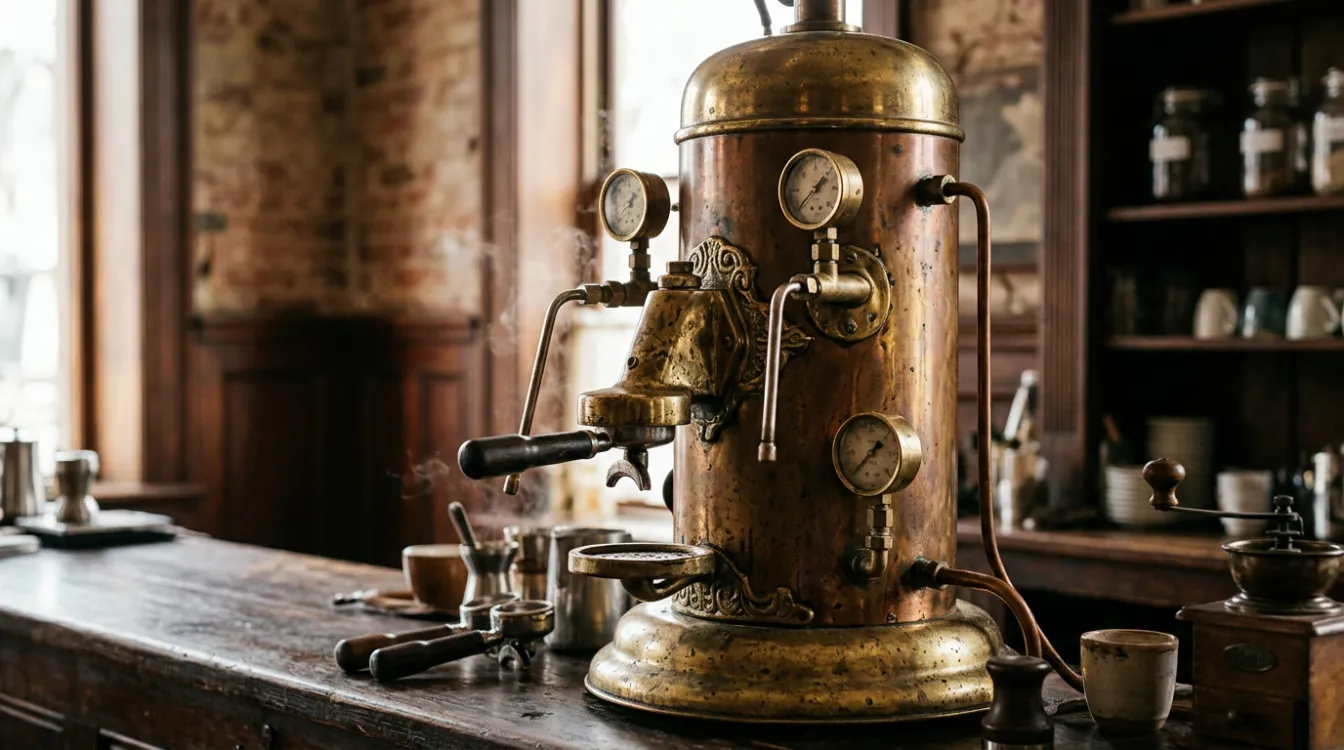
The story usually starts in Turin in 1884, when inventor Angelo Moriondo patented a coffee machine that used steam and pressure to brew coffee faster.
His machine used an upright boiler heated by burners underneath. Steam pressure in the boiler helped push hot water through a large bed of ground coffee. It included features that seem surprisingly modern:
- Gauges showing the water level in the boiler.
- Gauges showing steam pressure.
- A safety valve to stop pressure building too high.
- A quick-mount handle for practical operation.
- Controls for adjusting water and steam.
But Moriondo's machine was a batch brewer, not an espresso machine as we know it. Its brewing basket held roughly 21 ounces, about 1.3 pounds, of ground coffee and made around 30 servings at once. It was designed to make lots of coffee quickly, not individual shots.
Moriondo laid the foundation for pressurized coffee brewing, but the idea of a single cup made to order was still to come.
Moriondo's design was shown publicly in Turin, and it attracted attention as a clever way to serve coffee quickly to crowds. Yet he seems to have built only a few machines and never turned his invention into a large business. The commercial breakthrough would come from others who built on his ideas over the following decades.
Why the espresso machine was born in Italy
At the end of the 19th century, coffee was already popular across Europe, but brewing it took time. In Italy's growing industrial cities, such as Turin and Milan, cafés served workers who wanted coffee quickly before heading to factories and offices.
That demand for speed shaped the invention. The word "espresso" is often linked to the idea of coffee made "expressly" for one person, on demand, and quickly, as well as to coffee "pressed out" under pressure. Both meanings fit what inventors were trying to achieve: fresh coffee, made fast, one cup at a time.
Italy also had a strong tradition of engineering and craftsmanship, and a café culture where people often drank coffee standing at the bar. Machines that could serve many customers quickly, and look impressive doing it, were a perfect fit.
1901: Luigi Bezzera and the single serving
In 1901, Milanese inventor Luigi Bezzera introduced his Gigante machine and a patent that changed everything. His machine still relied on steam and boiler pressure, but it introduced group heads designed to hold individual portafilters.
That meant coffee could be brewed in single portions, made fresh for each customer, rather than in large batches. It's the foundation of the café workflow we know today: grind, dose, lock in, brew, serve.
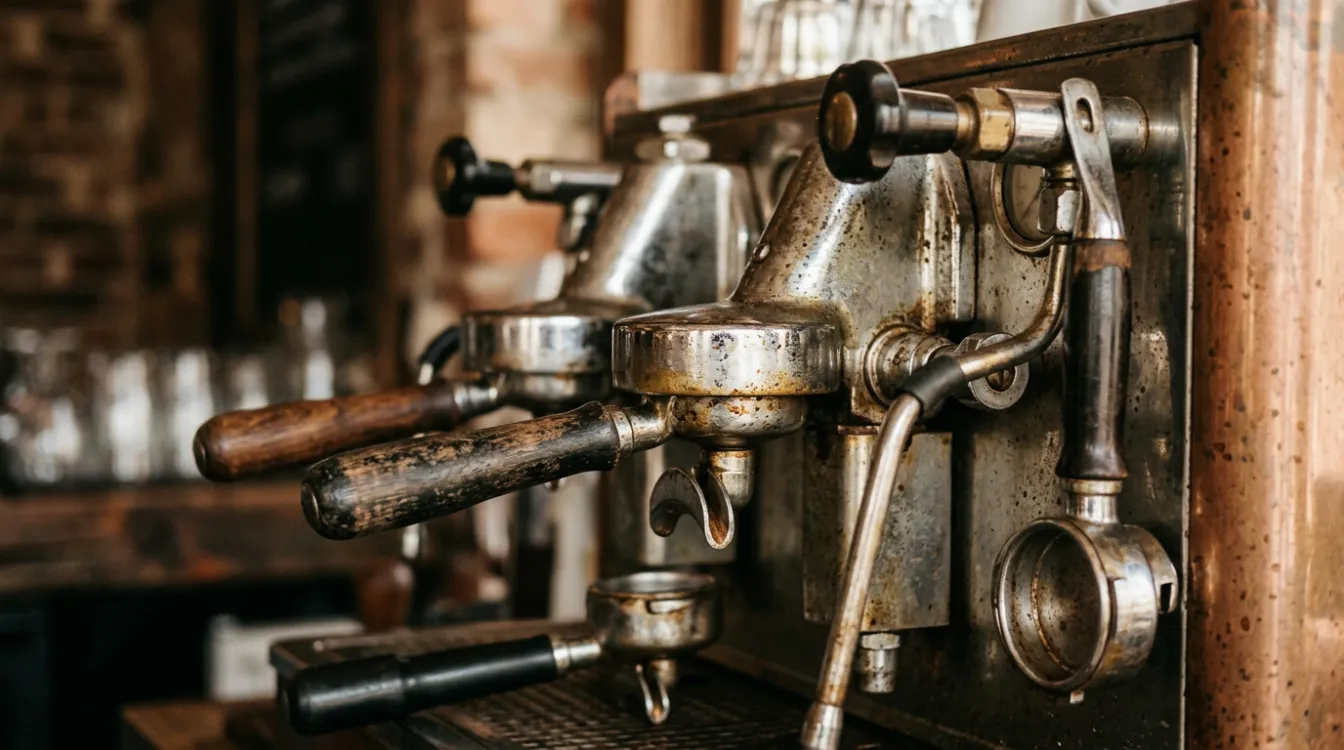
The portafilter also made cleaning easier. Operators could remove it, knock out the used grounds, rinse it and prepare the next serving. In busy cafés, that practicality mattered.
Bezzera's contribution can be summed up in three ideas:
- Coffee made individually.
- Easier cleaning and maintenance.
- Coffee prepared at the moment of ordering.
1902-1906: Pavoni brings espresso to market
Within a year of his patent, Bezzera began working with Desiderio Pavoni, a family friend. In 1902, Pavoni bought Bezzera's patent. The exact details of their arrangement aren't entirely clear, but both men appear to have produced machines based on the same core design.
Pavoni's strength was turning the invention into a commercial product. His Ideale machine was presented at the 1906 Milan Fair, on a stand that still carried Bezzera's name. The Ideale became one of the first commercially successful pressurized coffee machines, and it helped spread the technology to cafés across Italy.
This was the moment espresso machines moved from inventions to products. The company Pavoni founded, La Pavoni, still makes espresso machines today.
1909: Luigi Giotto and the first pump
In 1909, Luigi Giotto of Turin introduced what's believed to be the first pump-operated espresso machine.
Earlier machines relied on steam pressure from the boiler, which made it hard to control brewing pressure independently. Giotto's machine used a manually operated water pump to push water through a heat exchanger inside the boiler. The water was heated as it passed through, without mixing with the boiler's steam.
It also included an air pump to dry the coffee puck after brewing.
No surviving Giotto machines are known, but the idea was groundbreaking: separating brewing pressure from steam pressure. That principle would become central to espresso machine design decades later.
1910 onward: the screw-piston experiments
In 1910, Pierre Teresio Arduino patented a design using a screw-operated piston in the group head. After water entered the group, the operator turned a large screw to push it through the coffee. It was a mechanical way of creating pressure, independent of steam.
Arduino seems to have abandoned the idea fairly quickly; later patents didn't continue it. But the concept resurfaced in a later patent by Antonio Cremonesi.
Cremonesi died shortly after securing his patent, at just 42. His wife, Rosetta Scorza, inherited it and eventually sold the screw-piston concept to Giovanni Achille Gaggia. That purchase would lead to one of the most important breakthroughs in espresso history.
1942-1947: horizontal boilers and design icons
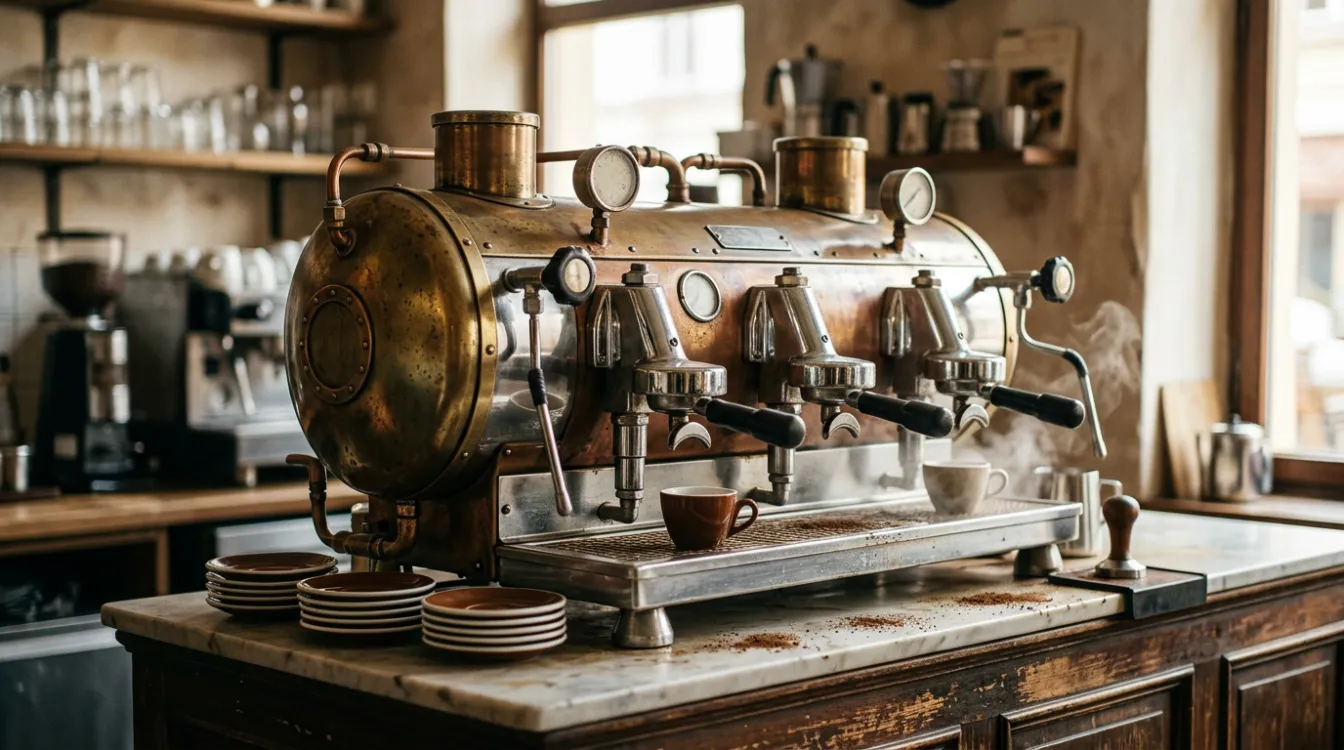
Early espresso machines had tall, upright boilers that towered over café counters. In 1942, manufacturer La San Marco introduced a machine with a horizontal boiler.
A horizontal layout changed how machines were built. Group heads could be arranged side by side along the front, making machines wider and lower, and more practical for baristas working along a counter. It also made room for more sophisticated internal systems.
In 1947, the famous architect and designer Gio Ponti created a striking machine for La Pavoni. His design showed that espresso machines could be objects of industrial design as well as tools, and it marked a period when espresso machines became symbols of modern Italian style.
1945: the founding of FAEMA
In 1945, Ernesto Valente co-founded FAEMA. In its early years, the company made household appliances, including hair dryers, rather than coffee machines.
In 1947, Valente met Giovanni Achille Gaggia and formed a manufacturing partnership. FAEMA became Gaggia's official manufacturer until 1950, building machines that used Gaggia's new lever group. That partnership connected Gaggia's mechanical innovation with FAEMA's ability to manufacture at scale, and set FAEMA on its path to becoming one of the most influential espresso machine makers in history.
The spring lever revolution: Gaggia
Gaggia's big idea was to redesign Cremonesi's screw piston using a lever and a heavy spring.
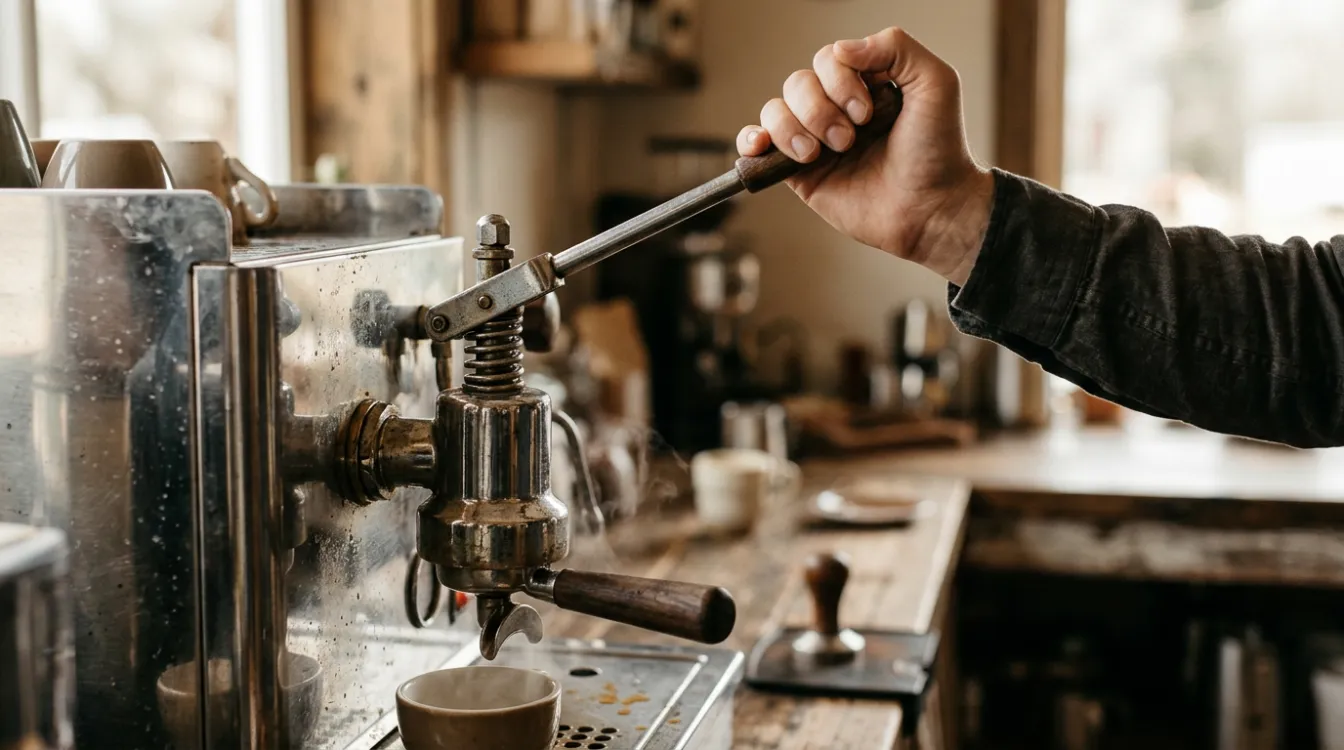
Here's how it works:
- Pull the lever downThis compresses a powerful spring and lets hot water into the group above the coffee.
- Release the leverThe spring pushes the piston down.
- Pressure buildsThe piston forces water through the coffee at high pressure.
- The shot flowsPressure gradually falls as the spring extends, creating a declining pressure profile.
This mechanism could generate much higher pressure than steam-driven machines. That changed espresso itself. Higher pressure produced a thicker, more concentrated drink topped with a layer of golden foam, what we now call crema. Some say Gaggia initially marketed it as "caffè crema" to explain the new foam to customers.
The first Gaggia lever machine was installed at a bar in Milan's busy San Babila area, and it quickly became a sensation. Lever machines spread across Italy and beyond, and many cafés still use them today. My guide to espresso crema explains what crema is and what it tells you about a shot.
The 1950s: lever machines evolve
During the 1950s, FAEMA continued making lever machines while licensing Gaggia's group design. It was a decade of experimentation, with manufacturers improving consistency, temperature control, pressure and usability.
In early 1957, FAEMA introduced the Presidente lever machine, which used a dual-boiler setup:
- One boiler supplied water for brewing.
- Another boiler produced steam for milk.
Separating brewing and steaming let each function work more independently and helped solve one of the long-standing challenges of espresso machines: keeping brewing water at the right temperature while also providing powerful steam. It paved the way for the pump-driven dual-boiler machines that followed. My guide to espresso machine types explains single boilers, heat exchangers and dual boilers in detail.
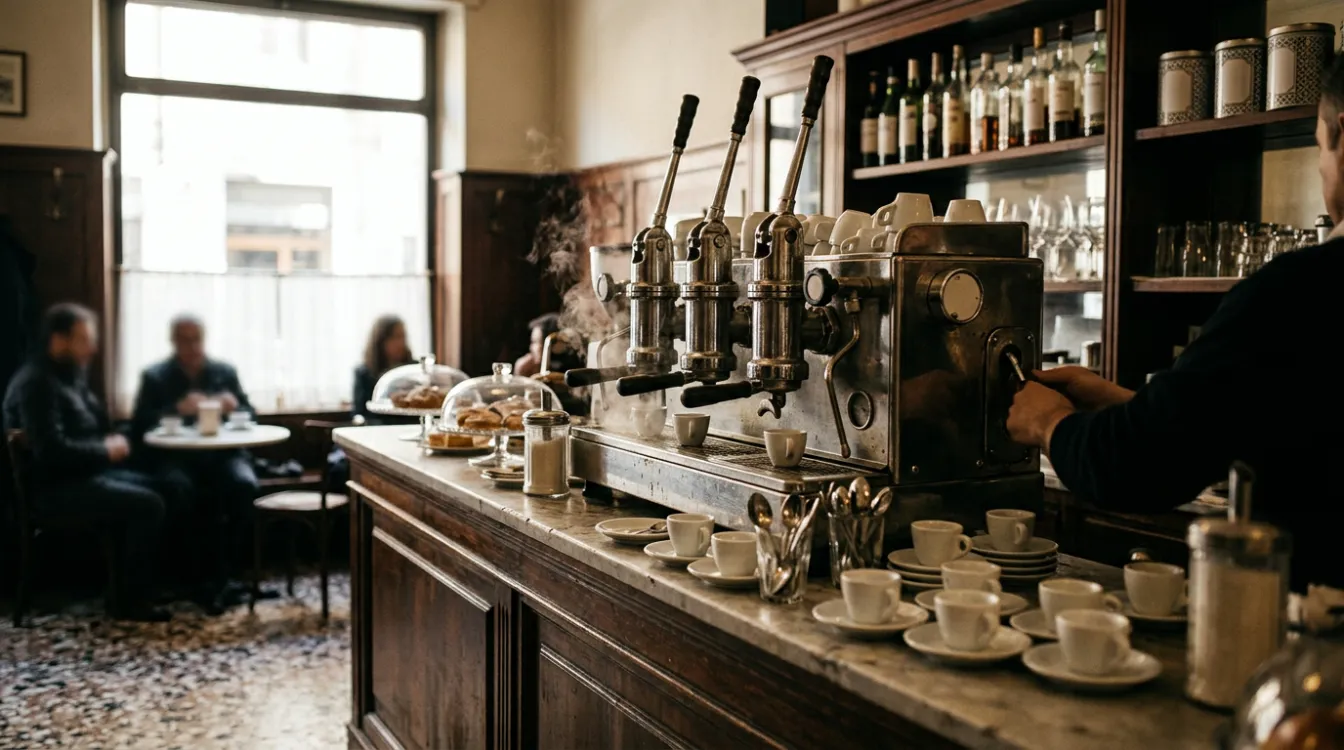
The arrival of high-pressure lever machines also changed how coffee was roasted and ground. Roasters adjusted blends and roast levels to suit the new, more concentrated extraction, and finer, more consistent grinding became essential. In other words, the lever didn't just change the machine; it reshaped the whole chain from roastery to cup, and many classic Italian espresso blends grew up around these machines.
Late 1950s: the FAEMA TR "Tartaruga"
Toward the end of the 1950s, FAEMA introduced the Termo Riscalento, or TR. Roughly a year after launch, it became widely known as the Tartaruga, Italian for "tortoise," because of its shape.
Its importance went far beyond its looks. The TR combined two key technologies:
- An electric rotary pump to deliver water to the group under pressure.
- A dual-boiler system separating brewing water from the steam boiler.
The electric pump meant brewing pressure no longer depended on steam or a barista's arm on a lever. The dual boilers allowed brewing temperature to be adjusted without changing steam boiler pressure, a major step forward in temperature control.
For busy cafés, this was a big deal. Coffee extraction and milk steaming need different conditions, and the TR let baristas manage them independently. It pulled together ideas from decades of earlier work: individual portafilters, separate brewing and steam pressure, mechanical pumps and independent boilers.
1961: the E61 and the modern espresso machine
In 1961, FAEMA launched the E61, named after the solar eclipse that year. It became one of the most influential espresso machines ever made.
The E61 brought together several innovations:
- An electric pump: delivering consistent brewing pressure, around 9 bar.
- A heat exchanger: fresh water was heated as it passed through a tube inside the steam boiler, so brewing water was always fresh rather than stale boiler water.
- A thermosiphon group head: water circulated naturally between the boiler and the heavy brass group, keeping the group hot and stable.
- Gentle pre-infusion: a mechanism that wetted the coffee before full pressure was applied, helping extraction.
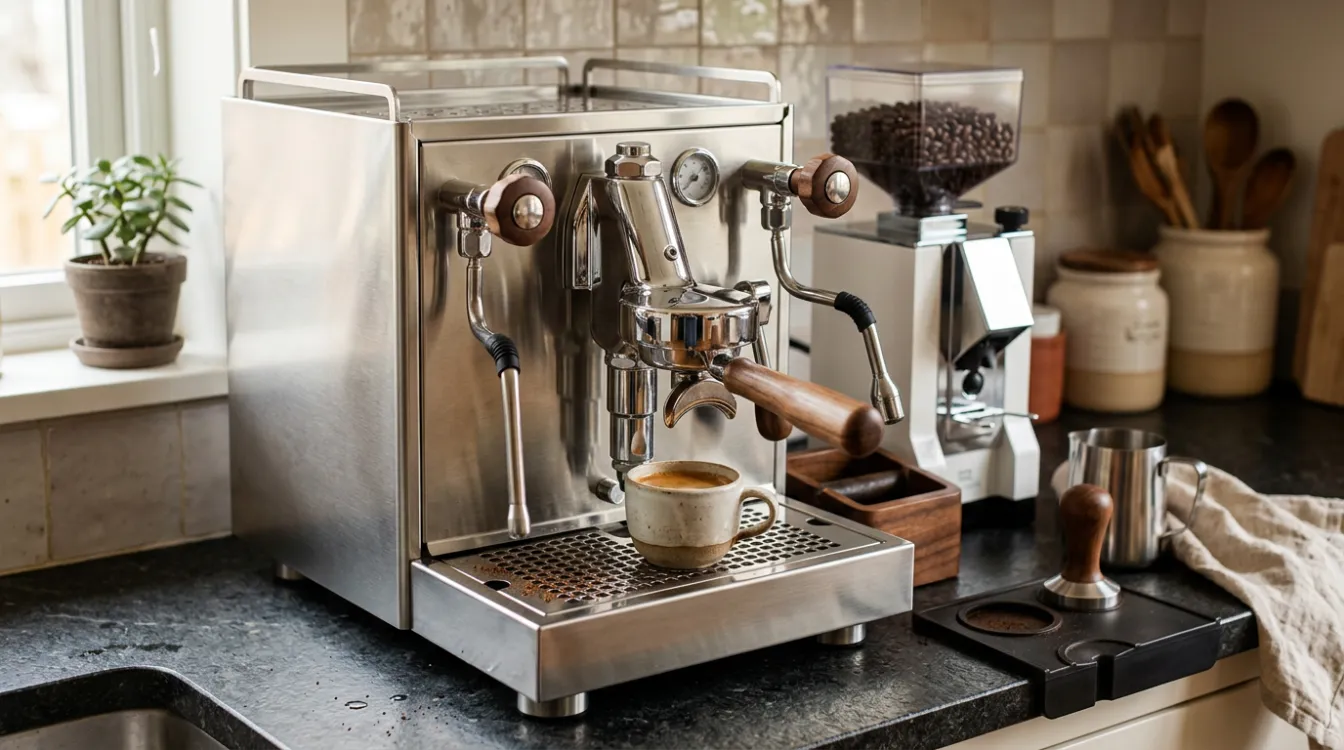
The E61 group head was so successful that versions of it are still used on many prosumer and commercial machines today. If you've seen a home espresso machine with a chrome, mushroom-shaped group and a lever on top, you've probably seen an E61-style design.
From the 1970s to today
After the E61, espresso machine development continued in many directions:
- Saturated groups and dual boilers: manufacturers developed groups directly connected to brew boilers for even greater temperature stability, setting new standards for commercial machines.
- Home espresso machines: smaller machines with vibratory pumps brought espresso into kitchens around the world from the 1970s onward.
- Super-automatic machines: bean-to-cup machines that grind, tamp, brew and froth at the touch of a button became popular from the 1980s. My guide to super-automatic vs semi-automatic machines explains the difference.
- PID temperature control: digital controllers allowed precise, stable brewing temperatures.
- Pressure and flow profiling: modern machines let baristas control pressure and flow during the shot, echoing what lever machines did mechanically decades earlier.
- Multi-boiler commercial machines: separate boilers for each group let cafés brew different coffees at different temperatures side by side.
- Smart and connected machines: apps, scales and sensors now help baristas track and repeat recipes.
Engineering principles that shaped espresso
Looking back, several principles from this history still define espresso machines:
| Principle | Where it started | Why it matters today |
|---|---|---|
| Pressure generation | Moriondo, Giotto, Gaggia, FAEMA | Higher, controlled pressure creates espresso and crema |
| Individual servings | Bezzera's portafilter | The basis of café workflow |
| Separate brewing and steam | Giotto, FAEMA Presidente and TR | Better temperature control |
| Temperature stability | Heat exchangers, dual boilers, E61 group | Consistent shots |
| Practical cleaning and reliability | Bezzera, Pavoni, FAEMA | Machines that survive busy service |
| Design | Ponti, La San Marco, FAEMA | Machines as icons of café culture |
My guide to espresso pressure explains how pressure affects the shot, and my article on espresso brew time covers timing.
The E61's influence is hard to overstate. For decades, it set the template for what a professional espresso machine looked like and how it worked, and its pump-plus-heat-exchanger design became the standard many cafés relied on. Even machines that moved on to saturated groups and dual boilers were, in many ways, answering the questions the E61 had raised about stability and consistency.
What did early "espresso" taste like?
Coffee from early steam machines was very different from today's espresso. Because pressure came from steam in the boiler, brewing water was often well above ideal temperatures, and pressure was relatively low, roughly 1.5 to 2 bar compared with around 9 bar in modern machines.
The result was strong, fast coffee, but often harsh and bitter, without the thick crema we now associate with espresso. It was closer to a very strong brewed coffee than to a modern shot.
That's why the spring lever was so revolutionary. By separating pressure from steam and pushing water through the coffee at much higher pressure and more suitable temperatures, it created the syrupy, crema-topped espresso that defines the drink today.
Where the parts of your machine came from
| Part of a modern machine | Historical origin |
|---|---|
| Boiler and pressure gauges | Moriondo's 1884 machine |
| Portafilter and group head | Bezzera's 1901 patent |
| Commercial production | Pavoni's Ideale |
| Separate brewing pressure | Giotto's pump concept and later FAEMA pumps |
| Piston and lever | Arduino, Cremonesi and Gaggia |
| Horizontal layout | La San Marco's horizontal boiler |
| Dual boilers | FAEMA Presidente and TR |
| Heat exchanger and thermosiphon group | FAEMA E61 |
| Electronic temperature control | Later digital PID controllers |
| Pressure and flow profiling | Modern machines, echoing lever behavior |
Next time you lock in your portafilter, you're using an idea more than 120 years old.
Where are those companies now?
Several names from this history are still part of the coffee world:
- La Pavoni still makes espresso machines, including home lever machines inspired by its history.
- Bezzera continues to produce commercial and home machines.
- Gaggia remains a well-known brand, especially for home machines.
- FAEMA is still associated with commercial espresso machines, and E61-style groups are made by many manufacturers.
- La San Marco continues to build commercial machines.
Many other brands have joined them, from Italian manufacturers to companies around the world, but the founding names remain a link to espresso's origins.
Espresso machines as design icons
From the start, espresso machines were meant to be seen. Early upright machines were topped with eagles and ornate decorations, gleaming with brass and copper. Mid-century machines adopted sleek chrome curves inspired by cars and aircraft. Gio Ponti's designs and later FAEMA models are now celebrated in design museums and collections.
That visual appeal still matters. Many people choose home machines partly for their looks, and cafés often place their machine where every customer can see it. The espresso machine has always been as much a symbol of café culture as a tool.
The key people at a glance
| Person | Contribution |
|---|---|
| Angelo Moriondo | Early steam-pressure coffee machine patent, 1884 |
| Luigi Bezzera | Group heads and individual portafilters, 1901 |
| Desiderio Pavoni | Commercial success with the Ideale, shown in 1906 |
| Luigi Giotto | First known pump-operated machine, 1909 |
| Pierre Teresio Arduino | Screw-piston group patent, 1910 |
| Antonio Cremonesi | Later screw-piston patent, sold to Gaggia |
| Giovanni Achille Gaggia | Spring-lever group and high-pressure espresso with crema |
| Ernesto Valente | Co-founder of FAEMA, pump and dual-boiler machines, E61 |
| Gio Ponti | Iconic machine design for La Pavoni |
How brewing pressure increased over time
Approximate brewing pressure by era (bar)
The jump from steam to lever machines was the single biggest change in how espresso tasted. Higher pressure allowed finer grinds, faster extraction of oils and solids and the creation of crema. My guide to espresso pressure explains why many modern baristas experiment with pressures below 9 bar.
A brief history of pre-infusion
Pre-infusion means gently wetting the coffee before full pressure is applied. It helps the coffee bed settle evenly and reduces channeling.
Lever machines naturally pre-infuse: when the lever is pulled down, water fills the group at boiler pressure before the spring takes over. The E61 group added a mechanical pre-infusion chamber to pump machines. Modern machines can program pre-infusion time and pressure precisely.
Once again, a feature marketed as modern turns out to have deep roots.
Steam wands and the rise of milk drinks
From Moriondo's machine onward, espresso machines had boilers producing steam, and steam wands soon followed. That made it easy to heat and froth milk right next to the coffee.
Steam wands transformed café menus. Cappuccino, caffè latte and later flat whites and modern latte art all depend on the ability to steam milk to the right texture. As dual boilers and larger steam boilers arrived, baristas gained the power to steam milk while pulling shots, making milk drinks fast enough for busy cafés. My guide to the science of steamed milk explains what happens to milk under the wand.
Grinders evolved alongside machines
Espresso machines couldn't do their job without suitable grinders. As pressure increased, coffee had to be ground much finer and more consistently. Burr grinders with precise adjustment, doser grinders that measured portions in cafés and later on-demand grinders all developed alongside espresso machines.
Today, many baristas consider the grinder even more important than the machine. My guide to coffee grind size explains why.
How the barista's role changed with the machines
As machines evolved, so did the job of the person behind them. Operators of early steam machines mostly managed fire, water and pressure. With Bezzera's portafilters, they began preparing individual cups. The spring lever made the barista's arm part of the brewing process, and pulling shots became a visible, physical skill admired by customers.
Pump machines like the E61 shifted the focus again, from physical effort to consistency, speed and milk technique. Today's baristas also manage grinders, recipes, water and milk with scientific precision, and many compete on the world stage. My article on the World Barista Championship shows how far the craft has come since the days of steam and gauges.
How espresso machines shaped café culture
The machines didn't just change coffee; they changed how people used cafés.
- The standing bar: quick, strong coffee made at the counter encouraged the Italian habit of drinking espresso standing up, chatting with the barista and leaving within minutes.
- The barista as performer: gleaming machines with levers and steam made coffee preparation a visible craft and a bit of theater.
- Milk drinks: steam wands made cappuccino and other milk drinks possible, giving cafés more to offer.
- Design and status: stylish machines became symbols of modernity, and cafés competed to have the most impressive one on the counter.
After World War II, as lever machines spread, espresso bars became centers of social life in Italian cities.
Espresso spreads around the world
In the 1950s, espresso bars with Italian machines opened in cities such as London, often attracting young people and becoming fashionable meeting places. Italian immigrants also brought espresso culture to countries including Australia, the United States and Argentina, where it mixed with local habits.
In Australia and New Zealand, Italian-style cafés laid the foundations for the flat white and today's strong café culture. In the United States, espresso drinks became widely popular from the 1980s and 1990s, as coffeehouse chains brought lattes and cappuccinos to every corner.
Today, espresso machines are found in cafés from Tokyo to Bogotá, and in millions of home kitchens. My guide to essential coffee drinks explains the drinks that grew out of this history.
How lever and pump machines differ
| Feature | Spring-lever machine | Pump machine |
|---|---|---|
| Pressure source | Spring-driven piston | Electric pump |
| Pressure profile | Starts high and gradually declines | Usually steady, unless profiled |
| Barista involvement | Physical pull for every shot | Push a button or turn a paddle |
| Consistency | Depends on spring and technique | Very consistent |
| Noise | Quiet | Pump noise |
| Electricity for pressure | No | Yes |
Lever machines are still loved for the natural declining pressure profile, which many people find produces sweet, syrupy shots. Pump machines dominate commercial cafés because they're fast, consistent and easy to train on.
How espresso came into the home
For most of the 20th century, espresso was something you drank in a café. Commercial machines were large, expensive and needed plumbing and powerful electrical connections.
Home espresso became possible as manufacturers developed smaller machines:
- Stovetop moka pots, popular in Italian homes since the 1930s, gave people strong coffee at home, though not true espresso.
- Small manual lever machines for the home appeared in the mid-20th century, bringing café-style shots to enthusiasts.
- Compact pump machines with vibratory pumps made home espresso far more accessible from the 1970s onward.
- Prosumer machines borrowed commercial technology, including E61 groups, heat exchangers and dual boilers.
- Super-automatics and capsule machines made espresso-style coffee possible with a button press.
Today's home baristas have more control than café baristas had for most of history, with PID controllers, pressure gauges, flow control and precise grinders. My guide to espresso machine types explains the main options.
Restoring and collecting vintage machines
Many coffee enthusiasts collect and restore vintage espresso machines, especially lever machines and early pump machines from the 1950s and 1960s. Some restored machines are used daily in cafés and homes; others are displayed as works of design.
Restoring a vintage machine usually involves:
- Descaling or replacing old boilers and pipes.
- Replacing gaskets, seals and springs.
- Updating electrical wiring for safety.
- Rechroming or repainting the body.
- Testing safety valves and pressure systems carefully.
If you're interested in a vintage machine, have it checked by a technician familiar with older equipment. Old boilers and wiring can be dangerous if not properly restored. My guide to coffee machine cleaning and descaling covers modern maintenance basics.
Pulling shots on a vintage lever
A few years ago, I had the chance to pull shots on a restored 1950s-style spring lever machine in a small café. Lowering the lever, feeling the spring compress and then watching the shot flow as the lever slowly rose felt completely different from pressing a button.
The espresso was thick and sweet, with a dense crema. It was a reminder that many of the "new" ideas in modern machines, such as pre-infusion and declining pressure, were already built into these machines more than seventy years ago.
What the history teaches home baristas
- Pressure matters, but so does control. From steam to springs to pumps, every step aimed to control how water moves through coffee.
- Temperature stability is key. Heat exchangers and dual boilers exist because temperature swings ruin shots.
- Clean machines make better coffee. Bezzera's removable portafilter was partly about easier cleaning.
- Fresh, single servings taste best. The whole history moves from batches toward coffee made to order.
- Good design lasts. The E61 group is over sixty years old and still widely used.
Choosing a machine with history in mind
Understanding this history can actually help when choosing a home machine.
- If you love tradition and hands-on brewing, a manual or spring-lever machine offers the experience of 1950s cafés, with natural pre-infusion and declining pressure.
- If you want classic café performance, an E61-style heat exchanger or dual-boiler machine follows the design that defined modern cafés.
- If you want convenience, a super-automatic machine continues the long-standing goal of making coffee faster and easier.
- If you love experimenting, a modern profiling machine lets you recreate the pressure curves of lever machines or try entirely new ones.
There's no single right choice. Each type reflects a different chapter in espresso history, and each can make excellent coffee in the right hands. What matters most is good beans, a capable grinder, clean equipment and a little practice.
How the classic Italian espresso was defined
As espresso matured, Italian organizations tried to define what a traditional espresso should be. One well-known standard from the Italian Espresso National Institute describes a single espresso made with about 7 grams of coffee, water around 88°C (about 190°F), roughly 9 bar of pressure and an extraction of about 25 seconds, producing around 25 milliliters of coffee.
Specialty coffee has since moved in different directions, often using larger doses, different ratios and lighter roasts. But the classic standard captures the drink that lever and pump machines made possible in the mid-20th century: small, strong, sweet and topped with crema. My guide to espresso brew time explains how modern recipes differ.
Where to experience espresso history today
If you'd like to see this history in person:
- Coffee machine museums: there are museums dedicated to espresso machines in Italy, including one near Milan that traces the history of Italian coffee machines with restored examples.
- Historic cafés: many old cafés in Turin, Milan, Naples and Rome still use classic lever machines or display vintage ones.
- Trade shows: coffee fairs often feature restored vintage machines alongside the latest technology.
- Specialty cafés: some modern cafés choose lever machines for their flavor and theater.
Seeing a 1950s lever machine pull a shot next to a modern multi-boiler machine is a great way to appreciate how far, and how little, things have changed.
Where espresso machines are heading
Today's innovations build directly on this history:
- Precise profiling: machines that control pressure, flow and temperature second by second.
- Energy efficiency: better insulation, smarter heating and boilers that heat only what's needed.
- Connectivity: apps that log shots, share recipes and guide beginners.
- Automation with quality: semi-automatic machines that automate grinding, dosing and milk texturing while keeping the barista in control.
- Sustainability: machines designed for repair, longer lifespans and lower water use.
Many of these advances echo the goals of the original inventors: make great coffee faster, more consistently and with more control.
Myths about the history of espresso
"One person invented espresso"
Espresso evolved through many inventors over decades, from Moriondo to Bezzera, Pavoni, Giotto, Gaggia and FAEMA.
"Espresso has always had crema"
Thick crema arrived with high-pressure lever machines in the late 1940s.
"Early machines made single shots"
Moriondo's original machine was a batch brewer making around 30 servings at once.
"Pumps are a modern invention"
Giotto experimented with a manual pump in 1909, and FAEMA introduced electric rotary pumps in the 1950s.
"Pressure profiling is new"
Lever machines have always created a declining pressure profile; modern machines simply let you control it electronically.
The verdict
The espresso machine wasn't invented in a single moment. It grew from a series of breakthroughs between 1884 and the early 1960s. Moriondo showed that steam and pressure could brew coffee quickly. Bezzera and Pavoni introduced individual portafilters and turned the idea into a commercial product. Giotto separated brewing pressure from steam. Arduino and Cremonesi explored pistons, and Gaggia's spring lever created high-pressure espresso with crema.
FAEMA then brought pump-driven machines and dual boilers into cafés with the TR, and the E61 combined a pump, heat exchanger and thermosiphon group into a design still used today.
Every time you pull a shot at home or order a cappuccino, you're enjoying the results of more than a century of Italian engineering, design and café culture.
Frequently asked questions
Who invented the espresso machine?
No single person. Angelo Moriondo patented an early steam machine in 1884, and many others refined it.
When was the first espresso machine made?
Moriondo's 1884 patent is usually cited as the starting point.
Who invented the portafilter?
Luigi Bezzera introduced group heads with individual portafilters in 1901.
When did crema appear?
With Gaggia's high-pressure spring-lever machines in the late 1940s.
What was the FAEMA E61?
A 1961 machine combining a pump, heat exchanger and thermosiphon group, still widely copied.
What is a lever espresso machine?
A machine where a spring or lever drives a piston to push water through the coffee.
What did La Pavoni contribute?
Commercializing Bezzera's design with the Ideale, one of the first successful machines.
Are E61 machines still made?
Yes, E61-style group heads are used on many modern machines.

- Michael Reynolds, historical research
- Espresso machine, Wikipedia
- Angelo Moriondo, Wikipedia
- Achille Gaggia, Wikipedia
- Faema E61, Wikipedia
Related guides
Espresso machine types Espresso crema explained Coffee machine cleaning and descalingWritten by Michael Reynolds. Last updated November 20, 2026.