Super-Automatic vs Semi-Automatic Espresso Machines: Convenience, Flavor and Which to Buy
One machine makes a cappuccino at the press of a button. The other asks you to grind, tamp, time and steam, and rewards you with bolder espresso. Choosing between a super-automatic and a semi-automatic is one of the biggest decisions in home coffee. I've used both side by side for months. Here's how they really differ, and who each one is for.
We choose products independently. We may earn a commission through links on this page; your price stays the same. Affiliate policy
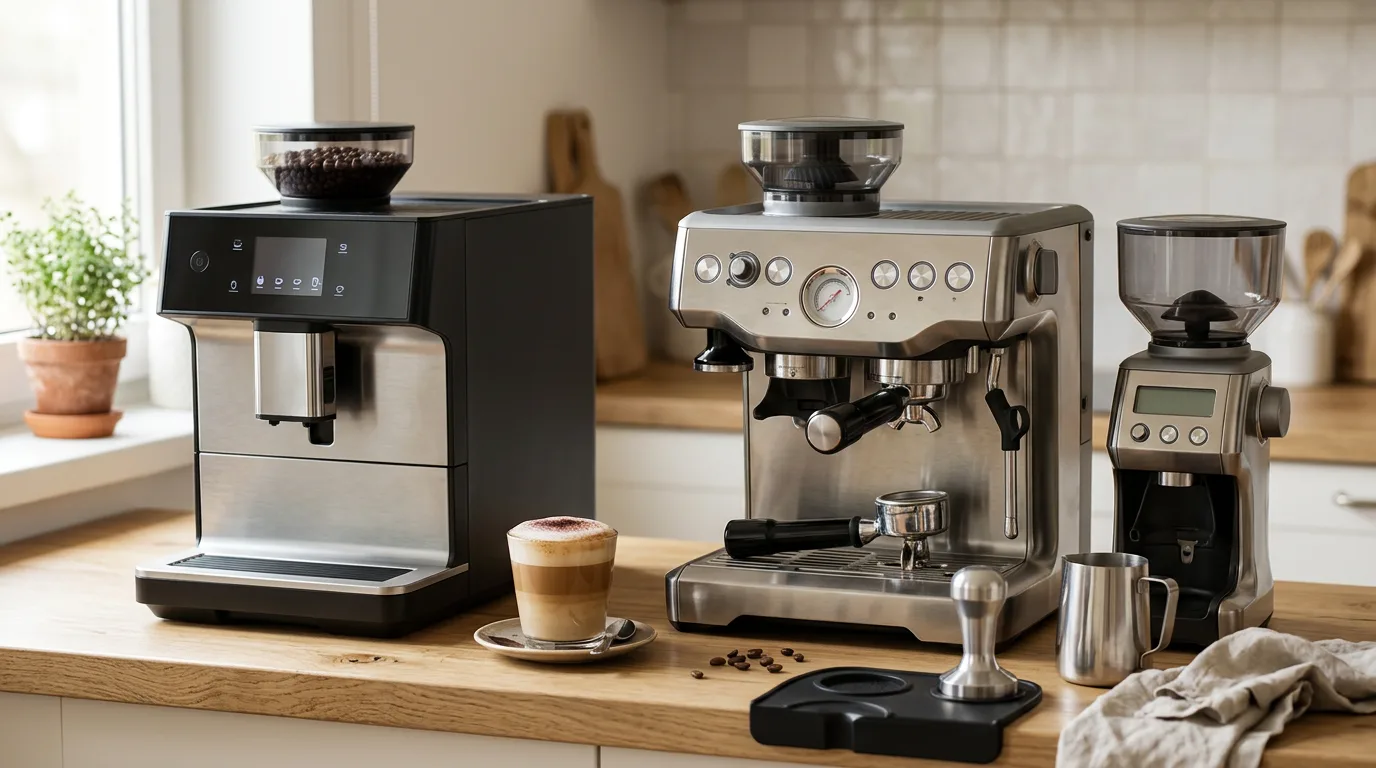
Buy a super-automatic if you want great coffee with zero effort: it grinds, doses, tamps, brews and froths milk at the press of a button, the same way every time. Buy a semi-automatic if you enjoy the craft: you grind, tamp, time the shot and steam the milk yourself, and in return you get bolder, more nuanced espresso and room to grow. Super-automatics suit busy mornings and multi-person households. Semi-automatics suit hobbyists who buy specialty beans and have a few extra minutes.
Why this choice matters so much
If you're upgrading your home coffee, the choice between a super-automatic and a semi-automatic shapes everything that follows: your mornings, your budget, the beans you buy and how much you'll learn.
The two categories are built on completely different philosophies. A super-automatic hides the entire process inside the machine. A semi-automatic puts most of it in your hands.
To compare them fairly, I lived with a high-end example of each: the Jura E8 as the push-button super-automatic, and the Breville Oracle Jet as a modern, smart semi-automatic. I also used a traditional semi-automatic with a separate grinder to see the fully manual end of the spectrum.
Neither is objectively better. They answer different questions. The right one depends on how you want coffee to fit into your day.
Think of it this way: a super-automatic is like a great dishwasher, quietly doing a job well so you never have to think about it. A semi-automatic is more like a good chef's knife, a tool that becomes more rewarding the better you get at using it.
Super-automatic vs semi-automatic at a glance
| Feature | Super-automatic | Semi-automatic |
|---|---|---|
| Grinding | Built in, automatic | Separate grinder or built-in, you control it |
| Dosing and tamping | Automatic, hidden | By you (or assisted) |
| Shot timing | Programmed volume | You start and judge it |
| Milk | Automatic frothing | Steam wand (manual or assisted) |
| Time per milk drink | About 2 minutes, hands-free | 3-6 minutes, hands-on |
| Learning curve | Almost none | Moderate to steep |
| Espresso flavor | Smooth, consistent, lighter | Bolder, richer, more nuanced |
| Bean freshness needs | Forgiving | Demanding |
| Best for | Busy people, households | Hobbyists, flavor seekers |
How I tested
For several months, both machines sat side by side on my counter. Every morning I made at least one drink on each, using the same medium roast house blend most days and a light roast Ethiopian on weekends.
I timed each workflow from switching on to the first sip, counted the steps, and noted every time something went wrong: a sour shot, a clogged milk line, a forgotten purge.
I also asked my household and visiting friends to use both machines without instructions. Their reactions told me as much as my own tasting notes.
Finally, I ran blind tastings of straight espresso and cappuccinos made with the same beans, so I wasn't fooled by knowing which machine made which cup.
Manual, semi-automatic, automatic and super-automatic
The names are confusing, so let's clear them up. They describe how much of the process the machine does for you.
- Manual (lever): you create the pressure yourself by pulling a lever.
- Semi-automatic: a pump creates the pressure, but you start and stop the shot. You also grind, dose and tamp.
- Automatic: like a semi-automatic, but the machine stops the shot at a programmed volume.
- Super-automatic: the machine does everything, from grinding beans to frothing milk.
In everyday conversation, "semi-automatic" usually covers both semi-automatic and automatic machines, because the hands-on workflow is the same. That's how I'll use it here.
How a super-automatic works
The whole point of a super-automatic is simplicity with unwavering repeatability. You put a cup under the spout and press a button. Everything else happens inside.
With a super-automatic, you never have to learn the traditional barista skills:
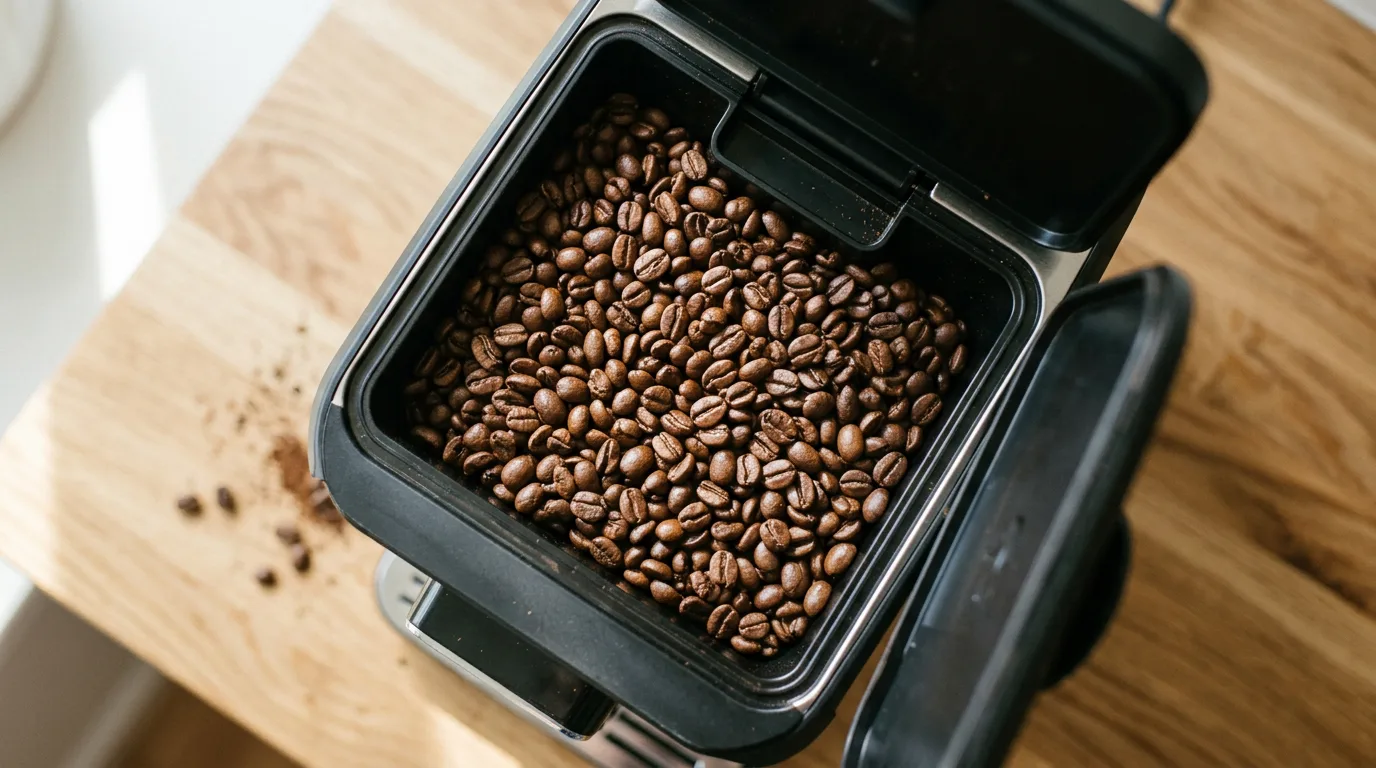
- No manual grinding. A built-in burr grinder grinds beans straight from the hopper.
- No manual dosing. No scale, no ratios to calculate.
- No manual tamping. The brew unit compresses the coffee itself.
- No shot timing. The machine stops at the programmed volume.
- No milk technique. Milk is drawn from a container and frothed automatically.
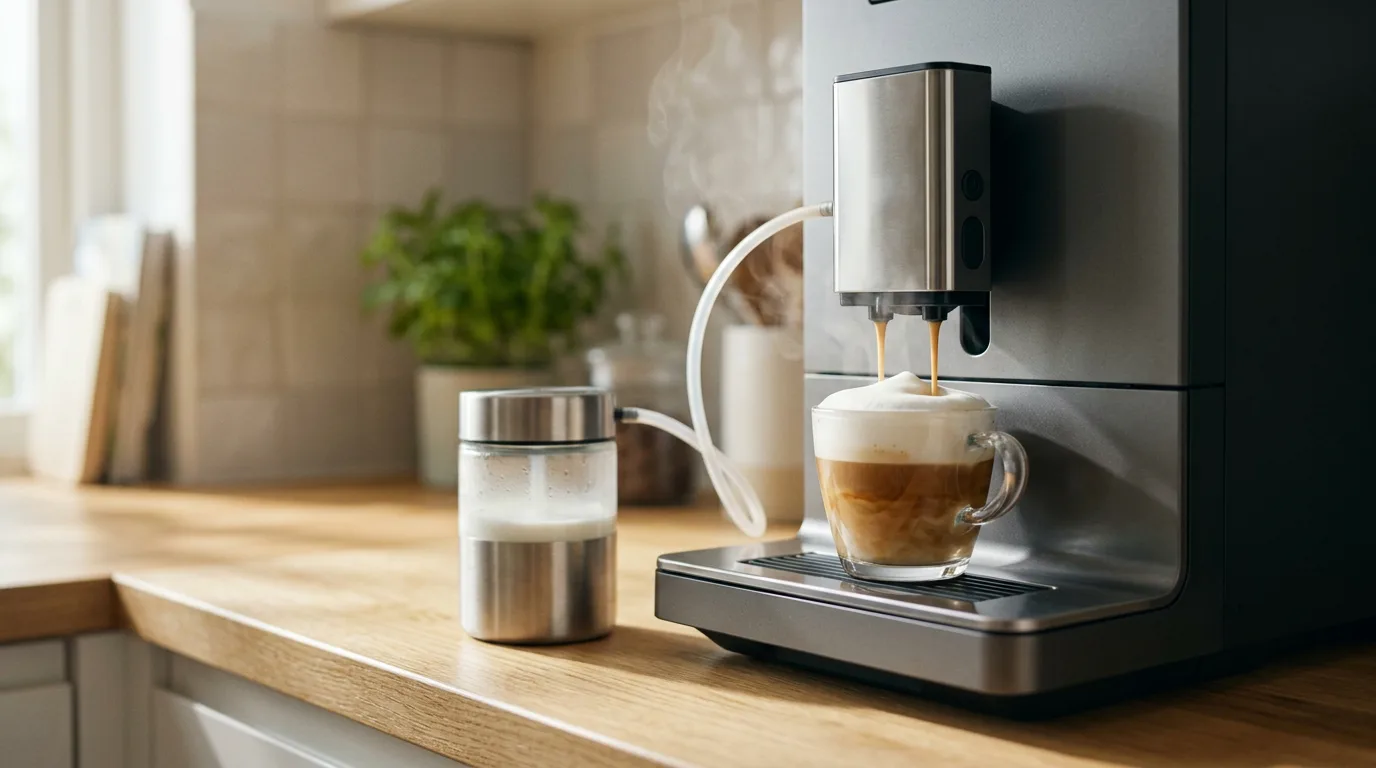
Because it grinds whole beans right before each cup, you always get freshly ground coffee. And because the machine repeats the same process every time, the cup you love on Monday tastes the same on Friday.
Inside, the key part is the brew unit: a small chamber that receives the grounds, compresses them into a puck, pushes hot water through at pressure, then ejects the spent puck into an internal bin.
Customizing a super-automatic
A common myth is that super-automatics lock you into factory settings. In reality, high-end models let you fine-tune almost every drink in advance.
On the Jura E8, for example, you press and hold the cappuccino button to open its settings. There you can adjust:
- Coffee strength. How much coffee is ground for the shot, which controls boldness and body.
- Espresso volume. The exact liquid output, for instance 1 ounce for a single or 2 ounces for a double.
- Brew temperature. Usually a few levels, so you can match it to the roast.
- Milk and foam amounts. How much milk and how much foam go into each drink.
- Extra shot. Automatically adds another shot for a stronger drink.
Once you save your favorites, the machine remembers them. Many models also store profiles for different people in the household, so everyone gets their own drink with one press.
The grind size is usually adjustable too, but only in a few steps and often only while the grinder is running. It's coarse control compared with a dedicated espresso grinder.
Our tip: Spend your first week tweaking strength and volume for each drink. A super-automatic tuned to your taste is far better than one left on factory settings.
A super-automatic morning
Once your preferences are saved, daily use takes almost no thought:
- Place your cupPut your mug or cappuccino cup, typically 6 to 8 ounces, under the spout.
- Connect the milkAttach the milk tube to a glass milk container, a chilled stainless steel jug or the carton.
- Press the buttonChoose your drink.
- Walk awayYou hear the grinder, the brew unit and the milk frother; in under 2 minutes, the drink is done.
During my test, this was the machine my household reached for on weekday mornings. Nobody had to think, nobody made a mess, and everyone got the same drink they liked yesterday.
How a semi-automatic works
A semi-automatic works on a completely different idea. It's rooted in the traditional café workflow, where a barista controls each step.
The machine supplies hot water at pressure and steam. Everything else, from grinding to timing to milk, depends on you.
Modern smart semi-automatics like the Breville Oracle Jet automate some of the fiddliest parts. But even the smartest semi-automatic still asks you to handle the portafilter, start the shot and finish the drink.
Grinding, dosing and tamping
On a traditional semi-automatic, you buy a separate grinder, grind fresh coffee into the portafilter, weigh the dose, distribute it evenly and tamp it firmly and level.
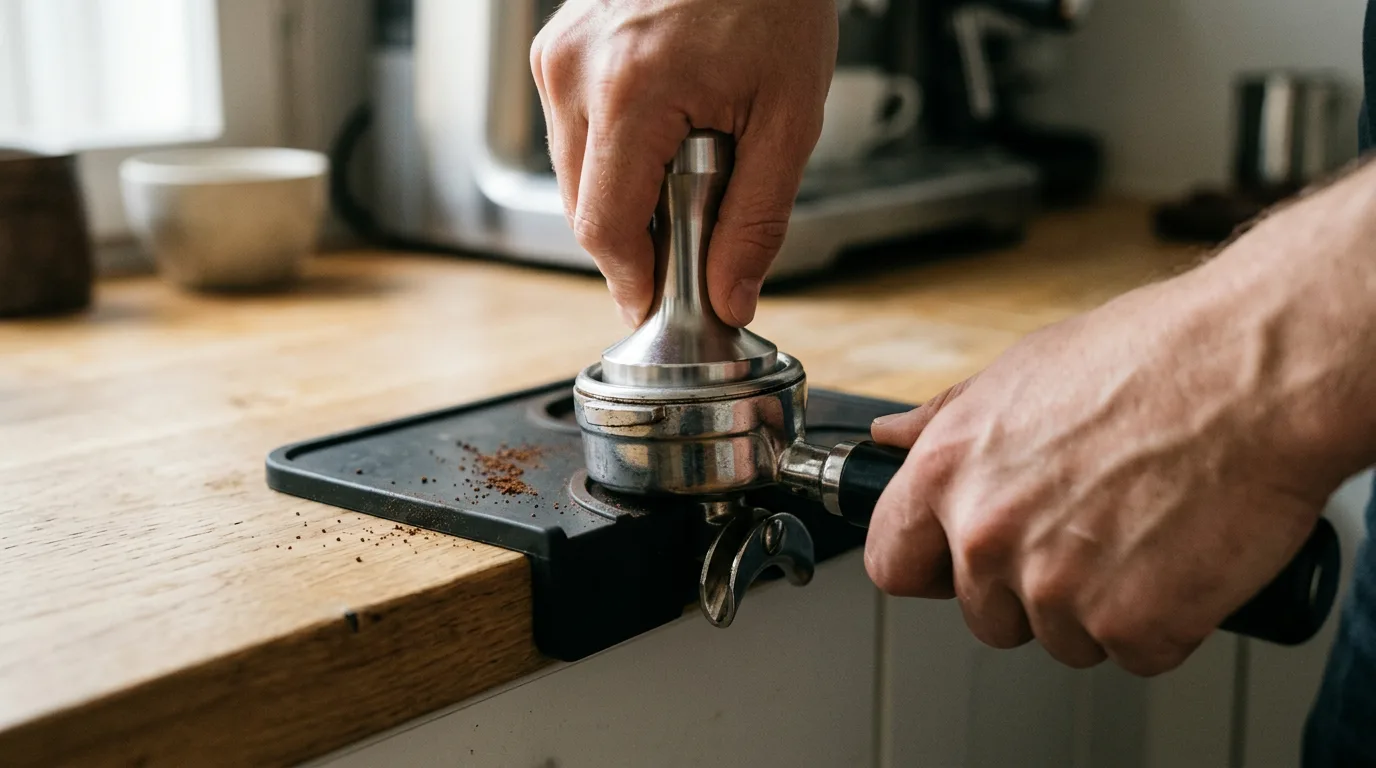
Each step matters. An uneven bed or a crooked tamp lets water find weak spots, which causes channeling and a sour, thin shot.
Smart machines like the Oracle Jet streamline this. When you choose a drink, a built-in grinder doses straight into the portafilter and an automatic tamping arm compresses the coffee.
But then the human part takes over again:
- You unlock the portafilter from the grinding station.
- You move it across and lock it firmly into the group head.
- You place your cup and start the extraction.
Our tip: On any semi-automatic, a cheap scale and a distribution tool improve consistency more than almost any machine upgrade.
Dialing in: the 30-second rule
The defining trait of a semi-automatic is how much it depends on extraction timing. You're in charge of how water and coffee meet.
The usual benchmark is a double shot of about 2 ounces of liquid espresso in roughly 25 to 30 seconds. Missing that window changes the taste a lot:
- Too fast (15 to 20 seconds): water rushes through, under-extracts the coffee and leaves it sour, thin and salty.
- Too slow (50 to 60 seconds): water struggles through, over-extracts and turns the shot bitter, harsh and drying.
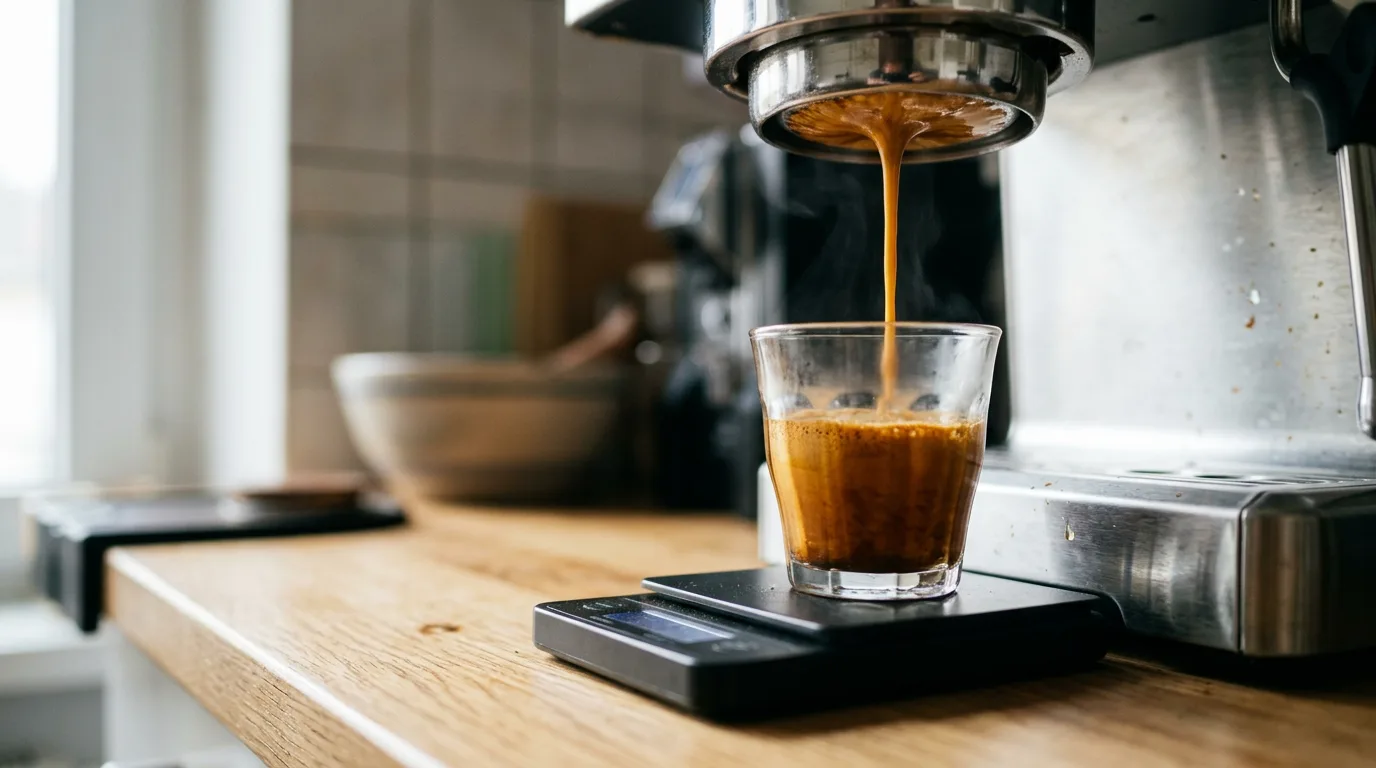
Adjusting your setup to hit the target is called dialing in. The main tool is the grinder:
- Shot too fast (under 25 seconds)? Grind finer to slow the water down.
- Shot too slow (over 35 seconds)? Grind coarser to let it flow.
Every new bag of beans, and even the same beans as they age, can need a small adjustment. Smart semi-automatics like the Oracle Jet help by monitoring shot time and suggesting grind changes on the screen.
Time is a guide, not the goal. Taste decides. My guide to coffee extraction explains what's happening in the cup.
Milk: one button vs a steam wand
On a super-automatic, milk is drawn through a tube, heated and frothed automatically, then poured into your cup. The amount and foam level are preset.
The result is consistent and pleasant, though usually a little airier and less silky than well-steamed milk from a wand. Latte art is mostly out of reach.
On a classic semi-automatic, you texture milk with a steam wand. You control the wand position, how much air goes in and when to stop. It takes practice, but it produces glossy microfoam you can pour into latte art.
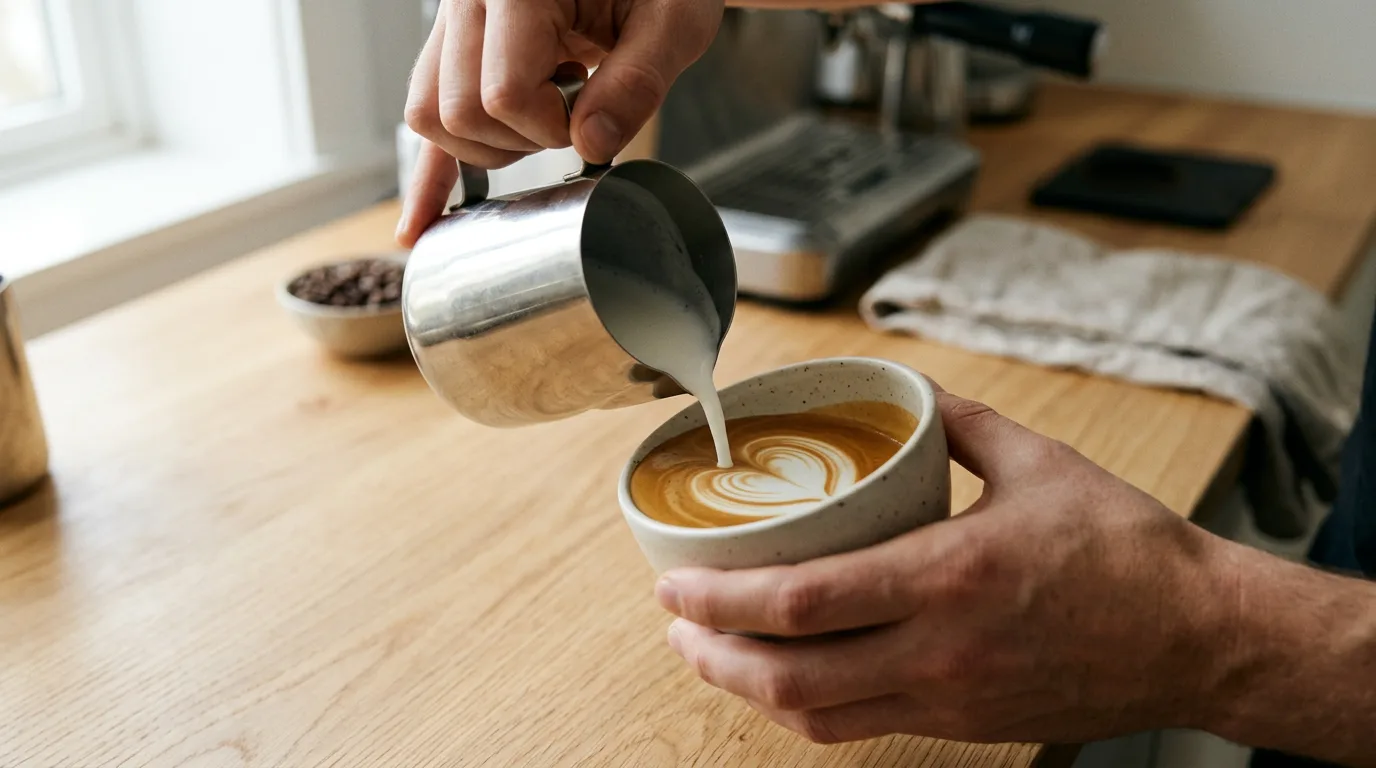
The Oracle Jet offers a middle ground: an automatic steam wand where you set the milk temperature and foam level, then it steams and stops by itself. You still pick up the pitcher and pour.
If you love flat whites with silky texture, a steam wand wins. If you want a reliable cappuccino without thinking, the super-automatic wins.
A semi-automatic morning, step by step
For comparison with the one-button routine, here's what a cappuccino looks like on a traditional semi-automatic:
- Warm upSwitch the machine on early enough for the boiler and group head to stabilize.
- Weigh and grindWeigh about 18 grams of beans and grind them fresh into the portafilter.
- Distribute and tampLevel the grounds, then tamp firmly and evenly.
- Pull the shotLock in, start the pump and stop at about 36 grams of liquid in 25 to 30 seconds.
- Steam the milkPurge the wand, stretch the milk briefly, then spin it into glossy microfoam.
- PourSwirl the pitcher and pour into the espresso, ideally with a little latte art.
- Clean upKnock out the puck, rinse the portafilter and wipe and purge the steam wand.
Written down it looks like a lot. In practice, after a few weeks it becomes a smooth, almost meditative routine of four to six minutes.
Our tip: Start steaming milk while the shot is running if your machine allows it. It saves a minute and keeps the espresso fresher.
Pros and cons side by side
Super-automatic
- Pro: one-button drinks in about two minutes, with no skill needed.
- Pro: the same result every time, for every person in the house.
- Pro: forgiving with beans and easy for guests.
- Con: lighter espresso with less body and nuance.
- Con: limited control over grind and extraction.
- Con: more hidden parts to clean and maintain.
Semi-automatic
- Pro: bolder, richer, more complex espresso.
- Pro: full control, and real milk texture for latte art.
- Pro: a rewarding hobby with room to grow.
- Con: takes time, attention and practice.
- Con: needs fresh beans and usually a separate grinder.
- Con: results vary with your technique.
Time and morning workflow
This is the clearest difference between the two, and for many people, the deciding one.
A super-automatic needs almost no time and no attention. You press one button, and within about 2 minutes the drink is ready while you pack lunches or get dressed.
A semi-automatic needs you at the machine from start to finish. Grinding, moving the portafilter, timing the shot and steaming the milk all take active effort.
| Task | Super-automatic | Semi-automatic |
|---|---|---|
| One espresso | About 1 minute, hands-free | 2-3 minutes, hands-on |
| One cappuccino | About 2 minutes, hands-free | 4-6 minutes, hands-on |
| Four cappuccinos | About 8 minutes, mostly waiting | 15-20 minutes, active |
| Daily cleanup | Rinse milk system, empty bin | Knock out puck, purge wand, wipe up |
On rushed weekday mornings, I simply didn't have time for the semi-automatic. On weekends, I looked forward to it.
The learning curve
A super-automatic has virtually no learning curve. Anyone can walk up on day one, read the drink icons and make something good. Guests, teenagers and grandparents all managed it in my kitchen without instructions.
A semi-automatic has a moderate to steep learning curve. Even with smart guidance, you need to understand grind size, dose, yield, shot time and milk texture.
My first week with a traditional semi-automatic produced plenty of sour shots and bubbly milk. By the third week, I was pulling shots I'd happily pay for in a café. That progress is a big part of the appeal.
My impressions after months with both
Flavor and body
A super-automatic produces a consistently smooth, rich and very enjoyable cup that easily beats pods and most office coffee. Milk drinks in particular taste great.
A semi-automatic produces noticeably bolder, heavier and more pronounced espresso. The reasons are mostly physical:
- Bigger dose, bigger basket. A standard portafilter basket holds more coffee in a deeper bed than most super-automatic brew units.
- Finer, better grind. A dedicated espresso grinder can grind finer and more evenly than the small built-in grinders of most super-automatics.
- More precise control. You can fine-tune dose, yield, time and temperature for each coffee.
In side-by-side tastings with the same beans, the semi-automatic shot was thicker, sweeter and more complex. The super-automatic shot was lighter and rounder. In a large latte, that gap shrinks a lot.
If you mostly drink milk drinks, you'll notice the difference less. If you drink straight espresso, you'll notice it right away.
Drink variety: what each can make
Modern super-automatics come with long drink menus: espresso, ristretto, lungo, Americano, cappuccino, latte macchiato, flat white, hot milk and hot water. Some add iced and cold-brew-style drinks. Everything is one press away.
A semi-automatic can make all of the classic espresso drinks too, but you build each one yourself. That's more work, yet it means you can make anything, in any size, with any milk texture you like.
If you love trying different drinks without effort, the super-automatic's menu is a real perk. If you have one or two favorite drinks you want to perfect, the semi-automatic is better suited. My guide to cappuccino vs latte vs flat white covers the classic milk drinks either machine can make.
Plant-based milks work in both. In super-automatics, barista versions of oat milk froth most reliably; with a steam wand, you can adjust your technique to each milk.
Bean sensitivity
A super-automatic is much more forgiving about beans. Coffee roasted two weeks ago or two months ago will produce a decent cup, because the machine isn't relying on fine puck resistance.
A semi-automatic is very sensitive to freshness. To get the right resistance for a 25 to 30 second shot, beans usually need to be within a few weeks of roasting. Stale beans run fast and taste flat no matter what you do.
There's one more catch for super-automatics: very oily, dark roasted beans can clog the grinder and hopper over time. Medium roasts work best in most models.
Our tip: With a semi-automatic, buy smaller bags more often from a roaster that prints the roast date. My guide to coffee freshness explains why it matters.
Inside the machine: brew unit vs group head
Much of the taste difference comes from the hardware where water meets coffee.
A super-automatic uses a compact brew unit. Ground coffee drops into a small chamber, a piston compresses it, water is pushed through, and the puck is ejected. It's clever engineering, but the chamber is small and the coffee bed is relatively shallow.
A semi-automatic uses a group head and portafilter, the same design cafés use. The basket holds a deeper, wider bed of more finely ground coffee, and the heavy metal group helps keep temperature stable.
| Part | Super-automatic | Semi-automatic |
|---|---|---|
| Where coffee brews | Internal brew unit | Portafilter in a group head |
| Typical dose | Smaller, adjustable by strength | About 18-20 g for a double |
| Grinder | Small built-in burr, few steps | Dedicated espresso grinder, fine control |
| Pressure and pre-infusion | Preset by the machine | Often adjustable |
| Spent coffee | Dropped into an internal bin | Knocked out by hand |
That's why a super-automatic's espresso tends to be lighter, and why it shines in milk drinks where body matters less.
Pressure, temperature and pre-infusion
Both machine types brew espresso with pressurized hot water, usually around 9 bar at the coffee. The difference lies in who decides the details.
A super-automatic runs a fixed program. Most include a short pre-infusion, where the coffee is wetted before full pressure, and offer a few temperature levels. You choose from presets rather than shaping the shot.
A semi-automatic often gives you more say. Depending on the model, you can set the exact brew temperature with a PID, adjust pre-infusion time, or even control water flow during the shot.
For medium roasts, the presets on a good super-automatic work well. For light roasts, which need higher temperatures and careful extraction, the extra control of a semi-automatic makes a clear difference.
If you want to understand temperature in more depth, my guide to espresso machine types explains how boilers and PID controllers keep it stable.
Cleaning and maintenance
Both machines need care, but in different ways.
Super-automatic
- Rinse the milk system after every milk drink, and run a milk-system clean regularly.
- Empty the drip tray and spent-puck bin often.
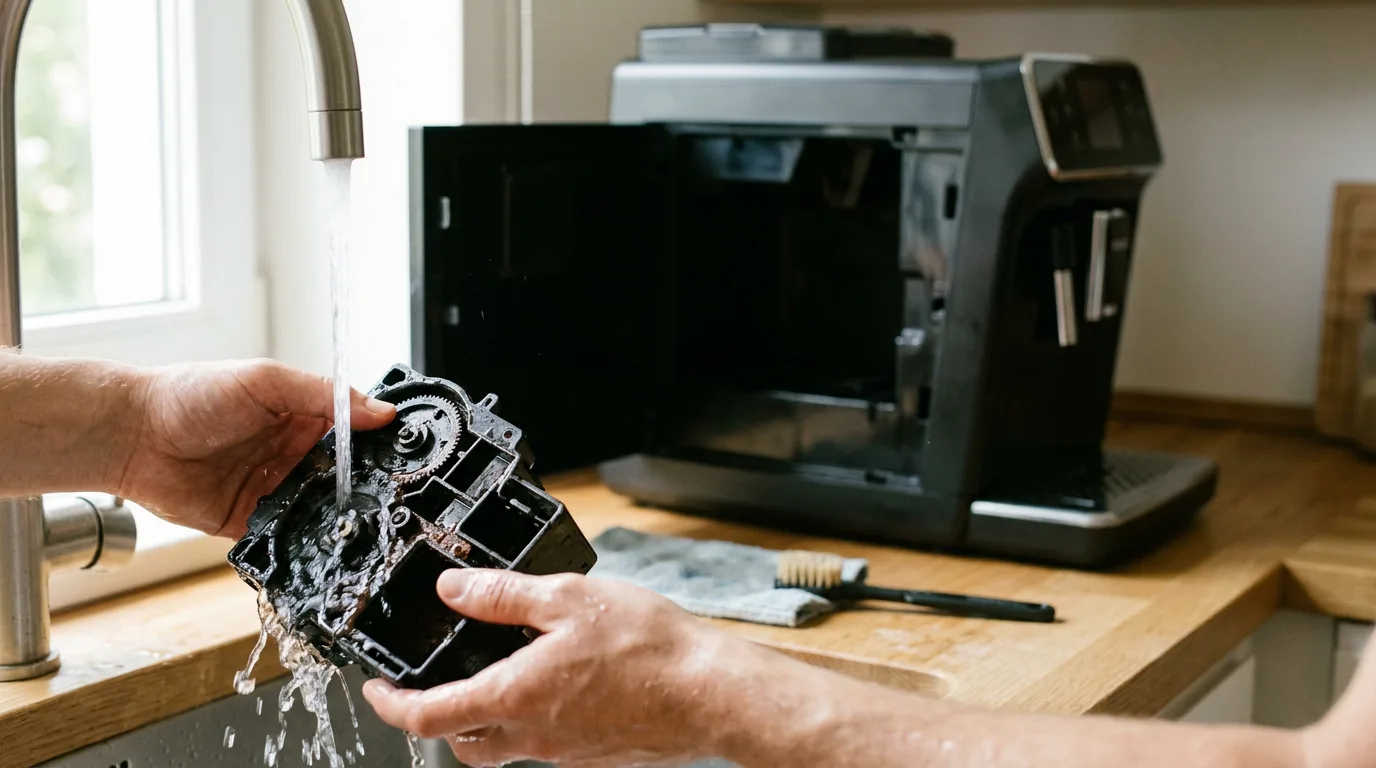
- Remove and rinse the brew unit weekly, if your model allows it.
- Run cleaning tablets and descaling cycles when the machine asks.
Semi-automatic
- Knock out the puck and rinse the portafilter after each shot.
- Purge and wipe the steam wand after every use.
- Backflush the group with a blind basket regularly.
- Clean the grinder and descale or filter the water as needed.
A super-automatic's cleaning is more automated but has more hidden parts. A semi-automatic's cleaning is more hands-on but everything is visible and easy to reach.
Cost of ownership
Both categories range from affordable to very expensive, so it's more useful to think about what you're paying for.
With a super-automatic, you're paying for automation: the built-in grinder, brew unit, milk system and electronics. It's a single purchase, but repairs to those internal parts can be costly.
With a semi-automatic, you're paying for brewing quality and control. A traditional setup also needs a separate grinder, a scale, a tamper and a milk pitcher. Smart models build some of those in.
Running costs are similar: beans, milk, cleaning products and water filters. The real difference is time, which a super-automatic saves every single day.
Noise, space and design
A super-automatic is one self-contained box. It needs space for the machine, room above or behind for the water tank and bean hopper, and access to the front for the drip tray and milk container.
A traditional semi-automatic is usually two boxes: the machine and the grinder. Add a knock box, a tamping station and a pitcher, and it takes more counter space overall. Smart semi-automatics with built-in grinders are a single, but large, machine.
Noise is similar overall. Both grind beans and run a pump. Super-automatics bundle all the noise into one short burst, while semi-automatics spread it over the routine.
Design is personal. Super-automatics tend to look sleek and modern, often with touchscreens. Semi-automatics range from classic chrome café styling to modern minimalism, and many people love having them on display.
Our tip: Measure the height under your cabinets with the bean hopper lid open. It's the dimension people most often forget.
Households, offices and guests
In a multi-person household, the super-automatic shines. Everyone can make their own drink, exactly how they like it, without learning anything or leaving a mess for the next person.
During my test, family members who never touched the semi-automatic used the super-automatic several times a day. Saved profiles meant my partner's flat white and my teenager's mild latte were one press apart.
For entertaining, a super-automatic also wins on speed. Guests can help themselves while you get on with hosting.
A semi-automatic is more personal. It works best when one or two people enjoy using it, and others are happy to be served.
Offices are a special case. In a shared workspace, nobody wants to clean up after a colleague's messy tamping, and few people want to learn dialing in. A super-automatic with a large bean hopper, a big water tank and simple cleaning prompts is almost always the better fit there.
The same goes for holiday homes and guest apartments. Visitors can make themselves a good coffee in seconds, and the machine stays in good shape because it handles the tricky parts itself.
Couples are where it gets interesting. If one person loves the craft and the other just wants coffee, a semi-automatic can work well, as long as the enthusiast is happy to be the household barista.
A week with each: what daily life felt like
On weekdays, the super-automatic quietly became the household favorite. Coffee happened in the background of breakfast, lunches and school runs. Nobody complained, nothing went wrong, and the kitchen stayed clean.
The only friction was the milk system. Forgetting to rinse it once left a sour smell the next morning, and I learned to run the quick clean right after every milk drink.
The semi-automatic was a different experience. On weekday mornings it felt like a chore when I was in a hurry, and a couple of shots ran fast because I rushed the tamp.
On weekends, it was the highlight. I tried new beans, adjusted the grind, practiced latte art and served friends flat whites that genuinely impressed them. That sense of craft is something a super-automatic doesn't offer.
By the end, I understood why so many coffee lovers end up with one of each.
Smart semi-automatics: the middle ground
Machines like the Breville Oracle Jet blur the line. They automate grinding, dosing, tamping and milk steaming, but keep the portafilter, the group head and real espresso extraction.
In my experience, they're the best of both worlds for many people. Shots come out much closer to a traditional semi-automatic, while the workflow is far less demanding.
The trade-offs are complexity and size. They're big machines with lots of electronics, and you still need a couple of minutes at the counter for each drink.
If you want espresso that tastes like a café's but you're nervous about the learning curve, a smart semi-automatic is worth a serious look.
Upgrade paths: who outgrows what
It helps to think about where you'll be in two or three years.
People who start with a super-automatic often stay happy for years, especially if most of their drinks are lattes and cappuccinos. The ones who move on usually discover specialty coffee and start wanting more intensity and control than the machine can give.
People who start with a semi-automatic tend to upgrade within the category: a better grinder first, then a machine with more temperature stability or flow control. A few go the other way and buy a super-automatic for weekdays, keeping the semi-automatic for weekends.
That two-machine setup is more common than you'd think among coffee lovers with busy jobs or families. It was, honestly, my favorite part of this test.
Which should you buy?
Buy a super-automatic if
- You prioritize speed and convenience. Your mornings are rushed and you need coffee without effort.
- You value effortless consistency. You don't want to troubleshoot sour shots or adjust grinders.
- You live with several coffee drinkers. Everyone can make their own drink.
- You prefer hands-off coffee. Coffee is a daily comfort and fuel, not a hobby.
Buy a semi-automatic if
- You see coffee as a ritual or hobby. You enjoy the tactile process.
- You want the most flavor. You buy specialty single origins and want to taste every detail.
- You have a few extra minutes. Five more minutes in the morning don't bother you.
- You want to grow your skills. Learning extraction, milk texture and latte art sounds fun.
Glossary of key terms
Questions to ask yourself before buying
- How much time do I have in the morning?Under five minutes points strongly to a super-automatic.
- Who will use it?Several people with different tastes favor saved drink profiles.
- What do I drink most?Milk drinks narrow the flavor gap; straight espresso widens it.
- Do I enjoy learning skills?If dialing in sounds fun, a semi-automatic will reward you.
- Where will I buy beans?Fresh specialty beans get the most out of a semi-automatic.
- How much counter space do I have?A semi-automatic plus grinder can take more room than one super-automatic.
Answer these honestly, and the right machine is usually obvious.
If you are still unsure after that, think about the last few coffees you really enjoyed. If they were quick lattes grabbed on the way out of the door, lean toward a super-automatic. If they were slow weekend espressos you made with care, lean toward a semi-automatic. Your own habits are the most reliable guide you have.
Common mistakes
With super-automatics
- Using very oily dark roasts. They can clog the grinder and brew unit.
- Never adjusting settings. Factory strength and volume rarely suit everyone.
- Skipping milk cleaning. Old milk residue ruins flavor and hygiene.
- Ignoring descaling prompts. Scale is the main cause of breakdowns.
With semi-automatics
- Using pre-ground or stale coffee. Shots will run fast and taste flat.
- Not weighing dose and yield. Without numbers, dialing in is guesswork.
- Changing several variables at once. Adjust one thing at a time.
- Underspending on the grinder. It matters as much as the machine.
Myths
"Super-automatics make bad espresso"
A good super-automatic makes very good coffee, far better than pods. It's just lighter and less intense than a well-made manual shot.
"Super-automatics can't be customized"
High-end models let you set strength, volume, temperature and milk for every drink.
"Semi-automatics are only for professionals"
Anyone can learn. With a scale and a little patience, most people pull good shots within a few weeks.
"More automation always means less quality"
Smart semi-automatics prove otherwise. Automation can remove errors without removing quality.
The verdict
The choice comes down to what you want from coffee.
If you want delicious, consistent coffee at the press of a button, for yourself and everyone in your home, a super-automatic is the right machine. It saves time every day and never asks you to learn anything.
If you want to make the best espresso you can, enjoy the process and like the idea of improving over time, a semi-automatic is the right machine. It asks for more, and gives more back.
And if you want something in between, a smart semi-automatic gives you real espresso with much of the hard work automated.
Whichever you choose, a few things make every machine better. Buy fresh whole beans from a roaster you trust, use filtered water to protect the machine from scale, and keep the milk system or steam wand spotless.
Give yourself time to adjust, too. A super-automatic needs a week of tweaking to match your taste. A semi-automatic needs a few weeks of practice before it shows what it can really do.
Most of all, be honest about your mornings. The best espresso machine is the one you will actually enjoy using every day, not the one that looks most impressive on paper or in a café.
For me, the answer turned out to be both: a super-automatic for busy weekdays and a semi-automatic for slow weekends. If you only have room for one, let your daily routine decide.
Frequently asked questions
What is the difference between super-automatic and semi-automatic?
A super-automatic grinds, doses, tamps, brews and froths milk for you. A semi-automatic leaves grinding, tamping, shot timing and milk to you.
Which makes better espresso?
A well-used semi-automatic usually makes bolder, more nuanced espresso. A super-automatic is smoother and more consistent.
Is a super-automatic worth it?
Yes, if convenience matters most and several people drink coffee at home.
Do I need a separate grinder for a semi-automatic?
For a traditional one, yes. Some smart semi-automatics have a built-in grinder.
Can you make latte art with a super-automatic?
Rarely. Automatic milk systems usually make airier foam that's hard to pour into art.
How long does it take to learn a semi-automatic?
Most people pull good shots within a few weeks with a scale and fresh beans.
Which beans work best in a super-automatic?
Medium roasts that aren't too oily. Very oily dark roasts can clog the grinder.
Which is easier to clean?
A super-automatic automates much of it, but has hidden parts. A semi-automatic is more hands-on, but everything is easy to reach.

- Michael Reynolds, months of side-by-side home use
- Espresso machine, Wikipedia
- Espresso, Wikipedia
- Coffee preparation, Wikipedia
Related guides
Espresso machine types explained Cappuccino vs latte vs flat white Coffee extraction explainedWritten by Michael Reynolds. Last updated November 20, 2026.