Coffee Machine Cleaning and Descaling Explained: A Complete Routine for Espresso Machines, Grinders and Brewers
A dirty machine can make even excellent coffee taste harsh and stale, and scale slowly damages equipment from the inside. I keep a simple cleaning routine for my own home setup. Here's how to clean and descale espresso machines, grinders, drip brewers, kettles and accessories, and how often to do each job.
We choose products independently. We may earn a commission through links on this page; your price stays the same. Affiliate policy
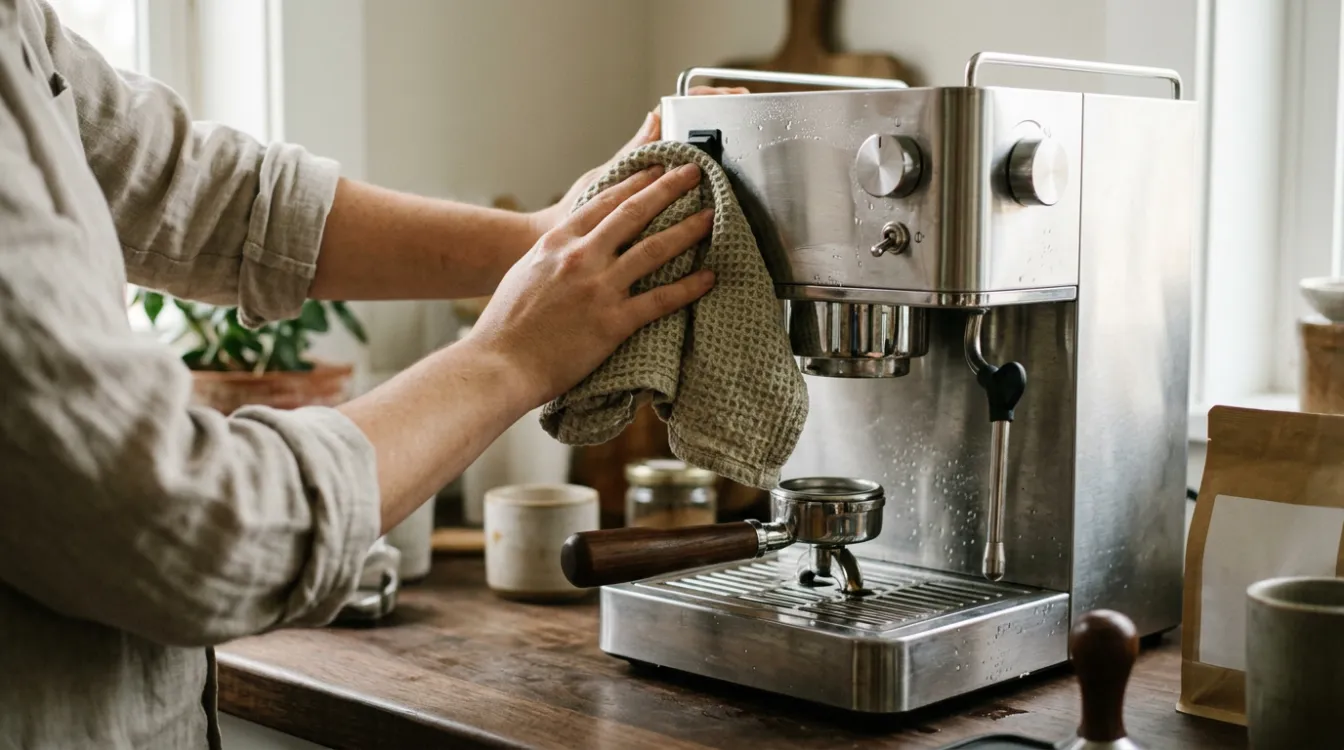
Coffee oils and grounds build up on portafilters, shower screens, group heads, steam wands and grinders, making coffee taste bitter and stale. Rinse the portafilter and flush the group after use, purge the steam wand every time, clean the shower screen and backflush about weekly, and brush out the grinder chute regularly. Descaling removes mineral buildup from hard water, typically every 6 to 12 months for home machines, more often with hard water. Use the descaler your manufacturer recommends; citric acid works for many machines but not all. Always follow your machine's manual.
Why cleaning your coffee machine matters
I've tasted it many times: a lovely, expensive coffee that somehow comes out harsh, bitter and stale. More often than not, the culprit isn't the beans or the recipe. It's a dirty machine.
Coffee leaves oils and fine particles on everything it touches. Over days and weeks, those residues turn rancid and add bitter, ashy flavors to every cup. Meanwhile, minerals in water slowly build up as scale inside boilers, pipes and valves, restricting flow and eventually damaging equipment.
Regular cleaning and descaling keep coffee tasting the way it should and protect your equipment, whether you plan to keep it for a decade or sell it when you upgrade. In this guide I'll walk through cleaning espresso machines, grinders, drip brewers, kettles and accessories, plus how and when to descale.
Before you start, always check your manufacturer's manual. Machines differ, and following the official instructions protects both your equipment and your warranty.
Cleaning and descaling at a glance
| Task | How often (home use) |
|---|---|
| Rinse portafilter and basket | After every session |
| Flush group head | After every shot |
| Purge and wipe steam wand | After every use |
| Empty and wash drip tray | Every day or two |
| Clean shower screen | At least weekly for frequent use |
| Backflush with detergent | About weekly |
| Clean grinder exit chute | About weekly |
| Wash grinder hopper | Every few weeks |
| Change water in reservoir | Daily, or after a few days away |
| Descale | Every 6-12 months, more often with hard water |
| Replace group gasket | About yearly, or when worn |
Cleaning the portafilter and basket
The portafilter and basket touch every shot, so they collect coffee oils and fine grounds quickly. Ideally, clean them after every espresso session.
- Knock out the puck and rinse the basket and portafilter with hot water.
- Remove the basket now and then; a small teaspoon can help lever it out.
- Wash inside and outside with a little dish soap and a soft, non-abrasive sponge.
- Rinse thoroughly to remove all soap.
A quick test: run a finger around the inside of the portafilter. It should feel clean, not greasy.
For built-up residue, soak the metal parts in hot water with espresso machine cleaning detergent for about an hour or overnight. Don't submerge the handle, especially if it's wood or another material that could be damaged.
I think of the portafilter like a frying pan: you wouldn't cook in a dirty pan, and you shouldn't brew in a dirty portafilter either.
Cleaning the shower screen and group head
The shower screen spreads water evenly over the coffee. Behind it, grounds and oils build up steadily, and you can't reach them with a quick rinse.
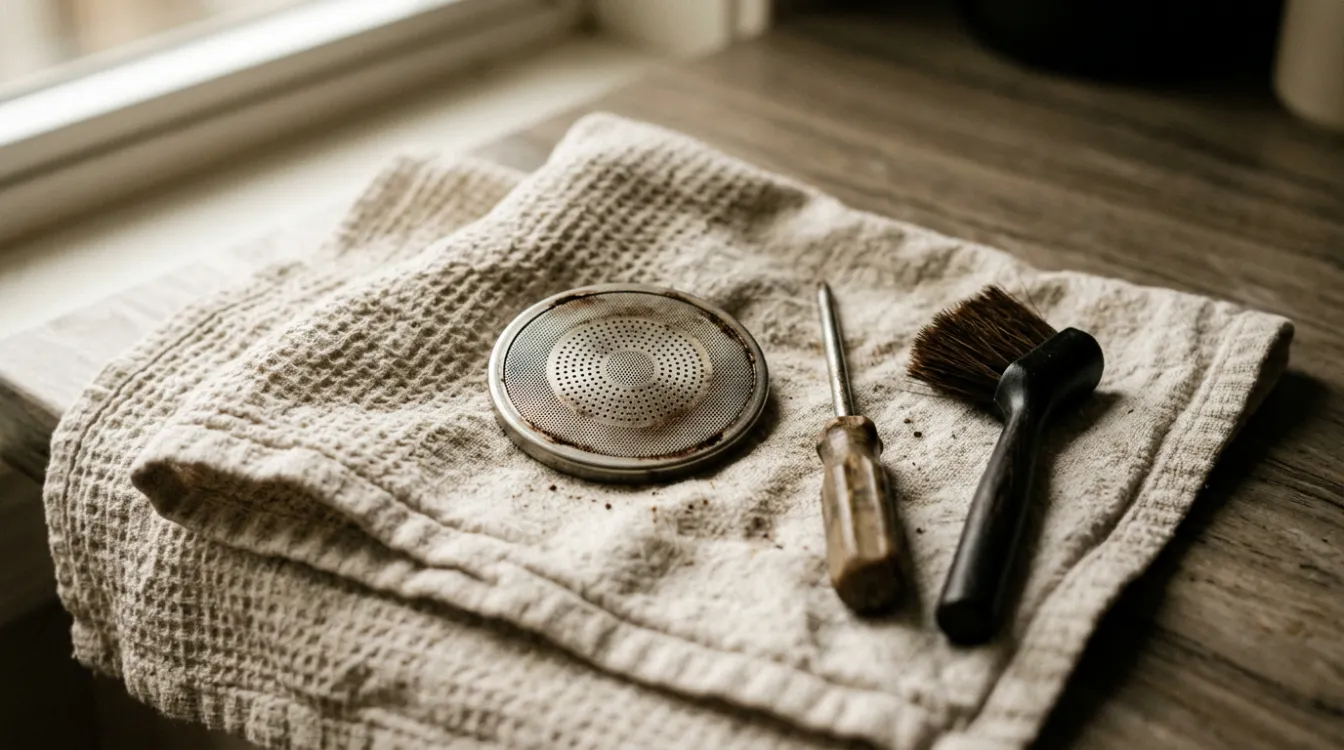
For a machine used most days, remove and clean the shower screen at least weekly:
- Let the machine coolWork on a cool or warm group, never one that's scalding.
- Remove the screenUndo the central screw with the right screwdriver for your machine.
- Inspect the backYou'll often find a layer of old coffee and oil.
- ScrubUse warm water, a little dish soap and a soft brush.
- Clean the dispersion blockWipe away residue behind the screen if your machine has one.
- Wipe the gasketClean around the group head gasket.
- Rinse and refitRinse everything thoroughly and reassemble.
Old grounds trapped behind the screen add bitterness and harshness to espresso, so this one task can noticeably improve flavor.
If you only do one thing after reading this guide, make it removing your shower screen. It takes five minutes, needs only a screwdriver and a brush, and it's the job most home baristas skip. The first time you see what's hiding behind it, you'll understand why your espresso hasn't tasted quite right, and you'll probably never skip it again.
Backflushing your espresso machine
Backflushing cleans the internal paths of machines with a three-way solenoid valve, which is common on many prosumer and commercial espresso machines.
Why it's needed
A three-way valve connects three paths: the boiler, the group head and the drain. During a shot, the valve sends hot water from the boiler to the coffee. When the shot ends, it releases pressure from the group through the drain. As that pressure releases, coffee-infused water travels backward through internal passages and leaves oils and residues behind.
Backflushing pushes water and detergent back through those passages to remove the buildup.
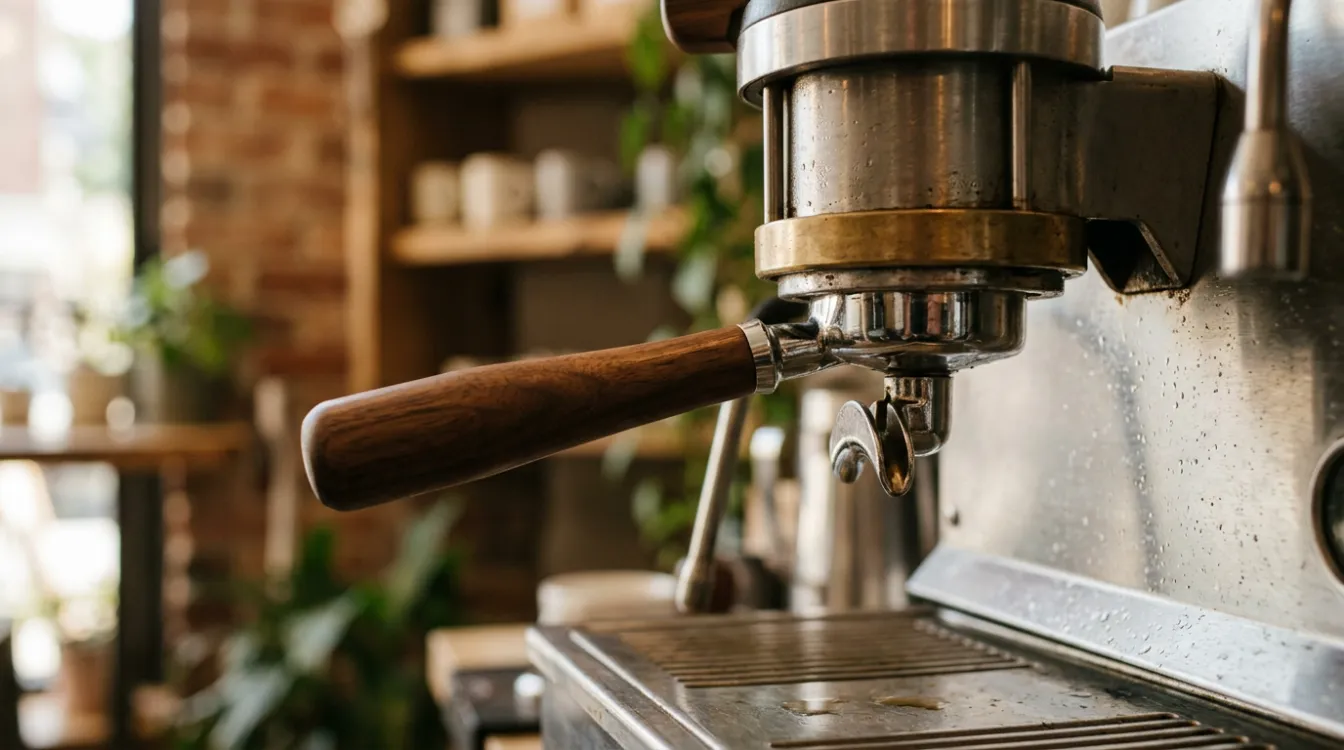
How to backflush
- Fit a blind basketReplace your normal basket with a blind (solid) basket.
- Add detergentAdd a small amount of espresso machine cleaning detergent.
- Lock in the portafilterAttach it firmly to the group head.
- Run the pump brieflyRun for a few seconds to mix water and detergent.
- Stop and restStop the pump and let the solution work in the passages.
- RepeatRepeat according to your machine and detergent instructions.
- Rinse the portafilterRemove, rinse and refit without detergent.
- Flush with waterRepeat cycles with plain water until no detergent remains.
- Flush the groupRun fresh water through until it's clean and tastes neutral.
Much of the cleaning happens while the pump is off and the detergent sits in the passages. A small amount of detergent is enough when you clean regularly; using too much just wastes product.
For home use, about once a week is a good starting point. Adjust based on how much you use the machine. Always check whether your machine supports backflushing; machines without a three-way valve shouldn't be backflushed with detergent.
Flushing after every shot
One simple habit makes a big difference: flush the group head for about five seconds right after removing the portafilter. This rinses away loose grounds and residue before they dry onto the screen.
It's especially important after a choked or very slow shot, when the water left in the group is loaded with dissolved coffee. A quick flush stops that concentrated residue settling inside the machine.
Cleaning the steam wand
The steam wand touches milk, so hygiene is critical. Dried milk is hard to remove and can cause bad smells and hygiene problems.
After every use:
- Purge the wand for a second or two immediately after steaming.
- Wipe the outside with a clean, damp cloth.
- Purge again to clear any milk drawn inside.
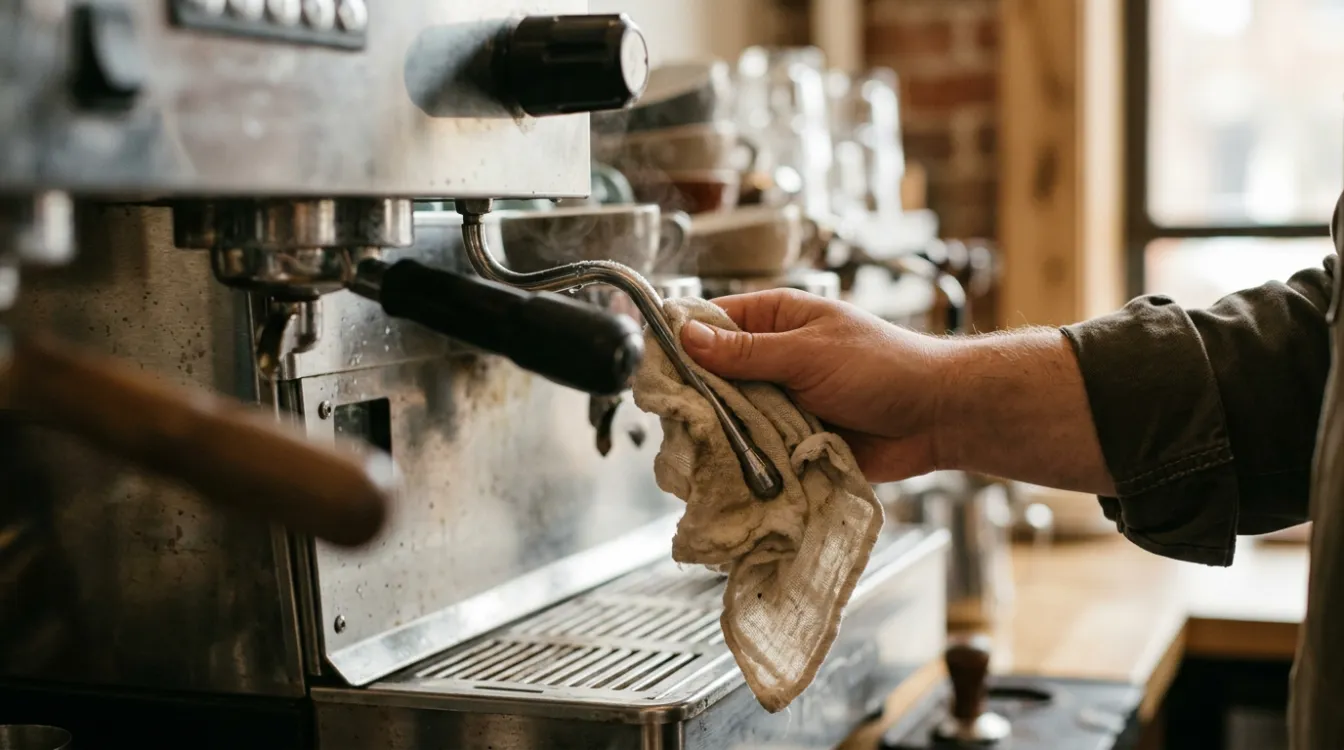
If milk has dried around the tip, remove the tip if your machine allows it, soak it in hot water with a suitable cleaner, clear the holes and rinse well. Avoid soaking the whole wand assembly, as damaged seals could let liquid into the steam system.
Drip tray and external cleaning
Empty the drip tray daily or every couple of days. Standing water, coffee and milk residue can smell and encourage mold. Wash it with warm soapy water, rinse and dry before refitting.
Wiping the outside of the machine doesn't change flavor, but it keeps your machine looking good and helps you spot leaks early.
How dirty equipment changes the taste of coffee
It's easy to underestimate how much residue affects flavor. Coffee oils oxidize and go rancid within days. When fresh coffee passes over old residue, it picks up those stale, bitter compounds.
In my own tests, I've pulled shots before and after a thorough clean using the same beans and recipe. Before cleaning, the espresso tasted ashy, flat and slightly bitter at the finish. After removing the shower screen, backflushing and soaking the basket, the same coffee tasted sweeter, cleaner and more aromatic. The difference was obvious even to friends who don't drink espresso often.
The same applies to milk. A steam wand with dried milk inside can give fresh milk a cooked or sour note. And in drip brewers, old oils in the carafe make coffee taste stale long before it has actually been sitting for long.
If your coffee suddenly tastes worse and you haven't changed beans, clean your equipment before changing anything else. It's the cheapest and fastest fix there is. My guide to coffee extraction explains how to diagnose bitter or sour coffee once your equipment is clean.
Water quality, limescale and corrosion
Water is the biggest ingredient in coffee and the biggest factor in how long a machine lasts. Two water-related problems matter most: scale and corrosion.
Limescale
Water rich in calcium and bicarbonate leaves mineral deposits called limescale. Scale builds up inside boilers, pipes, valves and heating elements. Over time, it restricts flow, affects temperature control and can eventually damage the machine.
Corrosion
Very soft or aggressive water, particularly water high in chloride, can corrode metal parts. That's why simply using distilled or reverse-osmosis water with no minerals isn't ideal for many machines either.
Tools such as water chemistry calculators, including the Langelier Saturation Index, can help predict whether your water is likely to form scale or cause corrosion. Many manufacturers also recommend specific filters or water recipes.
Descaling an espresso machine
Descaling uses a mildly acidic solution to dissolve mineral deposits inside the machine.
Regular maintenance vs heavy scale
For a machine that's descaled regularly and has little buildup, a mild solution of roughly 2 to 5% acid by weight is often appropriate, depending on the manufacturer.
A machine that hasn't been descaled in years is a different story. A weak solution may loosen chunks of scale without fully dissolving them, and those pieces can travel through the machine and block narrow parts. Some machines have flow restrictors only about 0.8 millimeters wide, which are easy to clog.
Don't simply use stronger acid or longer soaking on a heavily scaled machine. Follow the manufacturer's instructions, and consider professional servicing if you suspect heavy scale.
Choosing a descaler
Citric acid is cheap, widely available and easy to measure. For example, a 3% solution uses about 1 ounce (roughly 2 tablespoons) of citric acid in enough water to make about one quart.
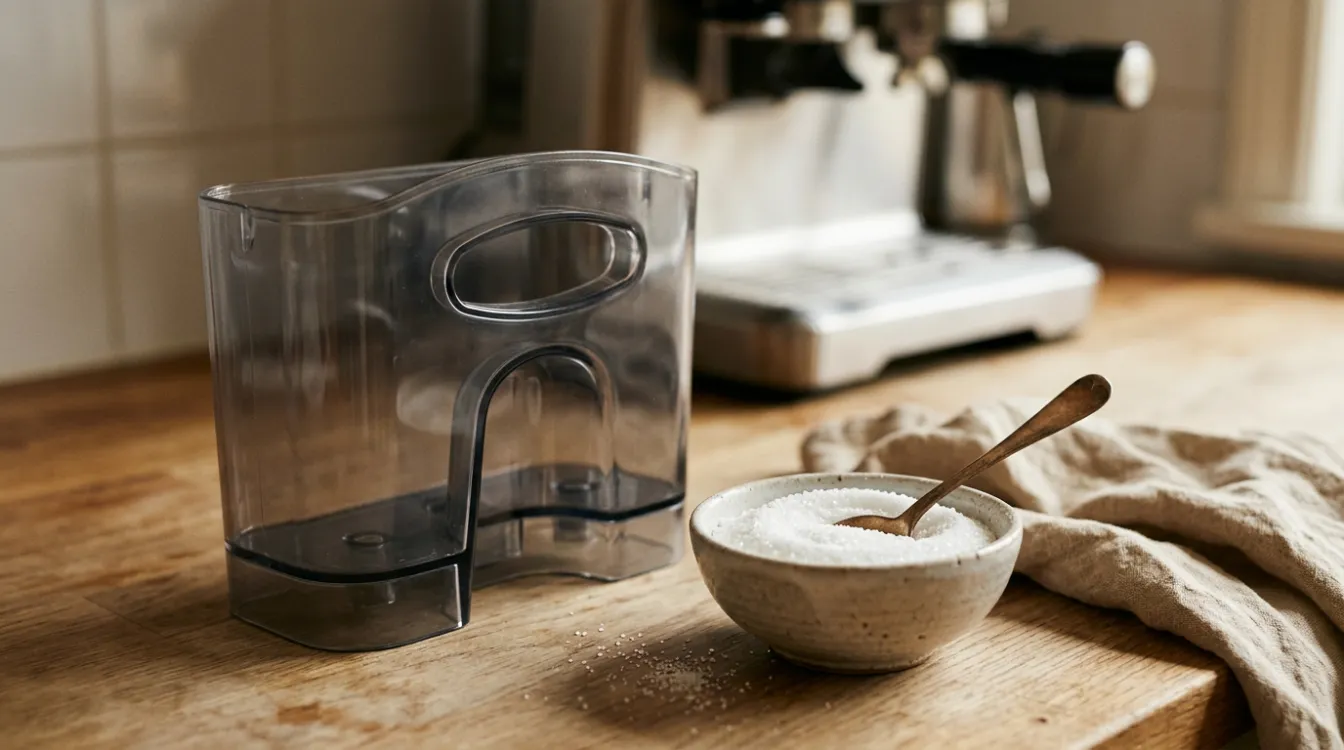
But citric acid isn't suitable for every machine. Some manufacturers advise against it, particularly for machines with aluminum boilers, because of corrosion concerns. If your manufacturer recommends a specific descaler, use it.
How often?
It depends on your water and usage. In areas with soft water, every 6 to 12 months may be enough for some machines. Hard water areas may need more frequent descaling. Understanding your water is better than following a fixed calendar.
A simple way to monitor flow
To spot scale early, measure how much water comes out of your group head:
- Remove the portafilterPlace a container under the group.
- Run waterLet water run freely for 30 seconds.
- Weigh itWeigh the water and write down the result.
- Repeat every couple of monthsCompare results over time.
If the amount slowly drops, scale or another restriction may be building up.
Basic descaling steps
- Empty the reservoirRemove any old water.
- Make the solutionMix the recommended descaler.
- Fill and circulateAdd it to the reservoir and run it through the system as instructed.
- Let it workFollow heating and soaking times from the manufacturer.
- Flush thoroughlyEmpty, rinse the reservoir and run fresh water through.
- Taste-testKeep flushing until there's no sour or acidic taste.
Keep the water reservoir fresh
Don't leave water sitting in the reservoir for days. Standing water can grow biofilm and develop off-flavors. If you've been away or haven't used the machine for a few days, empty and refill it with fresh water. Wash the reservoir regularly with warm water and a little dish soap, then rinse well.
Replacing gaskets and shower screens
Group head gaskets harden and become brittle over time. Depending on use and material, replacing them about once a year is reasonable. Signs it's time:
- Water leaking around the portafilter.
- The portafilter locking further to the right than before, or feeling hard to lock in.
- A poor seal during extraction.
- Visible cracks or hardening.
Shower screens also wear. Replace them if the mesh is damaged, separating or badly distorted. A good-quality screen should last well over a few months of home use.
Extra care for E61 and lever machines
Some machine designs need specific maintenance beyond the basics.
E61 group heads
The E61 group, found on many prosumer machines, has a cam and lever mechanism that opens valves inside the group. Frequent backflushing with detergent can wash away the lubricant on the cam. Many owners therefore backflush with detergent less often and rinse with water more often, and occasionally lubricate the cam with food-safe grease as described in the manual.
Lever machines
Spring-lever and manual lever machines usually don't have a three-way valve, so detergent backflushing isn't part of their routine. Instead, clean the shower screen and group regularly, and have the piston seals inspected and replaced when they wear. My guide to the history of the espresso machine explains how lever machines work.
Don't forget cloths and milk pitchers
- Bar cloths: use separate cloths for the steam wand and for the counter. Wash them frequently; a damp cloth left in a heap grows bacteria quickly.
- Milk pitchers: rinse immediately after use and wash with hot soapy water. Dried milk is hard to remove and spoils fresh milk's taste.
- Tampers and distribution tools: wipe after use to remove grounds and oils.
- Knock box: empty daily and rinse out.
These small items rarely get attention, but they touch coffee and milk every day.
Descaling frequency by water hardness
| Water hardness | Typical descaling frequency (espresso machine) | Notes |
|---|---|---|
| Soft | Every 6-12 months | Watch for corrosion with very soft water |
| Moderate | Every 3-6 months | A jug or inline filter helps |
| Hard | Every 1-3 months | Use a softening filter; monitor flow |
| Very hard | Monthly or use treated water | Consider professional advice |
These are rough guides. Follow your manufacturer's recommendations and use flow tests to see what your machine actually needs.
Cleaning cold brew equipment
Cold brew is brewed without heat, so clean equipment is especially important for food safety. Wash jars, filters, bags and bottles thoroughly with hot soapy water after each batch, rinse well and dry. Replace cloth or felt filters regularly, and don't leave wet grounds sitting in brewers. My guide to the science of cold brew covers safe cold brew storage.
Cleaning your coffee grinder
Grinders collect old grounds and oils that affect both performance and flavor.
The exit chute
Ground coffee leaves the burrs through the exit chute. If it gets clogged, coffee stays in the grinding chamber and gets ground again and again, creating extra fines that make espresso harsh and uneven.
- Check the chute regularly.
- Brush it out with the grinder's cleaning brush.
- Pay attention to corners where coffee sticks.
- Aim for about once a week, more with heavy use.
The hopper
Coffee beans are oily, and those oils coat the hopper walls. Over time they go rancid and add stale, unpleasant flavors.
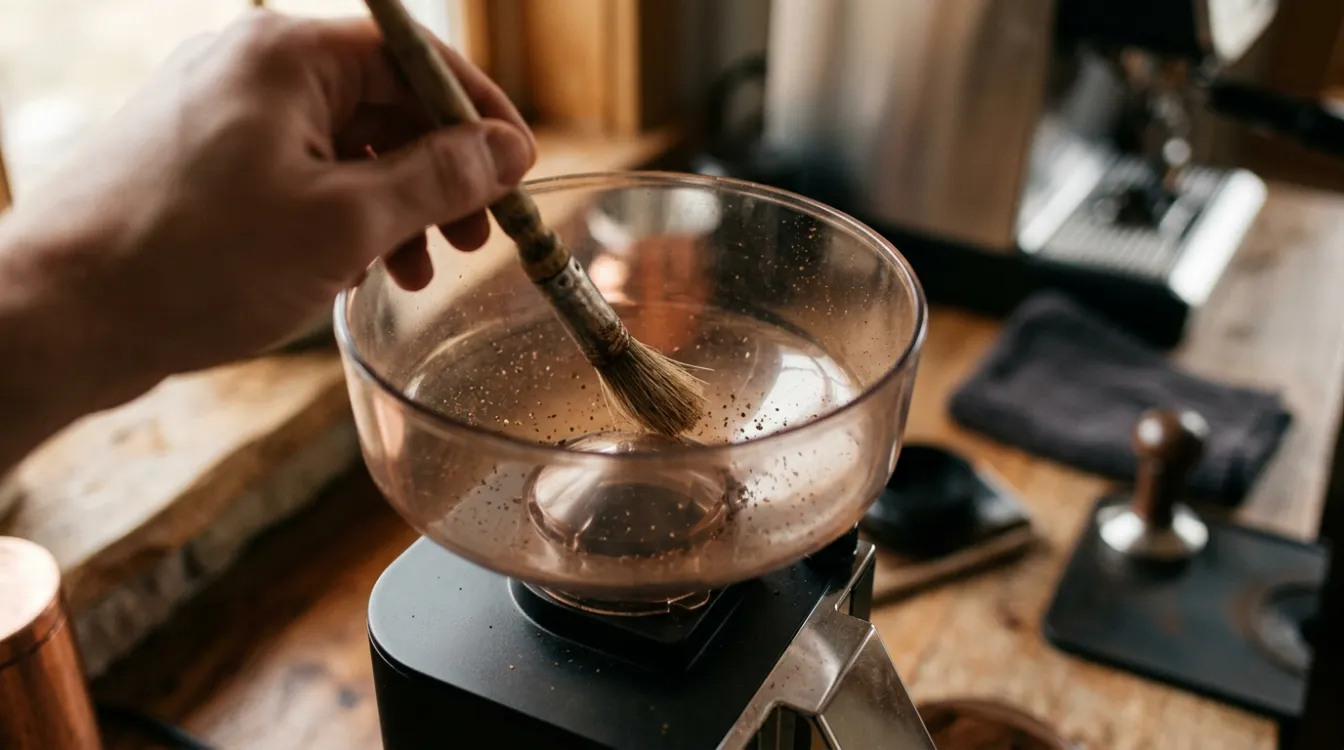
- Empty the beansRemove all remaining beans.
- Remove the hopperTake it off the grinder if it's removable.
- Wash itUse warm water and dish soap to remove oily residue; water alone won't cut through oils.
- Rinse and dryRinse well and let it dry completely before refitting.
For fixed hoppers, wipe accessible surfaces with a slightly damp cloth and keep moisture away from the burrs and motor.
The burr chamber
Opening the burr chamber gives a deeper clean, but grinders vary a lot. Some open easily; others are tricky to reassemble. If your grinder has threaded parts near the burrs, grounds in the threads can make reassembly difficult.
If your manufacturer allows it:
- Unplug the grinder.
- Follow the disassembly instructions.
- Brush out loose grounds and carefully vacuum the rest.
- Avoid damaging the burr edges.
- Reassemble correctly, checking your grind setting afterward.
Many manufacturers suggest opening the burr chamber only every 6 to 12 months for home grinders.
Burr wear
Burrs gradually dull. Lifespan depends on burr material, coffee and roast; light roasts are harder and wear burrs faster. Signs of worn burrs include more fines, coffee coming out warm, inconsistent grinding and difficulty getting good extraction. Clean the grinder first, since a dirty grinder can mimic worn burrs.
Cleaning tablets, not rice
Grinder cleaning pellets are designed to pass through the burrs and absorb oils. Grind them as directed, then grind some coffee afterward to clear residue.
Don't use rice. It's harder than coffee and can strain grinder parts, and some manufacturers say it can void your warranty. My comparison of hand grinders vs electric grinders covers grinder care for both types.
Cleaning drip coffee makers and carafes
Filter brewers are simpler than espresso machines, but oils and scale still build up.
- Brew basket and mesh filters: wash regularly with warm, soapy water, even if you use paper filters.
- Thermal carafe: fill with hot water and about a teaspoon of espresso machine cleaner, leave for around 30 minutes, then rinse thoroughly. You'll be amazed at what comes out.
- Descaling: run a suitable descaling solution partway through a brew cycle, switch off for about 30 minutes, finish the cycle and then run fresh water through.
Insulated stainless carafes are usually better than glass pots on hot plates, which slowly cook coffee. My guide to pour over vs drip coffee explains why.
Descaling kettles
Kettles, especially shared household ones, often build up scale. Many can be descaled with citric acid if the manufacturer allows it:
- Add water and citric acidUse a suitable amount for your kettle size.
- Heat if allowedWarming the solution speeds up descaling.
- Let it workLeave it until the scale dissolves.
- Empty and rinseRinse several times with fresh water.
Make sure no descaler remains before using the kettle for coffee.
Travel cups, moka pots and accessories
- Travel cups: soak with hot water and a little espresso machine cleaner now and then, paying attention to lids and seals.
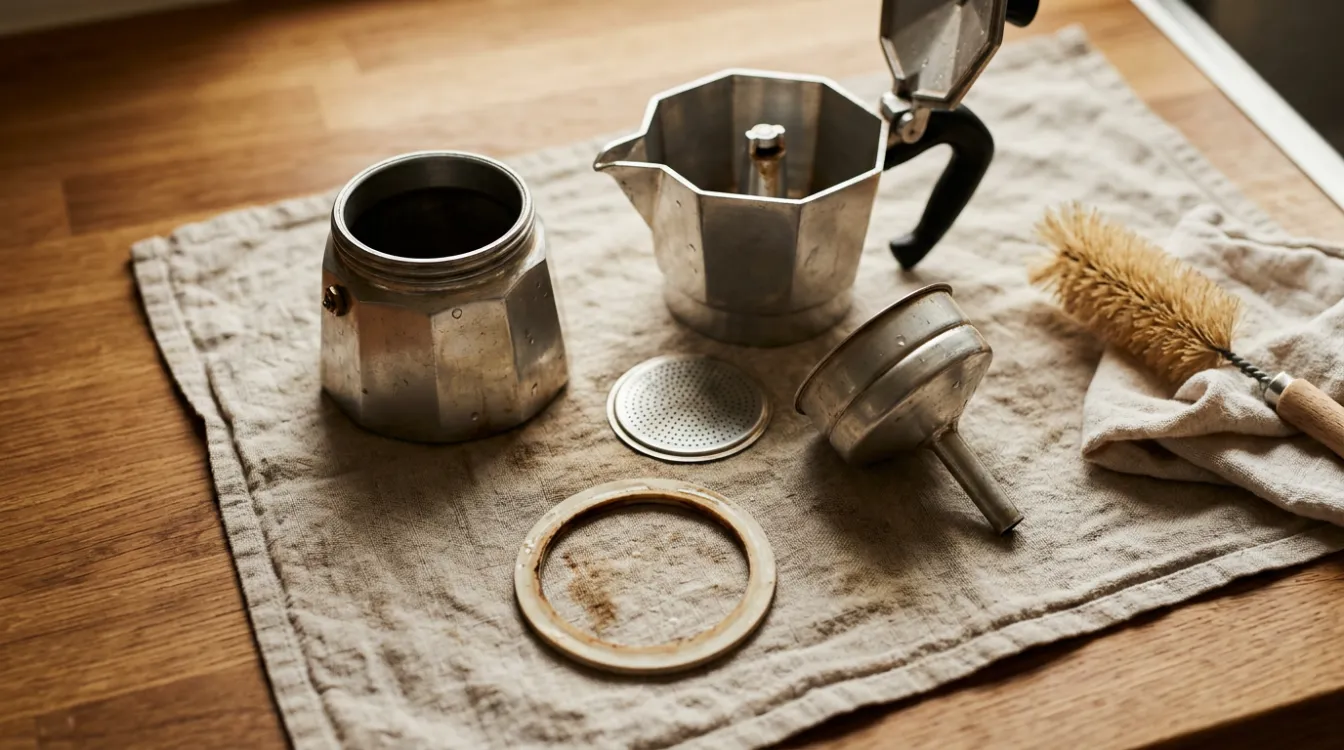
- Moka pots: clean all parts after use. Old coffee residue isn't "seasoning"; it's just stale oil that spoils flavor. Replace the rubber gasket if it's cracked, hard, leaking or won't seal.
Cleaning super-automatic machines
Bean-to-cup machines do a lot of the cleaning for you, but they still need attention.
- Daily rinse cycles: most machines rinse the coffee spouts automatically on startup and shutdown. Let them run.
- Grounds container and drip tray: empty and wash these daily or when prompted. Wet grounds go moldy fast.
- Brew group: if your machine has a removable brew group, rinse it under lukewarm water about weekly and let it dry. Don't use soap unless the manual says so; lubricate it only as instructed.
- Milk system: run the milk-cleaning cycle after use and deep-clean with the recommended milk cleaner regularly. Milk residue is the biggest hygiene risk in these machines.
- Cleaning tablets: run the cleaning program with the manufacturer's tablets when prompted to remove coffee oils.
- Descaling program: use the built-in descaling cycle with the recommended descaler. Many machines track water use and tell you when it's due.
- Water filter: if your machine uses a filter cartridge, replace it on schedule and set the water hardness correctly in the menu.
My guide to super-automatic vs semi-automatic espresso machines explains how these machines work.
Cleaning pod and capsule machines
Pod machines are low-maintenance, but they still build up scale and coffee residue.
- Empty the used capsule container daily.
- Rinse the drip tray and capsule area regularly.
- Run a water-only cycle without a capsule now and then to rinse the system.
- Descale according to the manufacturer's schedule, typically every few months depending on water hardness.
Cleaning French presses, pour-over drippers and AeroPresses
Manual brewers are simple, but oils still build up.
- French press: take the plunger apart regularly and wash the mesh screens, which trap grounds and oils.
- Pour-over drippers: rinse after each use and wash with soapy water now and then; ceramic and glass drippers can go through the dishwasher if the manufacturer allows.
- AeroPress and similar brewers: rinse after use and occasionally wash the seal and chamber with warm soapy water.
- Kettles and gooseneck kettles: descale when you see white deposits.
- Scales: wipe them; never submerge.
Which cleaning product for which job
| Product | Use it for | Don't use it for |
|---|---|---|
| Dish soap | Portafilters, baskets, hoppers, carafes, drip trays | Inside the machine or grinder burrs |
| Espresso machine detergent | Backflushing, soaking baskets, carafes, travel cups | Descaling |
| Descaler (citric, lactic or proprietary) | Removing limescale from boilers, kettles, brewers | Removing coffee oils |
| Milk system cleaner | Steam wand tips, milk systems | Coffee oils in the group |
| Grinder cleaning tablets | Absorbing oils in burrs and chutes | Machines or brewers |
Keeping the right products on hand makes cleaning faster and safer for your equipment.
Safety tips while cleaning
Coffee machines combine hot water, steam, pressure and electricity, so a few precautions matter:
- Let the machine cool before removing shower screens, gaskets or other parts near the boiler.
- Unplug before deep cleaning grinders or opening panels.
- Never open a pressurized boiler or steam valve unless the manual explains how to do it safely.
- Point the steam wand away from your hands when purging.
- Wear gloves when handling strong cleaning detergents and descalers, and keep them away from children.
- Rinse thoroughly after detergent or descaler so no residue ends up in your coffee.
- Don't mix cleaning products, especially acids and other chemicals.
If anything seems wrong, such as unusual hissing, leaks from inside the casing or electrical smells, switch off the machine and contact the manufacturer or a technician. Cleaning should never involve taking risks with pressure or electricity.
Water filters and water recipes
The best way to reduce scale is to start with suitable water. Options include:
- Jug or tank filters: reduce chlorine and some hardness; good for moderately hard water.
- Inline softening filters: common in plumbed-in machines; replace cartridges on schedule.
- Bottled water: some still waters have mineral levels suitable for espresso; check the label for hardness and alkalinity.
- Custom water recipes: some enthusiasts add measured minerals to distilled water to create ideal brewing water. It's effective but requires care.
Avoid fully demineralized water in most machines, as it can taste flat and, over time, may be corrosive. My guide to espresso machine types explains why boilers are particularly sensitive to water quality.
When to call a technician
Most cleaning is easy to do yourself, but some jobs are best left to a professional:
- Heavy scale in boilers or pipes.
- Leaks from inside the machine.
- Pressure or temperature problems after cleaning and descaling.
- Electrical faults or tripped breakers.
- Valves that stick or don't release pressure.
A technician can disassemble the boiler, remove heavy scale safely, replace worn seals and gaskets and check safety valves. For a well-used machine, an occasional professional service can extend its life considerably.
Cleaning before storing or selling a machine
If you're putting a machine away for a while or selling it:
- Backflush and clean thoroughlyRemove all coffee oils from the group and baskets.
- DescaleRemove any mineral buildup.
- Drain the waterEmpty the reservoir and, if the manual explains how, drain the boiler to prevent stagnant water.
- Dry everythingLet removable parts dry fully.
- Store clean and dryKeep it covered in a dry place.
A clean, well-maintained machine is far easier to sell, and buyers often ask about maintenance history. Keeping notes of descaling and gasket changes helps.
What I learned the hard way
Early on, I neglected my first espresso machine. I rinsed the portafilter but never removed the shower screen or backflushed. After a few months, my espresso tasted bitter no matter what I did, and I blamed the beans.
When I finally removed the shower screen, the back was coated in a thick, dark layer of old coffee. One proper clean and backflush later, the same beans tasted sweet and balanced again. Since then, I've been almost evangelical about cleaning.
A few years later, a friend's machine slowed to a trickle. He'd never descaled it, and his water was very hard. The repair involved replacing a blocked valve and descaling the boiler professionally. A few minutes of regular maintenance would have prevented it.
How much time does all this take?
It sounds like a lot when you list everything, but in practice cleaning takes very little time once it becomes routine.
- Daily tasks: about two to three minutes, mostly rinsing, wiping and flushing as you go.
- Weekly tasks: about 15 to 20 minutes for backflushing, the shower screen and the grinder chute.
- Monthly tasks: about 10 minutes for the hopper, carafe and accessories.
- Descaling: usually 30 to 60 minutes, mostly waiting while the solution works.
Spread across a month, that's a small investment compared with the time you spend making and enjoying coffee, and far less than the hassle of a broken machine.
General cleaning principles
A few rules apply to almost all coffee equipment:
- Clean little and often: small regular cleanings prevent stubborn buildup.
- Use the right product: dish soap for removable parts, espresso cleaner for coffee oils, descaler for minerals. They aren't interchangeable.
- Follow the manual: some machines tolerate certain acids or cleaners; others don't.
- Protect electrics: never soak motors, electrical parts or delicate handles.
- Dry before refitting: removable parts should be completely dry when required.
- Notice changes: slower flow, odd noises, leaks or inconsistent grinding are early warning signs.
My cleaning routine
This is the routine I follow for my home espresso setup. It takes only a few minutes a day.
After every shot
- Knock out the puck and wipe the basket.
- Flush the group head for about five seconds.
After every milk drink
- Purge the steam wand, wipe it and purge again.
End of each day
- Rinse the portafilter and basket.
- Empty and rinse the drip tray.
- Wipe the machine.
- Refresh the water reservoir.
Weekly
- Backflush with detergent.
- Remove and clean the shower screen.
- Brush out the grinder exit chute.
- Soak portafilter and baskets if needed.
Every few weeks
- Wash the grinder hopper.
- Deep-clean the thermal carafe or travel mugs.
Every 6 to 12 months
- Descale (more often with hard water).
- Check gaskets and shower screens.
- Consider cleaning the burr chamber.
Signs your coffee equipment needs attention
- Espresso tastes bitter, harsh or stale even with fresh beans.
- Shots run slower or less evenly than before.
- Water flow from the group head drops.
- The machine heats more slowly or struggles to hold temperature.
- Grinder output becomes clumpy or full of fines.
- The steam wand sputters or smells of milk.
- Visible white scale appears in the reservoir or kettle.
- The portafilter leaks or is hard to lock in.
Catching these early is much cheaper and easier than fixing a seriously scaled or damaged machine.
Myths about cleaning coffee equipment
"Coffee residue seasons the machine"
Old oils go rancid and make coffee taste bitter and stale. Clean equipment makes better coffee.
"Vinegar is the best descaler"
Vinegar can leave strong flavors and smells and isn't recommended by many manufacturers. Use the descaler your manufacturer recommends.
"Rice is a great way to clean grinders"
Rice can strain grinder parts. Use grinder cleaning tablets instead.
"Filtered or distilled water means you never need to descale"
Filters reduce scale but rarely eliminate it, and distilled water can cause other problems. Monitor your machine.
"If it looks clean, it is clean"
Most residue hides behind shower screens, inside valves and in grinder chutes.
A quick cleaning checklist
- Portafilter and basket rinsed.
- Group head flushed.
- Steam wand purged and wiped.
- Drip tray emptied.
- Reservoir refreshed.
- Shower screen cleaned this week.
- Backflush done this week (if your machine supports it).
- Grinder chute brushed this week.
- Hopper washed this month.
- Descaling date checked.
- Gasket and screen condition checked.
Print it out or keep it on your phone, and tick things off until the routine becomes second nature.
The verdict
Clean equipment is just as important as good beans. Coffee oils and old grounds make even excellent coffee taste harsh and stale, and scale slowly damages machines from the inside.
For espresso machines, focus on the portafilter and basket, shower screen, group head, steam wand and internal passages, with regular backflushing and appropriate descaling. For grinders, keep the exit chute clear, wash the hopper and replace worn burrs. Drip brewers, carafes, kettles, travel cups and moka pots need attention too.
The secret is consistency. A few minutes after each session and a short weekly routine keep your coffee tasting great, your equipment running reliably and its value intact for years.
Frequently asked questions
How often should I clean my espresso machine?
Rinse and flush daily, backflush and clean the shower screen about weekly, and descale every 6 to 12 months.
What is backflushing?
Running water and detergent backward through the group head using a blind basket to clean internal passages.
Can I use vinegar to descale?
Many manufacturers don't recommend it. Use their recommended descaler.
Can I use citric acid to descale?
Often yes, but not for all machines, especially some with aluminum boilers.
How do I know my machine needs descaling?
Slower flow, longer heat-up and visible scale are common signs.
Can I clean a grinder with rice?
No. Use grinder cleaning tablets instead.
How often should I replace the group gasket?
About once a year, or when it leaks or hardens.
How do I clean a thermal carafe?
Soak with hot water and a little espresso machine cleaner for about 30 minutes, then rinse.

- Michael Reynolds, home espresso maintenance
- Espresso machine, Wikipedia
- Limescale, Wikipedia
- Langelier Saturation Index, Wikipedia
- Hard water, Wikipedia
Related guides
Espresso machine types Hand grinder vs electric grinder History of the espresso machineWritten by Michael Reynolds. Last updated November 20, 2026.