Philips 4400 Series review: 12 hot and iced drinks, a bigger coffee dose and LatteGo milk in a quiet, quick-starting machine
The Philips 4400 Series Fully Automatic Espresso Machine makes 12 hot and iced coffees at one touch, from ristretto to iced espresso, with the easy-clean LatteGo milk jug. It starts in well under a minute, brews more quietly than older Philips machines and uses a noticeably bigger coffee dose than the entry models. Two profiles save your favorites, but milk texture is automatic and the dose still isn't café-sized.

Michael Reynolds
Hands-on review
Hands-on testing, research, specs
4 weeks
22 minutes
Jargon helpNew to espresso? Tap any dotted term to see what it means.
In this review
Yes, if you want the widest choice of drinks in Philips' mid-range, including real iced coffees, without moving up to a flagship. The Philips 4400 Series was ready in about 30 to 45 seconds, its strongest setting doses roughly 11 to 12 grams for a fuller espresso, and the LatteGo jug takes seconds to rinse. It is still an automatic machine: you can't texture milk by hand, the dose is modest by café standards, and the brew group needs regular care.
Philips 4400 Series at a glance
Philips 4400 Series pros and cons
- 12 hot and iced drinks at one touch
- Quick start and quieter brewing
- Bigger dose than entry models for fuller espresso
- Milk foam is automatic, no manual control
- Maximum dose still below café espresso
- Brew group needs rinsing, degreasing and grease
Who should buy the Philips 4400 Series?
- Iced coffee fans who drink it all year round
- Two-person households with different favorite drinks
- Busy mornings that need coffee fast
- Latte art and manual milk steaming fans
- Espresso purists who want full control
- People who only ever drink plain black coffee
First impressions of the Philips 4400 Series
Most automatic espresso machines treat iced coffee as an afterthought.
You brew a hot espresso, pour it over a glass of ice and watch half of it melt into a watery drink.
The Philips 4400 Series is one of the few machines in this class that takes iced coffee seriously.
It has dedicated iced espresso, iced coffee and iced Americano drinks alongside nine hot ones.
Out of the box, it looked smarter than the entry-level Philips machines.
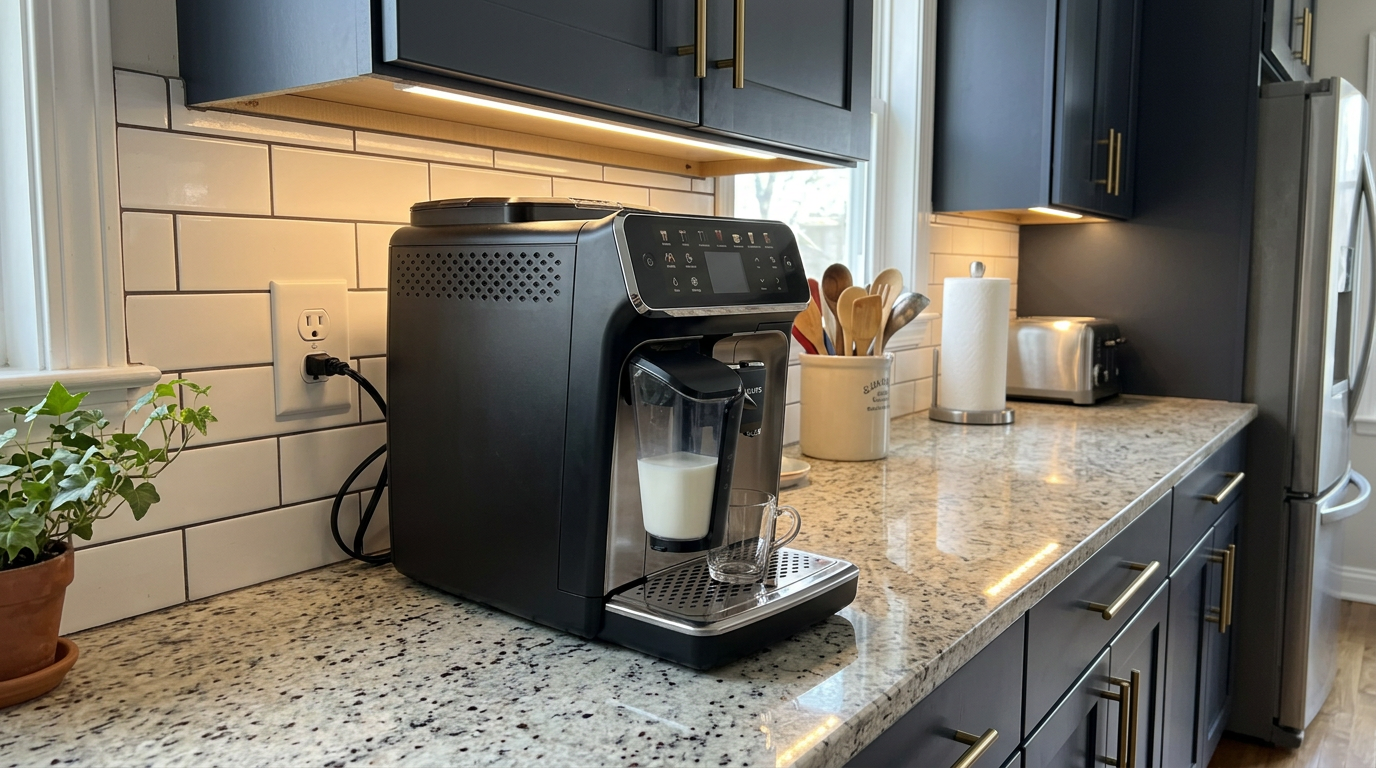
The front has a brushed, satin nickel-style finish that hides fingerprints well.
The display is a color touchscreen with six main drink buttons and a "more drinks" menu.
The body is mostly plastic, but the finish makes it look more expensive than it is.
The first thing I noticed in use was the speed.
From pressing the power button, the machine was ready to brew in well under a minute.
The second was the noise: the grinder and brew unit are noticeably quieter than on Philips' older machines.
By the end of the first week, the iced espresso had become Alex's afternoon habit, and the ristretto mine.
The satin front of the 4400 resists fingerprints much better than glossy finishes.
What the Philips 4400 Series actually is
The 4400 is a fully automatic, bean-to-cup espresso machine from Philips' LatteGo family.
It grinds whole beans, doses and presses them in the removable brew group, brews and drops the used puck into a drawer.
For milk drinks, the LatteGo jug froths milk and pours it straight into your cup.
It heats with a thermoblock✕ThermoblockA heater that warms water as it flows through a hot metal block, instead of heating a whole tank. It makes a machine ready to brew within seconds., which is why it's ready so quickly.
The 12 drinks
| Hot drinks | Iced drinks | Extras |
|---|---|---|
| Espresso | Iced espresso | Hot water |
| Ristretto | Iced coffee | Frothed milk |
| Coffee | Iced Americano | |
| Americano | ||
| Caffè crema | ||
| Cappuccino | ||
| Latte macchiato | ||
| Caffè latte | ||
| Café au lait |
What's in the box
The US model includes an AquaClean filter, a measuring scoop, a water hardness test strip, a tube of brew group grease and a storage lid for the LatteGo jug.
Our tip: Download the HomeID app before you set the machine up, because it has the manual, quick-start guide and troubleshooting steps on your phone.
Philips 4400 Series design and setup
The Philips 4400 Series measures about 24.6 × 37.1 × 43.3 cm, or 9.7 × 14.6 × 17 inches, and weighs about 8 kg, or 17.6 pounds.
It's the same compact Philips footprint, with a bigger menu inside.
The finish
The brushed nickel-style finish was my favorite of the Philips machines I tested.
It has a soft sheen rather than a mirror shine, so it didn't show smudges around the drip tray and jug.
Light enough to move
At 17.6 pounds, it's easy to slide forward from under a cabinet to refill beans or wipe the counter.
That sounds minor, but I did it almost every day.
Setup
The display guides you through filling the tank, adding beans, fitting the AquaClean filter and setting your water hardness.
Then the machine primes and rinses itself.
As always, pour away the first few drinks while the grinder settles.
Our tip: Turn on the initial rinse setting if you make one coffee in the morning, because it pre-heats the system so the first drink comes out hotter.
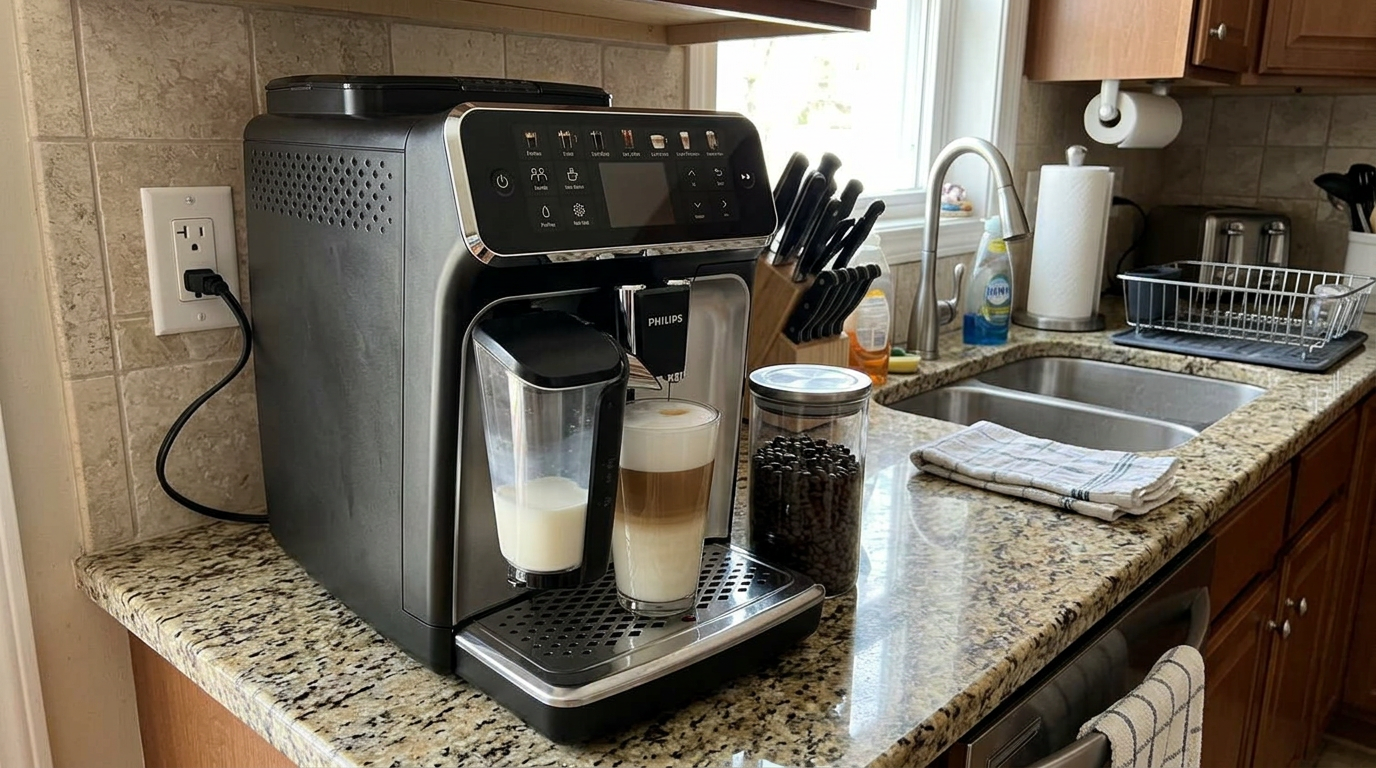
A latte straight from the LatteGo jug, next to the sink for easy rinsing.
Touchscreen, drinks menu and profiles
The front touchscreen shows six main drink buttons in color.
The other drinks, including the iced ones, sit in a "more drinks" menu one tap away.
When you pick a drink, its settings appear right away: strength, coffee volume and, for milk drinks, milk volume.
Profiles
The 4400 has two user profiles plus a guest profile.
Each profile saves its own version of every drink.
I saved a strong ristretto and a short cappuccino, and Alex saved a mild coffee and his iced espresso.
After that, mornings were one tap on our name and one on the drink.
A dedicated cleaning section
Maintenance functions live in their own section of the menu.
Rinsing, degreasing and descaling are all there, with clear step-by-step instructions.
Our tip: Put your most-used iced drink in your profile, so it is only one tap away instead of buried in the more drinks menu.
Strength settings and the coffee dose
This is where the Philips 4400 Series pulls ahead of Philips' entry models.
It has five strength levels, and each step adds roughly 0.04 ounces, or about 1 gram, of coffee.
I weighed the doses by stopping the machine after grinding.
Measured doses, rounded. Exact amounts vary with beans and grind.
How that compares
The strongest setting gives you about 11 to 12 grams of coffee.
That's a clear step up from the roughly 6 to 8 grams I measured on Philips' entry machines.
It's still below the 14 to 18 grams of a café double, but in the cup the difference was obvious: more body, more sweetness, more presence in milk.
Approximate doses from my measurements and typical café practice.
Espresso, ristretto and the black coffees
The 4400 grinds with 100% ceramic burrs✕Ceramic burrsGrinding plates made of ceramic instead of steel. They wear slowly and stay cool, which helps keep the coffee's aroma intact during grinding. with 12 grind settings, adjusted inside the bean hopper while the grinder runs.
Espresso and ristretto
On level 5 with a fresh medium-dark blend, the espresso had a fuller body than any other automatic Philips machine I tested.
The crema✕CremaThe golden-brown foam on top of an espresso. It forms when pressure pushes gases and oils out of freshly ground coffee. was thicker and lasted longer.
The ristretto✕RistrettoAn even shorter espresso, brewed with less water. It tastes more concentrated and sweeter, with less bitterness. was my favorite: short, sweet and chocolatey.
Coffee, Americano and caffè crema
The coffee button makes a long, smooth cup.
The Americano adds hot water to espresso for a cleaner taste.
Caffè crema sits between them, with a long body and a crema on top.
| Drink | Taste in my tests | Best setting I found |
|---|---|---|
| Ristretto | Sweet, concentrated, chocolatey | Level 5, smallest volume |
| Espresso | Full body, lasting crema | Level 5, small volume |
| Americano | Clean, round | Level 4 or 5 |
| Caffè crema | Mild, smooth | Level 3, one step coarser grind |
| Coffee | Easy-drinking mug | Level 3 or 4 |
Temperature
There are three brewing temperatures.
I used high for espresso and ristretto, and medium for long drinks.
The initial rinse setting made the first espresso of the day noticeably hotter.
| What you taste or see | Likely cause | First change |
|---|---|---|
| Thin | Strength too low | Raise to level 4 or 5 |
| Sour | Grind too coarse | One step finer while grinding |
| Bitter, dry | Volume too large | Smaller volume |
| First drink lukewarm | Cold system | Turn on initial rinse |
| Weak in milk drinks | Low strength | Level 5 in your profile |
Our tip: Turn the grind knob only while the grinder runs, one click at a time, and judge two drinks later.
Iced coffee: the 4400 Series' standout feature
If you drink cold coffee, this section is the reason to choose the Philips 4400 Series.
It has three dedicated iced drinks: iced espresso, iced coffee and iced Americano.
Why ordinary iced espresso goes wrong
Pour a normal hot espresso over a tall glass of ice and the ice melts fast.
You end up with a weak, watery drink that tastes of very little.
What the 4400 does differently
The iced recipes are calibrated for ice.
The iced espresso, for example, is designed to work with less ice than you might use otherwise.
That keeps the drink concentrated and full-flavored instead of diluted.
In my tests, iced espresso over a few cubes tasted clearly stronger and rounder than a regular espresso poured over a full glass of ice.
My ratings out of 100 for flavor and strength.
Building your own iced drinks
The iced espresso is a great base.
Add cold milk for an iced latte, or a little syrup for a sweeter drink.
The HomeID app has recipes for drinks like caramel lattes that match the 4400's menu.
| Drink | How I made it | Tip |
|---|---|---|
| Iced espresso | Preset, 3 to 4 ice cubes | Use the cubes the preset suggests |
| Iced latte | Iced espresso plus cold milk | Pour milk first, coffee on top |
| Iced Americano | Preset over ice | Big glass, refreshing |
| Iced caramel latte | Iced espresso, cold milk, caramel syrup | Stir syrup into the coffee first |
| Iced coffee | Preset over ice | Mildest of the three |
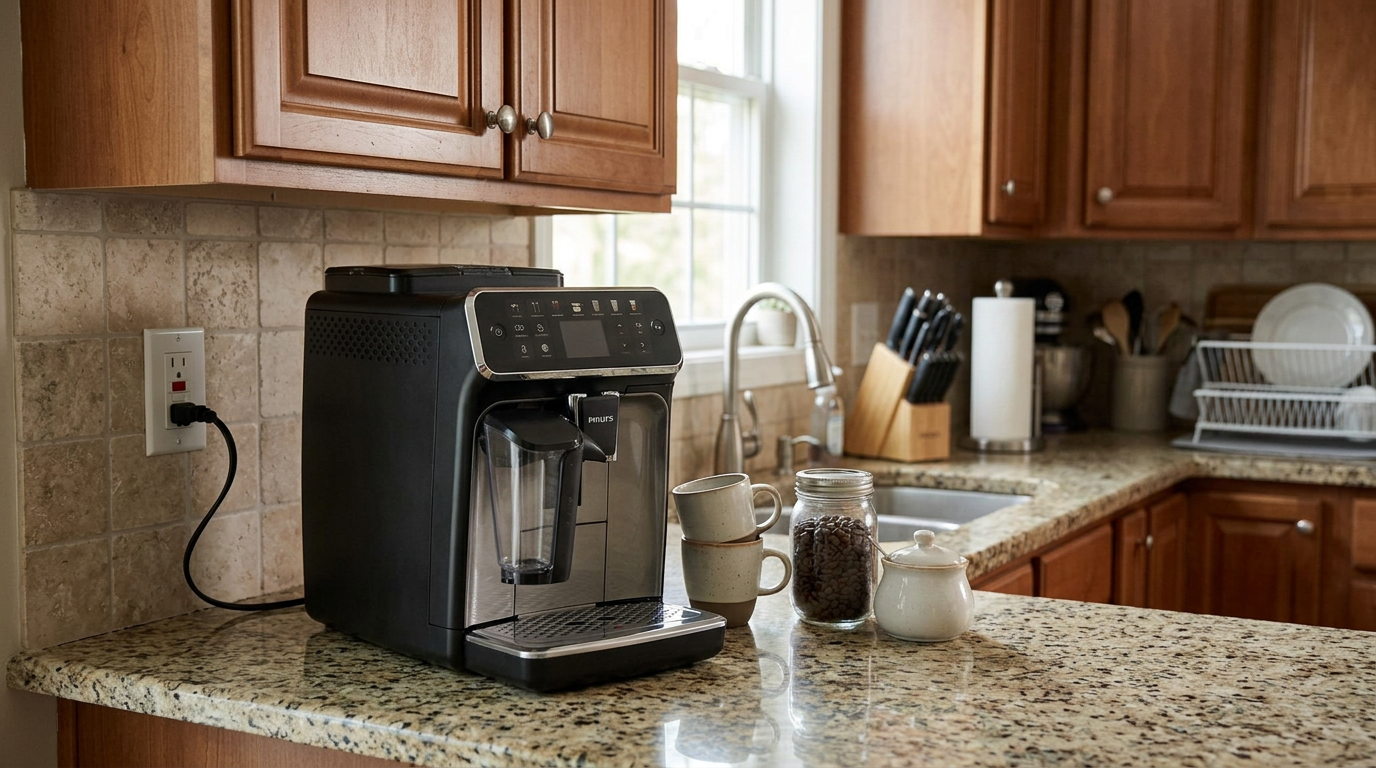
A glass under the spout: the iced espresso preset is built for a few cubes, not a full glass.
LatteGo milk drinks
The LatteGo jug on the 4400 has two main parts and no tubes.
Fill it with cold milk, clip it on the front and pick a milk drink.
The machine sends steam through the jug's frothing chamber, which spins the milk with air and pours the foam into your cup.
Fill lines
The jug has markings for one or two drinks, so you only pour in the milk you need.
That helped us waste less milk.
How the foam turned out
The cappuccino had a thick, creamy foam.
The caffè latte and latte macchiato had more milk and a lighter layer of foam.
With the bigger coffee dose on level 5, the coffee taste came through the milk far better than on Philips' entry machines.
It's automatic foam, so you can't control the texture like with a steam wand, and it isn't microfoam✕MicrofoamMilk foam with bubbles so small you can't see them. It feels silky and blends into the coffee instead of sitting on top like froth. for latte art.
My ratings out of 10 for foam texture and stability. Barista versions of plant milks foamed more consistently.
Storing milk
The jug comes with a lid for the fridge.
It isn't airtight, so it's fine for a day, not for a week.
Our tip: Choose barista versions of plant milks, because they contain added protein and fat that make the foam far more stable in LatteGo.
My favorite drinks and settings
These are the settings we saved to our profiles on the Philips 4400 Series after four weeks.
| Drink | Strength | Volume | Notes |
|---|---|---|---|
| Morning ristretto | Level 5 | Smallest | High temperature, warm cup |
| Espresso | Level 5 | Small | Grind 2 steps finer than default |
| Cappuccino | Level 5 | Less milk | Full coffee taste |
| Caffè latte | Level 4 | Medium milk | Alex's daily drink |
| Iced espresso | Level 5 | Preset | Three or four cubes |
| Iced Americano | Level 4 | Preset | Big glass on hot days |
| Caffè crema | Level 3 | Medium | Grind one step coarser |
Making a flat-white-style drink
There's no flat white button on the US model.
Make a ristretto into a small cup, then use the frothed milk option for a little hot milk and pour it on top.
It isn't true microfoam, but it's a short, strong milky coffee.
Hot chocolate
The frothed milk option is handy for kids' drinks too.
Froth milk into a mug with a spoon of cocoa, stir, and you're done.
General milk guidance. LatteGo drinks sat comfortably in the middle band in my tests.
Our tip: Save each perfected drink to your profile straight away, because it is easy to forget the exact strength and volume a week later.
Start-up speed and noise
Quick start
The 4400 was ready to brew within about 30 to 45 seconds of switching on in my tests.
That's thanks to the thermoblock, which heats water as it flows instead of warming a whole boiler.
On busy mornings, that made a real difference.
4400 time measured in testing. Boiler machines vary widely.
Quieter brewing
Philips' SilentBrew technology reduces brewing noise compared with its older machines.
The grinder still makes a noticeable burst, and the brew unit clicks as it moves.
During steaming, you'll hear a regular ticking from the thermoblock, which is normal.
Overall, it was the quietest automatic Philips machine I tested, and it didn't wake anyone in our apartment.
| Sound | When | Normal? |
|---|---|---|
| Grinder burst | Start of each drink | Yes |
| Clicking | Brew unit moving into place | Yes |
| Ticking | Thermoblock making steam | Yes |
| Water in drip tray | During brewing | Yes, excess water is drained there |
| Grinding with no beans or stopped brew | Any time | No, check HomeID troubleshooting |
Pre-ground coffee, hot water and the HomeID app
Pre-ground coffee
The pre-ground coffee✕Pre-ground bypassA separate chute that sends already-ground coffee straight to the brew unit, skipping the grinder. Handy for decaf without emptying the bean hopper. compartment lets you brew decaf without swapping the beans in the hopper.
Add one level scoop and pick your drink.
The same compartment is also where the coffee oil cleaning tablet goes during degreasing.
Hot water and frothed milk
Hot water is handy for tea and warming cups.
The frothed milk option makes hot foam on its own, which I used for hot chocolate.
The HomeID app
The app isn't needed for daily use, but it was useful.
It has the user manual, the quick-start guide, troubleshooting steps and drink recipes matched to the 4400's menu.
When the machine made an unfamiliar sound in week two, the troubleshooting section explained it in under a minute.
Cleaning and maintaining the Philips 4400 Series
The Philips 4400 Series tells you when it needs attention: low water, full grounds container and full drip tray.
The drip tray and grounds container
The drip tray has a red float that pops up when it's full.
A little water in the tray after brewing is normal, because excess water is drained there.
One useful tip from the manual: remove and empty the drip tray and grounds container while the machine is switched on.
That way, its sensors register the change and reset the warnings.
LatteGo
The two-part jug rinses clean under the tap and is dishwasher-safe.
I rinsed it after every milk drink and put it in the dishwasher daily.
The brew group
The brew group✕Brew groupThe part inside an automatic machine that receives the ground coffee, presses it into a puck, pushes hot water through it and then ejects the used grounds. comes out through a service door on the side, behind the water tank.
I rinsed it weekly under the tap and let it dry before refitting it.
Its moving parts need a little of the included grease every couple of months.
Degreasing
Coffee oils build up in the brew group over time, and water alone doesn't remove them.
The 4400 has a degreasing cycle that uses a cleaning tablet in the pre-ground compartment.
Descaling
With the AquaClean filter replaced when prompted, Philips says you can go up to 5,000 cups before descaling✕DescalingRunning a mild acid solution through the machine to dissolve mineral scale left by hard water. Scale slows heating and can block pipes..
The cleaning menu guides you through descaling when it's due.
| Task | What it removes | How often |
|---|---|---|
| Rinse LatteGo | Milk residue | After every milk drink |
| Empty drip tray and grounds | Water and pucks | When prompted, usually daily |
| Rinse brew group | Loose coffee residue | Weekly |
| Degreasing tablet | Coffee oils | When prompted or monthly |
| Grease brew group | Friction on moving parts | Every couple of months |
| Descale or new filter | Mineral scale | When prompted |
My estimate of hands-on cleaning time per day.
Our tip: Empty the drip tray and grounds drawer with the machine switched on, so the full-tray and grounds warnings reset properly.
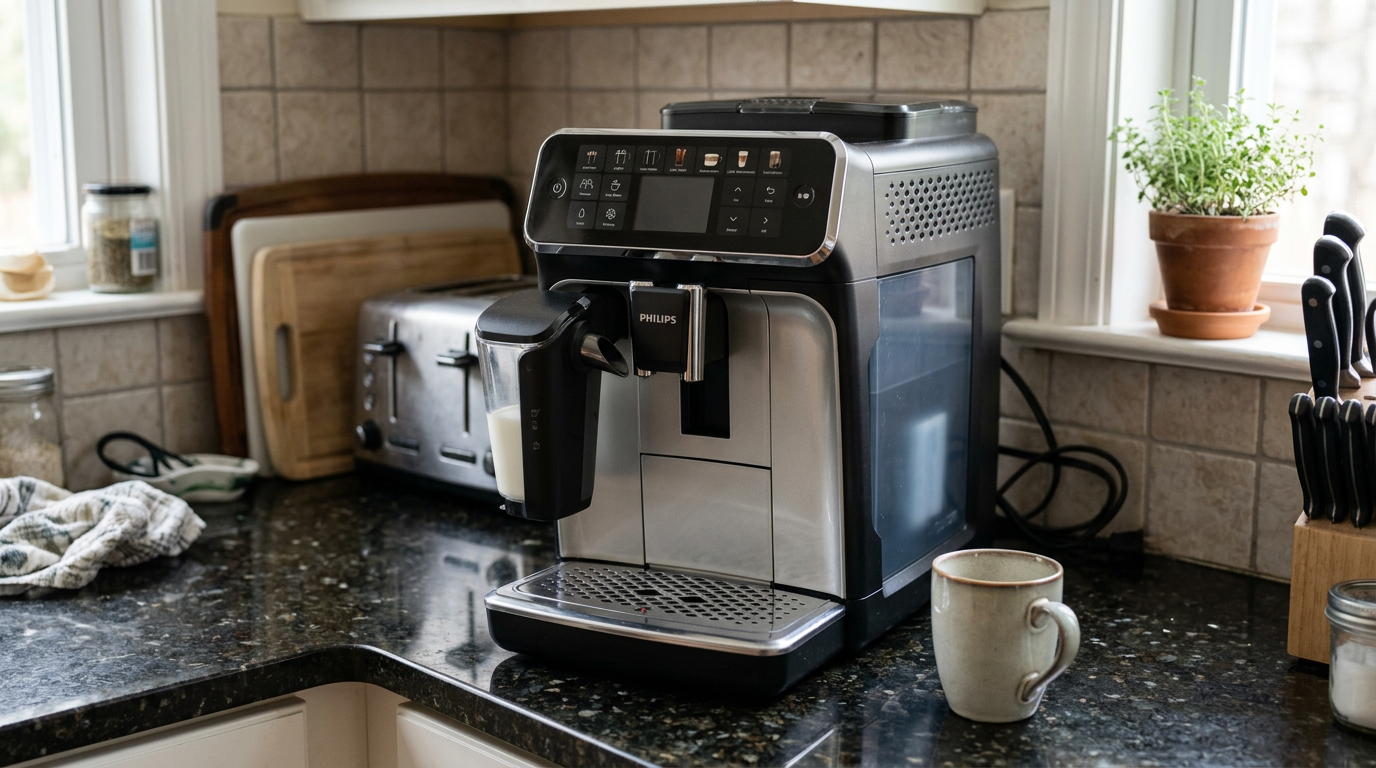
The removable drip tray has a red float that pops up when it needs emptying.
What daily use is really like
Our mornings with the 4400 were the fastest of all the Philips machines I tested.
Switch on, and by the time I'd filled the milk jug, it was ready.
I tapped my profile for a ristretto, and Alex tapped his for a caffè latte.
In the afternoon, it was iced espressos for both of us.
The 1.8-liter tank, about 61 fluid ounces, lasted us around a day and a half with that mix.
Rough maths from a 1.8 L tank, allowing for rinses.
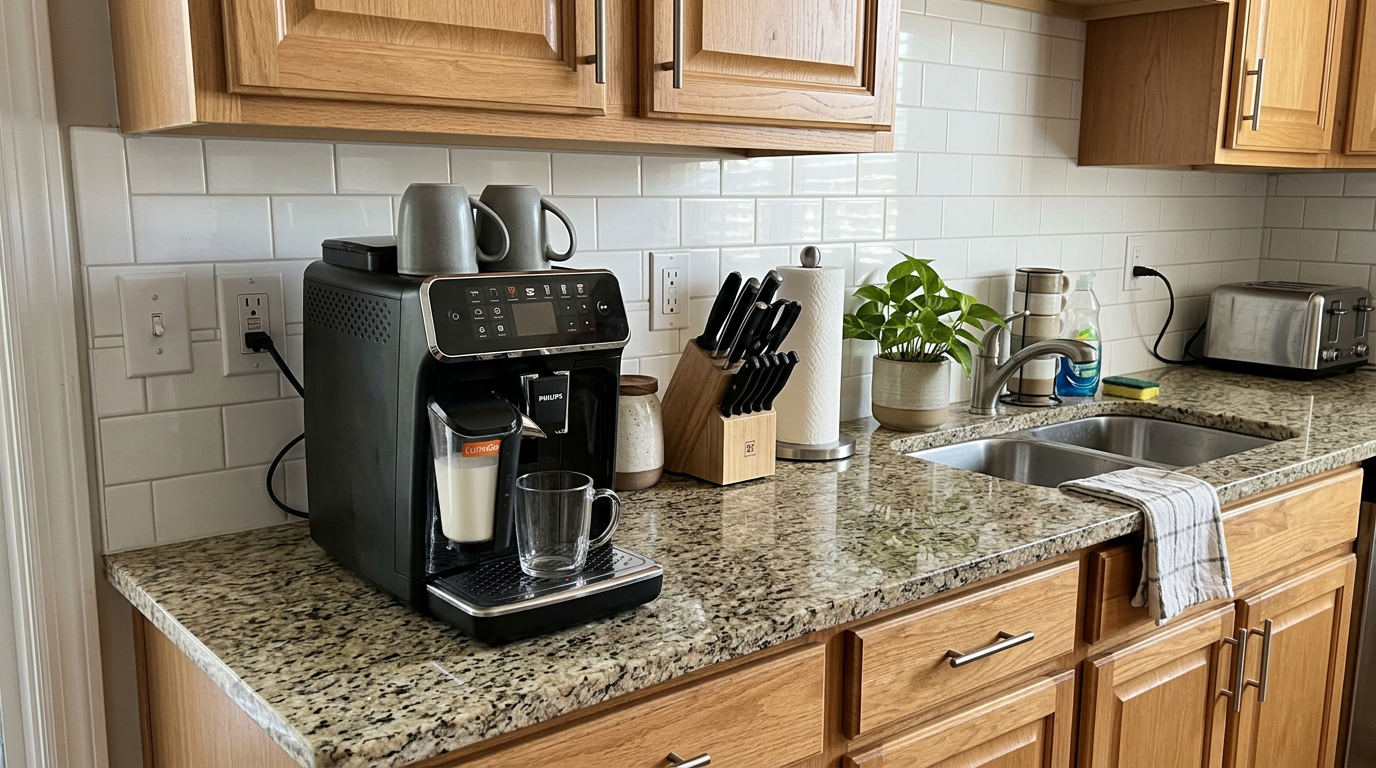
Two profiles meant each of us got our own drink with one tap.
Beans, water and milk
The bigger dose means the 4400 shows off good beans better than Philips' entry machines.
Medium-dark blends made the best ristretto and milk drinks.
Medium roasts were lovely in the caffè crema and iced Americano.
Avoid oily and flavored beans, which leave residue in the grinder and brew group.
| Bean type | Hot espresso | Milk drinks | Iced drinks |
|---|---|---|---|
| Medium-dark blend | Best | Excellent | Very good |
| Medium roast | Good, brighter | Good | Best, refreshing |
| Light roast | Can be sour | Fades in milk | Good, fruity |
| Oily or flavored | Avoid | Avoid | Avoid |
Water and milk
Use fresh, cold water and keep the AquaClean filter fitted.
Use cold milk straight from the fridge, and barista versions of plant milks.
Four weeks with the 4400, week by week
Week 1: exploring the menu
We tried all 12 drinks in the first few days and saved our profiles.
The quick start and the quieter brewing stood out immediately.
Week 2: dialing in
I moved the grind two steps finer and saved ristretto and espresso on level 5.
Alex discovered the iced espresso and stopped buying iced coffee on the way home.
Week 3: the routine
LatteGo rinsing and weekly brew group rinses became habit.
The HomeID app explained a ticking sound during steaming: the thermoblock, and perfectly normal.
Week 4: the first degreasing cycle
We ran a degreasing cycle with a tablet.
Nothing broke or rattled, and the drinks tasted as good as in week two.
Our combined feeling about the machine, from our shared notes.
Common mistakes to avoid
| Mistake | What happens | Better habit |
|---|---|---|
| Filling the glass with ice for iced drinks | Watery coffee | Three or four cubes |
| Emptying the tray with the machine off | Warnings do not reset | Empty with the machine on |
| Using regular plant milk | Thin, unstable foam | Barista versions |
| Skipping degreasing | Oily residue, bitter taste | Run it when prompted |
| Leaving milk in the jug for days | Spoiled milk | Use within a day |
| Low strength in milk drinks | Coffee gets lost | Level 4 or 5 |
What I would change
A bigger maximum dose would bring the espresso even closer to a café shot.
A third profile would help larger households.
And a manual steam option would let enthusiasts texture their own milk.
Three households, three verdicts
The iced coffee fan
Someone who buys iced coffee on the way to work most days.
The 4400 is the best Philips machine I tested for this, by a clear margin.
The couple with different tastes
One drinks ristretto, the other lattes.
Two saved profiles and 12 drinks make this effortless.
The black coffee purist
Just a big mug of black coffee every morning.
The 4400 does it well, but most of its features would go unused.
| Household | Fit | Main reason |
|---|---|---|
| Iced coffee fan | Excellent | Calibrated iced recipes |
| Couple with different tastes | Excellent | Two profiles, 12 drinks |
| Busy family | Very good | Quick start, easy cleaning |
| Black coffee purist | Fair | Most features unused |
Is the Philips 4400 Series worth the money?
The 4400 sits above Philips' entry models and below the flagship machines.
For that, you get 12 drinks including real iced coffees, a quick start, quieter brewing, two profiles and a noticeably bigger dose.
If you drink iced coffee regularly, the dedicated iced recipes alone make it worth choosing over the cheaper models.
If you only drink hot black coffee, it's more machine than you need.
Three questions to ask:
Do you drink iced coffee?
Do two people use the machine daily?
And do you want fuller espresso than an entry model can give?
How it compares with other coffee setups
| Feature | Philips 4400 Series | Entry-level automatic machine | Manual machine and grinder |
|---|---|---|---|
| One-touch drinks | 12 hot and iced | 2 to 5 | None |
| Iced coffee | Dedicated recipes | Hot coffee over ice | By hand |
| Strongest dose | About 11–12 g | About 6–8 g | 14–18 g or more |
| Milk | LatteGo, automatic | Frother or LatteGo | Steam wand, full control |
| Profiles | 2 plus guest | None | N/A |
| Start-up | About 30–45 s | Fast | Often several minutes |
Compared with an entry machine, the 4400 adds variety, iced drinks and a fuller espresso.
Compared with a manual setup, it gives up milk control and the biggest doses, but saves you a lot of time and skill.
| You mostly drink | Is the 4400 a fit? | Why |
|---|---|---|
| Iced coffee | Excellent | Dedicated, calibrated iced recipes |
| Ristretto and espresso | Very good | Up to about 11–12 g dose |
| Lattes and cappuccinos | Very good | Easy LatteGo, fuller coffee |
| Latte art | Poor | Automatic foam only |
| Plain black coffee only | Fair | More machine than you need |
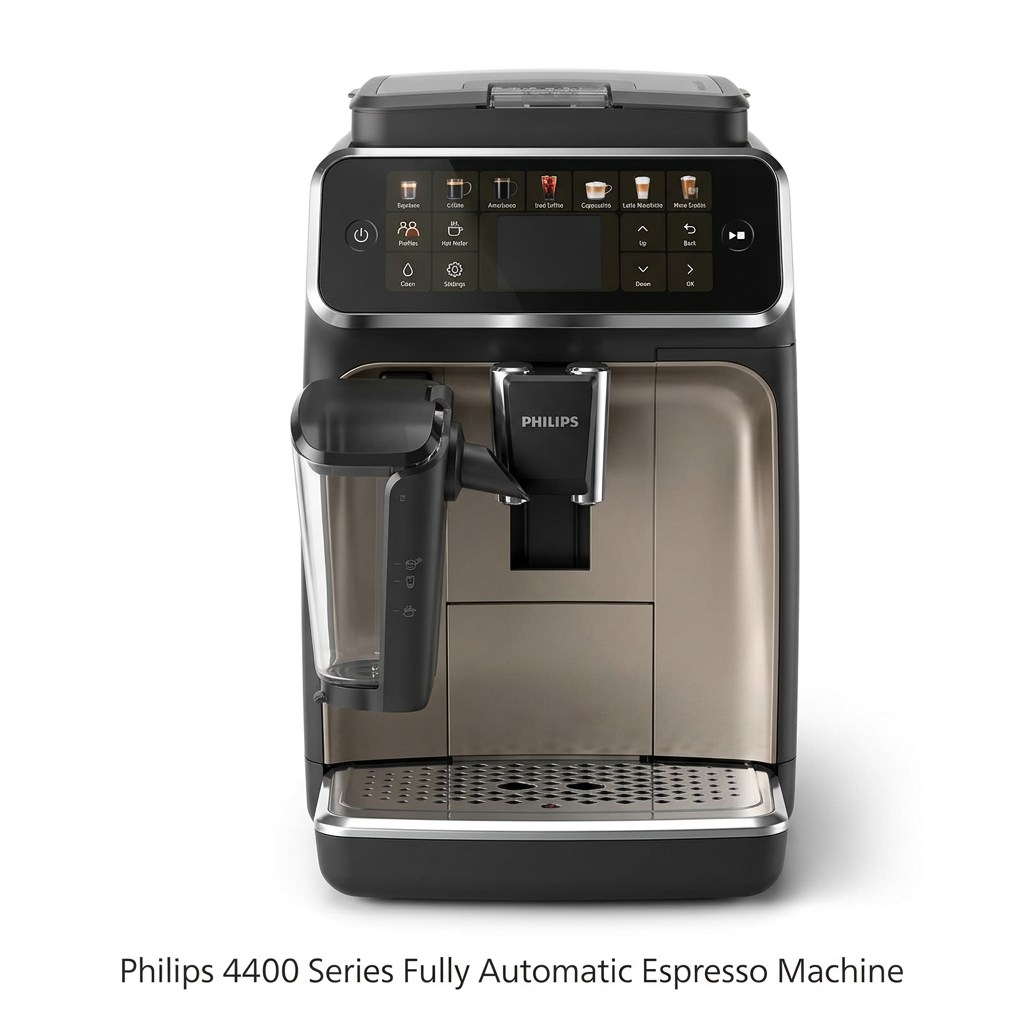
The full package: color touchscreen, adjustable spout and the LatteGo jug.
Other Philips machines I tested
For eight drinks and a similar display, see my Philips 4300 Series review.
The Philips 3200 Series is the simpler five-drink option.
And to make espresso by hand, my Philips Barista Brew review covers Philips' semi-automatic machine.
If a one-touch cappuccino is all you need, my Philips 2300 Series review covers the cheapest way I know into the same LatteGo jug.
Which one is right for you: is the Philips 4400 Series your match?
4 quick questionsPhilips 4400 Series specifications
From manufacturer data and my own testing.
How I tested and scored the Philips 4400 Series
For four weeks, the Philips 4400 Series was our everyday coffee machine for all 12 drinks.
Alex van Gog and I each used our own profile and kept joint notes.
We weighed doses at all five strength levels, timed the start-up and compared the iced presets with hot espresso poured over ice.
We tested dairy, oat, almond and cashew milk in LatteGo, and followed the full routine, including a degreasing cycle.
Finally, I checked our notes against Philips' specifications, the user manual and the HomeID app.
- Espresso (8.2): body, crema and flavor across the dose range.
- Milk drinks (8.3): foam, coffee balance and plant milk performance.
- Ease of use (9.0): touchscreen, profiles, speed and iced drinks.
- Cleaning (8.5): LatteGo, brew group, degreasing, alerts and descaling.
The overall score of 8.6 is an editorial rating that reflects those four areas.
Philips 4400 Series FAQ
Is the Philips 4400 Series worth it?
Yes, if you want lots of hot and iced drinks, fuller espresso than entry models and easy milk cleaning. If you only drink plain black coffee, a simpler machine will do.
What drinks does the Philips 4400 Series make?
Twelve one-touch drinks, including espresso, ristretto, coffee, Americano, caffè crema, cappuccino, latte macchiato, caffè latte, café au lait, iced espresso, iced coffee and iced Americano, plus hot water and frothed milk.
How does the iced coffee work?
The iced recipes are calibrated for a few ice cubes, so the drink stays concentrated instead of watery. Use three or four cubes rather than a full glass.
How much coffee does the 4400 use?
I measured about 6 to 7 grams on the mildest of the five levels and about 11 to 12 grams on the strongest.
How quickly is it ready?
In my tests, about 30 to 45 seconds after switching on, thanks to its thermoblock heater.
Is the Philips 4400 Series quiet?
It is quieter than older Philips machines thanks to SilentBrew. The grinder and brew unit are still audible, and the thermoblock ticks during steaming, which is normal.
Does LatteGo work with plant milk?
Yes. Oat, almond and cashew milk all worked, and barista versions gave the most stable foam.
How many user profiles does it have?
Two user profiles plus a guest profile.
Why is there water in the drip tray?
Some water is drained into the tray during normal brewing. It isn't a leak.
How do I clean the brew group?
Remove the water tank, open the side service door and pull out the brew group. Rinse it weekly, run a degreasing cycle when prompted and grease the moving parts every couple of months.
Can it make latte art?
No. LatteGo makes automatic foam that is creamy but not pourable microfoam.
Does it need descaling?
Yes, but with the AquaClean filter replaced when prompted, Philips says you can go up to 5,000 cups between descales.
Kitchen & coffee tester
Michael spent six years as a line cook in restaurants in Chicago and New York, and he has tested kitchen appliances for HouseholdMe since 2018, from air fryers to coffee makers. He holds an SCA certificate in barista skills and used the Philips 4400 Series as his everyday coffee machine for four weeks for this review.
- Four weeks of hands-on testing of the Philips 4400 Series Fully Automatic Espresso Machine
- Philips product specifications and user manual
- General espresso brewing and maintenance guidance