Philips 4400 vs 5500: which high-end Philips should you choose?
They share a body, a ceramic grinder, a brew group and the same LatteGo milk jug. Then they split: the Philips 4400 gives you 12 hot and iced drinks, two profiles and a color touchscreen, while the Philips 5500 stretches to 20 drinks, four profiles, an Extra Shot button and a flat white. I used both every day for four weeks each, measured what matters and lined up the data to find out which one belongs in your kitchen.
We choose products independently. We may earn a commission through links on this page; your price stays the same. Affiliate policy
Jargon helpNew to espresso? Tap any dotted term to see what it means.
In this comparison
For a household of three or four, buy the Philips 5500. Its four profiles, 20 drinks, one-touch flat white and Extra Shot button make it the easier machine to share, and its milk came out hotter in my tests. If it is just the two of you, you love iced espresso and you want to keep a little money in your pocket, the Philips 4400 gives you nearly everything that matters: the same grinder, the same LatteGo jug, the same compact body and iced recipes that tasted stronger in my glass.
The two machines
Specs checked November 14, 2026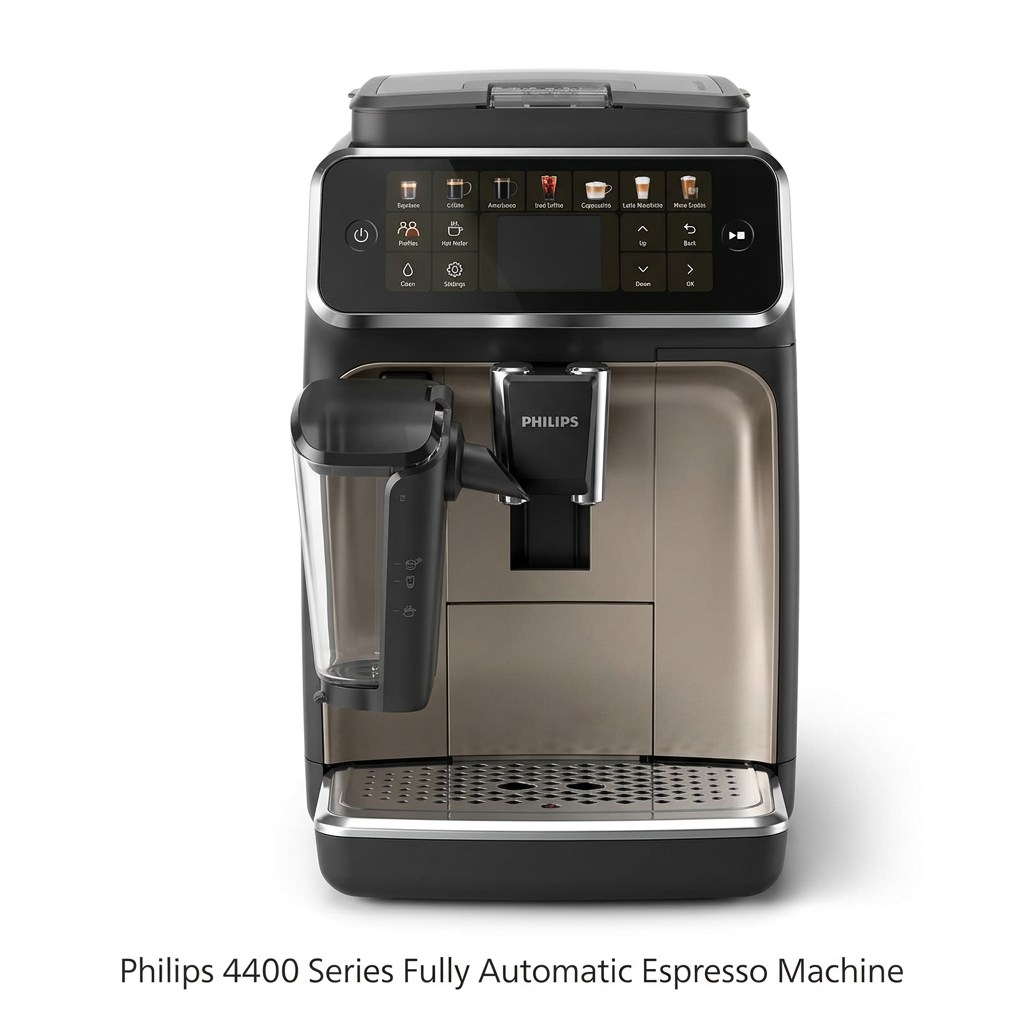
12 hot and iced drinks, two profiles plus guest, a color touchscreen and a measured strongest dose of about 11 to 12 grams.
Check price on Amazon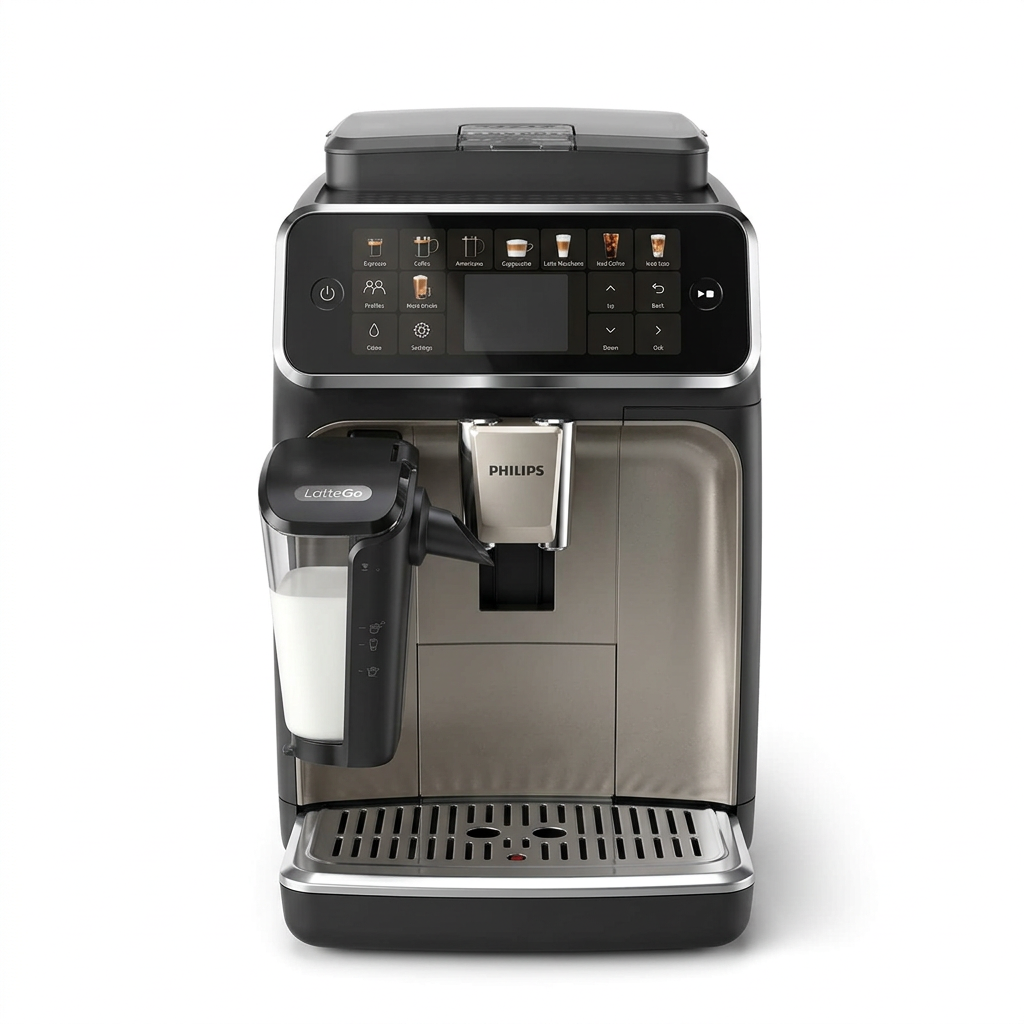
20 hot and iced drinks including flat white, four profiles plus guest, Extra Shot for stronger coffee and milk at about 167°F.
Reveal Today’s DealPhilips 4400 vs 5500 at a glance
- Buy the 4400 if two people share the machine and iced espresso is a daily habit.
- Buy the 5500 if three or more people want their own drinks, or you want flat whites and stronger milk drinks.
- Under the hood they are twins: same ceramic grinder, same brew group, same 61 oz tank and 9.7 oz hopper.
- The upgrade buys you drinks, profiles and Extra Shot, not better espresso extraction.
Head to head
The better result in each row is marked, based on my testing and the manufacturer specs. Rows where the two machines are identical have no winner.
Keep in mind that the tally is not my verdict. Some rows matter far more than others, and which ones matter depends on how many people use the machine.
| Spec | Philips 4400 | Philips 5500 |
|---|---|---|
| One-touch drinks | 12 hot and iced | 20 hot and iced ✓ Best |
| Flat white button | No, built by hand | Yes ✓ Best |
| User profiles | 2 plus guest | 4 plus guest ✓ Best |
| Extra Shot | No | Yes, a second fresh brew ✓ Best |
| Strongest dosemeasured | About 11–12 g | Same grinder, plus Extra Shot ✓ Best |
| Iced espressomy tasting | Strong and round, few cubes ✓ Best | Pleasant, more diluted |
| Iced milk drinks | Iced latte by hand | Iced latte and iced cappuccino ✓ Best |
| Milk temperature | About 140–150°F | About 167°F ✓ Best |
| Controls | Color touchscreen | Color display with buttons |
| Ready from switch-on | About 30–45 s | About 20–25 s ✓ Best |
| Noise | SilentBrew | SilentBrew, about 60 dB grinding |
| Grinder | Ceramic, 12 settings | Ceramic, 12 settings |
| Water tank / beans | 61 oz / 9.7 oz | 61 oz / 9.7 oz |
| Footprint | 9.7 × 14.6 × 17 in | 9.7 × 14.6 × 17 in |
| Value | Costs less ✓ Best | Pricier for the extras |
| Rows won | 2 | 8 |
Philips 4400 vs 5500 pros and cons
Philips 4400
- Iced espresso that stays strong and round
- Bigger strongest dose than entry Philips machines
- Same LatteGo jug and compact body for less money
- No flat white or Extra Shot
- Only two saved profiles
- Milk drinks a little cooler than the 5500
Philips 5500
- 20 drinks, including flat white and five iced recipes
- Four profiles that save every drink for every person
- Extra Shot makes milk drinks properly strong
- Espresso is still lighter than a café shot
- Iced drinks are brewed warm and dilute the ice
- Fixed milk spout means cup placement matters
Who should buy which machine?
- Couples who each have one favorite drink
- Iced espresso and iced Americano fans
- Buyers who want LatteGo for less
- Families of three or four
- Flat white and strong cappuccino drinkers
- Anyone who wants the widest menu
Design, size and build
Put the two machines side by side and you would struggle to tell which is which from across the room.
They share the same chassis: about 9.7 inches wide, 14.6 inches tall and 17 inches deep, with the LatteGo jug clipped to the front. Both weigh about 17.6 pounds.
The Philips 4400 wears a brushed, satin nickel-style front that hid fingerprints better than any Philips I have tested. The Philips 5500 frames its display in chrome and adds a stainless steel grate on the drip tray.
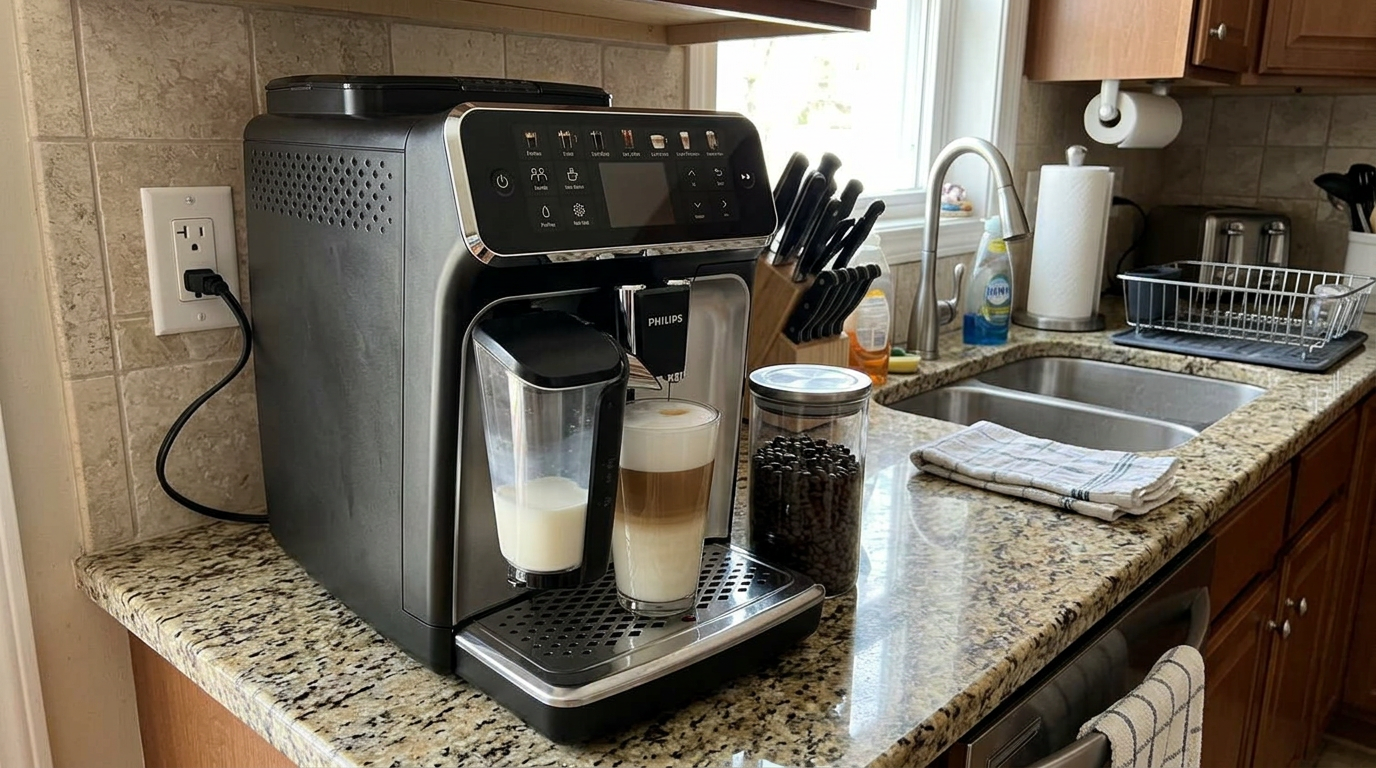
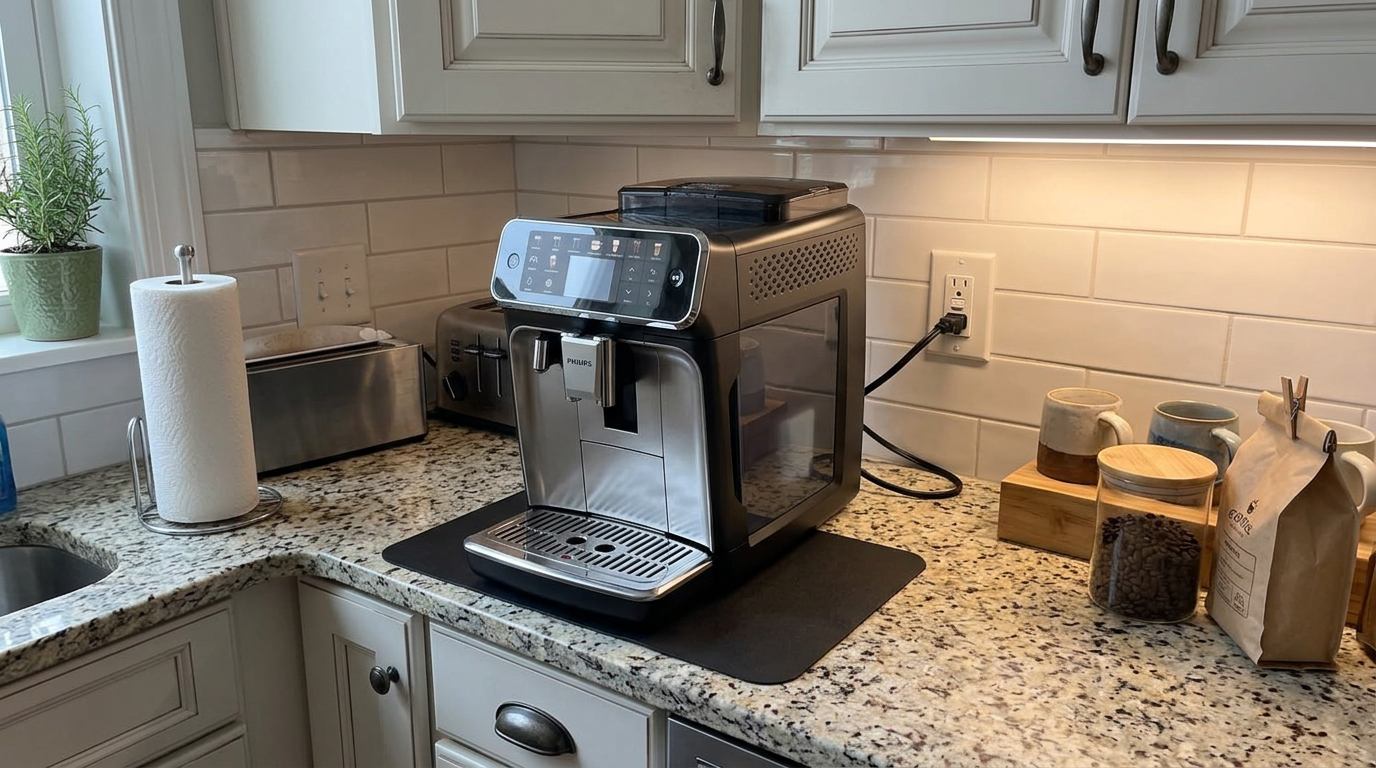
The 4400’s satin finish hides smudges around the jug and drip tray.
Both bodies are mostly plastic. Neither flexed or creaked in four weeks, and both wiped clean with a damp cloth.
The real design win is shared. Everything you refill daily slides out from the front: the water tank, the grounds drawer and the drip tray.
That means you can push either machine right up against the wall or under a cabinet without losing access. Only the bean hopper lid needs headroom.
Width compared with a typical automatic
Both Philips machines are among the narrowest full-featured automatics you can buy.
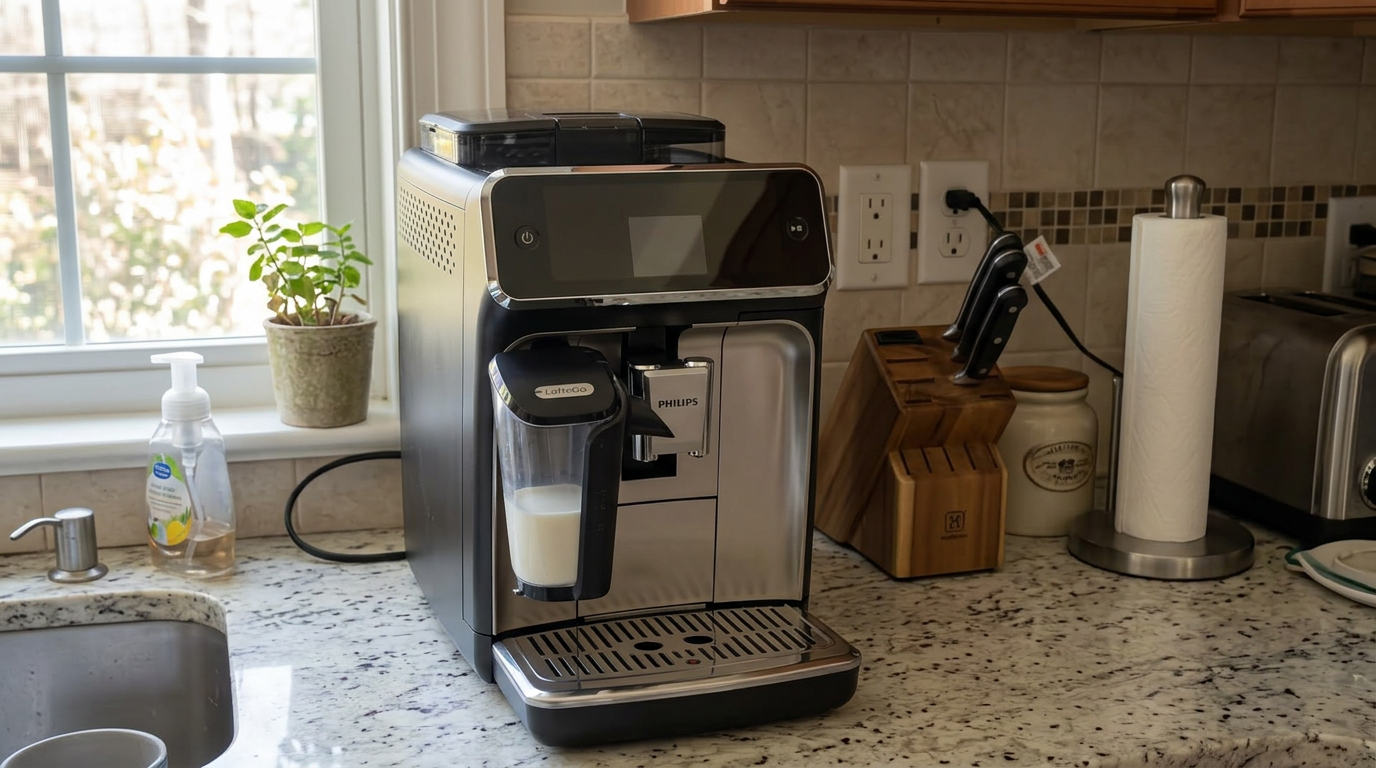
The 5500 frames its display in chrome, but the body is the same size as the 4400.
Our tip: Slide either machine forward to refill beans rather than lifting the lid under a cabinet, because at 17.6 pounds it moves easily and you won’t spill beans behind it.
Setup and the first week
Setup is identical and took me about ten minutes on each. You test your water with the included strip, enter the result, fit the AquaClean filter, fill the tank and let the machine prime itself.
Both then walk you through the basics on screen. I’d recommend the free HomeID app for both, because it puts the manual, troubleshooting steps and drink recipes on your phone.
My first few drinks on both were noticeably thinner than the ones I made after about a dozen brews. The grinder and brew group need time to bed in, so I didn’t judge anything until the second day.
| Setup step | Philips 4400 | Philips 5500 |
|---|---|---|
| Water hardness | Strip, entered on screen | Strip, entered on screen |
| Filter | AquaClean in the tank | AquaClean in the tank |
| Profiles to set up | 2 plus guest | 4 plus guest |
| Time to first good drink | About a dozen brews | About a dozen brews |
One habit made the biggest difference on both: setting up profiles on day one. On the 5500 especially, giving each person a color before anyone changed the defaults saved a lot of “who changed my latte?” moments.
Our tip: Turn on the initial rinse if you make one coffee in the morning, because it pre-heats the system so the first drink comes out hotter.
Display, controls and profiles
This is where the two machines feel most different day to day, even though the menus look alike.
The Philips 4400 uses a color touchscreen with six main drink buttons and a “more drinks” menu. When you pick a drink, its strength, coffee volume and milk volume appear right away.
The Philips 5500 uses a full-color display surrounded by soft-touch buttons rather than a touchscreen. I came to like that, because buttons work reliably with wet or milky fingers at 7 a.m.
Profiles: the real upgrade
The 4400 has two user profiles plus a guest profile. The 5500 has four color-coded profiles, blue, green, red and yellow, plus a guest.
On both, a profile remembers your version of every drink, not just one favorite. When I changed my cappuccino to stronger and smaller, that became my cappuccino from then on.
For a couple, two profiles is plenty. For a family of four, the 5500 is the only one where everyone gets their own drinks without overwriting someone else’s.
| Feature | Philips 4400 | Philips 5500 |
|---|---|---|
| Display | Color touchscreen | Color display with buttons |
| Main drink buttons | 6, plus more drinks menu | Quick buttons, plus hot and iced menus |
| User profiles | 2 plus guest | 4 plus guest |
| Strength levels | 5 | 5, plus Extra Shot |
| Temperature settings | 3 | Several |
| Eco settings | Initial rinse option | 5 eco settings, QuickStart |
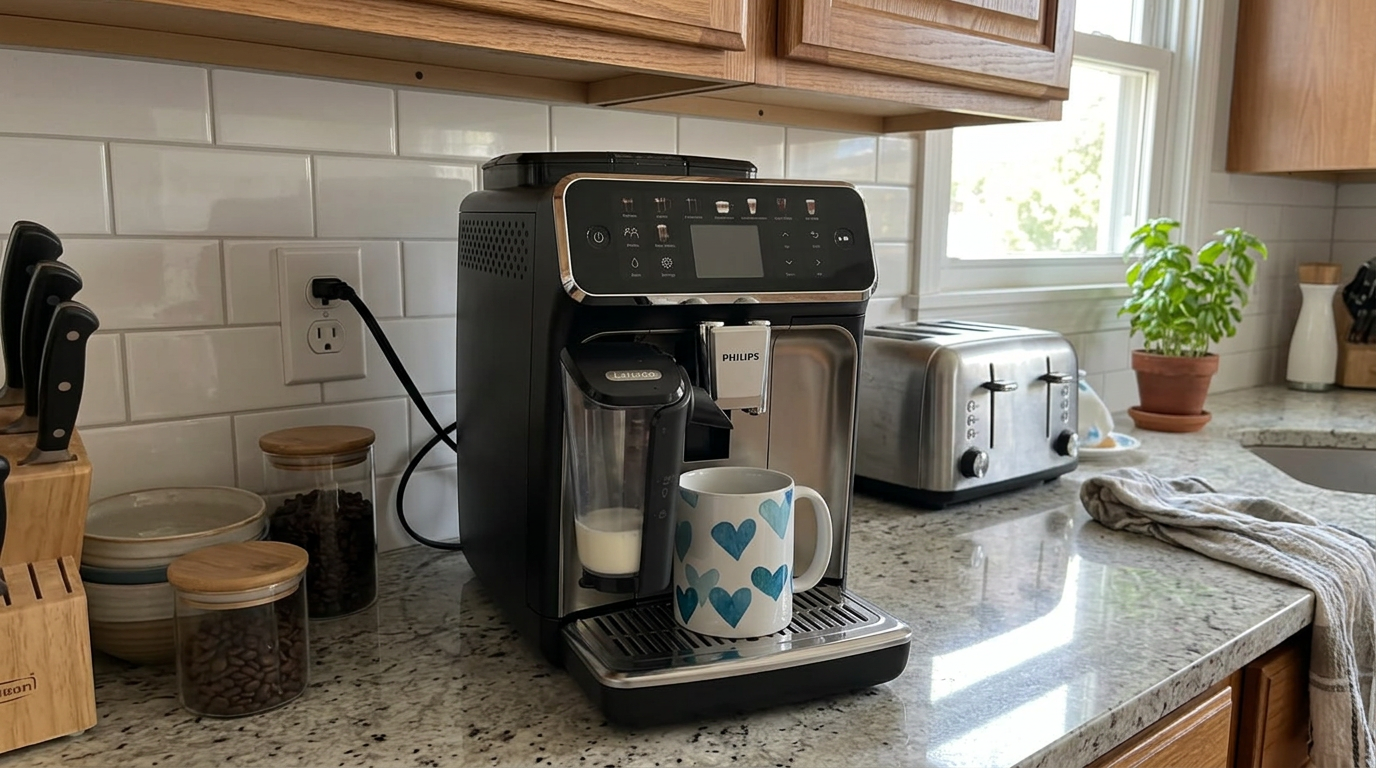
The 5500’s buttons around the display worked well with damp fingers.
Our tip: Give each person their own profile color on day one, before anyone starts changing the shared default drinks.
Grinder, dose and strength
Both machines grind with 100% ceramic flat burrs and 12 grind settings, adjusted by a dial inside the bean hopper. Ceramic stays cooler than steel, so it doesn’t warm the coffee before it meets water.
Both also use the same removable brew group. That means the basic extraction is the same machine, and the differences come from what each one does around it.
Dose by strength level
I weighed the 4400’s doses by stopping the machine after grinding. Each strength step added roughly 1 gram of coffee.
Measured 4400 doses, rounded. The 5500 uses the same grinder and brew group.
Extra Shot: the 5500’s secret weapon
The Philips 5500 has an Extra Shot option that grinds and brews a second fresh puck straight after your drink. You get more coffee, rather than more water pushed through the same grounds.
That is a real difference in milk drinks. A cappuccino at level 5 with Extra Shot had properly strong coffee flavor, while the 4400’s level 5 cappuccino was good but softer.
| Grinder detail | Philips 4400 | Philips 5500 |
|---|---|---|
| Burrs | 100% ceramic, flat | 100% ceramic, flat |
| Grind settings | 12 | 12 |
| Strength levels | 5 | 5 |
| Extra Shot | No | Yes |
| Pre-ground chute | Yes, one scoop | Yes, one scoop |
| Bean hopper | 9.7 oz | 9.7 oz |
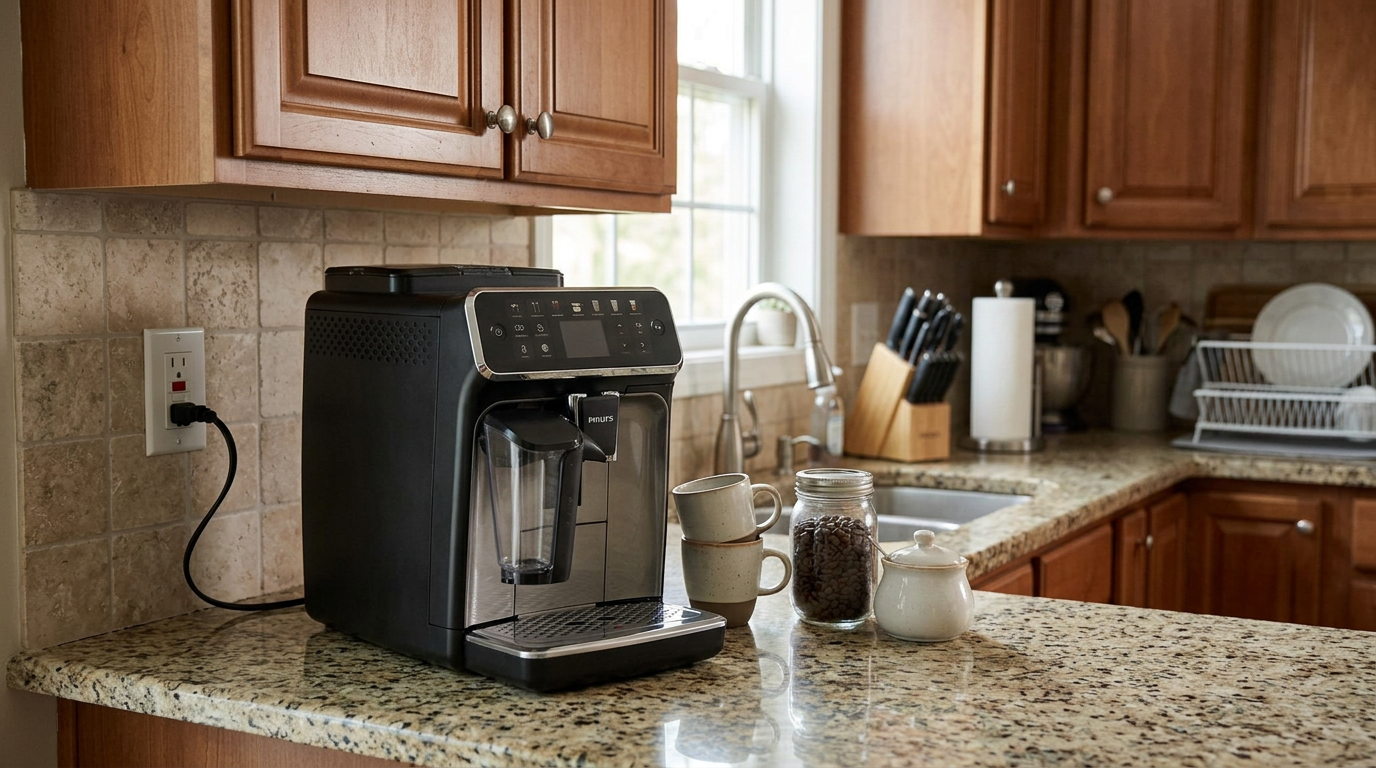
At level 5 with a small volume, the 4400 pulled its best espresso.
Our tip: Turn the grind dial only while the grinder is running, one click at a time, and judge the result two drinks later.
Espresso quality
This is where the two machines are closest, because they share the grinder and the brew group.
On level 5 with a fresh medium-dark blend, the Philips 4400 pulled an espresso with real body and a crema✕CremaThe golden, foamy layer on top of a fresh espresso. It forms when pressure pushes oils and gases out of the coffee. that lasted. The ristretto was my favorite: short, sweet and chocolatey.
I measured the Philips 5500’s espresso with a refractometer at between 4.5% and 5.5% TDS✕Total dissolved solids (TDS)The share of the drink that is dissolved coffee. A higher number means a stronger, more concentrated cup.. A typical café espresso sits somewhere around 8% to 12%.
Espresso concentration
My refractometer readings on the strongest settings. The 4400 tasted very similar on level 5.
In the cup, both made a smooth, balanced espresso that is lighter than a café shot. That is typical of automatic machines with a modest dose.
Neither will give you a dense, syrupy ristretto like a portafilter machine. For milk drinks, though, both cut through well at level 4 or 5.
| What you taste | Likely cause | First fix on either machine |
|---|---|---|
| Sour, thin | Under-extraction✕Under-extractionWhen water does not pull enough flavor out of the coffee. The shot tastes sour, thin and watery. | Grind one step finer |
| Bitter, dry | Volume too large | Choose a smaller volume |
| Weak in milk drinks | Strength too low | Level 5, or Extra Shot on the 5500 |
| First drink lukewarm | Cold system | Turn on the initial rinse and pre-warm the cup |
Temperature
On its hottest setting, the 5500’s espresso measured about 176°F at the spout. The 4400 felt the same in the cup on its high setting.
A cold porcelain cup steals several degrees fast on both, so a splash of hot water first makes a real difference.
Find Out the Price TodayIced coffee
Both machines have dedicated iced recipes, which is the main reason many people look at these two in the first place.
Neither uses cold extraction. The 5500 lowers its brewing temperature to about 140°F, compared with about 176°F for hot espresso, and the warm coffee then cools as it meets the ice.
The difference was in how each recipe is tuned. The Philips 4400’s iced espresso is designed for just three or four cubes, which keeps it concentrated.
In my glass, the 4400’s iced espresso tasted clearly stronger and rounder than a regular espresso poured over a full glass of ice. On the Philips 5500, the iced drinks were refreshing but more diluted, especially iced lattes, where meltwater thins the milk as well as the coffee.
The 5500 fights back with variety and Extra Shot. With maximum strength and Extra Shot switched on, its iced lattes kept their coffee flavor right to the bottom.
How iced drinks tasted
My ratings out of 10 for flavor and strength.
| Iced drink | Philips 4400 | Philips 5500 |
|---|---|---|
| Iced espresso | Yes, my favorite | Yes |
| Iced coffee | Yes | Yes |
| Iced Americano | Yes | Yes |
| Iced latte | By hand, cold milk | Yes, with cold froth |
| Iced cappuccino | No | Yes, thinner cap |
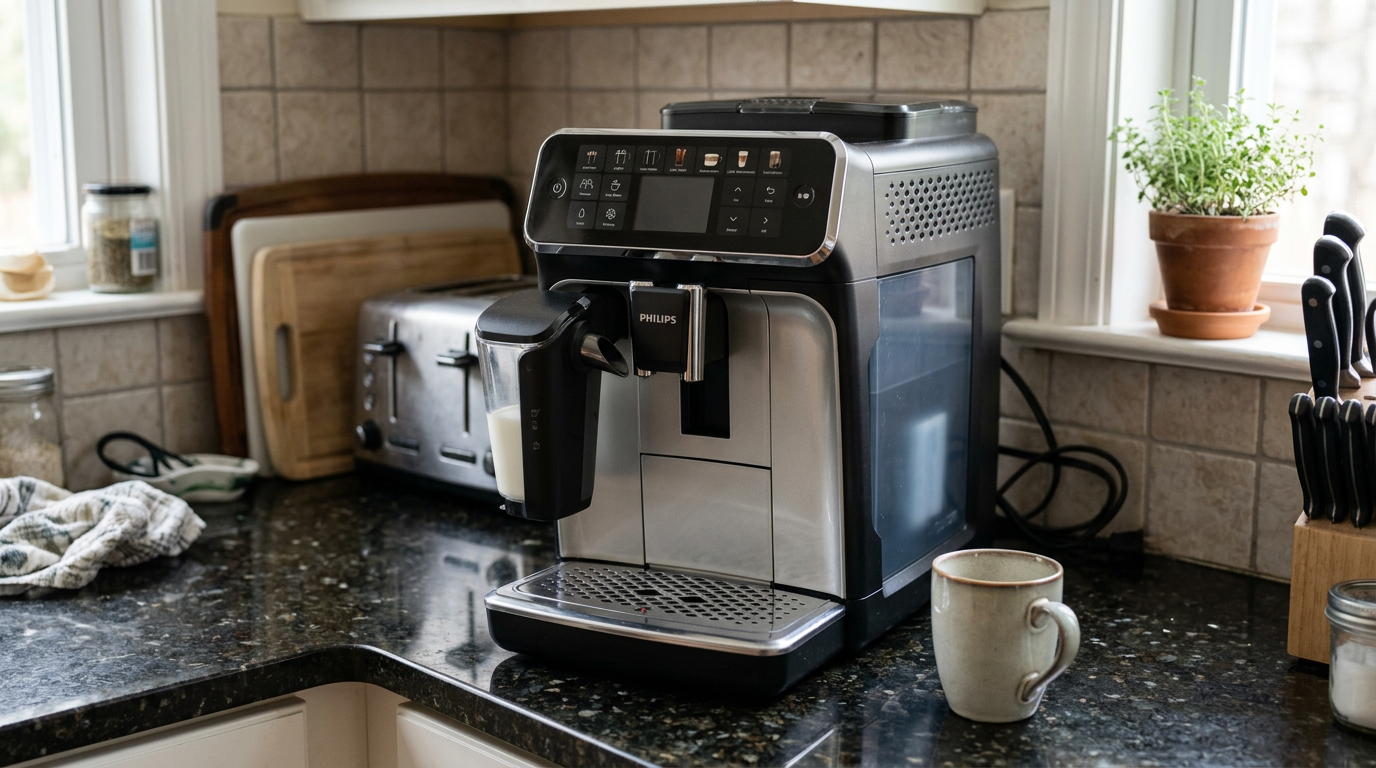
The 4400’s iced espresso stayed strong with just a few cubes.
Our tip: Use large ice cubes for every iced drink, because big cubes melt more slowly and keep the coffee from turning watery.
Milk drinks
Both machines use the same LatteGo✕LatteGoPhilips’ two-part milk jug with no tubes. Steam and air spin the milk in a small chamber inside the jug, and the foam pours straight into your cup. jug. It has two parts, no tubes and fill lines for one or two drinks.
You fill it on the front of the machine, pick a drink and the foam pours straight into the cup. Afterwards, it comes apart and rinses clean under the tap in about 10 seconds.
The foam on both is thick, airy and generous. It is perfect for a tall cappuccino or a layered latte macchiato, but it isn’t the glossy microfoam you need for latte art.
Where they differed
The Philips 5500 ran hotter. Its milk measured about 167°F, which is hot without tasting scalded, while the Philips 4400’s milk drinks sat in the sweet 140 to 150°F band.
Both are fine. If you like a latte you can sip straight away, the 4400 is gentler; if you like a drink that stays hot on the school run, the 5500 is better.
Milk temperature I measured
Milk tastes sweetest around 140 to 150°F and starts to lose sweetness above about 158°F.
How each milk foamed
My ratings out of 10 for texture and stability in LatteGo. Results were near identical on both machines.
The LatteGo jug pours foam straight into the cup and rinses clean in seconds.
| Milk drink | Philips 4400 | Philips 5500 |
|---|---|---|
| Cappuccino | One touch | One touch |
| Latte macchiato | One touch | One touch |
| Caffè latte | One touch | One touch |
| Flat white | By hand | One touch |
| Café au lait | One touch | One touch |
| Extra Shot in milk drinks | No | Yes |
| Milk temperature | About 140–150°F | About 167°F |
Our tip: Line your cup up just in front of the coffee spout on both machines, because the LatteGo spout is fixed and milk can catch the rim of a cup set too far back.
Noise and warm-up
Both use Philips’ SilentBrew✕SilentBrewPhilips’ noise-reduction design, with sound shielding around the grinder and brew unit. Philips says it makes brewing about 40% quieter than its earlier machines. design, which Philips says makes brewing about 40% quieter than its older machines. I believe it.
With the hopper lid closed, the 5500’s grinder peaked at just 59 to 60 dB on my meter at about a meter away. With the lid off, it jumped to about 71 dB, which shows how much that rubber seal is doing.
The 4400 sounded the same to my ear. It was the quietest Philips I had tested before the 5500 arrived, and neither machine woke anyone in my apartment.
Sound levels on the 5500
Peak readings from about 1 meter. About 60 dB is roughly a normal conversation.
Warm-up
Both heat with a thermoblock, which warms water on its way through instead of heating a boiler. The 5500 was ready in about 20 to 25 seconds, the 4400 in about 30 to 45.
The 5500 also skips the hot-water rinse on power-up, so you don’t start every morning with rinse water in the drip tray.
Time from switch-on to ready, measured in my kitchen.
Our tip: Always close the hopper lid firmly before brewing on either machine, because the seal is what keeps the grinder down at conversation level.
Cleaning and upkeep
Cleaning is identical, and it is one of the best reasons to buy either one.
There are no milk tubes, so there is no milk cleaning cycle to run and nothing to soak. You rinse the LatteGo jug after each milk drink and put it in the dishwasher once a day.
The brew group✕Brew groupThe part that compresses the ground coffee, holds it while water passes through and then ejects the used puck. On Philips machines you can take it out and rinse it. comes out through a side door behind the water tank. I rinsed it weekly on the 4400 and every two weeks on the 5500, and both need a thin layer of the included grease every couple of months.
My daily hands-on cleaning time
My estimate of hands-on time per day, not counting automatic rinses.
| When | Philips 4400 | Philips 5500 |
|---|---|---|
| After milk drinks | Rinse LatteGo, about 10 s | Rinse LatteGo, about 10 s |
| Daily | Empty tray and grounds | Empty tray and grounds |
| Weekly or every 2 weeks | Rinse the brew group | Rinse the brew group |
| Monthly or when prompted | Degreasing tablet | Degreasing tablet |
| Every 2–4 months | Grease the brew group | Grease the brew group |
| With AquaClean | Up to 5,000 cups before descaling | Up to 5,000 cups before descaling |
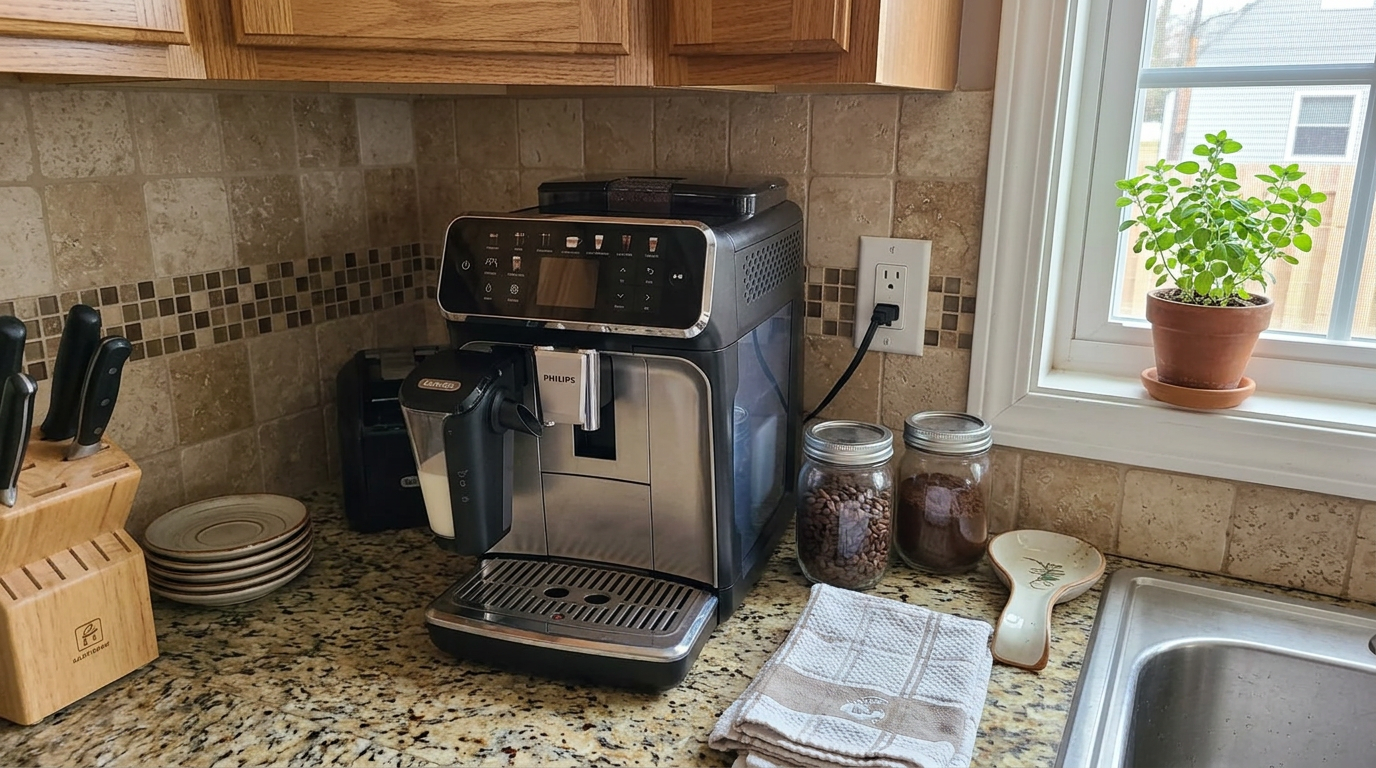
Everything you empty slides out from the front on both machines.
Our tip: Empty the drip tray and grounds drawer while the machine is switched on, so its sensors register the change and reset the warnings.
Water, beans and supplies
Both use the same 61-ounce tank, the same 9.7-ounce hopper and the same AquaClean filter, so refills come around at the same pace.
Philips says that if you replace the AquaClean filter whenever the machine asks, you can go up to 5,000 cups without descaling. Without the filter, plan on descaling every one to four months depending on your water.
Drinks per full tank
Rough maths from a 1.8-liter tank, allowing for rinses. The same on both machines.
| Bean type | Hot espresso | Milk drinks | Iced drinks |
|---|---|---|---|
| Medium-dark blend | Best | Excellent | Very good |
| Medium roast | Good, brighter | Good | Best, refreshing |
| Light roast | Can be sour | Fades in milk | Good, fruity |
| Oily or flavored | Avoid | Avoid | Avoid |
Very dark, shiny beans leave oil on the ceramic burrs and can stick in the hopper. Medium roasts with a dry surface gave me the most consistent results on both.
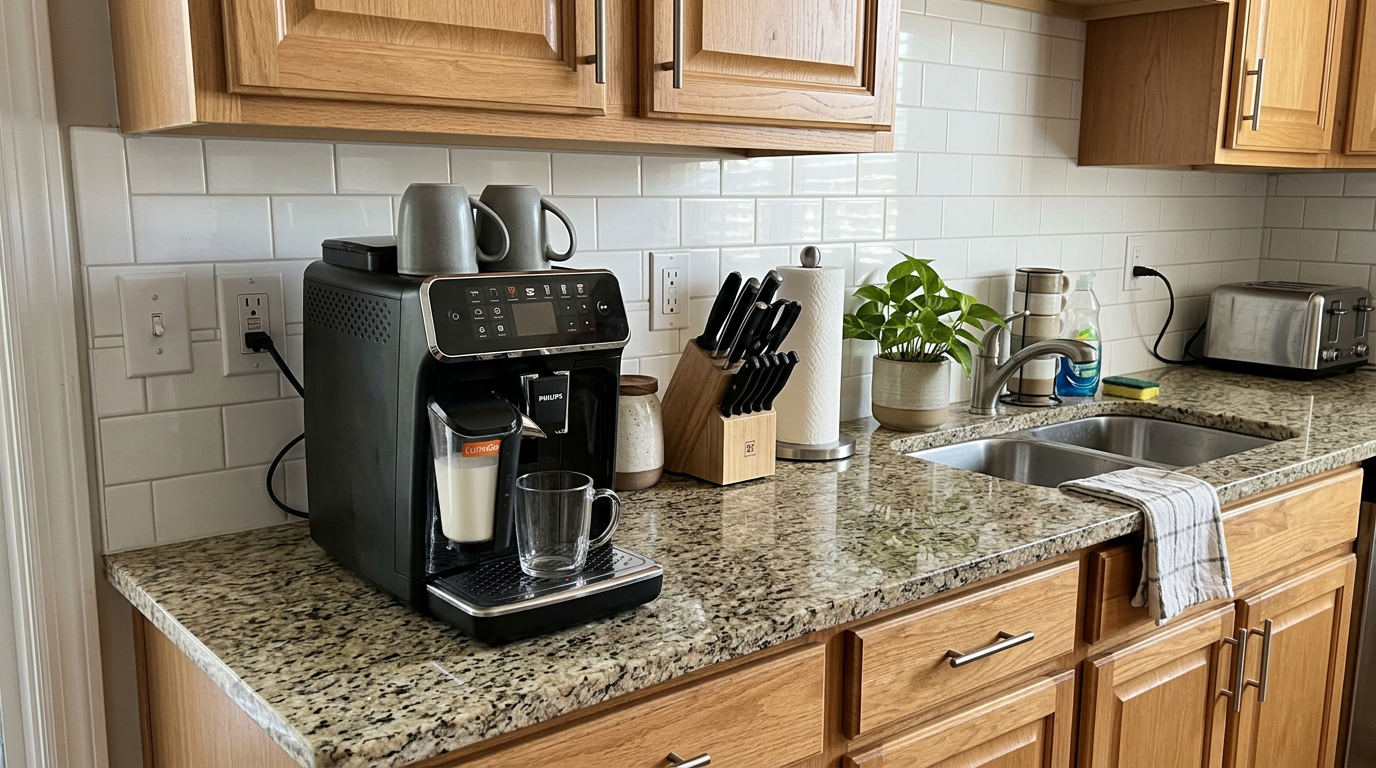
Medium roasts with a dry surface suit both ceramic grinders best.
Our tip: Choose barista versions of plant milks, because the added protein and fat make LatteGo foam far more stable.
Real-life scenarios
Specs only go so far. These are the situations where one machine clearly pulled ahead during my testing.
The 4400’s iced recipe is tuned for three or four cubes and stayed strong and round. The 5500’s version was more diluted.
Four color-coded profiles mean everyone saves their own version of every drink, with a guest profile for visitors.
One touch, with Extra Shot for real coffee flavor. On the 4400, I had to build it from a ristretto and frothed milk.
Two profiles cover it perfectly, and you keep the money the extra drinks would cost.
Milk at about 167°F stays hot far longer than the 4400’s gentler 140 to 150°F.
Tie in size, but the 4400 does everything a small kitchen needs for less. Both slide out from the front.
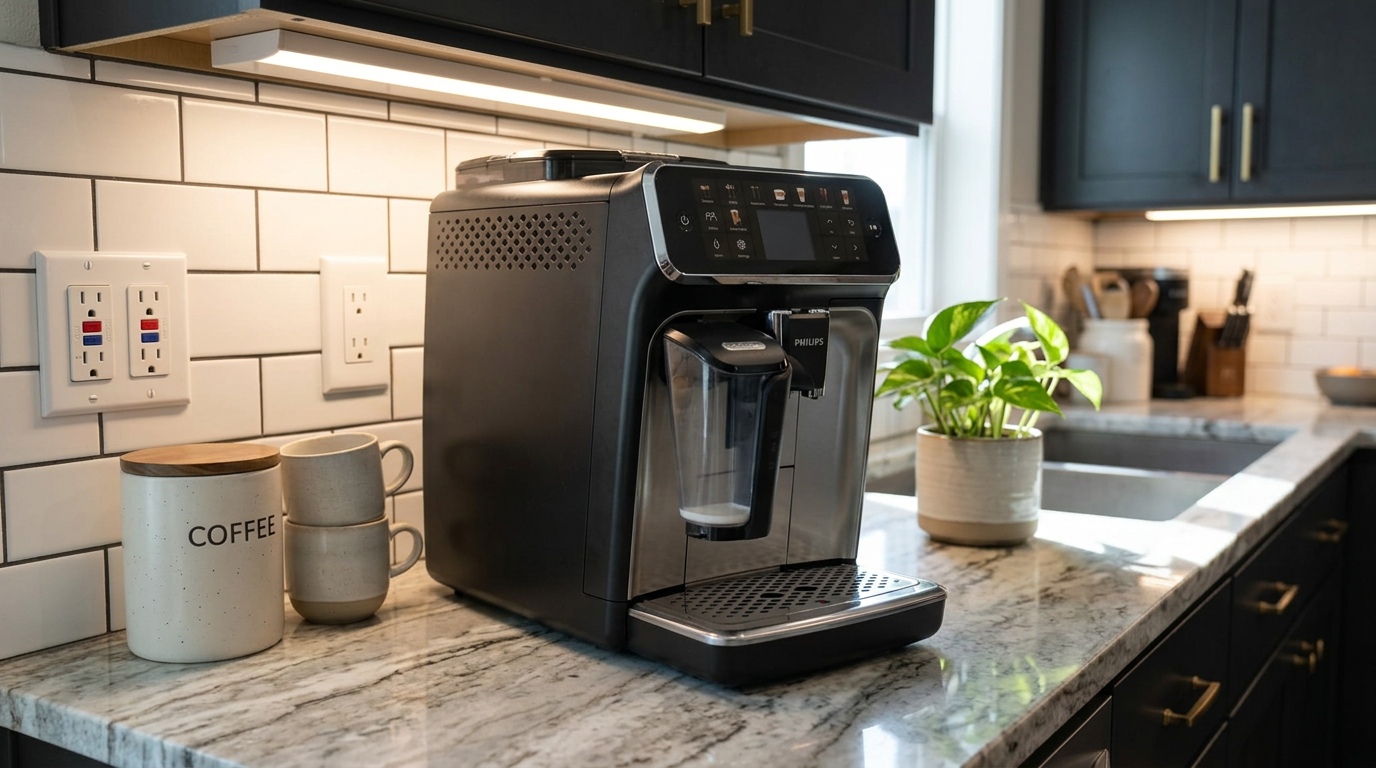
For a busy household, the 5500 was the machine nobody needed help with.
My scorecard
These are my own scores out of 10. The first four come from my single reviews of each machine, and I added drink range and iced drinks because they decide this matchup.
Philips 4400
Philips 5500
Overall, I rate the 4400 8.6 and the 5500 8.5. The 4400 edges it on value and iced espresso; the 5500 is the better machine to share, with more drinks, more profiles and hotter milk.
See How Much You’ll SaveWhich one is right for you?
4 quick questionsWhich one should you buy?
It comes down to one question: how many people will stand in front of this machine every morning?
If it is two, the 4400 gives you nearly everything for less. If it is three or more, the 5500’s extra profiles alone are worth the step up. If none of these is quite right for you, my guide to the best Philips espresso machines covers the rest of the range I’ve tested.
To see the whole range, my Philips 3200 vs 5500 comparison covers the cheaper five-drink model, and Philips 4300 vs 5500 shows where the 4300 fits in.
For two people and iced espresso, the 4400 is the smart buy.
- Two people use the machine
- You drink iced espresso often
- You like a touchscreen
- You want to spend less
- You want a one-touch flat white
- Three or more people share it
- You like very hot milk drinks
- Three or more people share it
- You want flat whites and Extra Shot
- You like hotter milk drinks
- You want the widest menu
- You mostly drink iced espresso
- Two profiles are plenty
- You want the lowest price
For most households, my pick is the Philips 5500. Twenty drinks, four profiles, Extra Shot and hotter milk make it the easier machine to share, and its LatteGo jug is just as quick to clean. It’s the one my household reached for most.
The Philips 4400 is the smarter buy for a couple. It uses the same grinder, brew group and milk jug, makes the better iced espresso and costs less. For that household, the 5500’s extras are drinks and profiles you won’t use.
Whichever you choose, use fresh medium roasts, cold milk and the AquaClean filter. Both machines reward a little care with years of easy coffee.
Philips 4400 vs 5500 specifications
From manufacturer specifications and my own testing.
| Philips 4400 | Philips 5500 | |
|---|---|---|
| Model | 4400 Series, EP4444 | 5500 Series, EP5544 |
| Type | Fully automatic with LatteGo | Fully automatic with LatteGo |
| One-touch drinks | 12 hot and iced | 20 hot and iced |
| User profiles | 2 plus guest | 4 plus guest |
| Display | Color touchscreen | Color display with buttons |
| Pump | 15 bar | 15 bar |
| Heating | Thermoblock, ready in about 30–45 s | Thermoblock with QuickStart, about 20–25 s |
| Grinder | 100% ceramic, 12 settings | 100% ceramic, 12 settings |
| Strength | 5 levels | 5 levels plus Extra Shot |
| Measured dose | About 6–12 g | Same grinder and brew group |
| Milk system | LatteGo, 8.8 fl oz jug | LatteGo, 8.8 fl oz jug |
| Milk temperature measured | About 140–150°F | About 167°F |
| Noise | SilentBrew | SilentBrew, about 60 dB grinding |
| Water tank | 61 fl oz | 61 fl oz |
| Bean hopper | 9.7 oz | 9.7 oz |
| Water filter | AquaClean | AquaClean |
| Dimensions (W × H × D) | 9.7 × 14.6 × 17 in | 9.7 × 14.6 × 17 in |
| Weight | About 17.6 lb | About 17.6 lb |
How I tested and compared them
I used each machine as my everyday coffee maker for four weeks, making espresso, ristretto, Americanos, cappuccinos, lattes and every iced recipe, plus flat whites with Extra Shot on the 5500.
I weighed doses at all five strength levels, measured espresso concentration with a refractometer, took milk and coffee temperatures with a probe thermometer and logged noise with a decibel meter.
Michael Reynolds and a second HouseholdMe tester each used their own profile on both machines and wrote the notes together, then compared them with Philips’ specifications, owner documentation and published test data.
- Coffee: dose, crema, body and consistency.
- Milk: foam texture, temperature and drink range.
- Workflow: display, profiles, iced recipes and daily routine.
- Ownership: noise, cleaning, water care and footprint.
Philips 4400 vs 5500 FAQ
Is the Philips 5500 worth the upgrade over the 4400?
Yes for households of three or more, or if you want a one-touch flat white. The 5500 adds 8 more drinks, two more profiles, Extra Shot and hotter milk. For a couple, the 4400 gives you the same grinder, brew group and LatteGo jug for less.
What is the main difference between the Philips 4400 and 5500?
The menu and profiles. The 4400 makes 12 hot and iced drinks with two profiles; the 5500 makes 20 with four profiles plus a guest. They share the same body, grinder, brew group, tank and milk system.
Which makes better espresso?
They are very close, because they share the grinder and brew group. My 5500 shots measured 4.5 to 5.5 percent TDS, and the 4400 tasted similar at level 5. The 5500’s Extra Shot makes milk drinks noticeably stronger.
Which is better for iced coffee?
For iced espresso and iced Americano, the 4400. Its recipes are tuned for three or four cubes and stayed stronger in my tests. The 5500 has more iced drinks, including iced latte and iced cappuccino, but they were more diluted.
Does the Philips 4400 make a flat white?
Not at one touch. I made a flat-white-style drink by pulling a ristretto and topping it with frothed milk. The 5500 has a one-touch flat white.
How hot is the milk?
I measured about 167°F on the 5500. The 4400’s milk drinks sat around 140 to 150°F.
Are they the same size?
Yes. Both measure about 9.7 inches wide, 14.6 inches tall and 17 inches deep and weigh about 17.6 pounds.
Which one is quieter?
They sound the same. Both use SilentBrew, and I measured the 5500’s grinder at about 60 dB with the hopper lid closed.
How long does the LatteGo take to clean?
About 10 seconds under the tap on both, and both parts are dishwasher safe. There are no milk tubes to clean.
Do they use the same filters and parts?
Yes. Both use the AquaClean filter, the same LatteGo jug and the same brew group grease and degreasing tablets.

- Our hands-on Philips 4400 Series review
- Our hands-on Philips 5500 review
- Philips product specifications and owner documentation
- Coffee standards, Specialty Coffee Association
- General espresso brewing and maintenance guidance