Philips 5500 review: 20 drinks, a 10-second milk clean and iced coffee with a catch
The Philips 5500 Series Fully Automatic Espresso Machine makes 20 hot and iced drinks at the touch of a button and rinses its milk system clean in seconds. It's quiet, compact and easy to share with a whole household, though the espresso is lighter than a café shot and the iced drinks are brewed warm.
Jargon helpNew to espresso? Tap any dotted term to see what it means.
In this review
Yes, if you want lattes, cappuccinos and the occasional iced coffee with almost no effort. The Philips 5500 Series loads from the front, saves drinks for four people, grinds quietly and rinses its two-part milk carafe clean in about 10 seconds. Espresso purists will find the shot lighter than a café pull, and the iced drinks lose some strength to melting ice. For a busy household that mostly drinks milk coffee, it's one of the easiest machines I've lived with.
Philips 5500 at a glance
Philips 5500 pros and cons
- Two-part milk carafe cleans in about 10 seconds
- 20 drinks with four saved user profiles
- Quiet grinding at around 60 dB with the lid closed
- Espresso is lighter than a café shot
- Iced drinks use warm coffee poured over ice
- Fixed milk spout means cup placement matters
Who should buy the Philips 5500?
- Households where several people want different drinks
- Anyone who hates cleaning milk tubes and hoses
- Small kitchens with low wall cabinets
- Espresso fans who want dense, syrupy shots
- People who drink true cold brew every day
- Home baristas chasing latte-art microfoam
First impressions of the Philips 5500
Most fully automatic espresso machines promise café drinks at the touch of a button.
Far fewer make the cleanup afterwards feel just as easy, and that's usually where the daily routine falls apart.
I went into my time with the Philips 5500 Series Fully Automatic Espresso Machine with one question: would the ease last beyond the first week?
The first thing I noticed was how little space it asks for.
At under 25 centimeters wide, it slid into a gap on my counter that bigger bean-to-cup machines simply wouldn't fit.
The second thing was the finish.
The body is mostly plastic, but a chrome border frames the display and the drip tray carries a stainless steel grate, so it looks more expensive than the materials suggest.
Then I made a cappuccino, and the most important feature revealed itself in the sink.
The milk carafe came apart in two pieces, rinsed clean under the tap in about 10 seconds and went straight back on the machine.
No tubes, no hidden hoses, no cleaning cycle to wait for.
That small moment is the reason this machine is interesting.
It doesn't try to turn you into a barista. It tries to make good milk coffee something you never have to think about.
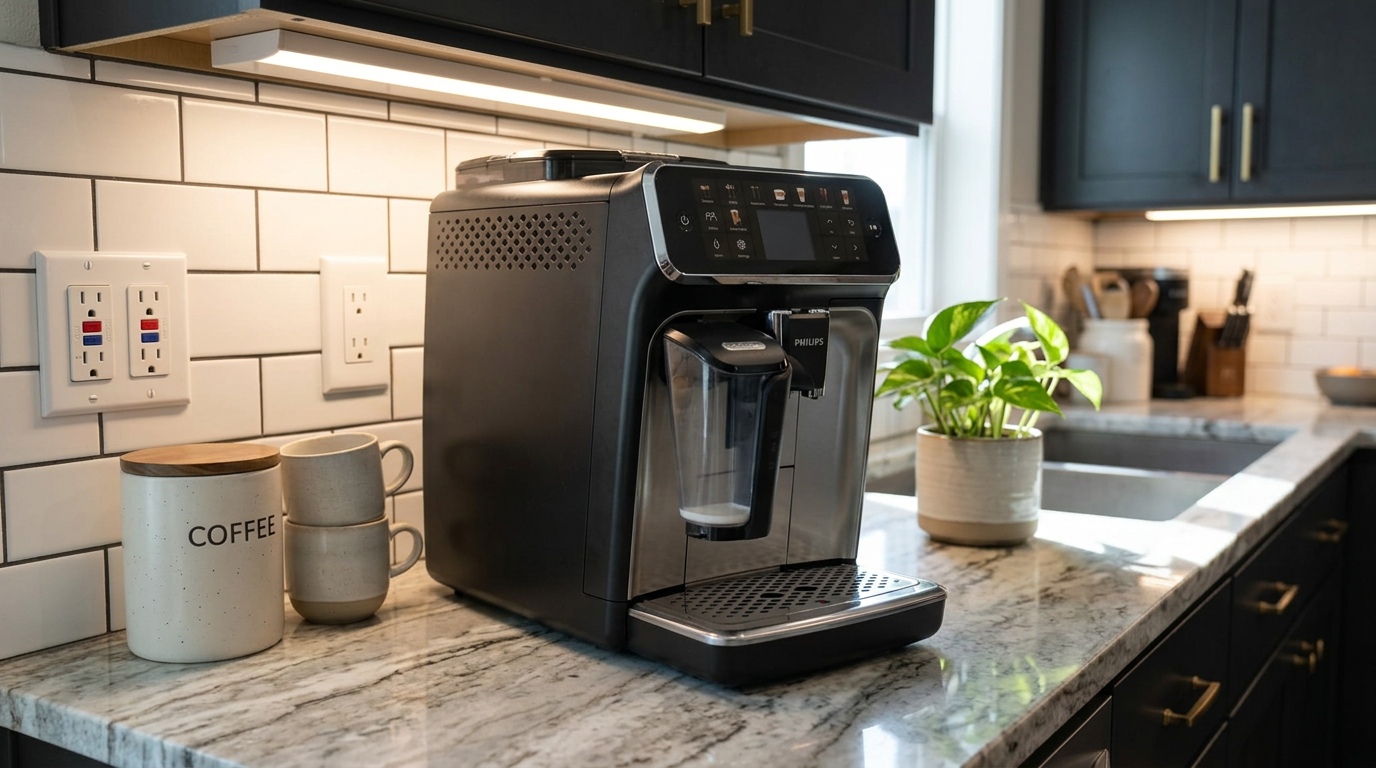
It fits neatly under low cabinets, and everything you refill slides out from the front.
What the Philips 5500 actually is
The Philips 5500 is a fully automatic bean-to-cup espresso machine.
That means it grinds whole beans, doses them, tamps them, brews, froths milk and dumps the used puck without you touching a portafilter.
You choose a drink, adjust strength or volume if you like, and press start.
Inside sits a 15-bar pump, a fast-heating thermoblock✕ThermoblockA compact heater that warms water as it flows through, instead of keeping a big boiler hot. It heats up in seconds. and a grinder with ceramic burrs✕Ceramic burrsGrinding parts made of ceramic instead of steel. They stay cool and last a long time..
Milk is handled by the LatteGo system, a two-part carafe that clips to the front and froths without any internal tubing.
The machine I tested is the 20-drink version with iced coffee recipes, the top of the series.
Its 20 recipes cover classic black coffees, milk drinks, hot water and a full menu of iced options.
Four color-coded user profiles and a guest profile let everyone in the house keep their own settings.
Manufacturer capacities and my measurements. The small milk carafe is designed to be filled for each session, not stored full.
Those numbers tell you who the machine is built for.
The tank and hopper are sized for a household making a handful of drinks a day, not an office pouring dozens.
Smaller capacities also mean fresher water and fresher beans, which matters more for taste than most people expect.
How the Philips 5500 works
Every drink follows the same automated chain, and it helps to know what happens inside so you can adjust the right thing later.
The grinder drops a measured dose into the brew group✕Brew groupThe removable unit inside an automatic machine that holds, presses and brews the ground coffee., which compresses it into a puck.
Hot water is then pushed through at pressure, and the spent puck is ejected into the grounds container.
- Choose: pick a drink from the quick buttons or the hot and iced menus.
- Adjust: set strength, volume and temperature, and they save to your profile.
- Grind: the ceramic grinder doses whole beans automatically.
- Brew: the thermoblock heats water on the way through and the pump extracts the shot.
- Froth: for milk drinks, LatteGo whips steam, air and milk and pours it straight into the cup.
The clever part is the milk path.
Milk is drawn into a small cyclonic chamber in the carafe itself, where steam and fast-moving air whip it into foam.
Because it never travels through the body of the machine, there's nothing inside for old milk to sour in.
The heating side is just as practical.
A thermoblock doesn't need a long warm-up, so the 5500 skips the slow boiler phase and is ready to brew within about 20 to 25 seconds of being switched on.
Our tip: Keep a few drinks on the quick buttons for everyday use and save the menus for when you fancy something different.
Philips 5500 design and setup
The Philips 5500 is narrow, and that is its biggest physical advantage.
Philips lists it at 24.6 × 37.1 × 43.3 centimeters, or about 9.7 × 14.6 × 17 inches.
It weighs around 8 kilograms, close to 17.6 pounds, which is light enough to slide forward when you need to.
| Measurement | Metric | Imperial |
|---|---|---|
| Width | 24.6 cm | 9.7 in |
| Height | 37.1 cm | 14.6 in |
| Depth | 43.3 cm | 17 in |
| Weight | 8 kg | 17.6 lb |
| Water tank | 1.8 L | 61 oz |
Everything you handle daily comes out of the front.
The 1.8-liter water tank slides forward, and so do the grounds container and drip tray.
That means you can push the machine right up against a wall or under a low cabinet without losing access.
The one exception is the bean hopper on top.
You still need to lift its lid to refill, so leave enough headroom for that or plan to slide the machine forward on refill days.
The grind dial also sits inside the hopper, which keeps the front clean but means you open the lid to adjust it.
Our tip: Measure from the counter to the underside of your cabinets before buying, and allow a few extra centimeters for the hopper lid.
Setup took me about ten minutes.
I tested my water with the hardness strip in the box, fitted the AquaClean filter, filled the tank and let the machine prime itself.
After that, it walked me through the basics on the color display.
I'd recommend throwing away the first few drinks while the grinder and brew group bed in.
My early cups were noticeably thinner than the ones I made after about a dozen brews.
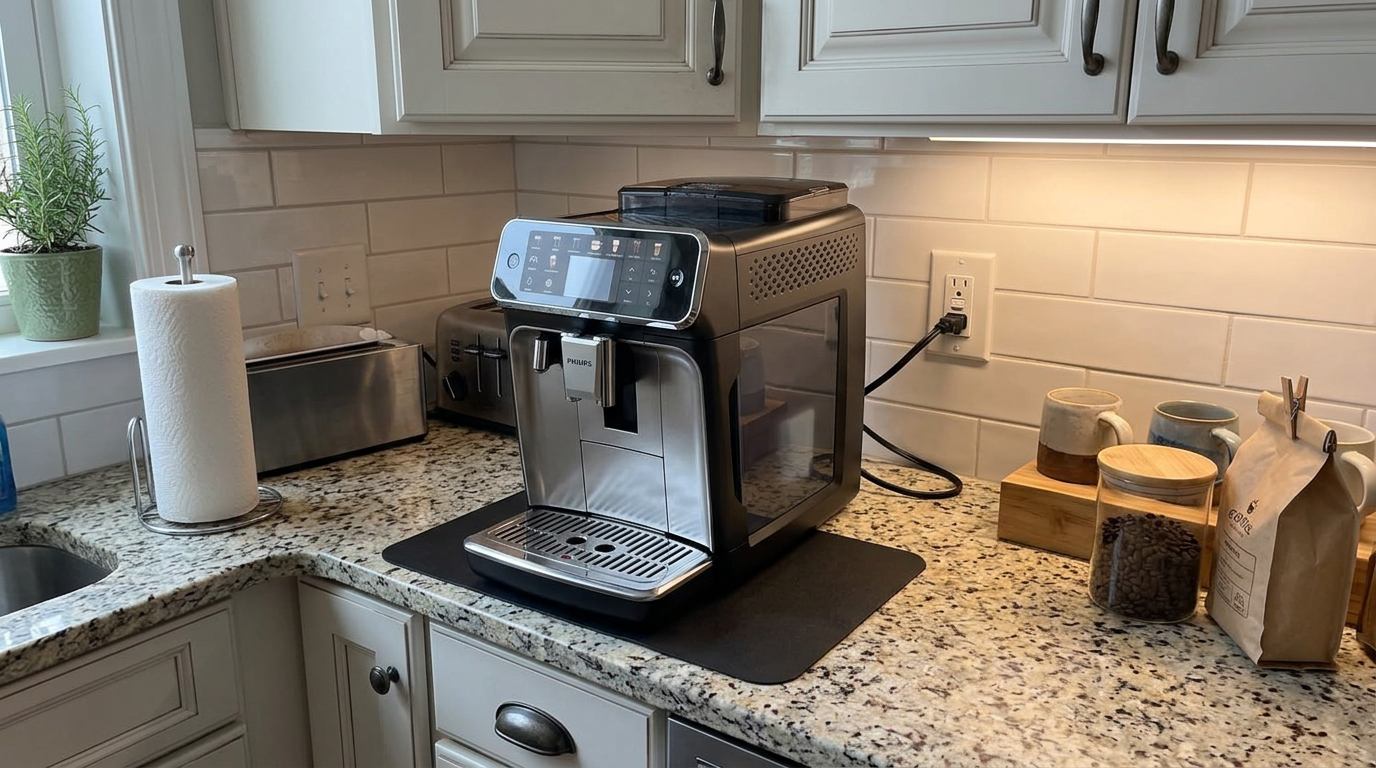
A slim footprint and front-loading parts make it easy to place in a corner.
The display, drinks and user profiles
The control panel is a full-color TFT display with simple pictures for each drink.
It isn't a touchscreen. Instead, soft-touch buttons sit around the screen.
I came to prefer that, because buttons work reliably with wet or milky fingers at seven in the morning.
The most popular drinks live on the quick buttons, and a menu button opens separate lists for hot and iced recipes.
In total, the Philips 5500 offers 20 recipes.
| Category | Examples | Best for |
|---|---|---|
| Black coffee | Espresso, ristretto, espresso lungo, coffee, americano, caffè crema | Straight coffee and long black drinks |
| Milk drinks | Cappuccino, latte macchiato, caffè latte, flat white, café au lait | Everyday milk coffee |
| Iced drinks | Iced coffee, iced latte, iced cappuccino, iced americano, iced espresso | Warm days and quick cold drinks |
| Extras | Hot water, frothed milk | Tea, hot chocolate and toppings |
Each drink can be tuned with five aroma strength levels, several temperature settings and separate volumes for coffee and milk.
There's also an Extra Shot option, which grinds and pulls a second shot straight after the drink for more strength.
I used that one a lot, and I'll come back to why.
How the user profiles work
The profile system is better thought out than most.
There are four color-coded profiles, blue, green, red and yellow, plus a guest profile.
Rather than saving one or two favorites, a profile remembers your settings for every single recipe.
So when I changed my cappuccino to stronger and smaller, that became my cappuccino from then on.
My partner's profile kept a milder, larger version without either of us touching the other's settings.
The guest profile is the quiet hero here.
Visitors can tweak a drink without overwriting anyone's carefully tuned defaults.
Our tip: Give each person in the house their own color on day one, before anyone starts changing the shared default drinks.
The ceramic grinder
The Philips 5500 uses flat ceramic burrs with 12 grind settings, adjusted by a dial inside the bean hopper.
Ceramic stays cooler than steel during grinding, which helps avoid heating the coffee before it ever meets water.
The burrs are also known for lasting a long time, which matters on a machine you'll use every day.
Philips ships the grinder at a middle setting, and that's a sensible place to start.
Only change the grind while the grinder is running, because turning the dial with the burrs still can strain the mechanism.
Then give each change two or three drinks before judging it, since the first cup still contains some grounds from the previous setting.
| What you taste or see | Likely cause | First change |
|---|---|---|
| Sour, sharp, thin | Under-extraction | Grind one step finer |
| Bitter, harsh, drying | Over-extraction | Grind one step coarser |
| Watery even at max strength | Grind too coarse or dose too small | Grind finer and use Extra Shot |
| Drink drips slowly | Grind too fine | Grind one step coarser |
| Pucks crumbly and wet | Grind too coarse or brew group not bedded in | Grind finer and give it a dozen drinks |
With a medium roast, I ended up two steps finer than the factory setting.
That gave a rounder, sweeter espresso with more body and less sourness.
Dark, oily roasts behaved best a step or two coarser and tended to cling in the hopper, so I'd treat them with some caution.
There's also a chute for pre-ground coffee in front of the hopper.
It's handy for an evening decaf without emptying your main beans, and it takes a single level scoop.
Philips 5500 espresso performance
Here's the honest part of this review.
The espresso from the Philips 5500 is smooth, balanced and easy to drink, but it is lighter than what you'd get from a café portafilter machine.
That's typical of fully automatic machines, and the numbers show why.
I measured shots with a refractometer, which reads TDS✕TDSTotal dissolved solids: the share of a drink that is dissolved coffee. Higher numbers mean a stronger, more concentrated drink., or how much coffee is actually dissolved in the cup.
My espresso shots read between 4.5% and 5.5% TDS.
A typical portafilter espresso tends to land somewhere around 8% to 12%.
My refractometer readings on the strongest settings, compared with a typical portafilter espresso range.
In the cup, that means a softer, lighter-bodied espresso with a gentle crema✕CremaThe golden foam on top of an espresso, made from oils and gases released during brewing under pressure..
It won't give you a dense, syrupy ristretto✕RistrettoA short, concentrated espresso made with less water than a normal shot. like a manual machine can.
For milk drinks, though, it's more than strong enough to cut through, especially with the Extra Shot setting turned on.
Getting more strength from it
The Extra Shot feature is the most useful tool for stronger coffee.
It brews a second fresh puck after your drink, so you get more coffee rather than more water pushed through the same grounds.
Combined with the highest strength level and a finer grind, it gave my cappuccinos real backbone.
For a long black coffee, I had better results with a double espresso topped up with hot water than with the longest coffee setting.
Pushing a lot of water through one small puck makes a thinner, flatter cup.
Temperature
On its hottest setting, espresso reached about 80°C, or 176°F, at the spout.
That's a comfortable drinking temperature, but a cold porcelain cup will steal a few degrees quickly.
Our tip: Pre-warm your cup with a splash from the hot water function, and your espresso will stay hot for noticeably longer.
Milk drinks and the LatteGo carafe
Milk drinks are where the Philips 5500 earns its place in the kitchen.
The LatteGo carafe is made of just two snap-fit parts, and the updated lid locks on firmly while it works.
There are no tubes or silicone hoses anywhere, so nothing hides inside where you can't see it.
You fill the carafe while it's attached to the front of the machine.
That felt odd at first, but it means no carrying a full jug of milk across the kitchen.
Fill lines on the side show how much to add for one or two drinks, so you use exactly what you need.
Foam texture and temperature
Milk came out at about 75°C, or 167°F, which is hot without tasting scalded.
The foam is thick, airy and generous, perfect for a tall cappuccino or a layered latte macchiato.
What it doesn't make is the fine, glossy microfoam✕MicrofoamMilk steamed into tiny, even bubbles with a glossy, paint-like texture. It's what baristas use for latte art. you need for latte art.
That's a deliberate trade-off: fast, hands-off foam over fine texture.
Whole milk gave the richest results in my testing, while barista-style oat milk foamed almost as well.
Skimmed milk produced plenty of foam but tasted thinner.
Taken at the spout on the hottest settings. The iced setting brews cooler on purpose before the coffee meets ice.
The 10-second clean
This is the feature I'd miss most if it disappeared.
After each milk drink, I separated the two parts and held them under the tap.
About 10 seconds later they were clean, and both pieces are dishwasher safe for a deeper wash.
The milk carafe holds 260 milliliters, enough for one or two drinks.
A storage lid is included, but I preferred filling only what I needed and rinsing straight away.
The carafe isn't airtight, so I wouldn't leave milk in it for long.
Mind the fixed spout
My one real complaint about the milk system is that its spout can't be angled.
Your cup needs to sit further forward on the drip tray than you'd expect, or the milk catches the rim.
Wide mugs make this much easier, while very narrow glasses need a little care.
Our tip: Line your cup up just in front of the coffee spout so both the coffee and the milk land in the middle.
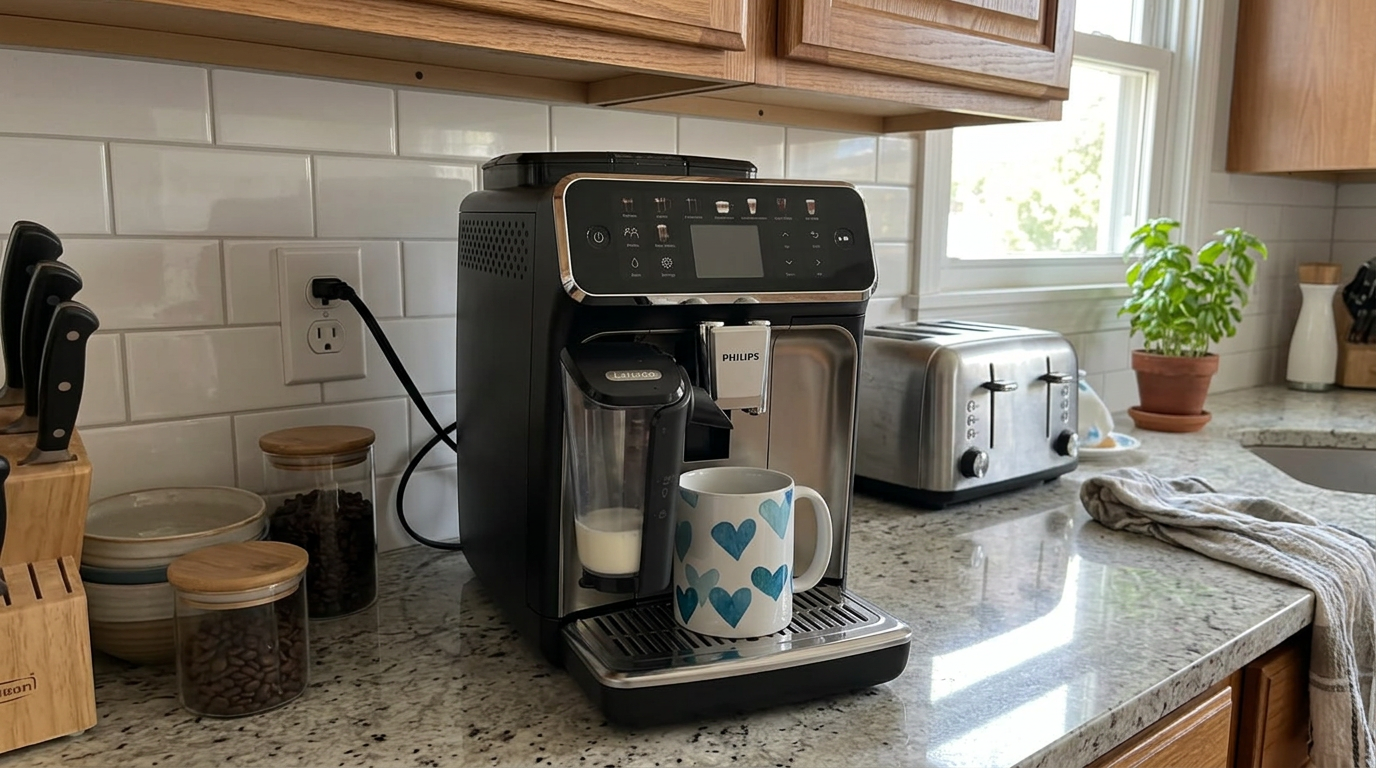
The LatteGo carafe fills on the machine and pours straight into the cup.
Iced coffee on the Philips 5500
The iced menu is a big part of the appeal on this model, so I tested it carefully.
Choose an iced drink and the machine tells you how much ice to add, then pours coffee and, if needed, cold-frothed milk on top.
It's quick and it works, but it's important to understand how.
The Philips 5500 doesn't use cold extraction✕Cold extractionBrewing coffee with cold water so it never gets hot. It tastes smoother and is how cold brew is made..
Instead, it lowers its brewing temperature to about 60°C, or 140°F, compared with about 80°C for hot espresso.
That warm coffee then hits the ice, cools down and melts some of it along the way.
The result is a pleasant, refreshing iced drink, but a slightly diluted one.
Iced lattes and iced cappuccinos suffered most, because the meltwater thins the milk as well as the coffee.
Cold milk also foams less, so the iced cappuccino had a thinner cap than its hot version.
Iced americanos and iced espressos held up best, since they're meant to be lighter in the first place.
If you drink iced coffee every day and love the smooth taste of true cold brew, this isn't the machine for that.
If you want a quick cold coffee on a warm afternoon, it does the job without any extra equipment.
How loud is the Philips 5500?
Noise is one area where the Philips 5500 genuinely surprised me.
I measured each stage with a decibel meter about a meter from the machine.
With the bean hopper lid closed, grinding peaked at just 59 to 60 dB.
With the lid off, the same grind jumped to about 71 dB, which shows how much the rubber seal on the lid is doing.
Peak readings from about 1 meter. Each 10 dB step sounds roughly twice as loud to the human ear.
For context, around 60 dB is roughly the level of a normal conversation.
The pump hummed at about 58 dB during extraction and frothing stayed around 60 dB.
That makes this a realistic machine for early mornings in an open-plan home.
Nobody in my house woke up to the grinder, which I can't say about every machine I've used.
Our tip: Always close the hopper lid properly before brewing, because the seal is what keeps the grinder quiet.
Warm-up, QuickStart and eco settings
The QuickStart heating is one of the small things that makes the Philips 5500 pleasant to live with.
Switch it on and it skips the long boiler warm-up, going straight to ready in about 20 to 25 seconds.
It also skips the automatic hot-water rinse on power-up, so you don't start every morning with a cup of rinse water in the drip tray.
It does still rinse when you switch it off, which keeps the spouts clean overnight.
The housing stayed cool to the touch even after 20 minutes of making drinks back to back.
There are also five eco settings for those who want to trim energy and water use.
You can dim the display and cup light, shorten the time before standby, reduce rinse water and set the auto power-off timer.
seconds from power-on to ready to brew, in my testing
Cleaning and maintaining the Philips 5500
Cleaning is the second reason I'd recommend the Philips 5500.
Day to day, there's very little to do beyond rinsing the milk carafe and emptying containers.
The grounds container holds about 12 used pucks before an alert appears on the display.
The drip tray has a level indicator that pops up when it needs emptying, so you're never guessing.
The removable brew group
Like most Philips machines, the 5500 has a brew group you can take out yourself.
It's behind a side panel, next to the water tank, and comes out with a gentle squeeze of two tabs.
I rinsed it under lukewarm tap water every two weeks to clear coffee oils and fine grounds.
Every two to four months, the moving rails need a thin layer of food-grade lubricant to keep everything sliding smoothly.
It's a five-minute job, and it's the best thing you can do for the machine's lifespan.
| When | Task | Why it matters |
|---|---|---|
| After each milk drink | Separate and rinse the LatteGo carafe | Stops milk residue drying on |
| Daily | Empty the drip tray and grounds container | Prevents mold and odors |
| Every 2 weeks | Remove and rinse the brew group | Clears coffee oils and fine grounds |
| Every 2–4 months | Lubricate the brew group rails | Keeps the mechanism moving smoothly |
| When prompted | Replace the AquaClean filter or descale | Controls scale inside the system |
Compared with machines that run milk through internal tubes, this is a refreshingly short list.
There's no automatic milk-cleaning cycle to run and no tubes to soak or replace.
Our tip: Never wash the brew group with dish soap, because it strips the lubricant from the moving parts.
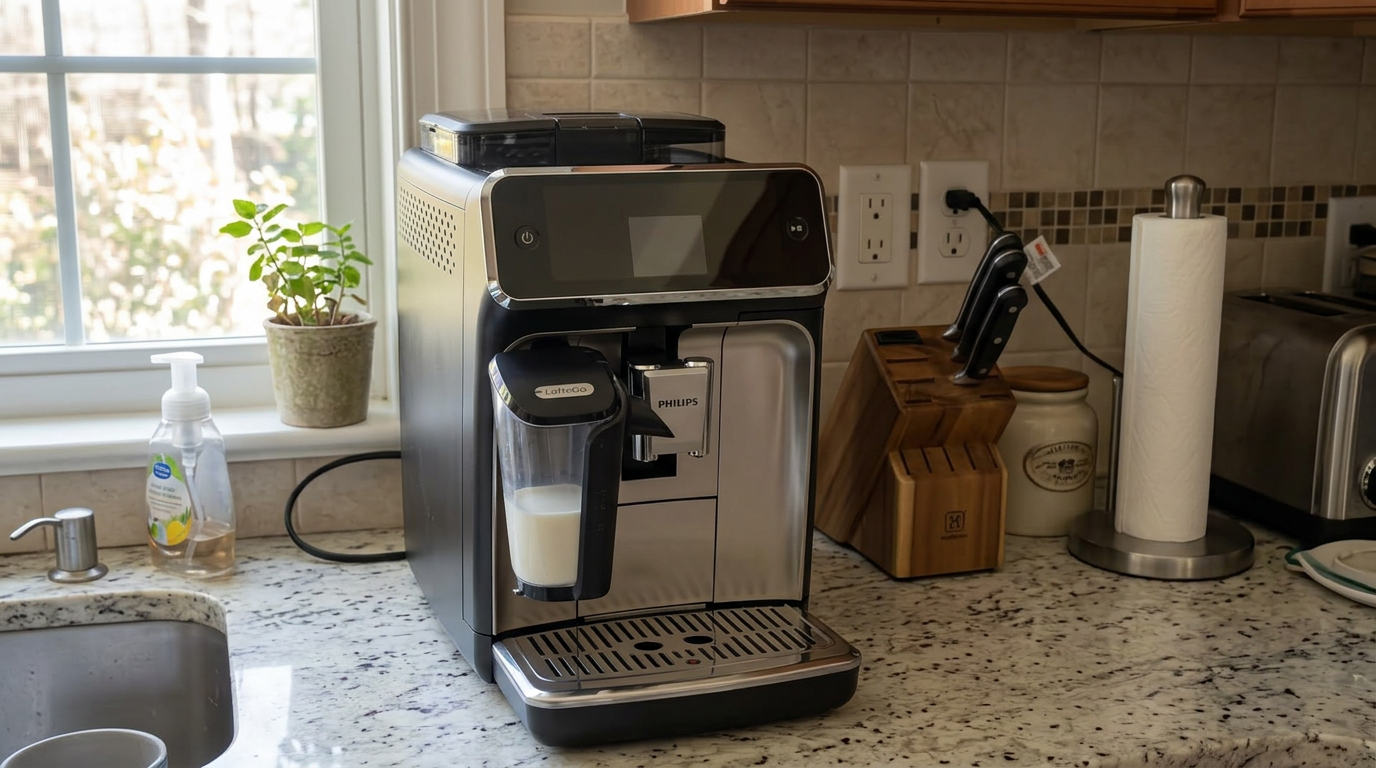
With no milk tubes inside, keeping the 5500 clean takes only minutes a week.
Water, AquaClean and descaling
Water quality matters on every espresso machine, and the Philips 5500 makes it easy to manage.
The machine works with Philips' AquaClean filter, which sits inside the water tank and catches the minerals that form scale.
Philips says that if you replace the filter whenever the machine asks, you can go up to 5,000 cups without needing to descale✕DescalingRunning an acid-based cleaning solution through a machine to dissolve the mineral buildup that hard water leaves behind..
The filter does take up some space in the tank, so the usable volume is a little smaller than 1.8 liters.
For a household of two or three, I found that perfectly fine, and refilling the tank often keeps the water fresh anyway.
If you skip the filter, the machine will prompt you to descale based on your water hardness.
The automated descaling routine takes about 30 to 40 minutes with a standard descaling solution.
General guidance for home machines. Always follow the machine's prompts first.
I'd test your water with the strip in the box during setup and enter the result in the settings.
That simple step makes the descaling reminders far more accurate.
What daily use is really like
Specifications only tell you so much. What matters is how a machine feels on a busy weekday.
With the Philips 5500, a normal morning has almost no steps in it.
I switch it on, and by the time I've found a cup, it's ready.
I pick my profile, tap cappuccino and pour milk into the carafe up to the line.
About a minute later the drink is done, and the carafe gets its 10-second rinse.
| Step | Who does the work | What you control |
|---|---|---|
| Warm-up | Machine, in about 20 seconds | Nothing |
| Grind and dose | Machine | Grind setting and strength |
| Brewing | Machine | Volume, temperature, Extra Shot |
| Milk | Machine, via LatteGo | Milk volume and strength |
| Cleanup | You, about 10 seconds | Rinse the carafe |
That's the whole appeal: it automates nearly everything and keeps the cleanup tiny.
It also makes the machine easy to share.
My partner and visitors could make their own drinks without asking how anything works.
Making several drinks in a row
Back-to-back milk drinks work well, though the small carafe means a refill every one or two cups.
The machine brews coffee and froths milk in one automated cycle, so there's no waiting for steam pressure between drinks.
For a family breakfast, I brew black coffees as doubles and refill the carafe between milk drinks.
The drip tray and grounds container are the parts that slow you down on a busy morning.
Keep an eye on them if you're making four or five drinks in a row.
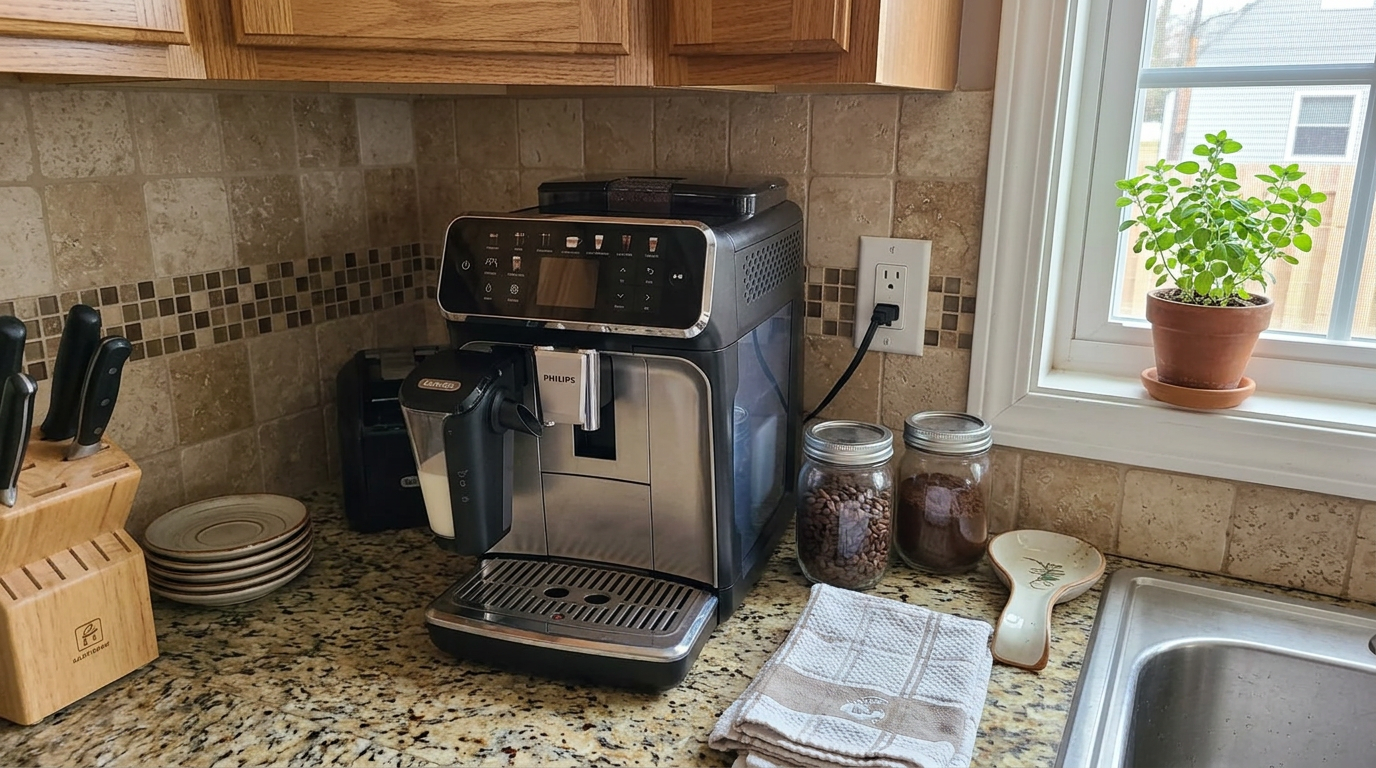
In daily use, the 5500 asks for very little beyond a refill and a quick rinse.
Common mistakes to avoid
The Philips 5500 is about as easy as espresso gets, but a few habits can still hold it back.
These are the ones I'd watch for during the first couple of weeks.
| Mistake | What happens | Better habit |
|---|---|---|
| Judging the first drinks | The brew group hasn't bedded in yet | Give it a dozen drinks |
| Using the longest coffee setting | Thin, flat black coffee | Brew a double espresso and add hot water |
| Placing the cup too far back | Milk catches the rim | Move the cup forward on the tray |
| Leaving milk in the carafe | Residue dries and sours | Rinse straight after use |
| Using oily dark roasts | Beans clump and the grinder struggles | Choose medium, dry-looking beans |
| Ignoring the brew group | Coffee oils build up | Rinse every two weeks |
Bean choice deserves a special mention.
Very dark, shiny beans leave oil on the grinder and hopper and can cause beans to stick instead of falling into the burrs.
Medium roasts with a dry surface gave me the most consistent results and the best-tasting espresso.
Is the Philips 5500 worth the money?
The Philips 5500 sits in the mid-range of fully automatic machines, so the real question is what you're paying for.
You're not paying for café-strength espresso or advanced barista controls.
You're paying for an unusually easy routine: 20 drinks, saved profiles for the whole household, quiet operation and a milk system that almost cleans itself.
That makes it great value if you drink milk coffee every day.
If you mostly drink straight espresso, the lighter shot means you may be happier spending your budget elsewhere.
Think about who drinks what in your home, how often you'll want iced drinks and how much cleaning you'll honestly do.
Those three answers will tell you more than any list of features.
For me, the time saved on cleaning and the ease of sharing outweigh the lighter espresso.
That balance is what earns the machine its score.
How it compares with other espresso setups
The most useful comparison isn't with one particular model.
It's with the kinds of machine you're most likely to be choosing between.
The Philips 5500 is strongest when you value easy milk drinks and quick cleanup over control.
| Feature | Philips 5500 | Semi-automatic with grinder | Automatic with milk tubes |
|---|---|---|---|
| Grinding | Built-in, automatic | Built-in, you dose and tamp | Built-in, automatic |
| Drinks at one touch | 20 hot and iced | Espresso only, milk by hand | Usually 10 to 20 |
| Milk cleaning | Two parts, about 10 seconds | Wipe and purge the wand | Rinse cycles and tube cleaning |
| Espresso strength | Light to medium | Strong, skill-dependent | Light to medium |
| Iced drinks | Built-in, brewed warm | By hand | Varies by model |
| Learning curve | Very low | Moderate to steep | Low |
| Counter footprint | Narrow, front access | Usually wide and deep | Often wider |
A semi-automatic machine with a built-in grinder makes stronger espresso and gives you more control.
It also asks you to dose, tamp and steam by hand, and the learning curve is real.
An automatic machine with a tube-based milk system can match the drink menu, but the cleaning routine is longer.
The Philips 5500 lands in an appealing middle ground: full automation with the simplest milk cleanup I've seen.
| On the Philips 5500 | Hot drinks | Iced drinks |
|---|---|---|
| Brew temperature | About 80°C / 176°F | About 60°C / 140°F |
| Dilution | None | Some, from melting ice |
| Milk foam | Thick and airy | Thinner cold foam |
| Best drinks | Cappuccino, flat white, latte macchiato | Iced americano, iced espresso |
| My tip | Pre-warm the cup | Big ice cubes and Extra Shot |
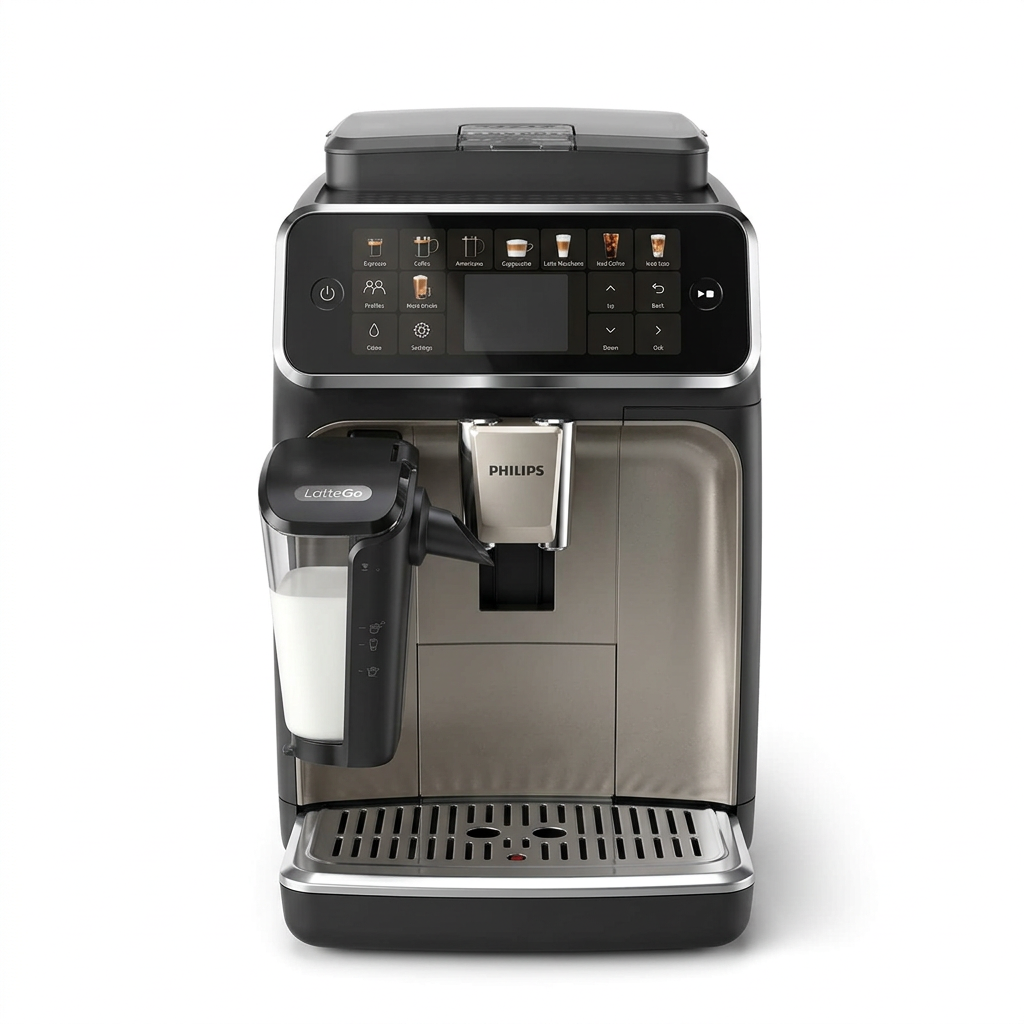
The front view: display and quick buttons on top, coffee spout in the middle and LatteGo on the left.
Which one is right for you?
4 quick questionsPhilips 5500 specifications
From manufacturer data and my own measurements.
How I tested and scored the Philips 5500
I used the Philips 5500 Series for its everyday jobs: espresso, black coffee, hot milk drinks and the iced menu.
I measured espresso concentration with a refractometer, drink temperatures at the spout and noise levels with a decibel meter at about a meter away.
I tested whole dairy milk, skimmed milk and barista oat milk, and followed the full cleaning routine, including removing and rinsing the brew group.
I then compared my notes with the manufacturer's specifications and general espresso brewing guidance.
- Espresso (8.2): flavor, strength, consistency and temperature.
- Milk drinks (8.8): foam, milk temperature and ease of use.
- Iced drinks (7.0): flavor, dilution and cold foam.
- Ease of use (9.3): controls, profiles, warm-up and refilling.
- Cleaning (9.2): daily and long-term maintenance effort.
The overall score of 8.5 is an editorial rating that reflects those five areas.
Philips 5500 FAQ
Is the Philips 5500 worth it?
Yes, if you mostly drink milk coffee and want the easiest possible cleanup. It's less compelling if you want strong, dense espresso or drink true cold brew every day.
How many drinks can the Philips 5500 make?
It offers 20 recipes, covering black coffees, milk drinks, hot water, frothed milk and a menu of iced drinks.
How long does it take to clean the milk system?
The two-part LatteGo carafe rinses clean under the tap in about 10 seconds, and both parts are dishwasher safe.
Does the Philips 5500 make real cold brew?
No. Iced drinks are brewed at about 60°C (140°F) and poured over ice, so they cool quickly but are slightly diluted. Large ice cubes and a stronger setting help.
How hot is the coffee?
On the hottest setting, I measured espresso at about 80°C (176°F) at the spout and frothed milk at about 75°C (167°F). Pre-warming the cup helps.
Is the Philips 5500 loud?
No. Grinding measured about 59 to 60 dB with the hopper lid closed, the pump about 58 dB and frothing about 60 dB.
How long does it take to warm up?
With QuickStart, it was ready to brew about 20 to 25 seconds after switching on.
How often do I need to clean the brew group?
Rinse it under lukewarm water every two weeks and lubricate the rails every two to four months.
Can I use pre-ground coffee?
Yes. There's a chute for a single level scoop of pre-ground coffee, which is handy for decaf.
How many people can save their drinks?
Four color-coded profiles each remember every recipe's settings, and a guest profile keeps visitors from changing them.
- Hands-on testing of the Philips 5500 Series with LatteGo and iced coffee
- Philips product specifications and owner documentation
- General espresso brewing, water and maintenance guidance