Philips 3200 vs 5500: do you need the extra drinks and quiet brewing?
Same size, same ceramic grinder, same tubeless LatteGo milk jug. Then they split: the Philips 3200 makes five classic drinks from a dead-simple panel, while the Philips 5500 makes 20 hot and iced drinks, saves four user profiles, adds Extra Shot and grinds at about 60 dB. I used each one every day for four weeks to find out which is worth putting on your counter.
We choose products independently. We may earn a commission through links on this page; your price stays the same. Affiliate policy
Jargon helpNew to espresso? Tap any dotted term to see what it means.
In this comparison
If one or two people drink espresso, coffee, cappuccino and latte macchiato, buy the Philips 3200. It makes those five drinks at one touch, its LatteGo jug rinses clean in ten seconds and there’s nothing to learn. If several people share the machine, or you want flat whites, iced drinks and stronger coffee, the Philips 5500 is the upgrade worth paying for: 20 drinks, four saved profiles, Extra Shot and the quietest grinder I’ve measured in this class.
The two machines
Specs checked November 14, 2026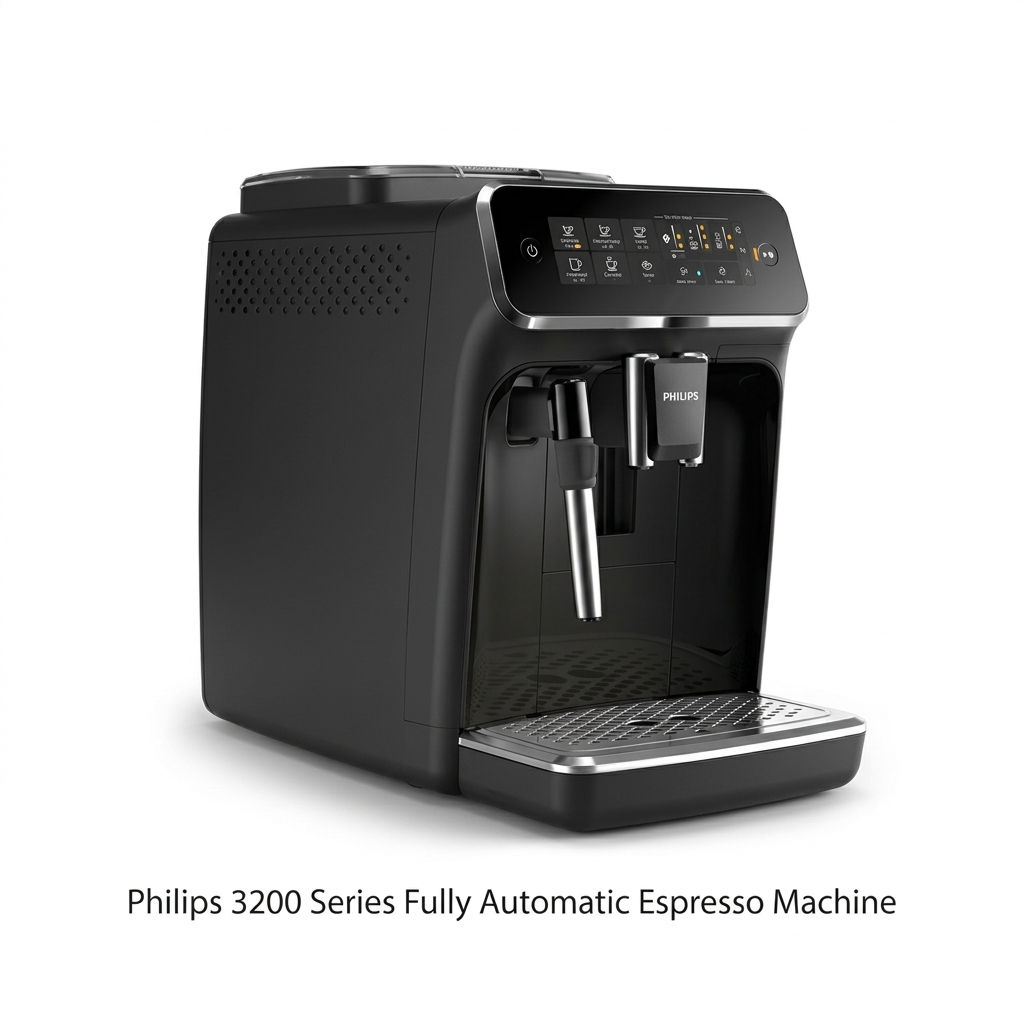
Five one-touch drinks, a tubeless LatteGo jug and a removable brew group in a compact, easy-going machine.
Check price on Amazon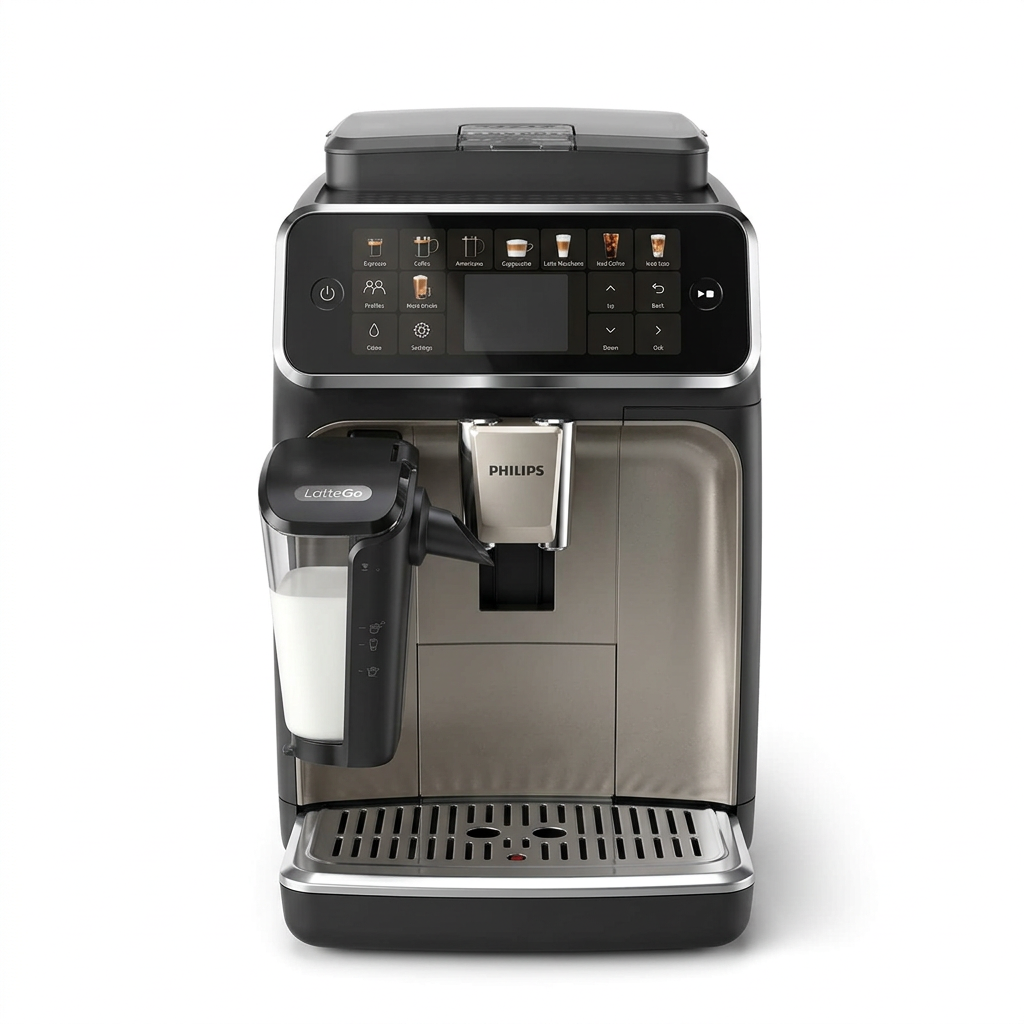
20 hot and iced drinks, four user profiles plus a guest, Extra Shot, quiet grinding and front-loading everything.
Reveal Today’s DealPhilips 3200 vs 5500 at a glance
- Buy the 3200 if you want the classic drinks at one touch, easy milk cleaning and the best value, and you like mild coffee.
- Buy the 5500 if several people share the machine, you want flat whites and iced drinks, or you find standard super-automatic espresso too weak.
- Both are the same size, use 12-step ceramic grinders, 1.8-liter tanks and two-part, tube-free LatteGo milk systems.
- The 5500 is the easier machine to share and the quieter one to wake up to; the 3200 does fewer things but does the basics very well.
Head to head
The better result in each row is marked, based on four weeks with each machine and Philips’ own specs. Rows where they’re the same have no winner.
Don’t read the tally as my verdict. For a couple who drink a cappuccino each, half these rows won’t matter; for a family of four, profiles alone can decide it.
| Spec | Philips 3200 | Philips 5500 |
|---|---|---|
| Espressomy tasting, same beans | Mild, lungo-style | Smooth, rounder, more body ✓ Best |
| One-touch drinks | 5, plus hot water | 20 hot and iced ✓ Best |
| Flat white and caffè latte | No | Yes ✓ Best |
| Iced drinks | No | Yes, brewed warm over ice ✓ Best |
| User profiles | None | 4 plus guest ✓ Best |
| Strength levels | 3 | 5 plus Extra Shot ✓ Best |
| Display | Touch icons | Color TFT with buttons ✓ Best |
| Milk system | LatteGo, two parts | LatteGo, two parts, locking lid |
| Grinding noise | Short, fairly loud burst | About 60 dB, lid sealed ✓ Best |
| Warm-up rinse | Rinses on start-up | QuickStart, no start-up rinse ✓ Best |
| Front access to tank and tray | Tank on the side | Everything slides out the front ✓ Best |
| Brew group cleaning | Weekly rinse | Rinse every 2 weeks |
| Simplicity | 5 icons, nothing to learn ✓ Best | More menus to explore |
| Footprint | 9.7 × 17 in | 9.7 × 17 in |
| Rows won | 1 | 10 |
Philips 3200 vs 5500 pros and cons
Philips 3200
- Five one-touch classics, including latte macchiato
- LatteGo jug rinses clean in about ten seconds
- Simple, no-menu control panel anyone can use
- Mild espresso from a small dose
- No user profiles, flat white or iced drinks
- Fairly loud grinder and a small drip tray
Philips 5500
- 20 hot and iced drinks with four saved profiles
- Quiet grinding at about 60 dB with the lid closed
- Extra Shot and five strength levels for fuller coffee
- Espresso still lighter than a café shot
- Iced drinks are brewed warm and dilute the ice
- Fixed milk spout makes cup placement fussy
Who should buy which machine?
- Couples who drink the same few drinks every day
- Anyone who wants the simplest possible panel
- Buyers who want the most value from LatteGo
- Families where everyone wants a different drink
- Iced coffee and flat white drinkers
- Early risers in open-plan homes
Design, size and build
On paper, these two are the same size: about 9.7 inches wide, 14.6 inches tall and 17 inches deep, and both weigh about 17.6 pounds. On my counter, they took up exactly the same gap.
Both are mostly plastic with a stainless steel drip tray cover. Neither feels premium in the hand, but neither rattled or creaked after a month of daily use.
The look is where they part ways. The Philips 3200 has a glossy black panel with simple drink icons, and it looks tidy rather than special.
The Philips 5500 frames a color display with a chrome border, and it looks noticeably more expensive than the materials suggest.
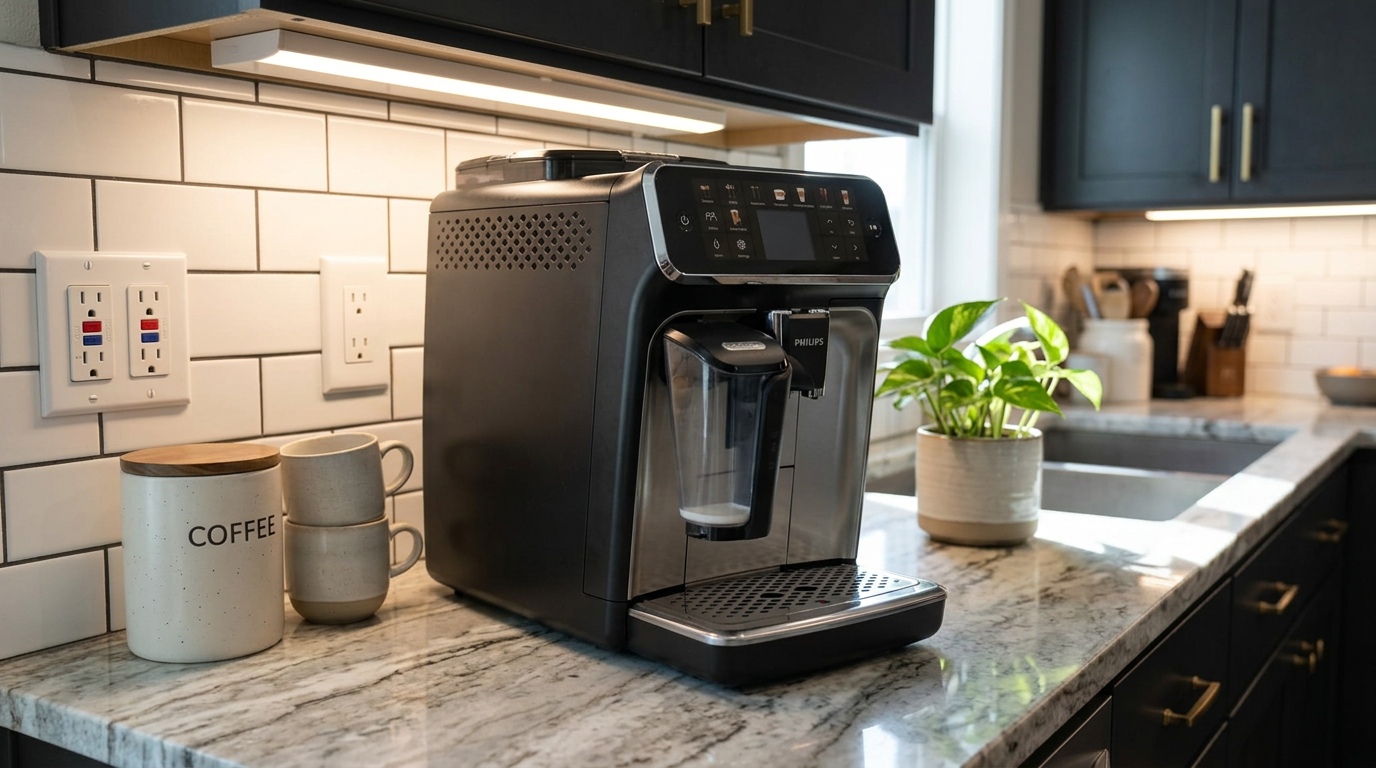
The 5500’s chrome-framed display makes it look more upmarket than the 3200.
The more useful difference is access. On the 3200, the water tank lifts out from the side, so I needed a little room next to the machine.
On the 5500, the tank, grounds container and drip tray all slide out from the front. I could push it right up against the wall and under a low cabinet without losing access to anything except the bean hopper on top.
Side clearance I needed for the water tank
The 5500 loads from the front, so it can sit tight against a wall or another appliance.
Our tip: Measure from the counter to the underside of your cabinets and add a couple of inches for the hopper lid, because both machines refill beans from the top.
Setup and the first week
Setup is almost identical. I tested my water hardness with the strip, entered it in the settings, fitted the AquaClean filter, filled the tank and let each machine prime itself. It took about ten minutes on both.
On the 3200, the hidden settings live behind button combinations: with the machine off, you hold a button for three seconds to reach water hardness and other options.
On the 5500, the color display walked me through the basics with pictures, which was friendlier for everyone else in the house.
On both, I poured away the first few drinks while the grinder and brew group✕Brew groupThe part inside a super-automatic that compresses the coffee, holds it while water passes through and ejects the used puck. bedded in. My early cups were thinner than the ones I made after about a dozen brews.
| Setup step | Philips 3200 | Philips 5500 |
|---|---|---|
| Water hardness | Strip, set via button combination | Strip, set on the display |
| AquaClean filter | Included, fits in the tank | Compatible, fits in the tank |
| Guidance | Manual | On-screen pictures |
| Drinks to pour away | First 3 to 4 | About a dozen to bed in |
| Time to first good drink | About 10 minutes | About 10 minutes |
Our tip: Enter your water hardness on day one on either machine, so the descaling reminders are accurate from the start.
Display, controls and profiles
The 3200’s panel is one of the simplest on any super-automatic. Five drink icons, a hot water button, an aroma button, a volume button and start. Nobody in my house needed instructions.
Philips calls its customization My Coffee Choice. On the 3200, you get three aroma strengths, adjustable coffee and milk length per drink and three temperatures. What you don’t get is profiles, so everyone shares the same defaults.
The 5500 uses a full-color TFT display with soft buttons around it. It isn’t a touchscreen, and I came to prefer that, because buttons work with wet, milky fingers at seven in the morning.
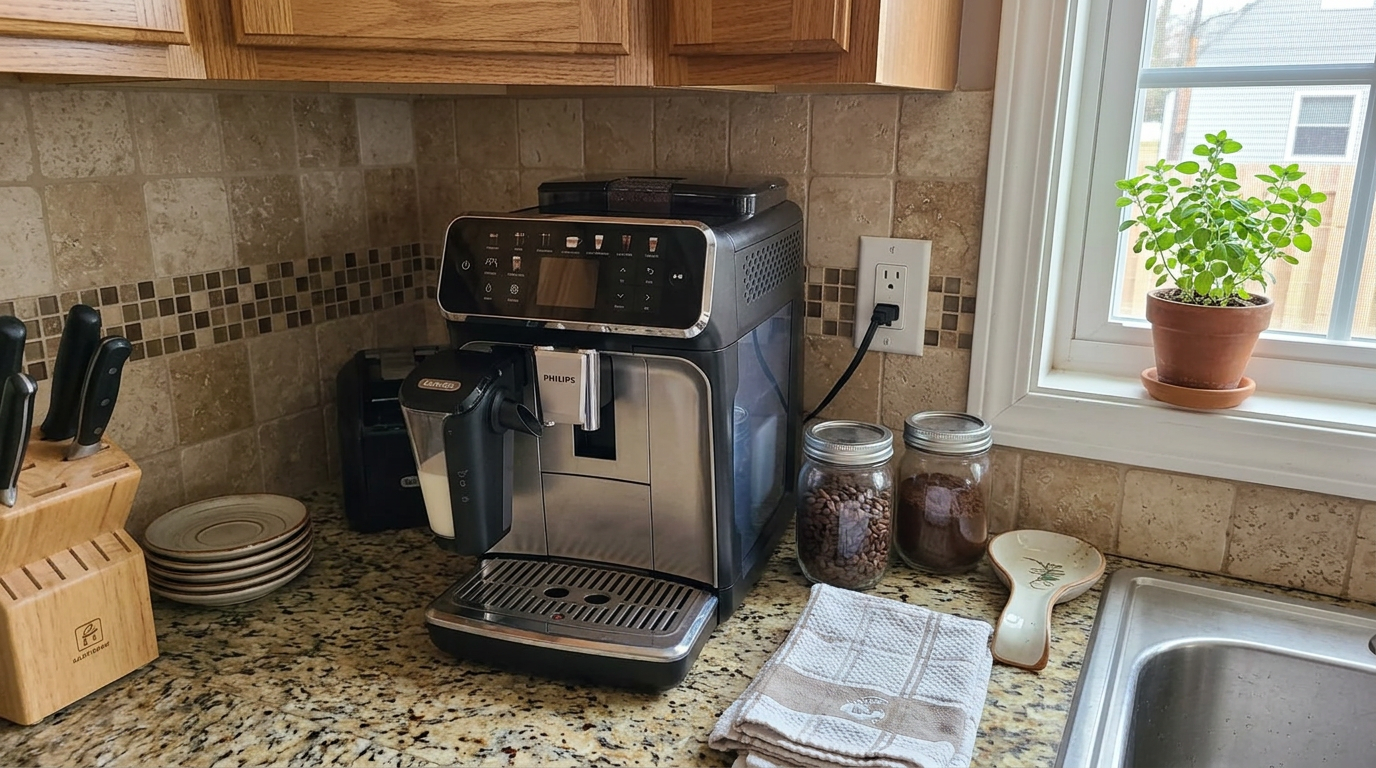
The 5500’s color display isn’t a touchscreen, which made it easier with wet fingers.
Profiles: the 5500’s quiet superpower
The 5500 has four color-coded profiles, blue, green, red and yellow, plus a guest profile. Each profile remembers your settings for every single recipe, not just one or two favorites.
When I made my cappuccino stronger and smaller, that became my cappuccino. My partner’s profile kept a milder, larger version, and visitors used the guest profile without overwriting anyone.
On the 3200, we ended up negotiating defaults. I wanted the strongest aroma and smallest volume; my partner wanted a bigger, softer mug. One of us always had to press a couple of extra buttons.
| Feature | Philips 3200 | Philips 5500 |
|---|---|---|
| Display | Touch icons, no screen | Color TFT with buttons |
| Quick drinks | 5 icons | Quick buttons plus hot and iced menus |
| Strength | 3 levels | 5 levels plus Extra Shot |
| Temperature | 3 levels | Several levels |
| User profiles | None | 4 plus guest |
| Settings saved | One default per drink | Every drink, per profile |
Our tip: On the 5500, give each person their own color on day one, before anyone starts changing the shared default drinks.
The drink menu: 5 vs 20
This is the headline difference, and for many households it decides everything.
The Philips 3200 makes espresso, coffee, Americano, cappuccino and latte macchiato, plus hot water. Those five cover what most couples drink every day.
The Philips 5500 makes 20 recipes. On top of the 3200’s list, it adds a ristretto✕RistrettoA “restricted” espresso made with less water than a normal shot. It’s shorter, thicker and sweeter., espresso lungo, caffè crema, flat white✕Flat whiteA short milk coffee with a strong coffee base and a thin layer of silky foam. It’s stronger and less foamy than a cappuccino., caffè latte, café au lait, frothed milk and a full iced menu.
One-touch drinks per category
Counted from each machine’s menu. Hot water and frothed milk are not included.
| Drink | Philips 3200 | Philips 5500 |
|---|---|---|
| Espresso | Yes | Yes |
| Ristretto | No | Yes |
| Espresso lungo | No | Yes |
| Coffee | Yes | Yes |
| Americano | Yes | Yes |
| Cappuccino | Yes | Yes |
| Latte macchiato | Yes | Yes |
| Flat white | No, build by hand | Yes |
| Caffè latte and café au lait | No | Yes |
| Iced coffee, latte, cappuccino, americano, espresso | No | Yes |
| Two cups at once | Espresso and coffee | Black coffees as doubles |
On the 3200, I built a flat-white-style drink by shortening the cappuccino milk, using a small cup and adding a second espresso. It was close enough for a weekday, but it’s a workaround every time.
The 5500’s Extra Shot was the surprise hit in my house. It grinds and brews a second, fresh puck after your drink, so you get more coffee rather than more water pushed through the same grounds.
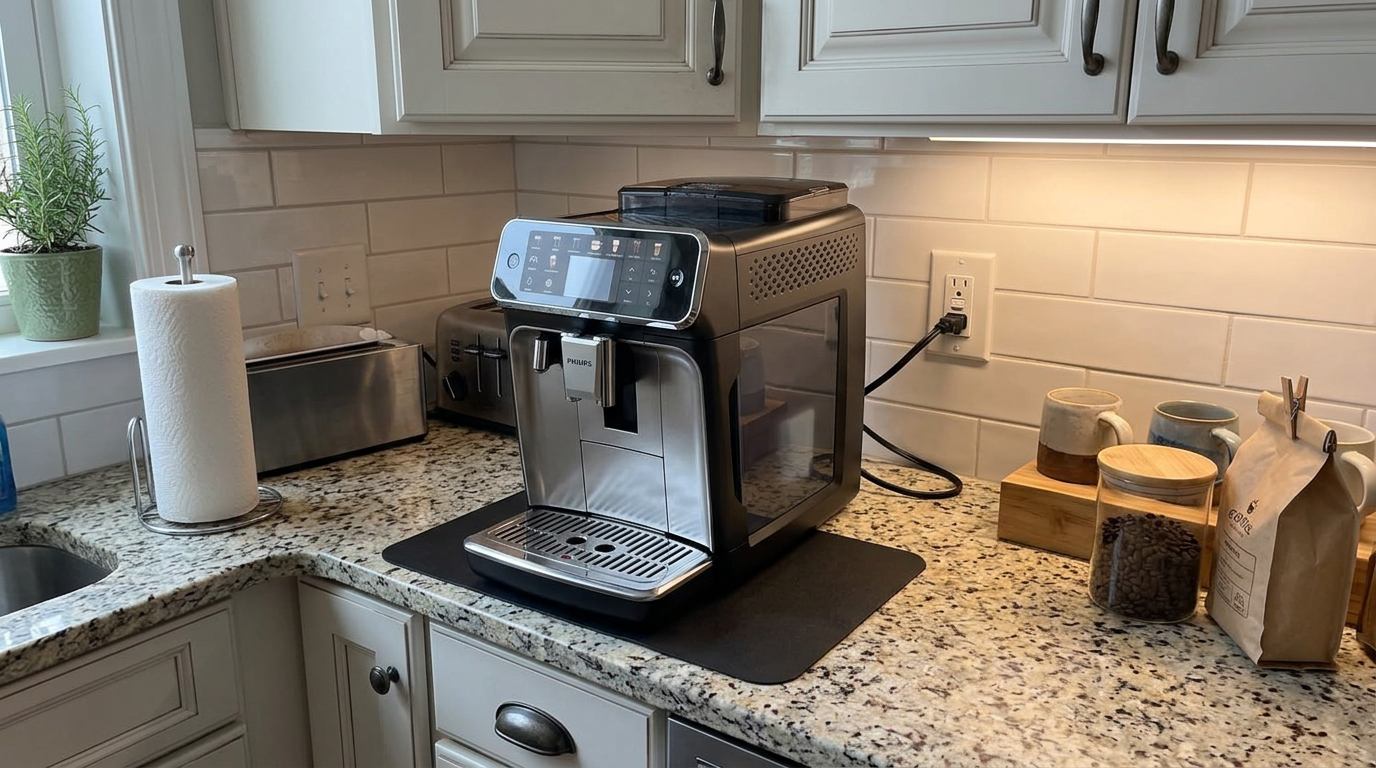
Twenty drinks, from ristretto to iced latte, make the 5500 easy to share.
See Today’s PriceGrinder and dose
Both machines use flat ceramic burrs with 12 settings, adjusted with a knob inside the bean hopper. Ceramic stays cool and lasts a long time, which matters on a machine you use every day.
On both, I only turned the knob while the grinder was running, one step at a time, and gave each change two or three drinks before judging it.
With a medium roast, I ended up two steps finer than the factory middle setting on both machines. That gave a rounder, sweeter espresso with less sourness.
The dose is the real limit
I stopped the 3200 after grinding on its strongest setting and weighed the coffee: about 8 grams. A café double uses 14 to 18 grams, so the 3200’s espresso lands closer to a lungo✕LungoA “long” espresso made with more water than a normal shot. It’s milder and less concentrated..
The 5500 tackles that in two ways. Its five strength levels go further than the 3200’s three, and Extra Shot adds a whole second dose to any drink.
With strongest strength and Extra Shot switched on, my 5500 cappuccino had real backbone. The best I could do on the 3200 was strongest aroma, smallest volume and an extra espresso on top.
Coffee per drink, strongest settings
The 3200 dose is my weighed measurement; the 5500 Extra Shot brews a second full puck.
| Grinder detail | Philips 3200 | Philips 5500 |
|---|---|---|
| Burrs | 100% ceramic, flat | Ceramic, flat |
| Settings | 12 | 12 |
| Adjustment | Knob inside the hopper | Dial inside the hopper |
| Strength | 3 levels | 5 levels plus Extra Shot |
| Bean hopper | About 9.7 oz | About 10 oz |
| Pre-ground chute | Yes, one scoop | Yes, one scoop |
Our tip: Avoid shiny, oily beans in both machines, because the oil clings to the hopper and can block the ceramic grinder over time.
Espresso quality
Neither of these makes café-strength espresso, and Philips doesn’t pretend otherwise. But there’s a real gap between them.
On the 3200, the espresso was smooth, mild and easy to drink, with a thin, even crema✕CremaThe golden, foamy layer on top of a fresh espresso. It forms when pressure pushes oils and gases out of the coffee.. I tasted gentle caramel and nut notes and very little bitterness, but not much body.
On the 5500, I measured shots with a refractometer, which reads TDS✕TDS (total dissolved solids)How much coffee is actually dissolved in the drink, shown as a percentage. Higher numbers mean a stronger, more concentrated cup.. My espressos read between 4.5 and 5.5 percent, against a typical portafilter espresso of around 8 to 12 percent.
In the cup, that meant a softer, lighter espresso than a café shot, but rounder and fuller than the 3200’s, especially two steps finer on the grinder.
Espresso concentration (TDS)
My refractometer readings on the 5500’s strongest settings.
My espresso ratings
My scores out of 10 for body, crema, flavor and consistency, from the single reviews.
Temperature was similar. The 5500’s espresso measured about 176°F at the spout on its hottest setting, and the 3200 felt much the same.
On both, a cold porcelain cup stole a few degrees fast, so I pre-warmed cups with a splash of hot water.
| What you taste | Likely cause | First fix on either machine |
|---|---|---|
| Sour, sharp, thin | Grind too coarse | One step finer, while grinding |
| Bitter, harsh | Volume too large or grind too fine | Smaller volume or one step coarser |
| Watery at max strength | Small dose | 5500: Extra Shot. 3200: smallest volume |
| Thin black coffee | Too much water through one puck | Double espresso topped with hot water |
Our tip: For a big black coffee on either machine, brew a double espresso and add hot water instead of using the longest coffee setting.
Milk drinks and LatteGo
Both machines use LatteGo✕LatteGoPhilips’ two-part milk jug. Steam draws milk into a small chamber in the jug, whips in air and pours foam straight into the cup, with no internal tubes., and it’s the best reason to buy either. It’s a two-part jug that clips to the front, with no tubes or hoses anywhere.
Steam draws milk into a small cyclonic chamber in the jug, mixes in air and pours foam straight into your cup. Because the milk never travels through the machine, there’s nothing hidden inside for old milk to sour in.
On the 3200, the foam was creamy and fairly fine. Latte macchiatos came out in neat layers in a tall glass, and cappuccinos had a soft, generous cap.
On the 5500, the updated lid locks on more firmly, and the foam was thick, airy and hot, at about 167°F. It also adds flat white, caffè latte and plain frothed milk, so you get more control over how much foam ends up in the cup.
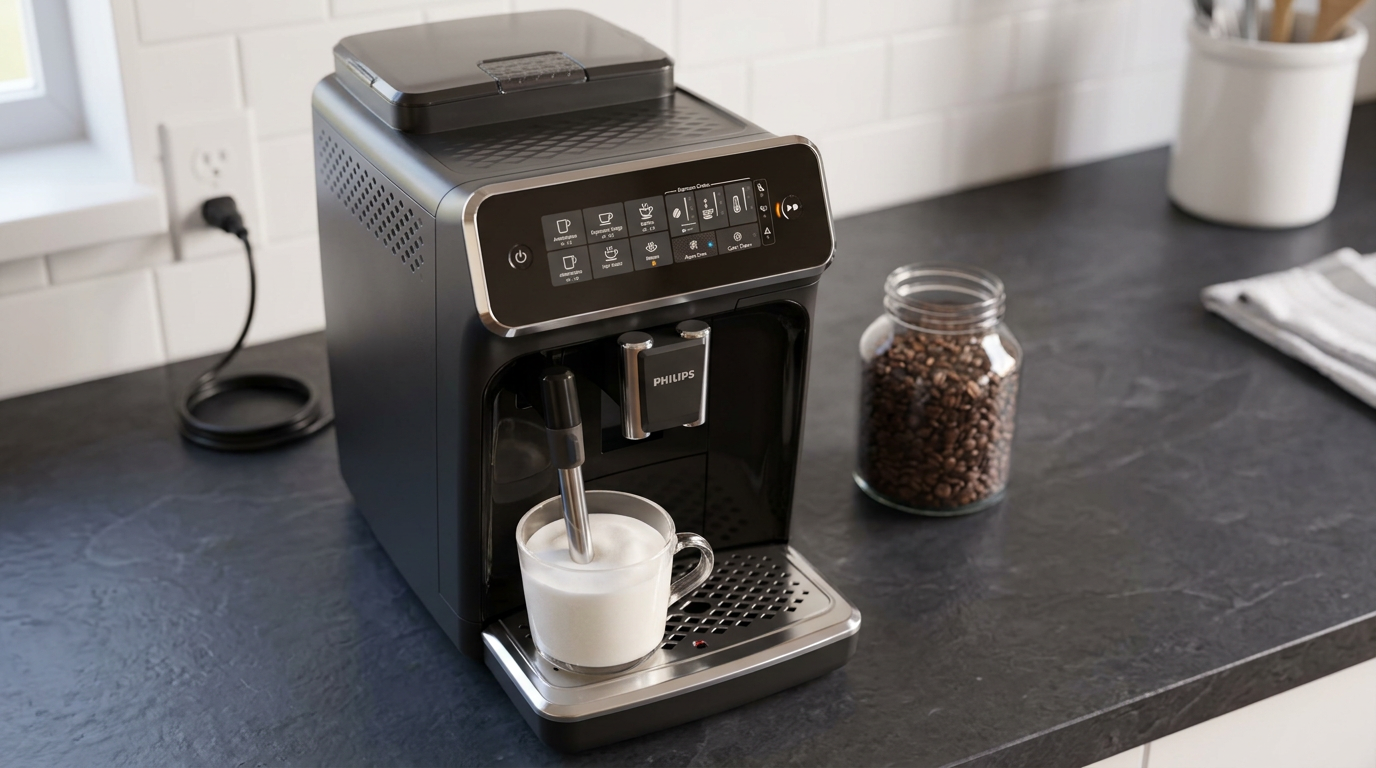
The 3200’s LatteGo jug makes neat, layered latte macchiatos at one touch.
Neither makes the fine, glossy microfoam✕MicrofoamMilk foam with bubbles so small you can barely see them. It feels silky and glossy, and it’s what you need for latte art. you need for latte art. That’s the trade-off for foam with no technique and almost no cleaning.
One 5500 quirk caught me out. Its milk spout is fixed, so the cup has to sit further forward on the drip tray than you’d expect, or the milk catches the rim. Wide mugs made it easy; narrow glasses needed care.
My milk drink ratings
My scores out of 10 from the single reviews.
| Milk detail | Philips 3200 | Philips 5500 |
|---|---|---|
| System | LatteGo, two parts | LatteGo, two parts, locking lid |
| Jug size | About 8.8 fl oz | About 9 fl oz |
| Milk drinks | Cappuccino, latte macchiato | Cappuccino, latte macchiato, flat white, caffè latte, café au lait |
| Frothed milk only | No | Yes |
| Measured milk temperature | Comfortably hot | About 167°F |
| Rinse time | About 10 seconds | About 10 seconds |
| Dishwasher safe | Yes | Yes |
Our tip: Use cold whole milk or barista-style oat milk on either machine, because they gave the creamiest LatteGo foam in my tests.
Reveal Today’s DealIced drinks
The 3200 has no iced menu at all. For an iced latte, I brewed two strong espressos into a glass, let them cool for a minute and poured them over ice and cold milk.
The 5500 has five iced recipes. Pick one, and the machine tells you how much ice to add, then pours coffee and, if needed, cold-frothed milk on top.
It’s important to understand how it works. The 5500 doesn’t use cold extraction. It lowers the brewing temperature to about 140°F, compared with about 176°F for hot espresso, and that warm coffee melts some of the ice.
Brew temperature on the 5500
Measured at the spout. Lower brew temperature limits ice melt, but doesn’t stop it.
The result is a refreshing iced drink, but a slightly diluted one. Iced americanos and iced espressos held up best; iced lattes and cappuccinos suffered most, because meltwater thins the milk as well as the coffee.
If you drink true cold brew every day, neither machine replaces it. If you want a quick cold coffee on a warm afternoon, the 5500 does it with no extra equipment.
| Iced drink | Philips 3200 | Philips 5500 |
|---|---|---|
| Iced americano | By hand | One touch, held up best |
| Iced espresso | By hand | One touch |
| Iced latte | By hand | One touch, some dilution |
| Iced cappuccino | By hand | One touch, thinner cold foam |
| Cold brew | No | No |
Hot water and tea
Both have a hot water button for tea, instant drinks or warming cups. It’s convenient for a cup or two, but I wouldn’t replace a kettle with either.
The water came out hot enough for green and herbal tea, and a splash was perfect for pre-warming espresso cups.
Our tip: Run a splash of hot water into your cup before every espresso on either machine, and it stays hot noticeably longer.
Cleaning and upkeep
These are two of the easiest milk machines to keep clean, and the routines are close.
After every milk drink, I separated the two LatteGo parts and rinsed them under the tap for about ten seconds on both. Once a day, they went in the dishwasher.
Both have a removable brew group behind a side panel. On the 3200, I rinsed it weekly; on the 5500, every two weeks was enough. Never use dish soap on it, because it strips the lubricant from the moving parts.
Both need a thin layer of food-grade grease on the brew group every couple of months. It’s a five-minute job and the best thing you can do for either machine’s lifespan.
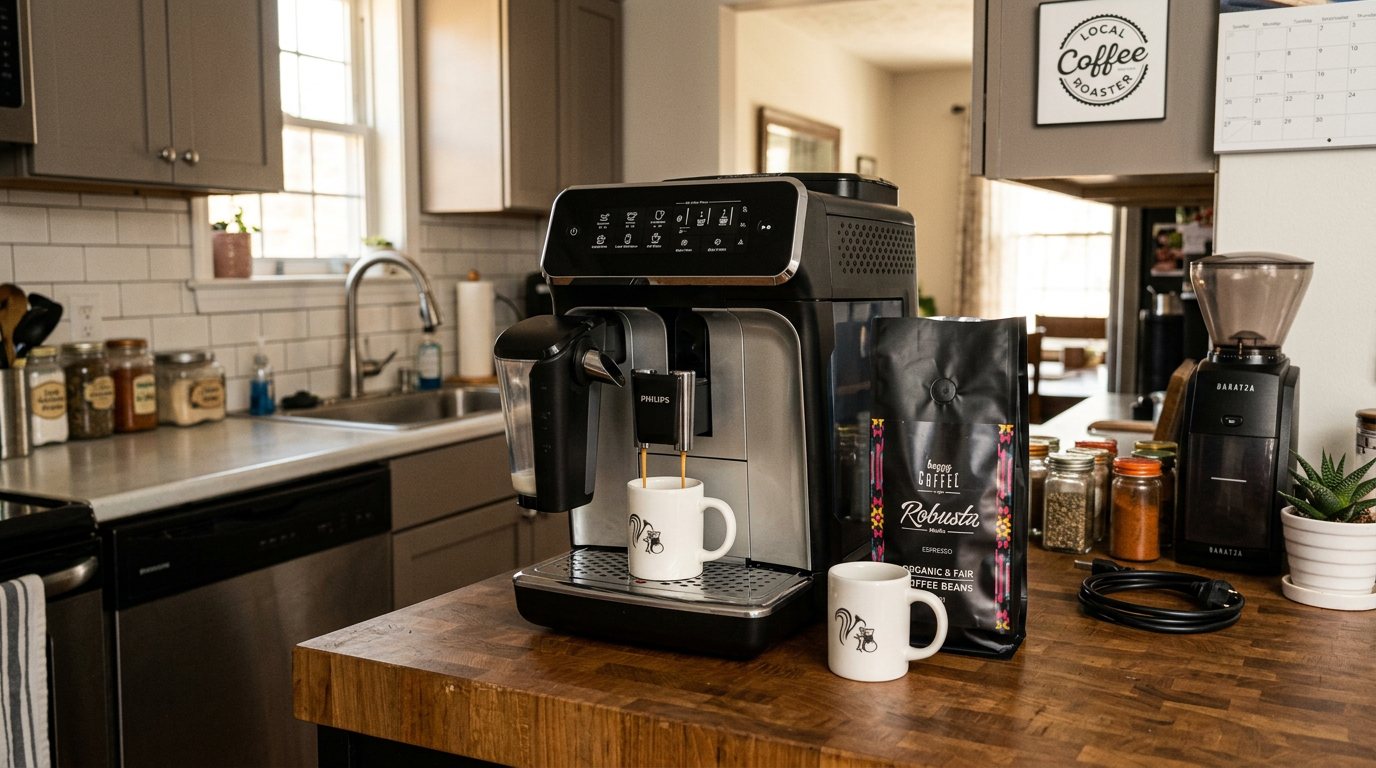
A removable brew group on both machines means you can see exactly how clean it is.
The daily differences are small but real. The 3200 rinses its coffee path when you switch it on, so every morning starts with a little water in the small drip tray.
The 5500’s QuickStart skips the start-up rinse and only rinses at switch-off. Its drip tray has a level indicator, and its grounds container holds about 12 pucks before an alert appears.
With the AquaClean filter replaced whenever prompted, Philips says both can go up to 5,000 cups without descaling✕DescalingRunning a mild acid through the machine to dissolve the mineral scale that hard water leaves behind in the heater and pipes.. Without it, the machines prompt you based on your water hardness.
My daily hands-on cleaning time
My estimates, not counting automatic rinses.
| When | Philips 3200 | Philips 5500 |
|---|---|---|
| After milk drinks | Rinse LatteGo parts | Rinse LatteGo parts |
| Daily | Empty drip tray and grounds, LatteGo in dishwasher | Empty tray and grounds when indicated |
| Brew group rinse | Weekly | Every 2 weeks |
| Grease brew group | Every 2 months | Every 2 to 4 months |
| When prompted | Replace AquaClean or descale | Replace AquaClean or descale |
Our tip: Leave the brew group to air-dry fully before you slide it back in, so no water gets trapped behind the side panel.
Noise and warm-up
Noise is where the 5500 clearly pulls ahead. I measured it with a decibel meter about three feet away: grinding peaked at just 59 to 60 dB with the hopper lid closed, the pump hummed at about 58 dB and frothing stayed around 60 dB.
For context, that’s about the level of a normal conversation. With the lid off, the grind jumped to about 71 dB, which shows how much the rubber seal does.
The 3200’s grinder is a short, fairly loud burst and its milk frothing a steady hiss. It’s normal for the class, but noticeable in a quiet kitchen early in the morning.
Measured noise on the 5500
Peak readings from about three feet. Each 10 dB step sounds roughly twice as loud.
The 5500 was also ready in about 20 to 25 seconds from power on, with no rinse cycle. The 3200 runs a short rinse at start-up, which adds a little time and a little water before your first drink.
Our tip: Always close the 5500’s hopper lid properly before brewing, because the seal is what keeps the grinder quiet.
Water, beans and supplies
Both have a 1.8-liter tank, about 61 ounces, and a hopper that holds roughly 10 ounces of beans. The AquaClean filter takes up a little space in the tank on both.
Both machines use the same supplies: AquaClean filters, brew group grease and descaler if you skip the filter. That makes running them almost identical.
The Specialty Coffee Association recommends water with about 150 ppm of total dissolved solids and moderate hardness. Filtered tap water with AquaClean fitted was the sweet spot on both; skip distilled water.
Roughly how far one 1.8 L tank goes
Rough maths allowing for rinses. Extra Shot on the 5500 uses a little more water.
| Bean type | Philips 3200 | Philips 5500 |
|---|---|---|
| Medium-dark blend | Best body, great in milk | Best all-rounder |
| Medium roast | Balanced, gentle | Rounder espresso, two steps finer |
| Light roast | Bright but thin | Bright, use Extra Shot in milk |
| Oily, very dark | Avoid | Avoid, clings in the hopper |
Our tip: Choose medium roasts with a dry surface for both machines, because they gave the most consistent grind and the best espresso.
Real-life scenarios
These are the moments where one machine clearly pulled ahead during my testing.
Five icons, a ten-second rinse and nothing else to think about. The extras on the 5500 would go unused.
Four color profiles meant every drink was saved exactly as each person liked it.
One touch. On the 3200, I had to fake it with a short cappuccino and an extra espresso.
Pick a recipe, add ice, done. On the 3200, it’s a manual job with cooled espresso.
About 60 dB with the lid sealed, and no start-up rinse to wake anyone.
No menus, no profiles, no screen. Grandparents and guests used it without asking.
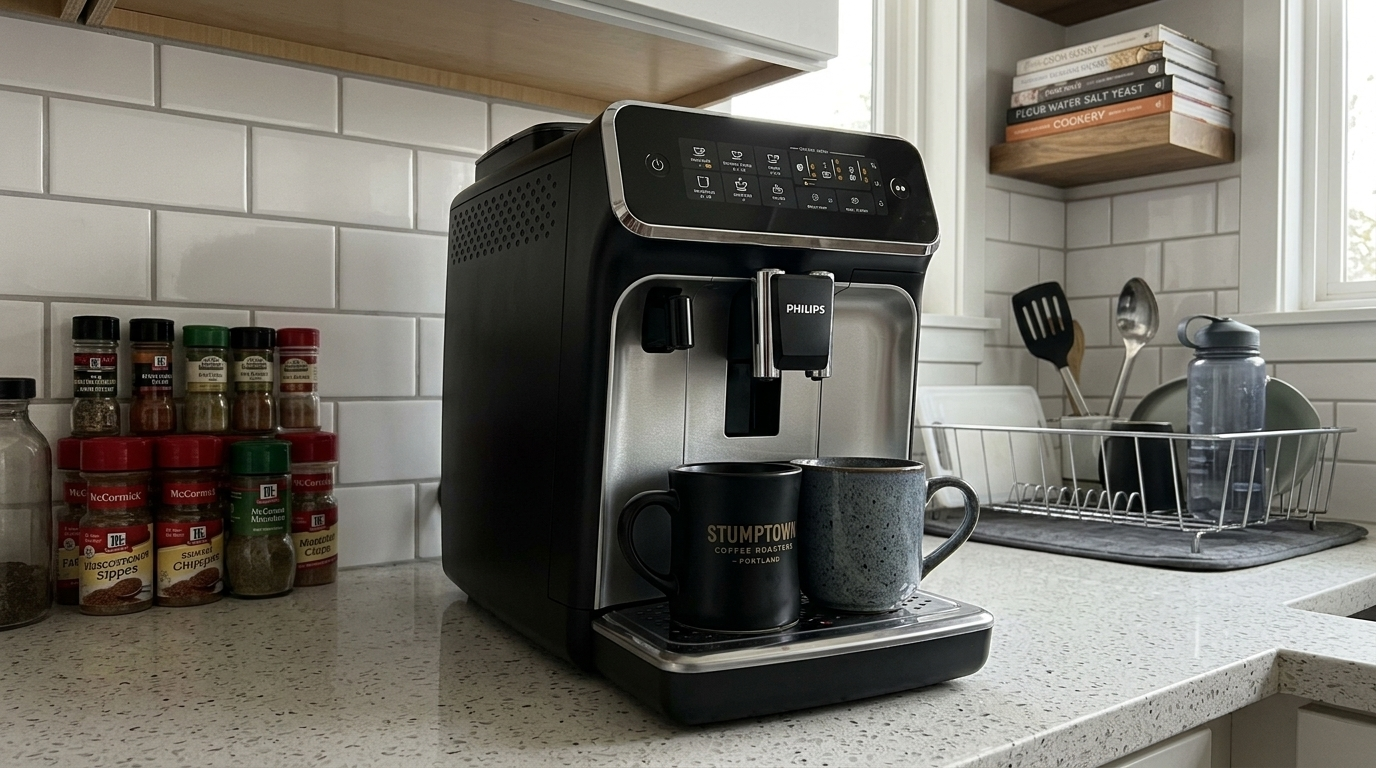
For a couple who drink the classics, the 3200 does everything they need.
My scorecard
These are my own scores out of 10. The first four come from my single reviews, and I added drink range and household sharing because they decide this matchup.
Philips 3200
Philips 5500
Overall, I rate the 3200 8.0 and the 5500 8.5. The 5500 is better at almost everything; the 3200 is the one that asks less of you and leaves the most money for beans.
See How Much You’ll SaveWhich one is right for you?
4 quick questionsWhich one should you buy?
It comes down to one question: does more than one person in your home want something different? If yes, the 5500’s profiles and menu pay for themselves every morning. If no, the 3200 makes your drink just as easily. For the wider picture beyond this matchup, see my guide to the best super-automatic espresso machines.
Still deciding? My Philips 2200 vs 3200 comparison shows what LatteGo adds over a manual frother, and my Philips 3300 vs 5500 matchup covers the 3300 in between. For the whole range, see my guide to the best Philips espresso machines.
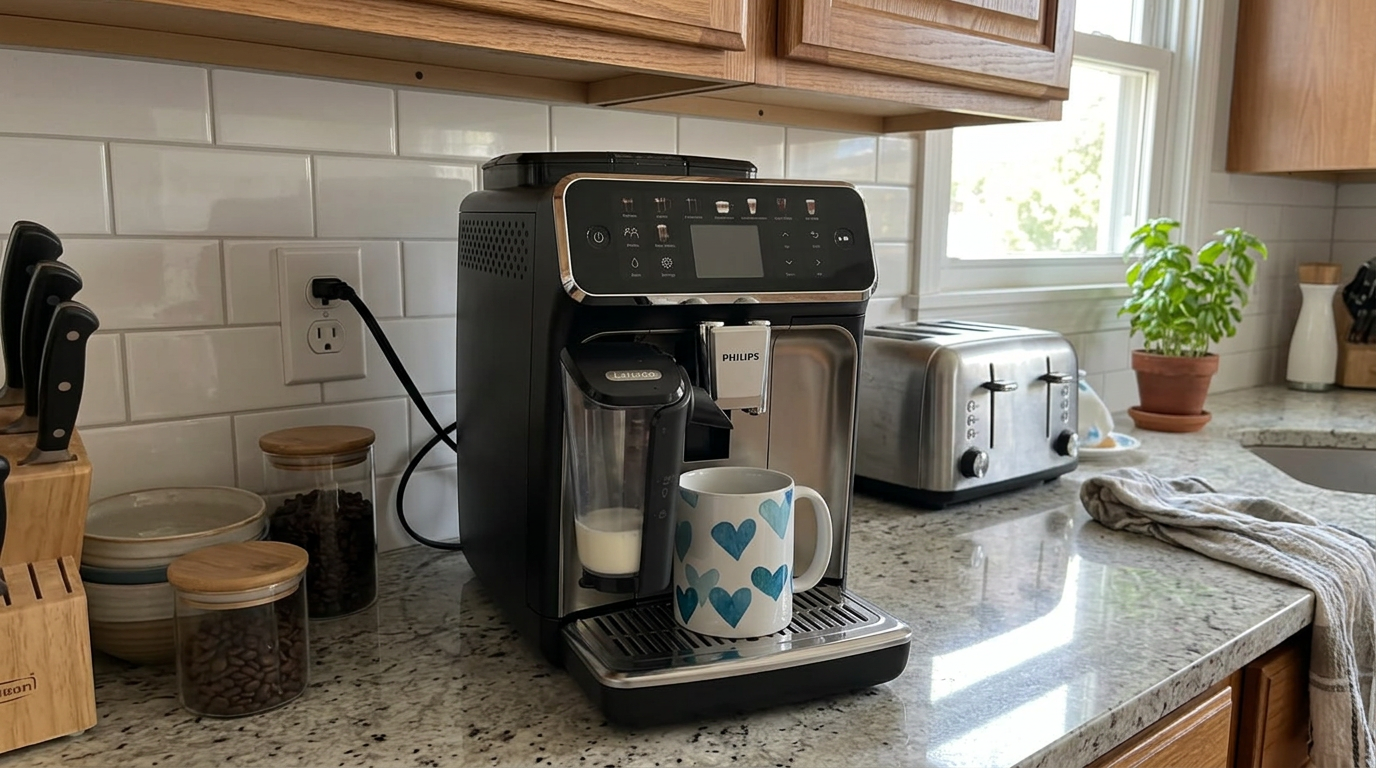
For busy households, the 5500 is the easier machine to share.
- You drink the classic five drinks
- One or two people use the machine
- You want the simplest controls
- You prefer mild, smooth coffee
- You want flat whites or iced drinks
- Several people want their own settings
- You want the strongest coffee possible
- Several people share the machine
- You want flat whites and iced drinks
- You want a quieter grinder
- You want Extra Shot for stronger milk drinks
- You only drink two or three drinks
- You want true cold brew
- You use very narrow glasses
For most households, my pick is the Philips 5500. Twenty drinks, four saved profiles, Extra Shot and quiet grinding make it the easier machine to share, and its espresso is noticeably fuller than the 3200’s.
The Philips 3200 is the smarter buy for a couple who drink the classics. It makes the same tubeless LatteGo milk drinks, cleans up just as fast and asks nothing of you, and you won’t pay for 15 drinks you’ll never press.
Whichever you choose, set the strongest aroma, grind two steps finer and rinse the LatteGo jug straight after every drink. Both reward that tiny bit of care with good, easy coffee every day.
Philips 3200 vs 5500 specifications
From manufacturer specifications and my own testing.
| Philips 3200 | Philips 5500 | |
|---|---|---|
| Type | Fully automatic with LatteGo | Fully automatic with LatteGo |
| One-touch drinks | 5 plus hot water | 20 hot and iced |
| Pump | 15 bar | 15 bar |
| Heating | Thermoblock, 1500 W | Thermoblock with QuickStart |
| Grinder | Ceramic, 12 settings | Ceramic, 12 settings |
| Measured dose | About 8 g | Plus Extra Shot |
| Strength levels | 3 | 5 plus Extra Shot |
| User profiles | None | 4 plus guest |
| Display | Touch icons | Color TFT with buttons |
| Milk jug | About 8.8 fl oz | About 9 fl oz |
| Water tank | 1.8 L / 61 oz | 1.8 L / 61 oz |
| Bean hopper | About 9.7 oz | About 10 oz |
| Measured noise | Not measured, normal for class | About 58 to 60 dB, lid closed |
| Dimensions (W × H × D) | 9.7 × 14.6 × 17 in | 9.7 × 14.6 × 17 in |
| Weight | About 17.6 lb | About 17.6 lb |
How I tested and compared them
I used each machine as my household’s everyday coffee maker for four weeks, making every drink on its menu. The testing notes were written up together by Michael Reynolds and the HouseholdMe team.
I weighed doses, measured drink volumes and temperatures, read espresso concentration with a refractometer and measured noise with a decibel meter at about three feet.
I made milk drinks with whole, skimmed and barista oat milk, tried the 5500’s iced menu with different ice, followed every cleaning routine and checked my notes against Philips’ specifications and manuals.
- Coffee: dose, strength, crema and consistency.
- Milk: foam texture, temperature and LatteGo cleaning.
- Workflow: controls, profiles, drink range and warm-up.
- Ownership: noise, cleaning, water care and footprint.
Philips 3200 vs 5500 FAQ
Is the Philips 5500 worth the upgrade over the 3200?
Yes, if several people share the machine or you want flat whites, iced drinks and stronger coffee. The 5500 adds 15 drinks, four user profiles, Extra Shot and quieter grinding. If you only drink the classic five drinks, the 3200 does them just as easily.
What is the main difference between the Philips 3200 and 5500?
The drink menu and profiles. The 3200 makes 5 one-touch drinks with no profiles. The 5500 makes 20 hot and iced drinks and saves settings for four people plus a guest.
Which makes stronger espresso?
The 5500. It has five strength levels and Extra Shot, which brews a second fresh puck. The 3200 used about 8 grams of coffee per shot in my tests, which gives mild, lungo-style espresso.
Do both use LatteGo?
Yes. Both use the two-part, tube-free LatteGo jug, which rinses clean in about 10 seconds. The 5500’s lid locks on more firmly.
Can the Philips 3200 make iced coffee?
Not at one touch. You can brew two espressos, let them cool for a minute and pour them over ice and cold milk. The 5500 has five iced recipes, brewed at about 140°F.
Is the Philips 5500 quieter than the 3200?
Yes. I measured the 5500’s grinder at about 60 dB with the hopper lid sealed. The 3200’s grinder is a fairly loud burst, normal for the class.
Are they the same size?
Yes, both are about 9.7 inches wide, 14.6 inches tall and 17 inches deep and weigh about 17.6 pounds. The 5500 loads its tank, tray and grounds from the front.
Do they have user profiles?
The 5500 has four color-coded profiles plus a guest. The 3200 has none.
Can I make a flat white on the 3200?
Not at one touch. I made a close version by shortening the cappuccino milk in a small cup and adding a second espresso.
How often do I clean the brew group?
I rinsed it weekly on the 3200 and every two weeks on the 5500. Both need a thin layer of food-grade grease every couple of months.

- Our hands-on Philips 3200 Series review
- Our hands-on Philips 5500 review
- Philips product specifications and user manuals
- Specialty Coffee Association brewing water guidance
- General espresso brewing and maintenance guidance