Philips 3300 vs 5500: which automatic espresso machine should you buy?
They share the same grinder, the same brew group, the same milk carafe and even the same body. One keeps things to six simple drinks, while the other adds 20 hot and iced recipes, four saved profiles and an Extra Shot button. I lived with both, measured what matters and compared the data to find out whether the upgrade is worth it for you.
We choose products independently. We may earn a commission through links on this page; your price stays the same. Affiliate policy
Jargon helpNew to espresso? Tap any dotted term to see what it means.
In this comparison
If more than one person uses the machine, I would pick the Philips 5500. It makes the same coffee as the 3300, but its four saved profiles, five strength levels, Extra Shot button and iced menu make it far easier to share and to get a stronger cup. If it is mostly you making cappuccinos and lattes, the Philips 3300 is the smarter buy, because you get the same grinder, brew group, quiet lid and milk carafe without paying for software you may never touch. Be aware that neither machine makes café-strength espresso from a single cycle, and neither brews truly cold coffee.
The two machines
Specs checked November 11, 2026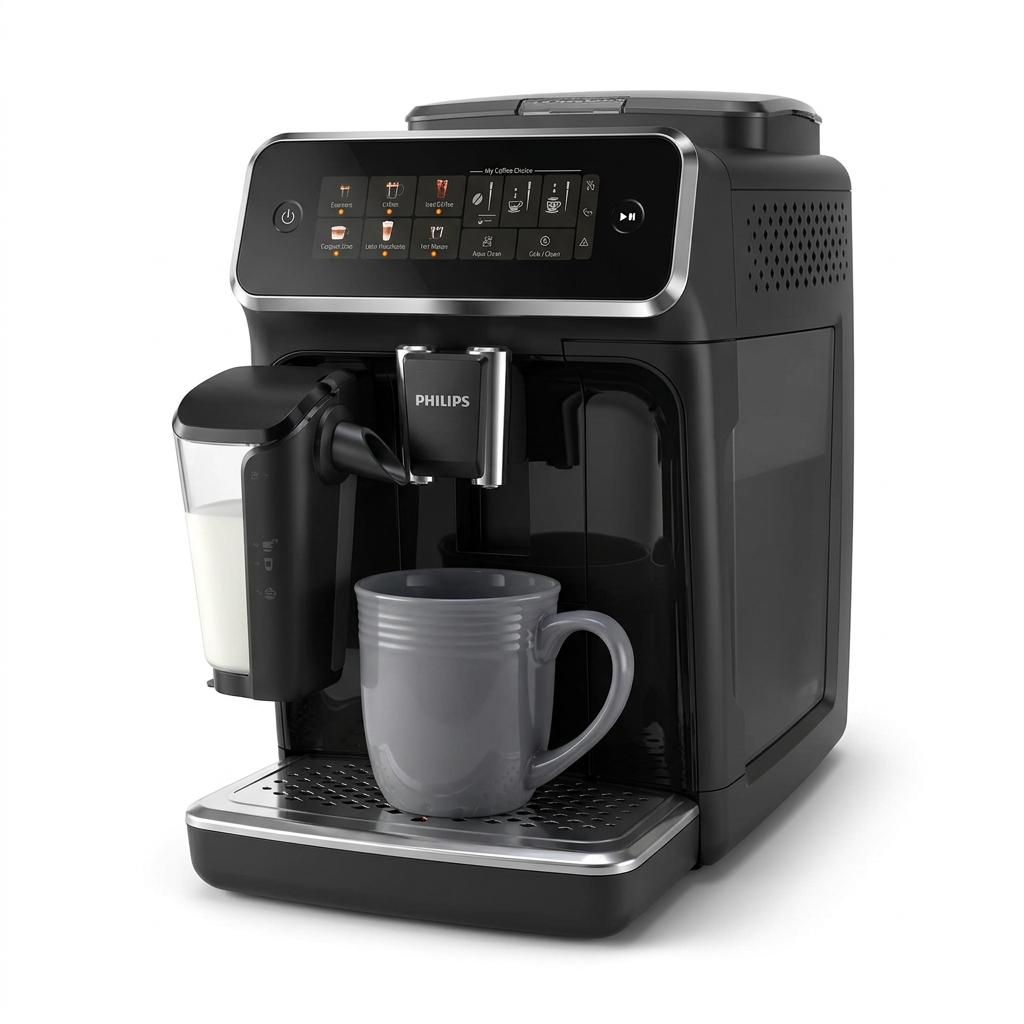
Six one-touch drinks on backlit icons, a sealed quiet grinder, a tube-free milk carafe and front access to everything you refill or empty.
See Today’s Price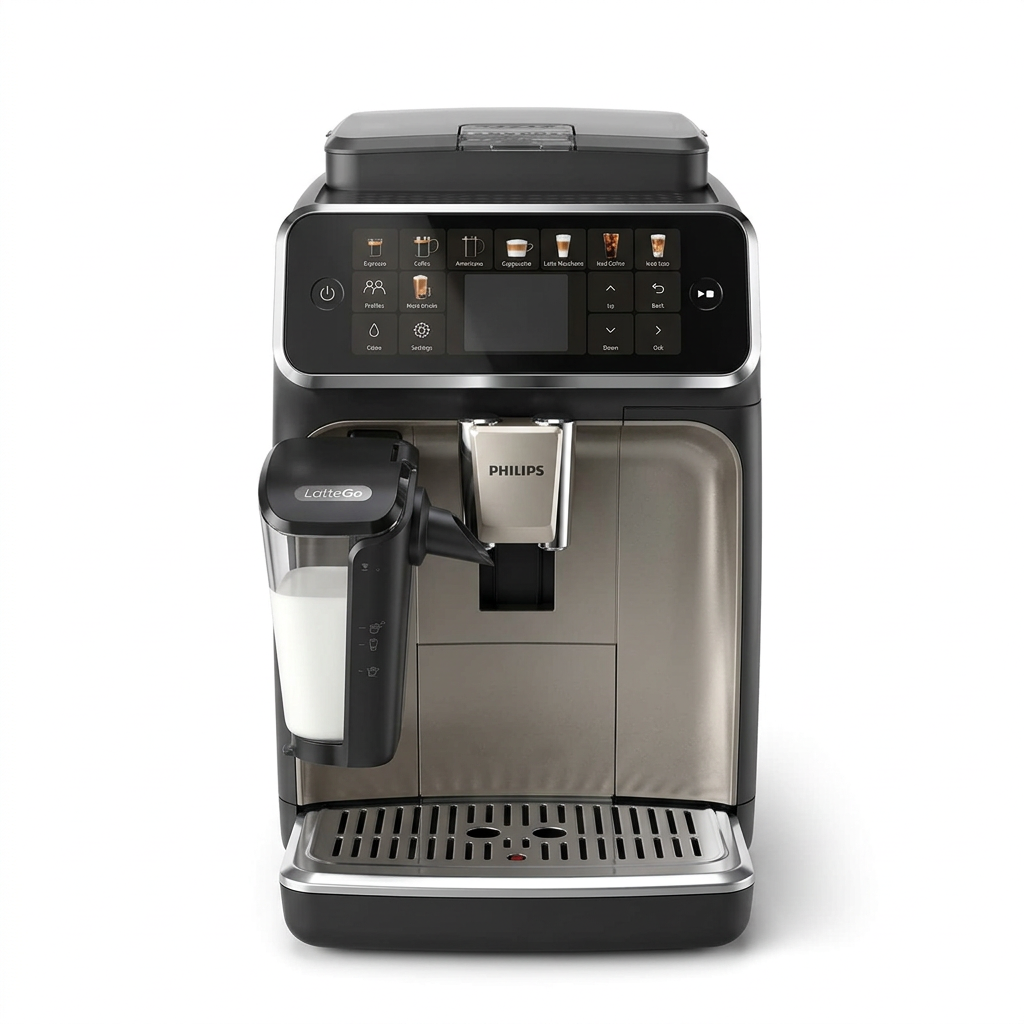
20 hot and iced recipes on a color display, four profiles plus a guest mode, five strength levels with Extra Shot and QuickStart heating.
Reveal Today’s DealPhilips 3300 vs 5500 at a glance
- The coffee in the cup is the same. Both machines grind about 8 grams per cycle through the same ceramic grinder and brew group.
- Buy the 5500 if several people share the machine, or if you want stronger drinks at one touch thanks to Extra Shot.
- Buy the 3300 if you drink a handful of classic milk drinks and want the simplest controls in the range.
- Neither makes true cold brew, but the 5500 has a full iced menu, while the 3300 has one iced coffee setting.
Head to head
The better result in each row is marked, and rows without a mark are a tie or a matter of taste. Figures come from my own measurements and the manufacturer's specifications.
Do not read the tally as my verdict. Almost every 5500 win is about software and convenience, while the parts that actually make your coffee are shared.
| Spec | Philips 3300 | Philips 5500 |
|---|---|---|
| One-touch drinks | 6 | 20 hot and iced ✓ Best |
| User profiles | None | Four plus guest ✓ Best |
| Controls | Backlit touch icons | Color display with buttons ✓ Best |
| Strength levels | 3 | 5, plus Extra Shot ✓ Best |
| Iced recipes | 1, iced coffee | Iced coffee, latte, cappuccino, americano, espresso ✓ Best |
| Warm-up | Heats and rinses on startup | QuickStart, about 20 to 25 sec ✓ Best |
| Eco settings | Auto power-off | Five adjustable settings ✓ Best |
| Milk carafe lid | Sits loose, no latch | Locks on firmly ✓ Best |
| Ease for first-timers | No menus at all ✓ Best | Menus for hot and iced drinks |
| Cup placement | Lines up easily ✓ Best | Cup must sit forward for the milk |
| Espresso at the spoutmeasured, hottest setting | About 185°F ✓ Best | About 176°F |
| Grinder | Ceramic, 12 settings | Ceramic, 12 settings |
| Dose per cycle | About 6 to 8 g | About 6 to 8 g |
| Grinder noisemeasured, lid closed | 61 to 62 dB | 59 to 60 dB |
| Milk system | LatteGo, 260 ml | LatteGo, 260 ml |
| Water tank and hopper | 1.8 L, 275 g | 1.8 L, 275 g |
| Size and weight | 9.7 x 14.6 x 17 in, 17.6 lb | 9.7 x 14.6 x 17 in, 17.6 lb |
| Rows won | 3 | 8 |
Philips 3300 vs 5500 pros and cons
Philips 3300
- Six backlit icons with no menus to scroll through
- Same quiet grinder and 10-second milk clean as the 5500
- The least you can spend on this hardware with LatteGo
- No user profiles, so everyone shares one setting per drink
- Only three coarse strength steps and no Extra Shot
- Milk carafe lid has no latch and can slide off
Philips 5500
- 20 hot and iced recipes on a clear color display
- Four saved profiles plus a guest mode for visitors
- Extra Shot and five strength levels for fuller drinks
- Espresso is no stronger per cycle than on the 3300
- Iced drinks are brewed warm and dilute the ice
- Fixed milk spout means you have to place the cup carefully
Who should buy which machine?
- One or two people who drink the same few milk drinks
- Capsule users who want fresh beans without learning a menu
- Anyone who wants the core hardware and nothing extra
- Families where everyone likes their coffee differently
- People who drink iced lattes and americanos in summer
- Anyone who wants a stronger cup at a single touch
What is identical inside
Before comparing features, it helps to know what you are really choosing between. Open the side panel on either machine, and you will find the same removable brew group✕Brew groupThe removable unit inside an automatic machine that holds, presses and brews the ground coffee., the same grinder and the same pump.
Both use a 15-bar pump, a thermoblock✕ThermoblockA heater that warms water as it flows through, instead of keeping a tank of water hot all day. heater and ceramic burrs✕Ceramic burrsGrinding parts made of ceramic instead of steel. They stay cool and last a long time. with 12 grind settings. Both brew chambers hold about 8 grams of coffee per cycle, and both use the same two-part LatteGo milk carafe.
Even the bodies are the same shell. The water tank, bean hopper, drip tray and grounds bin are the same size and slide out of the same places.
So where does the difference come from? Almost entirely from the software and the front panel: how many drinks you can pick, how finely you can adjust them and who can save their own settings.
That is the lens I used for the rest of this comparison. Whenever the result in the cup changed between the two, I looked for the setting that caused it rather than assuming one machine was simply better.
Design, size and build
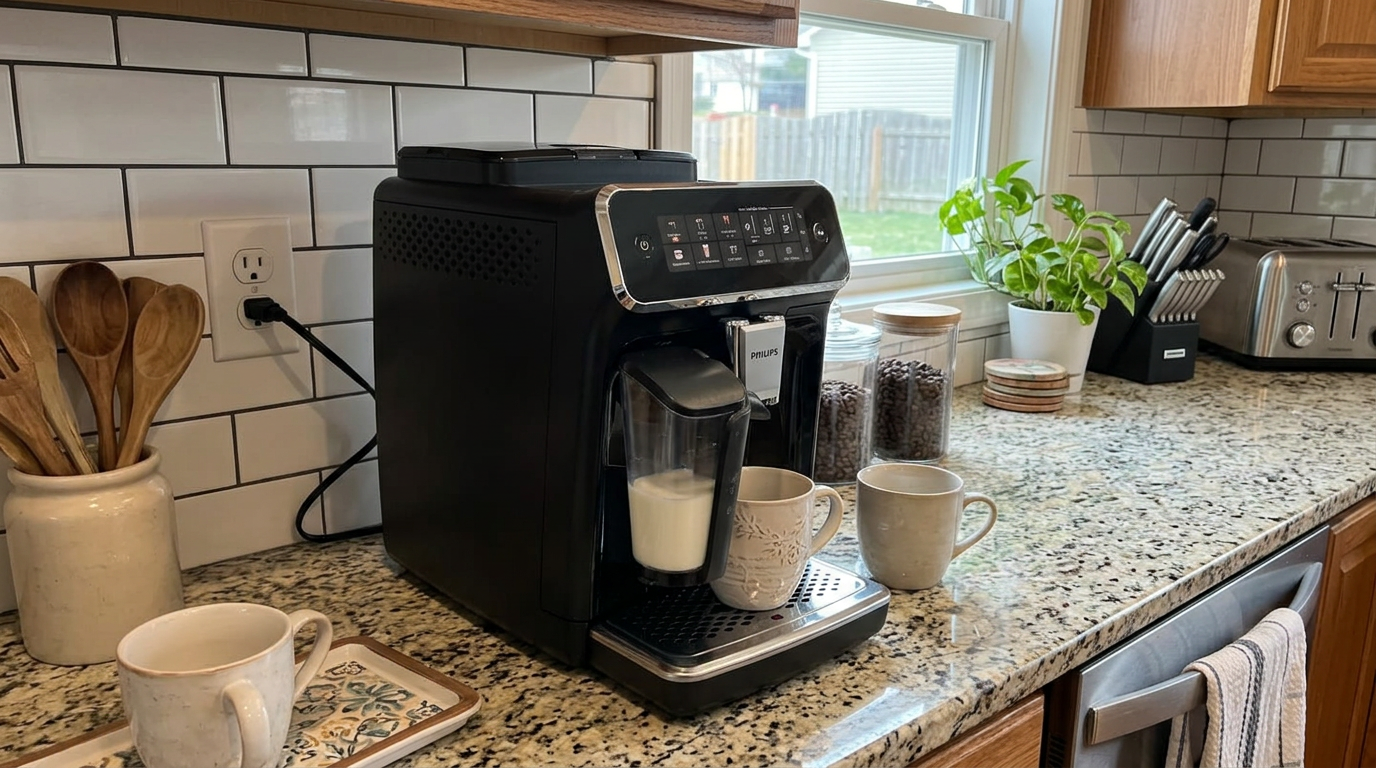
Side by side on my counter, the two machines are the same height, width and depth. Each is about 9.7 inches wide, 14.6 inches deep and 17 inches tall, and each weighs around 17.6 pounds.
The difference is the face. The Philips 3300 has a flat panel of backlit icons, while the 5500 has a color display framed in chrome with soft buttons around it.
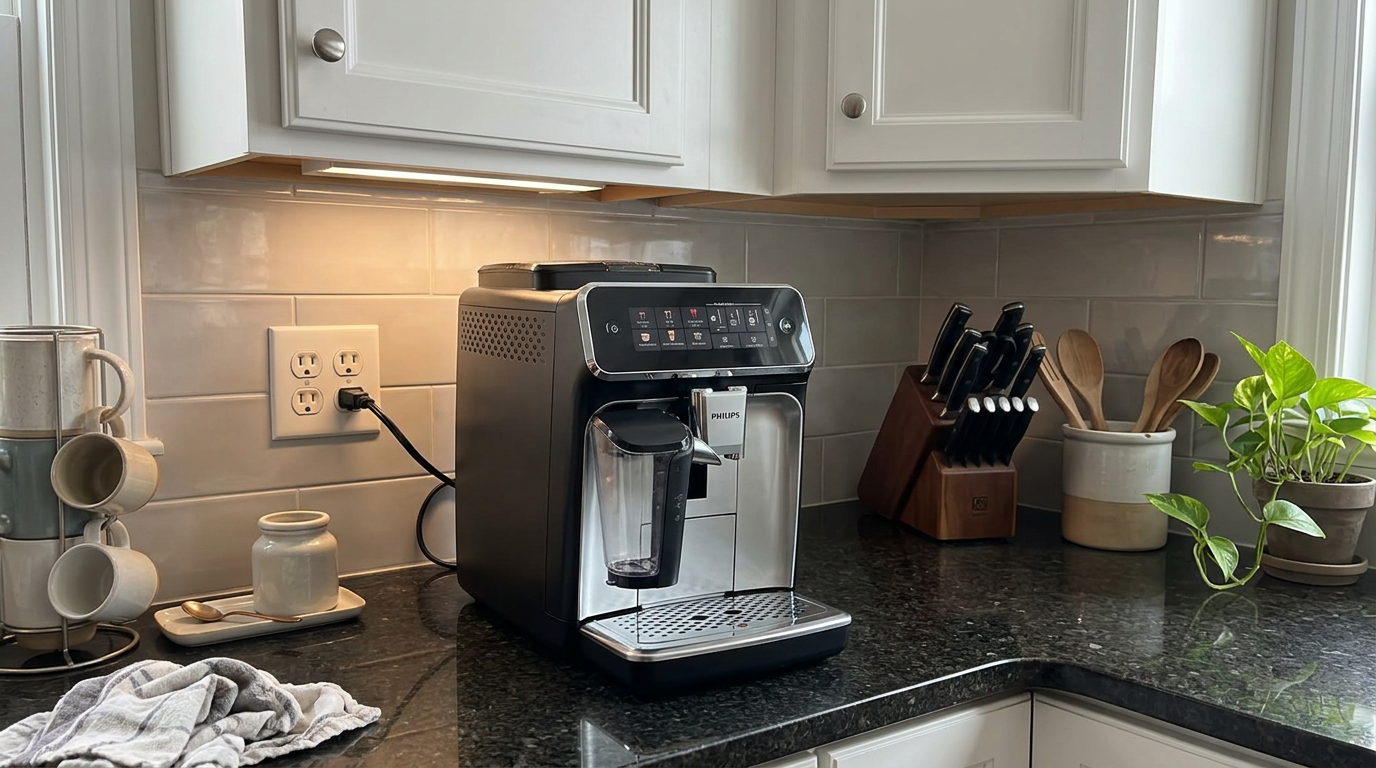
The 3300 is narrow enough to slip into a gap most bean-to-cup machines would not fit.
The 5500 looks a little more expensive up close. The chrome border, darker finishes and stainless drip tray grate give it a more premium feel, although both bodies are mostly molded plastic.
Both share the best design decision in this range. The water tank, drip tray and grounds bin all slide out of the front, so you can push either machine against the wall or into a corner and never turn it around.
Width compared with a typical bean-to-cup machine
The only part that needs headroom on both is the bean hopper. Its lid lifts up, and the grind dial sits inside it, so leave a little space under your wall cabinets.
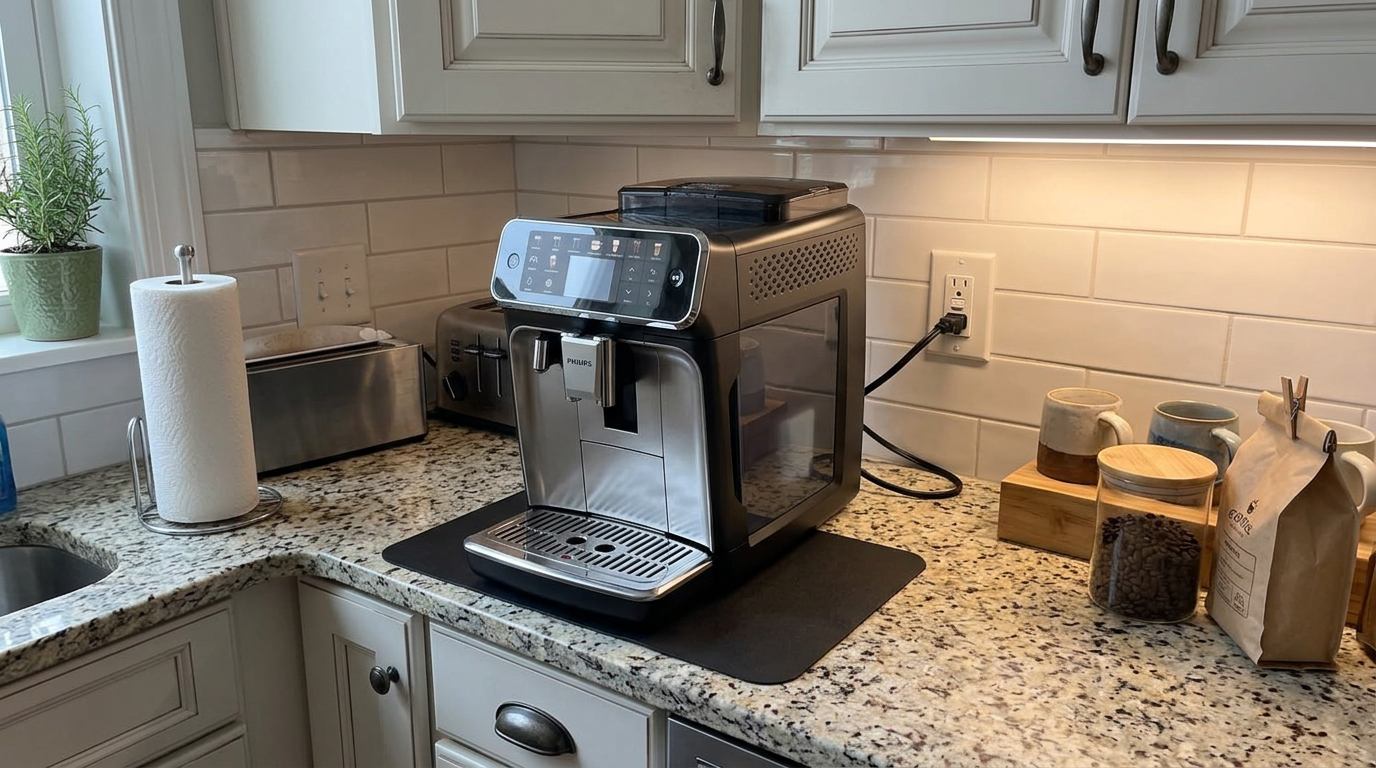
Front-loading parts mean the 5500 can live in a corner without losing access.
Build quality is equal where it counts. On both, the removable water tank has a little flex, and both drip trays have internal baffles that stop water sloshing on the way to the sink.
Our tip: Measure from your counter to the underside of the wall cabinets and add a few centimeters for the hopper lid before you order either machine.
Setup and the first week
Setup took me about ten minutes on each. You rinse the tank, dip the included strip to test your water hardness, fit the AquaClean filter and let the machine prime and rinse itself.
The 5500 walked me through those steps on its color display. On the 3300, a few deeper settings, such as water hardness and temperature, are changed by holding buttons in a sequence, so keep the manual close the first time.
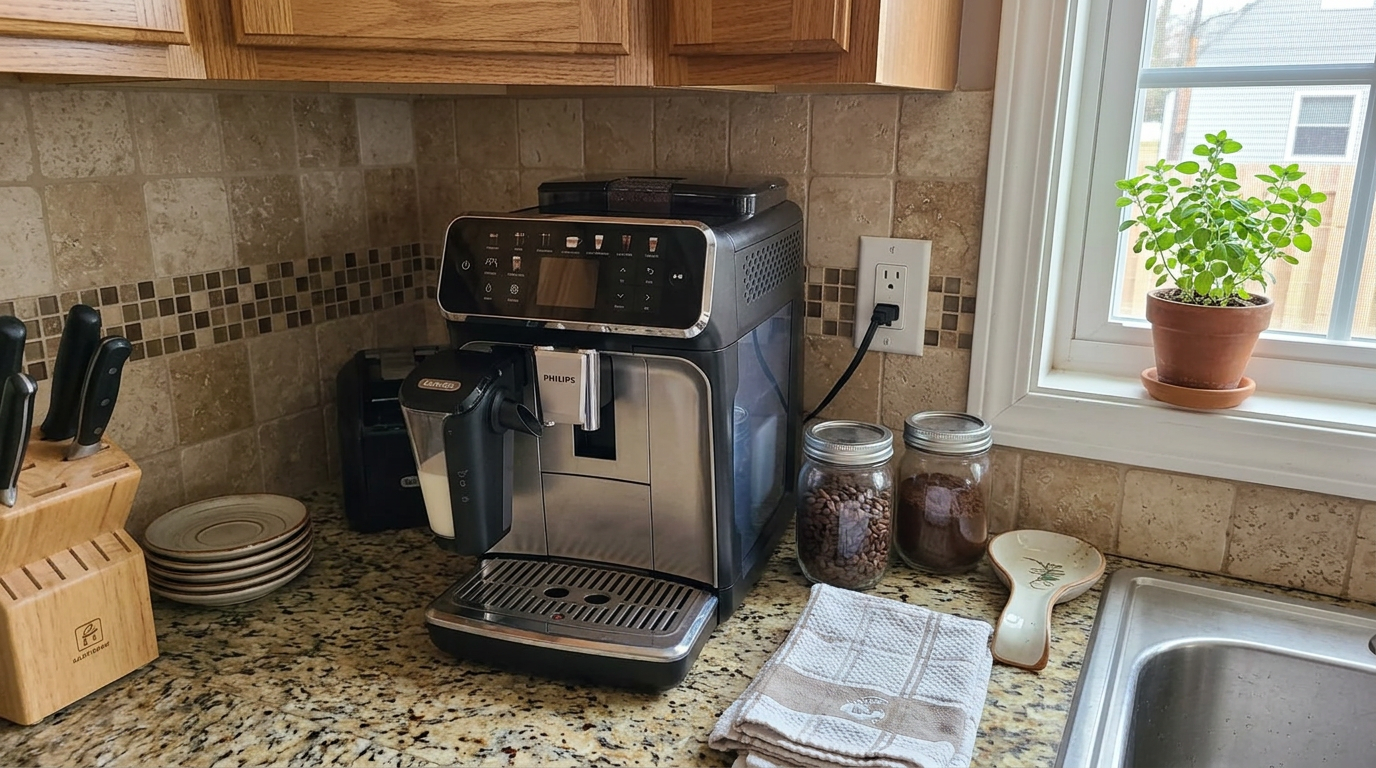
The 5500's display guides you through setup, so there is less to look up.
Both machines also need a break-in period. New ceramic burrs and a fresh brew group took roughly 20 to 30 drinks to settle, and the pucks went from crumbly to firm over that time.
Puck quality during break-in, both machines
My first cups from each were noticeably thinner than the ones I made after a week or two. If you judge either machine on day one, you will judge it too harshly.
Controls and drink menu
This is the clearest difference between the two. The 3300 has six backlit icons for espresso, coffee, cappuccino, latte macchiato, iced coffee and hot water, and nothing else to navigate.
The Philips 5500 puts its favorite drinks on quick buttons around a color display and opens separate menus for hot and iced recipes. In total, it offers 20 drinks.
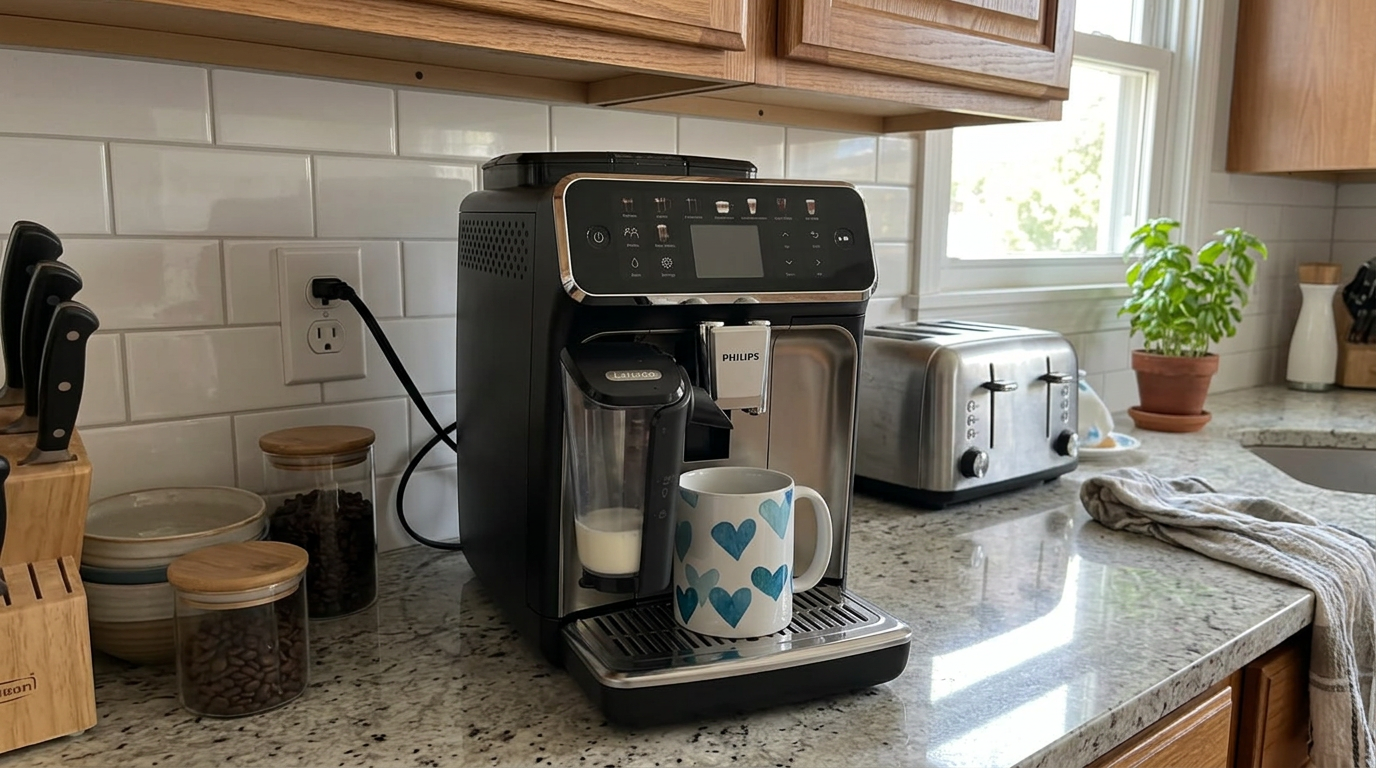
The 5500 uses soft buttons around a color screen, which work fine with wet fingers.
I expected to prefer a touchscreen, but the 5500's buttons were easier with milky fingers at seven in the morning. The 3300's icons are just as reliable and even quicker, because each drink is one press away.
| Drink type | Philips 3300 | Philips 5500 |
|---|---|---|
| Espresso drinks | Espresso | Espresso, ristretto, espresso lungo |
| Long black coffee | Coffee | Coffee, americano, caffè crema |
| Milk drinks | Cappuccino, latte macchiato | Cappuccino, latte macchiato, caffè latte, flat white, café au lait |
| Iced drinks | Iced coffee | Iced coffee, iced latte, iced cappuccino, iced americano, iced espresso |
| Extras | Hot water | Hot water, frothed milk |
| Total one-touch drinks | 6 | 20 |
Look closely at that table and a pattern appears. Many of the extra recipes are variations you could make on the 3300 by changing the volume or adding hot water yourself.
A flat white, for example, is a smaller, stronger latte, and an americano is espresso topped up with hot water. The 5500 saves you the steps, but it does not unlock a new kind of coffee.
Two extras are harder to copy on the 3300. A dedicated frothed milk button is handy for hot chocolate, and the iced latte and iced cappuccino recipes add milk to the iced menu.
One-touch drinks by category
User profiles and personal settings
If I had to name the one feature that justifies the 5500, it would be this. The machine has four color-coded profiles, blue, green, red and yellow, plus a guest profile.
A profile does not just store one favorite drink. It remembers your settings for every recipe, so once I made my cappuccino stronger and smaller, that became my cappuccino from then on.
My partner's profile kept a milder, larger version, and neither of us ever touched the other's settings. Visitors used the guest profile and tweaked drinks without overwriting anything.
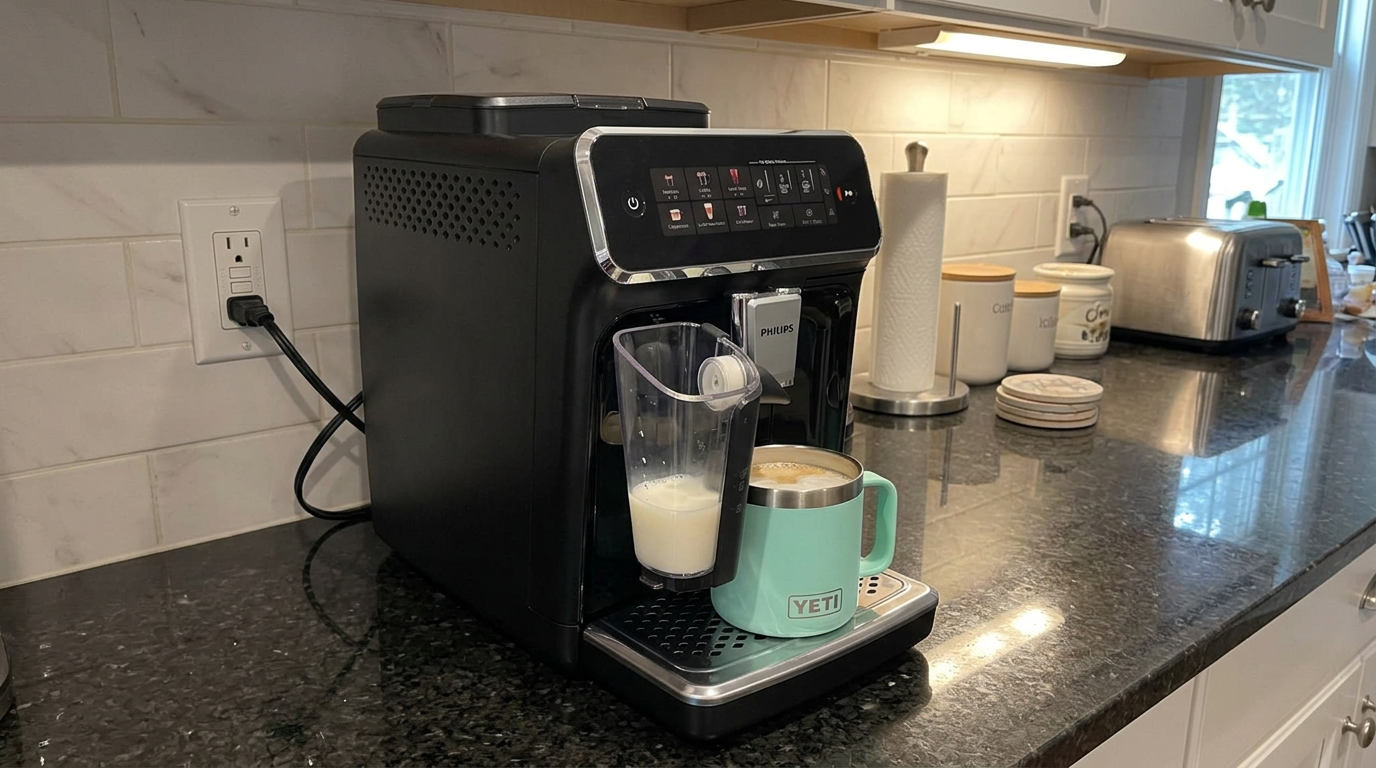
On the 3300, everyone shares one setting per drink, which is fine when tastes are similar.
The 3300 has no profiles at all. You can save a default volume for each drink, but that default belongs to everyone in the house.
In my two-person household, that meant small daily resets. Whoever made coffee second had to change the strength or volume back, and occasionally forgot and got the wrong drink.
| Household | Better fit | Why |
|---|---|---|
| One person | 3300 | Profiles add nothing |
| Two people, same drinks | 3300 | Shared defaults work fine |
| Two people, different tastes | 5500 | No daily resetting |
| Family of three or four | 5500 | One profile per person |
| Frequent guests | 5500 | Guest mode protects your settings |
Our tip: On the 5500, give each person their own color on day one, before anyone starts changing the shared default drinks.
Grinder, strength and Extra Shot
The grinders are the same part. Both use flat ceramic burrs with 12 settings, adjusted with a dial inside the bean hopper, where 1 is the finest and 12 the coarsest.
Both ship in the middle of the range, which I found too coarse. With a medium roast, settings 1 to 3 gave me firmer pucks and more body on the 3300, and two steps finer than the factory setting gave the 5500 a rounder, sweeter shot.
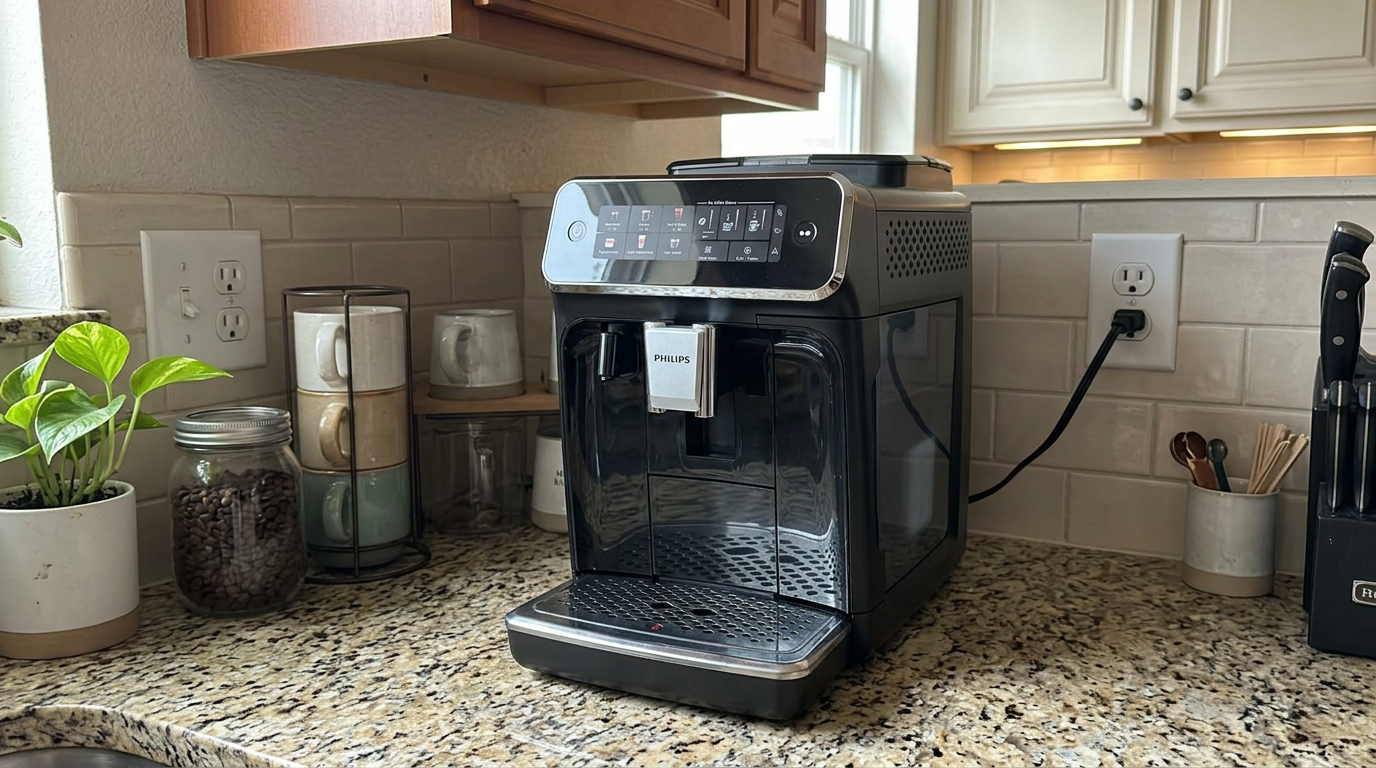
The grind dial sits inside the hopper on both machines, so you open the lid to adjust it.
Strength is where the two part ways. The 3300 has three levels that move the dose✕DoseThe amount of ground coffee used for one drink, measured in grams. between roughly 6 and 8 grams, so the taste difference between them is subtle.
The 5500 has five aroma strength levels across the same small range, plus an Extra Shot option. Extra Shot grinds and brews a second fresh puck✕PuckThe pressed disc of used coffee grounds that the machine ejects after each brew. after your drink, so you get more coffee rather than more water pushed through the same grounds.
Coffee per drink at the strongest setting
The 3300 can reach the same 16 grams, but you have to work for it. You use the double function or run two single espresso cycles into the same cup, which does not work as neatly for a milk drink.
That is why my espresso and milk scores ended up higher on the 5500 even though the hardware is identical. It is not making better coffee per gram, it is just much easier to put more grams in the cup.
| What you taste | Likely cause | First change on either machine |
|---|---|---|
| Sour, sharp, thin | Under-extraction | Grind one step finer |
| Bitter, harsh, drying | Over-extraction | Grind coarser or lower the volume |
| Watery even at max strength | Dose too low | Extra Shot on the 5500, a double on the 3300 |
| Coffee drips very slowly | Grind too fine | Grind one step coarser |
| Wet, sloppy pucks | Grind too coarse, or still breaking in | Grind finer and give it more cups |
One rule applies to both. Only turn the grind dial while the grinder is running, because turning it while the burrs are still can force them against trapped beans.
Our tip: After any grind change, brew two or three drinks before judging it, because coffee from the old setting is still in the grinder path.
Espresso quality
With the same beans and the same grind, the two machines poured espresso I could not tell apart. Both were clean and balanced, with a moderate crema✕CremaThe golden-brown foam on top of a fresh espresso, made of oils and gases released during brewing. and none of the burnt bitterness I have had from cheaper automatic machines.
Both were also lighter in body than a café shot. To put a number on that, I measured TDS✕TDSTotal dissolved solids: the percentage of your drink that is dissolved coffee. Higher means stronger and denser. with a refractometer✕RefractometerA small meter that reads how much coffee is dissolved in a drink by measuring how light bends through it..
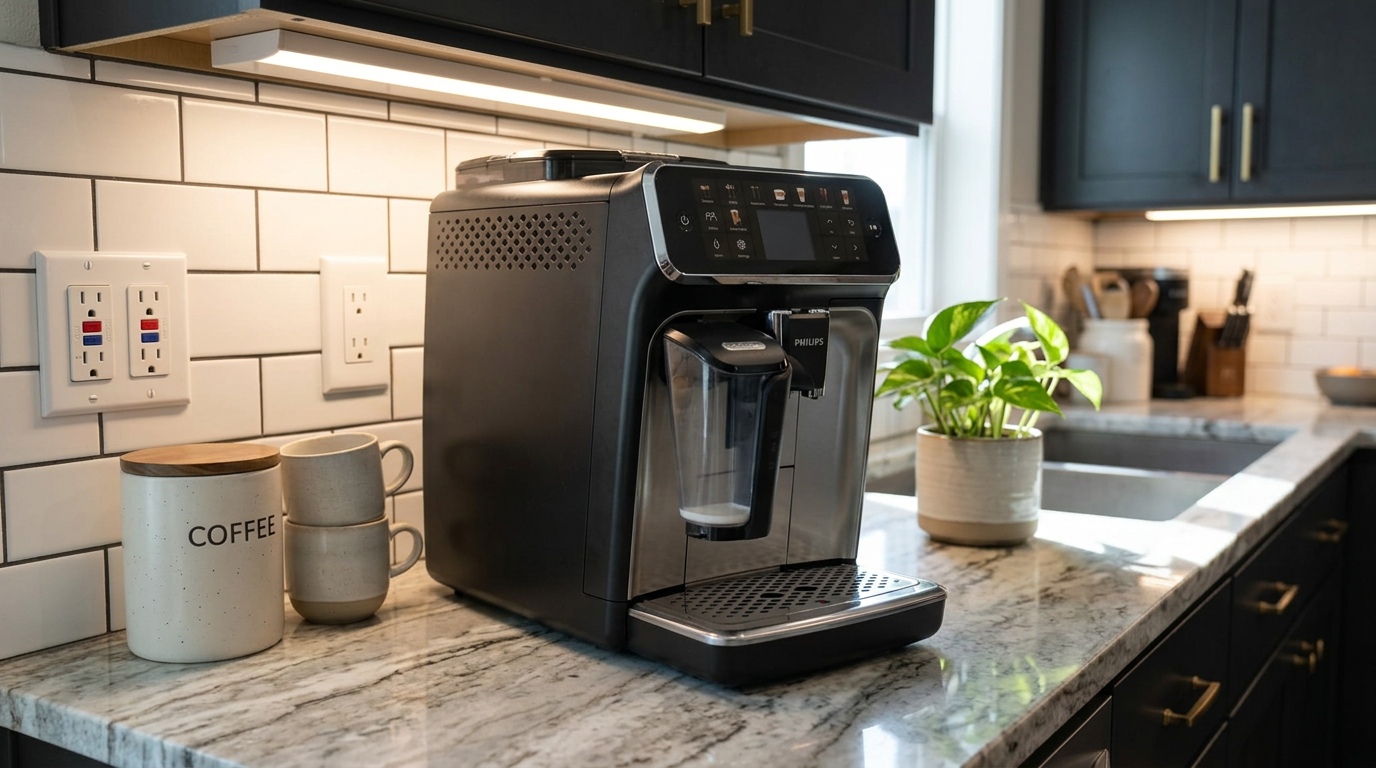
The 5500's espresso matched the 3300 shot for shot until I switched on Extra Shot.
Single espressos from both machines landed between 4.5% and 5.5% TDS at fine grind settings. A traditional espresso machine with a separate grinder usually reaches somewhere between 8% and 12%.
Espresso strength (TDS)
The cause is physical. An 8-gram puck is shallow, and water passes through it quickly, so a single cycle tastes closer to a strong short coffee than a syrupy espresso.
Under milk, that matters much less than you would think. With a fine grind and the highest strength, both made cappuccinos with enough coffee flavor to cut through the foam.
The difference showed up when I wanted more. On the 5500, I tapped Extra Shot and got a fuller espresso or latte in one go, while on the 3300 I had to plan a double.
For long black coffee, both machines behaved the same way. The largest Coffee setting pushes a lot of water through one small puck and turns thin and flat.
Find Out the Price TodayHeating, warm-up and temperature
Both machines heat water on demand with the same thermoblock, so neither keeps a boiler hot all day. What differs is how they start.
The 5500 has QuickStart. In my testing it went from power-on to ready in about 20 to 25 seconds, and it skips the hot-water rinse on startup, so you do not begin each morning with rinse water in the drip tray.
The 3300 heats and runs a short rinse every time you switch it on. It is still quick, but I usually had a cup of rinse water to tip away first, and the drip tray filled a little faster.
| Measured output | Philips 3300 | Philips 5500 |
|---|---|---|
| Espresso at the spout | About 185°F (85°C) | About 176°F (80°C) |
| Coffee for milk drinks | 183 to 185°F | Warm, best in a preheated cup |
| Frothed milk | Warm, not scalded | About 167°F (75°C) |
| Hot water spout | 170 to 194°F | Hot enough for black tea |
| Startup rinse | Yes | No, only on switch-off |
| Rated power | 1,500 W | 1,500 W |
My 5500 measured a few degrees cooler at the spout on its hottest setting. That surprised me, given the shared heater, and I suspect QuickStart heats to the recipe rather than to a fixed temperature.
Espresso temperature at the spout
Both readings are below the 194 to 201°F range often recommended for brewing water, though some heat is lost between the brew group and the cup. If you like your coffee very hot, choose the highest of the temperature settings on either machine.
Our tip: Run a splash of hot water into your cup and tip it out before brewing, so a cold mug does not steal heat from a small espresso.
Milk drinks with LatteGo
Both machines use the LatteGo carafe, and it is the reason many people choose Philips in the first place. It is just two molded parts that snap together, with no tubes, hoses or hidden channels.
Milk is drawn into a small cyclonic chamber in the carafe itself, whipped with steam and air and poured straight into your cup. Because it never travels through the body of the machine, there is nothing inside for old milk to sour in.
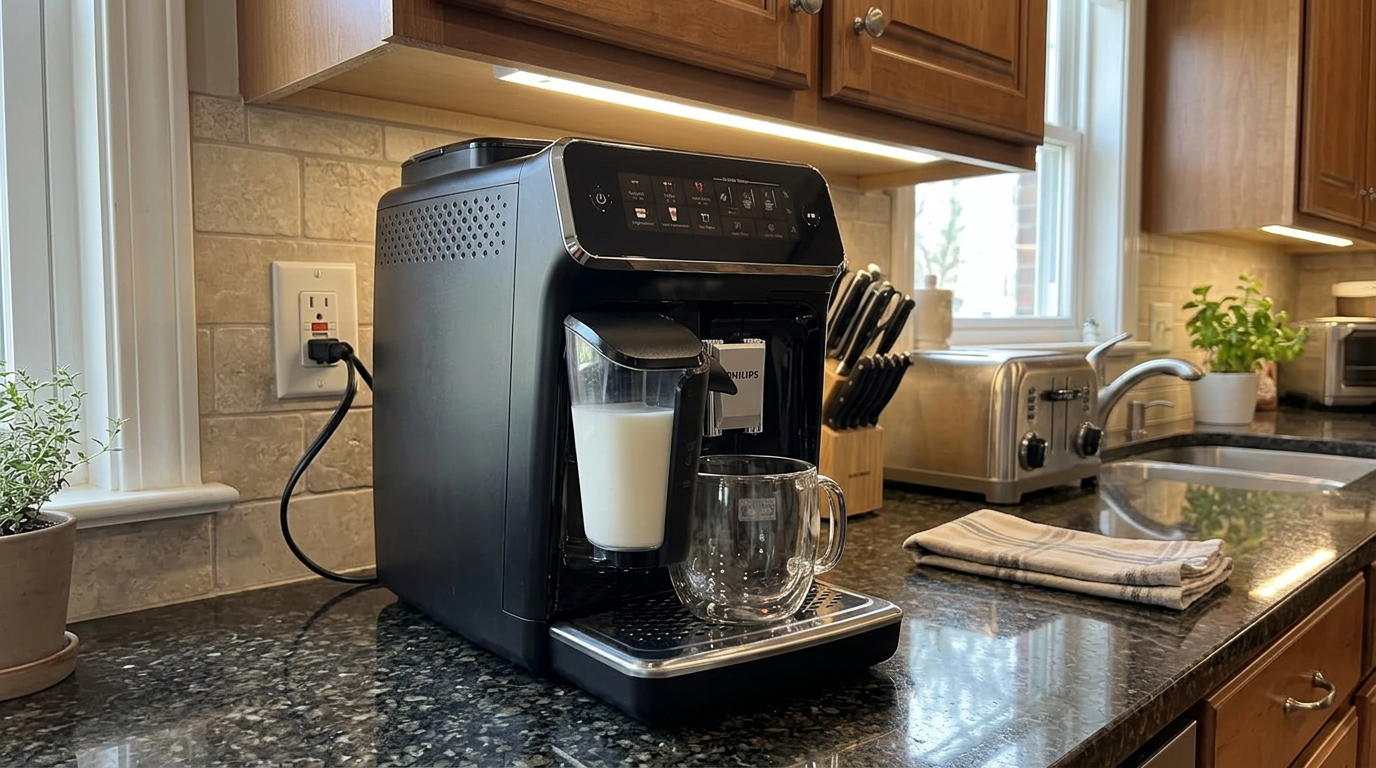
The foam from both carafes is dense and generous, ideal for a tall cappuccino.
The foam was dense, stiff and generous on both. That is exactly right for a classic cappuccino with a spoonable cap or a layered latte macchiato, and both handled barista-style oat milk well.
What neither makes is the glossy, silky microfoam✕MicrofoamMilk with tiny, even bubbles that feels silky and pours well enough for latte art. you need for latte art. The bubbles are a little coarser, and the foam sits on the milk rather than blending into it.
The 5500's carafe has a few small upgrades. Its lid locks on firmly, while the 3300's lid sits loose and slid off twice when I picked the carafe up by its body.
The 5500 carafe also has fill lines for one or two drinks, and you fill it while it is attached to the machine. That felt odd at first, but it meant pouring exactly what I needed and no carrying a full jug across the kitchen.
Milk results out of 10
The 5500 scored higher on milk drinks because of choice and control, not foam quality. It has a flat white, a caffè latte, a café au lait and a frothed milk button, and you can set coffee and milk volumes separately and save them to your profile.
It has one quirk the 3300 avoided in my kitchen. Its milk spout is fixed, so my cup had to sit further forward on the drip tray than I expected, or the milk caught the rim of narrow glasses.
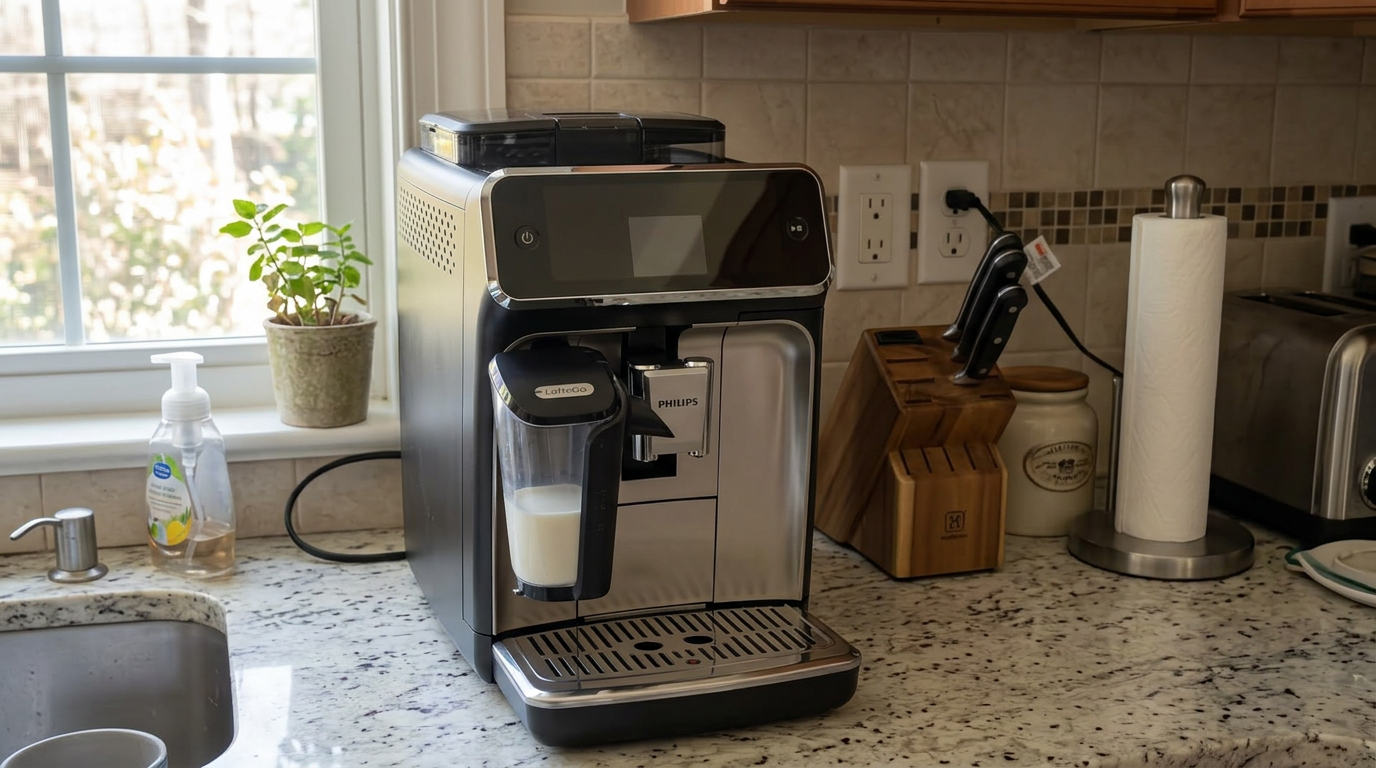
On the 5500, line the glass up just in front of the coffee spout so the milk lands in the middle.
The 260 ml carafe is the same size on both. That is enough for about two cappuccinos or one large latte macchiato before you top it up.
Our tip: Use milk straight from the fridge in either carafe, because cold milk builds firmer, longer-lasting foam.
See How Much You’ll SaveIced coffee and cold drinks
The iced menu is one of the headline differences. The 3300 has a single iced coffee icon, while the 5500 offers iced coffee, iced latte, iced cappuccino, iced americano and iced espresso.
It is important to understand how both work, because neither machine chills anything. The thermoblock still heats the water, but the pump slows down and brews a concentrated coffee at a lower temperature, around 140°F on the 5500.
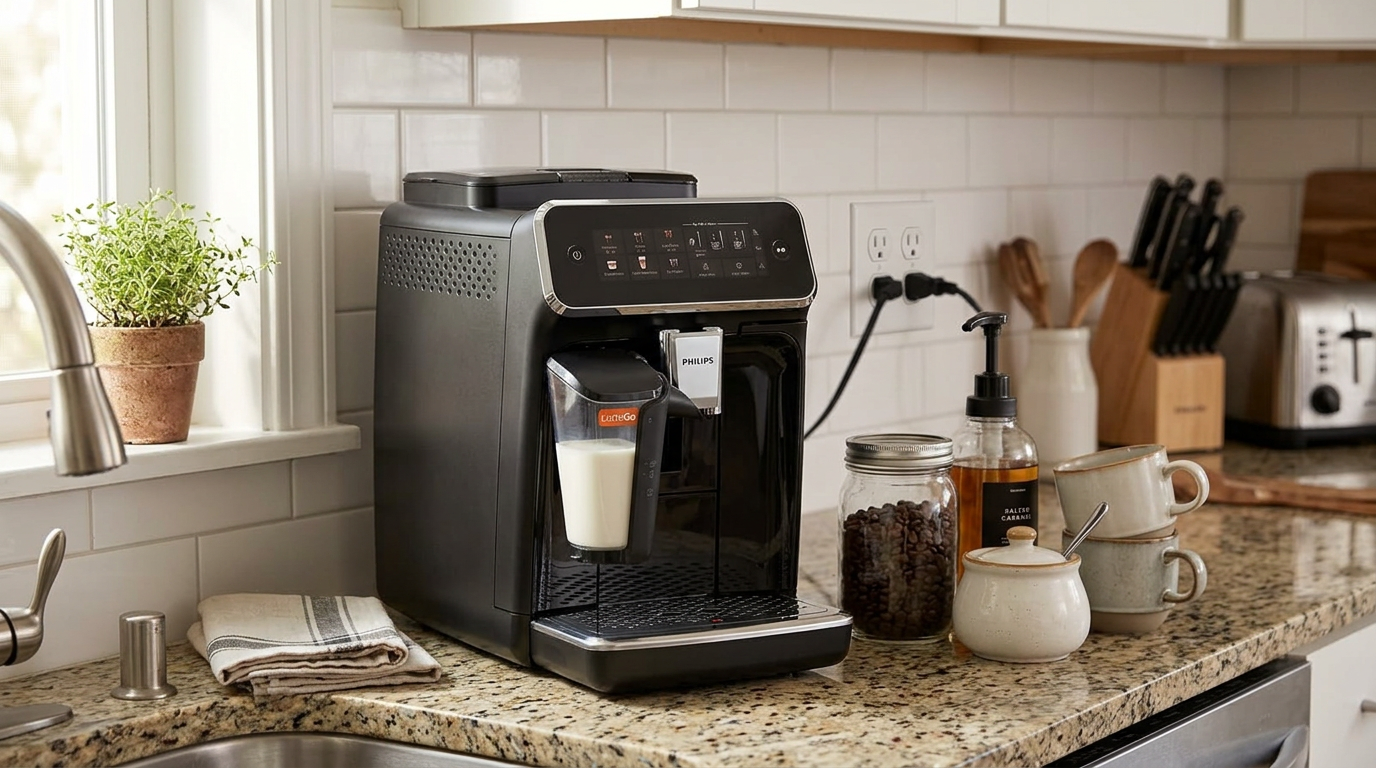
The 3300's single iced coffee setting covers the basics for an occasional summer drink.
That warm coffee then pours onto ice that you have already put in the glass. It cools almost instantly, but it also melts some of the ice, so the drink ends up slightly diluted.
On the 5500, the iced latte and iced cappuccino suffered most, because the meltwater thins the milk as well as the coffee. Cold milk also foams less, so the iced cappuccino had a thinner cap than the hot one.
| Cold drink | Philips 3300 | Philips 5500 |
|---|---|---|
| Iced coffee | Yes | Yes |
| Iced americano and iced espresso | By hand | One touch |
| Iced latte and iced cappuccino | No | One touch, with cold-frothed milk |
| Tells you how much ice to add | No | Yes |
| True cold brew | No | No |
The iced americano and iced espresso held up best on the 5500, since they are meant to be lighter anyway. With maximum strength and Extra Shot switched on, my iced lattes kept their coffee flavor to the bottom of the glass.
How cold the drink got, by amount of ice
On both machines, the amount of ice made the biggest difference. Large cubes melted more slowly than small ones, and a full glass cooled the coffee without watering it down too much.
If you drink smooth cold brew every day, neither machine replaces it. If you want a quick iced coffee on a warm afternoon, both do the job, and the 5500 gives you far more choice.
Noise
Both machines have the same SilentBrew hopper lid, and both are among the quietest fully automatic machines I have measured. A thick rubber gasket seals the grinder compartment and absorbs most of the high-pitched whine.
Philips says the design makes these machines 40% quieter than its earlier models, and both carry an independent quiet certification. My decibel✕Decibels (dB)A measure of loudness. Every 10 dB increase sounds roughly twice as loud to most people. meter agreed that the lid does the heavy lifting.
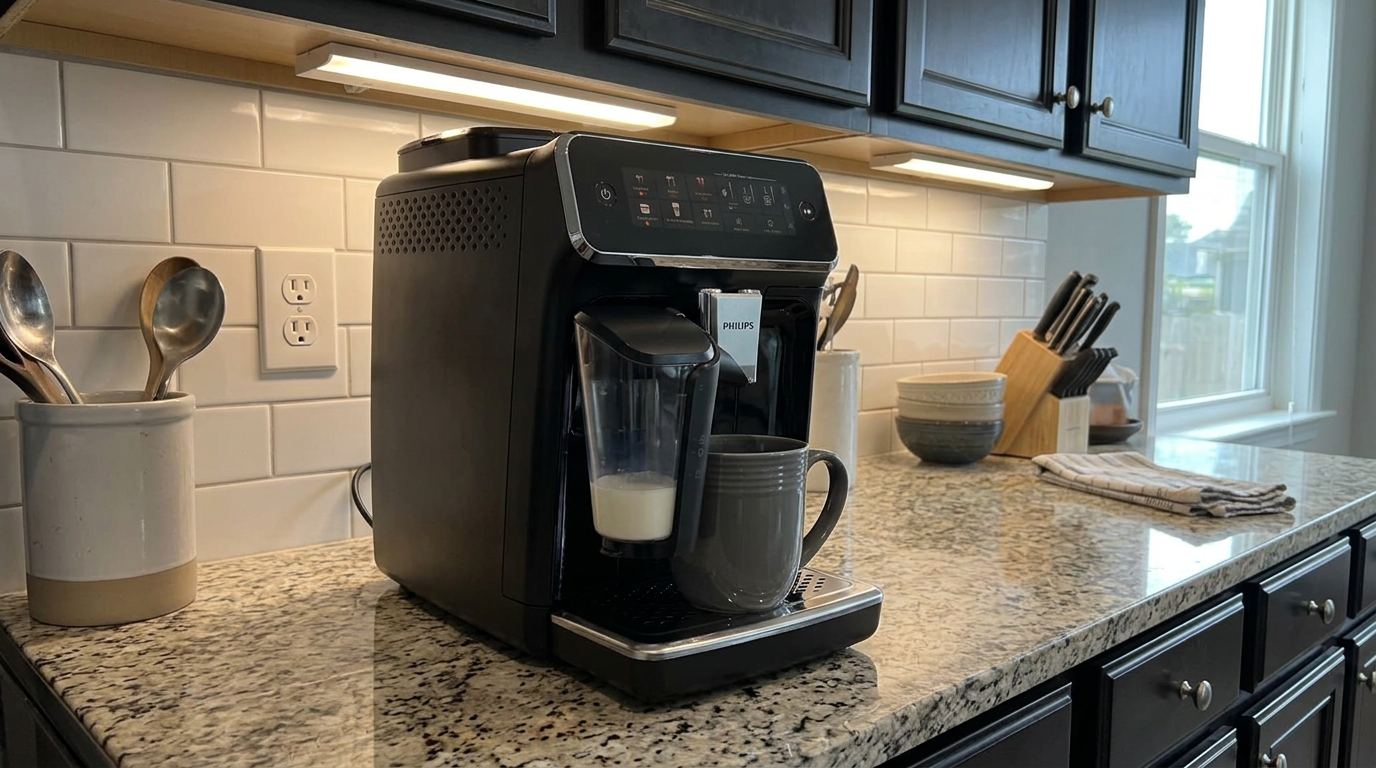
With the lid shut, both grinders are a low rumble rather than a whine.
With the lid closed, the 3300's grinder peaked at 61 to 62 dB and the 5500's at 59 to 60 dB. With the lid removed, both jumped above 70 dB.
Measured peak noise at about 1 meter
A two-decibel gap is at the edge of what most people can hear, and I could not tell the grinders apart by ear. The pump was the loudest part on both, a steady buzz that only lasts as long as the brew.
For context, around 60 dB is about the level of normal conversation. I made coffee at 6 a.m. on both machines with a child asleep in the next room, and nobody woke up.
Our tip: Press the hopper lid down firmly after every refill, because a lid left slightly open undoes most of the noise reduction on both machines.
Cleaning and upkeep
Cleaning is where these two shine, and they shine equally. My daily routine on either machine took less than a minute, and the milk carafe was the star.
I timed myself separating, rinsing and refitting the LatteGo carafe, and it took under 10 seconds on both. The two parts are dishwasher safe, so I put them in once a day after the last drink.
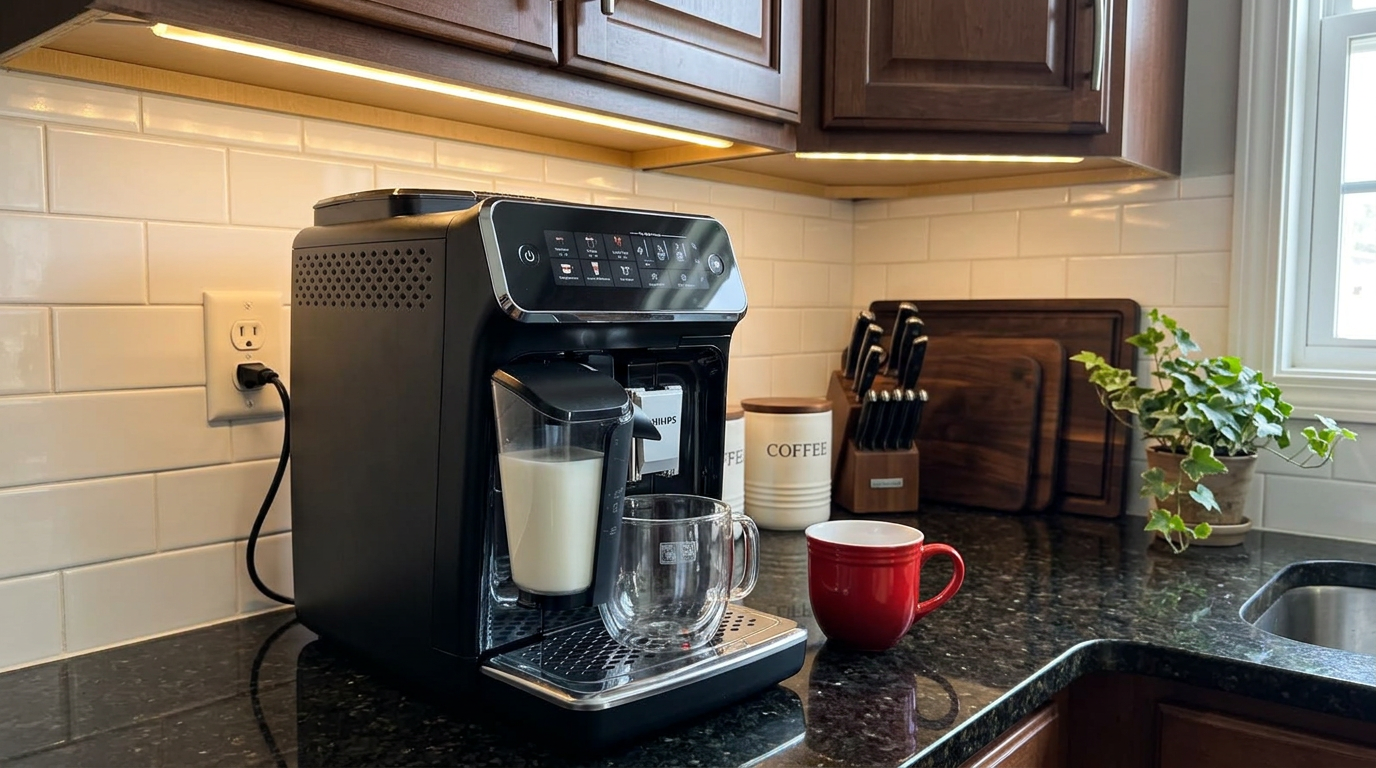
Everything you empty daily slides out of the front on both machines.
The drip tray and grounds bin are the same on both, too. A small indicator pops up through the drip tray cover when it is full, and the grounds bin holds about 12 pucks before the machine asks you to empty it.
The weekly job is identical. You open the side panel, squeeze the tabs on the brew group, slide it out and rinse it under warm water, then let it dry before refitting it.
Time I spent on cleaning per week
The only practical difference is the 5500's rinse habit. Because it rinses on switch-off rather than on startup, its drip tray filled a little more slowly in my kitchen.
Do not wait for either machine to tell you the grounds bin is full. Warm, damp pucks in a closed space can start to grow mold within a few days.
Water, filters and descaling
Scale is the slow killer of automatic coffee machines. Minerals in hard water build up inside the heater and narrow the water paths, which lowers temperature and flow over time.
Both machines use the AquaClean filter, which sits inside the 1.8-liter water tank. Philips says that if you replace it whenever the machine asks, you can go up to 5,000 cups without descaling✕DescalingRunning a cleaning solution through the machine to dissolve mineral build-up from hard water..
Each filter lasts roughly 500 to 600 cups, or about three months in a typical home. Without a filter, both machines prompt you to descale based on the water hardness you entered during setup.
Cups between descaling
The descaling routine takes about 30 to 40 minutes on either machine with a standard descaling solution. Vinegar is a bad idea, because it can damage seals and is not effective enough on its own.
The filter takes up a little room in the tank, so the usable volume is slightly under 1.8 liters on both. For two or three people, I never found that limiting.
Our tip: Write the date on the filter box when you fit a new one, so you know roughly when the next one is due.
Beans per bag and everyday running
Because the dose is the same, a bag of beans lasts the same on both machines. A 250-gram bag makes about 31 single drinks at roughly 8 grams each.
Extra Shot changes that on the 5500. If you switch it on for every drink, you use about 16 grams per cup and get roughly 15 drinks per bag, the same as brewing doubles on the 3300.
Drinks from a 250 g bag of beans
Energy use is close as well. Both draw 1,500 watts while heating, and both switch to standby on their own, but the 5500 adds five eco settings.
Those let you dim the display and cup light, shorten the time before standby, reduce rinse water and set the auto power-off timer. It is a small saving per day, but it adds up over years of use.
Bean choice matters on both. Very oily, shiny dark roasts can stick to the hopper walls and clog the grinder over time, so medium roasts and dry dark roasts are the sweet spot.
Real-life scenarios: which machine fits your home?
Spec sheets only get you so far, so it helps to picture a normal week with each machine. These are the moments where the choice became obvious for me.
Set it once, press one icon, rinse the carafe. The extra recipes on the 5500 would sit unused.
Each person taps their own color, and nobody has to reset strength, size or milk before their coffee.
The iced menu adds cold-frothed milk and tells you how much ice to use, which the 3300 cannot do.
Six icons feel familiar straight away, and there is no menu to learn before the first good drink.
Extra Shot adds a second fresh puck at one touch, while the 3300 needs a planned double.
Visitors managed both machines without asking, and the 5500's guest mode keeps your settings safe.
What each machine asks of you
Neither machine has a real learning curve. You never tamp, weigh or steam by hand, and both made a drinkable coffee within the first few attempts.
The 3300 asks you to accept a few compromises, such as coarse strength steps and shared settings. The 5500 asks for a few minutes exploring menus, and a little care with cup placement under the fixed milk spout.
My scorecard
These are my own scores out of 10, based on weeks of daily use and the measurements above. They are a judgment call rather than a lab result, but they show where the extra features pull the 5500 ahead and where the two are level.
Philips 3300
Philips 5500
Overall, I rate the Philips 5500 8.5 and the Philips 3300 8.4. That narrow gap tells you this is a decision about your household, not about one machine making better coffee.
Which one is right for you?
4 quick questionsWhich one should you buy?
It comes down to one question: how many people, and how many different drinks, does your machine need to serve? The coffee itself will not decide it, because the parts that make it are the same.
If you are one or two people with a settled routine, the 3300 gives you everything that matters. If your kitchen has several coffee drinkers, the 5500's profiles and Extra Shot remove small frictions every single day.
- You drink a few classic milk drinks
- One or two people share similar tastes
- You want the simplest controls possible
- You only make iced coffee now and then
- Several people want their own saved drinks
- You want stronger drinks at one touch
- You want iced lattes and cappuccinos
- Three or four people use the machine
- You like trying different drinks
- You want Extra Shot for fuller lattes
- Iced drinks are part of your summer
- You expect stronger espresso per cycle
- You want true cold brew
- You would never use profiles or menus
Pick the Philips 3300 for the same coffee, the same quiet grinder and the same easy cleanup with six simple icons. Pick the Philips 5500 for saved profiles, Extra Shot and 20 hot and iced drinks.
My pick is the Philips 5500 for most households. Its profiles, five strength levels and Extra Shot make the same hardware easier to share and easier to get a stronger cup from.
The Philips 3300 is still the smarter buy if it is mostly you at the machine. You get the same grinder, the same quiet lid and the same 10-second milk clean, without paying for menus you will not open.
Whichever you choose, grind finer than the factory setting, fit the water filter and give it a couple of weeks to break in.
Philips 3300 vs 5500 specifications
From manufacturer specifications and my own measurements. Checked November 11, 2026.
| Philips 3300 | Philips 5500 | |
|---|---|---|
| Type | Fully automatic | Fully automatic |
| Pump pressure | 15 bar | 15 bar |
| Heating | Thermoblock | Thermoblock with QuickStart |
| Grinder | Ceramic, 12 settings | Ceramic, 12 settings |
| Dose per cycle | About 6 to 8 g | About 6 to 8 g |
| Strength levels | 3 | 5, plus Extra Shot |
| One-touch drinks | 6 | 20 hot and iced |
| User profiles | None | 4 plus guest |
| Display | Backlit touch icons | Color TFT display with buttons |
| Milk system | LatteGo, 260 ml | LatteGo, 260 ml, locking lid |
| Water tank | 61 oz (1.8 L), front | 61 oz (1.8 L), front |
| Bean hopper | 9.7 oz (275 g), sealed lid | 9.7 oz (275 g), sealed lid |
| Grounds container | About 12 pucks | About 12 pucks |
| Pre-ground option | Yes, one scoop | Yes, one scoop |
| Water filter | AquaClean | AquaClean |
| Noise (measured) | 61 to 62 dB grinding | 59 to 60 dB grinding |
| Eco settings | Auto power-off | Five settings |
| Power | 1,500 W | 1,500 W |
| Dimensions | 9.7 x 14.6 x 17 in | 9.7 x 14.6 x 17 in |
| Weight | 17.6 lb | 17.6 lb |
How I tested and compared them
I used each machine as my main coffee maker for several weeks, making espresso, long coffee, cappuccinos, latte macchiatos and iced drinks. On the 5500, I also worked through the flat white, americano and the full iced menu.
I tested the grind range with the same medium roast on both, tracked the break-in period and measured strength with a refractometer. I took temperatures at the spouts and measured noise with a decibel meter at about one meter, with the hopper lid on and off.
I timed the daily and weekly cleaning, including the brew group and the LatteGo carafe, and tested whole milk, skimmed milk and barista oat milk. I then compared my notes with the manufacturer's specifications and general espresso brewing guidance.
- Coffee: dose, crema, strength and consistency.
- Milk: foam texture, temperature and plant milk results.
- Workflow: controls, menus, profiles and warm-up.
- Ownership: noise, cleaning, water care and footprint.
Philips 3300 vs 5500 FAQ
Is the Philips 5500 better than the Philips 3300?
For shared households, yes. It adds 20 hot and iced recipes, four user profiles plus a guest mode, five strength levels and Extra Shot. The coffee hardware is the same, so the 3300 is just as good if you only need a few drinks.
Does the Philips 5500 make better espresso?
Not per cycle. Both use the same ceramic grinder and an 8-gram brew chamber, and both measured 4.5% to 5.5% TDS in my testing. The 5500's Extra Shot makes it easier to get a stronger drink at one touch.
Are the Philips 3300 and 5500 the same size?
Yes. Both measure about 9.7 x 14.6 x 17 inches and weigh about 17.6 pounds, and both load the water tank, drip tray and grounds bin from the front.
Which is quieter?
They are almost identical. Both use the gasket-sealed SilentBrew lid, and I measured 61 to 62 dB on the 3300 and 59 to 60 dB on the 5500 while grinding, a gap I could not hear.
Do both use the same milk carafe?
Both use the two-part LatteGo carafe with no tubes, and both rinse clean in about 10 seconds. The 5500's version has a lid that locks on and fill lines for one or two drinks.
Can either machine make cold brew?
No. Both brew warm, concentrated coffee to pour over ice. The 3300 has one iced coffee setting, while the 5500 has five iced recipes, including iced lattes with cold-frothed milk.
Does the Philips 3300 have user profiles?
No. You can change and save drink settings, but they are shared by everyone. The 5500 has four color-coded profiles plus a guest profile.
What is Extra Shot on the Philips 5500?
It grinds and brews a second fresh puck after your drink, roughly doubling the coffee to about 16 grams. It is the easiest way to get a stronger latte or espresso from the 5500.
Which heats up faster?
The 5500. Its QuickStart function had it ready in about 20 to 25 seconds in my testing and skips the startup rinse. The 3300 heats and rinses each time you switch it on.
How often do I need to descale?
It depends on your water. With the AquaClean filter replaced when prompted, Philips claims up to 5,000 cups between descales on both machines.

- Our hands-on Philips 3300 review
- Our hands-on Philips 5500 review
- Philips product specifications and user manuals
- General espresso brewing, water and maintenance guidance
- Comparison published.