Philips 3300 review: quiet grinding, a 10-second milk clean and a lighter shot
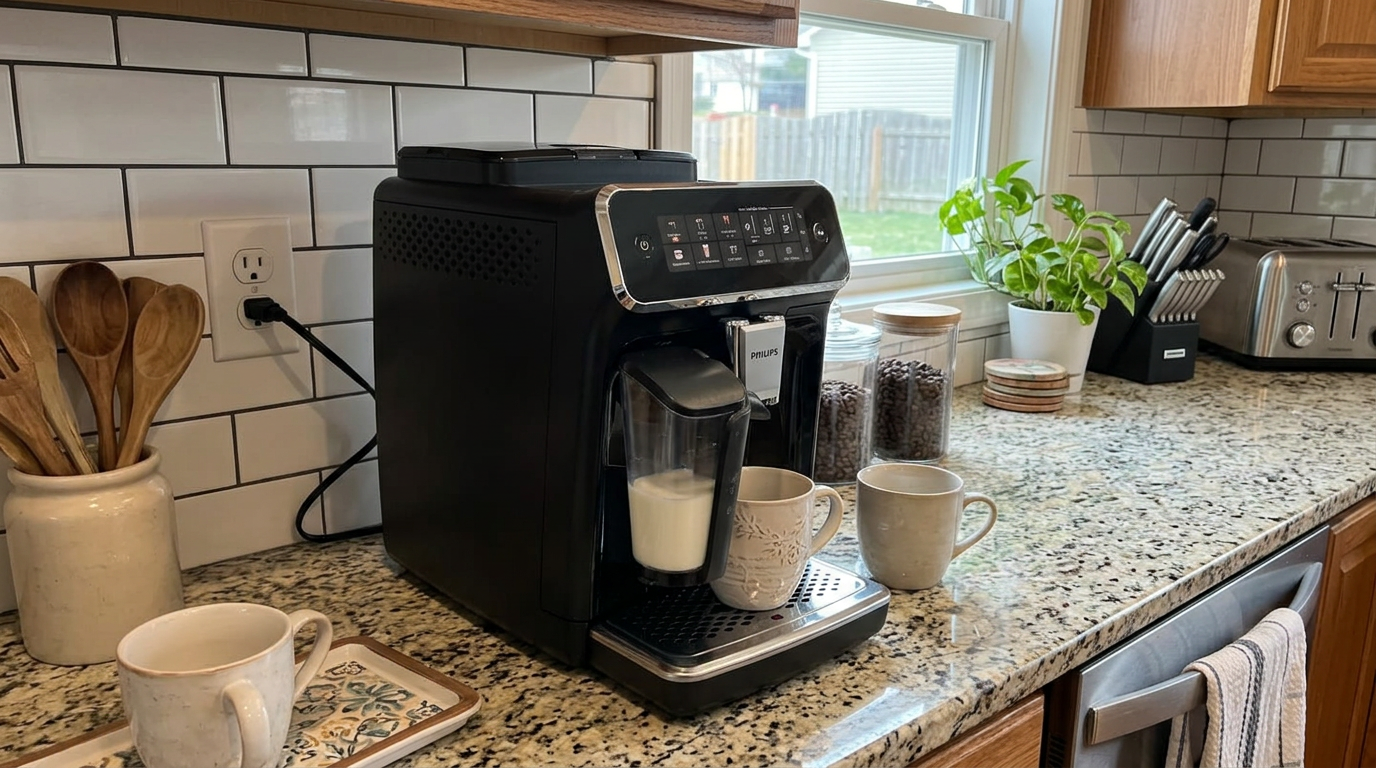
The Philips 3300 Series Fully Automatic Espresso Machine grinds, brews and froths at the touch of an icon, and it does it more quietly than I expected. It made my mornings faster and my cleanup almost effortless, though its espresso is milder than a café shot unless you double up.
In this review
Yes, if you want fresh-bean coffee and milk drinks with almost no effort and almost no cleanup. The Philips 3300 Series is one of the quietest fully automatic machines I've used, and its two-part milk carafe rinses clean in seconds. The trade-off is strength: a single cycle uses about 8 grams of coffee, so the espresso is lighter than a café shot unless you brew a double. For anyone moving up from capsules, it's an easy machine to live with every day.
Philips 3300 at a glance
Philips 3300 pros and cons
- Gasket-sealed bean lid keeps grinding quiet
- Two-part milk carafe with no tubes to clean
- Water tank and grounds bin pull out from the front
- Single-cycle espresso is lighter than café espresso
- Milk foam is stiff rather than silky
- Plastic body feels less premium up close
Who should buy the Philips 3300?
- Capsule users who want fresh beans without a learning curve
- Households where someone is asleep while coffee is made
- People who hate cleaning milk hoses and frothers
- Home baristas who want to control dose, tamp and yield
- Anyone who drinks strong straight espresso all day
- Latte-art fans who need silky microfoam
First impressions of the Philips 3300
I've spent a lot of time with espresso machines that reward patience.
You weigh, you grind, you tamp, you wait, and on a good day you get a great shot.
The Philips 3300 Series comes from the opposite direction.
It's built around one question: how little can you do and still get a decent coffee made from fresh beans?
The answer, it turns out, is very little.
You fill the hopper, fill the tank, put a cup under the spout and touch an icon.
The machine grinds, tamps, brews and ejects the used puck into an internal bin.
The first thing that surprised me wasn't the coffee, though.
It was the sound.
Most automatic machines announce themselves with a sharp, high-pitched grinder whine that carries through the house.
This one makes a low, muffled hum while it grinds, and the loudest part of the cycle is actually the water pump.
The second surprise was how quickly the milk carafe came apart and went back together.
Two plastic pieces, no tubes, no hidden channels.
I rinsed it under a hot tap and it was done before the kettle would have boiled.
Then I tasted the espresso, and I understood where the compromise was.
It was balanced and pleasant, but lighter in body than the shots I'm used to from a portafilter machine.
That isn't a defect so much as a design limit, and I'll explain exactly why later on.
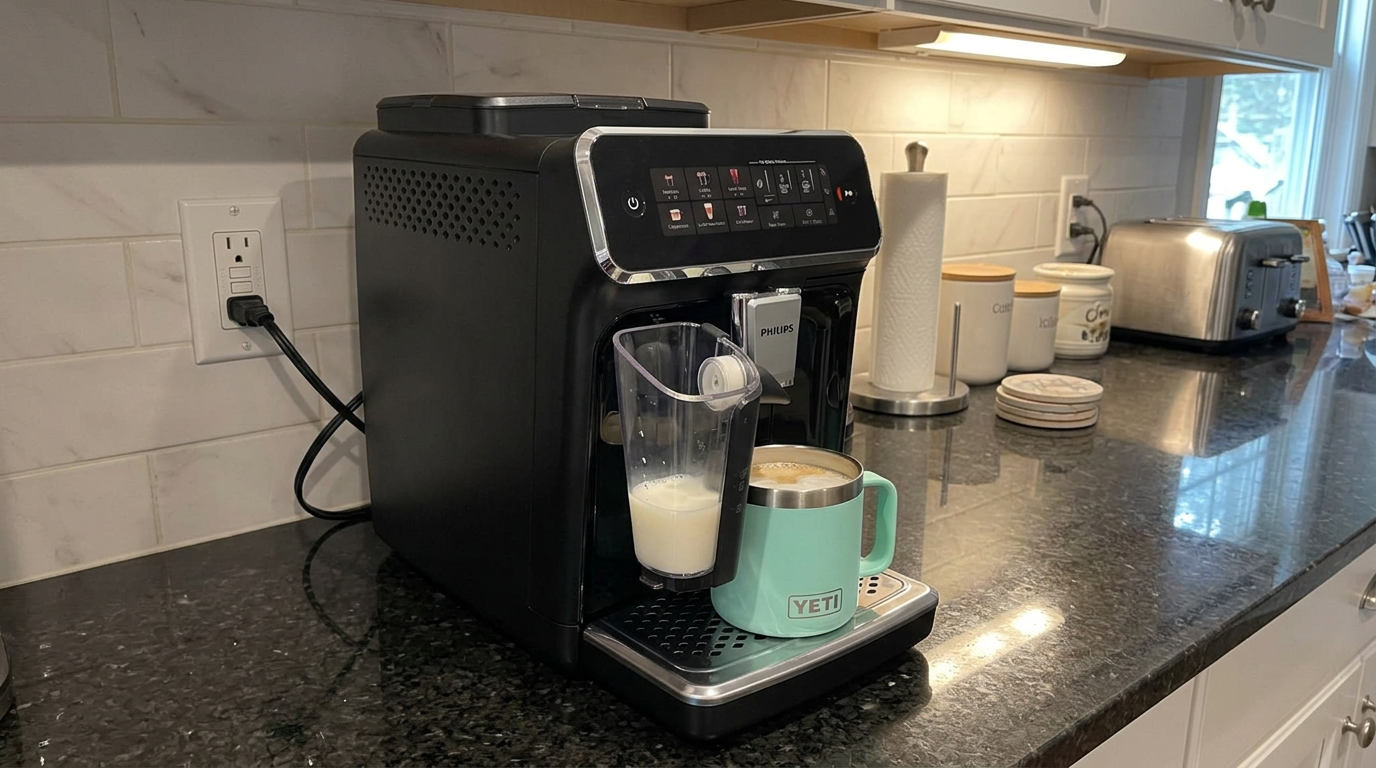
A narrow footprint that slips easily between a toaster and the wall.
What the Philips 3300 actually is
The Philips 3300 is a fully automatic, bean-to-cup espresso machine.
Fully automatic is the important phrase here.
There's no portafilter to lock in and no tamper to hold.
Everything from grinding to disposing of the used coffee happens inside the machine.
The core parts are a ceramic burr grinder, a removable brew group, a thermoblock heater and a 15-bar pump.
Milk is handled by the LatteGo carafe, which clips onto the front and froths milk directly into your cup.
The version I used offers six options on the main panel: espresso, coffee, cappuccino, latte macchiato, iced coffee and hot water.
Each drink can be adjusted for strength, cup volume and, where it applies, the amount of milk.
It's worth knowing where the 3300 sits in its family.
Philips makes simpler models below it and more elaborate ones above it, but the grinder, brew group, heater and pump are shared across the range.
What you pay more for higher up is software: bigger screens, more drink recipes and user profiles.
The 3300 is the point where the most useful upgrades arrive, namely the quieter lid, the backlit interface and the iced coffee recipe.
Manufacturer capacities. The hopper holds roughly a 10-ounce bag of beans.
Philips 3300 design and setup
This is a compact machine by fully automatic standards.
It measures 246 × 371 × 433 mm, or roughly 9.7 inches wide, 14.6 inches deep and 17 inches tall.
At about 8 kg, or 17.6 pounds, it's light enough to move around without a second pair of hands.
The narrow width is the number that matters most in a real kitchen.
It fit into a gap on my counter that I'd assumed was only good for a utensil jar.
Height is fine under standard wall cabinets, though you'll want a little clearance to lift the bean lid.
| Measurement | Metric | Imperial |
|---|---|---|
| Width | 246 mm | 9.7 in |
| Depth | 371 mm | 14.6 in |
| Height | 433 mm | 17.0 in |
| Weight | 8 kg | 17.6 lb |
| Spout height | 85–145 mm | 3.3–5.7 in |
| Cord length | 100 cm | 39 in |
Front-loading, which matters more than it sounds
The best design decision on this machine is that everything you service daily comes out of the front.
The water tank slides out forward, and so do the drip tray and grounds container.
That means you never have to pull the machine away from the wall or rotate it to get to the reservoir.
With a short cord and a corner position, I appreciated that every single morning.
Build quality
The body panels are mostly molded ABS plastic with chrome-look accents.
It wipes clean easily, and fingerprints don't show much on the matte areas.
But there's a little flex in non-structural parts, especially the removable water tank.
The drip tray is better than I expected.
It has internal baffles that stop water sloshing when you carry it to the sink, and a stainless steel grate on top that shrugs off scratches from mugs.
Rear vents and upper chutes let warm, moist air out, which helps keep humidity away from the beans and internal parts.
Our tip: Leave a few centimeters behind the machine so the rear vents can release heat and steam freely.
First setup
Setup took me about ten minutes, including reading the quick start guide.
You rinse the tank, test your water hardness with the included strip, insert the AquaClean filter and let the machine prime and rinse itself.
The first few cups are best treated as practice, because the grinder and brew group need time to settle in.
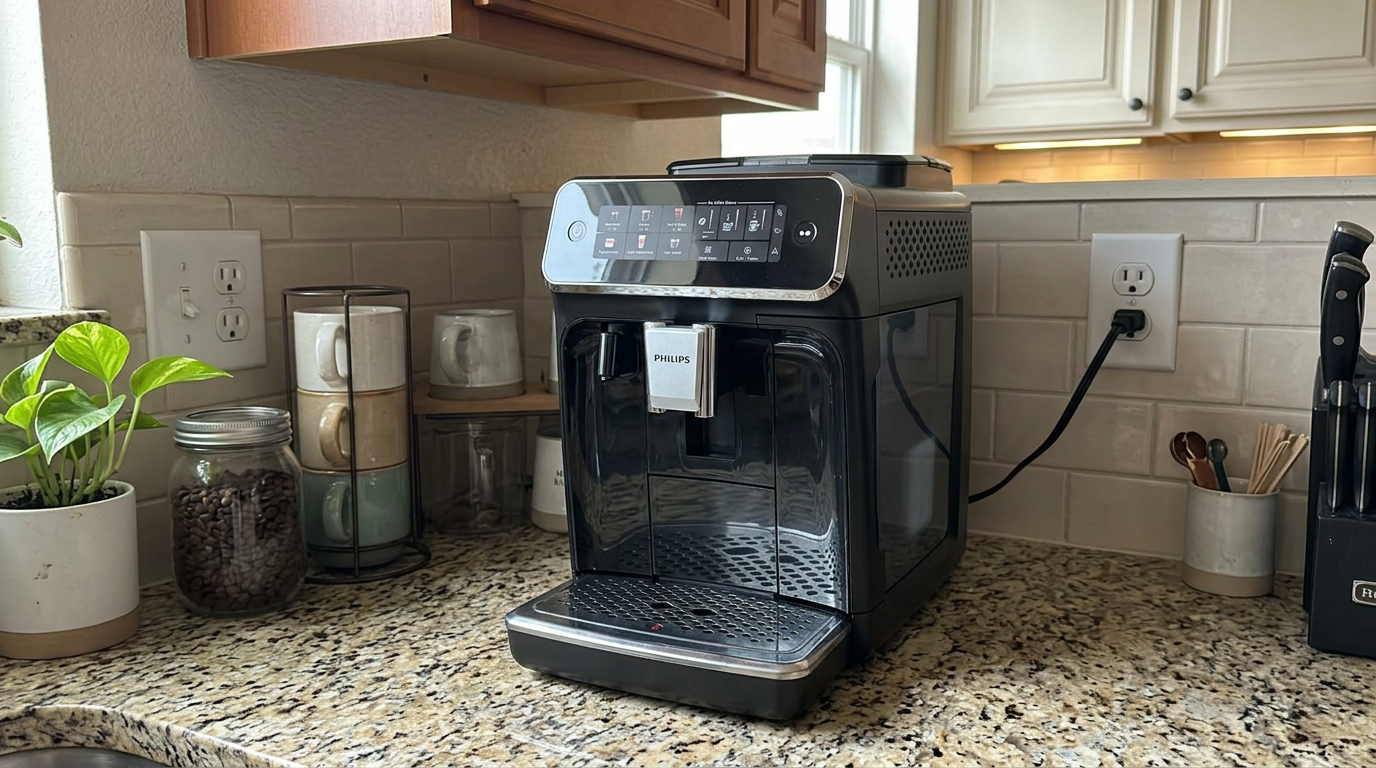
Water tank, drip tray and grounds bin all come out from the front.
Controls and drink options
The control panel uses backlit touch icons rather than a large full-color screen.
I actually prefer it for a machine like this.
Each drink has its own icon, and the strength, volume and milk settings light up so you can see what you've chosen at a glance.
There's no scrolling through menus before your first coffee of the day.
Deeper settings, like brewing temperature or saving a default volume, are changed by holding certain buttons in a sequence.
It works, but you'll need the manual nearby the first time.
| Drink | What the machine does | Best used for |
|---|---|---|
| Espresso | Short, concentrated extraction | Straight shots and doubles |
| Coffee | Longer extraction through the same puck | A lungo-style mug |
| Cappuccino | Froths milk, then brews espresso on top | Classic foamy milk drinks |
| Latte macchiato | More milk, espresso poured through it | Layered glass drinks |
| Iced coffee | Slower, cooler concentrated brew | Pouring straight over ice |
| Hot water | Bypasses the coffee path | Tea or a manual Americano |
Three settings, three steps each
Every drink can be adjusted in three ways, each with three levels.
Strength changes the dose, from about 6 grams up to an 8-gram maximum.
Volume sets how much water goes into the cup, and milk sets how long the carafe froths.
That gives you 27 combinations for every milk drink, which is plenty for most households.
What it doesn't give you is precision.
The volume steps are fairly coarse, so if you want exactly 40 ml of espresso, you'll be choosing the nearest level rather than dialing it in.
Approximate dose per single cycle. The jump between levels is small, so taste differences are subtle.
Our tip: Set strength to the highest level first and only lower it if the coffee tastes too intense.
The ceramic grinder
The grinder uses ceramic burrs, which Philips leans on heavily in its marketing.
There's a real reason for it.
Ceramic is thermally stable, so it doesn't pass much heat into the beans during a long grinding run.
It's also very durable, which matters on a machine that grinds every single cup.
There are 12 grind settings, adjusted with a knob inside the bean hopper.
Setting 1 is the finest and 12 is the coarsest.
Out of the box, the machine sits in the middle of the range, which is too coarse for the best results in my experience.
Settings 1 to 3 gave me firmer pucks and noticeably more body in the cup.
One rule matters here: only turn the grind knob while the grinder is running.
Turning it while idle can force the burrs against trapped beans.
Relative extraction strength in my testing with a medium roast. Oily dark roasts may need a slightly coarser setting.
Adjust slowly
The machine only picks up a new grind setting after a few cups have passed through.
So I moved one click at a time and waited two or three drinks before judging the result.
If you jump straight from 8 to 1, you won't know which change helped and which one went too far.
| What you taste or see | Likely cause | First change |
|---|---|---|
| Watery, thin coffee | Grind too coarse or dose too low | Grind one step finer, raise strength |
| Sour, sharp taste | Under-extraction | Grind finer or raise temperature |
| Bitter, harsh finish | Over-extraction or volume too high | Lower the volume level |
| Wet, sloppy pucks | Grind too coarse, or still breaking in | Grind finer and give it more cups |
| Coffee drips slowly | Grind too fine for that bean | Go one step coarser |
How quiet is the Philips 3300?
Noise is where this machine really stands out.
Philips calls the feature SilentBrew, and the hardware behind it is simpler than the name suggests.
The bean hopper lid has a thick rubber gasket that seals the grinder compartment.
That seal absorbs a lot of the high-frequency noise from the motor and burrs.
I measured it both ways, because I wanted to know how much of the effect came from the lid alone.
With the lid closed, the grinder peaked at around 61 to 62 decibels.
With the lid removed, the same grind peaked at 72 to 73 decibels.
My measurements at about 1 meter. A 10 dB drop sounds roughly half as loud to most people.
That 10-decibel difference is bigger than it looks on paper.
Decibels are logarithmic, so a 10 dB drop cuts the sound energy by about 90% and sounds roughly half as loud.
The tone changes too.
With the lid on, the grind is a low, muffled rumble; with it off, it's the sharp whine I associate with older automatic machines.
The pump is now the loudest part
Because the grinder is so well insulated, the vibration pump becomes the main noise source.
During extraction, I measured 62 to 68 decibels.
It's a steady buzz rather than a harsh sound, and it only lasts as long as the brew.
For context, normal conversation sits around 60 decibels, so the whole cycle is about as loud as two people talking nearby.
I made coffee at 6 a.m. with a child asleep in the next room, and nobody woke up.
Our tip: Always press the hopper lid down firmly after refilling, because a lid left slightly open undoes most of the noise reduction.
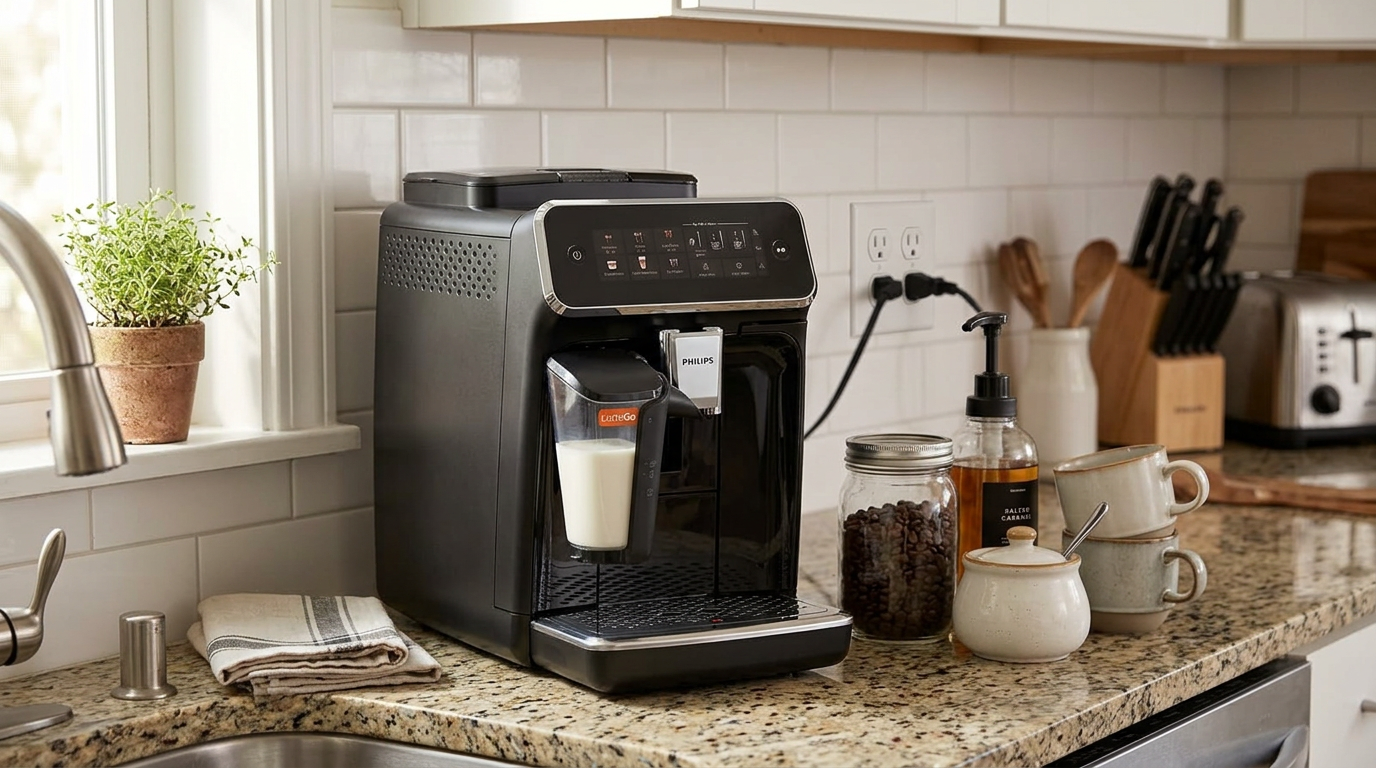
Quiet enough for early mornings in an open kitchen.
Philips 3300 espresso performance
Here's where I need to be honest about what a machine like this can and can't do.
The espresso from the Philips 3300 is clean, balanced and pleasant.
It has a moderate layer of crema and none of the burnt bitterness I've had from cheaper automatics.
But it's lighter in body than a shot from a traditional portafilter machine.
The reason is physical, not a matter of settings.
The 8-gram limit
The brew chamber can hold about 8 grams of ground coffee per cycle.
A typical café double shot uses 16 to 18 grams.
So a single press of the espresso icon is working with roughly half the coffee you'd find in a café double.
The puck is also shallower, and the water passes through it relatively quickly.
The result is a lighter, more approachable cup rather than a thick, syrupy one.
Running a double closes most of the gap on dose.
What the numbers say about strength
To put a number on body, I measured total dissolved solids, or TDS.
TDS tells you what percentage of the liquid in your cup is actually dissolved coffee.
At fine grind settings, the 3300 produced espresso between 4.5% and 5.5% TDS.
Automatic machines with more compression in the brew chamber typically reach 6% to 7%.
A traditional semi-automatic espresso machine usually lands between 10% and 12%.
Higher TDS means a denser, more concentrated shot. Bars show the midpoint of each range.
Those figures line up with what I tasted.
On its own, a single espresso from this machine is closer to a strong short coffee than a true café espresso.
Under milk, that difference matters much less than you'd think.
How I got more out of it
The simplest fix is to use the double function, or run two single cycles into the same cup.
That gets you to about 16 grams of coffee, and the difference in body is obvious.
Combined with a finer grind and the highest strength level, it produced the best espresso I got from the machine.
| Goal | Grind | Strength | Volume | Cycles |
|---|---|---|---|---|
| Fuller espresso | 1–2 | Strong | Lowest | Double |
| Everyday cappuccino | 2–3 | Strong | Lowest | Single |
| Large latte | 2–3 | Strong | Medium | Double |
| Mug of black coffee | 3–4 | Medium | Medium | Single |
| Americano | 2 | Strong | Lowest | Double + hot water |
My preferred starting recipes with a medium roast. Adjust by taste.
The "Coffee" setting deserves a short note.
It pushes more water through the same small puck, which works for a lungo-style cup but gets thin at the largest volume.
For a bigger black coffee, I preferred a double espresso topped up with the hot water spout.
That keeps the extraction short and adds the extra volume afterward, which tastes cleaner.
Give it a break-in period
My first week of espresso wasn't representative.
New ceramic burrs and a fresh brew group need roughly 20 to 30 cycles, or one to two weeks of normal use, to settle in.
In that time, the auto-dosing stabilizes and the pucks go from slightly crumbly to firm and solid.
If you judge the machine on day one, you'll judge it too harshly.
My observations from the first weeks of daily use.
Our tip: Run your first 20 or so drinks before changing any settings, so you're adjusting a machine that has finished breaking in.
Brewing temperature and heat
A thermoblock heats water on demand rather than keeping a boiler full and hot.
That's why the 3300 is ready quickly and uses little energy when idle.
I measured the output at the spouts across different drinks.
Espresso came out at about 85°C, or 185°F, on initial startup.
Cappuccino and other milk drinks measured 84 to 85°C, or 183 to 185°F, at the coffee spout.
The hot water spout ranged from about 77 to 90°C, or 170 to 194°F, and stayed stable over back-to-back dispenses.
| Output | Celsius | Fahrenheit | How it felt |
|---|---|---|---|
| Espresso at startup | 85°C | 185°F | Warm, drinkable straight away |
| Coffee for milk drinks | 84–85°C | 183–185°F | Consistent cup to cup |
| Hot water spout | 77–90°C | 170–194°F | Fine for most teas |
| Top of machine after 20 min | 35°C | 95°F | Barely warm |
Those espresso temperatures are a few degrees lower than the 90 to 94°C range often recommended for brewing.
Some heat is lost between the brew group and the spout, so the actual brewing water is a little hotter than what I measured in the cup.
Still, if you like your coffee very hot, raise the temperature to its highest of the three settings.
Preheating the cup also makes a real difference with small espresso volumes.
The top of the machine reached only about 35°C after 20 minutes idle, so don't count on it as a cup warmer.
Our tip: Run a splash of hot water into your cup and tip it out before brewing, so a cold mug doesn't steal the heat from a small espresso.
Milk drinks with the LatteGo carafe
LatteGo is the reason many people will choose this machine, and I understand why.
Most automatic milk systems rely on a hose, a pick-up tube and a frothing head with small internal channels.
Those channels collect dried milk, which means daily rinse cycles and regular deep cleans.
The LatteGo carafe has none of that.
It's two molded plastic parts that snap together with no latches, tubes or hidden passages.
Milk is pulled up into a small side chamber, mixed with air at high speed and poured straight into your cup.
How the foam turned out
The foam is dense, stiff and generous in volume.
For a classic cappuccino with a tall, spoonable cap of foam, that's exactly right.
It also handled oat milk well, which isn't a given with automatic frothers.
What it doesn't make is the glossy, silky microfoam you'd use for latte art.
The bubbles are a little coarser, and the foam sits on the milk rather than blending into it.
My ratings out of 10 after several weeks of daily milk drinks.
Cleaning it is genuinely fast
I timed myself, and separating, rinsing and reassembling the carafe took under 10 seconds.
Both parts are also dishwasher safe, which I used once a day after the last drink.
That's the single biggest quality-of-life improvement over every hose-based milk system I've cleaned.
It also means there's less temptation to leave milk sitting in the system, which matters for hygiene.
A few quirks
The lid sits loosely on top of the carafe with no latch.
Twice I picked the carafe up by the body and the lid slid off.
There's also no dedicated "hot milk only" button on my version, so for a cup of frothed milk without coffee you have to stop a cycle manually.
Its 260 ml capacity is enough for two cappuccinos or one large latte macchiato before a refill.
Our tip: Use milk straight from the fridge, because cold milk builds firmer, longer-lasting foam than milk that has warmed up on the counter.
If your version has a steam wand
Some versions in the 3300 range ship with a classic milk frother instead of the carafe.
In automatic mode, its chrome sleeve injects air for you and makes thick foam with almost no skill.
Slide the sleeve off, though, and you get a short bare nozzle you can use like a basic steam wand.
With a stainless steel pitcher and a bit of practice creating a whirlpool, it can make silky microfoam good enough for simple latte art.
Wipe the nozzle immediately afterward and run a quick hot water purge to clear the steam passage.
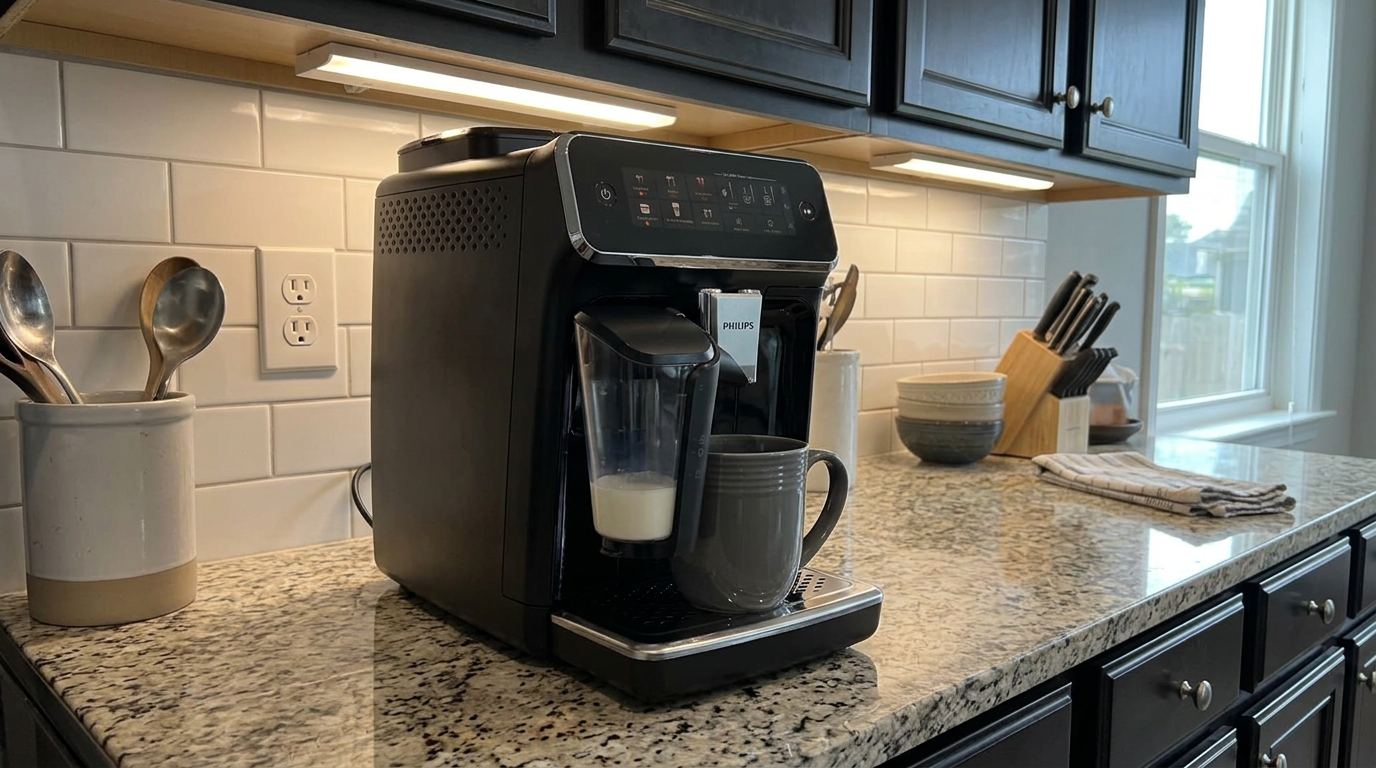
The LatteGo carafe clips onto the front and froths directly into the cup.
Iced coffee, pre-ground coffee and other extras
The iced coffee icon is one of the newer additions to this series.
I went in expecting something clever, but it's important to understand what it actually does.
The machine doesn't chill anything.
The thermoblock still heats the water, but the pump pulses more slowly and brews at a slightly lower temperature.
The result is a concentrated, warm coffee meant to be poured directly over a full glass of ice.
Done that way, it works well.
The concentrated brew cools almost instantly and doesn't taste watered down.
If you use only a few ice cubes, though, you'll get a lukewarm, diluted drink.
Fill the glass all the way, then add milk or syrup afterward.
Our tip: Fill your glass to the top with large ice cubes before pressing iced coffee, because big cubes melt more slowly than crushed ice.
The pre-ground coffee chute
A small door on top of the machine lets you skip the bean hopper entirely.
You add one level scoop of pre-ground coffee, up to about 12 grams, and brew a single drink.
I used it for decaf in the evening without emptying the hopper of regular beans.
Only add one scoop per drink, and don't use instant coffee in it.
Double cup and hot water
The twin coffee spouts let you brew two espressos into two cups at once.
The spout height adjusts from about 85 to 145 mm, so it reaches down to small espresso cups and up for taller glasses.
Hot water comes from its own spout, which keeps it free of coffee residue for tea.
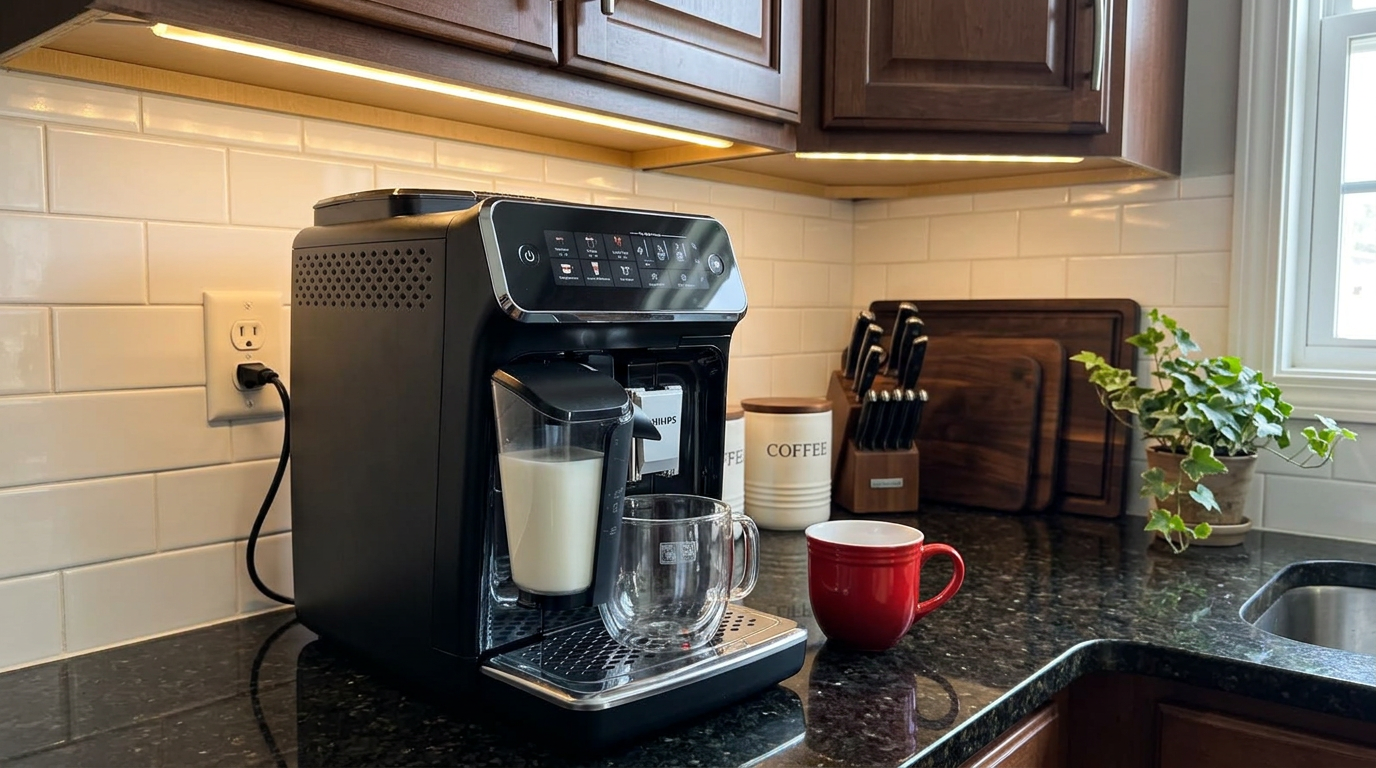
The adjustable spout handles both small espresso cups and taller glasses.
Cleaning and maintaining the Philips 3300
If the coffee is where this machine compromises, cleaning is where it shines.
My daily routine took less than a minute.
Rinse the milk carafe, empty the drip tray and grounds bin when the indicator pops up, and wipe the spouts.
The weekly job is a little more involved, but still simple.
You open a side panel, press a button on the brew group and slide it out.
Then you rinse it under plain warm water, let it dry and slide it back in.
Being able to see and rinse the brew group yourself is a real advantage for hygiene and long-term reliability.
| When | Task | Why it matters |
|---|---|---|
| After each session | Rinse the LatteGo carafe or put it in the dishwasher | Stops milk residue building up |
| Daily or when full | Empty drip tray and grounds bin | Prevents odors and mold |
| Weekly | Remove and rinse the brew group in warm water, no detergent | Clears coffee oils and grounds |
| Monthly | Clear the pre-ground chute with a spoon handle | Removes dust and oily buildup |
| Every 2–4 months or 500 cups | Grease the brew group rails and shaft | Keeps moving parts smooth |
| Every 500–600 cups | Replace the AquaClean filter | Delays descaling |
| When prompted | Run the descaling program | Protects the thermoblock |
Don't skip the grease
Lubricating the brew group is the task most owners forget.
The machine comes with a tube of food-grade silicone grease for exactly this purpose.
A thin layer on the rails, the piston and the central shaft every few months keeps the group moving freely.
If you skip it, the group can start to stick or creak over time.
Our tip: Never wash the brew group with dish soap, because detergent strips the lubricant from its moving parts.
Watch the drip tray
A small red indicator pops up through the drip tray cover when it's full.
The grounds bin holds about 12 pucks, and the machine tells you when it needs emptying.
I found it easiest to empty both at the same time every morning, whether they were full or not.
Damp coffee grounds left in a warm machine for days can start to grow mold, so it's a habit worth building.
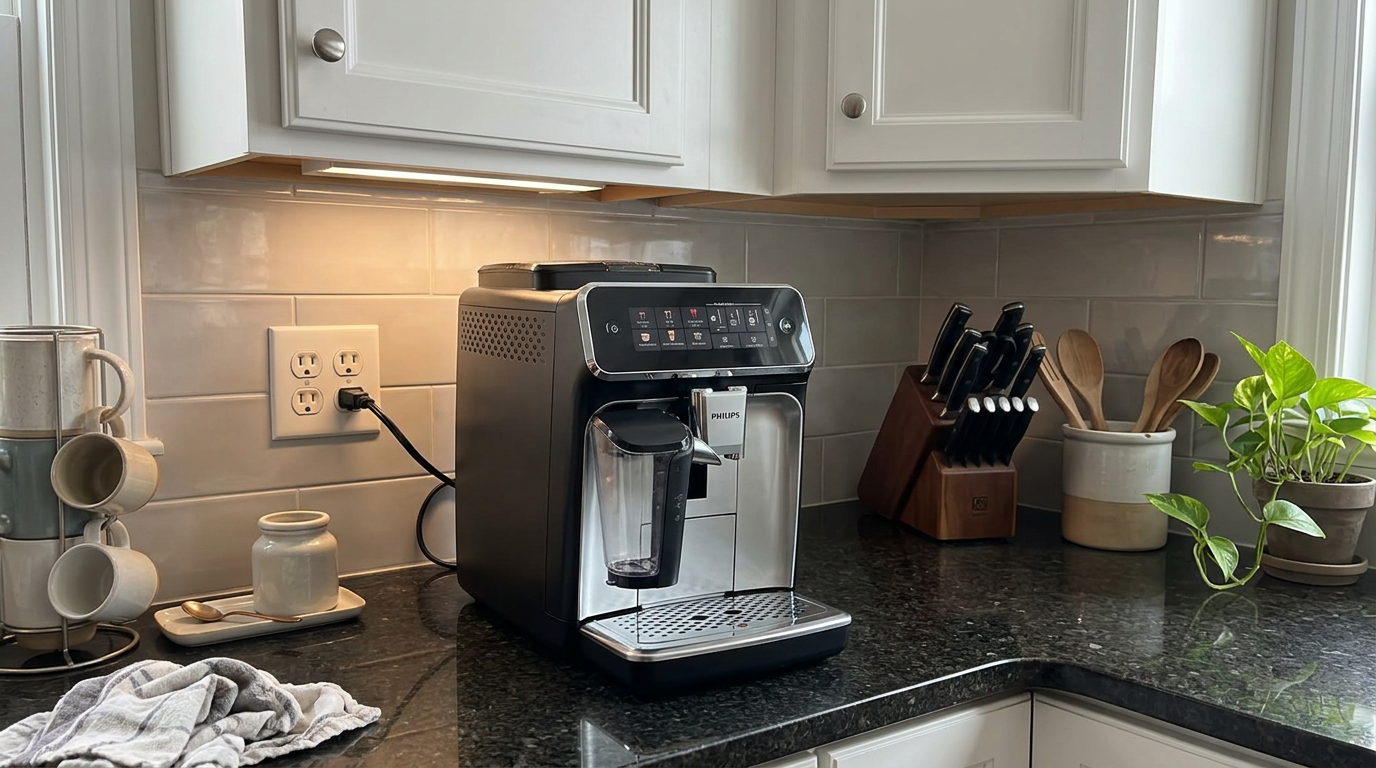
The silver finish looks smart, and the flat panels are easy to wipe down.
Water, AquaClean and descaling
Scale is the slow killer of automatic coffee machines.
Minerals in hard water build up inside the thermoblock and narrow the water paths over time.
Philips addresses that with the AquaClean filter, which sits inside the water tank.
It combines ion exchange with fine filtration to remove much of the hardness before it reaches the heater.
Philips says that if you keep replacing the filter when prompted, you won't need to descale for up to 5,000 cups.
Each filter lasts roughly 500 to 600 cups, or about three months in a typical home.
After about eight filters, the machine will ask you to run a full descale.
Unfiltered figures are rough estimates, as the machine sets its schedule from your water hardness setting. The AquaClean figure is the manufacturer's claim.
Setting the water hardness correctly during setup matters.
The included test strip takes seconds, and the machine uses the result to decide when to remind you.
If you choose not to use the filter, follow the descaling prompts and use the manufacturer's descaler.
Vinegar is a bad idea here, as it can damage seals and isn't effective enough on its own.
Our tip: Write the date on the AquaClean box when you install a new filter, so you know roughly when the next one is due.
What daily use is really like
Specifications are one thing, but what matters is how a machine fits into an ordinary morning.
With the Philips 3300, my routine shrank to almost nothing.
I switch it on, and it runs a short rinse while it heats.
Then I clip on the carafe with cold milk, put a glass under the spout and touch cappuccino.
About a minute later, the drink is ready.
The machine handles every step that would normally need my attention.
| Step | Who does the work | What you control |
|---|---|---|
| Heat-up and rinse | Machine | When you switch it on |
| Grinding and dosing | Machine | Grind and strength level |
| Tamping and brewing | Machine | Volume and temperature |
| Frothing milk | Machine, via LatteGo | Milk amount |
| Disposing of the puck | Machine | Nothing |
| Cleanup | You | Rinse carafe, empty tray |
That table says a lot about who this machine is for.
If you enjoy the craft of espresso, there's very little craft left here.
If you just want a good coffee without thinking, that's exactly the point.
It's also easy for anyone else in the house to use.
My guests made their own drinks without a single question, which never happens with a portafilter machine.
Making several drinks in a row
Back-to-back drinks went smoothly in my testing.
The thermoblock recovers quickly, and I made four milk drinks in a row without waiting between them.
The real limits are the milk carafe and the grounds bin.
The carafe needs topping up after about two cappuccinos, and the bin fills after twelve pucks.
The 1.8-liter tank lasts much longer than both, so you'll rarely run out of water mid-session.
My estimates in normal use, including the startup rinses.
Energy use
The machine draws 1,500 watts while heating and brewing.
Because it uses a thermoblock rather than a large boiler, it doesn't keep liters of water hot all day.
It also switches itself off after a period of inactivity, so leaving it on by mistake isn't a big deal.
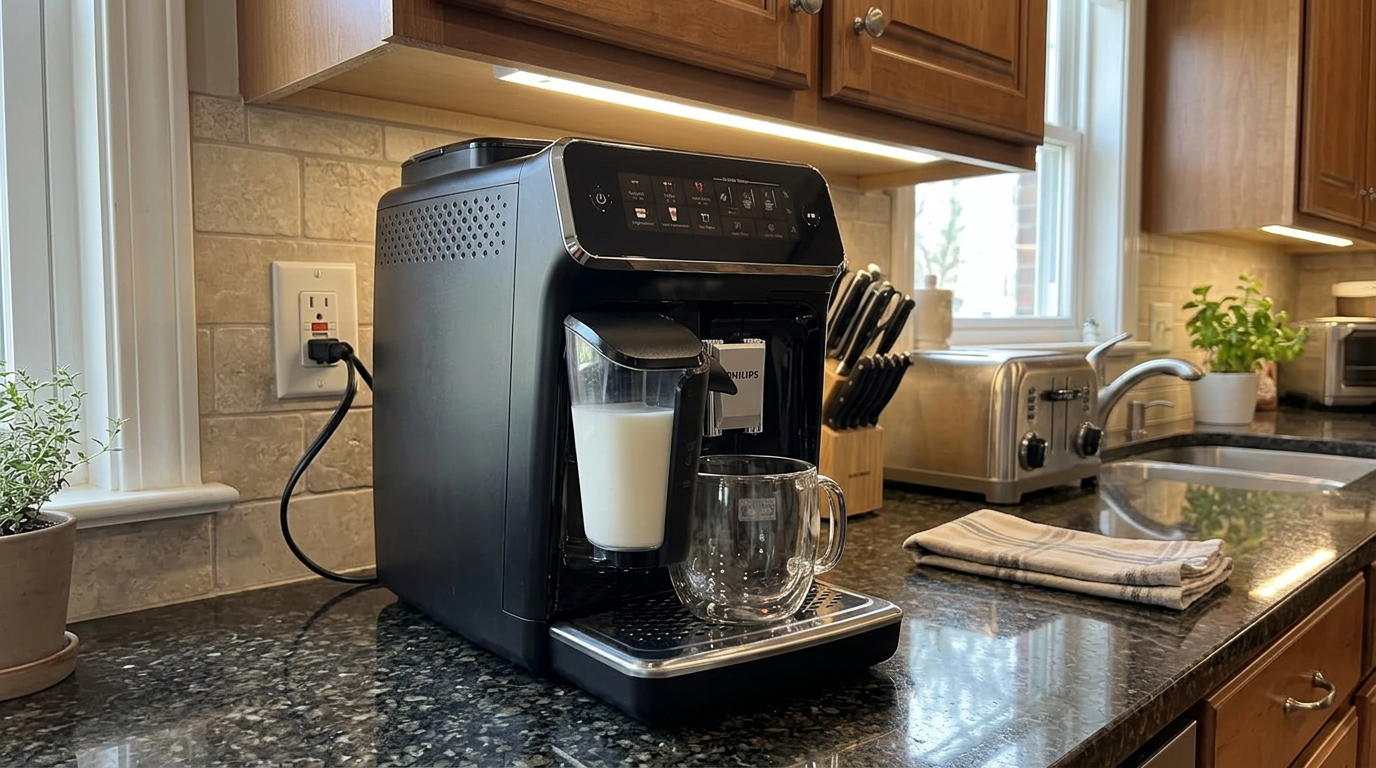
From switching on to a finished latte macchiato takes only a couple of minutes.
Common mistakes to avoid
The Philips 3300 is hard to get wrong, but a few habits made a clear difference in my results.
These are the ones I'd keep an eye on during the first month.
| Mistake | What happens | Better habit |
|---|---|---|
| Leaving the grind at the default | Lighter, thinner coffee | Move to settings 1–3 |
| Turning the grind knob while idle | Strain on the burrs | Only adjust while grinding |
| Using oily, very dark beans | Clogged hopper and grinder | Choose medium or dry dark roasts |
| Using the largest volume for black coffee | Watery, bitter cup | Double espresso plus hot water |
| Washing the brew group with soap | Removes lubricant | Warm water only, then grease |
| Leaving milk in the carafe | Spoilage and residue | Return milk to the fridge, rinse carafe |
Choose the right beans
Bean choice matters more on an automatic than people expect.
Very oily, shiny dark roasts tend to stick to the hopper walls and can clog the grinder over time.
Medium roasts, or dark roasts with a dry surface, worked best for me.
Because the dose is small, a bean with plenty of body and chocolate notes also helps the espresso taste fuller.
Fresh beans make a difference, but you don't need to obsess over roast dates the way you would with a manual setup.
What I would change
My wish list is short.
A larger brew chamber would fix the main weakness in the cup, though that would mean a different machine altogether.
A latch on the LatteGo lid and a hot-milk-only option would solve two small daily annoyances.
Finer volume control for espresso would also be welcome.
None of that changes my overall view, but you should know about them before buying.
Is the Philips 3300 worth the money?
The Philips 3300 sits in the mid-range of fully automatic machines.
The best way to judge its value is to compare it with what you'd otherwise be doing.
If you're coming from capsules, the cost per cup drops significantly once you switch to whole beans.
A typical bag of beans makes many more drinks than the same spend on pods, and there's no capsule waste.
If you're buying café drinks most days, the machine can pay for itself surprisingly quickly.
Calculated from dose per drink. The small single dose stretches a bag of beans much further.
There's an upside to that small dose, too.
A bag of beans goes about twice as far on single cycles as it would on a portafilter machine.
For milk drinks, where the coffee strength matters less, that's a genuine saving.
It's also worth thinking about what you'd pay for in the higher series.
Because the grinder, brew group and pump are the same, spending more mostly gets you a bigger screen, more recipes and user profiles.
If you're happy with six drinks and three settings, the 3300 is the sweet spot for coffee quality per dollar in this family.
Ask yourself three questions
Do you mostly drink milk-based coffee?
Do you want to spend under a minute a day on cleanup?
Is a quiet machine more important to you than a dense, café-strength shot?
If you answered yes to all three, this machine is a strong fit.
If you drink mostly straight espresso and care deeply about its body, you'll probably be happier with a semi-automatic machine and a separate grinder.
Philips gives the machine a two-year warranty, so check the terms where you buy.
How it compares with other coffee setups
The most useful comparison isn't with one specific rival.
It's with the types of machine you're most likely to be weighing up.
The Philips 3300 is strongest for people who value speed, quiet operation and easy cleaning over full control.
| Feature | Philips 3300 | Capsule machine | Semi-automatic with grinder |
|---|---|---|---|
| Fresh beans | Yes | No | Yes |
| One-touch milk drinks | Yes | Some models | No |
| Espresso body | Light to medium | Light | Full |
| Milk texture control | Limited | Limited | High, skill-dependent |
| Daily cleanup | Under a minute | Seconds | Several minutes |
| Noise | Low | Low | Moderate to high |
| Learning curve | Very low | None | Steep |
| Waste | Compostable grounds | Used capsules | Compostable grounds |
A capsule machine is simpler still, but you give up fresh beans and pay more per cup.
A semi-automatic machine with a separate grinder makes far better straight espresso.
It also asks for real skill, more counter space and several minutes of cleanup every day.
The 3300 sits squarely in between.
It gives you fresh-bean coffee with almost the same convenience as a capsule machine.
Where the 3300 sits in its own range
The other question is whether to step up or down within the same family.
| Feature | Entry series | 3300 Series | Higher series |
|---|---|---|---|
| Grinder and brew group | Same | Same | Same |
| Sound insulation | Standard | Gasketed SilentBrew lid | Gasketed lid |
| Interface | Buttons | Backlit touch icons | Full color touchscreen |
| Drinks | Fewer | Six, including iced coffee | Up to 20 |
| Strength levels | 3 | 3 | 5 |
| User profiles | No | No | Yes |
Because the core hardware is identical across the range, stepping up won't make your espresso stronger.
Stepping down saves money but loses the quieter grinder, which is the 3300's best feature.
For most people, that makes the 3300 the most sensible choice in the family.
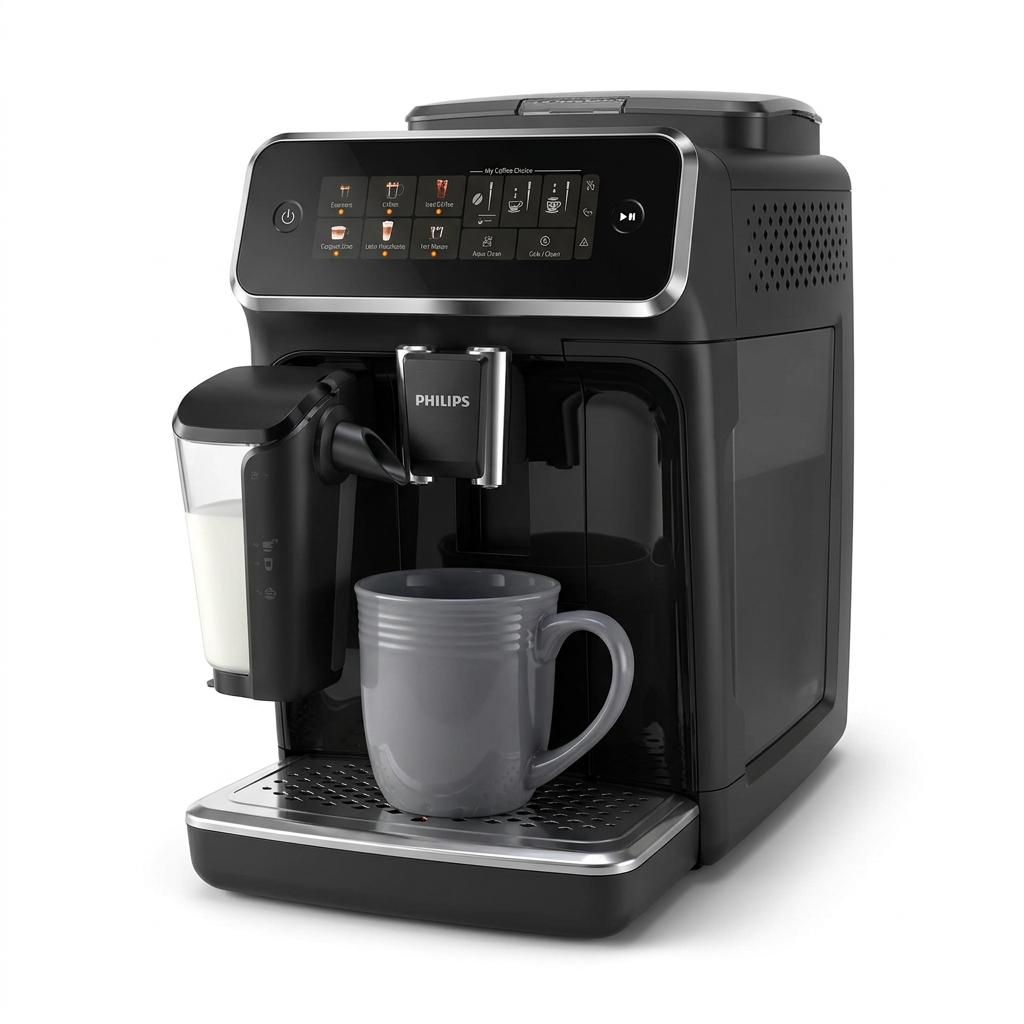
The LatteGo carafe on the left, adjustable twin spouts in the center and the drip tray below.
Philips 3300 specifications
From manufacturer data and my own measurements.
How I tested and scored the Philips 3300
I used the Philips 3300 Series as my everyday machine, making espresso, cappuccino, latte macchiato, iced coffee and black coffee.
I tested all 12 grind settings with a medium roast and tracked how the pucks changed through the break-in period.
I measured noise with the bean lid on and off, recorded temperatures at the spouts and checked strength with a TDS meter.
I also timed the daily and weekly cleaning, including the brew group and the LatteGo carafe.
Finally, I compared my notes with the manufacturer's specifications and general espresso guidance.
- Espresso (7.4): body, crema, strength and consistency across settings.
- Milk (8.2): foam quality, plant milk results and speed.
- Ease of use (9.2): controls, setup, noise and daily routine.
- Cleaning (9.4): daily, weekly and long-term maintenance effort.
The overall score of 8.4 is an editorial rating that reflects those four areas.
Philips 3300 FAQ
Is the Philips 3300 worth it?
Yes, if you want quiet, one-touch milk drinks from fresh beans with very little cleanup. It’s less suited to people who want dense, café-strength straight espresso.
Is the Philips 3300 quiet?
Yes. With the gasketed bean lid closed, I measured the grinder at about 61 to 62 dB, compared with 72 to 73 dB with the lid removed.
Why is the espresso weaker than in a café?
The brew chamber holds about 8 grams of coffee per cycle, while a café double uses 16 to 18 grams. Using the double function or two cycles into one cup closes most of that gap.
What is the best grind setting?
Settings 1 to 3 gave me the best body. Adjust one step at a time, only while the grinder is running, and wait a few cups before judging.
How do you clean the LatteGo carafe?
Pull the two parts apart and rinse them under hot water, which takes under 10 seconds. Both parts are also dishwasher safe.
Can it make latte art?
Not with the LatteGo carafe, which makes stiff, voluminous foam. Versions with a classic frother can make basic microfoam with the sleeve removed.
Does the iced coffee setting chill the coffee?
No. It brews a slower, concentrated coffee at a slightly lower temperature, meant to be poured over a glass full of ice.
How often do you need to descale?
With the AquaClean filter replaced when prompted, Philips says you won’t need to descale for up to 5,000 cups. Without it, follow the machine’s prompts.
Can you use pre-ground coffee?
Yes. A bypass chute on top takes one scoop of pre-ground coffee per drink, which is handy for decaf.
How big is the Philips 3300?
It measures 246 × 371 × 433 mm, about 9.7 × 14.6 × 17 inches, and weighs around 8 kg.
- Hands-on testing of the Philips 3300 Series with LatteGo
- Philips product specifications and user manual
- General espresso brewing and maintenance guidance