Philips 2200 vs 3200: is LatteGo worth the extra money?
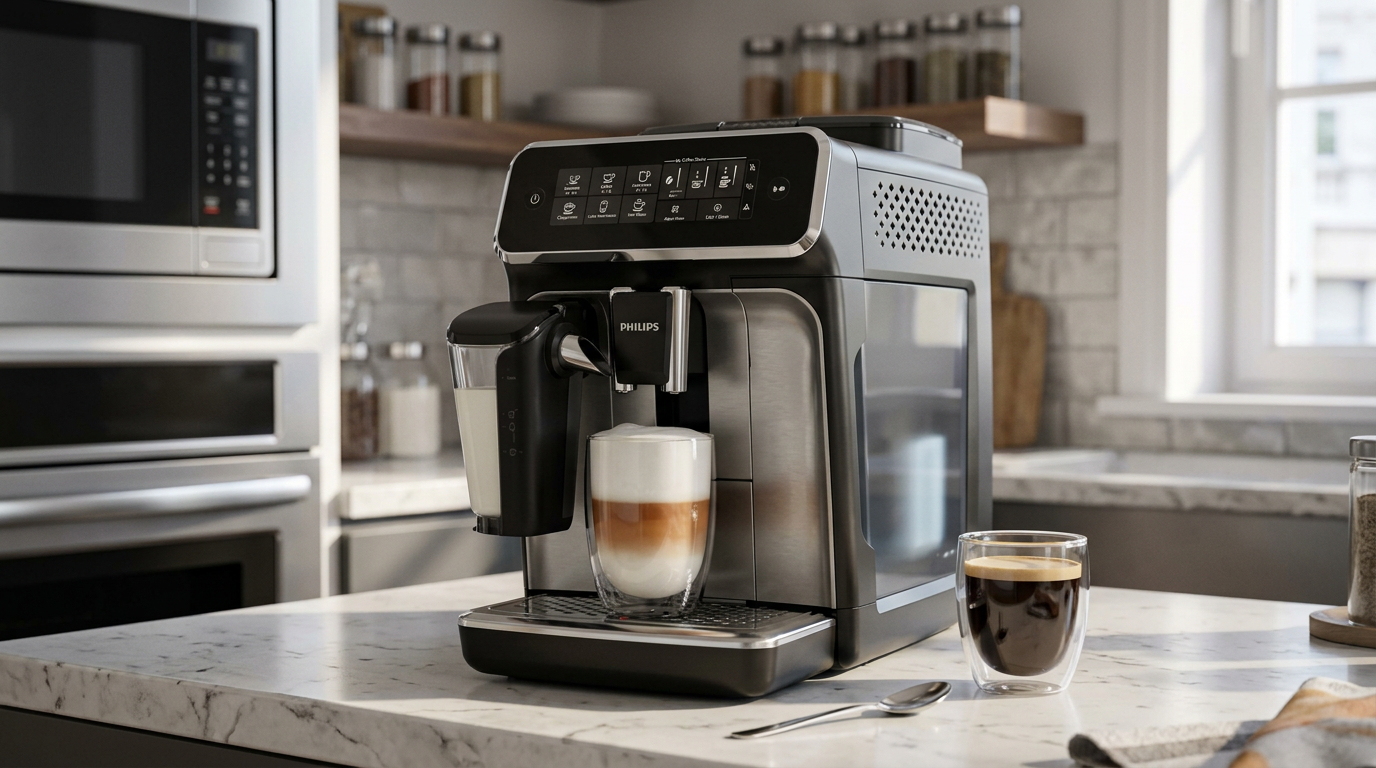
They share the same body, the same 12-step ceramic grinder, the same 1.8-liter tank and the same removable brew group. Then they split: the Philips 2200 Series makes espresso and coffee and hides a real steam tip under its frother sleeve, while the Philips 3200 Series adds an Americano button, one-touch cappuccino and latte macchiato and the tubeless LatteGo milk jug. I used each one as my everyday machine for four weeks, measured doses, volumes and temperatures, and lined up the data to find out whether LatteGo is worth paying for.
We choose products independently. We may earn a commission through links on this page; your price stays the same. Affiliate policy
Jargon helpNew to espresso? Tap any dotted term to see what it means.
In this comparison
If more than one person in your home drinks lattes or cappuccinos, or you simply never want to hold a milk pitcher, buy the Philips 3200 Series. LatteGo makes creamy foam at one touch and rinses clean in about ten seconds, and the extra Americano and latte macchiato buttons make it the easier machine to share. If you mostly drink espresso and Americanos, or you would like to learn to steam silky milk for latte art, the Philips 2200 Series is the smarter buy: pull its frother sleeve off and you get a real steam tip, and its espresso is every bit as good as the 3200’s.
The two machines
Specs checked November 13, 2026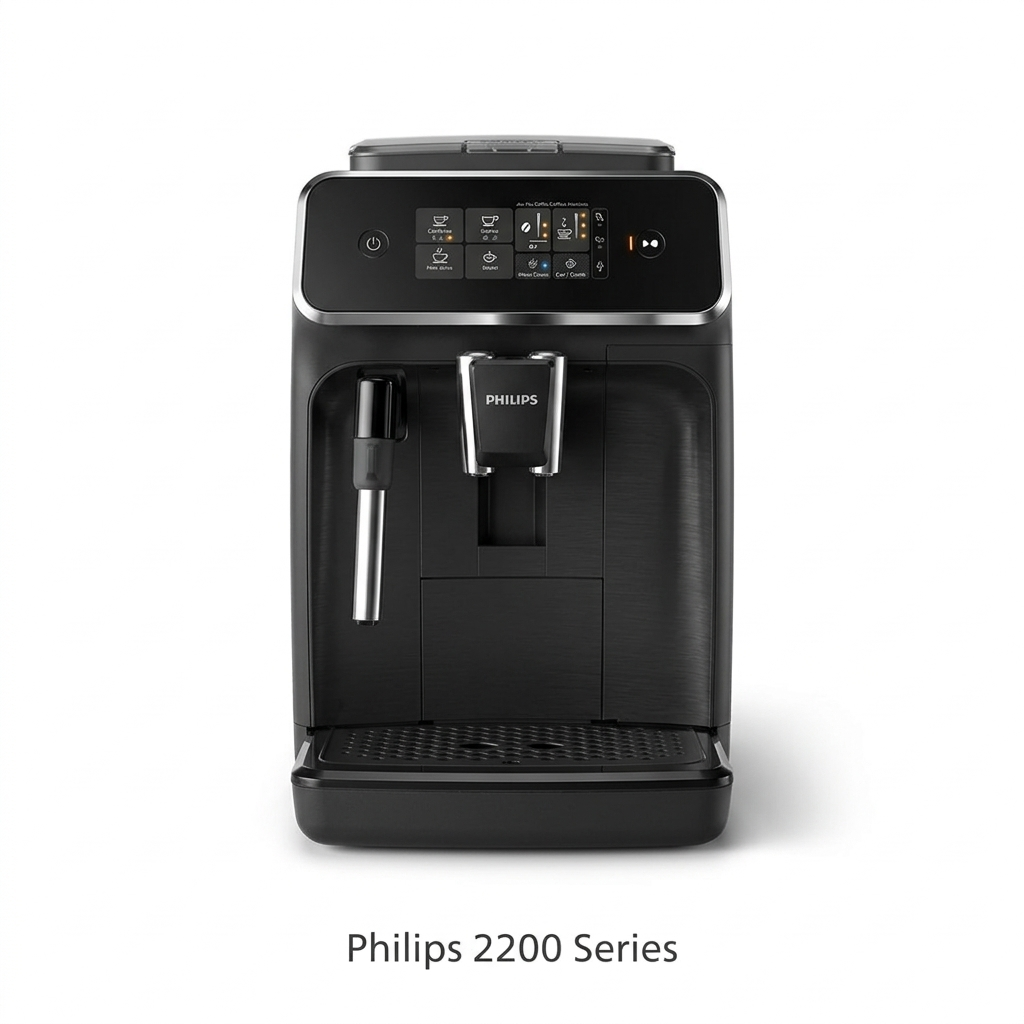
Espresso and coffee at a touch, three strength and size levels, an AquaClean filter in the box and a frother sleeve that comes off to reveal a real steam tip.
Check price on Amazon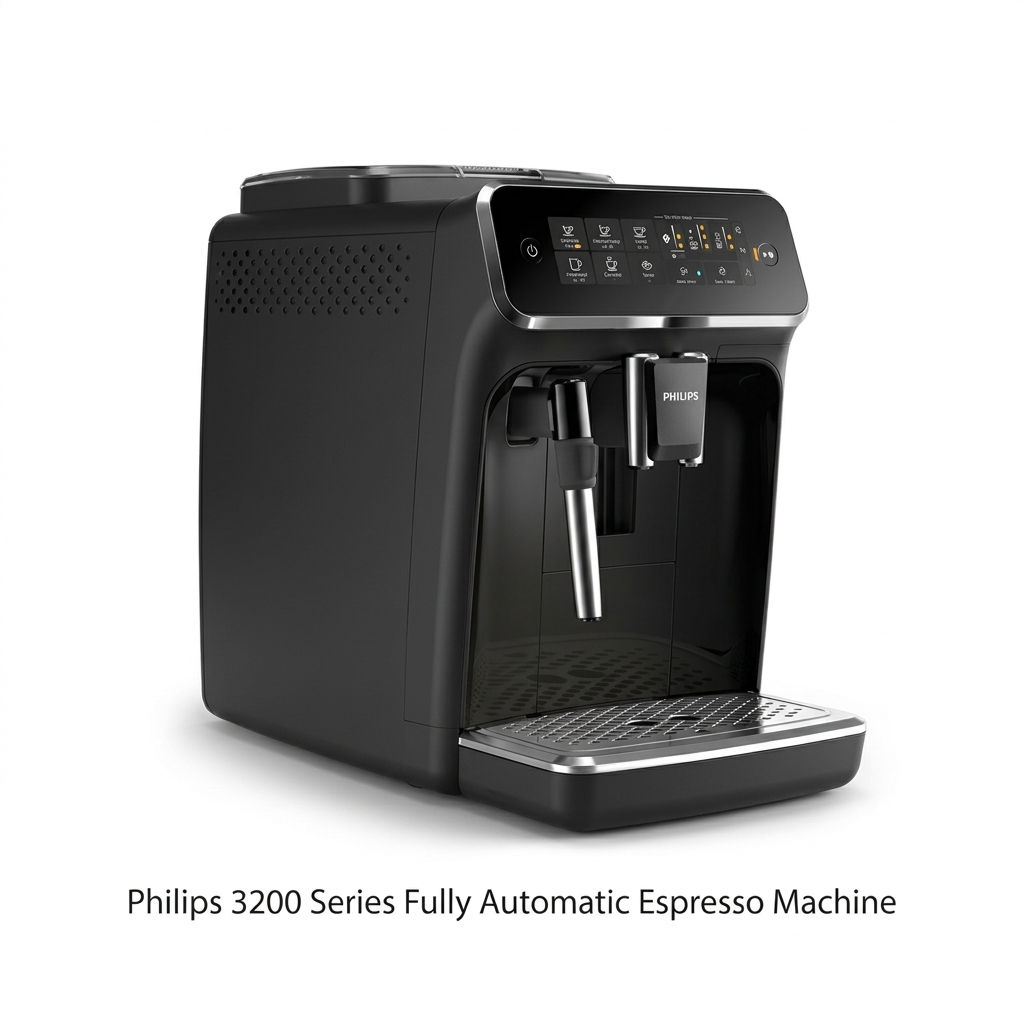
Five one-touch drinks including Americano, cappuccino and latte macchiato, plus the two-part, tubeless LatteGo jug that rinses clean in seconds.
Reveal Today’s DealPhilips 2200 vs 3200 at a glance
- Buy the 3200 if you want cappuccinos and latte macchiatos at one touch with the easiest milk cleaning around.
- Buy the 2200 if you mostly drink black coffee or want to learn to steam glossy microfoam yourself.
- Under the hood they are nearly identical: same grinder, same tank, same brew group, same footprint.
- Neither makes strong, syrupy espresso; both use a small dose, so use the strongest, smallest setting.
Head to head
The better result in each row is marked, based on four weeks with each machine and Philips’ specs. Rows where the two are identical have no winner.
The tally favors the 3200, but it is not my verdict. If you only drink black coffee, most of its wins do not apply to you.
| Spec | Philips 2200 | Philips 3200 |
|---|---|---|
| One-touch drinks | Espresso, coffee | Espresso, coffee, Americano, cappuccino, latte macchiato ✓ Best |
| Americano button | No, add hot water yourself | Yes ✓ Best |
| Milk system | Frother sleeve or bare steam tip | LatteGo jug, one touch ✓ Best |
| Latte-art microfoammy testing | Yes, with the bare tip ✓ Best | No |
| Milk cleaning | Wipe and purge the tip | Rinse two parts, ~10 s ✓ Best |
| Max doseweighed | About 7.1 g | About 8 g ✓ Best |
| Temperature settings | 3 | 3 |
| Grinder | 12-step ceramic | 12-step ceramic |
| Two cups at once | Double runs two cycles | Espresso and coffee, two cups ✓ Best |
| Removable brew group | Yes | Yes |
| AquaClean filter included | Yes | Yes |
| FootprintW x H x D | 9.7 x 14.6 x 17 in | 9.7 x 14.6 x 17 in, plus jug |
| Weight | About 16.5 lb ✓ Best | About 17.6 lb |
| Rows won | 2 | 6 |
Philips 2200 vs 3200 pros and cons
Philips 2200 Series
- Bare steam tip can make silky microfoam for latte art
- Simple touch panel with three strength and size levels
- AquaClean filter included and the brew group comes out
- Small dose makes espresso closer to a lungo
- Only two coffee drinks on the menu
- Steaming takes practice to get the best texture
Philips 3200 Series
- Five one-touch drinks, including latte macchiato
- LatteGo jug has no tubes and rinses clean fast
- Slightly bigger dose and two cups at once
- Espresso is still mild from a small dose
- LatteGo foam is good, not café-smooth
- Small drip tray needs emptying daily
Who should buy which machine?
- Espresso and Americano drinkers
- Beginners who want to learn latte art
- Anyone who rarely drinks milk
- Households where everyone drinks something different
- Daily cappuccino and latte macchiato drinkers
- Anyone who hates cleaning milk systems
Design, size and build
Put the two machines side by side and you would struggle to tell them apart from across the kitchen. Both are about 9.7 inches wide, 14.6 inches tall and 17 inches deep, with the water tank on the side and the drip tray and grounds drawer at the front.
The differences are on the front. The 2200 has a matte black touch panel with four drink icons and a frother wand on the left.
The 3200 has a glossy black panel with more icons, and instead of the wand it has a connector for the LatteGo jug. The jug adds a few inches to the depth when it is clipped on.
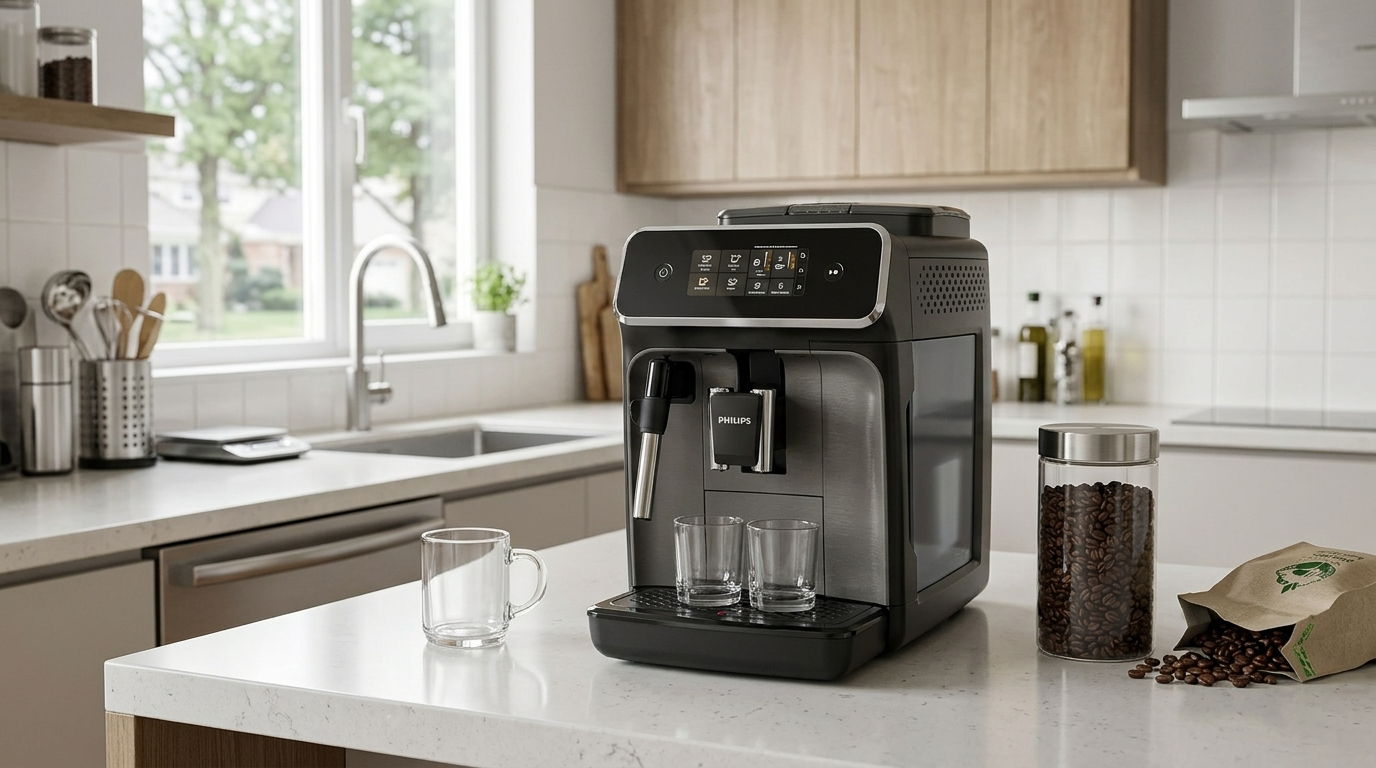
The 2200 keeps its frother on the left and two espresso glasses fit side by side under the spout.
Both bodies are mostly plastic. The 3200 has a stainless steel drip tray cover, which felt sturdier and wiped clean more easily.
Neither rattled or loosened during my four weeks. They look tidy rather than premium, and both fit next to a sink or under standard wall cabinets.
The 2200 is the lighter of the two at about 16.5 lb, against about 17.6 lb for the 3200. Neither is something you will want to move often, but both are easy to pull forward to refill the hopper.
Our tip: Leave a hand’s width at the side of either machine, because the water tank slides out sideways rather than lifting out from the top.
Setup and controls
Setup is the same on both and takes about ten minutes. You test your water hardness with the strip, set the level, fit and prime the AquaClean filter, fill the hopper and switch on.
Then you pour away the first three or four drinks while the grinder settles. Both machines rinse their coffee path every time they switch on, so a cup under the spout is a good habit from day one.
The water hardness setting is not a taste setting. It tells the machine how often to remind you to descale✕DescalingRunning a mild acid through the machine to dissolve the mineral scale that hard water leaves behind in the heater and pipes., so a wrong setting means reminders that arrive too late.
With the AquaClean✕AquaClean filterPhilips’ water filter cartridge. It sits in the water tank and reduces scale, so the machine needs descaling far less often when you replace it on time. filter fitted and replaced when the machine asks, Philips says you can go up to 5,000 cups without descaling.
The touch panels
The 2200’s panel has espresso, coffee, hot water and steam, plus a strength button, a cup-size button and start. Each strength and size has three levels, shown as small bars.
The 3200 adds Americano, cappuccino and latte macchiato icons, and its My Coffee Choice menu lets you set coffee length and milk length for each drink. Neither has user profiles, so a household shares one set of defaults per drink.
| Control | Philips 2200 | Philips 3200 |
|---|---|---|
| Coffee drinks | Espresso, coffee | Espresso, coffee, Americano |
| Milk drinks | Steam by hand | Cappuccino, latte macchiato |
| Strength levels | 3, plus pre-ground | 3, plus pre-ground |
| Size levels | 3 | Adjustable length per drink |
| Milk length | You decide by hand | Adjustable |
| Temperature | 3 levels | 3 levels |
| User profiles | No | No |
Our tip: Set the water hardness with the test strip before your very first coffee, because changing it later is easy to forget.
The drink menu: 2 vs 5
This is the headline difference, and for most buyers it is what you are paying for.
The 2200 makes espresso and coffee, each as a single or a double, plus hot water and steam. That covers a black coffee drinker completely, and an Americano is just a double espresso topped up from the hot water button.
The 3200 adds an Americano button and two one-touch milk drinks: cappuccino and latte macchiato✕Latte macchiatoA tall, milk-forward drink. Foamed milk goes in the glass first and espresso is poured through it, which creates visible layers.. It also brews two espressos or two coffees at once, side by side.
One-touch drinks per category
Counted from each machine’s panel. Hot water and steam are not included.
On the 2200, a double does not brew one big dose. The machine runs the full grind-and-brew cycle twice in a row, which keeps each cup from tasting watered down.
On the 3200, two cups at once means two people get their espresso at the same time. On a busy morning, that small detail saved a couple of minutes.
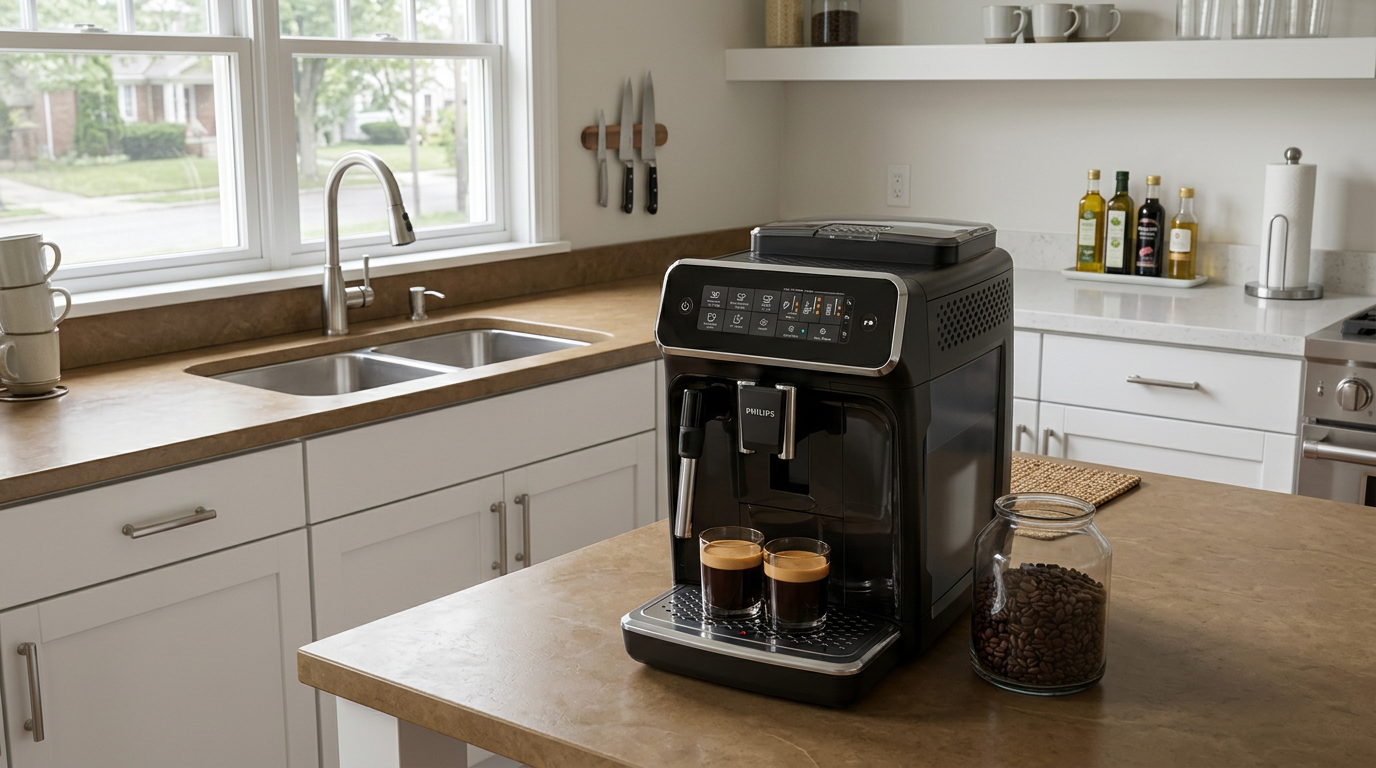
The 3200 brews two espressos side by side, handy when two people want coffee at once.
See Today’s PriceDose and strength: why both taste mild
This is the most important section if you love strong espresso, and it applies to both machines.
To see what they were really brewing, I stopped each machine right after it ground and weighed the coffee. On the strongest setting, the 2200 used about 7.1 grams and the 3200 about 8 grams.
A typical café double espresso uses 14 to 18 grams. So even at full strength, both use roughly half the coffee of a café shot.
Coffee dose compared, weighed
Each Philips figure is the average of several weighed doses.
On the 2200’s medium size, about 6.5 grams made about 40 grams of espresso, a brew ratio✕Brew ratioThe weight of coffee in the basket compared with the weight of espresso in the cup. 16 g in and 32 g out is a 1:2 ratio. of roughly 1:6. A classic espresso is closer to 1:2, so in plain terms both machines make something closer to a lungo✕LungoA longer espresso, pulled with more water through the same coffee. It is lighter in body and less intense than a standard shot..
That is not necessarily a problem. Both tasted pleasant, smooth and low in bitterness; they just are not thick and syrupy.
Espresso quality
With fresh medium-dark beans, the two machines made espresso so similar that I could not reliably tell them apart in a blind test.
On the 2200’s strongest setting and medium size, the shot weighed about 38 grams, with a visible layer of crema✕CremaThe golden, foamy layer on top of a fresh espresso. It forms when pressure pushes oils and gases out of the coffee.. It tasted of dark chocolate with a little sweetness toward the finish.
The 3200’s espresso was smooth, mild and easy to drink, with a thin, even crema and gentle caramel and nut notes. Its slightly bigger dose gave it a touch more body, but only a touch.
Both use a 12-step ceramic grinder adjusted with a knob inside the hopper. Moving two steps finer than the default gave me the best balance on both, and the coarsest settings made thin, watery shots.
My espresso scores
My scores out of 10 for body, crema, flavor and consistency.
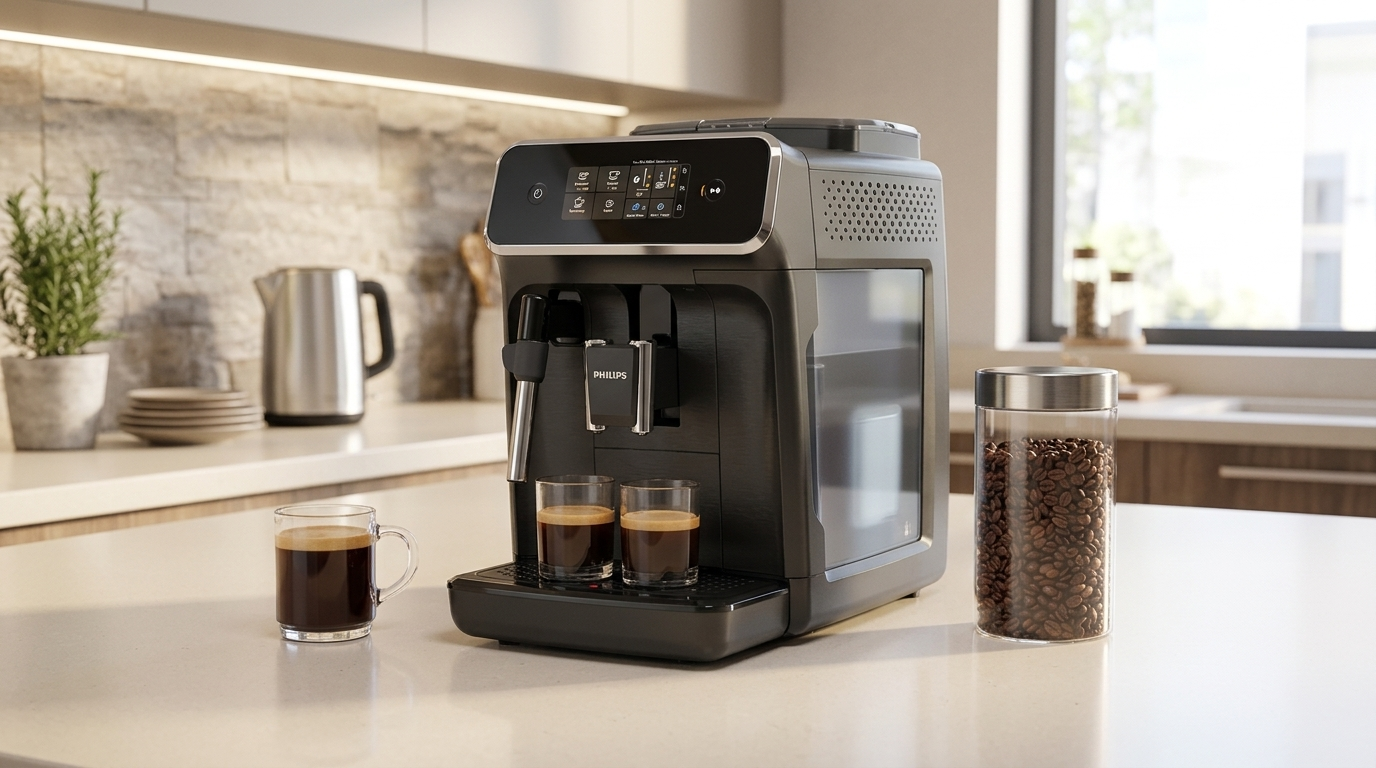
Two shots from the 2200: smooth and chocolatey, but closer to a lungo than a café ristretto.
I measured the 2200’s espresso at about 154 to 158°F in the cup. That is comfortable to drink straight away, and on both machines the cup temperature can be raised one of three levels.
| What you taste | Likely cause | First fix on either machine |
|---|---|---|
| Thin and watery | Too much water for the small dose | Smallest cup size |
| Sour | Under-extracted✕Under-extractionWhen water does not pull enough flavor out of the coffee. The shot tastes sour, thin and watery., grind too coarse | One step finer while grinding |
| Bitter, dry finish | Largest cup size | Drop one size |
| Little crema | Stale beans | Fresh beans with a recent roast date |
| Lukewarm | Cold cup | Warm the cup with hot water first |
Our tip: Turn the grind knob inside the hopper only while the grinder is running, one click at a time, and wait two drinks before judging the change.
Coffee, Americanos and hot water
Both coffee buttons make what many Europeans call a coffee crema: a longer drink brewed under pressure, with a crema layer drip coffee never has.
On the 2200’s medium size with high strength, I got about 3.9 fl oz at about 162°F, smooth and pleasant. The 3200’s coffee was mellow and round, and for people who do not like strong coffee it was one of the nicest cups I made.
The 3200’s Americano button adds hot water to an espresso, so it is lighter in body than its coffee button. Because the base shot is already mild, the Americano is very gentle unless you set the strongest aroma and smallest coffee part.
On the 2200, I made my Americano✕AmericanoA shot of espresso topped up with hot water. Made this way, the coffee is never over-extracted, unlike pushing a whole mug of water through the grounds. by hand: a double espresso, then hot water from the frother. It took ten extra seconds and tasted the same.
Measured drink temperatures in the cup
Measured on the 2200 at the top of the cup with room-temperature cups; the 3200 felt the same.
Hot water at about 183°F is fine for black and herbal tea and a little hot for delicate green tea. I used it constantly for warming cups before espresso on both machines.
| Drink | Philips 2200 | Philips 3200 |
|---|---|---|
| Espresso | Smooth, chocolatey, mild | Smooth, caramel and nut, mild |
| Coffee | About 3.9 fl oz with crema | Mellow, round, crema on top |
| Americano | Double espresso plus hot water | One touch, very gentle |
| Two cups | Double runs two cycles | Two cups side by side |
| Hot water | About 183°F | Same |
Our tip: For a stronger big coffee on either machine, make two espressos into one mug and top them up with hot water instead of using the largest coffee size.
Milk: the bare steam tip vs LatteGo
Here is where the two machines truly part ways, and where your money goes.
The 2200 has a classic frother with a Panarello✕Panarello sleeveA plastic sleeve that fits over a steam wand. It sucks in air through a small hole and whips milk into foam automatically, so you need almost no technique. sleeve. With the sleeve on, it pulls in air and makes a big, light cap of foam with almost no technique.
Pull the sleeve off and you find a plain, single-hole steam tip, the kind you would find on a manual espresso machine. That one detail changes what the 2200 can do.
The 2200 without the sleeve
With a stainless pitcher and the tip near the side to start a whirlpool, I let in air for two or three seconds, then lowered the tip slightly and kept the milk spinning until the pitcher was hot.
The milk came out glossy and silky, with foam and milk properly blended. It was close to what you get from a conventional espresso machine wand, and by week three I was pouring clean hearts most mornings.
The 3200 with LatteGo
On the 3200, you pour cold milk into the two-part LatteGo jug, clip it on and press cappuccino or latte macchiato. Steam draws the milk into a small chamber, mixes in air and pours foam straight into your cup, then the coffee runs on top.
The foam was creamy and fairly fine, and latte macchiatos came out in clean layers. It is not the glossy, pourable microfoam✕MicrofoamMilk foam with bubbles so small you can barely see them. It feels silky and glossy, which is what latte art needs. a skilled barista makes, and you cannot pour latte art with it, but it is clearly better than a sleeve with no technique at all.
Milk system scores, from my testing
My scores out of 10. Texture after practice; convenience includes cleaning.
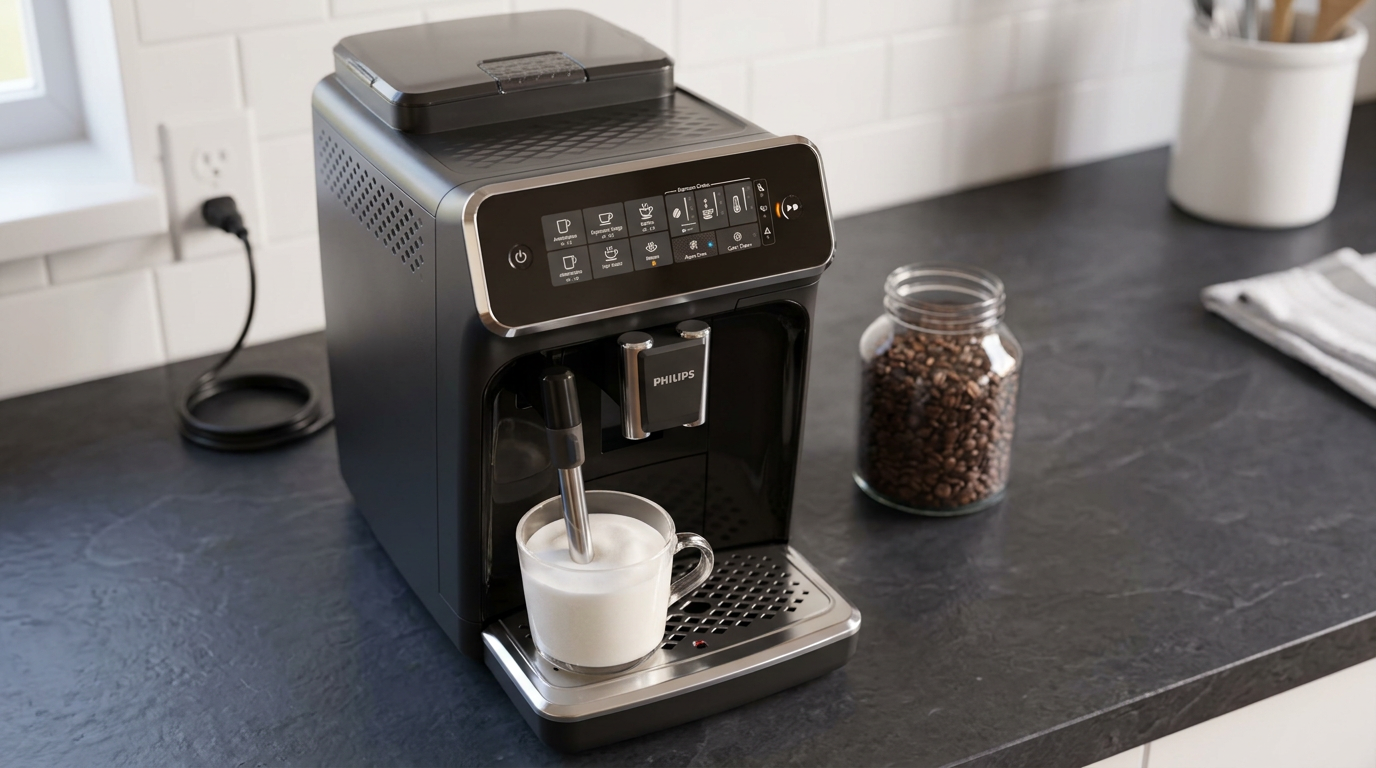
LatteGo makes creamy foam at one touch, with no pitcher and no technique.
| 2200 with sleeve | 2200 bare tip | 3200 LatteGo | |
|---|---|---|---|
| Skill needed | Almost none | Some practice | None |
| Foam | Big, airy | Tiny, glossy microfoam | Creamy, fairly fine |
| Latte art | No | Hearts and simple shapes | No |
| Hands-on time | About 1 minute | About 1 minute | Press a button |
| Cleaning | Wipe and purge | Wipe and purge | Rinse two parts |
Milk drink recipes I made on each
These are the milk drinks I made most on each machine, with the settings that worked.
On the 2200, everything starts with a double espresso on the strongest setting and smallest size. On the 3200, I set the strongest aroma for every milk drink, because the mild espresso is easy to drown in milk.
| Drink | Philips 2200 | Philips 3200 |
|---|---|---|
| Flat white | Double espresso, ~4 oz milk, bare tip, little air | Short cappuccino plus an extra espresso |
| Latte | Double espresso, ~7 oz milk, bare tip | Latte macchiato, more milk |
| Cappuccino | Double espresso, sleeve on, lots of foam | One touch, strongest aroma |
| Cortado | Single espresso, ~2 oz milk, almost no air | Not on the menu |
| Latte macchiato | Milk first, then espresso, by hand | One touch, tall glass |
| Iced latte | Two espressos over ice, cold milk | Two espressos over ice, cold milk |
Milk temperature and sweetness
General steaming guidance that matched my tasting notes on both machines.
There is no flat white button on the 3200, but you can get close: reduce the milk length on the cappuccino, use a small cup and add a second espresso. It will not be true microfoam, but it will be a shorter, stronger milky coffee.
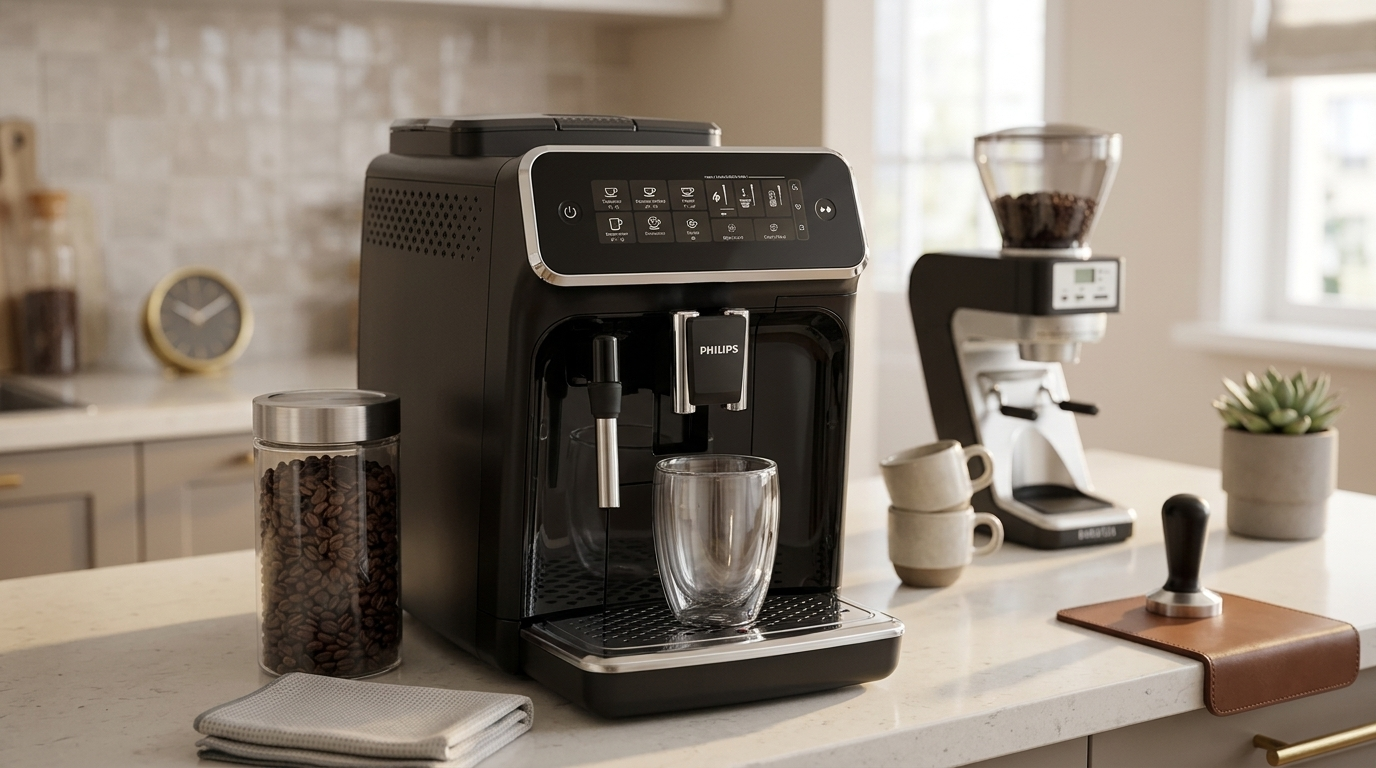
With the bare steam tip, the 2200 makes flat whites and lattes with silky milk.
Our tip: Fill your steaming pitcher only up to the bottom of its spout on the 2200, so the milk has room to spin and expand without spilling.
Cleaning and upkeep
On the coffee side, both machines are identical. They rinse themselves at start-up, drop used pucks into a grounds drawer that holds about a dozen, and have a removable brew group✕Brew groupThe part that compresses the ground coffee, holds it while water passes through and then ejects the used puck. On Philips machines it slides out for rinsing. you slide out from the side for a weekly rinse under the tap.
The brew group’s rails need a thin layer of the included food-safe grease every couple of months. The 2200’s brew group rinse cycle used about 8.45 fl oz of water, so put a big container under the spout.
The milk side is the real difference
On the 2200, I purged the steam tip and wiped it with a damp cloth straight after every milk drink. Milk dries fast on hot steel, so the habit matters.
On the 3200, I rinsed the two LatteGo parts under the tap after each milk drink, which took about ten seconds, and put them in the dishwasher once a day. There are no tubes and no hidden pipes, which makes it one of the easiest milk systems I have used.
My hands-on cleaning time per day
My estimate, not counting automatic rinses.
| When | Philips 2200 | Philips 3200 |
|---|---|---|
| After milk drinks | Purge and wipe the tip | Rinse LatteGo, about 10 s |
| Daily | Empty tray and grounds | Empty tray and grounds, LatteGo in dishwasher |
| Weekly | Rinse brew group | Rinse brew group |
| Every 2 months | Grease the brew group | Grease the brew group |
| When prompted | Replace AquaClean or descale | Replace AquaClean or descale |
| Dishwasher-safe | Drip tray | Drip tray, LatteGo parts |
Our tip: Seat the two LatteGo parts carefully every time you put the jug together, because a loose piece leaks and makes weak foam.
Daily use and noise
My mornings on the 2200 were quick. Switch on, let it rinse into a cup, then espresso on the smallest size while I poured milk into the pitcher; a flat white took about three minutes, including the wipe and purge.
On the 3200, a cappuccino took a little over a minute of machine time and almost no hands-on time. In a house making three or four drinks every morning, one button per person was the whole point.
Hands-on minutes for a milk drink
Average across my weekday mornings, including cleaning the milk side.
Both grinders are loud for about ten seconds, and the steam on both makes a steady hiss. Neither felt unusual for the class, but both are noticeable in a quiet kitchen at 6 a.m.
The 1.8-liter tank lasted about two days on the 2200 and about a day and a half on the 3200, because more people were using it. The small drip tray on the 3200 needed emptying every day.
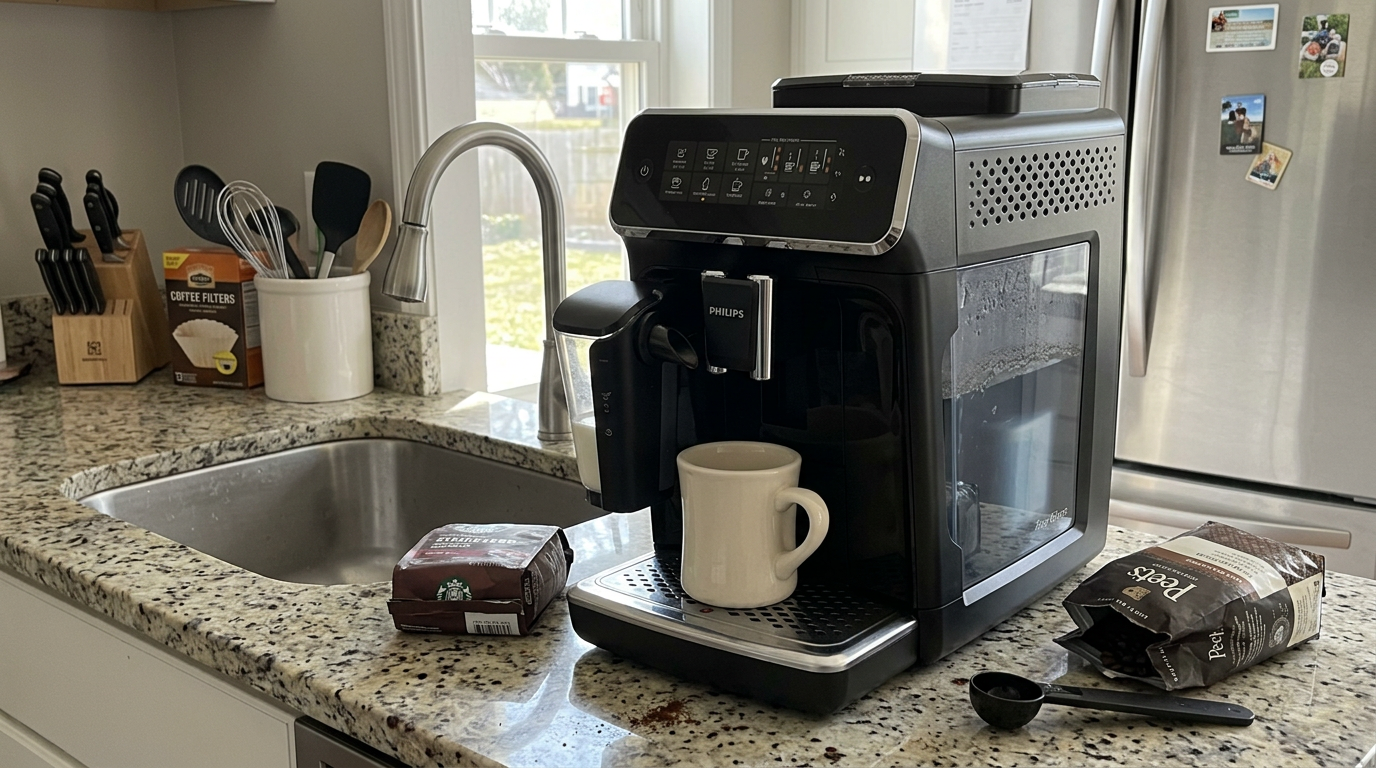
One button per person made the 3200 the easier machine to share.
Roughly how far one 1.8 L tank goes
Rough maths allowing for start-up rinses.
Beans, water and supplies
Because both doses are small, your beans do a lot of the work. Fresh, recently roasted espresso beans made the biggest single improvement on both machines.
Medium-dark roasts with chocolate notes suited the gentle extraction best. A blend with some Robusta gave more crema and caffeine, which helps in milk drinks.
Avoid oily, very dark and flavored beans, which can clog the grinder on both. Use cold, fresh water, keep the AquaClean filter in if your water is hard, and skip distilled water.
Research at the University of Oregon found that uneven extraction can waste up to 40% of the coffee in a puck, and on a small-dose machine you cannot afford to waste any.
| Bean type | Philips 2200 | Philips 3200 |
|---|---|---|
| Medium-dark blend | Best, chocolate and sweet | Best body and sweetness |
| Arabica-Robusta blend | More crema, cuts through milk | More crema and punch |
| Medium roast | Brighter, lighter | Balanced, gentle |
| Light roast | Often sour | Bright, thin |
| Oily or flavored | Avoid | Avoid |
Our tip: Choose beans with a roast date in the last few weeks, because on a small-dose machine freshness matters more than anything else.
Find Out the Price TodayReal-life scenarios
Specs only go so far. These are the situations where one machine clearly pulled ahead during my eight weeks of testing.
Espresso, Americano, cappuccino and latte macchiato, each one button away. Nobody needed a lesson.
Pull the sleeve off and the bare steam tip makes glossy microfoam. LatteGo cannot.
Same espresso, fewer buttons you will not use, and hot water on tap for the Americano.
A ten-second rinse of two parts, then the dishwasher. No pitcher, no wand to wipe.
Two cups side by side in one cycle, instead of two cycles back to back.
The 2200’s sleeve and the 3200’s LatteGo both make big foam with no skill.
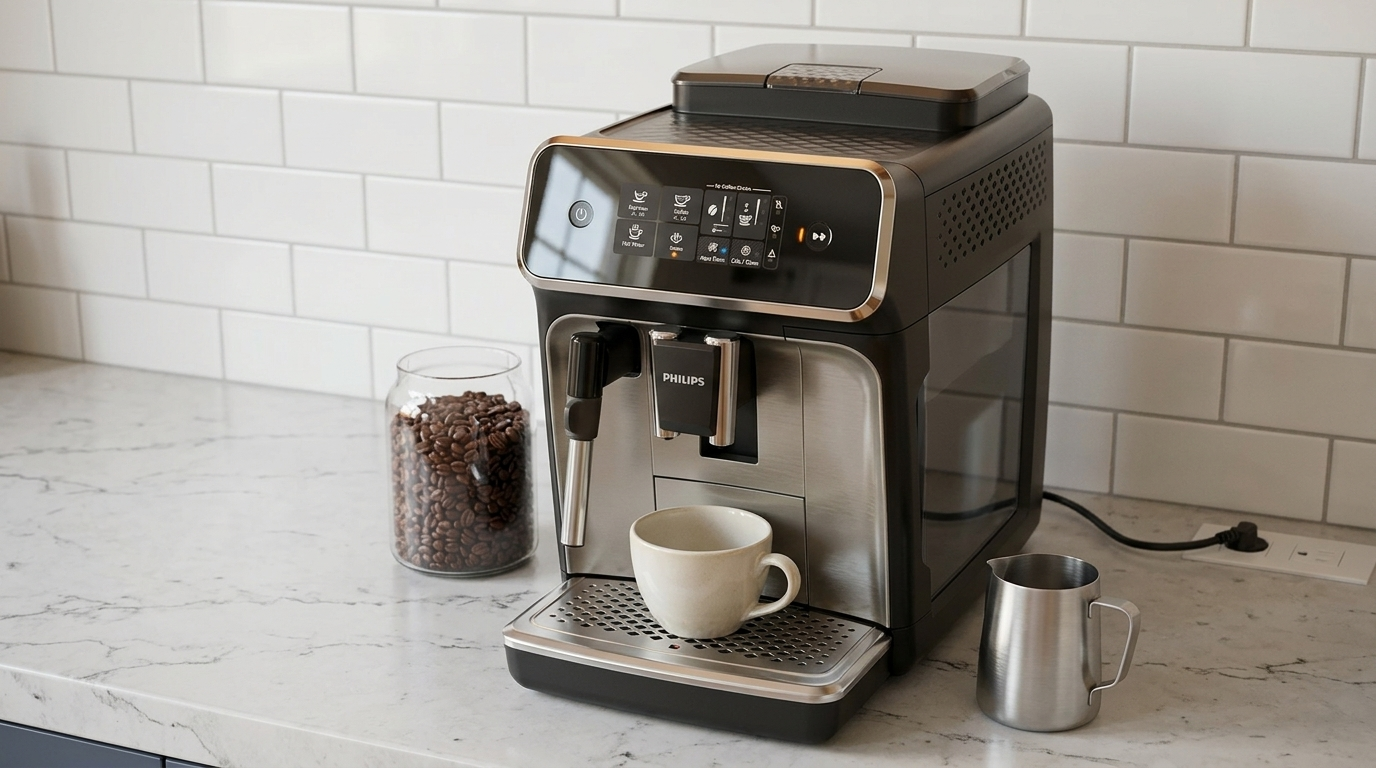
For black coffee and hand-steamed milk, the 2200 does everything the 3200 does.
My scorecard
These are my own scores out of 10. The first four come from my single reviews of each machine, and I added drink range and milk skill ceiling because they decide this matchup.
Philips 2200 Series
Philips 3200 Series
Overall, I rate the 2200 7.9 and the 3200 8.0. That gap is small on purpose: the 3200 is the easier machine to share, and the 2200 is the better machine if you are willing to steam your own milk.
See How Much You’ll SaveWhich one is right for you?
4 quick questionsWhich one should you buy?
It comes down to one question: who is going to make the milk? If the answer is you, with a pitcher, buy the 2200. If the answer is the machine, buy the 3200.
For the full detail, read my Philips 2200 Series review and Philips 3200 Series review, or browse all the coffee makers I have tested.
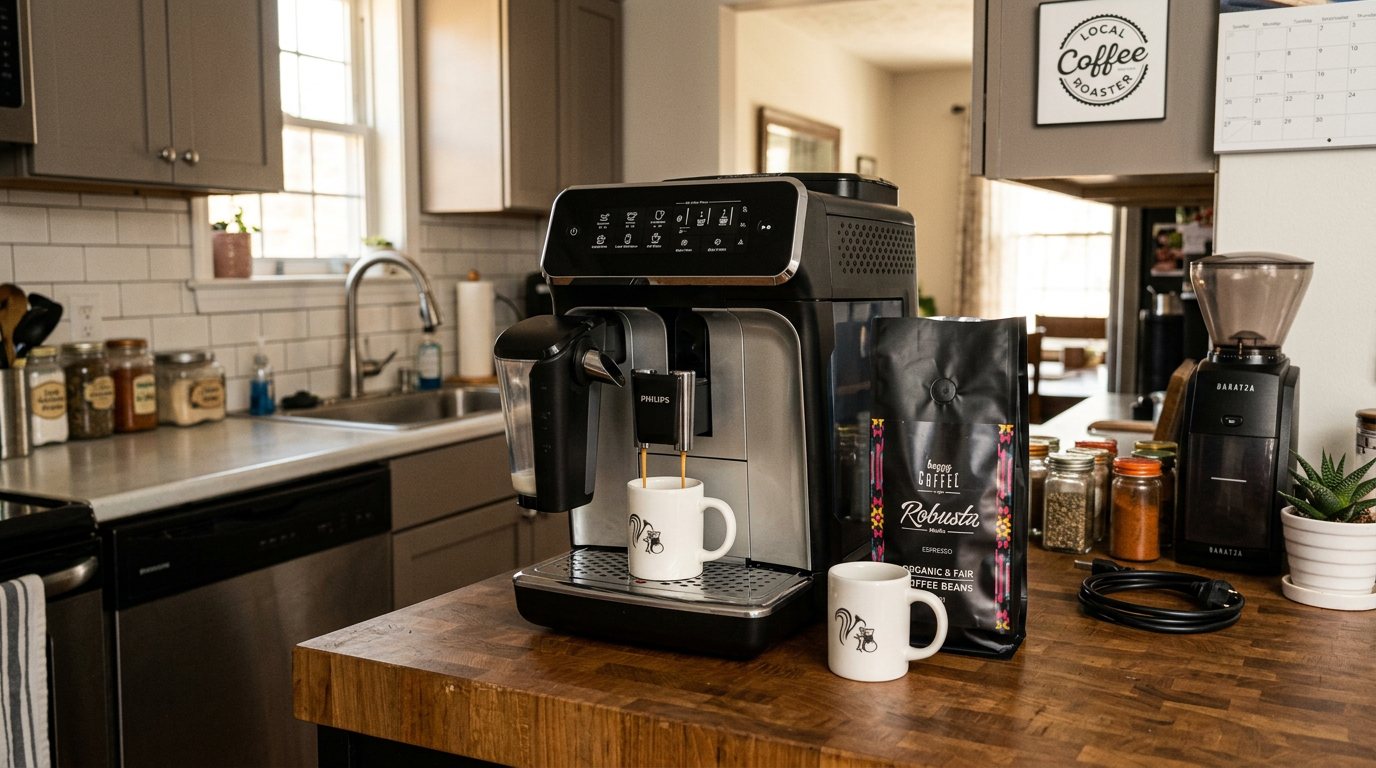
For shared kitchens and daily milk drinks, the 3200 earns its place.
- You mostly drink espresso or Americanos
- You want to learn latte art
- You want the lighter, simpler machine
- You rarely drink milk
- You want one-touch cappuccinos
- Several people share the machine
- You never want to hold a pitcher
- You drink cappuccinos or latte macchiatos daily
- Your household wants different drinks
- You hate cleaning milk systems
- You want two cups at once
- You want latte-art microfoam
- You only drink black coffee
- You want strong, syrupy espresso
For most households, my pick is the Philips 3200 Series. LatteGo makes creamy milk drinks at one touch and is the easiest milk system I know to clean, and the extra Americano and latte macchiato buttons make it the machine everyone in the house can use. Set the strongest aroma for milk drinks and it fixes its biggest weakness.
The Philips 2200 Series is the smarter buy if you mostly drink black coffee or want to learn to steam milk properly. Its espresso is just as good, and its hidden steam tip can do something LatteGo never will: pour latte art.
Whichever you choose, buy fresh medium-dark beans, use the strongest, smallest espresso setting and keep the AquaClean filter fresh. Both machines reward a little care with years of easy coffee.
Philips 2200 vs 3200 specifications
From manufacturer specifications and my own testing.
| Philips 2200 Series | Philips 3200 Series | |
|---|---|---|
| Model | EP2220 | EP3241 |
| Type | Fully automatic, classic frother | Fully automatic, LatteGo |
| One-touch drinks | Espresso, coffee | Espresso, coffee, Americano, cappuccino, latte macchiato |
| Pump pressure | 15 bar | 15 bar |
| Grinder | 100% ceramic, 12 settings | 100% ceramic, 12 settings |
| Measured max dose | About 7.1 g | About 8 g |
| Strength levels | 3, plus pre-ground | 3, plus pre-ground |
| Temperature settings | 3 | 3 |
| Milk system | Panarello sleeve, removable to a steam tip | LatteGo, 0.26 L / 8.8 fl oz jug |
| Bean hopper | 275 g / 9.7 oz | 275 g / 9.7 oz |
| Water tank | 1.8 L / 61 fl oz | 1.8 L / 61 fl oz |
| Water filter | AquaClean, included | AquaClean, included |
| Power | 1,500 W | 1,500 W |
| Dimensions (W x H x D) | 9.7 x 14.6 x 17 in | 9.7 x 14.6 x 17 in |
| Weight | About 16.5 lb | About 17.6 lb |
| Warranty | 2 years limited | 2 years limited |
How I tested and compared them
I used each machine as my everyday coffee maker for four weeks, making espresso, coffee crema, Americanos, cappuccinos, flat whites, latte macchiatos and tea. Testing notes were written up together by Michael Reynolds and the HouseholdMe team.
I weighed doses by stopping each machine after grinding, measured drink volumes and cup temperatures, steamed whole and oat milk with and without the 2200’s sleeve, and timed every milk routine.
I followed every rinse, brew group and AquaClean routine, then checked my notes against Philips’ specifications, user manuals and published espresso research.
- Coffee: dose, crema, body, flavor and consistency.
- Milk: foam texture, temperature, speed and drink range.
- Workflow: heat-up, controls, guidance and daily routine.
- Ownership: cleaning, water care, noise and footprint.
Philips 2200 vs 3200 FAQ
Is the Philips 3200 worth the extra money over the 2200?
Yes, if your household drinks milk drinks at one touch or several people share the machine. The 3200 adds Americano, cappuccino and latte macchiato buttons and the LatteGo jug. If you mostly drink black coffee or want to steam milk yourself, the 2200 is the better value.
What is the main difference between the Philips 2200 and 3200?
The milk system and the drink menu. The 2200 has a classic frother with a removable sleeve and makes espresso and coffee. The 3200 has the LatteGo jug and five one-touch drinks. The body, grinder, tank and brew group are the same.
Which makes better espresso?
They are very close. The 3200 uses a slightly bigger dose, about 8 grams against about 7 grams, but both make mild, lungo-style espresso. Use the strongest strength and smallest size on either.
Can the Philips 2200 make latte art?
Yes. Pull off the Panarello sleeve and the 2200 has a single-hole steam tip that can make glossy microfoam. By week three I was pouring clean hearts most mornings.
Can LatteGo make latte art?
No. LatteGo makes creamy, fairly fine foam that is great for cappuccinos and latte macchiatos, but it is not pourable microfoam.
How do you clean LatteGo?
Rinse its two parts under the tap after each milk drink, which takes about ten seconds, and put them in the dishwasher once a day. There are no tubes.
Are the Philips 2200 and 3200 the same size?
Yes. Both are about 9.7 inches wide, 14.6 inches tall and 17 inches deep. The LatteGo jug adds a little depth at the front of the 3200.
Do both come with an AquaClean filter?
Yes. Replaced when prompted, Philips says it lets you go up to 5,000 cups without descaling.
Do both have a removable brew group?
Yes. It slides out from the side for a weekly rinse and needs a thin layer of grease every couple of months.
Can either make two drinks at once?
The 3200 brews two espressos or two coffees side by side. The 2200’s double runs two full brew cycles into one cup or two cups.

- Our hands-on Philips 2200 Series review
- Our hands-on Philips 3200 Series review
- Philips product specifications and user manuals
- The perfect shot of espresso every time with chemistry, University of Oregon research
- General espresso brewing, milk steaming and maintenance guidance