De’Longhi Dedica vs CASABREWS CM5418
Two of the slimmest pump espresso machines you can buy, both about 6 inches wide and both built around forgiving pressurized baskets. The De’Longhi Dedica EC680R adds ESE pod support, a cup warmer and an aerating milk sleeve. The CASABREWS CM5418 adds a pressure gauge and a steam wand that can make latte-art milk with practice. I used each one for four weeks to find the better small machine.
We choose products independently. We may earn a commission when you buy through our links. Affiliate policy
Jargon helpNew to espresso? Tap any dotted term to see what it means.
In this comparison
Buy the De’Longhi Dedica EC680R for the better machine out of the box. Its shots tasted rounder, it takes ESE pods for zero-mess mornings, and its aerating sleeve makes thick cappuccino foam with no skill. Buy the CASABREWS CM5418 if you want to learn milk steaming properly or upgrade toward real espresso later. Its plain steam wand and pressure gauge give you more room to grow.
The two machines
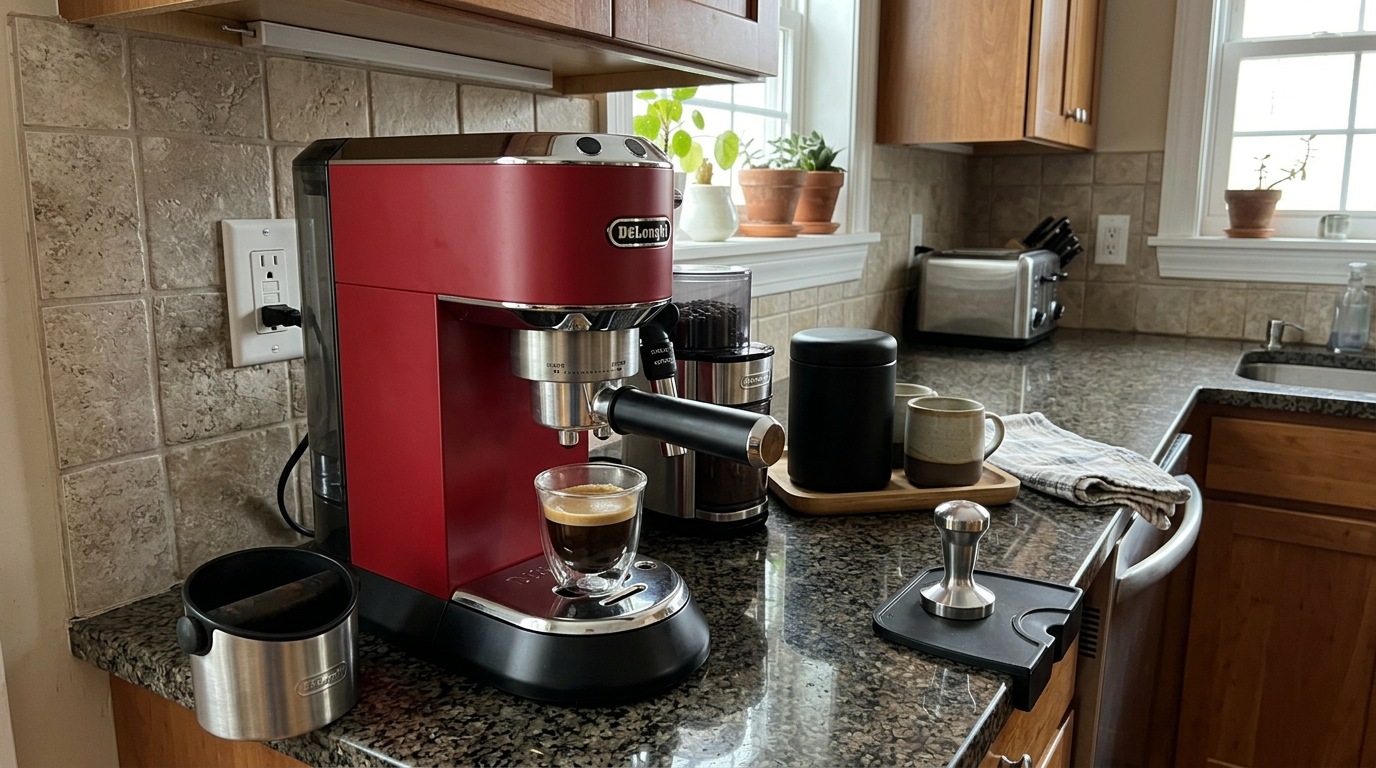
Specs checked November 24, 2026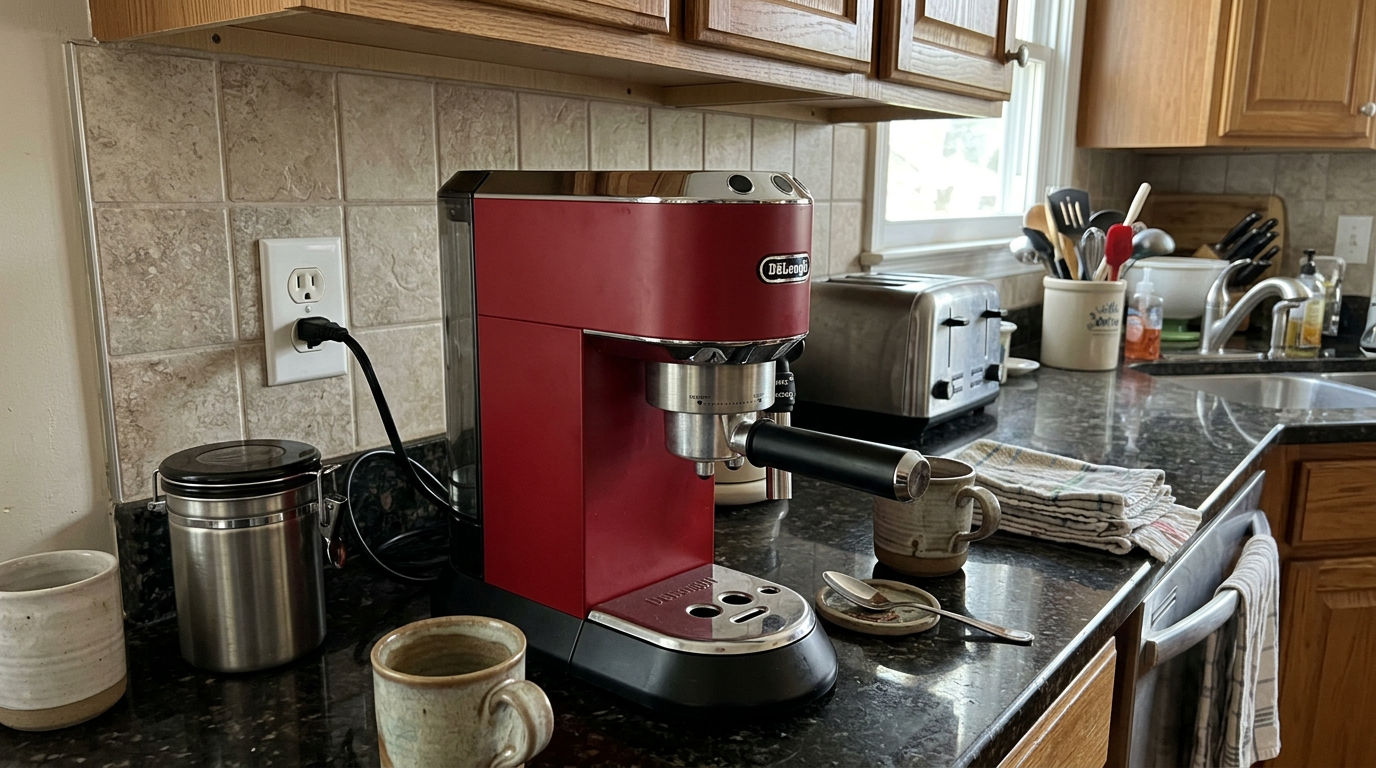
About 6 inches wide, ready in about 40 seconds, with pressurized baskets including one for ESE pods, a cup warmer and a frothing wand with an aerating sleeve.
Check price on Amazon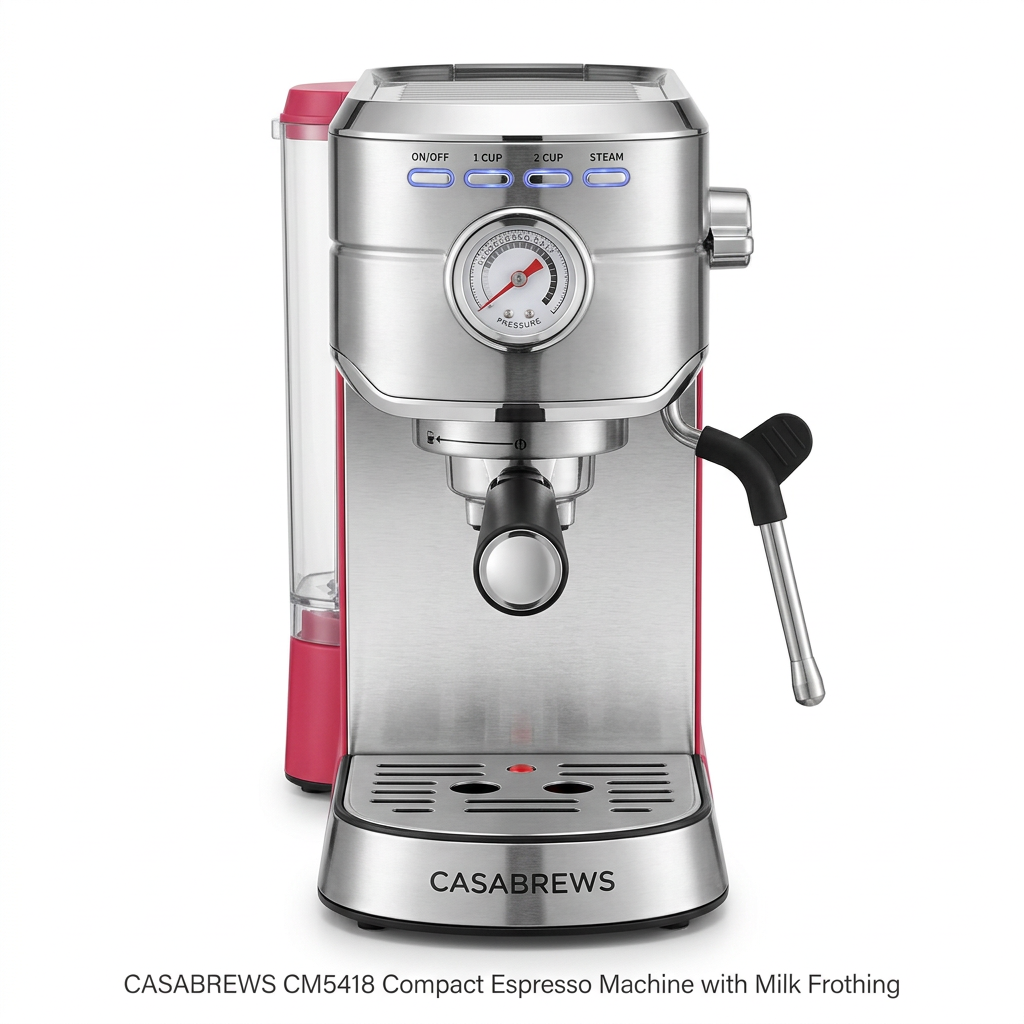
A slim stainless machine with a 20-bar pump, a front pressure gauge, pressurized baskets and a single-hole steam wand that doubles as a hot water outlet.
Find Out the Price TodayDedica vs CM5418 at a glance
- Both are pump machines about 6 inches wide, with pressurized baskets that forgive pre-ground coffee.
- The Dedica made the better espresso out of the box and adds ESE pods, a cup warmer and a taller-glass drip tray.
- The Dedica’s aerating sleeve makes thick foam easily, but the CM5418’s plain wand can make smoother, latte-art milk once learned.
- Choose the Dedica as an appliance; choose the CM5418 as a project.
Head to head
The better result in each row is marked, based on my four weeks with each machine and the manufacturer specs.
These two are closer in size and idea than any pair in this series. The Dedica wins on polish and convenience; the CM5418 wins on what you can learn and upgrade.
| Spec | Dedica | CM5418 |
|---|---|---|
| Stock espressomy tasting, same coffee | Full body, chocolatey ✓ Best | Thick crema, flatter |
| ESE pods | Yes, dedicated basket ✓ Best | No |
| Milk, day one | Thick foam, no skill ✓ Best | Smooth milk takes practice |
| Milk, week four | Foamy, hard to pour art | Smooth, simple tulips ✓ Best |
| Pressure gauge | No | Yes ✓ Best |
| Upgrade pathmy testing | Designed around its baskets | Three-tab portafilter, single-wall ✓ Best |
| Cup warmer | Passive, on top ✓ Best | Mugs stack on top |
| Tall glasses | Two-level drip tray ✓ Best | Small cups only |
| Width | About 6 in | About 5.5 to 5.9 in |
| Water tank | About 35 oz | About 34 oz |
| Rows won | 5 | 3 |
The Dedica takes the tally and the taste test. If you see your machine as something to learn on and improve, the CM5418’s three rows may matter more.
Is It On Sale? Check NowDedica vs CM5418 pros and cons
De’Longhi Dedica EC680R
- Only about 6 inches wide
- Forgiving baskets make easy crema, plus ESE pods
- Ready in about 40 seconds
- Less control than single-wall baskets
- Aerating sleeve limits milk texture
- Steam needs recovery between drinks
CASABREWS CM5418
- Pressure gauge shows what each shot is doing
- Plain wand can make latte-art milk
- Big jump in quality with cheap upgrades
- Stock espresso can taste flat
- Modest steam, slow for big jugs
- Narrow tank is easy to spill
Who should buy which machine?
- Beginners who want it right out of the box
- Cappuccino lovers who like thick foam
- Rushed mornings with ESE pods
- People who want to learn latte art
- Tinkerers who plan to upgrade
- Anyone who likes a pressure gauge
Pump espresso, tiny footprint
Both are semi-automatic✕Semi-automatic espresso machineA machine where you dose and tamp the coffee into the portafilter yourself, and the machine controls the water and stops the shot. pump machines. A pump pushes water through finely ground coffee at high pressure, which is how real espresso is made, unlike steam espresso makers that brew at a few bar.
The Dedica uses a 15-bar pump; the CM5418 a 20-bar pump. Both numbers are maximum ratings. Good espresso is extracted at about 9 bar at the coffee, so neither has a real advantage here.
Both heat water with a thermoblock✕ThermoblockA metal block with water channels that heats water on demand. Fast and compact, but less precise than PID-controlled systems. rather than a boiler, which is why they warm up so quickly.
| Feature | Dedica | CM5418 |
|---|---|---|
| Pump rating | 15 bar | 20 bar |
| Heater | Thermoblock | 1,350 W thermoblock |
| Shot buttons | Single and double, flow stop | Single and double |
| Milk | Wand with aerating sleeve | Single-hole wand |
Our tip: Ignore the bar numbers on the box; good espresso is extracted at about 9 bar, and both machines get there.
So the bigger differences are not in the pump or heater. They are in the baskets, the milk wand and the small conveniences around them.
Design, size and build
Side by side, these are the two narrowest pump machines I have tested. The Dedica is about 6 inches wide, 13 inches deep and 12 inches tall. My red test unit looked more like a design object than an appliance.
The CM5418 is about 5.5 to 5.9 inches wide, 12.3 inches deep and 12 inches tall, with a brushed steel front and a round pressure gauge in the middle of its face.
The Dedica has three controls on the front, single, double and steam, with a steam knob on the side. The CM5418 has a similar layout, with its wand hanging off the right side.
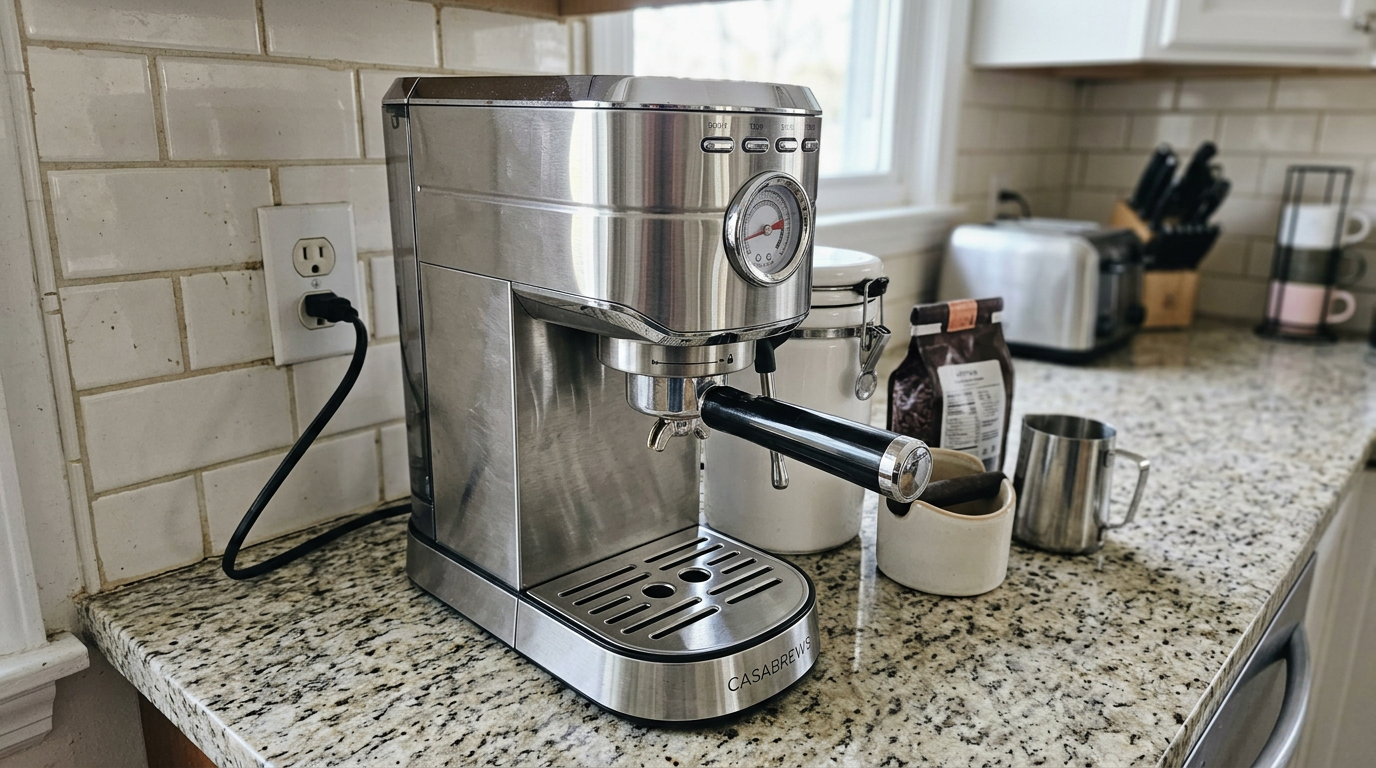
The CM5418 squeezed between a toaster and a knife block.
Two Dedica details made daily life easier. Its passive cup warmer on top kept cups ready, and its two-level drip tray let a tall glass slide under the spouts for iced lattes.
The CM5418 is lighter and slid slightly when I locked in the portafilter, so I steadied it with my other hand.
Both tanks sit at the back. Under low cabinets, I slid each machine forward to lift the tank out, which became second nature after a few days.
Our tip: Measure the depth of your counter as well as the width; both machines are about 12 to 13 inches deep.
Setup and first shots
Setup took about ten minutes on each. I ran a full tank of water through the Dedica’s group and wand to flush out any factory taste.
The CM5418’s narrow tank has a small opening, and I splashed water down the back on day one, so I filled it at the sink after that.
My first shot on both, with supermarket pre-ground espresso, came out with a layer of crema. The Dedica’s tasted fuller; the CM5418’s looked better than it tasted, with a tall foam on top and a thinner, slightly bitter body.
| Setup step | Dedica | CM5418 |
|---|---|---|
| Time to first shot | About 10 minutes | About 10 minutes |
| In the box | Single, double and ESE baskets, tamper | Single and double baskets, scoop-tamper |
| Milk jug included | No | No |
| First drinkable shot | First try | First try, better in milk |
Our tip: Fill the CM5418’s narrow tank at the sink, not on the machine; it spills down the back.
Baskets and ESE pods
Both ship with pressurized baskets✕Pressurized (dual-wall) basketA filter basket with a double floor and one tiny exit hole. It builds pressure for you, so even coarse or pre-ground coffee makes a foamy crema. that build pressure for you, so pre-ground coffee and a light tamp still make crema.
The Dedica adds a third basket for ESE pods✕ESE (Easy Serving Espresso) podsRound paper pods of pre-ground, pre-pressed coffee made to a shared standard, so they fit many espresso machines.: paper pods of pre-ground, pre-pressed coffee. On rushed mornings, they were the fastest, cleanest espresso I made in this test.
The CM5418 has no pod option, but its basket path is more open: with a compatible three-tab portafilter, it takes standard single-wall baskets.
| Option | Dedica | CM5418 |
|---|---|---|
| Pre-ground espresso | Very good | Good |
| ESE pods | Yes | No |
| Fresh beans, medium-fine | A little sweeter | A little sweeter |
| Single-wall upgrade | Not designed for it | Tested, big gain |
ESE pods on the Dedica
The ESE basket deserves its own note, because it changed how I used the Dedica on busy days.
Drop a pod in, lock the portafilter, press the button, then throw the pod away. There is no grinding, no dosing, no tamping and no grounds on the counter.
The coffee was decent rather than great, about a point below fresh beans in my tasting. For a quick Americano before leaving the house, I reached for a pod more than once.
The CM5418 has nothing similar, so if zero-mess mornings appeal, that alone may decide it.
| Option on the Dedica | Mess | Flavor | Best for |
|---|---|---|---|
| ESE pod | None | Fair | Rushed mornings |
| Pre-ground, double basket | Some | Good | Everyday cappuccinos |
| Fresh beans, double basket | Some | Best | Weekends |
Dose and tamp
Both double baskets took about 14 to 15 grams. I weighed the dose for the first week on both, which stopped my shots swinging between watery and bitter.
Both tampers are basic. For pressurized baskets, a light, level press is all you need. Wiping the basket rim before locking in prevented most leaks on both.
The Dedica’s flow stop lets you reprogram the single and double volumes. I set the double to my favorite size on day one, which saved me stopping shots by hand.
| Prep detail | Dedica | CM5418 |
|---|---|---|
| Double dose | About 14 to 15 g | About 15 g |
| Tamp | Light and level | Light and level |
| Shot volume | Programmable flow stop | Programmable |
| Feedback | Taste and crema | Pressure gauge |
The CM5418’s gauge rose almost whatever I did with the stock basket, so it taught me less than I hoped. It only became a real teacher once I upgraded to a single-wall basket.
One habit helped on both: tapping the portafilter gently to level the grounds before tamping. Uneven grounds made the shot run faster on one side.
Espresso quality
For machines this small, both make genuinely good espresso for milk drinks. The Dedica’s shots had a steady crema, full body and a balanced, chocolatey flavor with medium-dark beans.
The CM5418’s shots ran fast and smooth under a tall, golden foam, but tasted thinner and slightly bitter on their own.
In blind tastings with the same pre-ground coffee, I picked the Dedica eight times out of ten. In a latte, the gap almost disappeared.
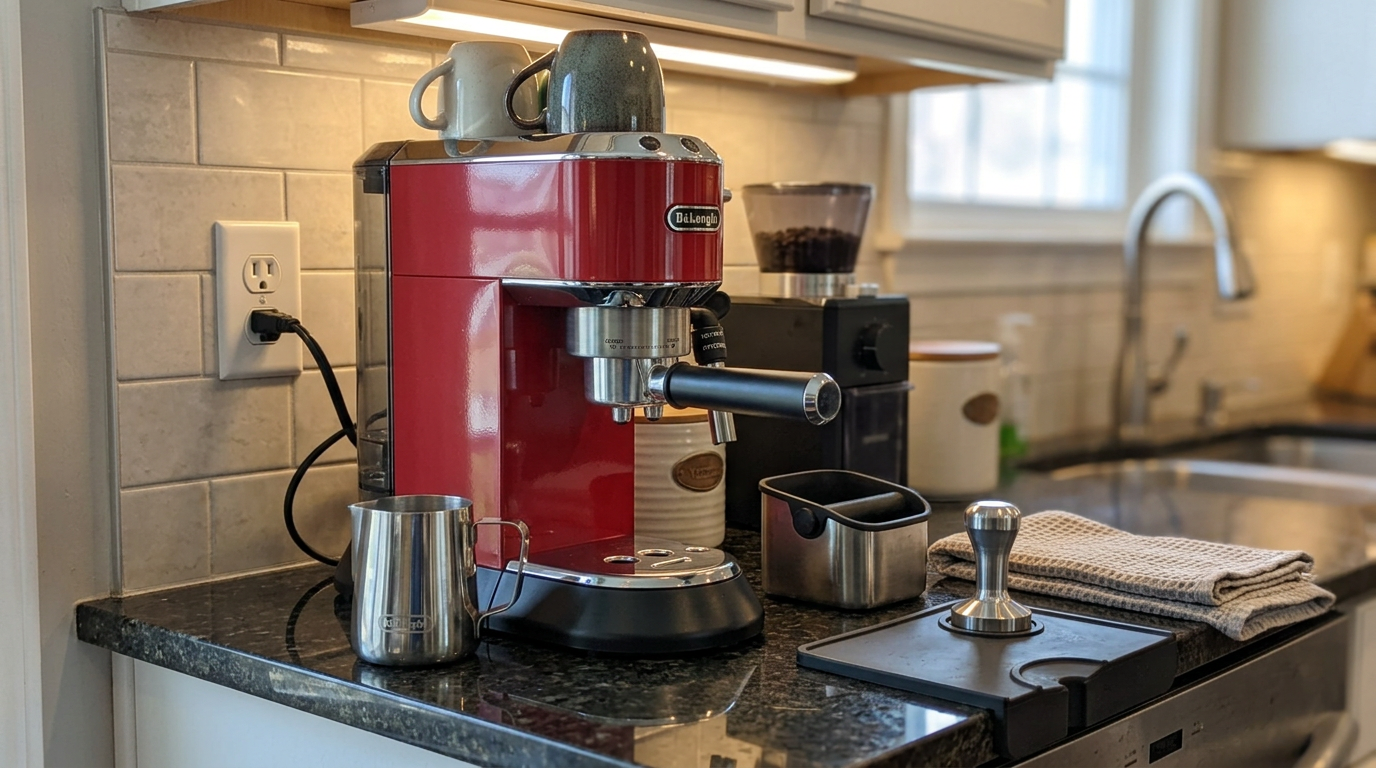
The Dedica made the rounder shot of the two in my blind tastings.
My espresso ratings
Ratings out of 10 from my tasting notes, same coffee where possible.
| What you taste | Likely cause | First fix on both |
|---|---|---|
| Weak, watery | Grind too coarse or dose too low | Espresso grind, fill the basket |
| Bitter, slow | Grind too fine for the basket | Go a step coarser |
| Leaks around the group | Grounds on the rim | Wipe the rim |
| Lukewarm | Cold cup and machine | Warm the cup, run a blank shot |
If you are still choosing beans, my guide to coffee roast levels explains how roast changes flavor.
Reveal Today’s DealFresh beans helped both. Ground just before brewing at a medium-fine setting, they made sweeter shots with more aroma, though the jump was smaller than on a machine with single-wall baskets.
Very dark, oily supermarket beans tasted bitter on both when brewed straight, but worked well in milk.
Heat-up and speed
The Dedica was ready in about 40 seconds from cold. The CM5418 took a similar time, under a minute, before its lights settled.
Both need a short wait to switch from brewing to steam, and neither can brew and steam at once. The Dedica also needed time to recover after a second milk drink before the steam was strong again.
Switch-on to first sip
My timings, including dosing and a quick wipe of the wand.
Both switch themselves off when idle, so neither keeps water hot all morning.
Temperature and cup warming
Neither machine has digital temperature control, so warming everything up made a real difference on both.
On the Dedica, I kept cups on the passive warmer on top and ran a short blank shot through the empty portafilter. My first espresso of the day was noticeably hotter for it.
On the CM5418, I warmed cups with a splash of hot water from the wand and ran a blank shot too. Without that, the first shot was lukewarm.
After the first shot, both made hot, drinkable espresso, and temperature stayed reasonably steady for a second and third.
| Habit | Dedica | CM5418 |
|---|---|---|
| Warm the cup | Cup warmer on top | Water from the wand |
| Blank shot first | Yes | Yes |
| First shot without warming | Cooler | Lukewarm |
Milk steaming
The two wands take opposite approaches, and this is where your choice really lies.
Dedica: aerating sleeve, easy foam
The Dedica’s wand has an aerating sleeve, often called a panarello✕Panarello (aerating sleeve)A sleeve over the steam wand that sucks in air, so it makes foam easily. It makes thick foam rather than fine, silky microfoam.. It pulls air into the milk for you, so thick cappuccino foam came out right on the first morning.
The catch is texture: the foam was big and airy rather than glossy, which made latte art hard.
CM5418: plain wand, more control
The CM5418’s single-hole wand makes no foam for you. In week one, my milk was flatter and bubblier than the Dedica’s.
With a 12-ounce jug a third full, I learned to build a whirlpool, and by week three I was pouring simple tulips. The steam is modest, so one drink at a time worked best.
Milk texture over four weeks
My texture ratings out of 10 with cold whole milk. The Dedica starts higher; the CM5418 ends higher.
| Milk feature | Dedica | CM5418 |
|---|---|---|
| Wand | Aerating sleeve | Single-hole tip |
| Best drink | Cappuccino | Latte, flat white |
| Latte art | Difficult | Simple tulips with practice |
| Back-to-back | Needs recovery | Modest steam, small jugs |
| Barista oat milk | Foamy | Smooth with practice |
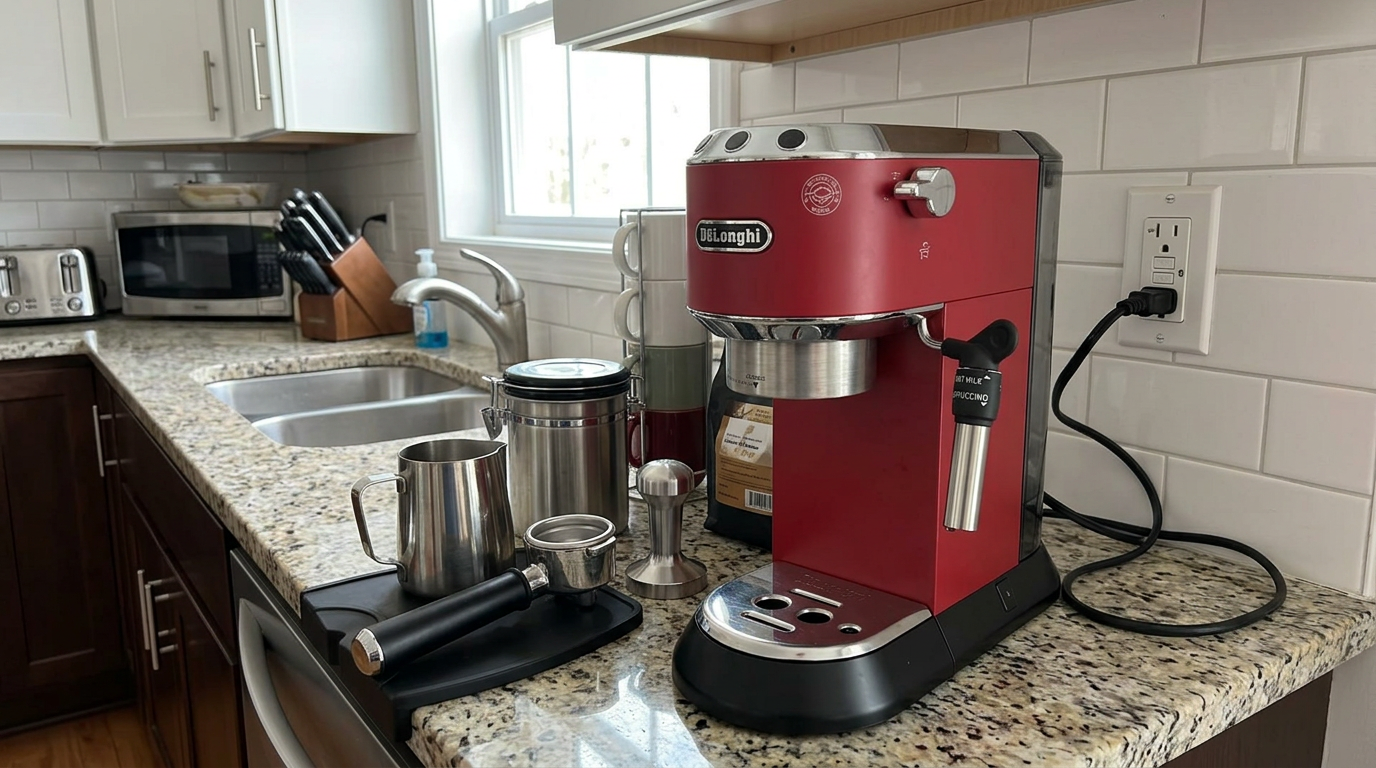
The Dedica beside my sink, milk pitcher ready for a cappuccino.
Our tip: After steaming on either machine, tap the jug on the counter and swirl it for a few seconds to pop big bubbles.
See How Much You’ll SaveIf you want the Dedica’s ease with smoother milk, you can slide off its outer sleeve and steam with the bare tip. It gave me a little more control, but the wand is short and the steam modest, so it never matched the CM5418 by week four.
Hot water, Americanos and tea
Both send hot water through the steam wand using the side knob.
For an Americano✕AmericanoEspresso topped up with hot water. Adding the water after the shot keeps more of the crema., I brewed a double into a mug and added water from the wand. On the CM5418, this softened the bitter edge of its stock shots nicely.
The Dedica’s steam needed a short recovery after hot water, so for an Americano and a cappuccino together, I made the milk first.
| Drink | Dedica | CM5418 |
|---|---|---|
| Americano | Good | Very good, softens bitterness |
| Iced latte | Tall glass on lower tray | Brew into a cup, pour over ice |
| Long black | Water first, shot on top | Water first, shot on top |
| Tea for one | From the wand | From the wand |
For tea, both wands spat for the first second, so I purged over the drip tray before holding the mug underneath. A kettle was still quicker for more than one cup.
Upgrades: the CM5418’s strong suit
If you see your first machine as a project, this section decides it. I took the CM5418 from stock to a three-tab 51 mm portafilter with a single-wall basket, a burr grinder, a metal tamper and a WDT tool✕WDT (Weiss Distribution Technique)Stirring the ground coffee with thin needles to break up clumps before tamping, which helps water flow evenly.. Its straight espresso rose from about 6 to 8 out of 10.
The stock CM5418 portafilter did not take the standard single-wall baskets I tried, so the new portafilter was part of the plan.
The Dedica is designed around its own pressurized baskets. I did not modify it. Fresh beans from a burr grinder made its shots sweeter, but the basket still capped the flavor.
How each upgrade changed CM5418 espresso
My average ratings out of 10, same beans and machine.
For why burr grinders matter so much, see my guide to burr vs blade grinders.
If you only ever drink lattes and cappuccinos, you may never need any of this. Plenty of owners use both machines exactly as they come for years.
Cleaning and upkeep
Neither has a three-way valve✕Three-way solenoid valveA valve that releases leftover pressure from the group after the shot, leaving a drier coffee puck., so both leave a wet puck. I let it rest a minute before knocking it out.
The Dedica’s aerating sleeve needs rinsing after every milk drink and a proper wash every few days, or milk dries inside. It also has a descaling alert. The CM5418’s plain wand just needs a wipe and a purge, but its pressurized basket hole needs clearing weekly.
| When | Dedica | CM5418 |
|---|---|---|
| After milk | Rinse and purge the sleeve | Wipe and purge the wand |
| Daily | Empty tray, rinse baskets | Empty tray, rinse baskets |
| Every few days | Wash the sleeve | Brush the gasket |
| When prompted | Descale, alert light | Descale every 2 to 3 months |
My daily hands-on cleaning time
My estimates, not counting descaling.
Our tip: Leave the cup under the spouts for five seconds after the shot to catch the last drips on either machine.
Descale both every two to three months, or sooner with hard water. Skipping it is the quickest way to weak steam and slow shots on a thermoblock machine.
Noise
Both have the usual short vibration-pump buzz. The CM5418 rattled a touch more on my granite, because it is lighter. Steaming was a steady hiss on both, with a little gurgle from the Dedica’s sleeve.
Neither has a built-in grinder, so with pre-ground coffee the whole routine was pleasantly quiet on both. If you add a burr grinder for the CM5418 upgrade, it will be the loudest part of the setup.
Beans, water and long-term care
The tanks are almost identical: about 35 ounces on the Dedica, with a level window on the side, and about 34 ounces on the CM5418. Both lasted me two or three days.
Never let the Dedica’s tank run dry; the pump can struggle to re-prime. If the CM5418’s pump cannot draw water after a refill, reseating the tank and running hot water through the wand fixed it for me.
Medium-dark roasts tasted best on both with the stock baskets, especially in milk. My guide to water chemistry for coffee explains why filtered water helps.
Our tip: Refill the Dedica’s tank before it runs dry; re-priming the pump is a nuisance.
Use filtered water and refresh the tank daily on both. Stale water tastes flat and builds scale faster in the thermoblock.
Serving guests
Four milk drinks took about 14 minutes on the Dedica and about 15 on the CM5418. On both, I brewed all the shots first, then frothed in two smaller jugs.
The Dedica’s steam needed recovery between jugs; the CM5418’s modest steam simply worked slowly. For Americanos, both kept up easily.
Four milk drinks, start to finish
Including dosing, steaming and wiping between jugs.
The Dedica’s cup warmer helped with guests: four cups sat warming on top while I worked through the shots.
Build quality and long-term ownership
The Dedica mixes metal-finished panels with plastic parts, and its glossy finish wiped clean easily. The CM5418 has a steel front and top, with more plastic around the sides and base.
Neither gave me a fault in four weeks. The CM5418’s 51 mm size makes aftermarket parts easy to find.
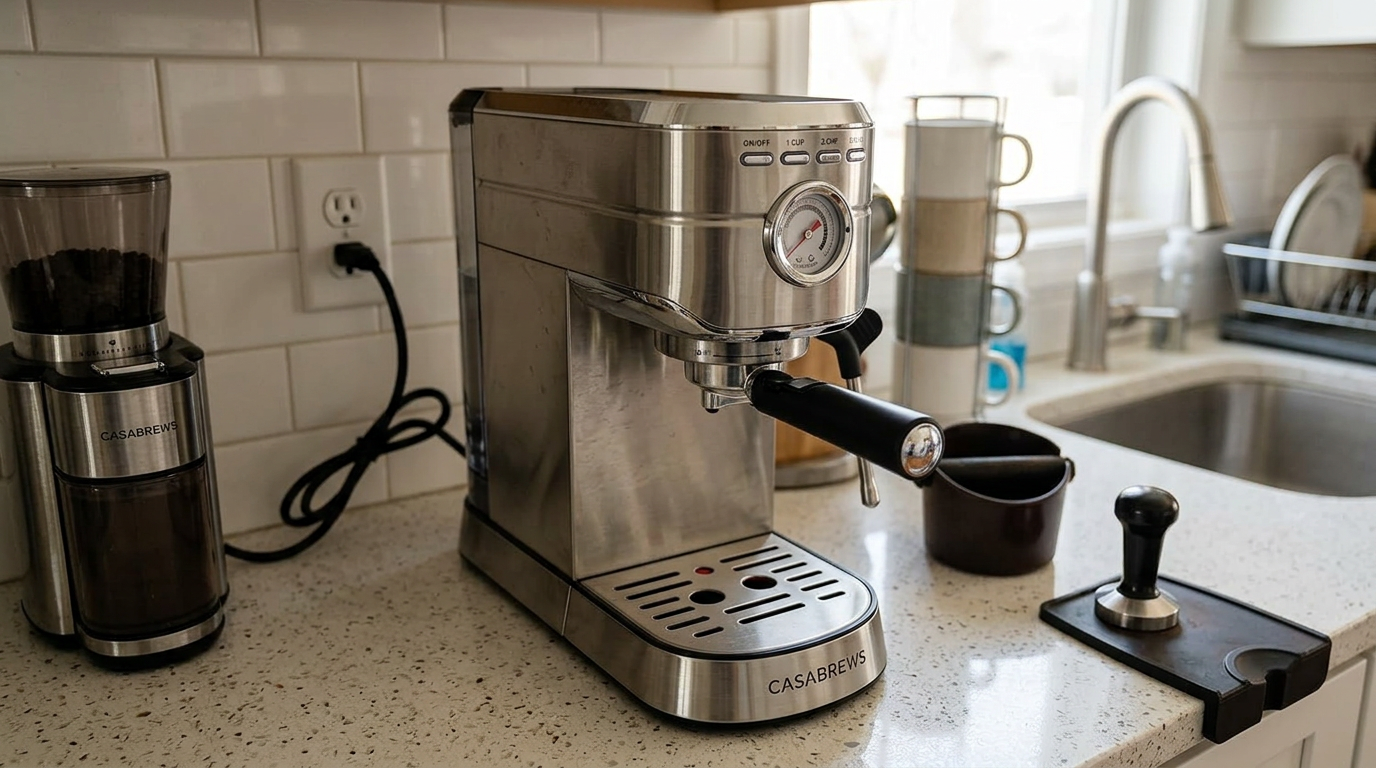
The CM5418 with the grinder and knock box I added for the upgrade test.
On looks, the Dedica wins for me. Its slim, glossy body and clean front made it the machine visitors asked about. The CM5418’s brushed steel and gauge look more like a classic espresso machine, which some people will prefer.
Mistakes to avoid
Grinding very fine for either machine. Both choked and turned bitter.
Steaming on the Dedica before the light stops flashing. The steam was weak and watery.
Steaming a big jug on the CM5418. The whirlpool weakened and the foam was uneven.
Buying single-wall baskets for the stock CM5418 portafilter. They may not fit; budget for a three-tab portafilter.
| Problem | Fix |
|---|---|
| Weak Dedica steam | Wait for the light, purge first |
| Dedica sleeve clogged | Wash it after milk |
| CM5418 spills when filling | Fill at the sink |
| Watery shots | Espresso grind, fill the basket |
Letting the Dedica’s tank run dry. The pump struggled to re-prime, and I had to run water through the wand to restart it.
A typical morning on each
My weekday routine was a cappuccino for my partner and a latte for me.
On the Dedica, I switched on, warmed the cups on top, pulled both shots, then frothed two jugs with a short recovery between them. Both drinks took about seven minutes.
On the CM5418, I warmed the cups with water from the wand, pulled both shots, then steamed two small jugs. Both drinks took about eight minutes.
| Step | Dedica | CM5418 |
|---|---|---|
| Heat-up | About 40 s | Under a minute |
| Dose and tamp | About 45 s | About 45 s |
| Shot | About 30 s | About 25 to 30 s |
| Switch to steam | A short wait | About 30 s |
| Steam one jug | About 45 s | About 60 s |
On weekends, I often skipped the milk on the Dedica and dropped in an ESE pod for a quick espresso, which took about a minute from switching on.
The drinks I made most
Each machine has a sweet spot. On the Dedica, cappuccinos and quick ESE espressos were the stars. On the CM5418, lattes and Americanos were best, and straight espresso once I upgraded.
| Drink | Dedica | CM5418 |
|---|---|---|
| Cappuccino | Its best milk drink | Good, more effort |
| Latte | Good, spoon back the foam | Its best milk drink |
| Flat white | Hard, foam too airy | Possible by week three |
| Americano | Good | Very good |
| Iced latte | Tall glass on the lower tray | Brew over ice |
| Espresso | Good, fuller | Best once upgraded |
If you are new to these drinks, my guide to cappuccino vs latte vs flat white explains the differences.
Which makes the better first espresso machine?
For most beginners, the Dedica. It needs less of you: fuller shots out of the box, ESE pods for lazy mornings and cappuccino foam with no skill.
For a curious beginner who wants to learn properly, the CM5418. Its plain wand teaches real milk steaming, and its upgrade path leads to genuinely good espresso.
| Coming from | Better pick | Why |
|---|---|---|
| Pods | Dedica | ESE pods and easy foam |
| Café cappuccinos | Dedica | Aerating sleeve |
| Wanting latte art | CM5418 | Plain wand |
| Curious tinkerer | CM5418 | Gauge and upgrades |
Both are forgiving enough that you will make a decent drink on the first morning. The real question is whether you want that to be the end point or the starting point.
Small extras worth having
Neither comes with a milk jug, so a 12-ounce stainless pitcher is the first thing to buy for either.
For the Dedica, a box of ESE pods is a handy backup. For the CM5418, a scale and a 51 mm metal tamper made shots more consistent, and the three-tab portafilter is the big upgrade.
| Extra | Dedica | CM5418 |
|---|---|---|
| 12 oz milk pitcher | Essential | Essential |
| ESE pods | Handy backup | Not supported |
| Small scale | Useful | Very useful |
| Metal tamper | Not needed | Useful |
| Three-tab portafilter | Not needed | The big upgrade |
Still torn between the two?
Ask yourself one question: appliance or project? If you want to press a button and get a good cappuccino, the Dedica is the better choice.
If you enjoy learning, practicing milk and adding parts over time, the CM5418 gives you more room to grow.
Our tip: Buy a 12-ounce milk pitcher with either machine; neither comes with one.
Four weeks with each: my diary notes
These are the notes I kept as each machine settled into my routine.
De’Longhi Dedica EC680R
Week 1: Pre-ground coffee, double basket. Crema from day one; thick foam on the first cappuccino.
Week 2: ESE pods on rushed mornings. Reprogrammed the double.
Week 3: Fresh beans at medium-fine: sweeter. Finer made it worse.
Week 4: Learned to wait for steam recovery between cappuccinos.
CASABREWS CM5418
Week 1: Stock baskets, pre-ground. Lattes good, straight shots flat.
Week 2: Small jug, a third full: first real whirlpool.
Week 3: Three-tab portafilter, single-wall basket, metal tamper. Espresso jumped to 8.
Week 4: Simple tulips in the latte. The gauge finally useful.
Real-life scenarios
These are the situations where one machine fit better in my four weeks.
Aerating sleeve does the work.
ESE pods.
Plain wand, smoother milk.
Proven upgrade path.
Two-level drip tray.
Both about 6 inches wide.
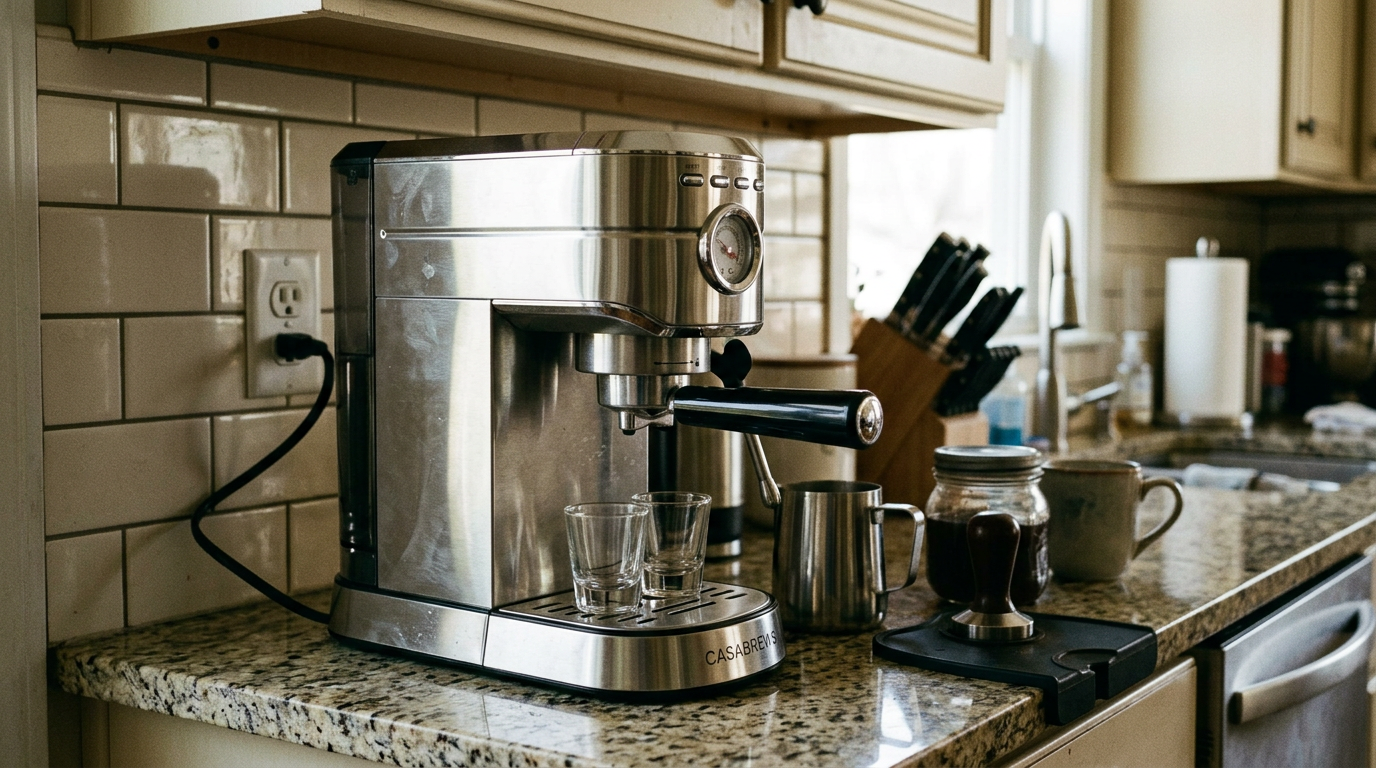
Two shots from the CM5418: tall crema from the stock basket.
Both machines suit a one- or two-person home best. For a big household making many milk drinks in a row, both will feel slow.
My scorecard
These are my scores out of 10 from my single reviews and four weeks of side-by-side use.
De’Longhi Dedica EC680R
CASABREWS CM5418
Overall, I rate the Dedica 8.0 and the CM5418 7.2. Upgraded, the CM5418’s espresso rose to about 8.0.
Find Out the Price TodayWhich one is right for you?
4 quick questionsWhich one should you buy?
For most people, the De’Longhi Dedica EC680R. It made the better espresso and the easier milk out of the box.
For learners and upgraders, the CASABREWS CM5418. For the full detail, read my Dedica review and CM5418 review, or my Bambino Plus vs Dedica comparison.
- You want good drinks out of the box
- You like thick cappuccino foam
- You would use ESE pods
- You want latte-art milk
- You plan to upgrade
- You make many milk drinks in a row
- You want to learn milk steaming
- You plan to upgrade
- You like a pressure gauge
- You want easy foam
- You want ESE pods
- You will never upgrade
My pick for most people is the De’Longhi Dedica EC680R. Its fuller shots, ESE pod basket, cup warmer and easy foam made it the better everyday machine.
The CASABREWS CM5418 is the smarter buy if you want to learn milk steaming properly and upgrade toward real espresso.
Whichever you choose, grind medium-fine, wipe the basket rim before every shot and purge the wand after every drink.
Dedica vs CM5418 specifications
From manufacturer specifications and my own testing.
| Dedica EC680R | CM5418 | |
|---|---|---|
| Type | Semi-automatic, frothing wand | Semi-automatic, steam wand |
| Pump | 15 bar | 20 bar |
| Heating | Thermoblock, about 40 s | 1,350 W thermoblock |
| Portafilter | 51 mm | 51 mm |
| Baskets | Pressurized single, double and ESE | Pressurized single and double |
| Pressure gauge | No | Yes |
| Milk | Wand with aerating sleeve | Single-hole wand |
| Hot water | Via the wand | Via the wand |
| Cup warmer | Yes, passive | No |
| Water tank | About 35 oz | About 34 oz |
| Dimensions (W x D x H) | About 6 x 13 x 12 in | About 5.5 to 5.9 x 12.3 x 12 in |
How I tested and compared them
Michael Reynolds here. I used each machine as my everyday espresso maker for four weeks, with the same coffee, the same grinder and the same scale, and kept detailed notes throughout.
I tested both with pre-ground espresso and fresh beans, tried ESE pods on the Dedica, and upgraded the CM5418 with a three-tab portafilter and single-wall basket.
I frothed whole, 2%, barista oat and almond milk on both, timed every step and ran blind tastings with the same coffee.
- Espresso: body, crema, flavor and consistency.
- Milk: foam texture and learning curve.
- Workflow: heat-up, prep and daily routine.
- Ownership: cleaning, noise, water and footprint.
Dedica vs CM5418 FAQ
What is the difference between the Dedica and the CM5418?
Both are pump machines about 6 inches wide with pressurized baskets. The Dedica adds an ESE pod basket, a cup warmer, a taller-glass drip tray and a frothing wand with an aerating sleeve. The CM5418 adds a pressure gauge and a plain single-hole steam wand, and it can be upgraded with a three-tab portafilter.
Which makes better espresso?
Out of the box, the Dedica. Upgraded with a single-wall basket, the CM5418 went further in my testing.
Which is better for cappuccinos?
The Dedica. Its aerating sleeve makes thick foam with no skill.
Which is better for latte art?
The CM5418. Its plain wand made smoother milk once I had practiced.
Does the CM5418 take ESE pods?
No. Only the Dedica has an ESE pod basket.
Can I use pre-ground coffee?
Yes. Both are built around pressurized baskets that suit it.
Which is narrower?
They are almost the same, about 6 inches wide.
Do they leave a dry puck?
No. Neither has a three-way valve.
How fast do they heat up?
The Dedica in about 40 seconds; the CM5418 in under a minute.
Do they come with a milk jug?
No. Plan to buy a 12-ounce pitcher.

- Our hands-on De’Longhi Dedica EC680R review
- Our hands-on CASABREWS CM5418 review
- Manufacturer specifications and owner documentation
- General espresso brewing and milk frothing guidance