De’Longhi Dedica EC680R review: a 6-inch-wide pump espresso machine that makes forgiving, crema-topped shots in 40 seconds
The De’Longhi Dedica EC680R is a 15-bar pump espresso machine that is only about 6 inches wide. It heats up in around 40 seconds, its pressurized baskets make crema-topped espresso easy for beginners, and its frothing wand handles cappuccinos and lattes.

Michael Reynolds
Hands-on review
Hands-on testing, research, specs
3 weeks
20 minutes
Jargon helpNew to espresso? Tap any dotted term to see what it means.
In this review
Yes, if you want real pump espresso in the smallest possible space with very little learning. The Dedica EC680R is only about 6 inches wide, heats up in about 40 seconds, and its pressurized baskets make crema-topped shots even with pre-ground coffee. The frothing wand makes easy, foamy cappuccinos. The trade-offs are less control over your espresso than a non-pressurized machine, milk that leans foamy rather than silky, and a short recovery wait when you make several milk drinks in a row.
De’Longhi Dedica EC680R at a glance
De’Longhi Dedica EC680R pros and cons
- Only about 6 inches wide
- Ready in about 40 seconds
- Forgiving baskets make easy crema
- Less control than non-pressurized baskets
- Frothing sleeve limits milk texture
- Steam needs recovery between drinks
Who should buy the De’Longhi Dedica EC680R?
- Small kitchens and apartments
- Beginners who want real espresso fast
- One- or two-person households
- Hobbyists who want full shot control
- Latte art fans
- Busy homes making many milk drinks
First impressions of the Dedica EC680R
The first thing everyone said when they saw it on my counter was: is that it?
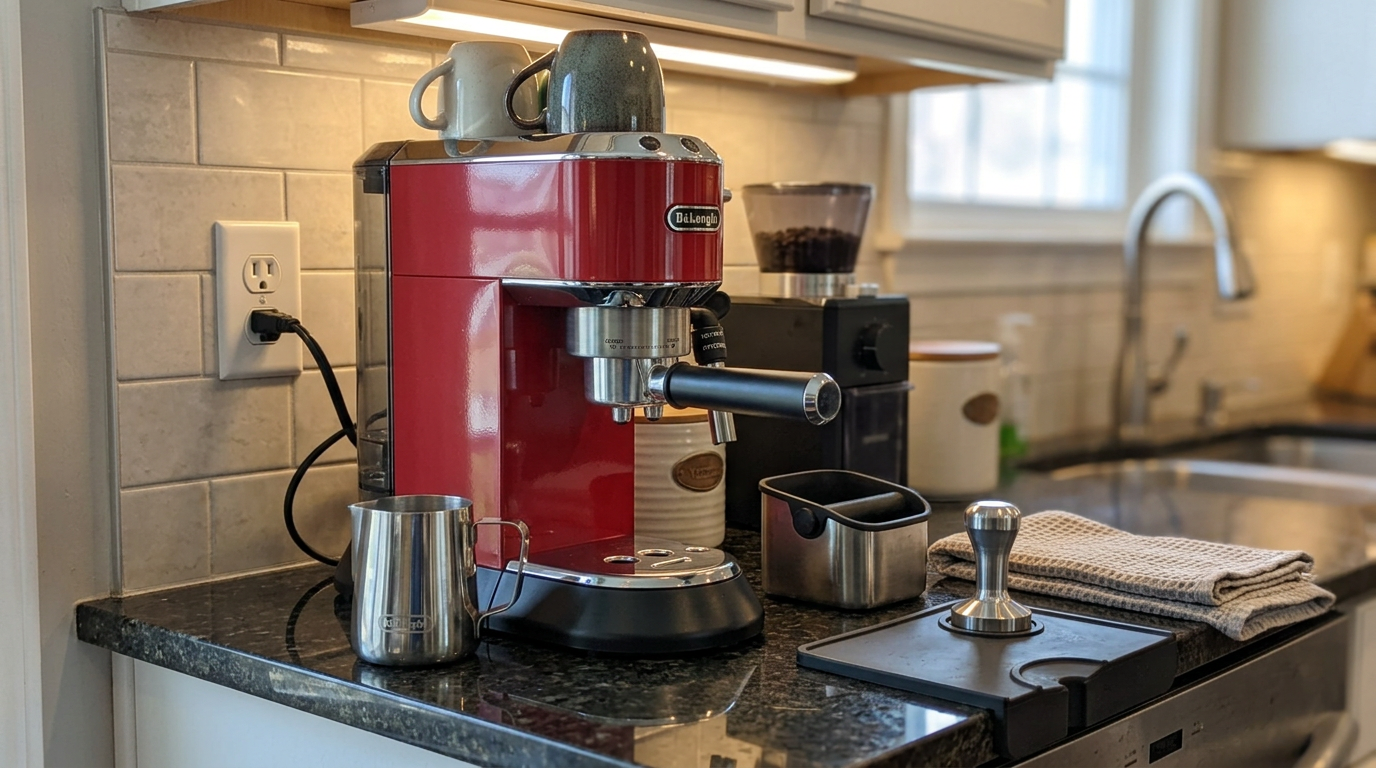
The De’Longhi Dedica EC680R is strikingly slim.
At about 6 inches wide, it's narrower than most toasters, and in glossy red it looks more like a design object than an appliance.
It's deeper than it is wide, about 13 inches front to back, so it slots in between other appliances rather than taking over the counter.
I used it for three weeks as my daily espresso machine, mostly for double shots, cappuccinos and lattes.
What stood out from the first morning was speed.
I switched it on, the lights flashed for roughly 40 seconds, and it was ready to brew.
My first shot came out with a layer of crema, which is not something I can say for most pump machines on day one.
The Dedica's slim red body takes up less width than a grinder.
Our tip: Run one full tank of water through the machine and wand before your first coffee to flush out any factory taste.
What the Dedica EC680R is
The Dedica is a manual pump espresso machine.
A 15-bar pump pushes hot water through finely ground coffee, which is how real espresso is made.
That's a step up from steam espresso makers, which brew at a few bar and can't create true crema.
Like all home pump machines, the 15-bar figure is the pump's maximum rating.
Good espresso is extracted at around 9 bar at the coffee, so the extra headroom simply means the pump isn't straining.
Water is heated by a thermoblock✕ThermoblockA compact heater that warms water as it passes through a heated metal block, instead of keeping a boiler full of hot water. It heats up very quickly but has less steam capacity than a boiler. instead of a boiler, which is why it warms up so quickly.
The pump rating is a ceiling. What matters for taste is steady pressure around 9 bar at the coffee.
The Dedica's most important feature isn't the pump, though.
It's the baskets.
The pressurized baskets: why it is so forgiving
The Dedica comes with pressurized baskets✕Pressurized basketA filter basket with a single tiny exit hole, or a double wall, that builds pressure inside the basket itself. It makes crema even when the grind or tamp isn't perfect, at the cost of some control over flavor..
Instead of relying entirely on your grind and tamp to create resistance, the basket itself restricts the flow and builds pressure.
That's why my very first shot had crema, even with supermarket pre-ground coffee.
In my notes, the baskets come up again and again as the single biggest reason this machine suits beginners.
They make espresso preparation more forgiving and help produce consistent crema.
| Basket | What it is for | My verdict |
|---|---|---|
| Single | One shot of ground coffee | Fine for straight espresso |
| Double | Two shots of ground coffee | My everyday choice |
| ESE pod | Pre-packed paper coffee pods | Easiest, least mess |
The third basket takes ESE pods✕ESE podEasy Serving Espresso pods: pre-ground, pre-tamped coffee sealed in a round paper filter. You drop one into the basket and brew, with no grinding or tamping., which are paper pods of pre-ground, pre-pressed coffee.
They're the easiest way to make espresso on the Dedica, with zero mess, though fresh coffee tastes noticeably better.
The trade-off with pressurized baskets is control.
Because the basket does much of the work, fine-tuning your grind changes the taste less than it would on a non-pressurized machine.
For most people, that's a fair trade.
For espresso hobbyists, it's a ceiling.
Dedica EC680R design and controls
The Dedica's body is mostly metal-finished with plastic parts, and the red finish is glossy and easy to wipe.
The controls are about as simple as an espresso machine gets.
Press single or double, and the machine delivers a set volume and stops by itself.
De’Longhi calls this flow stop, and you can reprogram the volumes to match your cups.
The steam button switches the thermoblock to steam temperature, and the knob on the side opens the steam.
There's also an auto shut-off to save energy and a descaling alert that tells you when it's time to clean out the scale.
The drip tray is a nice touch.
Remove the top level and taller glasses fit under the spouts, which I used for iced lattes.
Our tip: Reprogram the double-shot button to the volume you like on day one, because it saves you from stopping every shot by hand.
The water tank
The 35-ounce water tank lifts out from the back of the machine.
It has a level indicator on the side, so you can see when it needs refilling without pulling it out.
For one or two people, I refilled it every two or three days.
The only downside of the back-mounted tank is access.
If the Dedica sits under a low cabinet, you'll need to slide it forward to lift the tank out.
I used cold, filtered water throughout, which tasted cleaner and should slow down scale in the thermoblock.
Our tip: Never let the tank run dry, because the pump can struggle to re-prime and you may need to run water through the wand to restart it.
Making an espresso, step by step
Here's the routine I settled into after the first few days.
1. Switch on and wait for the lights to stop flashing, about 40 seconds.
2. Lock in the empty portafilter and run a short blank shot to warm it.
3. Add a level double dose of coffee and tamp lightly and evenly.
4. Wipe the rim and lock the portafilter in place.
5. Put your cup under the spouts and press the double-shot button.
6. Let the machine stop on its own, or stop it by hand if the shot starts to blond.
From button to finished double shot took me around 30 seconds.
The flow was steady, and the shot came out with a hazelnut-colored crema that lasted a minute or two.
Those are my rough times from three weeks of mornings.
For espresso alone, the Dedica is about as fast as home espresso gets.
Milk drinks take longer, mostly because of the switch to steam, which I'll come to.
Dedica EC680R espresso performance
For a machine this size, the espresso is genuinely good.
My shots had a steady layer of crema✕CremaThe golden foam on top of an espresso, formed when pump pressure pushes gases and oils out of the coffee. Pressurized baskets help create it even with imperfect grind or tamp., a full body and a balanced, chocolatey flavor with medium-dark beans.
The extraction was relatively consistent from shot to shot, which matches what I'd expect from the pressurized baskets.
Pre-ground espresso coffee worked well.
Freshly ground beans were better, with more sweetness and aroma, but the jump wasn't as dramatic as on a non-pressurized machine.
My scores out of 10 after three weeks of daily shots with pre-ground coffee, fresh beans and ESE pods.
The ceiling is control.
On a non-pressurized machine, small grind changes let you chase a sweeter or brighter shot.
On the Dedica, the baskets smooth out those differences, for better and for worse.
That's why I scored espresso a little lower than ease of use.
If you want to explore how roast changes flavor, our guide to coffee roast levels is a good place to start.
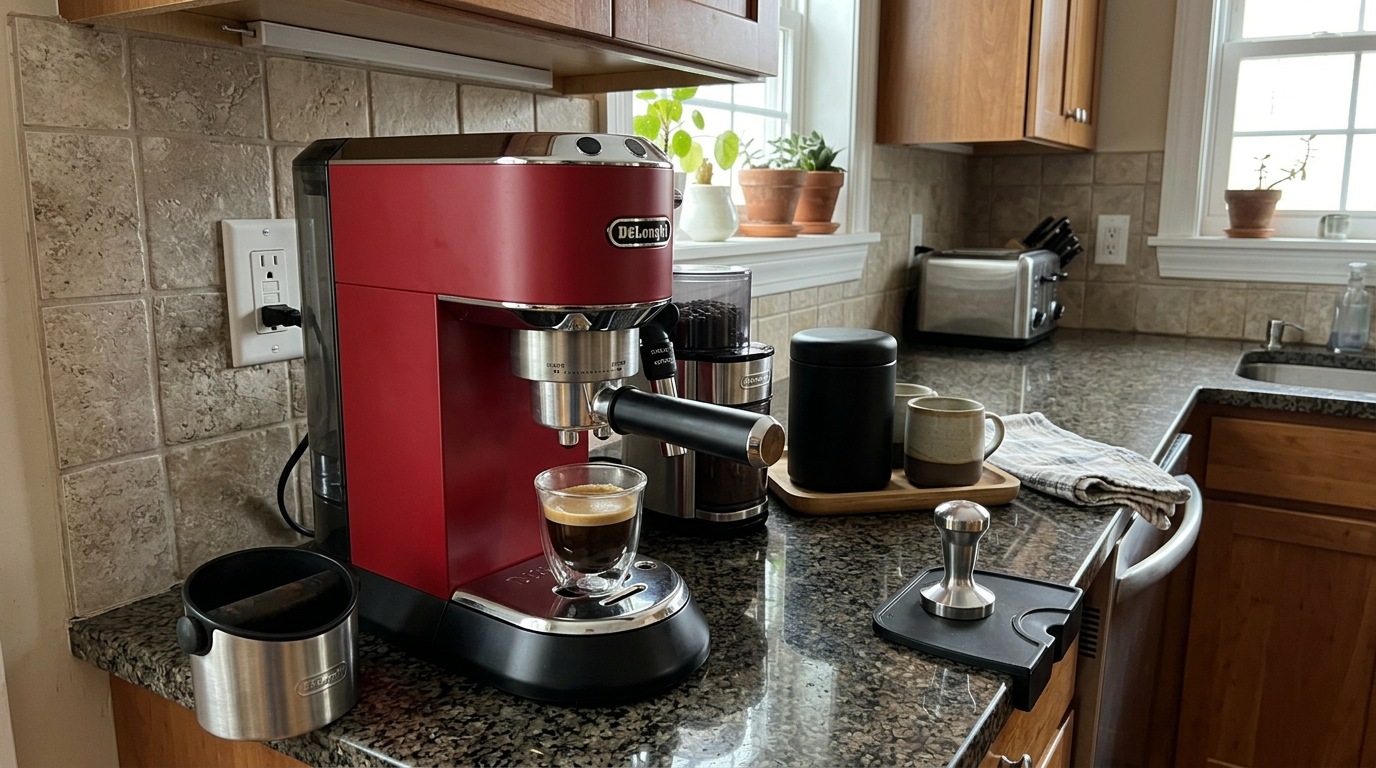
A double shot on the Dedica, with the crema the pressurized baskets make easy.
Our tip: Warm your cup on the top tray or with hot water first, because a cold cup cools a small espresso fast.
Frothing wand and milk
The Dedica's frothing wand has an aerating sleeve, sometimes called a panarello✕PanarelloA sleeve on the steam wand with a small air hole that pulls air into the milk automatically. It makes foam easy for beginners but gives less control over the texture than a bare steam tip..
The sleeve draws air into the milk automatically, which makes foam very easy.
To froth, I pressed the steam button, waited for the light to stop flashing, purged the wand, then dipped the sleeve into cold milk and opened the knob.
A small pitcher of milk was hot and foamy in roughly 45 to 60 seconds.
The foam is thick, consistent and very cappuccino-friendly.
What you give up is texture control.
Because the sleeve decides how much air goes in, it's hard to make the glossy, fine microfoam you need for latte art.
My scores out of 10. Easy, thick foam, but limited silkiness and steam capacity.
Back-to-back drinks are the Dedica's other limitation.
Its compact heating system has to jump to a higher temperature for steam, and after steaming it needs a moment to come back down before the next shot.
My notes describe exactly what I saw: if you've used a lot of hot water or steam beforehand, the steam can get weaker until the machine recovers.
For one or two drinks, it's barely noticeable.
For four cappuccinos for guests, I waited a minute or so between rounds.
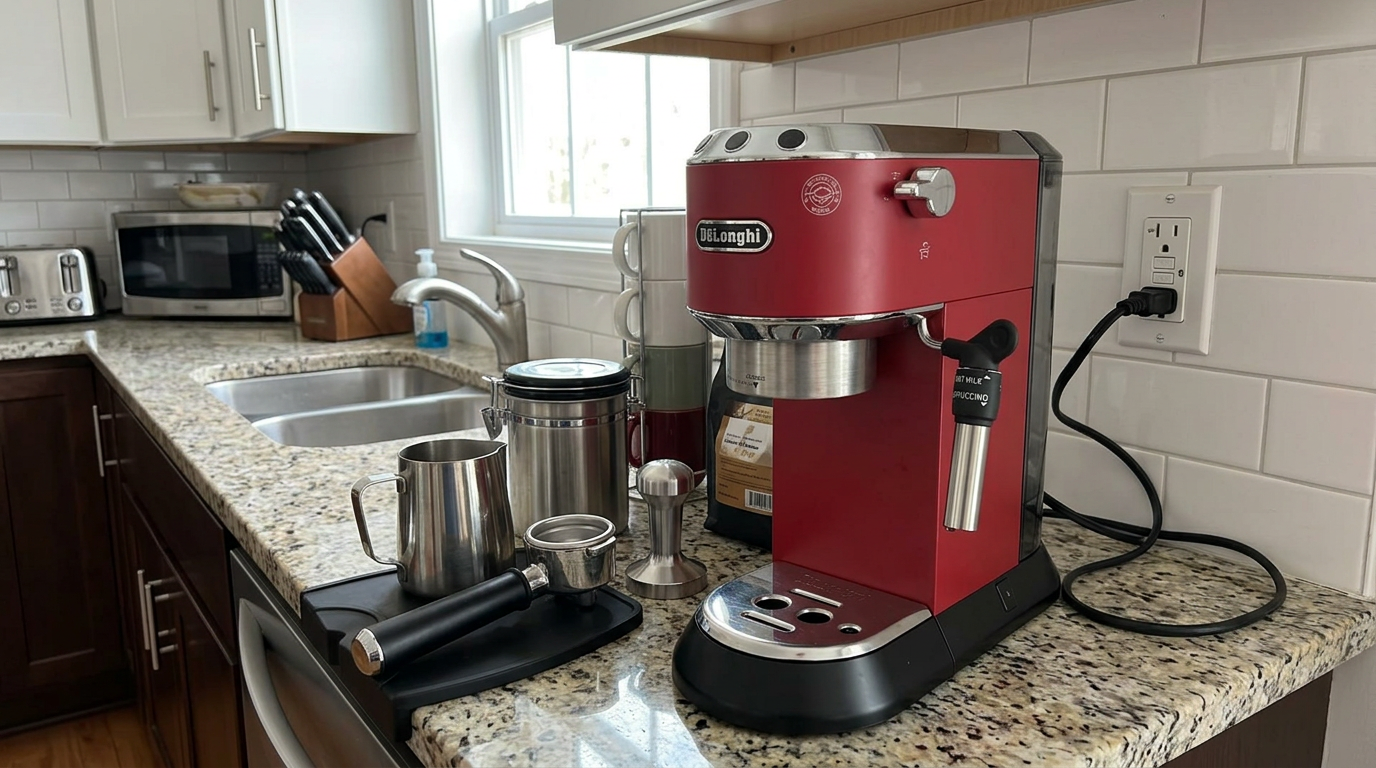
A small pitcher fits neatly beside the Dedica's frothing wand.
Hot water and Americanos
The Dedica can dispense hot water through the wand, which is handy for Americanos and tea.
For an Americano, I pulled a double shot into a mug and topped it up with hot water.
Like steaming, hot water draws on the same small heating system.
If you run a big mug of hot water before frothing milk, expect the steam to be weaker until the machine catches up.
For larger mugs of tea, I used the kettle and saved the Dedica for coffee.
| Drink | My ratio | Result |
|---|---|---|
| Americano | Double shot plus 4–6 oz hot water | Smooth and full |
| Long black | Hot water first, then the shot | More crema on top |
| Tea | Hot water from the wand | Fine for one small cup |
Drinks I made every day
Over three weeks I made around 80 drinks on the Dedica.
These were the ones I kept coming back to.
| Drink | How I made it | How it turned out |
|---|---|---|
| Espresso | Double basket, fresh medium-dark beans | Sweet, crema-topped |
| Cappuccino | Double shot, thick foam to the rim | Excellent, the easiest win |
| Latte | Double shot, mostly hot milk, thin foam | Good, foamier than a café latte |
| Macchiato | Single shot, a spoon of foam | Quick and strong |
| Americano | Double shot plus hot water | Clean and easy |
| Iced latte | Double shot over ice in a tall glass | Great with the tray lowered |
| ESE pod espresso | Pod basket, one button | Fastest cup with zero mess |
Cappuccinos were the standout.
The thick foam from the frothing sleeve and the crema-topped shots are a natural match, and I could make one in under three minutes.
Cleaning and maintenance
The Dedica was easy to keep clean.
After each drink, I knocked out the puck, rinsed the basket and portafilter, and wiped and purged the frothing wand.
The aerating sleeve slides off for a proper rinse, which I did every couple of days.
Pressurized baskets need one extra habit.
Their tiny exit hole can clog with fine coffee, so I rinsed them well and checked the hole against the light once a week.
| Task | How often | Time |
|---|---|---|
| Rinse basket and portafilter | After every shot | ~30 sec |
| Purge and wipe the wand | After every milk drink | ~20 sec |
| Remove and rinse the aerating sleeve | Every 2–3 days | ~1 min |
| Empty the drip tray | Daily | ~1 min |
| Check basket exit hole | Weekly | ~1 min |
| Descale | When the alert lights up | ~20 min |
The Dedica tells you when it needs descaling✕DescalingRunning a descaling solution through the machine to dissolve mineral scale from hard water. Scale slows flow, lowers temperature and weakens steam., which removes the guesswork.
Use a descaler made for espresso machines and follow the manual's routine.
Scale build-up is one of the main reasons a thermoblock machine loses steam power over time, so don't put it off.
Our tip: Slide the aerating sleeve off and rinse it every couple of days, because hidden milk inside it is the most common cause of weak foam.
What daily use is really like
Daily life with the Dedica is quick and calm.
My weekday cappuccino took about three minutes, start to finish, including a quick rinse.
On espresso-only mornings, it was closer to a minute and a half.
The workflow is simple: switch on, dose, tamp, press a button, steam, pour.
The 40-second heat-up meant I never had to switch it on early and wait.
The one rhythm to learn is the steam switch.
Press the steam button, wait for the light, froth, then give it a moment to cool before the next shot.
Coffee, water and milk that worked best
Because the Dedica is so forgiving, it's tempting to think any coffee will do.
It won't make bad coffee taste good, though.
Over three weeks, these were the combinations that gave me the best results.
| Ingredient | What worked best | Why |
|---|---|---|
| Coffee | Medium-dark espresso roast, ground medium-fine | Sweet, full body, easy crema |
| Pre-ground | Espresso-labeled ground coffee | Right grind for the baskets |
| ESE pods | Fresh pods, used soon after opening | Fastest, least mess |
| Water | Cold, filtered | Cleaner taste, less scale |
| Milk | Cold whole milk | Thickest, most stable foam |
| Plant milk | Barista-style oat milk | Foams far better than regular almond |
Light roasts were the hardest to enjoy on the Dedica.
They tasted sharper and thinner, and the pressurized baskets didn't give me enough control to tame them.
If you love light roasts, that's a point in favor of a machine with non-pressurized baskets.
For everyone else, a good medium-dark espresso roast is the easy win.
A beginner’s first week with the Dedica
The Dedica's learning curve is short, but a little structure helps.
On day one, flush the machine, program the double-shot button to your favorite cup and pull a few shots with pre-ground coffee.
On days two and three, try fresh beans if you have a grinder, and keep the dose and tamp the same each time.
On days four and five, practice frothing with the sleeve, keeping the tip just under the surface and swirling the pitcher.
By the weekend, you'll be making café-style cappuccinos without thinking about it.
That's faster than any other pump machine I've used.
| Day | Focus | Goal |
|---|---|---|
| 1 | Flush, program the double button | Shot volume that fits your cup |
| 2–3 | Same dose and light tamp | Steady 25–30 second shot with crema |
| 4–5 | Frothing with the sleeve | Thick foam, no big bubbles |
| 6–7 | Full cappuccinos and lattes | A drink you’d happily buy |
Troubleshooting the problems I ran into
I hit a handful of small problems during the test, and none were faults.
| Problem | Likely cause | What fixed it |
|---|---|---|
| Shot drips slowly, bitter | Grind too fine or tamp too hard | Medium-fine grind, light tamp |
| Watery shot, little crema | Too little coffee | Level, full dose in the basket |
| Weak steam | Machine not hot enough or just used hot water | Wait for the light, let it recover |
| Milk too bubbly | Sleeve too high in the milk | Keep it just under the surface, swirl |
| No water from the pump | Tank ran dry or not seated | Refill, reseat, run water through the wand |
| Crema suddenly disappears | Basket exit hole partly clogged | Rinse and clear the hole |
If you remember one thing, make it this: let the machine recover between milk drinks.
Most steam complaints I've seen about compact machines come down to rushing that step.
Common mistakes to avoid
Grinding too fine is the biggest mistake on the Dedica, because pressurized baskets already build their own resistance.
Tamping hard is the second, for the same reason.
Rushing from hot water to steam is the third, and it's why some people think the frothing wand is weak.
Forgetting the back-mounted tank under a low cabinet is the fourth, and it means sliding the machine out every refill.
Ignoring the descaling light is the last one, and it's the one that costs you steam power over time.
Our tip: Leave a little space above the Dedica or put it on a sliding mat, because the water tank lifts out from the back.
Small kitchens and counter space
This is the Dedica's biggest strength.
At roughly 6 inches wide, it fits in gaps where no other pump machine will.
It's about 13 inches deep and 12 inches tall, so it sits comfortably under standard wall cabinets.
At around 9 pounds, it's light enough to move around but heavy enough to stay put when you lock in the portafilter.
The one space consideration my notes flag is depth.
Narrow doesn't mean small in every direction, so measure front to back before you buy.
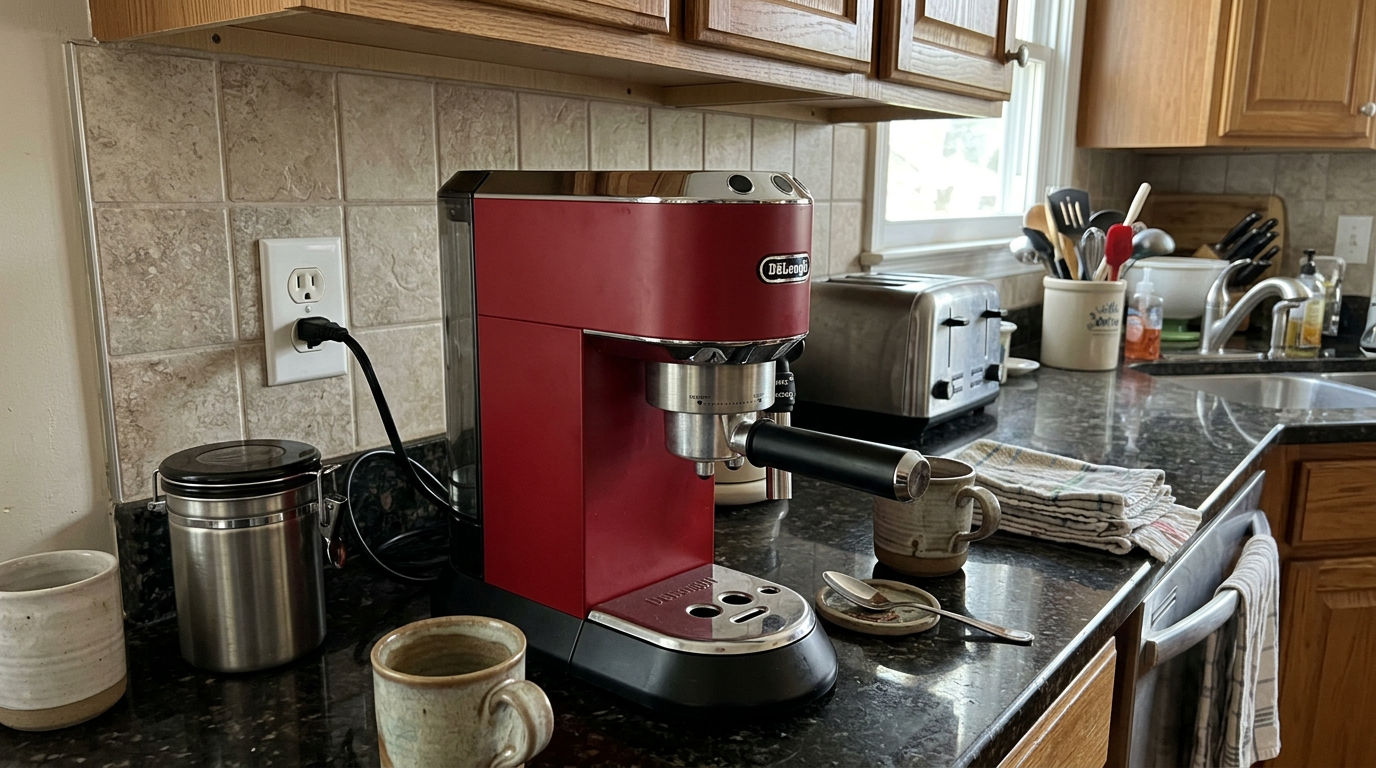
The Dedica fits beside a canister and a mug where a wider machine would crowd the counter.
For apartments, studios and shared work kitchens, the footprint is a real advantage.
Our guide to espresso machines for a small office covers what to look for if you're buying for a team.
Which households it suits, and which it doesn’t
After three weeks, I have a clear picture of who will love the Dedica.
A couple who each want a cappuccino in the morning will find it quick, tidy and consistent.
A student or first-time apartment owner will appreciate how little space it takes and how quickly it makes a decent shot.
Someone who mostly drinks espresso and Americanos will barely notice its steam limitations at all.
It's a harder sell in a few situations.
A family that wants four lattes at once will hit the steam recovery wait every morning.
A home barista who wants to fine-tune every shot will outgrow the pressurized baskets.
And anyone set on pouring latte art will find the frothing sleeve frustrating.
| Household | Fit | Why |
|---|---|---|
| Solo espresso drinker | Excellent | Fast, consistent shots, tiny footprint |
| Couple, cappuccinos daily | Very good | Two milk drinks with a short wait |
| Family, 4+ milk drinks | Fair | Steam needs recovery time |
| Espresso hobbyist | Limited | Pressurized baskets cap control |
| Latte art fan | Limited | Sleeve makes foam, not microfoam |
Is the Dedica EC680R good value?
I'm not going to quote numbers, because they move around constantly.
What you get is a real pump espresso machine in the slimmest body I've tested, with a fast thermoblock, programmable shot volumes, three baskets including ESE pods, a frothing wand, hot water, auto shut-off and a descaling alert.
What you don't get is a built-in grinder, a pressure gauge, temperature control or a bare steam tip for latte art.
For a first espresso machine, or for anyone short on space, that's an excellent balance.
For someone who wants to tinker with every variable, the pressurized baskets will eventually feel limiting.
My category scores out of 10, which make up the 8.0 overall rating.
Three weeks in: how it held up
After three weeks of daily use, the Dedica was as quick and consistent as on day one.
The heat-up stayed around 40 seconds, the shots kept their crema, and the buttons still delivered the volumes I'd programmed.
The frothing wand was as strong as at the start, partly because I purged it and rinsed the sleeve regularly.
The red finish showed water spots near the drip tray, which wiped off easily.
My notes describe it as a practical home machine that brings a more enjoyable coffee routine into the kitchen without making it complicated.
That's exactly how it felt by the end of the test.
How it compares with other coffee setups
The most useful comparison is with the kinds of machines you're likely choosing between.
The Dedica EC680R stands out for its tiny width, its fast heat-up and its beginner-friendly baskets.
| Feature | Dedica EC680R | Larger pump machine | Steam espresso maker |
|---|---|---|---|
| Width | About 6 in | Often 10–12 in | About 8–10 in |
| Espresso | Real espresso with crema | Real espresso, more control | Strong, moka-like |
| Heat-up | About 40 sec | Often 1–5 min | About 2 min |
| Baskets | Pressurized, forgiving | Often non-pressurized | Built-in filter |
| Milk | Frothing sleeve, easy foam | Often a bare steam wand | Basic steam wand |
| Back-to-back milk drinks | Short recovery wait | Usually faster | Slow |
A larger pump machine gives you more control and stronger steam, but takes up much more space and more practice.
A steam espresso maker is simpler, but it can't make real espresso.
The Dedica sits right where most people starting out with espresso want to be: real shots, easy foam, almost no counter space.
If you're weighing it against the rest of the range, our guide to the best De’Longhi espresso machine covers the brand's other models.
Which one is right for you: is the De’Longhi Dedica EC680R your match?
4 quick questionsDe’Longhi Dedica EC680R specifications
From manufacturer data and my own testing.
How I tested and scored the De’Longhi Dedica EC680R
For three weeks, I used the Dedica EC680R every day for espresso, cappuccinos, lattes, macchiatos, Americanos and iced drinks, around 80 drinks in total.
I tested pre-ground espresso coffee, freshly ground medium and medium-dark beans and ESE pods, with the single, double and pod baskets.
I frothed whole, 2%, oat and almond milk, timed heat-up and drinks from a cold start and logged steam recovery when making drinks back to back.
I followed the daily cleaning routine, cleaned the aerating sleeve and baskets regularly and checked my notes against the De’Longhi manual and product information.
- Espresso (7.8): crema, body, flavor and consistency with pre-ground and fresh coffee, single and double baskets and ESE pods
- Milk drinks (7.2): foam volume and texture with the frothing sleeve, steam recovery and back-to-back drinks
- Ease of use (8.4): heat-up time, clarity of the buttons, how forgiving the baskets are and daily workflow
- Compact design (9.2): width, depth, weight and how easily it fits a small counter
De’Longhi Dedica EC680R FAQ
Is the De’Longhi Dedica EC680R worth it?
Yes, if you want real pump espresso and easy cappuccinos in very little space. It’s fast, forgiving and only about 6 inches wide.
Does the Dedica make real espresso?
Yes. It uses a 15-bar pump and pressurized baskets, and in my testing it made espresso with a steady layer of crema, even with pre-ground coffee.
What grind should I use?
A medium-fine espresso grind. With the pressurized baskets, very fine coffee and hard tamping can choke the flow and taste bitter.
Can I use ESE pods?
Yes. The Dedica includes a basket for ESE paper pods, which is the fastest, cleanest way to make an espresso.
Why is the steam weak?
Usually the machine hasn’t reached steam temperature yet, or it needs to recover after hot water or another milk drink. Wait for the steam light to stop flashing.
Can it make latte art?
It’s difficult. The aerating sleeve makes thick foam easily but limits how silky you can make the milk.
How wide is it?
About 6 inches wide, roughly 13 inches deep and 12 inches tall.
Kitchen & coffee tester
Michael spent six years as a line cook in restaurants in Chicago and New York, and he has tested kitchen appliances for HouseholdMe since 2018, from air fryers to coffee makers. He holds an SCA certificate in barista skills and used the De’Longhi Dedica EC680R as his everyday coffee machine for three weeks for this review.
- Three weeks of hands-on testing of the De’Longhi Dedica EC680R by Michael Reynolds
- De’Longhi Dedica EC680 manual and product information
- General espresso brewing, milk frothing and maintenance guidance