CASABREWS CM5418 review: a compact budget espresso machine that gets much better with a few upgrades
The CASABREWS CM5418 Compact Espresso Machine with Milk Frothing is one of the best-known budget espresso machines: slim, stainless and simple, with pressurized baskets and a manual steam wand. I used it for three weeks, first exactly as it comes and then with a few cheap upgrades, to see how good it can get.

Michael Reynolds
Hands-on review
Hands-on testing, research, specs
3 weeks
24 minutes
Jargon helpNew to espresso? Tap any dotted term to see what it means.
In this review
Yes, if you want an easy, compact first espresso machine and you're happy to upgrade it later. Straight out of the box, the CASABREWS CM5418 makes good-looking shots for lattes and Americanos, and its steam wand handles everyday milk drinks. Straight espresso from the stock pressurized baskets tastes flat, though, and the steam is modest. Add a proper grinder, a three-tab portafilter with a single-wall basket and a metal tamper, and it becomes a genuinely enjoyable machine.
CASABREWS CM5418 at a glance
CASABREWS CM5418 pros and cons
- Slim, simple and easy to learn
- Forgiving pressurized baskets for pre-ground coffee
- Big jump in quality with cheap upgrades
- Stock espresso can taste flat and bitter
- Modest steam power
- Stock portafilter limits basket upgrades
Who should buy the CASABREWS CM5418?
- First-time espresso makers
- Latte and Americano drinkers
- Tinkerers who enjoy upgrading
- Straight-espresso drinkers who won't upgrade
- Households making many milk drinks in a row
- Anyone who wants automatic milk
First impressions of the CASABREWS CM5418
The CM5418 is one of those machines I kept seeing in friends' kitchens, so I was curious to finally live with one.
Out of the box, it looks neater than its price suggests.
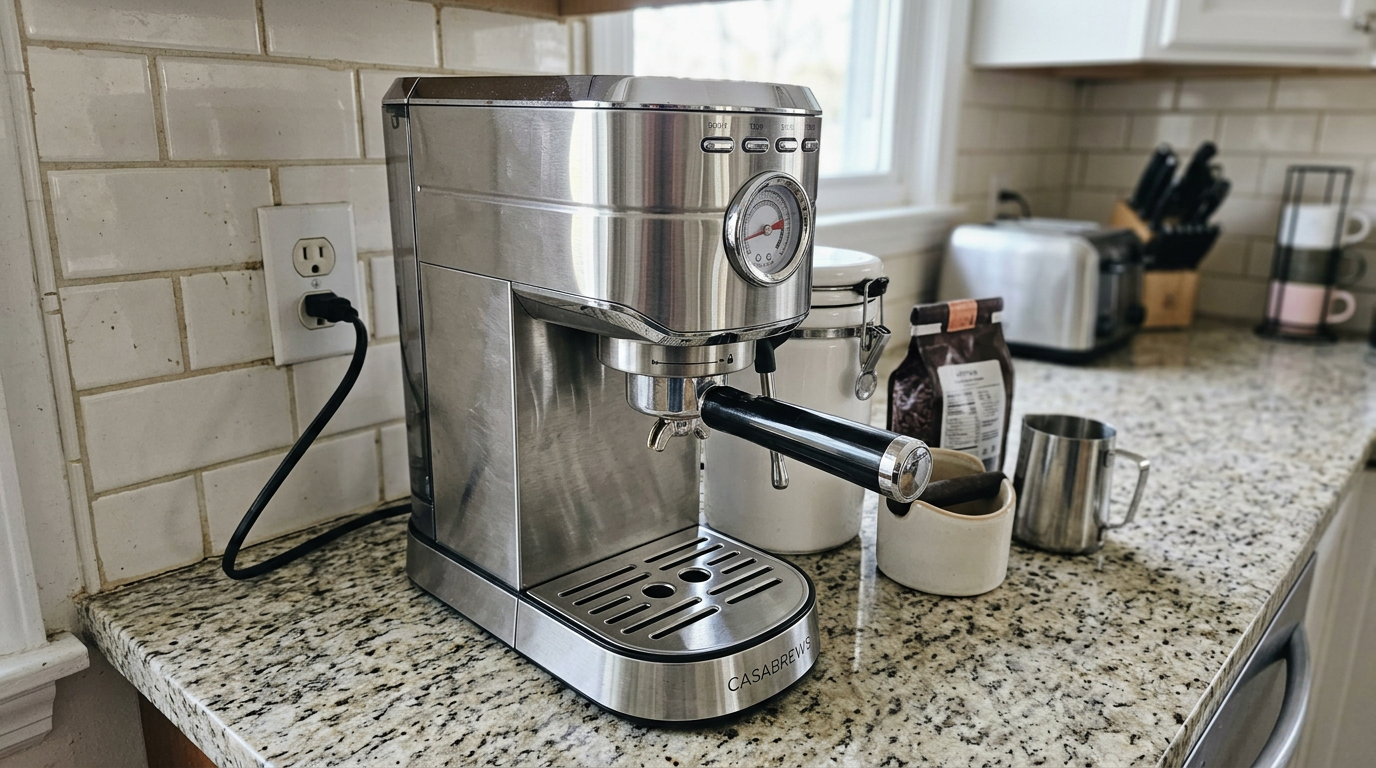
The front and top are brushed steel, the pressure gauge sits in the middle of the face, and the steam wand hangs off the right side.
It's narrow enough to tuck between a toaster and a knife block, which is exactly where it ended up in my kitchen.
In the box, I found the machine, a 51 mm portafilter✕PortafilterThe handle with a metal basket that holds the ground coffee. You lock it into the machine to brew., single and double pressurized baskets, a combined plastic scoop and tamper, and the manual.
There's no milk pitcher, so I used one of my own.
My first shot, with a medium grind and the double basket, ran quickly and came out with a thick, golden layer of foam.
It looked like something from a café.
Then I tasted it on its own, and it was a little bland and a little bitter.
That gap between how the CM5418 looks and how it tastes became the story of my first week.
The CM5418 by my kitchen window. It's slim enough to share the counter with a toaster and knife block.
What the CM5418 actually is
The CASABREWS CM5418 is a compact semi-automatic espresso machine with a manual steam wand and no grinder.
You fill the basket, tamp, lock it in and press the single or double button, and the machine stops the shot for you.
A 20-bar✕BarA unit of pressure. One bar is about the air pressure at sea level. Espresso is usually brewed at around 9 bar at the coffee. pump pushes the water, and a 1,350-watt thermoblock✕ThermoblockA compact heater that warms water as it flows through, instead of keeping a boiler of hot water ready. heats it on demand.
What's in the box
| Item | Details | My verdict |
|---|---|---|
| Portafilter | 51 mm aluminum, plastic handle, plastic spout | Works, but limits basket choice |
| Single basket | 1 cup, pressurized | Rarely used |
| Double basket | 2 cup, pressurized, up to about 15 g | My daily choice when stock |
| Scoop and tamper | Combined plastic tool | Fine to start, replace soon |
| Manual | Setup and cleaning steps | Worth a read |
The features that matter
The machine runs a short pre-infusion✕Pre-infusionA short, gentle wetting of the coffee before full pressure. It helps water soak the puck evenly. before each shot, gently wetting the coffee before full pressure.
The front gauge, or manometer✕ManometerA pressure gauge. On espresso machines it shows roughly how much pressure is building during a shot., shows how much pressure builds while the shot runs.
The steam wand has a single-hole tip and also delivers hot water, which is handy for Americanos.
CM5418 design and setup
The CM5418 is built to take up as little room as possible.
The water tank
The tank holds about 34 ounces and slides out of the back.
It's very narrow, and the opening is small, so pouring water in while it sits on the machine is asking for a spill.
I splashed water down the gap between the tank and the body on day one, and filled it at the sink from then on.
Build
The steel front and top look smart and wipe clean easily.
There's some plastic around the sides and base, and the machine is light, so I kept a hand on it when locking the portafilter in.
First-time setup
Setup took about ten minutes: wash the tank, portafilter and baskets, fill the tank, then run water through the group and the wand.
If the pump can't draw water after a refill, the manual suggests reseating the tank and running hot water for about 20 seconds, which fixed it for me once.
Our tip: Lift the narrow tank out and fill it at the sink; pouring onto the machine spills down the back.
Pressurized vs single-wall baskets, explained
To understand the CM5418, you need to understand its baskets.
Pressurized baskets
The included pressurized baskets✕Pressurized basketA double-wall basket with one tiny exit hole. It builds pressure for you, so even pre-ground coffee makes a foamy crema. have a double floor with one tiny exit hole.
That hole creates resistance, so the machine builds pressure even when the coffee is too coarse or loosely tamped.
The result is a thick, attractive crema✕CremaThe golden-brown foam on top of an espresso. It forms when pressure pushes oils and gases out of the coffee. almost every time, which is great for beginners and for pre-ground coffee.
The catch
That foam is made by the basket, not by a well-made shot.
It can look perfect while the coffee underneath is under-extracted, which is why my early shots looked lovely but tasted flat and slightly bitter.
Single-wall baskets
A single-wall basket✕Single-wall basketA basket full of small holes. All the resistance comes from the coffee itself, so grind and tamp matter much more. has dozens of small holes and no built-in restriction.
The coffee itself has to create the resistance, so the grind, dose✕DoseThe weight of ground coffee you put in the basket, usually measured in grams. and tamp✕TampPressing the ground coffee into a firm, level bed before brewing. all suddenly matter.
It's less forgiving, but it lets you make espresso that actually tastes as good as it looks.
| You value | Pressurized (stock) | Single-wall (upgrade) |
|---|---|---|
| Ease | Very easy | Takes practice |
| Works with pre-ground | Yes | Poorly |
| Looks of the crema | Thick, foamy | Finer, darker |
| Best possible flavor | Fair to good | Very good |
| Room to improve | Limited | Lots |
CM5418 espresso performance, out of the box
I spent my first ten days using the CM5418 exactly as it comes.
How it tasted
With a 15 gram dose in the double basket and a fairly coarse grind, shots ran fast and smooth.
They had a golden-brown stream and a tall layer of foam.
On their own, though, they tasted thin, with a bitter edge and not much sweetness.
In milk, those same shots were perfectly pleasant, and in an Americano they were better than most pod coffee.
Grind for the stock basket
With the pressurized basket, a medium-fine grind worked best.
Going very fine made things worse, because the basket's tiny hole plus a dense puck slowed the shot to a drip.
My flavor ratings on a 10-point scale with the same machine.
| What you taste or see | Likely cause | First change |
|---|---|---|
| Weak, watery | Grind too coarse or dose too low | Use espresso grind, fill to about 15 g |
| Bitter, harsh | Very dark roast or shot too long | Stop the shot earlier |
| Barely drips | Grind too fine for a pressurized basket | Go coarser |
| Leaking around the group | Grounds on the rim | Wipe the rim |
| Soupy puck | No pressure-release valve | Normal; let it rest |
My verdict on the stock setup: great for milk drinks, fine for Americanos, not great for straight espresso.
Dose, distribute and tamp
Even with the stock baskets, a little care made my shots more consistent.
Dose
The double basket holds up to about 15 grams.
I weighed 15 grams every time; less made watery shots, and more made the portafilter hard to lock in.
Distribute
Tap the portafilter gently or level the grounds with a finger before tamping.
With the single-wall upgrade, I used a WDT✕WDTShort for Weiss Distribution Technique: stirring the grounds with fine needles to break up clumps before tamping. tool to break up clumps, which made a big difference.
Tamp
The plastic scoop-tamper is small and light.
With pressurized baskets, a light, level press is all you need.
With a single-wall basket, it isn't good enough; a solid 51 mm metal tamper gave me level, repeatable pucks.
Clean the rim
Wipe stray grounds off the rim before locking in, or the seal won't close properly.
Upgrade one: a proper grinder
The single most useful thing I added to the CM5418 was a better grinder.
Why it matters
Espresso is very sensitive to grind size.
Too coarse, and water rushes through, making a weak, sour shot.
Too fine, and it can barely get through, making a slow, bitter one.
A grinder made for espresso lets you make small steps between those extremes instead of jumping from one to the other.
What you actually need
You don't need a commercial grinder.
An entry-level burr grinder that goes fine enough for espresso, with small adjustment steps, did the job.
A good hand grinder works too if you only make one or two drinks a day.
A blade grinder doesn't; it makes a mix of dust and chunks that's impossible to dial in.
My guide to burr vs blade grinders explains why burrs give more even grounds.
The difference it made
Even with the stock pressurized basket, fresh beans ground just before brewing tasted noticeably sweeter and more aromatic than pre-ground coffee.
But the grinder really earns its place once you switch to a single-wall basket.
Our tip: If you can only buy one upgrade, buy the grinder first; everything else depends on it.
Upgrade two: a single-wall basket and portafilter
This is the upgrade that turns the CM5418 from a latte machine into an espresso machine.
The compatibility catch
The stock portafilter isn't great for swapping baskets.
The basket has a small notch that lines up with a groove in the portafilter, and the alternative 51 mm single-wall baskets I tried didn't fit it.
The fix is a compatible three-tab 51 mm portafilter, which takes standard single-wall baskets.
I used a spouted version for daily drinks and briefly tried a bottomless portafilter✕Bottomless portafilterA portafilter with the bottom cut away, so you can see the espresso flow straight from the basket., which shows you exactly how the coffee flows.
Spouted or bottomless?
The bottomless one taught me a lot about uneven pucks in a few days, but it also sprayed coffee when my prep was sloppy.
For everyday use, the spouted version is tidier and perfectly good.
The metal tamper
With a single-wall basket, the plastic tamper isn't enough.
A solid metal tamper that matches the basket made level tamping easy and repeatable.
| Upgrade | What it fixes | How much it helped |
|---|---|---|
| Espresso grinder | Grind control, freshness | Big |
| Three-tab portafilter + single-wall basket | Real extraction, real crema | Biggest |
| Metal tamper | Level, consistent pucks | Medium |
| WDT tool | Clumps and channeling | Medium |
| Small scale | Repeatable dose and yield | Medium |
Dialing in the upgraded CM5418, step by step
With the single-wall basket, I followed a simple recipe and adjusted one thing at a time.
My starting recipe
I kept the dose at 15 grams and aimed for about 30 to 36 grams of espresso in 25 to 30 seconds.
That's a brew ratio✕Brew ratioDose compared with yield. A 1:2 ratio means 18 grams of coffee makes 36 grams of espresso. of roughly 1:2 to 1:2.4, a good middle ground for medium roasts.
| If the shot... | What it means | What I changed |
|---|---|---|
| Hits 36 g in under 20 s | Grind too coarse | Grind finer |
| Takes over 35 s for 30 g | Grind too fine | Grind coarser |
| Sprays or spurts | Uneven puck, channeling✕ChannelingWhen water finds a weak path through the coffee puck and rushes through it, leaving the rest under-extracted. | Stir with WDT, tamp level |
| Tastes sour | Under-extracted | Grind finer or run a little longer |
| Tastes bitter and dry | Over-extracted | Grind coarser or stop earlier |
How long it took
My first upgraded shot ran in 14 seconds and tasted sour.
Four grind steps finer, it ran in 27 seconds and tasted round and sweet.
After that, I only nudged the grind when I opened a new bag.
Shot time as I adjusted the grind on my first morning with the single-wall basket.
The pre-infusion✕Pre-infusionA short, gentle wetting of the coffee before full pressure. It helps water soak the puck evenly. helped here, gently wetting the puck so the main shot ran more evenly.
What the upgraded espresso tastes like
This is where the CASABREWS CM5418 surprised me.
With a medium roast, a 15 gram dose and a 28-second shot, I got a smooth, rounded espresso with clear nutty and chocolate notes.
The bitterness that bothered me in week one was mostly gone.
The crema was thinner than the stock basket's foam, but finer, darker and more natural-looking.
The body was heavier too, and the flavor lasted longer after each sip.
My average ratings out of 10, same beans and machine.
It's not the depth you'd get from a machine with precise temperature control, but it's a big step up from the stock setup.
The point is that the machine itself was never the main limit; the stock basket and tamper were.
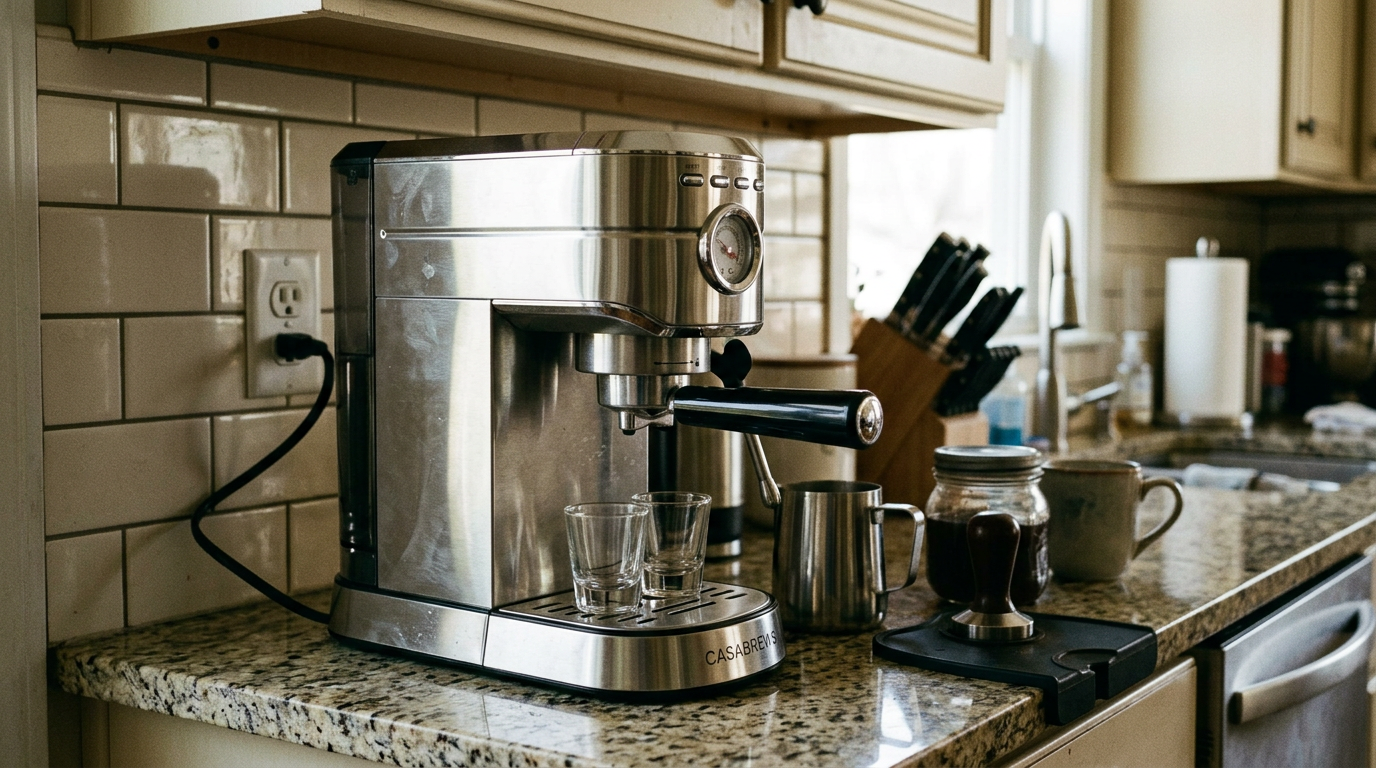
Two shots into glasses. With the single-wall basket, the crema came out finer and darker than the stock basket's foam.
Steaming milk with the CM5418
The single-hole steam wand is modest, but it does the job with a bit of patience.
How it works
Press the steam button and wait for the light to settle while the thermoblock heats up, which took about half a minute in my testing.
Open the knob for steam, close it to stop.
The machine can't brew and steam at the same time, so for milk drinks I always brewed first.
What the milk is like
There's less power than on the strongest budget machines, so a full jug takes a little longer.
With a 12 ounce pitcher about one-third full of cold milk, I could build a steady whirlpool and get smooth, glossy milk.
With a bigger jug or more milk, the whirlpool was weaker and the foam less even.
My ratings on a 10-point scale for texture and stability.
The CM5418 rewards small batches: one drink at a time, in a small pitcher, gave me the best results.
Oat milk and latte art, step by step
Alternative milks are harder to foam than dairy, so I spent a week practicing with barista oat milk.
| Step | What I do | Why |
|---|---|---|
| 1. Cold milk | Fill a small jug about one-third | More time to texture |
| 2. Purge | Open the wand briefly over the tray | Clears condensed water |
| 3. Position | Tip just under the surface, at about three o'clock | Sets up a spin |
| 4. Stretch | A few seconds of a soft tearing sound | Adds air |
| 5. Sink | Lower the tip slightly | Starts the whirlpool |
| 6. Heat | Stop when the jug is too hot to hold | Avoids scalding |
| 7. Polish | Tap the jug, then swirl | Pops big bubbles, adds gloss |
| 8. Pour | Steady, then lower and speed up | Makes the pattern |
My first oat-milk foam had big bubbles on top.
Tapping the jug and swirling for ten seconds fixed most of that.
By the end of the week, I could pour a simple tulip, though it was never as crisp as with whole milk.
My oat-milk latte art over the test, rated out of 10.
Our tip: After steaming, tap the jug on the counter and swirl it for a few seconds; it turns bubbly foam into glossy milk.
Hot water and Americanos
The steam wand doubles as a hot water outlet, and I used it more than I expected.
With the machine in brew mode, opening the knob sends hot water through the wand instead of steam.
It's not fast, but it saved me boiling a kettle for one cup.
Making an Americano
I brewed a double into a mug, then topped it up with hot water from the wand.
With the stock pressurized basket, this was the drink where the machine shone, because the water softened the slightly bitter edge.
With the upgraded basket, it tasted clean and sweet, close to a good filter coffee.
Other uses
I also used the hot water to warm cups before brewing and to make tea and hot chocolate.
The first second or two can spit, so keep your hand clear of the tip.
| Drink | Water | Notes |
|---|---|---|
| Americano | About 4 to 6 oz on a double | Water after the shot keeps the crema |
| Long black | Water first, shot on top | Stronger aroma |
| Cup warming | A splash, swirl, pour away | Hotter espresso |
| Tea | Straight from the wand | Handy for one mug |
If you like long coffees, the CM5418's hot water function is a small feature that makes a real difference.
Drips, leaks and the wet puck
Like most machines at this level, the CM5418 has no three-way valve✕Three-way valveA valve that releases leftover pressure after a shot, so the used coffee comes out drier and the spouts stop dripping sooner. to release pressure after the shot.
The wet puck
The used coffee stays wet and loose in the basket.
Knocking it out straight away was messy, so I let it sit for a minute or two first.
With the single-wall basket, the puck✕PuckThe cake of used coffee left in the basket after a shot. was a little firmer, but still not dry.
Drips after brewing
The spouts kept dripping for a few seconds after most shots.
Real leaks around the group were almost always down to grounds on the rim or an overfilled basket.
How often I had to wipe up after a shot.
None of this is unusual, but it's worth knowing before you buy the CASABREWS CM5418.
Our tip: Leave the cup under the spouts for five seconds after the shot ends to catch the last drips.
Beans, roast and water
Fresh beans made the biggest difference to my coffee, with either basket.
Roast level
With the stock basket, medium-dark and dark roasts tasted best, especially in milk.
With the single-wall basket, medium roasts came alive, with the nutty and chocolate notes I described above.
Light roasts were hard work on both setups and tasted a little sour unless I ground them very fine.
My guide to coffee roast levels explains the differences if you're new to them.
| Roast | Stock pressurized basket | Single-wall basket |
|---|---|---|
| Light | Thin, sour | Tricky, needs a fine grind |
| Medium | Flat but sweet | Round, nutty, my favorite |
| Medium-dark | Bold, good in milk | Chocolatey, balanced |
| Dark | Bitter straight, fine in milk | Bittersweet, heavy |
Freshness
Beans roasted within the last few weeks and ground just before brewing gave the best results.
Pre-ground coffee from an open bag tasted dull after about two weeks.
Water
I used filtered water and refreshed the tank every morning; stale water tastes flat and builds scale faster.
Our tip: Store beans in an airtight container away from light and grind only what you need for each shot.
My upgrade plan, in order of impact
You don't need to buy everything at once.
This is the order I'd add things, based on how much each step improved my coffee.
How much each upgrade improved my straight espresso, out of 10.
Note that the top two depend on each other: a single-wall basket is pointless without a grinder that can go fine enough.
If you only drink lattes, the milk pitcher and a grinder are probably all you'll ever need.
If you love straight espresso, plan for the grinder, the portafilter and basket, and the tamper together.
Do you need all of this?
No. Plenty of people use the CM5418 exactly as it comes for years and enjoy every latte.
The upgrades are there if you get curious, which is one of the nicest things about this machine.
My first-week checklist for new owners
These steps made the biggest difference in my first week.
| Day | What to do | Why |
|---|---|---|
| Day 1 | Wash parts, fill the tank at the sink, flush water through | Clean start |
| Day 1 | Use espresso-grind coffee, 15 g in the double basket | Best starting point |
| Day 2 | Warm the cup with hot water from the wand | Hotter espresso |
| Day 2 | Wipe the basket rim before every shot | Fewer leaks |
| Day 3 | Try an Americano and a latte, not just straight shots | Plays to its strengths |
| Day 4 | Practice steaming in a small jug | Better whirlpool |
| Day 6 | Try fresh beans ground just before brewing | More sweetness |
| Day 7 | Decide whether you want the upgrades | Plan your next step |
What other owners say
Three weeks is a fair test, but I also looked at what other owners and testers report.
The most common praise is for the price, the compact stainless design and how easy it is to learn.
Many owners say they make lattes, Americanos and even matcha drinks with it every day, and are happy with the results.
The most common complaints match mine: flat or bitter straight espresso from the stock baskets, modest steam, a narrow tank that's easy to spill, and a wet puck.
Experienced users almost all recommend the same upgrades: a better grinder, a single-wall basket with a compatible portafilter, and a metal tamper.
What that means for you
The machine is a reliable, forgiving starting point, and its weaknesses are well known and fixable.
If you go in expecting to upgrade later, you're unlikely to be disappointed.
Cleaning and maintaining the CM5418
Cleaning is simple, and there are no milk tubes or carafes to worry about.
| When | Task | Why it matters |
|---|---|---|
| After steaming | Wipe and purge the wand | Stops milk drying inside the tip |
| Daily | Rinse the portafilter and baskets | Removes coffee oils |
| Daily | Empty and rinse the drip tray | Prevents odors |
| Daily | Refresh the tank water | Keeps coffee tasting clean |
| Weekly | Brush the group head and gasket | Keeps the seal tight |
| Weekly | Clear the pressurized basket's exit hole | Keeps shots flowing |
| Every few months | Descale | Protects the thermoblock and pump |
Descaling
Follow the manual's descaling✕DescalingRunning a mild acid solution through the machine to dissolve the mineral scale that builds up from tap water. steps with a proper descaling solution every two to three months, or more often in a hard-water area.
Skipping it is the quickest way to weak steam and slow shots.
The steam wand
I wiped the wand with a damp cloth and gave it a one-second purge✕PurgeOpening the steam wand briefly to blow out water or milk left inside it. after every drink.
Dried milk inside the tip is the most common cause of weak steam on machines like this.
My estimate of hands-on cleaning time per day.
What daily use is really like
My mornings: switch on, warm a cup with hot water from the wand, dose 15 grams, tamp, brew.
For a latte, I pressed steam, waited about half a minute, purged and steamed.
From switching on to drinking took about five minutes, including wiping the wand.
Noise
The pump has the usual vibration pump✕Vibration pumpThe small, buzzing pump used in most home espresso machines. It pushes water through the coffee in quick pulses. buzz during the shot.
The steam is a steady hiss, louder if the tip sits too deep in the milk.
Tank life
Rough maths from a 34 oz tank. Actual numbers depend on your cup size and purges.
If you prefer a machine that grinds for you, my AMZCHEF CM5560 review covers a budget machine with a built-in grinder.
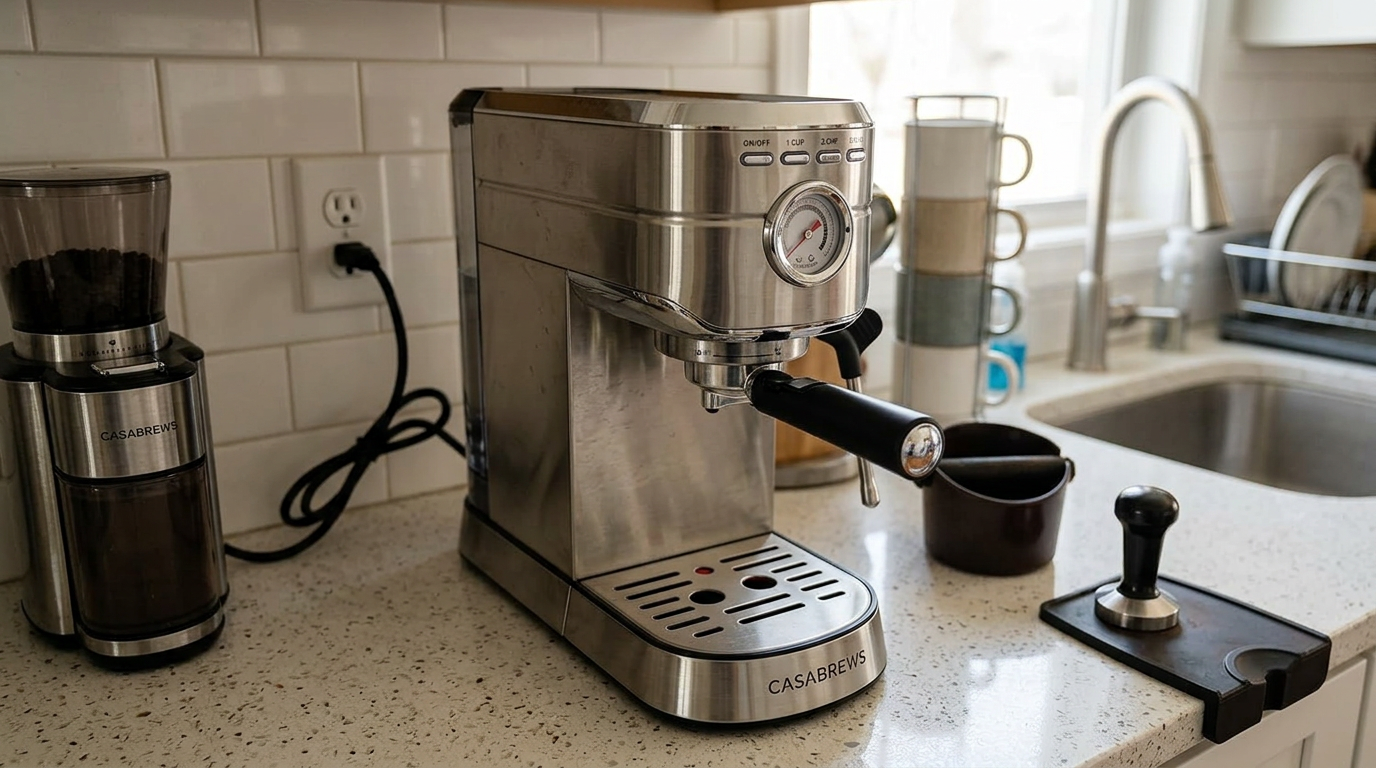
Mugs stacked on top and a grinder close by: my everyday setup for the CM5418.
The drinks I made most often
These are the recipes I settled on, first with the stock basket and then with the upgrades.
| Drink | Coffee | How I made it | Notes |
|---|---|---|---|
| Latte | 15 g double | About 8 oz steamed whole milk | Great even with stock basket |
| Oat latte | 15 g double | Barista oat milk, small jug | Tap and swirl before pouring |
| Cappuccino | 15 g double | More air in the stretch | Light, tall foam |
| Americano | 15 g double | Hot water from the wand | Softens bitterness |
| Iced latte | 15 g double | Over ice, cold milk | No steaming needed |
| Espresso | 15 g in, 30 to 36 g out | Single-wall basket, 25 to 30 s | Nutty, chocolatey |
With the stock basket, the latte and Americano were my go-to drinks.
Once I'd upgraded, a straight double in the afternoon became a treat rather than a chore.
Our tip: For an iced latte, brew the double straight over a full glass of ice so it chills fast and stays strong.
Living with it: week one to week three
Week one
I used the CM5418 exactly as it came, with pre-ground coffee and the stock baskets.
Lattes and Americanos were good from day one, while straight shots disappointed me.
I also learned to fill the tank at the sink after one spill too many.
Week two
I added a burr grinder and fresh beans, which made the stock espresso noticeably sweeter.
I also spent the week practicing oat milk and finally poured a recognizable tulip.
Week three
I switched to a three-tab portafilter, a single-wall basket, a metal tamper and a WDT tool.
After one morning of dialing in, my straight espresso jumped from a 6 to an 8 out of 10.
By the end, I was genuinely enjoying a budget machine I'd nearly dismissed in week one.
How I rated each drink by the end of the test, out of 10.
Serving guests
For Americanos, the CM5418 keeps up easily: brew, add hot water, repeat.
Milk drinks are slower, because you can't brew and steam at once and the steam takes a moment to heat.
Four lattes took me about 15 minutes, including dosing and cleaning the wand between jugs.
What helped
I brewed all the shots first, then steamed milk in two batches and split each jug between two cups.
Steaming a larger jug in one go gave weaker foam, so two smaller batches were worth the extra minute.
I also refilled the tank before starting, because four lattes with purges nearly emptied it.
Our tip: For guests, brew every shot first, then steam two small jugs rather than one big one.
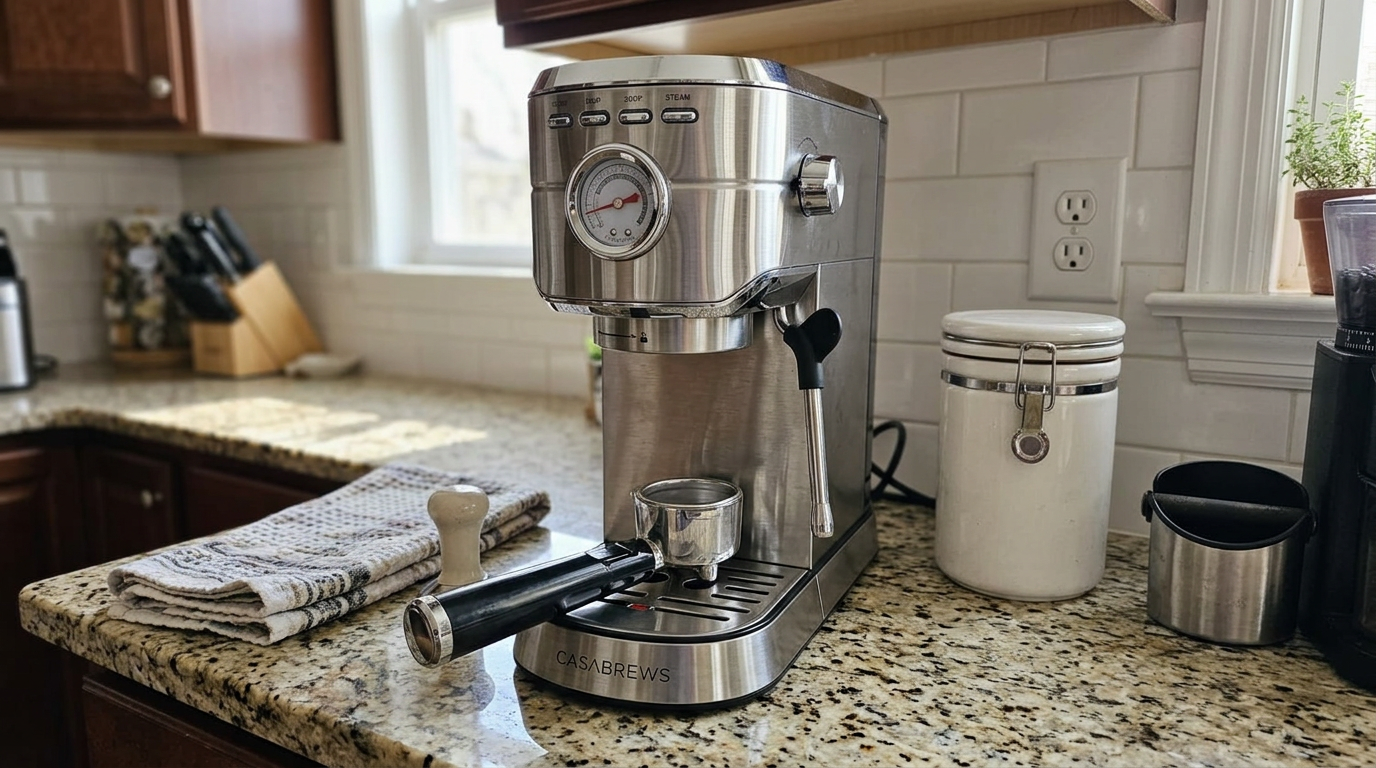
The CM5418 with its portafilter out. Between drinks, I knocked out the wet puck and wiped the rim before the next shot.
Build quality and long-term ownership
The brushed steel front and top look smarter than you'd expect at this level and wipe clean easily.
The sides and base use more plastic, and the machine is light, so it can slide a little when you twist the portafilter in.
The aluminum portafilter is solid enough, but the plastic handle and spout feel basic.
The plastic scoop-tamper is the weakest part of the package.
Reliability
Over three weeks of daily use, I had no faults, and the pressure and steam stayed consistent.
Owners commonly report years of use with regular cleaning and descaling, though three weeks can't prove that on its own.
The 51 mm size means spare baskets, tampers and portafilters are easy to find if something wears out.
What I liked most, and what bugged me
What I liked most
The size: it fits almost anywhere and looks neat doing it.
The simplicity: two shot buttons, a steam button and a knob, with nothing to learn beyond the basics.
The forgiveness: pre-ground coffee and the stock baskets gave me good lattes on day one.
And the potential: a few upgrades turned it into a machine that makes properly good espresso.
What bugged me
Stock straight espresso looked far better than it tasted.
The steam wand is modest, so bigger jugs and back-to-back milk drinks are slow.
The narrow tank is easy to spill when filling.
And the stock portafilter doesn't take standard single-wall baskets, so the best upgrade also means buying a new portafilter.
Who will enjoy it
If you want an easy machine for lattes and Americanos, or a cheap platform to learn and upgrade, you'll enjoy the CASABREWS CM5418.
If you want excellent espresso without spending time or money on extras, you'll be frustrated.
Common mistakes to avoid
The CM5418 is easy to use, but these habits hold it back.
| Mistake | What happens | Better habit |
|---|---|---|
| Judging it on stock straight espresso | You'll think it's worse than it is | Try a latte or Americano first |
| Grinding very fine for the stock basket | Slow, bitter, barely drips | Medium-fine with pressurized baskets |
| Buying single-wall baskets for the stock portafilter | They may not fit | Get a three-tab portafilter too |
| Using a blade grinder | Uneven grounds, impossible to dial in | Use a burr grinder |
| Filling the tank on the machine | Water spills down the back | Fill it at the sink |
| Steaming a big jug | Weak whirlpool, uneven foam | Use a small jug, one drink at a time |
| Skipping descaling | Weaker steam and flow | Descale every two to three months |
What I would change
A portafilter that takes standard single-wall baskets would make upgrading much easier.
A metal tamper and a milk pitcher in the box would help beginners from day one.
And a wider tank opening would end the spills.
CM5418 vs the newer 5418 PRO
CASABREWS also makes the 5418 PRO, which looks almost identical, so it's worth explaining the difference.
The PRO uses a thick-film✕Thick-film heaterA flat heating element printed onto a metal plate. It has little mass, so it heats up and changes temperature very quickly. heater instead of a thermoblock.
In my testing, that let it switch from brewing to steaming in a few seconds instead of about half a minute, and its steam added less water to the milk.
Both use 51 mm pressurized baskets, both have a gauge and both leave a wet puck.
| Feature | CM5418 | 5418 PRO |
|---|---|---|
| Heating | Thermoblock | Thick-film, faster switching |
| Steam power | Modest | Stronger, drier |
| Wait before steaming | About 30 s | A few seconds |
| Baskets | Pressurized | Pressurized |
| Best upgrade path | Three-tab portafilter, single-wall basket | Bottomless portafilter, single-wall basket |
| Best for | Lattes and Americanos on a budget | Frequent milk drinks |
If you make lots of milk drinks in a row, the PRO's speed is worth considering; my CASABREWS 5418 PRO review goes into detail.
If you make one or two drinks a day, or want the cheapest sensible platform to upgrade, the CM5418 makes more sense.
Is the CASABREWS CM5418 worth the money?
For beginners and tinkerers on a budget, yes.
You get a slim stainless machine, forgiving baskets, a usable steam wand and hot water, in a footprint that fits almost any kitchen.
What you give up out of the box is good straight espresso, strong steam and a dry puck.
Ask yourself three questions before you buy.
Do you mostly drink lattes, cappuccinos or Americanos? Is counter space tight? Would you enjoy upgrading it over time?
If the answers are yes, the CASABREWS CM5418 is a sensible, low-risk first espresso machine.
If you want to learn real espresso from day one without buying extras, the machine in my Breville Bambino review will suit you better.
How it compares with other entry-level setups
| Feature | CASABREWS CM5418 | Budget machine with built-in grinder | Compact machine with single-wall baskets |
|---|---|---|---|
| Baskets | Pressurized | Usually pressurized | Pressurized and single-wall |
| Grinder | No | Yes | No |
| Milk | Modest manual wand | Manual wand | Manual or automatic |
| Hot water | Yes | Usually | Varies |
| Espresso ceiling | Good once upgraded | Good | Excellent |
| Footprint | Very slim | Small to medium | Small |
| Best for | Budget lattes, upgrading later | One-machine setups | Learning real espresso |
| You mostly drink | Is the CM5418 a fit? | Why |
|---|---|---|
| Lattes and cappuccinos | Good | Steam wand handles one drink at a time |
| Americanos | Very good | Hot water from the wand |
| Straight espresso, stock | Fair | Pressurized baskets mute flavor |
| Straight espresso, upgraded | Good | Single-wall basket and grinder |
| Lots of milk drinks in a row | Fair | Can't brew and steam at once |
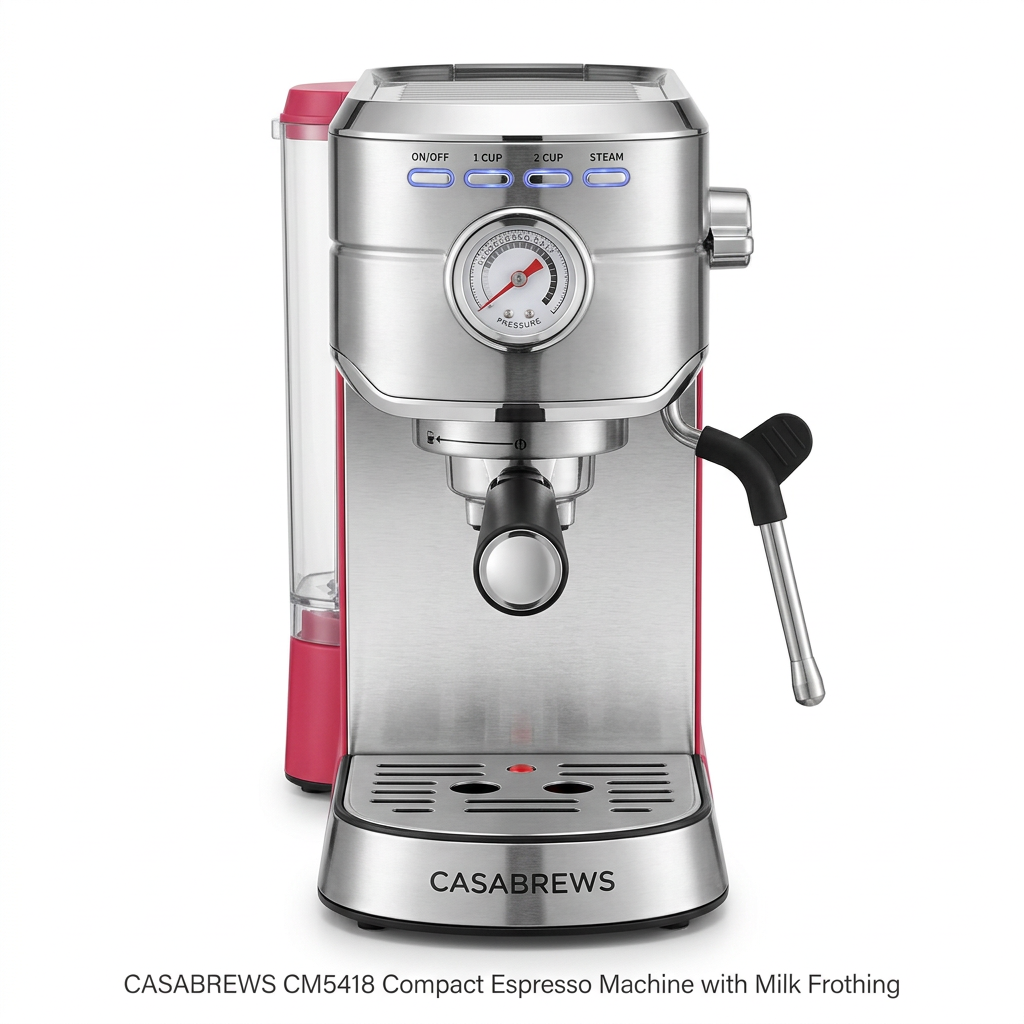
The CM5418 from the front: two shot buttons, the gauge in the middle and the steam wand on the right.
Which one is right for you: is the CASABREWS CM5418 your match?
4 quick questionsCASABREWS CM5418 specifications
From manufacturer data and my own testing.
How I tested and scored the CASABREWS CM5418
For three weeks, I used the CASABREWS CM5418 as my everyday machine for espresso, lattes, cappuccinos, Americanos and iced drinks, usually three or four drinks a day.
For the first ten days, I used it exactly as it comes, with the pressurized baskets, the plastic tamper and both pre-ground and freshly ground coffee.
For the rest of the test, I added a three-tab 51 mm portafilter with a single-wall basket, a metal tamper and a WDT tool, and timed and weighed my shots.
I steamed whole, 2% and barista oat milk, then checked my notes against CASABREWS' specifications, other hands-on reviews and owner feedback.
- Espresso (6.6): crema, body and flavor with stock and upgraded baskets.
- Milk drinks (7.2): steam power, microfoam, wait time and milk types.
- Ease of use (8.0): controls, setup, tank, hot water and learning curve.
- Cleaning (7.0): daily cleaning, wet puck, drips and descaling.
The overall score of 7.2 is an editorial rating that reflects those four areas.
CASABREWS CM5418 FAQ
Is the CASABREWS CM5418 worth it?
Yes, as an affordable first machine for lattes and Americanos. It gets much better with a few upgrades if you want great straight espresso.
Are the baskets pressurized?
Yes. Both baskets are double-wall pressurized baskets that hold up to about 15 grams.
Can I use a single-wall basket?
Yes, but the alternative baskets I used didn't fit the stock portafilter, so you need a compatible three-tab 51 mm portafilter.
What size is the portafilter?
51 mm.
Can I use pre-ground coffee?
Yes. The pressurized baskets are made for it. Use espresso grind rather than filter grind.
Does it have a pressure gauge?
Yes, on the front, which helps you see what's happening during the shot.
Can it steam oat milk?
Yes. Barista oat milk worked best, and I could pour a simple tulip with practice.
Can it brew and steam at the same time?
No. Brew first, then switch to steam and wait for it to heat up.
Does it make hot water?
Yes, through the steam wand, which is handy for Americanos.
How big is the water tank?
About 34 ounces, roughly 1 liter.
Is a milk pitcher included?
No. Buy a small stainless steel pitcher separately.
Why does it drip after brewing?
It has no pressure-release valve, so some water drips after the shot and the puck stays wet.
Kitchen & coffee tester
Michael spent six years as a line cook in restaurants in Chicago and New York, and he has tested kitchen appliances for HouseholdMe since 2018, from air fryers to coffee makers. He holds an SCA certificate in barista skills and used the CASABREWS CM5418 as his everyday coffee machine for three weeks for this review.
- Three weeks of hands-on testing of the CASABREWS CM5418
- CASABREWS product specifications and user manual
- Independent hands-on reviews of the CM5418
- Owner feedback on upgrades, steaming and drips