De'Longhi Classic Signature review: a traditional-looking espresso machine that makes first espressos easy
The De'Longhi Classic Signature Espresso Machine takes the internals of De'Longhi's popular compact machines and wraps them in a traditional café look, with a metal front, a central pressure gauge, top buttons and a cup warmer. I used it for three weeks to see whether it's a better first espresso machine, or just a prettier one.

Michael Reynolds
Hands-on review
Hands-on testing, research, specs
3 weeks
19 minutes
Jargon helpNew to espresso? Tap any dotted term to see what it means.
In this review
Yes, if you want your first espresso machine to look the part and be very easy to use. The De'Longhi Classic Signature heats in about 15 seconds, makes a crema-topped shot in roughly a minute, and its Panarello wand foams milk with no skill at all. But it's light enough to slide when you lock in the portafilter, the portafilter feels hollow, the gauge tells you little with the stock baskets, and there's no single-wall basket or milk pitcher in the box.
De'Longhi Classic Signature at a glance
De'Longhi Classic Signature pros and cons
- Fast 15-second heat-up and one-minute routine
- Classic look with gauge, metal front and cup warmer
- Foolproof pressurized baskets and Panarello foam
- Light machine slides when locking in
- Hollow, plastic-heavy portafilter
- No single-wall basket or milk pitcher included
Who should buy the De'Longhi Classic Signature?
- First-time espresso buyers
- People moving up from pod machines
- Families who want hot milk and cappuccinos
- Enthusiasts with a precision grinder
- Latte-art fans who won't modify the wand
- Very small kitchens
First impressions of the De'Longhi Classic Signature
The Classic Signature looks like a miniature café machine.
The metal front, the round gauge in the middle, the buttons on top and the flat cup warmer all say "serious espresso" before you've brewed a drop.
That impression lasted until I locked in the portafilter✕PortafilterThe handle with a metal basket that holds the ground coffee. You lock it into the machine to brew. for the first time and the whole machine twisted across the counter.
It's light, and the portafilter feels hollow, with a lot of plastic inside once you pop the basket out.
Neither turned out to be a real problem, but they're the first things you notice.
The box is minimal: the machine, the portafilter, single and double pressurized baskets, and a plastic scoop with a tamping end.
There's no milk pitcher and no single-wall basket.
My first shot, made with 14 grams of pre-ground espresso, was ready about a minute after I switched the machine on.
It came out under a thick layer of foam and tasted bold and smooth, a clear step up from the pod machine it replaced in my test kitchen.
For a first espresso machine, the De'Longhi Classic Signature makes a very friendly first impression.
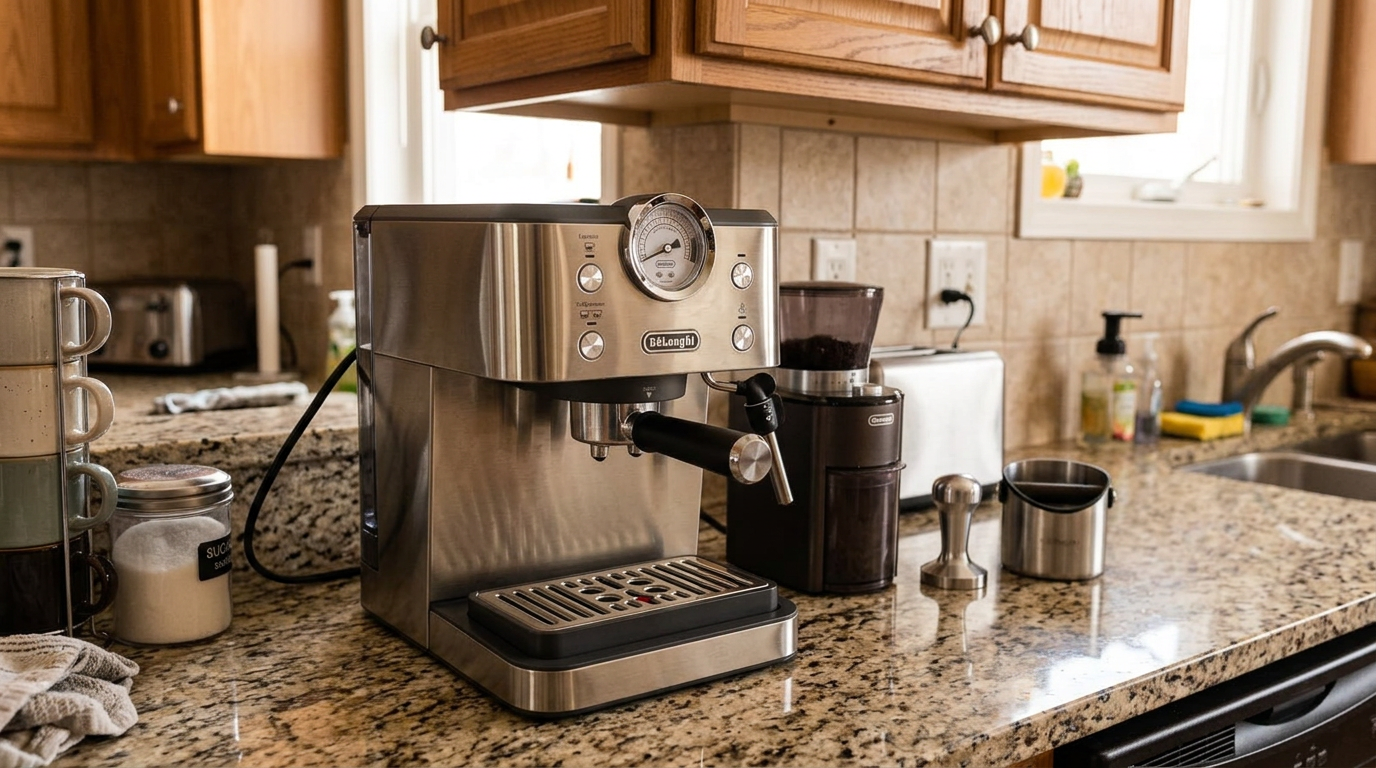
The Classic Signature by my sink, with a grinder close by. The central gauge gives it a traditional café look.
What the Classic Signature actually is
The Classic Signature is a compact semi-automatic espresso machine built on the same foundations as De'Longhi's popular Dedica.
A thermoblock✕ThermoblockA compact heater that warms water as it flows through, instead of keeping a boiler of hot water ready. heats water on demand, a 15-bar pump drives the shot, and a Panarello wand handles the milk.
What's different is the body: wider, more traditional, with a gauge, a cup warmer and a larger water tank.
| Item | Details | My verdict | |
|---|---|---|---|
| Portafilter | Proprietary fit, plastic-heavy | Works, feels hollow | |
| Baskets | Single and double, pressurized | Forgiving, flavor-limited | |
| Scoop and tamper | Plastic combo | Enough for pressurized baskets | |
| Steam wand | [[Panarello | panarello]] | Effortless foam |
| Missing | Milk pitcher, single-wall basket | Budget for both |
Classic Signature design and build
The traditional look is the Classic Signature's main reason to exist, and it delivers.
The metal front panel, central gauge and top-mounted buttons look smart on a counter, and the flat top doubles as a passive cup warmer.
The trade-off: weight
To keep it affordable, the machine is built from light materials.
When I twisted the portafilter in, the whole machine shifted or turned on the counter.
Holding the top with my other hand fixed it, and after a few days it became automatic.
The portafilter
The portafilter is unique to this model, so it isn't the same as the standard Dedica's.
It feels hollow and toy-like, but it never leaked or failed during my test.
Size
It's noticeably wider than the slim Dedica, so it suits a medium counter space rather than a tiny gap.
The tank
The removable tank is larger than the Dedica's, which meant fewer refills during my test.
Our tip: Rest your free hand on top of the machine while you lock in the portafilter so it doesn't slide.
The one-minute routine
Speed is the Classic Signature's strongest practical feature.
| Step | What I did | Time |
|---|---|---|
| 1. Switch on | Press power | Ready in about 15 s |
| 2. Dose | About 13 to 14 g in the double basket | While it heats |
| 3. Tamp | Light press with the plastic tamper | A few seconds |
| 4. Lock in | Hold the machine, twist the portafilter | A few seconds |
| 5. Brew | Press the one-cup or two-cup button | About 25 to 30 s |
The machine stops the shot by itself, so I could start steaming or warming a cup while it brewed.
Once I'd settled on a coffee and set my shot volume, the whole thing took about a minute from switch-on to cup.
That's close to pod-machine convenience with real ground coffee.
Programming the volume
Both buttons can be reprogrammed if the factory shots are too short or too long.
I shortened my double slightly for a richer, less watery espresso.
Our tip: Reprogram the double button to a slightly shorter shot; it gave me a richer espresso with the stock basket.
Dose, grind and tamp
With pressurized baskets, there are only two things to get right: dose and grind.
Dose
13 to 14 grams in the double basket worked best.
At 15 grams the basket was overfilled, the coffee pressed against the shower screen, and the shots tasted worse.
Grind
This is the most common beginner mistake on this machine.
When I ground fine like a traditional espresso, the combined resistance of the coffee and the pressurized basket choked the machine.
The gauge needle shot straight into the red, and only a few slow, bitter drops came out.
A standard store-bought espresso grind flowed evenly and tasted balanced.
Tamp
A light, level press with the plastic tamper is enough; heavy tamping isn't needed with these baskets.
Classic Signature espresso performance
With the stock baskets, the Classic Signature makes the kind of espresso most beginners are delighted with.
How it tasted
With a medium-dark pre-ground espresso, shots were bold, smooth and slightly chocolatey, with a thick foam on top.
They made excellent cappuccinos and lattes, and they tasted far richer than pod coffee.
On their own, they lacked the syrupy body, sweetness and layered flavor of a well-made shot from a single-wall basket.
About that crema
The foam on a pressurized shot is created by the basket's tiny exit hole whipping air into the coffee.
It looks like great crema✕CremaThe golden-brown foam on top of an espresso. It forms when pressure pushes oils and gases out of the coffee., but it can hide a shot that's under-extracted, so don't judge the coffee by the foam alone.
My flavor ratings on a 10-point scale.
| What you see | Likely cause | First change |
|---|---|---|
| Needle in the red, few drips | Grind too fine | Use a coarser espresso grind |
| Weak, watery | Too little coffee or long shot | Dose 13 to 14 g, shorten the shot |
| Bitter | Very dark roast or overfilled basket | Try medium-dark, dose less |
| Lukewarm | Cold cup | Warm cups on the top |
| Leaks at the group | Grounds on the rim | Wipe the rim |
Is the pressure gauge useful?
The central gauge is the Classic Signature's best visual feature, but with the stock baskets it isn't much of a tool.
Because the pressurized basket creates its own back-pressure, the needle climbs into the espresso range on almost every shot, whatever you do.
So for beginners, I'd mostly ignore it and watch the shot volume, the flow time and the taste instead.
With a single-wall basket
Once I fitted a single-wall basket, the manometer✕ManometerA pressure gauge. On espresso machines it shows roughly how much pressure is building during a shot. became genuinely useful.
The needle now depended on my grind and dose, so it showed straight away whether the coffee was gushing or choking.
Even then, it's a guide; the brew ratio✕Brew ratioDose compared with yield. A 1:2 ratio means 18 grams of coffee makes 36 grams of espresso. and taste matter far more.
| Basket | What the needle tells you | Useful? |
|---|---|---|
| Stock pressurized | Almost always in range | Rarely |
| Single-wall | Real resistance from your coffee | Yes |
Upgrading with a single-wall basket
De'Longhi doesn't include a single-wall basket✕Single-wall basketA basket full of small holes. All the resistance comes from the coffee itself, so grind and tamp matter much more., which feels like a missed opportunity.
An inexpensive third-party single-wall basket that fits the portafilter changed the Classic Signature more than anything else I tried.
What you need
A burr grinder that can grind fine enough for espresso, a scale, and more care with distribution and tamping.
The plastic scoop-tamper isn't really up to it, so a proper tamper that fits the basket helps.
What it tasted like
Once dialed in, shots gained real body, a natural crema and much clearer flavor, with caramel sweetness and a longer finish.
It took me about a morning to find the right grind, and the gauge finally helped.
| Setup | Ease | Flavor |
|---|---|---|
| Stock pressurized basket | Very easy | Good |
| Third-party single-wall basket | Takes practice | Very good |
If you're happy with cappuccinos, you may never need it; if you get curious, it's the obvious next step.
My guide to burr vs blade grinders explains the grinder side of the upgrade.
Steaming milk with the Panarello wand
The Panarello wand is made for beginners.
Its sleeve has small air holes that pull air into the milk automatically, so you just dip it in and open the steam.
What it's good at
Thick, airy foam for tall cappuccinos and latte macchiatos, with no technique at all.
Hot milk for hot chocolate, which my test-week guests' children loved.
Hot water for Americanos and tea.
What it can't do
It can't make glossy microfoam✕MicrofoamMilk foam with bubbles so small you can't see them. It feels silky and pours well for latte art. for latte art, because the bubbles are too big and the milk doesn't swirl.
My ratings on a 10-point scale for texture.
Removing the sleeve
Like other De'Longhi compacts, you can pull off the sleeve to expose a rubber nozzle and steam manually.
Secure that nozzle with a small zip tie first, or steam pressure can push it off into your milk.
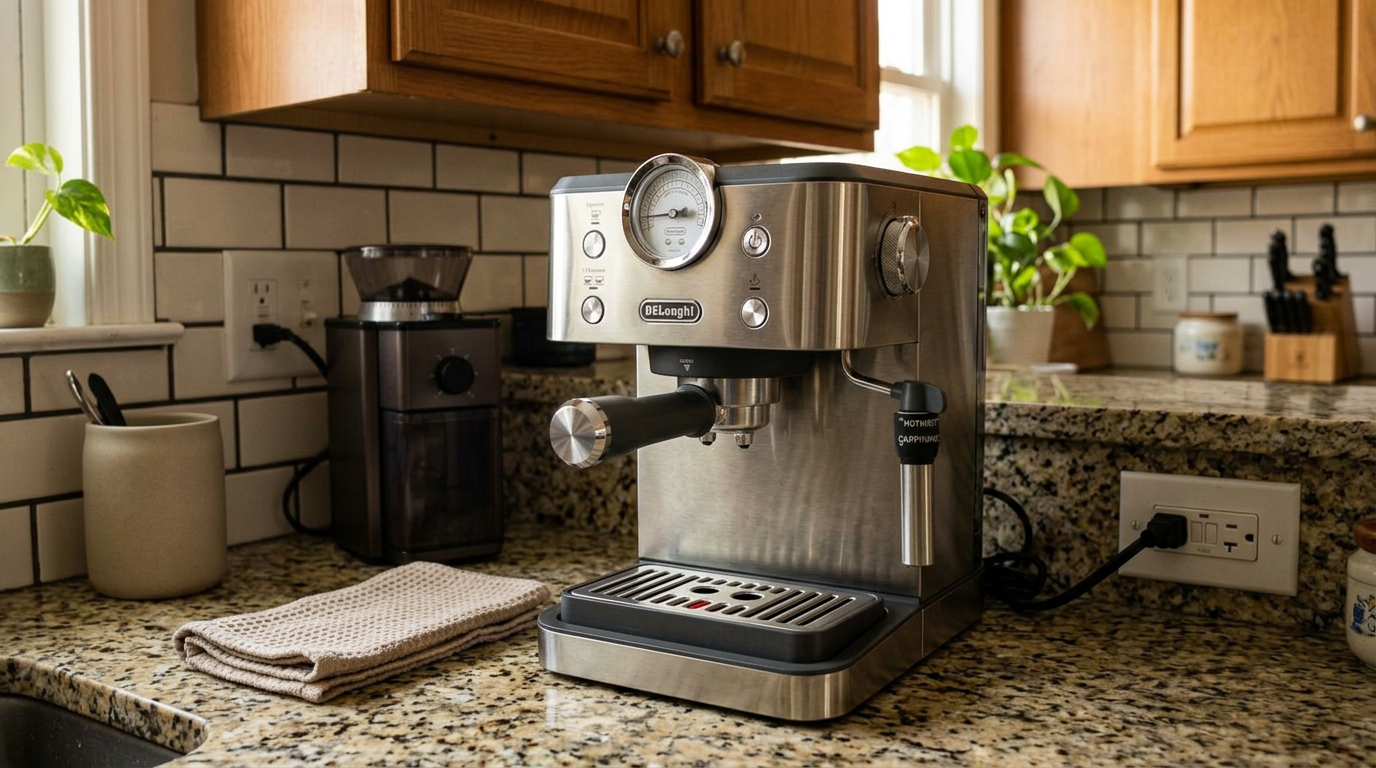
The Classic Signature with my grinder. The Panarello wand on the side is the easiest milk tool I've used.
How I steam milk, step by step
| Step | Sleeve on (cappuccino) | Sleeve off (latte art) |
|---|---|---|
| 1. Brew | Pull the shot first | Pull the shot first |
| 2. Heat | Press steam, wait for the light | Press steam, wait for the light |
| 3. Purge | Open briefly over the tray | Open briefly over the tray |
| 4. Steam | Dip deep, open fully | Tip just under the surface, then sink |
| 5. Stop | When the jug is too hot to hold | When the jug is too hot to hold |
| 6. Clean | Rinse the sleeve, wipe the wand | Wipe the nozzle, purge |
With the sleeve on, the whole thing takes under a minute and needs no attention.
With it off, it takes practice, but the milk is far silkier.
My cappuccino foam over the test, rated out of 10.
Our tip: With the sleeve on, keep the jug low so the tip sits deep in the milk; you'll get finer, steadier foam.
Hot chocolate, tea and family drinks
The Classic Signature turned out to be a good family machine.
The Panarello wand heats plain milk quickly for hot chocolate, which made it popular with younger visitors.
The hot water function handled tea and Americanos.
| Drink | How I made it | Notes |
|---|---|---|
| Hot chocolate | Steamed milk, cocoa stirred in | Big hit with children |
| Babyccino | Warm foamy milk, sprinkle of cocoa | Keep it only warm |
| Tea | Hot water from the wand | Handy for one mug |
| Americano | Double shot, hot water | Smooth afternoon drink |
Keep an eye on milk temperature for children's drinks; stop as soon as the jug feels warm rather than hot.
Our tip: For children's drinks, stop steaming as soon as the jug feels warm to your hand.
Classic Signature vs the standard Dedica
This is the question most shoppers will have.
The short answer: inside, they're very similar, and the espresso tastes virtually the same.
| Feature | Classic Signature | Standard Dedica |
|---|---|---|
| Look | Traditional café style | Slim and modern |
| Width | Noticeably wider | Very narrow |
| Pressure gauge | Yes, central | No |
| Water tank | Larger | Smaller |
| Cup warmer | Yes | Yes |
| Espresso quality | Same | Same |
| Best for | Classic look, fewer refills | Tiny counters |
Choose the Classic Signature if you love the traditional look and want a gauge and a bigger tank.
Choose the Dedica if counter width matters most.
Neither is better at making coffee; they're two outfits on the same idea.
Beans, roast and water
With pressurized baskets, roast mattered more than freshness.
Medium-dark and dark blends tasted best: bold, smooth and great in milk.
Light roasts tasted thin and a little sour in the stock baskets, but were enjoyable with the single-wall upgrade.
My guide to coffee roast levels explains the differences.
| Roast | Stock basket | Single-wall basket |
|---|---|---|
| Light | Thin, sour | Bright, needs practice |
| Medium | Smooth, a bit flat | Sweet and balanced |
| Medium-dark | Bold, chocolatey | Rich, my favorite |
| Dark | Bitter straight, fine in milk | Heavy, bittersweet |
Water
I used filtered water and refreshed the tank every couple of days.
Our tip: Buy pre-ground espresso in small bags and seal them tightly; flavor fades fast once opened.
My first-week checklist for new owners
| Day | What to do | Why |
|---|---|---|
| Day 1 | Rinse parts, fill the tank, run water through | Clean start |
| Day 1 | Use pre-ground espresso, 13 to 14 g | Best starting point |
| Day 2 | Hold the machine when locking in | It's light |
| Day 2 | Keep cups on the warmer | Hotter espresso |
| Day 3 | Reprogram the double to your preferred length | Richer shots |
| Day 4 | Try cappuccinos and hot chocolate with the Panarello | Its strength |
| Day 5 | Buy a small milk pitcher | None in the box |
| Day 7 | Consider a single-wall basket | Big flavor upgrade |
What other owners say
Three weeks is a fair test, but I also looked at what other owners and testers report.
The most common praise is for the look, the speed and how easy it is for beginners and people coming from pod machines.
Many owners mention the cup warmer and the gauge as features that make it feel more expensive than it is.
The most common complaints match mine: the light build that slides when locking in, the hollow portafilter, stiff Panarello foam and the missing pitcher and single-wall basket.
What that means for you
The Classic Signature is easy and dependable for what it's designed to do.
Its compromises are about feel and flexibility, not reliability.
Cleaning and maintaining the Classic Signature
| When | Task | Why it matters |
|---|---|---|
| After steaming | Rinse the Panarello sleeve, wipe the wand | Milk hides in the sleeve |
| Daily | Rinse the portafilter and basket | Removes coffee oils |
| Daily | Empty the drip tray | Prevents odors |
| Weekly | Brush the group head and gasket | Keeps the seal tight |
| Weekly | Clear the pressurized basket hole | Keeps shots flowing |
| Every few months | Descale | Protects the thermoblock |
Descaling
Follow the manual's descaling✕DescalingRunning a mild acid solution through the machine to dissolve the mineral scale that builds up from tap water. steps with a proper descaler every few months, more often with hard water.
My estimate of hands-on cleaning time per day.
What daily use is really like
My weekday routine: switch on, dose while it heats, lock in, press the double, then steam.
A cappuccino took about three minutes, including rinsing the Panarello sleeve.
The pump is a normal buzz, and the Panarello steam is a soft hiss.
Thanks to the larger tank, I refilled about twice a week.
The cup warmer was more useful than I expected, because cold cups take a lot of heat out of a small espresso.
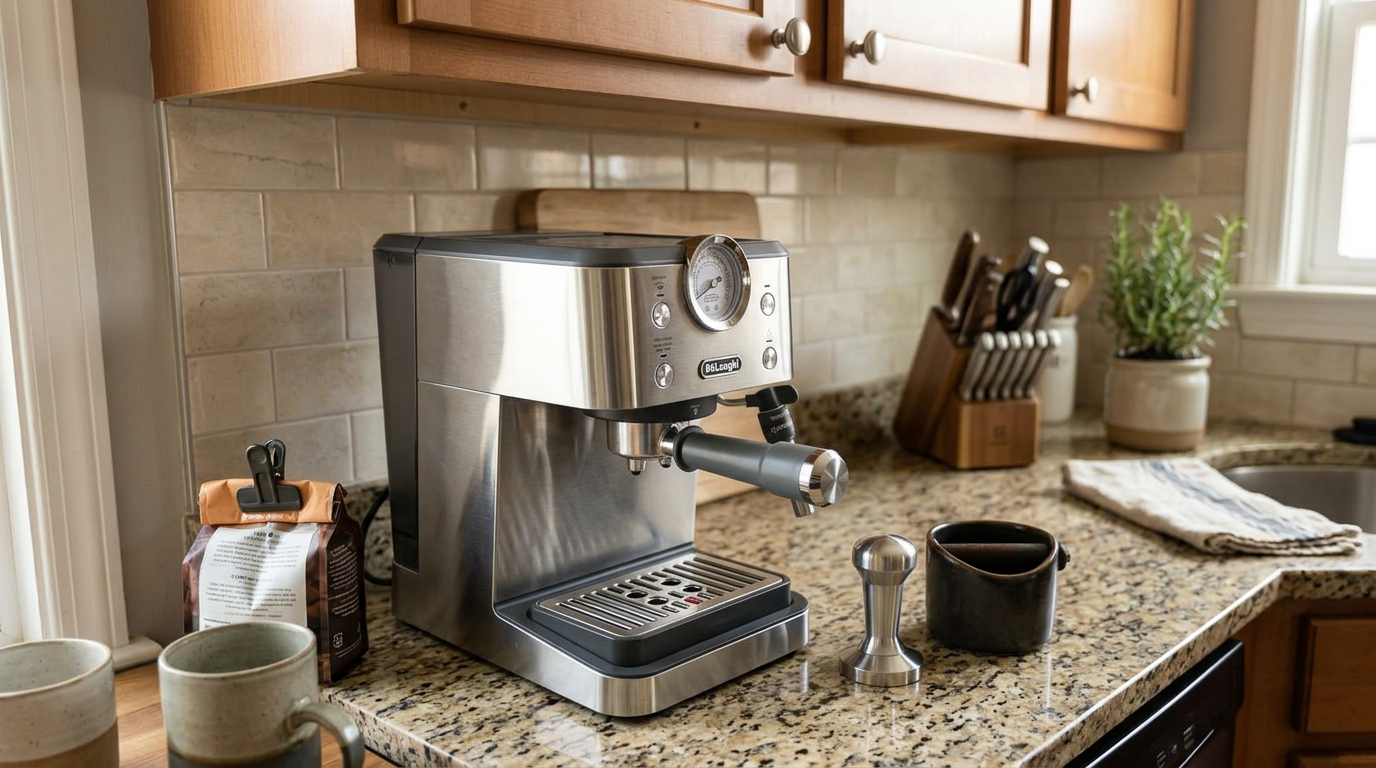
A black mug and tamper beside the Classic Signature. The flat top keeps cups warm while the machine is on.
For a slimmer alternative with a manual wand, see my CASABREWS CM5418 review.
Is it a good step up from a pod machine?
A lot of people looking at the Classic Signature are replacing a capsule machine, so I tested it with that in mind.
The good news is that the routine is almost as quick.
From switch-on to a finished shot took about a minute, and the machine stops the shot automatically, just like a pod machine.
The extra steps are dosing, tamping and knocking out the used coffee, which add about a minute a day.
What you gain
Coffee choice: any pre-ground espresso, or fresh beans if you buy a grinder.
Milk: a steam wand that makes proper cappuccino foam and hot milk, rather than a separate frother.
Less packaging waste, since there are no capsules.
What you lose
A little tidiness, because grounds and a wet puck need dealing with.
And total consistency, because your dose and grind now affect the cup.
| Factor | Pod machine | Classic Signature |
|---|---|---|
| Time per drink | Under a minute | About a minute |
| Coffee choice | Capsules only | Any ground coffee |
| Milk | Separate frother | Built-in Panarello wand |
| Cleanup | Almost none | Knock out, rinse, wipe wand |
| Flavor ceiling | Good | Good, very good with upgrades |
For most pod upgraders, the Classic Signature is a very comfortable next step.
The drinks I made most often
| Drink | Coffee | How I made it | Notes |
|---|---|---|---|
| Cappuccino | 14 g double | Panarello foam, sleeve on | Easy and reliable |
| Latte | 14 g double | About 8 oz steamed milk | Mild, creamy |
| Latte macchiato | 14 g double | Foamy milk first, shot through it | Pretty layers |
| Americano | 14 g double | Hot water from the wand | Smooth |
| Hot chocolate | No coffee | Steamed milk and cocoa | Family favorite |
| Espresso | Single-wall basket, fresh beans | About 30 g in 25 to 30 s | Best after upgrading |
The cappuccino was the drink the machine did best as it comes.
After the upgrade, a straight espresso became worth drinking on its own.
Living with it: week one to week three
Week one
I learned the one-minute routine, found my 13 to 14 gram dose and stopped grinding too fine.
I also learned to hold the machine when locking in the portafilter.
Week two
I reprogrammed the shot buttons, made lots of cappuccinos and hot chocolates, and tried several pre-ground coffees.
Week three
I added a single-wall basket and removed the Panarello sleeve.
The espresso improved dramatically, and the milk became silkier, though both took more effort.
How I rated each drink by the end of the test, out of 10.
Serving guests
The fast heat-up and automatic shots make the Classic Signature easy to use for visitors.
Four cappuccinos took me about 13 minutes, including the wait to switch between brewing and steaming.
I brewed all four shots first, kept the cups on the warmer, then steamed milk in two batches.
Guests could also make their own drinks with almost no instruction, which is the Panarello's great strength.
Our tip: For guests, brew every shot first and steam milk in two batches rather than switching back and forth.
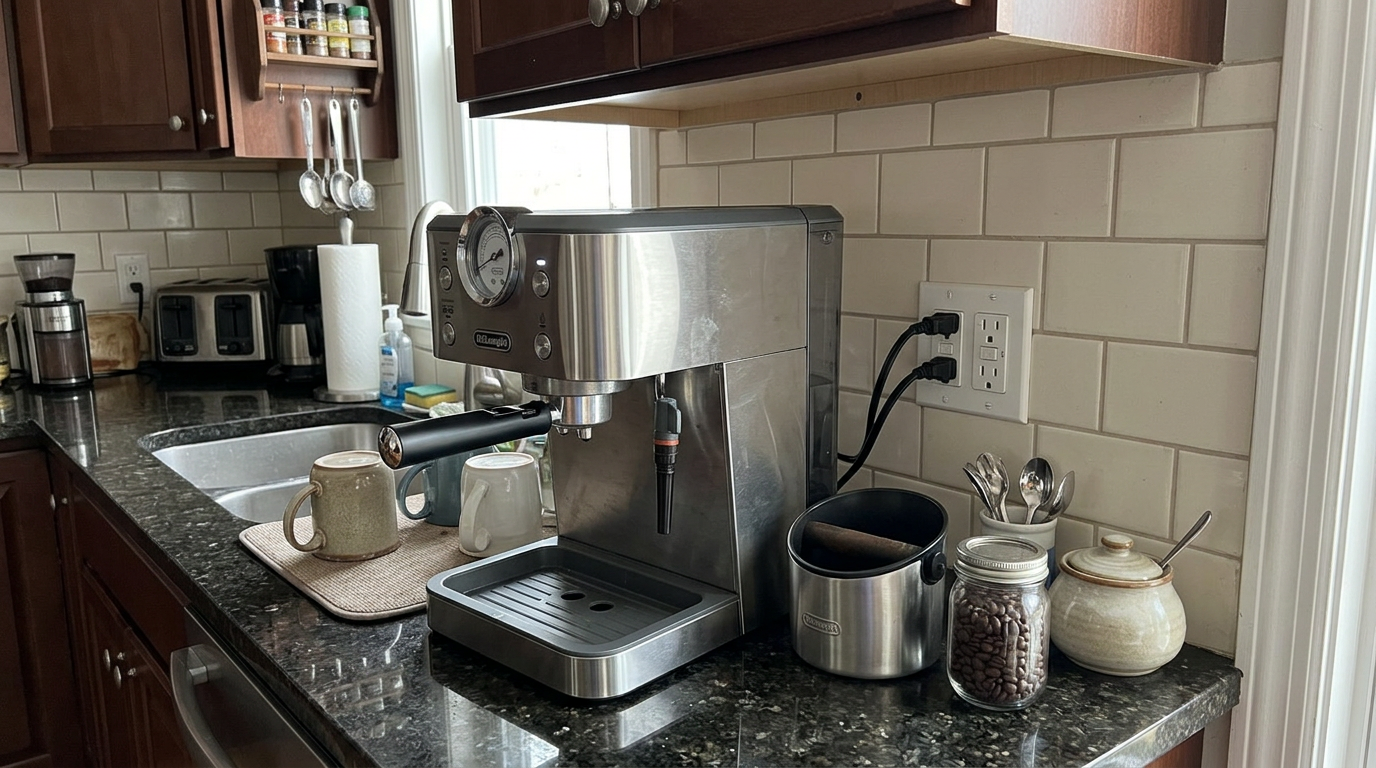
The Classic Signature by the sink with mugs ready. Between drinks, I knocked out the puck and wiped the rim.
What I liked most, and what bugged me
What I liked most
The look: a traditional café style that suits many kitchens.
The speed: about 15 seconds to heat and a minute to a finished shot.
The ease: forgiving baskets and foolproof foam.
And the small touches: a cup warmer, a bigger tank and programmable buttons.
What bugged me
The machine slides when you lock in the portafilter.
The portafilter feels hollow and cheap.
The gauge is mostly decorative with the stock baskets.
And there's no pitcher or single-wall basket in the box.
Who will enjoy it
If you want an attractive, simple first machine, you'll enjoy the De'Longhi Classic Signature.
If you want precision and a solid feel, you'll want something heavier.
Common mistakes to avoid
| Mistake | What happens | Better habit |
|---|---|---|
| Grinding fine for the stock basket | Needle in the red, few drips | Use a normal espresso grind |
| Overfilling with 15 g | Worse taste, messy | Use 13 to 14 g |
| Not holding the machine | It twists on the counter | Brace it with one hand |
| Judging shots by the foam | Foam hides weak shots | Judge by taste |
| Leaving milk in the sleeve | Smells, weak foam | Rinse after every use |
| Skipping descaling | Weaker steam | Descale every few months |
What I would change
A heavier, more solid portafilter.
A single-wall basket and a small pitcher in the box.
And a little more weight in the base so it stays put.
Is the De'Longhi Classic Signature worth the money?
For beginners and pod upgraders who care about looks, yes.
You get a traditional-looking machine with a gauge, cup warmer and big tank, very fast heat-up and the easiest possible milk foam.
What you give up is a solid feel, precise espresso out of the box and silky milk.
Ask yourself three questions before you buy.
Do you want a classic-looking machine? Do you mostly drink cappuccinos? Will you use pre-ground coffee, at least at first?
If the answers are yes, the Classic Signature is an easy, friendly choice.
If you'd rather start with single-wall baskets and a heavier build, see my CASABREWS Ultra review.
How it compares with other entry-level setups
| Feature | De'Longhi Classic Signature | De'Longhi Classic (matte black) | Slim pressurized-basket machine |
|---|---|---|---|
| Look | Traditional, central gauge | Modern, front gauge | Slim, modern |
| Portafilter | Proprietary | Common 51 mm | 51 mm |
| Milk | Panarello | Panarello | Manual wand |
| Upgrade path | Third-party single-wall basket | Bottomless portafilter | Varies |
| Best for | Classic look, easy drinks | Easy drinks, more upgrades | Tight counters |
| You mostly drink | Is the Classic Signature a fit? | Why |
|---|---|---|
| Cappuccinos | Very good | Foolproof Panarello foam |
| Hot chocolate and hot milk | Very good | Quick, easy |
| Straight espresso, stock | Fair | Pressurized baskets limit flavor |
| Latte art | Fair | Needs the sleeve off and a zip tie |
For a version with a common 51 mm fitting that takes bottomless portafilters, see my De'Longhi Classic Matte Black review.
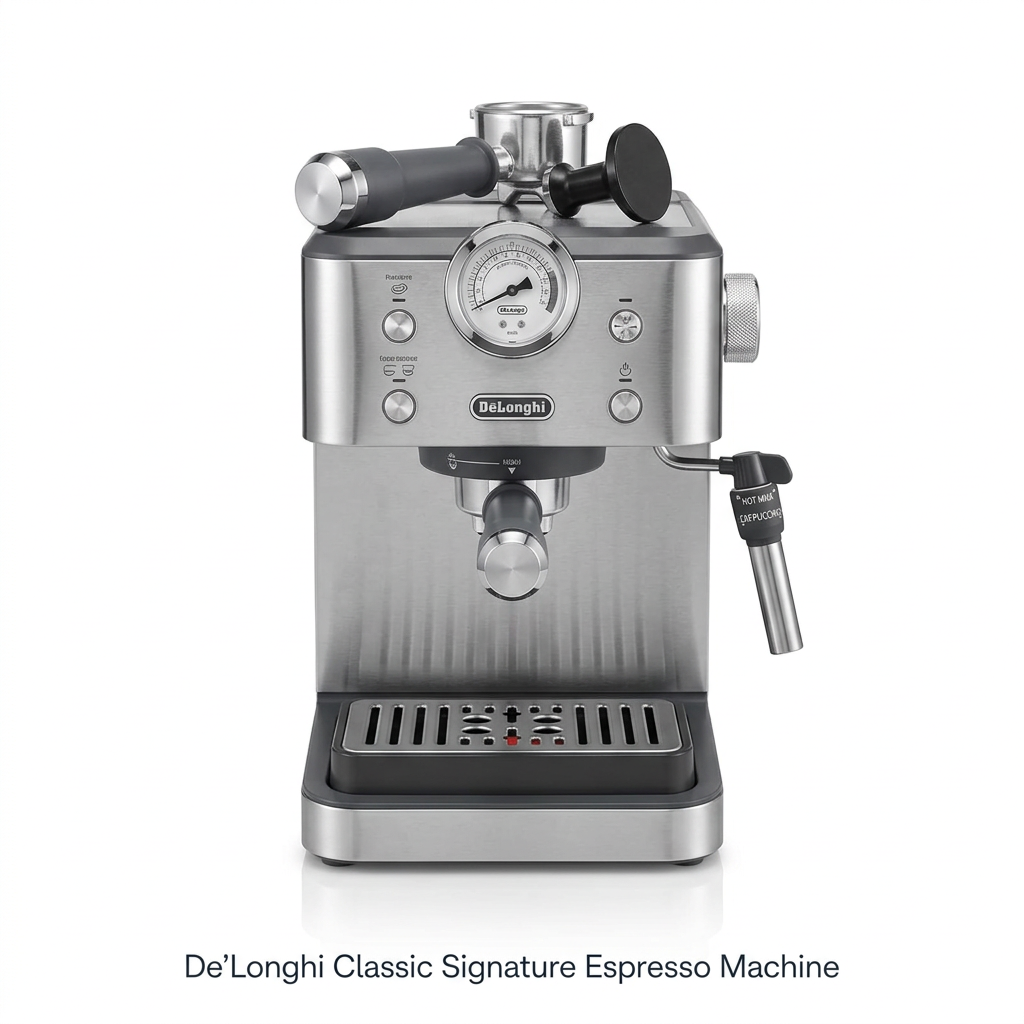
The Classic Signature from the front: central gauge, top buttons and the Panarello wand on the side.
Build quality and long-term ownership
The outside of the Classic Signature is its strongest part: the metal front looks smart, the buttons feel positive and the cup warmer is a nice touch.
Underneath, it's built light to keep the machine affordable, and you feel that every time you lock in the portafilter.
The portafilter is the weakest part, with a lot of plastic inside and a hollow, light handle.
That said, nothing leaked, loosened or failed in three weeks of daily use.
What tends to need attention
On machines like this, the parts that wear first are the group gasket, the Panarello sleeve and the rubber nozzle underneath it.
All are cheap and easy to replace.
The thermoblock needs regular descaling, especially in hard-water areas, or the steam weakens over time.
Keep your receipt and register the warranty, as with any appliance at this level.
Choosing coffee for the Classic Signature
Because the stock baskets are pressurized, you don't need specialty beans or an expensive grinder to get good drinks.
That makes buying coffee simpler than for most espresso machines.
What worked best
A pre-ground espresso labeled for espresso machines, in a medium-dark or dark roast, gave the most consistent results.
Smaller bags were better than big ones, because ground coffee loses aroma quickly once the bag is open.
What to avoid
Filter-grind coffee is too coarse and makes weak, watery shots.
Coffee ground very fine at home chokes the pressurized basket.
Very oily dark roasts left residue in the basket and tasted smoky.
| Coffee | Result | Verdict |
|---|---|---|
| Pre-ground espresso, medium-dark | Bold, smooth, good foam | Best start |
| Pre-ground espresso, dark | Strong, great in milk | Good |
| Filter grind | Fast, watery | Avoid |
| Home-ground very fine | Chokes the basket | Avoid with stock baskets |
My guide to storing coffee has tips for keeping an open bag fresher.
Hot water and Americanos
In brew mode, the side control sends hot water through the wand.
I used it for Americanos almost every afternoon, adding about five ounces of water to a double shot.
Americanos were one of the stock baskets' best drinks, because the water softened the slightly flat edge of pressurized shots.
I also used hot water to warm cups when the cup warmer was full, and for the occasional cup of tea.
| Drink | Water | Notes |
|---|---|---|
| Americano | About 5 oz on a double | Smooth and easy |
| Long black | Water first, shot on top | More aroma |
| Tea | Straight from the wand | Handy for one mug |
The first second can spit, so keep your fingers away from the tip.
Which one is right for you: is the De'Longhi Classic Signature your match?
4 quick questionsDe'Longhi Classic Signature specifications
From manufacturer data and my own testing.
How I tested and scored the De'Longhi Classic Signature
For three weeks, I used the De'Longhi Classic Signature as my everyday machine for espresso, cappuccinos, lattes, Americanos and hot chocolate, usually three or four drinks a day.
I used pre-ground coffee and freshly ground beans in the stock pressurized baskets, tested different grind sizes and doses, and reprogrammed the shot volumes.
For the last week, I added an inexpensive third-party single-wall basket and tried the Panarello wand with the sleeve removed and the nozzle zip-tied.
I then checked my notes against De'Longhi's specifications, other hands-on reviews and owner feedback.
- Espresso (6.8): crema, body and flavor with stock and single-wall baskets.
- Milk drinks (7.2): Panarello foam, hot milk and the sleeve-off option.
- Ease of use (8.2): heat-up, controls, programming and setup.
- Cleaning (7.0): daily cleaning, wand care and descaling.
The overall score of 7.3 is an editorial rating that reflects those four areas.
De'Longhi Classic Signature FAQ
Is the De'Longhi Classic Signature worth it?
Yes, for beginners who want a classic-looking, very easy machine. Enthusiasts with a precision grinder will outgrow it.
How fast does it heat up?
About 15 seconds, and a full shot takes roughly a minute from switching on.
Are the baskets pressurized?
Yes. Both the single and double baskets are pressurized, so pre-ground coffee works well.
How much coffee should I use?
About 13 to 14 grams in the double basket. 15 grams overfilled it in my testing.
Why does the gauge jump into the red?
Your grind is too fine for the pressurized basket. Use a standard pre-ground espresso coarseness.
Is the pressure gauge useful?
Not much with the stock baskets. It becomes useful with a single-wall basket.
Can I use a single-wall basket?
Yes. An inexpensive third-party single-wall basket worked in my testing and improved the espresso a lot.
Can it make latte art?
Not with the Panarello sleeve on. Removing it and zip-tying the inner nozzle helps.
Does it slide when locking the portafilter?
Yes. It's light, so hold the machine with your other hand.
Can I change the shot volume?
Yes. Both the single and double buttons can be reprogrammed.
Is a milk pitcher included?
No. You'll need to buy one separately.
How is it different from the standard Dedica?
The internals and espresso are very similar. The Classic Signature is wider, with a gauge, a bigger tank and a traditional look.
Kitchen & coffee tester
Michael spent six years as a line cook in restaurants in Chicago and New York, and he has tested kitchen appliances for HouseholdMe since 2018, from air fryers to coffee makers. He holds an SCA certificate in barista skills and used the De'Longhi Classic Signature as his everyday coffee machine for three weeks for this review.
- Three weeks of hands-on testing of the De'Longhi Classic Signature
- De'Longhi product information and manual
- Independent hands-on reviews of the Dedica Classic
- Owner feedback on build, baskets and steaming