Philips espresso machine comparison: every series from 800 to 5500 explained
Philips names its espresso machines with numbers, and the numbers don't tell you much. I tested nine of them for four weeks each, from the simple Philips 800 Series to the 20-drink Philips 5500 Series, weighing doses, timing drinks and living with each one as my daily coffee maker. This comparison explains what changes at each step, which upgrades are worth it and which machine fits your kitchen.
We choose products independently. We may earn a commission through links on this page; your price stays the same. Affiliate policy
Jargon helpNew to espresso? Tap any dotted term to see what it means.
In this comparison
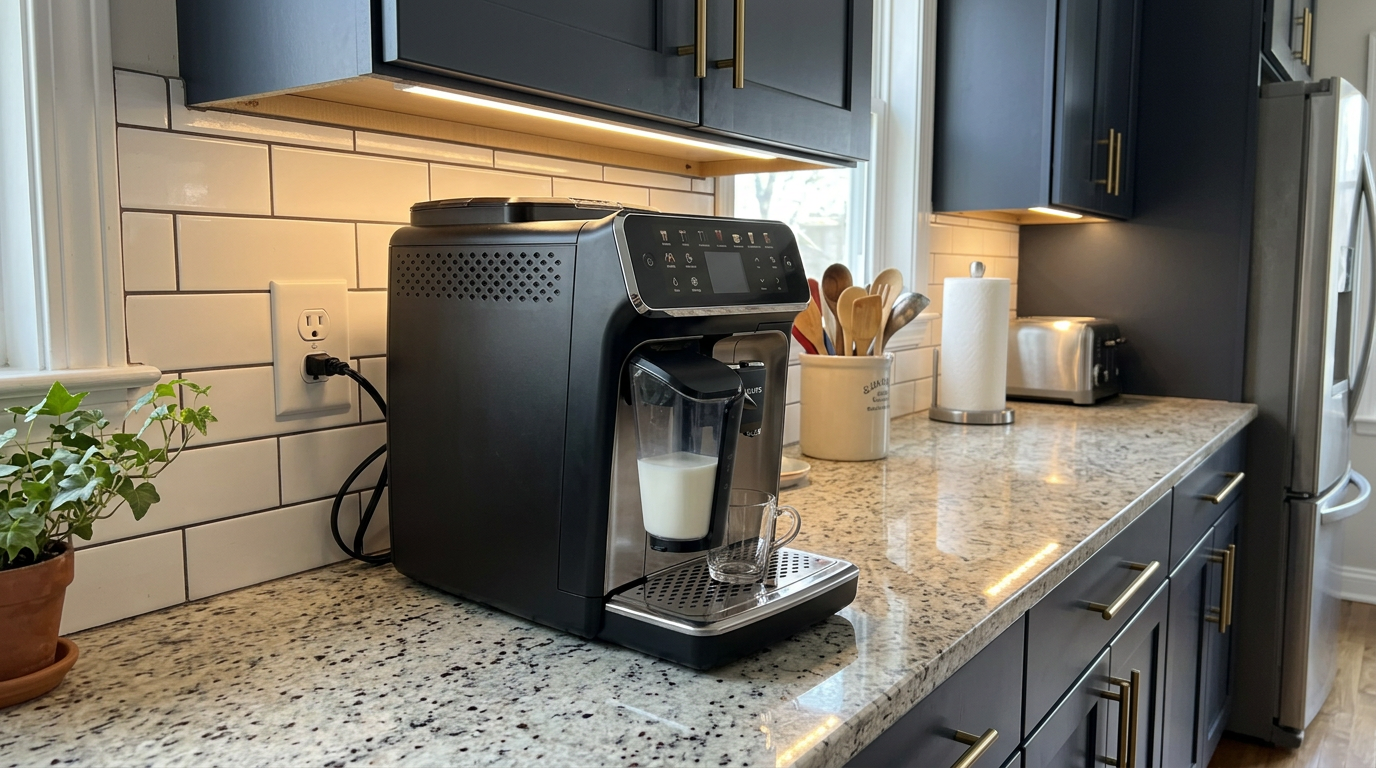
For most people, the Philips 4400 Series is the Philips to buy. It doses more coffee than any other Philips I tested, makes 12 hot and iced drinks with the easy LatteGo jug and was quiet and quick every morning. If several people share the machine, step up to the Philips 5500 Series for four profiles and 20 drinks. If you want one-touch cappuccinos for less, the Philips 2300 Series is the entry point, and if you only drink black coffee or want to learn steaming, the Philips 2200 Series is the smart pick.
The nine Philips machines
Specs checked November 14, 2026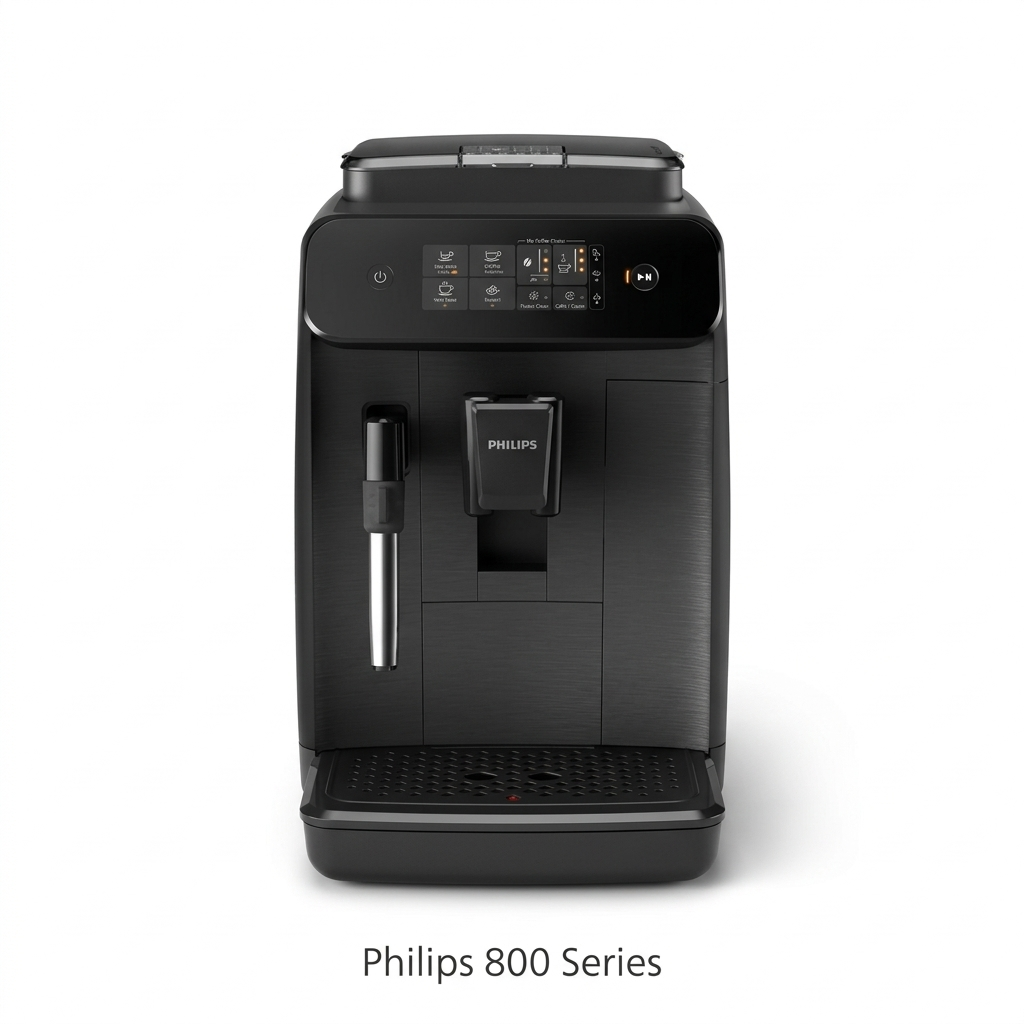
Two drinks, three strengths, a 12-step ceramic grinder and a basic steam wand. Fresh beans without any fuss.
Check price on Amazon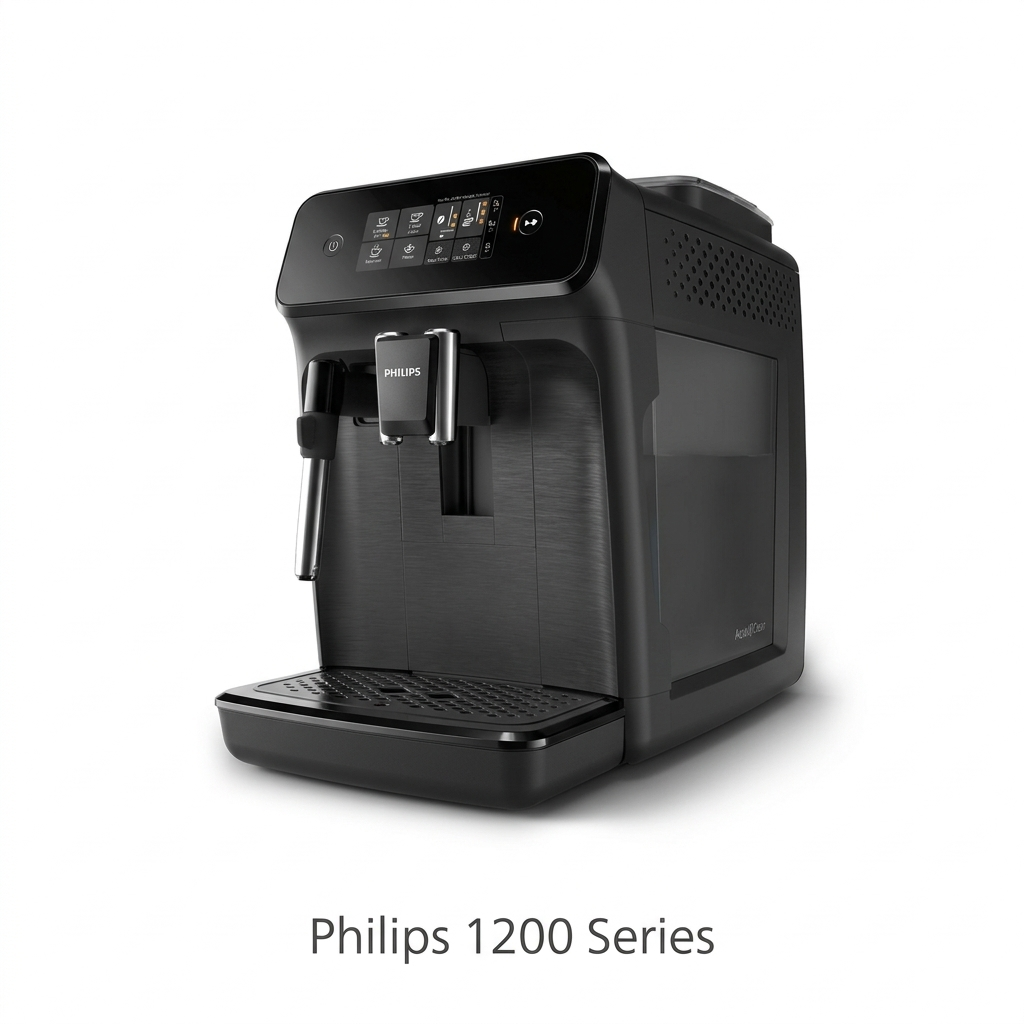
A touch panel, a sealed tinted hopper, three brew temperatures and a forgiving classic frother.
Check price on Amazon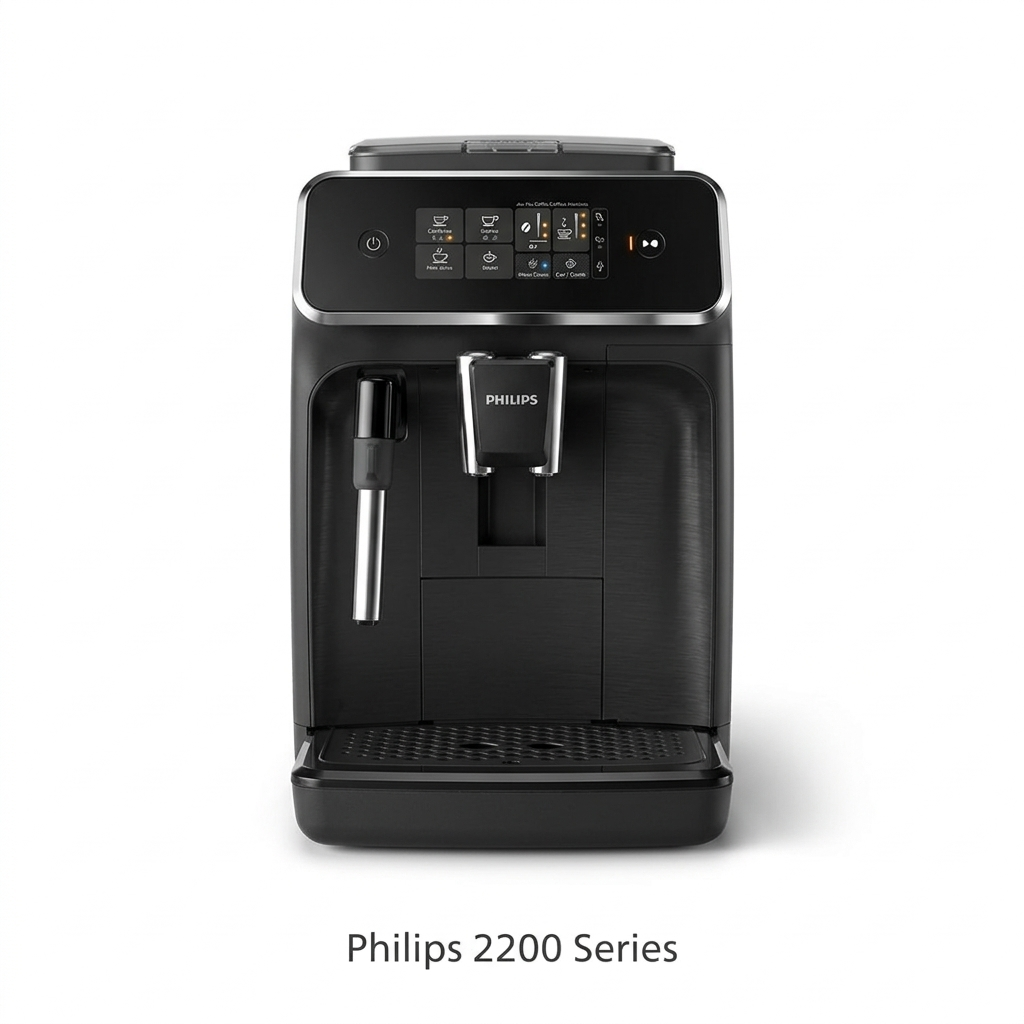
A simple touch panel and a frother that hides a real steam tip for silky milk, with AquaClean in the box.
Check price on Amazon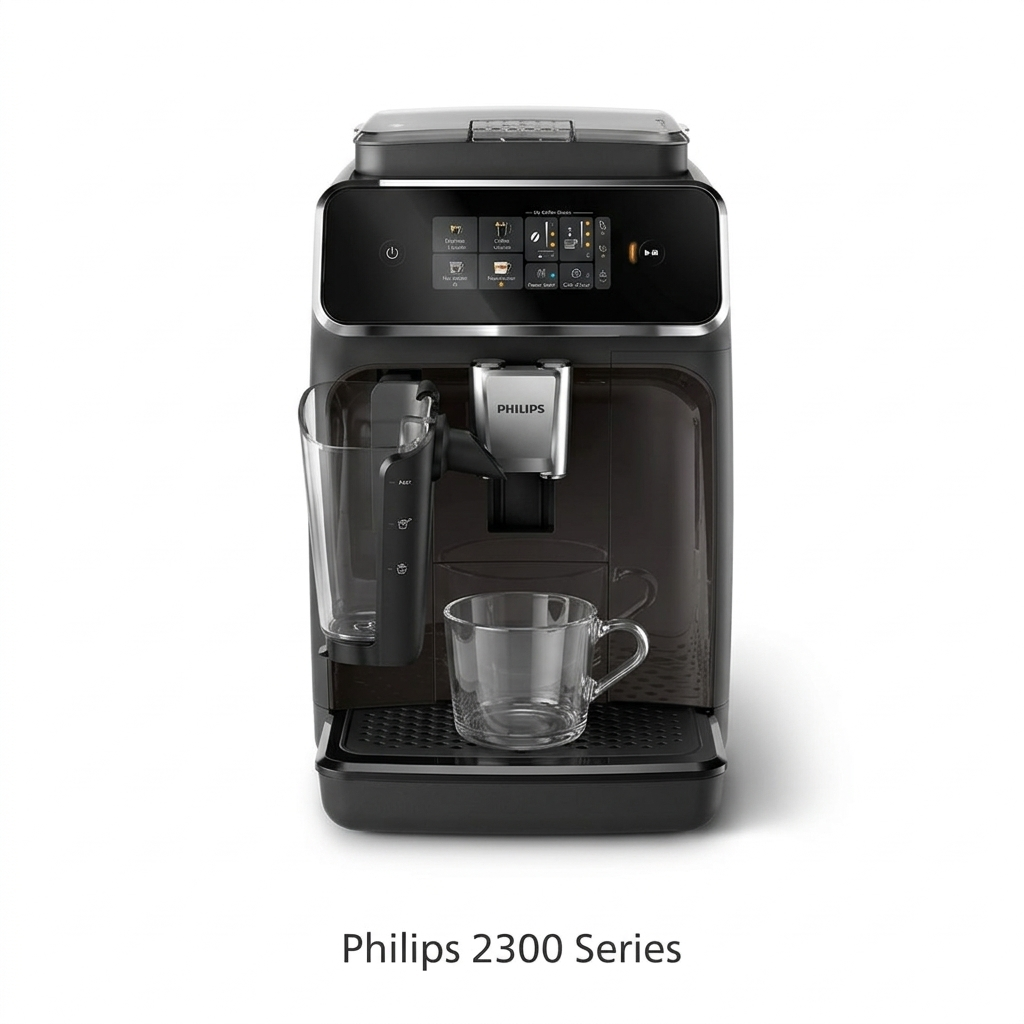
The entry point to one-touch cappuccinos, with a two-part LatteGo jug and SilentBrew in a slim body.
Check price on Amazon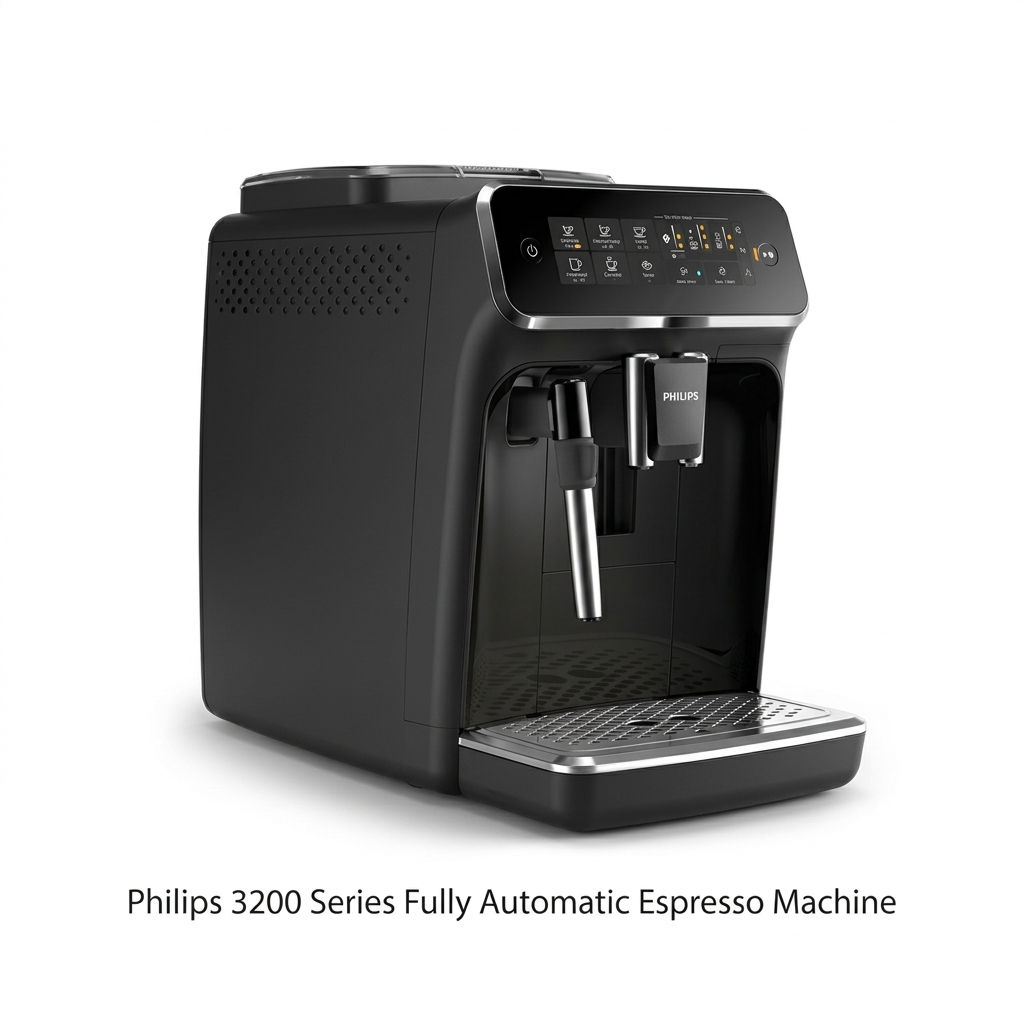
Five one-touch drinks and the easy-clean LatteGo jug. Gentle coffee for households with mixed tastes.
Check price on Amazon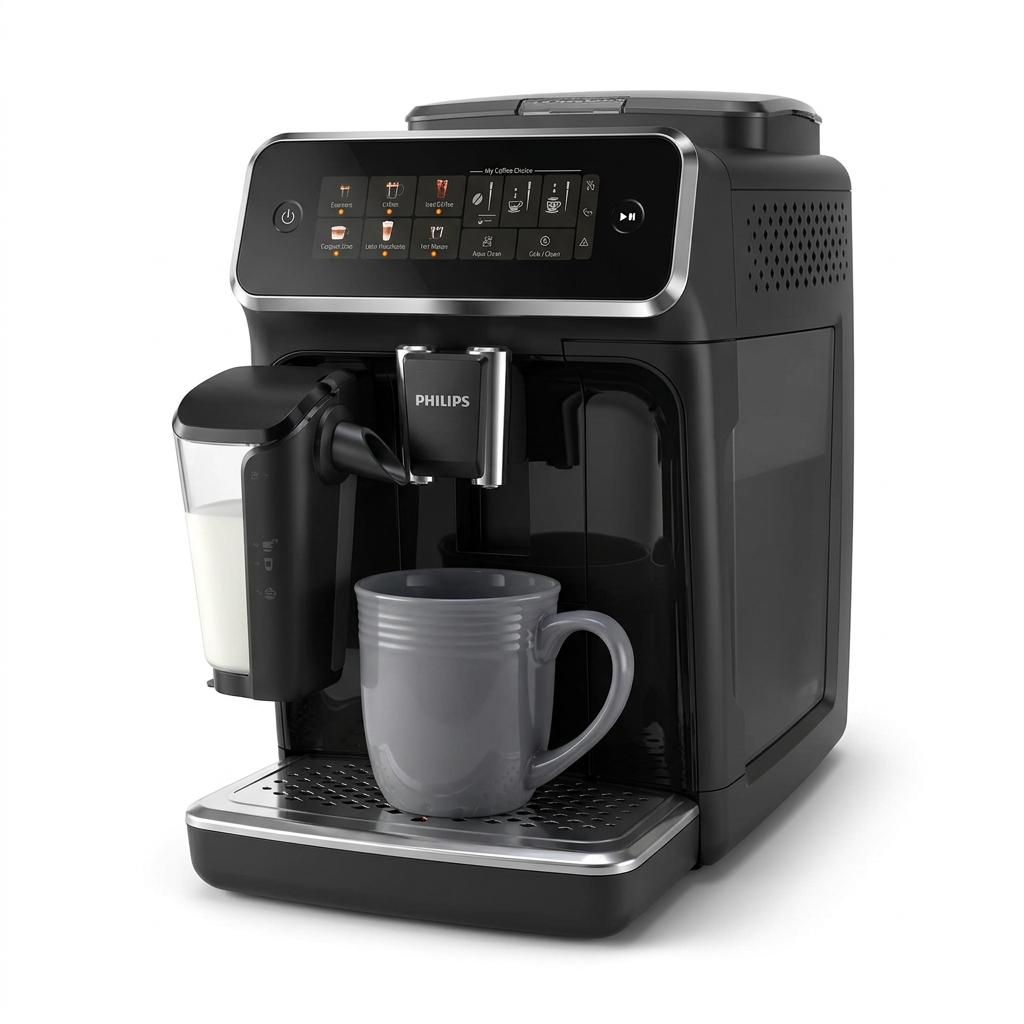
Quiet grinding, a two-part milk carafe that rinses in about 10 seconds and the best cleaning score I gave.
Check price on Amazon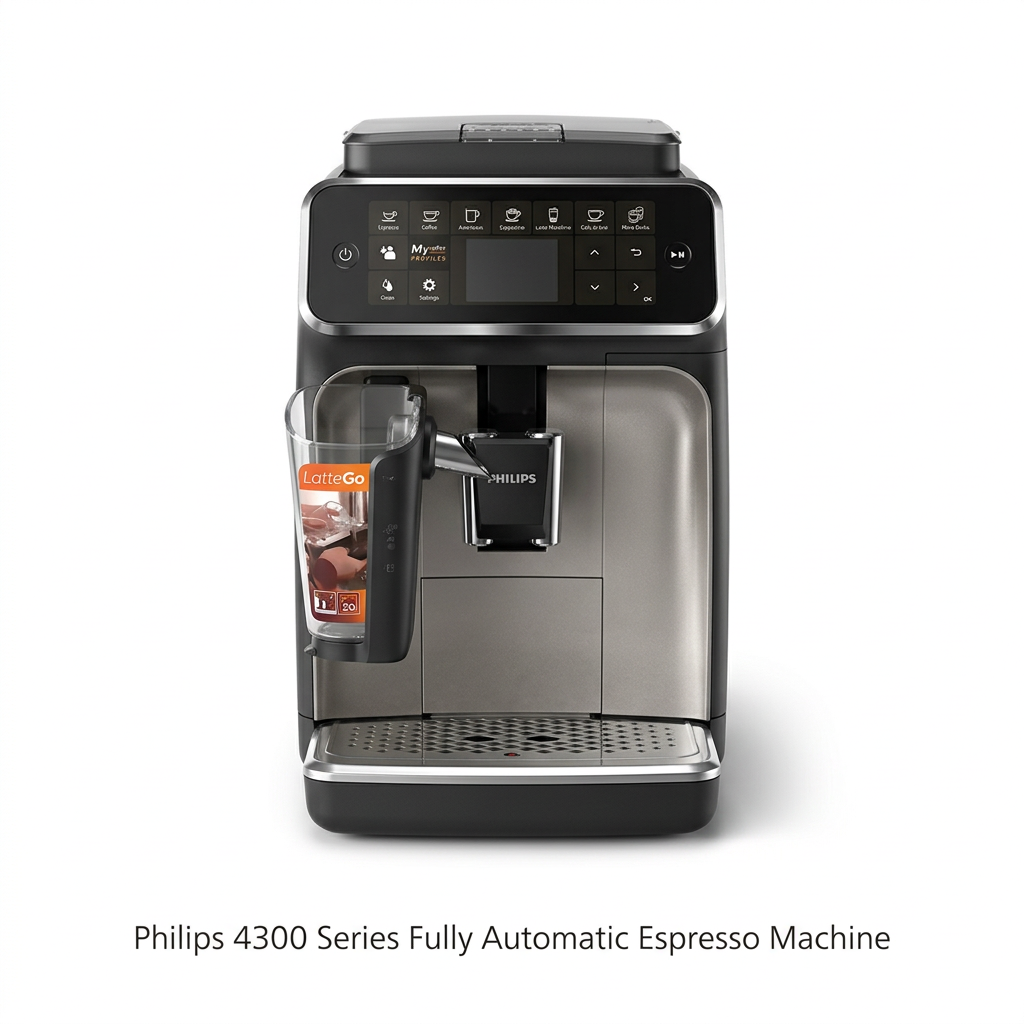
Eight one-touch drinks, two profiles and a color display that shows real volumes in milliliters.
Check price on Amazon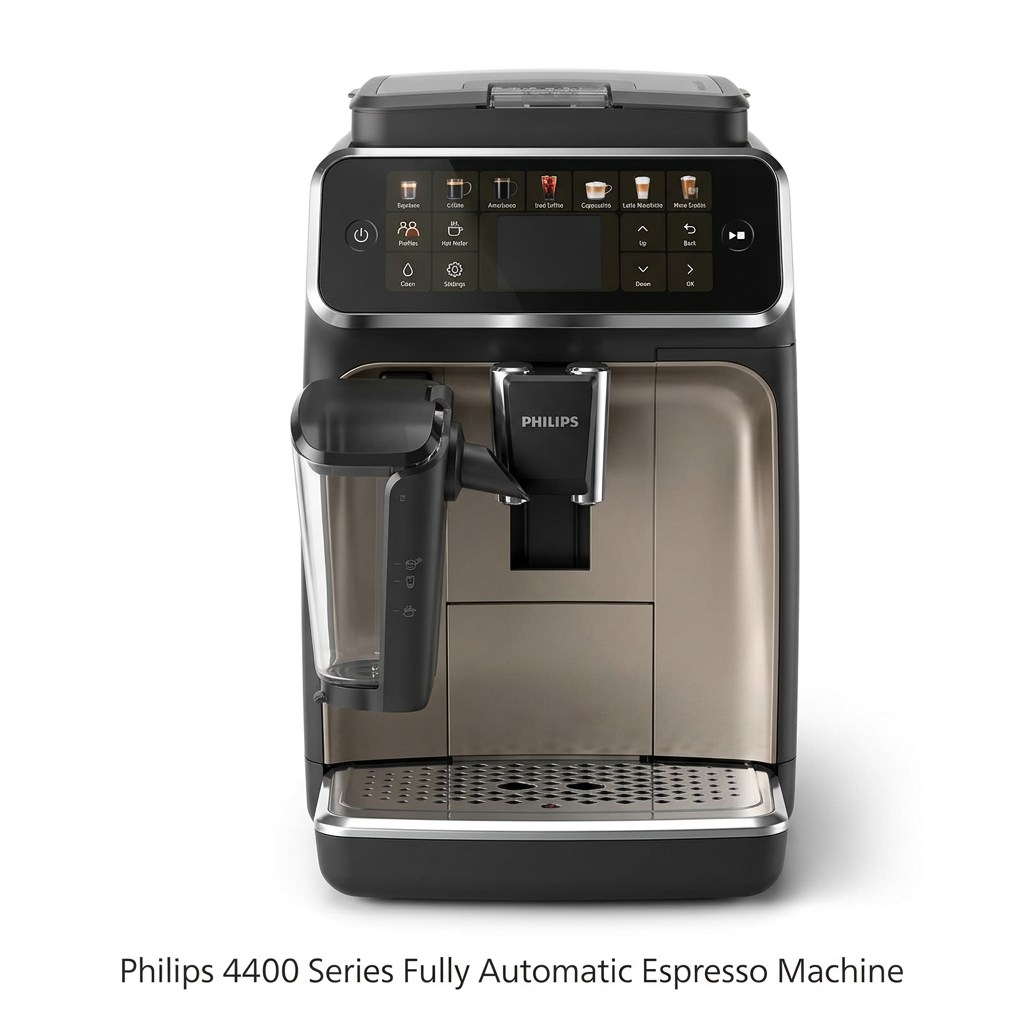
12 hot and iced drinks, a bigger 11 to 12-gram dose, two profiles and a quiet, quick-starting machine.
Reveal Today’s Deal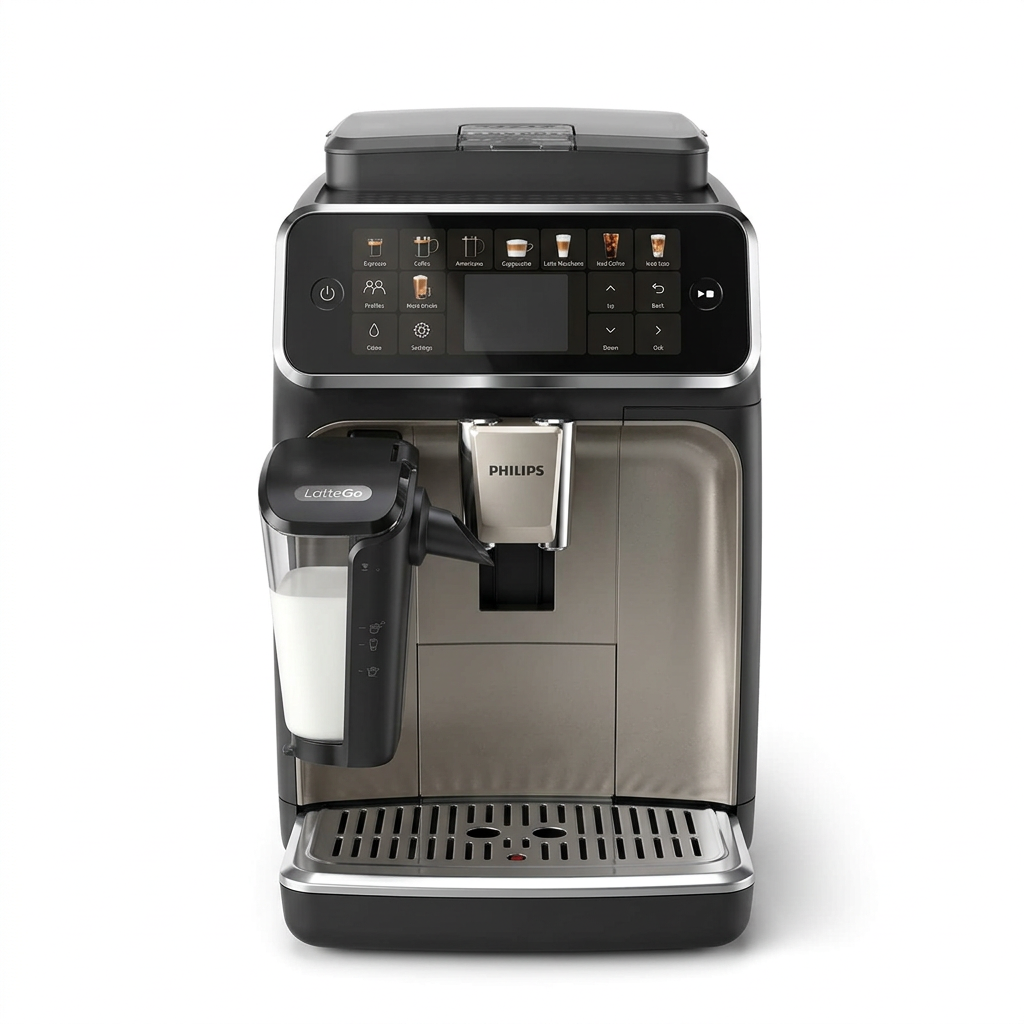
20 hot and iced drinks, four profiles, front loading and a milk carafe that rinses clean in seconds.
See Today’s PricePhilips espresso machine comparison at a glance
- The first digit tells you the tier: 800 to 2200 are steam-wand machines, 2300 and up use one-touch LatteGo milk.
- Most Philips machines use a small 6 to 8-gram dose, so espresso is mild; the 4400 is the exception at 11 to 12 grams.
- Every Philips I tested has a removable brew group and a 12-step ceramic grinder, so long-term care is the same.
- The worthwhile upgrades are 2200 to 2300 for one-touch milk, 3200 to 3300 for quiet and cleaning, and 4300 to 4400 for dose and iced drinks.
Head to head
The better result in each row is marked, based on my testing and Philips specifications. With nine machines, scroll the table sideways on a phone.
Keep in mind that the tally is not my verdict. The top models win more rows by design; what matters is whether those rows matter to you.
| Spec | 800 Series | 1200 Series | 2200 Series | 2300 Series | Philips 3200 | 3300 Series | 4300 Series | 4400 Series | 5500 Series |
|---|---|---|---|---|---|---|---|---|---|
| Overall scoremy rating | 7.5 | 7.6 | 7.9 | 8.2 | 8.0 | 8.4 | 8.3 | 8.6 ✓ Best | 8.5 |
| Espressomy rating | 7.4 | 7.5 | 7.6 | 7.8 | 7.2 | 7.4 | 7.8 | 8.2 | 8.2 |
| Milk drinksmy rating | 6.2 | 6.5 | 7.4 | 8.0 | 7.8 | 8.2 | 8.0 | 8.3 | 8.8 ✓ Best |
| Cleaningmy rating | 8.4 | 8.3 | 8.4 | 8.2 | 8.5 | 9.4 ✓ Best | 8.2 | 8.5 | 9.2 |
| Milk system | Steam wand | Classic frother | Frother with steam tip | LatteGo | LatteGo | Two-part carafe | LatteGo | LatteGo | LatteGo |
| Strongest doseweighed | Standard | Standard | 6–7 g | Standard | About 8 g | About 8 g | Standard | 11–12 g ✓ Best | Standard |
| Iced drinks | No | No | No | No | No | No | No | Yes ✓ Best | Yes, brewed warm |
| User profiles | No | No | No | No | No | No | 2 plus guest | 2 plus guest | 4 ✓ Best |
| SilentBrew | No | No | No | Yes | No | Yes | No | Yes | Yes |
| Rows won | 0 | 0 | 0 | 0 | 0 | 1 | 0 | 3 | 2 |
Philips espresso machine comparison pros and cons
800 Series
- The simplest way into fresh-bean coffee
- Ceramic grinder and removable brew group
- Light and narrow, easy to place
- Noisy grinder
- Coarse milk foam from the basic wand
- All-plastic build feels entry level
1200 Series
- Clear touch panel that remembers your settings
- Sealed, tinted bean hopper
- Tall cup clearance for a 12-ounce mug
- Airy, bubbly foam
- Short drink menu
- Water filter not in the box
2200 Series
- Frother hides a real steam tip for silky milk
- AquaClean filter included
- Simple touch panel, almost no learning curve
- Light espresso from a 6–7 g dose
- Every milk drink is manual
- Plastic build
2300 Series
- Cheapest route to one-touch cappuccinos
- Two-part LatteGo jug with no tubes
- SilentBrew and fast drinks
- Milk frothing is loud
- Short menu
- One cappuccino at a time
Philips 3200
- Five drinks at one touch
- LatteGo is the easiest milk system to clean
- Removable brew group and AquaClean
- Mild espresso from about 8 g
- Foam is good rather than great
- No profiles
3300 Series
- Very quiet grinding
- Milk carafe rinses clean in about 10 seconds
- Best cleaning score I gave any Philips
- Light espresso unless you brew a double
- Coarse volume steps
- About 8 g maximum dose
4300 Series
- Eight one-touch drinks
- Display shows real volumes in milliliters
- Two profiles and guided descaling
- Milk drinks take a while
- Easy to forget the milk rinse
- Standard Philips dose
4400 Series
- Biggest dose of any Philips, 11–12 g
- 12 hot and iced drinks
- Ready in 30 to 45 seconds and quiet
- Milk texture is automatic only
- Dose still below café size
- Two profiles, not four
5500 Series
- 20 hot and iced drinks
- Four user profiles and front loading
- Milk carafe rinses clean in about 10 seconds
- Espresso lighter than a café shot
- Iced drinks are brewed warm
- Most features you may never use
Who should buy which machine?
- Black coffee drinkers on a tight setup
- People new to bean-to-cup
- Small kitchens
- Tall mug coffee drinkers
- People who want a sealed hopper
- Simple, foamy cappuccino fans
- Anyone who wants to learn milk steaming
- Espresso and long coffee drinkers
- First-time buyers
- One-touch cappuccino on a budget
- Small kitchens
- Couples with simple tastes
- Mixed households, black and milk
- People who hate cleaning
- Gentle coffee lovers
- Light sleepers
- People who want minimal cleanup
- Milk drink lovers
- Two-person households
- People who like exact volumes
- First automatic machine buyers
- Most households
- Stronger espresso fans in the Philips range
- Iced coffee drinkers
- Families of three or four
- Iced and hot drink variety
- Anyone who wants the most drinks
How Philips names its machines
Philips uses series numbers instead of names, and the numbers loosely track features. The higher the number, the more drinks, the better the milk system and, usually, the more convenience.
Here is the rule of thumb I landed on after testing all nine. The 800, 1200 and 2200 Series use a steam wand or frother, so milk drinks are hands-on. From the 2300 Series up, they use LatteGo✕LatteGoPhilips's tubeless milk system. A small two-part jug clips onto the front, and the machine draws milk in, froths it and pours it straight into the cup., a two-part milk jug that makes one-touch cappuccinos.
Three other Philips terms come up again and again. AquaClean✕AquaClean filterPhilips's water filter. Replaced when prompted, Philips says it can stretch descaling to up to 5,000 cups. is the water filter, SilentBrew is Philips's quieter brewing technology and almost every model uses a 12-step ceramic grinder.
My overall scores, all nine Philips machines
Each machine was tested for four weeks.
The scores tell an interesting story: the order isn't strictly by number. The 2300 beat the 3200, and the 4400 beat the 5500.
Our tip: Read the first digit as a tier and ignore the rest, because two machines a hundred apart can be very different and two a thousand apart can share most parts.
The range at a glance
This table lines up the nine machines on the features that actually change your mornings.
| Series | Milk system | One-touch drinks | Profiles | Iced | My score |
|---|---|---|---|---|---|
| 800 | Basic steam wand | 2 | No | No | 7.5 |
| 1200 | Classic frother | Espresso, coffee and doubles | No | No | 7.6 |
| 2200 | Frother with steam tip | Espresso, coffee, hot water | No | No | 7.9 |
| 2300 | LatteGo | 3 coffees plus cappuccino | No | No | 8.2 |
| 3200 | LatteGo | 5 | No | No | 8.0 |
| 3300 | Two-part carafe | Several, incl. milk drinks | No | No | 8.4 |
| 4300 | LatteGo | 8 | 2 plus guest | No | 8.3 |
| 4400 | LatteGo | 12 hot and iced | 2 plus guest | Yes | 8.6 |
| 5500 | LatteGo | 20 hot and iced | 4 | Yes | 8.5 |
Under the skin, the range is more alike than the menus suggest. Every machine I tested has a removable brew group, a 15-bar pump, a fast-heating thermoblock✕ThermoblockA compact heater that warms water on its way through a metal block, instead of keeping a tank of water hot. It heats up fast and switches tasks quickly. and a ceramic grinder.
The 4400 Series sits at the sweet spot of the Philips range.
Our tip: Decide on the milk system first, because it splits the range in two and narrows nine machines down to three or four in seconds.
Design and size
Philips uses almost the same body across the range. Most machines I tested measure about 9.7 inches wide, 14.6 inches tall and 17 inches deep, and weigh between 16.5 and 17.6 pounds.
That makes them some of the lightest bean-to-cup machines I've tested. I could lift the 800 Series onto the counter with one arm, and the 4400 was easy to slide forward from under a cabinet.
The 2300 Series is a touch slimmer at about 9.4 inches wide. The 5500 Series is under 25 centimeters wide and loads its water and beans from the front, which helps under low cabinets.
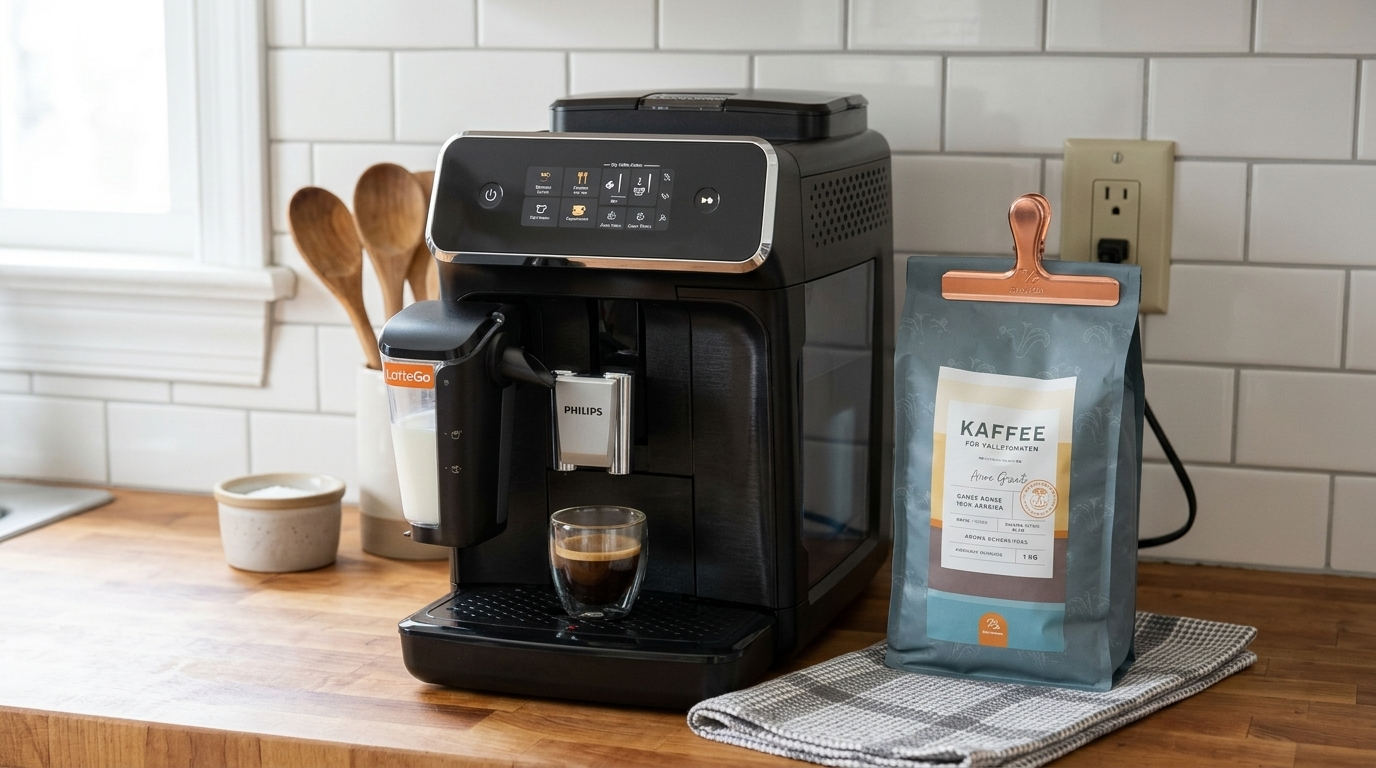
The 2300 is a little slimmer, at about 9.4 inches wide.
Finishes change as you move up. The entry machines are plain plastic, the 4300 has a silver front and the 4400 a satin front that resisted fingerprints far better than glossy finishes.
Our tip: Check the power cord length before you plan the spot, because the 2300's cord is only about 39 inches long.
Grinder and dose: the key to Philips espresso
This is the most important thing to understand about Philips machines. Most use a small dose of coffee per shot, which is why their espresso tastes mild.
Every model I tested uses a 12-step ceramic grinder, adjusted with a knob inside the bean hopper. Philips rates its ceramic burrs for around 20,000 cups.
The dose is what changes. On the 2200, I measured 6 to 7 grams. On the 3200 and 3300, about 8 grams at the strongest setting. A café double uses 14 to 18 grams.
Coffee dose compared
Weighed doses at each machine's strongest setting.
The 4400 Series is the exception. It has five strength levels, each adding roughly a gram, and its strongest setting doses about 11 to 12 grams.
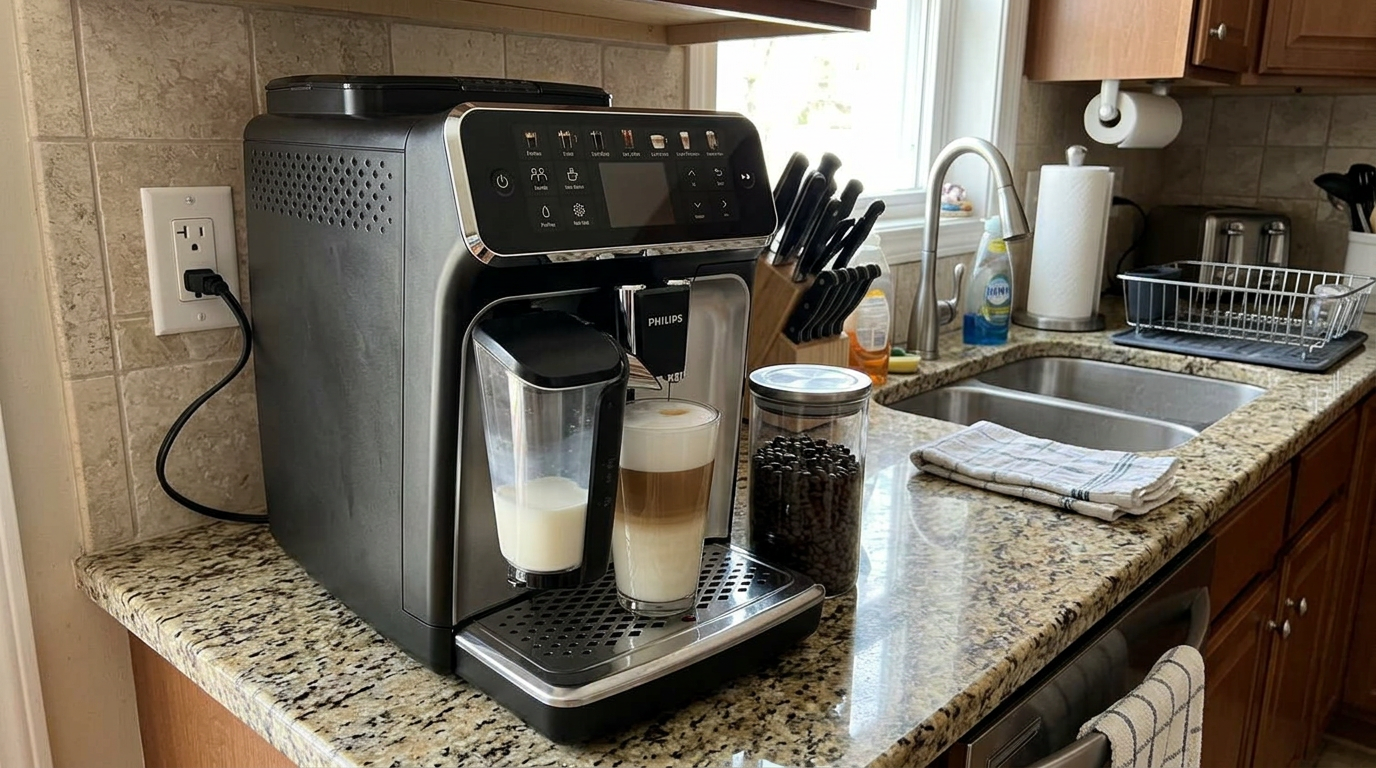
The 4400's strongest setting doses 11 to 12 grams, the most in the range.
| Bean type | Grind setting I used | Notes |
|---|---|---|
| Medium-dark espresso blend | 3 | Best all-rounder |
| Medium roast | 4 | Balanced |
| Light roast | 2 | Strongest aroma |
| Decaf | 5 | Grinds faster |
Espresso quality across the range
Philips espresso is smooth, gentle and easy to like, but it is rarely strong. My espresso scores ranged from 7.2 to 8.2.
My espresso ratings
Scores out of 10 for body, crema, flavor and consistency.
On the 2200, the espresso volume measured about 1 fluid ounce on the low setting, 1.35 on medium and 2.2 on high. The short setting was the one to use.
The 4400 and 5500 made the fullest shots, with the thickest crema✕CremaThe golden, foamy layer on top of a fresh espresso. It forms when pressure pushes oils and gases out of the coffee. in the range. The 4400 did it with a bigger dose; the 5500 with careful tuning and its double option.
If straight espresso is your main drink, no Philips will match a high-dose machine. In milk drinks, the difference largely disappears.
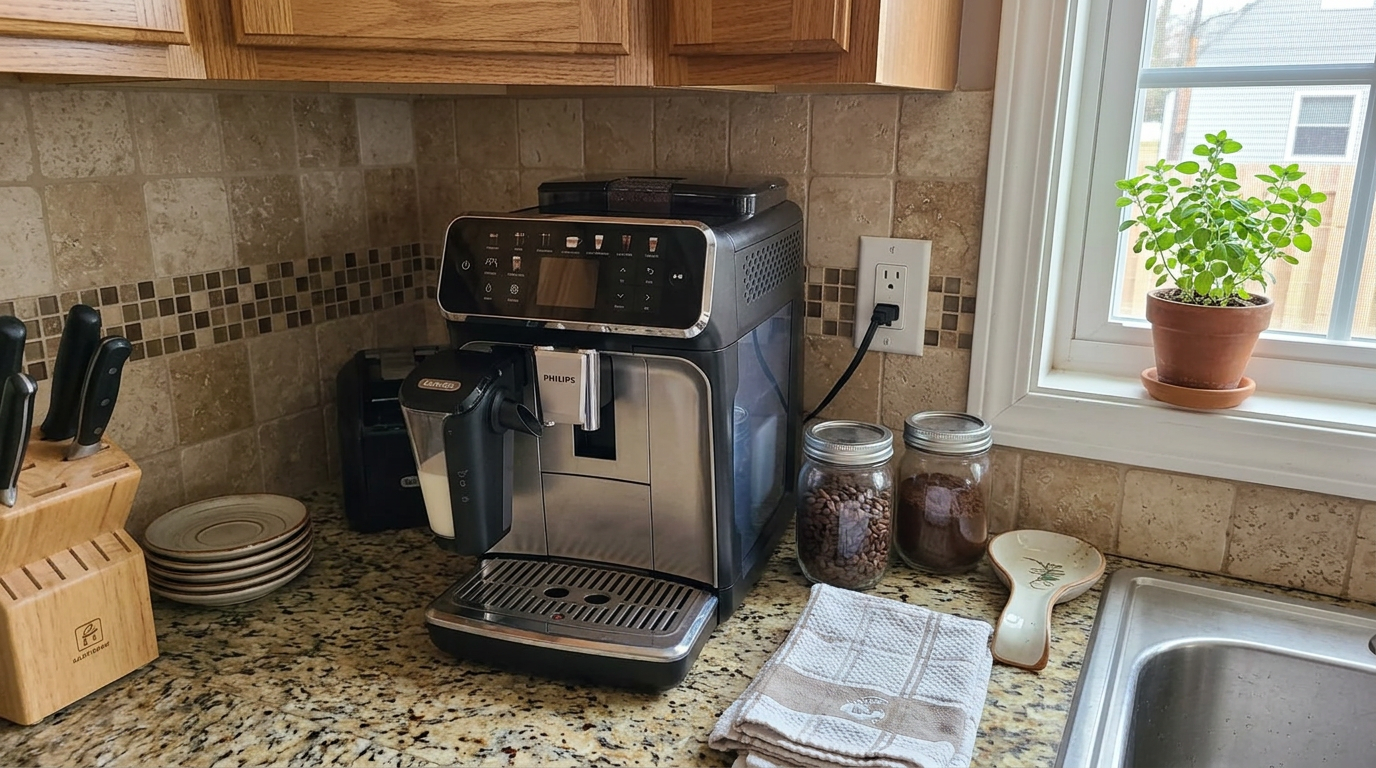
The 5500 and 4400 made the fullest espresso in the Philips range.
Our tip: Brew a double on the 3300 or 5500 when you want a stronger cup, because two grind cycles roughly double the coffee in the drink.
Milk systems: wand, frother or LatteGo
Philips uses three kinds of milk system, and this is the biggest practical difference across the range.
Steam wand and classic frother
The 800 Series has a basic steam wand. It made coarse foam that was fine for a quick cappuccino but not for a silky flat white.
The 1200 Series uses a classic frother with a sleeve that pulls in air for you. It makes a classic, foamy cappuccino with very little practice, but the foam is airy.
The 2200 Series has the cleverest trick. Pull off the frother sleeve and you get a plain steam tip that can make silky microfoam✕MicrofoamMilk foam with bubbles so small you can barely see them. It feels silky and glossy, which is what latte art needs. for latte art.
LatteGo
From the 2300 up, Philips uses LatteGo: a two-part jug with no tubes. You fill it, clip it on and press cappuccino or latte macchiato.
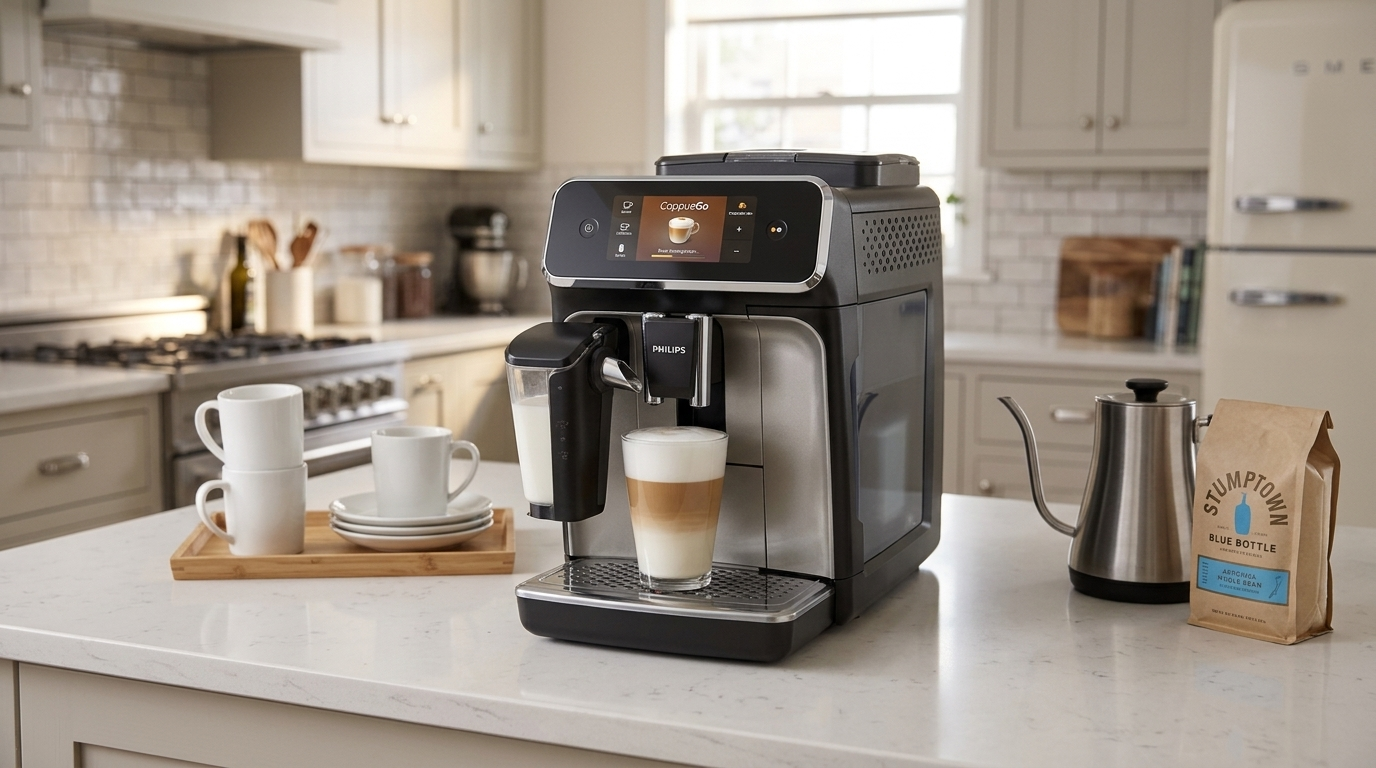
LatteGo has two parts and no tubes, and rinses clean in about 10 seconds.
On the 2300, a cappuccino took about 72 seconds. Its jug holds about 260 ml, or 8.8 fluid ounces, enough for one or two drinks.
My milk drink scores
Scores out of 10 for foam, temperature and ease.
| Milk temperature | What it tastes like |
|---|---|
| Below 131°F | Lukewarm |
| 140–150°F | Sweet, ideal |
| Above 158°F | Very hot, less sweet |
On every LatteGo machine, whole milk foamed best and barista oat milk came close. I rated whole milk 8.8 and barista oat 8.2 on the 2300.
Our tip: Place your cup right under the LatteGo spout, because the foam leaves with some force and lands a little in front of the jug.
Drinks and iced coffee
The menu grows steadily as you climb the range. The 800 Series makes espresso and coffee; the 5500 makes 20 hot and iced drinks.
One-touch drinks by series
Counted from each machine's menu. Hot water is not included.
The 4300 adds ristretto and café au lait among its eight drinks. The 4400 adds iced coffees, and it was one of the few machines in its class that takes iced coffee seriously.
The 5500's iced drinks come with a catch. They are brewed warm and poured over ice, so they melt more ice than a true cold brew. I scored its iced drinks 7.0.
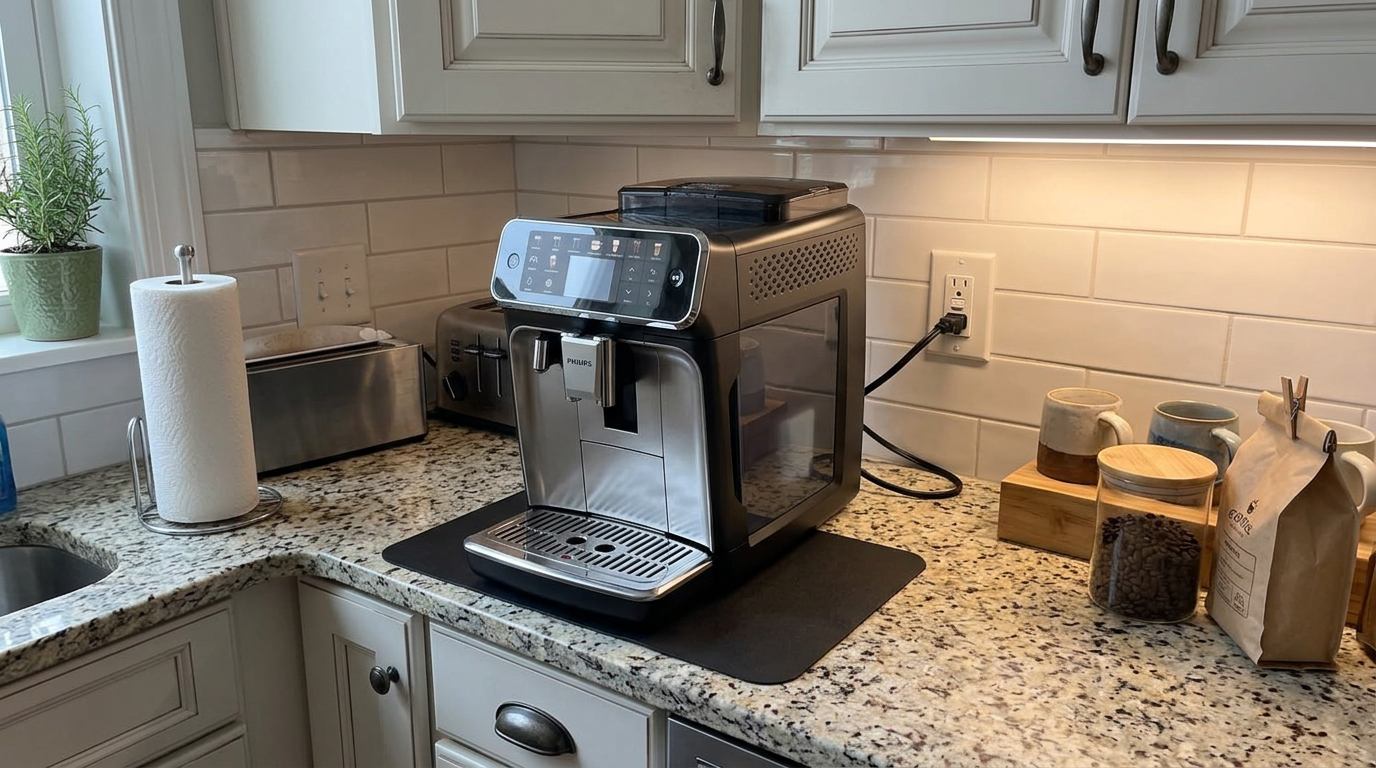
The 5500's iced drinks are brewed warm, so use plenty of ice.
In practice, most households used four or five drinks on any machine. The bigger menus matter most when several people share the machine.
Our tip: Fill the glass to the top with ice for any Philips iced drink, because the coffee is brewed warm and a half-full glass ends up watery.
See Today’s PriceDisplays, controls and profiles
The entry machines use simple icons with strength and size bars. The 800 Series even uses buttons rather than a touch panel.
The 4300 Series was my favorite display. Instead of guessing what three bars means, it shows you real volumes, such as a 40 ml espresso or a 150 ml coffee.
Profiles arrive with the 4300 and 4400, which each save two people plus a guest. The 5500 saves four people's drinks.
| Series | Controls | Profiles | Shows real volumes |
|---|---|---|---|
| 800 | Buttons | No | No |
| 1200 and 2200 | Touch icons | No | No |
| 2300, 3200 and 3300 | Touch icons | No | No |
| 4300 | Color display | 2 plus guest | Yes |
| 4400 | Color display | 2 plus guest | Yes |
| 5500 | Color display | 4 | Yes |
On the 4300, a black coffee from switching on took about 1 minute 56 seconds, and a cappuccino with handling and cleanup about 2 minutes 57 seconds. The 4400 was ready to brew in about 30 to 45 seconds.
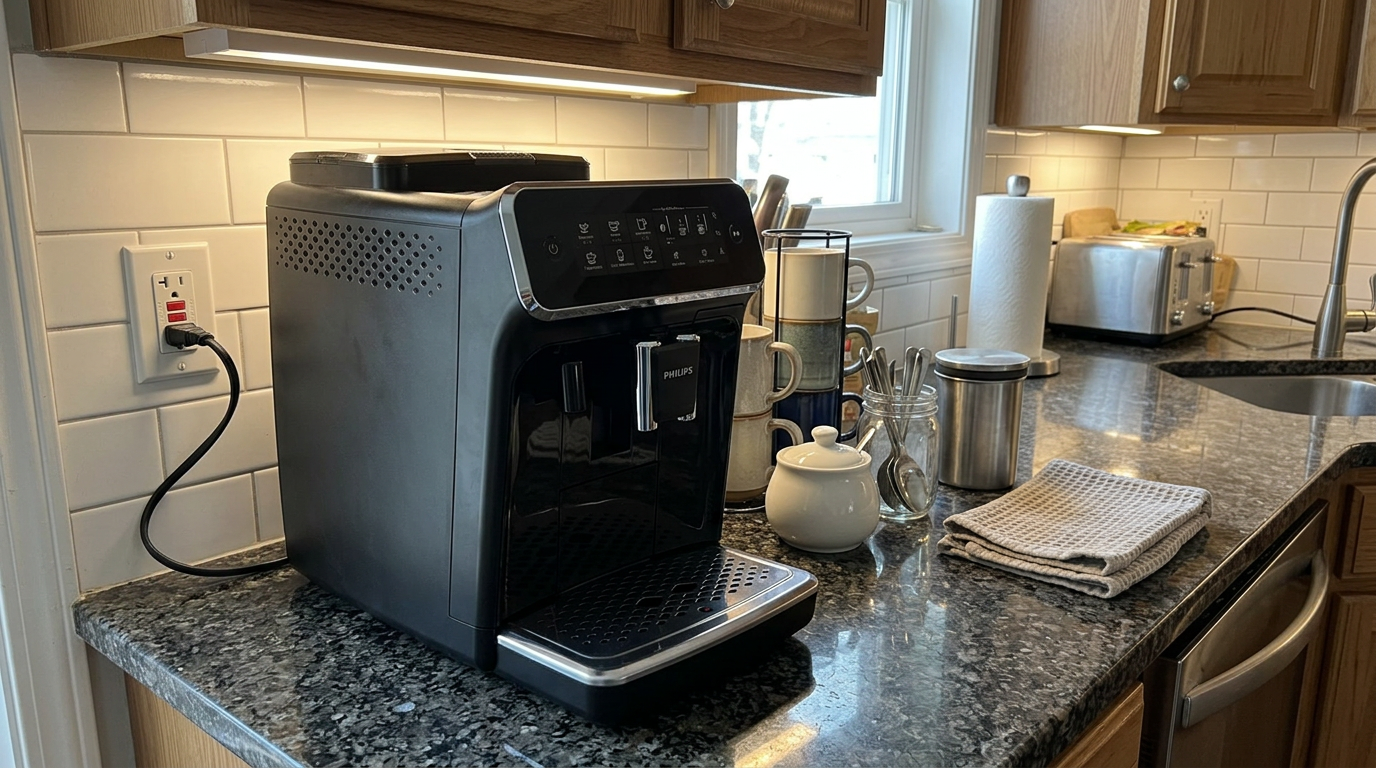
The 4300 shows real volumes in milliliters instead of bars.
Cleaning and upkeep
Philips machines are among the easiest to keep clean, and that is true across the whole range.
Every model has a removable brew group✕Brew groupThe part that compresses the ground coffee, holds it while water passes through and then ejects the used puck. On Philips machines it slides out for rinsing. that you rinse under the tap once a week. With the AquaClean filter fitted and replaced when prompted, Philips says you can go up to 5,000 cups without descaling.
The LatteGo jug and the 3300's carafe come apart in two pieces and rinse clean in about 10 seconds. I put them in the dishwasher every evening.
My cleaning scores
Scores out of 10 for daily and weekly care.
The 4300 has guided descaling, step by step on the display. On the 1200, note that the water filter isn't in the box.
| When | Every Philips I tested |
|---|---|
| After milk drinks | Rinse the LatteGo jug or wipe the wand |
| Daily | Empty drip tray and coffee grounds container |
| Evening | LatteGo parts in the dishwasher |
| Weekly | Rinse the brew group under the tap |
| Monthly | Grease the brew group |
| When prompted | Replace AquaClean or descale |
Our tip: Set a fixed weekly day to rinse the brew group, because on every Philips I tested it was the one job that kept the coffee tasting clean.
Noise and SilentBrew
Noise varies more than you'd expect across one brand. The 800 Series had the noisiest grinder I tested from Philips.
Philips's SilentBrew technology appears on the 2300, 3300, 4400 and 5500. Philips claims about 40% quieter brewing than its earlier machines, and the 3300 was one of the quietest fully automatic machines I've used.
How loud each felt, my ranking
Relative loudness from my testing. Shorter bars are quieter.
One caveat on the 2300: its milk frothing is loud, even though its brewing is quiet.
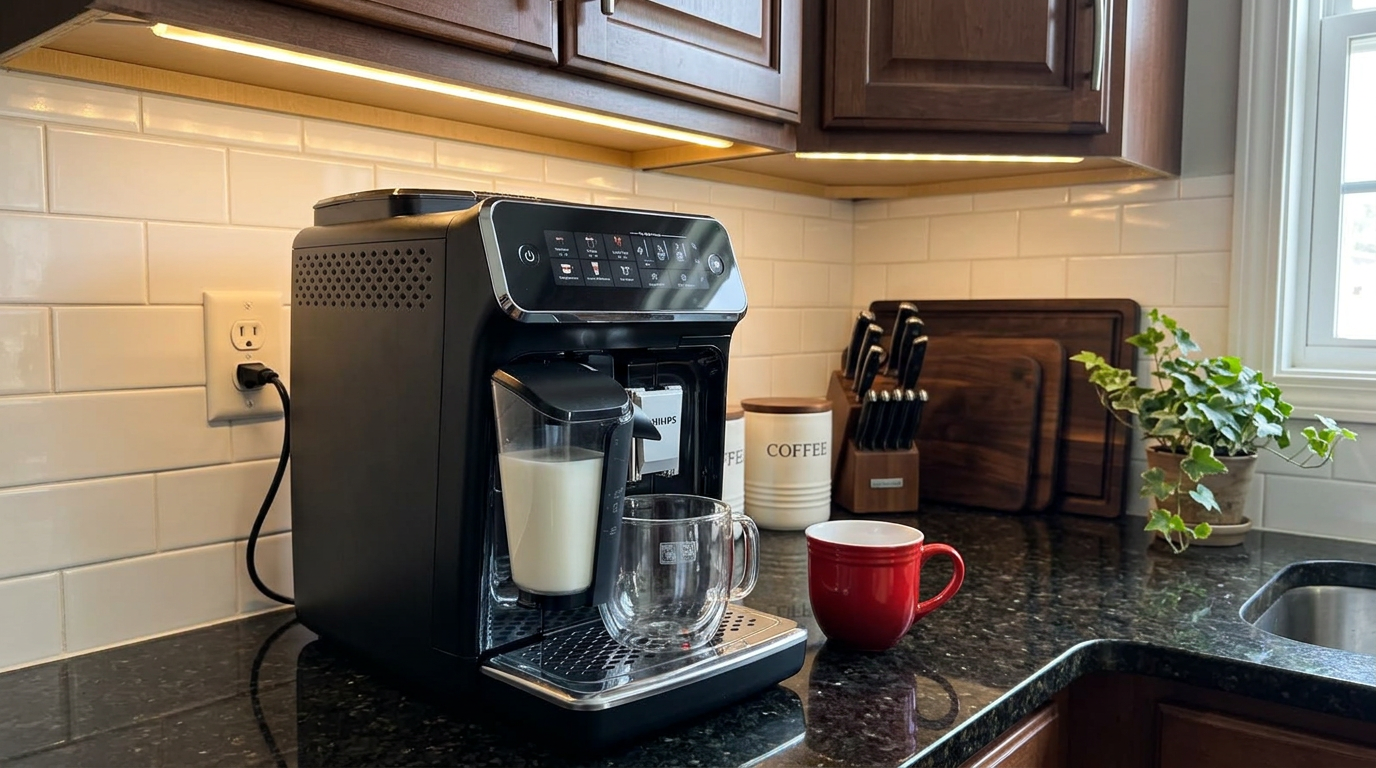
The 3300 was one of the quietest fully automatic machines I've used.
Which upgrades are worth it?
Philips makes it tempting to step up one model at a time. These are the steps that changed my experience, and the ones that didn't.
The 2200's frother hides a real steam tip for silky milk, and AquaClean comes in the box.
One-touch cappuccinos with a two-part LatteGo jug.
Two more one-touch drinks, but I scored the 2300 higher.
Much quieter and the easiest cleaning in the range.
Eight drinks, two profiles and real volumes on the display.
A bigger 11 to 12-gram dose, 12 hot and iced drinks and a quicker start.
Four profiles and 20 drinks, but not stronger espresso.
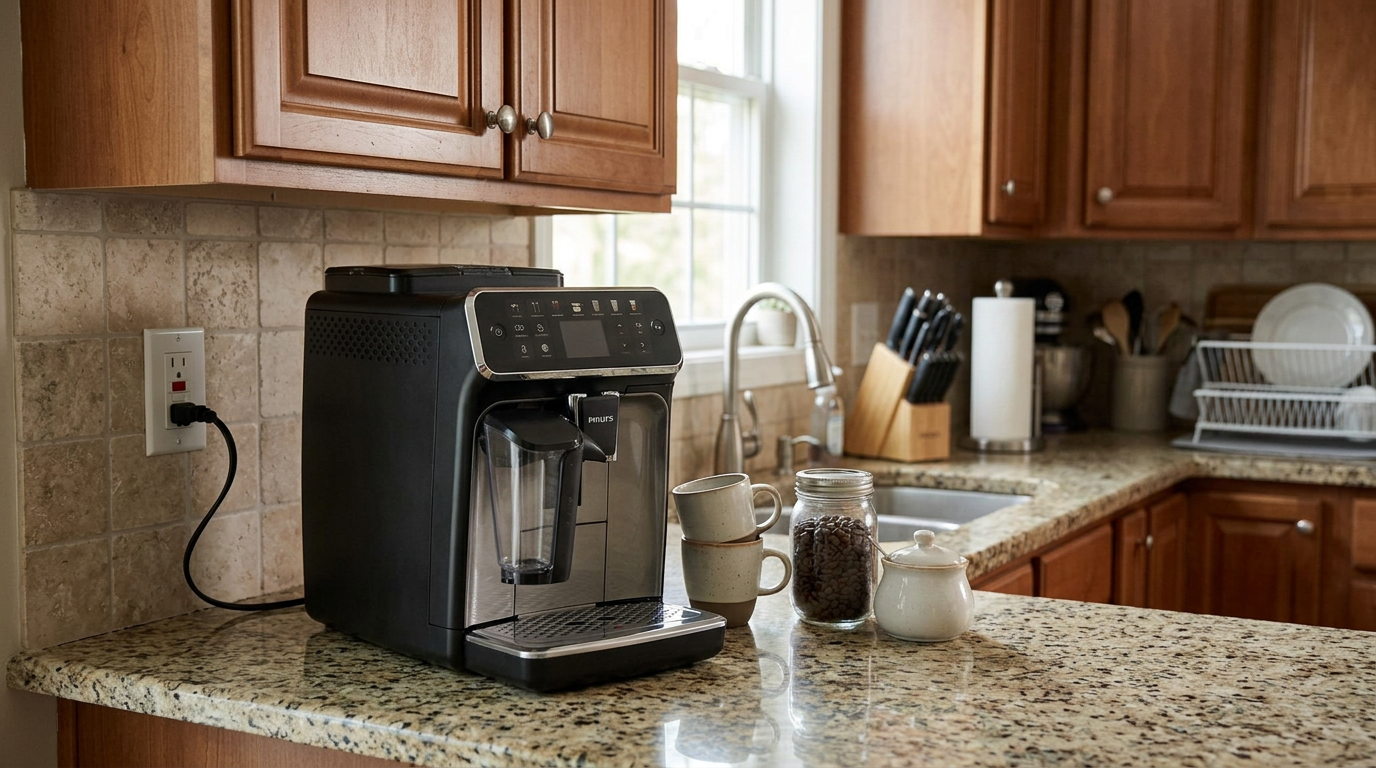
The 4300 to 4400 step was the most worthwhile upgrade in the range.
Real-life scenarios
Specs only go so far. These are the situations where one Philips clearly pulled ahead during my testing.
Two drinks, three strengths and a start button.
Take the sleeve off and the steam tip makes real microfoam.
LatteGo in a 9.4-inch body, with a cappuccino in about 72 seconds.
Very quiet, and the milk carafe rinses in about 10 seconds.
An 11 to 12-gram dose at level 5.
Four profiles and 20 drinks, loaded from the front.
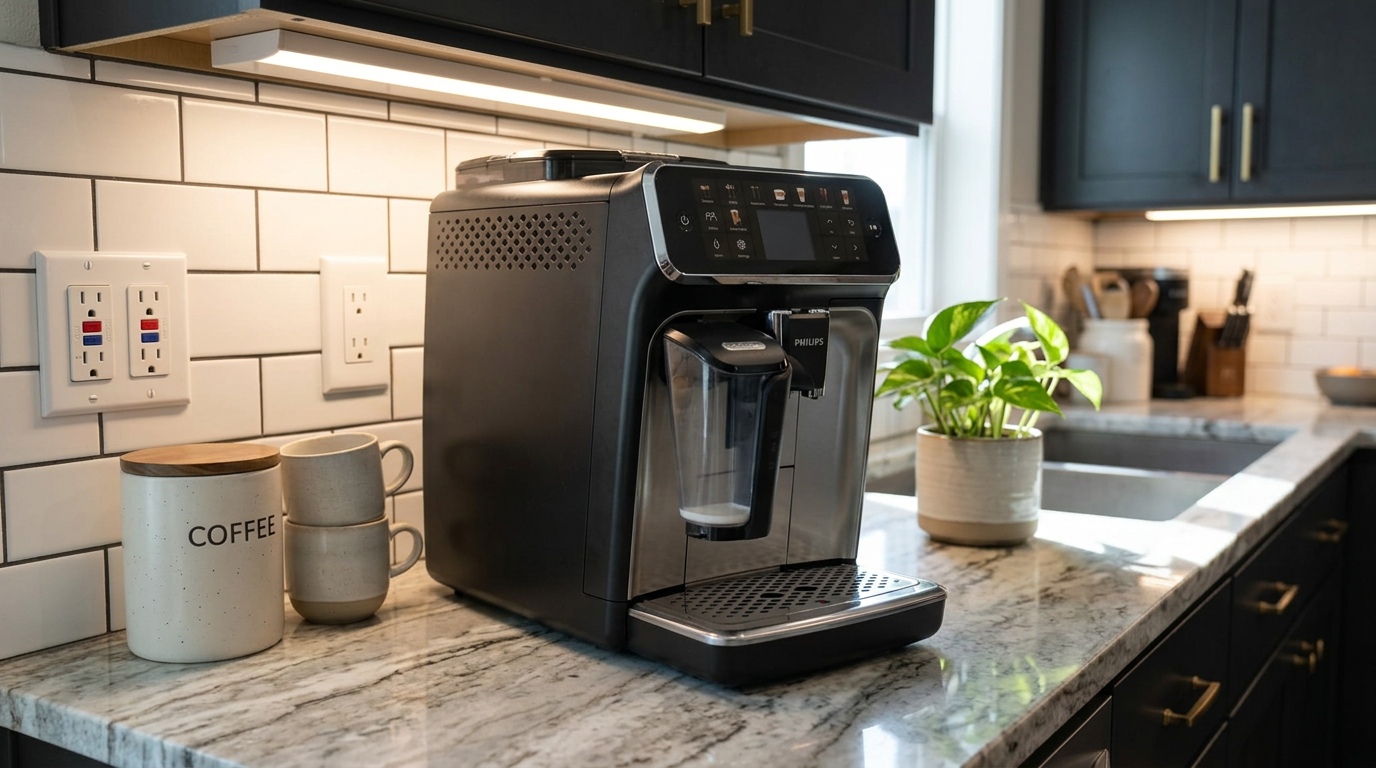
For families, the 5500's four profiles and 20 drinks make it the easiest to share.
My scorecard
These are my own scores out of 10, taken from my single reviews of each machine. The overall score is an editorial rating that reflects all four areas.
800 Series
1200 Series
2200 Series
2300 Series
Philips 3200
3300 Series
4300 Series
4400 Series
5500 Series
The 4400 Series tops my overall scores at 8.6, with the 5500 close behind at 8.5. At the other end, the steam-wand machines trade milk convenience for simplicity.
See How Much You’ll SaveWhich one is right for you?
4 quick questionsWhich one should you buy?
Start with the milk system, then think about who uses the machine. Those two answers narrow nine machines to one or two. Still weighing other options? I rank every model I’ve tested in my guide to the best super-automatic espresso machines.
For ranked picks, see my guide to the best Philips espresso machine. For head-to-heads, my Philips 2200 vs 3200 and Philips 3300 vs 5500 comparisons go deeper on two popular choices.
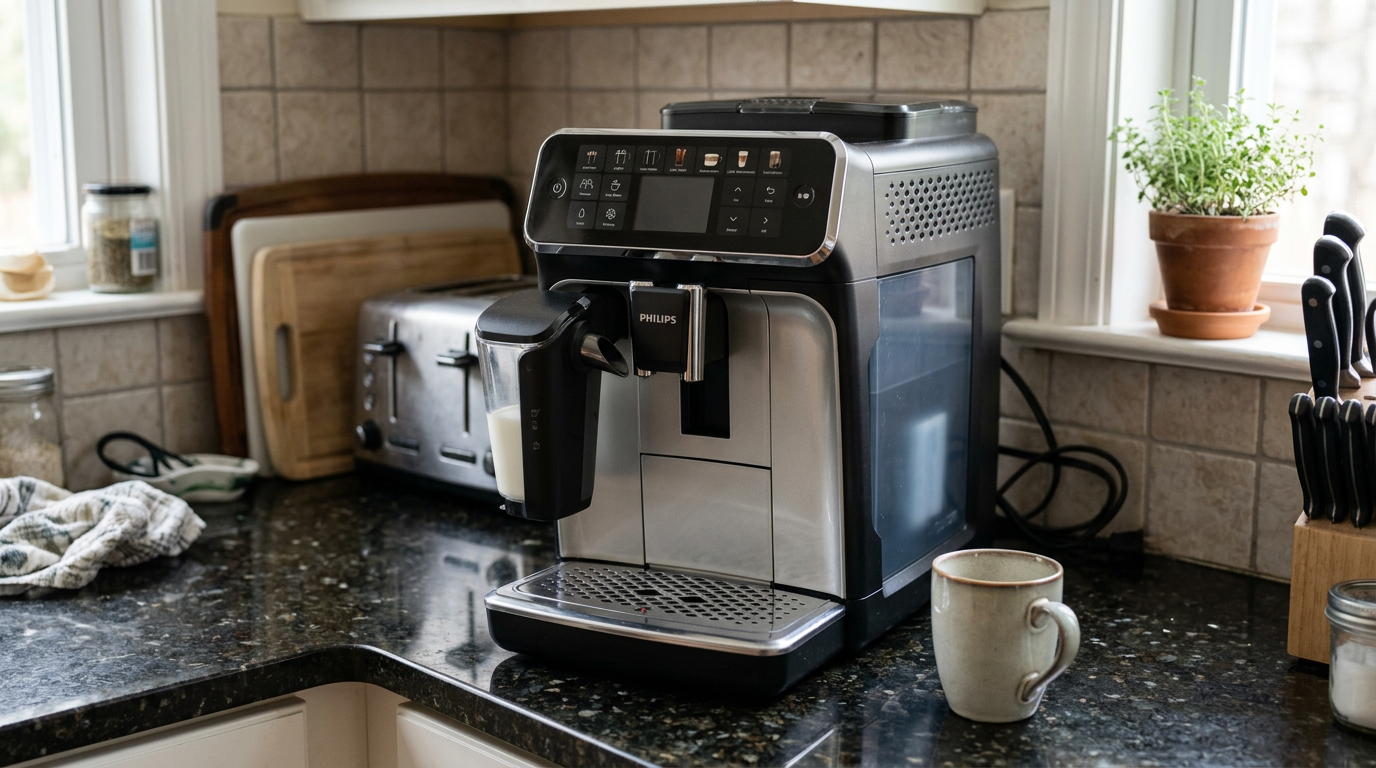
For most households, the 4400 Series is the Philips I'd buy.
- You only drink espresso or black coffee
- You want the simplest machine
- Your counter is small
- You want fresh beans with no fuss
- You want milk drinks at one touch
- You hate grinder noise
- You want latte art
- You drink from tall mugs
- You want a sealed hopper
- You like a foamy cappuccino
- You want a simple touch panel
- You want silky microfoam
- You want the filter included
- You want lots of drinks
- You want to learn milk steaming
- You want AquaClean in the box
- You drink espresso and coffee
- You want an easy first machine
- You want one-touch milk
- You want strong espresso
- You want profiles
- You want one-touch cappuccinos
- Your kitchen is small
- You drink a few classics
- You want easy milk cleaning
- You want profiles
- You make two cappuccinos at once
- You hate loud frothing
- You want five drinks at one touch
- Your household mixes black and milk
- You hate cleaning
- You like gentle coffee
- You want strong espresso
- You want profiles
- You want iced drinks
- You want a quiet machine
- You want the easiest cleaning
- You drink milk drinks daily
- You want simple controls
- You want strong single shots
- You want precise volumes
- You want iced drinks
- Two people share the machine
- You like exact volumes
- You want eight drinks
- You want guided descaling
- You want iced drinks
- You want a bigger dose
- You want four profiles
- You want the strongest Philips espresso
- You want iced coffee
- You want a quick start
- Two people share the machine
- You want four profiles
- You want to steam milk by hand
- You want a café-size dose
- A family shares the machine
- You want 20 drinks
- You want four profiles
- You want front loading
- You want the strongest espresso
- You want true cold brew
- You only drink black coffee
For most households, my pick is the 4400 Series. It doses more coffee than any other Philips I tested, makes 12 hot and iced drinks with the easy LatteGo jug and starts in under a minute. It earned my highest Philips score.
If several people share the machine, the 5500 Series is worth the step up for its four profiles and 20 drinks. If you want one-touch milk in a small kitchen, start with the 2300 Series, and if you want the quietest, easiest machine to clean, choose the 3300 Series.
If you drink black coffee or want to learn to steam milk, the 2200 Series is the smart, simple choice. Whichever you choose, use the strongest aroma and a short volume for espresso, fit the AquaClean filter and rinse the brew group weekly.
Philips espresso machine comparison specifications
From manufacturer specifications and my own testing.
| 800 Series | 1200 Series | 2200 Series | 2300 Series | Philips 3200 | 3300 Series | 4300 Series | 4400 Series | 5500 Series | |
|---|---|---|---|---|---|---|---|---|---|
| Milk system | Steam wand | Classic frother | Frother, steam tip | LatteGo | LatteGo | Two-part carafe | LatteGo | LatteGo | LatteGo |
| One-touch drinks | 2 | Espresso, coffee | Espresso, coffee | 4 | 5 | Several | 8 | 12 | 20 |
| Iced drinks | No | No | No | No | No | No | No | Yes | Yes |
| Profiles | No | No | No | No | No | No | 2 plus guest | 2 plus guest | 4 |
| Grinder | Ceramic, 12 steps | Ceramic, 12 steps | Ceramic, 12 steps | Ceramic, 12 steps | Ceramic, 12 steps | Ceramic, 12 steps | Ceramic, 12 steps | Ceramic, 12 steps | Ceramic |
| Strongest dose | Standard | Standard | 6–7 g | Standard | About 8 g | About 8 g | Standard | 11–12 g | Standard |
| Pump | 15 bar | 15 bar | 15 bar | 15 bar | 15 bar | 15 bar | 15 bar | 15 bar | 15 bar |
| Water tank | 1.8 L | 1.8 L | 1.8 L | 1.8 L | 1.8 L | 1.8 L | 1.8 L | 1.8 L | 1.8 L |
| Bean hopper | 275 g | 275 g | 275 g | 275 g | 275 g | About 10 oz | 275 g | 275 g | 275 g |
| SilentBrew | No | No | No | Yes | No | Yes | No | Yes | Yes |
| Width | About 9.7 in | About 9.7 in | About 9.7 in | About 9.4 in | About 9.7 in | About 9.7 in | About 9.6 in | About 9.7 in | Under 9.8 in |
| Weight | About 16.5 lb | About 16.5 lb | About 16.5 lb | Light | About 17.6 lb | About 17.6 lb | Light | About 17.6 lb | Light |
How I tested and compared them
I tested nine Philips fully automatic machines, from the 800 to the 5500 Series, using each as my everyday coffee maker for four weeks.
I weighed coffee doses at each strength level, measured espresso volumes and milk temperatures, timed drinks from power-on and ran every cleaning and descaling routine. This comparison pulls together those notes, written up by Michael Reynolds, and compares them with Philips specifications and owner documentation.
- Coffee: dose, crema, body and consistency.
- Milk: foam texture, temperature and system type.
- Workflow: controls, drink menus, profiles and timings.
- Ownership: noise, cleaning, water care and footprint.
Philips espresso machine comparison FAQ
Which Philips espresso machine is the best?
In my testing, the 4400 Series, with a score of 8.6. It has the biggest dose of any Philips I tested, 12 hot and iced drinks and the LatteGo milk jug.
What do the Philips series numbers mean?
They loosely track features. The 800, 1200 and 2200 Series use a steam wand or frother. From the 2300 up, machines use the LatteGo one-touch milk system, and higher numbers add drinks, displays and profiles.
Why is Philips espresso mild?
Most models use a small dose. I measured 6 to 7 grams on the 2200 and about 8 grams on the 3200 and 3300. The 4400 is the exception at 11 to 12 grams.
What is the cheapest Philips with one-touch cappuccino?
The 2300 Series, which uses the two-part LatteGo jug.
What is the difference between the Philips 2200 and 2300?
The milk system. The 2200 has a manual frother that hides a real steam tip; the 2300 makes one-touch cappuccinos with LatteGo.
Which Philips is the quietest?
The 3300 Series was one of the quietest fully automatic machines I have used. SilentBrew models also include the 2300, 4400 and 5500.
Which Philips makes iced coffee?
The 4400 and 5500 Series. The 5500 brews its iced drinks warm and pours them over ice.
Which Philips has user profiles?
The 4300 and 4400 save two people plus a guest. The 5500 saves four.
Do all Philips machines have a removable brew group?
Yes, every Philips I tested has a brew group that slides out for rinsing under the tap.
How often do Philips machines need descaling?
With the AquaClean filter fitted and replaced when prompted, Philips says up to 5,000 cups between descales.

- Our hands-on Philips 800, 1200, 2200, 2300, 3200, 3300, 4300, 4400 and 5500 Series reviews
- Our hands-on Philips 4400 Series review
- Our hands-on Philips 5500 review
- Philips product specifications and owner documentation
- General espresso brewing and maintenance guidance
- Composting and Coffee Grounds, Cornell University