The History of the London Coffeehouse: Penny Universities, Gossip and the Birth of Modern Debate
Three hundred years ago, walking into a London coffeehouse meant sitting down next to strangers and asking for the news. These smoky, noisy rooms helped sober up a city, spread newspapers and gossip, launched famous businesses and shaped how people argue in public. Here's the full story.
We choose products independently. We may earn a commission through links on this page; your price stays the same. Affiliate policy
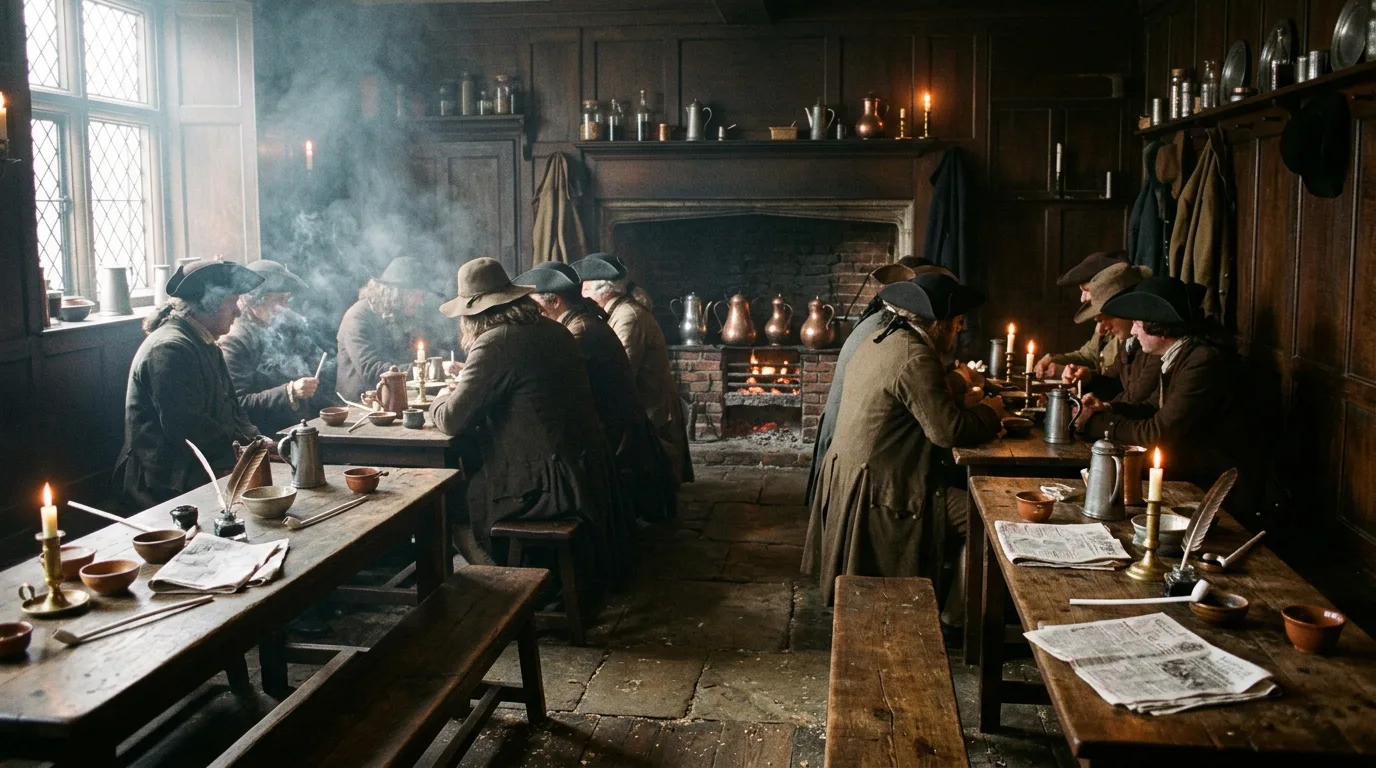
London's first coffee stall opened in 1652, and within decades the city had hundreds, by some estimates thousands, of coffeehouses. For the price of a penny, men of almost any rank could sit at long shared tables, read the newspapers and argue about politics, science and literature with strangers. Coffeehouses helped sober up a beer-drinking city, spread news and rumor, and gave birth to institutions like Lloyd's of London. Women, however, were largely shut out.
Why I wrote this
On a gray afternoon in the City of London, I followed a tiny alley off Cornhill and found a small plaque on a wall. It marks the spot where London's first coffee was sold, in 1652.
Afterward, I sat in a modern coffee shop a few streets away. Every table was occupied, and almost nobody was talking. People had headphones in, laptops open, eyes on screens. It was busy and silent at the same time.
That contrast stuck with me. Three centuries ago, a London coffeehouse was the opposite: loud, crowded, smoky, and built around conversation with strangers. Walking in and keeping to yourself would have been strange. Today, walking up to a stranger's table and asking for the latest news would be stranger still.
I've spent a lot of time since reading about these places. They're a fascinating mix of science, politics, business, gossip and very bad coffee. This guide is what I learned.
What you'll learn
- How coffee arrived in London and why it spread so fast.
- What a coffeehouse was actually like, from the smell to the etiquette.
- The strangest and most famous coffeehouses.
- How coffeehouses shaped news, business and literature.
- Why they faded, and what's left today.
The coffeehouse then vs the coffee shop now
The easiest way to understand the old London coffeehouse is to compare it with a typical coffee shop today.
| Feature | 1700s London coffeehouse | Modern coffee shop |
|---|---|---|
| Seating | Long shared tables and benches | Small separate tables |
| Talking to strangers | Expected, even required | Rare, often awkward |
| Entertainment | Newspapers, debate, gossip | Phones, laptops, headphones |
| Atmosphere | Smoky, loud, crowded | Quiet, bright, curated |
| Coffee quality | Bitter, gritty, often awful | Far better |
| Who got in | Men only, in practice | Everyone |
| Identity | Each one different, with its own crowd | Often standardized chains |
The coffee has improved enormously. The conversation, arguably, has not.
The first coffee stall: Pasqua Rosée, 1652
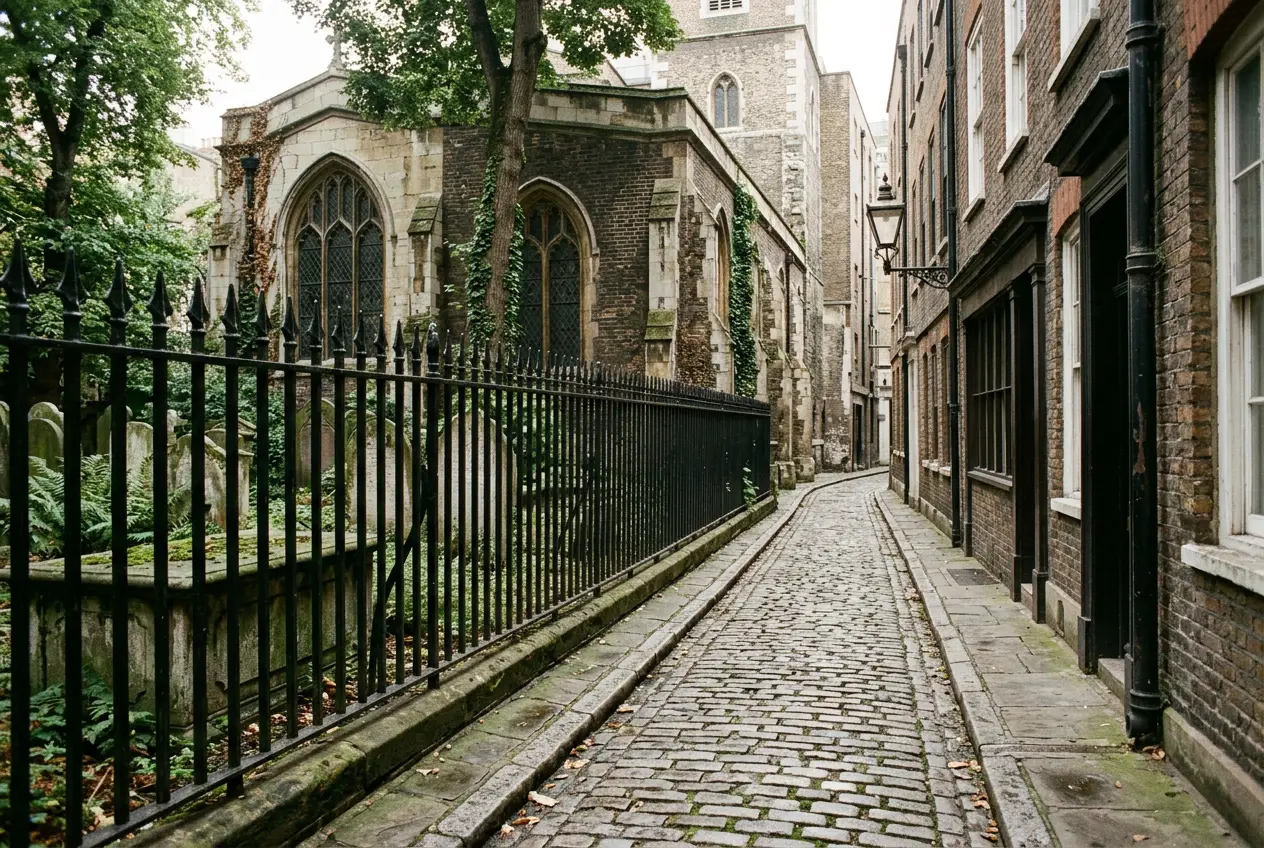
London's coffee story begins in 1652 in St Michael's Alley, a narrow lane off Cornhill in the heart of the City of London. There, against the wall of a churchyard, a Greek-born servant and entrepreneur named Pasqua Rosée started selling coffee.
Rosée had worked for a merchant who traded with the Ottoman Empire and had picked up the coffee habit abroad. His first venture was little more than a shack or stall, not yet the furnished room with tables and benches that later coffeehouses would have.
He promoted coffee hard. A handbill of the time praised "the vertue of the coffee drink" and claimed it helped with everything from digestion and headaches to coughs and gout. Most of those claims were nonsense, but customers did notice that coffee woke them up and made conversation livelier.
Today the site is marked by a plaque, and a historic pub, the Jamaica Wine House, stands on or near the spot. Black iron railings still line the old churchyard nearby.
What the coffee actually tasted like
If you're used to modern specialty coffee, with carefully measured water temperatures and machines that beep when a shot runs long, 17th-century London coffee would shock you.
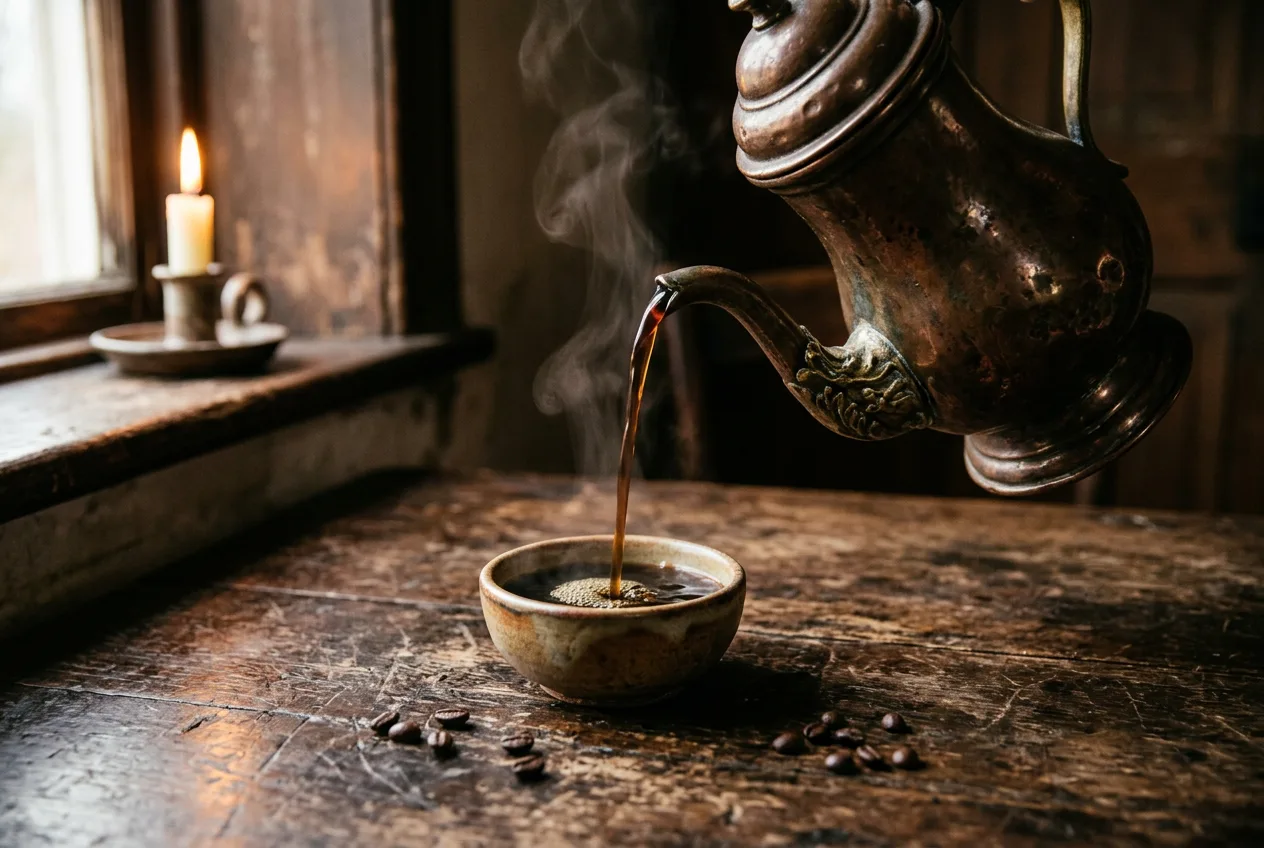
Beans were roasted unevenly, often very dark, ground coarsely and boiled for a long time. The result was thick, bitter and gritty. Contemporaries compared it to oil, ink, soot, mud and worse. Critics called it a hellish brew.
Coffee was usually served black in small, handleless dishes, sometimes with sugar. Milk wasn't common at first. The flavor was not the point. The effect, and the company, were.
If you want to understand why badly extracted coffee tastes so harsh, my guide to coffee extraction explains what's happening chemically. Boiling coffee for a long time is about the fastest route to bitterness there is.
How coffee was made in a 1700s coffeehouse
Coffeehouse coffee was a far cry from today's carefully brewed cup. Here's roughly how it was done, based on descriptions from the period.
- Roast in a pan or drumGreen beans were roasted over a fire, often unevenly and very dark.
- Grind by handBeans were pounded or ground coarsely, sometimes well in advance, so the coffee was often stale.
- Boil, and boil againGrounds were boiled in water in a big pot, then kept hot for hours by the fire.
- Pour into dishesThe coffee was poured, grounds and all, into small handleless dishes.
- Add sugar if you likedSugar was available for those who could afford it; milk was uncommon at first.
The constant reheating is a big part of why the coffee tasted so harsh. Holding coffee hot for a long time breaks down its aromatic compounds and pushes it toward bitterness. Modern brewing does the opposite: fresh grounds, short contact time, and drinking it right away.
Our tip: If you ever want to taste something close to coffeehouse-era coffee, simmer coarsely ground dark roast in water for ten minutes, let it settle and pour. Then brew a fresh pour-over and compare. It makes you grateful for the last three hundred years of progress.
A city sobers up
Coffee's rapid success wasn't only about taste or novelty. It was also about what Londoners drank before.
The Thames and many local water supplies were badly polluted. Drinking plain water could make you seriously ill. So people drank weak beer and ale throughout the day, from breakfast onward, because brewing made the water safer. Later, gin added to the problem.
The result was a population that was often at least a little tipsy. Coffee changed that. Because it was made with boiled water, it was relatively safe. And because it was a stimulant rather than a depressant, it sharpened people up instead of slowing them down.
Historians often describe this as a shift from alcohol to caffeine in public life. Business, politics, science and writing increasingly happened over coffee rather than beer. Many writers have linked that change, at least in part, to the intellectual energy of the period we now call the Enlightenment.
Our tip: Next time someone says coffee changed the world, this is a good example. Swapping beer for coffee in meeting places genuinely changed how people met, worked and argued.
The coffeehouse boom
Rosée's success was copied quickly. Coffeehouses spread across the City, then west toward Westminster and beyond. Estimates vary a lot, but by the early 1700s London had hundreds of coffeehouses, and some historians put the peak at around 3,000.
Unlike today's chains, no two were alike. Each coffeehouse had its own regulars, its own topics and its own personality. Merchants went to one, lawyers to another, scientists, writers, ship captains and political factions each had their favorites.
If you wanted to find someone, you often knew which coffeehouse to look in. Some people even had their letters delivered to their favorite coffeehouse rather than their home.
How London's coffee scene grew (rough picture)
What else was on the menu
Coffee gave the coffeehouse its name, but it was rarely the only thing served. As the 1600s went on, many coffeehouses added other fashionable hot drinks from abroad.
- Tea: introduced to London around the same time as coffee, at first expensive and exotic, later the drink that helped end the coffeehouse age.
- Chocolate: a rich, spiced drinking chocolate, popular with wealthier customers. Some establishments became known as chocolate houses.
- Sherbet: a sweet, fruit-flavored drink inspired by Ottoman recipes.
- Alcohol: despite the sober image, plenty of coffeehouses also sold wine, punch or spirits.
- Tobacco: pipes were everywhere, and tobacco was as much part of the experience as the drinks.
Food was usually simple or absent, since coffeehouses were about drinks, papers and talk rather than meals. If you wanted dinner, you went to a chophouse or tavern.
"Penny universities" and the price of a seat
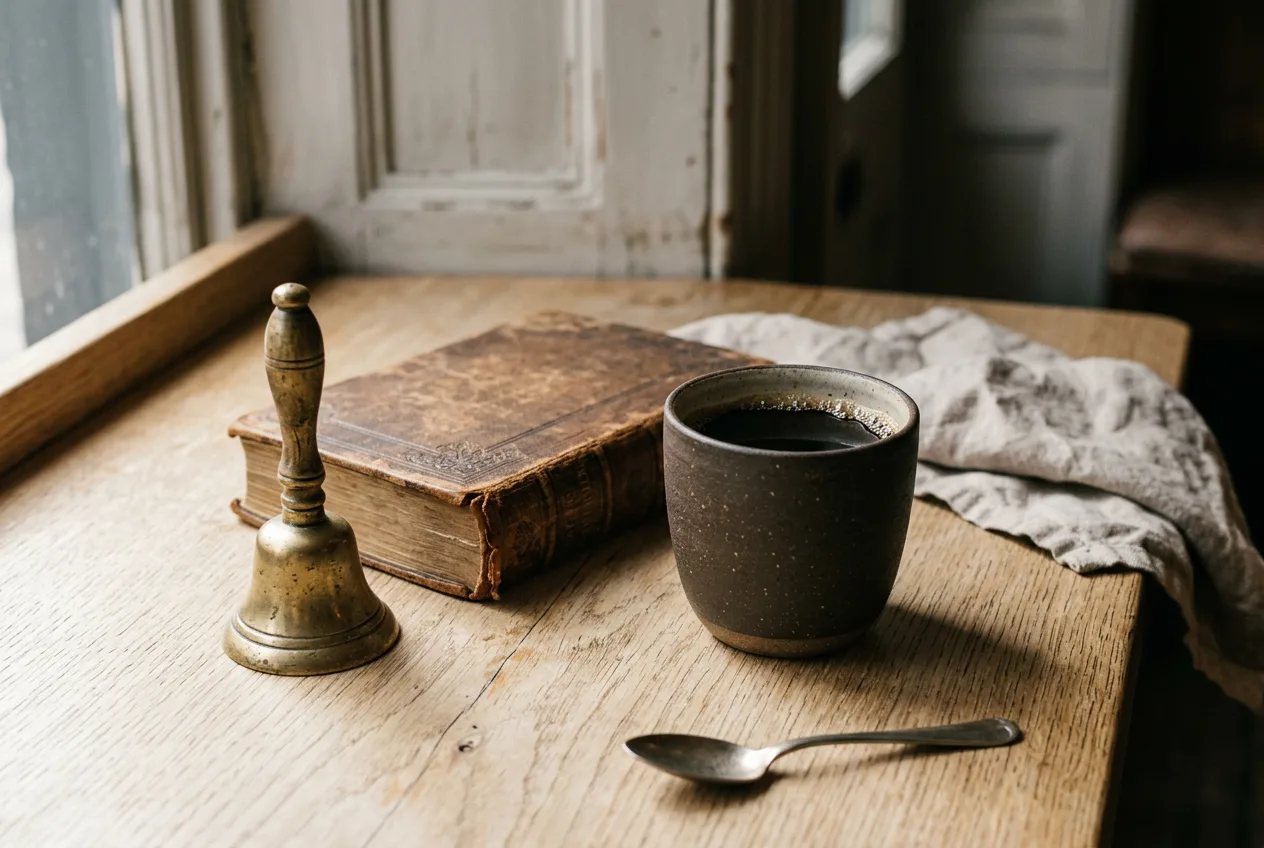
Entry to a coffeehouse usually cost a penny, which bought you a dish of coffee and access to the room, the newspapers and the conversation. That's where the nickname "penny universities" came from: for a penny, you could listen to, and argue with, some of the sharpest minds in London.
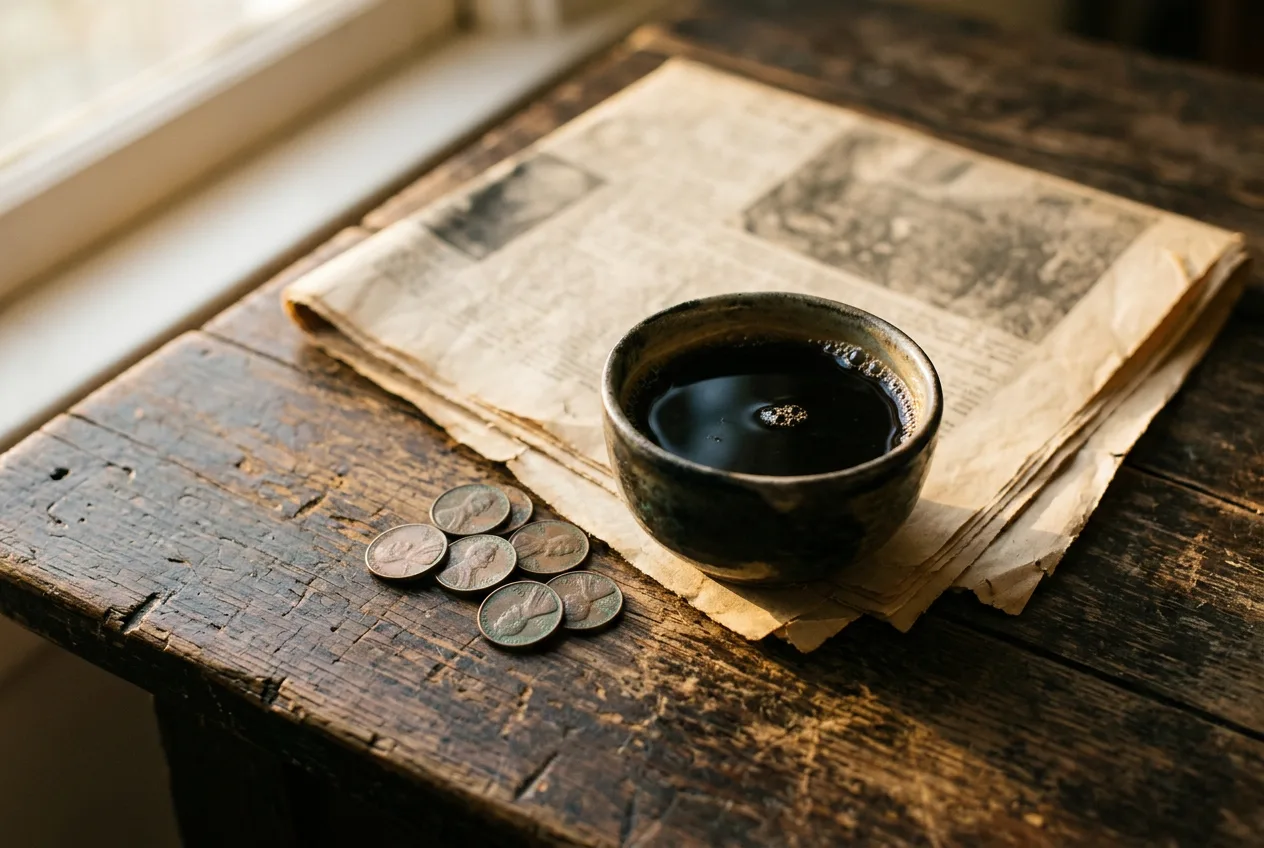
But the real currency was information. The classic greeting when a newcomer walked in was something like "Your servant, sir, what news from Tripoli?" or simply "What news have you?"
You were expected to contribute. That might be something you read in a broadsheet, heard at the docks, picked up from a letter, or, if we're honest, made up on the spot. Then you slid onto a bench and joined a conversation already in full swing.
Inside a London coffeehouse
Picture stepping through the door. The first thing that hits you is the air: thick with tobacco smoke, steam from the coffee pots and the smell of a crowded room. Your eyes take a moment to adjust to the gloom.
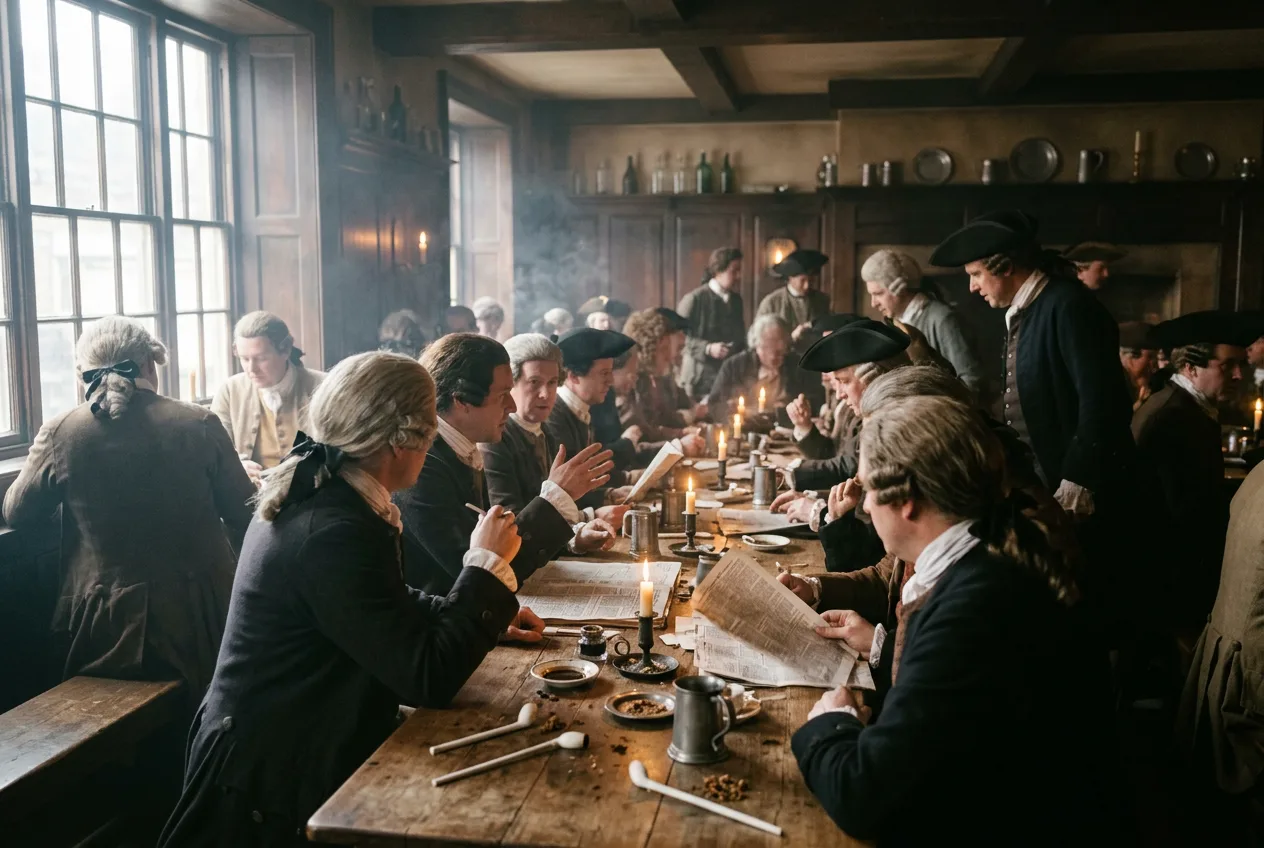
Long wooden tables run down the room, with benches on either side. Men in coats and wigs sit shoulder to shoulder, reading newspapers aloud, scribbling notes, smoking long white clay pipes and arguing. A pot of coffee simmers by the fire. A boy or a woman behind the bar pours dish after dish.
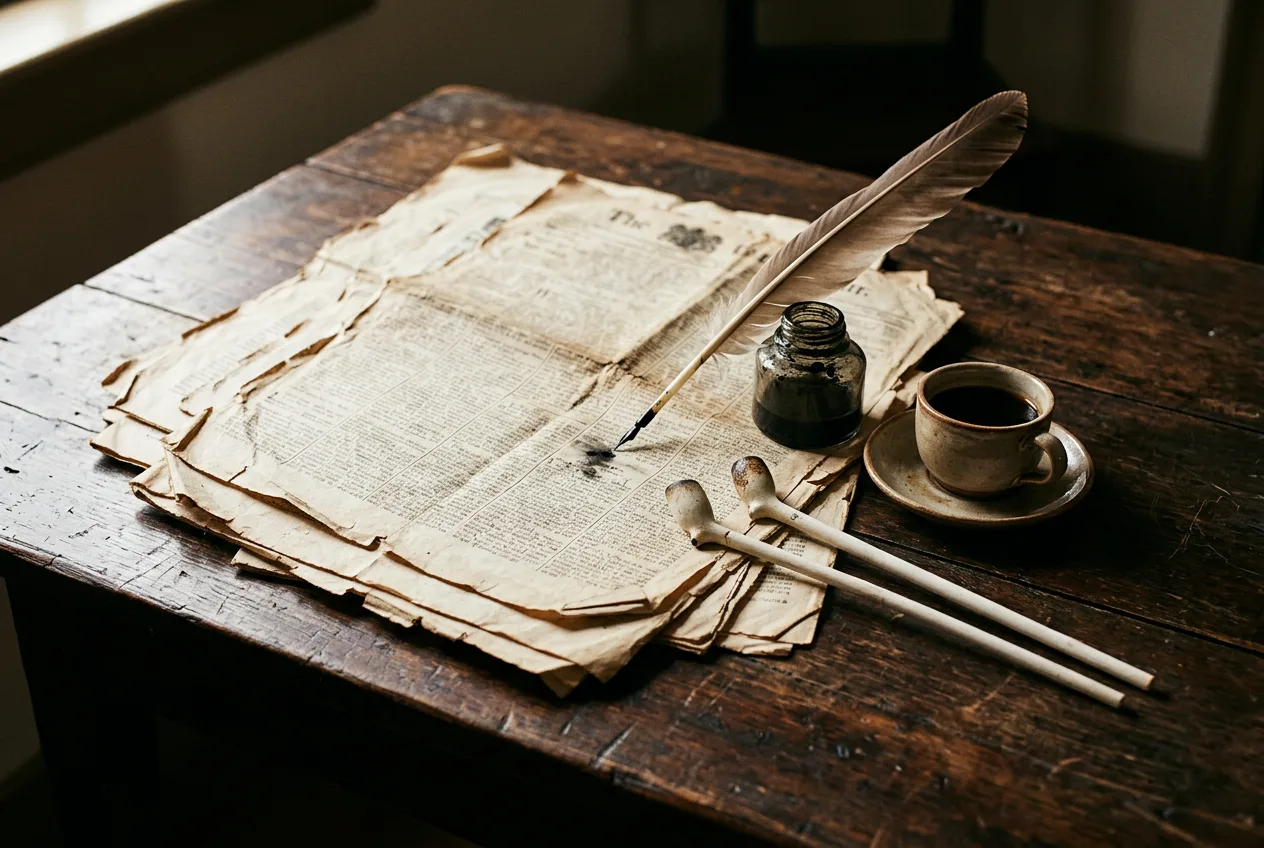
There might be a resident cat, curled up somewhere warm and tolerating the attention of bored customers. Notices and advertisements are pinned up. Someone is reading out the latest shipping news. Someone else is loudly wrong about politics.
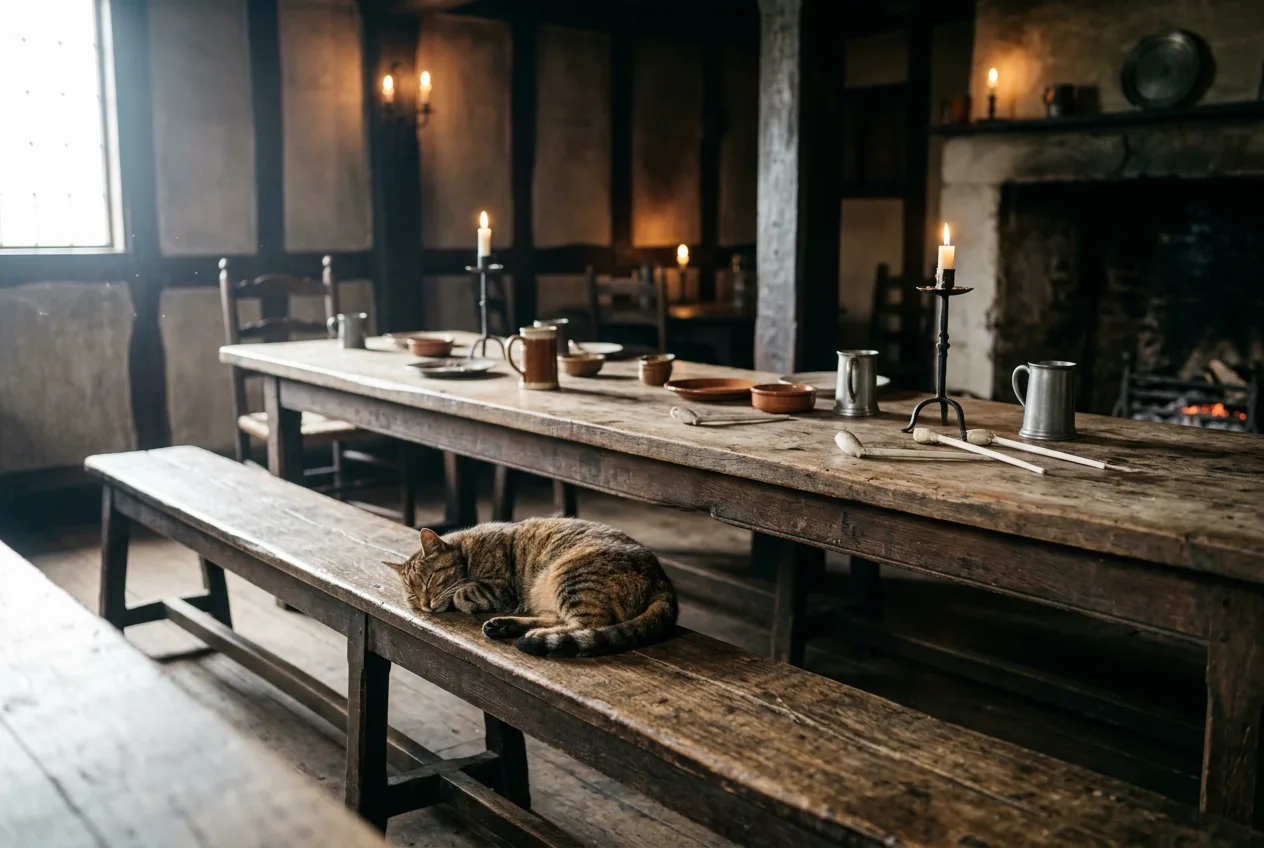
It wasn't refined. Fights broke out, and old engravings show the occasional dish of hot coffee being thrown in someone's face. But it was alive in a way few public rooms are today.
A day in the life of a London coffeehouse
Coffeehouses were busy from morning until late. A typical day in a busy City coffeehouse might have looked something like this.
- Early morningThe fire is lit and the first pots go on. Early customers come for a dish of coffee and the latest papers before work.
- Mid-morningMerchants and brokers arrive. Shipping news is read aloud. Deals are discussed at the tables.
- MiddayThe room is at its busiest. Letters are collected, notices pinned up, and arguments get loud.
- AfternoonWriters, lawyers and idlers settle in. New pamphlets are passed around and judged.
- EveningSome move on to taverns; others stay to talk politics late into the night by candlelight.
Regulars might visit more than one coffeehouse in a day, collecting news in one and sharing it in another. In a city without phones or a fast postal service, that circuit was how information traveled.
Coffeehouse vs tavern
The coffeehouse defined itself partly against the tavern, the older social space it competed with.
| Feature | Coffeehouse | Tavern |
|---|---|---|
| Main drink | Coffee, later also tea and chocolate | Beer, wine, spirits |
| Effect | Alert, talkative | Merry, then sleepy |
| Image | Sober, rational, respectable | Rowdy, indulgent |
| Used for | News, business, debate | Eating, drinking, celebrating |
In reality the line blurred, and plenty of coffeehouses also sold alcohol. But the idea of the coffeehouse as the sober, sensible alternative was a big part of its appeal.
A young man's diary: Dudley Ryder
One of the best windows into coffeehouse life comes from the private diary of Dudley Ryder, a young law student who lived in Hackney around 1715 and 1716.
Hackney was then a semi-rural village outside the city, with fields, meadows and market gardens. From the road into town, you could see the dome of St Paul's in the distance.
Ryder was a regular at local coffeehouses. He describes walking into a room full of strangers, sitting down and asking for the news. During the Jacobite rising of 1715, he heard alarming rumors that rebel forces were marching south from Scotland toward London, and he spent hours debating what it all meant with people he had never met.
For Ryder, the coffeehouse was also a kind of training ground. In his early twenties he was awkward and self-conscious, but ambitious. He used coffeehouse conversation to practice being witty, confident and sociable, watching how others behaved and trying on different personas.
It seems to have worked. Ryder went on to a distinguished legal career and eventually became Lord Chief Justice of England. His diary is a reminder that coffeehouses were places where social rules loosened. Within those walls, at least in theory, men of different backgrounds could talk as equals.
The strangest and most famous coffeehouses
Because every coffeehouse had its own character, some became famous, or infamous, for very specific reasons.
Don Saltero's, Chelsea
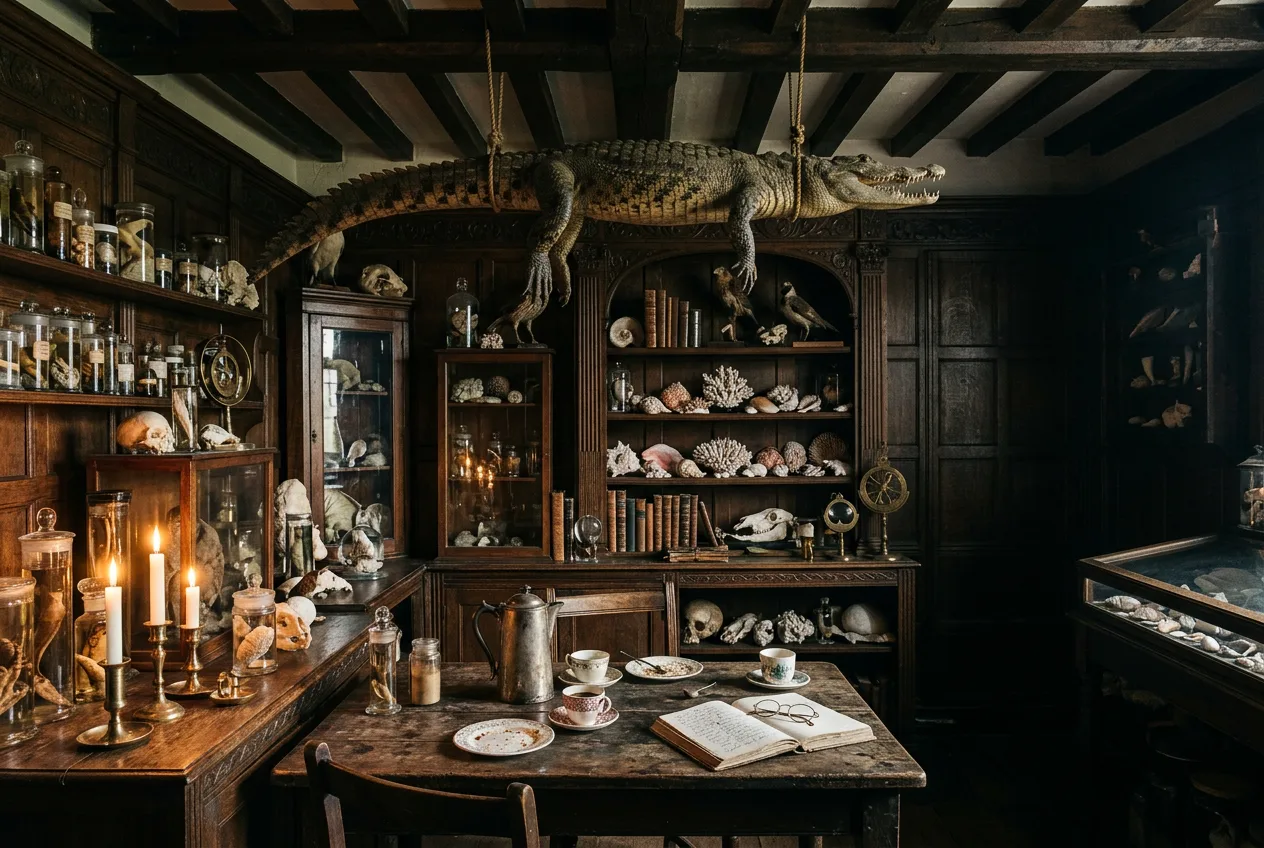
Don Saltero's doubled as a museum of curiosities. Stuffed animals, including a crocodile, hung from the ceiling, along with strange specimens and oddities collected from around the world. Famous scientists are said to have dropped in, and visitors came as much for the exhibits as the coffee.
The Grecian
The Grecian, near the law courts, was a favorite of scholars and members of the scientific Royal Society. Debates could be very hands-on. One famous story tells of a group of natural philosophers dissecting a dolphin there to settle an anatomical argument.
The Latin Coffee House, Clerkenwell
Opened by Richard Hogarth, father of the painter William Hogarth, near St John's Gate in Clerkenwell, this coffeehouse had one rule: customers had to speak Latin. Unsurprisingly, there weren't enough Latin speakers looking for casual conversation, and the business failed.
Floating and frozen coffeehouses
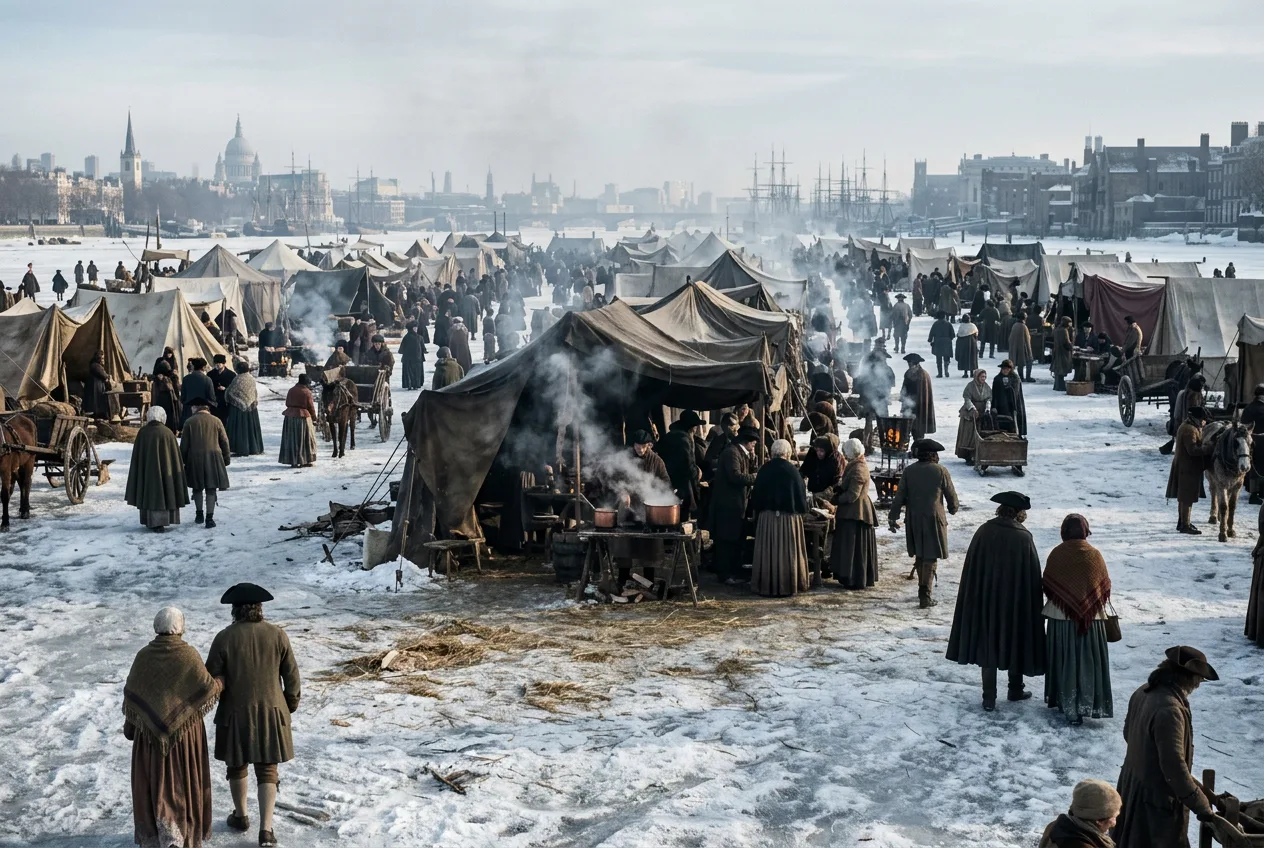
Some entrepreneurs opened coffeehouses on boats moored on the Thames, which became lively, fashionable party spots. And during the Little Ice Age, when the Thames sometimes froze solid in harsh winters, traders set up temporary coffee booths right on the ice at the famous frost fairs.
The darker side
Not every coffeehouse story is charming. Some accounts describe coffeehouses near Hoxton, then an area known for private asylums, being used for grim public hearings into whether a person was insane. It's a reminder that these were public rooms reflecting all of 18th-century society, including its cruelties.
Coffee and the scientific revolution
Coffeehouses were important meeting places for the scientists of the day. Members of the Royal Society, founded in 1660, often continued their discussions in coffeehouses after formal meetings.
The diary of Robert Hooke, one of the great experimental scientists of the period, mentions visits to coffeehouses again and again. He met colleagues, discussed experiments, heard about new instruments and argued over theories, all over coffee.
That mattered. Science in the 17th and 18th centuries depended on sharing observations, letters and ideas quickly. Coffeehouses offered a place where people interested in astronomy, anatomy, mathematics and mechanics could find each other without an invitation. Some even hosted public lectures and demonstrations for a small fee.
It's tempting to say coffee powered the scientific revolution. That's too simple. But coffeehouses certainly made it easier for ideas to travel and collide, which is exactly what science needs.
Beyond London: Oxford, Paris and Vienna
London is the most famous English coffeehouse city, but it wasn't actually first. Oxford had a coffeehouse around 1650, a couple of years before Pasqua Rosée started selling coffee in London, and Oxford's coffeehouses became popular with students and scholars.
Elsewhere in Europe, coffeehouse culture took different forms. In Paris, the Café Procope, opened in the late 1600s, became a famous meeting place for writers and thinkers. In Vienna, coffeehouses developed into elegant, unhurried institutions where people could sit for hours over a single cup and a stack of newspapers, a tradition still alive today.
| City | Coffeehouse character |
|---|---|
| London | Loud, crowded, news, business and debate |
| Oxford | Scholars and students, early adopter |
| Paris | Literary and philosophical salons |
| Vienna | Elegant, slow, newspapers and long stays |
| Istanbul | The older model: games, music, storytelling |
All of them traced their roots back to the coffeehouses of the Ottoman world, where public coffee drinking had been common since the 1500s. London's version simply took that idea and turned up the volume.
Button's and the literary world
One of the most celebrated coffeehouses of the era was Button's, in Covent Garden near the piazza. It was set up around 1712 by Daniel Button, with the backing of the essayist and playwright Joseph Addison, who reportedly liked having a pleasant escape from home.
Button's became the meeting place of many leading writers of the age. Addison, Richard Steele, Alexander Pope, John Gay and Jonathan Swift are all associated with it. Their opinions on a new poem, play or pamphlet could make or break a young writer's reputation, a bit like a viral review from a major critic today.
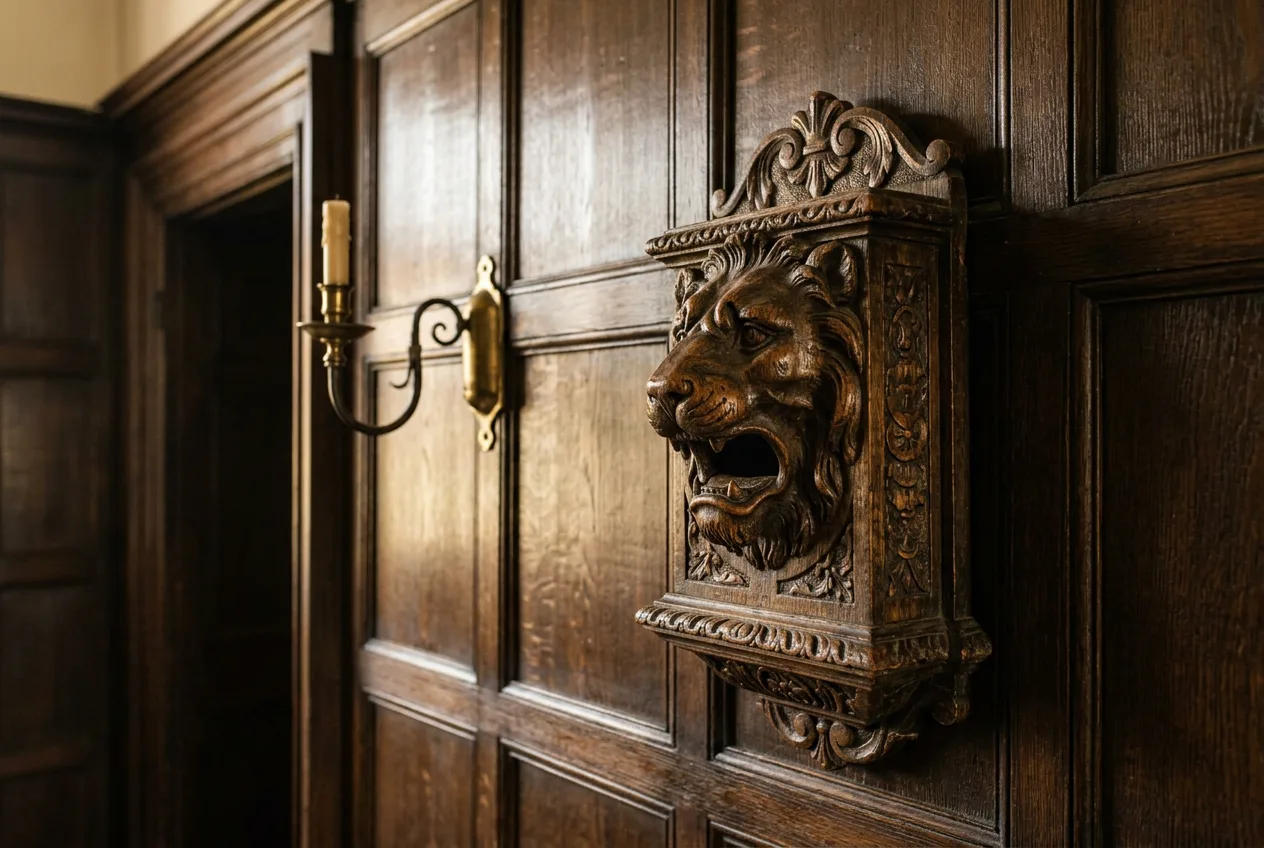
Button's had a famous feature: a carved lion's head mounted on the wall with an open mouth that served as a letterbox. The public could drop in letters, poems, jokes and stories. The best were published in The Guardian, a periodical run by Steele and Addison (not the modern newspaper of the same name). It was an early form of reader submissions.
A little earlier, Will's coffeehouse nearby had been the haunt of the poet John Dryden, who reportedly had his own chair by the fire in winter and by the window in summer. Covent Garden was, in effect, the literary review section of its day.
Today the site of Button's in Covent Garden has no plaque, and you could easily walk past it without knowing its literary history.
Where big business began
Coffeehouses weren't just for chat. Many became informal offices where deals were made, and some grew into institutions that still exist.
| Coffeehouse | Known for | What it became |
|---|---|---|
| Lloyd's | Ship captains, merchants and shipping news | Lloyd's of London, the insurance market |
| Jonathan's | Stock traders and brokers | A forerunner of the London Stock Exchange |
| Garraway's | Auctions of goods and property | A famous trading and auction venue |
| Tom's | Coffee, then increasingly tea | The origin of a tea business still on the Strand today |
| The Grecian | Scientists and scholars | A meeting place for Royal Society members |
Edward Lloyd's coffeehouse is the best-known example. It attracted sea captains, ship owners and merchants, and Lloyd made it more useful by circulating shipping news. Insurers began meeting there to underwrite voyages, and that informal market grew into Lloyd's of London.
Coffeehouses worked for business for the same reason they worked for gossip: the right people were in the room, news flowed fast, and a deal could be struck over a dish of coffee.
Why coffeehouses took off when they did
Three big forces came together to make the coffeehouse what it was.
- A media explosionWhen strict government licensing of printing lapsed in the 1690s, London was flooded with newspapers, pamphlets and periodicals. Subscriptions were expensive, so coffeehouses bought them and laid them out for customers to share and read aloud.
- A fast-growing cityLondon was becoming a huge commercial capital. Newcomers from the provinces and abroad needed public places, other than church, home or tavern, to meet, network and do business.
- The cult of politenessWriters of the time promoted "politeness" as a civic virtue. The idea was that mixing with people who disagreed with you would smooth your rough edges and make you a better, more tolerant citizen.
Put those together and you get a public room full of fresh news, ambitious newcomers and a belief that arguing politely with strangers was good for you. That's the coffeehouse in a sentence.
The women left out
The golden age of the coffeehouse had a glaring limit: it was, in practice, for men. Coffeehouses presented themselves as places of reason and sober debate, and under the assumptions of the time, women were wrongly seen as unsuited to that kind of public discussion.
Women did work in coffeehouses, often behind the bar, and some ran them. But a woman sitting down as a customer risked damaging her reputation.
Women also pushed back. In 1674, a satirical pamphlet called "The Women's Petition Against Coffee" complained that men were wasting their time and energy in coffeehouses. Whether written by women or by men poking fun, it shows that the coffeehouse's men-only culture was noticed and resented.
Meanwhile, women had other social spaces, including tea tables at home and, later, tea gardens. In fact, the rise of tea is part of why the coffeehouse eventually declined.
The king who tried to close them
Coffeehouses were places where people criticized the government, so not everyone in power liked them. In late 1675, King Charles II issued a proclamation to suppress coffeehouses, seeing them as breeding grounds for false news and political dissent.
The backlash was immediate. Coffeehouses were already too popular and too woven into business and daily life. Within days, the order was effectively withdrawn, and coffeehouses carried on.
It's an early example of something we still see today: governments worrying about where people share news and opinions, and finding that it's very hard to shut down a place people genuinely want to gather.
News, rumors and 18th-century misinformation
Coffeehouses were vital news networks. But because everyone was expected to bring some news, and not all of it was true, they were also engines of rumor, gossip and partisan spin.
A story overheard at the docks could be repeated, embellished and "confirmed" in three coffeehouses by lunchtime. Political factions had their own coffeehouses where their version of events was the only one taken seriously.
If that sounds familiar, it should. Many historians have compared the coffeehouse news ecosystem to the internet: fast, social, exciting and full of misinformation. The difference is that you were saying it to someone's face, across a wooden table, which arguably kept people a little more honest and a little less cruel.
Why the coffeehouses faded
By the later 18th century, the great age of the London coffeehouse was ending. Several things changed.
- Tea: Britain's trade increasingly favored tea, which became cheaper and more popular, especially at home.
- Private clubs: many coffeehouse crowds turned into exclusive gentlemen's clubs, with membership rules instead of open doors.
- Specialization: business coffeehouses like Lloyd's and Jonathan's became formal institutions.
- Taverns and chophouses: food and drink venues absorbed some of the social role.
- Newspapers at home: as printing became cheaper, people didn't need a coffeehouse to read the news.
Coffee itself didn't disappear from London, but the open, chatty, penny-entry coffeehouse did. For about two centuries, Britain became much more of a tea nation.
London coffee today
Coffee came back to London in a big way from the late 20th century, first with Italian espresso bars, then international chains, and later an independent specialty scene. Today London is one of the best coffee cities in the world.
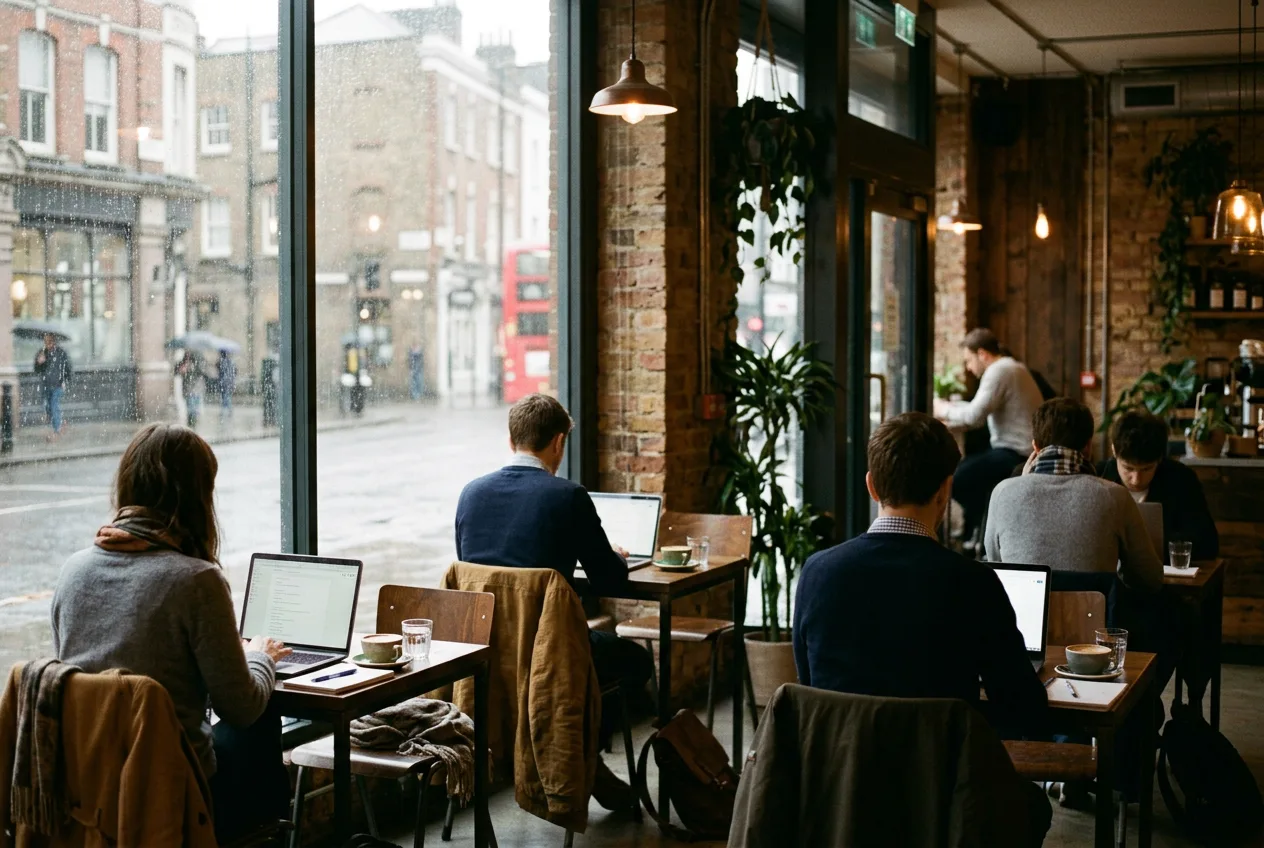
The modern revival came in waves. Italian espresso bars appeared in Soho in the 1950s and became hangouts for young people and musicians. Big chains spread across the city from the 1990s. Then, in the 2000s, Australian and New Zealand baristas helped kick off London's independent specialty scene, bringing flat whites, careful espresso and light roasts with them. Today, the city has hundreds of independent roasters and cafes.
Neighborhoods like Hackney, where Dudley Ryder once walked to his coffeehouse through fields, are now full of small independent cafes, canal-side kiosks and bakeries that treat coffee as a craft.
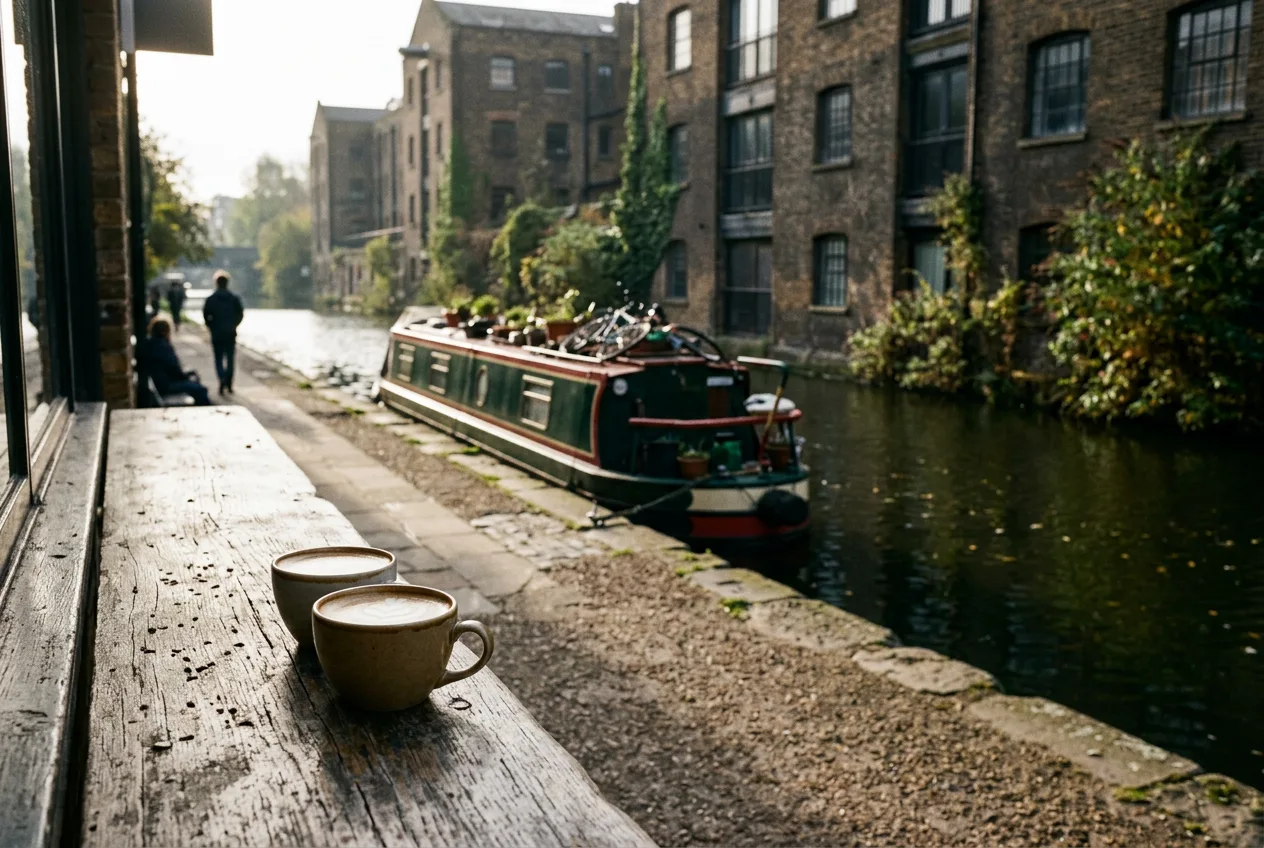
The coffee is better than it has ever been. But the culture is very different. Modern cafes can feel like Edward Hopper's painting Nighthawks: people together in a bright room, yet quietly apart. We sit near strangers, but rarely with them.
For more on how a single chain reshaped coffee shops, see how Starbucks changed coffee. And for the bigger picture, see coffee culture around the world.
Traces of the coffeehouse age you can still visit
Most of London's original coffeehouses are long gone, but you can still find their traces on a walk through the City and the West End.
- St Michael's Alley, CornhillLook for the plaque marking London's first coffee house and the old churchyard railings nearby.
- Change Alley and CornhillThe tangle of lanes where Jonathan's and Garraway's once stood, now among bank offices.
- Lloyd's of LondonThe modern insurance market, whose origins go back to Edward Lloyd's coffeehouse.
- The StrandA historic tea shop still trading on the site of an early 18th-century coffeehouse.
- Covent GardenOnce home to Button's and Will's, the great literary coffeehouses.
- St John's Gate, ClerkenwellWhere Richard Hogarth's short-lived Latin coffeehouse operated.
Our tip: Do the walk on a weekday morning, then stop at an independent cafe and do something radical: ask the person next to you what news they have.
What we can borrow from the old coffeehouses
Nobody wants the smoke, the bad coffee or the exclusion of women back. But some parts of coffeehouse culture are worth reviving.
- Shared tables: long communal tables make conversation more likely.
- Talking across differences: the coffeehouse ideal was arguing politely with people who disagreed with you.
- Face-to-face debate: online arguments can get vicious because of distance and anonymity. Sitting across a table imposes a natural accountability.
- Local identity: a cafe with its own regulars and personality is more interesting than one that looks like every other branch.
- Screens down, now and then: the coffeehouse ran on newspapers read aloud and shared, not private feeds.
Some modern cafes host debates, book clubs, language exchanges and "conversation tables" for exactly this reason. It's the closest thing we have to a penny university.
Myths about London coffeehouses
- "London had the first coffeehouse in England." Oxford had one a couple of years earlier, around 1650.
- "Everyone was welcome." Men of many ranks mixed, but women were largely excluded as customers.
- "The coffee was good." By most accounts it was bitter, gritty and often stale.
- "Coffeehouses were always calm, rational places." They were loud, smoky and sometimes violent.
- "Coffeehouses disappeared because coffee went out of fashion." Tea, private clubs and new institutions mattered more than coffee itself.
Timeline of the London coffeehouse
| When | What happened |
|---|---|
| 1652 | Pasqua Rosée sells London's first coffee in St Michael's Alley |
| 1660s | Coffeehouses spread through the City |
| 1674 | "The Women's Petition Against Coffee" is published |
| 1675 | Charles II tries to suppress coffeehouses and backs down |
| 1680s | Edward Lloyd's coffeehouse opens, later the root of Lloyd's of London |
| 1690s | Printing licensing lapses; newspapers flood coffeehouses |
| Early 1700s | Peak of the coffeehouse age |
| c. 1712 | Button's opens in Covent Garden |
| 1715-1716 | Dudley Ryder records coffeehouse life in his diary |
| Late 1700s | Tea, private clubs and new institutions replace the open coffeehouse |
| Late 1900s - today | Espresso bars, chains and a booming specialty scene |
The verdict
The London coffeehouse was never a perfect place. The coffee was terrible, the air was thick with smoke, women were shut out and plenty of what was said was rumor or nonsense.
But for a century or so, it was one of the most important public spaces in the world. It helped sober up a city, spread newspapers, shaped literature, launched institutions like Lloyd's and taught a generation that you could sit across a table from a stranger and argue about anything.
It also reminds me that the places where we drink coffee shape how we think. A room built around a shared table and a stack of newspapers produces conversation. A room built around power outlets and solo tables produces quiet. Neither is wrong, but it's worth noticing which one we're choosing.
Our coffee is far better today. Our coffee shops are cleaner, quieter and open to everyone. If we could add back just a little of the old spirit, the shared table and the question "What news have you?", we'd have the best of both worlds.
Frequently asked questions
When did the first coffeehouse open in London?
In 1652, when Pasqua Rosée started selling coffee in St Michael's Alley, off Cornhill in the City of London.
Why were coffeehouses called penny universities?
Because for about a penny, the price of entry and a dish of coffee, you could read the newspapers and join conversations with educated people on almost any subject.
How many coffeehouses were there in London?
Estimates vary widely. By the early 1700s there were hundreds, and some historians suggest the number may have reached around 3,000.
Were women allowed in London coffeehouses?
Mostly not as customers. Women worked in and sometimes ran coffeehouses, but the customer culture was overwhelmingly male.
Which famous company started in a coffeehouse?
Lloyd's of London grew out of Edward Lloyd's coffeehouse, where merchants and ship owners met and insured voyages.
Why did London coffeehouses decline?
The rise of tea, private gentlemen's clubs, formal business institutions and cheaper newspapers all reduced the need for the open coffeehouse.
What did 17th-century coffee taste like?
Bitter, thick and gritty. It was usually boiled for a long time and served black, and contemporaries compared it to ink or mud.
Can you visit the site of London's first coffeehouse?
Yes. A plaque in St Michael's Alley, off Cornhill, marks the spot.

- Michael Reynolds, notes from London walks and reading on coffee history
- English coffeehouses in the 17th and 18th centuries, Wikipedia
- Pasqua Rosée, Wikipedia
- Lloyd's Coffee House, Wikipedia
- Button's Coffee House, Wikipedia
- Dudley Ryder, Wikipedia
Related guides
History of coffee Coffee culture around the world Italian coffee cultureWritten by Michael Reynolds. Last updated November 20, 2026.