Technivorm Moccamaster KBTS review
The Technivorm Moccamaster 79212 KBTS Coffee Brewer is a handmade Dutch drip coffee maker with a 32-ounce thermal carafe, tightly controlled water temperature and a manual drip-stop brew basket. It brewed a full carafe in about 6 minutes and made the cleanest, sweetest drip coffee I have had at home. It has no timer, no app and no frills, and it is an investment.

Michael Reynolds
Hands-on review
Hands-on testing, research, specs
3 weeks
21 minutes
Jargon helpNew to coffee gear? Tap any dotted term to see what it means.
In this review
Yes, if you drink drip coffee every day and want café-quality filter coffee without fuss. The Moccamaster KBTS brewed a full carafe in about 6 minutes at a steady, hot temperature, wetted the grounds evenly and kept coffee hot in its thermal carafe for hours without a burnt taste. It has no programmable timer or smart features, and you pay for the build quality up front.
Moccamaster KBTS at a glance
Moccamaster KBTS pros and cons
- Clean, sweet, balanced coffee every time
- Full carafe in about 4 to 6 minutes
- Thermal carafe keeps coffee hot without a burnt taste
- No programmable timer or smart features
- Premium price for a drip machine
- Carafe lid needs regular cleaning
Who should buy the Moccamaster KBTS?
- Daily drip coffee drinkers
- Households that drink a full pot slowly
- Buyers who want a machine that lasts for years
- Single-cup or pod drinkers
- Anyone who wants coffee ready on a timer
- Espresso and latte fans
First impressions of the Moccamaster KBTS
I have reviewed a lot of espresso machines with touchscreens, apps and dozens of recipes.
The Technivorm Moccamaster KBTS has a single rocker switch.
That is the point of it.
It is a drip coffee maker designed to do one thing extremely well: heat water to the right temperature, spread it evenly over the coffee and get out of the way.
Out of the box, the polished silver body looks like a piece of lab equipment from the 1970s, in a good way.
There is a clear water tank at the back, a tall column carrying the water up to an outlet arm, a cone-shaped brew basket and a stainless steel thermal carafe underneath.
Everything feels solid, with a metal body and very little plastic where it matters.
My first carafe, using a freshly ground medium roast, was ready in just under six minutes.
It tasted clean, sweet and balanced, without the flat, slightly bitter edge I am used to from cheaper drip machines.
My partner, who usually adds milk and sugar, drank her first cup black and asked what beans I had bought.
They were the same beans as the week before.
Over the next three weeks, I tried to find its weak spots, from half batches to light roasts to iced coffee.
There were a few, mainly around convenience, but the coffee itself was consistently excellent.
The polished silver KBTS has a single switch and a design that has barely changed in decades.
What the Moccamaster KBTS actually is
The KBTS is a drip coffee maker, also called a filter coffee machine, with an insulated thermal carafe instead of a glass pot on a hot plate.
It is handmade in the Netherlands, and the design has changed very little over the years because it works.
Water from the tank is heated as it rises through the column, then sprays out of an outlet arm with several holes over the coffee in the cone.
The coffee drips into the thermal carafe through a brew-through lid that you leave on while brewing.
What's in the box
My box held the brewer, the brew basket, the 32-ounce thermal carafe with its brew-through lid, a sample of paper filters, a measuring scoop and the manual.
Our tip: Rinse the paper filter with hot water before adding coffee, because it removes any papery taste and warms the basket and carafe.
Moccamaster KBTS design and build
The KBTS is tall and narrow, and it took up less counter width than our old drip machine.
It sat comfortably under my upper cabinets, although I slid it forward to fill the water tank from the top.
Build quality
The body is metal, the switch has a satisfying clunk, and the outlet arm and basket click into place firmly.
After three weeks of daily use, nothing had loosened or rattled.
This is a machine built to be repaired rather than replaced, and that shows in the details.
The thermal carafe
The stainless steel carafe is double-walled and feels sturdy.
It pours cleanly once you turn the lid to the pour position, without dribbling down the side.
The lid stays on during brewing, which keeps the heat in from the first drop.
Our tip: Pre-heat the empty carafe with hot tap water for a minute before brewing, because a warm carafe keeps coffee hotter for noticeably longer.
Setup and the first brew
Setup took me about ten minutes, most of it reading the short manual.
I washed the carafe, lid and basket, ran two full tanks of water through without coffee to rinse the system, and then made my first real batch.
Here is the routine I settled on for every brew.
| Step | What to do | Why it matters |
|---|---|---|
| 1 | Fill the tank with fresh, cold water | Old water tastes flat |
| 2 | Pre-heat the carafe with hot tap water, then empty it | Keeps coffee hotter |
| 3 | Fold the filter seams and rinse it with hot water | Removes paper taste |
| 4 | Add freshly ground coffee and level the bed | Even saturation |
| 5 | Set the basket flow and put the lid on the carafe | Right contact time |
| 6 | Flip the switch and walk away | About 5 minutes to coffee |
| 7 | Remove the basket and close the lid when done | Keeps heat in |
The machine switches itself off once the water tank is empty, so there is nothing to remember afterwards.
Brewing temperature and even saturation
Two things matter most in drip coffee, and the Moccamaster is built around both.
Temperature
Coffee extracts best with water roughly between 196 and 205°F.
Too cool, and the coffee tastes flat and sour because not enough flavor dissolves.
Too hot or unstable, and you pull out more bitterness.
Many budget drip machines never get hot enough, or they swing up and down during the brew.
When I measured the water landing on the coffee, the Moccamaster stayed in the ideal range from start to finish.
My probe readings during a full brew, rounded.
Even saturation
The outlet arm sprays water through several holes over the whole bed of coffee, rather than a single stream in the middle.
That matters because uneven water leaves dry pockets that under-extract while other spots over-extract.
When I opened the basket after brewing, the spent coffee was evenly wet with a flat, level bed.
On our old machine, there was always a crater in the middle and dry grounds around the edge.
This even wetting is what gives you good extraction✕ExtractionHow much flavor water dissolves from the coffee. Too little tastes sour and thin, too much tastes bitter and dry., and it's why the same beans tasted so much better.
The bloom
At the start of the brew, hot water hits the dry grounds and they puff up and bubble as trapped gas escapes.
This is called the bloom✕BloomThe bubbling and swelling of fresh coffee grounds when hot water first hits them, as trapped carbon dioxide escapes. It helps water reach all the coffee evenly..
The Moccamaster wets the grounds steadily enough that the bloom happens naturally, without you needing to stir or pause.
How the coffee tastes
I ran blind tastings with my partner and two friends over three weekends.
Same beans, same grind, same coffee-to-water ratio, brewed on the Moccamaster KBTS and on a standard budget drip machine.
The Moccamaster won every single round.
People described it as cleaner, sweeter, brighter and less bitter.
The budget machine's coffee was described as flat, muddy or slightly burnt, especially after half an hour on its hot plate.
Average scores out of 100 from four tasters, same beans and ratio.
With a light-roast Ethiopian, the Moccamaster brought out fruit and floral notes that the other machine flattened completely.
With a darker house blend, it tasted chocolatey and round rather than harsh.
Brew speed
A full carafe took between about 4 and 6 minutes in my tests, depending on the grind and how much coffee was in the basket.
That is fast for drip coffee and much faster than our old machine, which took around 10 minutes.
Moccamaster timed in my tests; budget machine my previous drip maker.
A half carafe took about 3 minutes with the basket set to slow the flow.
On weekday mornings, that speed made a real difference: by the time I had fed the cat and put the bread in the toaster, the coffee was done.
The thermal carafe and keeping coffee hot
The KBTS has no warming plate.
Instead, the coffee brews straight into an insulated thermal carafe✕Thermal carafeA double-walled, insulated coffee pot that keeps coffee hot without a heating plate underneath, so the coffee doesn't keep cooking and turning bitter..
That sounds like a small detail, but it changes how coffee tastes after the first cup.
Coffee sitting on a hot plate keeps cooking, and within half an hour it tastes stewed and bitter.
In the thermal carafe, the coffee simply cools very slowly and keeps its flavor.
My measurements with a pre-heated carafe, full batch.
Pouring and the lid
You turn the lid to open the pouring channel, and the carafe pours smoothly.
The lid has a few parts that trap coffee, so it needs a proper wash rather than a quick rinse.
Our tip: Turn the carafe lid to the closed position between pours, because an open lid lets heat escape much faster.
The drip-stop brew basket and flow control
The brew basket has a small switch that controls how quickly coffee drains into the carafe.
In the closed position, it stops the flow completely, so you can lift the carafe away mid-brew without coffee dripping everywhere.
In the slower position, it holds water in the cone a little longer, which helps when you brew a half batch.
In the open position, coffee flows straight through for a full carafe.
| Basket setting | What it does | When I used it |
|---|---|---|
| Open | Full flow | Full carafe, medium grind |
| Half | Slower flow, longer contact | Half carafe or 2–3 mugs |
| Closed | Stops the flow | Pulling the carafe out mid-brew |
With a half batch on the open setting, the coffee tasted thin because the water ran through too quickly.
On the slower setting, the same half batch tasted as full as a full carafe.
That simple, mechanical control is all the adjustment the Moccamaster gives you, and it is enough.
Ratios, grind and getting it right
Coffee-to-water ratio
The Moccamaster rewards measuring your coffee.
I weighed coffee with a kitchen scale for the whole test and found the sweet spot quickly.
| Batch | Water | Coffee | Ratio |
|---|---|---|---|
| Full carafe | About 34 fl oz / 1 L | About 60 g / 2.1 oz | About 1:16.5 |
| Three mugs | About 24 fl oz / 0.7 L | About 42 g / 1.5 oz | About 1:16.5 |
| Two mugs | About 17 fl oz / 0.5 L | About 30 g / 1.1 oz | About 1:16.5 |
If you don't own a scale, the included scoop holds roughly 7 grams of medium-ground coffee.
That works out to about 8 to 9 scoops for a full carafe.
Grind size
A medium grind, roughly the texture of coarse sand, worked best for full carafes.
For half carafes, I went one step finer to make up for the shorter, smaller bed of coffee.
| What you taste | Likely cause | First change |
|---|---|---|
| Thin, weak | Too little coffee | Add 5 g of coffee |
| Sour | Grind too coarse | One step finer |
| Bitter, dry | Grind too fine | One step coarser |
| Muddy | Very uneven grind | Use a burr grinder |
| Thin half batch | Flow too fast | Use the slower basket setting |
Our tip: Weigh your coffee for the first week, then mark the right level on your scoop, because consistent doses matter more than any other setting.
Which grinder to pair with it
The Moccamaster doesn't grind coffee, so the grinder you use matters a lot.
A burr grinder✕Burr grinderA grinder that crushes beans between two burrs set at a fixed distance, giving even particles. Blade grinders chop beans unevenly, which makes coffee taste muddy and bitter. makes a much bigger difference here than an expensive bag of beans.
I tested three options with the same medium roast.
My ratings out of 100, same beans and ratio.
The blade grinder made a mix of powder and chunks, and the fine powder slowed the drip and added bitterness.
The burr grinder's even particles let the water flow steadily, and the cup tasted far cleaner.
If you are choosing where to spend money, a decent burr grinder plus the Moccamaster beats a fancier machine with pre-ground coffee every time.
For more, see my comparison of burr vs blade grinders.
Our tip: Grind right before brewing, because ground coffee loses much of its aroma within the first 15 minutes.
Strengths and recipes I liked
Not everyone likes coffee at the same strength, and the Moccamaster makes it easy to adjust without changing anything else.
These are the recipes we used most, all with a medium grind.
| Recipe | Coffee per liter | Taste | Best for |
|---|---|---|---|
| Light and bright | About 55 g | Delicate, tea-like | Light roasts, black |
| House standard | About 60 g | Balanced, sweet | Everyday mugs |
| Strong morning | About 65 g | Fuller, richer | With milk |
| Iced flash brew | About 60 g, half the water over ice | Bright, refreshing | Summer afternoons |
| Cold milk and coffee | About 70 g | Bold | Iced coffee with lots of milk |
A note on the SCA standard
Coffee experts often talk about a golden cup✕Golden cupA coffee-industry guideline for well-brewed filter coffee: the right strength and extraction, usually around 55 to 60 grams of coffee per liter of water with water near 200°F. standard for drip coffee.
It describes a target strength and extraction, with water held in a narrow temperature range and a full brew finished within a few minutes.
The Moccamaster is designed around those targets, which is why my best batches landed right around 60 grams per liter.
Why drip coffee from cheaper machines tastes worse
I wanted to understand exactly why the same beans tasted so different, so I watched both machines closely.
The budget machine heated water slowly, and the first third of the brew ran noticeably cooler.
It also dripped water from a single central hole, so the middle of the bed got most of the water.
The result was a mix of under-extracted and over-extracted coffee in the same cup, which tastes flat and bitter at the same time.
On top of that, its glass pot sat on a hot plate, which kept cooking the coffee.
The Moccamaster fixes all three problems: steady, hot water from the first drop, an outlet arm that wets the whole bed, and a thermal carafe instead of a hot plate.
None of that needs a screen or an app, which is why the machine looks so simple.
Where the budget machine lost points in my side-by-side, from my notes.
Beans, water and filters
The Moccamaster is transparent: it shows off good beans and doesn't hide stale ones.
Freshly roasted medium and light roasts tasted their best, with clear fruit and sweetness.
Darker roasts were smooth and chocolatey, though they lost some of the clarity that makes this machine special.
| Bean type | How it tasted | Notes |
|---|---|---|
| Light roast | Fruity, floral, bright | Shines on the Moccamaster |
| Medium roast | Sweet, balanced | Best all-rounder |
| Medium-dark blend | Chocolatey, round | Great with milk |
| Dark roast | Smoky, a little flat | Use a touch less coffee |
| Pre-ground supermarket coffee | Acceptable, dull | Fresh grinding is a big upgrade |
Water
Coffee is mostly water, so water quality matters.
Our tap water is fairly hard, and filtered water made the coffee noticeably sweeter and kept scale from building up as quickly.
See my guide to water chemistry for coffee for more.
Filters
Use standard No. 4 cone paper filters, and fold the seams so the filter sits flat against the basket.
Noise and kitchen fit
The Moccamaster is quiet, but not silent.
You hear a soft gurgle as water heats and rises through the column, then a gentle patter as it sprays over the coffee.
There is no grinder, no pump and no beeping, so it never woke anyone in our apartment.
When it finishes, it simply goes quiet and switches off.
Fitting it in
It is narrower than most drip machines, which helped on our crowded counter.
The height was fine under standard cabinets, and I only slid it forward to fill the tank.
If your cabinets are low, measure the height with the lid of the tank open.
| Sound | When | Normal? |
|---|---|---|
| Gurgling | Water heating in the column | Yes |
| Soft patter | Water spraying over the coffee | Yes |
| Faint clicks | Heating element cycling | Yes |
| Hissing or spitting | Scale build-up | Time to descale |
What daily use is really like
Our weekday routine was the simplest of any machine I have tested.
Fill the tank, rinse a filter, add 60 grams of fresh coffee, flip the switch, walk away.
About 5 minutes later, the carafe was full, and it stayed hot through a long breakfast and the first hour of work.
On weekends, I often brewed a second half carafe in the afternoon.
From my brew log.
The only thing I missed was a timer.
On a couple of early mornings, I would have liked to wake up to coffee already brewed.
Iced coffee on the Moccamaster
The Moccamaster doesn't have an iced coffee setting, but it makes excellent flash-brewed iced coffee.
I put about 250 grams of ice in the carafe, used 60 grams of coffee and filled the tank with about 500 ml of water.
The hot coffee melts part of the ice as it drips, which dilutes it to normal strength and chills it in seconds.
The result was bright, clean and much fresher than coffee brewed hot and left to cool.
| Iced coffee recipe | Amount |
|---|---|
| Coffee, medium grind | About 60 g / 2.1 oz |
| Water in the tank | About 17 fl oz / 500 ml |
| Ice in the carafe | About 9 oz / 250 g |
| Basket setting | Half, for longer contact |
Our tip: Brew iced coffee straight onto ice in the carafe with the lid off, then pour into glasses with fresh ice, because the first batch of ice has done its job.
Cleaning and maintaining the Moccamaster
Daily cleaning is quick.
Throw away the filter and grounds, rinse the basket, and rinse the carafe with hot water.
The carafe lid
The lid is the one part that needs attention.
Coffee gets into the pouring channel and the brew-through valve, so I took it apart and washed it with soapy water every two or three days.
Descaling
The Moccamaster has no descaling alert, so you need to remember yourself.
Descaling✕DescalingRunning a mild acid solution through the machine to dissolve mineral scale left by hard water. Scale slows heating and can block the water path. matters even more on a machine without alerts.
With our hard water, I would descale every four to six weeks, and with soft water every two to three months.
| Task | What it removes | How often |
|---|---|---|
| Discard filter, rinse basket | Grounds and oils | After every brew |
| Rinse carafe | Coffee residue | Daily |
| Wash carafe lid thoroughly | Trapped coffee and oils | Every 2–3 days |
| Wash basket with soap | Coffee oils | Weekly |
| Descale | Mineral scale | Every 1–3 months |
My estimate of hands-on cleaning time per day.
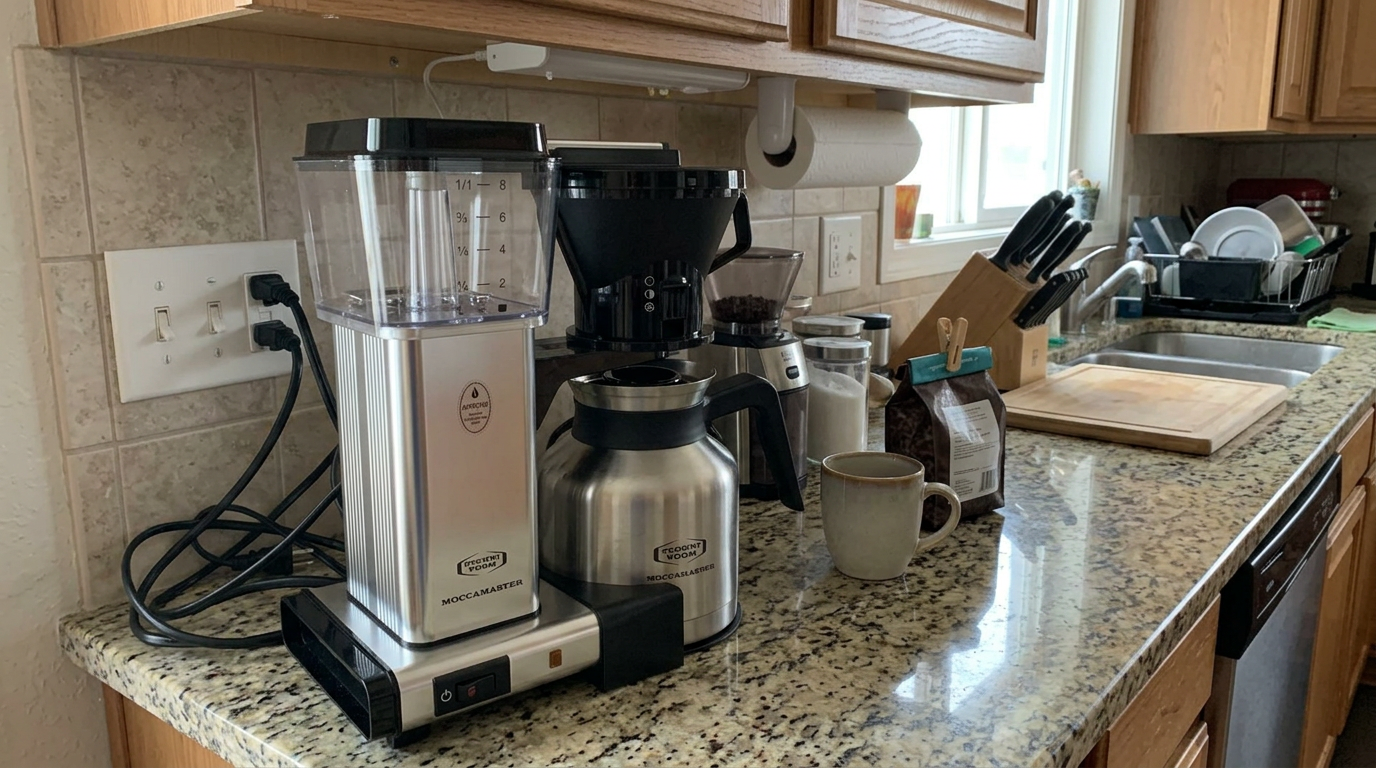
Daily cleaning is just the filter, the basket and a rinse of the carafe.
Three weeks with the Moccamaster, week by week
Week 1: getting the ratio right
I weighed every batch and settled on 60 grams per liter by day four.
The speed and the clean taste stood out immediately.
Week 2: half batches and iced coffee
I learned to use the slower basket setting for half carafes and tried flash-brewed iced coffee.
Both worked well.
Week 3: the routine
Brewing became automatic, and the carafe kept coffee hot well into the morning.
The only frustration was the lack of a timer on early mornings.
Our combined feeling about the machine, from our shared notes.
Common mistakes to avoid
| Mistake | What happens | Better habit |
|---|---|---|
| Using a scoop without weighing | Strength changes daily | Weigh for the first week |
| Half batch on the open setting | Thin, weak coffee | Use the slower setting |
| Skipping the filter rinse | Papery taste | Rinse with hot water |
| Cold carafe | Coffee cools faster | Pre-heat with hot water |
| Forgetting to descale | Slower brews, cooler water | Set a phone reminder |
| Grinding too fine | Slow drip, bitter coffee | Medium, like coarse sand |
What I would change
A simple, optional timer would make early mornings easier.
A carafe lid with fewer parts would be quicker to clean.
Otherwise, there is very little I would change.
Three households, three verdicts
The daily drip drinker
Someone who drinks two or three mugs of black coffee every morning.
The Moccamaster KBTS is the best machine I have tested for this.
The work-from-home couple
Two people who drink coffee slowly through the morning.
The thermal carafe keeps it hot for hours without turning bitter.
The family with guests
A household that hosts brunch most weekends and needs several mugs at once.
A full carafe in about 5 minutes, then a second batch while the first is being poured, kept eight of us in coffee without anyone waiting.
The 32-ounce carafe is the one limit, so for big groups you will be brewing twice.
The latte lover
Someone who mainly drinks espresso-based milk drinks.
The Moccamaster is the wrong machine, however good it is.
| Household | Fit | Main reason |
|---|---|---|
| Daily drip coffee drinkers | Excellent | Clean, sweet, fast |
| Work-from-home households | Excellent | Thermal carafe keeps coffee hot |
| Specialty light-roast fans | Excellent | Brings out fruit and clarity |
| People who need a timer | Fair | No timer |
| Espresso and latte fans | Poor | Drip only |
Is the Moccamaster KBTS worth the money?
The KBTS costs much more than a typical drip coffee maker.
What you get is consistent temperature, even saturation, a fast brew, a thermal carafe and a machine built to last for many years.
In my blind tastings, the difference in the cup was obvious to everyone, not just to me.
If you drink drip coffee every day, that difference adds up to a better cup every morning for years.
If you only drink coffee occasionally, or you want a timer and smart features, a cheaper programmable machine makes more sense.
It also helps to think in years rather than months.
Cheaper drip makers often get replaced every few years when a heating element fails or the pot cracks.
The Moccamaster is built to be repaired, with parts like carafes and lids sold separately, and many owners keep theirs for a decade or more.
Spread over that time, the cost per morning looks very different.
For us, the bigger win was simply that every pot tasted good, without any effort.
Three questions to ask:
Do you drink drip coffee every day?
Do you care more about taste than features?
Are you happy to switch it on yourself each morning?
How it compares with other coffee setups
| Feature | Moccamaster KBTS | Budget drip machine | Pour-over by hand |
|---|---|---|---|
| Brew temperature | Steady, about 196–205°F | Often under 185°F | Depends on your kettle |
| Saturation | Even, multi-hole outlet arm | Often a single stream | Even, with practice |
| Full pot time | About 4–6 min | 8–12 min | About 9 min of attention |
| Keeping warm | Thermal carafe, no hot plate | Hot plate, turns bitter | Server or carafe |
| Timer | None | Usually | None |
| Lifespan | Built to last for years | Often a few years | Very long |
Compared with a budget drip machine, the Moccamaster brews hotter, more evenly and faster, and its carafe keeps coffee tasting fresh for hours.
Compared with pour-over by hand, it makes coffee almost as good with none of the attention.
For more on that trade-off, see my comparison of pour-over vs drip coffee and my guide to coffee brewing ratios.
| You mostly drink | Is the KBTS a fit? | Why |
|---|---|---|
| Black drip coffee | Excellent | Clean, sweet, hot |
| Coffee with a splash of milk | Excellent | Full flavor holds up |
| Iced coffee | Very good | Flash-brew onto ice |
| One cup at a time | Fair | Built for batches |
| Espresso and lattes | Poor | Drip only |
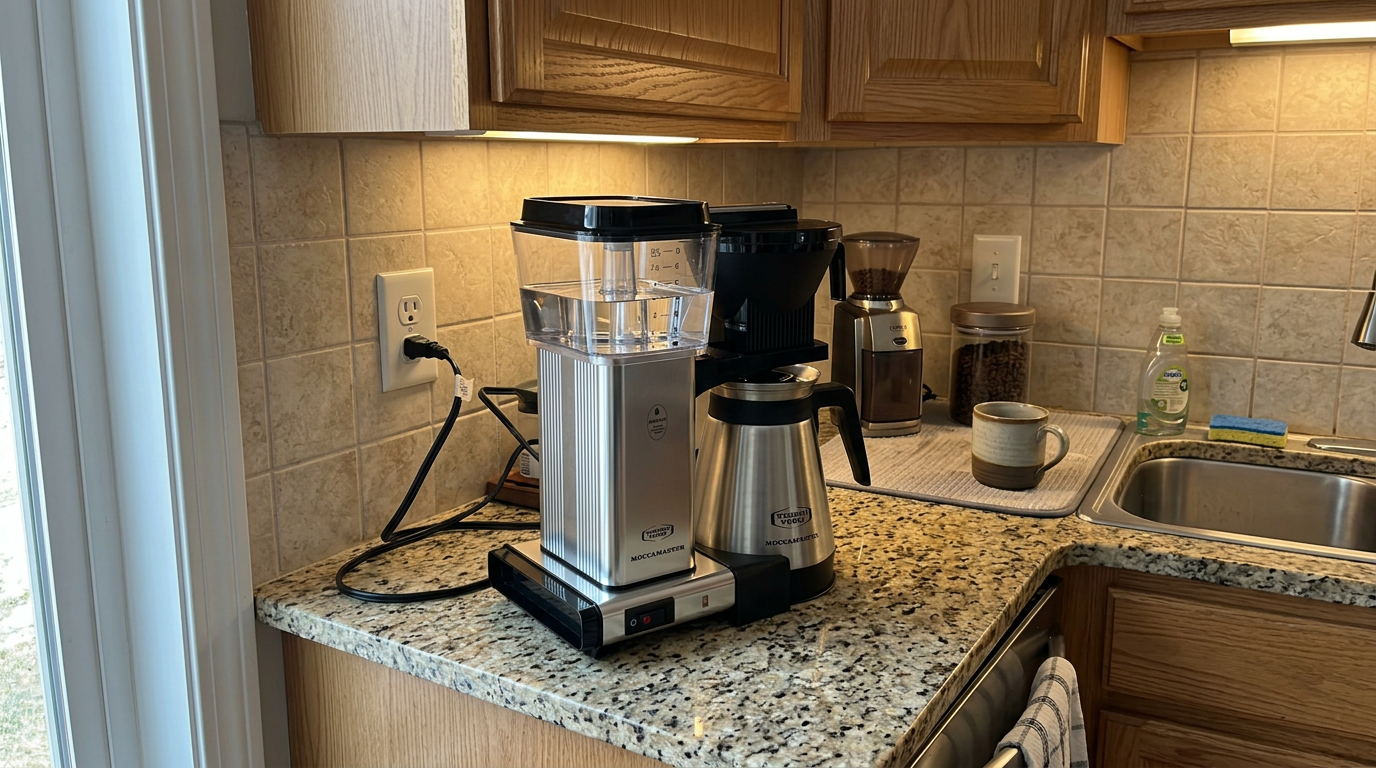
The KBTS on our counter, where it made at least one carafe every day for three weeks.
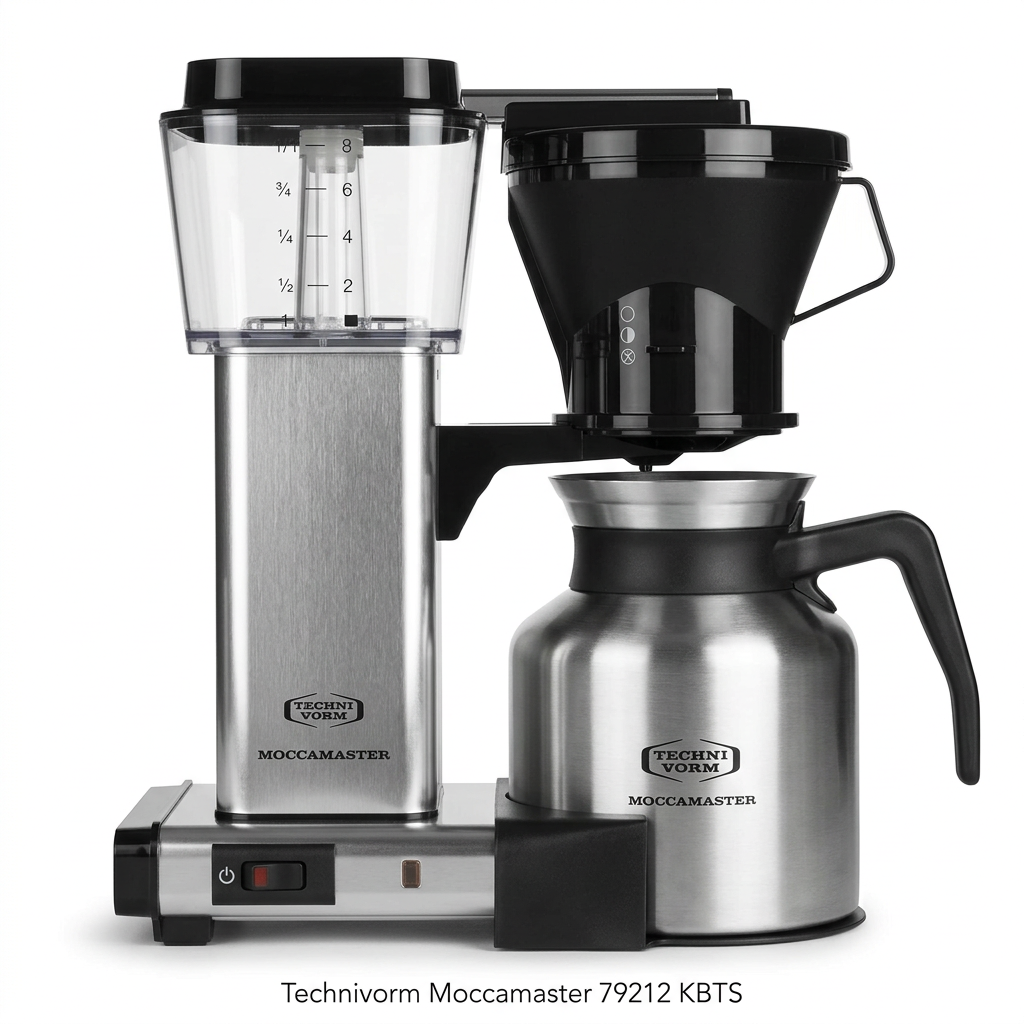
The full package: water tank, outlet arm, drip-stop brew basket and 32-ounce thermal carafe.
Which one is right for you: is the Moccamaster KBTS your match?
4 quick questionsMoccamaster KBTS specifications
From manufacturer data and my own testing.
How I tested and scored the Moccamaster KBTS
For three weeks, the Moccamaster KBTS was our everyday coffee maker, brewing at least one full carafe every morning and often a half carafe in the afternoon.
I timed every full and half brew, measured water and coffee temperature with a probe thermometer, and logged how hot the carafe stayed after one, two and three hours.
I brewed the same freshly ground medium roast on the Moccamaster and on a standard budget drip machine for blind tastings with my partner and friends.
I also tested the drip-stop and flow settings, half batches, different grind sizes and the cleaning and descaling routine.
- Coffee flavor (9.2): clarity, sweetness and balance in blind tastings.
- Speed (9.0): brew time for full and half carafes.
- Ease of use (8.6): setup, controls, drip-stop basket and carafe pouring.
- Cleaning (8.3): basket, carafe lid and descaling.
The overall score of 8.8 is an editorial rating that reflects those four areas.
Moccamaster KBTS FAQ
Is the Moccamaster KBTS worth it?
Yes, if you drink drip coffee every day and care about flavor. It brews quickly, evenly and hot, and it is built to last for years.
How long does it take to brew?
About 4 to 6 minutes for a full 32-ounce carafe in my tests.
How hot does it brew?
It holds water in the ideal brewing range of roughly 196 to 205°F throughout the brew.
Does it have a warming plate?
No. It brews into an insulated thermal carafe, which keeps coffee hot without scorching it.
How long does the carafe keep coffee hot?
In my tests, coffee was still pleasantly hot after about two hours and warm after three.
Does it have a timer?
No. You switch it on when you want coffee. There is no programmable timer or app.
What does the drip-stop do?
It lets you close or slow the flow from the brew basket, so you can pull the carafe out without drips and adjust brewing for smaller batches.
Can I brew a half carafe?
Yes. I set the basket to the slower flow for half batches so the coffee had enough contact time.
Which filters does it use?
Standard No. 4 cone paper filters.
What grind size should I use?
A medium grind, like coarse sand. I went slightly finer for half batches.
Where is it made?
It is handmade in the Netherlands.
How do I clean it?
Rinse the basket and carafe daily, wash the carafe lid well, and descale every month or two depending on your water.
Kitchen & coffee tester
Michael spent six years as a line cook in restaurants in Chicago and New York, and he has tested kitchen appliances for HouseholdMe since 2018, from air fryers to coffee makers. He holds an SCA certificate in barista skills and used the Moccamaster KBTS as his everyday coffee maker for three weeks for this review.
- Three weeks of hands-on testing of the Technivorm Moccamaster 79212 KBTS
- Manufacturer product specifications and user manual
- General drip brewing, extraction and water guidance