Ninja Luxe Café Mini review
The Ninja Luxe Café Mini packs a 60-setting grinder, a built-in scale, espresso and drip-style coffee and a manual steam wand into a compact body. Guided grinding and weight-based brewing made consistent, chocolatey espresso easy, and the wand produced latte-art milk with practice. The small tank, tight work area and single-spout portafilter are the trade-offs.

Michael Reynolds
Hands-on review
Hands-on testing, research, specs
3 weeks
19 minutes
Jargon helpNew to coffee gear? Tap any dotted term to see what it means.
In this review
Yes, if you want a grinder, scale and real espresso in a small kitchen and you're happy to steam milk by hand. The Ninja Luxe Café Mini recommended a grind, weighed every dose and shot and made smooth, chocolatey doubles, plus a clean filter-style coffee. The manual wand made glossy milk with practice. Its small tank needed daily refills, the work area is cramped, the single spout can't split a shot and there are no cold or hot-water functions.
Ninja Luxe Café Mini at a glance
Ninja Luxe Café Mini pros and cons
- Built-in grinder with 60 settings
- Integrated scale for consistent shots
- Compact body with filter-style coffee too
- Small water tank
- Cramped work area around the wand
- Single-spout portafilter, no cold functions
Who should buy the Ninja Luxe Café Mini?
- Small kitchens that want a grinder built in
- Beginners who want guided, consistent shots
- Latte art learners
- One-touch milk drink fans
- Iced coffee and cold brew lovers
- People who make many drinks in a row
First impressions of the Ninja Luxe Café Mini
Most all-in-one espresso machines with a built-in grinder are big.
They take over a whole stretch of counter, which is a problem in apartments and small kitchens.
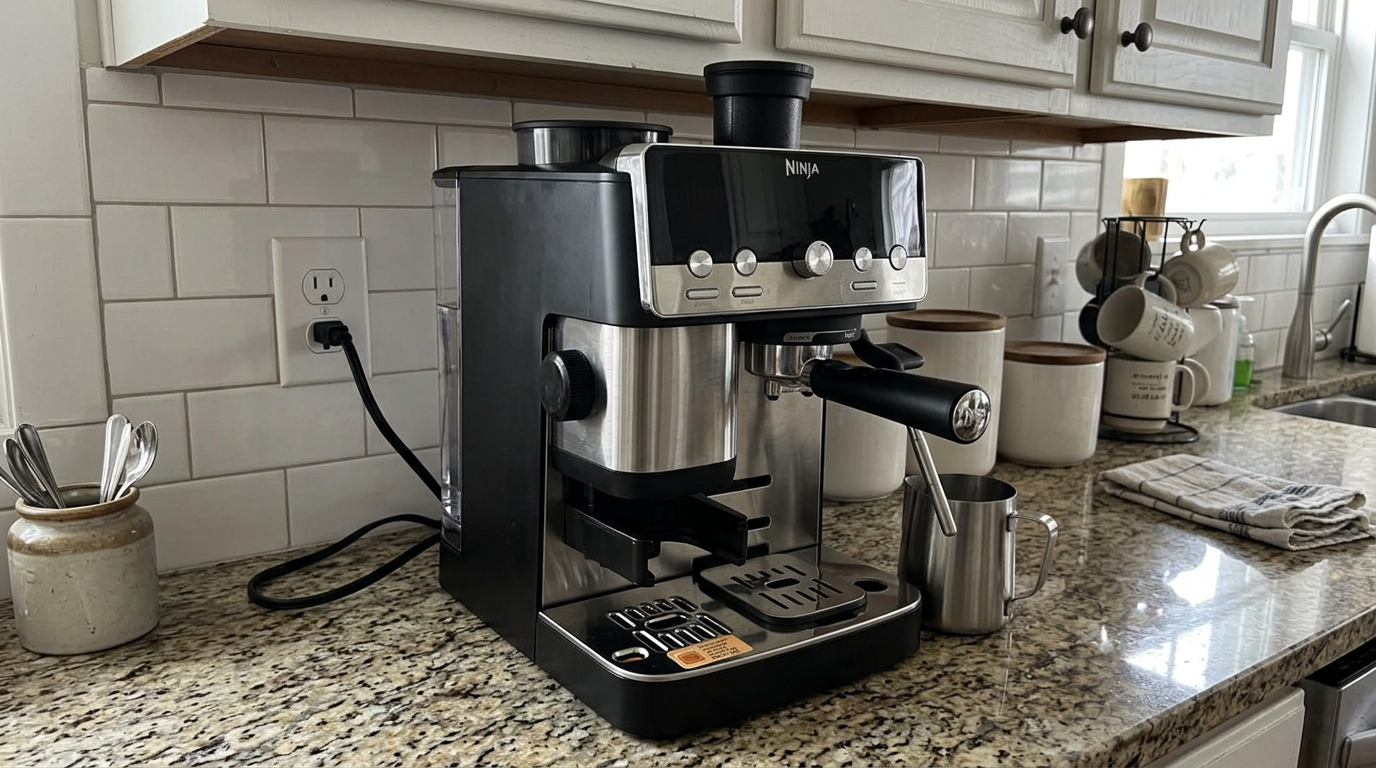
The Ninja Luxe Café Mini squeezes a grinder, a built-in scale, espresso and drip-style coffee and a manual steam wand into a body about 30 percent smaller than Ninja's larger Luxe Café machines.
It's the manual-frothing sibling of the Mini Plus, which adds hands-free milk frothing.
Out of the box, the Mini looked compact and well thought out.
The tamper and dosing funnel sit on top of the machine, handholds are molded into the sides, and the grinder knob has a ridged grip that's easy to turn.
The sides and back are plastic, but the drip tray is metal and the steam wand is stainless steel.
My first espresso, with the machine's recommended grind and dose, was smooth and chocolatey.
The built-in scale took most of the guesswork out of it.
The small water tank was the first thing that nagged me, and it kept nagging for three weeks.
A grinder, scale, portafilter and steam wand in a body about 30 percent smaller than Ninja's bigger Luxe Café machines.
What the Ninja Luxe Café Mini actually is
The Luxe Café Mini is a compact semi-automatic espresso machine with a built-in conical grinder and an integrated scale.
It recommends a grind setting for each drink, weighs your dose and your drink, and stops brewing at a target weight.
It makes espresso at different strengths and a drip-style filter coffee, and you steam milk by hand.
Mini vs Mini Plus
| Feature | Luxe Café Mini | Luxe Café Mini Plus |
|---|---|---|
| Grinder and scale | Yes | Yes |
| Espresso and drip-style coffee | Yes | Yes |
| Milk | Manual steam wand | Hands-free auto froth plus manual |
| Steam wand | Smaller | Larger, rounded, non-burn |
| Cold drinks | No | No |
| Best for | People who want to learn milk by hand | One-touch milk drinks |
If you want automatic milk, my Ninja Luxe Café Mini Plus review covers the hands-free version.
Our tip: Decide early whether you want to learn milk steaming by hand, because that's the main reason to choose the Mini over the Plus.
Design and counter space
The Mini's compact body is its headline.
It fit under our wall cabinets with room to spare and left space for a milk pitcher and cups beside it.
Thoughtful details
The tamper and funnel store on top, keeping the sides clean.
Recessed handholds made it easy to slide forward and lift when I wiped the counter.
The ridged grind knob gave me precise control without slipping.
The compromises
The sides and back are plastic, not metal.
The work area around the portafilter and steam wand is tight, and placing a separate scale under the cup took some maneuvering.
And the water tank is small.
Our tip: Leave a little space above the machine, because the bean hopper and the top-stored tamper and funnel both need room to lift off.
Setup and the first day
Setup took about 15 minutes, mostly because there are more parts than on a simple espresso machine.
I washed the portafilter, baskets, funnel, drip tray and tank, then followed the on-screen prompts to prime the system.
The machine flushed itself, and I ran water through the steam wand before the first drink.
| Step | What I did | Time |
|---|---|---|
| Wash parts | Portafilter, baskets, funnel, tray, tank | 5 min |
| Fill tank and hopper | Filtered water, fresh beans | 2 min |
| Prime and flush | Following the prompts | 3 min |
| Flush the steam wand | Into a cup of water | 1 min |
| First espresso | Recommended grind, double | 3 min |
The first shots
The recommended grind was close, but my first double ran slightly fast.
Two steps finer fixed it, and the scale made it obvious what changed.
Our tip: Pull two or three practice shots with your first bag of beans, because the grinder needs a few doses to settle and the first grams are often off.
Dialing in, step by step
The Mini makes dialing in easier than any compact machine I've used, because the scale shows you exactly what's happening.
This is the process that worked for me.
- 1. Start: use the recommended grind for espresso with the double basket.
- 2. Weigh: check the dose reads about 17 to 18 grams.
- 3. Brew: let the machine stop at its target and note the time.
- 4. Taste: sour and fast means grind finer; bitter and slow means grind coarser.
- 5. Adjust: change one or two grind steps and repeat.
- 6. Save: once it tastes right, keep that setting for that bag of beans.
| Taste | Shot time | Change |
|---|---|---|
| Sour, thin | Under 20 s | One or two steps finer |
| Balanced, sweet | 25–30 s | Keep it |
| Bitter, dry | Over 35 s | One or two steps coarser |
| Weak in milk | Any | Use the high strength setting |
Double shots, medium-dark blend.
For more on why these changes work, my explainer on coffee extraction is a good read.
Our tip: Re-dial the grind for every new bag of beans, because different coffees need different settings even on the same machine.
Reliability after three weeks
Over three weeks, the Mini made around 45 espressos, 25 milk drinks and about 10 filter coffees without a fault.
The grinder never jammed, the scale stayed accurate and the machine behaved the same on day 21 as on day one.
From my test log.
Our tip: Run the grinder empty for a second after switching beans, because it clears leftover grounds so your next dose isn't mixed with the old coffee.
The grinder and 60 settings
The built-in conical burr grinder✕Burr grinderA grinder that crushes beans between two abrasive plates, giving even particles. Blade grinders chop unevenly and make espresso harder to control. has 60 settings.
That's more steps than earlier Luxe Café grinders, so small adjustments are easier.
Guided grinding
You choose your basket and drink, and the machine recommends a grind range.
Espresso uses a fine setting; drip-style coffee uses a much coarser one, around 47 in my tests.
Anti-jam behavior
When you move toward a finer setting, the grinder briefly turns the burrs.
That stops grounds jamming between them, which is a nice touch.
Going coarser doesn't need it.
Lower numbers are finer. My settings with a medium blend.
| Drink | Recommended grind | My final setting | Tip |
|---|---|---|---|
| Espresso, double | Fine | Around 10 | Adjust one or two steps at a time |
| Drip-style coffee | Coarse | Around 47 | Level the bed before brewing |
Our tip: Change the grind by one or two steps at a time and taste, because 60 settings means each step is small and big jumps overshoot.
The built-in scale
The integrated scale is one of the Mini's best features.
It weighs your dose and the drink in the cup, then stops at a target weight.
You confirm which basket is installed, and the machine uses that to set the grind and brew.
Ratios without the guesswork
The double basket held about 17 to 18 grams.
On the strongest setting, the Mini aims for close to a 1:2 brew ratio✕Brew ratioThe weight of coffee compared with the weight of water or finished drink, such as 1:2 for espresso or about 1:16 for drip coffee.: about 36 grams of espresso from 18 grams of coffee.
Low, medium and high strength settings change that target.
Averages from three weeks with a medium blend.
Why it matters
Most beginners never weigh their shots, so they can't tell why one tastes great and the next doesn't.
The Mini does it for you, every time.
That made my shots far more consistent than on machines without a scale.
Our tip: Use the scale's readout to learn what a good shot looks like, because seeing 18 grams in and 36 grams out builds intuition fast.
Espresso quality
With fresh beans, the Mini made a full-bodied espresso with real substance.
A well-adjusted double tasted smooth, with chocolate and hints of nougat.
My typical double of 17 to 18 grams in produced around 40 grams out, a little longer than a strict 1:2, and still nicely balanced.
Puck prep
After grinding, I used a needle tool (WDT✕WDTShort for Weiss Distribution Technique: stirring the grounds with thin needles to break up clumps before tamping.) to break up clumps, which is optional but helped.
The spring-loaded tamper works with the funnel still on, which keeps grounds contained.
A gentle twist settled the coffee, and tilting the funnel away as I lifted the tamper stopped grounds being pulled up.
The single-spout portafilter
Coffee runs from one central spout rather than two.
It makes a neat, concentrated stream, but you can't split one double between two cups.
There's also a plastic insert inside the portafilter that shapes the flow.
Doubles at the high strength setting.
Our tip: Tilt the funnel away as you lift the tamper, because it breaks the suction and stops grounds being pulled out of the basket.
Drip-style filter coffee
The filter setting turns the Mini into a single-cup drip-style brewer.
The grinder moves to a much coarser setting, around 47, and grinding is quicker because of it.
The bloom
The machine first wets the coffee bed and lets it bloom✕BloomThe first moments of brewing, when hot water releases trapped carbon dioxide from fresh grounds and the coffee bed swells and bubbles., so trapped gas escapes and the grounds swell.
Then it pauses before continuing.
That pause is part of the program, not a fault, though it fooled me once on the first day.
The full bloom, pause and brew took about a minute and twenty seconds.
From pressing start to finished cup.
How it tasted
The result was a hot, clean cup of black coffee with a lighter body than espresso and no crema.
It's ideal for people who want a mug of black coffee rather than espresso.
For a broader look at brew styles, see my guide on pour over vs drip coffee.
Our tip: Lightly level the coarse grounds before brewing filter coffee, because an uneven bed lets water run through one side and taste weak.
Manual milk steaming
The Mini has a manual steam wand, so you control the milk.
Compared with the Plus, there's no hands-free frothing: you hold the pitcher, set the tip depth and create the whirlpool yourself.
How it performed
The wand had enough power to heat and texture milk properly once I had the technique.
With cold whole milk and a 12-ounce pitcher, I made glossy microfoam✕MicrofoamMilk foam with bubbles so small you can't see them. It feels silky and blends into the coffee instead of sitting on top like froth. good enough for simple latte art by week two.
- Purge: open the steam briefly to clear water.
- Stretch: tip just under the surface for a few seconds while the milk is cold.
- Spin: sink slightly and tilt the pitcher to make a whirlpool.
- Stop: when the pitcher is too hot to hold for more than a second.
- Wipe: clean and purge the wand straight away.
Manual steaming over three weeks.
The tight work area
The space around the wand is cramped.
A 12-ounce pitcher fit comfortably; a big 20-ounce pitcher was awkward.
Our tip: Use a 12-ounce pitcher with the Mini, because the work area around the wand is tight and a larger pitcher is hard to angle.
Water use and the small tank
The tank is small, about 44 ounces, which keeps the machine compact.
But the Mini also flushes water through its system after brewing, so it uses more than the drinks alone.
I refilled it roughly every day, sometimes twice on weekends.
My estimate, allowing for automatic flushes.
The drip tray
Flushing also means the drip tray fills steadily.
I emptied it daily.
Our tip: Refill the tank every evening, because the Mini's automatic flushing uses more water than you'd expect and an empty tank mid-shot is annoying.
Heat-up, speed and noise
The Mini warmed up faster than earlier Luxe Café machines I've used.
It also ran with fewer pauses during brewing, and it was quieter overall.
My average time per drink, start to finish.
Noise
The grinder makes a short, loud burst, as all grinders do.
Brewing and the after-brew flush are quieter than I expected.
Steaming is the loudest part, as on every machine with a wand.
Cleaning and maintenance
Daily cleaning is quick.
Knock out the puck, rinse the basket and portafilter, wipe and purge the wand, and empty the drip tray.
| Task | Why | How often |
|---|---|---|
| Knock out puck, rinse basket | Grounds and oils | After every shot |
| Wipe and purge steam wand | Milk | After every milk drink |
| Empty drip tray | Flush water | Daily |
| Refill tank | Small capacity | Daily |
| Brush grinder chute | Coffee dust | Weekly |
| Clean portafilter insert | Coffee oils | Weekly |
| Descale | Mineral scale | When prompted |
Clean the wand immediately
Milk dries quickly on any steam wand.
A damp cloth straight after steaming, plus a short purge, kept it clean.
Descaling
Follow the machine's descaling✕DescalingRunning a mild acid solution through the machine to dissolve mineral scale left by hard water. Scale slows heating and can block pipes. prompt, and use filtered water to stretch the time between descales.
My estimate of daily hands-on cleaning time.
Our tip: Brush the grinder chute once a week, because coffee dust builds up in compact machines and can affect your dose.
My favorite drinks and settings
| Drink | How I made it | Tip |
|---|---|---|
| Double espresso | Double basket, high strength | Fresh beans, WDT |
| Latte | Double plus 7 oz manual-steamed milk | 12 oz pitcher |
| Cappuccino | Double plus 4 oz foamier milk | Stretch a little longer |
| Flat white | Double plus 4 oz thin silky milk | Minimal air |
| Filter coffee | Filter setting, grind around 47 | Level the bed |
| Iced latte | Double over ice, cold milk | Use a few ice cubes |
No cold brew or hot water
The US Mini doesn't have a hot-water outlet or cold brew functions.
For an Americano, I brewed a double into hot water from the kettle.
Our tip: Make Americanos by brewing a double into a mug of kettle water, because the US Mini has no hot-water outlet.
Coffee to use
Fresh, medium and medium-dark roasts gave the best espresso.
Light roasts worked well as filter coffee.
| Coffee | Espresso | Filter-style | Milk drinks |
|---|---|---|---|
| Fresh medium-dark blend | Excellent | Good | Excellent |
| Fresh medium roast | Very good | Very good | Very good |
| Light roast | Tricky, bright | Excellent | Fades in milk |
| Oily dark roast | Bitter | Fair | Good |
| Old supermarket beans | Flat | Flat | Fair |
Avoid oily beans
Very oily beans can clog the built-in grinder over time.
For freshness tips, see my guide on how to store coffee beans.
Our tip: Avoid very oily, dark beans in the built-in grinder, because the oil coats the burrs and chute and causes clogs over time.
Three weeks with the Mini, week by week
Week 1: guided start
The recommended grind and the scale gave me good espresso from the first day.
I learned to empty the drip tray and refill the tank daily.
Week 2: dialing in and milk
I fine-tuned the grind a step or two finer and added a needle tool.
Manual steaming clicked, and I poured my first simple hearts.
Week 3: routine
Espresso and lattes on weekdays, filter coffee at weekends.
The small tank remained the only real annoyance.
Our combined feeling about the machine, from shared notes.
Common mistakes to avoid
| Mistake | What happens | Better habit |
|---|---|---|
| Wrong basket selected | Wrong grind and dose | Confirm the basket every time |
| Big grind jumps | Overshoot the target | One or two steps at a time |
| Lifting the tamper straight up | Pulls grounds out | Tilt the funnel away |
| Big milk pitcher | Awkward angle | 12 oz pitcher |
| Forgetting the tank | Runs dry mid-shot | Refill every evening |
| Oily beans | Grinder clogs | Medium roasts |
What I would change
A bigger water tank would make the biggest difference.
A little more space around the portafilter and wand would help too.
And a double-spout portafilter option would let you split a shot between two cups.
Three households, three verdicts
The small-kitchen espresso fan
Wants a grinder and scale but has limited space.
The Mini is an excellent fit.
The latte learner
Wants to learn real milk steaming and latte art.
The manual wand rewards practice.
The one-touch latte drinker
Wants milk drinks without any skill.
The Mini Plus, with automatic frothing, suits them better.
| Household | Fit | Main reason |
|---|---|---|
| Small kitchen espresso fan | Excellent | Grinder and scale in a compact body |
| Latte art learner | Very good | Manual wand, good power |
| Black coffee drinker | Very good | Filter-style coffee setting |
| One-touch milk drinker | Fair | No auto frothing |
| Iced coffee and cold brew fan | Poor | No cold functions |
Is the Ninja Luxe Café Mini worth it?
The Mini is worth it if you want a grinder, scale and real espresso in a compact machine, and you're happy to steam milk by hand.
The guided grinding and built-in scale make consistent espresso easy, and the filter setting adds a good mug of black coffee.
The small tank, tight work area, single spout and lack of cold or hot-water functions are the trade-offs.
Three questions to ask:
Is counter space tight?
Do you want to learn milk steaming yourself?
And can you live with refilling a small tank daily?
If yes, the Ninja Luxe Café Mini is a very capable compact choice.
How it compares with other coffee setups
| Feature | Ninja Luxe Café Mini | Ninja Luxe Café Mini Plus | Separate machine plus grinder |
|---|---|---|---|
| Grinder | Built-in, 60 settings | Built-in, 60 settings | Separate |
| Scale | Built-in | Built-in | Separate |
| Milk | Manual wand | Auto froth plus manual | Usually manual |
| Filter coffee | Yes | Yes | No |
| Counter space | Compact | Compact | Two footprints |
| Water tank | Small | Small | Varies |
Compared with the Mini Plus, the Mini gives up hands-free frothing but keeps the same grinder, scale and brew styles.
Compared with a separate espresso machine and grinder, it saves space and guesswork, but you can't upgrade the grinder later.
If you're curious how the Mini stacks up against a larger Ninja, my Ninja Luxe Café Mini vs Premier comparison goes into detail.
| You mostly drink | Is the Mini a fit? | Why |
|---|---|---|
| Espresso | Excellent | Guided grind plus scale |
| Lattes, steamed by hand | Very good | Capable manual wand |
| Black filter coffee | Very good | Filter-style setting |
| One-touch lattes | Fair | No auto froth |
| Cold brew | Poor | No cold functions |
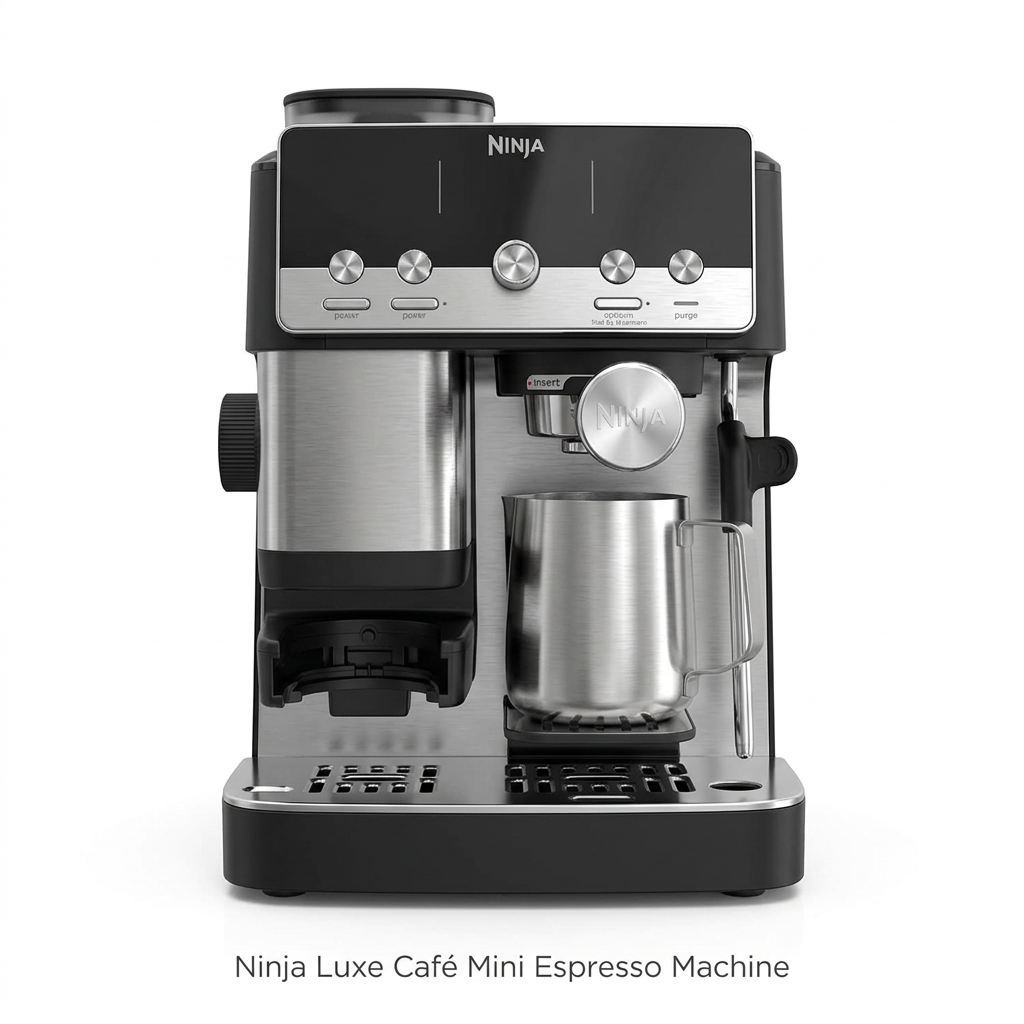
The full package: built-in grinder, scale, single-spout portafilter and manual steam wand.
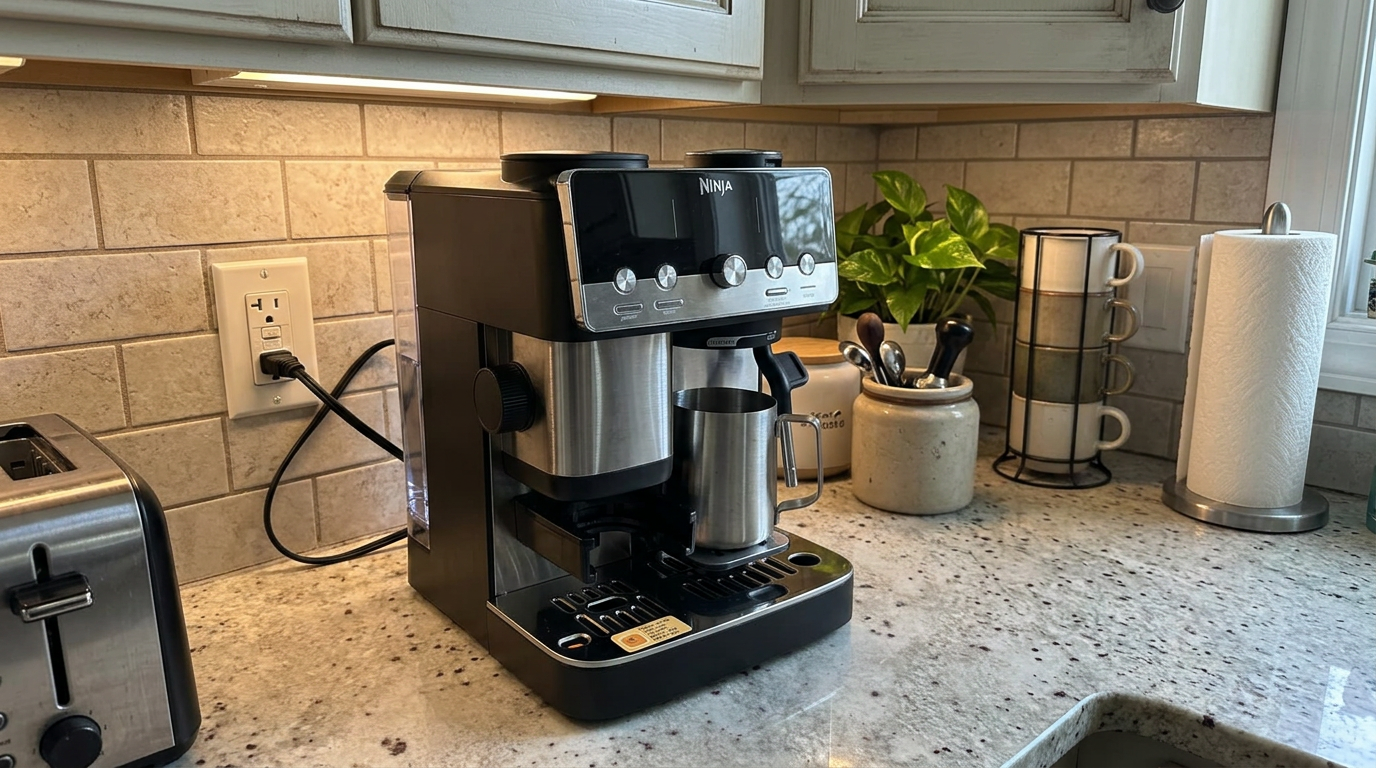
The built-in scale weighs the dose and stops the shot at its target weight.
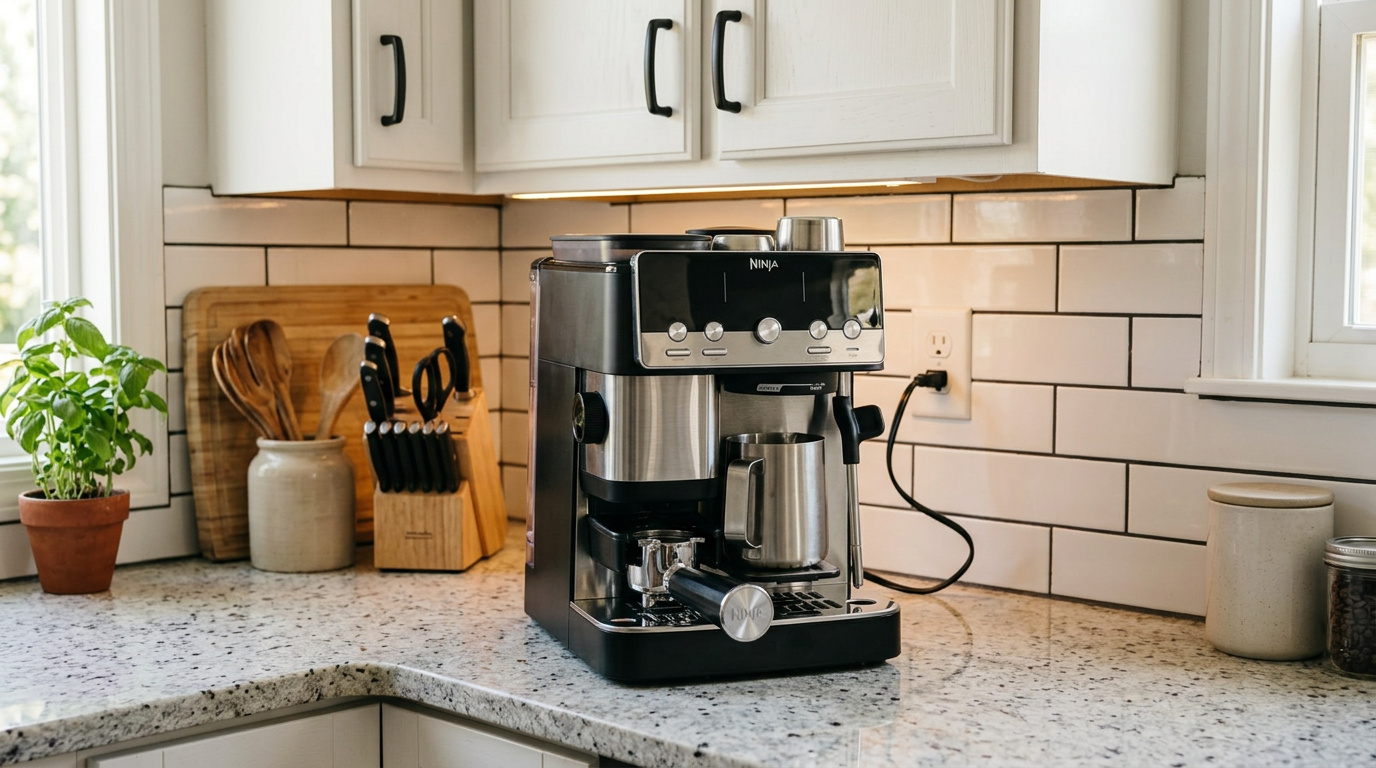
With a 12-ounce pitcher, the manual wand made glossy milk for lattes.
Which one is right for you: is the Ninja Luxe Café Mini your match?
4 quick questionsNinja Luxe Café Mini specifications
From manufacturer data and my own testing.
How I tested and scored the Ninja Luxe Café Mini
For three weeks, the Ninja Luxe Café Mini was our everyday espresso machine for doubles, lattes, flat whites and filter coffee.
I used the recommended grind settings, fine-tuned them, and logged doses and shot weights from the built-in scale.
I tested filter-style brewing, manual steaming with whole, 2% and oat milk, and tracked tank refills.
I tried five kinds of beans and followed the full cleaning routine.
Finally, I checked my notes against Ninja's product information and manual.
- Espresso (8.6): body, flavor and consistency with guided grind and scale.
- Milk drinks (8.0): manual wand power, microfoam and work space.
- Ease of use (8.6): guided grinding, scale, controls and daily routine.
- Cleaning (8.0): puck, wand, drip tray, tank refills and descaling.
The overall score of 8.4 is an editorial rating that reflects those four areas.
Ninja Luxe Café Mini FAQ
What is the difference between the Ninja Luxe Café Mini and Mini Plus?
Both have the same grinder, scale and brew styles. The Mini has a manual steam wand; the Plus adds hands-free automatic frothing with a larger wand.
How many grind settings does it have?
60, with guided recommendations for each drink.
Does it have a built-in scale?
Yes. It weighs the dose and the drink, and stops at a target weight.
How much coffee goes in the double basket?
About 17 to 18 grams.
Can it make drip coffee?
Yes, a drip-style filter coffee with a bloom and pause, in about a minute and twenty seconds.
How big is the water tank?
Small, about 44 ounces. I refilled it daily.
Can I split a shot into two cups?
No. The portafilter has a single spout.
Does it make cold brew?
No. The US Mini has no cold brew or hot-water outlet.
Is the steam wand good?
Yes, with practice it made glossy milk for simple latte art.
Is it loud?
The grinder burst is loud, but brewing and flushing are quieter than earlier Luxe Café machines.
Is it good for beginners?
Yes. Guided grinding and the built-in scale make consistent espresso easy.
How do I make an Americano?
Brew a double into a mug of hot water from the kettle.
Kitchen & coffee tester
Michael spent six years as a line cook in restaurants in Chicago and New York, and he has tested kitchen appliances for HouseholdMe since 2018, from air fryers to coffee makers. He holds an SCA certificate in barista skills and used the Ninja Luxe Café Mini as his everyday coffee machine for three weeks for this review.
- Three weeks of hands-on testing of the Ninja Luxe Café Mini
- Ninja product information and user manual
- General espresso, grinding and milk-steaming guidance