Mr. Coffee 4-Cup Steam vs Mr. Coffee Espresso and Cappuccino
Two Mr. Coffee machines for people who want cappuccinos and lattes at home without spending much. The Mr. Coffee 4-Cup Steam Espresso System is a tiny steam espresso maker with a glass carafe and a frothing arm. The Mr. Coffee Espresso and Cappuccino Machine, sold as the Café Barista, uses a 15-bar pump and froths milk automatically from a fridge-friendly reservoir. I used each one for four weeks to find out which to buy.
We choose products independently. We may earn a commission when you buy through our links. Affiliate policy
Jargon helpNew to espresso? Tap any dotted term to see what it means.
In this comparison
Buy the Mr. Coffee Espresso and Cappuccino Machine if you want push-button lattes and cappuccinos. Its pump makes a stronger espresso base, and its automatic frother pours hot, foamy milk straight into your cup with no skill at all. Buy the Mr. Coffee 4-Cup Steam Espresso System if you want the smallest, simplest way to strong coffee for two, especially sweet Cuban-style shots, and do not mind frothing by hand.
The two machines
Specs checked November 24, 2026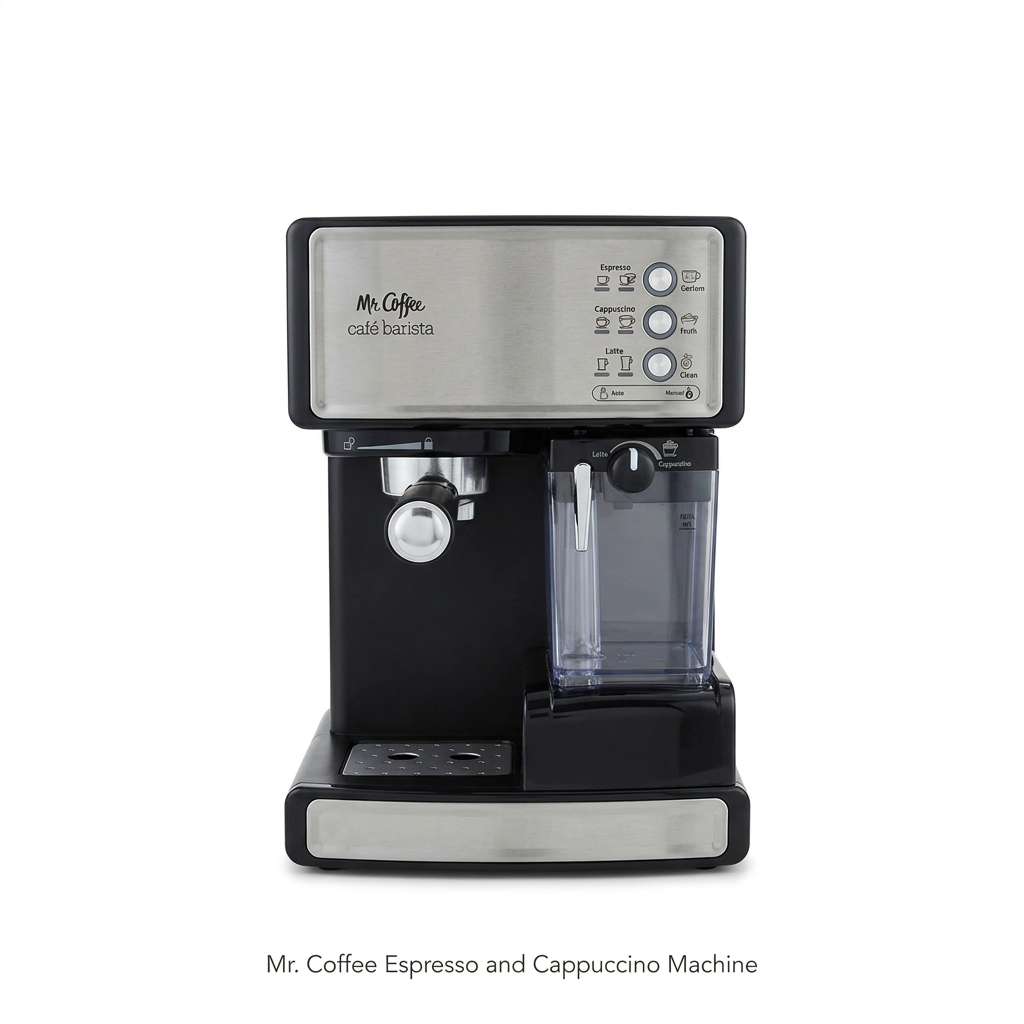
A 15-bar pump, one-touch single, double, cappuccino and latte buttons, and an automatic frother with a removable, fridge-friendly milk reservoir.
Check price on Amazon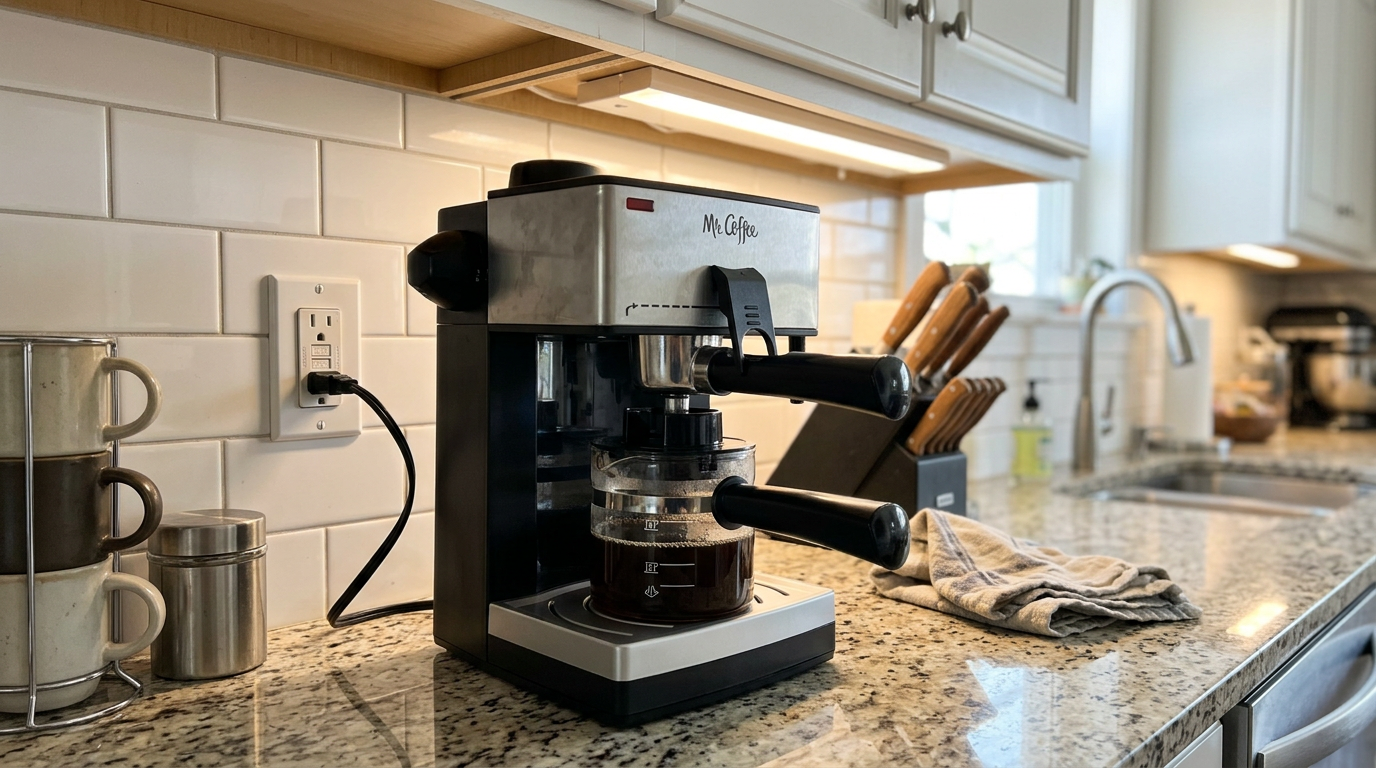
A tiny steam espresso maker that brews two or four shots into a glass carafe, with a frothing arm for cappuccino foam.
See Today’s PriceMr. Coffee 4-Cup vs Café Barista at a glance
- The Café Barista is a pump espresso machine with automatic milk; the 4-Cup is a steam espresso maker with a manual frothing arm.
- The Café Barista made the stronger espresso base and pours milk drinks at one touch, but its foam is airy and it needs a clean cycle after every milk drink.
- The 4-Cup is tiny, simple and great for sweet Cuban-style coffee, but you must release pressure before every refill.
- For daily lattes, the Café Barista; for the smallest budget and space, the 4-Cup.
Head to head
The better result in each row is marked, based on my four weeks with each machine and the manufacturer specs.
The Café Barista wins on coffee and convenience. The 4-Cup wins on size, simplicity of parts and brewing for two at once.
| Spec | Café Barista | 4-Cup Steam |
|---|---|---|
| Coffeemy tasting | Strong, thin body ✓ Best | Bold, moka-style |
| Crema | Pale layer of foam ✓ Best | Very little |
| Milk | Automatic, airy foam ✓ Best | Thick foam by hand |
| One-touch drinks | Cappuccino and latte ✓ Best | No |
| Next drink | Brew again after a clean cycle ✓ Best | Release pressure, refill |
| Drinks per brew | One cup | Two or four shots ✓ Best |
| Width | About 11.2 in | About 8 in ✓ Best |
| Weight | About 10 lb | About 3.5 lb ✓ Best |
| Daily cleaning | Clean cycle after every milk drink | Rinse carafe and arm ✓ Best |
| Hot water | No separate function | No separate function |
| Rows won | 5 | 4 |
The tally is close, but the Café Barista’s wins are the ones that matter most for daily milk drinks.
Is It On Sale? Check NowMr. Coffee 4-Cup vs Café Barista pros and cons
Mr. Coffee Espresso and Cappuccino Machine
- One-touch cappuccinos and lattes
- Removable milk reservoir that goes in the fridge
- No barista skills needed
- Straight espresso is only average
- Foam is airy, not silky microfoam
- Milk system needs cleaning after every use
Mr. Coffee 4-Cup Steam Espresso System
- Tiny footprint and very light
- Bold coffee for two or four shots
- Frothing arm makes thick foam
- Not true espresso, little crema
- Pressure must be released before refilling
- Coffee turns bitter if over-brewed
Who should buy which machine?
- Daily latte and cappuccino drinkers
- Busy households who want push-button drinks
- Anyone who does not want to learn frothing
- Fans of strong, sweet Cuban-style coffee
- The smallest budgets and spaces
- Making two cappuccinos at once
Steam vs pump, explained
This is the key difference between these two Mr. Coffee machines.
The 4-Cup is a steam espresso maker✕Steam espresso makerA machine that heats water in a sealed tank until steam pressure pushes it through the coffee. It brews at a few bar, so it makes strong, moka-style coffee rather than true espresso.. It heats water in a sealed reservoir until steam pressure, about 3 to 4 bar, pushes it through the coffee and into a glass carafe.
The Café Barista uses a 15-bar pump. An electric pump pushes water through the coffee at much higher pressure, which is how espresso is made, and why its shots have a layer of foam on top.
That difference shows in the cup: the Café Barista makes a stronger, more concentrated espresso base, while the 4-Cup makes a bold, moka-style coffee.
Brewing pressure compared
Approximate pressure at the coffee.
My guide to espresso pressure explains why about 9 bar matters.
Our tip: If you want espresso with crema, choose a pump machine; a steam maker cannot produce it, whatever you do.
Neither is a precision espresso machine. Both are built to make strong coffee for milk drinks easily, and judged that way, both do the job.
If you mostly drink lattes, the Café Barista’s pump shot gives the milk more coffee flavor. If you like strong, sweet coffee black or with a splash of milk, the 4-Cup’s brew suits that style.
Design, size and build
The 4-Cup is about 8 inches wide and weighs only about 3.5 pounds, smaller than the coffee canister beside it. It is black plastic with a stainless front, a screw cap on top, one knob, a frothing arm and a glass carafe.
The Café Barista is about 11.2 by 8.9 inches and 12.6 inches tall, at about 10 pounds. It is wider than most compact espresso machines because its clear milk reservoir clips onto the side.
The Café Barista has a cup-warming area on top and an adjustable cup tray for taller cups.
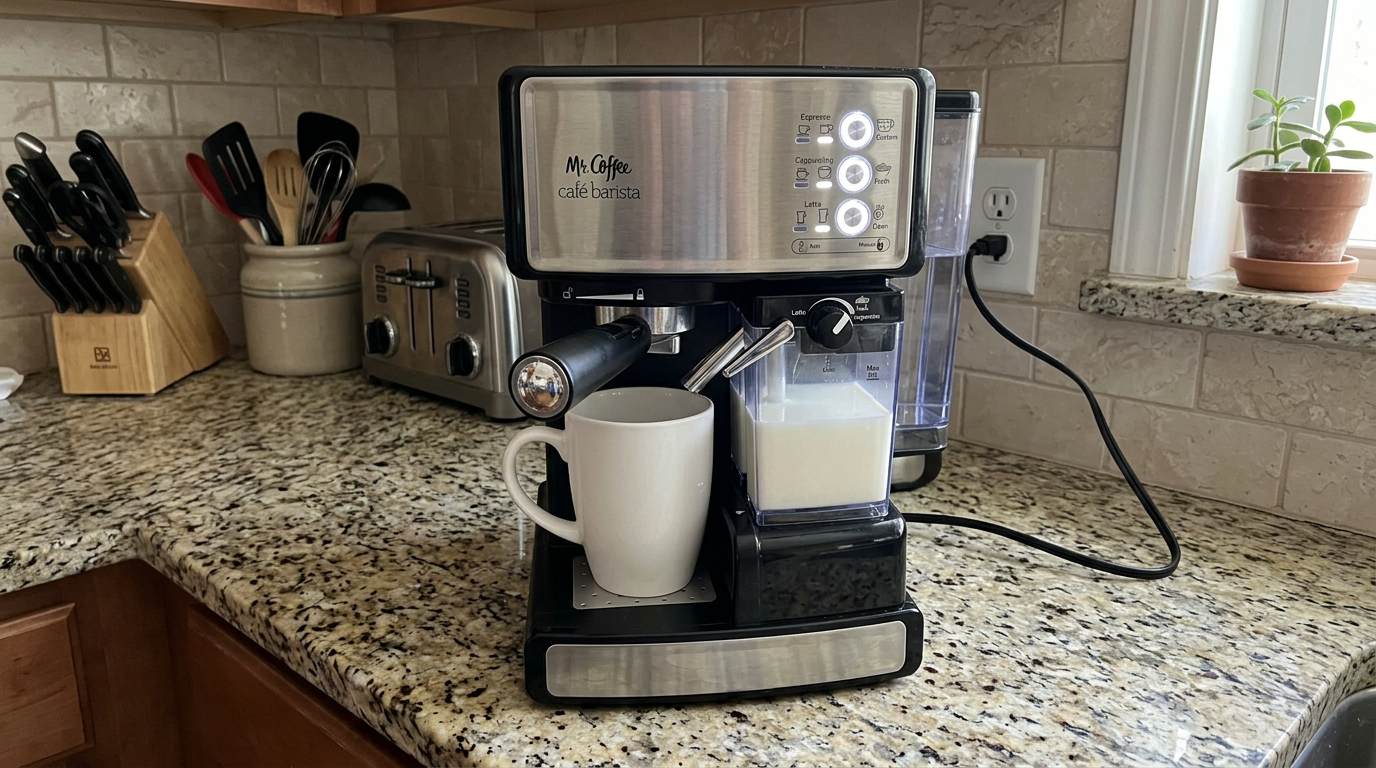
The Café Barista’s milk reservoir clips onto the side and can go in the fridge.
Both are light enough to lift with one hand. The 4-Cup is small enough to keep in a cupboard and bring out only when needed.
The Café Barista’s water reservoir is removable and fills at the sink or in place. The 4-Cup has no separate tank; it fills through its cap with water measured in the carafe.
Setup and first drinks
Both took about five to ten minutes. On the Café Barista, there is a red plug at the base of the water reservoir that must come out before first use. The cappuccino and latte buttons only light up when the milk reservoir is pushed in firmly.
On the 4-Cup, I brewed a carafe of plain water first to rinse it, and learned that the portafilter tips over on a flat counter, so I rested it in a bowl.
My first Café Barista cappuccino brewed a shot, paused and poured hot, foamy milk on top. My first 4-Cup brew was bold and dark, and the frothing arm made thick foam.
| Setup step | Café Barista | 4-Cup |
|---|---|---|
| Watch out for | Red plug under the water reservoir | Portafilter tips over |
| First rinse | Water through group and frother | Plain water brew |
| First milk drink | One touch | Froth by hand |
| Time | About 10 min | About 5 min |
Our tip: If the Café Barista’s cappuccino and latte buttons will not light, push the milk reservoir in harder until it clicks.
Both are simple to learn. The Café Barista’s buttons explain themselves; the 4-Cup needs you to learn the pressure-release routine before your first refill.
How brewing works on each
On the Café Barista, you scoop pre-ground espresso into the filter, press it lightly with the scoop’s tamping end, lock in the portafilter and press single, double, cappuccino or latte. A level double scoop worked best.
On the 4-Cup, you measure water with the carafe, about 4 fluid ounces for two shots or 8 for four, pour it into the reservoir and screw the cap on tight. Then fill the basket, lock in the portafilter and turn the knob.
| Step | Café Barista | 4-Cup |
|---|---|---|
| Water | From the reservoir | Measured with the carafe each time |
| Coffee | Level double scoop | Scoop, fine espresso grind |
| Brew | Press a button | Turn the knob, wait |
| Output | One cup | Two or four shots in a carafe |
On both, a fine espresso grind gave the strongest results. Drip-grind coffee made weak, watery drinks on the 4-Cup and pale, thin shots on the Café Barista.
Neither machine has a separate hot water function in my testing, so for an Americano or tea, I used a kettle alongside.
The 4-Cup’s glass carafe
The 4-Cup’s carafe doubles as the water measuring cup and the serving jug. Its markings show exactly how much you brewed, and four shots split neatly into two cappuccinos.
Because the machine only brews the water you put in, the strength is always what you planned. Two shots tasted smoother than four, because the longer brew pushed more hot, steamy water through the coffee at the end.
| Brew | Water | Best use |
|---|---|---|
| Two shots | About 4 fl oz | One cappuccino or two small cafecitos |
| Four shots | About 8 fl oz | Two lattes or cappuccinos |
Our tip: Brew two shots rather than four when you can; the 4-Cup’s coffee tasted smoother and less bitter.
The Café Barista has no carafe. It brews straight into your cup, one drink at a time, with an adjustable cup tray for taller cups.
Coffee quality
The Café Barista’s double shots were dark and strong, with a pale layer of foam, but thin in body and a little bitter on the finish. As a base for milk, they worked well.
The 4-Cup brewed a bold, dark, Cuban-style coffee with very little crema. Under milk and sugar, its roasty character worked well too.
In milk drinks, I preferred the Café Barista: the pump shot was more concentrated and held up better under foam. Straight, neither was great.
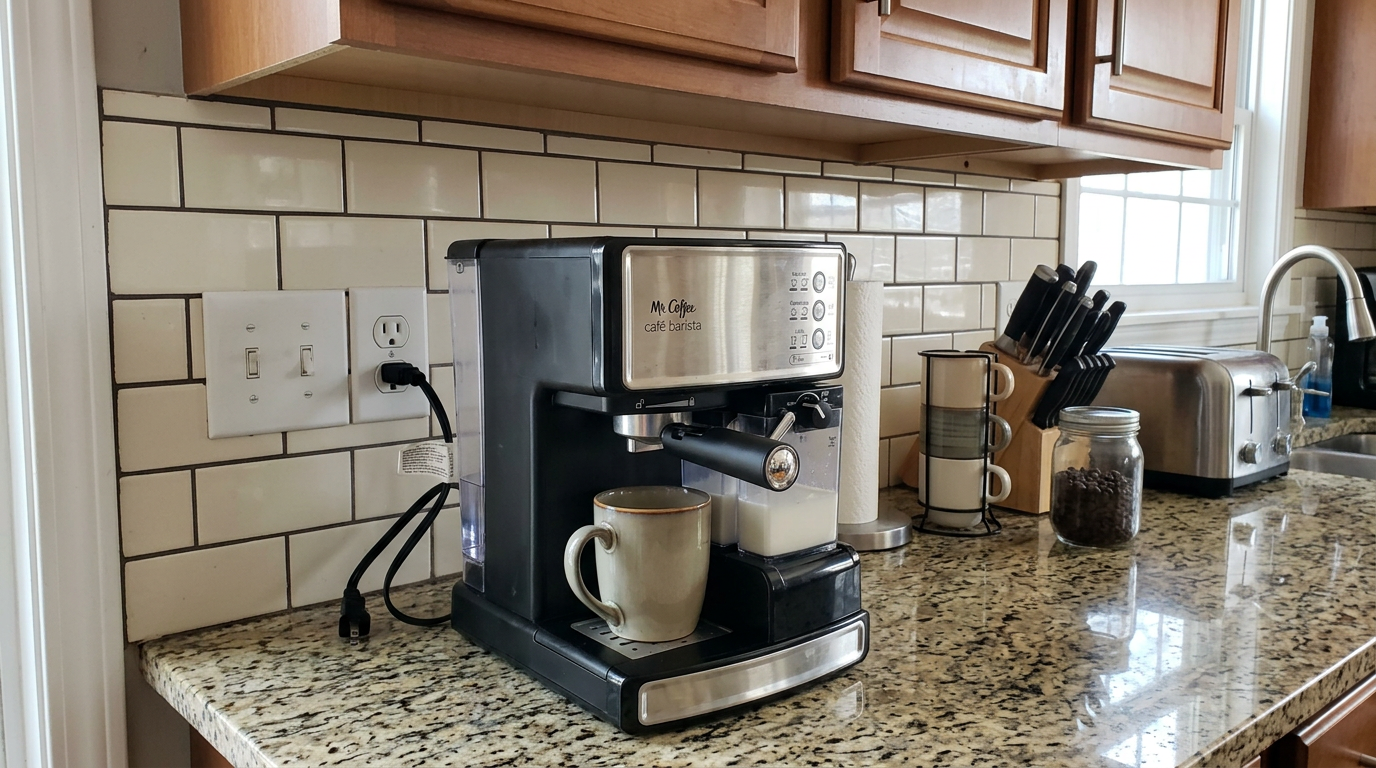
A Café Barista double: strong, but best under milk.
My coffee ratings
Ratings out of 10 from my single reviews.
| What you taste | Likely cause | Fix |
|---|---|---|
| Watery, pale | Filter-grind coffee | Espresso grind |
| Bitter 4-Cup carafe | Brew ran too long | Stop as the flow sputters |
| Café Barista shot drips slowly | Tamped too hard | A light press is enough |
| Weak latte | Mild coffee | Use a double shot or darker roast |
Pressing too hard on the Café Barista’s coffee slowed the shot to a drip. A light press to level the coffee was enough on both.
Dose and tamp
Prep is minimal on both, which is the point.
On the Café Barista, a level double scoop of pre-ground espresso filled the double filter well. Overfilling made the portafilter hard to lock in. A light press with the scoop’s tamping end was enough.
On the 4-Cup, I filled the basket with fine espresso grounds and packed them lightly with the scoop. Packing hard slowed the brew and made it bitter.
| Prep | Café Barista | 4-Cup |
|---|---|---|
| Coffee | Level double scoop | Scoop, to the basket rim |
| Grind | Espresso | Fine espresso |
| Tamp | Light press | Light press |
| Lock in | Firm twist | Line up, then twist |
On the 4-Cup, I also wiped the basket rim before locking in, which helped the portafilter seal and stopped drips around the edge.
Speed
The Café Barista made a cappuccino in a couple of minutes from switching on, with no frothing work.
The 4-Cup took about two minutes from cold before coffee flowed, then I frothed milk straight after.
The bigger difference came with the second round. The Café Barista just needs its clean cycle and a new dose. The 4-Cup needs the pressure released, a short cool-down and a refill.
Time to two cappuccinos
My timings. The 4-Cup makes two drinks from one carafe, but a second round needs a pressure release.
If you make one drink at a time, the Café Barista is the quicker machine day to day. If you always make two at once, the 4-Cup’s carafe evens it out.
The Café Barista warms cups on its top while it heats, which helped my cappuccinos stay hot for longer. On the 4-Cup, I warmed cups with hot water from the kettle.
Milk and foam
This is the main reason to choose between them.
The Café Barista has no steam wand. Its automatic frother draws milk from the reservoir, heats and foams it, and pours it into the cup. A froth control gives more or less foam. The result was hot, sweet and comforting, like a chain-café cappuccino, but airy rather than silky.
The 4-Cup’s frothing arm, with its removable frothing aid, made thick foam easily by hand. It was surprisingly good for such a small machine. There is only as much steam as there is water left in the reservoir, so I frothed straight after brewing.
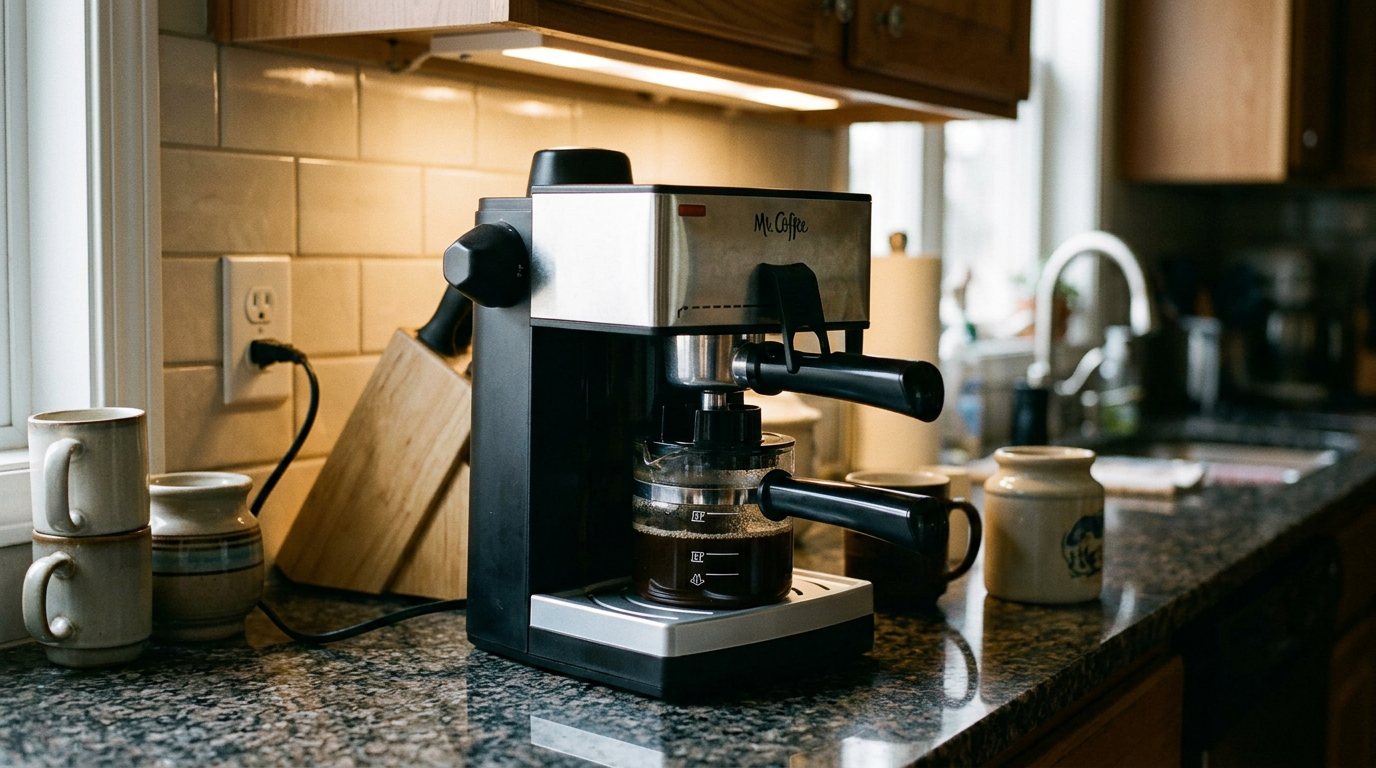
The 4-Cup’s frothing arm made thicker foam than I expected.
Milk ratings
My single-review milk scores out of 10.
| Milk feature | Café Barista | 4-Cup |
|---|---|---|
| Method | Automatic frother, reservoir | Frothing arm, by hand |
| Skill needed | None | A little |
| Texture | Airy foam | Thick foam |
| Latte art | No | No |
| Leftover milk | Reservoir goes in the fridge | Use it up |
Our tip: On the Café Barista, set the froth control to less foam for lattes; the milk is creamier and less bubbly.
See How Much You’ll SaveWith barista oat milk, both made acceptable foam; regular almond drink barely foamed on either. Whole milk gave the best results on both.
The milk reservoir up close
The Café Barista’s clear milk reservoir clips onto the side and is the heart of the machine. You fill it with cold milk, push it in until it clicks, and the cappuccino and latte buttons light up.
Between uses, the whole reservoir goes in the fridge with its lid on, which meant leftover milk was never wasted. That was a bigger convenience than I expected on busy mornings.
The froth control changes how much air goes into the milk. Less foam gave a creamier latte; more foam gave a taller cappuccino cap.
| Setting | Result | Best for |
|---|---|---|
| Less foam | Creamier, fewer bubbles | Lattes |
| More foam | Tall, airy cap | Cappuccinos |
| Cold milk from the fridge | Better foam | Both |
Our tip: Fill the Café Barista’s milk reservoir straight from the fridge; cold milk gave noticeably better foam than milk left on the counter.
The catch is cleaning. After every milk drink, the clean cycle flushes the milk path, and the reservoir and lid need a rinse. It takes a couple of minutes, and it is the price of push-button milk.
Pressure release and safety on the 4-Cup
Because the 4-Cup builds steam pressure in a sealed reservoir, you must never open its water cap while it is hot. Before every refill, you release the pressure.
My routine was: switch off, unplug, hold a cup of water under the frothing arm, turn to steam and let it escape, wait for the hissing to stop, return the knob to off, and only then open the cap.
The Café Barista has none of this. Its water reservoir can be filled at the sink or in place at any time.
If that routine sounds like a hassle, it is the single best reason to choose the Café Barista instead.
Cuban coffee and sweet drinks
This is where the 4-Cup shone. Its bold brew suits Cuban coffee✕Cuban coffee (cafecito)Strong coffee sweetened by whipping the first drops with sugar into a pale foam, then stirring in the rest of the brew.: I whipped the first drops with sugar into a pale foam, then stirred in the rest of the carafe.
The Café Barista made a good sweet latte or mocha, one cup at a time, but it is not built for a carafe of cafecito to share.
| Sweet drink | Café Barista | 4-Cup |
|---|---|---|
| Cuban cafecito | One shot at a time | Its best use |
| Sweetened latte | Very good | Good |
| Mocha | Very good | Good |
| Iced latte | Shot over ice, cold milk | Carafe over ice |
For a sweet iced coffee, brew either machine’s coffee over ice and stir in sugar while it is still warm; it dissolves far better than in cold coffee.
Cleaning and upkeep
The Café Barista’s milk system needs its clean cycle after every milk drink, then a rinse of the reservoir and lid. It is quick, but it is not optional; skipping it leads to dried milk in the lines.
The 4-Cup is simpler: rinse the carafe, basket and frothing aid, empty the drip tray, and descale regularly.
| When | Café Barista | 4-Cup |
|---|---|---|
| After milk | Run the clean cycle | Wipe and purge the arm |
| Daily | Rinse reservoir, lid and filter | Rinse carafe and basket |
| Every few days | Wash the milk parts | Wash the frothing aid |
| Regularly | Descale | Descale |
My daily hands-on cleaning time
My estimates, not counting descaling.
Descale both regularly, more often with hard water. On the 4-Cup, scale in the reservoir slows the brew and weakens the steam.
On the 4-Cup, I also wiped the gasket around the portafilter after each brew, so the next one sealed cleanly.
Noise
The Café Barista’s pump buzzes briefly during each shot, and its frother hums. The 4-Cup gurgles and hisses while brewing and hisses loudly during pressure release.
Neither is loud enough to bother anyone in the next room. The Café Barista’s frother hum lasts the length of the milk pour.
Beans, water and long-term care
Both want espresso-grind coffee. Medium-dark and dark roasts worked best on both, especially with milk and sugar.
I used cold, filtered water on both. On the 4-Cup, I measured water with the carafe markings every time, because the amount sets the strength of the whole brew.
| Bean type | Café Barista | 4-Cup |
|---|---|---|
| Medium-dark espresso blend | Strong, good in milk | Bold, best in milk |
| Dark roast | Good in milk | Cuban-style favorite |
| Light roast | Thin | Sour, avoid |
| Pre-ground espresso | Its intended use | Its intended use |
My guide to water chemistry for coffee explains why filtered water helps.
Our tip: Keep the Café Barista’s milk reservoir in the fridge between uses; cold milk froths better and stays fresh.
Store beans or ground coffee in an airtight container away from light. Pre-ground coffee from an open bag tasted dull within about two weeks on both.
On both, I emptied and rinsed the water every day or two so it never sat stale in the machine.
Serving guests
For two, the 4-Cup was handy: one four-shot carafe split into two cappuccinos.
For four, the Café Barista was quicker: one touch per drink, with a clean cycle every so often. The 4-Cup needed a pressure release and refill between carafes.
Four cappuccinos, start to finish
Including clean cycles and the 4-Cup’s pressure release.
With guests, the Café Barista’s one-touch buttons meant anyone could make their own drink, which took pressure off the host.
Build quality and long-term ownership
The Café Barista feels more solid, with a stainless front and a sturdy milk reservoir. The 4-Cup is light plastic, but nothing rattled or flexed in four weeks, and its glass carafe felt sturdy.
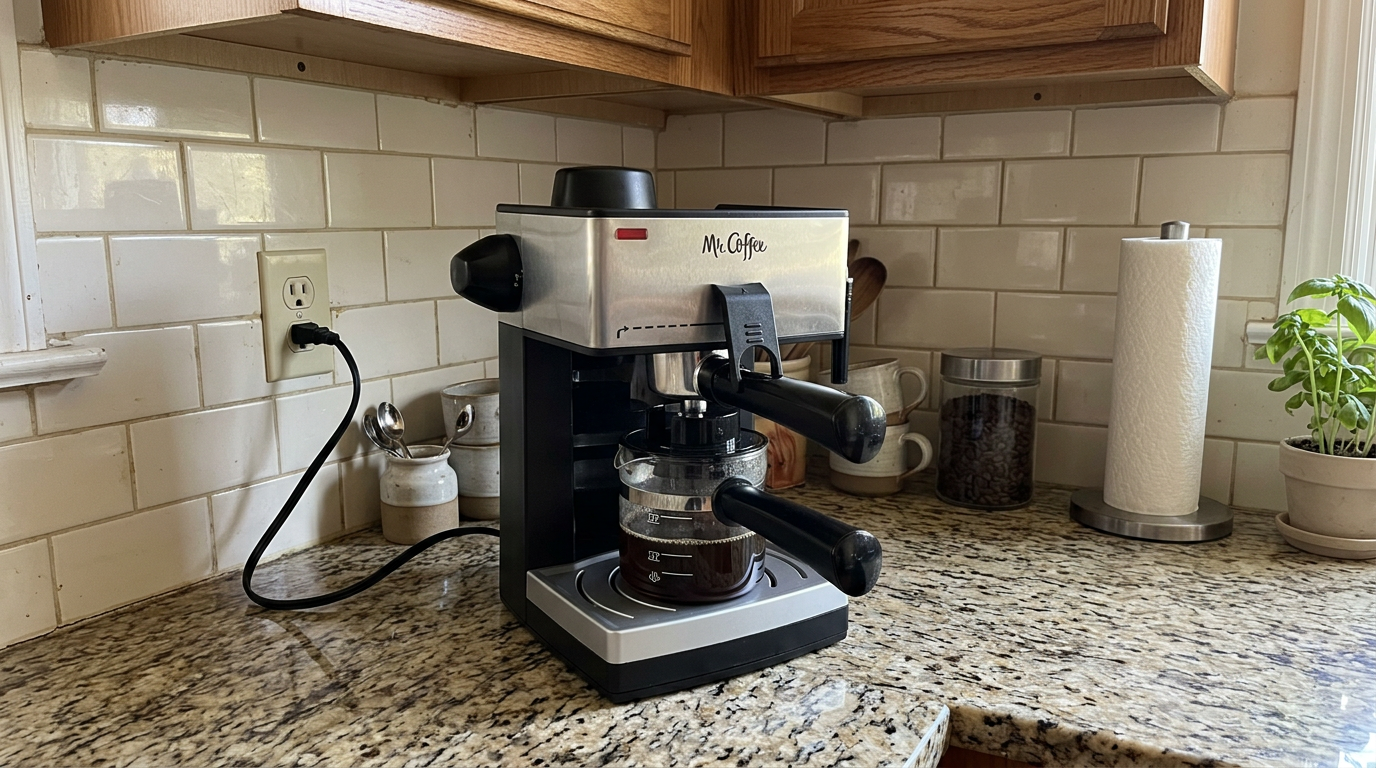
The 4-Cup is small enough to put away in a cupboard.
On both, the parts most likely to wear are rubber seals and the milk parts, which are cheap and easy to replace.
Mistakes to avoid
Skipping the Café Barista’s clean cycle. Milk dries in the lines quickly.
Missing the Café Barista’s red plug. Water cannot flow until it is out.
Opening the 4-Cup’s cap too soon. Always release the pressure first.
Letting the 4-Cup’s brew run to the end. The last of it turned the carafe bitter.
| Problem | Fix |
|---|---|
| Milk buttons dark on the Café Barista | Push the reservoir in until it clicks |
| Watery coffee | Use espresso grind |
| Bitter 4-Cup carafe | Stop as the flow sputters |
| Café Barista shot too slow | Tamp lighter |
Packing the coffee hard. On both machines, a hard tamp slowed the brew and made it bitter; a light press is all you need.
A typical morning on each
My weekday routine was two cappuccinos.
On the Café Barista, I dosed, pressed cappuccino, ran the clean cycle, dosed again and pressed cappuccino. Both drinks took about five minutes, with no frothing skill.
On the 4-Cup, I brewed a four-shot carafe, frothed one jug straight after and split both between two cups. It took about four and a half minutes.
| Step | Café Barista | 4-Cup |
|---|---|---|
| Water | Already in the reservoir | Measure with the carafe |
| Coffee | Level double scoop | Scoop, fine grind |
| Milk | Automatic, into the cup | Froth by hand |
| Cleanup | Clean cycle | Rinse carafe and arm |
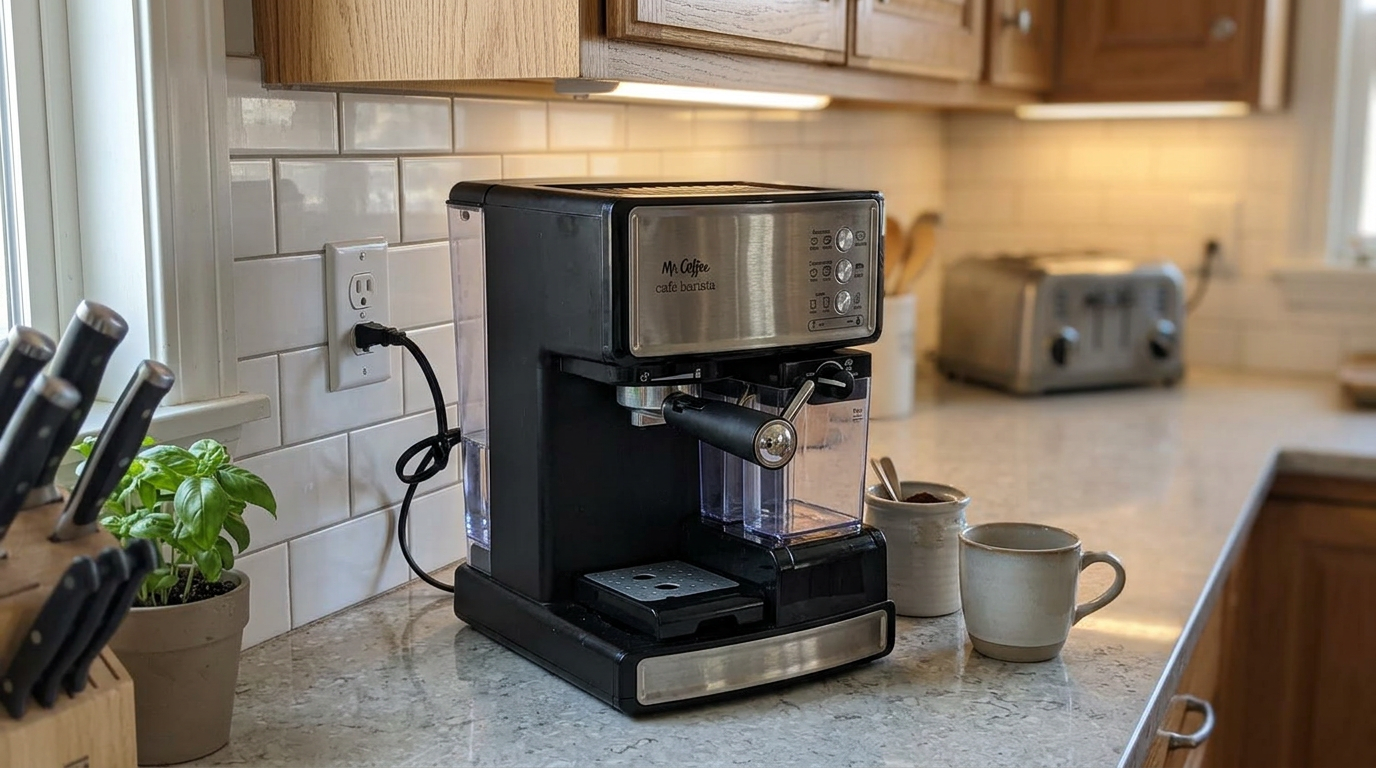
A weekday cappuccino round on the Café Barista.
On weekends, I often used the 4-Cup for a carafe of strong coffee for two and the Café Barista for a single latte later in the day.
The drinks I made most
The Café Barista was at its best with its one-touch drinks; the 4-Cup with strong, sweet coffee and cappuccinos for two.
| Drink | Café Barista | 4-Cup |
|---|---|---|
| Cappuccino | One touch | Froth by hand |
| Latte | One touch, less foam | Froth by hand |
| Espresso | Strong, a bit thin | Strong, little crema |
| Cuban coffee | One shot at a time | Its best use |
| Iced latte | Shot over ice | Carafe over ice |
If you are new to these drinks, my guide to cappuccino vs latte vs flat white explains the differences.
For a mocha on either machine, stir a spoon of cocoa and sugar into the coffee before adding milk; it dissolves evenly and tastes richer.
Which makes the better first machine?
For most people who want café-style milk drinks, the Café Barista. It is push-button simple and makes the better base for lattes.
For the smallest budget and space, or a love of sweet Cuban-style coffee, the 4-Cup.
| Coming from | Better pick | Why |
|---|---|---|
| Pods, lattes daily | Café Barista | One-touch milk |
| Moka pot | 4-Cup | Similar strength, adds foam |
| Tiny kitchen or dorm | 4-Cup | Small and light |
| Busy household | Café Barista | No skill needed |
Our tip: Decide first whether you want to froth by hand; if not, the Café Barista settles it.
Both are forgiving enough that you will make a good milk drink on the first morning, which is what most buyers of these machines want.
Small extras worth having
For the 4-Cup, a small milk pitcher for frothing, a bowl to rest the portafilter in and a cup kept by the machine for pressure release made the routine smoother.
For the Café Barista, a spare milk reservoir lid and a small brush for the milk parts were useful.
| Extra | Café Barista | 4-Cup |
|---|---|---|
| Milk pitcher | Not needed | Very useful |
| Cup for pressure release | Not needed | Essential habit |
| Small brush | For milk parts | For the frothing aid |
| Espresso-grind coffee | Essential | Essential |
Still torn between the two?
Ask whether you want to push a button or froth by hand. For push-button lattes, the Café Barista is the clear choice.
If you want the smallest machine, coffee for two in one go and strong sweet cafecito, the 4-Cup does that well.
For either machine, a small kitchen scale is optional, but it helped me keep the dose consistent while I was learning.
Four weeks with each: my diary notes
These are the notes I kept as each machine settled into my routine.
Mr. Coffee Café Barista
Week 1: Removed the red plug. First cappuccino at one touch.
Week 2: Set the froth control lower for lattes. Clean cycle became routine.
Week 3: Milk reservoir in the fridge between uses.
Week 4: Double shots under milk; straight espresso still thin.
Mr. Coffee 4-Cup Steam
Week 1: Bold coffee, thick foam. Rested the portafilter in a bowl.
Week 2: Pressure release became a habit.
Week 3: Cuban-style cafecito became a favorite.
Week 4: Stopping the brew early made the carafe smoother.
By the end of the month, the Café Barista was the one my household reached for on weekdays, and the 4-Cup the one I used for a slow weekend cafecito.
Real-life scenarios
These are the situations where one machine clearly fit better in my four weeks.
Automatic frother.
One carafe, two cups.
Bold brew in a carafe.
Reservoir goes in the fridge.
About 3.5 pounds.
No pressure release.
Both suit one- or two-person homes best. In a busier home, the Café Barista’s one-touch drinks are the bigger help.
My scorecard
These are my scores out of 10 from my single reviews and four weeks of side-by-side use.
Mr. Coffee Café Barista
Mr. Coffee 4-Cup Steam
Overall, I rate the Café Barista 7.1 and the 4-Cup 6.6.
Find Out the Price TodayThe Café Barista’s big lead in ease of use is the reason it wins overall; the 4-Cup’s compact design is its strongest score.
Which one is right for you?
4 quick questionsWhich one should you buy?
For most people, the Mr. Coffee Espresso and Cappuccino Machine. It makes milk drinks at one touch with a stronger espresso base.
For tiny budgets and spaces, the Mr. Coffee 4-Cup. For the full detail, read my Café Barista review and 4-Cup review, or my BELLA vs Mr. Coffee vs Dedica comparison.
- You want one-touch milk drinks
- You make one drink at a time
- You want milk in the fridge, ready
- You drink straight espresso
- You hate daily cleaning
- You want latte art
- You want the smallest machine
- You make two drinks at once
- You love Cuban-style coffee
- You want crema
- You hate the pressure-release routine
My pick for most people is the Mr. Coffee Espresso and Cappuccino Machine. Its pump makes a stronger base, and its automatic frother turns cappuccinos and lattes into a one-touch job.
The Mr. Coffee 4-Cup Steam Espresso System is the better choice for the smallest budget and space, and for sweet Cuban-style coffee for two.
Whichever you choose, use espresso-grind coffee and clean the milk parts after every drink.
Mr. Coffee 4-Cup vs Café Barista specifications
From manufacturer specifications and my own testing.
| Café Barista | 4-Cup Steam | |
|---|---|---|
| Type | Pump espresso machine, automatic milk | Steam espresso maker |
| Pressure | 15-bar pump | Steam, about 3 to 4 bar |
| Drink buttons | Single, double, cappuccino, latte | One knob |
| Milk | Automatic frother, removable reservoir | Frothing arm |
| Output | One cup | Two or four shots, glass carafe |
| Dimensions | About 11.2 x 8.9 x 12.6 in | About 8 in wide |
| Weight | About 10 lb | About 3.5 lb |
How I tested and compared them
Michael Reynolds here. I used each machine as my everyday coffee maker for four weeks, with the same pre-ground espresso, and kept detailed notes throughout.
I made every one-touch drink on the Café Barista, ran its clean cycle after each milk drink, brewed two and four shots on the 4-Cup and followed its pressure-release routine every time.
I frothed whole, 2%, barista oat and almond milk on both and ran side-by-side tastings.
- Espresso: body, crema, flavor and consistency.
- Milk: foam texture and learning curve.
- Workflow: heat-up, prep and daily routine.
- Ownership: cleaning, noise, water and footprint.
Mr. Coffee 4-Cup vs Café Barista FAQ
What is the difference between the Mr. Coffee 4-Cup and the Espresso and Cappuccino Machine?
The 4-Cup is a steam espresso maker that brews two or four shots into a glass carafe, with a manual frothing arm. The Espresso and Cappuccino Machine, sold as the Café Barista, uses a 15-bar pump and has one-touch cappuccino and latte buttons with an automatic frother.
Which makes better coffee?
The Café Barista, for milk drinks. Straight, neither is great.
Which is easier?
The Café Barista. Its milk drinks are one touch.
Can I keep milk in the Café Barista?
Yes. The milk reservoir can go in the fridge between uses.
How do I refill the 4-Cup safely?
Switch off, unplug, release the steam through the arm into a cup of water, wait for the hissing to stop, return the knob to off, then open the cap.
Which is better for Cuban coffee?
The 4-Cup.
Does either make latte art?
No. Both make airy or thick foam rather than silky microfoam.
Which is smaller?
The 4-Cup, at about 8 inches wide and 3.5 pounds.
How do I clean the Café Barista’s milk system?
Run the clean cycle after every milk drink, then rinse the reservoir and lid.
What grind should I use?
Espresso-grind coffee for both.

- Our hands-on Mr. Coffee Café Barista review
- Our hands-on Mr. Coffee 4-Cup review
- Manufacturer manuals and product information
- General coffee brewing and milk frothing guidance