Gevi ECMI0 review: a built-in grinder, a 58mm portafilter and real espresso for beginners
The Gevi 20 Bar Espresso Machine ECMI0-SS0A1 combines a 30-setting burr grinder, a 58mm portafilter, four baskets and a steam wand in one machine. It makes surprisingly good espresso once you weigh your beans, but the grinder dose drifts and there's no temperature control.

Michael Reynolds
Hands-on review
Hands-on testing, research, specs
4 weeks
24 minutes
Jargon helpNew to espresso? Tap any dotted term to see what it means.
In this review
Yes, if you want to learn real espresso without buying a separate grinder. The Gevi ECMI0 puts a conical burr grinder with 30 settings, a 58mm portafilter, four baskets, automatic pre-infusion and a three-way solenoid valve into one beginner-friendly machine. Once I weighed my beans and switched to the single-wall basket, it made thick, chocolatey espresso and silky lattes. The grinder dose changes with the grind setting, there's no temperature control, pressure gauge or shot timer, and the single heater means you brew first and steam second.
Gevi ECMI0 at a glance
Gevi ECMI0 pros and cons
- Built-in burr grinder with 30 settings
- 58mm portafilter and four baskets included
- Solenoid valve leaves clean, dry pucks
- Grinder dose changes with the grind setting
- No temperature control, gauge or shot timer
- One heater, so brew first and steam second
Who should buy the Gevi ECMI0?
- First-time home baristas
- Small kitchens that want one appliance
- Latte drinkers happy to steam by hand
- Light-roast fans who need temperature control
- Anyone who wants one-touch coffee
- Busy households making many milk drinks
First impressions of the Gevi ECMI0
Starting with espresso at home usually means buying two machines.
An espresso maker, and a grinder good enough to feed it.
The Gevi 20 Bar Espresso Machine ECMI0-SS0A1 tries to solve that in one box.
It has a conical burr grinder on top, a 58mm portafilter at the front and a steam wand on the side.
Unboxing it, Michael and I were surprised by how much comes with it.
Four filter baskets, a stainless steel milk pitcher, a tamper, a cleaning brush and a needle.
There's even a small storage drawer at the back for the spare basket and cleaning tools.
The machine has some weight to it and doesn't feel flimsy, even though parts of the side panels and cup tray are black plastic.
It's a practical, no-nonsense design rather than a showpiece.
The control panel is refreshingly simple, with three buttons and a small display.
On the right is one knob: turn it left for hot water, right for steam.
My first shot, ground on the default setting, ran far too fast.
My fourth, after two grind changes and a scale, had thick crema and a proper syrupy texture.
That's the story of this machine in a nutshell: it can make genuinely good espresso, but you need to set it up properly first.
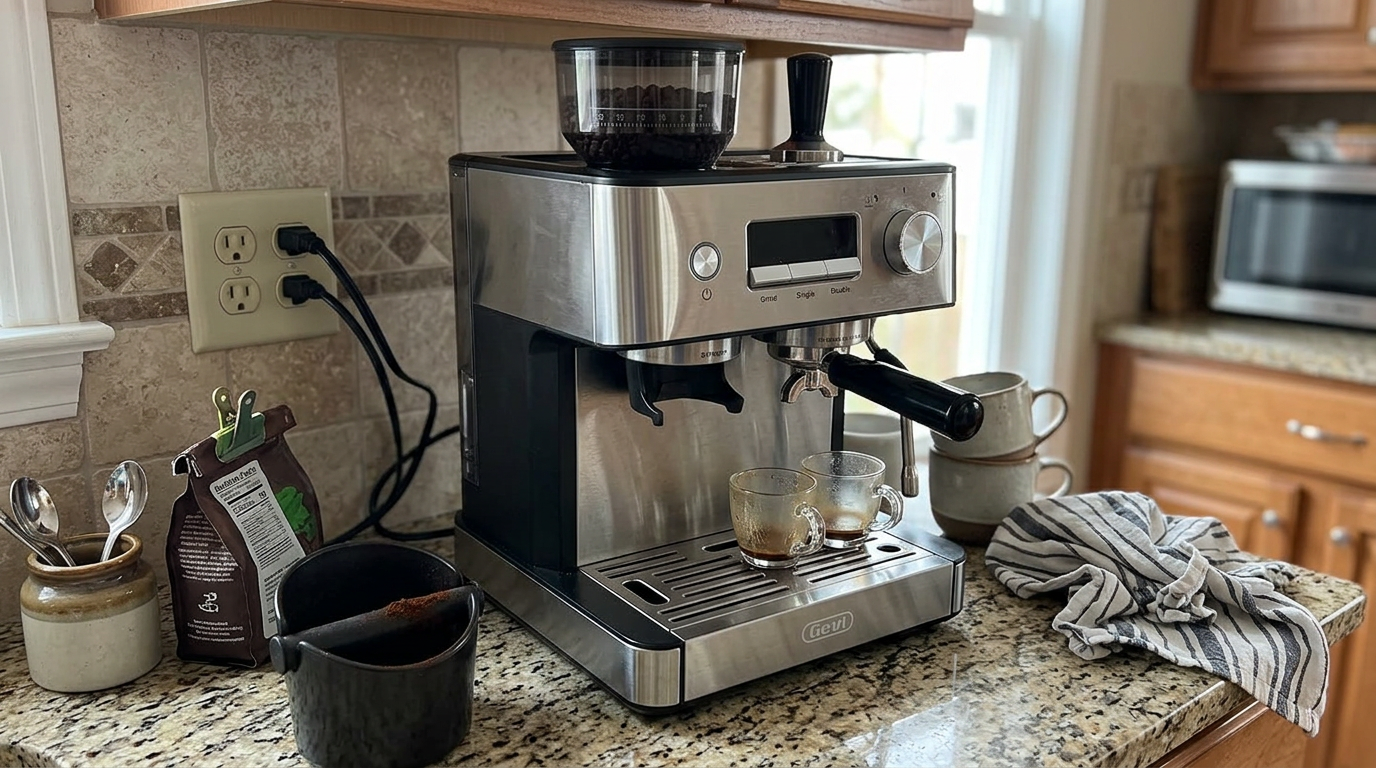
The ECMI0 puts a grinder, an espresso machine and a steam wand in one footprint.
What the Gevi ECMI0 actually is
The ECMI0 is a semi-automatic espresso machine with a built-in grinder.
The grinder fills the portafilter, you tamp and lock it in, and the machine brews.
Then you steam milk by hand with the wand.
Inside, a single thermoblock✕ThermoblockA compact heater that warms water as it flows through, instead of keeping a whole boiler hot. It heats up fast and uses less standby energy. handles both brewing and steaming.
It's rated at 20 bar, but what matters for espresso is the pressure at the coffee, and the machine starts every shot with a gentle pre-infusion✕Pre-infusionA short, gentle soak of the coffee before full pressure. It lets the puck swell evenly so water doesn't rush through weak spots..
There's also a three-way solenoid valve✕Three-way solenoid valveA valve that opens when the shot ends and releases the leftover pressure and water above the coffee into the drip tray. It leaves a drier puck and makes the portafilter safer to remove., which is rare at this level.
It releases pressure when the shot ends, so the puck comes out dry and you can remove the portafilter straight away.
Gevi ECMI0 design and setup
The Gevi ECMI0 is built around everyday use rather than looks.
The bean hopper sits on top and twists into place over the grinder.
It has an anti-popcorn lid, which stops beans bouncing around while the burrs work, so they feed in more evenly.
Below the grinder there's a cradle that holds the portafilter, so you can grind hands-free straight into the basket.
The drip tray is large, which I appreciated.
It needed emptying less often than on many small machines, even with the solenoid valve sending water into it after every shot.
The water reservoir is also generous, so refills weren't a daily chore for two of us.
What comes in the box
| Item | What it is | My verdict |
|---|---|---|
| Portafilter | 58mm, three-ear, with spouts | Solid and comfortable |
| Pressurized baskets | Single and double, dual-wall | Forgiving, good for learning |
| Non-pressurized baskets | Single and double, single-wall | Best flavor with fresh grounds |
| Tamper | Plastic | Works, but an upgrade is worth it |
| Milk pitcher | Stainless steel | Right size for one or two drinks |
| Cleaning tools | Brush and needle | Handy for the grinder and steam tip |
First-time setup
Setup took about twenty minutes, including washing the parts and flushing water through the group and steam wand.
Twist the hopper into place, fill the reservoir and switch on.
The machine takes about 90 seconds to warm up, which is quick enough that I never felt I was waiting.
Our tip: Run two or three blank shots through the group on day one to flush out any manufacturing taste.
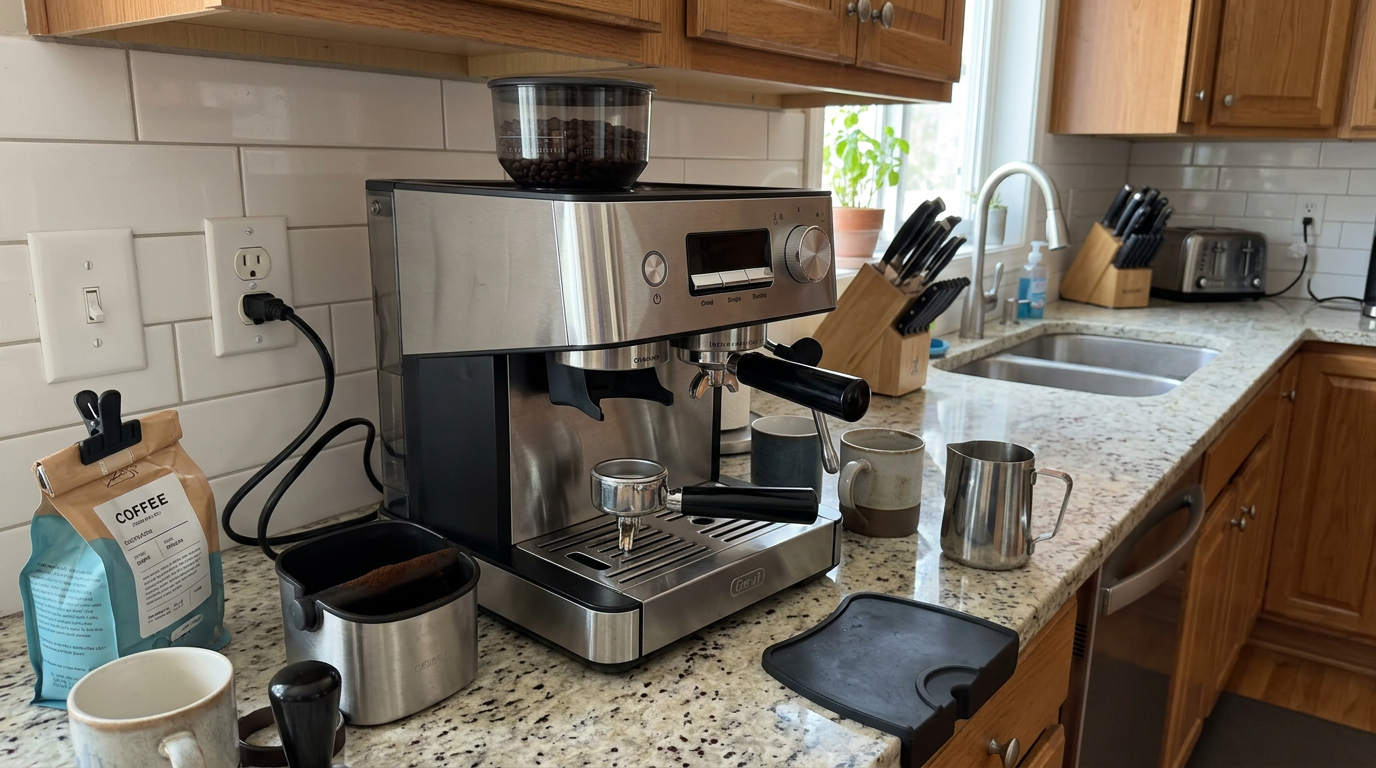
It fits comfortably between other appliances on a busy counter.
The built-in grinder
The grinder is the reason most people will look at this machine, so I spent a lot of time with it.
It uses conical burrs✕Conical burrsA cone-shaped cutting part that turns inside a ring. They grind evenly at fairly low speed, which keeps heat and noise down., a common five-point star design.
Conical burrs crush the beans to a much more even size than a blade grinder, which is essential for espresso.
You change the grind by turning the bean hopper, across 30 settings.
Lower numbers are finer and higher numbers are coarser.
With a fresh medium roast in the non-pressurized double basket.
A useful target is a texture like fine table salt.
Fine, but not so fine that it clumps into powder and sticks to your fingers.
Dosing is the catch
Press the grind button once for a single dose and twice for a double.
The problem is that the amount of coffee isn't fixed.
The grinder runs for a set time, and a finer grind comes out more slowly, so the dose shrinks as you go finer.
| Grind setting | Button | Coffee I measured |
|---|---|---|
| 0 | Single | About 6.8 g |
| 0 | Double | About 11.6 g |
| 5 | Double | About 16.3 g |
That's a big swing.
On setting 0, a double press gave me barely enough for a weak single.
You can reprogram the grind time by holding the grind button together with the single or double button, but there's no readout of how much coffee you're getting.
The outer burr also comes out for cleaning.
Remove the hopper, pull up the small adjustment ring and lift the burr out.
That makes it easy to brush out old coffee every couple of weeks.
Our tip: Change the grind one setting at a time, then pull two shots before deciding if it helped.
Pressurized vs non-pressurized baskets
Gevi includes two kinds of filter basket, and choosing the right one makes a big difference.
Pressurized baskets✕Pressurized basketA basket with a second, inner wall and a single tiny exit hole. It creates artificial resistance, so even coarse or stale coffee produces a crema-topped shot. Forgiving, but less flavorful. have a double wall with a tiny exit hole.
They create resistance on their own, so even a coarse grind gives you a passable shot with foamy crema.
Non-pressurized baskets✕Non-pressurized basketA filter basket with one layer of holes. All the resistance comes from the coffee itself, so the grind and tamp have to be right. have a single wall, so all the resistance comes from the coffee.
They're less forgiving, but they give you a much richer, more flavorful shot when the grind is right.
| Pressurized basket | Non-pressurized basket | |
|---|---|---|
| Best for | Beginners, pre-ground coffee | Fresh beans from the built-in grinder |
| Grind sensitivity | Low | High |
| Crema | Foamy, looks impressive | Finer, denser, more natural |
| Flavor | Fine, a little flat | Richer, more depth |
| Room to improve | Little | Lots |
In my testing, a pressurized basket on grind setting 10 still produced a reasonable shot.
The same setting in a non-pressurized basket gushed through in seconds.
My advice: start with the pressurized basket for a few days while you learn the workflow, then switch to the non-pressurized one and never look back.
Gevi ECMI0 espresso performance
With the right grind, the Gevi ECMI0 makes espresso that's far better than its simple controls suggest.
My starting recipe was 16 grams of coffee in, about 36 grams of espresso out, in 25 to 30 seconds.
That's a brew ratio✕Brew ratioThe weight of coffee in versus the weight of espresso out. 16 g in and 36 g out is about a 1:2.25 ratio. of roughly 1:2.25, a good place to start.
Dialing in, shot by shot
| Shot | Basket | Grind | Dose | Yield | Time | Result |
|---|---|---|---|---|---|---|
| 1 | Non-pressurized | 10 | 16 g | 36 g | 11 s | Gushed, watery and sour |
| 2 | Non-pressurized | 7 | 16 g | 36 g | 19 s | Better, still thin |
| 3 | Non-pressurized | 5 | 16 g | 36 g | 30 s | Thick crema, balanced |
| 4 | Pressurized | 10 | 16 g | 36 g | 24 s | Foamy crema, a bit flat |
The difference between shot 1 and shot 3 was dramatic.
Shot 3 looked thicker and creamier, with a hazelnut-brown crema✕CremaThe golden-brown foam on top of an espresso. It forms when pressure pushes gases and oils out of freshly ground coffee. that held its shape.
It tasted of cocoa and caramel, with just enough brightness to keep it lively.
For an all-in-one machine at this level, I was genuinely impressed.
How the shot actually flows
The automatic pre-infusion wets the coffee for a moment before full pressure arrives.
That helps the water spread evenly and reduces weak spots in the puck.
You can't change how long it lasts, but it clearly helped my consistency.
| What you taste or see | Likely cause | First change |
|---|---|---|
| Sour, thin, fast shot | Grind too coarse | Go 1–2 settings finer |
| Bitter, harsh, very slow | Grind too fine | Go 1 setting coarser |
| Weak even at a good time | Dose too low | Weigh your beans, aim for 16–18 g |
| Spurting or uneven flow | Clumps or tilted tamp | Stir with a WDT tool, tamp level |
| Pale crema that fades fast | Stale beans | Use beans roasted in the last few weeks |
Our tip: Aim for a grind that feels like fine table salt, then fine-tune by time and taste.
What it can’t do
The ECMI0 keeps things simple, and that means a few features are missing.
None of these is a deal-breaker for a first machine, but you should know about them.
| Missing feature | What it means day to day |
|---|---|
| Brew temperature control | You can't tune heat for light or dark roasts |
| Adjustable pre-infusion | It's automatic and fixed |
| Pressure gauge | You judge shots by time, weight and taste |
| Shot timer on the display | Use your phone or a scale with a timer |
| Brew and steam at once | One heater, so brew first, then steam |
The display is the one I missed most.
It shows icons, but a shot timer or grind timer would have made dialing in much easier.
I ended up using a scale with a built-in timer on the drip tray, which solved it.
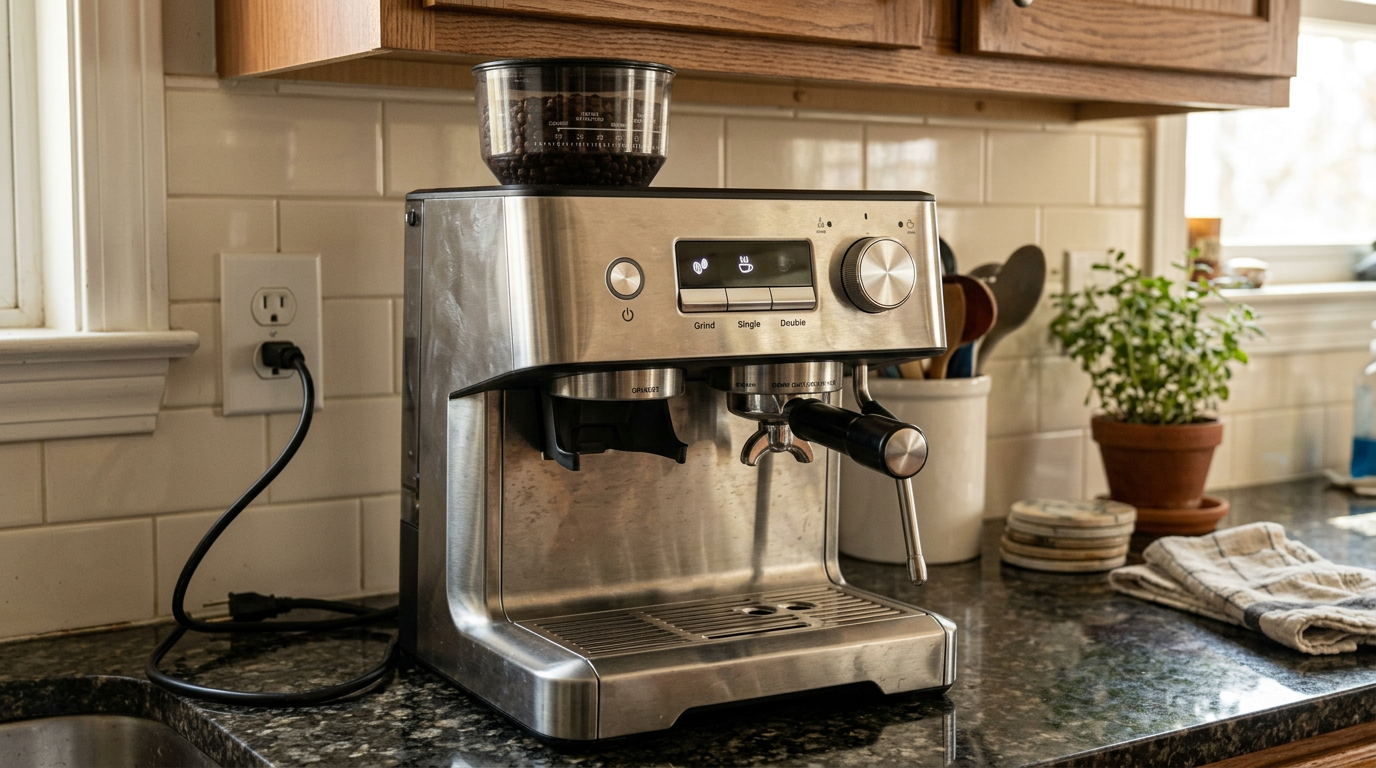
The simple front panel: three buttons, a small display and the steam knob on the right.
The three-way solenoid valve
This is the feature I didn't expect to care about and ended up loving.
When the shot finishes, you'll hear a short hiss as the valve releases pressure into the drip tray.
That means you can twist the portafilter out immediately, without a spray of hot water.
It also leaves the puck firm and fairly dry.
One tap on a knock box and the basket was clean.
On machines without this valve, the puck is often a soupy mess that you have to scoop out.
My rough time to remove the portafilter, knock out the puck and rinse the basket.
Our tip: Keep a small knock box next to the machine, because the dry pucks drop out in one clean tap.
Puck prep: the step that matters most
With a non-pressurized basket, how you prepare the coffee bed matters as much as the grind.
After grinding, the coffee sits in a small mound in the basket, often with clumps.
If you tamp it like that, some parts of the puck are denser than others.
Water then rushes through the loose areas, which is called channeling✕ChannelingWhen water finds a weak spot in the coffee puck and rushes through it, over-extracting that path and under-extracting the rest. The shot tastes sour and bitter at the same time..
The result tastes sour and bitter at the same time.
A gentle tap on the side of the portafilter settles the mound, but it doesn't fully distribute the coffee.
A cheap WDT tool✕WDT tool (Weiss Distribution Technique)A small tool with very thin needles that you stir through the ground coffee to break up clumps and spread it evenly before tamping. made the biggest difference in my testing.
Stirring the grounds for a few seconds broke up the clumps and gave me noticeably more even shots.
Our tip: Check that any bottomless portafilter you buy fits Gevi’s three-ear lock, because many two-ear models won’t.
Steam wand and milk drinks
The ECMI0 has a one-hole steam wand on the right side, and a stainless pitcher in the box.
Because there's a single heater, you brew your espresso first and then switch to steam.
Turn the knob to the right, wait a short moment for the machine to reach steaming temperature and you're ready.
How the steam performed
Steam power was reasonably good for this class of machine.
A one-hole tip is slower than a multi-hole tip, but it's also easier to control while you learn.
150 ml of cold whole milk took me about 45 to 60 seconds to reach drinking temperature.
With practice, I got a glossy, silky microfoam✕MicrofoamMilk foam with bubbles so small you can't see them. It feels silky and blends into the coffee instead of sitting on top like froth. that was good enough for a simple heart.
My ratings on a 10-point scale for texture, sweetness and stability.
| Drink | How to make it | Milk texture |
|---|---|---|
| Latte | Double shot, plenty of steamed milk | Thin, glossy, little foam |
| Cappuccino | Double shot, equal milk and foam | Thicker, airier |
| Flat white | Double shot, less milk | Very fine, silky |
| Americano | Double shot plus hot water | No milk |
Keep the tip just under the surface at first to let some air in, then lower it to spin the milk.
Stop when the pitcher becomes too hot to hold comfortably.
Our tip: Purge the steam wand for a second before and after steaming, so no water or old milk gets into your drink.
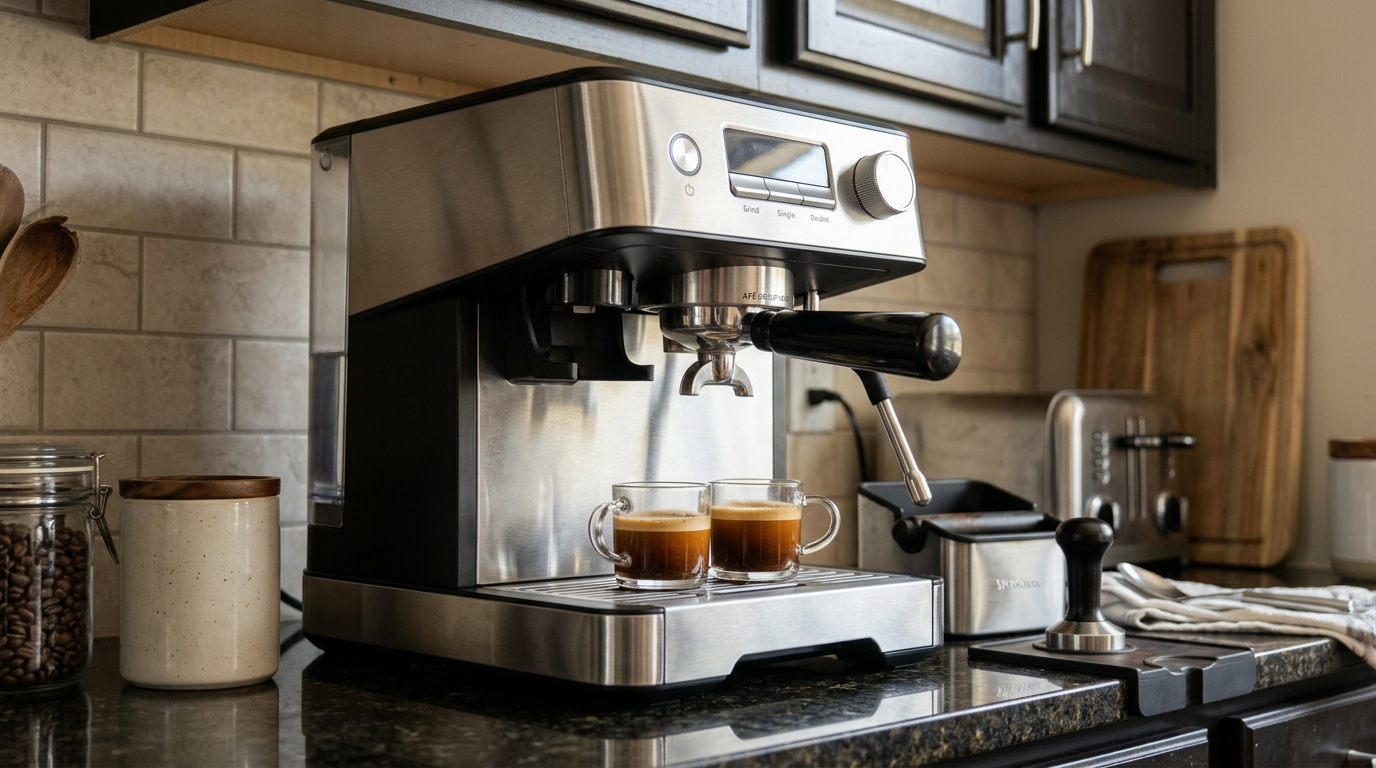
A double shot split into two glasses, with the included pitcher ready for steaming.
Hot water and Americanos
Turning the knob to the left gives you hot water from the wand.
For an Americano✕AmericanoAn espresso topped up with hot water. It keeps the espresso flavor but gives you a longer, milder drink., I pulled a double and added about 120 to 180 ml of hot water.
It's also useful for tea and for warming cups before a shot.
Brewing and steaming: the single-heater workflow
One heater means a set order of jobs, especially for milk drinks.
Here's the routine I settled on for a latte.
| Step | What you do | Time |
|---|---|---|
| 1 | Switch on and let it heat | ~90 s |
| 2 | Weigh and grind 16 g of beans | ~20 s |
| 3 | Stir, tamp and lock in | ~30 s |
| 4 | Pull the shot | ~30 s |
| 5 | Switch to steam and wait | A short pause |
| 6 | Steam the milk | ~45–60 s |
| 7 | Pour and wipe the wand | ~20 s |
All in, a latte took me about four to five minutes from cold.
For one or two drinks, that's perfectly fine.
For four lattes in a row, the switching back and forth adds up, so it's not ideal for a big household.
Troubleshooting the problems I hit
A few small problems came up during four weeks of daily use.
None of them was serious, and all of them had simple fixes.
| Problem | What I noticed | Fix that worked |
|---|---|---|
| Shot gushes in under 15 seconds | Pale, watery espresso | Grind finer, check the basket is single-wall |
| Shot barely drips | Over 45 seconds, bitter taste | Grind one or two settings coarser |
| Dose much lower than expected | Thin shots after going finer | Weigh beans instead of using the button |
| Grinder sounds strained | Very fine setting, oily beans | Go coarser, clean the burrs |
| Water instead of steam | Wet, bubbly milk | Purge longer, wait for steam temperature |
| Portafilter hard to lock in | Grounds on the rim | Wipe the rim before locking in |
The most common issue by far was the dose shrinking after a grind change.
It's easy to blame the grind for a weak shot when the real problem is that there's less coffee in the basket.
Once I started weighing beans, the troubleshooting got much simpler.
What surprised me most
I expected the built-in grinder to be the weak link, and in some ways it is, because of the dosing.
But the grind quality itself was better than I expected, fine and even enough for proper single-wall shots.
The solenoid valve and the large drip tray were the other pleasant surprises.
Both are small things, but they make the daily routine noticeably cleaner.
Our tip: Wipe loose grounds off the portafilter rim before locking it in, so it seals cleanly and doesn’t leak.
Cleaning and maintaining the Gevi ECMI0
Daily cleaning is quick, largely thanks to the dry pucks.
After each shot, knock out the puck and rinse the basket.
After every milk drink, wipe the steam wand with a damp cloth and purge it.
Milk dries onto the tip surprisingly fast, so don't leave it for later.
| When | Task | Why it matters |
|---|---|---|
| After every shot | Knock out the puck, rinse the basket | Stops coffee oils building up |
| After every milk drink | Wipe and purge the steam wand | Keeps the single hole clear |
| Daily | Empty the drip tray, wipe the group | Prevents odors and stains |
| Weekly | Wash the baskets and portafilter properly | Removes oily residue |
| Every 2 weeks | Remove the outer burr and brush the grinder | Clears stale grounds and fines |
| Every 2–3 months | Descale, more often with hard water | Protects the heater and pump |
The grinder is the part people forget.
Old coffee builds up around the burrs and chute, and it can make fresh beans taste stale.
Every couple of weeks I took the hopper off, lifted out the outer burr and brushed everything clean.
Descaling✕DescalingRunning a mild acid solution through the machine to dissolve mineral scale left by hard water. Scale slows heating and can block pipes. depends on your water, but every two to three months is a good rhythm for moderately hard tap water.
My estimate of hands-on cleaning time.
The storage drawer at the back is a nice touch.
I kept the cleaning needle, brush and spare basket in it, so they never went missing.
What daily use is really like
After the first week, my mornings were smooth.
Switch on, weigh beans while it heats, grind, stir, tamp and brew.
An espresso took about two and a half minutes from switching on, and a latte about four to five.
That's slower than a one-touch machine, but much faster than I expected for a grind-it-yourself setup.
Noise
The grinder is the loudest part, a short, gravelly whir for several seconds.
It's not quiet, but it's in line with other burr grinders.
The pump hums during the shot, and the solenoid valve gives a short hiss at the end.
My subjective comparison in a quiet kitchen.
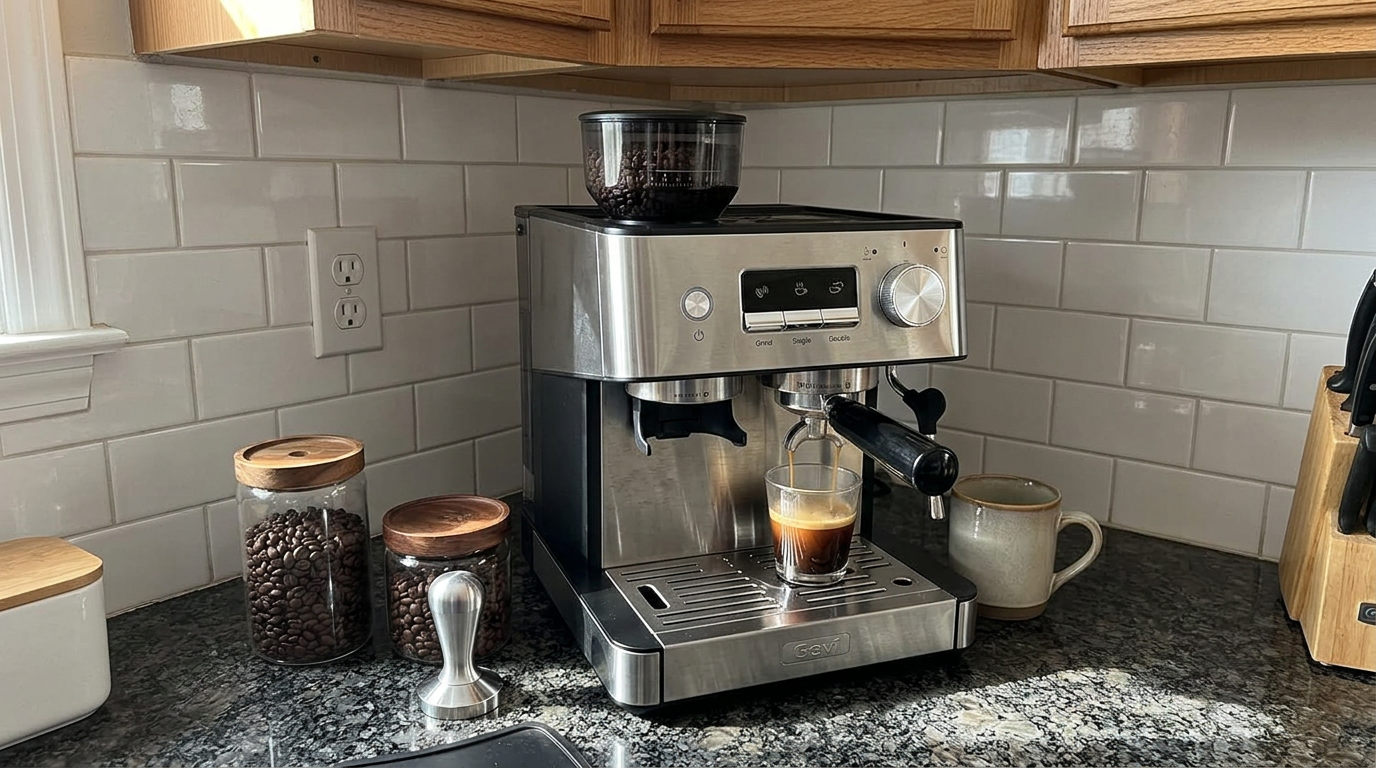
Grinding straight into the portafilter keeps the counter tidy.
Our tip: Fill the water reservoir the night before, so your first shot of the day never runs short.
Beans, water and milk
The built-in grinder works best with fresh whole beans, ideally roasted in the last two to five weeks.
Medium and medium-dark roasts were the easiest to dial in.
Light roasts needed a finer grind, close to setting 3 or 4, and still tasted a little sharp because you can't raise the brew temperature.
Very dark, oily beans can stick in the burrs and hopper, so I'd avoid them.
| Bean type | Starting grind setting | Notes |
|---|---|---|
| Medium roast | 5 | My everyday sweet spot |
| Medium-dark blend | 5–6 | Easy, chocolatey shots |
| Light roast | 3–4 | Brighter, can taste sharp |
| Dark, oily roast | 6–7 | Can clog the grinder, use sparingly |
| Pre-ground coffee | — | Use the pressurized basket |
Water and milk
Use fresh, cold, filtered water if you can, and avoid distilled water.
For milk drinks, whole milk is the easiest to steam, and barista oat milk is the best plant option.
Common mistakes to avoid
The Gevi ECMI0 is beginner-friendly, but a few habits will hold it back.
| Mistake | What happens | Better habit |
|---|---|---|
| Trusting the grind button for dose | Dose changes with grind setting | Weigh beans before grinding |
| Using setting 10 with the single-wall basket | Fast, watery, sour shots | Start around setting 5 |
| Skipping puck prep | Channeling and uneven taste | Stir with a WDT tool, tamp level |
| Steaming before brewing | Shot runs too hot or waits | Brew first, then steam |
| Leaving milk on the wand | Blocked single hole | Wipe and purge straight away |
| Buying a two-ear bottomless portafilter | It won't lock in | Buy one for the three-ear design |
Change one thing at a time and taste after each change.
If you change grind and dose together, you'll never know which one helped.
What I would change
A shot timer on the display would make dialing in much easier.
A grinder that doses by weight, or at least shows its grind time, would fix the dosing swing.
And a metal tamper in the box would be a welcome upgrade.
Is the Gevi ECMI0 worth the money?
For a first espresso setup, the ECMI0 makes a strong case.
You get a conical burr grinder, a 58mm portafilter, four baskets, a milk pitcher, pre-infusion and a solenoid valve in one machine.
Buying a separate machine and grinder with that list would usually cost noticeably more and take more space.
Ask yourself three questions before you buy.
Do you want to learn espresso, rather than just press a button? Are you happy to weigh your beans? And do you mostly make one or two drinks at a time?
If the answers are yes, the ECMI0 is easy to recommend as a starter.
If you already know you'll want temperature control and a pressure gauge, you'll outgrow it.
My four-week learning curve
Because this is a beginner's machine, I tracked how my results improved over the four weeks.
It's a good picture of what to expect if you've never made espresso before.
| Week | What I focused on | What changed |
|---|---|---|
| Week 1 | Pressurized basket, basic workflow | Drinkable shots from day one |
| Week 2 | Switched to non-pressurized, weighed beans | Big jump in body and sweetness |
| Week 3 | WDT tool, level tamping, grind fine-tuning | Shots became consistent |
| Week 4 | Milk steaming and latte art basics | Silky lattes and a simple heart |
My own tasting scores for a straight double espresso.
The jump between week one and week two came almost entirely from weighing the beans and moving to the single-wall basket.
After that, the gains came from puck prep and small grind tweaks.
By the end of the test, I was making espresso I'd happily serve to guests.
Our tip: Keep a simple log of grind, dose, yield and time for a week, and you’ll dial in twice as fast.
Cheap upgrades that make a big difference
The Gevi ECMI0 comes with what you need to start, but a few small accessories improve it a lot.
| Upgrade | What it fixes | Worth it? |
|---|---|---|
| Small scale with timer | Variable grinder dose, no shot timer | Essential |
| WDT tool | Clumps and channeling | Yes, very cheap |
| 58mm dosing ring | Spilled grounds while stirring | Yes |
| Solid 58mm tamper | Uneven tamping | Yes |
| Knock box | Messy puck disposal | Nice to have |
| Three-ear bottomless portafilter | Hidden channeling | For curious learners |
If you only buy one thing, make it the scale.
It fixes the two things the machine doesn't tell you: how much coffee you're using and how long the shot runs.
How it compares with other espresso setups
The most useful comparison is with the kinds of machines you're likely choosing between.
The Gevi ECMI0 stands out for packing a grinder, a 58mm portafilter and a solenoid valve into one beginner-friendly machine.
| Feature | Gevi ECMI0 | Separate machine and grinder | Fully automatic machine |
|---|---|---|---|
| Grinder | Built in, 30 settings | Separate, often better | Built in |
| Espresso quality | Good to very good | Very good to excellent | Good, consistent |
| Portafilter | 58 mm, three-ear | Varies | None |
| Temperature control | Fixed | Often adjustable | Preset levels |
| Milk | Manual steam wand | Manual steam wand | Often one-touch |
| Counter space | One appliance | Two appliances | One appliance |
| Learning curve | Moderate | Moderate to high | Very low |
A separate machine and grinder gives you more control and a clearer upgrade path, but costs more and takes more space.
A fully automatic machine is easier, but you lose the hands-on control and café-style texture of steamed milk.
The ECMI0 sits neatly in between, as an affordable way to learn real espresso.
| You mostly drink | Is the ECMI0 a fit? | Why |
|---|---|---|
| Straight espresso | Good | 58mm basket, solid shots once dialed in |
| Lattes and cappuccinos | Good | Decent steam, pitcher included |
| Americanos | Very good | Dedicated hot water |
| Coffee at one touch | Poor | You tamp and steam by hand |
| Light roasts | Fair | No temperature control |
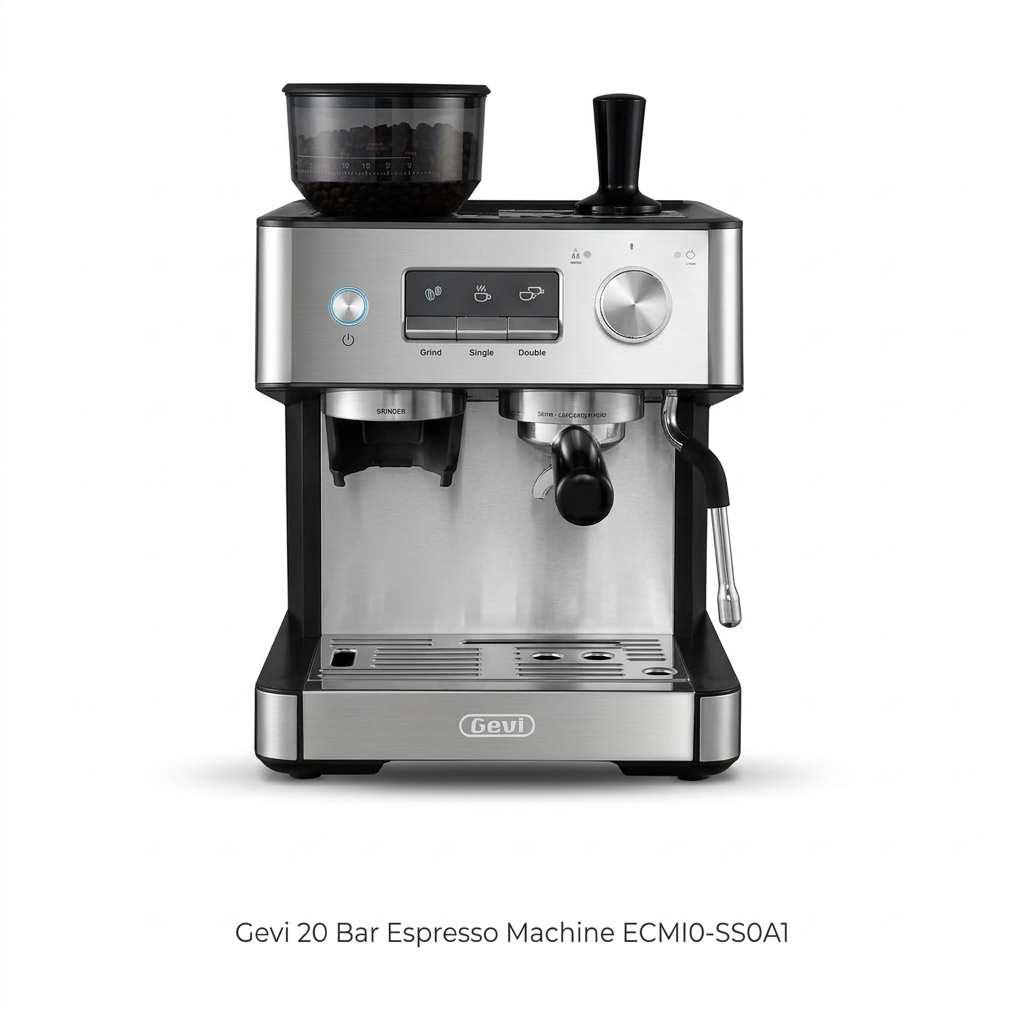
The full package: bean hopper, 58mm portafilter, three-button panel and steam wand.
Other Gevi machines I tested
If you already own a good grinder, the Gevi 58mm Commercial adds PID temperature control, a pressure gauge and a shot timer.
For the simplest and most compact option, see my Gevi 20 Bar ECM-5020ULSS review.
Which one is right for you: is the Gevi ECMI0 your match?
4 quick questionsGevi ECMI0 specifications
From manufacturer data and my own testing.
How I tested and scored the Gevi ECMI0
For four weeks, Michael Reynolds and I used the Gevi ECMI0 as our everyday espresso machine for straight espresso, Americanos, lattes, flat whites and cappuccinos.
We worked through the grind range, weighed the grinder's output at different settings and compared pressurized and non-pressurized baskets shot by shot.
We logged dose, yield and time, steamed whole, semi-skimmed, skim and oat milk, and followed the daily and weekly cleaning routine, including taking the burrs out.
We then checked our notes against Gevi's specifications and owner documentation.
- Espresso (8.0): body, crema, flavor and consistency once dialed in, with both basket types.
- Milk drinks (7.6): steam power, microfoam texture and the brew-then-steam workflow.
- Ease of use (7.8): setup, controls, the learning curve and how forgiving it is.
- Grinder (7.4): grind quality, adjustment range, dosing consistency and cleaning access.
The overall score of 7.8 is an editorial rating that reflects those four areas.
Gevi ECMI0 FAQ
Is the Gevi ECMI0 worth it?
Yes, if you want to learn espresso without buying a separate grinder. It includes a burr grinder, a 58mm portafilter, four baskets, pre-infusion and a solenoid valve, though it lacks temperature control and a pressure gauge.
What grind setting should I use?
Setting 5 was my sweet spot with a fresh medium roast in the single-wall basket. Setting 10 was too coarse for espresso, and setting 0 was close to powder.
Why does the grinder dose change?
The grinder runs for a set time, and finer grinds come out more slowly. I measured about 11.6 g on a double press at setting 0 and about 16.3 g at setting 5, so weighing beans is the best fix.
Should I use the pressurized or non-pressurized basket?
Start with the pressurized basket while you learn or when using pre-ground coffee. Switch to the non-pressurized basket with freshly ground beans for richer, more flavorful espresso.
What is a good starting recipe?
Try 16 g of coffee in and about 36 g of espresso out in 25 to 30 seconds, then adjust the grind one setting at a time.
Can I adjust the brew temperature?
No. The temperature is fixed, which matters most if you drink very light roasts.
Does it have a pressure gauge or shot timer?
No. I used a small scale with a built-in timer on the drip tray to track each shot.
Can it brew and steam at the same time?
No. It has a single heater, so pull the espresso first, then switch to steam.
Will any 58mm bottomless portafilter fit?
Not necessarily. The ECMI0 uses a three-ear lock, so check that any portafilter you buy is made for that design.
How long does it take to heat up?
About 90 seconds from switching on.
How do I clean the grinder?
Remove the hopper, lift the small adjustment ring and take out the outer burr, then brush away old grounds every couple of weeks.
Does it come with a milk pitcher?
Yes. A stainless steel frothing pitcher is included, along with a tamper, four baskets and cleaning tools.
Kitchen & coffee tester
Michael spent six years as a line cook in restaurants in Chicago and New York, and he has tested kitchen appliances for HouseholdMe since 2018, from air fryers to coffee makers. He holds an SCA certificate in barista skills and used the Gevi ECMI0 as his everyday coffee machine for four weeks for this review.
- Four weeks of hands-on testing of the Gevi ECMI0-SS0A1
- Gevi product specifications and owner documentation
- General espresso brewing, grinding and maintenance guidance