Gevi 58mm review: a commercial-size group, PID control and real café espresso in a slim metal body
The Gevi 58mm Commercial Espresso Machine packs a 58mm group, adjustable PID temperature, a pressure gauge, a shot timer and a three-way solenoid valve into a slim, mostly metal body. With a good grinder it makes excellent espresso and silky milk, but it rewards practice and won't hide a poor grind.

Michael Reynolds
Hands-on review
Hands-on testing, research, specs
4 weeks
26 minutes
Jargon helpNew to espresso? Tap any dotted term to see what it means.
In this review
Yes, if you own a good espresso grinder or plan to buy one. The Gevi 58mm gives you a commercial-size 58mm group, PID temperature control, a pressure gauge, a shot timer and a three-way solenoid valve in a solid, mostly metal body. With fresh beans it pulled some of the best shots I've had from a machine in this class, and its ball-joint steam wand makes proper latte-art milk. The catch is that its single-wall baskets need a capable grinder, the factory shot volumes are far too long, and the single heater means a short wait between steaming and brewing.
Gevi 58mm at a glance
Gevi 58mm pros and cons
- Excellent espresso with a 58mm group and PID control
- Powerful, flexible steam wand for real microfoam
- Solid metal build and a premium portafilter
- Needs a capable espresso grinder
- Factory shot volumes are far too long
- Short wait between steaming and brewing
Who should buy the Gevi 58mm?
- Home baristas who want to learn proper espresso
- Owners of 58mm accessories or a good grinder
- Latte and cappuccino fans who enjoy steaming milk
- Anyone who wants one-touch coffee
- People who only use supermarket pre-ground coffee
- Households making many milk drinks back to back
First impressions of the Gevi 58mm
Most affordable espresso machines look the part and then give the game away the moment you pick up the portafilter.
It's light, it rattles, and it only fits the accessories the brand sells you.
The Gevi 58mm Commercial Espresso Machine goes the other way.
The first thing I lifted out of the box was the portafilter, and it felt like something from a café counter.
Heavy, solid and balanced, with a small thumb dip on the handle and a rubber foot so it can rest on the counter without scratching it.
Then I lifted the machine itself.
At about 21.6 pounds, it's heavier than its slim 9-inch width suggests.
Almost everything you touch is metal: the front, the sides, the base, the cup-warming tray on top and, nicely, the drip tray.
The finish is polished and shiny, close to a mirror.
Michael and I both had the same first reaction: it looks like it should cost a lot more than it does.
The second thing that stood out was the control panel.
There's a pressure gauge, a shot timer, programmable single and double shot buttons and a temperature you can actually change.
These are features you usually find a tier or two higher.
My first shot, made with a medium roast and a borrowed scale, already had a thick, hazelnut-colored crema.
It wasn't perfect yet, but it told me this machine had real potential.
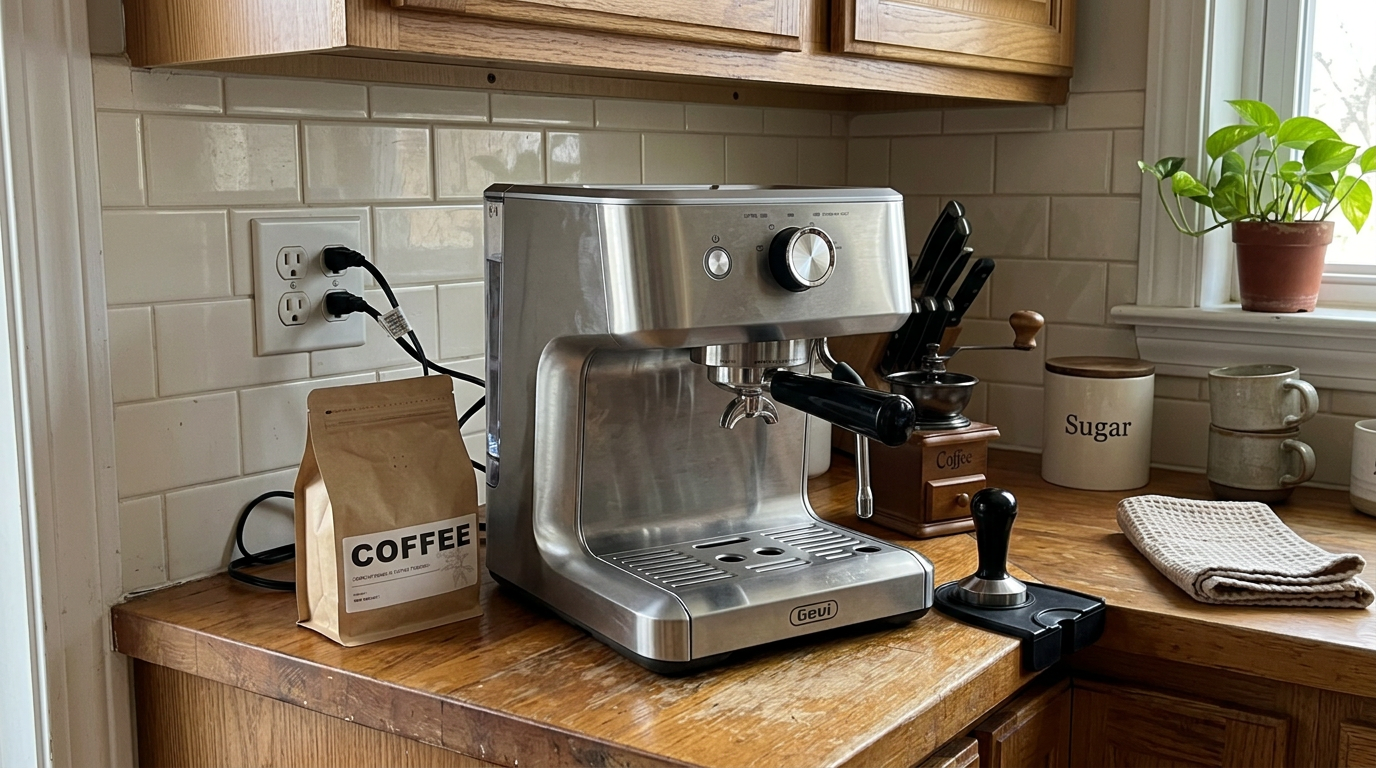
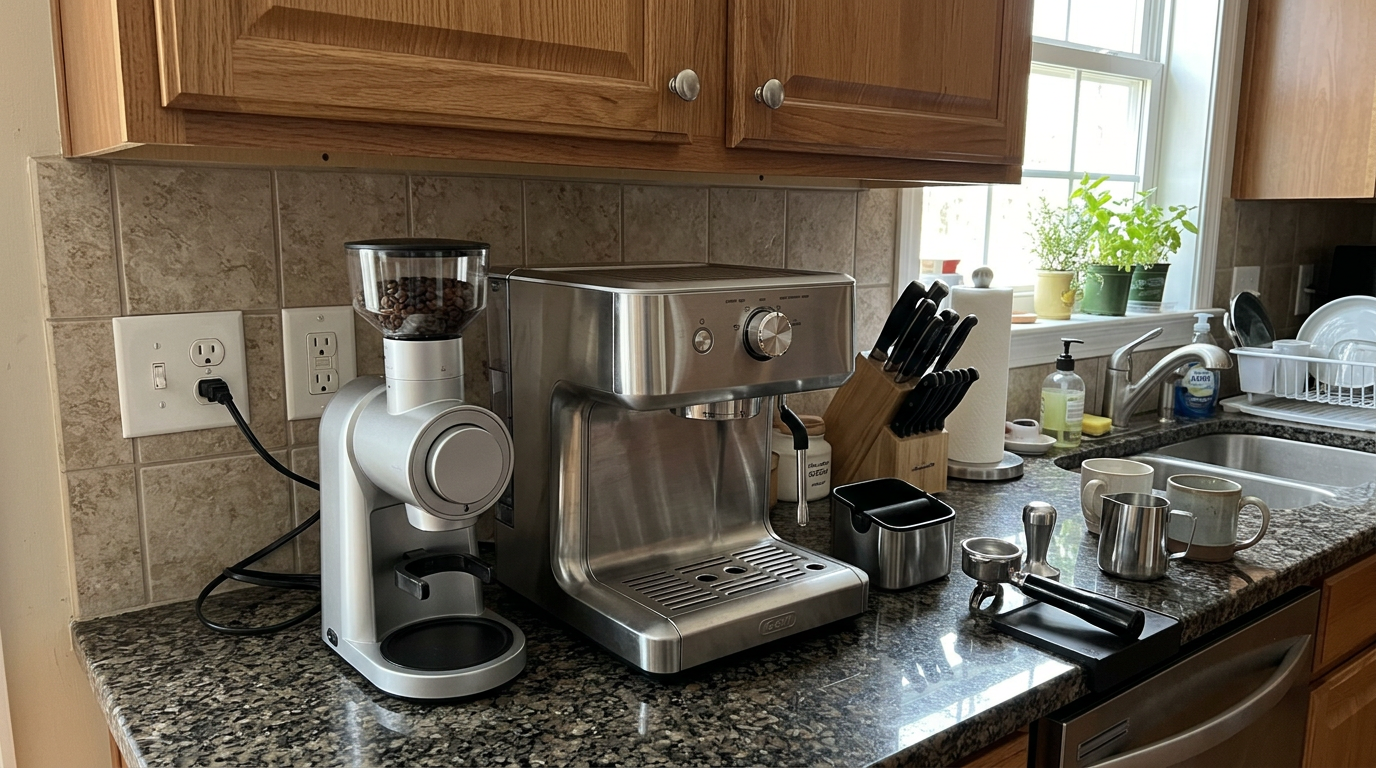
The polished finish looks right at home on a warm wooden counter.
What the Gevi 58mm actually is
The Gevi 58mm, model ECMN0, is a semi-automatic espresso machine.
That means you grind the coffee, dose it, tamp it and lock the portafilter in, and the machine handles the water and pressure.
It doesn't have a built-in grinder, and that's on purpose.
It's built for people who either own a good grinder already or plan to buy one.
Inside is a thermoblock✕ThermoblockA compact heater that warms water as it flows through, instead of keeping a whole boiler hot. It heats up fast and uses less standby energy. heater, controlled by a PID✕PID controllerA small computer that constantly checks the water temperature and makes tiny heater adjustments, so the temperature stays steady instead of swinging up and down. controller.
Gevi pairs the PID with a second temperature sensor, which helps keep the water close to the number you set.
The pump is rated at 20 bar, but an over-pressure valve✕Over-pressure valve (OPV)A valve that bleeds off excess pump pressure so the coffee sees a steady, sensible brewing pressure, usually around 9 bar, instead of the pump maximum. limits what actually reaches the coffee.
On my gauge, shots ran at just over 9 bar, which is the classic espresso target.
The brew head is a full 58mm group, the same size you'll find on most commercial café machines.
And when a shot finishes, a three-way solenoid valve✕Three-way solenoid valveA valve that opens when the shot ends and releases the leftover pressure and water above the coffee into the drip tray. It leaves a drier puck and makes the portafilter safer to remove. releases the pressure, so you knock out a dry puck instead of coffee mud.
Gevi 58mm design and setup
The Gevi 58mm measures about 9.05 inches wide, 14.17 inches tall and 15.55 inches deep.
The narrow width is a real plus in a crowded kitchen.
At just over 14 inches tall, it slid under my wall cabinets with room to spare, although lifting the lid of the water tank was easier with the machine pulled forward a little.
Like most espresso machines, it's deeper than it looks, so check that your counter leaves room for the drip tray and the portafilter handle.
The steam wand sits on the right side on a ball joint, so you want a few inches of clear space on that side.
The lever above it does two jobs.
Pull it back for hot water and push it forward for steam.
That's simpler than a dial, and after a day I did it without looking.
What comes in the box
Gevi includes a proper starter kit, which matters if this is your first serious espresso setup.
| Item | What it is | My verdict |
|---|---|---|
| Portafilter | Heavy 58mm three-ear portafilter with spouts | Excellent, feels premium |
| Filter baskets | Single and double, single-wall | Good, need a real espresso grinder |
| Tamper | Metal 58mm tamper | Fine to start, upgrade later if you like |
| Milk pitcher | Stainless steel frothing pitcher | Handy, right size for one or two drinks |
| Cleaning tools | Cleaning needle and brush | Useful for the steam tip |
| Scoop | Coffee spoon | Basic but useful |
First-time setup
Setup took me about fifteen minutes, including washing the parts.
The one step you can't skip is removing the stopper from the bottom of the water tank.
Without that, nothing flows, and it's easy to miss because it's small and sits underneath.
On my unit, the pump also needed a little help to pull water through the first time.
Lifting the tank slightly and setting it back down a couple of times got the water moving.
After that, I ran a few blank shots through the group and the steam wand to flush the system.
Our tip: Remove the small stopper under the water tank before your first fill, or the pump will run dry.
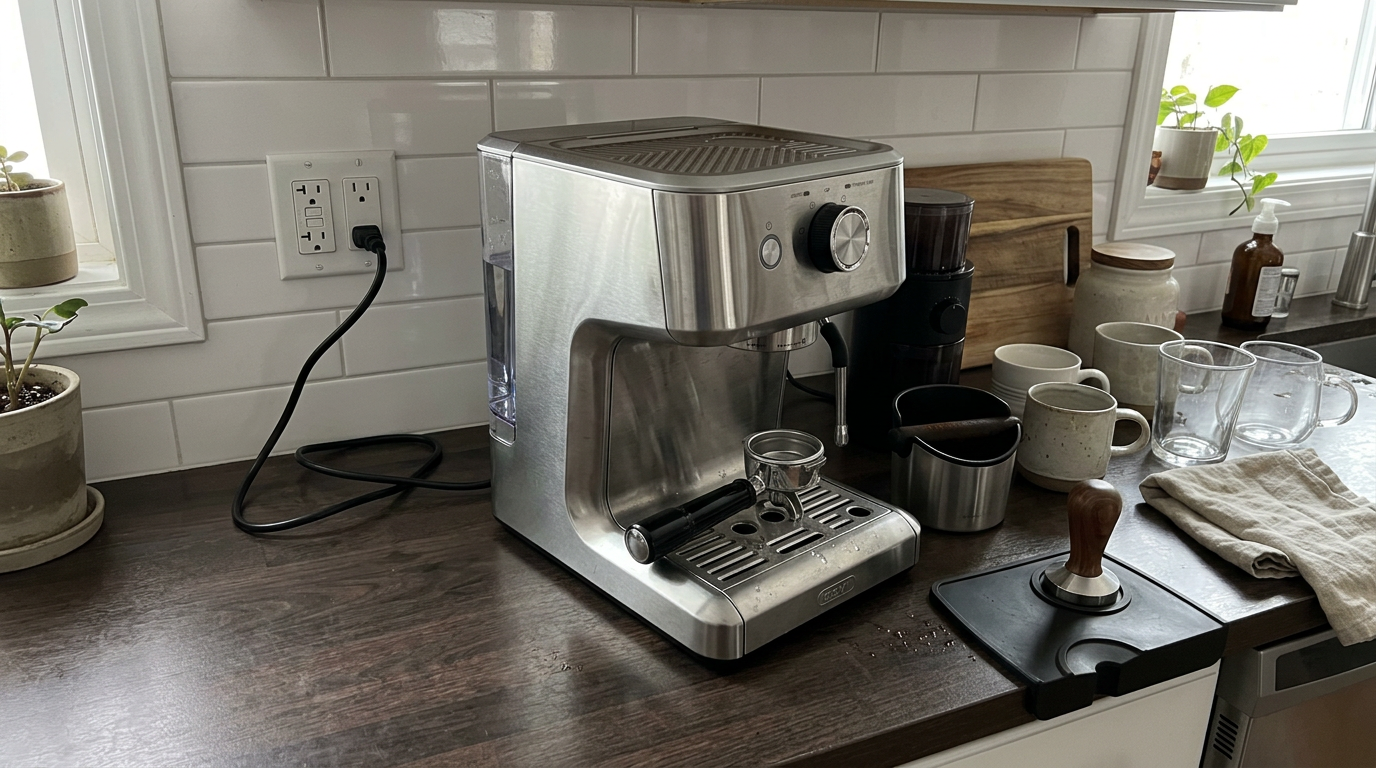
At about 9 inches wide, the Gevi tucks neatly against a backsplash.
The 58mm group and portafilter
The 58mm group is the most important feature on this machine, and it's worth explaining why.
Smaller portafilter sizes can make excellent espresso, so 58mm isn't a magic number for taste on its own.
The real advantage is choice.
58mm is the most common size in professional espresso, so there's a huge range of accessories made to fit it.
| Accessory | What it does | Why it matters on this machine |
|---|---|---|
| Bottomless portafilter | Shows the coffee leaving the basket | Lets you spot uneven flow instantly |
| Precision basket | Tighter, more even holes | Clearer, more consistent shots |
| Calibrated tamper | Tamps with the same force each time | Removes one big variable |
| Puck screen | Sits on top of the coffee bed | Spreads water and keeps the group clean |
| WDT tool | Fine needles that break up clumps | Fewer weak spots in the puck |
| Dosing funnel | Sits on the portafilter while grinding | Less mess on the counter |
The Gevi uses a three-ear attachment, the common design on café-style portafilters.
I tried a three-ear bottomless portafilter with an 18 to 20 gram basket, and it locked in firmly with no leaks.
That's what makes this machine interesting long term.
You can start with the included kit and upgrade one piece at a time, instead of replacing the whole machine.
The included baskets
The baskets are single-wall, also called non-pressurized✕Non-pressurized basketA filter basket with one layer of holes. All the resistance comes from the coffee itself, so the grind and tamp have to be right. Pressurized baskets add a second wall that fakes resistance, which is more forgiving but less flavorful. baskets.
That's the professional choice, and it gives you full control over the shot.
It also means the machine won't cover up a poor grind.
With supermarket pre-ground coffee, my shots ran fast and thin, often in under 15 seconds.
With freshly ground beans from a proper espresso grinder, the same machine produced syrupy, balanced shots.
Our tip: Budget for a real espresso grinder alongside this machine, because the single-wall baskets need a fine, even grind.
Temperature control and heat-up
Temperature is one of the quiet variables that makes or breaks an espresso.
Too cool and the shot tastes sour and hollow.
Too hot and it turns harsh and bitter.
The Gevi's default brew temperature is about 202°F, or roughly 94°C.
That's a sensible middle ground for most medium roasts.
You can adjust it, though the range is fairly narrow, topping out at around 204°F.
For light roasts I went to the top of the range, and for a dark, oily blend I came down a couple of degrees.
Starting points, not rules. Taste and adjust one degree at a time.
How fast it heats up
Because it's a thermoblock, the Gevi is ready quickly compared with a traditional boiler machine.
In my kitchen, it was ready to brew in about a minute or so after switching on.
I still recommend waiting a little longer and running a blank shot through the empty portafilter.
That warms the metal group and portafilter, which a fast heater alone can't do.
My rough timings from cold, including a blank shot to warm the group.
Switching from steam back to brewing
There's one trade-off with a single heater.
Brewing and steaming need different temperatures, and the Gevi can only be at one of them at a time.
After steaming milk, the machine has to cool back down to brew temperature before the next shot.
It handles this on its own, and the wait was short, usually well under a minute.
For one or two milk drinks it's a non-issue.
When I made four lattes in a row for guests, I learned to pull all the shots first and steam the milk afterward.
Our tip: Run a blank shot through the empty portafilter before your first espresso, so the metal is as warm as the water.
Gevi 58mm espresso performance
This is where the Gevi 58mm earned its score.
With a good grinder and fresh beans, it makes genuinely excellent espresso.
Every shot starts with a short pre-infusion✕Pre-infusionA short, gentle soak of the coffee before full pressure. It lets the puck swell evenly so water doesn't rush through weak spots., which wets the coffee before full pressure builds.
That makes the machine more forgiving of small tamping mistakes than I expected.
My two reference recipes
For a classic double, I used 17.5 grams of coffee in the supplied double basket.
I aimed for 32 to 33 grams of espresso in about 30 seconds, a brew ratio✕Brew ratioThe weight of coffee in versus the weight of espresso out. 18 g in and 36 g out is a 1:2 ratio, a common starting point for espresso. close to 1:1.9.
The gauge rose to just over 9 bar, and I stopped the shot at 32 grams after about 28 seconds.
The crema was thick and even, and the shot tasted round and balanced, with milk chocolate and a little stone fruit.
My refractometer read 11.6% TDS✕TDS (total dissolved solids)The percentage of the drink that is dissolved coffee. Espresso typically lands around 8 to 12%. It helps compare shots, but taste is still the final judge., which is right in the zone for a full-bodied espresso.
For the second recipe, I switched to a bottomless portafilter with 18 grams of coffee.
I ground a touch finer and aimed for 35 to 40 grams in about 30 seconds.
The flow came out evenly from across the basket and formed a neat cone, with no spurts.
I'd programmed the single-shot button to stop at about 37 grams, and it did, at just over 30 seconds.
That shot read 11.2% TDS, and it was my favorite of the whole test: sweeter, a little lighter and more layered.
| Recipe | Dose | Yield | Time | TDS | How it tasted |
|---|---|---|---|---|---|
| Classic double, stock portafilter | 17.5 g | 32 g | 28 s | 11.6% | Round, chocolatey, full body |
| Longer double, bottomless | 18 g | 37 g | 31 s | 11.2% | Sweeter, lighter, more layered |
| Pre-ground supermarket coffee | 17 g | 40 g | 13 s | — | Thin, sour, pale crema |
Consistency across a session
Thermoblocks sometimes drift when you pull several shots back to back.
I made five doubles in a row, a minute apart, and the shot times stayed within about two seconds of each other.
Taste stayed consistent too, which tells me the PID is doing its job.
| What you taste or see | Likely cause | First change |
|---|---|---|
| Sour, thin, fast shot | Grind too coarse or dose too low | Grind finer, then check dose |
| Bitter, harsh, slow shot | Grind too fine or too much coffee | Grind coarser or drop the dose slightly |
| Spurts from a bottomless portafilter | Clumps or uneven tamp | Use a WDT tool and tamp level |
| Pale crema that fades fast | Stale beans | Use beans roasted in the last few weeks |
| Wet, sloppy puck | Basket overfilled or underfilled | Adjust dose to suit the basket |
Our tip: Change only one thing per shot, usually the grind, so you know exactly what improved the taste.
Programming shots, the gauge and the timer
The control panel is simple once you know it.
There are single and double shot buttons, a steam button and the temperature controls, with the pressure gauge front and center.
To program a shot, you press and hold the single or double button for about three seconds.
The machine starts brewing, and you press the button again when the cup reaches your target weight.
That volume is saved for next time.
There's also a reset if you want to go back to the factory settings.
I also liked that you can ignore the programming completely.
Press the double button, watch the scale and press it again to stop whenever you like.
The built-in shot timer helps here, counting the seconds right in front of you.
Reading the pressure gauge
The gauge is more than decoration.
It shows you straight away if the grind is in the right range.
If the needle barely moves, the coffee is ground too coarse.
If it rushes past 10 bar and the shot slows to a drip, it's too fine.
On a dialed-in shot, mine rose smoothly to just over 9 bar and held there.
Pressure alone doesn't decide taste, but it's a quick sanity check.
Steam wand and milk drinks
The steam wand is the second big reason to look at this machine.
It's polished metal, mounted on a ball joint that swivels in almost any direction.
That freedom matters more than it sounds.
You can angle the tip exactly where you want it in the pitcher, which is the key to good microfoam✕MicrofoamMilk foam with bubbles so small you can't see them. It feels silky and blends into the coffee instead of sitting on top like froth..
The wand has a three-hole tip, which spreads the steam out and gets the milk spinning quickly.
There's also a rubber grip section, so you can move it without burning your fingers.
How the steam performed
After switching to steam mode, the machine needs a short wait to reach steaming temperature.
Once it gets there, the steam is strong and fairly dry.
Dry steam is what you want, because wet steam waters the milk down and makes it harder to build fine foam.
In my tests, 150 ml of cold whole milk went from fridge-cold to about 140°F in roughly 35 to 45 seconds.
The texture was glossy and smooth enough for basic latte art, a heart and a simple tulip, after a few days of practice.
My ratings on a 10-point scale for texture, sweetness and stability.
Steaming technique that worked best
Fill the pitcher to just below the bottom of the spout.
Put the tip just under the surface, slightly off center, and open the steam fully.
You'll hear a gentle tearing sound as air goes in.
Stretch the milk until it has grown by about a third for a latte, or a bit more for a cappuccino.
Then sink the tip a little lower and let the milk spin until the pitcher is too hot to hold comfortably.
| Drink | Milk texture | Stretch the milk by |
|---|---|---|
| Flat white | Very thin, silky | 10–15% |
| Latte | Thin, glossy | 20–30% |
| Cappuccino | Thicker, airy | 40–50% |
| Cortado | Barely foamed | Under 10% |
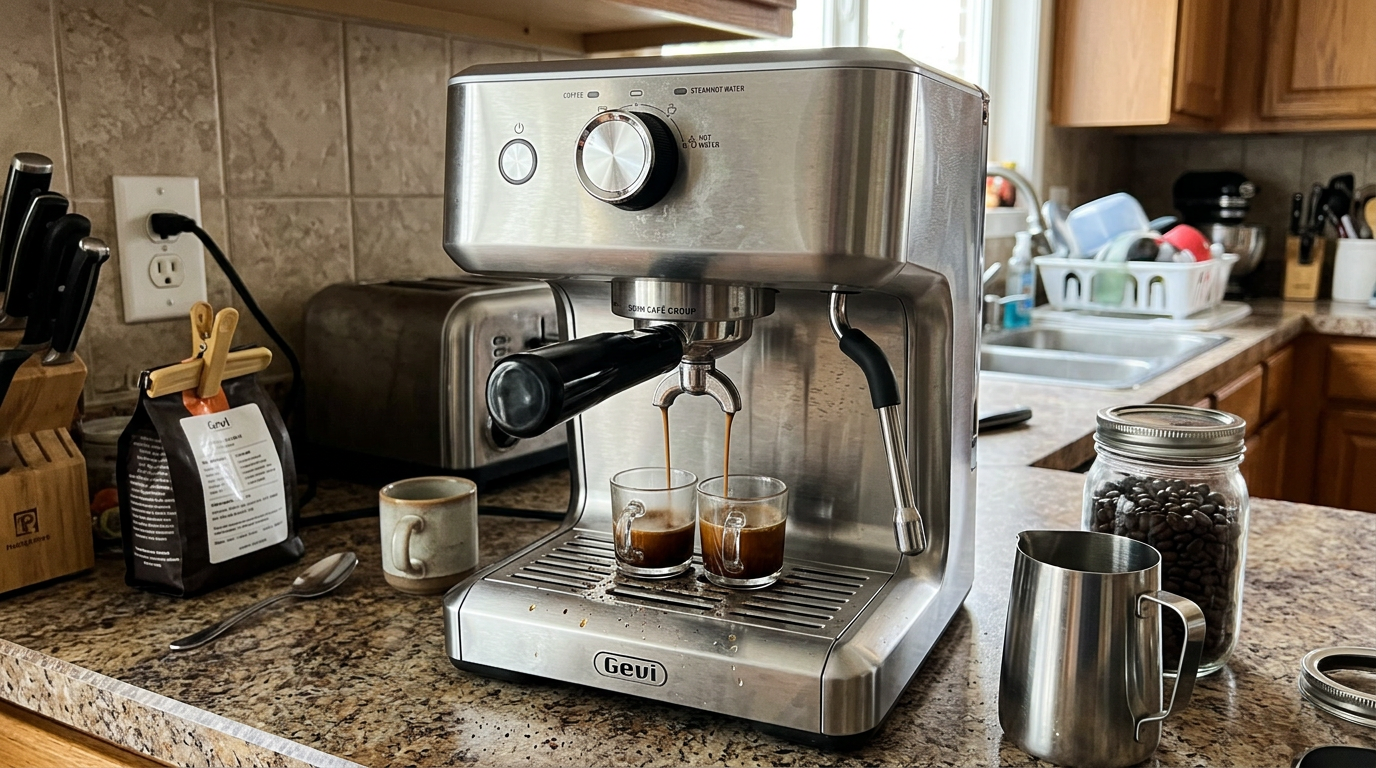
A double shot split into two glasses, with the milk pitcher ready for steaming.
Our tip: Start with cold milk straight from the fridge, because it gives you more time to stretch it before it gets too hot.
Hot water, Americanos and tea
Pulling the lever backward gives you hot water from the wand.
It's a small thing, but I used it every day.
For an Americano✕AmericanoAn espresso topped up with hot water. It keeps the espresso flavor but gives you a longer, milder drink, similar in strength to drip coffee., I pulled a double shot and then added about 120 to 150 ml of hot water.
Adding the water to the espresso, rather than the other way round, kept a little more crema on top.
It's also handy for tea, for warming cups and for anyone in the house who doesn't drink coffee.
| Drink | Espresso | Hot water | Notes |
|---|---|---|---|
| Short Americano | Double, about 36 g | About 90 ml | Strong, close to a long black |
| Classic Americano | Double, about 36 g | About 150 ml | My everyday mug |
| Large Americano | Double, about 40 g | About 220 ml | Milder, add a splash of milk |
| Cup warming | None | A splash | Swirl and pour away |
Why the grinder matters so much
I can't stress this enough: the Gevi 58mm is only as good as the grinder you pair it with.
It has no grinder of its own, and its single-wall baskets don't hide mistakes.
A good espresso grinder needs to do three things well.
It has to grind fine enough for espresso, it has to grind evenly, and it has to let you make small adjustments.
If the grounds are uneven, water finds the easy path through the coarse bits.
That's called channeling✕ChannelingWhen water finds a weak spot in the coffee puck and rushes through it, over-extracting that path and under-extracting the rest. The shot tastes sour and bitter at the same time., and it makes a shot taste sour and bitter at the same time.
| Grinder type | Works with this machine? | What to expect |
|---|---|---|
| Blade grinder | No | Uneven grind, fast and sour shots |
| Basic burr grinder for drip | Rarely | Often can't grind fine enough |
| Entry espresso burr grinder | Yes | Good shots with some fiddling |
| Stepless or micro-step espresso grinder | Yes, ideal | Full control and the best flavor |
For my testing I used an espresso burr grinder with fine steps, and it made the machine shine.
If you already own one, the Gevi is an easy recommendation.
If you don't, factor a grinder into your plans before you buy.
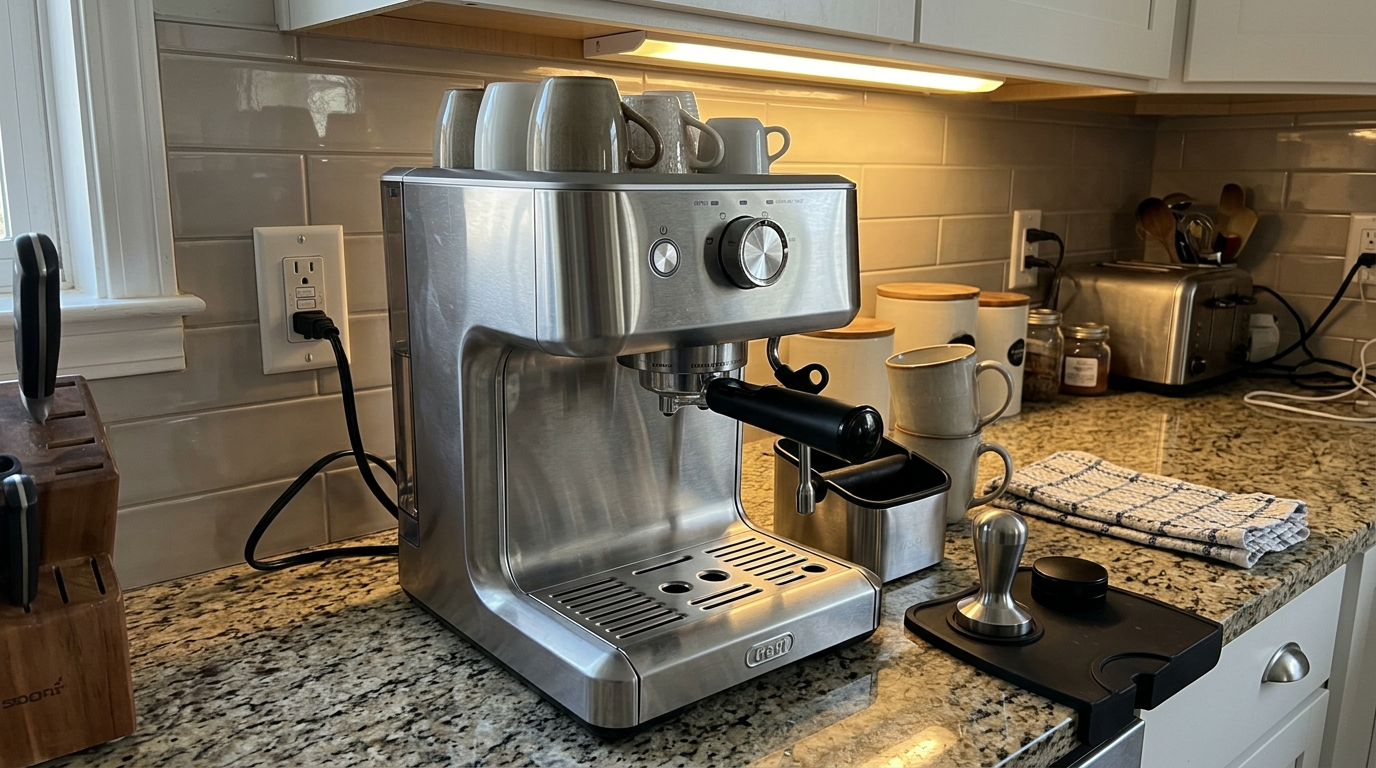
Paired with a proper burr grinder, the Gevi makes café-level espresso.
Our tip: Grind straight into the portafilter with a dosing funnel on top, so less coffee ends up on the counter.
Cleaning and maintaining the Gevi 58mm
Daily cleaning is quick, and the solenoid valve helps a lot.
Because the puck comes out dry, I could knock it out in one tap and rinse the basket in seconds.
The metal drip tray slides out easily and is sturdy enough that it doesn't flex when full.
The steam wand needs the most attention.
Milk dries on the tip fast, so wipe it with a damp cloth and purge it right after every use.
Every week or so, I unscrewed the tip and pushed the cleaning needle through the three holes.
| When | Task | Why it matters |
|---|---|---|
| After every shot | Knock out the puck and rinse the basket | Stops oils building up |
| After every milk drink | Wipe and purge the steam wand | Keeps milk out of the tip |
| Daily | Empty the drip tray and wipe the group | Prevents odors and stains |
| Weekly | Brush the shower screen and clean the steam tip | Keeps water flow even |
| Monthly | Backflush or clean the group as the manual advises | Removes coffee oils |
| Every 2–3 months | Descale, more often with hard water | Protects the heater and pump |
Descaling✕DescalingRunning a mild acid solution through the machine to dissolve mineral scale left by hard water. Scale slows heating and can block pipes. frequency depends on your water.
With moderately hard tap water, I'd plan on every two to three months.
With filtered or soft water, you can stretch that further.
My estimate of hands-on cleaning time per day.
The machine also has an eco mode that kicks in after a period of inactivity.
I liked that, because it's easy to leave an espresso machine on all morning without thinking.
What daily use is really like
My mornings fell into a simple rhythm within a few days.
Switch the machine on, put the cups on the warming tray and run a blank shot to heat the group.
While that happened, I weighed and ground the beans.
Distribute, tamp, lock in, press the double button and watch the gauge.
From switching on to sipping a flat white took me about five to six minutes.
That's longer than pressing one button on a fully automatic machine, and it always will be.
But it never felt like a chore, and the results were noticeably better.
Includes grinding, tamping and cleaning the portafilter.
Noise
The pump makes the usual buzz of a vibration pump, loud enough to notice but not harsh.
The steam wand hisses, as all steam wands do.
Your grinder will almost certainly be the loudest part of the routine.
The cup warmer
The metal tray on top gets warm while the machine is on.
It's not a powerful heater, but it takes the chill off small espresso cups.
A small shot loses a lot of heat to a cold cup, so I used it every day.
The metal cup-warming tray on top gets used every single morning.
Our tip: Keep your espresso cups on the warming tray, so the shot stays hot to the last sip.
Beans, water and milk
Because the Gevi gives you so much control, your ingredients matter a lot.
Use whole beans roasted within the last two to five weeks, and grind them right before brewing.
Medium and medium-dark roasts were the easiest to dial in.
Light roasts needed a finer grind, a higher temperature and a longer ratio, but rewarded the effort with bright, fruity shots.
| Bean type | Grind | Temperature | Ratio to try |
|---|---|---|---|
| Light roast | Finer | 203–204°F | 1:2.2 to 1:2.5 |
| Medium roast | Medium-fine | 201–202°F | 1:2 |
| Medium-dark blend | Medium-fine | 199–200°F | 1:1.8 to 1:2 |
| Dark, oily roast | Slightly coarser | 197–199°F | 1:1.5 to 1:1.8 |
Water
Use fresh, cold water and change it daily.
Filtered water tastes better and slows scale buildup.
Avoid distilled water, because coffee needs some minerals to extract properly and taste full.
Milk
Whole milk was the easiest to steam and tasted the sweetest.
For plant milk, barista versions of oat milk worked far better than standard cartons.
Common mistakes to avoid
The Gevi 58mm is rewarding, but a few habits will hold it back.
| Mistake | What happens | Better habit |
|---|---|---|
| Leaving the tank stopper in | Pump runs dry, no water | Remove it before the first fill |
| Using supermarket pre-ground coffee | Fast, sour, watery shots | Grind fresh with an espresso grinder |
| Trusting the factory shot buttons | Shots far too long | Program them with a scale |
| Brewing right after steaming | Shot runs too hot | Let the machine settle back first |
| Leaving milk on the wand | Blocked tip, sour smell | Wipe and purge straight away |
| Skipping the blank shot | First espresso tastes flat | Warm the group and portafilter first |
Change one setting at a time and taste after each change.
If you change the grind, dose and temperature together, you'll never know which one helped.
What I would change
A wider temperature range would help light-roast fans.
A dual heater, so you could steam and brew without waiting, would make a big difference for bigger households.
And I'd love a tank lid that's easier to reach when the machine sits under a cabinet.
Is the Gevi 58mm worth the money?
The Gevi 58mm earns its place by giving you the parts that matter in espresso.
A real 58mm group, a PID, a gauge, a timer, an OPV, a three-way solenoid valve and a capable steam wand.
That's a feature list you usually only see on more expensive machines.
The build quality backs it up, with metal almost everywhere you look.
Ask yourself three questions before you buy.
Do you own a good espresso grinder, or will you buy one? Do you enjoy the ritual of making coffee by hand? And are you happy to learn steaming technique?
If the answers are yes, this machine is easy to recommend.
If you want coffee at the press of one button, a fully automatic machine will make you happier.
Upgrades worth buying later
One of the nicest things about the Gevi 58mm is that it grows with you.
You don't need any of these on day one.
But after a few weeks, I found each of them made a clear, noticeable difference.
| Upgrade | What it fixes | How much it helped me |
|---|---|---|
| Small coffee scale with timer | Guessing doses and yields | Huge, the single best upgrade |
| Bottomless portafilter | Hidden channeling | Big, great for learning |
| Precision 18–20 g basket | Uneven extraction | Clear, sweeter shots |
| Puck screen | Messy shower screen | Moderate, easier cleaning |
| WDT tool | Clumpy grounds | Big with clumpy grinders |
| Calibrated tamper | Inconsistent tamping | Moderate, more repeatable |
My order would be a scale first, then a WDT tool, then a bottomless portafilter.
Those three teach you more about your shots than anything else.
Our tip: Buy a small scale that fits on the drip tray before any other accessory, because weighing shots fixes most problems.
How it compares with other espresso setups
The most useful comparison is with the kinds of machines you're likely choosing between.
The Gevi 58mm stands out for its commercial-size group, its feature list and its build.
| Feature | Gevi 58mm | Machine with built-in grinder | Fully automatic machine |
|---|---|---|---|
| Who grinds and tamps | You | Machine grinds, you tamp | Machine does it all |
| Espresso quality | Excellent with a good grinder | Good to very good | Good, consistent |
| Portafilter size | 58 mm, commercial | Often smaller | None |
| Temperature control | PID, adjustable | Varies | Preset levels |
| Milk | Manual steam wand | Manual steam wand | One-touch |
| Learning curve | Moderate | Moderate | Very low |
| Room to upgrade | Lots | Limited | Almost none |
A machine with a built-in grinder saves counter space and money upfront, but you're stuck with its grinder.
A fully automatic machine is far easier, but you give up control and the café-style texture of hand-steamed milk.
The Gevi sits in the enthusiast lane, with real control and plenty of room to grow.
| You mostly drink | Is the Gevi a fit? | Why |
|---|---|---|
| Straight espresso | Excellent | PID, gauge and 58mm accessories |
| Lattes and cappuccinos | Very good | Strong, dry steam and a flexible wand |
| Americanos | Very good | Dedicated hot water |
| Coffee at one touch | Poor | You grind, dose and tamp every time |
| Lots of milk drinks in a row | Fair | Single heater means short waits |
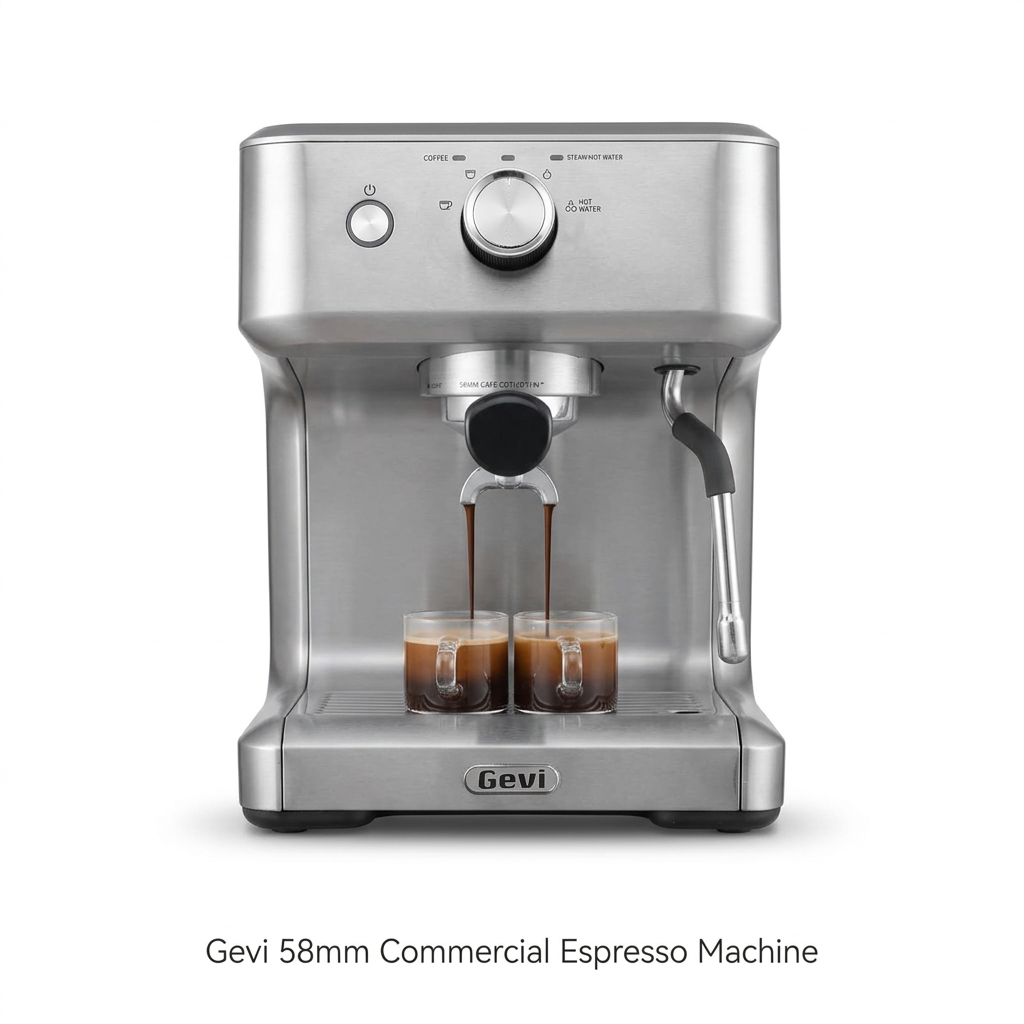
The full package: pressure gauge, single and double shot buttons and a 58mm portafilter.
Other Gevi machines I tested
If you'd rather have a grinder built in, the Gevi 20 Bar ECMI0 with grinder puts everything in one body.
For a smaller, simpler starter machine, see my Gevi 20 Bar ECM-5020ULSS review.
Which one is right for you: is the Gevi 58mm your match?
4 quick questionsGevi 58mm specifications
From manufacturer data and my own testing.
How I tested and scored the Gevi 58mm
For four weeks, Michael Reynolds and I used the Gevi 58mm as our everyday espresso machine for straight espresso, Americanos, lattes, flat whites and cappuccinos.
We pulled shots with the stock portafilter and a 58mm bottomless portafilter, logged dose, yield, time and pressure, and measured TDS with a refractometer.
We worked through the temperature range with light, medium and dark roasts, steamed whole, semi-skimmed, skim and oat milk, and followed the daily and weekly cleaning routine.
We then checked our notes against Gevi's specifications and owner documentation.
- Espresso (8.8): body, crema, flavor, TDS readings and consistency across back-to-back shots.
- Milk drinks (8.3): steam power, wand movement, microfoam texture and the wait between brewing and steaming.
- Ease of use (7.2): setup, programming, the learning curve and how forgiving it is.
- Build quality (8.6): materials, finish, portafilter feel and the included accessories.
The overall score of 8.2 is an editorial rating that reflects those four areas.
Gevi 58mm FAQ
Is the Gevi 58mm worth it?
Yes, if you own a good espresso grinder or plan to buy one. It gives you a commercial 58mm group, PID temperature control, a pressure gauge, a shot timer and a strong steam wand in a solid metal body.
Does the Gevi 58mm have a built-in grinder?
No. It's a semi-automatic machine, so you need a separate espresso grinder. Its single-wall baskets work best with fresh, finely and evenly ground beans.
Can I use pre-ground coffee?
You can, but supermarket pre-ground coffee is usually too coarse for single-wall baskets. Shots run fast and taste thin, so freshly ground beans give far better results.
What portafilter size does it use?
A 58mm three-ear portafilter, the common commercial size. Most 58mm bottomless portafilters, baskets, tampers and puck screens will fit.
What temperature does it brew at?
The default is about 202°F, and you can adjust it, up to about 204°F. Lighter roasts suit the top of the range and darker roasts a little lower.
How do I program the shot buttons?
Hold the single or double button for about three seconds, let the shot run onto a scale and press the button again at your target weight. The machine saves that volume.
Can it brew and steam at the same time?
No. It has a single heater, so after steaming it needs a short time to come back down to brewing temperature.
Does it make hot water for Americanos?
Yes. Pull the steam lever backward for hot water and push it forward for steam.
What is the three-way solenoid valve for?
It releases leftover pressure after a shot, so the puck comes out dry and the portafilter is easier and safer to remove.
How often should I descale it?
Every two to three months with moderately hard water, and less often with filtered or soft water. Follow the manual's descaling steps.
Is it good for latte art?
Yes. The ball-joint wand and three-hole tip produce dry, powerful steam that makes glossy microfoam with a little practice.
Kitchen & coffee tester
Michael spent six years as a line cook in restaurants in Chicago and New York, and he has tested kitchen appliances for HouseholdMe since 2018, from air fryers to coffee makers. He holds an SCA certificate in barista skills and used the Gevi 58mm as his everyday coffee machine for four weeks for this review.
- Four weeks of hands-on testing of the Gevi 58mm ECMN0
- Gevi product specifications and owner documentation
- General espresso brewing, milk steaming and maintenance guidance