Gevi ECM-5020ULSS review: a slim 20-bar espresso machine with a pressure gauge for small kitchens
The Gevi 20 Bar Espresso Machine ECM-5020ULSS squeezes a 20-bar pump, a pressure gauge and a steam wand into a slim stainless steel body. It's easy to learn and makes decent espresso from pre-ground coffee, but it shines with a proper grinder and has limited room under the spouts.

Michael Reynolds
Hands-on review
Hands-on testing, research, specs
4 weeks
22 minutes
Jargon helpNew to espresso? Tap any dotted term to see what it means.
In this review
Yes, if you want a first espresso machine for a small kitchen. The Gevi ECM-5020ULSS packs a 20-bar pump, a pressure gauge, a steam wand and hot water into a slim stainless steel body that fits where most machines won't. With the pressurized basket it makes a consistent, crema-topped espresso from good pre-ground coffee, and with a proper burr grinder and the single-wall basket it makes a noticeably richer shot. It has no grinder and no temperature control, clearance under the spouts is limited, and the single heater means you brew first and steam second.
Gevi ECM-5020ULSS at a glance
Gevi ECM-5020ULSS pros and cons
- Slim body fits tight counters
- Pressure gauge makes dialing in easier
- Forgiving pressurized basket for pre-ground coffee
- No grinder or temperature control
- Limited clearance for tall cups
- One heater, so brew first and steam second
Who should buy the Gevi ECM-5020ULSS?
- Small kitchens and apartments
- Beginners using pre-ground coffee
- Cappuccino lovers happy to steam by hand
- Anyone who wants one-touch coffee
- Light-roast fans who need temperature control
- People who brew straight into tall mugs
First impressions of the Gevi ECM-5020ULSS
Not everyone has room for a big espresso setup.
Plenty of kitchens have one spare corner of counter, wedged between the kettle and the knife block.
That's exactly where the Gevi 20 Bar Espresso Machine ECM-5020ULSS wants to live.
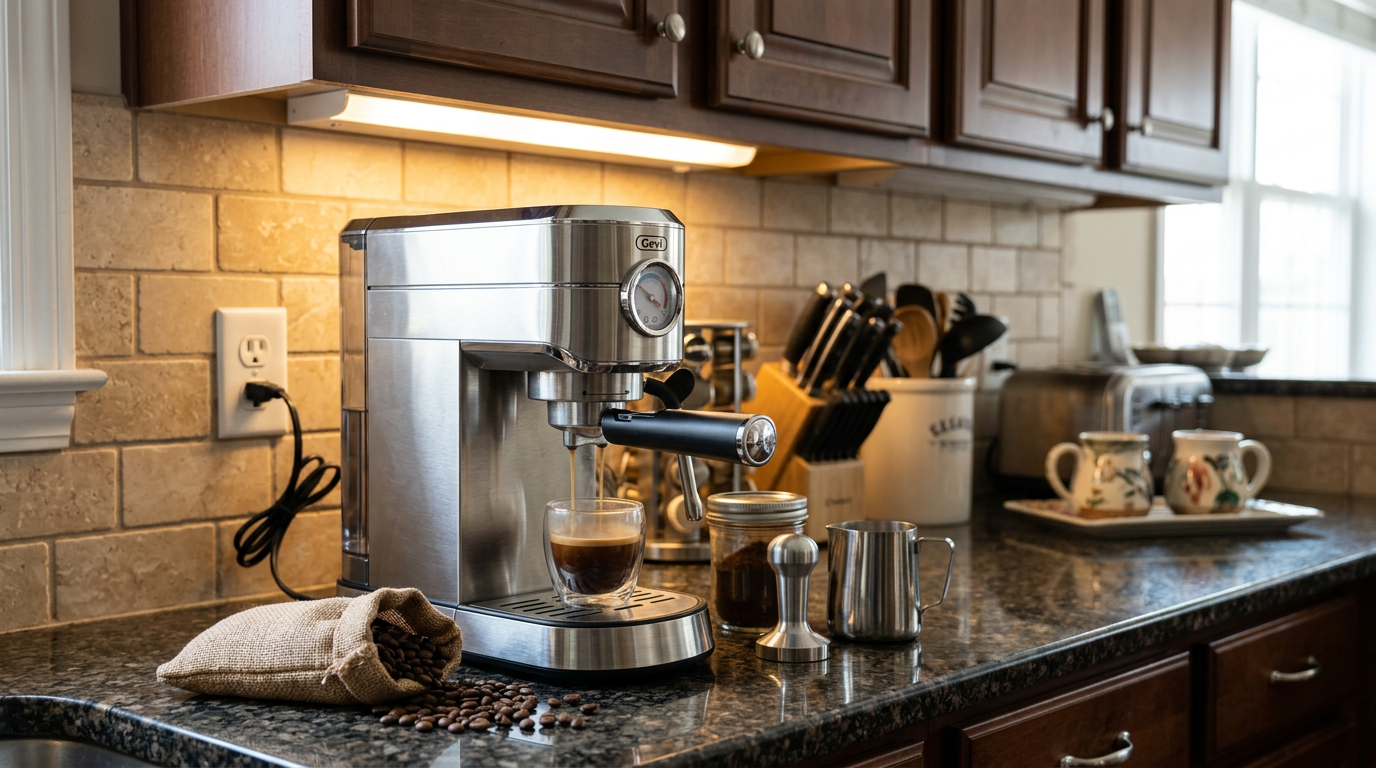
It's a slim, upright machine in brushed and polished stainless steel, much narrower than most espresso makers.
The first thing I noticed on the front was the round pressure gauge on the left, a feature you don't always get on compact machines.
Next to it sits a single control knob, and the steam wand hangs off the right side.
On top there's a flat cup-warming tray, and at the bottom a chrome drip tray with a grille.
Michael and I set it up in a small galley kitchen to see how it fits real life rather than a showroom.
It slid into a space next to the knife block that no other machine we've tested would fit.
My first espresso, made with fresh pre-ground coffee in the pressurized basket, had a thick, foamy crema straight away.
Not the most complex shot I've ever tasted, but a genuinely satisfying start for a machine this small and simple.
The ECM-5020ULSS is narrow enough to fit where most espresso machines won’t.
What the Gevi ECM-5020ULSS actually is
The ECM-5020ULSS is a compact, semi-automatic espresso machine.
You add ground coffee to the portafilter, tamp it and lock it in, and the machine pumps hot water through it.
For milk drinks, you steam milk by hand with the wand.
There's no built-in grinder, so you'll either use pre-ground coffee or a separate grinder.
It uses a 20-bar pump, but the number on the box isn't what makes good espresso.
What matters is the pressure that actually reaches the coffee, and on the gauge my shots sat in the classic range of roughly 9 to 10 bar once the grind was right.
Heating comes from a fast thermoblock✕ThermoblockA compact heater that warms water as it flows through, instead of keeping a whole boiler hot. It heats up fast and uses less standby energy., so you're not waiting long in the morning.
Gevi ECM-5020ULSS design and setup
The design is the main reason to choose this machine.
The Gevi ECM-5020ULSS is tall and narrow rather than wide, with most of its depth hidden behind the group head.
The stainless steel body looks smart and wipes clean easily, although polished parts do show fingerprints.
The water tank sits at the back.
That keeps the machine slim, but it means you need to pull it forward a little to lift the tank out if it lives under a cabinet.
The drip tray slides out from the front and has a chrome grille that looks good and cleans easily.
Cup clearance
Under the spouts there's enough room for an espresso cup or a small cappuccino cup.
Tall latte glasses and big mugs won't fit under the portafilter, so I brewed into a small cup and poured.
If you want to brew straight into a large mug, that's worth knowing before you buy.
First-time setup
Setup took me about ten minutes.
Wash the portafilter, baskets and tank, fill the tank and seat it firmly at the back.
Then run water through the group head and the steam wand a few times to flush the system.
After that, it's ready for the first shot.
Our tip: Flush a full tank of water through the group and steam wand before your first coffee, to clear any factory taste.
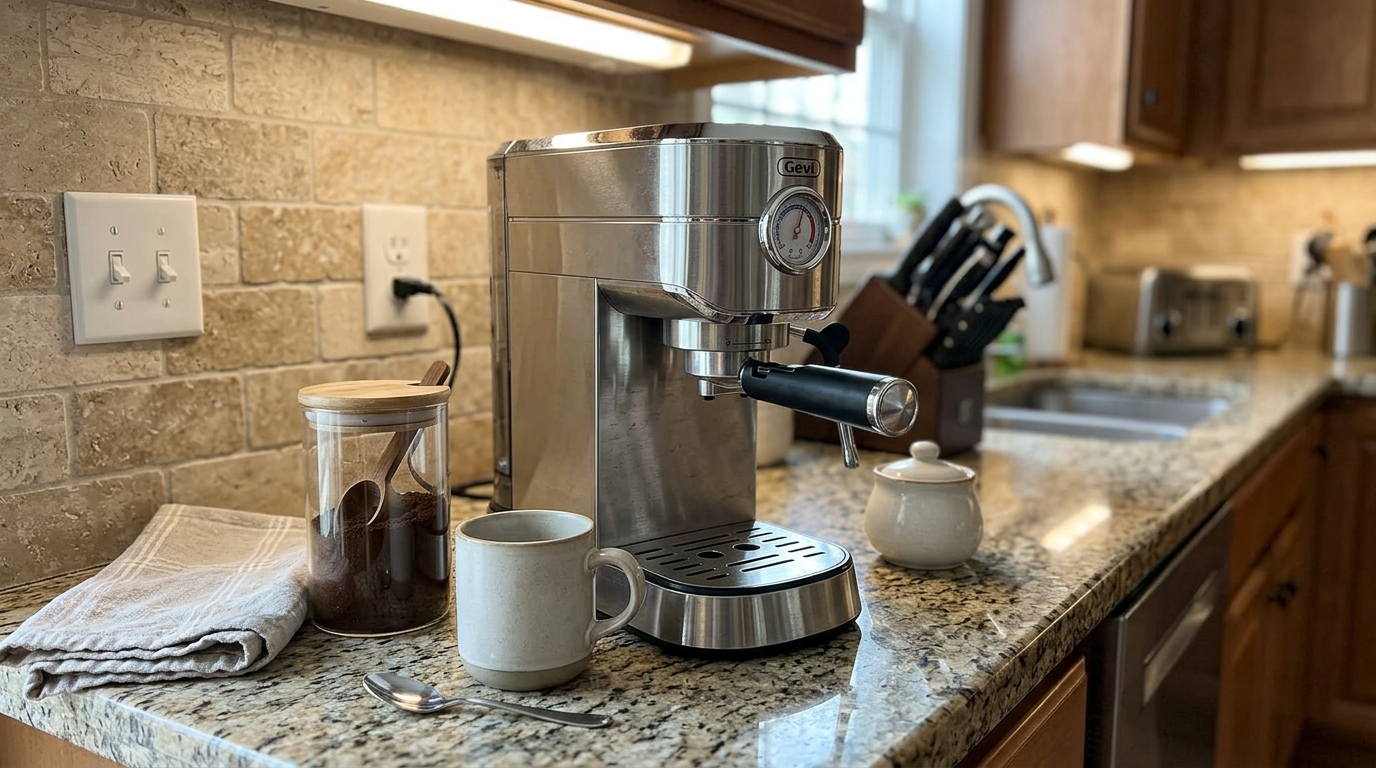
It shares the counter comfortably with a knife block and a jar of beans.
Controls and the pressure gauge
The controls are simple enough to learn in a single morning.
You pick the single or double basket, start the shot and stop it when the cup looks right, and the knob switches between hot water and steam.
That's it, and for a beginner that's a big plus.
The pressure gauge is the feature I came to rely on most.
It shows straight away if your coffee is ground too coarse or too fine.
Pressure isn't everything, but it's a quick sanity check on your grind.
With the pressurized basket, the gauge reads higher regardless of grind, because the basket itself creates resistance.
With the single-wall basket, it becomes a genuinely useful dial-in tool.
Our tip: Watch the gauge on your first few shots, because it tells you more about your grind than the crema does.
Pressurized vs single-wall baskets
Like many compact machines, the ECM-5020ULSS works best when you understand its filter baskets.
Pressurized baskets✕Pressurized basketA basket with a second, inner wall and a single tiny exit hole. It creates artificial resistance, so even coarse or stale coffee produces a crema-topped shot. Forgiving, but less flavorful. have a double wall that builds resistance on its own.
They make good-looking shots with supermarket pre-ground coffee, which is exactly what most people start with.
Single-wall baskets✕Single-wall (non-pressurized) basketA filter basket with one layer of holes. All the resistance comes from the coffee itself, so the grind and tamp have to be right. rely on the coffee itself for resistance.
They need a fine, fresh grind from a proper burr grinder, but they reward you with more body and flavor.
| Pressurized basket | Single-wall basket | |
|---|---|---|
| Coffee | Pre-ground works fine | Freshly ground, fine and even |
| Crema | Foamy, looks great | Finer, denser |
| Flavor | Pleasant, a bit flat | Richer, more depth |
| Forgiveness | Very forgiving | Needs a good grinder |
| Best for | Getting started, busy mornings | Learning proper espresso |
For most people buying this machine, the pressurized basket and good pre-ground coffee will be the everyday setup.
That's not a compromise to be embarrassed about.
It makes a consistent, crema-topped espresso with almost no fuss.
Gevi ECM-5020ULSS espresso performance
I tested the Gevi ECM-5020ULSS with three setups: supermarket espresso grounds, fresh pre-ground coffee from a local roaster and freshly ground beans from a burr grinder.
For each, I used about 16 to 18 grams of coffee and aimed for roughly twice that weight in espresso, in 25 to 30 seconds.
That brew ratio✕Brew ratioThe weight of coffee in versus the weight of espresso out. 18 g in and 36 g out is a 1:2 ratio, a common starting point for espresso. of about 1:2 is a classic starting point.
| Setup | Basket | Time | Crema | How it tasted |
|---|---|---|---|---|
| Supermarket espresso grounds | Pressurized | ~25 s | Thick, foamy | Roasty, a little flat |
| Fresh roaster pre-ground | Pressurized | ~27 s | Thick, finer bubbles | Chocolatey, pleasant |
| Fresh pre-ground | Single-wall | ~12 s | Thin, pale | Sour and watery |
| Freshly ground, burr grinder | Single-wall | ~28 s | Dense, hazelnut | Fullest body, sweetest |
The pattern was clear.
In the pressurized basket, the machine made a reliable, decent espresso with almost any coffee.
In the single-wall basket, it needed a proper espresso grind, but rewarded it with a noticeably sweeter, fuller shot.
Temperature and consistency
Thermoblock machines can run a little hot or cool from shot to shot.
I pulled three doubles in a row, a minute apart, and they tasted close enough that I wouldn't have noticed without paying attention.
The first shot of the morning was the weakest, until I started running a blank shot to warm the portafilter.
| What you taste or see | Likely cause | First change |
|---|---|---|
| Sour, thin, very fast | Grind too coarse or basket too forgiving for it | Use the pressurized basket or grind finer |
| Bitter and harsh | Shot ran too long | Stop the shot earlier |
| Lukewarm espresso | Cold portafilter and cup | Run a blank shot, use the cup warmer |
| Weak, watery | Too little coffee | Fill the basket to just below the rim |
| Coffee leaks around the portafilter | Grounds on the rim | Wipe the rim before locking in |
Our tip: Fill the basket to just below the rim and tamp firmly, because an underfilled basket makes a weak, watery shot.
Steam wand and milk drinks
The steam wand on the right side swings out so you can get a pitcher under it.
After brewing, turn the knob to steam, wait a short moment for the thermoblock to heat up and you're ready.
Because there's one heater, you brew first and steam second.
How the steam performed
Steam power was decent for a compact machine.
It's not the fastest wand I've used, but slower steam is actually easier to control while you learn.
150 ml of cold whole milk took me about 50 to 70 seconds to reach drinking temperature.
With some practice, I got a smooth, glossy microfoam✕MicrofoamMilk foam with bubbles so small you can't see them. It feels silky and blends into the coffee instead of sitting on top like froth. suitable for a latte, and thicker foam for a cappuccino.
My ratings on a 10-point scale for texture and stability.
| Drink | Espresso | Milk | Texture |
|---|---|---|---|
| Cappuccino | Double | Small, about 120 ml | Thick, airy foam |
| Latte | Double | Larger, about 200 ml | Thin, glossy |
| Flat white | Double | About 130 ml | Very fine, silky |
| Cortado | Double | About 60 ml | Barely foamed |
Use a small stainless pitcher, around 350 ml, and fill it to just below the spout.
Keep the tip just under the surface at first to add air, then lower it and let the milk spin.
Our tip: Purge the steam wand for a second before and after each use, so you get dry steam and no milk dries in the tip.
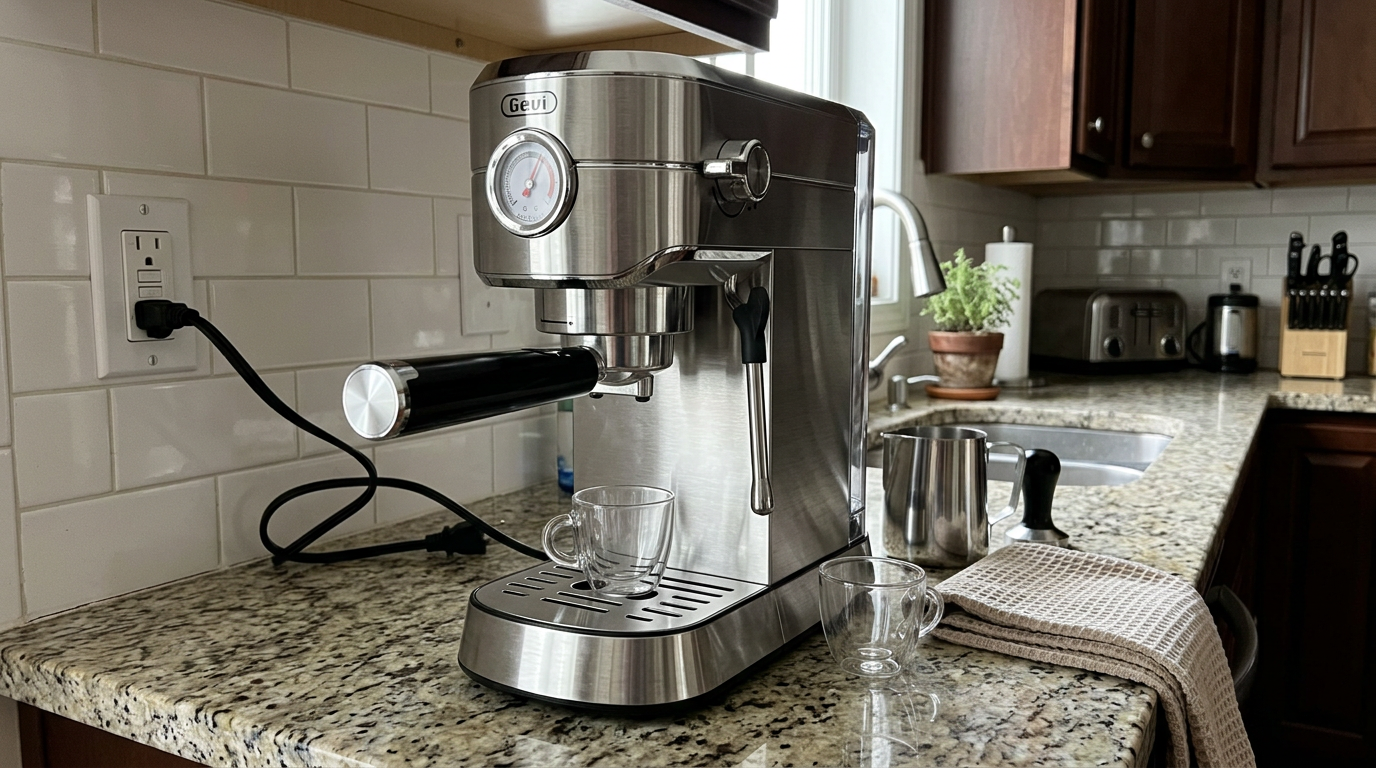
The steam wand on the right swings out for the milk pitcher.
Hot water and Americanos
The same knob gives you hot water through the wand.
For an Americano✕AmericanoAn espresso topped up with hot water. It keeps the espresso flavor but gives you a longer, milder drink., I pulled a double into a small cup, poured it into a mug and topped it up with about 120 to 180 ml of hot water.
It's handy for tea too, and for pre-heating cups.
Pre-ground coffee or a grinder?
This is the biggest decision you'll make with this machine.
The ECM-5020ULSS doesn't grind, so the quality of your coffee comes down to what goes into the basket.
| Coffee source | Which basket | What to expect |
|---|---|---|
| Supermarket espresso grounds | Pressurized | Decent, consistent, a bit flat |
| Fresh pre-ground from a roaster, used within a week | Pressurized | Noticeably better aroma and sweetness |
| Blade grinder | Pressurized | Uneven, but workable |
| Burr grinder made for espresso | Single-wall | Best flavor and body by far |
If you're just starting, buy fresh espresso-ground coffee from a local roaster in small bags.
Pre-ground coffee goes stale quickly once the bag is open, so use it within a week or two.
If you get hooked, a burr grinder that can grind fine enough for espresso is the single biggest upgrade you can make.
Our tip: Buy small bags of fresh espresso-ground coffee and keep them sealed, because pre-ground coffee loses aroma within days.
Five drinks I made every week
Once the basics clicked, these five drinks became my regular rotation.
Each one is easy on the Gevi ECM-5020ULSS, and together they cover most of what people order in a café.
| Drink | Basket | Coffee | Milk or water | My tip |
|---|---|---|---|---|
| Classic espresso | Double, pressurized | Medium roast | None | Stop the shot when it turns pale |
| Americano | Double, pressurized | Medium-dark | About 150 ml hot water | Add water to espresso, not the reverse |
| Cappuccino | Double | Medium-dark | About 120 ml milk, thick foam | Stretch the milk for longer |
| Latte | Double | Medium-dark | About 200 ml milk, thin foam | Keep the tip low after a short stretch |
| Iced latte | Double | Medium | Cold milk over ice | Pull the shot into a cup, then pour over ice |
The iced latte deserves a mention.
The machine has no cold program, but a double shot poured over ice and cold milk worked really well in warm weather.
Pull the shot into a small cup first, then pour it over the ice, so the hot espresso doesn't crack a glass.
Getting stronger milk drinks
If your lattes taste too milky, use less milk rather than more coffee.
The double basket is the strongest option, so a smaller cup is the easiest way to boost coffee flavor.
A medium-dark roast also cuts through milk better than a light one.
Cleaning and maintaining the Gevi ECM-5020ULSS
Cleaning a machine this simple is quick.
After each shot, knock out the puck and rinse the basket.
After every milk drink, wipe the wand with a damp cloth and purge it.
| When | Task | Why it matters |
|---|---|---|
| After every shot | Knock out the puck, rinse the basket | Prevents oily buildup |
| After every milk drink | Wipe and purge the steam wand | Stops milk drying in the tip |
| Daily | Empty the drip tray, wipe the group head | Prevents odors and stains |
| Weekly | Wash the baskets, portafilter and tank | Removes coffee oils |
| Every 2–3 months | Descale, more often with hard water | Protects the thermoblock |
Descaling✕DescalingRunning a mild acid solution through the machine to dissolve mineral scale left by hard water. Scale slows heating and can block pipes. matters more on small thermoblock machines, because scale builds up quickly in the narrow water channels.
If you have hard water, filtered water in the tank will make a real difference.
My estimate of hands-on cleaning time per day.
The stainless body only needs a wipe with a damp microfiber cloth.
Avoid abrasive pads, which will scratch the polished panels.
What daily use is really like
My routine settled quickly.
Switch on, run a blank shot while it heats, then fill and tamp the basket.
Lock in, brew, and if I wanted milk, switch to steam afterward.
From switching on to sipping an espresso took about two minutes.
A cappuccino took about three and a half to four.
Timed from switching the machine on, using pre-ground coffee.
Noise
The pump buzzes during the shot, as all vibration pumps do, but it's not harsh.
Without a grinder, the whole routine is quieter than most espresso setups.
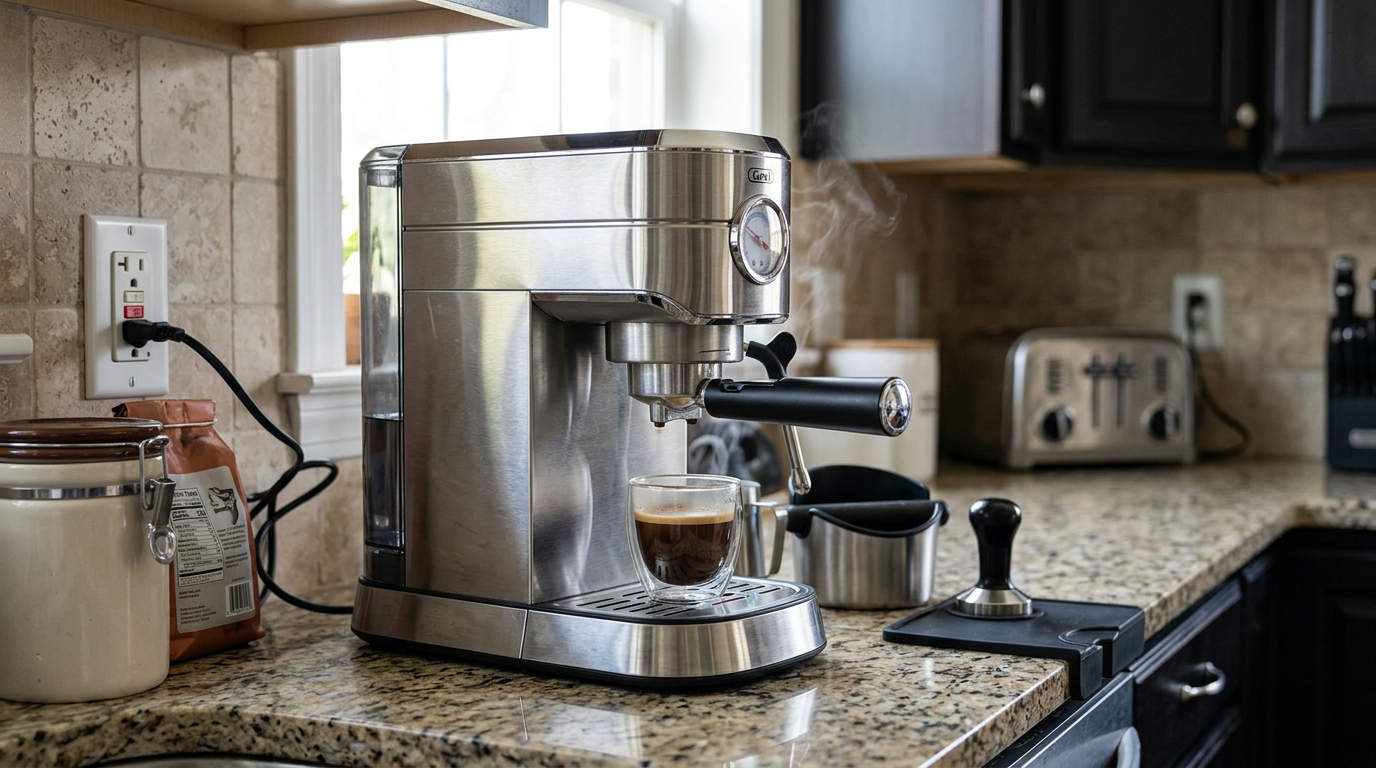
A double shot pouring into a glass cup, with a little room to spare under the spouts.
Our tip: Keep your cups on the top tray while the machine heats, so the espresso stays hot longer.
Coffee, water and milk
Medium and medium-dark roasts suited this machine best.
They produced chocolatey, rounded shots in the pressurized basket and made great lattes.
Light roasts can taste sharp and thin on a simple thermoblock machine, so I'd save those for a machine with temperature control.
| Roast | How it worked | Best drink |
|---|---|---|
| Medium | Balanced, sweet | Espresso and flat whites |
| Medium-dark | Chocolatey, bold | Lattes and cappuccinos |
| Dark | Roasty, can taste bitter | Milk drinks |
| Light | Sharp, thin | Not ideal here |
Water and milk
Use fresh, cold, filtered water and change it daily.
For milk, whole milk froths easiest, and barista oat milk is the best plant-based choice.
Small kitchen test
Because size is the headline here, I tested the Gevi ECM-5020ULSS in three different spots.
The goal was simple: can you actually use it comfortably in a tight space, not just fit it there?
| Spot | Fit | Usability |
|---|---|---|
| Between knife block and kettle | Fits easily | Good, wand swings out to the right |
| Under a low wall cabinet | Fits | Pull forward slightly to lift the tank |
| Corner of an L-shaped counter | Fits | Wand side needs a little clearance |
In every spot it fit, and in every spot I could make a latte without moving other appliances.
The only habit to build is pulling it forward a few inches to remove the rear tank.
Dosing and tamping without a scale
Most people buying a compact machine won't own a coffee scale, at least at first.
So I tested how far you can get with just the scoop and your eyes.
The answer is: surprisingly far, as long as you're consistent.
The key is to fill the basket the same way every time.
A slightly heaped basket, leveled flat, then a firm, level tamp gave me consistent shots in the pressurized basket all week.
Tamping✕TampingPressing the ground coffee into a firm, flat puck so water passes through it evenly instead of finding loose, easy paths. doesn't need a bodybuilder's strength.
Press until the coffee stops giving, keep the tamper level and stop.
When a scale is worth buying
If you move to the single-wall basket and a burr grinder, a small scale becomes very useful.
Weighing the coffee in and the espresso out is the fastest way to understand why one shot tastes better than another.
Until then, consistent scooping works fine.
Our tip: Level the coffee with a straight edge before you tamp, so the puck is the same height every time.
Troubleshooting the problems I hit
Over four weeks, a handful of small problems came up.
Every one of them had a quick fix.
| Problem | What I noticed | Fix that worked |
|---|---|---|
| Portafilter hard to lock in | Basket overfilled | Use slightly less coffee or tamp firmer |
| Water drips around the portafilter | Grounds on the rim or loose lock | Wipe the rim, twist firmly to lock |
| Steam sputters water | Wand not purged, still heating | Purge first, wait for steam temperature |
| Gauge stays low | Coarse grounds in single-wall basket | Switch to the pressurized basket |
| Espresso tastes burnt | Very dark roast | Try a medium or medium-dark roast |
| Machine heats slowly after weeks | Scale building up | Descale with a proper solution |
The most common mix-up by far was using the single-wall basket with ordinary pre-ground coffee.
The shot gushes, the gauge barely moves and it's easy to think the machine is at fault.
Swap to the pressurized basket and the same coffee suddenly works.
What surprised me most
I expected the gauge to be a gimmick on a machine this small.
Instead, it was the most useful teaching tool on the machine.
Watching the needle helped me understand grind and tamp faster than any amount of reading.
The other surprise was how well it handled milk for its size, once I learned to purge the wand and be patient.
Cheap upgrades worth buying
You don't need any of these to start, but each made the Gevi ECM-5020ULSS better in my testing.
| Upgrade | What it fixes | Worth it? |
|---|---|---|
| Small stainless milk pitcher | Messy steaming in a mug | Essential for milk drinks |
| Solid metal tamper | Uneven tamping | Yes |
| Small coffee scale | Guessing doses | Yes, once you use a grinder |
| Burr grinder for espresso | Stale, uneven pre-ground coffee | The biggest upgrade |
| Knock box | Messy puck disposal | Nice to have |
Common mistakes to avoid
The ECM-5020ULSS is easy to use, but a few habits will hold it back.
| Mistake | What happens | Better habit |
|---|---|---|
| Using the single-wall basket with supermarket grounds | Fast, sour, watery shots | Use the pressurized basket |
| Underfilling the basket | Weak espresso | Fill to just below the rim |
| Skipping the warm-up shot | First espresso tastes flat and cool | Run a blank shot first |
| Steaming before brewing | Long wait for the shot | Brew first, then steam |
| Leaving milk on the wand | Blocked tip, sour smell | Wipe and purge straight away |
| Ignoring descaling | Slower heating, weaker steam | Descale every 2–3 months |
Change one thing at a time and taste after each change.
That's the fastest way to learn what actually makes your coffee better.
What I would change
A little more room under the spouts would make it easier to brew into larger cups.
A front-loading water tank would suit under-cabinet spots better.
And a metal tamper in the box would be a nice upgrade.
Four weeks in: how it held up
Short tests can hide problems, so we kept the machine on the counter as our only espresso maker for a full month.
It made somewhere between 120 and 150 drinks over that time, mostly doubles and lattes.
| Area | Week 1 | Week 4 |
|---|---|---|
| Espresso taste | Good with pre-ground | Better, after dialing in routine |
| Steam performance | Slower while learning | Consistent, glossy milk |
| Build and finish | Spotless | Some fingerprints, no wear |
| Portafilter lock | Stiff | Smooth and easy |
| Leaks or faults | None | None |
The portafilter lock loosened up nicely after the first week, which made daily use smoother.
The polished panels picked up fingerprints, but a quick wipe kept it looking new.
We had no leaks, no error messages and no drop in steam power.
My own day-to-day satisfaction score, which rose as the routine became second nature.
That climbing score says a lot about this machine.
It's easy to get going on day one, and it gets more enjoyable as you learn a few simple habits.
Our tip: Wipe the polished panels with a dry microfiber cloth after cleaning, so water spots and fingerprints don’t build up.
Is the Gevi ECM-5020ULSS worth the money?
The ECM-5020ULSS makes the most sense as a first espresso machine for a small kitchen.
You get a 20-bar pump, a pressure gauge, a steam wand and hot water in a slim stainless body.
It's simple to learn, and the pressurized basket makes decent espresso from day one.
Ask yourself three questions before you buy.
Is counter space tight? Are you happy using pre-ground coffee, at least at first? And do you mostly make one or two drinks at a time?
If the answers are yes, it's an easy recommendation.
If you already own a good grinder and want to chase the best possible shot, you'll get more from a machine with temperature control.
It's also worth thinking about what else you won't need to buy.
There's no separate milk frother to find space for, and no kettle needed for Americanos or tea.
For a small kitchen, replacing two or three gadgets with one slim machine is a real win.
The main extra I'd budget for is a small stainless milk pitcher, and later, if you catch the espresso bug, a burr grinder.
Check what's included where you buy, because accessories can vary between listings and bundles.
How it compares with other espresso setups
The most useful comparison is with the kinds of machines you're likely choosing between.
The Gevi ECM-5020ULSS stands out for its slim footprint, its pressure gauge and its simplicity.
| Feature | Gevi ECM-5020ULSS | Machine with built-in grinder | Fully automatic machine |
|---|---|---|---|
| Footprint | Slim and compact | Wider and taller | Larger |
| Grinder | None | Built in | Built in |
| Espresso quality | Good, better with a grinder | Good to very good | Good, consistent |
| Pressure gauge | Yes | Varies | No |
| Milk | Manual steam wand | Manual steam wand | Often one-touch |
| Learning curve | Low | Moderate | Very low |
| Works with pre-ground | Yes, pressurized basket | Yes | Sometimes |
A machine with a built-in grinder gives you fresher coffee in one appliance, but takes more space.
A fully automatic machine is easier still, but costs more and gives up the hands-on milk texture.
The ECM-5020ULSS keeps things small, simple and approachable.
| You mostly drink | Is it a fit? | Why |
|---|---|---|
| Espresso | Good | Gauge helps, best with fresh coffee |
| Cappuccinos and lattes | Good | Decent steam wand |
| Americanos | Very good | Hot water on tap |
| Large mugs straight from the machine | Fair | Limited clearance under the spouts |
| Light roasts | Fair | No temperature control |
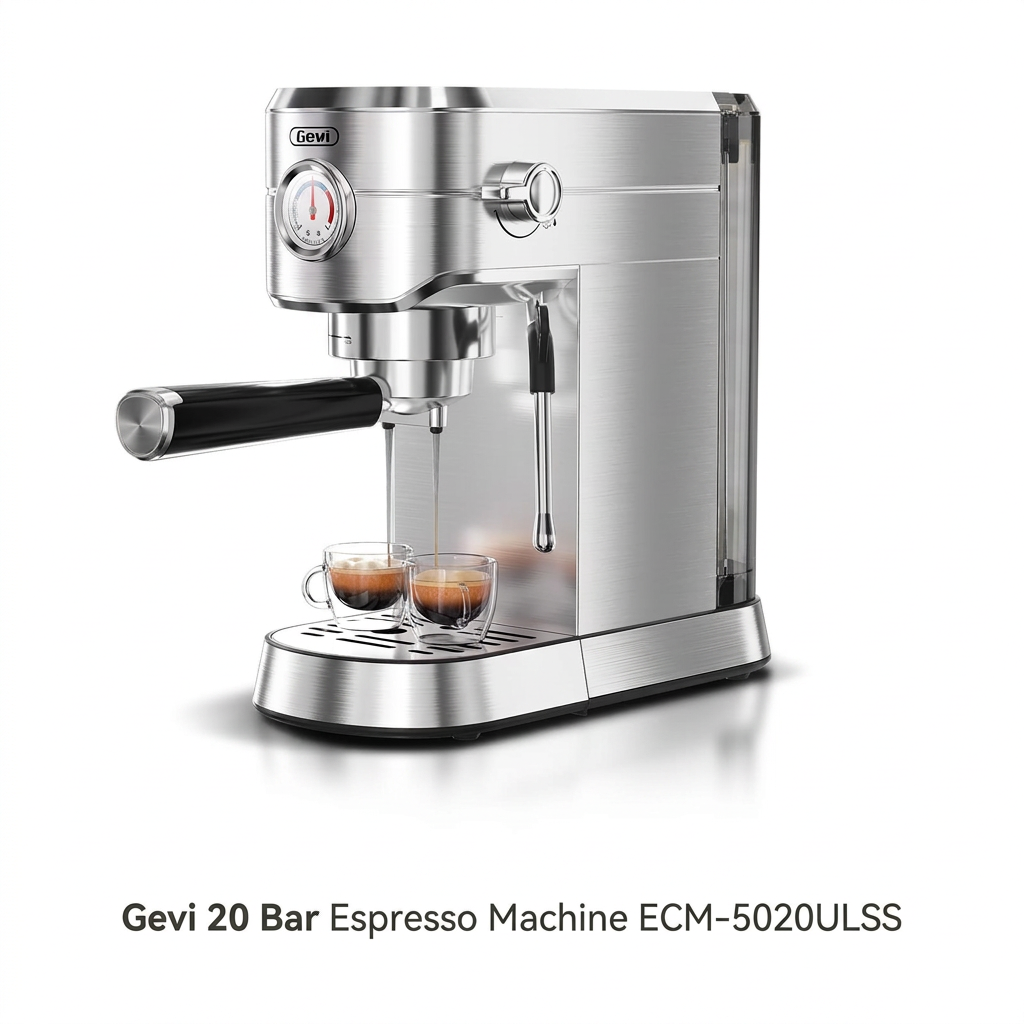
The full package: pressure gauge, control knob, steam wand and a slim stainless body.
Other Gevi machines I tested
If you want a grinder built in, the Gevi ECMI0 adds a 30-setting burr grinder and a 58mm portafilter.
If you already own a good grinder, the Gevi 58mm Commercial adds PID temperature control, a shot timer and a solenoid valve.
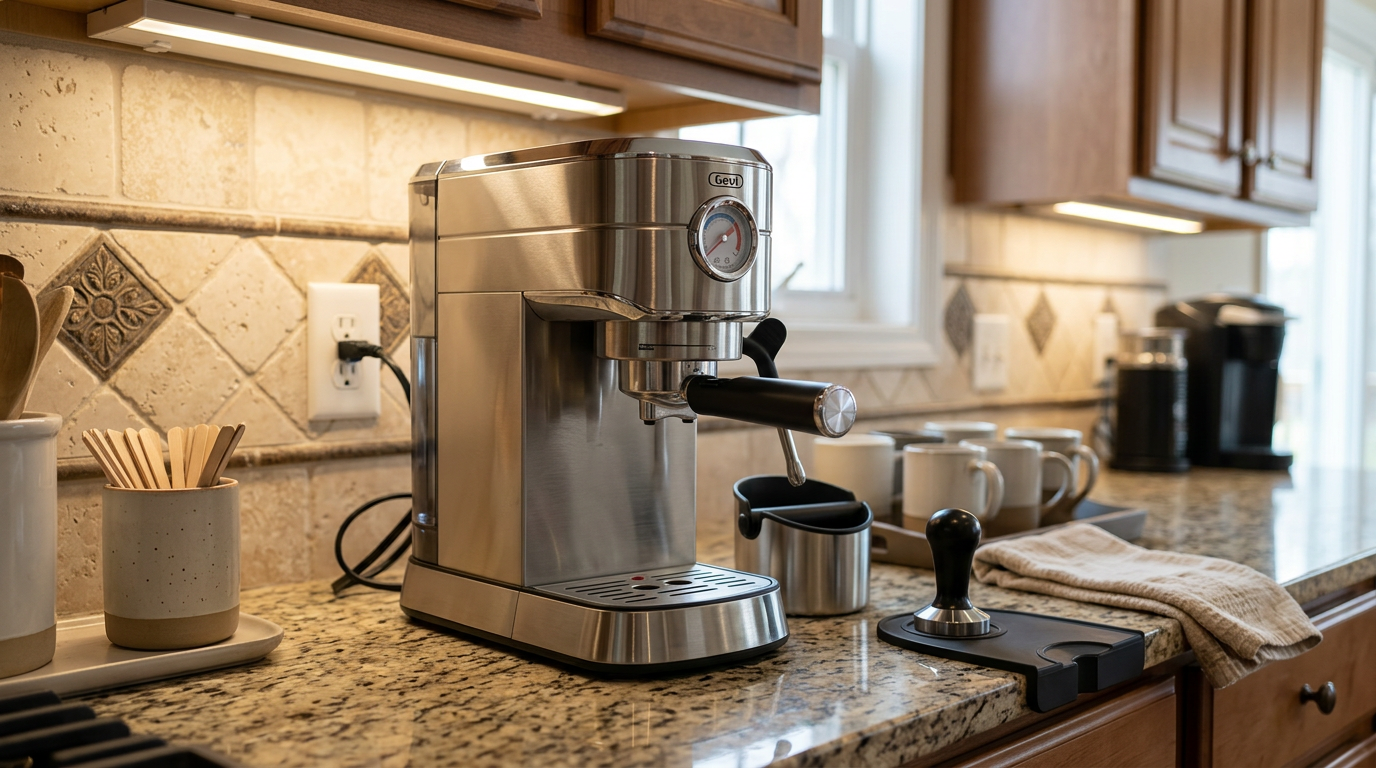
Under-cabinet lighting shows off the polished stainless finish.
Which one is right for you: is the Gevi ECM-5020ULSS your match?
4 quick questionsGevi ECM-5020ULSS specifications
From manufacturer data and my own testing.
How I tested and scored the Gevi ECM-5020ULSS
For four weeks, Michael Reynolds and I used the Gevi ECM-5020ULSS as our only espresso machine in a small galley kitchen.
We made straight espresso, Americanos, cappuccinos, lattes and flat whites, roughly 120 to 150 drinks in total.
We compared supermarket grounds, fresh pre-ground coffee from a roaster and freshly ground beans from a burr grinder, in both the pressurized and single-wall baskets, and watched the pressure gauge on every shot.
We steamed whole, semi-skimmed, skim and oat milk, timed each drink, tested the machine in three tight counter spots and followed the daily and weekly cleaning routine.
We then checked our notes against Gevi's product information and owner documentation.
- Espresso (7.3): body, crema and consistency with pre-ground and freshly ground coffee in both baskets.
- Milk drinks (7.2): steam power, microfoam texture and the brew-then-steam workflow.
- Ease of use (8.1): setup, controls, the pressure gauge and how forgiving it is for beginners.
- Compact design (8.6): footprint, layout, build quality and how well it works in a small kitchen.
The overall score of 7.4 is an editorial rating that reflects those four areas.
Gevi ECM-5020ULSS FAQ
Is the Gevi ECM-5020ULSS worth it?
Yes, if you want a simple first espresso machine for a small kitchen. It has a pressure gauge, a steam wand and hot water in a slim stainless body, but no grinder or temperature control.
Does it have a built-in grinder?
No. Use pre-ground espresso coffee in the pressurized basket, or a separate burr grinder with the single-wall basket.
Can I use pre-ground coffee?
Yes. Use the pressurized basket, which is designed to make a good shot with pre-ground coffee. Fresh grounds from a local roaster taste noticeably better than supermarket coffee.
Which basket should I use?
Use the pressurized basket with pre-ground coffee. Switch to the single-wall basket only when you grind fresh beans finely with a proper espresso grinder.
What does the pressure gauge show?
It shows the pressure during a shot. With the single-wall basket, about 9 to 10 bar means your grind is in the right range, while a low reading means it's too coarse.
Can it make lattes and cappuccinos?
Yes. The steam wand heats and textures milk, so you can make lattes, cappuccinos and flat whites with a small stainless pitcher.
Can it brew and steam at the same time?
No. It has a single thermoblock, so brew the espresso first, then switch to steam.
Will a tall mug fit under the spouts?
Usually not. There's room for an espresso or small cappuccino cup, so brew into a small cup and pour into a larger mug.
Does it make hot water for Americanos?
Yes. The control knob also switches the wand to hot water.
How often should I descale it?
Every two to three months with moderately hard water, more often with very hard water, and less often with filtered water.
Is it good for beginners?
Yes. The controls are simple, the pressurized basket is forgiving and the gauge helps you learn what a good shot looks like.
How long does it take to make a cappuccino?
About three and a half to four minutes from switching on, including warming up, brewing and steaming.
Kitchen & coffee tester
Michael spent six years as a line cook in restaurants in Chicago and New York, and he has tested kitchen appliances for HouseholdMe since 2018, from air fryers to coffee makers. He holds an SCA certificate in barista skills and used the Gevi ECM-5020ULSS as his everyday coffee machine for four weeks for this review.
- Four weeks of hands-on testing of the Gevi ECM-5020ULSS
- Gevi product information and owner documentation
- General espresso brewing, milk steaming and maintenance guidance