Gaggia Magenta Prestige review: 12 one-touch drinks, a smart milk carafe and true doubles in a slim body
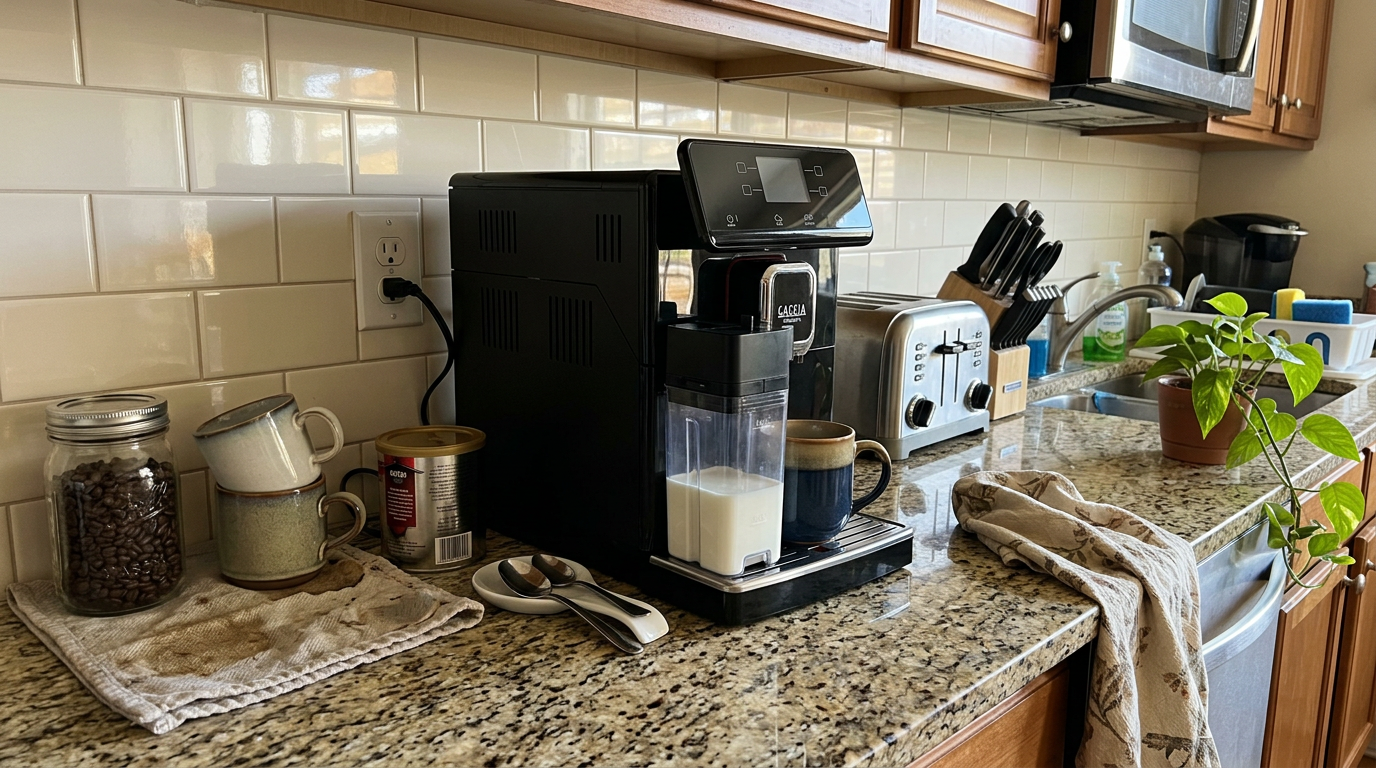
The Gaggia Magenta Prestige Super-Automatic Espresso Machine takes the slim Magenta body and adds a one-touch milk carafe that knows which drinks need milk first and which need espresso first. Over four weeks it made full, sweet espresso, proper double-shot flat whites and smooth cappuccinos at a single tap, though the carafe asks for daily attention.

Michael Reynolds
Hands-on review
Hands-on testing, research, specs
4 weeks
22 minutes
Jargon helpNew to espresso? Tap any dotted term to see what it means.
In this review
Yes, if you want café-style milk drinks at one touch from a machine that fits almost anywhere. The Gaggia Magenta Prestige makes sweet, full espresso, real two-grind doubles and a carafe-built flat white that tastes coffee-forward rather than milky. Its trick is changing the order of milk and espresso depending on the drink, which most one-touch machines don’t do. The carafe needs a quick clean after milk drinks, there are no user profiles, and the milk can’t match a skilled hand on a steam wand.
Gaggia Magenta Prestige at a glance
Gaggia Magenta Prestige pros and cons
- One-touch cappuccinos, flat whites and cortados that taste right
- Smart prep order: espresso-first or milk-first by drink
- True two-grind doubles in a body under 9 inches wide
- Milk carafe needs a quick clean after every milk drink
- No user profiles for different tastes
- Top lids need tall clearance to open
Who should buy the Gaggia Magenta Prestige?
- Small kitchens that want one-touch milk drinks
- Flat white and cortado drinkers
- Couples with similar coffee tastes
- Big households who need separate profiles
- People who want to pour latte art
- Anyone who hates daily cleaning of milk parts
First impressions of the Gaggia Magenta Prestige
I've used plenty of one-touch machines that make a cappuccino and then use exactly the same recipe, just with more milk, for everything else.
The Magenta Prestige felt different within the first day.
It is the same slim, 8.8-inch-wide body as the Magenta Plus, with a color touch display and a matte finish.
The difference is on the front.
Instead of a steam wand, there is a socket for a clear milk carafe that clicks in under the spout.
My first drink was a flat white.
The machine brewed two separate espresso shots into the cup first, then poured a thin layer of fine milk over the top.
That is how a barista builds a flat white, and it tasted like one, with the coffee clearly in charge.
My second drink was a cappuccino, and this time the milk went in first, with the espresso poured through the foam afterward.
That small detail, the order of things, turns out to matter a lot in the cup.
The Magenta Prestige pours a layered latte macchiato straight into a tall glass.
What the Gaggia Magenta Prestige actually is
The Magenta Prestige is a super-automatic, bean-to-cup espresso machine with an automatic milk system.
It grinds whole beans with ceramic burrs✕Ceramic burrsTwo grinding plates made of ceramic instead of steel. They stay cooler, run quieter and keep a sharp edge for many years., doses them into a removable brew group✕Brew groupThe removable unit inside the machine that receives the ground coffee, presses it into a puck, pushes hot water through it and then drops the used puck into the drawer., compresses the puck, brews at pressure and drops the used puck into a drawer.
For milk drinks, the carafe draws cold milk up, heats and froths it with steam and pours it straight into the cup.
There are 11 one-touch drinks plus hot water, so 12 buttons' worth of choice in total.
Heat comes from a fast stainless steel Quick Heat boiler✕Quick Heat boilerGaggia’s small, fast-heating stainless steel boiler. It heats only a little water at a time, so the machine is ready in about a minute., and the machine was ready in under a minute from cold every morning.
Strength is set with five Optiaroma✕OptiaromaGaggia’s strength setting. Each level tells the grinder to grind a bit more or less coffee for the drink. levels.
At the top level, the grinder doses up to about 0.41 ounces, or 11.5 grams, per grind cycle, which is a generous dose✕DoseThe weight of ground coffee that goes into one brew. A bigger dose gives a stronger, fuller drink. for a compact machine.
In short, it is a Magenta Plus that trades the manual wand for automatic milk and a much longer drink menu.
The grinder, brew group and true-double logic underneath are the same.
Gaggia Magenta Prestige design and setup
The Magenta Prestige measures about 8.8 inches wide, 14 inches tall to the top of the display and 17.1 inches deep.
That narrow width is the reason to choose it over bigger carafe machines.
It slipped into a gap on my counter that wouldn't take anything else with automatic milk.
The water tank and bean hopper both fill from the top under hinged doors.
To open them fully, you need about 17 and a quarter inches of vertical space.
Under standard wall cabinets, I had to slide the machine forward to open the water door, so most days I lifted the 60-ounce tank out and filled it at the sink.
The bean hopper holds a little over half a pound, about 8.8 ounces, with a sealing lid that keeps the beans from drying out.
The carafe sits in front of the machine, so add an inch or two to the depth when you plan where it goes.
Spout and cup clearance
The adjustable coffee spout gives up to about 5.75 inches of room underneath, enough for a travel mug.
A small removable platform lifts espresso cups closer to the spout, which stops the shot from splashing and keeps the crema whole.
The drip tray slides out from the front and needed emptying every couple of days.
First-time setup
Setup took about ten minutes.
You fill the tank, prime the system, test your water hardness with the included strip and enter the result.
The first two or three shots taste a bit rough while the grinder and brew group settle, so I poured those away.
Our tip: Put the machine where you can pull it forward easily, because the top doors need over 17 inches of height to open fully.
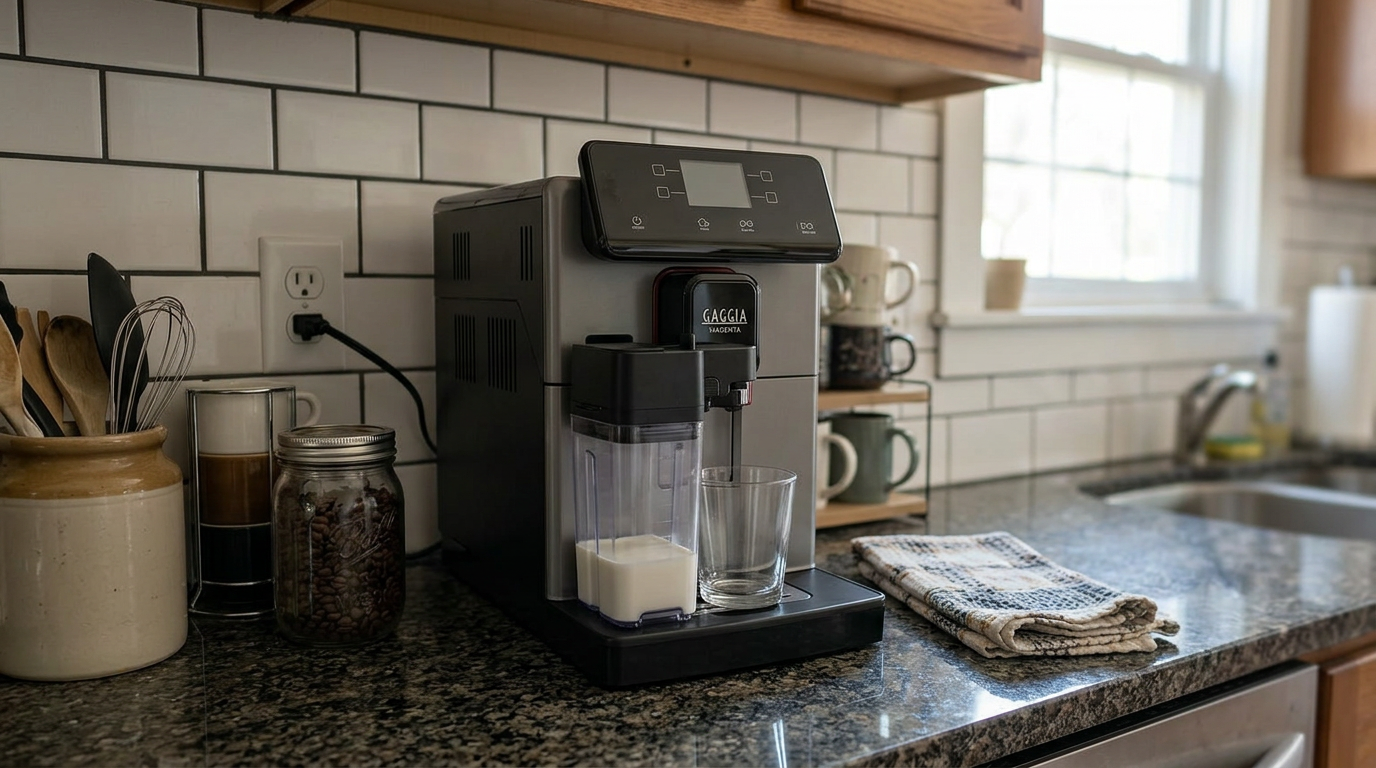
In gray, the Magenta Prestige looks clean and quiet next to a sunny window.
The built-in ceramic grinder
The grinder uses flat ceramic burrs✕Ceramic burrsTwo grinding plates made of ceramic instead of steel. They stay cooler, run quieter and keep a sharp edge for many years..
Ceramic doesn't heat up as much as steel during grinding, so it protects the coffee's aroma, and it keeps its edge for thousands of cycles.
It is also pleasantly quiet, with a short, low whirr.
The adjustment knob sits inside the bean hopper and has five steps, from 1, the finest, to 5, the coarsest.
Each step is a clear change, which makes dialing in straightforward.
Bars show how much resistance the coffee puts up and how long the shot takes to run.
Only adjust while it grinds
Turn the grind knob only while the burrs are spinning.
If you force it toward fine with the grinder stopped, beans can jam between the burrs.
I started an espresso, opened the hopper lid, moved the knob one step and judged the change two drinks later.
With a medium-dark blend, step 2 gave me the best balance of body and sweetness.
Finer grinding suits light roasts, while dark, oily roasts are happier a step coarser.
Our tip: After any grind change, wait two drinks before you judge it, because some coffee ground at the old setting is still in the chute.
Gaggia Magenta Prestige espresso performance
Every espresso starts with a short pre-infusion✕Pre-infusionA short, gentle soak of the coffee before full pressure. It lets the puck swell evenly so water does not rush through weak spots. that wets the puck before full pressure, so water flows evenly.
With a medium-dark blend at strength 3, the 1-ounce shots ran in about 25 seconds.
They had a thick, hazelnut-brown crema✕CremaThe golden-brown foam on top of an espresso. It forms when pressure pushes gases and oils out of freshly ground coffee. and a round, heavy body for a compact machine.
I tasted cocoa, toasted nuts and a little caramel, with soft acidity and a clean finish.
The ristretto✕RistrettoA short, restricted espresso made with less water. It is sweeter, thicker and more intense than a normal shot. button was a pleasant surprise.
It uses the same dose with less water, and the result was syrupy and sweet, the shot I reached for after dinner.
Consistency
Back-to-back shots stayed hot and tasted the same.
I made four cappuccinos in a row for guests, and the last espresso was as full as the first.
The small boiler recovers fast between drinks.
Where it falls short
You can't change pressure or the pre-infusion length, and the machine controls the tamp.
With very light, delicate roasts, a manual machine in skilled hands will show more fruit and clarity.
For a one-touch machine this size, the espresso is very good.
| What you taste or see | Likely cause | First change |
|---|---|---|
| Sour, thin, watery | Under-extraction✕Under-extractionWhen water does not pull enough out of the coffee, often because the grind is too coarse. The cup tastes sour, thin and watery. | Grind one step finer or raise strength |
| Bitter, harsh, drying | Over-extraction✕Over-extractionWhen water pulls too much out of the coffee, usually because too much water runs through one puck. The cup tastes bitter, harsh and thin. | Grind coarser or cut the volume |
| Pale crema that fades fast | Stale beans or grind too coarse | Fresher beans, finer grind |
| Drips or stops | Grind too fine for the dose | One step coarser while grinding |
| Lukewarm drink | Cold cup or low temperature | Warm the cup, set temperature to High |
Our tip: Warm your espresso cup with a splash of hot water first, because a small cold cup steals a lot of heat from a 1-ounce shot.
True double shots and stronger milk drinks
Tap the two-cup icon at the top right of the display, and the Magenta Prestige runs two complete grind-and-brew cycles in a row.
Each cup, or each half of a double, gets its own fresh puck.
That matters because many automatic machines make a "double" by pushing twice the water through one puck.
The result there is thin and bitter, a classic case of over-extraction✕Over-extractionWhen water pulls too much out of the coffee, usually because too much water runs through one puck. The cup tastes bitter, harsh and thin..
On the Prestige, my doubles had the same body and crema as two singles.
The same logic runs inside the milk recipes.
The flat white automatically uses two grind cycles for its espresso base.
At the top strength level, that is up to about 0.82 ounces of coffee in one drink, close to a triple shot.
| Drink | Grind cycles | Coffee used, approx. |
|---|---|---|
| Espresso, strength 3 | 1 | 0.28 oz |
| Espresso, strength 5 | 1 | 0.41 oz |
| Two-cup espresso, strength 3 | 2 | 0.56 oz |
| Flat white, strength 3 | 2 | 0.56 oz |
| Flat white, strength 5 | 2 | 0.82 oz |
The two-cup button works on coffee-only drinks, with one exception.
The Americano doesn't have a two-cup mode, so for two Americanos you simply run it twice.
Our tip: For a stronger latte macchiato, raise the strength to level 5 rather than adding more coffee volume, so the shot stays short and sweet.
Americano, coffee and lungo
There are three ways to make a bigger black coffee, and they taste quite different.
The Americano✕AmericanoAn espresso topped up with hot water that does not pass through the coffee. It keeps the espresso’s flavor in a longer, milder cup. brews a concentrated espresso first, then switches valves and adds clean hot water through a separate path.
The water never passes through the coffee, so the drink stays clean and sweet.
The Coffee button pushes all the water through the puck in one long extraction.
The Espresso Lungo✕LungoA long espresso: more water runs through the same puck. It is bigger and milder than an espresso, with a little more bitterness. sits in between, a long shot with more water than an espresso.
| Drink | How it is made | How it tasted |
|---|---|---|
| Americano | Espresso, then hot water added | Clean, sweet, least bitter |
| Coffee | All water through one puck | Round, heavier, a bit woody at big sizes |
| Espresso lungo | Long shot through one puck | Fuller than coffee, more bitter than Americano |
I drank the Americano most mornings.
It also has slightly less caffeine than a long coffee made from the same dose, because the water's contact time with the grounds is shorter.
The Coffee button was fine at normal mug sizes but went flat when I pushed the volume high.
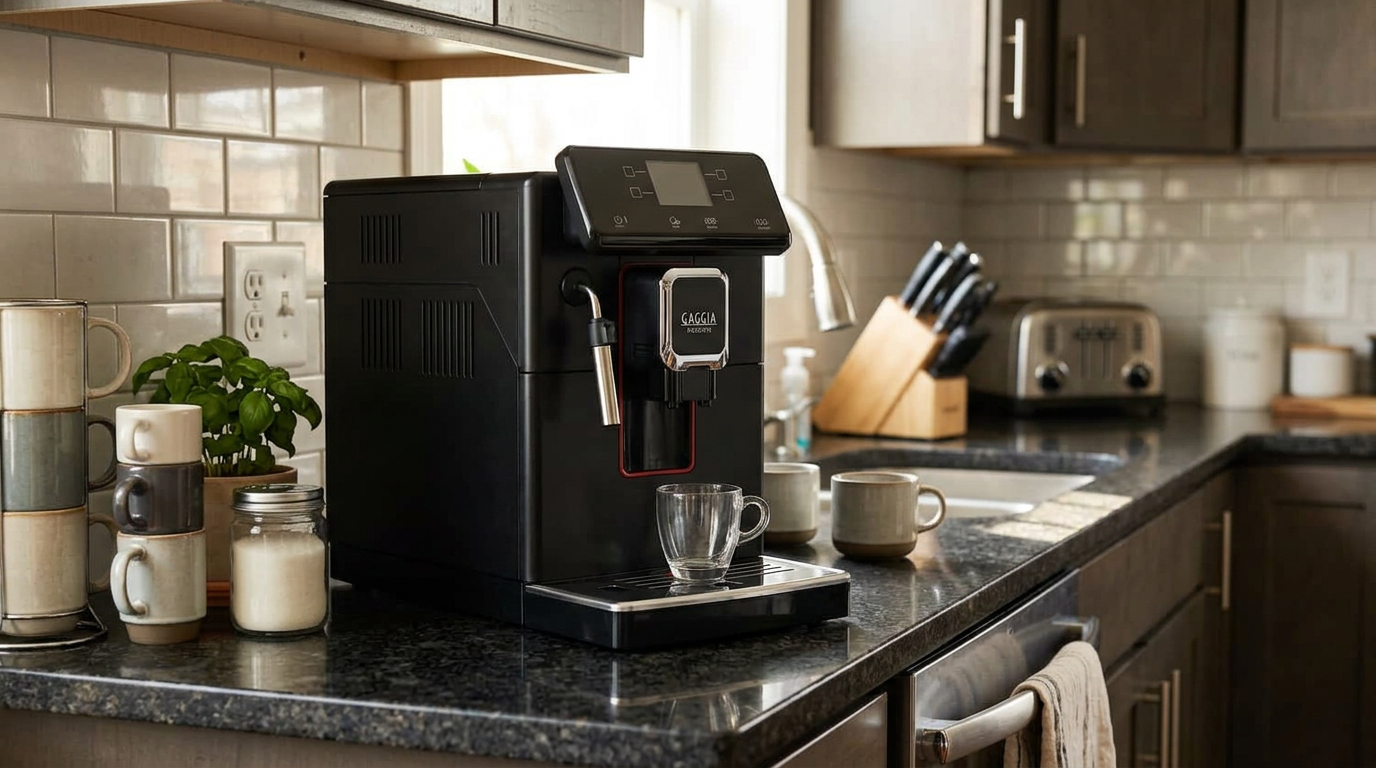
In black, the Prestige blends into a dark granite kitchen.
The milk carafe and how good the foam is
The carafe is a clear container with a frothing head on top.
It clicks into a socket on the front of the machine, and a short spout swings out over your cup.
When you choose a milk drink, steam rushes through the frothing head, the Venturi effect✕Venturi effectWhen a fluid speeds up through a narrow opening, its pressure drops. In a milk frother, fast steam creates suction that pulls milk up the tube. pulls cold milk up from the carafe, and air is mixed in before the hot foam pours out.
The carafe holds about 16.9 ounces, or half a liter, which was enough for four or five cappuccinos.
Foam quality
The foam was fine and creamy, with small bubbles and a gentle sweetness.
It held its shape in a latte macchiato and sat as a thin, smooth cap on the flat white.
It isn't the glossy, pourable microfoam✕MicrofoamMilk foam with bubbles so small you cannot see them. It feels silky and blends into the coffee instead of sitting on top like froth. you get from a skilled hand on a steam wand, and you can't pour latte art with it.
For a one-touch system, though, it was consistently good.
My ratings on a 10-point scale for texture, temperature and stability.
Whole milk gave the richest, sweetest foam.
Barista-style oat drinks worked well, while skim made a taller, stiffer foam that faded faster.
Cold milk straight from the fridge always foamed better than milk that had been sitting out.
Milk temperature
The milk came out warm rather than scalding, which is where it tastes sweetest.
If you like very hot drinks, preheat your cup and set the coffee temperature to High.
Milk-first or espresso-first: why the order matters
This is the Magenta Prestige's cleverest feature, and the one you notice in the cup.
Most automatic machines pour milk and coffee in the same order for every drink, usually milk first.
The Prestige changes the order to match how each drink is traditionally built.
| Drink | Order | What it does in the cup |
|---|---|---|
| Cappuccino | Milk first, then espresso | Espresso sinks under a tall foam cap with a dark ring |
| Latte macchiato | Milk first, then espresso | Clear layers of milk, coffee and foam |
| Flat white | Espresso first (double), then milk | Milk blends into the crema for a coffee-forward drink |
| Café au lait | Espresso first, then milk | Smooth, even, mild |
| Cortado | Espresso first, then a little milk | Bold coffee softened by warm milk |
When the espresso goes in first, the milk folds into the crema and the coffee oils, just as it does when a barista pours steamed milk into a shot.
The drink tastes more integrated and more like coffee.
When milk goes in first, the espresso cuts through the foam and forms distinct layers, which is exactly what you want in a latte macchiato.
I made the flat white side by side with a milk-first version I built manually.
The espresso-first one tasted noticeably richer and sweeter, with a velvety mouthfeel, while the milk-first one tasted flatter and milkier.
Display, buttons and programming
The full-color display shows drinks as clear icons, spread across a few screens.
Selecting a drink brings up all its settings before you brew: coffee strength, coffee volume, milk volume and temperature.
You adjust what you want, then press Start.
Saving a drink
After brewing, you choose whether to keep the change.
Press Return, or do nothing, and the change was for that one cup only.
Tap the checkmark, and the new recipe replaces the saved default for everyone.
It is simple and quick, and I liked being able to try a stronger cappuccino without losing my usual one.
No user profiles
The Prestige saves one version of each drink.
In my house, one person liked a strong, short cappuccino and another wanted a big, milky one, so somebody was always adjusting.
For a couple with similar tastes it's fine, but larger households should look at a machine with profiles.
Our tip: Save the drink you make most often at your favorite settings, and adjust everything else one cup at a time.
Pre-ground coffee and decaf
There is a bypass doser✕Bypass doserA small chute for pre-ground coffee that skips the grinder and sends one scoop straight to the brew group. Handy for an occasional decaf. on top for pre-ground coffee.
On the strength screen, you choose the scoop icon, add one level scoop to the chute and press Start.
It skips the grinder completely, which is perfect for an evening decaf without emptying the hopper.
It works for coffee and milk drinks, but not the Americano.
For a decaf Americano, brew a decaf espresso through the bypass and then add water with the Hot Water button.
Our tip: Never add more than one level scoop to the bypass chute, because extra grounds can jam the brew group.
Cleaning and maintaining the Gaggia Magenta Prestige
The coffee side looks after itself with automatic rinses when you switch on and off.
The milk side is where your daily attention goes.
After each milk drink, the display offers a Quick Clean.
You can also start it from the Clean menu, then Select and the checkmark.
Quick Clean pushes hot water and steam through the frothing head and spout into your cup or the drip tray, while the milk stays in the carafe.
Then you unclip the carafe and put it back in the fridge.
| When | Task | Why it matters |
|---|---|---|
| After milk drinks | Run Quick Clean | Flushes milk from the frothing head |
| Daily | Empty drip tray, store carafe in fridge | Prevents odors and keeps milk fresh |
| About every 15 drinks | Empty the puck drawer | The machine stops when it is full |
| Every 1–2 days | Take apart and wash the carafe head | Removes dried milk from small parts |
| Weekly | Rinse the brew group under warm water | Removes coffee oils and fines |
| Monthly | Grease the brew group rails | Keeps it moving smoothly |
| When prompted | Descale or change the filter | Protects the boiler from scale |
The carafe lid comes apart into a few pieces, and I washed them in warm soapy water every other day.
The brew group✕Brew groupThe removable unit inside the machine that receives the ground coffee, presses it into a puck, pushes hot water through it and then drops the used puck into the drawer. slides out through a side door after pressing two tabs.
Rinse it with warm water, no soap, let it dry and slide it back.
The machine prompts for descaling✕DescalingRunning a mild acid solution through the machine to dissolve mineral scale left by hard water. Scale slows heating and can block pipes. based on your water hardness, and a compatible filter stretches the time between cycles.
My estimate of hands-on cleaning time per day, including carafe care.
Looked after properly, these Gaggia machines often go past 15,000 brew cycles.
The warranty covers two years.
What daily use is really like
My mornings started with the power button and a short rinse.
Then I clicked in the carafe from the fridge, tapped Flat White and had a drink in a little over a minute.
Quick Clean took about 20 seconds, and the carafe went back in the fridge.
On black-coffee days, I just tapped Americano.
Tank, hopper and drawer
The 60-ounce tank lasted about three days for two of us.
The 15-puck drawer was the more frequent chore, because every flat white uses two pucks.
I emptied it every two to three days.
Rough maths from a 60 oz tank, allowing for rinse and Quick Clean water.
Noise
The ceramic grinder makes a low, short burst, and the frothing has a steady hiss.
It is not silent, but it didn't wake anyone early in the morning.
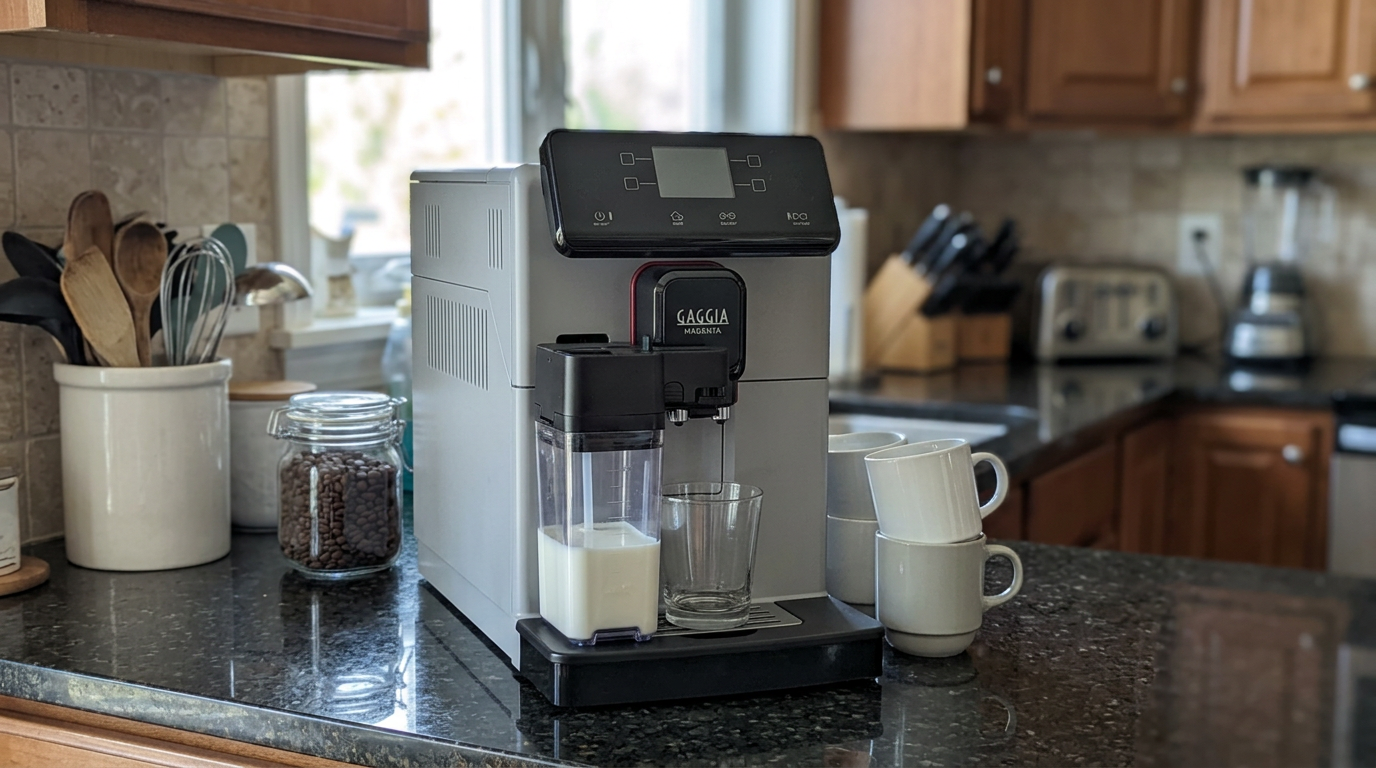
The clear carafe makes it easy to see when it is time to top up the milk.
Beans, water and milk
Use fresh whole beans with a roast date, ideally within four weeks of roasting.
Medium and medium-dark espresso blends gave the most balanced shots and the best milk drinks.
Light roasts needed the finest grind and a higher strength to avoid tasting sour.
Avoid very oily beans and flavored beans, which leave residue on the burrs and in the chute.
| Bean type | Espresso | Milk drinks |
|---|---|---|
| Medium-dark blend | Excellent, thick crema | Excellent, chocolatey |
| Medium roast | Very good, brighter | Good, lighter |
| Light roast | Grind finest, strength 4–5 | Can taste sharp in milk |
| Very dark, oily | Not recommended | Not recommended |
Water and milk
Use fresh, cold water and a filter if your water is moderately hard.
Avoid distilled water, because coffee needs some minerals to taste full.
For milk, use it cold from the fridge and pour only what you'll use in the next day or so into the carafe.
Common mistakes to avoid
The Gaggia Magenta Prestige is easy to live with, but a few habits will hold it back.
| Mistake | What happens | Better habit |
|---|---|---|
| Turning the grind knob with the grinder stopped | Beans jam and strain the burrs | Adjust only while it grinds |
| Skipping Quick Clean | Milk dries in the frothing head and foam suffers | Run it after every milk drink |
| Leaving the carafe on the counter | Warm milk foams poorly and spoils sooner | Store it in the fridge |
| Raising coffee volume for a stronger drink | Thin, bitter coffee | Raise strength instead |
| Overfilling the bypass chute | Loose grounds jam the brew group | One level scoop only |
| Forgetting the brew group | Oily, stale-tasting coffee | Rinse it weekly |
Change one setting at a time and taste after each change.
If you change grind and strength together, you won't know which made the difference.
What I would change
User profiles would make the Prestige much better for families.
I'd also like a top design that needs less vertical clearance and a slightly bigger puck drawer, since two-grind drinks fill it quickly.
Is the Gaggia Magenta Prestige worth the money?
The Magenta Prestige costs more than the wand-only Magenta Plus, and the extra money buys convenience and a longer menu.
The coffee itself is the same.
What changes is that cappuccinos, flat whites and cortados become one-touch drinks, and they're built in the right order.
That makes it a strong choice for people who drink milk drinks most days but don't want to learn steaming.
Ask yourself three questions before you buy.
Do you drink milk drinks most days? Is counter space tight? And are you happy to run a quick clean and wash a carafe head regularly?
If the answers are yes, the Prestige is easy to recommend. If you mostly drink espresso and only want the odd cappuccino, the Gaggia Brera covers that for a lot less money.
Making milk drinks at home with whole beans also costs a fraction of buying them out, so the savings add up quickly.
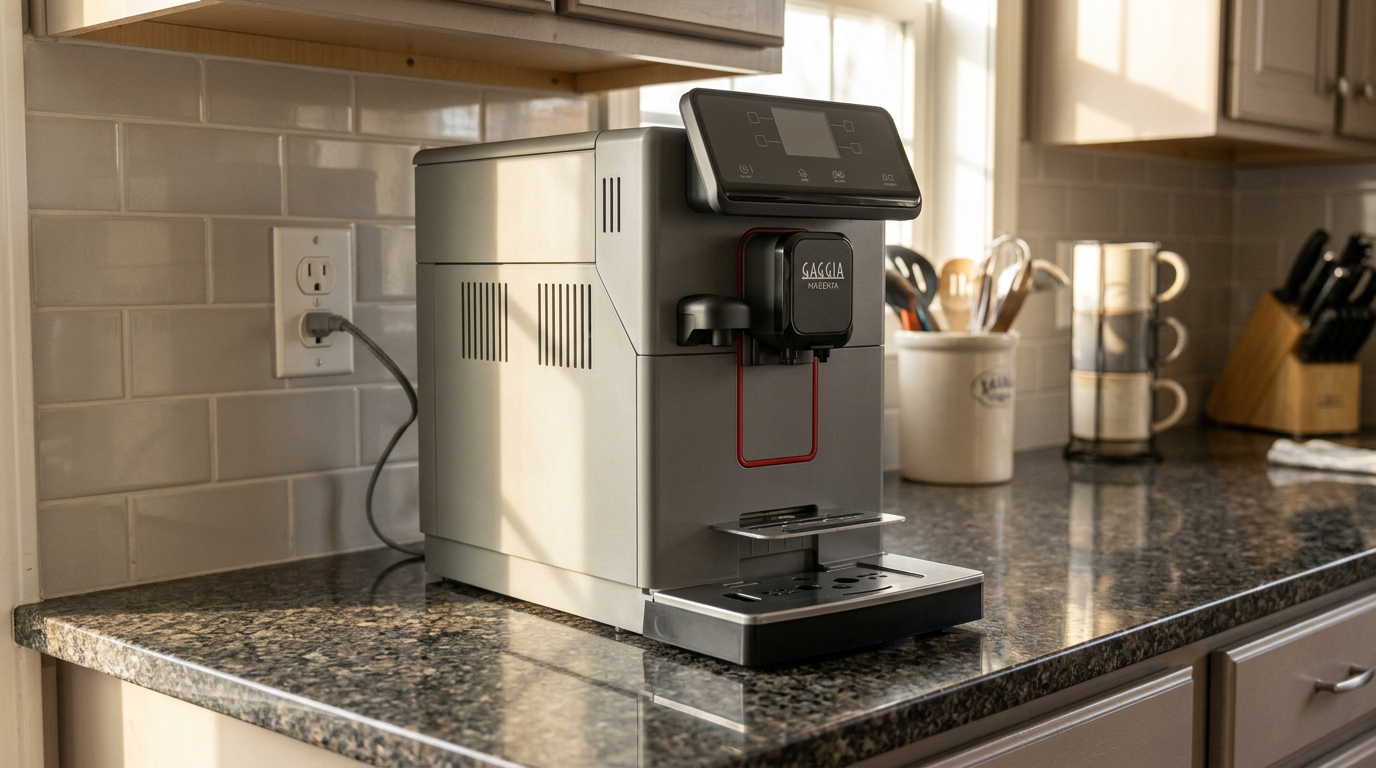
The Magenta Prestige fits neatly between other appliances without crowding them.
How it compares with other espresso setups
The most useful comparison is with the kinds of machines you are likely choosing between.
The Magenta Prestige stands out for its width, its prep-order logic and its true doubles.
| Feature | Gaggia Magenta Prestige | Machine with a steam wand | Larger carafe machine with profiles |
|---|---|---|---|
| Grinding and brewing | Fully automatic | Fully automatic | Fully automatic |
| Milk | One touch, right order per drink | Manual, latte art possible | One touch |
| True double shots | Yes | Varies | Varies |
| User profiles | None | Rare | Often several |
| Width | About 8.8 in | Varies | Often 10–12 in |
| Daily cleaning | Quick Clean plus carafe wash | Wipe and flush wand | Similar carafe care |
A wand machine gives you better milk if you have the skill, but every drink takes more effort.
A larger carafe machine adds user profiles and often a bigger tank, at the cost of counter space.
The Prestige sits between them, with one-touch milk drinks in a very small footprint.
| You mostly drink | Is the Prestige a fit? | Why |
|---|---|---|
| Flat whites and cortados | Excellent | Espresso-first order and two-grind base |
| Cappuccinos and latte macchiatos | Very good | Milk-first order, creamy foam |
| Espresso and Americano | Very good | Same grinder and brew group as the wand model |
| Latte art | Poor | Carafe foam is not pourable microfoam |
| Large household, many tastes | Fair | No user profiles |
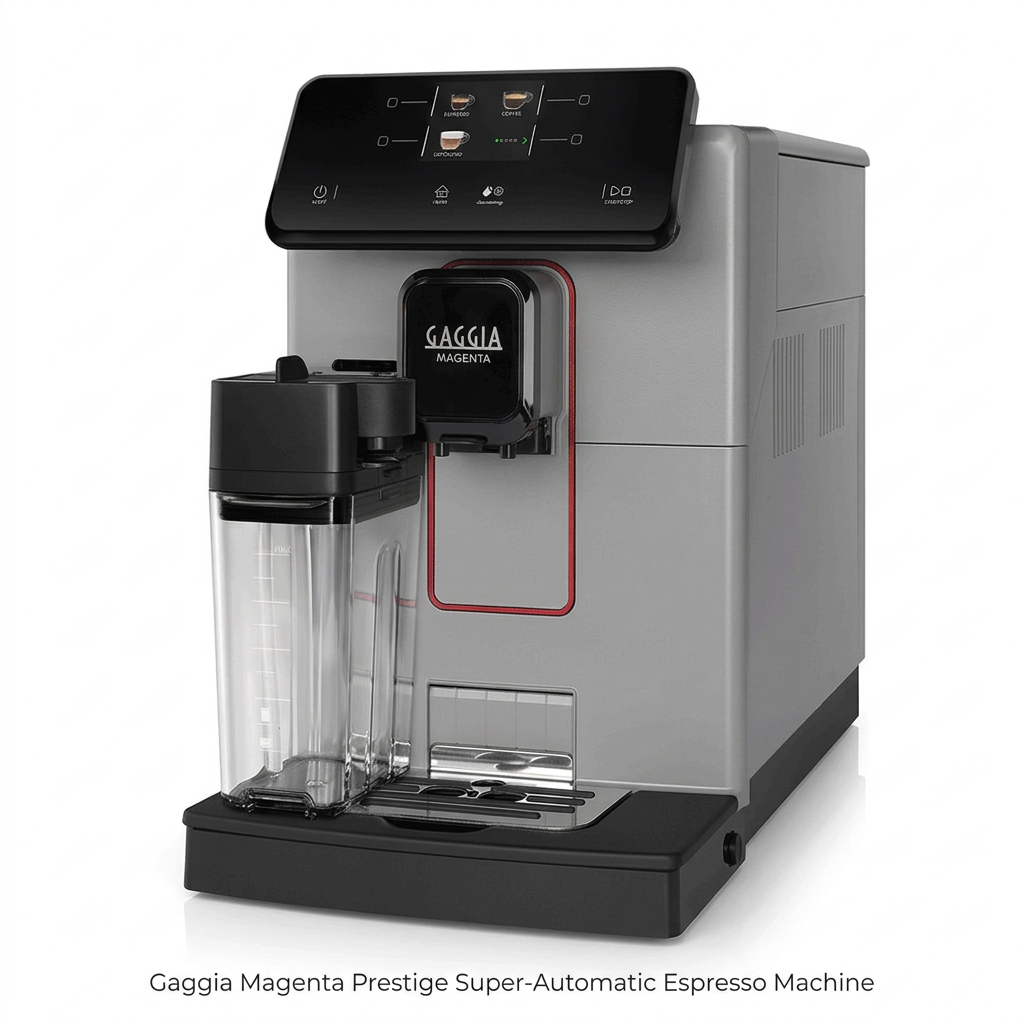
The full package: color display, adjustable spout and the clip-on milk carafe.
Other Gaggia machines I tested
If you'd rather steam milk yourself, the Gaggia Magenta Plus has the same body with a commercial-style wand.
For four user profiles and a front-loading tank, see my Gaggia Cadorna Prestige review.
For the most control and a premium build, read my Gaggia Accademia review.
Which one is right for you: is the Gaggia Magenta Prestige your match?
4 quick questionsGaggia Magenta Prestige specifications
From manufacturer data and my own testing.
How I tested and scored the Gaggia Magenta Prestige
For four weeks, I used the Gaggia Magenta Prestige as my everyday machine for espresso, ristretto, Americanos, cappuccinos, flat whites, cortados, latte macchiatos and hot chocolate.
I shared the machine with a second tester from the HouseholdMe team, and we wrote our tasting and usage notes together.
We compared espresso-first and milk-first versions of the same drink, tested singles against two-grind doubles and worked through every grind step and strength level.
I foamed whole, 2%, skim, oat and almond milk, timed the Quick Clean and weekly brew group rinse, and tracked how long the tank and puck drawer lasted.
I then checked our notes against Gaggia's specifications and owner documentation.
- Espresso (8.5): body, crema, flavor and consistency, including two-grind doubles.
- Milk drinks (8.4): foam texture, temperature and how well the prep order works in each drink.
- Ease of use (8.7): display, saving drinks, carafe handling and filling.
- Cleaning (7.9): Quick Clean, carafe washing, brew group care and prompts.
The overall score of 8.4 is an editorial rating that reflects those four areas.
Gaggia Magenta Prestige FAQ
Is the Gaggia Magenta Prestige worth it?
Yes, if you want one-touch cappuccinos and flat whites from a very slim machine. It makes true two-grind doubles and builds each milk drink in the right order. If several people need their own saved drinks, a model with user profiles is a better fit.
How many drinks does the Magenta Prestige make?
It has 11 one-touch drinks plus hot water: espresso, ristretto, espresso lungo, coffee, Americano, cappuccino, latte macchiato, flat white, café au lait, cortado and froth milk.
What does milk-first or espresso-first mean?
The machine changes the order for each drink. Cappuccinos and latte macchiatos get milk first. Flat whites, café au lait and cortados get espresso first, so the milk blends into the crema.
Is the flat white a real double shot?
Yes. The flat white runs two separate grind cycles for its espresso base, using up to about 0.82 ounces of coffee at the highest strength.
How do I clean the milk carafe?
Run Quick Clean after milk drinks, which flushes the frothing head with hot water and steam while the milk stays in the carafe. Wash the carafe head by hand every day or two.
Can I keep milk in the carafe in the fridge?
Yes. After Quick Clean, unclip the carafe and store it in the fridge with the milk inside.
Does the Magenta Prestige have user profiles?
No. You can save your own strength, volume and temperature for each drink, but the saved settings are shared.
How wide is the Gaggia Magenta Prestige?
About 8.8 inches. It is about 14 inches tall and 17.1 inches deep, and the top doors need about 17.25 inches of height to open fully.
Can I use pre-ground coffee?
Yes. Choose the scoop icon and add one level scoop to the bypass chute. It works for every drink except the Americano.
Can I pour latte art with it?
Not really. The carafe makes fine, creamy foam, but not the glossy microfoam you need for latte art. For that, you need a steam wand.
How often do I empty the puck drawer?
It holds about 15 pucks. Flat whites and two-cup drinks use two pucks, so most households empty it every two or three days.
Kitchen & coffee tester
Michael spent six years as a line cook in restaurants in Chicago and New York, and he has tested kitchen appliances for HouseholdMe since 2018, from air fryers to coffee makers. He holds an SCA certificate in barista skills and used the Gaggia Magenta Prestige as his everyday coffee machine for four weeks for this review.
- Four weeks of hands-on testing of the Gaggia Magenta Prestige Super-Automatic Espresso Machine
- Gaggia product specifications and owner documentation
- General espresso brewing and maintenance guidance