Gaggia Cadorna Prestige review: four user profiles, a true espresso-first flat white and front-loading everything
The Gaggia Cadorna Prestige Super-Automatic Espresso Machine is the Gaggia I’d hand to a busy family. It gives four people their own saved drinks, builds a flat white the way a barista does and lets you refill water and empty pucks from the front, so it lives happily under low cabinets. Four weeks in, it was the easiest one-touch machine I tested, with a small puck drawer as its main weakness.

Michael Reynolds
Hands-on review
Hands-on testing, research, specs
4 weeks
22 minutes
Jargon helpNew to espresso? Tap any dotted term to see what it means.
In this review
Yes, if more than one person in your house drinks coffee and you want café-style milk drinks without any fuss. The Gaggia Cadorna Prestige gives up to four people their own saved recipes, makes rich espresso and builds a proper espresso-first flat white with a real double shot. Its front-loading water tank and puck drawer make it the easiest Gaggia to live with under low cabinets. The drawer fills fast, grind changes are a bit fiddly, and the carafe foam won’t pour latte art.
Gaggia Cadorna Prestige at a glance
Gaggia Cadorna Prestige pros and cons
- Four color-coded user profiles for a shared household
- Espresso-first flat white with a true two-grind double
- Front-loading tank and puck drawer, easy under cabinets
- Puck drawer holds only about 10 pucks
- Grind changes are fiddly and must be made while grinding
- Carafe needs a quick clean after every milk drink
Who should buy the Gaggia Cadorna Prestige?
- Families with different coffee tastes
- Kitchens with low wall cabinets
- Flat white and big latte drinkers
- Anyone who wants to pour latte art
- Heavy users who hate emptying a drawer
- People who only drink plain black coffee
First impressions of the Gaggia Cadorna Prestige
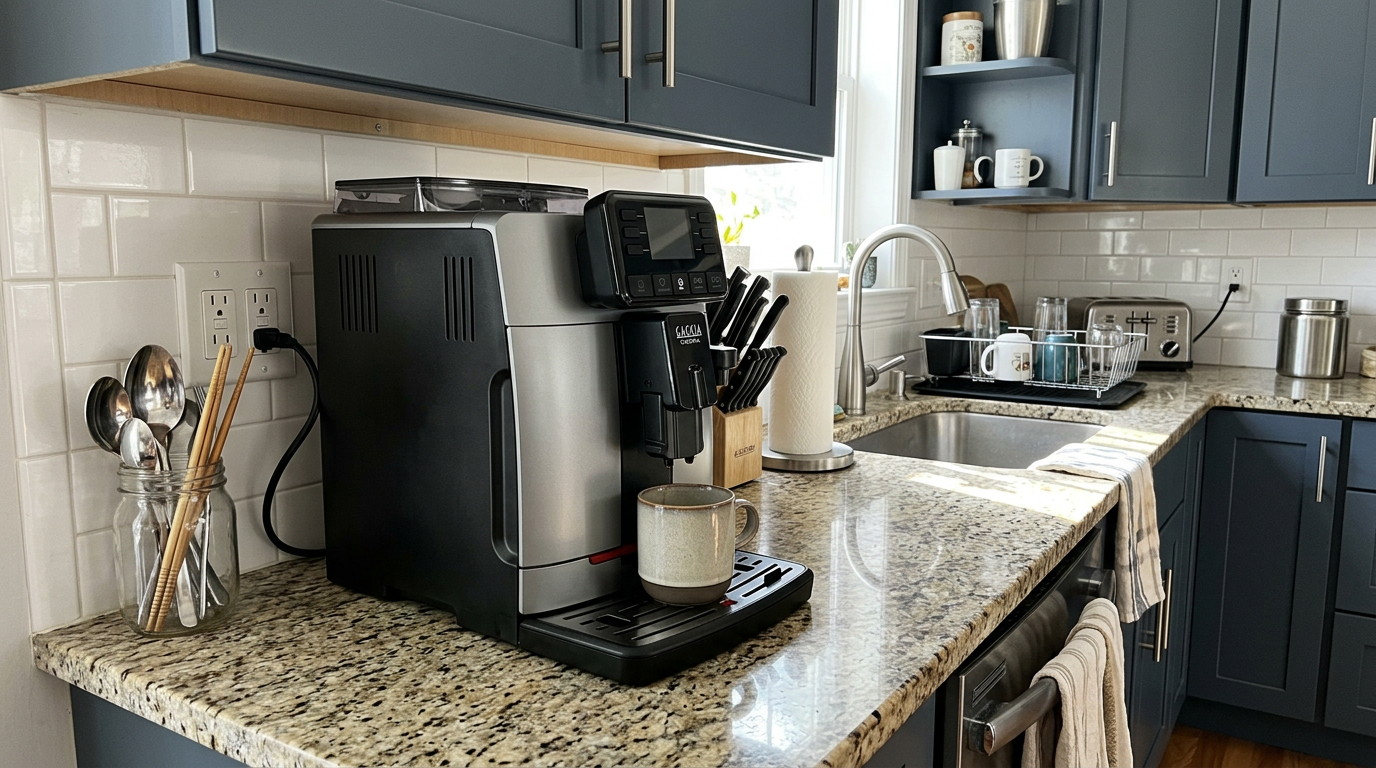
The first thing I did with the Cadorna Prestige was put it under my lowest wall cabinet, the spot where top-loading machines never work.
It fit, and more importantly, I never had to pull it out.
The water tank slides straight out of the front like a drawer, and so does the puck container.
Only the bean hopper opens from the top, and at about 15 inches tall, there was still plenty of room above it.
The second thing I noticed was the display.
It is a full-color TFT screen tilted slightly upward, so you read it while standing instead of bending down.
Below it are backlit buttons, and down the side of the screen sit four little colored hearts: red, green, blue and yellow.
Those are the user profiles, and within a week they had changed how my household used the machine.
My first drink was a flat white, and the machine brewed two separate shots into the cup before adding the milk.
It tasted rich and coffee-forward, with the milk folded into the crema rather than sitting on top.
Front-loading tank and drawer make the Cadorna Prestige easy to keep under low cabinets.
What the Gaggia Cadorna Prestige actually is
The Cadorna Prestige is a super-automatic, bean-to-cup espresso machine with an automatic milk carafe.
It grinds whole beans with ceramic burrs✕Ceramic burrsTwo grinding plates made of ceramic instead of steel. They stay cooler, run quieter and keep a sharp edge for many years., doses and tamps them in a removable brew group✕Brew groupThe removable unit inside the machine that receives the ground coffee, presses it into a puck, pushes hot water through it and then drops the used puck into the drawer., brews at pressure and ejects the used puck.
For milk drinks, the carafe draws cold milk, froths it with steam and pours it into the cup.
Heat comes from a quick-heating boiler that is ready in under 60 seconds from cold.
The pump is rated at 15 bar, while the coffee itself is extracted in roughly the 9 to 12 bar range once the puck builds resistance.
It is made in Italy, like the rest of Gaggia's super-automatic lineup.
What sets it apart from the slimmer Gaggia carafe models is mostly about living with it.
Four profiles, front access, an angled screen, a taller spout and XL milk drinks make it feel built for a busy family kitchen.
Gaggia Cadorna Prestige design and setup
The Cadorna Prestige measures about 10.2 inches wide, 15 inches tall and 17.3 inches deep, and weighs around 20.5 pounds.
Standard upper cabinets sit about 18 inches above the counter, so it leaves comfortable room to open the bean lid.
That front access is the design detail I'd put at the top of the list.
On most machines, refilling water means pulling the machine forward or lifting a lid you can't reach under a cabinet.
Here you pull the tank out like a drawer, fill it at the sink and slide it back.
The 1.5-liter tank, about 51 ounces, is a little smaller than some, but the front access makes up for it.
The bean hopper holds about 10.6 ounces, roughly 300 grams, which is close to a standard bag of beans.
Spout and drip tray
The spout slides up to about 6 inches, which fit every travel mug I own.
For espresso, a small tray pulls out above the drip tray to lift little cups closer to the spout, which stops splashing.
The drip tray has internal baffles, so it doesn't slosh when you carry it, and a red float pops up when it is full.
First-time setup
Setup took about ten minutes, including a water hardness test and a first rinse.
The first few drinks were a little thin while the grinder settled, so I poured away the first three shots.
I also set the automatic standby, which you can choose anywhere from 15 minutes to 3 hours after the last drink.
Our tip: Set the standby to 15 or 30 minutes if you drink coffee in short bursts, because the machine is ready again in under a minute anyway.
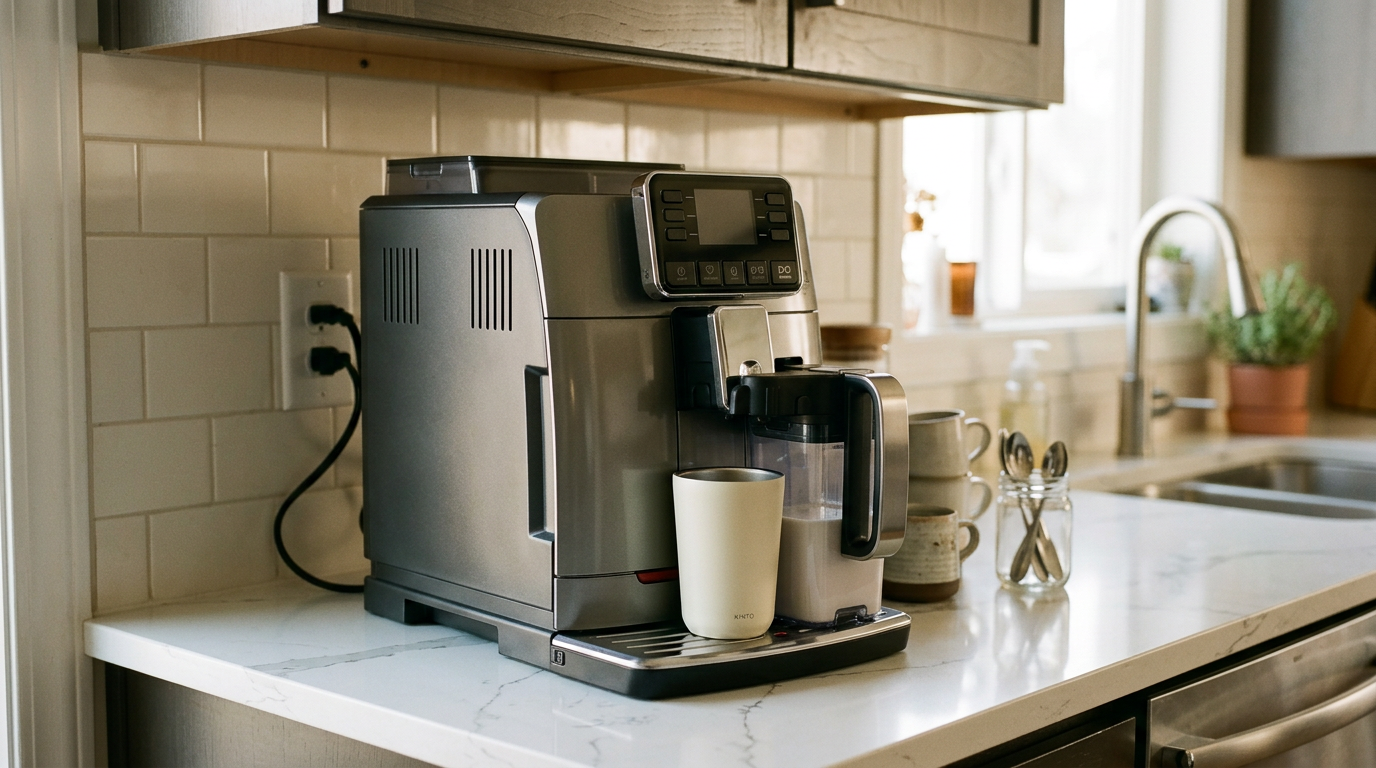
The angled display is easy to read standing up.
The built-in ceramic grinder
The grinder uses ceramic burrs✕Ceramic burrsTwo grinding plates made of ceramic instead of steel. They stay cooler, run quieter and keep a sharp edge for many years., which run cooler and quieter than steel and keep their edge for many thousands of cycles.
It is one of the quieter grinders I have tested in a super-automatic, with a soft, low whirr.
There are 10 grind steps, twice as many as the slimmer Gaggia models, which makes it easier to fine-tune for different beans.
Finer settings slow the water down for richer espresso.
Coarser settings let water through faster for lighter long coffees.
Bars show how much resistance the coffee puts up and how long the shot takes to run.
The fiddly part
The grind adjustment is inside the bean hopper and should only be turned while the grinder is running.
That means starting a drink, opening the lid, finding the dial among the beans and turning it while the burrs spin.
It isn't hard, but it is a two-handed job and you need to be quick.
I moved one or two steps at a time and judged the result two drinks later.
With a medium-dark blend, I ended up two steps finer than the factory setting.
Our tip: Scoop a few beans aside before you adjust, so you can actually see the grind dial and its markings.
Gaggia Cadorna Prestige espresso performance
The Optiaroma strength system has five levels, dosing from about 0.23 ounces up to about 0.4 ounces of coffee per grind cycle.
At level 4 with a medium-dark blend, my 1-ounce espressos came out with dense, tan crema✕CremaThe golden-brown foam on top of an espresso. It forms when pressure pushes gases and oils out of freshly ground coffee. and a full, chocolatey body.
There was a gentle sweetness and very little harshness at the finish.
The short pre-infusion✕Pre-infusionA short, gentle soak of the coffee before full pressure. It lets the puck swell evenly so water does not rush through weak spots. at the start of each shot helped keep the extraction even from cup to cup.
Consistency
Three espressos in a row tasted the same, and the third was as hot as the first.
Dual temperature sensors in the boiler keep the brewing water stable, which you notice most in back-to-back milk drinks.
Where it falls short
Like any super-automatic, you can't change pressure or puck preparation.
Very light roasts were good but lacked the brightness a manual machine can bring out.
For daily, one-touch espresso, it is strong and reliable.
| What you taste or see | Likely cause | First change |
|---|---|---|
| Sour, thin, watery | Under-extraction✕Under-extractionWhen water does not pull enough out of the coffee, often because the grind is too coarse. The cup tastes sour, thin and watery. | Grind 1–2 steps finer or raise strength |
| Bitter, harsh, drying | Over-extraction✕Over-extractionWhen water pulls too much out of the coffee, usually because too much water runs through one puck. The cup tastes bitter, harsh and thin. | Grind 1–2 steps coarser or cut the volume |
| Pale crema that fades fast | Stale beans or grind too coarse | Fresher beans, finer grind |
| Drips slowly or stops | Grind too fine or dose too high | Coarser grind, lower strength, rinse brew group |
| Lukewarm coffee | Low temperature setting or cold cup | Set to High and warm the cup |
Our tip: Warm small espresso cups with hot water first, because a cold cup can steal several degrees from a 1-ounce shot.
The true flat white
This is the drink that convinced me the Cadorna Prestige is more than a convenience machine.
Many one-touch machines make a flat white by pouring milk first and dripping a single shot on top, simply because that is easier to engineer.
The Cadorna does it the barista way.
It runs two complete grind-and-brew cycles into the cup first, making a genuine double shot.
Then it pours a smaller amount of finely textured milk over the top.
Depending on the strength level, that double uses between about 0.46 and 0.8 ounces of coffee.
| Approach | Order | Coffee used | Result |
|---|---|---|---|
| Typical one-touch flat white | Milk first, single shot on top | About 0.3 oz | Milky, coffee tastes faint |
| Cadorna Prestige, strength 3 | Double shot first, then milk | About 0.6 oz | Balanced, velvety |
| Cadorna Prestige, strength 5 | Double shot first, then milk | About 0.8 oz | Intense, coffee-forward |
Because the espresso is in the cup first, the milk folds into the crema and the coffee oils.
The result is smoother and sweeter, and it looks right too, with a thin, glossy layer on top.
Americano and long coffee
The Americano✕AmericanoAn espresso topped up with hot water that does not pass through the coffee. It keeps the espresso’s flavor in a longer, milder cup. works the proper way, too.
The machine brews a concentrated espresso, then switches paths and adds clean hot water that bypasses the brew group.
That keeps the bitter compounds that come from over-washing the grounds out of the cup.
It also has slightly less caffeine than a long coffee made from the same dose, because the water spends less time with the coffee.
The Coffee button, by contrast, pushes all the water through one puck.
| Quality | Americano | Coffee |
|---|---|---|
| How it is made | Espresso first, then hot water | All water through one puck |
| Flavor | Clean, sweet, aromatic | Rounder, heavier |
| Bitterness | Low | Higher at big sizes |
| Best for | Large mugs, medium roasts | Normal mugs, darker roasts |
Single drinks go up to about 8 ounces, and the two-cup button doubles that to around 16 ounces with two full grind cycles.
For a travel mug, I used the two-cup Americano and it tasted just as clean as a single.
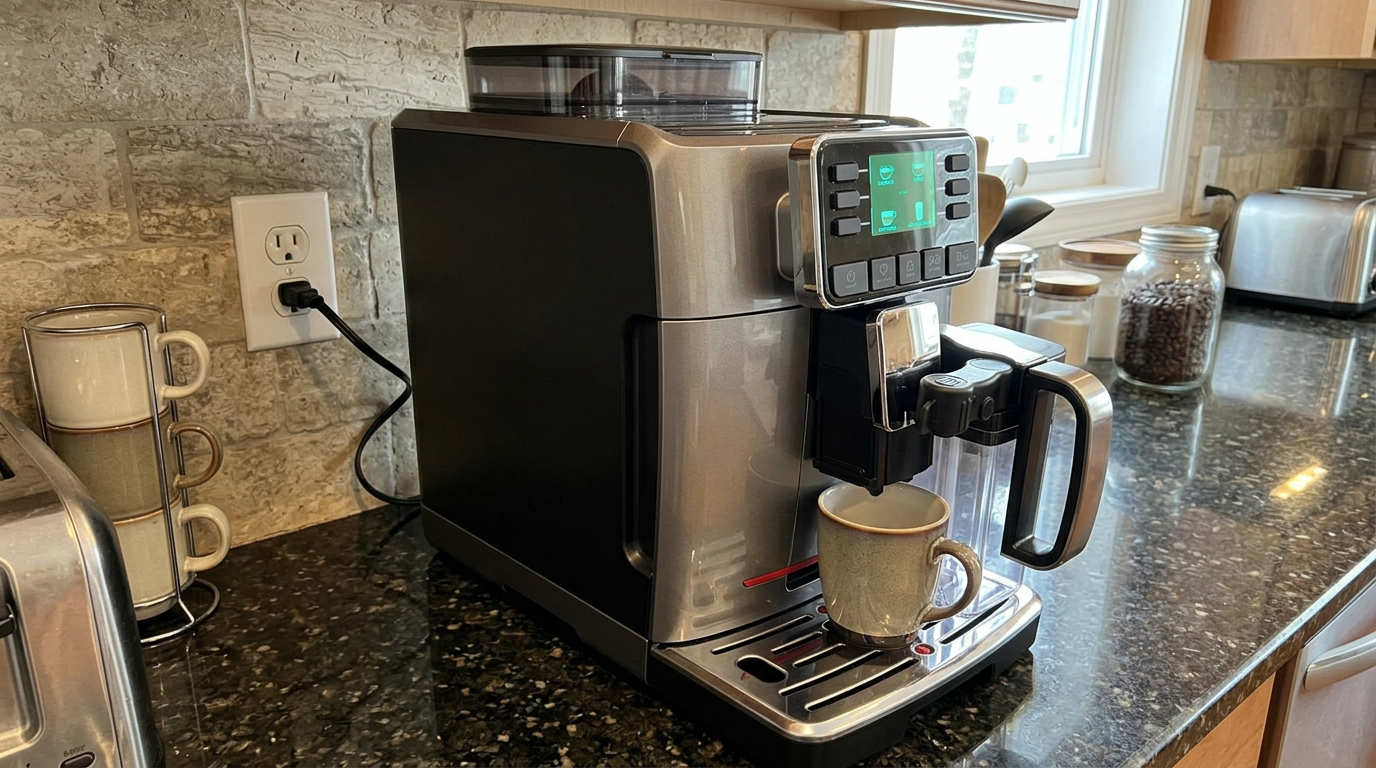
The 6-inch spout clearance easily fits a tall mug.
The milk carafe and how good the foam is
The carafe clicks into a coupling on the front of the machine, and you pull its spout out over the cup.
It holds about 0.6 liters, roughly 20 ounces, which was enough for a morning of drinks for three people.
Steam creates suction through the Venturi effect✕Venturi effectWhen a fluid speeds up through a narrow opening, its pressure drops. In a milk frother, fast steam creates suction that pulls milk up the tube., pulling cold milk up into the frothing chamber, where steam and air whip it into fine foam.
The milk is frothed and heated twice on its way through, which helps get both the texture and temperature right.
Foam and temperature
Foam was fine, dense and stable, with small bubbles and a natural sweetness.
Milk came out at about 155°F, hot enough for a satisfying latte but below the point where it starts tasting cooked.
It isn't glossy, pourable microfoam✕MicrofoamMilk foam with bubbles so small you cannot see them. It feels silky and blends into the coffee instead of sitting on top like froth., and you can't pour latte art with it.
As one-touch foam goes, it was among the best I tested.
My ratings on a 10-point scale for texture, temperature and how long the foam held.
Whole milk was richest and sweetest.
Barista-style oat and almond drinks both worked, though almond was thinner.
Milk straight from the fridge, at 40°F or colder, always foamed better than milk that had warmed up on the counter.
Our tip: Keep the milk at fridge temperature until the moment you click the carafe in, because warm milk foams poorly and comes out cooler.
Four user profiles: the feature that matters most
Next to the display are four hearts in red, green, blue and yellow.
Each one is a user profile, and each can store its own version of every drink on the menu.
To save a drink, you adjust strength, volume, milk and temperature, tap the heart icon and choose your color.
From then on, you tap your heart and then the drink, and it comes out exactly the way you saved it.
In my house, that ended the daily back-and-forth over settings.
One profile held a strong, short flat white.
Another held a big, mild Latte Macchiato XL.
A third held a hot Americano for a travel mug.
Nobody touched anyone else's recipes.
| Profile | Saved drink | Settings |
|---|---|---|
| Red | Flat white | Strength 4, less milk, high temperature |
| Green | Latte Macchiato XL | Strength 2, extra milk, medium temperature |
| Blue | Americano (two-cup) | Strength 3, about 14 oz, high temperature |
| Yellow | Cortado | Strength 5, small milk portion |
You can also set the machine to open on a chosen profile.
All profiles and recipes are stored in memory that survives power cuts, so unplugging the machine doesn't wipe them.
Our tip: Give each person a color on day one and save one favorite drink each, then add more as people find what they like.
Display and settings
The TFT color display is angled up slightly, so it stays readable from a standing position without glare.
Pick a drink, and the screen shows its parameters before you press Start.
Changes you make before pressing Start apply to that drink only, unless you save them to a profile.
The menu is easy to learn, and after the first evening nobody in the house needed help.
The machine also counts how many of each drink you've made, which helps you keep track of maintenance.
Pre-ground coffee and decaf
There's a bypass doser✕Bypass doserA small chute for pre-ground coffee that skips the grinder and sends one scoop straight to the brew group. Handy for an occasional decaf. chute on top for pre-ground coffee.
Select your drink, switch the coffee source to the pre-ground icon, open the lid and add one level scoop.
Then press Start.
Always choose bypass mode on the screen first, and never add more than one scoop or any whole beans or instant coffee.
Doing it in the wrong order or overfilling can clog the chute.
Our tip: If the bypass chute does clog, clear it gently with the handle of a spoon, then rinse the brew group.
Cleaning and maintaining the Gaggia Cadorna Prestige
After every milk drink, the machine prompts a quick clean.
It flushes hot water and steam through the carafe's frothing channels and spout, while the milk stays in the carafe.
Then you detach the carafe and put it back in the fridge.
The coffee side rinses itself automatically.
| When | Task | Why it matters |
|---|---|---|
| After milk drinks | Run the quick clean, store carafe in fridge | Keeps the milk path clean and milk fresh |
| When the red float rises | Empty the drip tray | Prevents overflow |
| About every 10 drinks | Empty the puck drawer, machine switched on | Resets the counter correctly |
| Weekly | Rinse the brew group, wash drawer, tray and carafe parts | Removes coffee oils and milk residue |
| Monthly | Grease brew group rails, check the bypass chute | Keeps parts moving and clear |
| When prompted | Descale, change the water filter | Protects the boiler from scale |
The brew group✕Brew groupThe removable unit inside the machine that receives the ground coffee, presses it into a puck, pushes hot water through it and then drops the used puck into the drawer. slides out of a side door after you press its release lever.
Rinse it under warm water with no soap or detergent, let it dry and push it back until it clicks.
Use only food-grade silicone grease on the rails once a month.
The machine prompts for descaling✕DescalingRunning a mild acid solution through the machine to dissolve mineral scale left by hard water. Scale slows heating and can block pipes. based on your water hardness and drink count.
My estimate of hands-on cleaning time per day, including carafe care.
With regular cleaning, lubrication and descaling, Gaggia owners commonly report 15,000 to 20,000 brew cycles.
The warranty runs for two years.
Troubleshooting the problems I ran into
| Problem | Likely cause | What fixed it |
|---|---|---|
| Espresso drips or stops | Grind too fine or dose too high | Two steps coarser, lower strength, rinse brew group |
| Watery espresso, pale crema | Grind too coarse or stale beans | Two steps finer, higher strength, fresh beans |
| Milk sputters, no foam | Dried milk in carafe head or warm milk | Wash carafe head, use fridge-cold milk, reseat carafe |
| Milk not hot enough | Milk too warm to start or scale build-up | Use milk at 40°F or colder, descale |
| Drawer warning too early | Drawer emptied with power off | Empty with power on, wait 5–10 seconds |
| Brew group won’t come out | Not in its home position | Close door, switch on, let startup finish |
Most issues I hit came down to the grind, the milk temperature or the drawer counter.
None of them needed anything more than a few minutes and the steps above.
What daily use is really like
My mornings went like this.
Switch on, wait less than a minute, tap the red heart and tap Flat White.
While it brewed, I took the carafe out of the fridge and clicked it in, since the coffee goes first anyway.
After the milk, I ran the quick clean and put the carafe back.
Tank, hopper and drawer
The 51-ounce tank lasted about two days for three of us.
The bean hopper needed a top-up every four or five days.
The 10-puck drawer was the one limit I kept running into, because flat whites and two-cup drinks use two pucks each.
With three people, it needed emptying every day.
Rough maths from a 1.5 L tank and a 10-puck drawer, allowing for rinse water.
Noise
The ceramic grinder is quiet for its class, and the frothing hiss is short.
It never woke anyone in the morning.
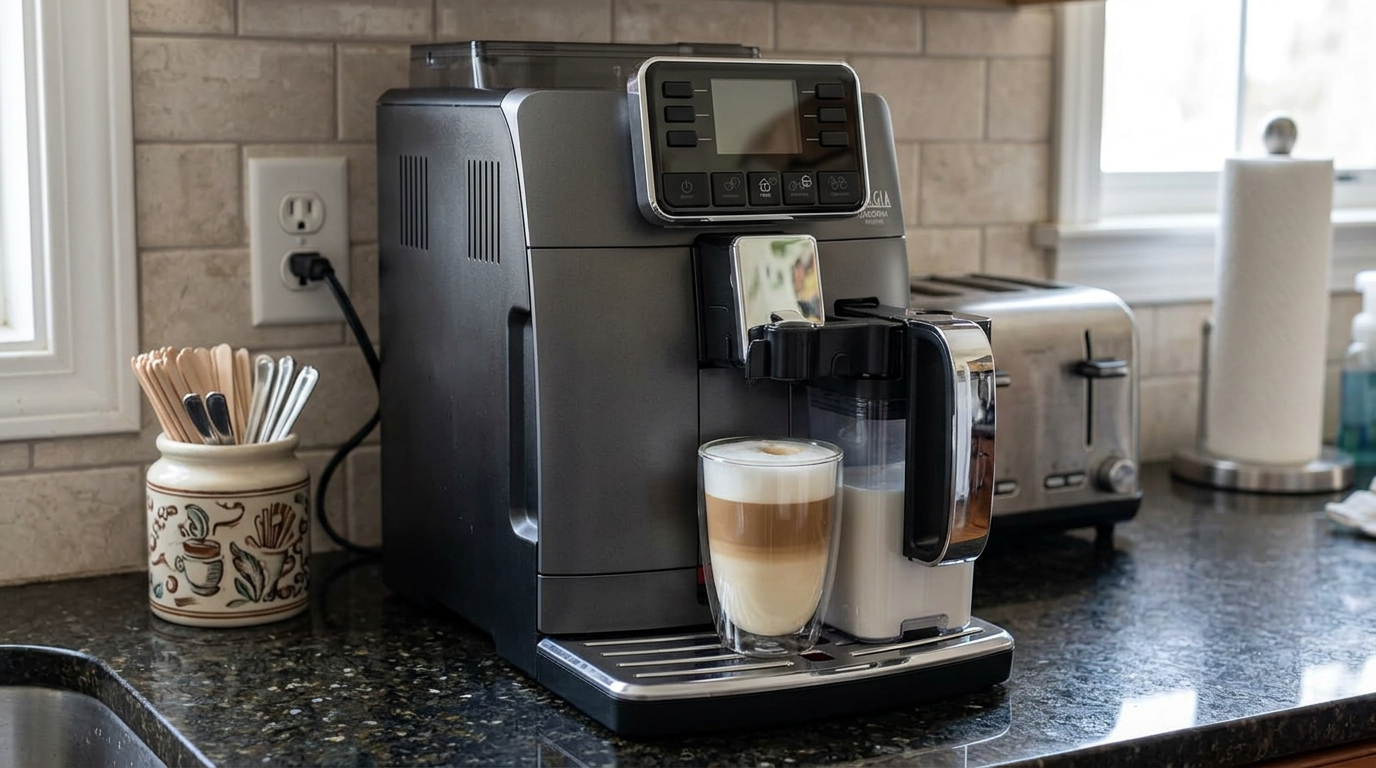
A Latte Macchiato XL, layered in the glass, at one touch.
Beans vs pods: what you save over a year
I don't put prices in reviews, because they change week to week, but the volumes are worth thinking about.
Take a household of four people who drink about two and a half coffees each a day.
That is 10 cups a day, or about 3,650 cups a year.
On a pod machine, every one of those cups leaves a plastic or aluminum capsule behind.
On the Cadorna, the only waste is spent coffee grounds, which you can compost.
Per cup, whole beans cost a fraction of what capsules do, and a homemade latte with fresh milk costs roughly a tenth of a café one.
For a busy household, the machine pays its way within its first year or so on coffee savings alone.
Beans, water and milk
Fresh whole beans make the biggest difference, so look for a roast date and use them within about four weeks.
Medium and medium-dark blends made the best espresso and milk drinks.
Light roasts needed a finer grind and higher strength.
Avoid oily, shiny beans and flavored beans, which leave residue on the burrs and can clog the chute.
| Bean type | Espresso | Milk drinks |
|---|---|---|
| Medium-dark blend | Excellent, dense crema | Excellent, chocolatey |
| Medium roast | Very good, brighter | Good, lighter |
| Light roast | Grind finer, strength 4–5 | Can taste sharp |
| Very dark, oily | Not recommended | Not recommended |
Use fresh, cold water and the water filter if your water is moderately hard.
Avoid distilled water, because coffee needs some minerals to taste full.
Common mistakes to avoid
The Gaggia Cadorna Prestige is easy to use, but a few habits will hold it back.
| Mistake | What happens | Better habit |
|---|---|---|
| Turning the grind dial with the grinder stopped | Beans jam between the burrs | Adjust only while it grinds |
| Emptying the drawer with the machine off | False "drawer full" warnings | Empty it with the power on |
| Skipping the quick clean | Dried milk blocks the carafe | Run it after every milk drink |
| Adding pre-ground before choosing bypass | Clogged chute | Select bypass on screen first |
| Using soap on the brew group | Strips grease, leaves residue | Warm water only |
| Saving everyone’s drinks on one profile | Constant re-adjusting | Give each person a color |
What I would change
A bigger puck drawer would be my first request, because 10 pucks fills quickly with double-shot drinks.
I'd also like the grind dial to be easier to reach.
Is the Gaggia Cadorna Prestige worth the money?
The Cadorna Prestige sits in the middle of Gaggia's carafe range, and it is the one I would recommend to most families.
The coffee quality is very close to the slimmer Magenta Prestige.
What you pay extra for is daily convenience: four profiles, front access, a taller spout, XL drinks and a bigger hopper.
Ask yourself three questions before you buy.
Do several people in your house drink coffee? Do your cabinets make top-loading machines awkward? And do you want one-touch milk drinks rather than steaming milk yourself?
If the answers are yes, the Cadorna Prestige is easy to recommend.
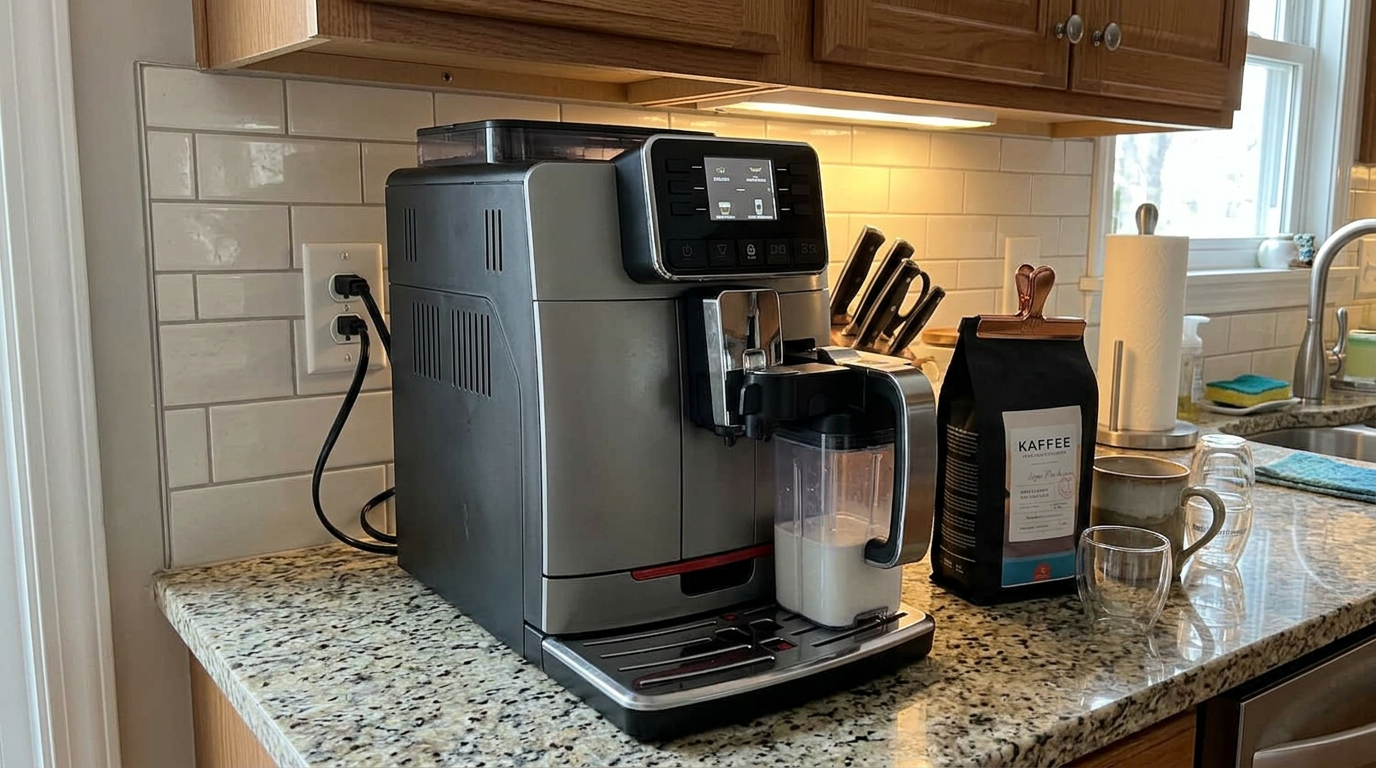
With the carafe attached, the Cadorna Prestige is ready for the next latte.
How it compares with other espresso setups
The most useful comparison is with the kinds of machines you are likely choosing between.
The Cadorna Prestige stands out for its profiles, its front access and its espresso-first flat white.
| Feature | Gaggia Cadorna Prestige | Slim carafe machine | Machine with a steam wand |
|---|---|---|---|
| Milk | One touch, right order per drink | One touch | Manual, latte art possible |
| User profiles | Four | Usually none | Rarely |
| Water tank access | Front drawer | Usually top | Varies |
| Cup clearance | About 6 in | About 5.75 in | Varies |
| Puck drawer | About 10 | About 15 | Varies |
| Width | About 10.2 in | About 8.8 in | Varies |
A slimmer carafe machine saves space and holds more pucks, but it has no profiles and usually fills from the top.
A wand machine gives you the best milk if you have the skill, but every drink takes effort.
The Cadorna is the easiest to share.
| You mostly drink | Is the Cadorna a fit? | Why |
|---|---|---|
| Flat whites and cortados | Excellent | Double shot first, then milk |
| Big lattes and cappuccinos | Excellent | XL sizes, hot sweet foam |
| Americano | Very good | Proper espresso-then-water build |
| Latte art | Poor | Carafe foam isn’t pourable microfoam |
| Large household, many tastes | Excellent | Four profiles, front access |
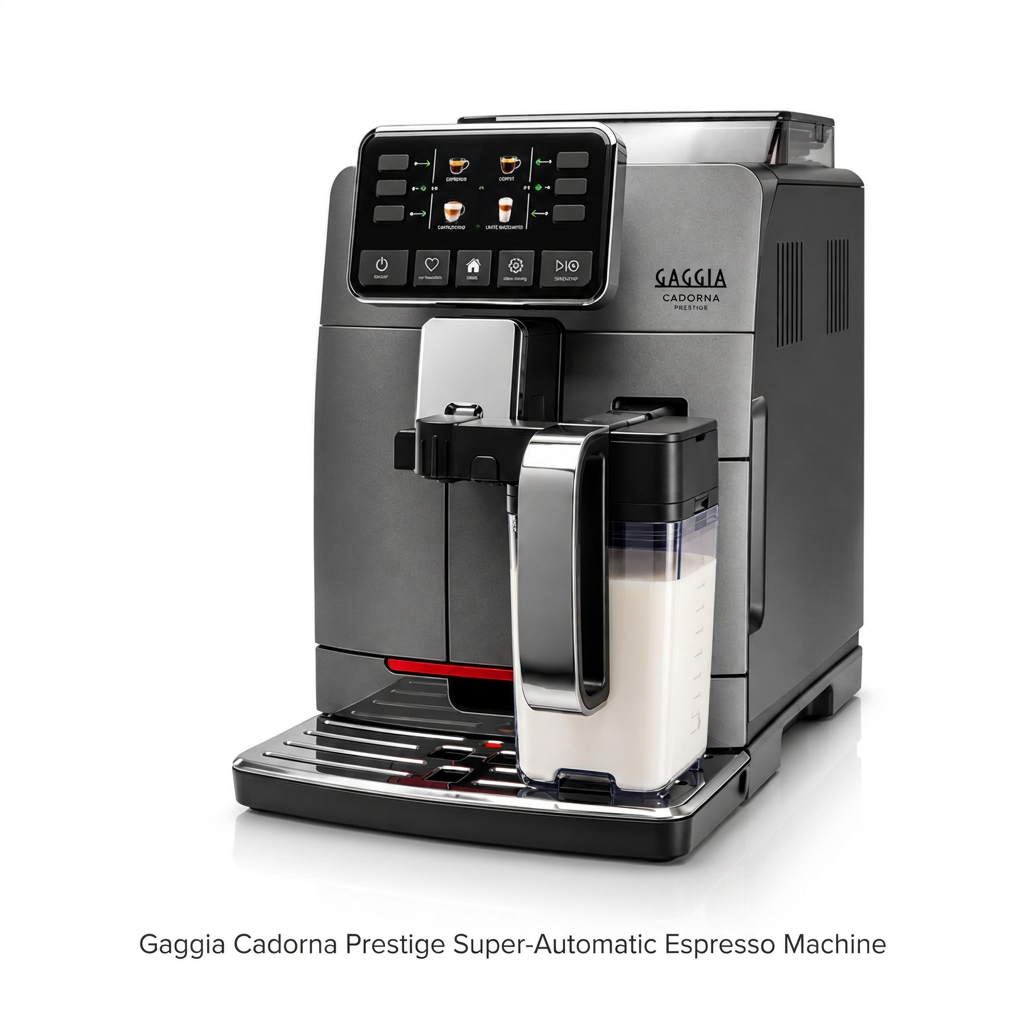
The full package: angled display, profile hearts and the front-mounted carafe.
Other Gaggia machines I tested
If counter space is very tight, the Gaggia Magenta Prestige gives you one-touch milk drinks in a body under 9 inches wide.
For flow control, a steam wand and a carafe in one premium machine, see my Gaggia Accademia review.
For a simpler one-touch cappuccino machine, read my Gaggia Naviglio Milk review.
Which one is right for you: is the Gaggia Cadorna Prestige your match?
4 quick questionsGaggia Cadorna Prestige specifications
From manufacturer data and my own testing.
How I tested and scored the Gaggia Cadorna Prestige
For four weeks, I used the Gaggia Cadorna Prestige as the main machine in a three-person household.
I shared the testing with a second tester from the HouseholdMe team, and we wrote our notes together.
We set up three profiles, made every drink on the menu, compared the espresso-first flat white with a milk-first version and tested the two-cup Americano in a travel mug.
I foamed whole, 2%, skim, oat and almond milk, measured drink temperatures with a probe thermometer and tracked how often the tank, hopper and drawer needed attention.
I then checked our notes against Gaggia's specifications and owner documentation.
- Espresso (8.6): body, crema, flavor and consistency across singles and doubles.
- Milk drinks (8.7): foam texture, temperature, prep order and the XL drinks.
- Ease of use (8.9): profiles, display, front access and day-to-day handling.
- Cleaning (8.1): quick clean, carafe washing, brew group care and the small drawer.
The overall score of 8.6 is an editorial rating that reflects those four areas.
Gaggia Cadorna Prestige FAQ
Is the Gaggia Cadorna Prestige worth it?
Yes, if two to four people share the machine and want one-touch milk drinks. Its four user profiles, espresso-first flat white and front-loading tank make it very easy to live with. If you want to pour latte art, choose a machine with a steam wand.
How do the user profiles work?
There are four color-coded hearts: red, green, blue and yellow. Each can save its own version of every drink. Tap your heart, tap the drink and it comes out the way you saved it.
Is the flat white a real double shot?
Yes. The machine runs two separate grind-and-brew cycles into the cup first, using about 0.46 to 0.8 ounces of coffee depending on strength, then adds the milk.
Where is the water tank?
It slides out from the front like a drawer, as does the puck container. Only the bean hopper opens from the top.
How big is the water tank?
About 1.5 liters, or 51 ounces. The bean hopper holds about 10.6 ounces and the puck drawer about 10 pucks.
Will it fit under my cabinets?
Very likely. It is about 15 inches tall, and the tank and drawer load from the front, so you don’t need to pull it out to refill water.
How hot is the milk?
About 155°F in my testing, which is hot but still sweet. Coffee reaches about 180°F on the High setting.
How do I clean the milk carafe?
Run the quick clean after milk drinks, then store the carafe in the fridge. Take apart and wash the carafe head and pick-up tube at least once a week.
Why does it say the drawer is full when it isn’t?
The counter resets only when you empty the drawer with the machine switched on and leave it out for five to ten seconds.
Can I use pre-ground coffee?
Yes. Select the pre-ground option on screen first, then add one level scoop to the bypass chute. Never add more than one scoop.
How tall a mug can I use?
The spout slides up to about 6 inches, which fits most travel mugs. A small pull-out tray lifts espresso cups closer to the spout.
Kitchen & coffee tester
Michael spent six years as a line cook in restaurants in Chicago and New York, and he has tested kitchen appliances for HouseholdMe since 2018, from air fryers to coffee makers. He holds an SCA certificate in barista skills and used the Gaggia Cadorna Prestige as his everyday coffee machine for four weeks for this review.
- Four weeks of hands-on testing of the Gaggia Cadorna Prestige Super-Automatic Espresso Machine
- Gaggia product specifications and owner documentation
- General espresso brewing and maintenance guidance