Gaggia Brera review: a compact, no-nonsense bean-to-cup machine with real double shots and a Pannarello wand
The Gaggia Brera Super-Automatic Espresso Machine is Gaggia’s simplest bean-to-cup machine, with buttons and a dial instead of a touchscreen. It shares its grinder and brew group with pricier Gaggia models, so the espresso is better than its size and simplicity suggest, and its double shot really is double. The Pannarello wand makes easy cappuccino foam, but milk drinks are hands-on and the cup clearance is low.

Michael Reynolds
Hands-on review
Hands-on testing, research, specs
4 weeks
22 minutes
Jargon helpNew to espresso? Tap any dotted term to see what it means.
In this review
Yes, if you want a simple, compact machine that grinds fresh and makes genuinely good espresso. The Gaggia Brera uses a similar grinder and brew group to Gaggia’s more expensive automatics, so the shot quality is the part you don’t sacrifice. Its double shot doubles the coffee as well as the water, and the Pannarello wand turns out thick, classic cappuccino foam with little practice. The trade-offs are a low spout, a small puck drawer, only three strength levels and milk drinks that are always manual.
Gaggia Brera at a glance
Gaggia Brera pros and cons
- Espresso quality close to pricier Gaggia machines
- Real double shot that doubles the coffee, not just the water
- Compact, simple and front-loading water tank
- Low cup clearance of about 4.7 inches
- Pannarello foam is thick, finer milk takes technique
- Small 8-puck drawer and only five grind settings
Who should buy the Gaggia Brera?
- First-time bean-to-cup buyers
- Small kitchens and apartments
- Espresso and cappuccino drinkers who like simple buttons
- People who want one-touch lattes
- Anyone who brews into tall travel mugs
- Tinkerers who want fine grind control
First impressions of the Gaggia Brera
The Brera is the kind of machine you understand within five minutes of unboxing it.
There is no touchscreen and no app, just a row of backlit buttons, a selector dial and a steam wand.
I liked that straight away.
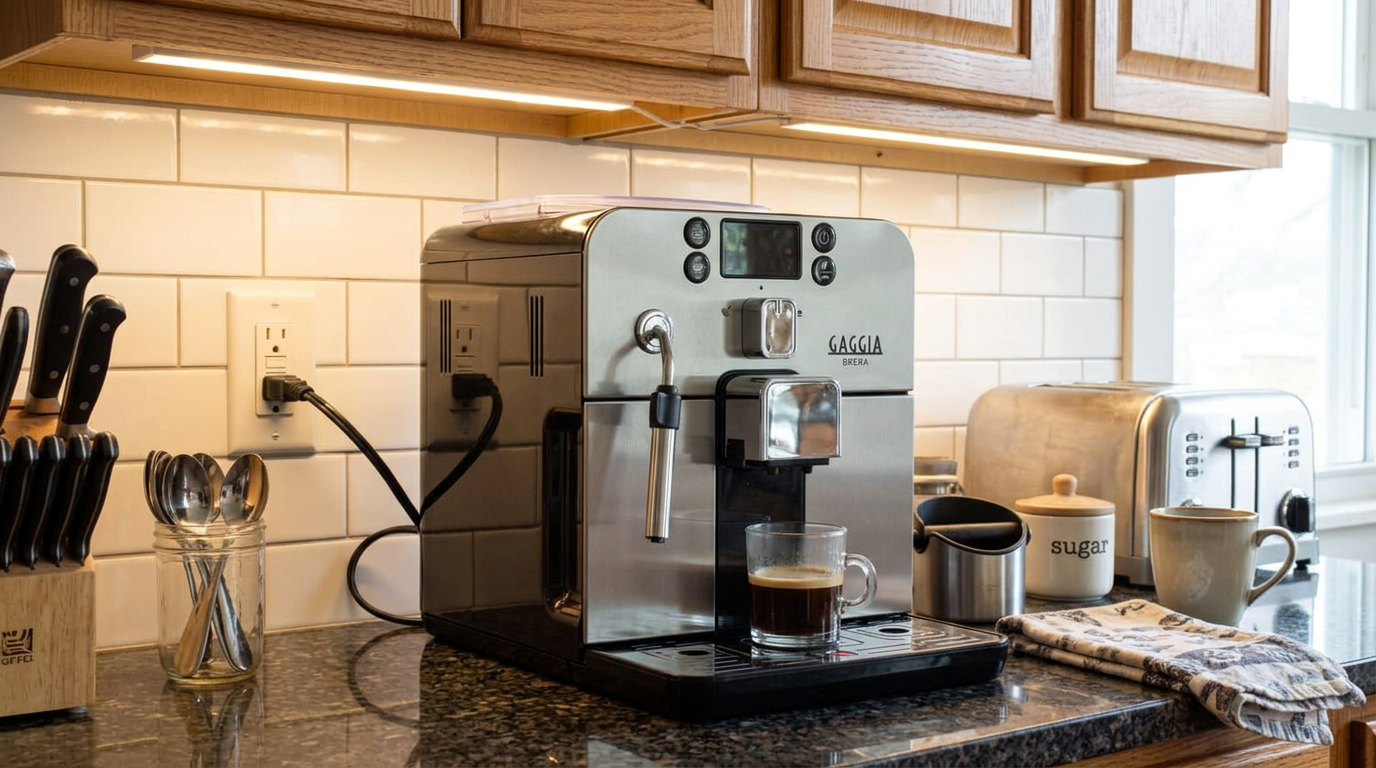
The stainless steel front panel and chrome-plated details make it look sturdier than many machines at this level, and it feels well built in the hand.
It is compact, too, at about 10 inches wide and just over 12 inches tall, so it sat comfortably under my wall cabinets.
My first two shots were bitter and thin, which is completely normal.
The first few espressos on any new machine are there to settle the grinder and brew group, and you should pour them away.
By the fourth shot, the Brera was making a dense, sweet espresso with a proper layer of crema✕CremaThe golden-brown foam on top of an espresso. It forms when pressure pushes gases and oils out of freshly ground coffee..
That surprised me, because simple machines often make simple coffee.
The reason is inside: the grinder and brew group✕Brew groupThe removable unit inside the machine that receives the ground coffee, presses it into a puck, pushes hot water through it and then drops the used puck into the drawer. are close relatives of the ones in Gaggia's more expensive models.
The Brera’s stainless front looks more expensive than its simple controls suggest.
What the Gaggia Brera actually is
The Brera is a fully automatic, bean-to-cup espresso machine at the entry point of Gaggia's range.
You fill the hopper with whole beans and the tank with water, choose a strength and press a button.
It grinds the beans with flat ceramic burrs✕Ceramic burrsTwo grinding plates made of ceramic instead of steel. They stay cooler, run quieter and keep a sharp edge for many years., doses and tamps the coffee, brews it and drops the used puck into a drawer.
For milk, there is a manual steam wand with a Pannarello✕PannarelloA sleeve that slips over a steam wand and sucks in air through a small hole. It makes thick foam easily, without much technique. sleeve.
Heat comes from a thermoblock✕ThermoblockA compact heater that warms water as it flows through, instead of keeping a big boiler hot. It heats up fast and uses little standby energy. with Gaggia's Rapid Steam✕Rapid SteamGaggia’s name for a heating system that switches from brewing to steaming temperature in seconds, so you do not wait long between a shot and frothing milk. system, which switches from brewing to steaming temperature in seconds.
The pump is rated at 15 bar.
The difference between the Brera and more expensive automatics is mostly convenience and features, not the coffee.
You lose one-touch milk, a color screen and user settings.
You keep a capable grinder, a removable brew group and honest dosing.
Gaggia Brera design and build
The Brera measures about 10 inches wide, 12.4 inches tall and 17.5 inches deep, and weighs around 18 pounds.
It is one of the shorter bean-to-cup machines I've tested, which helps under low cabinets.
The water tank pulls out from the front, which is the Brera's best practical detail.
You don't need to drag the machine forward or leave space above it just to fill the water.
You do still need a little room above to open the bean hopper on top, so don't push it hard against a cabinet.
The hopper holds about 8.8 ounces of beans in an airtight container with a UV-blocking lid.
The 40-ounce tank is on the smaller side, but it was fine for two people.
The low spout
The telescopic coffee spout gives a maximum of about 4.7 inches of clearance.
Espresso cups and standard coffee cups fit easily.
My taller mugs didn't, so for a big Americano I brewed into a smaller cup and topped it up afterward.
If you mostly use tall mugs or travel cups, this is the spec to check before you buy.
Build quality up close
The front panel and cup stand are stainless steel, while the body and bean hopper are plastic.
That mix is normal at this level, and the parts you touch most, the buttons, dial and drip tray cover, feel solid.
The control dial clicks firmly between espresso, hot water and steam, so you never land between positions by accident.
After four weeks of daily use, nothing had loosened, rattled or discolored.
The drip tray slides out smoothly and has a float that tells you when it needs emptying.
My one small gripe is the telescopic spout, which moves a little stiffly at first and loosens up after a week or so.
Our tip: Measure your favorite mug before buying, because anything taller than about 4.7 inches won’t fit under the spout.
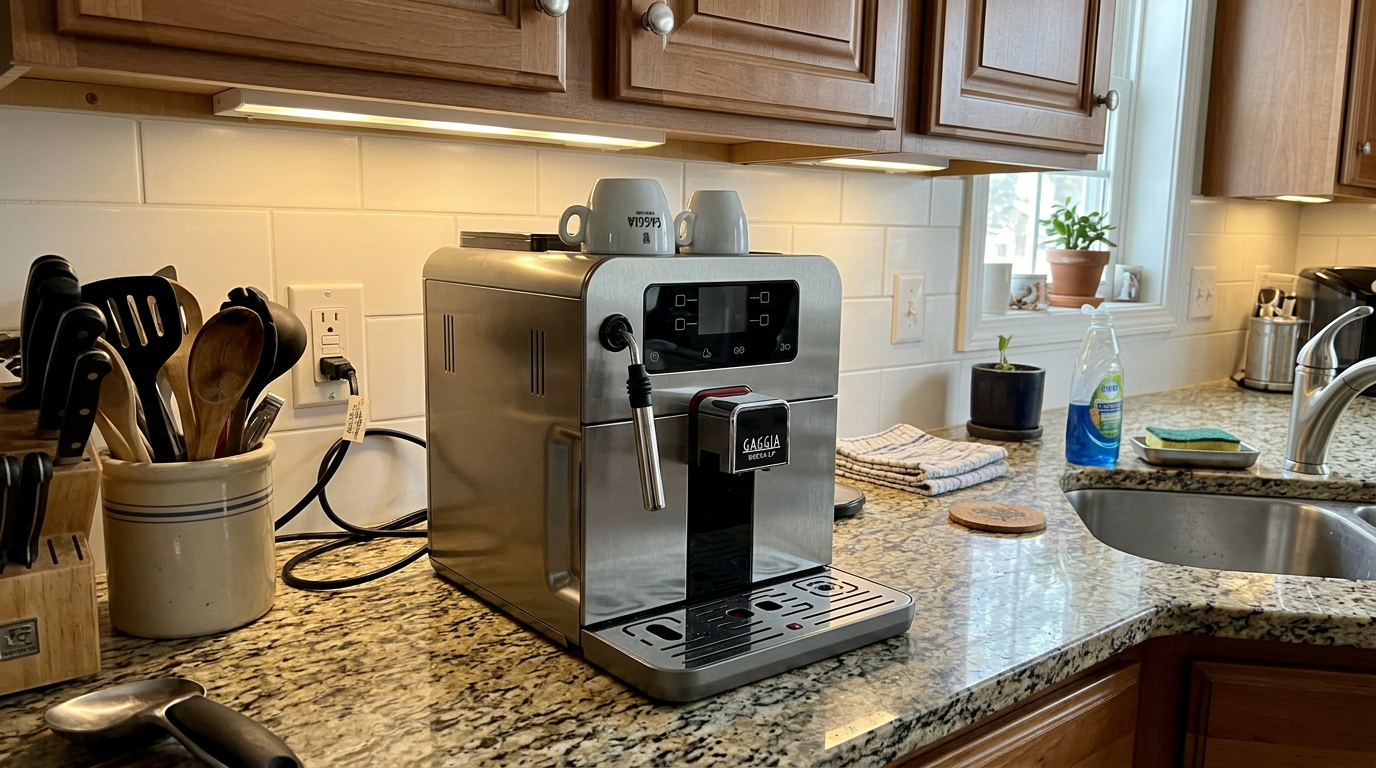
At about 12.4 inches tall, the Brera slips easily under standard wall cabinets.
First-time setup
Setup is guided by the indicator lights.
You fill the tank, and the machine primes and rinses its water circuit automatically.
Then you fill the hopper with beans and let it calibrate.
The calibration happens through the first few shots, which settle the grinder and brew group.
The first one or two taste rough enough that you shouldn't drink them.
Plan on making three to five shots before you judge the coffee.
| Step | What happens | Time |
|---|---|---|
| 1. Fill the tank | Front tank slides out, fill at the sink | 1 min |
| 2. Priming and rinse | Machine fills its circuit and rinses itself | 2 min |
| 3. Fill the hopper | Fresh whole beans, airtight lid | 1 min |
| 4. Calibration shots | Brew and discard 3–5 espressos | 3–4 min |
| 5. Set strength and volume | Choose a bean level, program your cup size | 2 min |
The built-in ceramic grinder
The Brera grinds with flat ceramic burrs✕Ceramic burrsTwo grinding plates made of ceramic instead of steel. They stay cooler, run quieter and keep a sharp edge for many years., the same material Gaggia uses across its automatics.
Ceramic stays cool and keeps its edge, which protects the coffee's aroma and helps the grinder last.
There are five grind settings.
A finer setting slows the water and gives a richer, stronger shot.
A coarser setting lets water through faster and gives a lighter cup.
Bars show how much resistance the coffee puts up and how long the shot takes to run.
Five settings is the Brera's main limitation if you like to experiment.
Each step is a big jump, and you can't fine-tune between them the way a dedicated grinder allows.
For everyday use with one or two favorite coffees, it was enough.
With a medium-dark blend, I used setting 2.
Light roasts liked setting 1, and a darker, oilier roast was better on setting 3.
Only adjust while it grinds
As on every Gaggia automatic, turn the grind adjustment only while the grinder is running.
Forcing it toward fine with the burrs stopped can jam beans between them.
I started a shot, made the change one step at a time and judged it two shots later.
Our tip: Wait two shots after a grind change before judging, because the first one still uses some coffee ground at the old setting.
Strength settings and coffee doses
The Brera has three strength settings, shown as one, two or three beans.
I like how clear these are.
Each setting corresponds to a specific dose✕DoseThe weight of ground coffee that goes into one brew. A bigger dose gives a stronger, fuller drink. of ground coffee, so you know exactly what you're getting.
| Strength setting | Single espresso dose | Double espresso dose |
|---|---|---|
| One bean | About 0.25 oz / 7 g | About 0.49 oz / 14 g |
| Two beans | About 0.32 oz / 9 g | About 0.63 oz / 18 g |
| Three beans | About 0.39 oz / 11 g | About 0.78 oz / 22 g |
One bean made a light, easy espresso.
Two beans was my everyday setting, with a good balance of body and sweetness.
Three beans gave a dense, intense shot that was best in milk drinks.
Three levels is fewer than the five on Gaggia's color-screen machines, but the steps are well spaced, so I didn't miss the in-between options.
Approximate ground coffee per drink.
Gaggia Brera espresso performance
Coffee quality is the Brera's biggest strength.
With a medium-dark blend at two beans and grind setting 2, my 1-ounce shots had a thick, hazelnut-colored crema✕CremaThe golden-brown foam on top of an espresso. It forms when pressure pushes gases and oils out of freshly ground coffee. and a round body.
I tasted cocoa, toasted nuts and a little brown sugar, with mild acidity and a clean finish.
That is broadly the same result I got from Gaggia's more expensive automatics using the same beans.
It makes sense, because the parts that make the coffee, the grinder and brew group, are so similar.
Consistency
The thermoblock heats quickly and held temperature well across three shots in a row.
The third shot was a little cooler than the first in a cold cup, so I preheated cups with hot water from the wand.
Where it falls short
There's no temperature setting, no pre-infusion control and only five grind steps.
You can't fine-tune for an unusual coffee as precisely as on a pricier machine.
For a daily espresso from good, fresh beans, though, it is genuinely good.
| What you taste or see | Likely cause | First change |
|---|---|---|
| Sour, thin, watery | Under-extraction✕Under-extractionWhen water does not pull enough out of the coffee, often because the grind is too coarse. The cup tastes sour, thin and watery. | Grind one step finer or add a bean |
| Bitter, harsh, drying | Over-extraction✕Over-extractionWhen water pulls too much out of the coffee, usually because too much water runs through one puck. The cup tastes bitter, harsh and thin. | Grind coarser or shorten the volume |
| Pale crema that fades fast | Stale beans | Use beans within four weeks of roasting |
| Drips slowly or stops | Grind too fine | One step coarser while grinding |
| Lukewarm shot | Cold cup | Warm the cup with hot water first |
Our tip: Preheat espresso cups with a splash from the hot water function, because the Brera has no temperature setting to compensate for a cold cup.
The real double shot
This is the feature I would point to if someone asked why the Brera beats other entry-level machines.
Press the espresso button twice, and the Brera grinds twice the coffee and makes twice the espresso.
It doesn't just run extra water through one puck.
At two beans, a double uses about 0.63 ounces of coffee, twice the single dose.
Many automatic machines make a larger drink when you choose a double but keep almost the same coffee dose.
That gives you a bigger, weaker and more bitter drink, a classic case of over-extraction✕Over-extractionWhen water pulls too much out of the coffee, usually because too much water runs through one puck. The cup tastes bitter, harsh and thin..
On the Brera, my doubles had the same body and crema as a single, just more of it.
| Method | Coffee used | What I tasted |
|---|---|---|
| Single at two beans | About 0.32 oz | Full and sweet |
| Single with double the water | About 0.32 oz | Thin, bitter finish |
| Brera double at two beans | About 0.63 oz | Full, sweet, rich crema |
| Brera double at three beans | About 0.78 oz | Intense, ideal for milk |
Programming espresso volume
Strength and volume are separate settings on the Brera, and it's worth understanding the difference.
Strength decides how much ground coffee goes in.
Volume decides how much liquid comes out.
For a stronger drink, raise the strength rather than the volume, because more water through the same coffee only makes it thinner.
To set the volume, press and hold the espresso or coffee button.
The machine starts brewing, and you press the button again when the cup reaches the level you want.
From then on, it remembers that amount.
I set the espresso to about 1 ounce and the long coffee to about 4 ounces, which fit a regular cup well.
Our tip: Program volume with the cup you actually use, so every drink fills it to the same level without overflowing.
Making a cappuccino with the Pannarello
The Brera's steam wand comes with a Pannarello✕PannarelloA sleeve that slips over a steam wand and sucks in air through a small hole. It makes thick foam easily, without much technique. sleeve, a metal tube with a small air hole near the top.
As steam rushes past, it sucks air in through that hole, which makes foaming milk much easier than with a bare wand.
To steam, you turn the control dial to the steam position.
Rapid Steam✕Rapid SteamGaggia’s name for a heating system that switches from brewing to steaming temperature in seconds, so you do not wait long between a shot and frothing milk. gets it ready in seconds, which is a big plus for a single-heater machine.
| Step | What I did | Why it matters |
|---|---|---|
| 1. Espresso | Single or double shot into the cup | Coffee first, milk on top |
| 2. Purge | Release a little water from the wand into the drip tray | Clears condensation so milk doesn’t get watery |
| 3. Steam | Tip just under the milk surface, dial to steam | The sleeve pulls in air and builds foam |
| 4. Control foam | Raise the jug slightly to slow aeration | Less air means smaller bubbles |
| 5. Stop at 140–149°F | Jug feels hot but you can still hold it | Milk tastes sweetest in this range |
| 6. Clean | Wipe the sleeve straight away | Stops milk from drying on |
| 7. Pour | Spoon or pour foam over the espresso | Classic tall cappuccino cap |
The foam the Pannarello makes is thick and stiff, with fairly large bubbles.
That's exactly what a traditional, old-school cappuccino calls for.
It sat on the espresso in a tall white cap and lasted until the bottom of the cup.
It isn't silky microfoam✕MicrofoamMilk foam with bubbles so small you cannot see them. It feels silky and blends into the coffee instead of sitting on top like froth., and you won't pour latte art✕Latte artPatterns like hearts or leaves poured into a milk drink. It needs silky microfoam, which you can only make with a proper steam wand. with it.
My ratings on a 10-point scale for foam texture and stability.
Our tip: Raise the jug a little as the foam builds, so the tip sits deeper and stops pulling in more air.
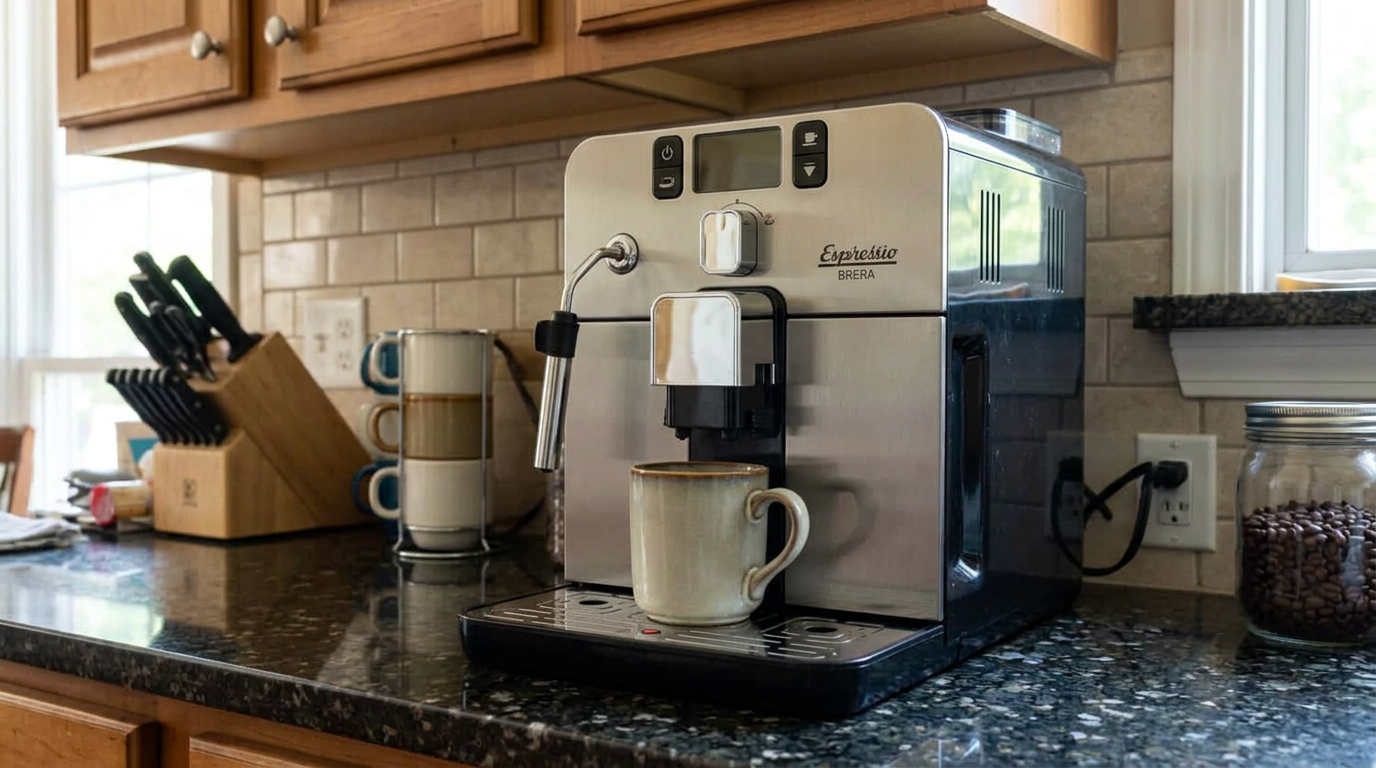
The Pannarello wand sits on the right side and swivels out over the drip tray.
A flat white without the sleeve
A flat white needs very different milk from a cappuccino: smooth, glossy and only lightly aerated.
The Brera can do it, but you have to take the Pannarello sleeve off.
With the sleeve removed, the bare steam pipe behaves more like a traditional steam wand✕Steam wandA metal pipe that blows steam into a jug of milk. You control the air and heat yourself, which takes practice but gives the most control..
That gives you direct control over how much air goes in, which is what fine milk needs.
| Step | What I did |
|---|---|
| 1. Double espresso | Press the espresso button twice at two or three beans |
| 2. Remove the sleeve | Slide the Pannarello off the steam pipe |
| 3. Purge | A short burst of steam into the drip tray |
| 4. Stretch briefly | Tip right at the surface for just a second or two |
| 5. Spin | Tilt the jug to create a whirlpool and fold the bubbles in |
| 6. Stop at 140–149°F | Jug hot but still holdable |
| 7. Polish and pour | Swirl the jug until glossy, pour into the center |
My first few attempts were too bubbly, because I let in too much air.
After a week, I could make smooth, shiny milk for a flat white more often than not.
It takes more attention than the Pannarello, but it's a real skill, and the Brera lets you learn it.
Americano and hot water
There's no one-touch Americano✕AmericanoAn espresso topped up with hot water that does not pass through the coffee. It keeps the espresso’s flavor in a longer, milder cup. button, but making one is easy.
You brew an espresso, usually a double for a bigger cup, then turn the dial to the hot water position and add water from the wand.
You can also put the hot water in first and brew the espresso over it.
Both work, and it comes down to whether you want to keep the crema on top.
| Drink | How it is made | How it tasted |
|---|---|---|
| Americano | Double espresso plus hot water from the wand | Clean, sweet, espresso flavor |
| Long coffee | More water through one puck | Rounder, a bit more bitter at large sizes |
| Strong Americano | Double at three beans, less water | Bold, ideal for a small mug |
Because the hot water comes from the wand, you control the strength exactly.
Less water makes a bolder drink, more water makes it milder.
I liked having the hot water on hand for tea, too.
The bypass chute for pre-ground coffee
The Brera has a bypass doser✕Bypass doserA small chute for pre-ground coffee that skips the grinder and sends one scoop straight to the brew group. Handy for an occasional decaf., a chute on top that sends pre-ground coffee straight to the brew group.
It's useful for an occasional decaf, or if you want to try coffee ground on a separate grinder.
The important thing is the dose.
Gaggia's guidance is a maximum of about 0.28 ounces, roughly one level scoop.
Depending on the grind, a little more can fit, but going over puts strain on the brew group and can damage it over time.
Approximate ground coffee per bypass shot.
Our tip: Stick to one level scoop in the bypass chute, because overloading the brew group is one of the few ways to damage the Brera.
Cleaning and maintaining the Gaggia Brera
The Brera rinses itself automatically when it switches on and off.
Daily care is mostly emptying the drip tray and the puck drawer and wiping the wand.
| When | Task | Why it matters |
|---|---|---|
| After steaming | Wipe the wand and sleeve, purge with hot water | Stops milk drying inside |
| Daily | Empty the drip tray | Prevents overflow and smells |
| About every 8 drinks | Empty the puck drawer | The machine stops when it is full |
| Every few days | Rinse the Pannarello sleeve at the sink | Removes milk from inside |
| Weekly | Rinse the brew group under warm water | Removes coffee oils and fines |
| Monthly | Grease the brew group | Keeps it moving smoothly |
| When prompted | Descale | Protects the thermoblock from scale |
The brew group✕Brew groupThe removable unit inside the machine that receives the ground coffee, presses it into a puck, pushes hot water through it and then drops the used puck into the drawer. comes out through a side door.
Rinse it under warm water without soap, let it air dry and slide it back in.
The machine tells you when it needs descaling✕DescalingRunning a mild acid solution through the machine to dissolve mineral scale left by hard water. Scale slows heating and can block pipes., and using a water filter in the tank means it asks less often.
My estimate of hands-on cleaning time per day.
Our tip: Rinse the brew group on the same day every week, so it never builds up the oily residue that makes coffee taste stale.
What daily use is really like
My mornings were simple.
Switch on, wait for the rinse, press espresso twice and steam milk while the second shot brewed.
A cappuccino took about two and a half minutes, including wiping the wand.
The front-loading tank meant refills never interrupted the routine.
Tank and drawer
The 40-ounce tank lasted about two days for two people.
The eight-puck drawer filled quickly, because every double uses two pucks.
I emptied it daily.
Rough maths from a 40 oz tank and an 8-puck drawer, allowing for rinse water.
Noise
The ceramic grinder is moderate, a short, low grind.
The pump hum is normal for a vibration pump.
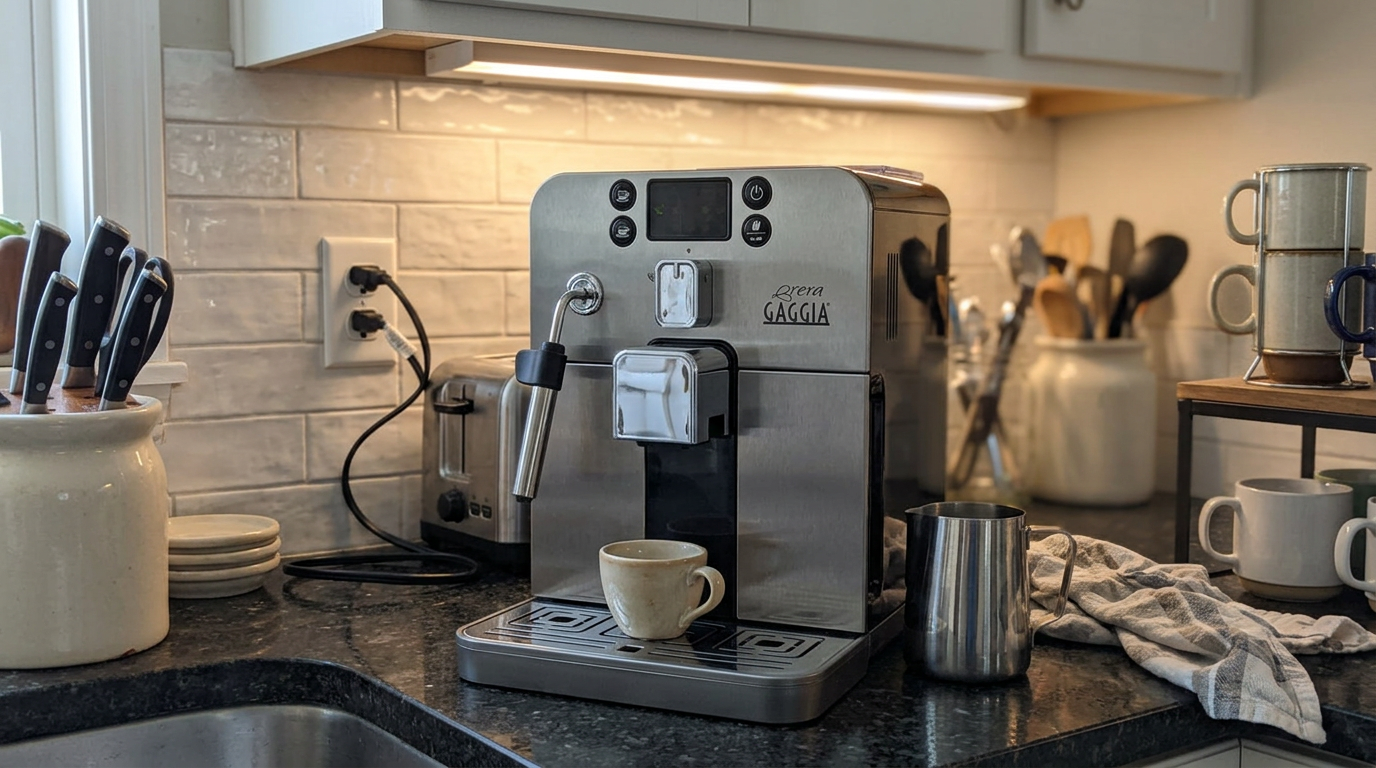
Simple buttons and a dial: the Brera is easy for anyone in the house to use.
Getting the best from a simple machine
The Brera has fewer settings than most automatics, so each one matters more.
After four weeks, these are the habits that made the biggest difference to my coffee.
The first is dialing in with the double shot rather than the single.
A double gives the brew group a fuller puck, and in my testing it was more forgiving of small grind differences.
Once the double tasted right, the single was usually right too.
The second is matching strength to the drink rather than to your mood.
I kept one bean for a light afternoon espresso, two beans for straight espresso and Americanos, and three beans for anything with milk.
Milk softens coffee a lot, and a weak shot simply disappears under a cappuccino's foam.
The third is keeping the hopper only half full.
Beans sitting under the lid for a week lose aroma, even with the airtight seal, so I added what I'd use in three or four days.
| Drink | Strength | Grind | Volume |
|---|---|---|---|
| Straight espresso | Two beans | Setting 2 | About 1 oz |
| Double for milk drinks | Three beans, button twice | Setting 2 | About 2 oz |
| Americano | Two beans, double | Setting 2 | 2 oz plus hot water |
| Long coffee | Two beans | Setting 3 | About 4 oz |
| Light afternoon shot | One bean | Setting 2 | About 1 oz |
Those settings were my starting points with a medium-dark blend.
With a different coffee, change one thing at a time and give each change two shots before you decide.
Our tip: Write your settings on a sticky note inside a cupboard door, because the Brera has no screen to remind you what you chose.
Beans and water
The Brera's coffee is only as good as your beans.
Buy whole beans with a roast date and use them within about four weeks.
Medium and medium-dark espresso roasts suited the five-step grinder best.
Light roasts needed setting 1 and three beans, and even then could taste a bit sharp.
Avoid oily, shiny beans and flavored beans, which can clog the grinder and the chute.
| Bean type | Espresso | Cappuccino |
|---|---|---|
| Medium-dark blend | Excellent, thick crema | Excellent |
| Medium roast | Very good, brighter | Good |
| Light roast | Finest setting, three beans | Can taste sharp |
| Very dark, oily | Not recommended | Not recommended |
Use fresh, cold water every day or two.
A water filter in the tank helps if your water is hard, and it stretches the time between descaling.
Common mistakes to avoid
The Gaggia Brera is about as simple as a bean-to-cup machine gets, but these habits will hold it back.
| Mistake | What happens | Better habit |
|---|---|---|
| Judging the first few shots | You think the machine is bad | Discard three to five calibration shots |
| Raising volume for a stronger drink | Weak, bitter coffee | Raise strength or use the double |
| Overfilling the bypass chute | Strain and possible damage to the brew group | About 0.28 oz maximum |
| Leaving milk on the Pannarello | Dried milk blocks the air hole | Wipe and rinse after every use |
| Adjusting grind with the grinder stopped | Beans jam in the burrs | Adjust only while it grinds |
| Using a tall mug | Mug won’t fit or coffee splashes | Use a cup under 4.7 inches |
What I would change
A taller spout would make the Brera much more practical for mug drinkers.
A bigger puck drawer and a couple more grind steps would also help, though they'd add size and cost.
Is the Gaggia Brera worth the money?
The Brera is Gaggia's entry point, and it puts its money in the right place.
You get a grinder and brew group close to those in the more expensive machines, so the espresso is the part you don't compromise on.
What you give up is convenience: no touchscreen, no one-touch milk, three strength levels and a low spout.
Ask yourself three questions before you buy.
Do you mostly drink espresso, Americanos and the occasional cappuccino? Do your cups fit under 4.7 inches? And are you happy to steam milk by hand?
If the answers are yes, the Brera is a smart, simple buy.
Whole beans also cost much less per cup than capsules, so it keeps paying you back.
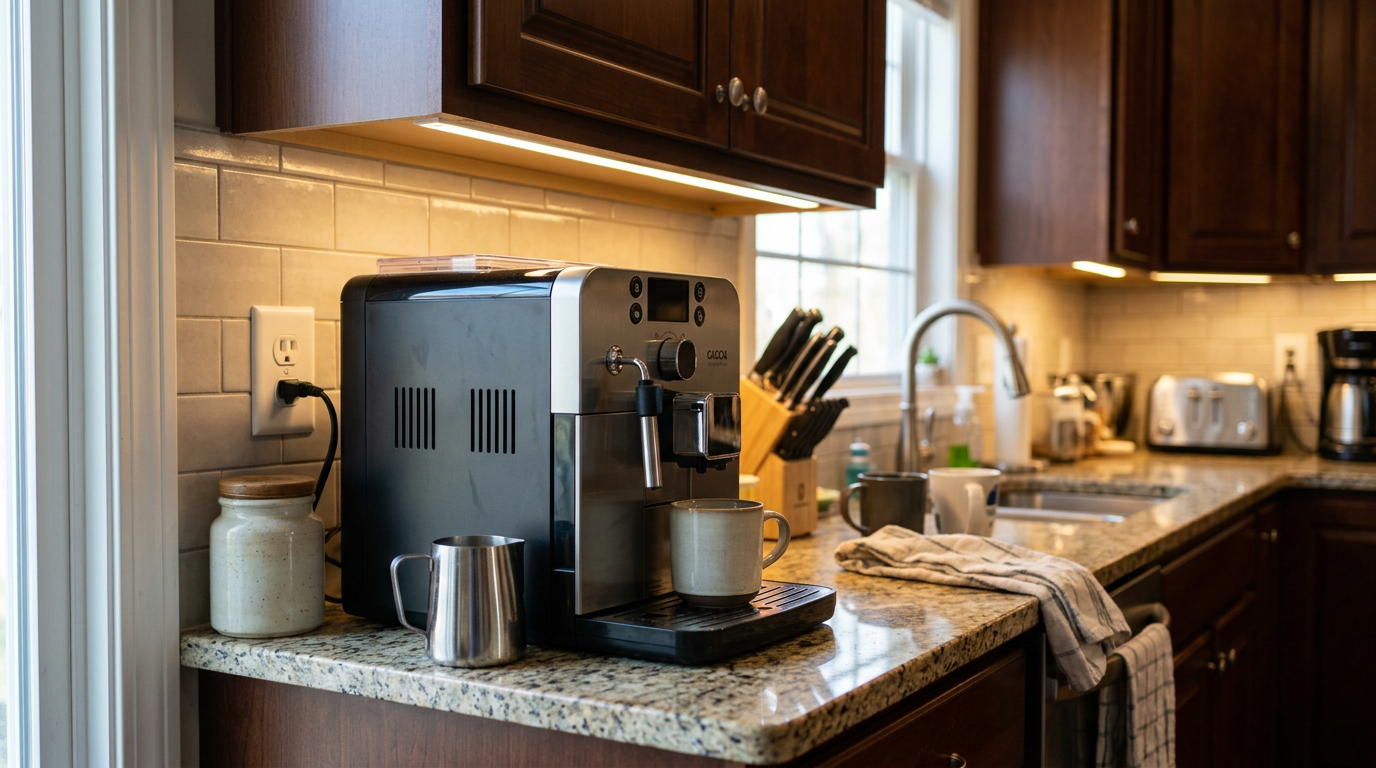
Compact and simple, the Brera fits a small kitchen without taking over the counter.
How it compares with other espresso setups
The most useful comparison is with the kinds of machines you are likely choosing between.
The Brera stands out for its simplicity, its espresso and its honest double shots.
| Feature | Gaggia Brera | Automatic with color screen and carafe | Manual machine and grinder |
|---|---|---|---|
| Grinding and brewing | Fully automatic | Fully automatic | You do it |
| Controls | Buttons and a dial | Touchscreen | Manual |
| Milk | Pannarello wand | One-touch carafe | Steam wand |
| Strength levels | 3 clear doses | Usually 5 | Unlimited |
| Cup clearance | About 4.7 in | Often 5.5–6 in | Varies |
| Learning curve | Low | Lowest | High |
A machine with a color screen and carafe adds one-touch milk drinks and more settings, but the coffee itself isn't dramatically better.
A manual setup gives you total control, but you grind, dose and tamp every shot yourself.
The Brera keeps the coffee and drops the extras.
| You mostly drink | Is the Brera a fit? | Why |
|---|---|---|
| Espresso | Excellent | Same style of grinder and brew group as pricier models |
| Classic cappuccino | Very good | Pannarello makes thick foam easily |
| Flat white | Good, with practice | Remove the sleeve for smoother milk |
| One-touch lattes | Poor | No automatic milk system |
| Big mugs and travel cups | Poor | About 4.7 in cup clearance |
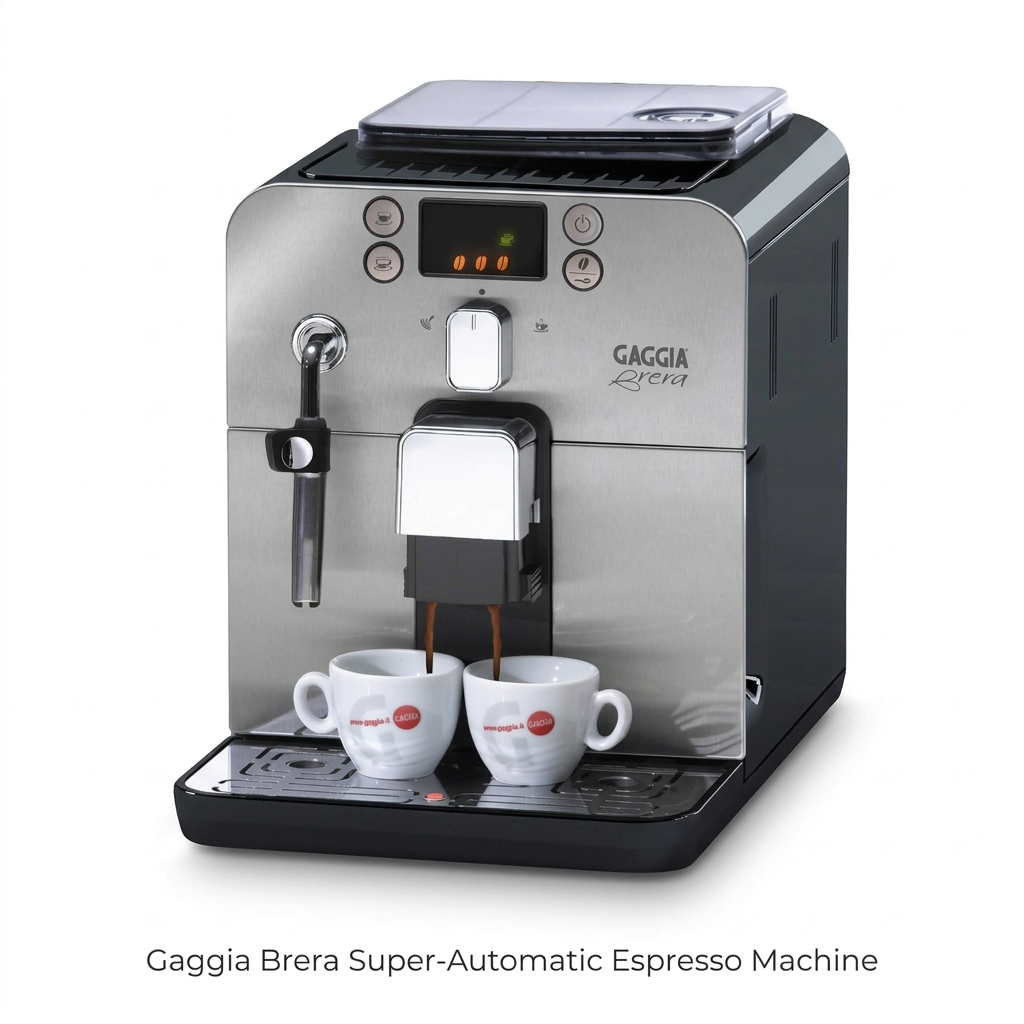
The full package: simple buttons, a selector dial and the Pannarello wand.
Other Gaggia machines I tested
For one-touch cappuccinos at a similar level, read my Gaggia Naviglio Milk review.
If you want a slim machine with a color screen and a true Americano, see the Gaggia Magenta Plus.
For one-touch milk drinks and user profiles, read my Gaggia Cadorna Prestige review.
Which one is right for you: is the Gaggia Brera your match?
4 quick questionsGaggia Brera specifications
From manufacturer data and my own testing.
How I tested and scored the Gaggia Brera
For four weeks, I used the Gaggia Brera as my everyday machine for espresso, doubles, Americanos, cappuccinos and flat whites.
I shared the machine with a second tester from the HouseholdMe team, and we wrote our tasting and usage notes together.
We tried all five grind settings and all three strengths, compared the Brera's double shot with a single run long, and made cappuccinos with the Pannarello and flat whites without it.
I foamed whole, 2%, skim, oat and almond milk, tested the bypass chute with decaf and timed the daily and weekly cleaning.
I then checked our notes against Gaggia's specifications and owner documentation.
- Espresso (8.2): body, crema, flavor and consistency, including the double shot.
- Milk drinks (6.8): Pannarello foam, flat white milk without the sleeve and the effort involved.
- Ease of use (7.9): buttons, programming, front tank and cup clearance.
- Cleaning (7.6): wand care, brew group rinse, small drawer and prompts.
The overall score of 7.6 is an editorial rating that reflects those four areas.
Gaggia Brera FAQ
Is the Gaggia Brera worth it?
Yes, if you want simple, fresh-ground espresso from a compact machine. Its grinder and brew group are close to those in pricier Gaggia models, so the coffee is very good. If you want one-touch milk drinks or use tall mugs, look elsewhere.
Does the Brera froth milk automatically?
No. It has a manual steam wand with a Pannarello sleeve. The sleeve makes thick cappuccino foam easily, and removing it gives you more control for smoother milk.
What are the Brera’s strength settings?
There are three: about 0.25, 0.32 and 0.39 ounces of coffee for a single shot. A double uses twice as much: about 0.49, 0.63 and 0.78 ounces.
Is the double shot really double?
Yes. Pressing the espresso button twice grinds twice the coffee and makes twice the espresso, instead of running extra water through one dose.
How tall a cup fits under the spout?
About 4.7 inches. Espresso cups and regular coffee cups fit, but many tall mugs and travel cups won’t.
How big is the water tank?
About 40 ounces, or 1.2 liters. It pulls out from the front, so you don’t need to move the machine to fill it.
How do I set the espresso volume?
Press and hold the espresso or coffee button. The machine starts brewing, and you press the button again when the cup reaches the level you want. It remembers that amount.
Can I use pre-ground coffee?
Yes, through the bypass chute on top. Use about one level scoop, roughly 0.25 to 0.28 ounces. Overfilling can strain the brew group.
Can I make a flat white on the Brera?
Yes. Make a double espresso, remove the Pannarello sleeve and steam the milk with the bare pipe, adding only a little air and spinning it into smooth microfoam.
How often do I empty the puck drawer?
It holds about eight pucks. Doubles use two each, so most people empty it every day or two.
Why does my first espresso taste bad?
The first three to five shots on a new machine settle the grinder and brew group. Pour them away and judge the coffee after that.
Kitchen & coffee tester
Michael spent six years as a line cook in restaurants in Chicago and New York, and he has tested kitchen appliances for HouseholdMe since 2018, from air fryers to coffee makers. He holds an SCA certificate in barista skills and used the Gaggia Brera as his everyday coffee machine for four weeks for this review.
- Four weeks of hands-on testing of the Gaggia Brera Super-Automatic Espresso Machine
- Gaggia product specifications and owner documentation
- General espresso brewing and maintenance guidance