De'Longhi Dedica Duo review
The De'Longhi Dedica Duo (EC890) keeps the famous 6-inch-wide Dedica shape and adds top touch controls, a flatter drip tray and a five-minute cold brew button. Espresso is decent from the pressurized baskets and genuinely good with a standard basket and fresh beans. The steam wand is weak and slow.

Michael Reynolds
Hands-on review
Hands-on testing, research, specs
3 weeks
19 minutes
Jargon helpNew to coffee gear? Tap any dotted term to see what it means.
In this review
Yes, if you want a slim machine for espresso and quick cold coffee, not daily lattes. The De'Longhi Dedica Duo made chocolatey doubles from its pressurized baskets, velvety espresso with a standard basket and fresh beans, and a refreshing cold brew in about five minutes. Its steam wand took about 24 to 25 seconds to start moving the milk, so lattes were slow and inconsistent, and coffee keeps dripping after you stop a shot.
De'Longhi Dedica Duo at a glance
De'Longhi Dedica Duo pros and cons
- Very slim, about 6 inches wide
- Cold brew in about five minutes
- Good espresso with a standard basket
- Weak, slow steam wand
- Keeps dripping after the shot stops
- Touch controls lack physical feedback
Who should buy the De'Longhi Dedica Duo?
- Espresso and iced coffee drinkers
- Very small kitchens
- Tinkerers who will add a good grinder
- Daily latte and cappuccino drinkers
- Latte art learners
- People who prefer physical buttons
First impressions of the De'Longhi Dedica Duo
The slim Dedica shape has been around for about a decade, and it's easy to see why.
It gives you a real portafilter✕PortafilterThe handle with a metal basket that holds the ground coffee and locks into the machine during brewing. espresso machine in a body barely wider than a cereal box.
The De'Longhi Dedica Duo, model EC890, keeps that famous shape and adds three new things: top-mounted touch controls, a flatter drip tray and a dedicated cold brew button.
Out of the box, the Duo felt familiar and fresh at once.
The front is cleaner without buttons, and the controls now sit on top, responding to a light tap.
The accessories are more complete than older Dedicas: two pressurized baskets✕Pressurized basketA filter basket with a single tiny exit hole. It builds resistance for you, so pre-ground coffee still makes crema, but it limits how much you can fine-tune the shot., a tamper with a metal base, a small milk pitcher and a cleaning pin for the wand.
My first double espresso, from pre-ground coffee, was chocolatey and decent within five minutes of unboxing.
My first cold brew, five minutes later, was even more of a surprise.
Then I steamed milk, and the honeymoon ended: the steam wand is weak.
That pattern, strong on espresso and cold coffee, weak on milk, held for all three weeks.
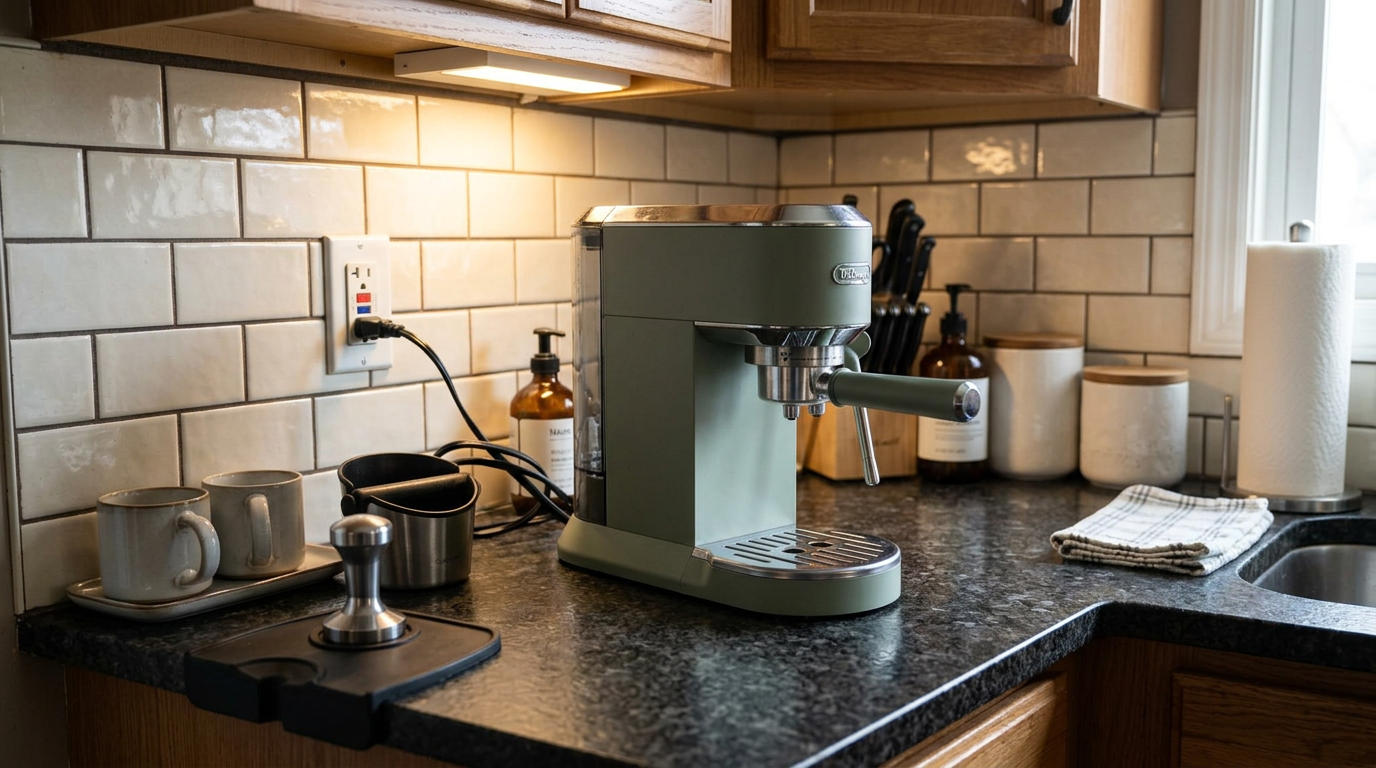
The famous slim Dedica shape, now with touch controls on top and a flatter drip tray.
What the Dedica Duo actually is
The Dedica Duo is a compact semi-automatic espresso machine with a portafilter, a steam wand and a new cold brew function.
You fill and tamp the basket, tap single or double, and steam milk by hand.
The cold brew button makes a chilled coffee in about five minutes without heating.
What's in the box
How it fits in the Dedica family
| Model | Controls | Milk system | Cold brew |
|---|---|---|---|
| EC680 | Physical buttons | Panarello sleeve | No |
| EC685 | Physical buttons | Updated Panarello | No |
| EC885 | Physical buttons | Safer-to-handle steam wand | No |
| EC890 Dedica Duo | Top touch controls | Steam wand | Yes |
If you want to compare it with an earlier model, my De'Longhi Dedica EC680 review covers the original design.
Our tip: Keep the cleaning pin somewhere you'll find it, because the steam tip is narrow and dried milk can block it quickly.
Design, controls and drip tray
The Duo is still the slim Dedica: about 6 inches wide, with the tank at the back.
It fit into a gap on our counter where no other portafilter machine has ever fit.
Touch controls
The controls moved from the front to the top, and they're now capacitive touch buttons.
They respond to a light tap, and the front looks much cleaner without them.
I missed the physical click of real buttons for the first few days, especially with wet fingers.
By week two, I didn't think about it.
The new drip tray
The drip tray is slightly larger and flatter than on older Dedicas.
That flat top makes cups sit more steadily, especially small espresso cups with narrow bases.
Our tip: Leave a little space above the machine, because the touch controls are on top and hard to reach under a low cabinet shelf.
Setup and the first day
Setup took about ten minutes.
I rinsed the tank, baskets, portafilter and pitcher, filled the tank and ran water through the group and the steam wand.
The touch panel walked me through the first rinse without needing the manual.
| Step | What I did | Time |
|---|---|---|
| Rinse parts | Tank, baskets, portafilter, pitcher | 4 min |
| Fill tank | Filtered water | 1 min |
| Flush group | Two water-only doubles | 1 min |
| Flush wand | Steam into a cup of water | 1 min |
| First espresso | Pre-ground, pressurized double | 2 min |
Our tip: Flush both the group head and the steam wand with water before your first coffee, because both paths can carry a factory taste.
Puck prep guide for the standard basket
If you move to a standard basket, preparation makes the biggest difference.
This is the routine that gave me the velvety shots described above.
- 1. Weigh: about 16 to 16.5 grams of fresh beans.
- 2. Grind: fine and even on a capable burr grinder.
- 3. Funnel: use a dosing funnel so grounds don't spill.
- 4. Distribute: stir with a needle tool to break up clumps.
- 5. Tamp: press firmly and level.
- 6. Brew: tap double and stop early, around 22 to 24 grams, to land near 32 grams after the drip.
What worked for me with a medium blend.
| Problem | Likely cause | Fix |
|---|---|---|
| Fast, sour shot | Grind too coarse | Grind finer |
| Slow, bitter shot | Grind too fine | Grind slightly coarser |
| Spurts and uneven flow | Clumps or uneven tamp | Distribute, tamp level |
| Shot too heavy | After-drip | Stop earlier |
For more on what's happening in the cup, my explainer on coffee extraction is a good primer.
Our tip: Use a dosing funnel with a standard basket, because the Dedica's slim basket overflows easily when you grind straight into it.
Heat-up and temperature
The Duo uses a thermoblock✕ThermoblockA heater that warms water as it flows through a hot metal block, instead of heating a whole boiler. It makes a machine ready within seconds rather than minutes., so it heats quickly: ready to brew in well under a minute.
Back-to-back shots tasted consistent, and the first shot of the morning didn't taste noticeably cooler.
After steaming, I could go straight to cold brew without a forced cooling step, which older Dedicas sometimes required.
Averages from the test.
Our tip: Brew your hot espresso before steaming milk, because the thermoblock runs hotter after steaming and a shot right after can taste harsh.
Reliability after three weeks
Over three weeks, the Duo made around 40 espressos, 15 cold brews and about a dozen milk drinks without a fault.
The touch panel never missed a tap once I got used to it, and nothing leaked.
From my test log.
Our tip: Wipe the touch panel with a dry cloth, because water droplets on capacitive controls can register as taps or stop them responding.
Espresso with the pressurized baskets
The included pressurized baskets are the easiest way to start.
They create resistance at the outlet, so pre-ground coffee still makes crema without a precise grinder.
My routine
About 14 grams of ground coffee fit comfortably in the double basket.
I leveled it and gave it a light tamp with the included tamper, then tapped double.
Watch the drip after stopping
The Duo doesn't have a solenoid valve, which on other machines releases pressure instantly when the shot ends.
So coffee keeps dripping after the pump stops.
In one shot, I stopped at about 25 grams and the cup finished at about 40 grams.
Typical shot from my notes. Plan for the extra drip.
How it tasted
The espresso was decent, with a noticeable chocolate character.
It was clearly better than what I get from basic capsule machines or cheap automatic coffee makers.
But it lacked depth and complexity compared with a traditional shot from a standard basket.
| Drink | Taste in my tests | Best setting |
|---|---|---|
| Double, pressurized | Chocolatey, simple | 14 g, stop early around 20–22 g |
| Single, pressurized | Light | Single basket, one tap |
| Americano | Clean | Double into hot water |
| Cortado | Balanced | Double plus a little milk |
Our tip: Stop the shot 10 to 15 grams before your target weight, because the Duo keeps dripping after the pump stops and the cup will catch up.
Upgrading to a standard basket
The Duo can also take a non-pressurized basket✕Non-pressurized basketA standard espresso basket with many open holes. The coffee puck itself has to create the resistance, so grind size and tamping matter far more., and that's where it surprised me.
With fresh beans, a good burr grinder✕Burr grinderA grinder that crushes beans between two abrasive plates, giving even particles. Blade grinders chop unevenly and make espresso harder to control. and careful preparation, it made a genuinely good espresso.
My standard-basket setup
I used about 16.5 grams of freshly roasted Arabica and Robusta blend, ground fine on an espresso-capable burr grinder.
A dosing funnel kept grounds off the counter, and a needle distribution tool (WDT✕WDTShort for Weiss Distribution Technique: stirring the grounds with thin needles to break up clumps before tamping.) broke up clumps.
Then I tamped evenly and stopped the shot at about 32 grams.
The result
The shot had thick crema and looked completely different from the pressurized version.
It tasted velvety and rounded, with bittersweet chocolate and nougat.
That was the best coffee I made on the Duo.
Averaged across three weeks.
Our tip: Budget for a capable burr grinder if you want to use a standard basket, because a cheap blade grinder can't make the fine, even grind it needs.
Milk steaming: the Duo's big weakness
This is where the Dedica Duo disappoints.
The steam wand✕Steam wandThe metal pipe that blasts steam into milk to heat it and create foam for cappuccinos and lattes. produces relatively little pressure, so it struggles to create the fast, rolling whirlpool that turns milk into silky microfoam✕MicrofoamMilk foam with bubbles so small you can't see them. It feels silky and blends into the coffee instead of sitting on top like froth..
What happened in my tests
After purging the wand, steam mode takes a moment to heat.
Then the wand mostly blew bubbles for the first stretch.
It took about 24 to 25 seconds before the milk started moving properly in the pitcher.
A stronger compact machine I used alongside it started a whirlpool in about eight seconds.
My measurements with the same pitcher and milk.
Can you still make a latte?
Yes, with patience.
I had to hold the pitcher at just the right angle and keep the tip in one spot the whole time.
The milk was drinkable, and once or twice I managed a simple heart, but it was hard and inconsistent.
The small pitcher makes sense
The included pitcher is small, and that suits this wand.
Large amounts of milk take far too long.
Our tip: Steam only 4 to 5 ounces of very cold milk at a time, because the weak wand handles small amounts far better than a full pitcher.
Cold brew in five minutes
The cold brew button is the Duo's most interesting new feature.
It makes a chilled coffee in about five minutes, compared with 12 hours or more for traditional cold brew✕Cold brewCoffee steeped in cold water for many hours. It tastes smooth and low in acidity, unlike hot coffee poured over ice..
It appears to work by switching off the heater and running water through the coffee slowly, without heating it.
No cool-down wait
On older Dedicas, after steaming, the machine would sometimes tell you the heater needed to cool before brewing again.
The Duo let me start cold brew right after steaming milk, with no forced cooling step.
How it tasted
The cold brew was tasty and refreshing, with a slightly sweeter impression than hot coffee poured over ice.
It isn't identical to coffee steeped in the fridge overnight, which is smoother and heavier.
But as a quick cold coffee on a hot afternoon, it was excellent.
Taste and convenience, averaged over the test.
| Drink | How I made it | Tip |
|---|---|---|
| Cold brew black | Cold brew button, over ice | Medium roast works best |
| Iced cold brew latte | Cold brew plus cold milk | No steaming needed |
| Sweet cold brew | Cold brew plus a little syrup | Stir before adding ice |
| Cold brew tonic | Cold brew over ice and tonic | Pour slowly |
For the full difference between methods, see my guide to iced coffee vs cold brew.
Our tip: Use a medium roast for the cold brew button, because it tasted rounder and sweeter than dark roasts, which turned flat when brewed cold.
What daily use is really like
A typical weekday: a pressurized double in the morning, a cold brew in the afternoon.
On weekends, I made standard-basket espresso with fresh beans and the occasional latte, accepting the slow steaming.
My average hands-on time per drink.
Noise
The pump buzzes during brewing, as on all compact pump machines.
Cold brew is quieter because the machine works more slowly.
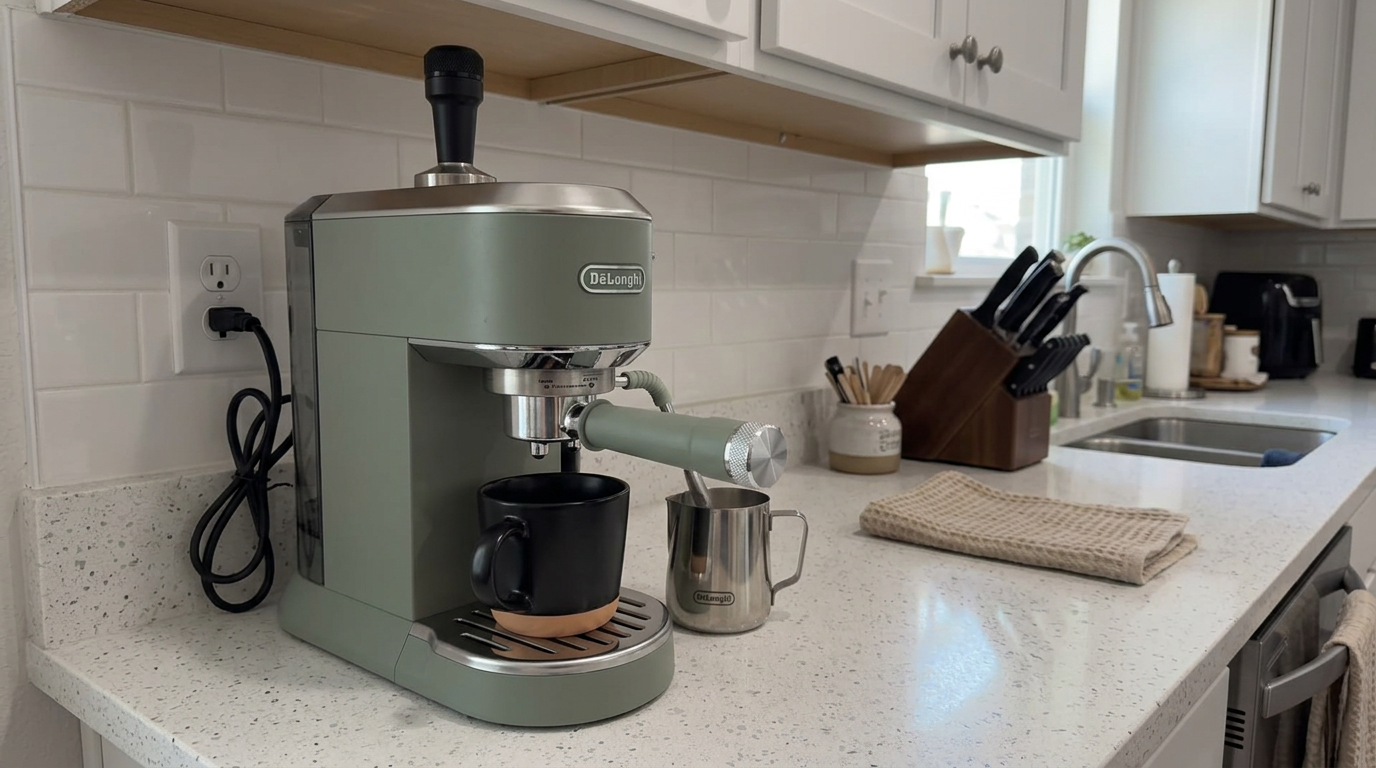
With a standard basket and fresh beans, the Duo made thick, velvety espresso.
Cleaning and maintenance
Daily cleaning is quick.
Knock out the puck, rinse the basket and portafilter, wipe and purge the steam wand and empty the drip tray.
| Task | Why | How often |
|---|---|---|
| Knock out puck, rinse basket | Grounds and oils | After every shot |
| Wipe and purge steam wand | Milk residue | After every milk drink |
| Clear wand tip with the pin | Dried milk | When steam weakens |
| Empty drip tray | Water | Daily |
| Soak basket and portafilter | Coffee oil | Weekly |
| Descale | Mineral scale | When the machine prompts or every 1 to 3 months |
Clean the steam tip
Because the steam wand is already weak, any blockage makes it worse.
I used the cleaning pin once a week to clear the tip.
Descaling
The Duo heats water with a thermoblock, which is sensitive to scale.
Regular descaling✕DescalingRunning a mild acid solution through the machine to dissolve mineral scale left by hard water. Scale slows heating and can block pipes., and using filtered water, keeps temperature and steam as strong as they can be.
My estimate of daily hands-on cleaning time.
Our tip: Clear the steam tip with the cleaning pin weekly, because even a small blockage makes an already weak wand noticeably slower.
Coffee and grind
Fresh beans made the biggest difference, especially with a standard basket.
Older beans gave flatter, less satisfying shots.
| Coffee | Pressurized basket | Standard basket | Cold brew |
|---|---|---|---|
| Fresh Arabica-Robusta blend | Good | Excellent, velvety | Good |
| Fresh medium roast | Good | Very good | Excellent |
| Pre-ground espresso | Fair to good | Not suitable | Fair |
| Light roast | Thin | Tricky, needs fine grind | Good, fruity |
| Old or stale beans | Flat | Flat, fast | Flat |
Grind
For pressurized baskets, espresso-ground coffee is fine.
For a standard basket, grind fresh and fine on a capable burr grinder, adjusting until a double runs in about 25 to 30 seconds.
My guide on burr vs blade grinders explains why the grinder is so important.
Our tip: Buy beans with a roast date and use them within about a month of roasting, because fresh beans made far richer, thicker espresso on the Duo.
Accessories worth adding
The Duo comes better equipped than older Dedicas, but a few additions unlock much more from it.
Because the Dedica shape has been around for years, plenty of compatible accessories exist, including parts made for earlier models.
| Accessory | Why | Priority |
|---|---|---|
| Capable burr grinder | Needed for a standard basket | High, if you want better espresso |
| Non-pressurized basket | Real control over the shot | High |
| Kitchen scale | Weigh dose and shot | High |
| Dosing funnel | Stops grounds spilling | Medium |
| Needle distribution tool | More even shots | Medium |
| Bottomless portafilter | See the flow, spot problems | Optional |
Check the fit
Always check that a basket or portafilter is listed as compatible with this model.
Dedica parts are common, but not every accessory fits every version.
Our tip: Start with a scale and a good grinder before anything else, because they improve every shot while the other accessories only fine-tune it.
Three weeks with the Duo, week by week
Week 1: easy espresso, frustrating milk
Pressurized doubles were easy and decent from day one.
Steaming milk was slow, and my first lattes were bubbly.
Week 2: cold brew and a standard basket
Cold brew became my afternoon habit.
With fresh beans and a standard basket, espresso jumped in quality.
Week 3: routine
Espresso and cold brew most days, milk drinks only when I had time.
The touch controls no longer bothered me.
Our combined feeling about the machine, from shared notes.
Common mistakes to avoid
| Mistake | What happens | Better habit |
|---|---|---|
| Stopping at your exact target weight | Cup ends 10–15 g heavier | Stop earlier |
| Big pitcher of milk | Takes forever, bubbly | 4 to 5 oz in the small pitcher |
| Warm milk | Even less time to texture | Milk straight from the fridge |
| Stale beans in a standard basket | Fast, flat shots | Fresh, roast-dated beans |
| Blade grinder | Uneven, harsh espresso | Capable burr grinder |
| Ignoring the wand tip | Weaker steam still | Clean with the pin weekly |
What I would change
More steam power is the one change that would transform this machine.
A solenoid valve would stop the after-drip.
And I'd like the option of physical buttons for people who prefer them.
Three households, three verdicts
The espresso and iced coffee drinker
Straight espresso in the morning, cold coffee in the afternoon.
The Duo is a very good fit, especially in a small kitchen.
The latte household
Daily cappuccinos, lattes or flat whites.
The weak steam wand makes this frustrating every single day.
The tinkerer
Someone who'll add a standard basket, a good grinder and fresh beans.
The Duo rewards that effort with genuinely good espresso.
| Household | Fit | Main reason |
|---|---|---|
| Espresso and cold brew fan | Very good | Decent shots, fast cold brew |
| Small kitchen | Excellent | About 6 in wide |
| Tinkerer with a good grinder | Very good | Standard basket shines |
| Daily latte drinker | Poor | Weak steam wand |
| Latte art learner | Poor | Hard, inconsistent milk |
Is the De'Longhi Dedica Duo worth it?
The Dedica Duo moves the Dedica line forward in some ways and backward in one.
The touch controls, flatter drip tray, fuller accessory set and five-minute cold brew are welcome.
Espresso is decent with the pressurized baskets and genuinely good with a standard basket and fresh beans.
The weak steam wand is the major disappointment.
Three questions to ask:
Do you mostly drink espresso and iced coffee rather than milk drinks?
Is counter space tight?
And would you invest in a good grinder later?
If yes, the De'Longhi Dedica Duo is a smart, slim choice.
How it compares with other coffee setups
| Feature | De'Longhi Dedica Duo | Older Dedica model | Larger semi-automatic machine |
|---|---|---|---|
| Width | About 6 in | About 6 in | Usually 9 in or more |
| Controls | Top touch panel | Front buttons | Varies |
| Cold brew | Yes, about 5 min | No | Rarely |
| Steam power | Weak | Moderate | Usually stronger |
| Baskets included | Pressurized single and double | Pressurized | Often standard too |
| After-drip | Yes, no solenoid | Yes | Often has a solenoid |
Compared with older Dedica models, the Duo adds cold brew, a better tray and a cleaner design, but steaming felt weaker.
Compared with a larger semi-automatic machine, it saves a lot of counter space but gives up steam power.
| You mostly drink | Is the Duo a fit? | Why |
|---|---|---|
| Espresso | Very good | Decent pressurized, great standard basket |
| Iced and cold coffee | Excellent | Five-minute cold brew |
| Americanos | Very good | Easy doubles |
| Lattes and cappuccinos | Poor | Weak, slow steam |
| Latte art | Poor | Hard, inconsistent foam |
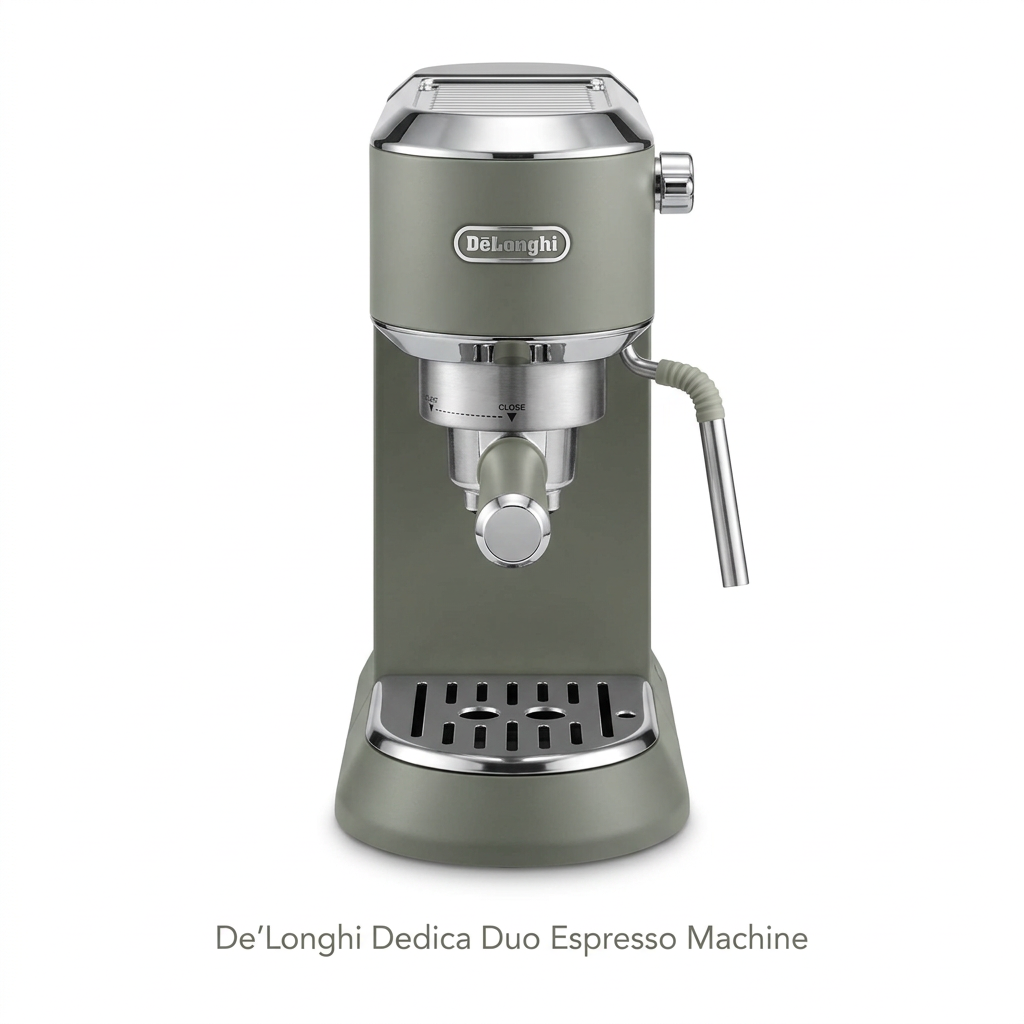
The full package: slim body, top touch controls, flat drip tray and steam wand.
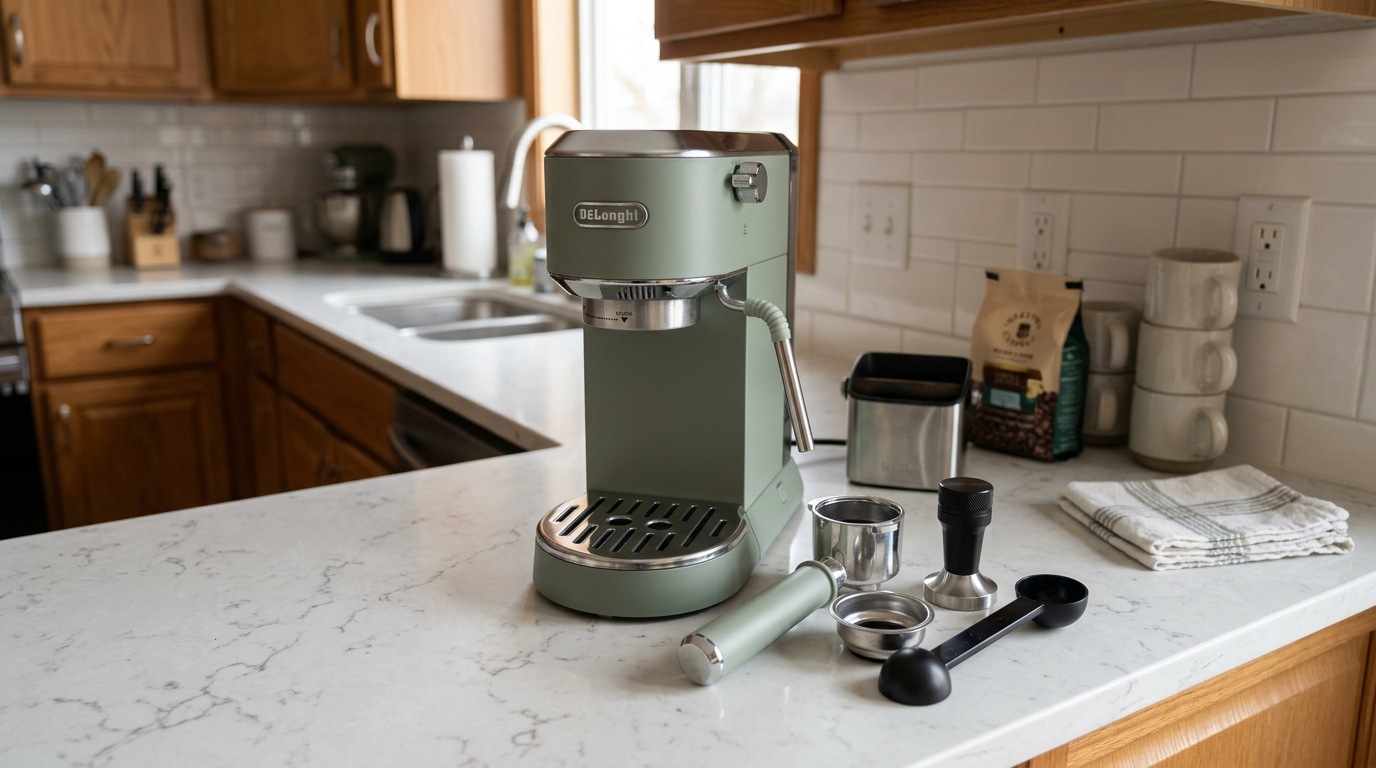
The cold brew button made a refreshing iced coffee in about five minutes.
Which one is right for you: is the De'Longhi Dedica Duo your match?
4 quick questionsDe'Longhi Dedica Duo specifications
From manufacturer data and my own testing.
How I tested and scored the De'Longhi Dedica Duo
For three weeks, the De'Longhi Dedica Duo was our everyday espresso machine for doubles, Americanos, cold brew and lattes.
I weighed doses and shots, measured after-drip and timed how long the wand took to start spinning milk.
I tested the pressurized baskets with pre-ground and fresh coffee, then a standard basket with fresh beans, a burr grinder and a needle distribution tool.
I made cold brew with three roasts and followed the full cleaning routine.
Finally, I checked my notes against De'Longhi's product information and manual.
- Espresso (8.0): pressurized and standard-basket shots, crema and flavor.
- Milk drinks (5.8): steam power, time to whirlpool and foam texture.
- Ease of use (8.0): touch controls, cold brew, drip tray and accessories.
- Cleaning (8.0): portafilter, wand tip, drip tray and descaling.
The overall score of 7.5 is an editorial rating that reflects those four areas.
De'Longhi Dedica Duo FAQ
What is new on the De'Longhi Dedica Duo?
Top-mounted touch controls, a flatter drip tray, a fuller accessory set and a cold brew button.
How does the cold brew work?
It makes a chilled coffee in about five minutes by brewing without heating. It is quick and refreshing, though not identical to overnight cold brew.
Is the steam wand good?
It is the weak point. It took about 24 to 25 seconds to start spinning the milk, so lattes are slow and inconsistent.
Can I use pre-ground coffee?
Yes. The included pressurized baskets work well with pre-ground espresso coffee.
Can I use a standard basket?
Yes. With fresh beans and a good burr grinder, it made the best espresso of the test.
Why does coffee keep dripping after the shot?
The Duo has no solenoid valve, so a few extra grams drip after the pump stops. Stop 10 to 15 grams early.
How wide is it?
About 6 inches.
What comes in the box?
A portafilter, single and double pressurized baskets, a tamper, a small milk pitcher and a cleaning pin.
How much coffee goes in the double basket?
About 14 grams.
Can I steam right after brewing cold brew?
Yes, and I could start cold brew straight after steaming without a forced cool-down.
Is it good for latte art?
Not really. It is possible with patience, but the weak wand makes it hard and inconsistent.
How often should I descale?
When prompted or every one to three months, depending on water hardness.
Kitchen & coffee tester
Michael spent six years as a line cook in restaurants in Chicago and New York, and he has tested kitchen appliances for HouseholdMe since 2018, from air fryers to coffee makers. He holds an SCA certificate in barista skills and used the De'Longhi Dedica Duo as his everyday coffee machine for three weeks for this review.
- Three weeks of hands-on testing of the De'Longhi Dedica Duo EC890
- De'Longhi product information and user manual
- General espresso, cold brew and milk-steaming guidance