Breville Barista Pro vs Barista Touch Impress: which one fits your routine?
They share a ThermoJet heater, a 30-step grinder, a 54 mm portafilter and a 2-liter tank. Then they split: the Breville Barista Pro hands you the controls, with a shot timer and a lightning-fast steam wand, while the Breville Barista Touch Impress tamps for you, corrects your dose and froths milk on its own. I used both every day for four weeks, weighed every shot and lined up the data to find out which one belongs in your kitchen.
We choose products independently. We may earn a commission through links on this page; your price stays the same. Affiliate policy
Jargon helpNew to espresso? Tap any dotted term to see what it means.
In this comparison
If you enjoy the craft of espresso and want to learn it properly, buy the Breville Barista Pro. It heats in about three seconds, steams faster than anything else at its level, and its LCD shot timer teaches you to dial in by taste. If you want café drinks every morning with far less guesswork, the Breville Barista Touch Impress is worth the upgrade: its Impress lever measures and corrects your dose, the 4-inch touchscreen walks you through every step, and its milk froths hands-free. My espresso was equally good on both once dialed in, so this choice is about workflow, not flavor.
The two machines
Specs checked November 14, 2026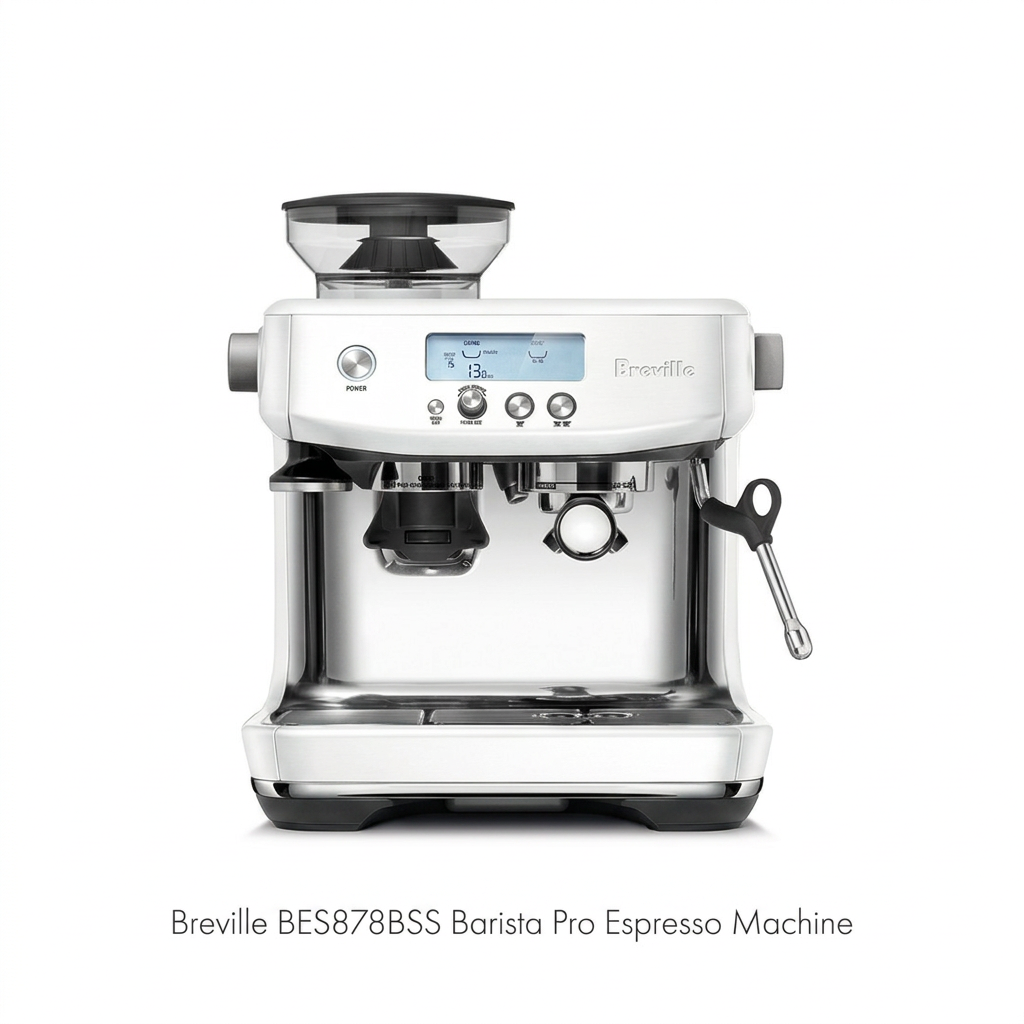
ThermoJet heat-up in about 3 seconds, a 30-step grinder, PID temperature control and a powerful four-hole steam wand.
Check price on Amazon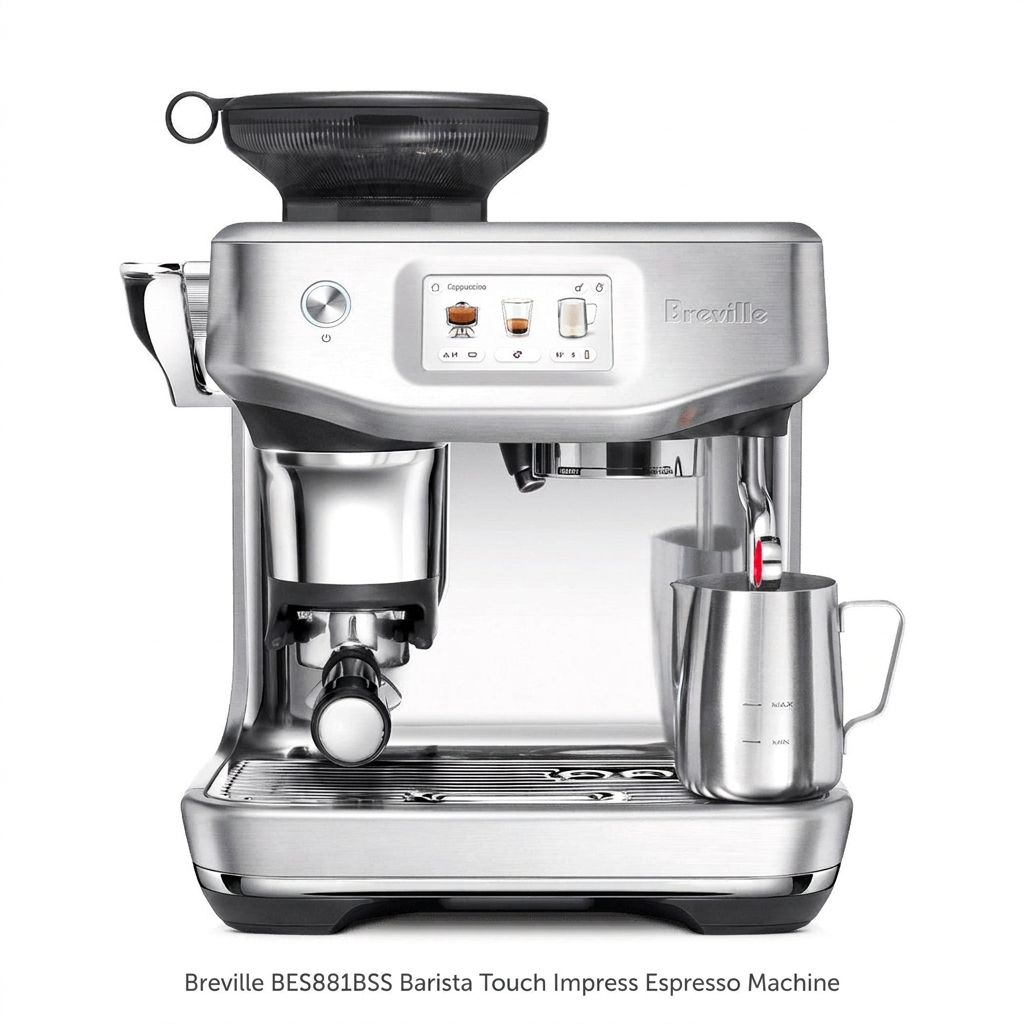
Lever tamping that corrects your dose, a 4-inch touchscreen, eight saved drinks and an automatic milk wand with 8 foam levels.
Reveal Today’s DealBarista Pro vs Barista Touch Impress at a glance
- Buy the Barista Pro if you want to learn espresso by hand and steam your own milk.
- Buy the Touch Impress if you want a guided routine with automatic dosing correction and hands-free milk.
- They share the same heater, a 54 mm portafilter, a 2-liter tank and 30 grind steps, so shot quality is very close.
- The Touch Impress is the larger, heavier machine and costs more, but it saves time and wasted coffee every day.
Head to head
The better result in each row is marked, based on my testing and the manufacturer specs. Rows where the machines are identical have no winner.
Keep in mind that the tally is not my verdict. Some rows matter far more than others, and which ones matter depends on what you drink.
| Spec | Breville Barista Pro | Breville Barista Touch Impress |
|---|---|---|
| Espresso qualitymy tasting, same beans | Syrupy, rich crema | Balanced, chocolatey |
| Heat-up | About 3 seconds | About 3 seconds |
| Tamping | Manual tamper | Impress lever, 22 lb, auto correction ✓ Best |
| Dose consistencysame beans, same setting | Wandered 15.8–16.2 g | Corrected automatically ✓ Best |
| Brew temperature control | PID, five settings | 192–207°F in 1° steps ✓ Best |
| Pre-infusion | Programmable, up to 10 s ✓ Best | Built into each drink |
| Milk | Manual four-hole wand, very fast | Auto wand, 8 foam levels, or manual ✓ Best |
| Manual steam speed6-oz latte jug | About 30 seconds ✓ Best | Slower, gentler |
| Display | LCD with shot timer | 4-inch color touchscreen ✓ Best |
| Saved drinks | None | Up to 8 ✓ Best |
| Grinder speeddouble dose | Fast ✓ Best | About 18–20 seconds |
| Bean hopper | About 8.8 oz | About 12 oz ✓ Best |
| Footprint | 14 × 13 in ✓ Best | 14.2 × 13.4 in |
| Weight | About 20 lb ✓ Best | About 24 lb |
| Rows won | 5 | 7 |
Barista Pro vs Barista Touch Impress pros and cons
Breville Barista Pro
- Ready in seconds, with near-instant steam
- Strong four-hole steam for fast, silky microfoam
- LCD shot timer makes dialing in easy
- No analog pressure gauge
- Dose wanders slightly between grinds
- You tamp by hand, so there is a learning curve
Breville Barista Touch Impress
- Lever tamping and dose correction remove guesswork
- Touchscreen guidance and eight saved drinks
- Milk works hands-free or fully manual
- Grinder takes about 20 seconds for a double
- Automatic milk is a little coarser than manual
- Bigger and heavier on the counter
Who should buy which machine?
- Hobbyists who want to learn espresso properly
- Latte art fans who want powerful steam
- Smaller kitchens and tighter counters
- Beginners who want great results from week one
- Busy mornings where hands-free milk saves time
- Households where several people make their own drink
Design, size and build
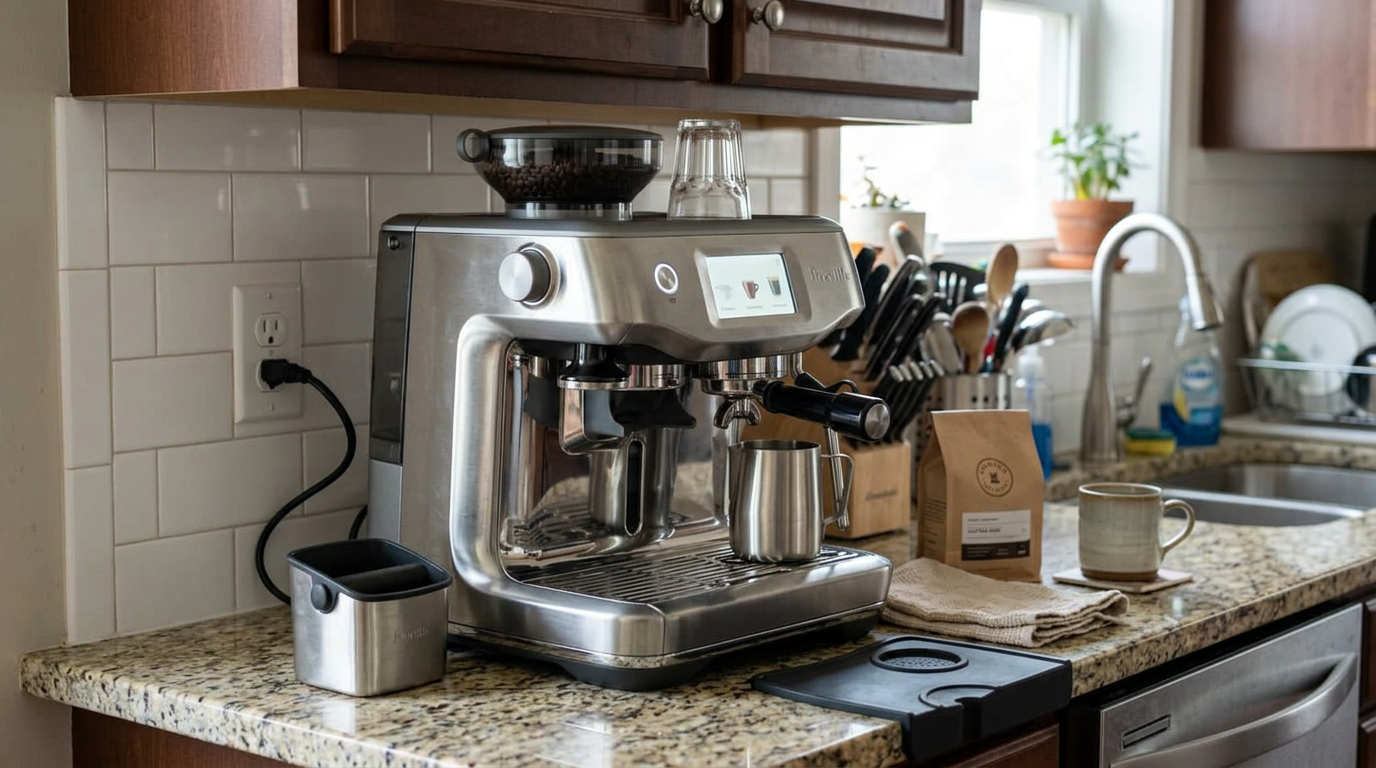
From across the room, these two look like siblings. Both are brushed stainless steel boxes with a bean hopper on top, a portafilter✕PortafilterThe handle with a metal basket that holds the ground coffee. You lock it into the machine’s group head to brew. in the middle, a steam wand on the right and a hot water outlet.
Up close, the Breville Barista Touch Impress is the bigger, more modern machine. Its 4-inch color touchscreen replaces the Barista Pro’s dials and buttons, and the Impress lever sits on the left of the group head.
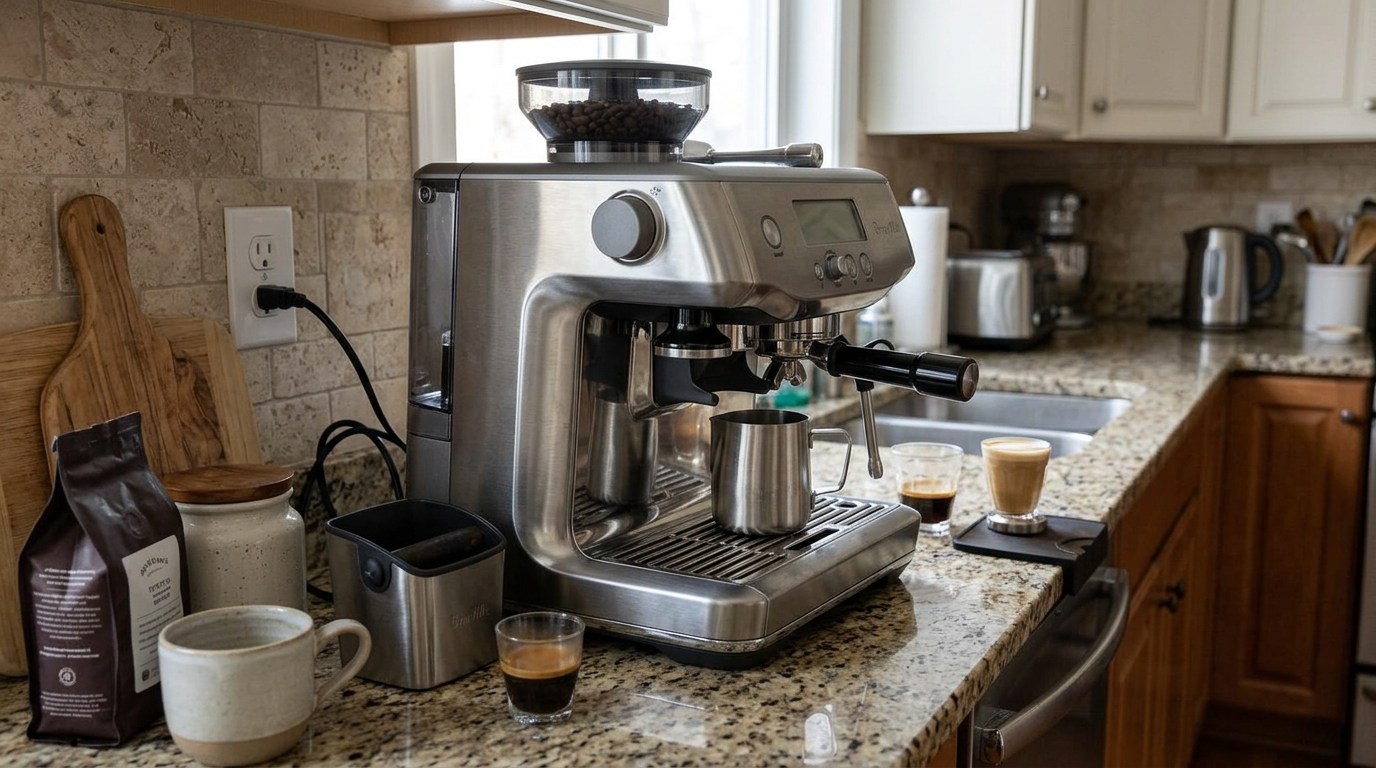
The Barista Pro is the more compact of the two, with a crisp LCD and chunky dials.
The Barista Pro measures about 14 inches wide, 13 inches deep and 16 inches tall, and weighs about 20 pounds. The Touch Impress is about 14.2 × 13.4 × 16.3 inches and weighs about 24 pounds.
Those few extra pounds are mostly the tamping mechanism. You feel it when you slide the machine forward to refill beans or clean behind it.
Weight on the counter
The Impress tamping system adds most of the extra weight.
Both feel well made. The steel panels did not flex, the portafilters are solid stainless steel, and the drip trays click in firmly.
If you have tight wall cabinets, check the height with the hopper lid off. On both machines, I needed a few inches above the hopper to refill beans without pulling the machine forward.
Our tip: Leave about 4 inches above the hopper so you can refill beans without dragging a 20-pound machine across the counter.
Setup and the first week
Setup took about 15 minutes on both. You rinse the parts, fill the tank, flush water through the group head and steam wand, and set the grind.
The first week is where they split. On the Barista Pro, I spent the first few days learning to dose and tamp consistently, weighing every shot and adjusting the grind by taste.
On the Breville Barista Touch Impress, the screen walked me through it. It asked for the beans, ground them, told me whether the dose was too high or low after tamping, and adjusted the next grind automatically.
By day three, my Touch Impress shots were balanced and chocolatey. On the Barista Pro, I got there by about day five, and I understood exactly why each change worked.
Days until I pulled consistently good shots
My experience with a medium roast. Complete beginners may take a little longer on either.
| Setup step | Barista Pro | Touch Impress |
|---|---|---|
| Water filter | Fitted in the tank | Fitted in the tank |
| First grind setting | Chosen by you | Guided on screen |
| Dose check | Weigh it yourself | Measured after tamping |
| Tamping | Hand tamper | Impress lever |
| Time to first good shot | A few days of practice | About three days |
Our tip: Weigh your coffee and your shot for the first two weeks on either machine, because a cheap scale teaches you faster than any screen.
Screen, controls and smart features
This is the most visible difference, and for many buyers it decides everything.
The Breville Barista Pro uses an LCD with three dials and a handful of buttons. It shows grind size, grind time, shot size and a live shot timer, which is the single most useful tool for learning espresso.
The Breville Barista Touch Impress replaces all that with a 4-inch color touchscreen. You swipe through drinks with pictures, tap to start, and the screen shows each step of the recipe as it happens.
It saves up to eight drinks, so my partner’s oat flat white and my double espresso each had their own button. On the Barista Pro, we each had to remember our own routine.
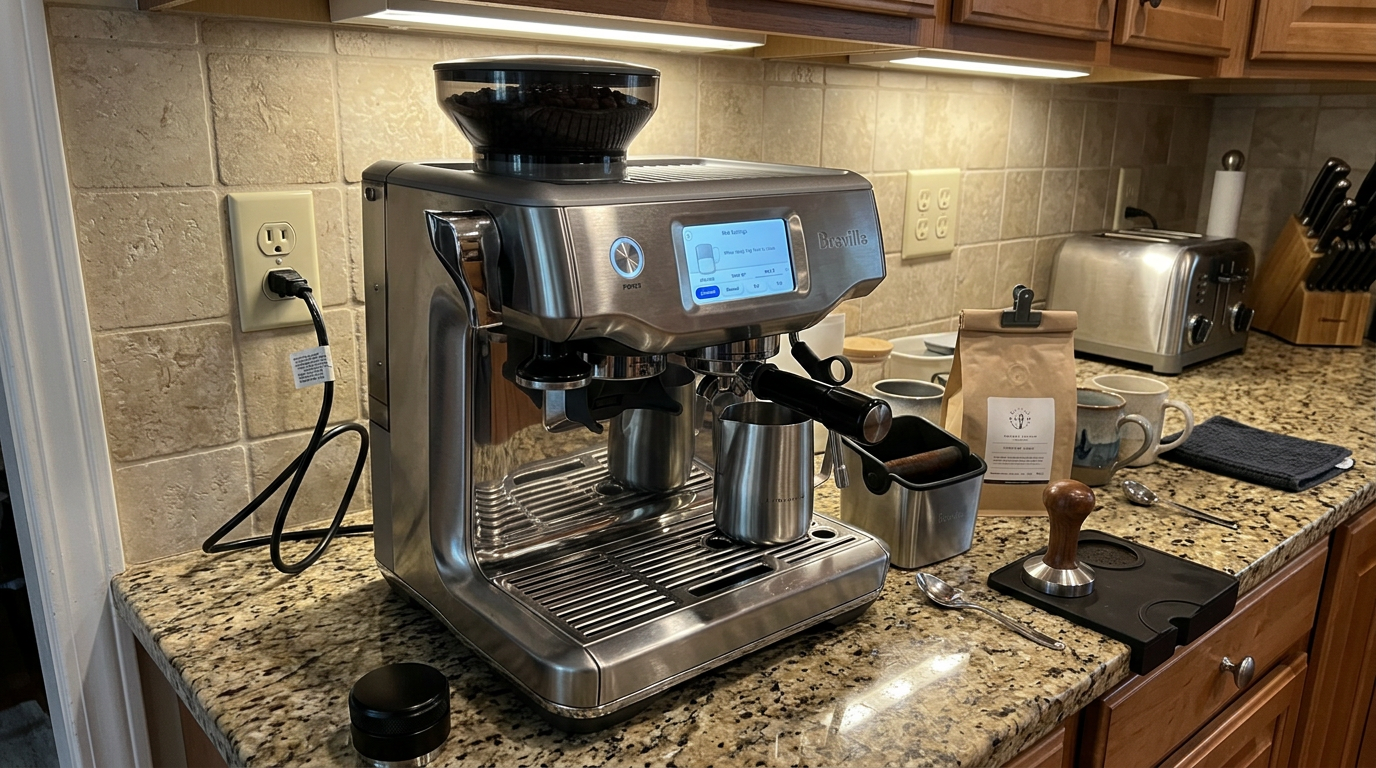
The Touch Impress touchscreen walks you through every drink, from grind to milk.
| Feature | Barista Pro | Touch Impress |
|---|---|---|
| Display | LCD with shot timer | 4-inch color touchscreen |
| Controls | Dials and buttons | Touch, plus the tamping lever |
| Shot timer | Yes, always visible | Yes, during the shot |
| Saved drinks | No | Up to 8 |
| Guidance | None | Step-by-step, dose feedback |
| Temperature setting | Five PID presets | 192–207°F in 1° steps |
I expected to prefer the buttons, because touchscreens and wet fingers rarely mix. In practice, the Touch Impress screen was responsive even with damp hands, and I never had a missed tap.
The Barista Pro’s dials still feel quicker when you know exactly what you want. If you like to change one thing at a time and watch the result, the LCD is perfect.
Our tip: Turn on the shot timer view on either machine and note the seconds for every shot, because time is the fastest clue to whether your grind is right.
Grinder and dose
Both machines use hardened steel conical burrs✕Conical burrsTwo cone-shaped grinding parts, one inside the other. Beans are crushed between them, and the gap between the burrs sets how fine the coffee is. with 30 grind settings. That is plenty of range for medium and dark roasts, and enough for most light roasts too.
The Barista Pro doses by time, set in tenths of a second. Even on a fixed time, my doses wandered between about 15.8 and 16.2 grams, because beans don’t all flow at the same speed.
That 0.4-gram swing sounds tiny, but in espresso it can change shot time by a few seconds. I weighed every dose for the first two weeks, then trusted the timer once the beans settled.
The Touch Impress solves this in a smarter way. After you tamp, it measures the height of the coffee in the basket and tells you if the dose was too high or too low, then adjusts the next grind automatically.
Dose spread on a fixed setting
Smaller is better. Measured over a week with the same beans.
The trade-off is speed. The Touch Impress grinder runs at about one gram per second, so a full 18-gram double takes 18 to 20 seconds. The Barista Pro felt noticeably quicker for my 16-gram dose.
The Touch Impress also has the bigger hopper, about 12 ounces against roughly 8.8, which means fewer refills for a two-coffee household.
| Grinder detail | Barista Pro | Touch Impress |
|---|---|---|
| Burrs | Hardened steel, conical | Steel, conical |
| Settings | 30 | 30 |
| Dosing | Timed, in tenths of a second | Height-sensing correction |
| My usual dose | 16 g | 18 g |
| Grind time, double | Quick | 18–20 seconds |
| Bean hopper | About 8.8 oz | About 12 oz |
Our tip: Start the blank flush while the grinder runs on the Touch Impress, because doing both at once saves about 15 seconds every morning.
Tamping: the Impress lever
Tamping✕TampingPressing the ground coffee into a firm, flat puck in the basket. An even tamp helps water flow through all the coffee at the same rate. is the step most beginners get wrong, and it is the reason the Touch Impress exists.
On the Barista Pro, you tamp by hand with the included steel tamper. Press too lightly or at an angle and the water finds the weak spot, a problem called channeling✕ChannelingWhen water forces a path through a weak spot in the coffee puck. Part of the coffee over-extracts and part under-extracts, so the shot tastes sour and bitter at once..
The Impress lever does it for you. Pull it down and it presses the coffee with about 22 pounds of force, then finishes with a 7-degree twist that polishes the surface.
It produced a level, even puck every single time. My kids could make a decent shot with it, which I can’t say about the hand tamper.
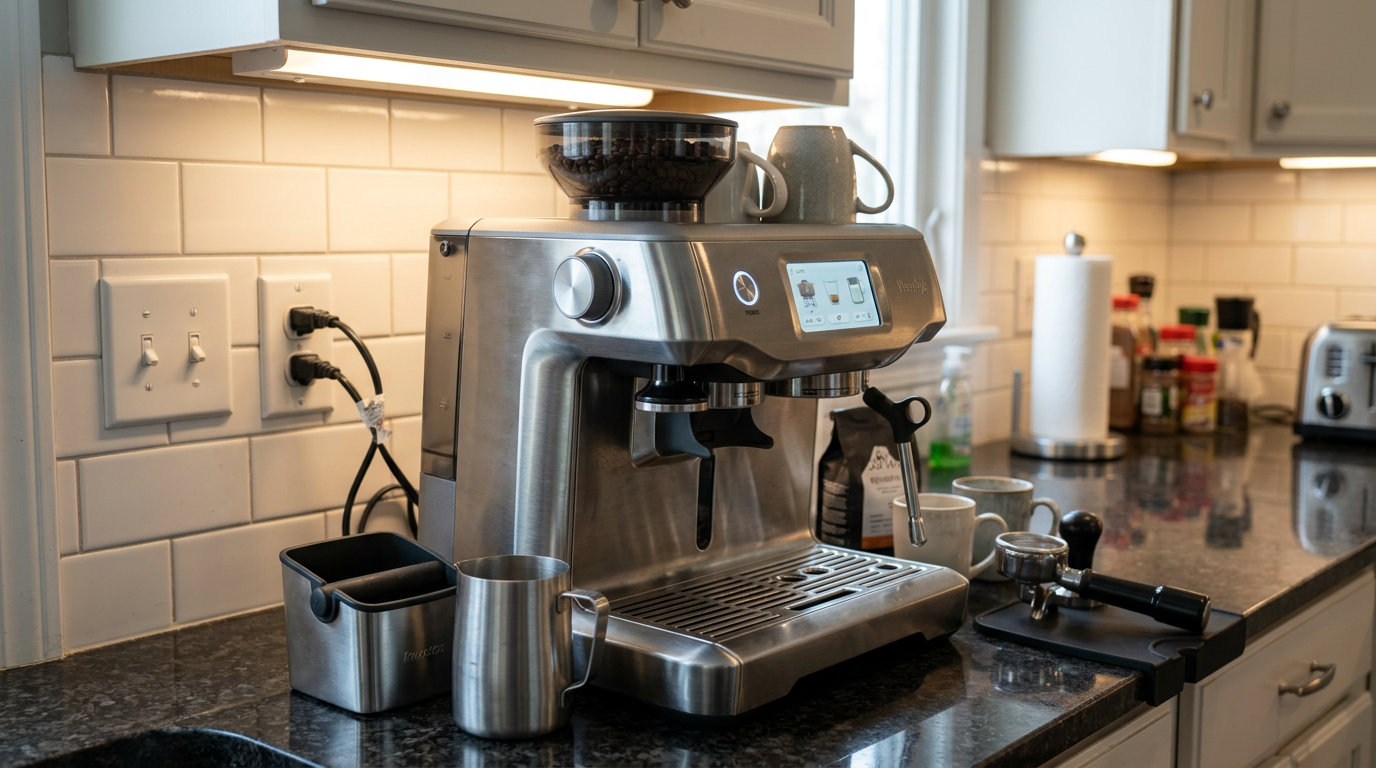
The Impress lever tamps with consistent force and checks your dose at the same time.
Is it worth paying for? If you already tamp well, no. If you have never made espresso before, it removes the biggest source of bad shots and wasted coffee in the first month.
Espresso quality
Here is the surprise: once dialed in, the two machines pulled espresso I could not reliably tell apart. Both scored 8.7 for espresso in my single reviews.
They share Breville’s ThermoJet heater, PID✕PID temperature controlA digital controller that keeps the brew water at a steady, set temperature instead of letting it swing up and down. temperature control and the 54 mm portafilter, so the fundamentals are the same.
On the Breville Barista Pro, my baseline was 16 grams in and 32 grams out. Medium-roast shots ran in about 28 to 30 seconds and poured like syrup, with thick crema.
On the Touch Impress, I used 18 grams in and 36 grams out, a classic 1:2 brew ratio✕Brew ratioThe weight of espresso in the cup compared with the weight of dry coffee. A 1:2 ratio means 18 grams of coffee makes 36 grams of espresso.. Shots took 27 to 30 seconds and tasted balanced and chocolatey from week one.
My espresso ratings
My scores out of 10 for body, crema, flavor and consistency.
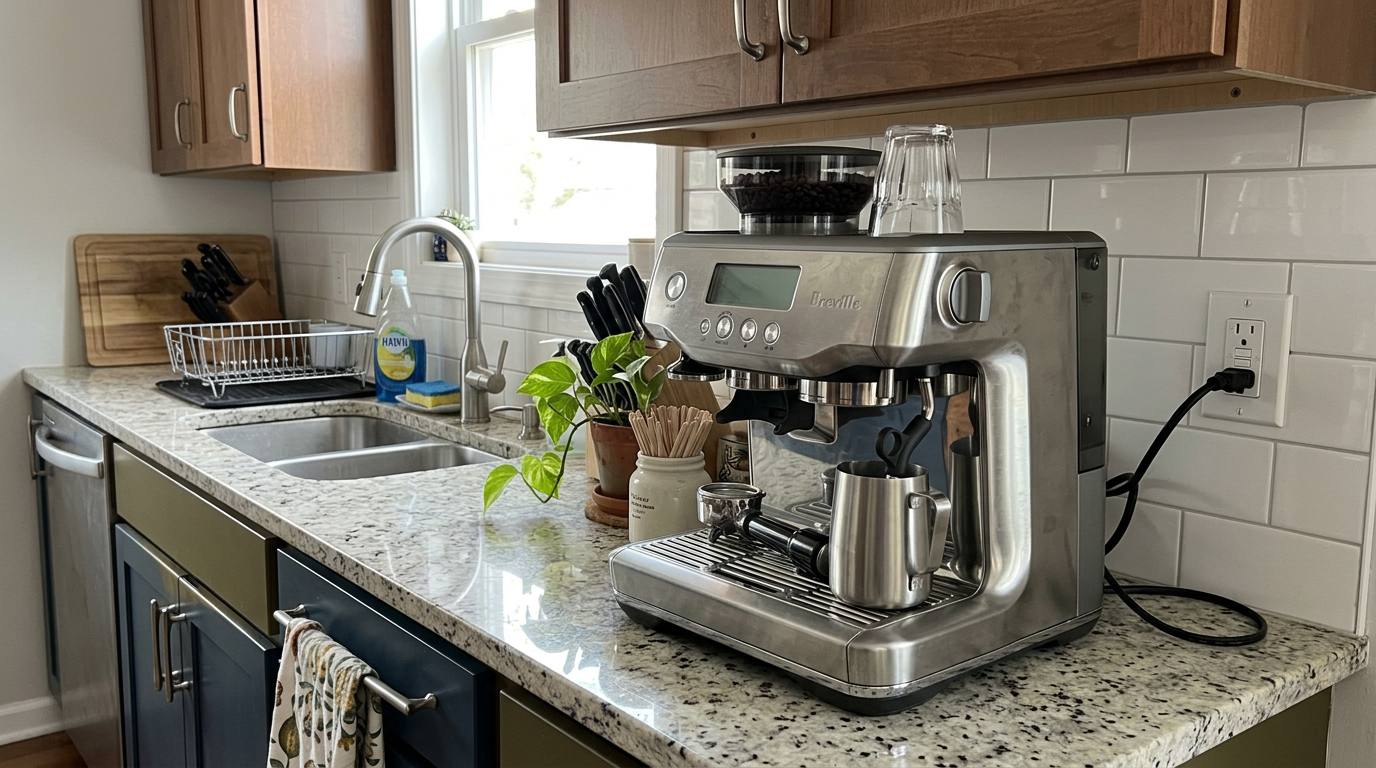
Once dialed in, the Barista Pro pulled syrupy shots with thick crema.
The difference is in how you get there. The Barista Pro gives you more direct control, including programmable pre-infusion✕Pre-infusionA short, low-pressure soak of the ground coffee before full pressure starts, so the water flows through the puck evenly. up to 10 seconds. The Touch Impress gives you finer temperature control, from 192 to 207°F in one-degree steps.
That temperature range mattered with lighter beans. For a light roast I went up to 203°F, which removed the sourness, and for a very dark roast I went down to 196°F, which softened the bitterness.
| Bean type | Barista Pro setting | Touch Impress setting |
|---|---|---|
| Light roast | Highest PID setting, finer grind | About 203°F |
| Medium roast | Default, 16 g in, 32 g out | 200°F, 18 g in, 36 g out |
| Dark roast | Lower setting, slightly coarser | About 196°F |
| Denser shot for milk | 16 g in, 28 g out | Shorter shot size |
Americanos, long coffee and hot water
Neither machine brews a true long coffee through the grounds, and that is a good thing. Pushing a whole mug of water through an espresso puck over-extracts it and turns it bitter.
Instead, both have a dedicated hot water outlet, so you build an americano the way a café does: espresso first, then hot water, or the other way around.
On the Breville Barista Touch Impress, the americano is a saved recipe. I always chose water first, about 4 to 6 ounces, then pulled the double shot over it, which keeps the crema on top.
On the Barista Pro, I did the same thing by hand. It took a few extra seconds, but the result was identical, and the hot water outlet was hot enough for tea as well.
If you love a big mug of black coffee every morning, keep in mind that both are espresso machines first. An americano is as close as they get to drip coffee, and to my taste it is better.
Our tip: Pour the hot water into the cup before the espresso, because pulling the shot on top keeps the crema and makes the drink taste rounder.
Milk drinks
This is the second big difference. The Barista Pro is manual only, and the Touch Impress gives you a choice.
The Breville Barista Pro has a four-hole steam tip with serious power. A 6-ounce latte jug took about 30 seconds, noticeably quicker than gentler machines, and I stopped the steam at around 140 to 150°F.
That speed is great once you have the technique, and it makes glossy microfoam✕MicrofoamMilk foam with bubbles so small you can barely see them. It feels silky and glossy, which is what a good flat white or latte needs. for latte art. It is less forgiving while you learn, because a few seconds too long and the milk turns bubbly.
The Breville Barista Touch Impress has an automatic wand with a temperature sensor. You set the milk type, choose one of eight foam levels, put the jug under the wand and walk away.
The default milk temperature is 149°F, and you can lower it to 140°F for sweeter milk. The automatic foam was reliable for everyday lattes, though slightly coarser than what I made by hand.
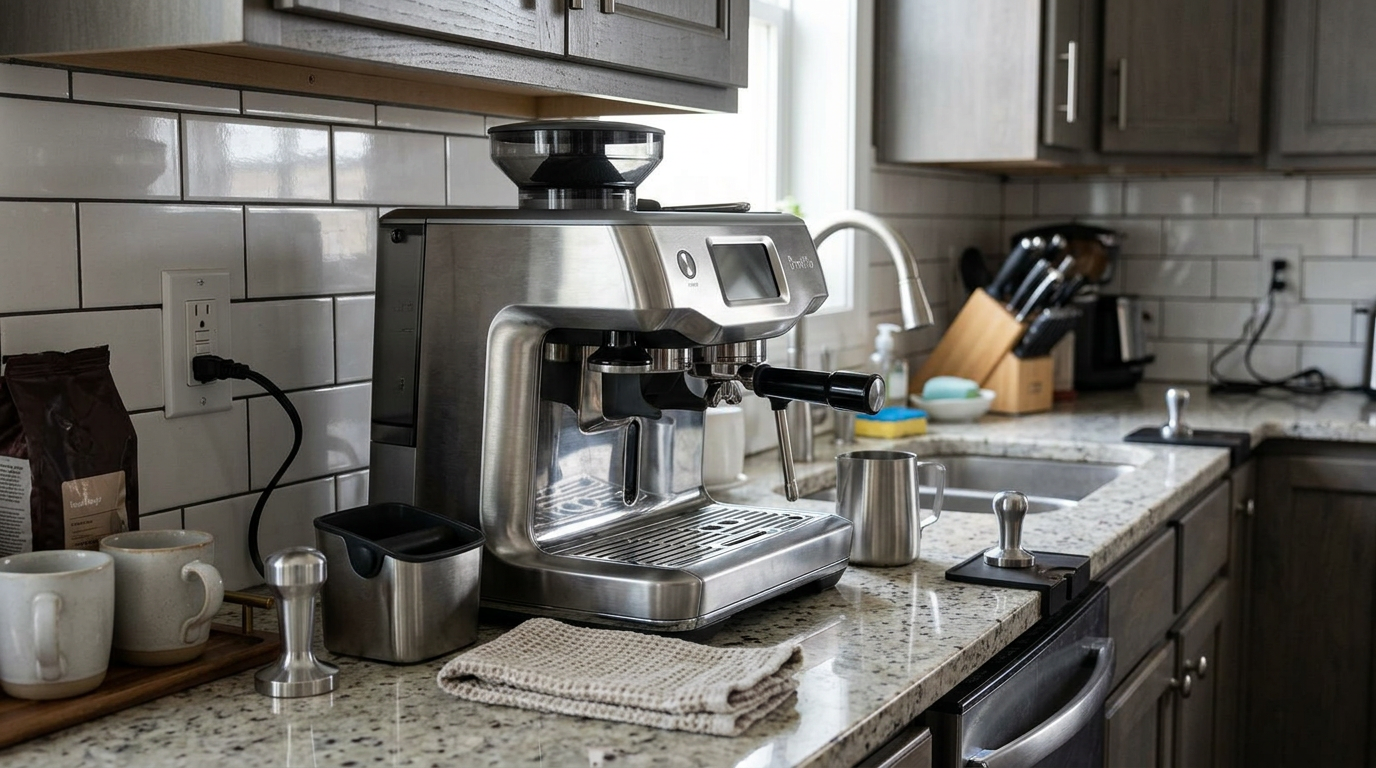
Hands-free milk on the Touch Impress freed me to clean up while it frothed.
Milk-drink ratings
My scores out of 10 from my single reviews, for texture, temperature and ease.
Milk sugars taste sweetest at around 140°F, and most baristas stop steaming somewhere between 140 and 155°F. Both machines live comfortably in that window.
For oat milk flat whites on the Touch Impress, I used a high-protein barista oat milk at 140 to 145°F. It held its texture well and never split.
| Milk feature | Barista Pro | Touch Impress |
|---|---|---|
| Steam wand | Manual, four-hole tip | Automatic or manual |
| Temperature sensor | No, by hand | Yes, 140°F to hotter |
| Foam levels | By technique | 8 presets |
| Milk types | By technique | Dairy and plant settings |
| Auto purge | Yes | Yes, and auto clean |
| 6-oz jug time | About 30 seconds | A little longer |
Our tip: Fill the jug only to the bottom of the spout on both machines, because overfilled milk can’t spin and won’t make silky foam.
Workflow and speed
Both machines are fast thanks to ThermoJet heating. Turn them on and they are ready in about three seconds, and switching from espresso to steam is nearly instant.
The time sinks are different. On the Barista Pro, the slowest part is you: grinding, tamping and steaming by hand.
On the Touch Impress, the grinder is the slowest step at about 20 seconds, followed by the blank flush to warm the portafilter. Everything else runs while you do something else.
For a single flat white, my morning routine came out roughly the same on both. For two or three drinks in a row, the Touch Impress pulled ahead because I could prep the next shot while the milk frothed itself.
My time for a flat white, start to finish
My rough timings once both machines were dialed in, including the blank flush.
Our tip: Run a blank shot through the empty portafilter before every coffee, because a cold portafilter steals heat and makes the first shot taste sour.
Cleaning and upkeep
Cleaning is similar, because these are both semi-automatic machines with a portafilter, a steam wand and a drip tray.
After each session, I knocked out the puck, rinsed the basket, wiped and purged the steam wand, and emptied the drip tray when the float popped up.
The Touch Impress has one advantage. After automatic frothing, it purges and cleans the steam wand itself, so there is less dried milk to scrub.
Both machines ask for a cleaning cycle with a tablet every few hundred shots, and a descale when the water hardness calls for it. Using the water filter in the tank stretches that interval a lot.
My daily hands-on cleaning time
With two or three milk drinks a day.
| When | Barista Pro | Touch Impress |
|---|---|---|
| After each shot | Knock out puck, rinse basket | Knock out puck, rinse basket |
| After milk | Wipe and purge the wand | Auto purge and clean, then wipe |
| Daily | Empty the drip tray | Empty the drip tray |
| When prompted | Cleaning tablet cycle | Cleaning tablet cycle |
| Every 2–3 months | Change the water filter | Change the water filter |
Our tip: Wipe the steam wand with a damp cloth within a minute of frothing, before the milk dries into a crust.
Beans, water and supplies
Both machines hold about 2 liters of water, which is roughly 60 espressos’ worth once you allow for flushing and rinsing. In my house, that meant a refill every three or four days.
The bean hoppers differ more. The Touch Impress holds about 12 ounces against roughly 8.8 on the Barista Pro, which is about 19 against 15 double shots at my doses.
Double shots per full hopper, my estimate
Based on hopper capacity and my usual dose. Leave a little in the hopper so the grinder feeds evenly.
Use fresh whole beans within about four weeks of the roast date. Stale beans make pale crema that disappears fast, and no amount of dialing in fixes that.
Both machines take Breville’s water filter in the tank. If your water is hard, use it and replace it every two to three months, because scale is the most common reason these machines lose temperature over time.
| Bean type | Barista Pro | Touch Impress |
|---|---|---|
| Medium roast blend | Best all-rounder, 16 g in | Best all-rounder, 200°F |
| Light single origin | Finest grind, highest temperature | About 203°F, finer grind |
| Dark roast | Slightly coarser, lower temperature | About 196°F |
| Very oily, flavored | Avoid | Avoid |
Our tip: Buy beans with a roast date on the bag, because a "best before" date tells you nothing about freshness.
Beginner mistakes I made, and how each machine handled them
I made plenty of mistakes in the first week, and the two machines responded very differently.
The Barista Pro let me make every mistake and learn from it. The Touch Impress caught most of them before they reached the cup.
| Mistake | What happened on the Barista Pro | What happened on the Touch Impress |
|---|---|---|
| Too much coffee in the basket | Shot choked and ran slow | Screen flagged the dose and corrected the next grind |
| Uneven tamp | Sour, thin shot from channeling | Lever tamped level every time |
| Skipping the blank flush | First shot tasted sour | Same, so flush on both |
| Milk too warm to start | Big bubbles, flat foam | Same, so use cold milk on both |
| Grind too fine | Coffee dripped after 15 seconds | Same signal, plus a grind suggestion |
The lesson is simple. The Touch Impress is the safer bet for beginners, but the Barista Pro will make you a better home barista, faster.
Real-life scenarios
Specs only go so far. These are the situations where one machine clearly pulled ahead during my testing.
The four-hole steam tip made glossy microfoam in about 30 seconds, and every pour taught me something.
I prepped the next shot while the milk frothed itself, and the queue moved a minute faster.
The lever and dose feedback gave balanced shots by day three, with very little wasted coffee.
It is slightly smaller and 4 pounds lighter, which made it easier to move for cleaning.
One-degree temperature steps let me raise the brew to 203°F and remove the sourness.
The shot timer, timed dosing and programmable pre-infusion put every control in your hands.
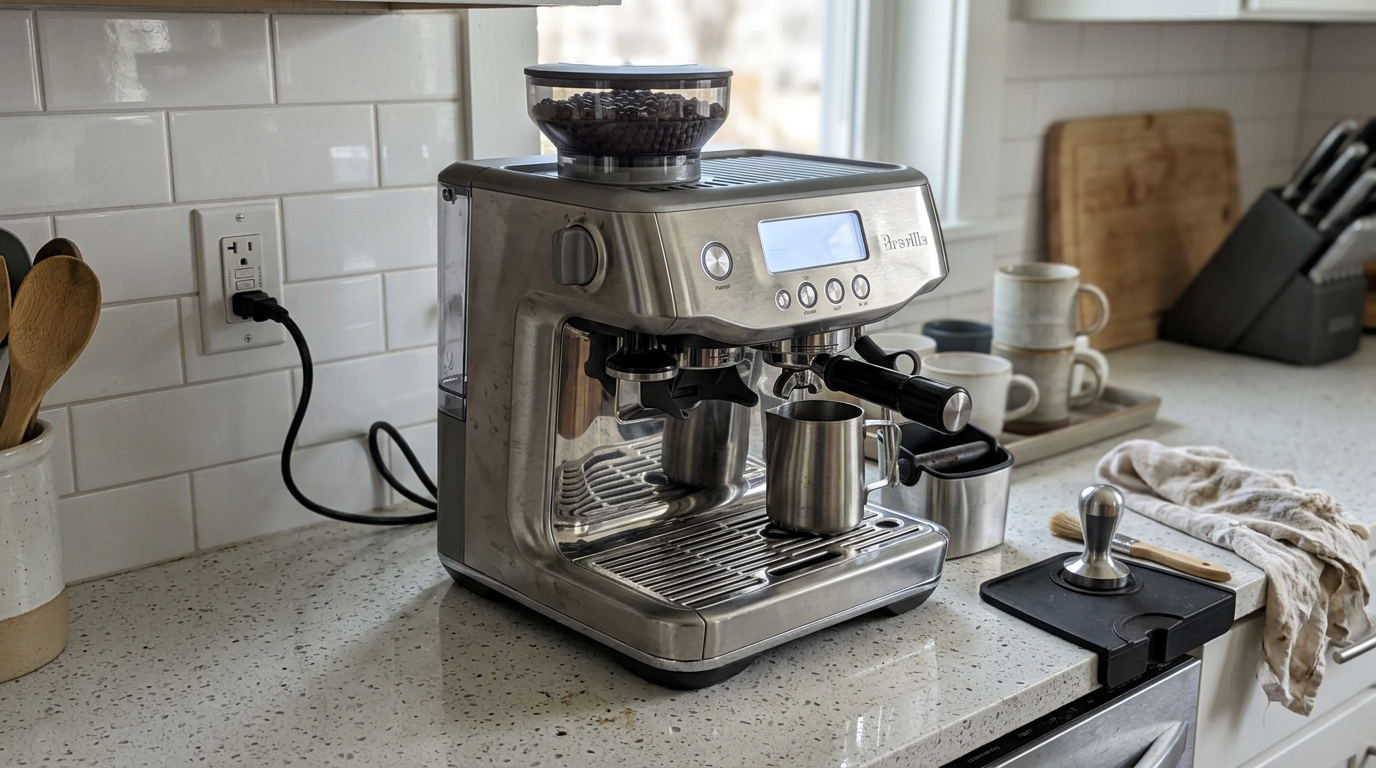
For hands-on brewers, the Barista Pro is the more rewarding machine.
My scorecard
These are my own scores out of 10. The first four come from my single reviews of each machine, and I added learning curve because it decides this matchup.
Breville Barista Pro
Breville Barista Touch Impress
Overall, I rate the Barista Pro 8.5 and the Touch Impress 8.7. The Touch Impress does more of the work for you, while the Barista Pro rewards you for learning.
See How Much You’ll SaveWhich one is right for you?
4 quick questionsWhich one should you buy?
It comes down to one question: do you want to make espresso, or do you want espresso made for you, with a little help? For the wider picture beyond this matchup, see my guide to the best Breville espresso machines.
Still deciding? See how the Pro compares with its touchscreen sibling in my Barista Pro vs Barista Touch comparison, or weigh two different upgrades in Barista Pro vs Barista Express Impress. If you want even more automation, read Barista Touch Impress vs Oracle Jet.
For guided espresso and hands-free milk, the Touch Impress earns its place.
- You want to learn espresso properly
- You want to practice latte art
- Your counter is a little tighter
- You like dials more than screens
- You want hands-free milk
- Several people need saved drinks
- You don’t want to weigh doses
- You are new to espresso
- You want hands-free, consistent milk
- Several people share the machine
- You want precise temperature control
- You want the fastest grinder
- You want the smallest machine
- You only ever steam by hand
For most people buying their first espresso machine, my pick is the Breville Barista Touch Impress. Its lever tamping, dose correction and touchscreen guidance gave me balanced shots by day three, and hands-free milk makes busy mornings genuinely easier.
The Barista Pro is the smarter buy if you want to learn the craft. It pulls the same quality of espresso, steams faster and gives you a shot timer that teaches you everything, for less money and in a slightly smaller body.
Whichever you choose, buy fresh beans, use a scale and run a blank flush before every shot. Both machines reward that care with café-quality coffee.
Barista Pro vs Barista Touch Impress specifications
From manufacturer specifications and my own testing.
| Breville Barista Pro | Breville Barista Touch Impress | |
|---|---|---|
| Model | Breville BES878BSS | Breville BES881BSS |
| Type | Semi-automatic with grinder | Semi-automatic with grinder and assisted tamping |
| Heating | ThermoJet, about 3 s | ThermoJet, about 3 s |
| Temperature control | PID, five settings | 192–207°F, 1° steps |
| Pre-infusion | Programmable, up to 10 s | Built into each drink |
| Grinder | Steel conical, 30 settings | Steel conical, 30 settings |
| Dosing | Timed | Height-sensing correction |
| Tamping | Manual tamper | Impress lever, about 22 lb |
| Portafilter | 54 mm | 54 mm |
| Bean hopper | About 8.8 oz | About 12 oz |
| Water tank | 67 oz | 67.6 oz |
| Steam | Manual four-hole wand | Auto or manual wand, 8 foam levels |
| Display | LCD with shot timer | 4-inch color touchscreen |
| Saved drinks | None | Up to 8 |
| Dimensions (W × D × H) | About 14 × 13 × 16 in | About 14.2 × 13.4 × 16.3 in |
| Weight | About 20 lb | About 24 lb |
How I tested and compared them
I used each machine as my everyday espresso maker for four weeks, making straight espresso, americanos, flat whites, cappuccinos and lattes with dairy and oat milk.
I weighed every dose and yield, timed shots and steaming, measured milk temperatures with a probe thermometer, and tested light, medium and dark roasts across the grind and temperature ranges.
I followed every cleaning routine and kept daily notes, then wrote up my notes and measurements together and checked them against Breville’s specifications and owner documentation.
- Espresso: dose, ratio, shot time, crema and taste
- Milk: texture, temperature and speed
- Workflow: controls, guidance and time per drink
- Ownership: cleaning, footprint and learning curve
Barista Pro vs Barista Touch Impress FAQ
Is the Barista Touch Impress worth it over the Barista Pro?
If you are new to espresso or want hands-free milk, yes. The Impress lever corrects your dose and tamps for you, the touchscreen guides every step, and the milk froths automatically. If you already know how to dial in and like steaming by hand, the Barista Pro gives you the same shot quality for less.
Which makes better espresso, the Barista Pro or Touch Impress?
Once dialed in, neither. Both scored 8.7 for espresso in my testing because they share the ThermoJet heater, PID control and 54 mm portafilter. The Touch Impress simply gets you there faster.
Does the Barista Pro have automatic milk frothing?
No. It has a powerful manual steam wand with a four-hole tip, which textured a 6-ounce jug of milk in about 30 seconds. The Touch Impress adds an automatic mode with eight foam levels and a temperature sensor.
How hot is the milk on the Touch Impress?
The default is 149°F, and you can lower it to 140°F for sweeter milk. I used 140 to 145°F for oat milk flat whites.
Do both machines heat up quickly?
Yes. Both use ThermoJet heating and were ready to brew in about three seconds, with almost no wait between pulling a shot and steaming.
Can I use 58 mm accessories on either machine?
No. Both use a 54 mm portafilter, so you need 54 mm baskets, tampers and distribution tools.
Which is easier to clean?
They are very similar. The Touch Impress cleans its own steam wand after automatic frothing, which saves a step. Both need the drip tray emptied daily and a cleaning cycle when prompted.
How long does the Touch Impress grinder take?
About 18 to 20 seconds for a full double dose. It is the slowest step in the routine, so start the blank flush while it grinds.
Which is better for latte art?
The Barista Pro. Its four-hole steam tip is strong and fast, which makes it easier to create glossy microfoam for pouring. The Touch Impress manual mode works too, but its automatic foam is a little coarser.
Are the Barista Pro and Touch Impress the same size?
Almost. The Barista Pro is about 14 × 13 × 16 inches and 20 pounds, and the Touch Impress about 14.2 × 13.4 × 16.3 inches and 24 pounds.

- Our hands-on Breville Barista Pro review
- Our hands-on Breville Barista Touch Impress review
- Breville product specifications and owner documentation
- General espresso brewing and milk steaming guidance
- How to Brew Coffee, National Coffee Association