Breville Barista Express vs Pro vs Touch: which one should you buy?
Three machines, three steps up the same ladder. The Barista Express gives you a pressure gauge and a gentle manual wand, the Barista Pro adds three-second heat-up, a shot timer and powerful four-hole steam, and the Barista Touch puts it all on a touchscreen and steams your milk for you. I used each one every day for four weeks to find out which step is right for you.
We choose products independently. We may earn a commission through links on this page; your price stays the same. Affiliate policy
Jargon helpNew to espresso? Tap any dotted term to see what it means.
In this comparison
For most people who steam their own milk, buy the Barista Pro: it heats in three seconds, has the best grinder and temperature control, scored highest for espresso and steams milk for latte art in about 30 seconds. If you want milk drinks without learning to steam, the Barista Touch does it hands-free and saves eight drinks. If you want to learn espresso from the ground up, the Barista Express and its pressure gauge are still the best teacher.
The three machines
Specs checked November 14, 2026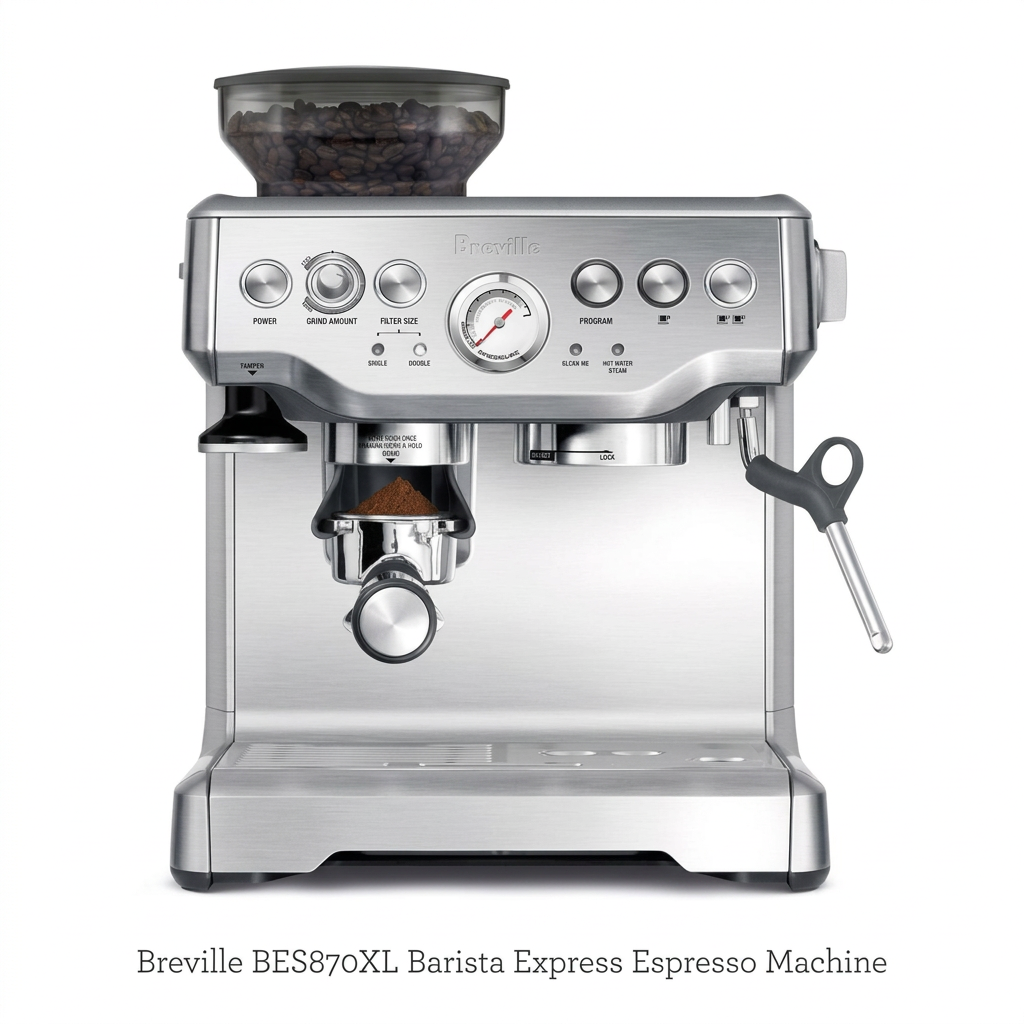
A pressure gauge, a 16-step grinder and a manual single-hole wand. The classic hands-on teacher.
Check price on Amazon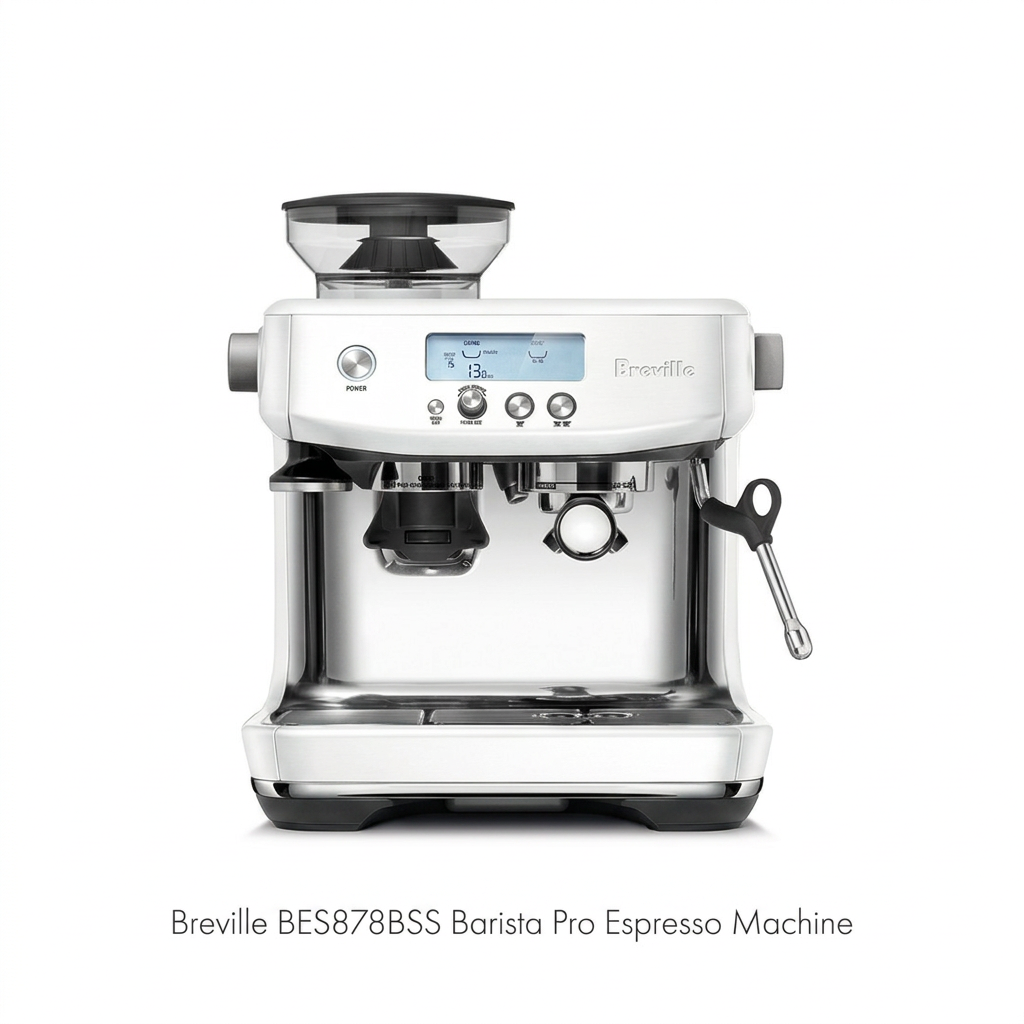
Three-second ThermoJet heat-up, an LCD shot timer, five temperatures and a powerful four-hole steam wand.
Reveal Today’s Deal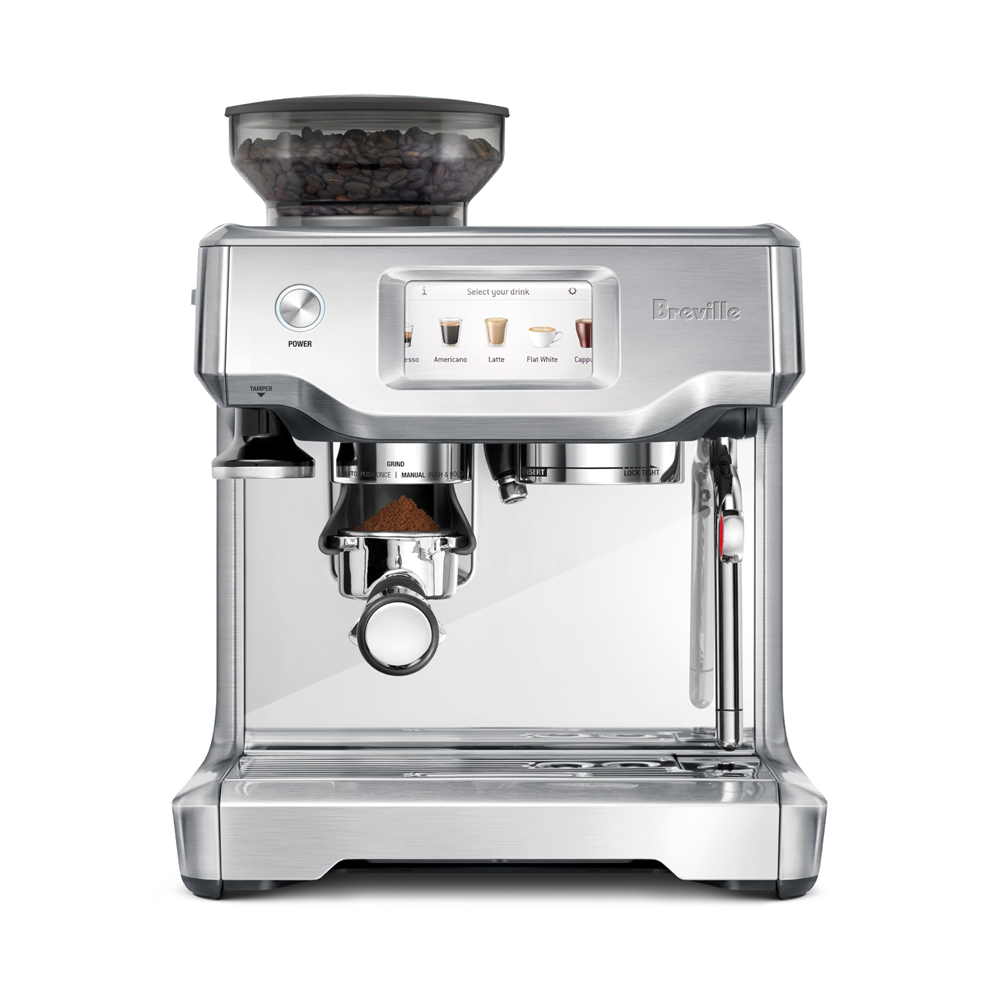
The Pro’s fast heat-up with a touchscreen, eight saved drinks and hands-free milk to your set temperature.
Find Out the Price TodayBarista Express vs Pro vs Touch at a glance
- Buy the Barista Express if you want the classic hands-on machine with a pressure gauge to learn from.
- Buy the Barista Pro if you want speed, the best espresso of the three and powerful manual steam for latte art.
- Buy the Barista Touch if you drink milk drinks daily and want them steamed hands-free, with eight saved drinks on a touchscreen.
- All three use a 54 mm portafilter, a built-in conical burr grinder, timed dosing, hand tamping and a 67 oz tank.
Head to head
The better result in each row is marked, based on four weeks with each machine and Breville’s specs. Rows where all three are the same have no winner.
The tally isn’t my verdict. The three are built for three different kinds of morning, so read the rows that match yours.
| Spec | Barista Express | Barista Pro | Barista Touch |
|---|---|---|---|
| Espressomy scores | 8.4 | 8.7 ✓ Best | 8.5 |
| Heat-up | About 1 minute | About 3 seconds | About 3 seconds |
| Heating | 1600 W thermocoil | 1680 W ThermoJet | 1680 W ThermoJet |
| Grind settings | 16, plus inner burr | 30, stepless ✓ Best | 30 |
| Shot feedback | Analog pressure gauge ✓ Best | LCD with shot timer | Touchscreen timer |
| Brew temperature | Button combination | 5 settings on screen ✓ Best | Adjustable in settings |
| Steam tip | 1 hole, gentle | 4 holes, strong | Automatic with sensor |
| Milk drinksmy scores | 7.8 | 8.6 | 8.6 |
| Hands-free milk | No | No | Yes ✓ Best |
| Saved drinks | 2 shot buttons | 2 shot buttons | 8 named drinks ✓ Best |
| Low-water warning | No | Yes, level sensor | Yes |
| Drip tray | Large, with float ✓ Best | Fills slowly | Small, fills fast |
| Warranty (US) | 1 year | 2 years | 2 years |
| Width | 12.5 in ✓ Best | About 14 in | 12.6 in |
| Rows won | 3 | 3 | 2 |
Barista Express vs Pro vs Touch pros and cons
Barista Express
- Pressure gauge makes dialing in easy to learn
- Gentle steam gives beginners time to learn latte art
- Large drip tray and simple, physical controls
- Grinder needs an inner-burr tweak out of the box
- About a minute of heat-up and slow steam
- No low-water warning on the tank
Barista Pro
- Ready in seconds, with near-instant steam
- Strong four-hole steam for fast, silky microfoam
- LCD shot timer and five temperatures for any roast
- No analog pressure gauge
- Pre-infusion capped at 10 seconds
- Portafilter still needs warm-up flushes
Barista Touch
- Ready in about three seconds
- Hands-free milk that stops at your set temperature
- Eight saved drinks on a clean touchscreen
- You still dose and tamp by hand
- Presets all use the same shot
- Small drip tray needs daily emptying
Who should buy which machine?
- Beginners who learn best from a pressure gauge
- Espresso and americano drinkers
- Tinkerers who like physical dials
- Daily latte drinkers who want to steam by hand
- Light-roast fans who need temperature control
- Anyone who hates waiting in the morning
- Milk drinkers who want it hands-free
- Households sharing one machine
- People who prefer a clean touchscreen
How the three fit together
Think of these as three steps on the same ladder. All three grind into a 54 mm portafilter✕PortafilterThe handle with a metal basket that holds the ground coffee. You lock it into the machine’s group head to brew., all three dose by time, and all three leave the tamping to you.
The Barista Express is the classic: a thermocoil heater, a round pressure gauge, physical dials and a gentle single-hole steam wand.
The Barista Pro keeps the buttons and the manual wand but swaps in a fast ThermoJet✕ThermoJetBreville’s fast heating system. Water is heated as it flows through a compact element, so the machine is ready in about three seconds. heater, a better 30-step grinder, an LCD shot timer and a far stronger four-hole steam tip.
The Barista Touch takes the Pro’s speed, puts everything on a touchscreen and adds an automatic steam wand that stops at your chosen milk temperature.
| What changes | Express → Pro | Pro → Touch |
|---|---|---|
| Heating | Thermocoil to ThermoJet, 1 min to 3 s | Same ThermoJet |
| Grinder | 16 steps to 30, Baratza-designed burrs | 30 steps on both |
| Feedback | Gauge to LCD shot timer | LCD to touchscreen |
| Steam | 1 hole to 4 holes, much faster | Manual to automatic |
| Saved drinks | None to none | None to 8 named |
| Water sensor | None to level sensor | Yes on both |
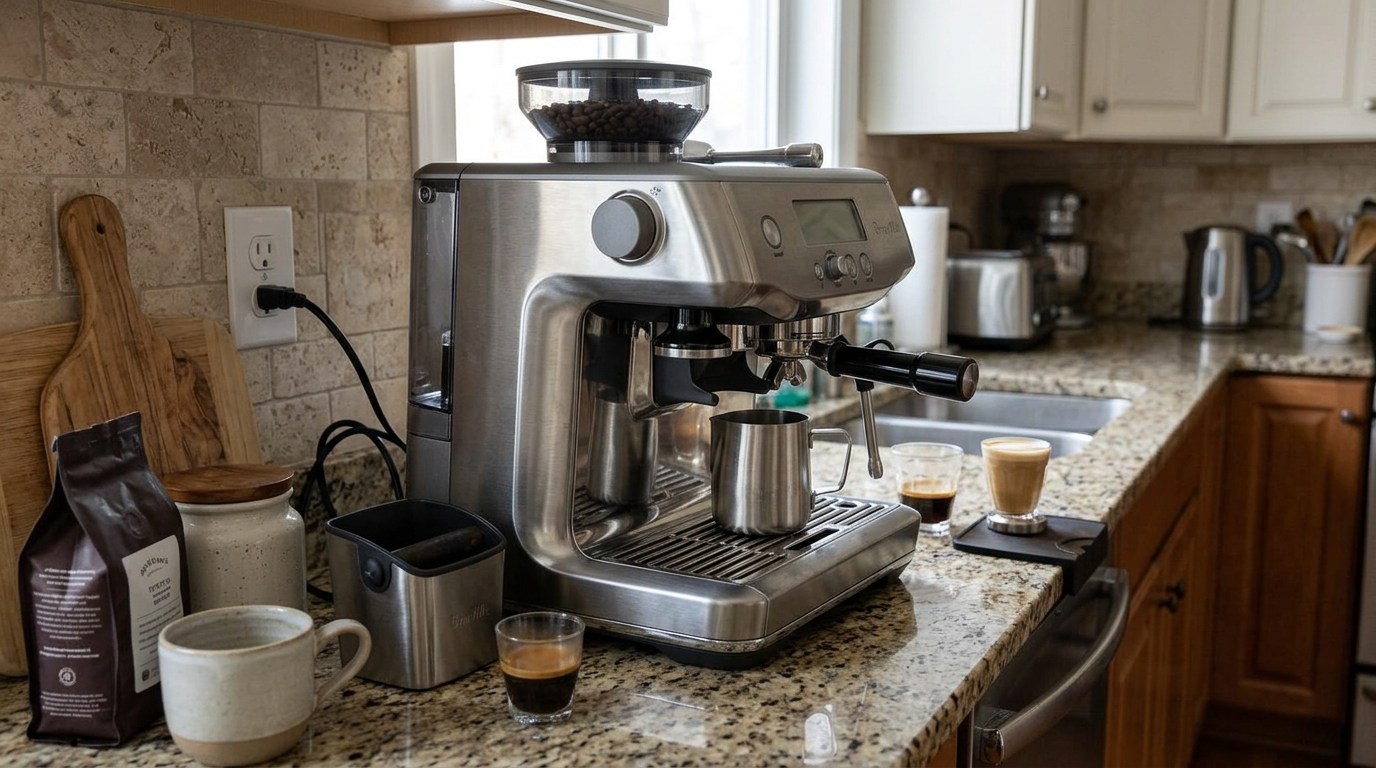
The Barista Pro sits in the middle: faster than the Express, more hands-on than the Touch.
Our tip: Decide how you want to steam milk first, because that one choice usually picks the machine for you.
Design, size and build
All three are brushed stainless steel with a hopper on top, a group head in the middle and a steam wand on the right. They all fit under standard wall cabinets, though I slid each forward to fill the hopper.
The Express is about 12.5 inches wide, 13.8 deep and 15.9 tall. The Pro is the widest at about 14 inches, but the shallowest at about 13 inches, and the lightest at about 20 pounds. The Touch is the most compact, at about 12.6 inches square and 16.1 inches tall.
The Pro’s stainless panels are magnetic, so I stuck a stirring tool and a brush right to its side. The Touch has no knobs at all apart from the grind dial, which keeps its front panel clean.
Width on the counter
Add a few inches in front for the portafilter handle.
Our tip: Stick small tools to the Barista Pro’s magnetic side panels, so your stirring tool and brush never wander off.
Heat-up and speed
This is the difference I felt every morning. The Express’s thermocoil was ready in about a minute; the Pro and Touch were ready in about three seconds.
The fast heaters change the routine. On the Pro and Touch, I switched off between coffees, because there was nothing to wait for. On the Express, I left it on during busy mornings.
The real gap is with milk. The Express can’t brew and steam at once, and after steaming it purges to cool back to brewing temperature. The Pro went from brew to full steam in about five seconds and back to brewing in about six. The Touch steams on its own while you clean the portafilter.
Power on to ready
My timings, from pressing the power button.
| Drink, power on to first sip | Express | Pro | Touch |
|---|---|---|---|
| Espresso | About 3 min | About 2 min | About 2 min |
| Latte or flat white | 4 to 5 min | 3 to 4 min | About 3.5 min |
Grinder and dosing
All three grind with conical burrs straight into the portafilter and dose by time. The difference is resolution and evenness.
The Express has 16 steps on its side dial, plus a hidden inner burr. From the factory, mine was set to 6 and most of the dial was too coarse, so I moved it to 2. After that, step 7 was my sweet spot for a medium roast.
The Pro uses Baratza-designed burrs on an effectively stepless collar, shown as 1 to 30 on the screen. It produced a more even grind with less clumping, and my medium roast landed around 10 to 12. You set the grind time in tenths of a second.
The Touch also shows 30 settings; my medium roast landed around 10 to 13. Its cradle lets you push once to pause halfway and settle the grounds.
Grind steps on the dial
More steps mean finer control between settings.
None of them weighs the dose. My doses were about 15.4 grams on the Express, 16 on the Pro and 17.5 on the Touch, all checked on a 0.1-gram scale. Even on a fixed timer, the Pro’s doses varied by about 0.2 to 0.4 grams, so the scale stayed on the counter.
| Grinder detail | Express | Pro | Touch |
|---|---|---|---|
| Burrs | Steel conical | Baratza-designed conical | Hardened steel conical |
| Settings | 16 plus inner burr | 30, stepless | 30 |
| My medium-roast setting | 7 (inner burr at 2) | 10 to 12 | 10 to 13 |
| Dose control | Grind Amount dial | Time in tenths of a second | Time on screen, push to pause |
| My double dose | About 15.4 g | About 16 g | About 17.5 g |
Our tip: Use a needle stirring tool on all three, because breaking up clumps before tamping fixed more sour shots than any grind change.
See Today’s PriceGauge, timer or touchscreen
Each machine gives you feedback in a different way, and it changes how you learn.
The Express has a round pressure gauge✕Pressure gaugeA dial that shows the pressure in the group head during a shot. Low means too coarse or under-dosed; maxed out means too fine.. My first “perfect” 27-second shot tasted sour because the needle never reached the espresso zone. The timer said yes, the gauge said no, and the gauge was right.
The Pro replaces the gauge with a backlit LCD showing grind setting, grind time, shot size and a running shot clock that starts when full pressure kicks in. It replaced my phone stopwatch on day one, and with a scale it gave me everything I needed.
The Touch puts everything on a touchscreen, with five presets, eight saved drinks and short visual tutorials. Its presets all brew the same shot, so I saved my own versions with different milk settings.
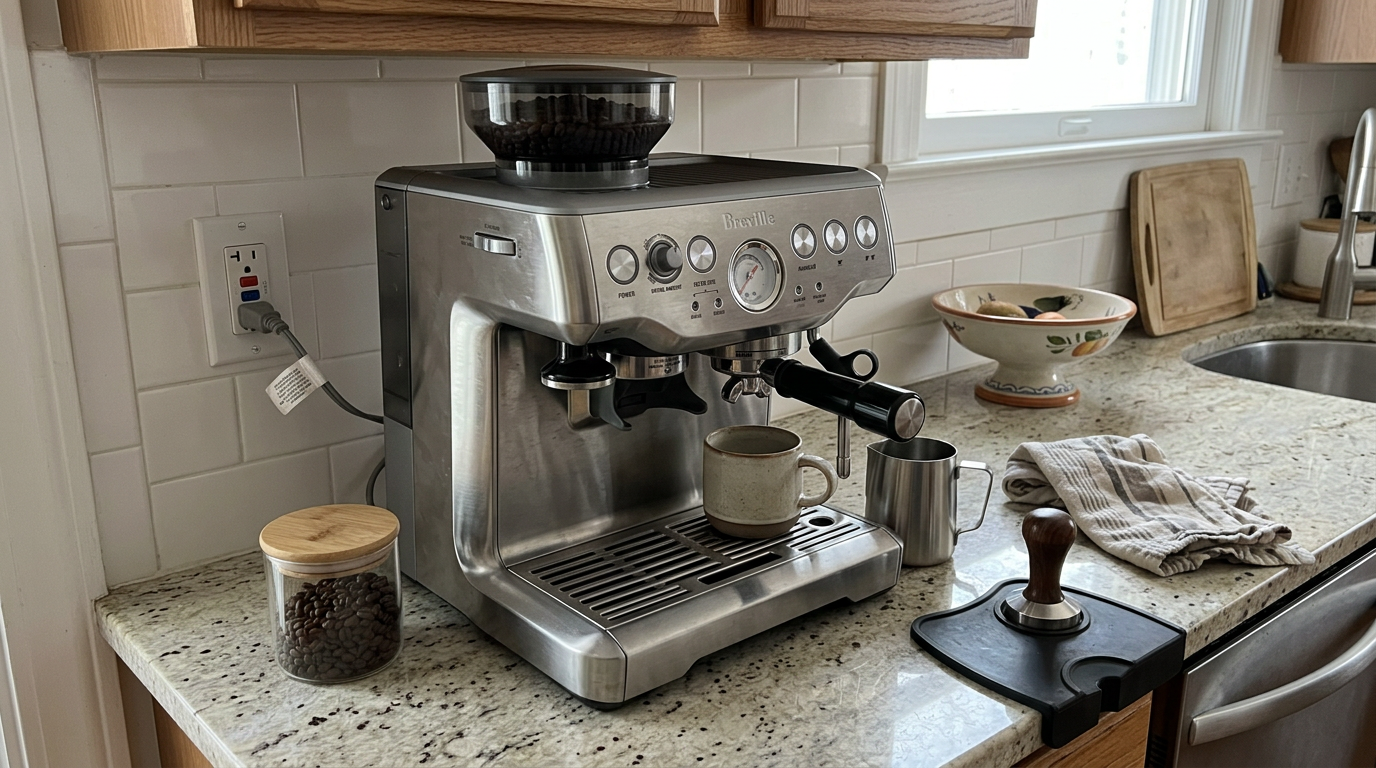
The Express gauge is still the best teacher of the three.
| Feature | Express | Pro | Touch |
|---|---|---|---|
| Shot feedback | Analog gauge | LCD shot clock | Touchscreen timer |
| Temperature control | Button combination | 5 settings, two presses | Settings menu |
| Pre-infusion | Low-pressure, automatic | Programmable, up to 10 s | Automatic |
| Programmable buttons | 1-cup and 2-cup | 1-cup and 2-cup | 5 presets, 8 saved drinks |
| On-screen help | No | No | Tutorials |
Our tip: On the Pro, set the temperature to match the roast before you touch the grind, because temperature changes the taste as much as a grind step.
Espresso quality
With good puck prep, all three make café-level espresso. The differences are in how easily you get there and how far you can push it.
On the Express, 15.4 grams in and 30 grams out in 25 to 30 seconds gave a shot that poured like warm honey, with deep, velvety crema✕CremaThe golden, foamy layer on top of a fresh espresso. and a sweet, creamy taste.
On the Pro, 16 grams in and 32 grams out ran in 28 to 30 seconds. The crema was thick and hazelnut-colored even with all-arabica beans, and it tasted of chocolate and caramel with gentle acidity.
On the Touch, I stopped shots by weight in manual mode: 17.5 grams in, 40 grams out in 28 to 32 seconds, with tiger-striped crema and chocolate and nut notes.
My espresso ratings
My scores out of 10 from the single reviews.
Shots in my target window, week 4
From my four-week shot logs. All three started around 45 to 50 percent in week one.
Light and dark roasts
Temperature control is where the Pro pulls ahead. On its default, a light roast tasted sharp and sour; on High with a finer grind, it opened into sweet citrus, orange peel and stone fruit. A dark roast on Medium-Low turned from burnt and bitter into toasted nuts and dark caramel.
The Touch handled roasts well too, at 198 to 200°F for dark and 204 to 206°F for light. The Express can be nudged warmer, but only through a button combination, and its narrow grind range struggles with very light, dense beans.
Light-roast sourness on the Pro, by temperature
My taste scores, where 10 is very sour.
| What you taste | Likely cause | First fix on any of the three |
|---|---|---|
| Sour, thin, fast | Under-extraction or clumps | Stir, then go finer |
| Bitter, harsh, slow | Over-extraction | Go coarser |
| Sour light roast | Too cool | Pro: High. Touch: 204–206°F |
| First shot weaker | Cold portafilter | Blank shots first |
Our tip: Light roasts need heat, so raise the temperature before you blame the grinder on the Pro or Touch.
Milk drinks
Milk is where these three split most clearly.
The Express has a manual wand with a single-hole tip. Steam arrived in about 15 seconds, and it’s gentle, which gave me time to find the whirlpool. By week three, I could pour a heart most mornings. For two or three drinks in a row, though, it felt slow.
The Pro has a four-hole tip and strong, dry steam within seconds. A 6-ounce jug took about 30 seconds and came out glossy, like wet paint. It’s one of the easiest all-in-ones I’ve used for latte art, once you learn not to overshoot the temperature.
The Touch steams milk on its own. A sensor in the drip tray stops the steam at your set temperature, with eight texture levels. Level 3 at 140°F made fine microfoam✕MicrofoamMilk foam with bubbles so small you can barely see them. It feels silky and glossy, and it’s what you need for latte art. good enough for hearts and simple tulips.
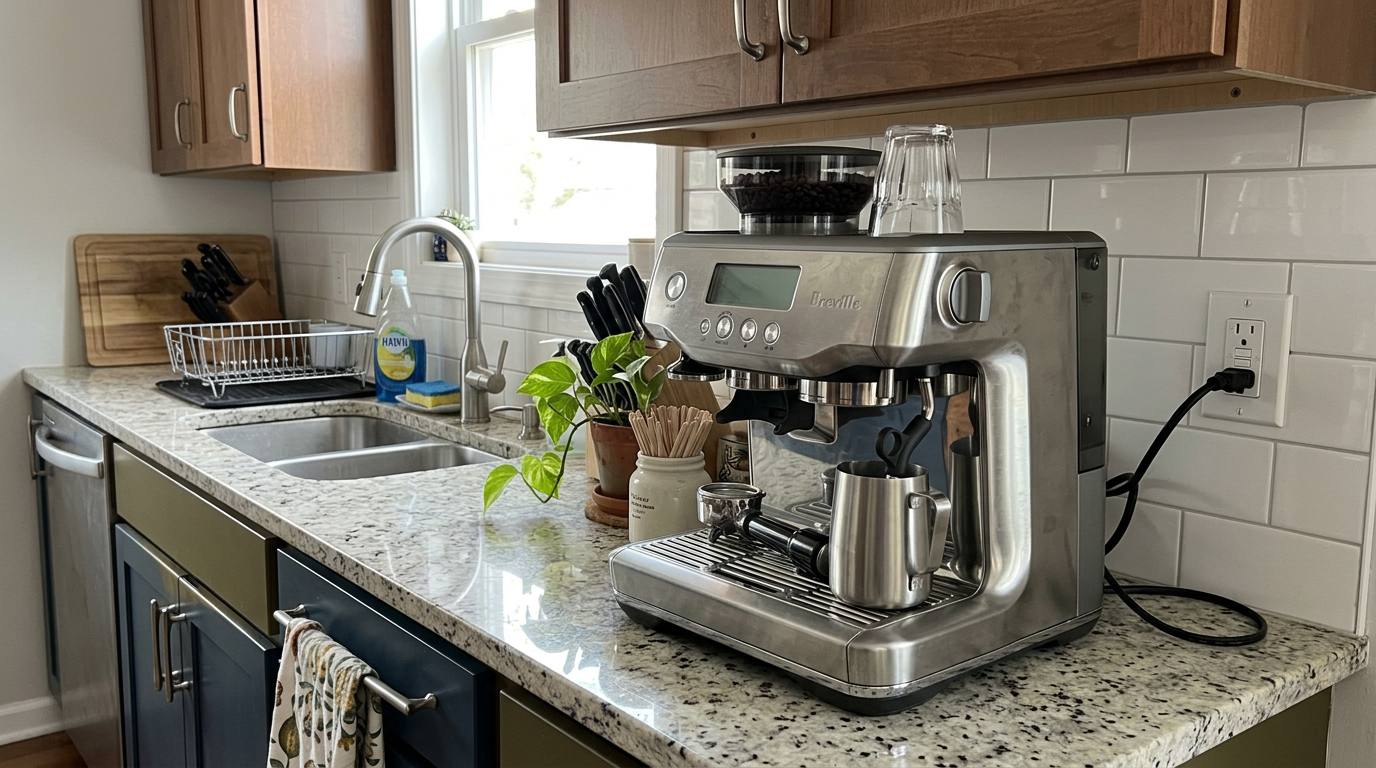
The Pro’s four-hole tip builds a whirlpool in seconds.
Seconds to steam about 6 oz of cold milk
My timings. On the Touch, you’re free to clean up while it steams.
| Milk detail | Express | Pro | Touch |
|---|---|---|---|
| Wand | Manual, 1 hole | Manual, 4 holes | Automatic, sensor |
| Speed | Gentle | Fast, strong | Hands-free |
| Latte art | Hearts by week 3 | Easiest of the three | Hearts and tulips at level 3 |
| Plant milks | Barista oat, stretch longer | Barista oat, a few extra seconds | Two texture levels higher |
| After steaming | Purge by hand | Auto purge, little water | Auto purge into small tray |
My milk drink ratings
From the single reviews.
Our tip: Use a smaller jug while you learn on the Pro, because its strong steam heats a big jug unevenly at the bottom.
Reveal Today’s DealHot water and americanos
All three have a dedicated hot water outlet, so none of them forces water through the coffee for a long drink.
On the Express, you turn the right-hand dial to hot water. The Pro’s spout delivered a smooth, steady stream that didn’t spit or sputter like older models. The Touch has an Americano preset that brews and adds water automatically.
For a long black✕Long blackA double espresso pulled on top of hot water. It keeps more crema than an americano, where the water goes in after the shot. on any of them, I poured water first and pulled the shot on top. The water on all three suits green and herbal tea better than strong black tea.
| Drink | Express | Pro | Touch |
|---|---|---|---|
| Americano | Shot, then hot water | Shot, then hot water | One-touch preset |
| Long black | Water first by hand | Water first by hand | Water first by hand |
| Tea | Good for green tea | Good for green and herbal | Hot water option |
Our tip: Warm your cup with the hot water outlet while the portafilter flushes, so both are ready at the same time.
Cleaning and upkeep
Daily habits are the same on all three: knock out the puck, rinse the basket, flush the group head and wipe the steam wand straight after milk.
The differences are in the details. The Express purges more water after steaming, which fills its drip tray faster on milk-heavy mornings, though its tray is large with a red float. The Pro’s purge uses much less water. The Touch’s automatic purge goes into its small tray, which I emptied daily.
The Pro’s four tiny steam holes clog fast if milk dries on them, so I purged and wiped immediately every time. All three prompt you to backflush✕BackflushingRunning water backwards through the group head with a blank disc and a cleaning tablet in the basket, to dissolve coffee oils. with a tablet; the Touch also guides descaling on screen.
Daily hands-on cleaning, two milk drinks
My estimates from the single reviews.
| When | Express | Pro | Touch |
|---|---|---|---|
| After milk drinks | Wipe and purge by hand | Purge and wipe at once | Wipe; it purges itself |
| Daily | Empty tray when float pops | Empty drip tray | Empty the small tray, often twice |
| Weekly | Brush gasket and chute | Brush gasket and burr chamber | Clean steam tip and baskets |
| When prompted | Backflush | Backflush | Backflush, guided descale |
| Every 2 to 3 months | Replace filter | Replace filter | Replace filter |
Our tip: Keep one damp towel for the steam wand and one dry towel for the basket, whichever machine you choose.
Water, beans and supplies
All three have a 67-ounce tank at the back and use the same Breville charcoal filters, cleaning tablets and descaler. The Pro and Touch warn you when water is low; the Express doesn’t, so I checked it every morning.
For water, the Specialty Coffee Association’s brewing standard aims for about 150 ppm of total dissolved solids. Very hard water scales the narrow ThermoJet channels faster, so the filter matters even more on the Pro and Touch.
Espressos per 67 oz tank
Rough maths allowing for blank shots and purging.
| Bean type | Express | Pro | Touch |
|---|---|---|---|
| Light roast | Finer, a touch warmer | 7 to 9, High temperature | 6 to 9, 204–206°F |
| Medium roast | Step 6 to 8 | 10 to 12, Medium-High | 10 to 13, 200–202°F |
| Dark roast | A step coarser | 14 to 16, Medium-Low | 14 to 17, 198–200°F |
| Very dark, oily | Coats the burrs | Clean burrs more often | Clean burrs more often |
Our tip: Write the grind number on each coffee bag once it’s dialed in, so the next bag of the same beans starts in the right place.
Mistakes I made, and how to avoid them
Each of these machines taught me a lesson in week one. Here’s how to skip straight to week two.
On the Express, I judged the grinder before moving the inner burr, and almost blamed the machine for shots that were really a setup issue. On the Pro, my first shot every morning ran two to four seconds faster than the second until I added two blank shots. On the Touch, I trusted the timed presets and my shots wandered by several seconds, until I switched to manual mode and stopped by weight.
| Mistake | Machine | Better habit |
|---|---|---|
| Leaving the inner burr on the factory setting | Express | Move it finer once, with the hopper empty |
| Forgetting the water tank | Express | Check it every morning; there’s no sensor |
| Skipping the warm-up flush | Pro and Touch | Two blank shots on cold mornings |
| Using one temperature for every roast | Pro | Match the setting to the roast |
| Relying on timed presets | Touch | Stop shots by weight in manual mode |
| Leaving milk on the wand | All three | Purge and wipe straight away |
None of these took more than a day to fix, and all three machines became predictable once I had.
Our tip: Change one setting at a time on any of the three, and taste after each change, so you always know what helped.
Real-life scenarios
These are the moments where one of the three clearly pulled ahead.
The gauge showed me what every grind change did. I understood espresso better after a month with it.
Three-second heat-up and a 30-second steam with a whirlpool that builds itself.
Press start on the milk and walk away; it stops at your temperature.
Five temperatures and a fine, even grinder brought out citrus and stone fruit.
Eight named drinks kept everyone’s milk settings separate.
The core workflow and a gauge to learn from, at the bottom of the ladder.
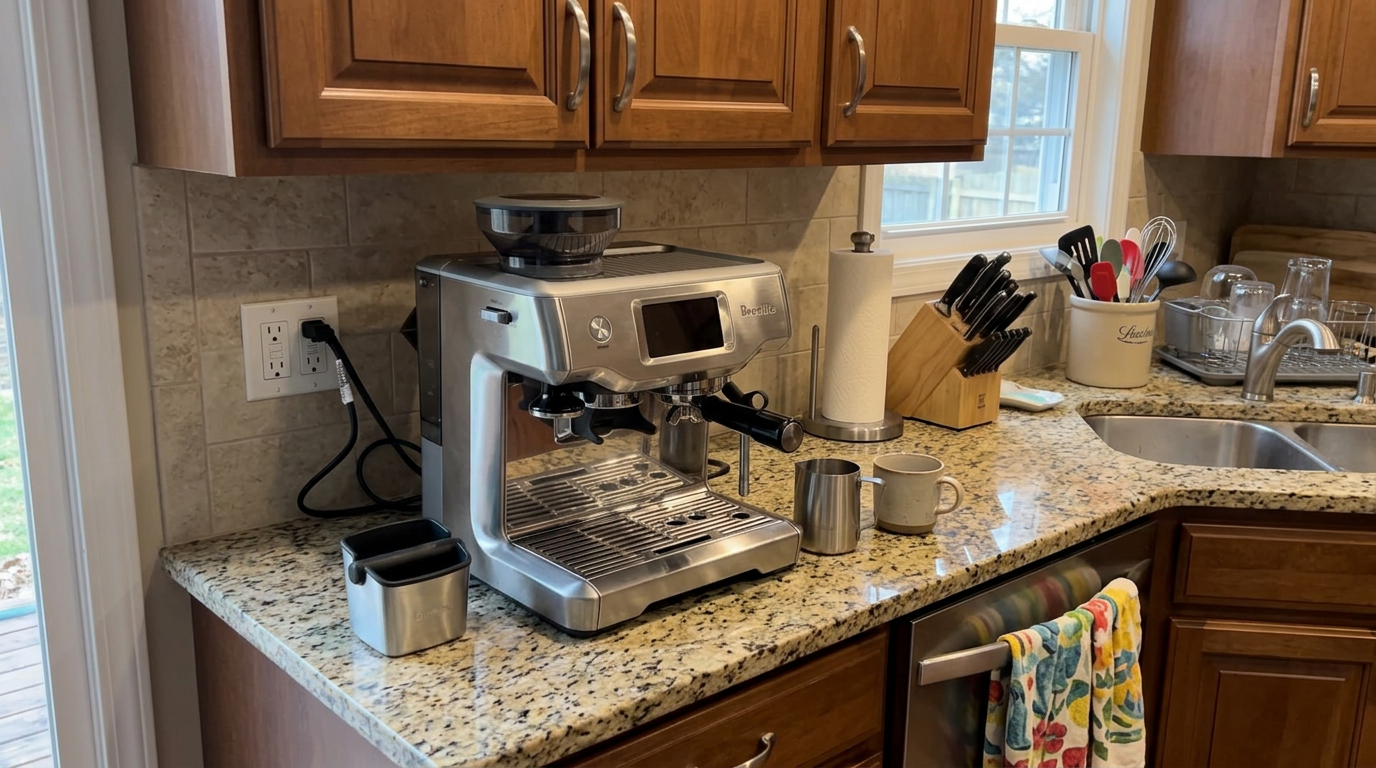
For milk drinkers who want it easy, the Touch is the one to share.
My scorecard
These are my own scores out of 10, from my single reviews of each machine. I added speed and learning value because they separate the three most clearly.
Barista Express
Barista Pro
Barista Touch
Overall, I rate the Express 8.0, the Pro 8.5 and the Touch 8.4. The Pro is the best all-rounder; the Touch is the easiest; the Express is the best teacher.
See How Much You’ll SaveWhich one is right for you?
4 quick questionsWhich one should you buy?
Start with the milk. If you want it steamed for you, buy the Touch. If you want to steam by hand, choose between the Express and the Pro based on how much speed and temperature control are worth to you. For the wider picture beyond this matchup, see my guide to the best Breville espresso machines.
For the two-way versions of this choice, see my Barista Express vs Barista Pro, Barista Pro vs Barista Touch and Barista Express vs Barista Touch comparisons. If tamping worries you, read Barista Touch vs Touch Impress.
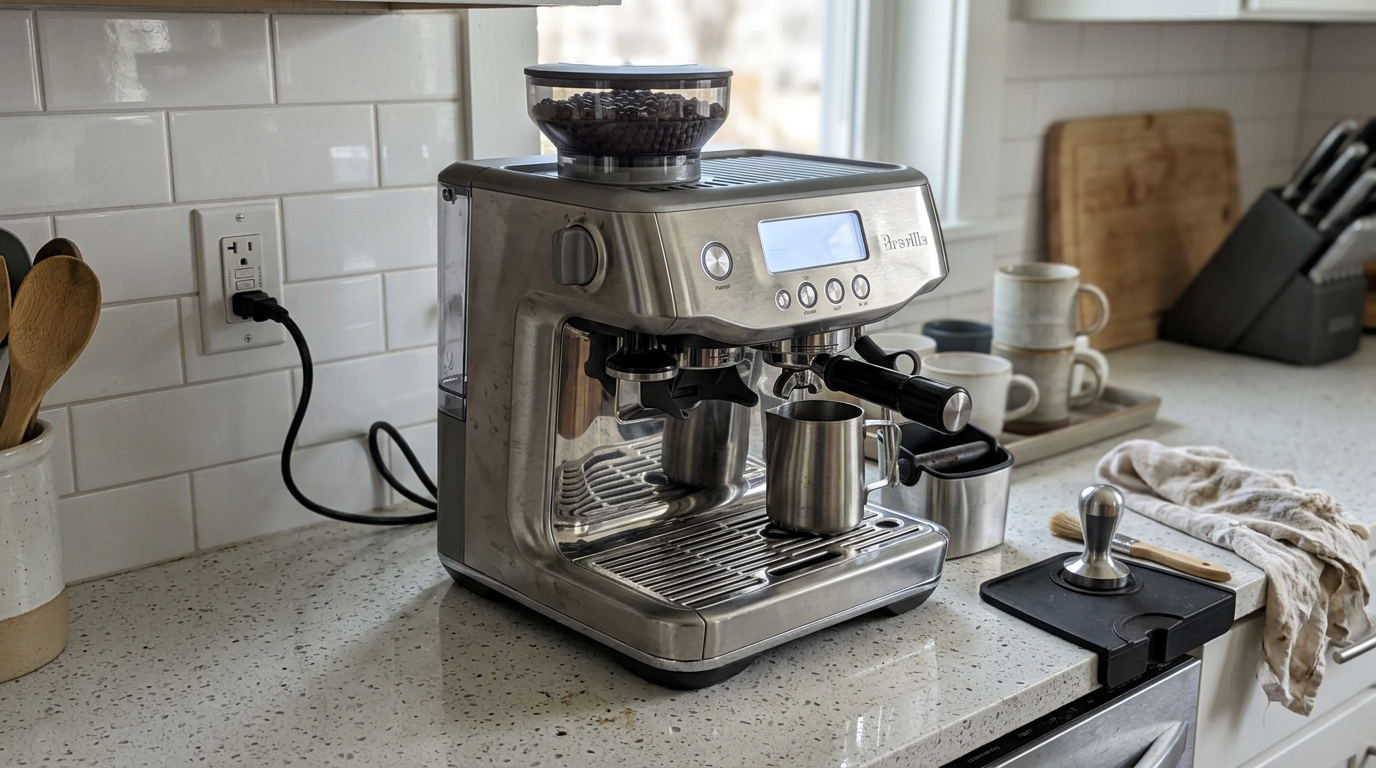
For most people who steam their own milk, the Pro is the sweet spot.
- You want a pressure gauge to learn from
- You mostly drink espresso and americanos
- You like physical dials
- You want the entry point to the range
- You hate waiting for heat-up
- You make several milk drinks in a row
- You want a low-water warning
- You steam milk by hand every day
- You want fast heat-up and strong steam
- You drink light roasts and need temperature control
- You want a water level sensor
- You want an analog gauge
- You want hands-free milk
- You want saved drinks for several people
- You want milk steamed hands-free
- Several people share the machine
- You like a clean touchscreen
- You want eight saved drinks
- You want full manual milk control
- You only drink black coffee
- You hate emptying a small drip tray
For most people, my pick is the Breville Barista Pro. It heats in three seconds, has the best grinder and temperature control of the three, pulled my highest-scoring espresso and steams milk faster and more easily for latte art than the Express.
If you want milk drinks without learning to steam, buy the Breville Barista Touch; its hands-free milk and eight saved drinks make it the easiest to share. If you want to learn espresso from the ground up, the Breville Barista Express and its pressure gauge remain a brilliant teacher.
Whichever you choose, buy fresh beans, a 0.1-gram scale and a needle stirring tool. All three reward that small investment every morning.
Barista Express vs Pro vs Touch specifications
From manufacturer specifications and my own testing.
| Barista Express | Barista Pro | Barista Touch | |
|---|---|---|---|
| Model | BES870XL | BES878BSS | BES880BSS |
| Heating | 1600 W thermocoil, PID | 1680 W ThermoJet, PID | 1680 W ThermoJet, PID |
| Heat-up | About 1 minute | About 3 seconds | About 3 seconds |
| Grinder | Steel conical, 16 + inner burr | Baratza-designed, 30, stepless | Hardened steel conical, 30 |
| Dosing | Timed, dial | Timed, tenths of a second | Timed, on screen |
| Portafilter | 54 mm | 54 mm | 54 mm |
| Feedback | Analog pressure gauge | LCD with shot timer | Touchscreen |
| Temperature | Adjustable via buttons | 5 settings | Adjustable |
| Steam | Manual, 1-hole tip | Manual, 4-hole tip | Automatic, 8 texture levels |
| Saved drinks | None | None | Up to 8 |
| Water tank | 67 oz, no sensor | 67 oz, level sensor | 67 oz, low-water warning |
| Dimensions (W × D × H) | 12.5 × 13.8 × 15.9 in | 14 × 13 × 16 in | 12.6 × 12.6 × 16.1 in |
| Weight | About 22–23 lb | About 20 lb | About 22 lb |
| Warranty (US) | 1 year | 2 years | 2 years |
How I tested and compared them
I used each machine as my everyday espresso maker for four weeks, for espresso, americanos, long blacks, cappuccinos, flat whites and lattes. The notes were written up together by Michael Reynolds and the HouseholdMe team.
I weighed every dose and yield on a 0.1-gram scale, logged shot times daily, mapped every grind range with light, medium and dark roasts, tested temperature settings and timed heat-up, steam and full drink routines.
I steamed whole, semi-skimmed, skim and oat milk, ran every cleaning routine and checked my notes against Breville’s specifications and owner documentation.
- Coffee: dose, yield, crema, body and roast range.
- Milk: steam power, texture, latte art and automatic milk.
- Workflow: heat-up, controls, feedback and drink timings.
- Ownership: cleaning, water care, footprint and warranty.
Barista Express vs Pro vs Touch FAQ
What is the difference between the Barista Express, Pro and Touch?
The Express has a thermocoil heater, a pressure gauge, a 16-step grinder and a gentle manual wand. The Pro adds a three-second ThermoJet, a 30-step grinder, an LCD shot timer, five temperatures and a four-hole steam tip. The Touch keeps the ThermoJet and grinder, adds a touchscreen with eight saved drinks and steams milk automatically.
Which one makes the best espresso?
The Barista Pro, in my testing: 8.7 against 8.5 for the Touch and 8.4 for the Express. Its five temperature settings made the biggest difference with light and dark roasts.
Is the Barista Pro worth the upgrade over the Express?
Yes, if you make milk drinks most days or hate waiting. The Pro heats in about three seconds and its four-hole wand steamed 6 oz of milk in about 30 seconds. You lose the analog pressure gauge.
Is the Barista Touch worth it over the Pro?
Only if you want hands-free milk or saved drinks for several people. Espresso quality is very similar; the Pro gives more manual steam control.
Do any of them tamp automatically?
No. All three are tamped by hand. For assisted tamping, look at the Impress models.
Which heats up fastest?
The Pro and Touch, at about three seconds. The Express took about a minute.
Which is best for latte art?
The Pro, thanks to its strong four-hole steam. The Express works too but is slower; the Touch can pour simple hearts at texture level 3.
Which has a pressure gauge?
Only the Barista Express. The Pro has an LCD shot timer, and the Touch a touchscreen.
Do they warn you when the water is low?
The Pro and Touch do. The Express doesn’t.
Do they use the same portafilter?
Yes, all three use a 54 mm portafilter.

- Our hands-on Breville Barista Express review
- Our hands-on Breville Barista Pro review
- Our hands-on Breville Barista Touch review
- Breville product specifications and owner documentation
- Specialty Coffee Association brewing water guidance