Braun BrewSense KF7150BK review
The Braun BrewSense KF7150BK is a 12-cup programmable drip coffee maker with Regular and Bold brewing, three warming-plate temperatures, a 1–4 cup setting and a reusable metal filter. It brewed hot, even coffee, about 11 minutes for a full pot. Its 21-inch height, the missing side water window and no end-of-brew beep are the trade-offs.

Michael Reynolds
Hands-on review
Hands-on testing, research, specs
3 weeks
20 minutes
Jargon helpNew to coffee gear? Tap any dotted term to see what it means.
In this review
Yes, if you brew a full or half pot most mornings and have open counter space. The Braun BrewSense made hot, evenly brewed coffee, with a Bold mode that gave a fuller pot and a 24-hour timer that had coffee ready before I woke. At about 21 inches tall, it won't fit under many cabinets, the reservoir has no side window, there's no end-of-brew beep and the metal filter lets a little sediment through.
Braun BrewSense at a glance
Braun BrewSense pros and cons
- Hot, evenly brewed coffee
- Bold mode makes a fuller pot
- Clear clock and 24-hour Auto Brew
- About 21 inches tall
- No side water window or end beep
- Metal filter lets some sediment through
Who should buy the Braun BrewSense?
- Families brewing a full pot daily
- People who want coffee ready on waking
- Small footprints with open space above
- Kitchens with low upper cabinets
- One-cup-a-day drinkers
- Slow sippers who keep coffee warm for hours
First impressions of the Braun BrewSense
A good drip coffee maker should be boring in the best way.
You add water and coffee, press a button, and a full pot of hot, even coffee appears while you get ready.
The Braun BrewSense KF7150BK mostly delivers exactly that, with a few extra controls that are genuinely useful.
It has Regular and Bold brew modes, three warming-plate temperatures, a 1–4 cup setting and a 24-hour timer.
Out of the box, it looked more refined than most drip machines.
The black and stainless styling is classic Braun, and the large clock and green indicator lights are easy to read from across the kitchen.
The controls are real buttons, not a touchscreen, which I appreciated with wet hands in the morning.
Then I tried to slide it under our kitchen cabinets, and it didn't fit.
At about 21 inches tall, it needs more vertical space than many kitchens offer under wall units.
That turned out to be the biggest practical issue in three weeks of daily brewing.
The coffee itself was hot, even and good, and the glass carafe poured cleanly every time.
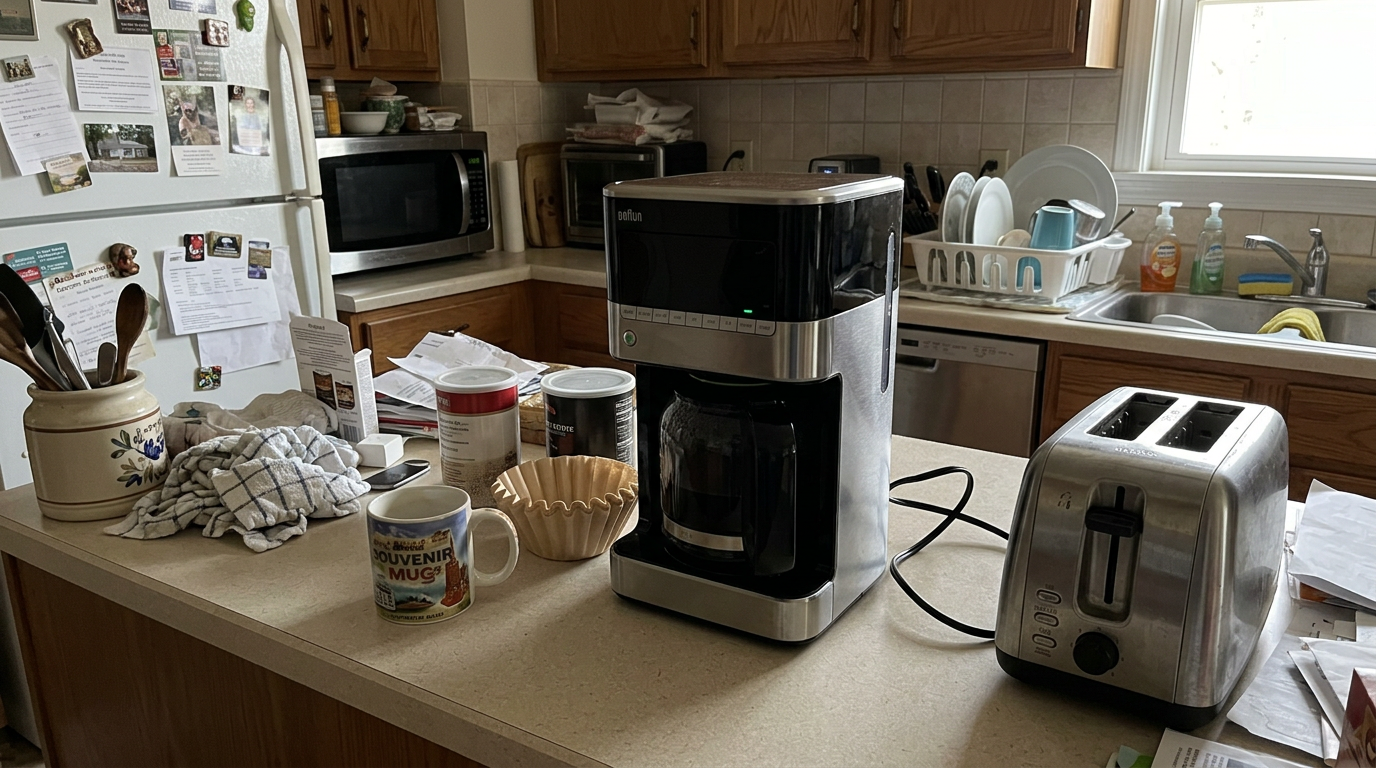
The black and stainless styling looks refined, but the tall body needs open space above it.
What the Braun BrewSense actually is
The BrewSense is a 12-cup programmable drip coffee maker with a glass carafe and a heated warming plate✕Warming plateThe heated plate under a glass carafe that keeps brewed coffee hot. Over long periods it can make coffee taste cooked..
You choose Regular or Bold brewing, set how warm the plate keeps your coffee, and can schedule brewing up to 24 hours ahead.
It comes with a reusable gold-tone metal mesh cone filter and a carbon water filter.
Key features at a glance
| Feature | What it does | Useful? |
|---|---|---|
| Regular / Bold | Changes the brew cycle | Yes, Bold tastes fuller |
| High / Medium / Low plate | Keeps coffee warm at your chosen level | Somewhat, small difference |
| 1–4 cup setting | Optimizes small batches | Yes, with the right water amount |
| Auto Brew | Starts brewing at a set time | Yes, every weekday |
| Auto Off | Plate shuts off after 15 min to 5 h | Yes, default 2 h |
| Clean indicator | Reminds you to descale | Yes |
| Water hardness H1–H3 | Sets descale reminder timing | Yes |
| Pause-and-serve | Pour mid-brew | Yes, return carafe quickly |
Our tip: Set the water hardness on day one, because the Clean reminder is only accurate if the machine knows how hard your water is.
Design, size and the 21-inch problem
The BrewSense has a small, square footprint of roughly 8 by 8 inches.
On paper that's great for a crowded counter.
The catch is height: it stands about 21 inches tall.
Many kitchens have around 18 to 19 inches between the countertop and the upper cabinets, and ours had about 18.
So the machine had to live on an open stretch of counter rather than tucked under a cabinet.
Measured in my kitchen. Check your own space before buying.
The lid
You also need room above it to open the lid when adding water and coffee.
The lid felt a little awkward to open at first, with a firm hinge that needed a deliberate lift.
Water reservoir
Water goes in at the back, with markings to show how much you've added.
There's no water window on the side, so the rear markings are your only reference.
I found it easier to measure water in the carafe and pour it in, which is how Braun suggests doing it anyway.
Our tip: Measure the gap between your counter and upper cabinets before you buy, because at about 21 inches tall this machine won't fit under many standard cabinets.
Controls, clock and settings
The control panel uses physical buttons with green indicator lights.
The large digital clock is one of the easiest to read I've used on a coffee maker.
Brew Now starts a cycle; its light flashes while brewing and turns steady when the cycle ends and the plate is keeping coffee warm.
No beep at the end
There's no sound when brewing finishes.
The light is your only signal: flashing means brewing, steady means done and warming.
I got used to checking the light, but I'd have liked an optional beep.
Setting Auto Brew
Setting the timer was quick once I'd read the steps once.
Every weekday, I loaded coffee and water the night before and set it to start ten minutes before my alarm.
| Button or setting | What it controls | When I used it |
|---|---|---|
| Brew Now | Starts brewing | Weekends |
| Auto Brew | Scheduled start | Every weekday |
| Regular / Bold | Brew cycle strength | Bold most days |
| 1–4 cups | Small batch mode | Afternoon pots |
| Temp High / Med / Low | Plate warmth | Medium |
| Auto Off | Plate shut-off time | Set to 1 hour |
| Clean | Descale reminder | When it lit up |
Our tip: Shorten Auto Off to one hour instead of the default two, because coffee on any hot plate starts tasting cooked after about an hour.
Filters and the brew basket
The BrewSense takes a No. 4 cone filter.
It includes a reusable metal mesh cone, but you can use No. 4 paper cones instead.
Use one or the other, never both together, or water backs up in the basket.
Metal mesh filter
The permanent filter is sturdy and easy to rinse.
Because it's a mesh, a little fine sediment gets through and settles at the bottom of your cup.
It isn't floating grounds, just a light silt, but you'll notice it in the last sip.
Paper filter
Paper catches that fine sediment and gives a cleaner, brighter cup.
Fold the seam, open it in the cone and press it against the sides so it follows the basket's shape.
| Filter | Cup clarity | Body | Effort |
|---|---|---|---|
| Metal mesh, included | Some fine sediment | Fuller, oilier | Rinse after use |
| No. 4 paper cone | Very clean | Lighter, brighter | Throw away |
The brew basket must click
The basket slides in and has to click into place every time.
Underneath it, a valve works with the carafe: when the carafe is in position, coffee flows; when you lift it out, the flow stops.
If the basket isn't fully seated, that valve doesn't line up properly.
Our tip: Push the brew basket in until you hear the click before every brew, because a half-seated basket is the main cause of drips and overflows.
How much coffee and water to use
The included scoop holds one tablespoon.
Braun's starting point is one tablespoon of medium-ground coffee per cup of water, and that worked well for me.
For a full 12-cup pot, use 12 tablespoons; the basket holds up to about 15 if you like it stronger.
| Batch | Water (carafe marking) | Coffee | Tip |
|---|---|---|---|
| 2 cups | 2 | 2 tbsp | Use 1–4 cup setting |
| 4 cups | 4 | 4 tbsp | Use 1–4 cup setting |
| 6 cups | 6 | 6 tbsp | Regular or Bold |
| 8 cups | 8 | 8 tbsp | Regular or Bold |
| 10 cups | 10 | 10 tbsp | Bold for fuller taste |
| 12 cups | 12 | 12 tbsp, up to 15 | Bold for fuller taste |
The 1–4 cup setting doesn't measure water
This confused me on the first day.
The 1–4 cup setting changes how the machine brews a small batch, but it doesn't limit the water.
If the reservoir holds 12 cups of water, you'll get 12 cups, setting or not.
So pour in exactly the amount you want to brew.
Braun's starting guideline. Adjust to taste.
Grind
Use a medium grind meant for drip machines.
Espresso-fine coffee clogged the mesh and tasted bitter; coarse French-press grounds tasted weak and thin.
If you want to understand the ratio side of this better, my guide to coffee brewing ratios explains it.
Our tip: Measure water with the carafe, then pour it into the reservoir, because the rear markings are hard to read and there's no side window.
Brewing time, temperature and taste
I timed and measured full pots throughout the test.
A full 12-cup pot on Regular took about 11 minutes, roughly a cup per minute.
Bold took about 15 minutes, adding four or five minutes with short pauses that give the grounds more contact time.
My average over several full pots.
Temperature
At the brew head, I measured water at about 194°F, close to the commonly recommended brewing range of roughly 195 to 205°F.
At the lower outlet, early in the cycle, it read about 171°F.
Poured into a cup, the finished coffee measured about 173°F, which is very hot.
Spot readings with a probe thermometer. Brew-head readings are tricky to take.
Taste
The coffee tasted good: round, balanced and properly hot.
The grounds looked evenly wet after brewing, with no dry patches, and the water never rose near the top of the basket.
Bold gave a noticeably fuller, deeper cup from the same coffee, and it became my default.
Our tip: Use paper filters with light roasts, because they give a cleaner, brighter cup that lets the fruitier flavors come through.
The warming plate and its three settings
The plate can be set to High, Medium or Low, even after brewing has finished.
It keeps the glass carafe warm for two hours by default, adjustable from 15 minutes to five hours with Auto Off.
These settings are separate from Regular and Bold: one changes how coffee is brewed, the other how it's kept warm.
How much difference do the settings make?
Less than I expected.
Between Low and High, the coffee in a full carafe differed by only about five to seven degrees Fahrenheit.
The plate did change temperature quickly after I switched settings, though.
Approximate difference I measured in a full carafe after warming.
Keeping coffee fresh
Any hot plate slowly "cooks" coffee, making it taste flatter and more bitter the longer it sits.
After about 45 minutes to an hour, I could taste it starting.
For a slow morning, I poured the rest into an insulated flask instead.
Our tip: Use the Low setting if you plan to drink the pot over an hour or more, because a cooler plate slows down that stewed, bitter taste.
Pause-and-serve
You can lift the carafe out mid-brew to grab a cup.
The valve under the basket closes and stops the flow while the carafe is away.
It works well for a quick first cup.
But put the carafe back promptly: coffee keeps collecting in the basket while it's out, and if you wait too long, the basket can overflow.
| Carafe out for | What happened in my tests |
|---|---|
| 10–15 seconds | No problem, flow resumed cleanly |
| About 30 seconds | Basket filled noticeably |
| Over a minute | Risk of overflow, don't do it |
Our tip: Pour your first cup within about 15 seconds and slide the carafe straight back, because the basket keeps filling while the valve is closed.
Noise, steam and end of cycle
For most of the cycle, the BrewSense sounds like any drip machine, a gentle gurgle.
Near the end, it gets louder, with some popping sounds as the last water heats.
Steam rises from the top, the back gets warm and steam can briefly drift over the front control panel.
Keep hands away from the top during that last minute.
After the main cycle, coffee keeps draining from the basket for a little while.
Let it finish before you pull the basket out, or you'll drip on the counter.
How loud each part of the cycle felt, my impression.
The glass carafe
The glass carafe has a removable hinged lid and a spout that pours smoothly, without dribbling down the side.
It lifts off the plate easily, and its opening is wide enough to fill the reservoir with a careful pour.
The plate gets very hot, and so does fresh coffee, so handle both with care.
When you're done, pressing the power button turns off the machine and the plate.
Glass vs thermal
A glass carafe on a warming plate lets you see how much coffee is left and keeps it hot as long as the plate is on.
A thermal carafe keeps coffee warm without a plate, and without the cooked taste, but you can't see inside.
If you drink the whole pot within an hour, glass is fine; if it lasts all morning, a flask helps.
Cleaning and care
Daily cleanup is simple.
Pull up the brew basket by its handle, hold it over the trash and tip out the grounds.
Never put coffee grounds down the sink, because they collect in the pipes and can cause a clog.
What goes in the dishwasher
The basket, permanent filter and carafe lid can go on the top rack.
Be careful with the basket's spring mechanism, which can catch on other items and come apart.
I handwashed the basket most days and only put it in the dishwasher once a week.
| Task | Why | How often |
|---|---|---|
| Empty grounds and rinse filter | Old grounds, oils | After every pot |
| Wash carafe | Coffee stains, oils | Daily |
| Wash basket and lid | Residue around valve | Daily rinse, weekly deeper clean |
| Wipe warming plate | Burnt drips | When cool, weekly |
| Change carbon filter | Taste and chlorine | Every 2 months or as marked |
| Descale | Mineral scale | When Clean lights up |
Descaling and the carbon filter
The Clean light turns on when it's time to descale, timed by the H1, H2 or H3 hardness you set.
Run a proper coffee-maker descaler through the machine as Braun describes.
The carbon water filter has a small green marker: slide it to the month you installed it so you know when to change it.
Our tip: Check that the basket's spring and valve are seated correctly after washing, because a loose part stops the pause-and-serve valve from working.
What daily use is really like
On weekdays, I filled the reservoir and basket the evening before and set Auto Brew.
By the time I'd showered, a full pot was ready and the kitchen smelled of coffee.
On weekends, I brewed Bold on demand and drank it slower, usually moving the last third into a flask.
Hands-on time for a typical pot.
Small batches
In the afternoon, I made two or three cups using the 1–4 cup setting.
With the right amount of water in the reservoir, those small pots tasted surprisingly balanced.
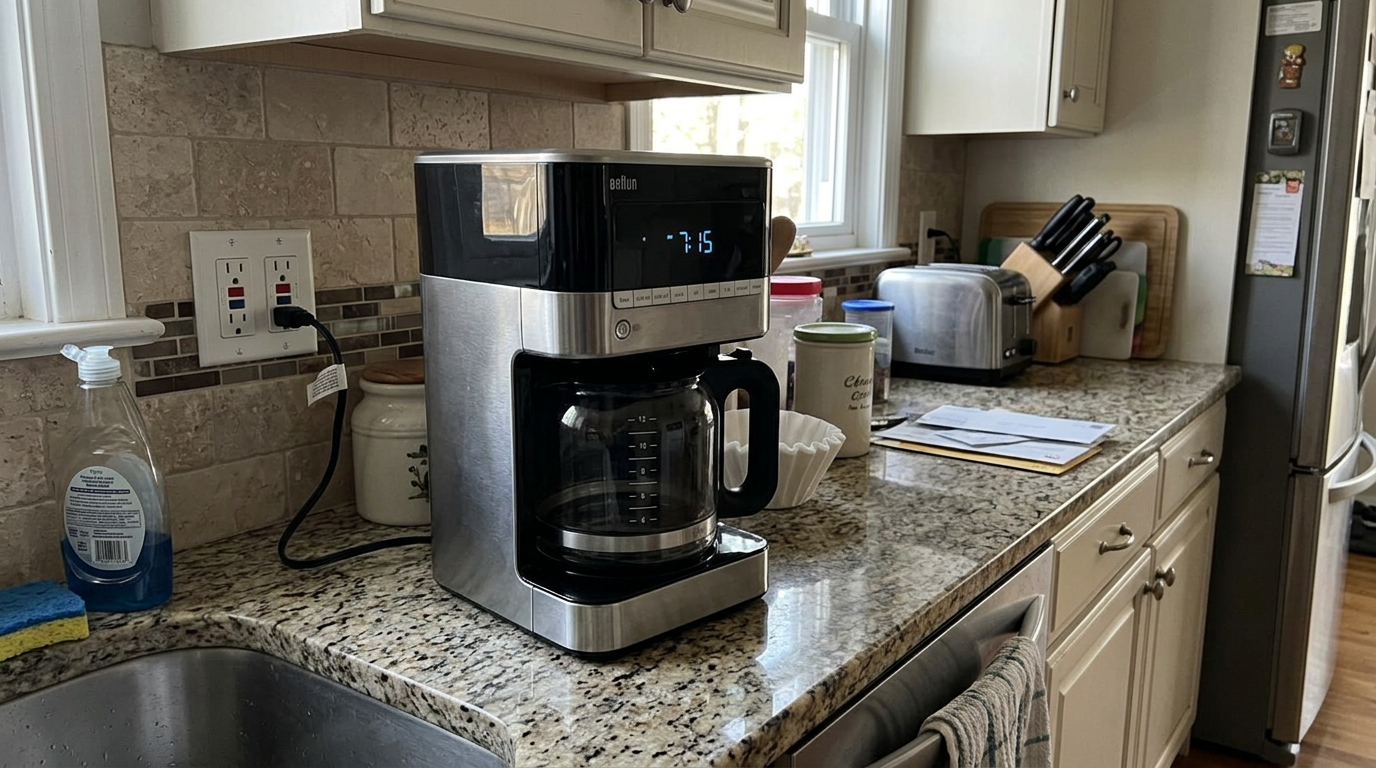
Auto Brew had a full pot ready before I got to the kitchen on weekday mornings.
Iced coffee, guests and other ways I used it
The BrewSense has no iced setting, but it makes good iced coffee with one simple change.
Brew a stronger, smaller batch and pour it straight over ice so it chills quickly without tasting watery.
My over-ice method
- Coffee: use the coffee for 6 cups, about 6 tablespoons.
- Water: add water for only 4 cups.
- Mode: choose Bold with the 1–4 cup setting.
- Ice: pour the hot coffee over a glass full of ice, or chill the carafe in the fridge.
The result tasted bold and cold, not diluted.
For a full comparison of cold coffee styles, see my guide to iced coffee vs cold brew.
Brewing for guests
For eight people after dinner, I brewed a full 12-cup pot on Bold and served it straight away.
Twelve "cups" on a coffee maker are about 5 ounces each, so a full carafe is roughly six to eight normal mugs.
Carafe "cups" are about 5 oz. Real mugs are bigger.
Decaf in the evening
A small 4-cup batch of decaf on Regular, with a paper filter, made a clean, light after-dinner coffee.
Our tip: Remember that a coffee maker cup is about 5 ounces, so plan on roughly seven normal mugs from a full 12-cup pot.
Coffee, grind and water to use
Medium roasts were the best all-rounders in the BrewSense.
Medium-dark roasts on Bold made a rich, chocolatey pot that held up well on the plate.
Light roasts were nicer with paper filters on Regular, where they tasted clean and bright.
| Coffee | Best mode | Best filter | Taste in my tests |
|---|---|---|---|
| Medium roast | Regular or Bold | Either | Balanced, sweet |
| Medium-dark roast | Bold | Metal mesh | Rich, chocolatey |
| Light roast | Regular | Paper | Clean, fruity |
| Dark roast | Regular | Paper | Smoky, less bitter on paper |
| Pre-ground supermarket coffee | Bold | Either | Fine, a bit flat |
Water
The included carbon filter helps with chlorine taste, and filtered water makes a cleaner cup overall.
It also slows scale, so the Clean light comes on less often.
For more on freshness, my guide on how to store coffee beans covers why ground coffee fades so quickly.
Our tip: Grind your beans just before brewing if you can, because drip coffee tastes noticeably flatter from coffee that was ground days ago.
Three weeks with the BrewSense, week by week
Week 1: finding its spot
It didn't fit under our cabinets, so it moved to the end of the counter.
I learned the controls and set the water hardness and Auto Brew.
Week 2: dialing in
I switched to Bold for full pots and tried paper vs metal filters.
Paper became my choice for light roasts; metal for darker ones.
Week 3: routine
Auto Brew every weekday, Bold on weekends, the plate set to Medium with a one-hour Auto Off.
The coffee was consistent from first pot to last.
Our combined feeling about the machine, from shared notes.
Common mistakes to avoid
| Mistake | What happens | Better habit |
|---|---|---|
| Using paper and metal filters together | Water backs up | Use one filter only |
| Full tank on the 1–4 cup setting | You still get 12 cups | Add only the water you need |
| Basket not clicked in | Drips, poor flow | Push until it clicks |
| Carafe out too long mid-brew | Basket overflows | Return within 15 seconds |
| Grounds in the sink | Clogged drain | Put them in the trash or compost |
| Leaving coffee on the plate for hours | Bitter, cooked taste | Shorter Auto Off, or a flask |
What I would change
A shorter body would solve the cabinet problem.
A water window on the side and an optional end-of-brew beep would make it easier to live with.
A thermal carafe version would avoid the cooked taste on slow mornings.
Three households, three verdicts
The big-pot family
Several people drinking coffee within the same hour each morning.
Twelve cups, Bold mode and Auto Brew make this an excellent fit, if there's open counter space.
The one-person household
One or two cups a day.
The 1–4 cup setting works well, but a 12-cup machine is more than you need.
The under-cabinet kitchen
Limited space between counter and cabinets.
At about 21 inches tall, it may simply not fit.
| Household | Fit | Main reason |
|---|---|---|
| Family or office pot | Excellent | 12 cups, Bold, Auto Brew |
| Couple | Very good | Small and full batches both work |
| Single drinker | Fair | Bigger than needed |
| Low cabinets | Poor | About 21 inches tall |
| Slow sippers | Fair | Hot plate, not thermal |
Is the Braun BrewSense worth it?
The BrewSense is a flexible, well-designed drip machine that makes hot, even, good-tasting coffee.
Regular and Bold, three plate temperatures, a working 1–4 cup mode and a clear timer give you more control than most basic drip machines.
Its weak points are practical: the height, no side water window, no completion beep and a little sediment from the metal filter.
Three questions to ask:
Do you have about 22 inches of open space above the counter?
Do you brew a full or half pot most days?
And do you drink it within an hour or so?
If yes, the Braun BrewSense is a very easy machine to recommend.
How it compares with other coffee setups
| Feature | Braun BrewSense | Basic drip machine | Pour-over by hand |
|---|---|---|---|
| Capacity | 12 cups | 10–12 cups | 1–4 cups |
| Strength control | Regular and Bold | Usually none | Full control |
| Scheduling | 24-hour Auto Brew | Sometimes | None |
| Keeping warm | Plate, 3 temperatures | Plate, one setting | Drink right away |
| Effort | Low | Low | High |
| Height | About 21 in | Often shorter | Tiny |
Compared with a basic drip machine, the BrewSense adds useful control without making mornings more complicated.
Compared with pour-over by hand, it gives up fine control and a little clarity, but makes a full pot with no effort.
If you're weighing these styles, my guide on pour over vs drip coffee goes into the differences.
| You mostly want | Is the BrewSense a fit? | Why |
|---|---|---|
| A full pot every morning | Excellent | 12 cups, Auto Brew |
| Strong, full coffee | Very good | Bold mode |
| One small cup | Fair | Works, but oversized |
| Coffee kept warm for hours | Fair | Plate can cook coffee |
| A machine under low cabinets | Poor | About 21 in tall |
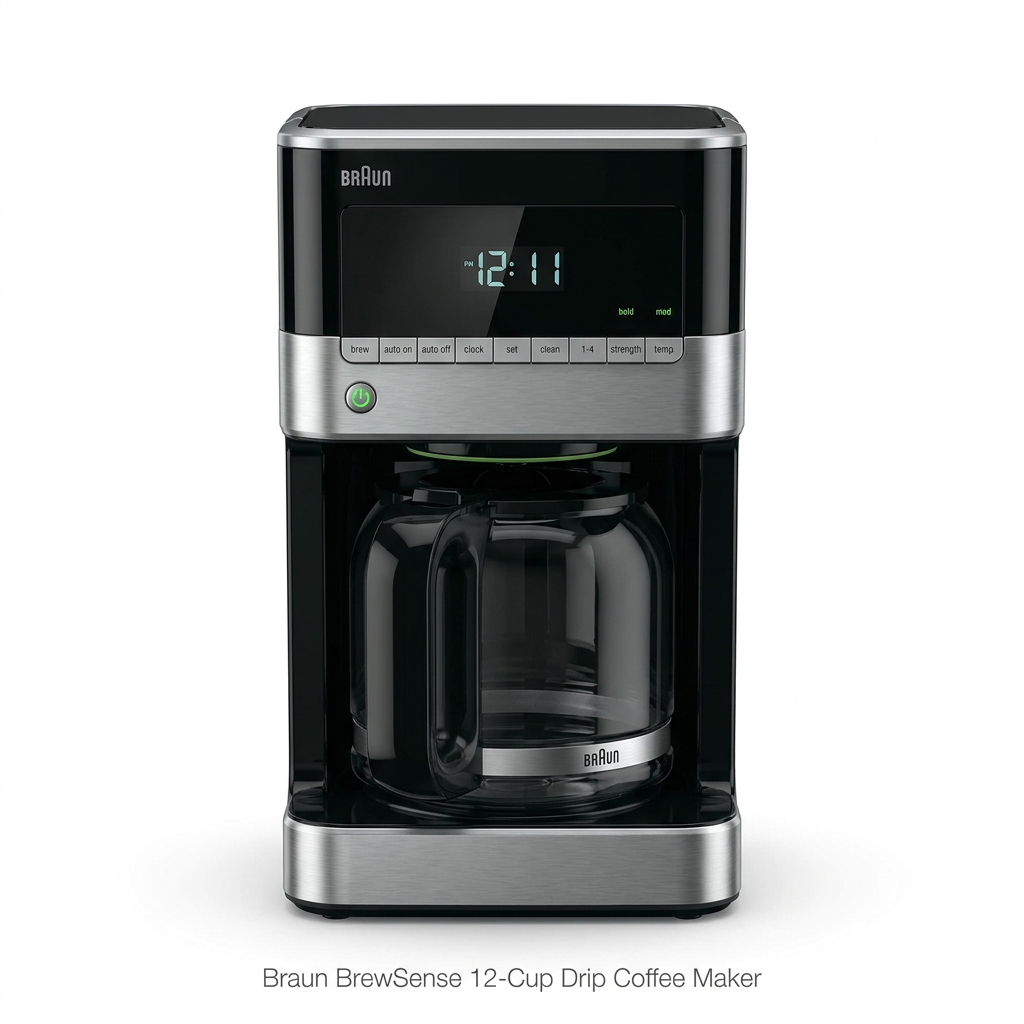
The full package: large clock, physical buttons, glass carafe and the tall, square body.
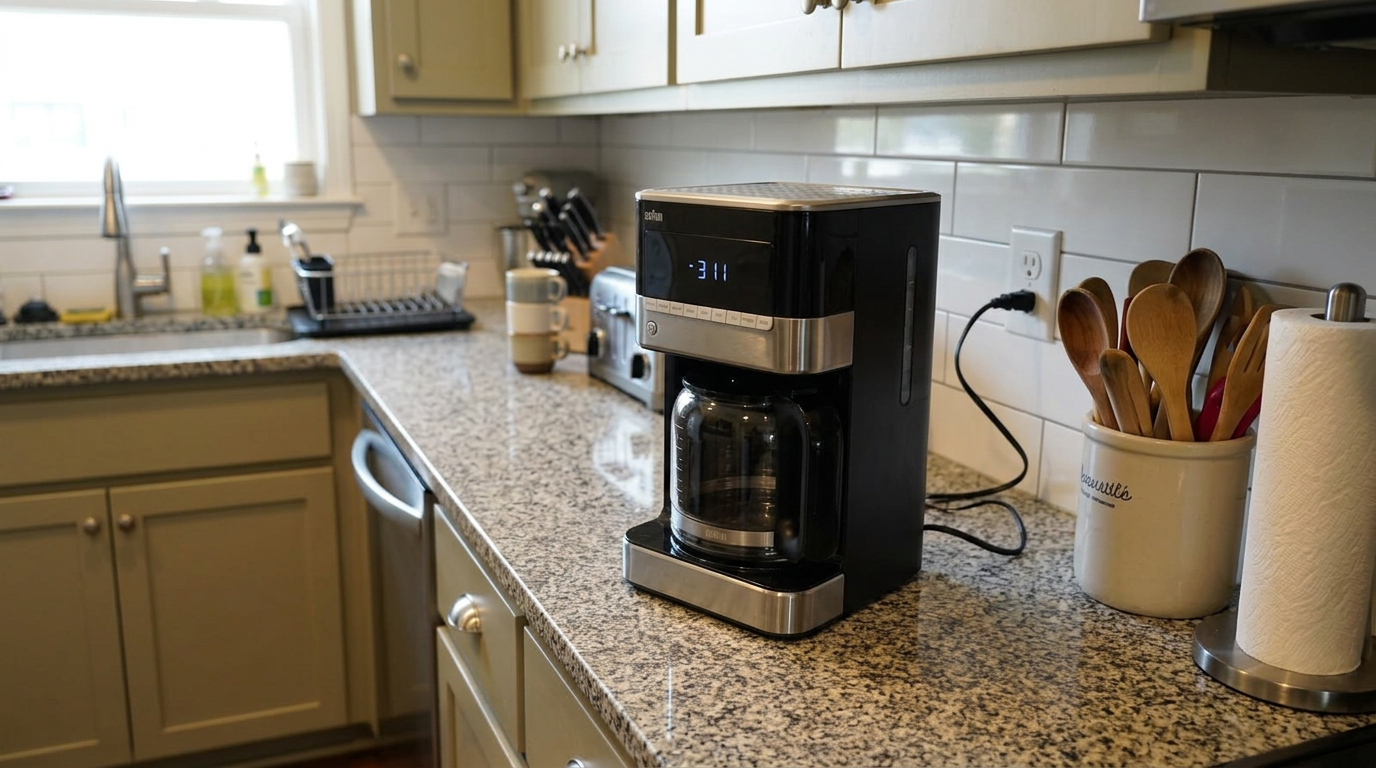
A full carafe on the plate: drink it within about an hour for the best taste.
Which one is right for you: is the Braun BrewSense your match?
4 quick questionsBraun BrewSense specifications
From manufacturer data and my own testing.
How I tested and scored the Braun BrewSense
For three weeks, the Braun BrewSense was our everyday coffee maker for full pots, half pots and small batches.
I timed full pots on Regular and Bold and took temperature readings at the brew head, outlet and cup.
I compared the metal filter with No. 4 paper cones, tested all three warming settings, Auto Brew, Auto Off and pause-and-serve.
I brewed light, medium, medium-dark and dark roasts and followed the full cleaning routine.
Finally, I checked my notes against Braun's specifications and the user manual.
- Coffee (8.3): taste, evenness, temperature and Regular vs Bold.
- Features (8.2): Auto Brew, 1–4 cup mode, plate settings and Auto Off.
- Ease of use (7.6): controls, filling, height, lid and status lights.
- Cleaning (8.0): basket, filters, carafe, descaling and carbon filter.
The overall score of 8.0 is an editorial rating that reflects those four areas.
Braun BrewSense FAQ
How long does the Braun BrewSense take to brew a full pot?
About 11 minutes on Regular and about 15 minutes on Bold in my tests.
What is the difference between Regular and Bold?
Bold adds pauses during brewing for longer contact with the grounds, giving a fuller taste. It takes four to five minutes longer.
How hot is the coffee?
I measured about 194°F at the brew head and about 173°F in the cup.
Does the 1–4 cup setting measure water?
No. It changes how a small batch brews. You must add only the water you want to brew.
What filters does it use?
A No. 4 cone filter. It includes a reusable metal mesh filter, or you can use No. 4 paper filters, but not both together.
Why is there sediment in my cup?
The metal mesh filter lets fine particles through. Paper filters give a cleaner cup.
Will it fit under my cabinets?
Only if you have more than about 21 inches of clearance, plus room to open the lid.
Does it beep when it is done?
No. The Brew Now light flashes while brewing and turns steady when it is done.
How long does the warming plate stay on?
Two hours by default, adjustable from 15 minutes to five hours.
Can I pour a cup mid-brew?
Yes, with pause-and-serve. Return the carafe within about 15 seconds to avoid overflow.
How do I know when to descale?
The Clean indicator lights up, timed by the water hardness setting you choose.
How much coffee should I use?
Start with one tablespoon of medium-ground coffee per cup of water, so 12 tablespoons for a full pot.
Kitchen & coffee tester
Michael spent six years as a line cook in restaurants in Chicago and New York, and he has tested kitchen appliances for HouseholdMe since 2018, from air fryers to coffee makers. He holds an SCA certificate in barista skills and used the Braun BrewSense as his everyday coffee machine for three weeks for this review.
- Three weeks of hands-on testing of the Braun BrewSense 12-cup drip coffee maker
- Braun product specifications and user manual
- General drip brewing temperature and ratio guidance