Philips 3200 vs Breville Barista Express: which should you buy?
These two sit side by side in a lot of shopping carts, and they could hardly be more different. The Philips 3200 Series grinds, brews and froths at one touch, with a LatteGo milk jug that rinses clean in seconds. The Breville Barista Express hands you a portafilter, a tamper and a steam wand, and asks you to learn espresso properly. I used each one for four weeks, weighed every dose and timed every drink, so you can decide which way of making coffee fits your life.
We choose products independently. We may earn a commission through links on this page; your price stays the same. Affiliate policy
Jargon helpNew to espresso? Tap any dotted term to see what it means.
In this comparison
If you want the better coffee and you're willing to spend a week learning, buy the Breville Barista Express. It doses about 15 grams of coffee against the Philips's 8, and once dialed in its espresso is in a different league. If you want coffee at the press of a button for a busy household, and easy cleaning matters more than intense espresso, the Philips 3200 Series is the better fit. Its milk drinks are as good as anything a beginner will steam in the first month, and anyone can use it.
The two machines
Specs checked November 14, 2026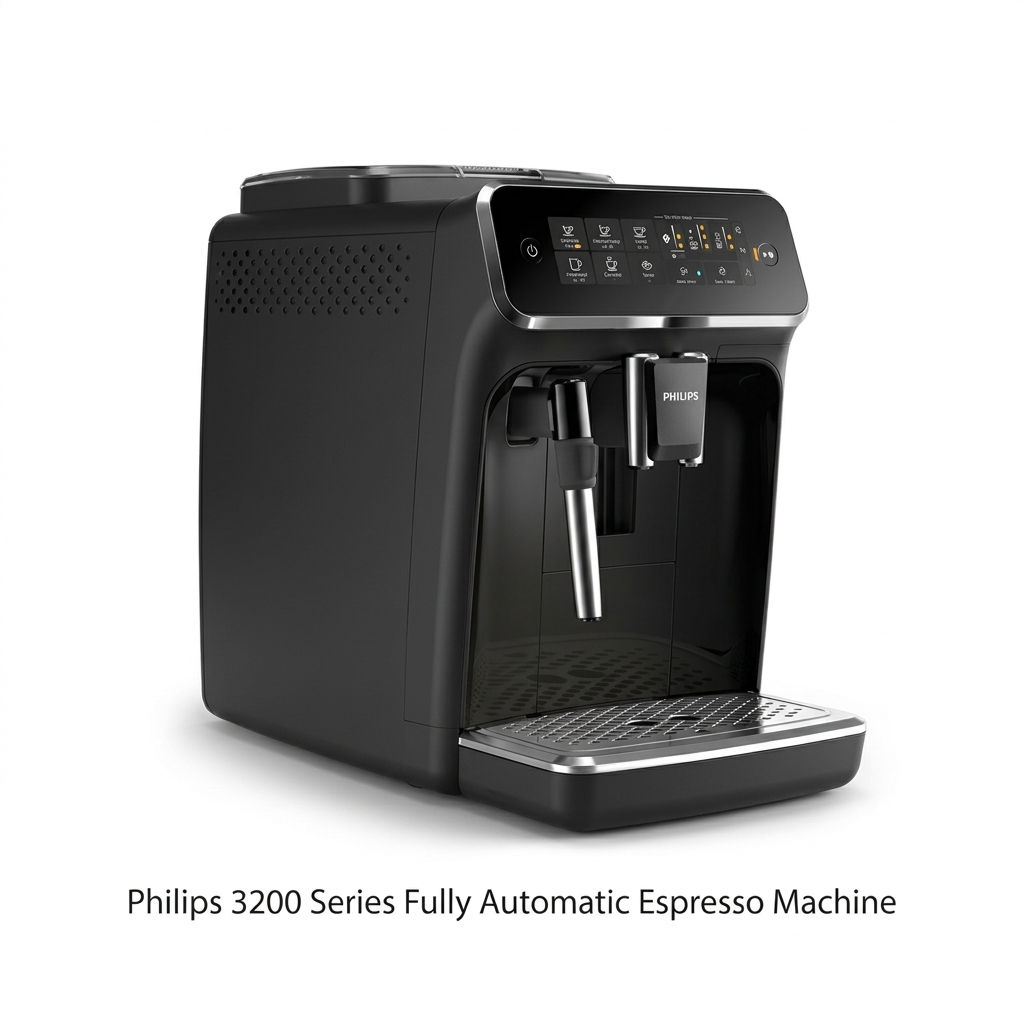
Five one-touch drinks, a tubeless LatteGo milk jug that rinses clean in seconds and a ceramic grinder with 12 settings.
Check price on Amazon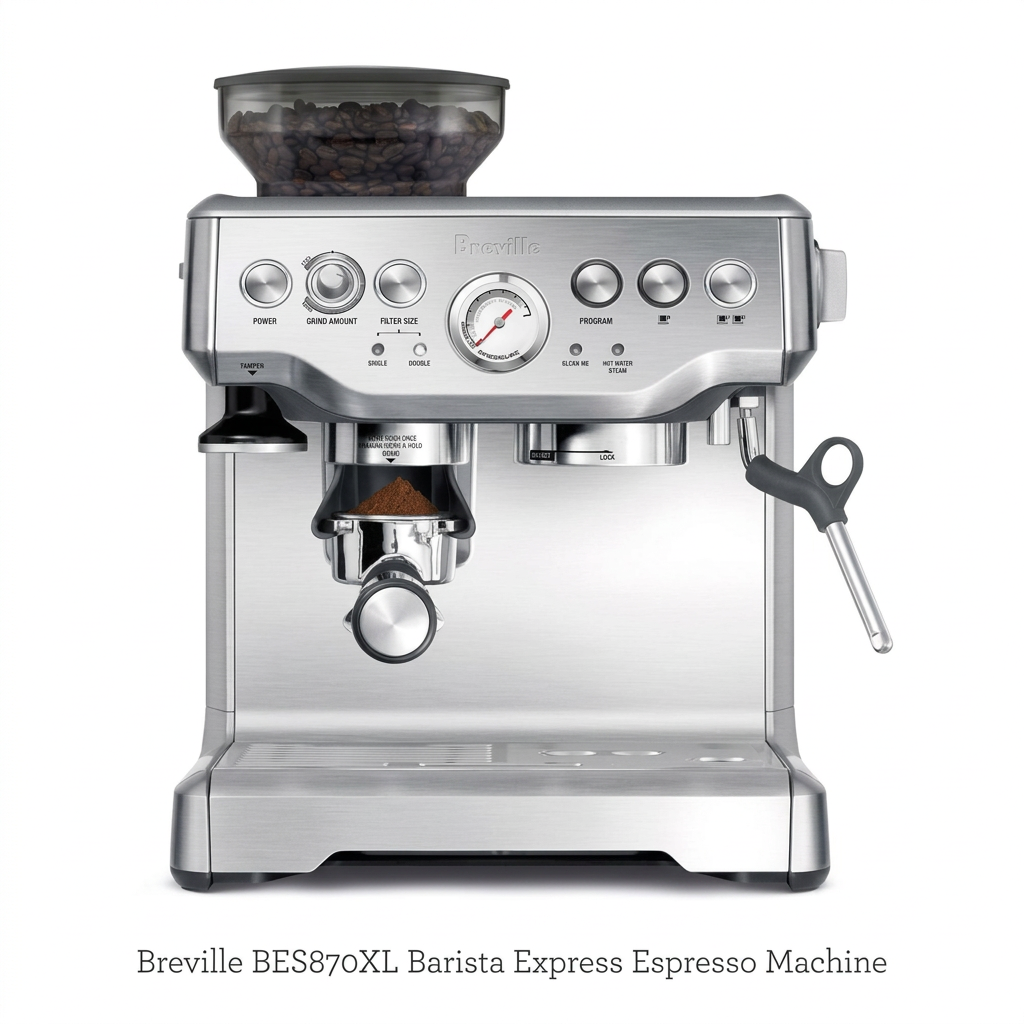
A built-in conical burr grinder, a 54 mm portafilter, a pressure gauge and a manual steam wand for sweet, syrupy shots.
Reveal Today’s DealPhilips 3200 vs Barista Express at a glance
- Buy the Barista Express if espresso flavor is the point and you enjoy a hands-on routine.
- Buy the Philips 3200 if you want one-touch coffee and milk drinks with almost no skill or mess.
- Milk drinks are a closer contest than espresso: the LatteGo is easy, the steam wand is better once learned.
- The Philips is lighter, quieter to use and simpler to share; the Breville is the more rewarding hobby.
Head to head
The better result in each row is marked, based on my testing and the manufacturer specs. These machines are built on different ideas, so few rows are ties.
Keep in mind that the tally is not my verdict. One row, espresso, matters far more to coffee lovers, and another, ease of use, matters far more to busy families.
| Spec | Philips 3200 | Barista Express |
|---|---|---|
| Espressomy tasting, same beans | Mild, gentle, light body | Sweet, syrupy, full body ✓ Best |
| Coffee doseweighed | About 8 g at strongest | About 15–15.5 g ✓ Best |
| Ease of use | One touch, anyone can use it ✓ Best | Grind, dose, tamp and steam yourself |
| Milk system | LatteGo jug, automatic ✓ Best | Manual steam wand |
| Best possible foam | Good, fixed texture | Silky microfoam with practice ✓ Best |
| Cleaning | Two-part jug, removable brew group ✓ Best | Basket, wand and grinder chute |
| One-touch drinks | 5 plus hot water ✓ Best | None, all manual |
| Learning curve | Minutes ✓ Best | About a week |
| Grinder | Ceramic, 12 settings | Steel conical burrs, 16 settings ✓ Best |
| Control over the shot | Strength and volume | Grind, dose, ratio and temperature ✓ Best |
| Water tank | About 60 oz | About 67 oz ✓ Best |
| Weight | About 17.6 lb ✓ Best | About 22–23 lb |
| Pump | 15 bar | 15 bar |
| Rows won | 6 | 6 |
Philips 3200 vs Barista Express pros and cons
Philips 3200
- Five drinks at one touch, so anyone in the house can use it
- LatteGo jug is the simplest milk system to clean
- Removable brew group and up to 5,000 cups between descales
- Mild espresso from a small, roughly 8-gram dose
- Foam texture is good rather than great
- Only five drinks and no user profiles
Barista Express
- Rich, syrupy espresso from a 15-gram dose
- Steam wand makes silky microfoam once you learn it
- Pressure gauge and full control teach you real espresso
- About a week of dialing in before it shines
- Grinding and tamping by hand makes some mess
- Every drink is a hands-on job
Who should buy which machine?
- Busy families who want coffee at one touch
- People who drink milk drinks and mugs of coffee
- Anyone who hates cleaning
- Espresso lovers who want café-style shots
- People who enjoy learning a hands-on craft
- Anyone who wants to pour latte art
Two kinds of espresso machine
Before the details, it helps to understand what you're really choosing between. These are two different kinds of machine, not two versions of the same thing.
The Philips 3200 is a super-automatic✕Super-automaticAn espresso machine that grinds, doses, tamps, brews and ejects the used coffee by itself. You press a button and wait. machine. It grinds the beans, presses them, brews the shot and drops the used puck into a drawer, all behind a closed door.
The Barista Express is a semi-automatic✕Semi-automaticAn espresso machine where you grind into a portafilter, tamp the coffee and lock it in yourself. The machine controls the water; you control everything else. machine with a built-in grinder. You grind into a portafilter✕PortafilterThe handle with a metal basket that holds the ground coffee. It locks into the machine, where hot water is pushed through the coffee., tamp the coffee, lock it in and start the shot.
| Step | Philips 3200 | Barista Express |
|---|---|---|
| Grinding | Automatic | You start it, into the portafilter |
| Dosing | Automatic, about 8 g | You weigh or judge, about 15 g |
| Tamping | Automatic | By hand |
| Brewing | One touch | One button, you watch the gauge |
| Milk | LatteGo jug, automatic | Steam wand, by hand |
| Cleaning up | Empty drawer and tray | Knock out puck, wipe wand |
That difference shapes everything else in this comparison. The Philips trades flavor and control for speed and ease. The Breville trades speed and ease for flavor and control.
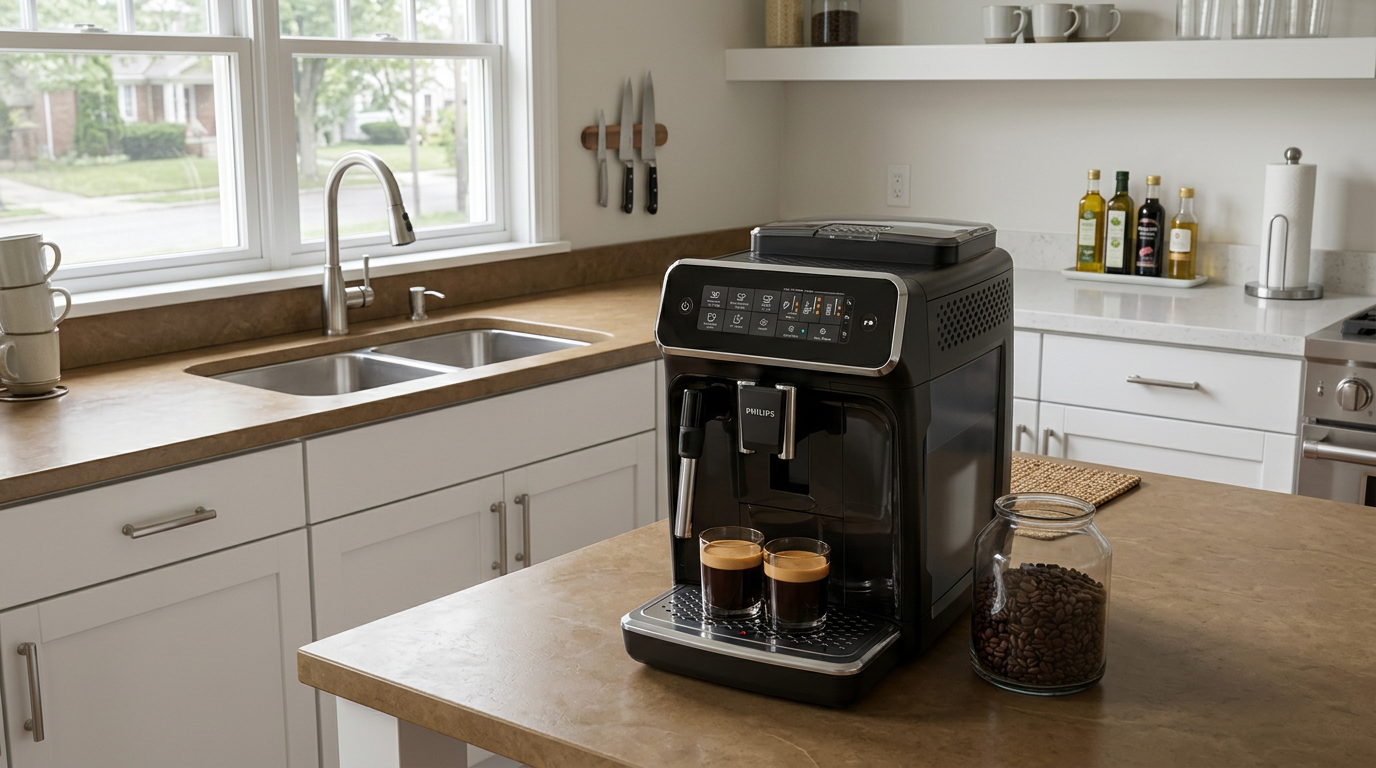
The Philips 3200 does every step behind a closed door.
Our tip: Be honest about your mornings before you buy, because the best espresso machine is the one you'll still enjoy using on a rushed Tuesday.
Design, size and build
The Philips is the tidier box. It measures about 9.7 inches wide, 17 inches deep and 14.6 inches tall, and weighs about 17.6 pounds.
The Barista Express is wider and shallower at about 12.5 inches wide, 13.8 inches deep and 15.9 inches tall with the hopper on. At 22 to 23 pounds of brushed steel, it stays put when you lock in the portafilter.
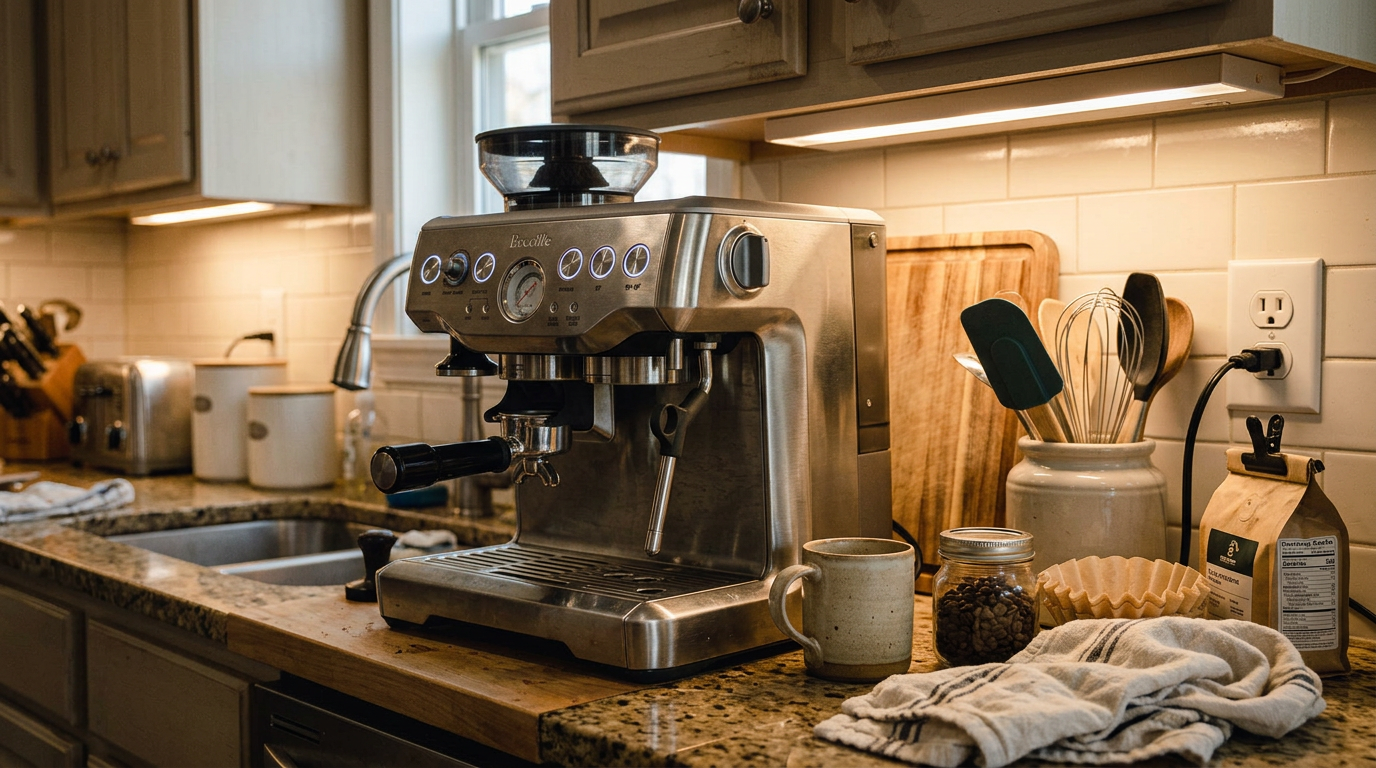
The Barista Express packs a grinder, a pressure gauge and a steam wand into one steel body.
The Philips is mostly plastic with a glossy front, and it looks modern and clean. The Breville looks and feels like a small café machine, with a round gauge, a chunky portafilter and a steam wand on a swivel.
Both fit under standard 18-inch wall cabinets. On both, you'll want to slide the machine forward to refill the beans.
Width on the counter
The Philips is deeper; the Breville is wider and needs room for its tools.
Our tip: Budget an extra 6 inches beside the Barista Express for a knock box and a tamping mat, because you'll use both several times a day.
Setup and the first week
The Philips was making drinks within about 15 minutes. You fill the tank, add beans, let it rinse and press a button.
The first few coffees were flat while the grinder settled, as with every new machine. By week two, I'd moved the grinder two steps finer and switched the espresso to the strongest aroma and smallest volume.
The Barista Express took real work. From the factory, my upper burr was set to 6, which was too coarse for fresh beans, so I lifted it out and moved it to 2.
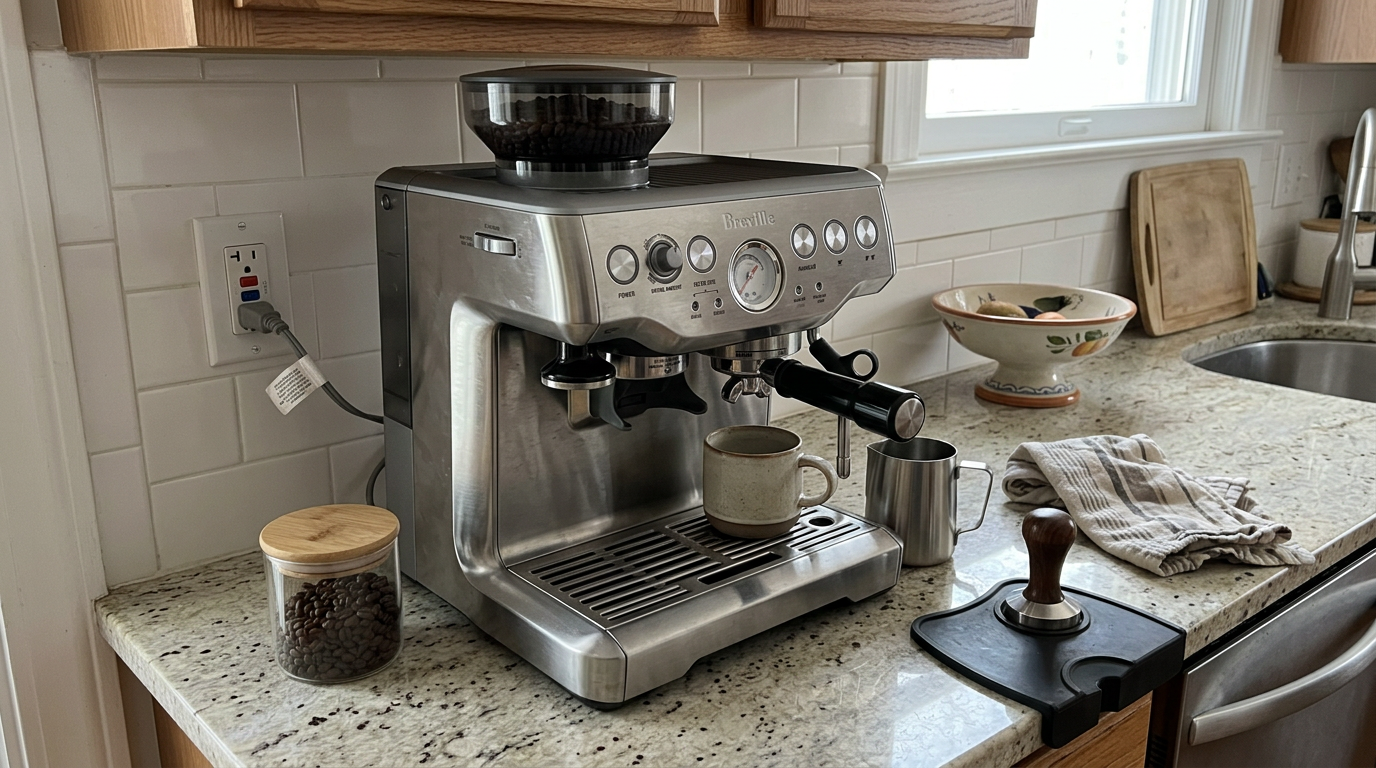
Dialing in the Barista Express took a scale, a timer and about a week.
Then I ground, weighed, adjusted and repeated until my scale read about 15.4 grams every time. My first shot looked fine at 30 grams in 27 seconds, but it tasted sour, so I moved the dial two steps finer.
Here's how my consistency improved across the month:
Barista Express shots in my 25–30 second window
My own logs. The Philips does this for you, so it scored the same on day one as on day 28.
Grinder and dose: the biggest difference
This is the section that explains almost everything about how these two taste.
The Philips uses a ceramic grinder with 12 settings, adjusted with a knob inside the bean hopper. At its strongest setting, I weighed its dose at about 0.28 ounces, or roughly 8 grams.
The Barista Express uses stainless steel conical burrs✕Conical burrsTwo cone-shaped grinding parts, one inside the other. Beans are crushed between them, and the gap sets how fine the coffee is. with 16 settings on the side dial. In the double basket, my sweet spot was 15 to 15.5 grams.
Coffee dose compared
Weighed doses. A typical café double uses 14 to 18 grams.
That's nearly twice as much coffee per shot. More coffee in the basket means more flavor, more body and more crema✕CremaThe golden, foamy layer on top of a fresh espresso. It forms when pressure pushes oils and gases out of the coffee. in the cup.
The Philips tries to make up for it with strength and volume settings. They help, but they don't turn it into a high-dose espresso machine.
| Grinder detail | Philips 3200 | Barista Express |
|---|---|---|
| Burrs | Ceramic | Steel, conical |
| Settings | 12 | 16, plus inner burr |
| Dose | About 8 g | About 15–15.5 g |
| Adjusted | Knob inside the hopper | Side dial and dose dial |
| Baskets | None, internal brew group | Four 54 mm baskets |
Our tip: Avoid shiny, oily beans in the Philips, because the oil builds up in the ceramic grinder and chute and can block them over time.
Espresso quality
With the same medium roast, the difference was obvious from the first sip.
On the Philips, the default espresso was about 1.1 fluid ounces from an 8-gram dose. It was smooth and gentle, with mild chocolate and a thin crema, but it lacked the body and sweetness of a real café shot.
On the Barista Express, I aimed for a 1:2 brew ratio✕Brew ratioThe weight of dry coffee compared with the weight of liquid espresso in the cup. A 1:2 ratio means 15 g of coffee makes about 30 g of espresso.: 15.4 grams in, 30 grams out, in 25 to 30 seconds. Once dialed in, it was sweet, syrupy and layered, with caramel and dark fruit.
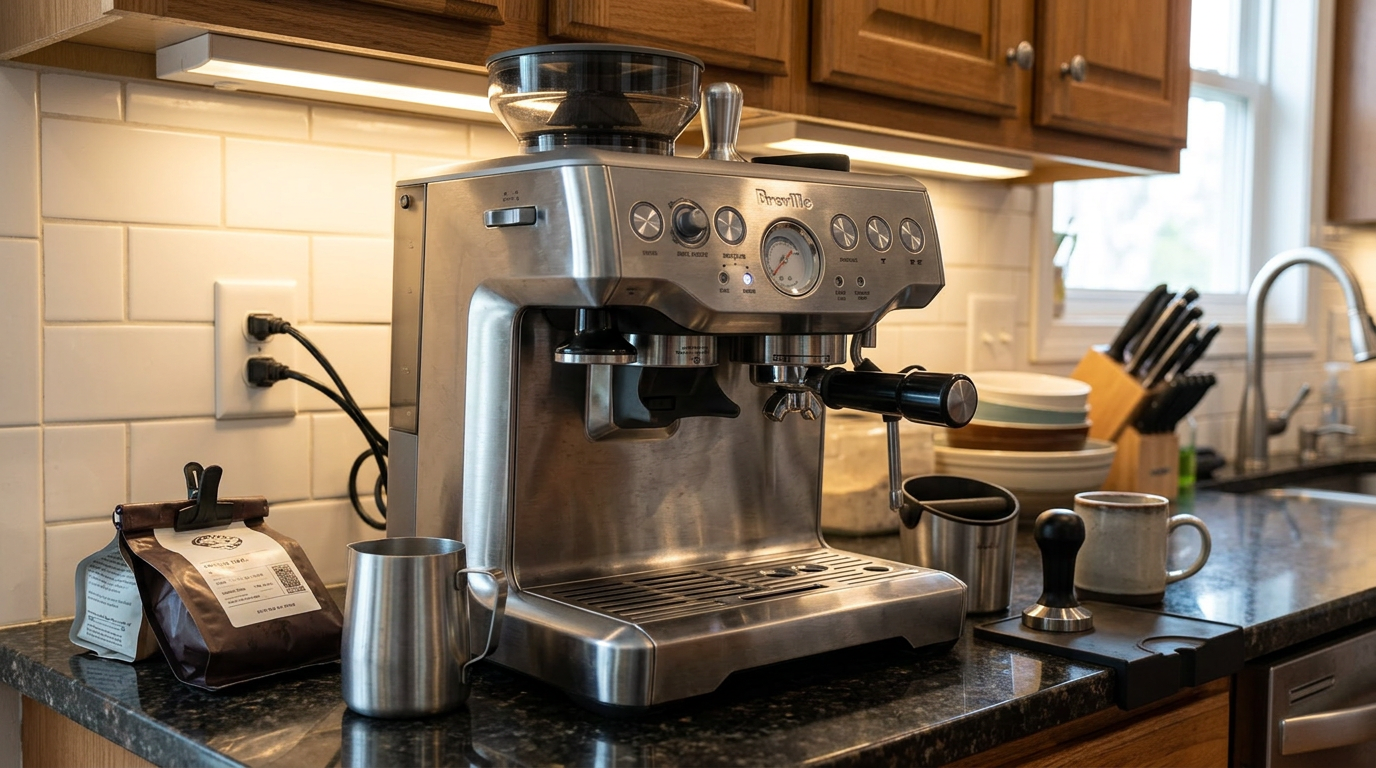
Once dialed in, the Barista Express pulled sweet, syrupy shots.
The pressure gauge✕Pressure gaugeA dial that shows how much pressure builds while the shot runs. It is a quick visual hint that the grind and dose are in the right range. helped a lot. When the needle sat in the espresso zone, the shot almost always tasted right.
A light roast tested the Breville's range. It needed a finer grind, a slightly higher temperature and a longer 1:2.3 ratio before its sourness turned into a pleasant, fruity brightness.
My espresso ratings
My scores out of 10 for body, crema, flavor and consistency.
| What you taste | Likely cause | Fix on the Barista Express | Fix on the Philips |
|---|---|---|---|
| Sour, thin | Under-extracted✕Under-extractionWhen water does not pull enough flavor out of the coffee. The shot tastes sour, thin and watery. | Grind finer | Grind finer, smaller volume |
| Bitter, harsh | Over-extracted | Grind coarser | Grind coarser |
| Weak, watery | Low dose | Check dose is 15 g | Strongest aroma, smallest volume |
| Spurts or pale streaks | Channeling✕ChannelingWhen water finds a crack or weak spot in the puck and rushes through it, leaving the rest under-extracted. | Distribute and tamp level | Not applicable |
Coffee, Americano and a mug of black
If you mostly drink a big mug of black coffee, the gap narrows.
The Philips has three black coffee buttons: espresso, coffee and Americano. Its Americano pulls a short shot and adds hot water, which kept the mug clean-tasting and smooth.
I drank all three daily on the Philips, and each had its place. The coffee button made a gentle, drip-like mug; the Americano made the more flavorful one.
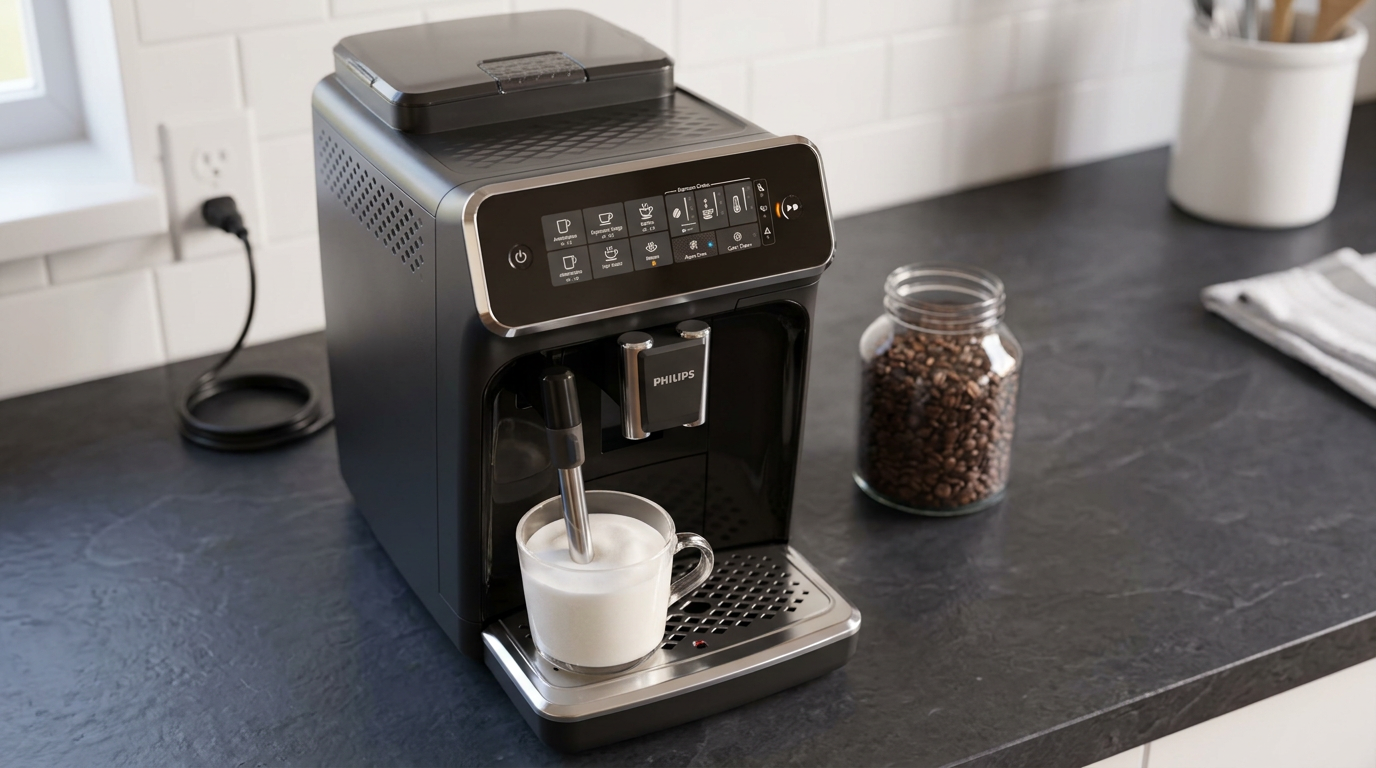
The Philips Americano adds hot water to a short shot, which kept the mug smooth.
On the Barista Express, I pulled a double and topped it with water from the hot water outlet. It took about a minute longer but tasted richer, because the espresso underneath was so much stronger.
Pushing a whole mug of water through the coffee tends to over-extract it and taste bitter, so both machines make their best mug by adding water to a short shot.
Our tip: On the Philips, use the Americano button rather than Coffee for big mugs, because it adds water to a short shot instead of pushing it all through a tiny dose.
Find Out the Price TodayMilk drinks: LatteGo vs steam wand
This is the closest contest in the matchup, and which one wins depends on how much effort you want to put in.
The Philips uses LatteGo✕LatteGoPhilips's tubeless milk system. A small two-part jug clips onto the front, and the machine draws milk in, froths it with steam and pours it straight into the cup., a small two-part jug that clips onto the front. You fill it, press cappuccino or latte macchiato, and the machine froths and pours.
It's the most convenient milk system I've used. My scores for it were 9.5 for convenience and 9.2 for cleaning ease, but 7.2 for foam texture and 4.0 for control.
LatteGo scores, from my testing
My scores out of 10 for the Philips milk system.
The Barista Express has a manual steam wand on a swivel. You turn the dial to steam, wait about 15 seconds for steam to build, and stretch and spin the milk yourself.
Once I had the technique, the wand made silky microfoam✕MicrofoamMilk foam with bubbles so small you can barely see them. It feels silky and glossy, which is what latte art needs. that looked like glossy paint after about 40 seconds. I stopped when the jug was too hot to hold, around 140 to 150°F.
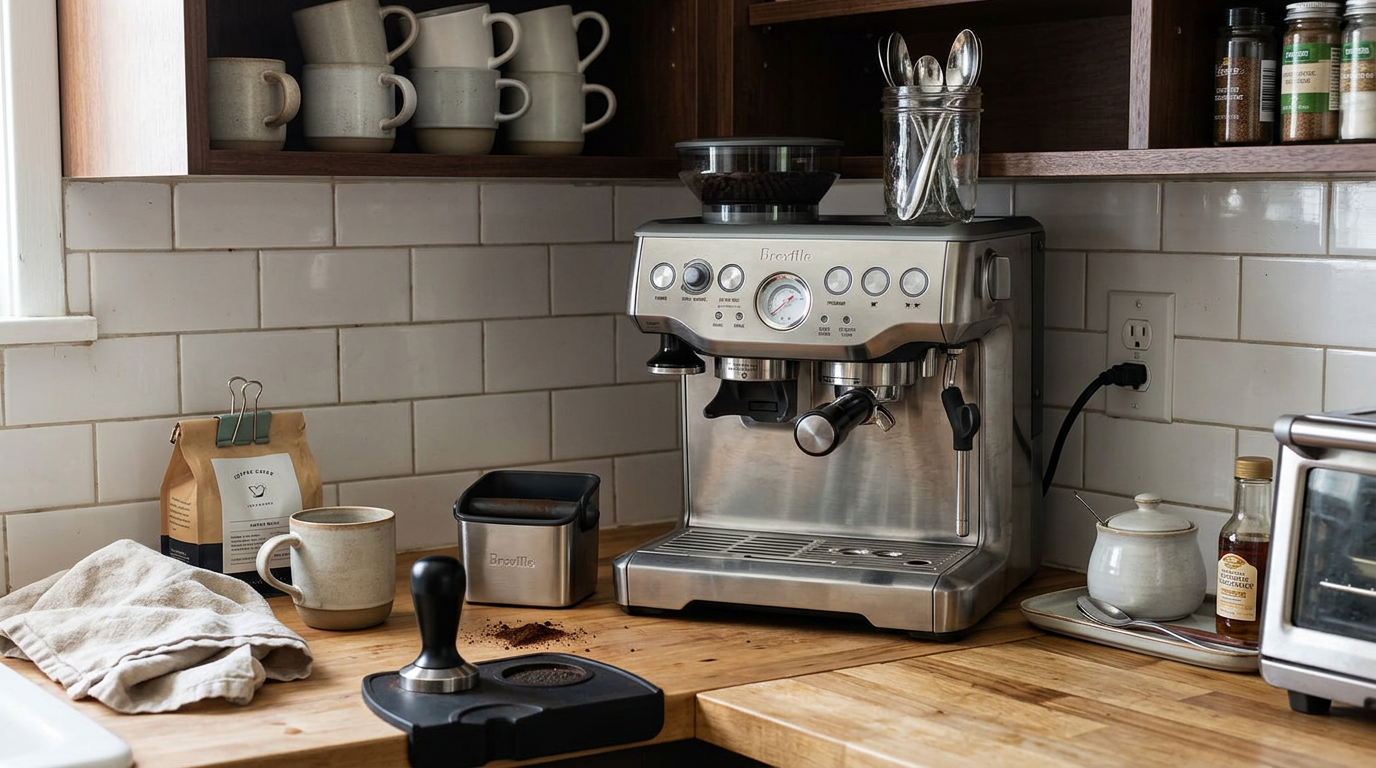
The steam wand made glossy microfoam after about 40 seconds once I'd learned it.
So in week one, the Philips made the better cappuccino. By week three, the Breville made a better flat white, and I could pour a simple heart.
| Milk temperature | What it tastes like | Which machine gets you there |
|---|---|---|
| Below 131°F | Lukewarm | Neither, by default |
| 140–150°F | Sweet, ideal | Breville, if you stop in time |
| About 150–158°F | Hot, still sweet | Philips default |
| Above 158°F | Very hot, less sweet | Breville, if you overshoot |
Our tip: Rinse the LatteGo jug under the tap straight after every milk drink, because it takes ten seconds and the jug goes in the dishwasher at night without any scrubbing.
Speed and daily workflow
Speed is where the Philips runs away with it. A cappuccino is one touch and about a minute.
On the Barista Express, a latte means grinding, tamping, pulling the shot, switching to steam, steaming the milk and wiping the wand. Once I was practiced, it took about four minutes.
Press start to first sip
My timings once I was comfortable with each machine. Shorter is better.
In my house, the Philips made three or four drinks every morning, and everyone made their own. With the Breville, I was the barista and everyone else waited.
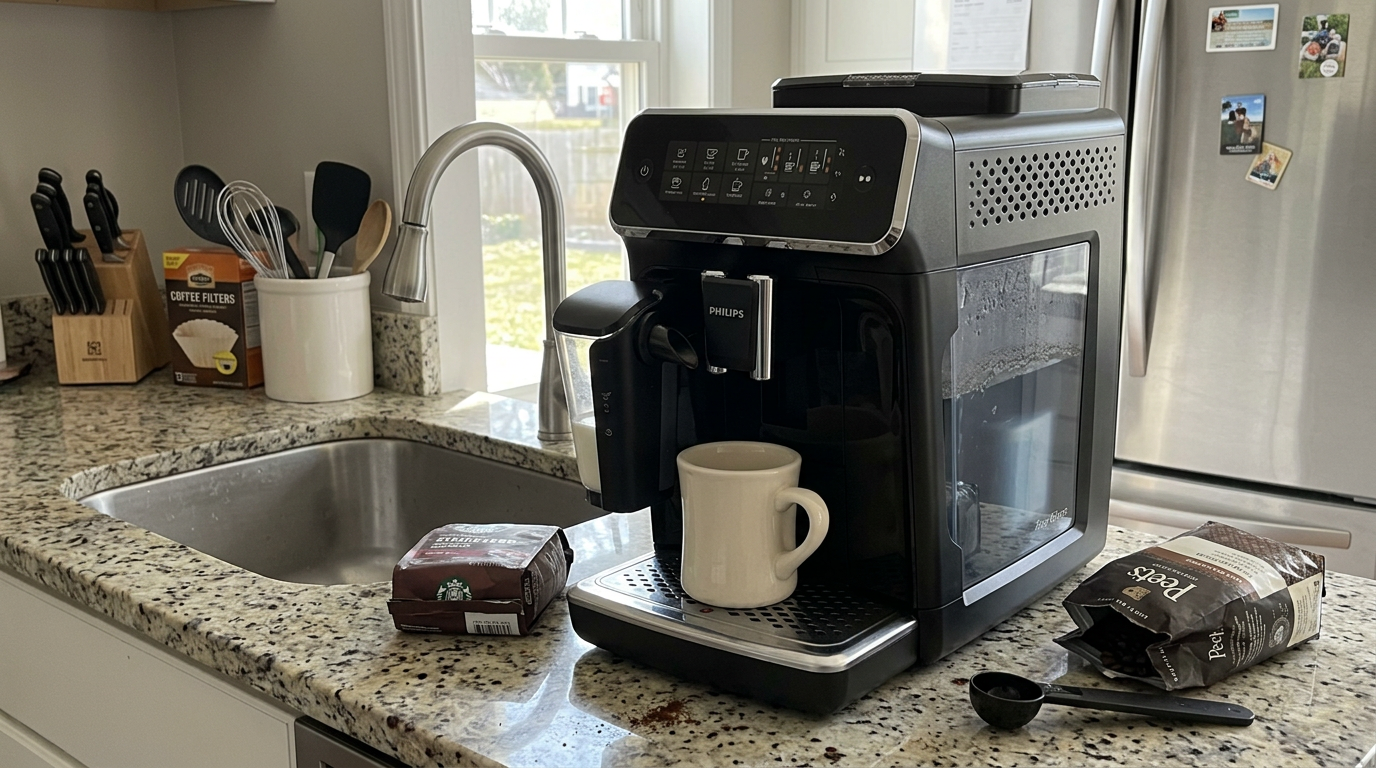
One touch and about a minute: the Philips is built for busy mornings.
Our tip: On the Barista Express, start the grinder first and heat your cup on the warming tray, because it overlaps two steps and saves about 30 seconds per drink.
Cleaning and upkeep
The Philips is one of the easiest milk machines to keep clean. The LatteGo jug has two parts and no tubes, and the brew group slides out for a weekly rinse.
With the AquaClean filter fitted and replaced when prompted, Philips says you can go up to 5,000 cups without descaling. That cut descaling down to almost nothing during my test.
The Barista Express asks for more small jobs. You knock out every puck, rinse the basket, wipe and purge the steam wand, and brush grounds off the counter.
| When | Philips 3200 | Barista Express |
|---|---|---|
| After milk | Rinse the LatteGo jug | Wipe and purge the wand |
| After every shot | Nothing | Knock out, rinse basket |
| Daily | Empty drip tray and drawer | Empty drip tray, wipe counter |
| Weekly | Rinse the brew group | Clean the grinder chute |
| Monthly | Grease the brew group | Cleaning cycle with a tablet |
| Descaling | Up to 5,000 cups with AquaClean | When prompted |
My daily hands-on cleaning time
My estimate for two milk drinks and one black coffee a day.
Neither job is hard. But if you're the kind of person who hates crumbs on the counter, the Philips is the calmer machine to live with.
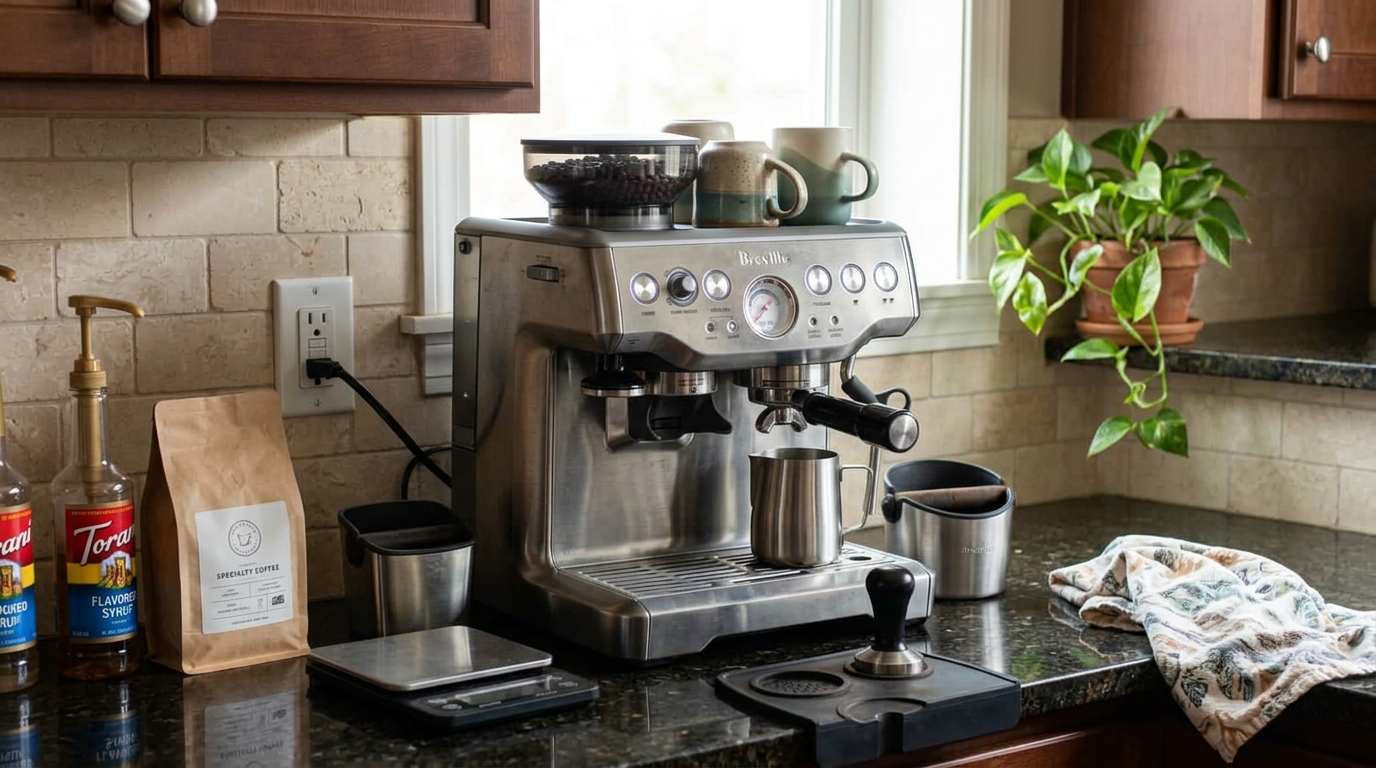
Expect a few grounds on the counter with the Breville; a tamping mat helps.
Our tip: Keep a damp cloth folded next to the Barista Express, because the steam wand needs a wipe within a minute of steaming or milk bakes onto the tip.
Noise
Both make the usual espresso machine sounds, but in different bursts.
The Philips grinder runs for a few seconds inside the body, then the brew group whirs and the pump buzzes. It's a short, contained sound.
The Breville grinder is louder and you run it in the open, right into the portafilter. The steam wand adds a loud hiss for 40 seconds or so.
How loud each felt, my ranking
Relative loudness from my side-by-side use. Shorter bars are quieter.
Neither is a problem in a busy kitchen. In an open-plan apartment at 6 a.m., the Philips is the gentler neighbor.
Water, beans and supplies
The Philips uses about half as much coffee per shot, so a bag of beans lasts nearly twice as long. That's one of its quiet advantages.
Its 1.8-liter tank lasted about a day and a half with three or four drinks every morning. The Breville's 67-ounce tank lasted about two days for two people.
Drinks per full tank
Rough maths allowing for rinses, blank shots and purging.
Use fresh whole beans within a few weeks of the roast date on both. The Breville is far fussier about freshness: stale beans ran fast and sour no matter what I did.
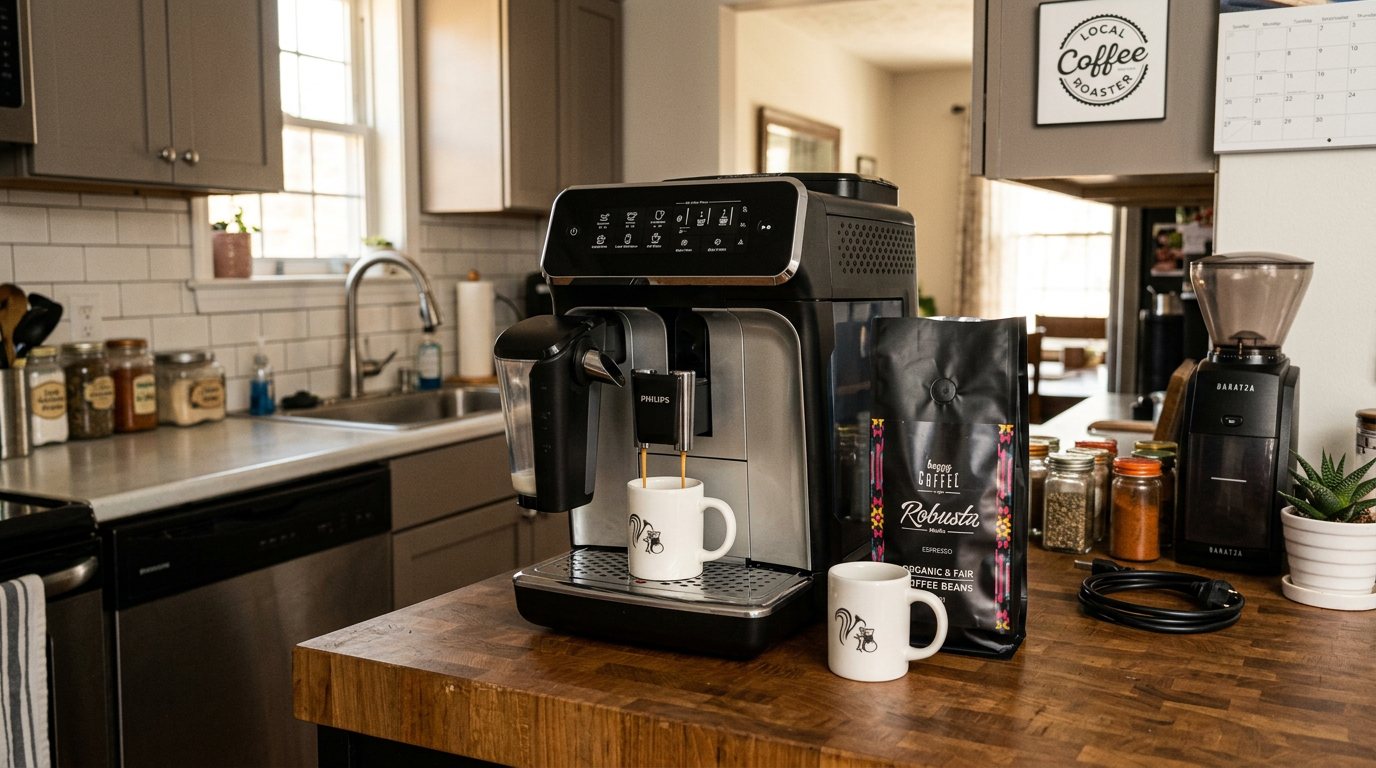
The Philips fits neatly on a standard counter, even next to the sink.
| Bean type | Philips 3200 | Barista Express |
|---|---|---|
| Fresh medium roast | Good, strongest aroma | Best all-rounder |
| Medium-dark blend | Best on the Philips | Sweet, forgiving |
| Light roast | Thin | Finer grind, longer ratio |
| Very oily, dark | Avoid | Works, but clean the grinder more |
Spent coffee from either machine makes a useful addition to a compost pile in small amounts.
Real-life scenarios
Specs only go so far. These are the situations where one machine clearly pulled ahead during my testing.
Everyone made their own drink at one touch, and it was all done in about four minutes.
Real microfoam and a sweet, syrupy double. Worth every minute.
About twice the dose and a fuller, sweeter shot.
Press a picture, get a drink. My guests used it without asking.
Grind, dose, ratio, temperature and milk are all yours to master.
No portafilter, no tamping, no grounds on the counter.
For coffee lovers who enjoy the ritual, the Barista Express is the more rewarding machine.
My scorecard
These are my own scores out of 10. The first four come from my single reviews of each machine, and I added speed and coffee control because they decide this matchup.
Philips 3200
Barista Express
Overall, I rate them both 8.0. That's why this is a decision about you, not about the machines: convenience on one side, flavor and craft on the other.
See How Much You’ll SaveWhich one is right for you?
4 quick questionsWhich one should you buy?
It comes down to one question: do you want to press a button, or make the coffee yourself? Answer that honestly and the choice makes itself. For the wider picture beyond this matchup, see my guide to the best Philips espresso machines.
If you like the Philips idea but want stronger espresso, my Philips 3200 vs Magnifica Evo comparison covers a higher-dose alternative. If you like the Breville but want help with tamping, my Barista Express vs Express Impress comparison is the next stop.
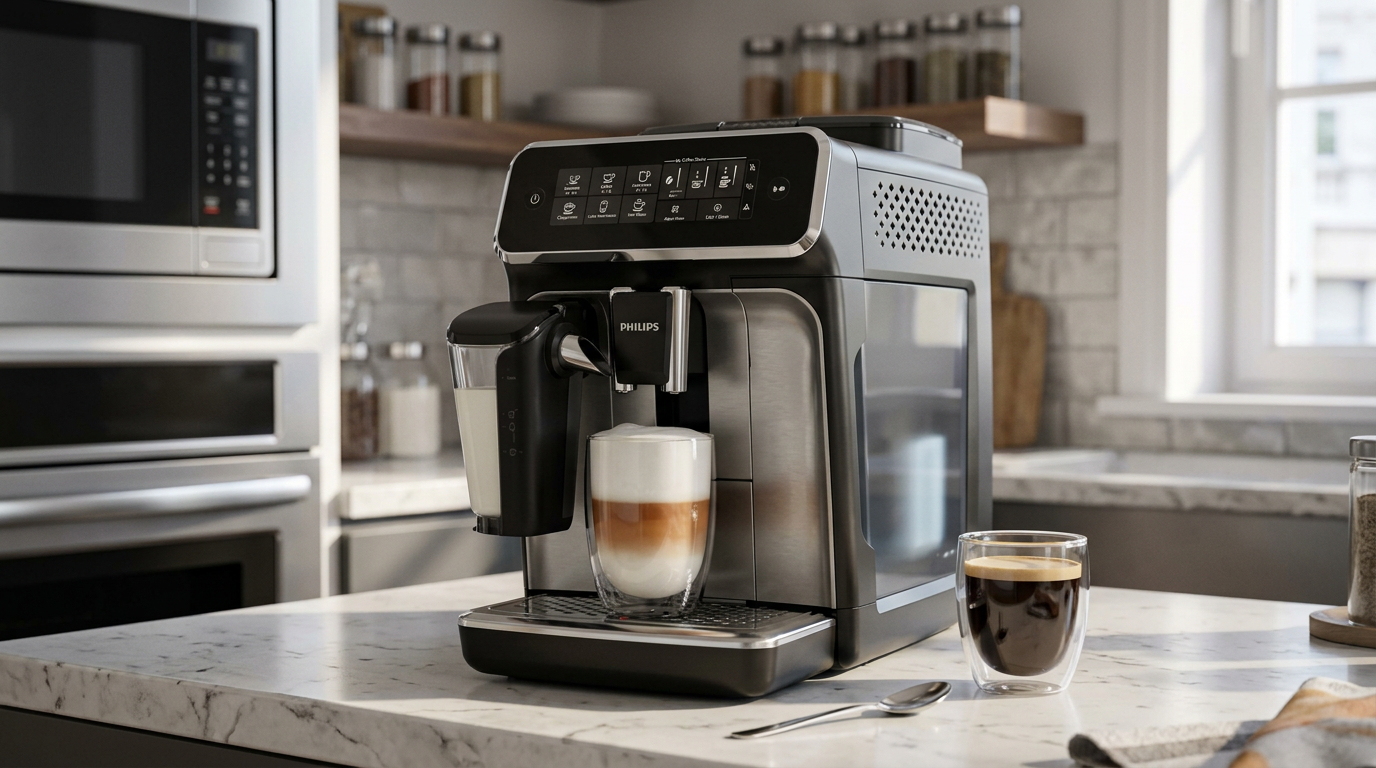
For busy families who want one-touch drinks, the Philips earns its place.
- Several people make their own drinks
- You want one-touch cappuccinos
- You hate cleaning and crumbs
- You drink mugs of coffee more than espresso
- You want strong, syrupy espresso
- You want full control over your shot
- You want to learn latte art
- Espresso flavor is your priority
- You enjoy learning a hands-on skill
- You want to pour latte art
- You usually make coffee for one or two
- You want coffee at one touch
- Several people need to use it without help
- You don’t want to own a scale
If coffee flavor is the reason you're buying, my pick is the Barista Express. It doses about twice as much coffee, and once dialed in its espresso and milk drinks are a clear step up. It asks for a week of learning and a few minutes per drink, and it repays both.
The Philips 3200 is the better buy for busy households who want one-touch coffee. Everyone can use it, the LatteGo jug cleans in seconds, and its milk drinks are as good as anything a beginner steams in the first weeks.
Whichever you choose, buy fresh beans and keep the milk parts clean. Both machines reward that little bit of care with years of good coffee.
Philips 3200 vs Barista Express specifications
From manufacturer specifications and my own testing.
| Philips 3200 | Barista Express | |
|---|---|---|
| Model | Philips 3200 Series (EP3241) | Breville BES870XL |
| Type | Super-automatic with LatteGo | Semi-automatic with grinder |
| One-touch drinks | 5 plus hot water | None, manual |
| Pump pressure | 15 bar | 15 bar |
| Heating | Thermoblock | Thermocoil, 1600 W |
| Grinder | Ceramic, 12 settings | Steel conical burrs, 16 settings |
| Dose | About 8 g at strongest | About 15–15.5 g |
| Portafilter | None, internal brew group | 54 mm, four baskets |
| Milk system | LatteGo jug | Manual steam wand |
| Pressure gauge | No | Yes |
| Brew group | Removable | Not applicable |
| Water tank | About 60 oz (1.8 L) | About 67 oz |
| Water filter | AquaClean, up to 5,000 cups | Charcoal filter |
| Dimensions (W x D x H) | About 9.7 x 17 x 14.6 in | About 12.5 x 13.8 x 15.9 in |
| Weight | About 17.6 lb | About 22–23 lb |
How I tested and compared them
I used each machine as my everyday coffee maker for four weeks, making espresso, Americanos, mugs of coffee, cappuccinos, lattes and latte macchiatos.
I weighed doses and yields with a 0.1-gram scale, logged shot times on the Breville, timed full drinks on both and measured milk temperatures with a probe thermometer.
I adjusted the Breville's inner burr, mapped its dial and ran every cleaning routine on both, then compared my notes with Philips and Breville specifications and owner documentation. Michael Reynolds wrote up the notes from both test periods.
- Coffee: dose, shot time, crema, body and consistency.
- Milk: foam texture, temperature and effort.
- Workflow: learning curve, speed and daily routine.
- Ownership: noise, cleaning, water care and footprint.
Philips 3200 vs Barista Express FAQ
Is the Philips 3200 or Breville Barista Express better?
For espresso flavor, the Barista Express: it doses about 15 grams against roughly 8 on the Philips. For ease, speed and sharing, the Philips 3200. I rate both 8.0 overall.
Which is better for beginners?
The Philips 3200 if you want good drinks immediately. The Barista Express if you want to learn espresso and don’t mind a week of dialing in with a scale.
Why does the Philips 3200 espresso taste mild?
Its dose is small. I weighed about 8 grams at the strongest setting, against 15 grams in the Breville’s double basket.
Does the Barista Express make cappuccinos?
Yes, with its manual steam wand. Once I had the technique, it made silky microfoam in about 40 seconds.
Which is easier to clean?
The Philips 3200. The LatteGo jug has two parts and no tubes, the brew group slides out and AquaClean can stretch descaling to 5,000 cups.
Do I need extra tools for the Barista Express?
A 0.1-gram scale helps a lot, and a knock box and tamping mat keep things tidy. The machine includes a tamper and four baskets.
Which one is faster in the morning?
The Philips. A cappuccino took about a minute at one touch. A latte on the Breville took about four minutes once I was practiced.
Which one uses more coffee beans?
The Barista Express, because it doses nearly twice as much per shot. A bag lasts noticeably longer in the Philips.
Can several people share the Barista Express?
Yes, but someone has to know how to dial it in. In my house, I became the barista while the Philips let everyone make their own.
How big are the water tanks?
About 1.8 liters, or 60 ounces, on the Philips and about 67 ounces on the Breville.

- Our hands-on Philips 3200 Series review
- Our hands-on Breville Barista Express review
- Philips and Breville product specifications and owner documentation
- General espresso brewing and maintenance guidance
- Composting and Coffee Grounds, Cornell University
- A living lexicon for brewed coffee, University of Oregon