Ninja Luxe Café Mini Plus vs Breville Bambino Plus
Two compact espresso machines for small kitchens, built on opposite ideas. The Ninja Luxe Café Mini Plus packs a 60-setting grinder, a built-in scale and an assisted tamper into one body, while the Breville Bambino Plus skips the grinder and spends its effort on a 3-second heat-up and hands-free silky milk. I used both every day for four weeks to find out which one belongs on your counter.
We choose products independently. We may earn a commission through links on this page; your price stays the same. Affiliate policy
Jargon helpNew to espresso? Tap any dotted term to see what it means.
In this comparison
Buy the Ninja Luxe Café Mini Plus if you don't already own a good espresso grinder. It puts a 60-setting grinder, a built-in scale, an assisted tamper and a strong steam wand into one compact body, and it also brews real filter coffee. Buy the Breville Bambino Plus if you already have a capable burr grinder or you mostly drink lattes and flat whites, because its automatic steam wand makes the silkiest hands-free milk I have tested at home and it is ready to brew in about 3 seconds.
The two machines
Specs checked November 24, 2026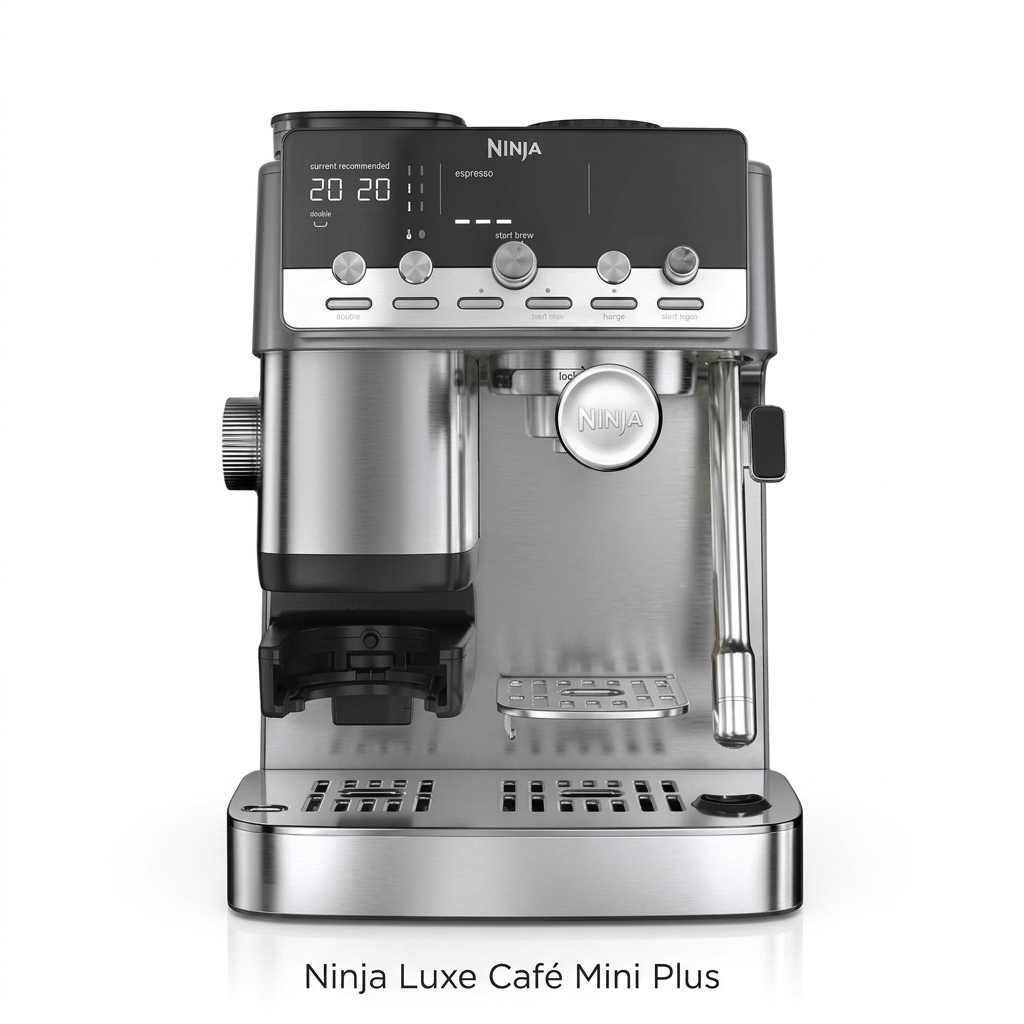
Grinder, scale, assisted tamper and steam wand in one compact body, with espresso, coffee crema and real filter coffee.
Check price on Amazon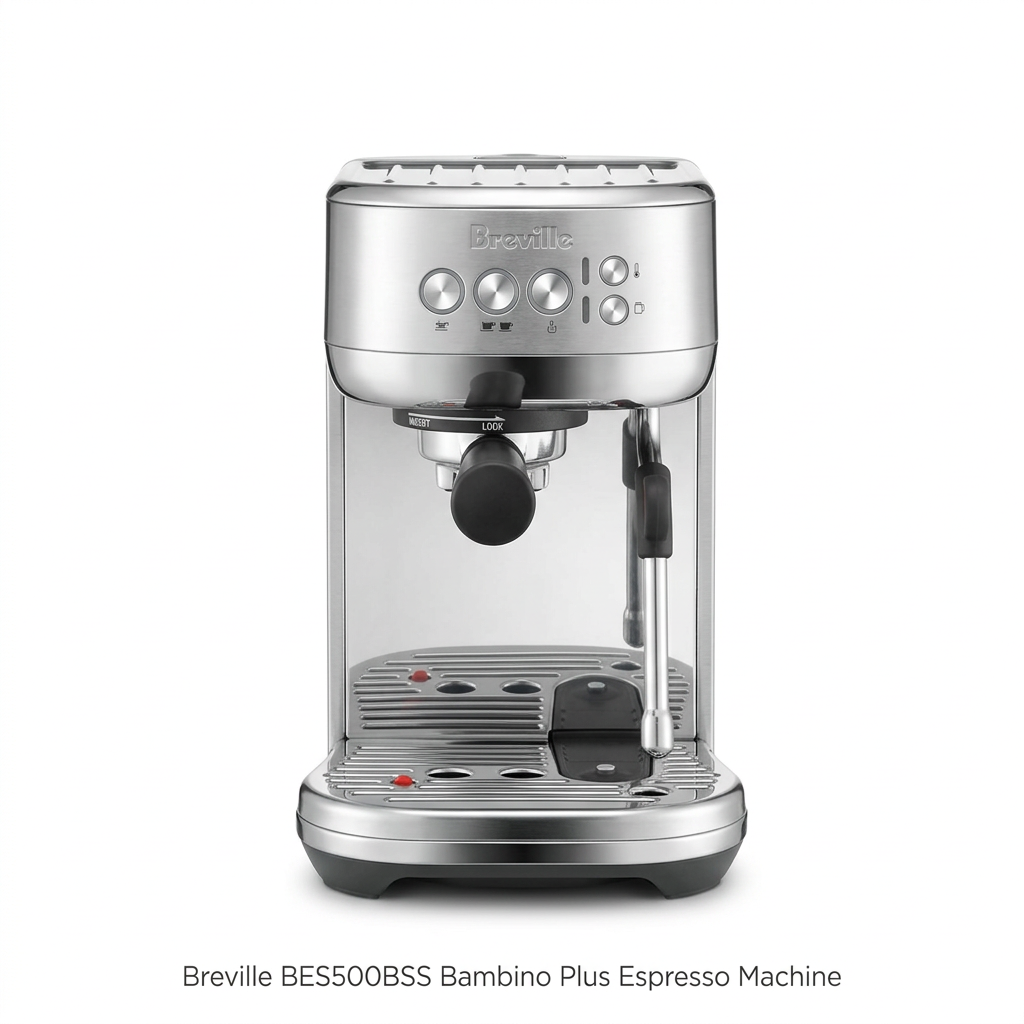
Three-second heat-up, steady PID temperature and an automatic steam wand with three temperature and three foam levels.
Reveal Today’s DealNinja Luxe Café Mini Plus vs Bambino Plus at a glance
- Both make proper, full-bodied espresso at about 9 bar, and the shots taste closer than you might expect.
- The Ninja is a complete kit: grinder, scale and tamper are all built in, so you only need beans.
- The Bambino Plus has the better milk system and heats up ten times faster, but it needs its own grinder.
- If you don't own a grinder, the Ninja is the easier buy; if you do, the Bambino Plus is the better machine.
Head to head
The better result in each row is marked, based on four weeks with each machine and the manufacturer specs. Rows where they are level have no winner.
The tally is close, and it hides one big fact: the Bambino Plus needs a grinder before it can match anything in this table.
| Spec | Ninja Mini Plus | Bambino Plus |
|---|---|---|
| Espressomy tasting, same beans | Full, chocolatey, thick crema | Rich, balanced, very consistent |
| Built-in grinder | Conical burr, 60 settings ✓ Best | None |
| Dosing and tamping | Built-in scale, assisted tamper ✓ Best | Razor tool, plastic tamper |
| Automatic milk | Auto froth, sometimes uneven | Sensor plate, silky every time ✓ Best |
| Manual steaming | Strong four-hole wand ✓ Best | Gentler single-hole wand |
| Heat-up | About 30 to 35 s | About 3 s ✓ Best |
| Filter coffee | Yes, bloom and brew ✓ Best | No |
| Water tank | About 44 oz | About 64 oz ✓ Best |
| Puck after the shot | Damp | Dry, three-way valve ✓ Best |
| Footprint | 10.2 in deep, 12.2 in wide | 12.6 in deep, 7.7 in wide |
| Pump pressure | 9 bar | 9 bar extraction |
| Rows won | 4 | 4 |
Ninja Luxe Café Mini Plus vs Bambino Plus pros and cons
Ninja Luxe Café Mini Plus
- Grinder, scale and tamper built in, so you only add beans
- 60 grind settings cover espresso, coffee crema and filter
- Strong steam wand for real manual microfoam
- Small 44 oz tank needs refilling daily
- Automatic frothing is sometimes uneven
- Single-spout portafilter cannot split a double
Breville Bambino Plus
- Automatic steam wand makes silky milk hands-free
- Ready to brew in about 3 seconds
- Dry pucks and steady PID temperature shot after shot
- Needs a good burr grinder, bought separately
- Plastic tamper feels cheap
- Drip tray fills fast from purges
Who should buy which machine?
- First-time buyers with no grinder
- Households that drink espresso and filter coffee
- Small kitchens that want one appliance, not two
- Daily latte and flat white drinkers
- People who already own an espresso grinder
- Anyone who hates waiting for a machine to warm up
Two different ideas of a compact espresso machine
These two machines solve the same problem, real espresso in a small kitchen, from opposite directions.
The Ninja Luxe Café Mini Plus is an all-in-one. It grinds, weighs and helps you tamp, then brews and steams, all from one semi-automatic✕Semi-automatic espresso machineA machine where you grind, dose and tamp the coffee into a portafilter yourself, and the machine controls the water, pressure and shot. It sits between a manual lever machine and a fully automatic bean-to-cup machine. body about 10 inches deep.
The Breville Bambino Plus is a specialist. It leaves the grinding to you and spends its effort on heating, temperature control and, above all, the milk.
That difference shapes everything else in this comparison, so I'll keep coming back to it.
| What you need | Ninja Mini Plus | Bambino Plus |
|---|---|---|
| Espresso machine | Included | Included |
| Grinder | Built in | Buy separately |
| Scale for the dose | Built in | Optional, recommended |
| Tamper | Assisted, spring-loaded | Plastic, upgrade advised |
| Milk jug | Included | Included, 16 oz |
So the honest comparison is not machine against machine. It is the Ninja on its own against the Bambino Plus plus a grinder.
Once you see it that way, the choice usually becomes obvious within a minute.
Our tip: Count your grinder before you compare, because the Bambino Plus with a good grinder takes more counter space and more money than the Ninja alone.
Design, size and build
The two have very different shapes.
The Ninja Mini Plus is wide and shallow: about 12.2 inches wide, 10.2 inches deep and 13.4 inches tall, and it weighs about 19 pounds.
The Bambino Plus is narrow and deep: about 7.7 inches wide, 12.6 inches deep and 12.2 inches tall, and it is much lighter.
On their own, the Breville takes less counter space. Next to a grinder, the pair ends up wider than the Ninja.
In my kitchen, the Ninja tucked between the toaster and the wall under a low cabinet. The Bambino Plus and my grinder needed the spot by the window.
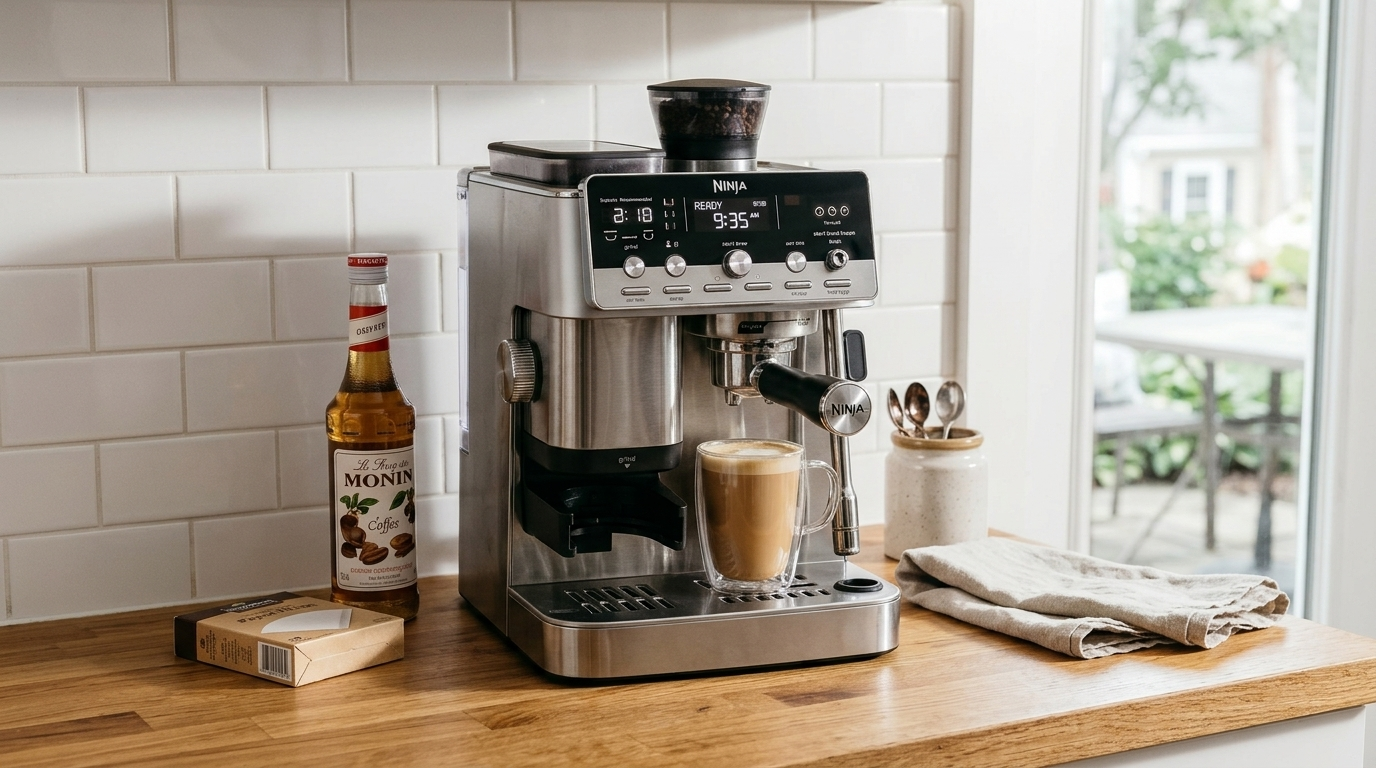
The Ninja’s shallow depth lets it sit under low cabinets.
Build quality
The Breville has a brushed stainless front and metal where it matters, with plastic panels elsewhere.
The Ninja is mostly plastic on the sides and back, with a metal drip tray, steam wand and brewing parts. It feels solid, but less premium than its bigger siblings.
Neither creaked or flexed during my month with each.
| Build detail | Ninja Mini Plus | Bambino Plus |
|---|---|---|
| Front | Plastic and metal | Brushed stainless |
| Portafilter | Single spout, metal | 54 mm, double spout |
| Accessory storage | Tamper and funnel on top | None |
| Handholds | Recessed, easy to lift | Light enough to grab |
| Cup clearance | Espresso and cappuccino cups | Small cups, not tall mugs |
Our tip: Leave a hand’s width on the right of either machine, because both steam wands sit on that side and you need room for the jug.
Setup and first shots
Setup took about 15 minutes on the Ninja and about 10 on the Breville.
On the Ninja Luxe Café Mini Plus, I fitted the water filter, tested my water hardness, ran a few flushes and filled the 250 gram bean hopper.
On the Bambino Plus, I rinsed the tank and jug, flushed water through the group and the wand, and pulled two blank shots.
The bigger difference came with the first coffee.
The Ninja recommended a grind, weighed the dose and helped me tamp. My first double was dense and chocolatey, with no dialing in at all.
The Breville’s first good shot depended entirely on my grinder. With a proper espresso grinder, I had a sweet double within three adjustments. With a basic one, I never got there.
| Setup step | Ninja Mini Plus | Bambino Plus |
|---|---|---|
| Time to first drink | About 15 minutes | About 10 minutes |
| Water filter | Included | Not included |
| Water hardness test | Yes | Optional |
| Shots until it tasted right | 1 to 2 | 3 to 6, grinder dependent |
| Extra kit needed | None | Grinder, ideally a scale |
Our tip: Pull two blank shots through the empty portafilter on the Bambino Plus each morning, because it warms the group and your cup at the same time.
Controls and settings
The Ninja has a dial and a small display that walk you through each drink.
You choose espresso, long espresso, coffee crema or filter, confirm the basket, and it tells you which grind setting to use. A progress bar shows how far along each brew is.
There are three strength settings and three brew temperatures, and the strongest setting aims for a classic 1:2 ratio.
The Breville is simpler. There are buttons for one cup, two cups, steam and hot water, plus two small rows of lights for milk temperature and foam level.
The shot buttons are volumetric✕Volumetric shotThe machine stops the shot after a set volume of water has passed through the coffee. You can usually reprogram it to the amount you prefer., and you can reprogram them. I dialed in by weight with a scale, then saved my two-cup volume.
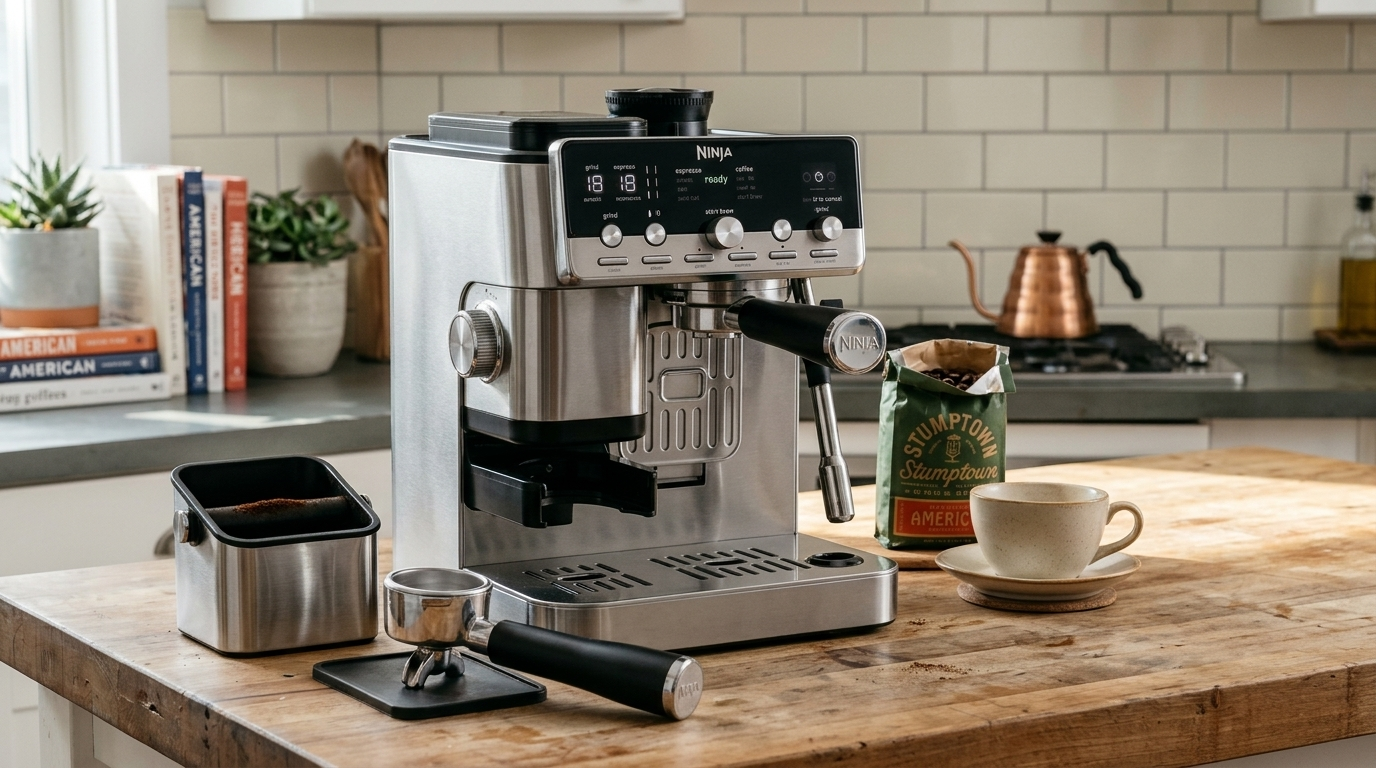
The Ninja’s chunky grind knob clicks clearly between its 60 settings.
| Setting | Ninja Mini Plus | Bambino Plus |
|---|---|---|
| Brew styles | Espresso, long, coffee crema, filter | 1 cup, 2 cups |
| Strength | 3 levels | Set by grind and volume |
| Brew temperature | 3 settings | Fixed, PID controlled |
| Milk settings | Dairy or plant, 3 froth levels | 3 temperatures, 3 foam levels |
| Programmable shots | Strength and size | 1 and 2 cup volumes |
| Warnings | Missing parts, empty tank, empty hopper | Descale reminder |
If you like being guided, the Ninja is more reassuring. If you like a few buttons that do exactly what they say, the Breville is calmer to live with.
Grinder, dose and tamping
This is the single biggest difference between the two.
The Ninja Luxe Café Mini Plus has a conical burr grinder with 60 settings. When you move to a finer setting, the burrs turn as you adjust, which stops grounds jamming.
Its built-in scale weighs about 17 to 18 grams for a double, and the spring-loaded tamper presses with the same force every time.
Where my Ninja grind settings ended up
Relative coarseness on the Ninja’s 60-step scale. Lower numbers are finer.
The Breville Bambino Plus has no grinder at all. It comes with a 54 mm portafilter, single-wall and dual-wall baskets, a Razor dosing tool and a light plastic tamper.
With the single-wall baskets, it is honest. A fine, even grind gives great shots, and anything less shows up immediately as sour, fast espresso.
| Dose and prep | Ninja Mini Plus | Bambino Plus |
|---|---|---|
| Double dose | 17 to 18 g, weighed for you | 18 to 19 g, weigh it yourself |
| Tamper | Assisted, spring-loaded | Plastic, 54 mm |
| Leveling | Funnel stays on while tamping | Razor tool trims the puck |
| Pre-ground option | Not the focus | Dual-wall baskets |
| Upgrade parts | Few | Common 54 mm size |
Our tip: Turn the Ninja’s grind knob only when the grinder is turning or the machine prompts you, so the burrs never jam on a finer setting.
Espresso quality
With the same fresh medium-dark blend, both made espresso I would happily serve in a café.
The Ninja’s doubles, 18 grams in and about 36 to 40 grams out, were full and round, with milk chocolate, nougat and a thick crema.
The Bambino Plus, 18 grams in and 36 grams out in about 28 seconds, tasted slightly cleaner, with dark chocolate, brown sugar and a light ripe-fruit sweetness.
The Breville was the more consistent of the two from morning to morning. Its PID✕PID temperature controlA digital controller that keeps the brewing water at a steady temperature, so back-to-back shots taste the same. control and pre-infusion✕Pre-infusionA short, gentle soak of the coffee at low pressure before full pressure starts. It helps water flow evenly through the puck. kept every shot on track.
The Ninja was the easier of the two to get right on day one, because it chose the grind and weighed the dose for me.
My espresso ratings
My scores out of 10 for body, crema and flavor, same beans.
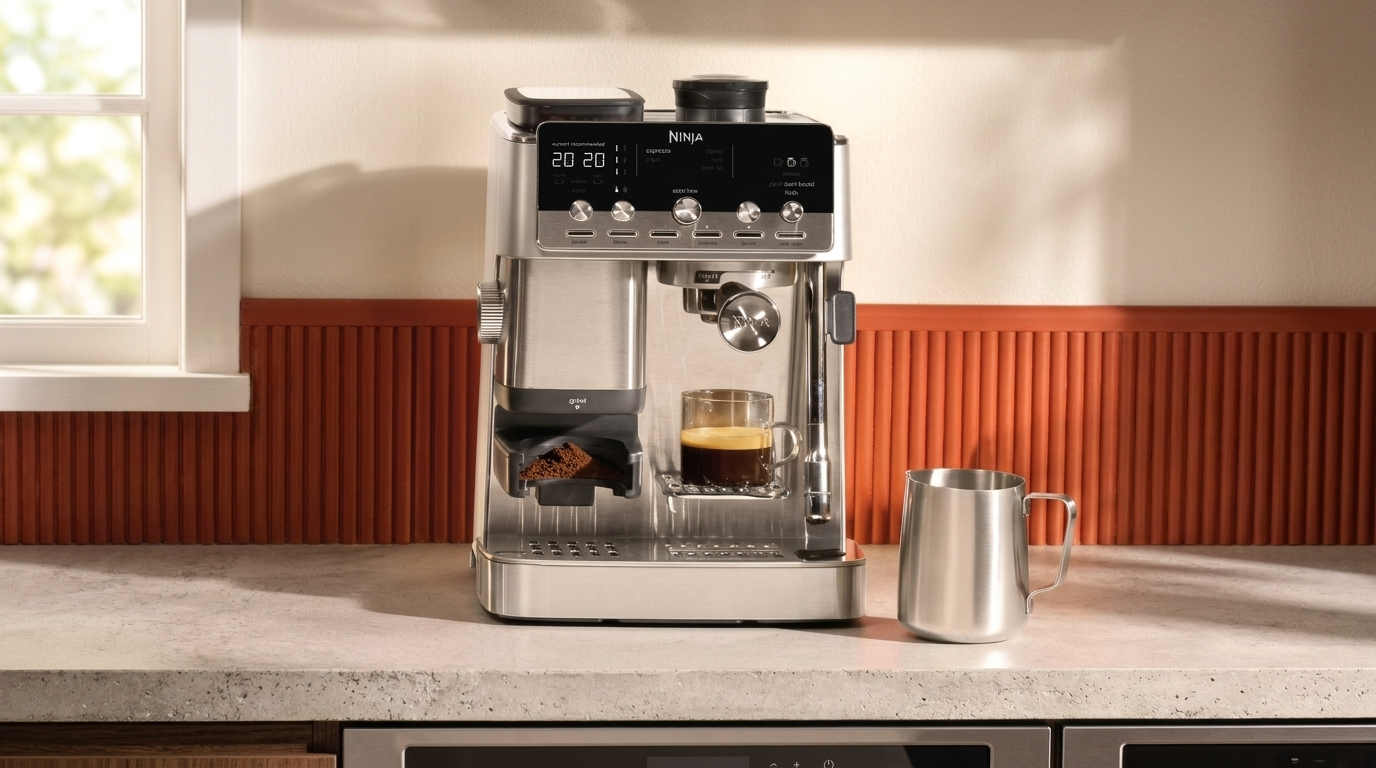
The Ninja’s single spout pours a neat, concentrated stream.
The three-way valve
After each shot, the Bambino Plus releases leftover pressure into the drip tray through a three-way valve✕Three-way solenoid valveA valve that vents pressure from the group head after the shot. The puck comes out drier and you can remove the portafilter straight away..
The puck came out firm and fairly dry, and I could knock it out right away. The Ninja’s pucks were damper, though never a real mess.
| What you taste | Likely cause | First fix on both |
|---|---|---|
| Sour, thin, fast | Grind too coarse | Two or three steps finer |
| Bitter, slow | Grind too fine | Two or three steps coarser |
| Sour and bitter together | Uneven puck | Stir the grounds, tamp level |
| Flat, little crema | Stale beans | Beans roasted within a few weeks |
Big mugs, coffee crema and filter coffee
If you drink black coffee in a mug, the Ninja is in a different league.
Its coffee crema mode turns the grind coarser, to around 17, and brews about 5 to 6 ounces of rich, full-bodied coffee through the portafilter. It became my mid-morning mug.
Its filter mode goes much coarser, around 45 to 50, wets the coffee for a short bloom✕BloomA short pre-wetting of the grounds before the main brew. It lets trapped gas escape so the water can extract the coffee more evenly., pauses and then brews. It tasted like a clean filter coffee, not a stretched espresso.
The Breville Bambino Plus makes espresso and hot water, and that’s it.
For a big black coffee, I pulled a double and topped it up with hot water for an americano✕AmericanoEspresso topped up with hot water. It keeps more sweetness than a shot pushed long through the coffee.. It was good, but it wasn’t a filter coffee.
Long drinks compared
My ratings out of 10 for flavor and balance in a mug.
Neither machine fits a tall travel mug under its spout. I brewed into a small cup and poured.
Our tip: Rinse the Ninja’s basket between filter coffee and espresso, because leftover coarse grounds upset the next shot.
Is It On Sale? Check NowMilk frothing
This is where the Bambino Plus earns its name, and the main reason to choose it.
Breville Bambino Plus: sensor plate and auto purge
You fill the 16 ounce jug with cold milk, set it on a small metal plate under the wand, choose one of three temperatures and three foam levels, and press steam.
The plate reads the jug temperature and stops the wand at your setting. When you lower the jug, the wand purges itself.
The milk came out glossy and smooth, like wet paint, drink after drink. Temperature 2 with foam 2 became my everyday latte, and foam 1 poured simple hearts.
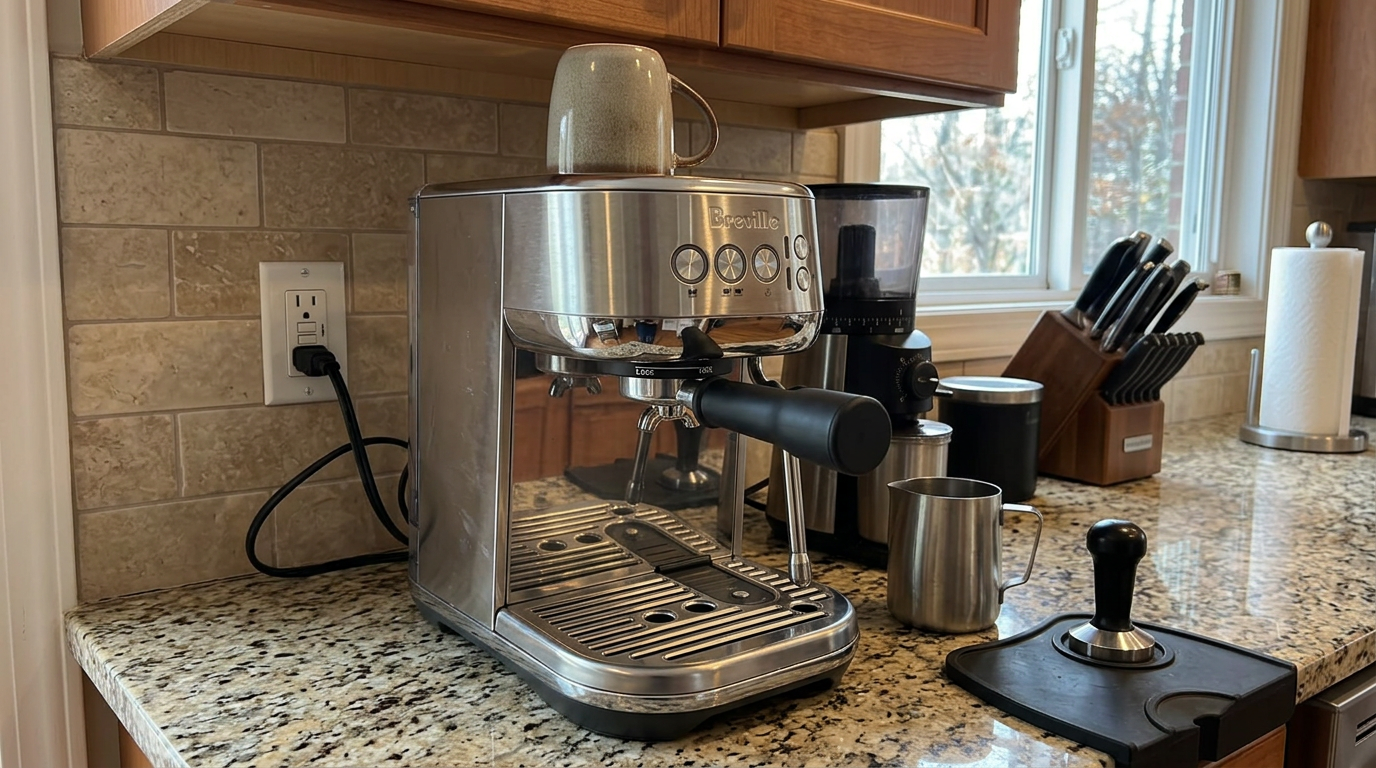
The Bambino Plus stops steaming when the sensor plate reads your chosen temperature.
Ninja Mini Plus: auto froth or manual
The Ninja Mini Plus has a large four-hole steam wand. For automatic frothing, the jug sits against a shaped holder, and you choose dairy or plant milk and low, medium or high froth.
Automatic frothing was convenient but inconsistent. Sometimes it was glossy and well mixed; other times I got liquid milk underneath with a separate layer of foam.
Manual steaming was a different story. The wand is strong enough to spin the milk into a proper whirlpool, and within a week I had microfoam✕MicrofoamMilk foam with bubbles so small you can barely see them. It feels silky and glossy, which is what a good flat white or latte needs. for simple latte art.
Milk, my ratings
My scores out of 10 for texture, consistency and temperature, cold whole milk.
| Milk feature | Ninja Mini Plus | Bambino Plus |
|---|---|---|
| Automatic mode | Jug holder, 3 froth levels | Sensor plate, 3 temps x 3 foams |
| Auto consistency | Sometimes separates | Very consistent |
| Manual power | Strong, four holes | Gentler, easier to learn |
| Auto purge | No, purge by hand | Yes |
| Plant milk | Dedicated setting | Works best with barista oat |
| Learning curve | A week for manual microfoam | None on auto |
Our tip: Use milk straight from the fridge on both machines, because cold milk gives you more time to build fine foam.
Heat-up, temperature and hot water
The Bambino Plus is ready in about 3 seconds thanks to its ThermoJet heater. I never had to plan my coffee.
The Ninja took about 30 to 35 seconds to heat up, which is quick for a machine with a grinder, but noticeably slower side by side.
Heat-up time, from my testing
From switching on to ready to brew.
In the cup, the Ninja’s espresso measured about 68 to 71°C in a warmed cup on its high setting. Its automatic froth reached about 60 to 66°C.
The Bambino Plus kept shots steady thanks to PID control, and its middle milk setting gave me hot, sweet milk without scalding.
Both dispense hot water for americanos and tea. On the Ninja, a dial on the side switches the wand to hot water.
| Temperature detail | Ninja Mini Plus | Bambino Plus |
|---|---|---|
| Brew temperature control | 3 settings | PID, fixed |
| Espresso in a warmed cup | About 68 to 71°C | Steady, shot after shot |
| Auto milk | About 60 to 66°C | 3 levels, stops automatically |
| Hot water | Yes, from the wand | Yes, from the wand |
Our tip: Preheat your cup with a splash of hot water on either machine, because a small espresso loses heat fast in a cold cup.
Cleaning and upkeep
Daily cleaning is quick on both, but the chores are different.
On the Ninja, I wiped and purged the steam wand after every milk drink, knocked out the puck and rinsed the basket. Several parts are dishwasher-safe, including the funnel, water tank, bean hopper and drip tray parts.
On the Bambino Plus, the wand purges itself, which helps, but the purge and the three-way valve both send water to the drip tray. I emptied it every day, sometimes twice.
My daily hands-on cleaning time
With one or two milk drinks a day, not counting descaling.
| When | Ninja Mini Plus | Bambino Plus |
|---|---|---|
| After milk | Wipe and purge the wand | Wipe the wand, it purges itself |
| After each shot | Knock out puck, rinse basket | Knock out the dry puck |
| Daily | Empty tray, wash jug | Empty tray, often twice |
| Weekly | Dishwasher-safe parts, brush the grinder | Wipe gasket, clean sensor plate |
| When prompted | Descale | Descale |
One thing the Breville doesn’t have is a grinder to keep clean, but your separate grinder still needs brushing out every week or two.
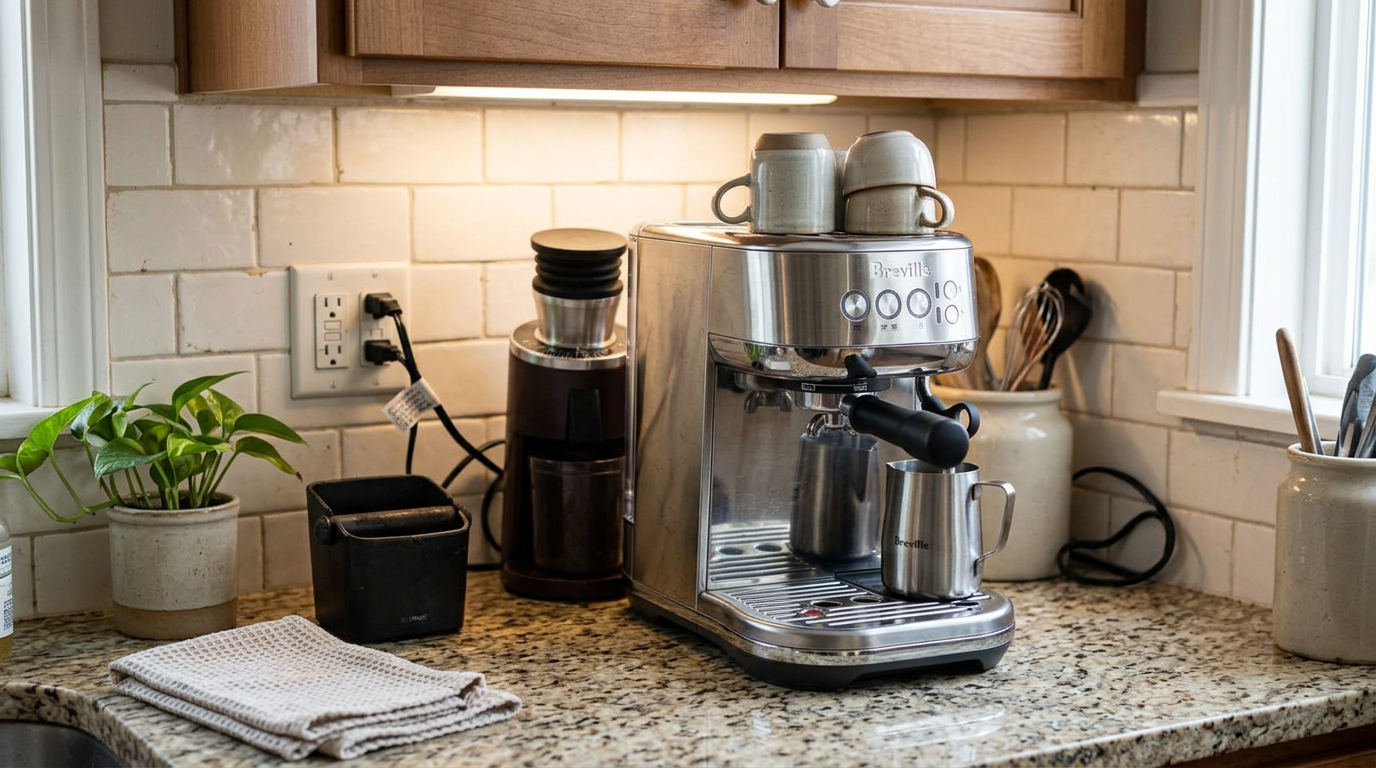
The auto purge clears the Bambino Plus wand, but sends water to a small drip tray.
Noise
The Bambino Plus is the quieter machine overall, simply because it doesn’t grind.
Its pump buzzes briefly, the valve gives a short hiss after each shot, and the auto steam is a steady hiss that stops on its own.
The Ninja is fairly quiet while brewing, but its grinder adds a few seconds of noise to every drink. Your separate grinder for the Breville will make a similar sound, of course.
How loud each felt, my ranking
Relative loudness from side-by-side use. Shorter bars are quieter.
Water tank, beans and long-term care
The Ninja’s 44 ounce tank is its biggest practical limit.
Ninja machines flush water through the system to keep it clean, and that adds up. With two of us making five or six drinks a day, I refilled it daily, sometimes twice.
The Bambino Plus’s 64 ounce tank sits at the back and lasted roughly two days for the same routine.
Drinks per full tank, rough maths
Allowing for flushes and purges. Real numbers depend on cup sizes.
Both prefer fresh medium to medium-dark beans. On the Ninja, beans live in a 250 gram hopper on top, so I kept only a few days’ worth in it.
With the Breville, beans stay in your grinder’s hopper or, better, a sealed container until you grind them.
| Bean type | Ninja Mini Plus | Bambino Plus |
|---|---|---|
| Medium-dark blend | Excellent espresso | Chocolatey, rich, great in milk |
| Medium roast | Excellent coffee crema and filter | Sweeter, grind slightly finer |
| Light roast | Good, grind finer | Bright when dialed in, grinder dependent |
| Old supermarket beans | Flat, weak | Use the dual-wall basket |
Our tip: Buy beans in bags you will finish within two to three weeks of the roast date, because both machines show stale beans straight away.
Mistakes to avoid on both
A month with each machine taught me a few habits that make or break the coffee.
Pairing the Bambino Plus with a cheap grinder. The single-wall baskets need a fine, even grind. A basic grinder gave me sour shots I couldn’t fix.
Trusting the Ninja’s auto froth blindly. Check the jug and swirl it, or learn to steam by hand.
Forgetting the Ninja’s small tank. It stopped halfway through a latte once. I started refilling it every night.
Ignoring the Breville’s drip tray. It overflowed onto my counter on day four.
| Problem | Fix |
|---|---|
| Sour, thin espresso on the Breville | Better grinder, grind finer, 18 g dose |
| Separated milk on the Ninja | Swirl hard or steam manually |
| Ninja stops mid-drink | Refill the tank every night |
| Breville tray overflows | Empty it daily |
| Bubbly foam on both | Cold milk, purge the wand first |
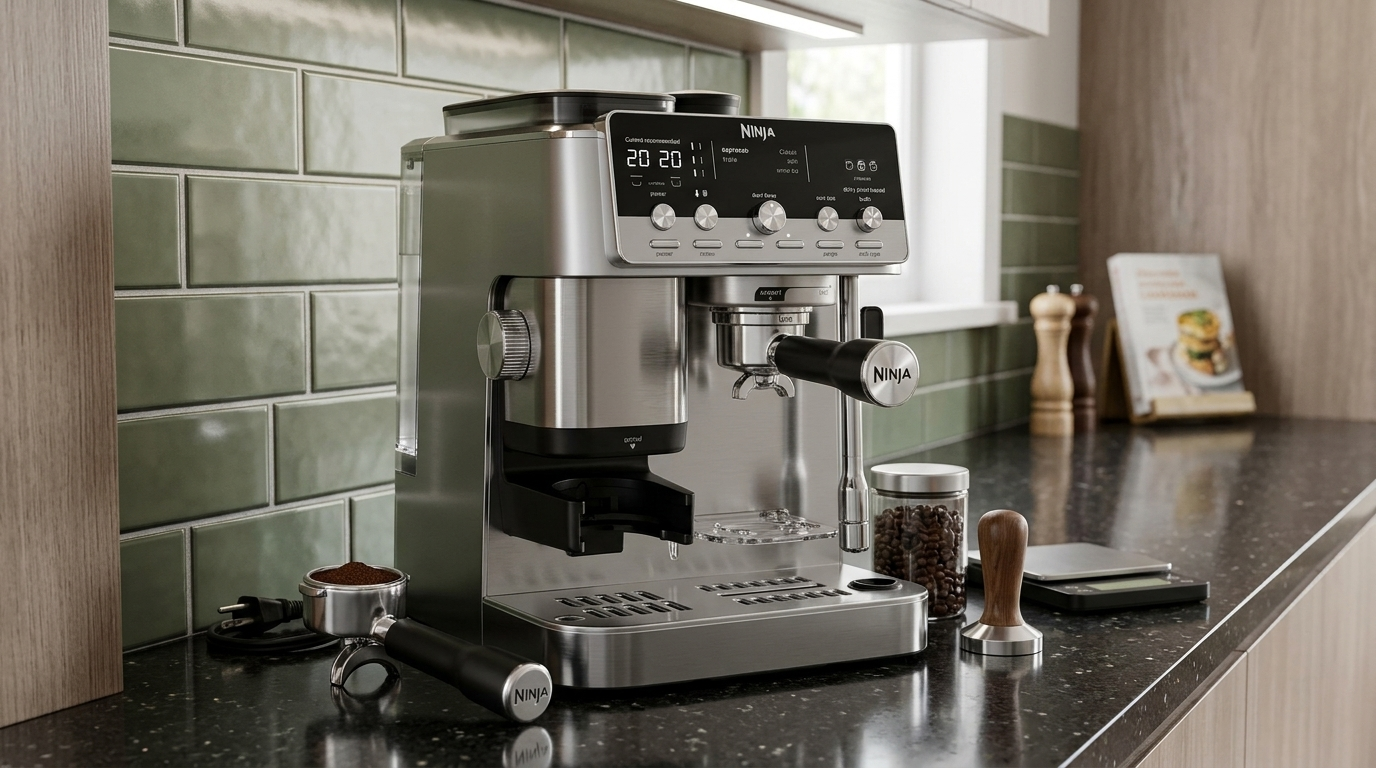
Small habits, like refilling the Ninja’s tank at night, made the biggest difference.
A typical morning on each
This was my real weekday routine in week three: a flat white for me and a latte for my partner.
On the Ninja, I set the grind, ground and weighed 18 grams, tamped with the funnel on and brewed. I steamed by hand while the second shot ran. Two drinks took about six minutes, including a wipe of the wand.
On the Bambino Plus, I ground on my separate grinder, trimmed with the Razor and tamped. As soon as the shot finished, I set the jug on the plate, pressed steam and ground the next dose while the milk textured itself. Two drinks took about five minutes.
Time per morning, two milk drinks
From switching on to two finished drinks, with a quick wipe.
The Breville was faster because it heats in seconds and steams hands-free. The Ninja was simpler because everything happened on one machine.
Our tip: On the Bambino Plus, grind and tamp the next shot while the milk steams on auto, because it nearly halves the time for a second drink.
Is either the right first espresso machine?
Both are popular first steps up from pods or a drip machine, and both are good at that job.
The Ninja Mini Plus is the easier first machine. It tells you what to do and checks your work. If you forget the funnel or try to brew without the portafilter locked in, it warns you.
The Bambino Plus is the better teacher. It does exactly what you ask, so you learn quickly what grind, dose and timing do to the taste.
| Coming from | Ninja Mini Plus | Bambino Plus |
|---|---|---|
| Pods | Fresher coffee, one appliance | Fresher coffee, plus a grinder to buy |
| Drip coffee | Keeps your filter coffee habit | Americanos instead of filter |
| A manual espresso setup | Less fiddling | Familiar workflow, faster heat-up |
If you have never owned an espresso grinder, I would start with the Ninja almost every time.
If you already have one, or you know you’ll enjoy dialing in, the Bambino Plus will reward you more.
Our tip: Give either machine a full week before judging it, because the first few days are spent finding your grind and milk settings.
Small extras worth having
Neither machine needs much, but a few small things made life easier.
For the Bambino Plus, a good espresso burr grinder is not an extra, it is part of the machine. A small scale and a 54 mm metal tamper were the next two upgrades I’d make.
For the Ninja, a needle tool to stir the grounds gave slightly more even shots, and a 12 ounce milk jug made manual steaming easier.
| Extra | Ninja Mini Plus | Bambino Plus |
|---|---|---|
| Espresso burr grinder | Not needed | Essential |
| Small coffee scale | Built in | Very useful |
| Metal tamper | Not needed | Worth it |
| Needle distribution tool | Useful | Useful |
| Water filter | Included | Useful with hard water |
Still torn between the two?
Ask yourself one question: do you already own a good espresso grinder?
If not, buy the Ninja Luxe Café Mini Plus. It is the complete package, and it saves you a second appliance and a second decision.
If you do, think about milk. If most of your drinks are lattes and flat whites, the Breville Bambino Plus makes better milk with less effort than anything else at this size.
Then think about black coffee. If anyone in your home drinks a mug of filter coffee every morning, the Ninja covers them and the Breville doesn’t.
Finally, think about speed. The Breville’s 3 second heat-up is a small luxury you feel every single morning.
Either way, both are honest, compact machines that make real espresso. The choice is about what sits around them.
Four weeks with each: my diary notes
These are the notes Michael and a second HouseholdMe tester kept as each machine settled into our routine.
Ninja Luxe Café Mini Plus
Week 1: Learned the workflow. Followed the recommended grinds and had good shots from day one.
Week 2: Went two steps finer for espresso and made coffee crema my mid-morning mug.
Week 3: Gave up on auto froth for flat whites and switched to manual steaming.
Week 4: Filter coffee for guests, nightly tank refills, a full descale.
Breville Bambino Plus
Week 1: Dialed in my grinder by weight and settled on 18 grams in, 36 out.
Week 2: Worked through all nine milk combinations and picked temperature 2, foam 2.
Week 3: Two people, four milk drinks a day. The milk never had a bad morning.
Week 4: Swapped the plastic tamper for a metal one and emptied a lot of drip trays.
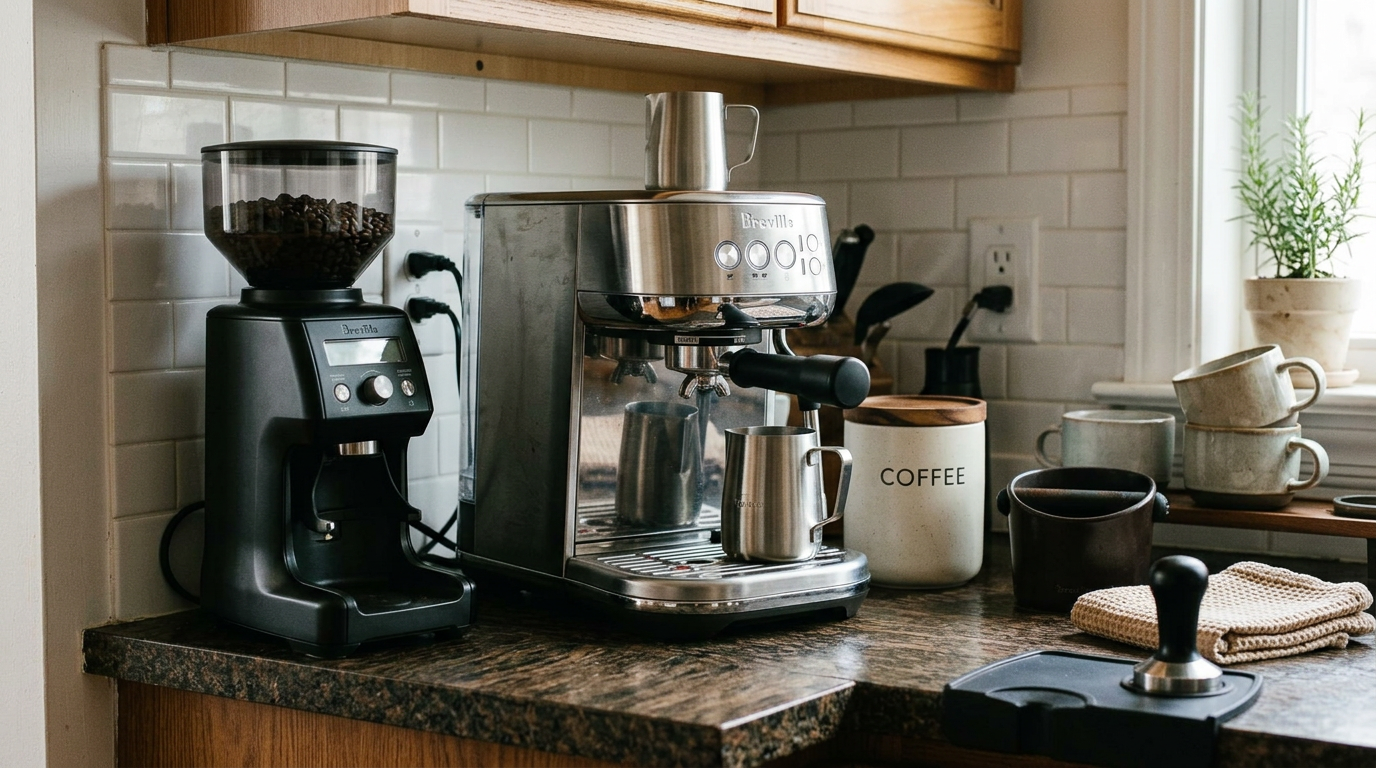
By week four, the Bambino Plus and its grinder had become a very fast latte station.
Real-life scenarios
These are the situations where one machine clearly pulled ahead during testing.
Grinder, scale and tamper are all built in.
The sensor plate makes silky milk hands-free.
Real bloom-and-brew filter mode.
Ready in about 3 seconds.
Only about 10 inches deep, with no grinder beside it.
Ninja for power by hand, Breville for easy auto foam 1.
My scorecard
These are our scores out of 10 from the single reviews of each machine, plus versatility because it decides this matchup.
Ninja Luxe Café Mini Plus
Versatility covers filter coffee, coffee crema and the built-in grinder.
Breville Bambino Plus
Espresso score assumes a good separate grinder.
Overall, I rate the Ninja 8.4 in this comparison and the Bambino Plus 8.3. As a machine alone, the Breville scored 8.5 in its single review; it loses points here because it can’t do anything without a grinder.
See How Much You’ll SaveWhich one is right for you?
4 quick questionsWhich one should you buy?
For most first-time buyers, the Ninja Luxe Café Mini Plus. It makes espresso just as good as the Bambino Plus in everyday use, it grinds and weighs for you, and it adds coffee crema and real filter coffee. For the wider picture, see my guide to the best Ninja espresso machines.
The Breville Bambino Plus is the better buy if you already own a good grinder or you live on lattes. Its hands-free milk is the best at this size. If you’re weighing Breville models, my Breville Bambino vs Bambino Plus comparison covers the cheaper manual-wand version, and my Ninja Luxe Café Mini Plus vs Premier comparison covers the bigger Ninja with cold drinks.
For a first espresso machine with no grinder, the Ninja is the easier, complete package.
- You don’t own an espresso grinder
- You also drink filter coffee
- Counter space is tight
- You want guidance on grind and dose
- You want hands-free café-quality milk
- You make lots of drinks a day
- You like splitting a double into two cups
- You already own a good burr grinder
- You drink lattes and flat whites daily
- You want coffee in 3 seconds
- You don’t want to buy a grinder
- You drink filter coffee
- You want a heavy all-metal build
My pick is the Ninja Luxe Café Mini Plus. It brings a 60-setting grinder, a built-in scale and an assisted tamper to a body about 10 inches deep, pulls full-bodied espresso with almost no guesswork and adds coffee crema and real filter coffee.
The Breville Bambino Plus is the better choice if you already have a good grinder or you drink milk drinks every day. Its sensor-plate steam wand makes silky microfoam hands-free, and it is ready to brew in about 3 seconds.
Whichever you choose, use fresh beans, cold milk and a warmed cup, and empty the drip tray every day.
Ninja Luxe Café Mini Plus vs Bambino Plus specifications
From manufacturer specifications and our own testing.
| Ninja Luxe Café Mini Plus | Breville Bambino Plus | |
|---|---|---|
| Model | ES351 | BES500BSS |
| Type | Semi-automatic with grinder, scale and steam wand | Semi-automatic with automatic steam wand |
| Brew styles | Espresso, long espresso, coffee crema, filter | 1 and 2 cup espresso |
| Grinder | Conical burr, 60 settings | None |
| Dosing | Built-in scale, about 17 to 18 g | About 18 to 19 g, 54 mm portafilter |
| Tamping | Assisted, spring-loaded | Plastic tamper, Razor dosing tool |
| Pressure | 9 bar | 15 bar pump, about 9 bar extraction |
| Heat-up | About 30 to 35 seconds | About 3 seconds, ThermoJet |
| Temperature | 3 brew settings | PID controlled |
| Milk | Steam wand, auto froth or manual | Auto steam wand, 3 temps, 3 foams, auto purge |
| Hot water | Yes | Yes |
| Bean hopper | About 250 g / 8.8 oz | None |
| Water tank | About 44 oz / 1.3 L | About 64 oz / 1.9 L |
| Power | 1,650 watts | 1,300 to 1,600 watts |
| Dimensions (W x D x H) | 12.2 x 10.2 x 13.4 in | 7.7 x 12.6 x 12.2 in |
| Weight | About 19.4 lb | Much lighter, no grinder |
| Included | Single-spout portafilter, baskets, tamper, funnel, jug | Portafilter, 4 baskets, tamper, Razor, 16 oz jug |
How I tested and compared them
Michael Reynolds here. Each machine was our everyday coffee maker for four weeks, making espresso, coffee crema, filter coffee, americanos, flat whites, lattes and cappuccinos. Michael and a second HouseholdMe tester shared each machine and wrote the notes together.
We weighed doses and yields on a separate scale, timed heat-up, shots and frothing, measured drink temperatures with a probe, and steamed whole, 2% and barista oat milk on both.
We ran the Bambino Plus with an entry-level grinder and a proper espresso burr grinder, tracked how often each tank and drip tray needed attention, and compared our notes with Ninja’s and Breville’s specifications and owner documentation.
- Coffee: dose, yield, crema, body and consistency.
- Milk: automatic and manual texture, temperature and ease.
- Workflow: setup, heat-up, controls and daily routine.
- Ownership: tank, cleaning, noise and footprint.
Ninja Luxe Café Mini Plus vs Bambino Plus FAQ
What is the difference between the Ninja Luxe Café Mini Plus and the Breville Bambino Plus?
The Ninja has a built-in 60-setting grinder, a scale, an assisted tamper and a filter coffee mode. The Bambino Plus has no grinder, but it heats up in about 3 seconds and has a better automatic steam wand with three temperature and three foam levels.
Which makes better espresso?
They are very close. With a good separate grinder, the Bambino Plus was slightly more consistent. Without one, the Ninja makes far better espresso.
Do I need a grinder for the Bambino Plus?
Yes, for its best shots. With pre-ground coffee, use the dual-wall baskets, but the flavor will be flatter.
Which is better for lattes?
The Bambino Plus. Its sensor plate stops steaming at your chosen temperature and makes silky milk hands-free. The Ninja’s wand is strong, but its automatic froth is less consistent.
Can the Ninja Luxe Café Mini Plus make filter coffee?
Yes. Filter mode uses a very coarse grind, a short bloom and then a brew, and it tastes like a clean filter coffee.
Which heats up faster?
The Bambino Plus, in about 3 seconds. The Ninja takes about 30 to 35 seconds.
Which is smaller?
The Bambino Plus is narrower, but once you add a grinder, the Ninja takes less space in total.
How big are the water tanks?
About 44 ounces on the Ninja and about 64 ounces on the Bambino Plus.
Can either make cold brew?
No. Neither has cold brew or cold foam modes. You can pour a fresh shot over a full glass of ice on both.
Which is better for beginners?
The Ninja, because it recommends the grind, weighs the dose and checks your work.

- Our hands-on Ninja Luxe Café Mini Plus review
- Our hands-on Breville Bambino Plus review
- Ninja and Breville product specifications and owner documentation
- General espresso brewing and milk frothing guidance