Neretva 20 Bar review: a super compact espresso machine with adjustable temperature and surprisingly strong steam
The Neretva 20 Bar Espresso Machine Super Compact packs a lot into a small body: adjustable brewing temperature from 180 to 205 °F, a shot timer, a cup warmer, a drip tray that tells you when it's full, grippy feet and a surprisingly strong steam wand. I used it daily for three weeks, and learned one rule that makes all the difference: brew first, steam second.

Michael Reynolds
Hands-on review
Hands-on testing, research, specs
3 weeks
19 minutes
Jargon helpNew to espresso? Tap any dotted term to see what it means.
In this review
Yes, if you want a small, well-featured machine for lattes and everyday espresso. The Neretva 20 Bar gives you adjustable temperature, a shot timer, a cup warmer and a steam wand that heats milk fast, and its grippy feet keep it still when you lock in the portafilter. The pressurized baskets keep espresso easy but limit flavor, and you must brew before you steam, or the machine locks you out while it cools. Learn that rule and the simple E2 fix, and it's a very capable little machine.
Neretva 20 Bar at a glance
Neretva 20 Bar pros and cons
- Adjustable brewing temperature and shot timer
- Strong, fast steam for its size
- Grippy feet, cup warmer and drip-tray float
- Must brew before steaming, or wait to cool
- Pressurized baskets limit flavor
- Occasional E2 error needs a water purge
Who should buy the Neretva 20 Bar?
- Latte and cappuccino drinkers
- Small kitchens and apartments
- Beginners using pre-ground coffee
- Espresso purists
- People who steam first and brew second
- Pod or capsule users
First impressions of the Neretva 20 Bar
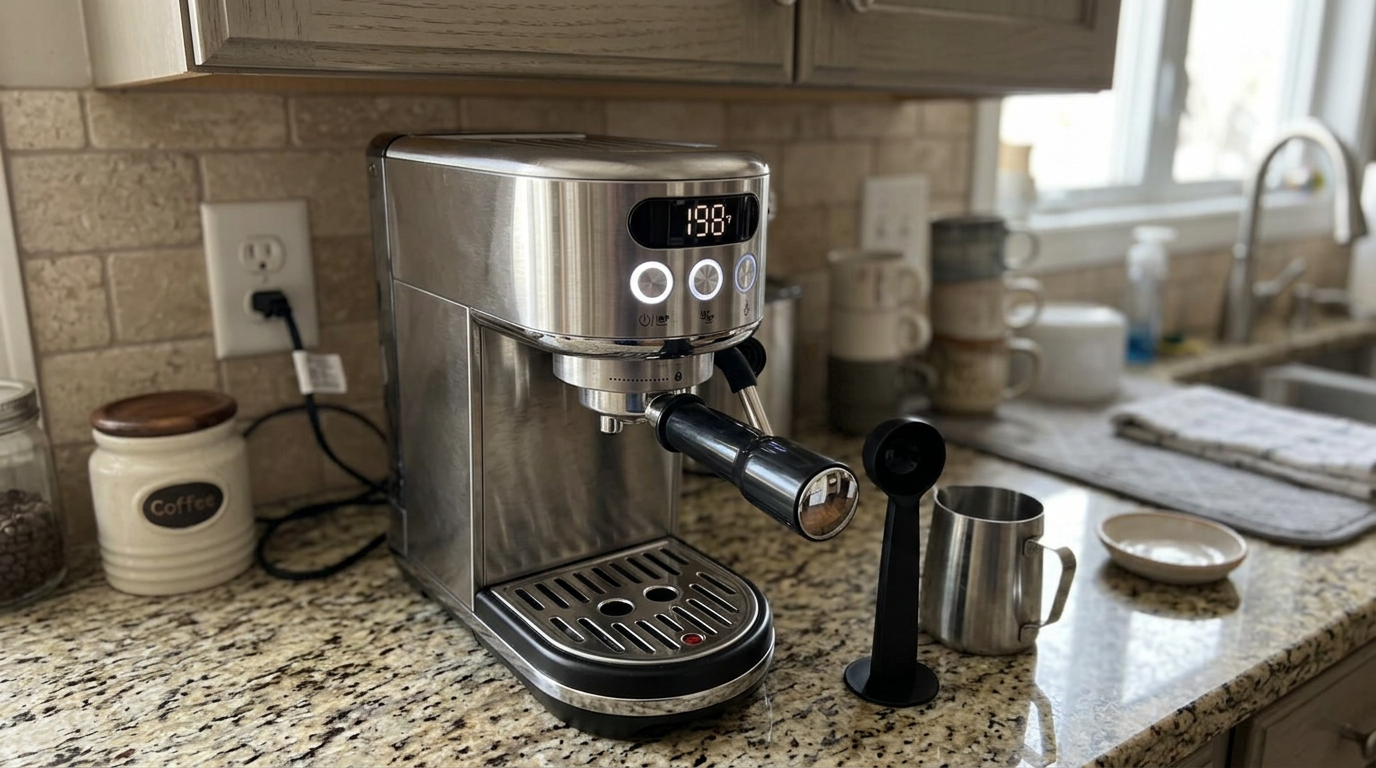
The Neretva is a neat little machine: brushed stainless, a small digital display, three buttons on the front and a steam dial on the side.
The first thing I noticed when I set it down was that it didn't want to move.
Grippy, suction-style pads underneath held it firmly in place, so locking in the portafilter✕PortafilterThe handle with a metal basket that holds the ground coffee. You lock it into the machine to brew. didn't slide it across the counter.
Setup had one catch: a small shipping cap on the bottom outlet of the water tank, which has to come off before the water can flow.
I missed it at first and wondered why nothing was happening.
Once primed, my first double shot, made with pre-ground espresso, started flowing after about 11 seconds of pre-infusion and finished at around 32 seconds with a beep.
It was bold and smooth with a thick foam on top.
Then I steamed milk, and the wand was stronger than I expected from such a small machine.
Finally, I tried to pull another shot straight away, and the machine refused, which taught me the most important rule of owning the Neretva 20 Bar.
The Neretva by my sink. The display shows the temperature and counts the seconds during a shot.
What the Neretva actually is
The Neretva is a compact semi-automatic espresso machine for ground coffee only, with no grinder and no capsule option.
A 1,350-watt heating system handles both brewing and steaming, and a 20-bar✕BarA unit of pressure. One bar is about the air pressure at sea level. Espresso is usually brewed at around 9 bar at the coffee. pump drives the shot.
| Feature | What it does | My verdict |
|---|---|---|
| Adjustable temperature | 180 to 205 °F | Rare at this size |
| Shot timer | Counts each shot on the display | Very useful |
| Pressurized baskets | Single and double | Forgiving |
| Steam wand and side dial | Variable steam or hot water | Strong and controllable |
| Cup warmer | Heated top tray | Handy |
| Drip tray float | Pops up when full | No overflows |
| Grippy feet | Stop the machine sliding | Excellent |
The golden rule: brew first, steam second
This is the single most important thing to know about the Neretva.
Brewing happens between 180 and 205 °F, but steaming needs the heater to climb to about 266 °F.
If you steam first, the system is far too hot to brew, so the machine shows an overheating warning and locks out brewing until it cools back below 205 °F.
Waiting for that cool-down slowed my early mornings down a lot.
The fix is simple: always pull your shot first, then press steam and froth your milk.
| Order | What happens | Wait |
|---|---|---|
| Brew, then steam | Shot at the right temperature, then steam heats up | Almost none |
| Steam, then brew | Overheat warning, brewing locked | Several minutes to cool |
Once I built the habit, the problem never came back, and making a latte was quick and smooth.
Adjustable brewing temperature
Being able to set the brewing temperature anywhere from 180 to 205 °F is unusual at this size, and it's genuinely useful.
Darker roasts tasted smoother and less bitter at lower temperatures, while lighter roasts needed the top of the range to avoid sourness.
| Roast | Temperature I used | What changed |
|---|---|---|
| Dark | About 190 °F | Less bitter, more chocolate |
| Medium-dark | About 198 °F | Balanced, my default |
| Medium | About 200 to 202 °F | Sweeter |
| Light | 205 °F | Less sour |
My ratings out of 10, same dose and coffee.
With pressurized baskets, the effect is smaller than on a machine with single-wall baskets, but it was still easy to taste.
Our tip: Start at about 198 °F, then go cooler for dark roasts and hotter for light ones.
Dose, distribute and tamp
The pressurized baskets make prep simple.
Dose
I filled the double basket with pre-ground espresso until it was level, weighing about 14 grams.
Underfilling made watery, under-extracted shots, which is the most common mistake on this machine.
Tamp
Press the coffee down evenly and firmly into a flat, level bed.
Lock in
Align the handle to the left, lift it into the group and twist right until it's tight.
The grippy feet kept the machine still every time, so I didn't need to brace it.
Our tip: Fill the double basket all the way; an underfilled basket was the main cause of my weak, watery shots.
Neretva espresso performance
The Neretva makes reliable, crema-topped espresso that's at its best under milk.
The shot
After pressing the button, the machine runs a short pre-infusion✕Pre-infusionA short, gentle wetting of the coffee before full pressure. It helps water soak the puck evenly. and builds pressure; espresso starts flowing after about 11 seconds.
A double takes about 30 to 35 seconds in total, and the machine stops and beeps when it's done.
The shot timer✕Shot timerA clock on the display that counts the seconds of each shot, so you can repeat a recipe. on the display made it easy to spot if something was off.
How it tasted
With a medium-dark pre-ground espresso at 198 °F, my doubles were bold, smooth and chocolatey, with a thick foam.
On their own, they lacked the depth and sweetness of a well-made single-wall shot, which is the usual limit of pressurized baskets✕Pressurized basketA double-wall basket with one tiny exit hole. It builds pressure for you, so even pre-ground coffee makes a foamy crema..
My ratings on a 10-point scale.
| What you taste or see | Likely cause | First change |
|---|---|---|
| Watery | Basket underfilled | Fill to level |
| Bitter | Temperature too high for a dark roast | Lower to about 190 °F |
| Sour | Temperature too low for a light roast | Raise toward 205 °F |
| Won't brew | Too hot after steaming | Wait, or brew first next time |
Steaming milk with the Neretva
The steam wand was the biggest surprise.
How it works
Press the steam button so the heater climbs to steam temperature, then turn the side dial.
As you open the dial past halfway, it switches from purging water to a strong, dry jet of steam.
What the milk is like
The steam is powerful for such a small machine, and it heated milk quickly.
With the tip just under the surface and the jug angled, I could stretch the milk and build a whirlpool into smooth, glossy microfoam✕MicrofoamMilk foam with bubbles so small you can't see them. It feels silky and pours well for latte art..
Because it's strong, it's easy to overheat or overflow the jug, so keep a hand on the side of the pitcher.
My ratings on a 10-point scale for texture.
Safety
The metal wand gets very hot, so only touch the insulated part and the dial.
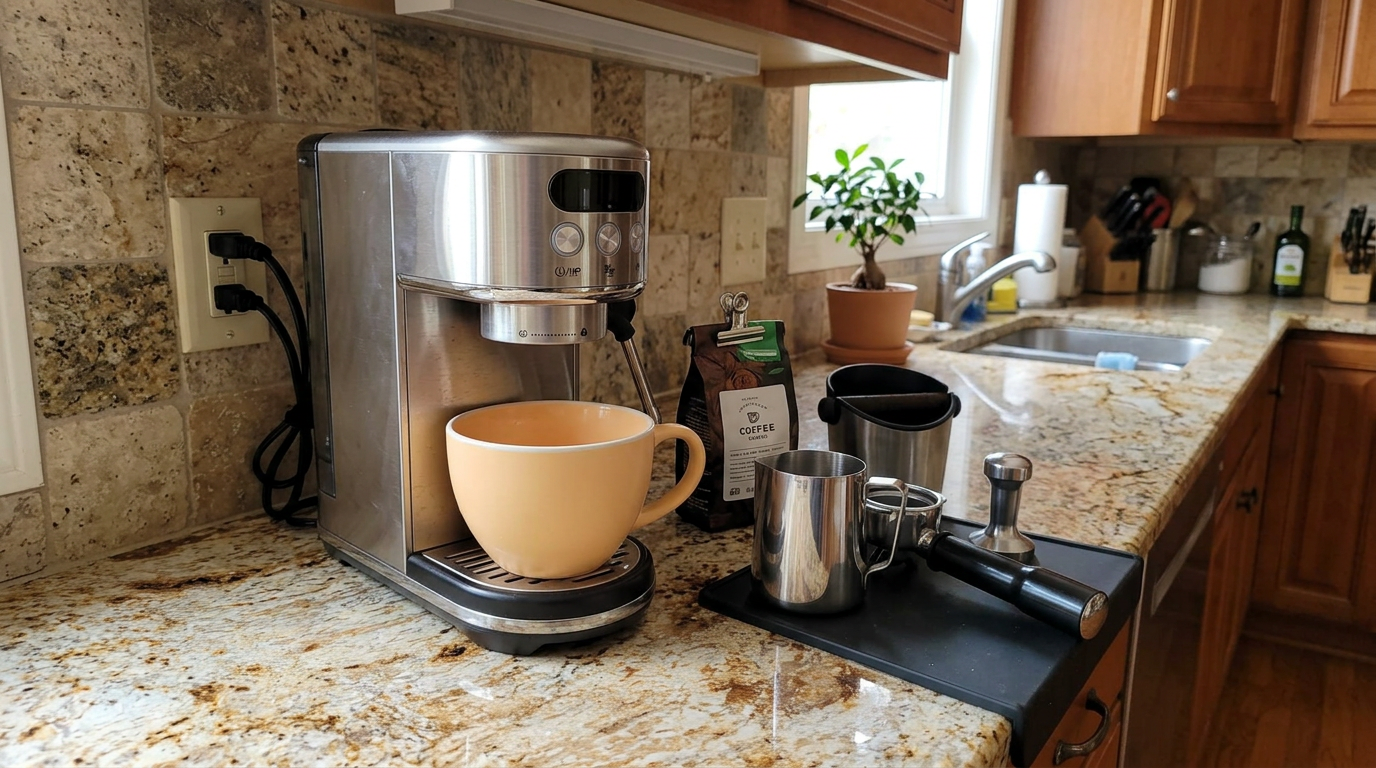
A big latte in an orange cup. The Neretva's steam wand heats milk quickly for its size.
How I steam milk on the Neretva, step by step
| Step | What I do | Why |
|---|---|---|
| 1. Brew | Pull the shot first | Brew-first rule |
| 2. Steam mode | Press the steam button | Heater climbs to about 266 °F |
| 3. Purge | Open the dial briefly over the tray | Clears water |
| 4. Stretch | Tip just under the surface, dial past halfway | Adds air |
| 5. Spin | Angle the jug, sink slightly | Folds in the foam |
| 6. Stop | Close the dial fully before removing the jug | No spray |
| 7. Clean | Wipe and give a short purge | Clears milk from the tip |
Close the dial completely before lifting the jug away, or you'll spray milk across the counter.
My milk texture over the test, rated out of 10.
Our tip: Keep one hand on the pitcher; the Neretva's steam is strong and milk heats faster than you expect.
Fixing the E2 error
A few times, after heavy steaming, the display flashed "E2".
It usually means air has got trapped in the water lines, or the system is confused after running hot in steam mode.
The fix takes about 20 seconds.
| Step | What I did | Why |
|---|---|---|
| 1. Steam off | Make sure the steam button isn't selected | Back to water mode |
| 2. Cup | Put a cup under the wand | Catches the water |
| 3. Purge | Open the side dial | Runs water through the wand |
| 4. Wait | Until it flows smoothly without sputtering | Air is pushed out |
| 5. Close | Turn the dial off | E2 clears |
After that, the machine was ready to use again.
Following the brew-first rule made the error much less frequent.
Our tip: If E2 appears, switch steam off and run hot water through the wand until it flows smoothly.
Hot water, tea and Americanos
With steam mode off, opening the side dial sends hot water through the wand straight away.
I used it for Americanos, tea and hot chocolate.
| Drink | Water | Notes |
|---|---|---|
| Americano | About 5 oz on a double | Smooth and easy |
| Tea | Straight from the wand | Quick for one mug |
| Hot chocolate | Hot water or steamed milk | Kids loved it |
Because hot water uses the brewing temperature range rather than steam, it doesn't trigger the overheat lockout.
It's also the same action you use to clear the E2 error, so it's worth getting comfortable with.
Design, footprint and handy details
The Neretva 20 Bar is built for small kitchens, and a few thoughtful details make it nicer to live with.
The cup warmer
Residual heat warms the top plate, and cups left there while the machine heats up were warm by the time I brewed.
The drip tray float
A small float rises through a gap in the tray when it's full, so I never had an overflow.
The tank
The clear tank shows the water level at a glance and lifts straight off for filling at the sink.
Just remember the shipping cap on its outlet before first use.
Our tip: Before first use, check the bottom of the water tank for a small shipping cap and remove it.
Beans, roast and water
Because the baskets are pressurized, pre-ground espresso works well, and fresh beans give a modest lift.
Medium-dark roasts were the easiest match, while the temperature control let dark and light roasts taste better than I expected.
My guide to coffee roast levels explains the differences.
| Roast | Temperature | Result |
|---|---|---|
| Light | 205 °F | Bright, a little thin |
| Medium | 200 °F | Sweet, gentle |
| Medium-dark | 198 °F | Bold, balanced |
| Dark | 190 °F | Smooth, chocolatey |
Grinding your own
If you buy whole beans, you'll need a separate grinder; an espresso-capable burr grinder set fairly fine worked well with the pressurized baskets.
My guide to burr vs blade grinders explains why burrs are better.
Water
Fresh, filtered water kept the coffee tasting clean and slows scale build-up.
My first-week checklist for new owners
| Day | What to do | Why |
|---|---|---|
| Day 1 | Remove the tank's shipping cap, rinse, prime | Water can flow |
| Day 1 | Fill the double basket to level | Avoid watery shots |
| Day 2 | Set about 198 °F as a starting point | Balanced flavor |
| Day 2 | Always brew before steaming | Avoid the lockout |
| Day 3 | Practice steaming with a hand on the jug | Strong steam |
| Day 4 | Use the cup warmer every morning | Hotter espresso |
| Day 5 | Try lower and higher temperatures with your beans | Find your taste |
| Day 7 | Learn the E2 water purge | Quick fix if needed |
What other owners say
I also looked at what other owners and testers report.
Owners frequently praise the compact size, the strong steam, the adjustable temperature and the grippy feet.
Many say it's an easy, good-value first espresso machine for lattes and mochas.
The most common complaints are the overheat lockout when steaming before brewing, the occasional E2 error and the flavor ceiling of the pressurized baskets.
A few owners missed the shipping cap on the tank and thought the pump was faulty.
What that means for you
The Neretva's quirks are about workflow, not reliability, and they're easy to learn.
Cleaning and maintaining the Neretva
| When | Task | Why it matters |
|---|---|---|
| After steaming | Wipe and purge the wand | Stops milk drying in the tip |
| Daily | Rinse the portafilter and basket | Removes coffee oils |
| When the float rises | Empty the drip tray | Prevents overflows |
| Daily | Refresh the tank water | Clean-tasting coffee |
| Weekly | Brush the group head | Keeps the seal tight |
| Every few months | Descale | Protects the heater |
Descaling
Follow the manual's descaling✕DescalingRunning a mild acid solution through the machine to dissolve the mineral scale that builds up from tap water. steps every few months, or more often with hard water.
My estimate of hands-on cleaning time per day.
What daily use is really like
My weekday routine: switch on, put a cup on the warmer, fill and tamp the double basket, brew, then press steam and froth.
A latte took about four minutes from a cold start, including wiping the wand.
The beep at the end of each shot was handy when I was busy with the milk jug.
Tank life
Rough maths from a 44 oz tank.
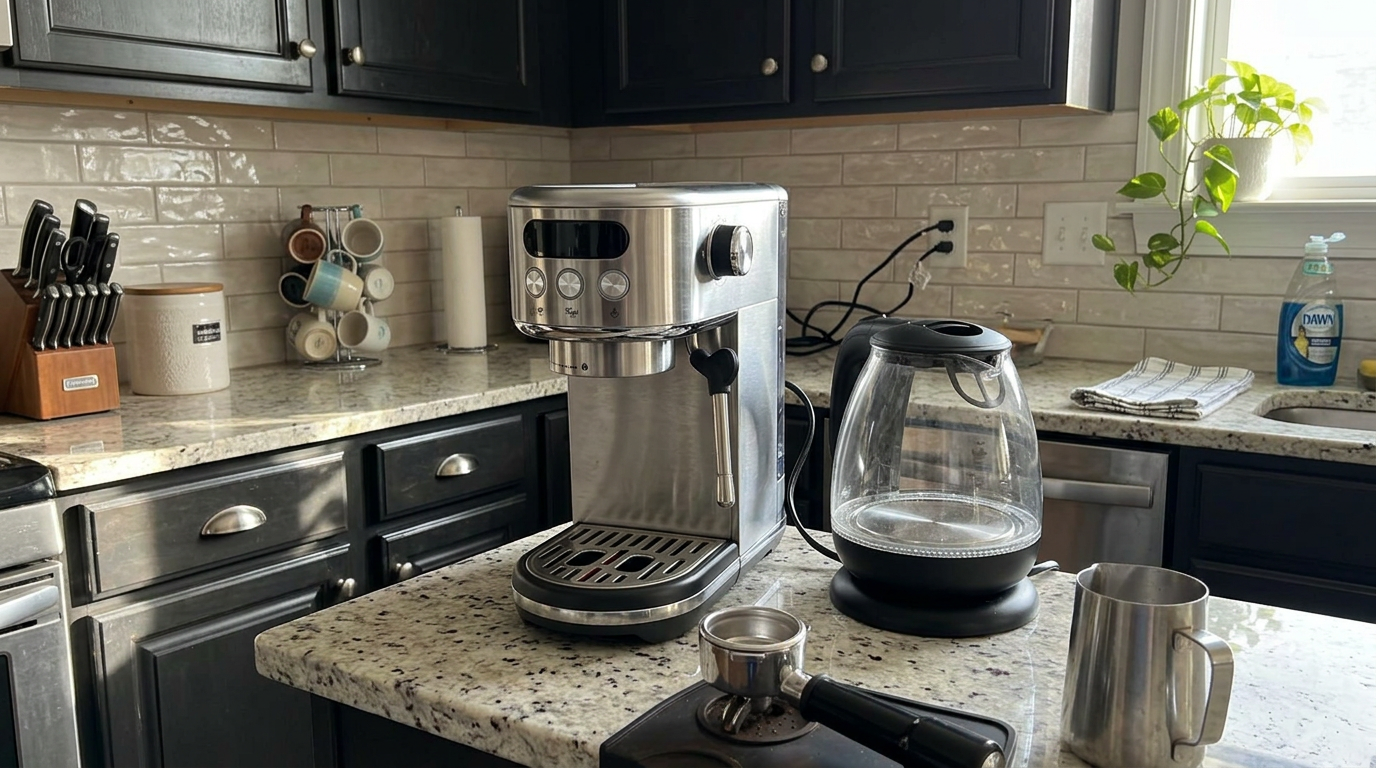
The Neretva under dark cabinets with a glass kettle and pitcher. It's small enough for the tightest corner.
For a slimmer machine with very fast steam switching, see my CASABREWS 5418 PRO review.
The drinks I made most often
| Drink | Coffee | How I made it | Notes |
|---|---|---|---|
| Latte | Double, 198 °F | About 8 oz steamed milk | My daily cup |
| Mocha | Double | Chocolate in the cup, steamed milk | Rich and easy |
| Cortado | Double | Equal parts steamed milk | Strong and quick |
| Cappuccino | Double | More air in the stretch | Tall foam |
| Americano | Double | Hot water from the wand | Smooth |
| Tea | None | Hot water from the wand | Handy |
The cortado was a pleasant surprise: a small amount of strong steamed milk balanced the bold shot perfectly.
Our tip: For a mocha, stir chocolate into the hot shot before adding milk so it melts completely.
Living with it: week one to week three
Week one
I found the shipping cap, learned the brew-first rule the hard way and saw my first E2 error.
Week two
I explored the temperature range with three roasts and learned to control the strong steam.
Week three
I used the Neretva 20 Bar for a busy household with guests, steaming milk in batches at the end.
It was dependable and quick once the workflow was second nature.
How I rated each drink by the end of the test, out of 10.
Serving guests
With guests, the brew-first rule shapes the whole routine.
I pulled all the shots first, keeping cups on the warmer, then switched to steam and frothed milk in two batches.
Four lattes took me about 12 minutes this way.
Steaming first and then trying to brew more shots would have meant waiting for the machine to cool, so planning ahead mattered.
Our tip: For guests, brew every shot before you press steam, then froth all the milk in one or two batches.
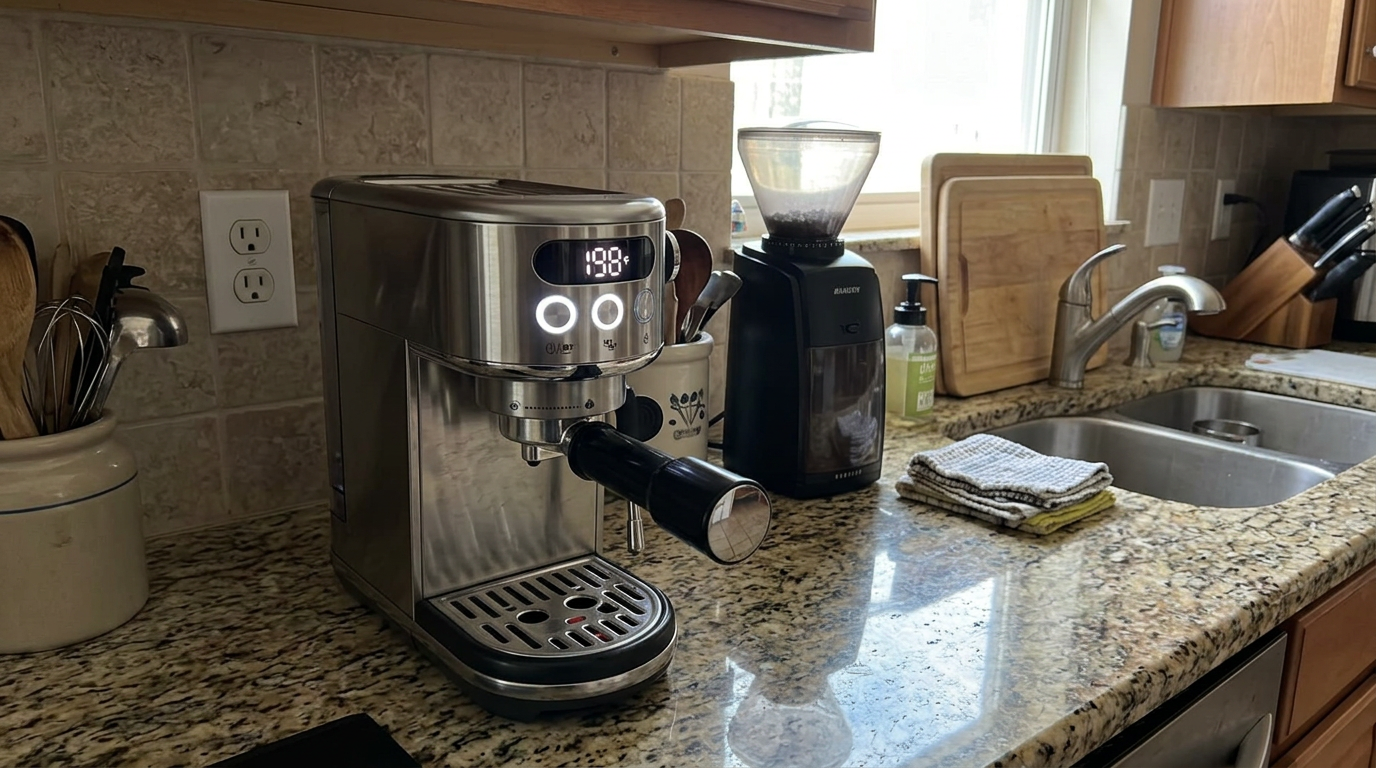
The Neretva next to my grinder. Shots first, milk last, is the routine that works best.
Build quality
The stainless body feels solid for a compact machine, and the grippy feet are a genuinely useful design choice.
The display is clear and easy to read, and the side dial gives fine control over steam and hot water.
In three weeks, I had no faults beyond the occasional E2 error, which the water purge always cleared.
What I liked most, and what bugged me
What I liked most
Adjustable temperature and a shot timer in a small machine.
Strong, fast steam.
Grippy feet, a cup warmer and a drip-tray float.
What bugged me
The overheat lockout if you steam before brewing.
The occasional E2 error.
The flavor ceiling of the pressurized baskets.
Who will enjoy it
If you want a compact, feature-rich machine for milk drinks, you'll enjoy the Neretva 20 Bar.
If you want complex espresso or the freedom to steam and brew in any order, look elsewhere.
Common mistakes to avoid
| Mistake | What happens | Better habit |
|---|---|---|
| Leaving the tank shipping cap on | No water flows | Remove it before first use |
| Steaming before brewing | Overheat warning, brewing locked | Brew first |
| Underfilling the basket | Watery shots | Fill to level |
| Lifting the jug before closing the dial | Milk spray | Close the dial first |
| Ignoring E2 | Machine won't work | Purge water through the wand |
| Touching the bare wand | Burns | Use the insulated grip |
A single-wall basket option in the box would let the Neretva grow with its owner.
Is the Neretva 20 Bar worth the money?
For latte drinkers who want a compact, well-equipped machine, yes.
You get adjustable temperature, a shot timer, strong steam, a cup warmer and thoughtful details in a small body.
What you give up is complex straight espresso and the freedom to steam first.
Ask yourself three questions before you buy.
Do you mostly drink milk drinks? Is counter space tight? Can you remember to brew first, steam second?
If the answers are yes, the Neretva 20 Bar is a capable, good-value little machine.
If you want single-wall baskets and a 58 mm portafilter, see my CASABREWS Ultra review.
How it compares with other compact machines
| Feature | Neretva 20 Bar | CASABREWS CM5418 | CASABREWS 5418 PRO |
|---|---|---|---|
| Adjustable temperature | Yes, 180 to 205 °F | No | No |
| Shot timer | Yes | No | No |
| Steam | Strong | Modest | Strong, very fast to start |
| Brew after steaming | Wait to cool | Wait to cool | Almost immediate |
| Grippy feet | Yes | No | No |
| Best for | Feature-rich milk drinks | Budget lattes | Back-to-back milk drinks |
| You mostly drink | Is the Neretva a fit? | Why |
|---|---|---|
| Lattes and cortados | Very good | Strong steam |
| Straight espresso | Fair | Pressurized baskets |
| Several milk drinks in a row | Good | Brew all, then steam |
| Tea and Americanos | Good | Hot water on demand |
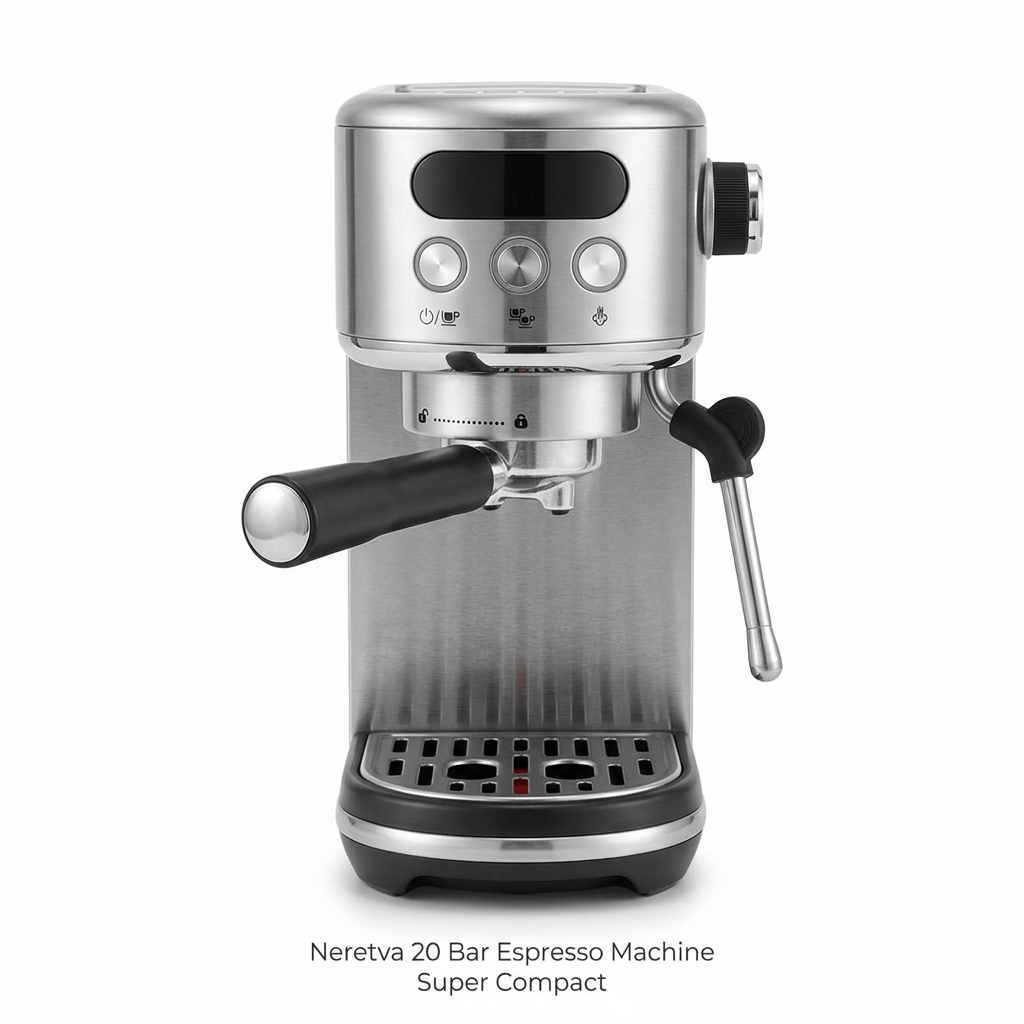
The Neretva from the front: display, three buttons and the steam wand with its side dial.
The display and shot timer
The small digital display does two jobs: it shows the temperature, and it counts the seconds during each shot.
That timer turned out to be one of my favorite features, because it made every shot a small experiment.
On a good morning, a double started flowing at about 11 seconds and finished around 32 seconds.
When a shot finished noticeably faster, I knew the basket was underfilled or the coffee was too coarse; when it dragged on, the coffee was too fine or too tightly tamped.
Even with forgiving pressurized baskets, watching the timer helped me make more consistent drinks.
The beep at the end of each shot was handy too, because I could turn my attention to the milk jug and still know when the espresso was done.
| Shot time for a double | What it usually meant | What I changed |
|---|---|---|
| Under 25 s | Too little coffee or too coarse | Fill to level, finer grind |
| About 30 to 35 s | Normal | Nothing |
| Over 40 s | Too fine or tamped too hard | Coarser grind, lighter tamp |
Our tip: Glance at the timer on every shot; it's the quickest way to spot an underfilled basket.
Getting the most from the steam dial
The side dial is a variable valve, so it controls how much steam or hot water comes out, not just on or off.
That gave me more control than the simple knobs on many budget machines.
When I opened it a little, the wand first pushed out some water; past about halfway, it switched to a strong, dry jet of steam.
For stretching milk, I opened it to just past that point, so the steam was dry but not fierce.
Once the milk was spinning, I opened it a bit more to heat it quickly.
For hot water, with steam mode off, opening the dial gave a steady stream for tea and Americanos.
| Dial position | Steam mode on | Steam mode off |
|---|---|---|
| Slightly open | Purges water | Gentle hot water |
| About halfway | Dry steam starts | Steady hot water |
| Fully open | Strong steam | Fast hot water |
Learning the dial took me about a week, and it's the main reason my milk improved so quickly.
Iced lattes and summer drinks
The Neretva makes great iced drinks, and they skip the brew-first issue entirely because there's no steaming.
I brewed a double straight over a glass of ice, then topped it with cold milk.
At about 198 °F with a medium-dark roast, the shot was bold enough to stay flavorful over ice and milk.
| Iced drink | How I made it | Notes |
|---|---|---|
| Iced latte | Double over ice, cold milk | My summer favorite |
| Iced Americano | Double over ice, cold water | Clean and refreshing |
| Iced mocha | Chocolate, double, ice, cold milk | A treat |
A slightly cooler brewing temperature, around 190 °F, made iced drinks taste smoother with darker roasts.
What to expect long term
Three weeks can't tell you how a machine will age, but some habits clearly help.
The most important is the brew-first workflow, because repeatedly forcing the machine to cool from steam temperature isn't ideal.
Purging the wand after every milk drink keeps the strong steam strong, and purging water through it clears the occasional E2 error.
Regular descaling protects the 1,350-watt heater, especially in hard-water areas.
Keep the drip tray float clean so it keeps moving freely, and check the tank outlet occasionally for debris.
Who the Neretva really suits
After three weeks, the Neretva 20 Bar felt like a machine for people who want more features than a basic budget machine, without more counter space.
It suits latte and cortado drinkers who like strong steam, and people who enjoy tweaking temperature to suit their beans.
It's also good for anyone whose counter is slippery or crowded, because the grippy feet keep it firmly in place.
It's less suited to people who want to steam milk first, like to switch freely between drinks, or want complex straight espresso.
| If you are... | Is it a good fit? | Why |
|---|---|---|
| A latte drinker in a small kitchen | Yes | Strong steam, compact |
| A tinkerer who likes settings | Yes | Temperature and timer |
| An espresso purist | Not really | Pressurized baskets |
| A pod user | No | Ground coffee only |
Why one heating system changes your routine
The Neretva uses a single 1,350-watt heating system for both brewing and steaming, which explains most of its quirks.
Brewing needs water between 180 and 205 °F, while good steam needs the heater at about 266 °F.
Going up from brewing to steaming is quick, because heating is fast.
Coming back down is slow, because the heater has to cool off on its own, and that's why the machine locks out brewing after steaming.
Machines with two heaters, or with very fast thick-film heaters, avoid this, but they're usually bigger or cost more.
For most people, the solution is simply to change the order: shots first, milk last.
| Machine type | Brew after steaming | Size |
|---|---|---|
| Single heating system, like the Neretva | Wait to cool | Compact |
| Fast thick-film heater | Almost immediately | Compact |
| Dual boiler or dual heater | Immediately | Larger |
Once you accept that order, the single heater is a sensible trade-off for such a small, well-equipped machine.
Our tip: If you forget and steam first, run hot water through the wand to speed up the cool-down.
Which one is right for you: is the Neretva 20 Bar your match?
4 quick questionsNeretva 20 Bar specifications
From manufacturer data and my own testing.
How I tested and scored the Neretva 20 Bar
For three weeks, I used the Neretva 20 Bar as my everyday machine for espresso, lattes, mochas, cortados and Americanos, usually three or four drinks a day.
I tried temperatures across the full 180 to 205 °F range with dark, medium and light roasts, using pre-ground coffee and fresh beans in the pressurized baskets.
I tested what happens when you steam before brewing, timed steaming and shots, and noted every error code.
I then checked my notes against Neretva's instructions, other hands-on reviews and owner feedback.
- Espresso (6.8): crema, body and flavor across roasts and temperatures.
- Milk drinks (7.8): steam power, foam texture and speed.
- Ease of use (7.8): controls, display, stability and the brew-first workflow.
- Cleaning (7.2): drip tray, wand care, E2 purge and descaling.
The overall score of 7.4 is an editorial rating that reflects those four areas.
Neretva 20 Bar FAQ
Is the Neretva 20 Bar worth it?
Yes, for latte drinkers who want features in a compact machine. Espresso purists may find the pressurized baskets limiting.
Can I use capsules or pods?
No. It only uses ground coffee.
Does it have a grinder?
No. Use pre-ground espresso or a separate grinder.
Can I adjust the temperature?
Yes, from 180 to 205 °F. Go cooler for dark roasts and hotter for light roasts.
Why won't it brew after I steam?
Steaming heats the system to about 266 °F. It locks out brewing until it cools to brewing temperature, so brew first, then steam.
What does the E2 error mean?
Usually air in the lines after heavy steaming. With steam off, open the side dial and run water through the wand until it flows smoothly.
Are the baskets pressurized?
Yes. Both have a single small exit hole, which makes them forgiving with pre-ground coffee.
What should I do before first use?
Remove the small shipping cap from the bottom of the water tank, then rinse and prime the machine.
Does it make hot water?
Yes. With steam mode off, open the side dial for hot water.
How do I know when the drip tray is full?
A float rises through a gap in the tray when it needs emptying.
How big is the water tank?
About 44 ounces.
Does it slide when I lock in the portafilter?
No. The grippy pads underneath kept it still in my testing.
Kitchen & coffee tester
Michael spent six years as a line cook in restaurants in Chicago and New York, and he has tested kitchen appliances for HouseholdMe since 2018, from air fryers to coffee makers. He holds an SCA certificate in barista skills and used the Neretva 20 Bar as his everyday coffee machine for three weeks for this review.
- Three weeks of hands-on testing of the Neretva 20 Bar
- Neretva instructions and product specifications
- Independent hands-on reviews of the Neretva 20 Bar
- Owner feedback on steaming, temperature and the E2 error