Gevi 20 Bar GECGI140-U-3 review
The Gevi 20 Bar Espresso Machine with Conical Burr Grinder is an affordable grind-and-brew station with 30 grind settings, a 58 mm portafilter, pre-infusion and a 3-way solenoid valve. It heated in about 90 seconds and, once dialed in, pulled rich shots with thick crema and steamed milk good enough for latte art. It skips temperature control, a pressure gauge and a shot timer, and a scale helps a lot.

Michael Reynolds
Hands-on review
Hands-on testing, research, specs
3 weeks
20 minutes
Jargon helpNew to coffee gear? Tap any dotted term to see what it means.
In this review
Yes, if you want a real built-in grinder and proper espresso without paying big-brand money. The Gevi 20 Bar GECGI140-U-3 gave me 36-gram doubles in about 30 seconds at grind setting 5, its 3-way solenoid made puck knock-outs clean and quick, and the steam wand made silky microfoam. You don't get adjustable temperature, a pressure gauge or a shot timer, the grinder's output changes with each setting, and the included tamper is basic.
Gevi 20 Bar GECGI140-U-3 at a glance
Gevi 20 Bar GECGI140-U-3 pros and cons
- Built-in grinder with 30 settings at a sensible price
- 58 mm portafilter, pressurized and non-pressurized baskets
- Pre-infusion and a 3-way solenoid for clean pucks
- No temperature control, gauge or shot timer
- Grind output varies by setting, so a scale helps
- Basic plastic tamper and a 3-tab portafilter
Who should buy the Gevi 20 Bar GECGI140-U-3?
- Beginners learning real espresso
- Budget-conscious buyers who want a grinder built in
- Latte and Americano drinkers
- Enthusiasts who want to tune temperature and pressure
- One-touch drink fans
- People who won't use a scale
First impressions of the Gevi 20 Bar GECGI140-U-3
I'll be honest: I expected the Gevi 20 Bar GECGI140-U-3 to feel like a compromise.
Built-in grinder machines from the big brands cost a lot more, and when a cheaper one arrives, there is usually a catch you discover in the first week.
With this Gevi, the catches are real but small, and the coffee is much better than its price suggests.
Out of the box, it looks clean and practical.
There is black plastic on the cup warming tray and side panels, a brushed front, three buttons in the middle and a rotary knob on the right for steam and hot water.
It isn't fancy, but it feels solid, and it has a reassuring weight when you move it around the counter.
The portafilter is the first thing that surprised me.
It is a full 58 mm size, the same diameter used on most café machines, which is rare at this level and opens up a huge range of accessories.
My first shot, on a pressurized basket with the default grind, was decent.
My first shot on a non-pressurized basket was thin and fast.
I spent the rest of the day weighing beans, timing shots on my phone and changing one grind step at a time.
By the end of the first afternoon, with a kitchen scale and a few grind changes, I was pulling rich, syrupy doubles with thick crema.
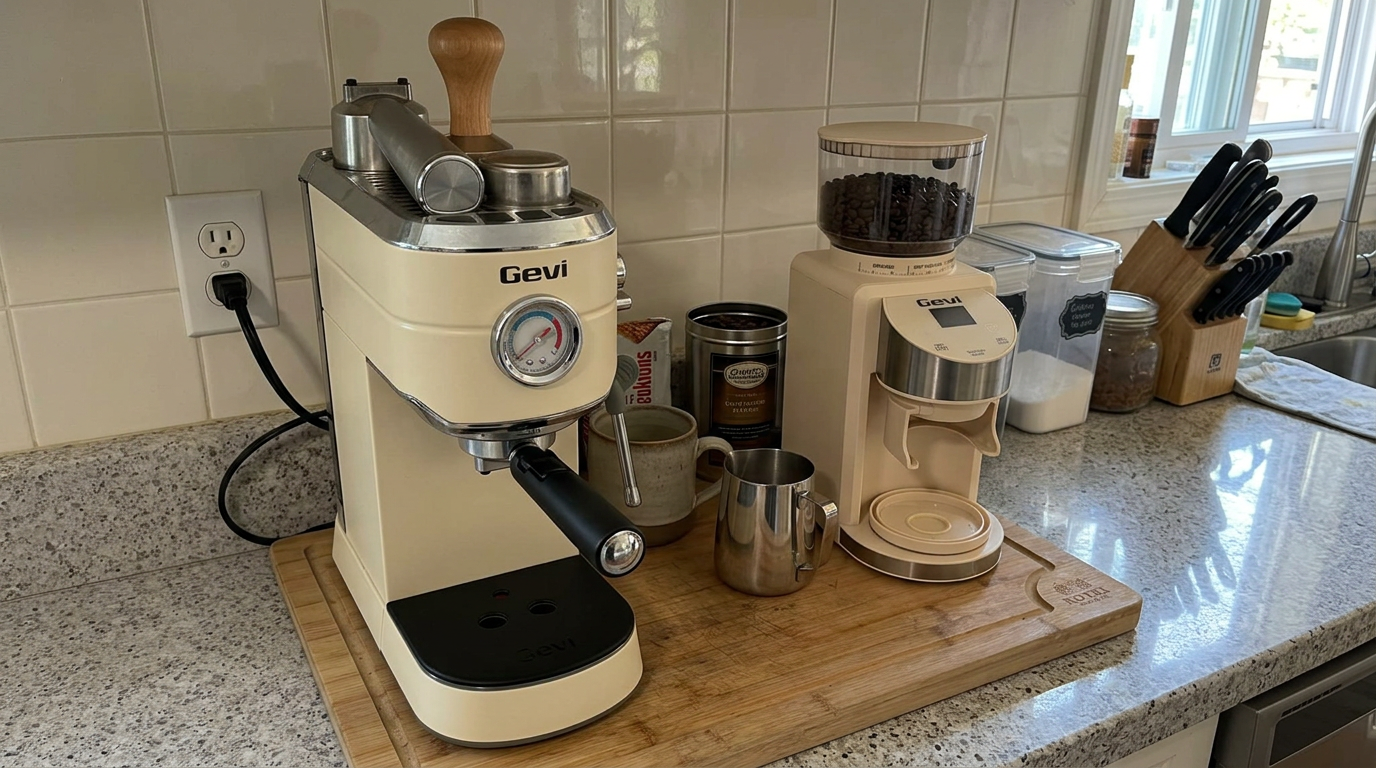
The Gevi looks practical rather than flashy, with the grinder on top and a rotary steam knob on the right.
What the Gevi GECGI140-U-3 actually is
This is an entry-level semi-automatic espresso machine with a built-in conical burr grinder.
You grind into the portafilter, tamp, lock it in, press the brew button and steam the milk yourself.
It is designed for newcomers who want a simple grind-and-brew station without complex menus, but it includes a few features that are rare at its price.
Those include pre-infusion✕Pre-infusionA short, gentle wetting of the coffee puck before full pressure. It lets the grounds swell and settle so water flows through them more evenly., a 3-way solenoid valve, a 58 mm portafilter and both pressurized and non-pressurized baskets.
What it leaves out is just as important: there is no adjustable brew temperature, no pressure gauge and no shot timer on the display.
What's in the box
My box held the machine, a spouted 58 mm portafilter, four filter baskets (two pressurized and two non-pressurized), a plastic tamper, a stainless steel milk pitcher, the bean hopper with its lid and a cleaning brush.
That is everything you need to start making espresso right away, although I would add a scale as soon as you can.
Our tip: Start with a pressurized basket for your first few days, because it makes a decent shot even before you have dialed in the grind.
Gevi GECGI140-U-3 design and build
Controls
The front has three buttons and a small icon display above them.
The icons tell you what the machine is doing, but they don't show any numbers.
I would have loved to see the grind time and brew time on that screen, because that is the information you need most when dialing in.
The steam and hot water knob
A rotary knob on the right controls the steam wand.
Turn it left and the wand dispenses hot water, which is handy for Americanos.
Turn it right and it switches to steam for milk.
Drip tray, tank and storage
The drip tray is large, so I only emptied it once a day.
The water tank is generous too, and I refilled it every two days or so with our usual mix of drinks.
At the back, a small storage compartment holds the cleaning brush and a spare basket, which kept the counter tidy.
Build quality
The plastic cup warmer and side panels are the clearest sign of the price, but nothing felt flimsy or hollow.
After three weeks of daily use, everything still locked and turned as it did on day one.
The built-in conical burr grinder
The grinder uses a conventional conical burr set with a five-star design that is well suited to espresso.
You adjust it by turning the bean hopper through 30 settings, and the clicks are clear and easy to feel.
Hopper and anti-popcorning lid
The hopper twists into place on top of the machine.
Its lid includes an anti-popcorning design that stops beans bouncing around as the burrs grab them.
That sounds like a gimmick, but it keeps beans feeding steadily into the burrs, which helps the grind stay even when you are down to the last few beans.
Two ways to use it
You can fill the hopper and grind by time, or weigh out a dose and grind it all, called single dosing✕Single dosingWeighing out exactly the beans for one shot and grinding them all, instead of storing beans in the hopper. It gives precise doses and fresher coffee..
I tried both and preferred single dosing, because the dose was exact every time.
Removing the burr
Cleaning access is good for a machine at this level.
Unscrew the hopper, lift the small ring and the outer burr comes out for brushing.
Our tip: Single-dose your beans for the first week, because it tells you exactly how much coffee went into each shot while you learn the grinder.
Grind presses and dose weights
This is the quirk that convinced me to keep a scale next to the machine.
The grind button is time-based: one press for a single, two presses for a double.
But the weight you get depends heavily on the grind setting, because finer settings grind more slowly.
My measurements with a medium-dark blend.
So the same double press gave me 11.6 grams at the finest setting and 16.3 grams at setting 5.
Since the display doesn't show grind time or weight, you can't see that change happening.
Programming your own grind time
You can set a custom grind time by holding the grind button with the single or double cup button, then pressing grind again when you have enough.
Even so, I found it easier to weigh the beans first and grind the whole amount.
Pressurized vs non-pressurized baskets
The Gevi comes with both kinds of filter basket, and they behave very differently.
A pressurized basket✕Pressurized basketA filter basket with a single small exit hole that builds pressure for you. It forgives a coarse grind or stale coffee but limits flavor. has a single small exit hole that builds back-pressure for you.
It makes a decent shot even if your grind is off, and it is useful with pre-ground coffee.
A non-pressurized basket has holes across the whole bottom.
It relies entirely on your grind, dose and tamp, but it rewards good prep with richer, more expressive espresso.
My ratings out of 100.
I used the pressurized baskets for the first two days, then switched to non-pressurized and never went back.
Our tip: Keep a pressurized basket in the rear storage compartment for guests who bring pre-ground coffee, because it rescues shots that a non-pressurized basket can't.
The 58 mm portafilter
A 58 mm portafilter✕PortafilterThe handle with a metal basket that holds the ground coffee and locks into the machine's brew head. is a big deal at this level.
It holds about 16 to 20 grams of coffee in the double basket, enough for strong, full-bodied shots.
And because 58 mm is the most common size in the coffee world, there is a huge range of tampers, dosing rings and precision baskets that fit.
The 3-tab catch
The Gevi uses three locking lugs on the portafilter instead of the usual two.
That means a standard 2-tab bottomless portafilter won't lock in.
If you want to upgrade to a bottomless one, look specifically for a 3-tab version made for this machine.
Dialing in and espresso
With a non-pressurized basket, I aimed for about 36 grams of espresso in 25 to 30 seconds from 16 grams of coffee, a classic 1:2 ratio.
Finding the grind by feel
Before pulling shots, I ground a few small samples and rubbed them between my fingers.
Setting 10 felt grainy, setting 5 felt like fine sand, and setting 0 was a powder that stuck to my fingers.
For espresso, you want something like fine salt that doesn't stick.
My dialing-in shots
| Shot | Grind | Dose | Yield | Time | Taste |
|---|---|---|---|---|---|
| 1 | 10 | 16 g | 36 g | About 12 s | Thin, watery |
| 2 | 7 | 16 g | 36 g | About 20 s | Bright, light |
| 3 | 5 | 16 g | 36 g | About 30 s | Rich, creamy, sweet |
| 4 | 4 | 16 g | 34 g | About 34 s | Heavier, slightly bitter |
At setting 5, the espresso came out noticeably richer and creamier, with a thick layer of crema✕CremaThe golden-brown foam on top of an espresso. It forms when pressure pushes gases and oils out of freshly ground coffee. that lasted for minutes.
It tasted chocolatey and sweet with a little brightness, well beyond what I expected at this level.
No shot timer
Because the display shows no brew time, I timed every shot on my phone.
A small scale with a built-in timer under the cup would solve this and is the first upgrade I would buy.
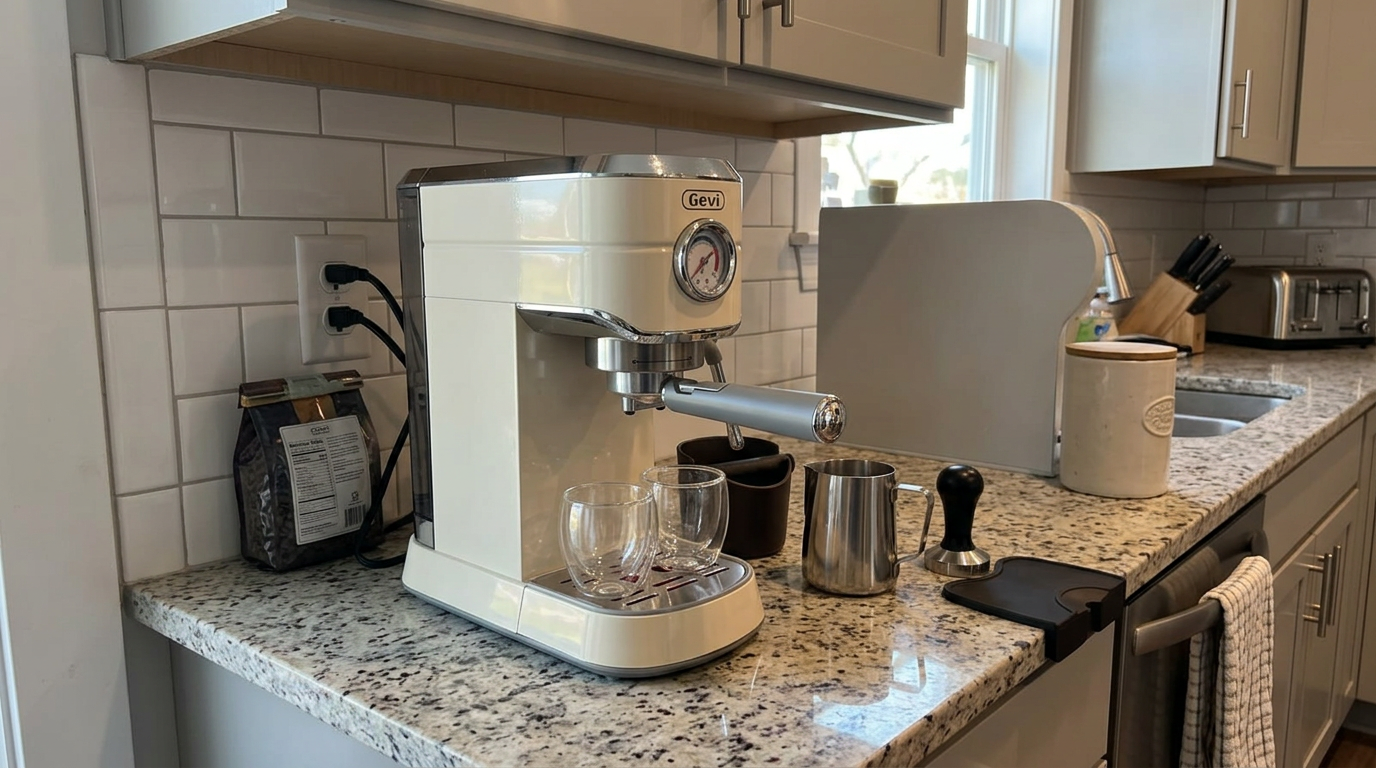
At grind setting 5, a 16-gram dose gave about 36 grams of rich espresso in roughly 30 seconds.
What “20 bar” really means
The box says 20 bar, and that number appears on almost every budget espresso machine.
It describes the most the pump can push, not the pressure your coffee is brewed at.
Good espresso is usually brewed at around 9 bars, and the actual pressure in the basket depends on how much resistance your coffee puck gives.
With a non-pressurized basket, a puck that is too coarse lets water rush through at low pressure, while a puck that is too fine chokes the flow.
That is why the grind matters more than the pump rating.
The Gevi has no pressure gauge, so you judge pressure by the result instead: shot time, yield and taste.
| What you see | What it means | First change |
|---|---|---|
| 36 g in under 20 s | Too little resistance | One step finer |
| 36 g in 25–30 s | About right | Keep it |
| Under 30 g after 40 s | Too much resistance | One step coarser |
| Spraying or a pale stripe | Channeling | Better distribution, level tamp |
| Thin, pale crema | Old beans or too coarse | Fresher beans, finer grind |
Our tip: Judge a shot by weight and time together, because a shot that looks fine can still be far too fast or slow.
Thermoblock, pre-infusion and the 3-way solenoid
Fast heat-up
The Gevi uses a single thermoblock✕ThermoblockA heater that warms water as it flows through a hot metal block instead of heating a whole boiler. It makes a machine ready in a minute or two. and was ready to brew in about 90 seconds.
That kept weekday mornings short.
Pre-infusion
Each shot starts with a short phase of low-pressure water before full pressure.
It wets the puck evenly and reduces channeling, and in my tests it made the shots a little more forgiving of small tamping mistakes.
You can't adjust its length, but the default worked well.
The 3-way solenoid valve
This is the feature I would least expect to see at this price.
When the shot finishes, the solenoid vents the leftover pressure from the puck into the drip tray.
That means you can remove the portafilter immediately, and the puck comes out dry and knocks out in one piece.
On machines without one, you have to wait or risk a spray of wet grounds.
Time from end of shot to clean basket, from my timings.
What's missing
There is no adjustable brew temperature, no adjustable pre-infusion and no pressure gauge.
For most beginners, that keeps things simple.
For tinkerers, it limits how far you can push lighter roasts.
Steaming milk and latte art
The steam wand has a single-hole tip and solid steam power.
Because the machine uses one thermoblock, you can't brew and steam at the same time.
After the shot, I turned the knob to steam and waited a few seconds for it to come up to temperature.
Microfoam
With the tip just under the surface for a few seconds, then sunk slightly to spin the milk, the wand made smooth, silky microfoam✕MicrofoamMilk foam with bubbles so small you can't see them. It feels silky and blends into the coffee instead of sitting on top like froth..
I poured hearts by the end of week one, and it worked well for lattes and cappuccinos.
Steaming 6 ounces of milk took about 50 seconds.
My ratings out of 10 for microfoam texture.
Cheap upgrades that make a big difference
The Gevi's 58 mm portafilter means you can improve it with inexpensive accessories.
These are the ones that made the biggest difference in my tests.
| Upgrade | What it fixes | Impact |
|---|---|---|
| Small scale with timer | No timer or dose readout | Very high |
| Dosing ring | Grounds spilling during grinding and stirring | High |
| WDT tool | Clumps that cause uneven extraction | High |
| Calibrated 58 mm tamper | Uneven tamping with the plastic tamper | Medium |
| Precision 58 mm basket | More even extraction | Medium |
| 3-tab bottomless portafilter | See channeling, more crema | Optional |
Why distribution matters
Tamping straight onto a mound of grounds can leave dense and loose spots in the puck.
Water then finds the easy path and rushes through, which tastes sour and bitter at the same time.
A dosing ring keeps the grounds contained, and a WDT tool✕WDT toolA tool with thin needles used to stir ground coffee in the basket before tamping. It breaks up clumps so the puck has an even density. lets you stir and level them before tamping.
With both, my shots were more consistent day to day.
Our tip: Buy a dosing ring and a WDT tool before anything else, because together they made a bigger difference to my shots than a better tamper.
My favorite drinks and settings
These are the recipes I used most on the Gevi 20 Bar GECGI140-U-3 after three weeks.
All of them use a non-pressurized double basket and 16 grams of freshly ground medium-dark beans at setting 5.
| Drink | Espresso | Milk or water | Notes |
|---|---|---|---|
| Double espresso | 16 g in, 36 g out, about 30 s | None | Warm the cup first |
| Cappuccino | Same double | About 5 oz, more foam | Stretch the milk a little longer |
| Latte | Same double | About 8 oz milk | Silky, thin foam |
| Flat white | Same double, 32 g out | About 4 oz milk | Shorter shot, stronger taste |
| Americano | Same double | 5–6 oz hot water from the wand | Water first, shot on top |
| Iced latte | Same double onto 3–4 ice cubes | Cold milk | Stir before adding milk |
A stronger latte
For big lattes, I pushed the dose to 18 grams at setting 4 and pulled 36 grams in about 30 seconds.
The coffee stood up much better to 10 ounces of milk.
Our tip: Raise the dose by a gram or two for large milk drinks rather than pulling a longer shot, because longer shots get bitter while a bigger dose just tastes stronger.
How long it takes to learn
I gave the Gevi to a friend who had only ever used a drip machine, with a scale and a short list of my settings.
Here is how long each step took her, from her notes.
Days to learn each step, from a first-time user's notes.
Her biggest hurdle was the dose changing with the grind setting, until she switched to weighing the beans.
After that, the machine felt simple, because there are only three buttons and one knob to learn.
For a beginner, that simplicity is a strength, even if it means fewer settings to play with.
Heat-up speed and noise
The Gevi was ready to brew about 90 seconds after switching on, and switching to steam after a shot took about 15 seconds more.
Gevi timed in my tests; boiler times vary widely.
The grinder is the loudest part, a short, sharp burst of around ten seconds for a double.
The pump hums through pre-infusion and the shot, and the solenoid gives a quick hiss into the drip tray when the shot ends.
None of it was loud enough to bother anyone in the next room.
| Sound | When | Normal? |
|---|---|---|
| Grinder burst | Grinding a dose | Yes |
| Pump hum | Pre-infusion and shot | Yes |
| Short hiss into the tray | Solenoid venting after the shot | Yes |
| Pulsing | Steam building up | Yes |
| Grinder runs with nothing coming out | Any time | No, check the hopper |
What daily use is really like
A weekday cappuccino took me about five minutes from switch-on.
While the machine heated, I weighed 16 grams of beans and filled the pitcher.
Then I ground, tapped, tamped, brewed, switched to steam, waited a moment and steamed the milk.
Americanos were quicker: brew the shot, turn the knob left and add hot water from the wand.
From my drink log, rounded.
The large tank and drip tray meant I only refilled and emptied once every day or two.
Cleaning and maintaining the Gevi
Daily cleaning was quick, mostly thanks to the solenoid.
After each shot, I knocked out the dry puck, rinsed the basket and ran a short flush through the group head.
After steaming, I wiped the wand and purged it into a cloth.
The grinder
Once a week, I brushed out the chute and portafilter holder.
Every two weeks, I removed the outer burr and brushed both burrs clean.
| Task | What it removes | How often |
|---|---|---|
| Knock out puck and rinse basket | Grounds and oils | After every shot |
| Wipe and purge steam wand | Milk residue | After every steam |
| Empty drip tray | Water | Daily |
| Brush chute and holder | Old grounds | Weekly |
| Remove outer burr and brush | Oils and fines | Every 2 weeks |
| Descale | Mineral scale | Every 2–3 months |
My estimate of hands-on cleaning time per day.
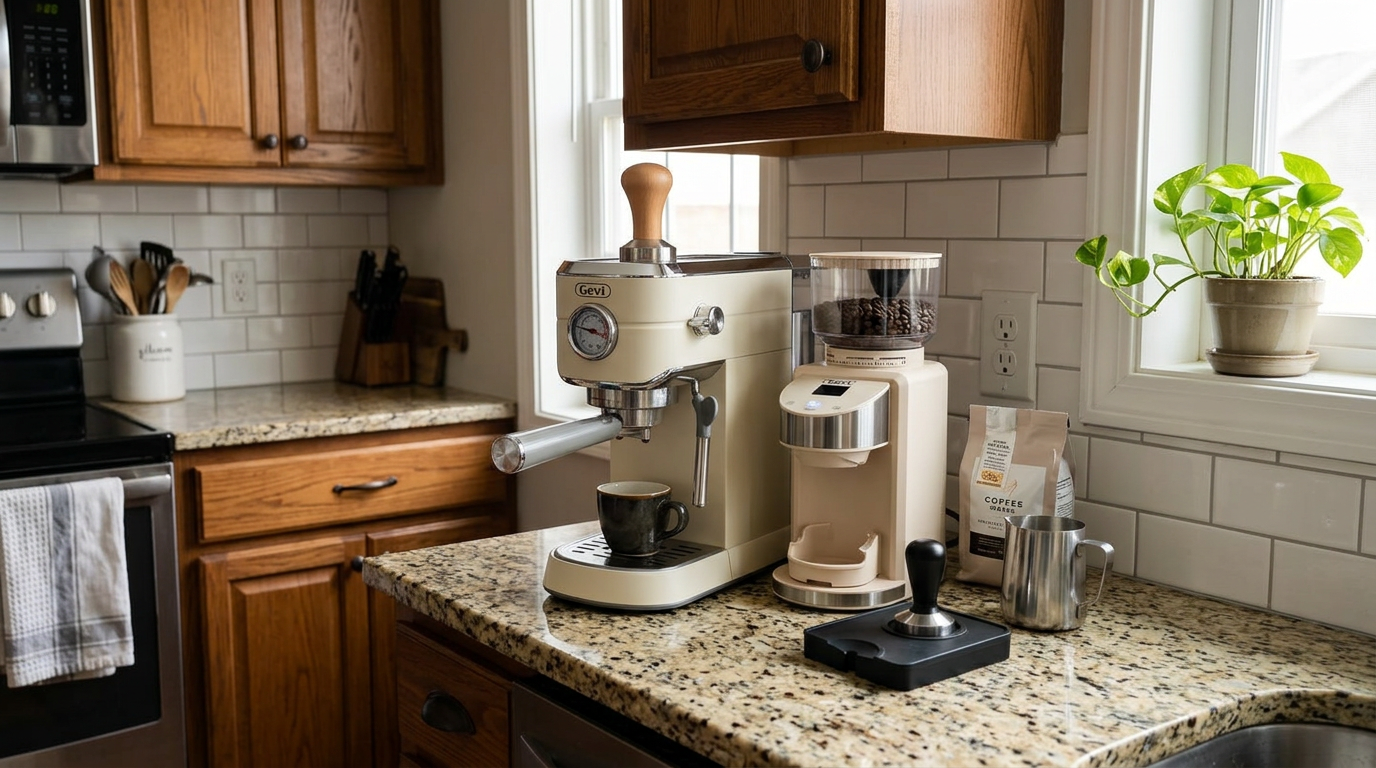
The large drip tray only needed emptying about once a day.
Beans, water and milk
Fresh medium and medium-dark roasts were the easiest to dial in.
Light roasts tasted a bit sour, because the machine's temperature can't be raised.
| Bean type | Espresso | Milk drinks | Notes |
|---|---|---|---|
| Medium-dark blend | Best | Excellent | Grind around 5 |
| Medium roast | Good, brighter | Good | Grind 4 or 5 |
| Light roast | Often sour | Fades in milk | No temperature boost |
| Dark, oily roast | Bitter edge | Strong | Clean burrs often |
| Pre-ground coffee | Pressurized basket only | Okay | Fresh is much better |
Use fresh, filtered water if your tap water is hard, and cold whole milk or barista oat milk for the best foam.
Three weeks with the Gevi, week by week
Week 1: learning
I learned the grinder, tested both basket types and found setting 5 for my beans.
I started single dosing on day three.
Week 2: upgrades and milk
I added a dosing ring and a WDT tool, and my shots became more consistent.
Milk got silky, and I poured my first clean heart.
Week 3: routine
Everything settled into a quick morning routine with very little mess.
The missing shot timer was the only thing I still noticed every day.
Our combined feeling about the machine, from our shared notes.
Common mistakes to avoid
| Mistake | What happens | Better habit |
|---|---|---|
| Trusting the grind buttons for dose | Dose changes with setting | Weigh beans first |
| Grind setting 10 in a non-pressurized basket | Thin, watery shots | Start around 5 |
| Tamping onto a mound | Uneven puck, channeling | Level and stir first |
| Buying a 2-tab bottomless portafilter | Won't lock in | Look for 3-tab |
| Steaming straight after brewing | Wet, weak steam | Purge and wait 3 seconds |
| Light roasts | Sour shots | Medium or medium-dark beans |
What I would change
A numeric display with grind and brew time would make dialing in much easier.
A metal tamper in the box would be a small but welcome upgrade.
And adjustable temperature would open the door to lighter roasts.
Three households, three verdicts
The beginner on a budget
Someone who wants a grinder and real espresso without spending big-brand money.
The Gevi GECGI140-U-3 is an excellent fit.
The latte couple
Two people who each drink one or two milk drinks a day.
It handles that well, with a short wait between brewing and steaming.
The Americano drinker
Someone who drinks two or three large black coffees a day.
The hot water from the steam wand makes Americanos easy, and the big tank means few refills.
The only small catch is that the wand needs a quick purge after steaming milk before you use it for water.
The tinkerer
Someone who wants to adjust temperature, pressure and pre-infusion.
They will outgrow it quickly.
| Household | Fit | Main reason |
|---|---|---|
| Beginners on a budget | Excellent | Grinder, 58 mm, solenoid |
| Latte and cappuccino drinkers | Very good | Silky microfoam |
| Americano drinkers | Very good | Hot water from the wand |
| Tinkerers | Fair | No temperature or gauge |
| One-touch drinkers | Poor | Manual workflow |
Is the Gevi GECGI140-U-3 worth the money?
The Gevi costs far less than the well-known all-in-one grinder machines.
For that, you get a built-in grinder with 30 settings, a 58 mm portafilter, four baskets, pre-infusion and a 3-way solenoid.
What you give up is temperature control, a pressure gauge, a shot timer and a premium tamper.
In my tests, the coffee was much better than the price suggests, especially after adding a scale, dosing ring and WDT tool.
To put it simply, this is the machine I would recommend to a friend who wants to try real espresso without a big commitment.
If they love it, the 58 mm portafilter means they can keep improving it with better baskets and tools, rather than replacing the whole machine.
If they don't, they haven't spent premium money to find out.
Three questions to ask:
Do you want a built-in grinder on a sensible budget?
Will you use a scale while you learn?
Can you live without temperature control and a gauge?
How it compares with other coffee setups
| Feature | Gevi GECGI140-U-3 | Premium all-in-one machine | Compact machine plus grinder |
|---|---|---|---|
| Grinder | Built in, 30 settings | Built in, more control | Separate, extra space |
| Portafilter | 58 mm, 3-tab | Often 54 or 58 mm | Often 51 or 54 mm |
| Temperature | Not adjustable | Adjustable | Varies |
| Pressure gauge | None | Often | Varies |
| Solenoid valve | 3-way | Usually | Rare at entry level |
| Shot timer | None | Often | Rare |
Compared with premium all-in-one machines, the Gevi skips the readouts and temperature control but keeps the features that matter most for taste.
Compared with a compact machine and a separate grinder, it saves space and money.
I also reviewed the Gevi ECMI0 and the Gevi 58mm Commercial if you want to compare models within the brand.
For more options, see my best espresso machines with a grinder.
| You mostly drink | Is the Gevi a fit? | Why |
|---|---|---|
| Double espresso | Very good | Rich shots at grind 5 |
| Lattes and cappuccinos | Very good | Silky microfoam |
| Americanos | Very good | Hot water from the wand |
| Light single origins | Fair | No temperature control |
| One-touch milk drinks | Poor | Manual steaming |
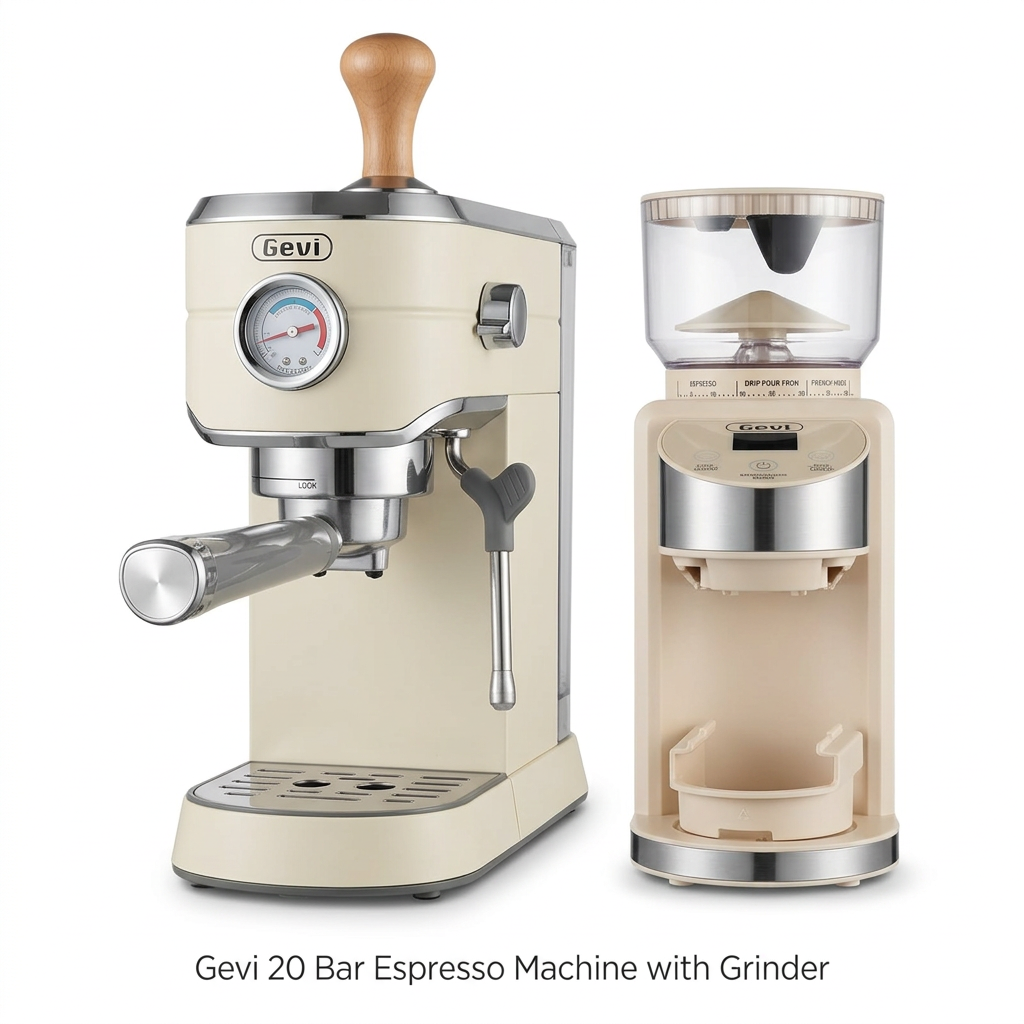
The full package: grinder and hopper on top, 58 mm portafilter and steam wand.
Which one is right for you: is the Gevi 20 Bar GECGI140-U-3 your match?
4 quick questionsGevi 20 Bar GECGI140-U-3 specifications
From manufacturer data and my own testing.
How I tested and scored the Gevi 20 Bar GECGI140-U-3
For three weeks, the Gevi GECGI140-U-3 was our everyday espresso machine for espresso, Americanos, cappuccinos and lattes.
I weighed beans, grounds and shots on a scale, tested the grinder output at several settings, and timed every shot with a phone stopwatch because the machine has no timer.
I compared pressurized and non-pressurized baskets, steamed whole and oat milk for latte art, and tried single dosing and hopper storage.
I also removed the outer burr for cleaning and followed the daily and weekly cleaning routine.
- Espresso (8.2): body, crema, balance and how easy it was to dial in.
- Milk drinks (7.9): steam power, microfoam quality and latte art.
- Ease of use (8.0): workflow, grinder controls, display and included tools.
- Cleaning (7.9): solenoid, drip tray, grinder access and steam wand care.
The overall score of 8 is an editorial rating that reflects those four areas.
Gevi 20 Bar GECGI140-U-3 FAQ
Is the Gevi 20 Bar GECGI140-U-3 worth it?
Yes, if you want a built-in grinder and real espresso on a sensible budget. It lacks temperature control, a gauge and a timer.
How many grind settings does it have?
30, adjusted by turning the bean hopper.
What size is the portafilter?
About 58 mm (2.28 inches), with a 3-tab design.
Will a standard bottomless portafilter fit?
Only if it is a 3-tab version. Standard 2-tab portafilters won't lock in.
What baskets are included?
Two pressurized and two non-pressurized baskets.
How long does it take to heat up?
About 90 seconds in my tests.
Does it have pre-infusion?
Yes, a short low-pressure wetting before full pressure. The length isn't adjustable.
What does the 3-way solenoid do?
It vents pressure from the puck after the shot, so you can remove the portafilter right away and knock out a dry, clean puck.
Can I brew and steam at the same time?
No. It has a single thermoblock, so you wait briefly after the shot for steam.
How much coffee does one grind press make?
It depends on the setting. At setting 0 I got about 6.8 g for one press and 11.6 g for two; at setting 5, two presses gave about 16.3 g.
What grind setting should I use?
For non-pressurized baskets, I started around setting 5 and adjusted one step at a time.
Can I make latte art?
Yes. The single-hole steam wand made smooth microfoam good enough for hearts.
Kitchen & coffee tester
Michael spent six years as a line cook in restaurants in Chicago and New York, and he has tested kitchen appliances for HouseholdMe since 2018, from air fryers to coffee makers. He holds an SCA certificate in barista skills and used the Gevi 20 Bar GECGI140-U-3 as his everyday coffee maker for three weeks for this review.
- Three weeks of hands-on testing of the Gevi 20 Bar GECGI140-U-3
- Gevi product specifications and user manual
- General espresso brewing, dialing-in and milk steaming guidance