Chefman CraftBrew review
The Chefman CraftBrew Espresso Machine is a compact 15-bar espresso maker with touch controls, single and double shots with adjustable volume, a steam wand and a roughly 50-ounce removable tank. Cleanup took under a minute, and the tank lasted over a week of daily doubles. It vibrates while brewing, enough to move light cups.

Michael Reynolds
Hands-on review
Hands-on testing, research, specs
3 weeks
19 minutes
Jargon helpNew to coffee gear? Tap any dotted term to see what it means.
In this review
Yes, if you want a dependable daily espresso with almost no cleanup. The Chefman CraftBrew made a full, consistent double shot, its touch controls were easy to learn, the large tank lasted more than a week of morning doubles and cleaning took under a minute. It vibrates while brewing, so light cups can slide, and the steam wand is basic rather than a latte-art tool.
Chefman CraftBrew at a glance
Chefman CraftBrew pros and cons
- Very quick, simple cleanup
- Large tank lasts over a week of doubles
- Easy touch controls with single and double
- Vibrates enough to move light cups
- Steam wand is basic
- Mostly plastic apart from the front
Who should buy the Chefman CraftBrew?
- Daily espresso and Americano drinkers
- Busy mornings with little time to clean
- Small kitchens
- Latte-first households
- Espresso hobbyists who tweak everything
- People using light, narrow cups
First impressions of the Chefman CraftBrew
Some people love the ritual of espresso: weighing, grinding, tamping, scrubbing every part afterwards.
Many more just want a proper double espresso in the morning without a ten-minute cleanup.
The Chefman CraftBrew Espresso Machine is built for the second group.
It's a compact, 15-bar machine with digital touch controls, single and double shot options, a steam wand and a big removable water tank.
Out of the box, the stainless steel front looked sharper than I expected at this level.
The touch panel is clean and modern, and the whole machine is compact enough to sit beside a toaster without a fight.
On the first morning, I made a double espresso, knocked out the grounds into the trash and rinsed the parts under the tap.
The whole cleanup took less than a minute, and that set the tone for the next three weeks.
There was one surprise: the machine vibrates noticeably while it brews.
My lightest espresso cup shuffled across the drip tray on the second day.
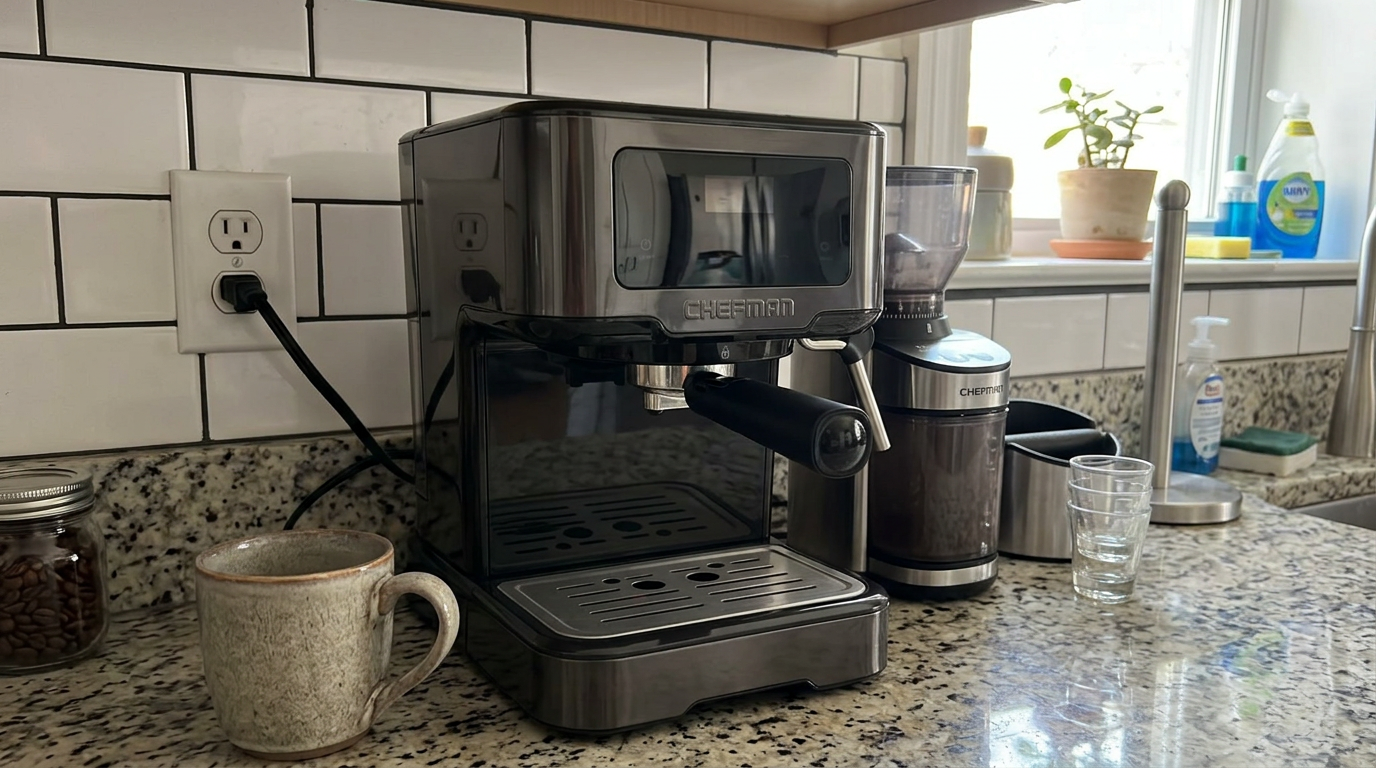
The stainless front and touch panel look sharp on the counter.
What the Chefman CraftBrew actually is
The CraftBrew is a semi-automatic espresso machine.
You add ground coffee to the portafilter✕PortafilterThe handle with a metal basket that holds the ground coffee and locks into the machine during brewing., lock it in and choose a single or double shot on the touch panel.
A steam wand✕Steam wandThe metal pipe that blasts steam into milk to heat it and create foam for cappuccinos and lattes. on the side lets you froth milk for lattes and cappuccinos.
What's in the box
Our tip: Use heavy, flat-bottomed espresso cups from day one, because the CraftBrew vibrates while brewing and light cups can slide across the tray.
Design and counter space
The CraftBrew is compact: about 9 inches wide, 11 inches deep and 12 inches tall.
That's small enough for a narrow counter, and it fit easily under our cabinets.
The stainless front panel looks premium; the sides and top are mostly plastic.
The water tank
The removable tank holds about 50 ounces, roughly 1.5 liters.
It lifts out easily to fill at the sink.
For a single person making a morning double, it lasted more than a week between refills.
Daily use patterns, approximate.
Our tip: Empty the tank and refill with fresh water every few days, even if it isn't empty, because water sitting for a week makes espresso taste flat.
Touch controls and shot options
The touch panel has buttons for single shot, double shot and steam, plus power.
The controls are clear, and the panel lights show what's active.
You can adjust the shot volume, so a "double" can be shorter or longer depending on how you like it.
Single vs double
The single shot is a short, concentrated serving for a quick espresso.
The double makes a substantial shot that fills a typical espresso cup, which is what I drank most mornings.
| Button | What it makes | When I used it |
|---|---|---|
| Single | Short single espresso | Afternoon pick-me-up |
| Double | Full double espresso | Every morning |
| Steam | Steam for milk | Lattes and cappuccinos |
| Adjusted volume | Shorter or longer shots | To fine-tune strength |
Our tip: Shorten the double shot volume a little if your espresso tastes watery, because a slightly shorter shot is richer and less bitter.
Setup and first shots
Setup took about ten minutes.
I washed the portafilter, baskets and tank, filled the tank, and ran water through the group head and the steam wand twice.
That flushed out any factory taste and warmed the system.
| Step | What I did | Time |
|---|---|---|
| Wash parts | Portafilter, baskets, tank, tray | 4 min |
| Fill tank | About 50 oz at the sink | 1 min |
| Flush group head | Two water-only doubles | 1 min |
| Flush steam wand | Steam into a cup of water | 30 s |
| First shot | Double, fresh espresso grind | 1 min |
Throw away the first few shots
My first two shots tasted a little metallic and thin.
By the third, the flavor was clean and the crema looked right.
Our tip: Pull two or three practice shots with cheap coffee before using your good beans, because the first shots on a new machine always taste a little off.
The 15-bar pump, explained
The 15-bar figure is the pump's maximum rating, not the pressure at the coffee.
Real espresso is usually brewed at around 9 bar at the puck, and the pump's extra headroom helps it reach that consistently.
More bar on the box doesn't automatically mean better espresso.
Pump rating vs the typical espresso brewing target.
Temperature
The CraftBrew heats quickly and was ready to brew within a minute or two in my tests.
Back-to-back doubles tasted consistent, and I didn't notice the second shot tasting hotter or cooler.
Steaming milk heats the system further, so I always made espresso first and milk second.
Our tip: Brew your espresso before steaming milk, because after steaming the water is hotter than ideal and the next shot can taste bitter.
Dosing and tamping guide
Most poor shots on small machines come from too little coffee or an uneven tamp.
These are the doses that worked best for me with the CraftBrew's baskets.
Fresh espresso grind, weighed on a kitchen scale.
How I tamped
- Fill: scoop coffee until the basket is level or slightly heaped.
- Settle: tap the portafilter gently on the counter to settle the grounds.
- Level: sweep across the top with a finger so the bed is flat.
- Tamp: press straight down firmly with the tamper, keeping it level.
- Check: the surface should look smooth and even, with no gaps at the edge.
What changed the shot most
In order, the grind, the dose and then the tamp made the biggest difference.
The adjustable volume was the final fine-tune once the first three were right.
| Change | Effect | How big |
|---|---|---|
| Finer grind | Slower, richer shot | Big |
| More coffee | Fuller body | Big |
| Firmer, level tamp | More even shot | Medium |
| Shorter volume | Stronger, less bitter | Medium |
Our tip: Weigh your dose once with a kitchen scale, because it shows you how full the basket should look and makes every later scoop more consistent.
Build and reliability after three weeks
Over three weeks and around 40 shots, the CraftBrew worked without a fault.
No leaks, no error lights and no change in shot quality from week one to week three.
From my test log.
What to keep an eye on
The plastic body and the vibration are the two things I'd watch over a longer period.
A machine that shakes can loosen fittings over time, so check that the drip tray and tank stay firmly seated.
Regular descaling and wiping will help it last.
Our tip: Check once a week that the drip tray and water tank are seated firmly, because the vibration can slowly nudge loose parts out of place.
Espresso quality
With fresh espresso-ground coffee and a firm tamp✕TampingPressing the ground coffee flat and firm in the basket, so water flows through it evenly instead of finding weak spots., the double shot was a solid everyday espresso.
It had a reasonable layer of crema✕CremaThe golden-brown foam on top of an espresso. It forms when pressure pushes gases and oils out of freshly ground coffee., a full body and a classic, roasty taste.
It isn't a machine for chasing perfect, nuanced shots, but it's consistent enough to rely on every morning.
Double-shot size
The double fills a regular espresso cup.
That's a satisfying serving for people who want a traditional double rather than a tiny sip.
Double shots, averaged over three weeks.
Getting the best shot
| What you taste | Likely cause | First change |
|---|---|---|
| Sour, thin | Grind too coarse or light tamp | Grind finer, tamp firmer |
| Bitter, harsh | Shot too long | Shorten the volume |
| Watery | Old coffee or too little coffee | Fresh coffee, full basket |
| Weak in milk | Single shot | Use the double |
For a closer look at shot length, my explainer on ristretto vs espresso vs lungo shows what changing volume does to taste.
Our tip: Fill the double basket right to the top before tamping, because an under-filled basket gives thin, watery espresso.
The vibration issue
This is the CraftBrew's most noticeable drawback.
The machine shakes while it brews, enough to move a light cup.
On day two, my thin-based espresso cup slid toward the edge of the drip tray during a double shot.
Why it matters
Most of the time, the cup just shuffles a little.
But with a light, narrow cup, it can end up half off the spout, and you lose some espresso.
What fixed it
A heavier cup with a wide, flat base stayed put every time.
Making sure the machine sat on a flat, solid counter helped too.
My observations over many shots.
Our tip: Put a small silicone mat or folded cloth under the machine if your counter is very smooth, because it can damp some of the vibration.
Cleaning: the CraftBrew's best feature
Easy cleaning is the main reason I'd recommend this machine.
After brewing, I removed the portafilter, knocked the used grounds straight into the trash and rinsed the parts under running water.
That's it.
Why that matters
Cleaning is where many people give up on home espresso.
If tidying the machine takes several minutes every morning, it starts to feel like a chore.
With the CraftBrew, cleanup took less than a minute, so I never put it off.
My daily hands-on cleaning time.
| Task | What it removes | How often |
|---|---|---|
| Knock out grounds | Used coffee | After every shot |
| Rinse portafilter and basket | Coffee residue | After every shot |
| Wipe and purge steam wand | Milk | After every milk drink |
| Empty drip tray | Water and drips | Every 1 to 2 days |
| Rinse water tank | Film | Weekly |
| Descale | Mineral scale | Every 1 to 3 months |
Descaling
Like every machine that heats water, scale builds up over time.
Descaling✕DescalingRunning a mild acid solution through the machine to dissolve mineral scale left by hard water. Scale slows heating and can block pipes. every one to three months, depending on your water, keeps it brewing at the right temperature.
Our tip: Rinse the basket while it's still warm, because coffee oils come off easily now but harden into a sticky film if left for hours.
The steam wand and milk drinks
The CraftBrew includes a steam wand for lattes, cappuccinos, flat whites and macchiatos.
I'll be honest: I used it less than any other part of the machine, because I mostly drank straight espresso.
Over three weeks, I steamed milk for roughly a dozen drinks.
What I found
The wand produced enough steam to heat and froth milk for a basic latte or cappuccino.
With cold whole milk and a small pitcher, I got a decent, creamy foam.
It took a few tries to get the right position, as it does on most small machines.
I wouldn't call it a latte-art machine, but for everyday milk drinks it does the job.
How I steamed milk
- Cold milk: whole milk straight from the fridge, pitcher half full.
- Purge: open the steam briefly into the tray to clear water.
- Stretch: tip just under the surface to add air for a few seconds.
- Spin: sink the tip slightly and tilt the pitcher to create a whirlpool.
- Wipe: clean the wand immediately after steaming.
About a dozen drinks. Treat as a first impression.
Our tip: Steam milk right after brewing your espresso, and wipe the wand within seconds, because dried milk on a hot wand is hard to remove.
Drinks I made most
| Drink | How I made it | Tip |
|---|---|---|
| Double espresso | Double button, fresh grind | Heavy, wide cup |
| Single espresso | Single button | Afternoon |
| Americano | Double shot into hot water | Water first, espresso on top |
| Cappuccino | Double plus about 4 oz foamy milk | Stretch milk a little longer |
| Latte | Double plus about 7 oz silky milk | Short stretch, more spin |
| Iced latte | Double over ice, cold milk | Few ice cubes, stir |
The Americano
Brewing a double shot into a mug of hot water gave a long, clean black coffee.
Pouring espresso onto water, rather than water onto espresso, kept some crema on top.
The iced latte
A double over a few ice cubes, topped with cold milk, made a quick iced latte on warm afternoons.
For more on chilled coffee, see my guide to iced coffee vs cold brew.
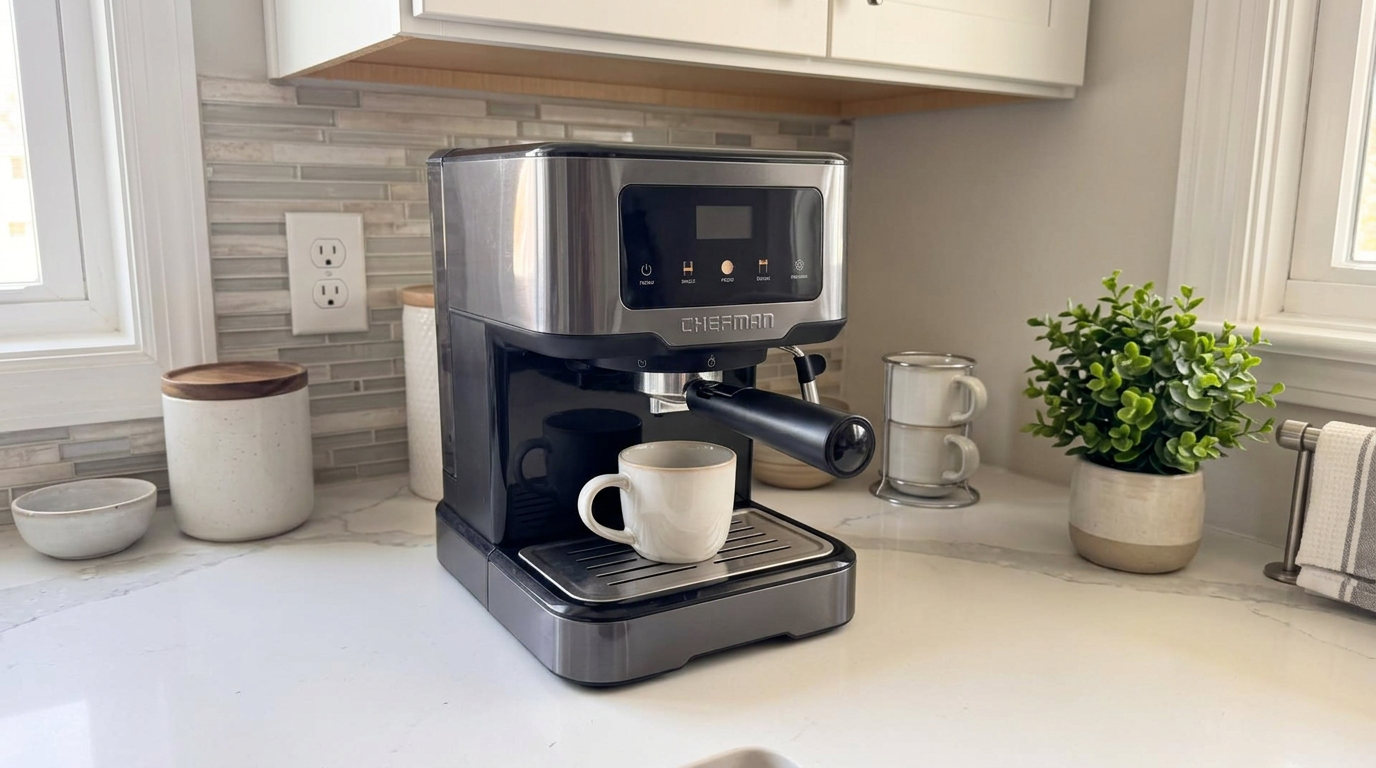
The steam wand handled basic lattes and cappuccinos with whole milk.
Our tip: Add hot water to the mug first and the espresso second for an Americano, because pouring espresso on top keeps more crema.
What daily use is really like
A typical morning took about three minutes, start to finish, for a double espresso.
Switch on, scoop and tamp, lock in, press double, then knock out and rinse while I drank.
On latte days, add about two minutes for steaming and wiping.
My average hands-on time per drink.
Noise
The pump is noticeable while brewing, along with the rattle of the vibration.
It's not unusually loud for a pump machine, but you'll hear it from the next room.
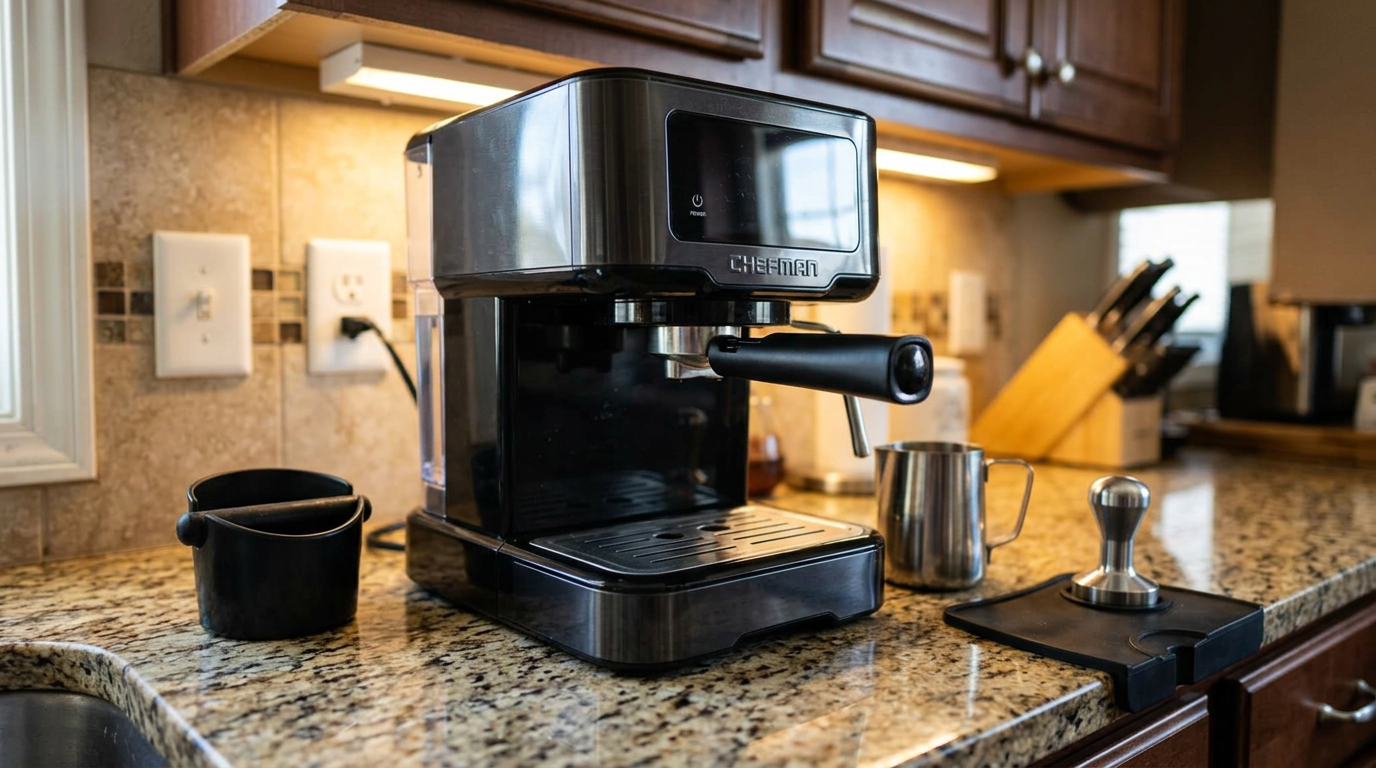
A heavy, wide cup stayed put on the drip tray during brewing.
Coffee and grind
Fresh coffee made the biggest difference to the CraftBrew's shots.
Medium-dark roasts gave the fullest, most chocolatey double.
Pre-ground espresso coffee worked well from a freshly opened bag, but faded quickly after a week or two.
| Coffee | Straight espresso | Milk drinks | Verdict |
|---|---|---|---|
| Medium-dark, fresh-ground | Full, chocolatey | Excellent | Best overall |
| Medium roast, fresh-ground | Balanced | Very good | Great all-rounder |
| Pre-ground espresso, fresh | Good | Good | Easiest start |
| Light roast | Sour, thin | Fades in milk | Avoid |
| Drip-grind coffee | Watery | Weak | Avoid |
Grinder or no grinder?
You can start with pre-ground espresso coffee.
If you want better shots, a burr grinder✕Burr grinderA grinder that crushes beans between two abrasive plates, giving even particles. Blade grinders chop unevenly and make espresso harder to control. is the most valuable upgrade.
My guide on burr vs blade grinders explains why blade grinders struggle with espresso.
Our tip: Buy small bags of espresso-ground coffee and finish each within two weeks, because pre-ground coffee loses aroma quickly once opened.
Accessories worth adding
The CraftBrew works fine out of the box, but a few small extras made a real difference in my test.
None of them are expensive, and all of them solve a specific problem I ran into.
| Accessory | Problem it solves | Worth it? |
|---|---|---|
| Heavy, wide-base espresso cups | Cups sliding from vibration | Yes, top priority |
| Small 12 oz milk pitcher | Hard to control foam | Yes, for milk drinks |
| Kitchen scale | Inconsistent doses | Yes |
| Knock box | Messy trash bin | Nice to have |
| Silicone mat under the machine | Vibration on smooth counters | Nice to have |
| Burr grinder | Flat, stale shots | Yes, if you're serious |
Start with the cups
If you buy only one thing, make it a pair of heavy espresso cups with flat, wide bases.
It fixed the CraftBrew's most annoying habit in one go.
Then a scale
A cheap kitchen scale that reads in grams helped me find the right dose in two days, instead of two weeks of guessing.
Our tip: Buy a knock box or keep a small container by the machine for grounds, because walking to the trash with a dripping portafilter is the messiest part of the routine.
A simple care calendar
Looking after the CraftBrew takes very little time if you spread it out.
This is the schedule I followed during the test, and the one I'd keep long term.
| When | Task | Time |
|---|---|---|
| After every shot | Knock out grounds, rinse basket | 30 s |
| After every milk drink | Purge and wipe steam wand | 15 s |
| Every 1 to 2 days | Empty and rinse drip tray | 1 min |
| Every few days | Fresh water in the tank | 1 min |
| Weekly | Soak basket and portafilter in hot water | 10 min, hands-off |
| Weekly | Wipe the group head with a damp cloth | 1 min |
| Every 1 to 3 months | Descale | About 30 min, mostly waiting |
Weekly hands-on care time, my estimate.
Water makes it easier
Filtered water meant less scale and fresher-tasting espresso.
In soft-water areas, you may only need to descale every two or three months.
Our tip: Wipe the group head with a damp cloth once a week, because old grounds stuck around the gasket make shots taste stale and can stop the portafilter sealing well.
Three weeks with the CraftBrew, week by week
Week 1: easy start
The controls took minutes to learn, and cleanup was quick from the first shot.
The vibration surprised me, and my light cups wandered on the tray.
Week 2: the right cup
I switched to a heavy, wide-based cup and the problem disappeared.
I adjusted the double volume slightly shorter for a richer shot.
Week 3: routine
A double every morning, an Americano or latte some afternoons.
The water tank lasted over a week with my daily double.
Our combined feeling about the machine, from shared notes.
Common mistakes to avoid
| Mistake | What happens | Better habit |
|---|---|---|
| Using light, narrow cups | Cup slides during brewing | Heavy, flat-based cup |
| Machine on an uneven surface | More vibration | Level, solid counter |
| Under-filling the basket | Thin, watery shots | Fill to the top, tamp firmly |
| Drip-grind coffee | Weak, sour espresso | Use espresso grind |
| Leaving grounds in the portafilter | Sticky, hard to clean | Knock out straight away |
| Forgetting the wand | Baked-on milk | Wipe immediately |
What I would change
Better internal damping would solve the vibration completely.
A little more weight in the base would help the machine sit firmer.
And a bigger drip tray would mean emptying it less often on milk-drink days.
Three households, three verdicts
The daily espresso drinker
One or two doubles a day, with as little cleanup as possible.
This is the CraftBrew's sweet spot.
The latte household
Mostly milk drinks every day.
The steam wand works, but there are better machines if milk is your priority.
The espresso hobbyist
Someone who wants to tweak every variable and chase the perfect shot.
They'll find it too basic.
| Household | Fit | Main reason |
|---|---|---|
| Daily espresso drinker | Excellent | Quick shots, quick cleanup |
| Busy mornings | Very good | Under a minute to clean |
| Small kitchen | Very good | Compact footprint |
| Latte-first household | Fair | Wand works, but basic |
| Espresso hobbyist | Poor | Limited control |
Is the Chefman CraftBrew worth it?
The CraftBrew is worth it if your priority is a good daily espresso with minimal fuss.
Its best qualities are the ones you feel every day: easy cleaning, a big tank and simple shot choices.
Its weak point is vibration, which is easy to manage once you know about it.
Three questions to ask:
Do you mostly drink straight espresso or Americanos?
Do you hate long cleanup routines?
And do you have a heavy, flat-based cup, or are you happy to buy one?
If yes, the Chefman CraftBrew is a practical choice for your mornings.
How it compares with other coffee setups
| Feature | Chefman CraftBrew | Pod espresso machine | Larger manual espresso machine |
|---|---|---|---|
| Coffee | Ground coffee, your choice | Pods only | Fresh-ground beans |
| Cleanup | About 1 minute | Throw away pod | Several minutes |
| Shot options | Single, double, adjustable volume | Fixed sizes | Full control |
| Milk | Steam wand | Often separate frother | Steam wand, more power |
| Water tank | About 50 oz | Usually smaller | Varies |
| Stability | Vibrates | Usually stable | Usually heavier |
Compared with a pod espresso machine, the CraftBrew lets you choose your own coffee and steam milk, with only a little more effort.
Compared with a larger manual machine, it gives up control and stability but saves a lot of cleaning and counter space.
| You mostly drink | Is the CraftBrew a fit? | Why |
|---|---|---|
| Double espresso | Excellent | Full double, quick cleanup |
| Americanos | Very good | Big tank, easy shots |
| Lattes daily | Fair | Basic wand |
| Latte art | Poor | Limited milk control |
| Espresso in light designer cups | Poor | Vibration moves cups |
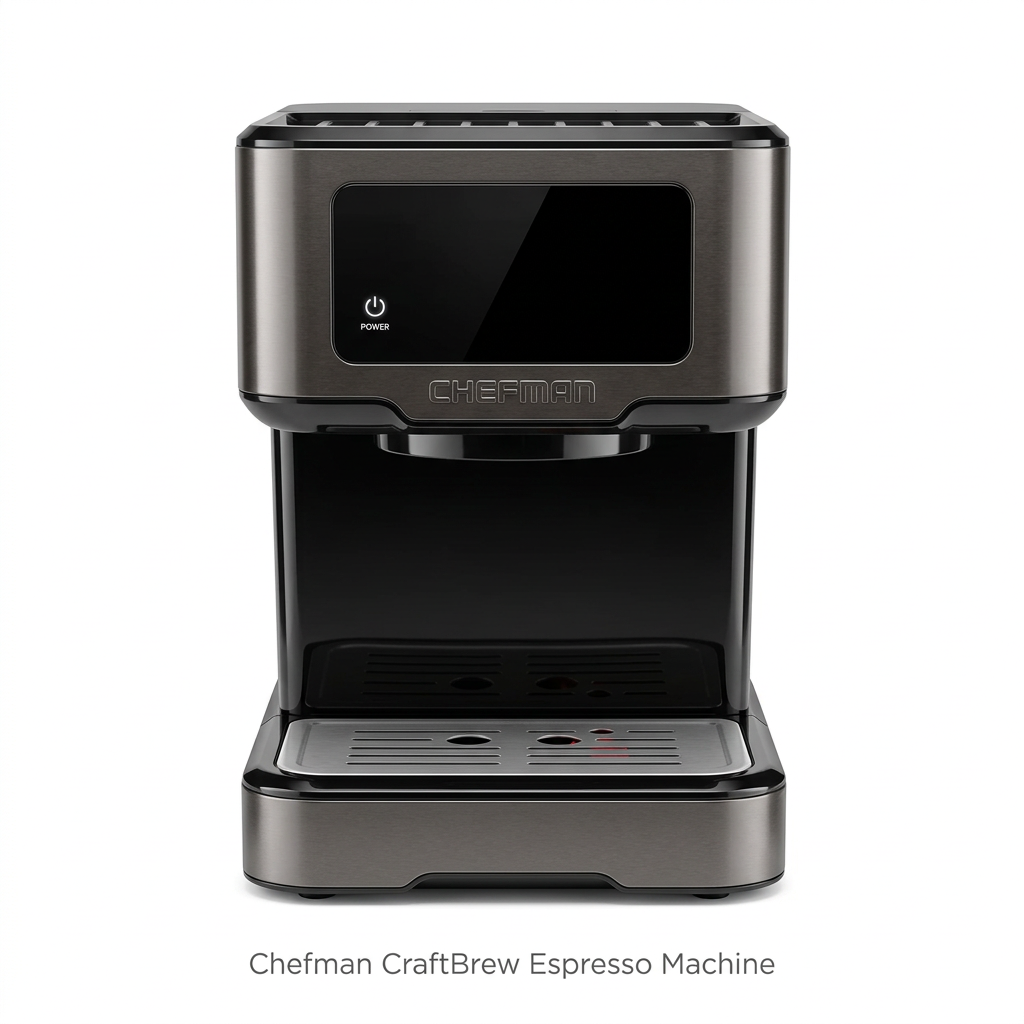
The full package: stainless front, touch panel, portafilter and steam wand.
Which one is right for you: is the Chefman CraftBrew your match?
4 quick questionsChefman CraftBrew specifications
From manufacturer data and my own testing.
How I tested and scored the Chefman CraftBrew
For three weeks, the Chefman CraftBrew was our everyday espresso machine, mostly for double espressos and Americanos.
I kept notes after every session and tracked tank refills and cleanup time.
I tested four kinds of coffee, adjusted shot volume and tried five different cups to measure the vibration issue.
I steamed milk for about a dozen lattes and cappuccinos, so treat the milk score as a first impression.
Finally, I checked my notes against Chefman's product information and manual.
- Espresso (7.6): crema, body and consistency of single and double shots.
- Milk drinks (6.8): steam wand performance in a limited number of lattes and cappuccinos.
- Ease of use (8.2): touch controls, shot options, tank and daily routine.
- Cleaning (9.0): knock-out, rinsing, drip tray and descaling.
The overall score of 7.6 is an editorial rating that reflects those four areas.
Chefman CraftBrew FAQ
Is the Chefman CraftBrew easy to clean?
Yes. Knock the grounds into the trash and rinse the portafilter and basket under the tap. It took under a minute.
How big is the water tank?
About 50 ounces, or 1.5 liters. It lasted more than a week of one double a day.
Does it make single and double shots?
Yes, and you can adjust the shot volume on the touch panel.
Why does my cup move while brewing?
The machine vibrates during extraction. A heavy, flat-based cup stays put.
Can it make lattes and cappuccinos?
Yes, with the steam wand. In my limited testing it made decent foam with cold whole milk.
How much pressure does it use?
It has a 15-bar pump.
Can I use pre-ground coffee?
Yes. Fresh, espresso-ground coffee works well. A burr grinder improves results.
Is it loud?
The pump and vibration are noticeable but not unusually loud for a pump machine.
Does it fit under cabinets?
Yes. It is about 11.9 inches tall.
How do I make an Americano?
Brew a double shot into a mug of hot water.
How often should I descale?
Every one to three months, depending on water hardness.
Is it good for beginners?
Yes, for people who want simple espresso. Espresso hobbyists may want more control.
Kitchen & coffee tester
Michael spent six years as a line cook in restaurants in Chicago and New York, and he has tested kitchen appliances for HouseholdMe since 2018, from air fryers to coffee makers. He holds an SCA certificate in barista skills and used the Chefman CraftBrew as his everyday coffee machine for three weeks for this review.
- Three weeks of hands-on testing of the Chefman CraftBrew espresso machine
- Chefman product information and user manual
- General espresso brewing and milk-steaming guidance