Breville vs Philips espresso machines: hands-on or push-button?
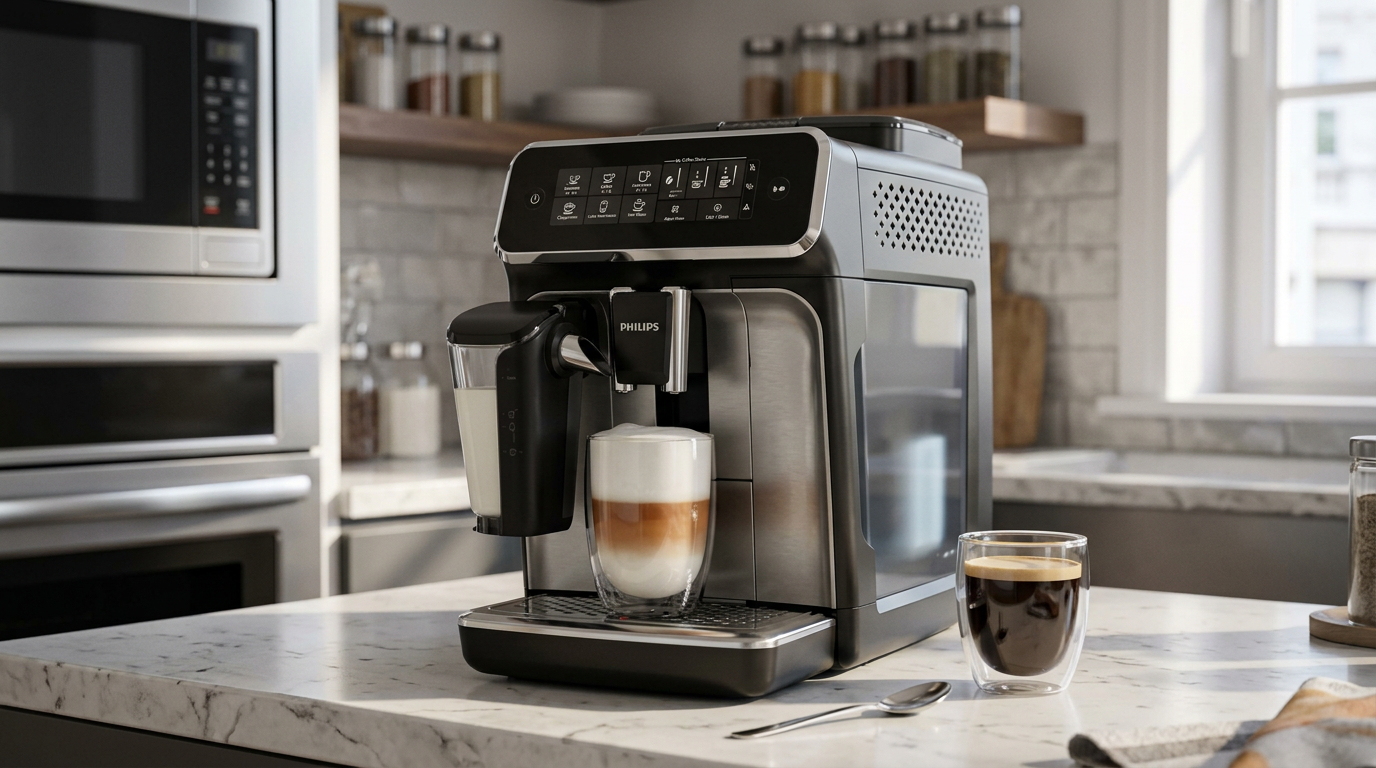
These two sit in the same price bracket and answer the same question in opposite ways. The Breville Barista Express hands you a portafilter, a tamper and a steam wand and asks you to learn, while the Philips 3200 grinds, brews and froths at one touch and asks nothing of you. I used each as my only coffee maker for four weeks, weighed every dose and timed every morning to find out which approach suits which home.
We choose products independently. We may earn a commission through links on this page; your price stays the same. Affiliate policy
Jargon helpNew to espresso? Tap any dotted term to see what it means.
In this comparison
If coffee flavor matters most and you’ll enjoy a few minutes of hands-on work, buy the Breville Barista Express. It used almost twice as much coffee per shot and made far richer espresso and better milk, including latte art. If you want five drinks at one touch and the easiest milk cleaning I know, buy the Philips 3200. Its coffee is milder, closer to a lungo than a café espresso, but nobody in your house will ever need instructions.
The two machines
Specs checked November 14, 2026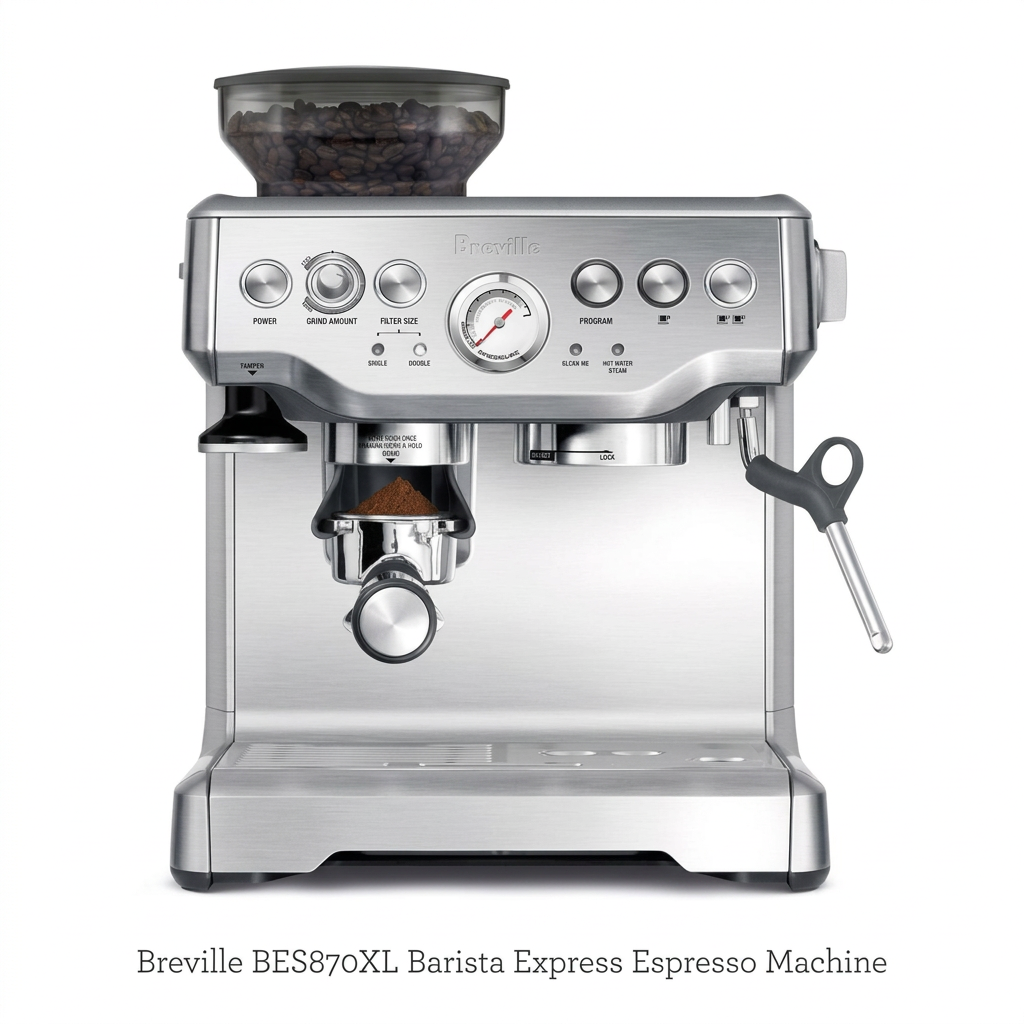
A built-in 16-step grinder, a 54 mm portafilter, a real pressure gauge and a manual steam wand that can pour latte art once you practice.
Check price on Amazon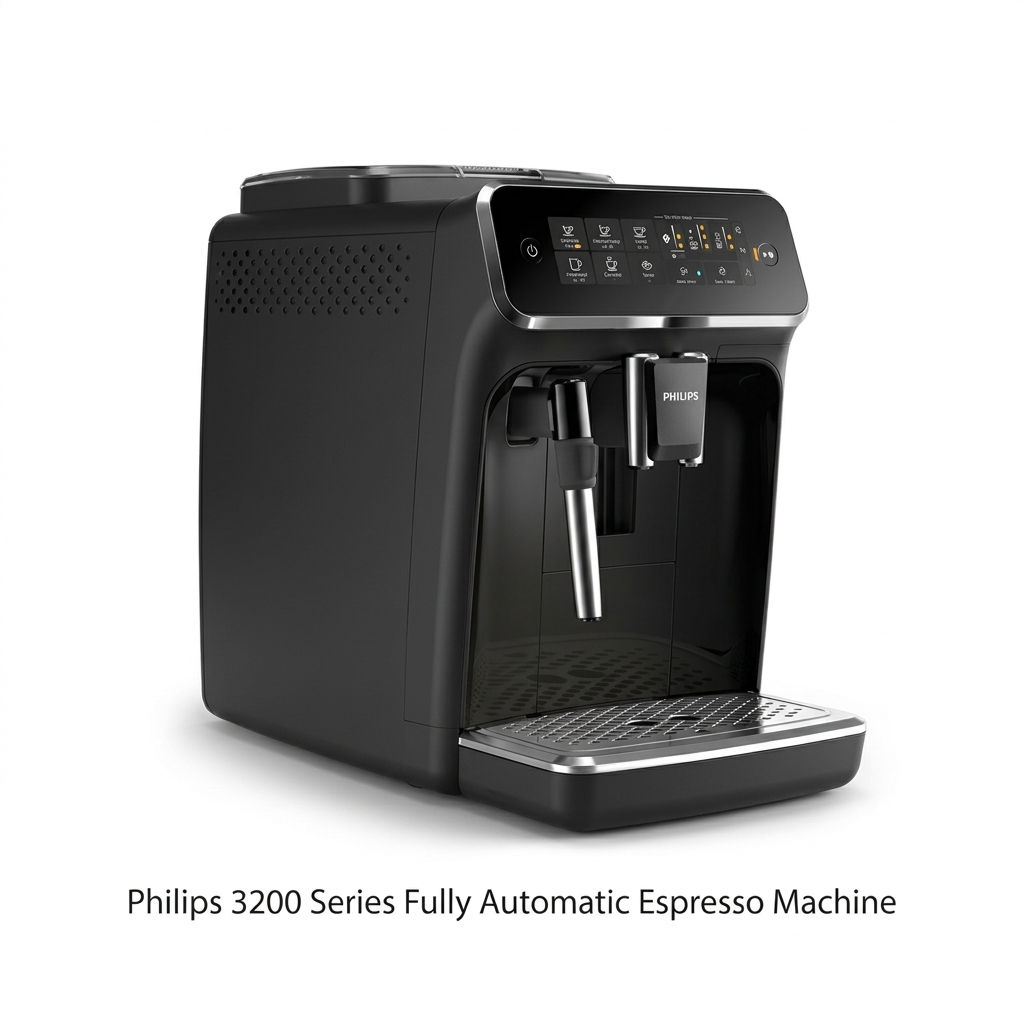
Five one-touch drinks, a two-part LatteGo milk jug with no tubes, a removable brew group and an AquaClean filter in the box.
See Today’s PriceBreville vs Philips at a glance
- Buy the Breville if you want café-strength espresso and are willing to learn.
- Buy the Philips if you want one-touch drinks and almost no cleanup.
- The biggest difference is dose: the Breville uses roughly twice as much coffee per shot.
- For latte art you need the Breville; for milk drinks with no effort you want the Philips.
Head to head
The better result in each row is marked, based on my testing and the manufacturer specs. Rows where they are equal have no winner.
The tally is not my verdict. A busy household may care only about the last few rows.
| Spec | Breville Barista Express | Philips 3200 |
|---|---|---|
| Espresso flavormy tasting, same beans | Sweet, syrupy, full body ✓ Best | Mild, lungo-style |
| Coffee per drink | About 15.4 g double ✓ Best | About 8 g |
| One-touch drinks | None | 5 ✓ Best |
| Learning curve | About a week | None ✓ Best |
| Milk texture | Real microfoam, latte art ✓ Best | Creamy foam, not café-smooth |
| Milk cleaning | Wipe and purge the wand | Two parts, about 10 s ✓ Best |
| Pressure feedback | Analog gauge ✓ Best | None needed |
| Grinder | Steel conical, 16 steps ✓ Best | Ceramic, 12 steps |
| Water tank | About 67 oz ✓ Best | 1.8 liters, about 61 oz |
| Water filter | Yes | AquaClean, up to 5,000 cups without descaling ✓ Best |
| Footprint | 12.5 x 13.8 in | 9.7 x 17 in ✓ Best |
| Daily hands-on timewith milk drinks | About 6 min | About 3 min ✓ Best |
| Rows won | 6 | 6 |
Breville vs Philips pros and cons
Breville Barista Express
- Sweet, syrupy espresso once dialed in
- Pressure gauge makes dialing in easy to learn
- Steam wand can make real latte-art microfoam
- Grinder needs an inner-burr tweak out of the box
- Slow steam and a wait between brewing and frothing
- No low-water sensor on the tank
Philips 3200
- Five one-touch drinks, including latte macchiato
- LatteGo jug has no tubes and rinses clean fast
- Removable brew group and AquaClean filter included
- Mild espresso from a small coffee dose
- Milk foam is good, not café-smooth
- Mostly plastic body and a small drip tray
Who should buy which machine?
- Espresso lovers who want café strength
- People who enjoy learning and tinkering
- Latte art at home
- Mixed households with different drinks
- Anyone who hates cleaning milk systems
- Mornings with no time to spare
Hands-on vs push-button: what you are really choosing
Breville and Philips both make espresso machines, but these two are built around opposite ideas. Understanding that matters more than any single spec.
The Breville Barista Express is a semi-automatic✕Semi-automaticA machine where you grind, dose and tamp into a portafilter yourself, and the machine controls the water and pressure.. It grinds into a portafilter✕PortafilterThe handle with a metal basket that holds the ground coffee. You lock it into the machine to brew., and you tamp, lock in, start and stop the shot, then steam milk with a wand.
The Philips 3200 is a super-automatic✕Super-automaticA machine that grinds, doses, tamps, brews and usually froths milk at the press of a button, with no portafilter to handle.. You press a picture of a drink, and it grinds, doses, presses, brews and froths inside the case, dropping the used puck into a drawer.
| Step | Breville Barista Express | Philips 3200 |
|---|---|---|
| Grind | Built in, timed | Built in, automatic |
| Dose | You check with a scale | Automatic, about 8 g |
| Tamp | By hand | Automatic |
| Brew | You start and stop | One touch |
| Milk | Manual steam wand | LatteGo, one touch |
| Puck | Knock out by hand | Drops into a drawer |
The trade is simple. Every step you do yourself is a step you can do better than a machine, and also a step you have to do at 6:30 a.m.
There is no wrong answer. A super-automatic gives up some flavor for consistency and speed, and a semi-automatic gives up some convenience for control and a better cup.
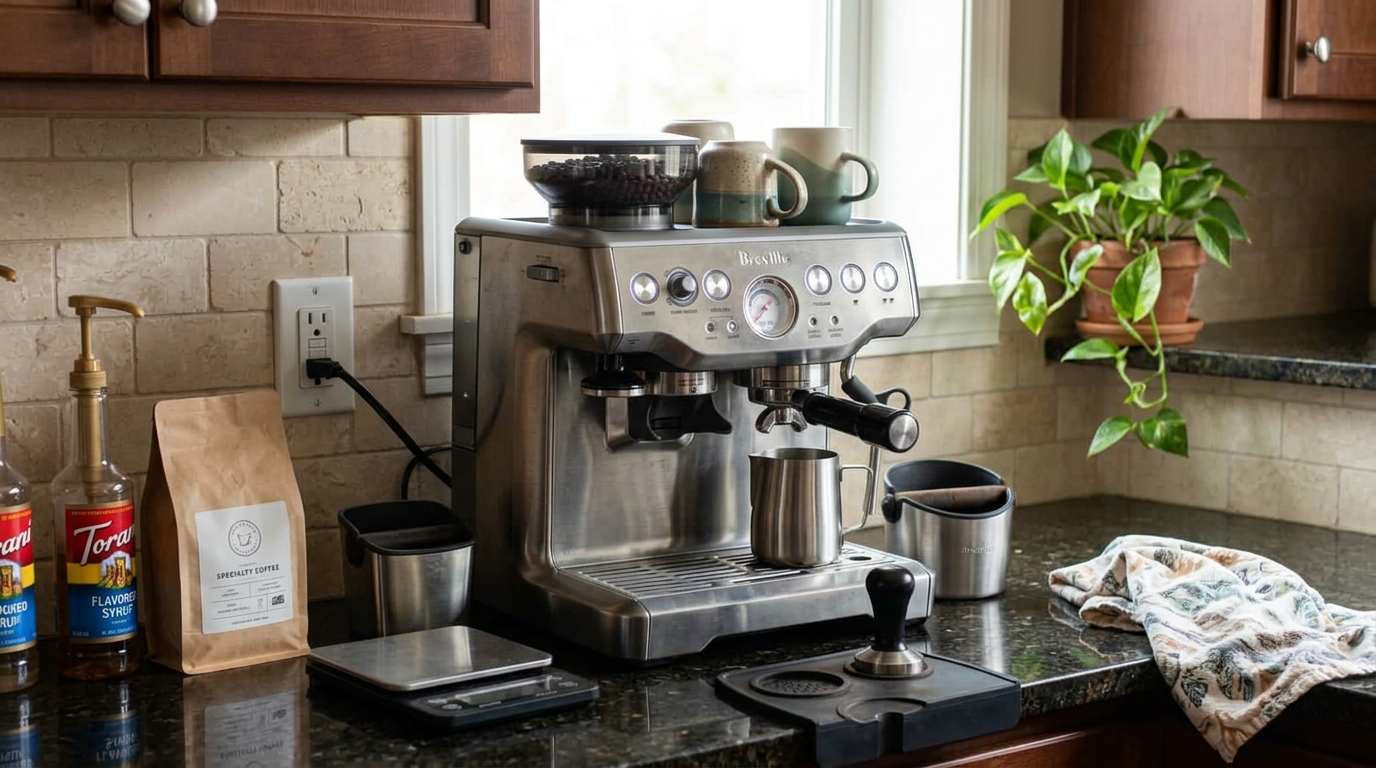
The Barista Express puts every step of espresso in your hands.
Our tip: Picture your busiest weekday morning, not a lazy Sunday, before you choose, because that is when a hands-on machine either delights you or gets left unused.
Design, size and build
The Breville looks like a small café machine, with brushed steel, a big pressure gauge and a bean hopper on top. At roughly 22 to 23 pounds, it stays put when you lock in the portafilter.
The Philips is a tidy plastic box with a touch panel and a milk jug that clips to the front. It weighs about 17.6 pounds, so it’s easy to slide forward.
Width on the counter
The Philips is narrower but deeper.
The Philips is narrower but deeper. The Breville is wider, and you will want room beside it for a knock box, a milk jug and a tamping mat.
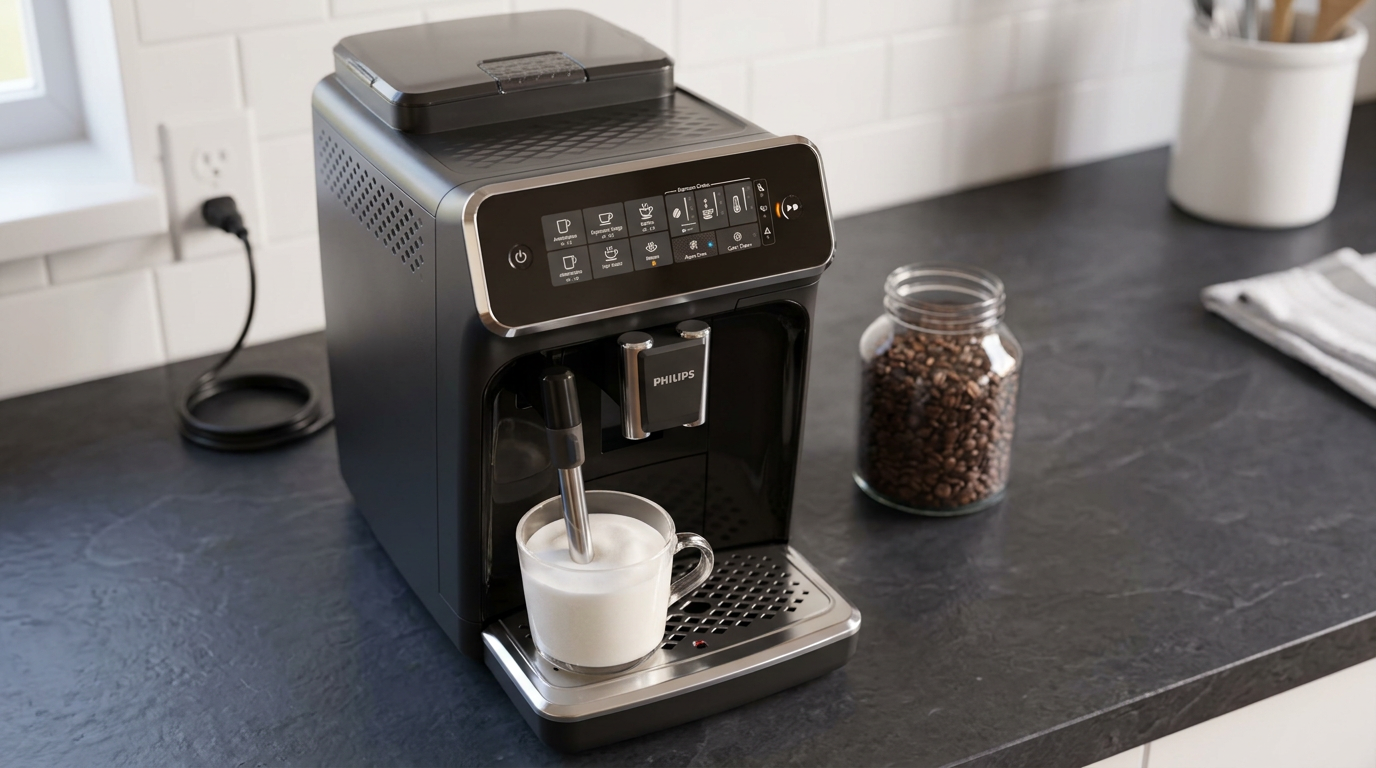
The Philips 3200 is a compact, all-in-one box with nothing else to store.
Build quality favors the Breville. Its steel body and heavy portafilter feel premium, while the Philips is mostly plastic with a small drip tray that filled quickly.
Our tip: Empty the Philips drip tray every day even if the float isn’t up yet, because its small tray overflows easily after a few rinse cycles.
Setup and the learning curve
The Philips was making good drinks within 15 minutes of opening the box. The Breville took me most of a week to master.
Breville: plan on a week
Out of the box, the Breville’s grinder ran a little coarse. I lifted the hopper and moved the upper burr from 6 to 2, so the side dial had enough fine steps.
Then I weighed doses until I hit about 15.4 grams every time and aimed for a 1:2 brew ratio✕Brew ratioThe weight of dry coffee compared with the weight of liquid espresso. 1:2 means 18 g of coffee makes 36 g of espresso.: 30 grams out in 25 to 30 seconds. My first properly dosed shot hit 30 grams in 27 seconds.
Philips: minutes
On the Philips, setup is water hardness, the AquaClean✕AquaClean filterPhilips’ water filter. Used as directed, it cuts scale so you descale far less often. filter and a rinse. Then you press a drink, and it’s done.
The only setting I changed was moving to the strongest aroma and a slightly finer grind, which helped its mild espresso.
How confident I felt, by week
My own rating of how reliably I got the drink I wanted.
Grinder and dose: the biggest difference
If you remember one number from this comparison, make it the dose✕DoseThe weight of ground coffee used for one drink. A bigger dose gives a stronger, fuller cup.. It explains most of the taste difference between these machines.
I stopped the Philips right after it ground and weighed the coffee. On the strongest setting, it came to about 0.28 ounces, or roughly 8 grams.
The Breville’s double basket wants 15 to 15.5 grams. That is almost twice as much coffee in every shot.
Coffee per espresso
Weighed on my scale after grinding.
The Philips uses a 100 percent ceramic burrs✕Ceramic burrsGrinding parts made of hard ceramic. They wear slowly and stay cool, which helps protect the coffee’s aroma. grinder with 12 settings, adjusted by a knob inside the hopper. Ceramic burrs wear slowly and stay cool.
The Breville uses steel conical burrs✕Conical burrsA cone-shaped burr that turns inside a ring-shaped burr. The gap between them sets how fine the coffee is ground. with 16 settings on the side dial, plus the inner burr adjustment. It goes finer, which matters for light roasts.
| Grinder detail | Breville | Philips |
|---|---|---|
| Burrs | Steel, conical | Ceramic |
| Settings | 16, plus inner burr | 12 |
| Dose | About 15.4 g, set by time | About 8 g at strongest |
| Adjust while | Grinding | Grinding |
| Best for | All roasts once dialed in | Medium and medium-dark |
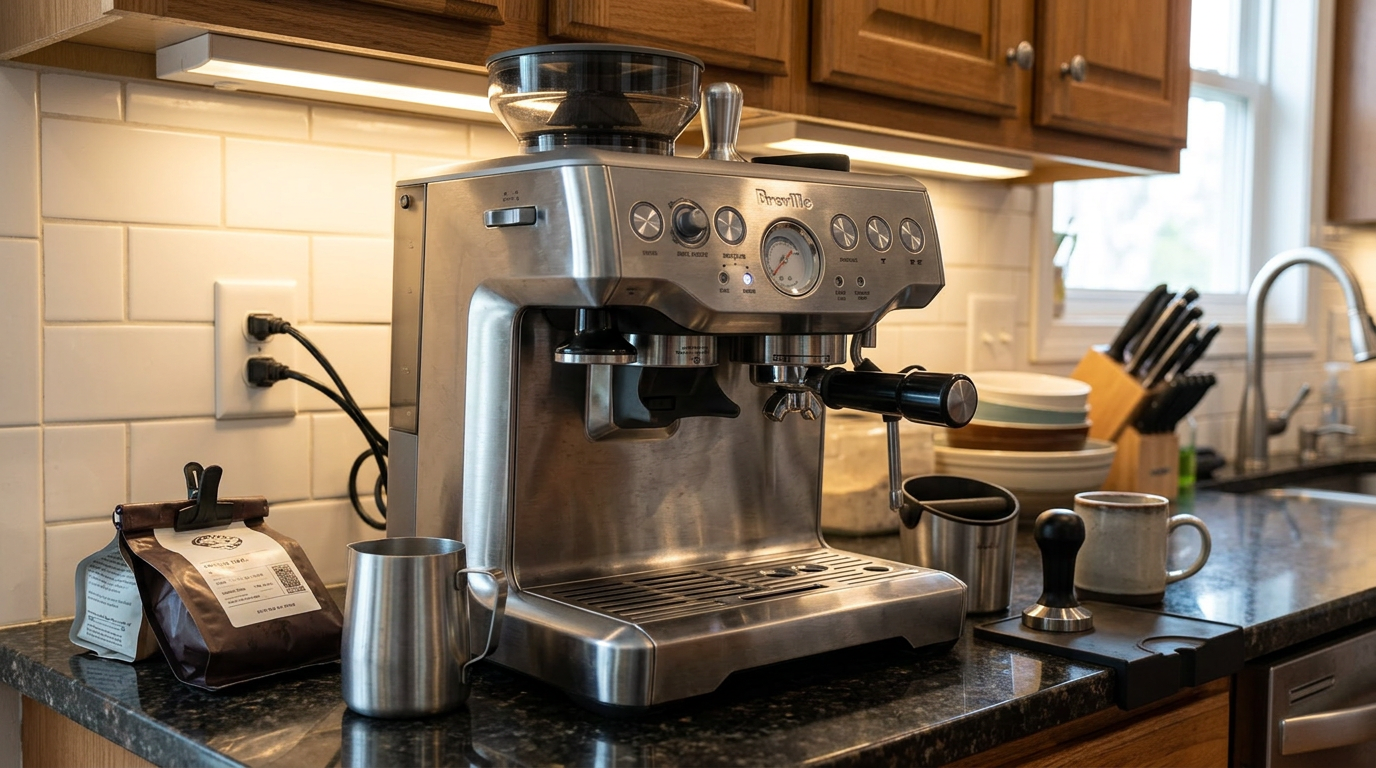
The Breville’s double basket takes about twice the coffee of the Philips.
Our tip: Use the strongest aroma and the smallest cup size on the Philips, because that is the closest it gets to a short, full espresso.
Espresso quality
With the same medium roast, these made two very different drinks. Calling both of them espresso is generous to the Philips.
The Breville, once dialed in, pulled sweet, syrupy espresso with a thick crema✕CremaThe golden, foamy layer on top of a fresh espresso. It forms when pressure pushes oils and gases out of the coffee. and a long, chocolatey finish. Most shots landed between 26 and 30 seconds for 30 grams out.
The Philips default espresso produced about 1.1 fluid ounces from 8 grams. That is a longer ratio than a classic espresso, closer to a lungo✕LungoA “long” espresso made by running more water through the same coffee. Lighter in body and slightly more bitter than a regular shot., and it tasted gentle and approachable.
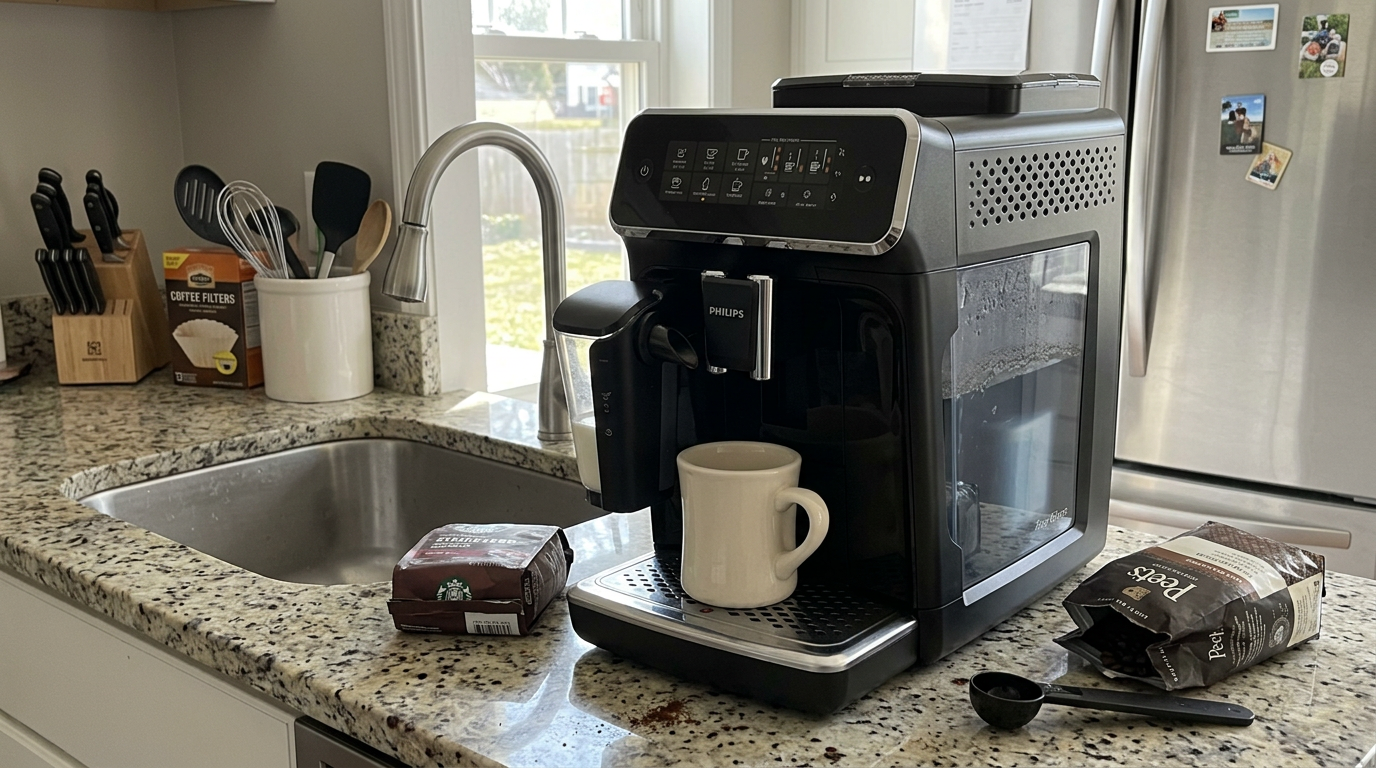
The Philips makes a gentle, lungo-style espresso.
My espresso ratings
Scores out of 10 for body, crema, sweetness and consistency.
There’s one place the Philips wins: consistency with no effort. Every cup tasted the same, while the Breville varied whenever I stopped weighing.
| What you taste | Breville fix | Philips fix |
|---|---|---|
| Sour, thin | One step finer | Finer grind, strongest aroma |
| Bitter, harsh | One step coarser | Shorter volume |
| Weak in milk | Use the double basket | Use the strongest setting |
| Lukewarm | Warm the cup and portafilter | Warm the cup |
Our tip: Run a blank shot of hot water through the Breville’s portafilter before your first espresso of the day, because a cold group head makes it taste flat.
Black coffee and americanos
For mug drinkers, the Philips has the more convenient menu. It has buttons for espresso, coffee and americano✕AmericanoEspresso topped up with hot water. It keeps the espresso flavor but gives you a longer, milder drink., and I drank all three daily.
Its americano is the best of the three black drinks, because it adds hot water to the espresso instead of pushing a whole mug of water through 8 grams of coffee.
Pushing a whole mug of water through a small puck over-extracts it and can turn the cup bitter. That is why the Philips americano beat its own coffee button.
The Breville makes americanos too, from a dedicated hot water outlet. With a 15-gram double underneath, they were much fuller, but you build every one by hand.
| Black coffee | Breville | Philips |
|---|---|---|
| Espresso | Rich, by hand | Mild, one touch |
| Americano | Rich, built by hand | One touch, best Philips black drink |
| Long coffee | Americano instead | Coffee button, milder |
| Hot water for tea | Dedicated outlet | Yes |
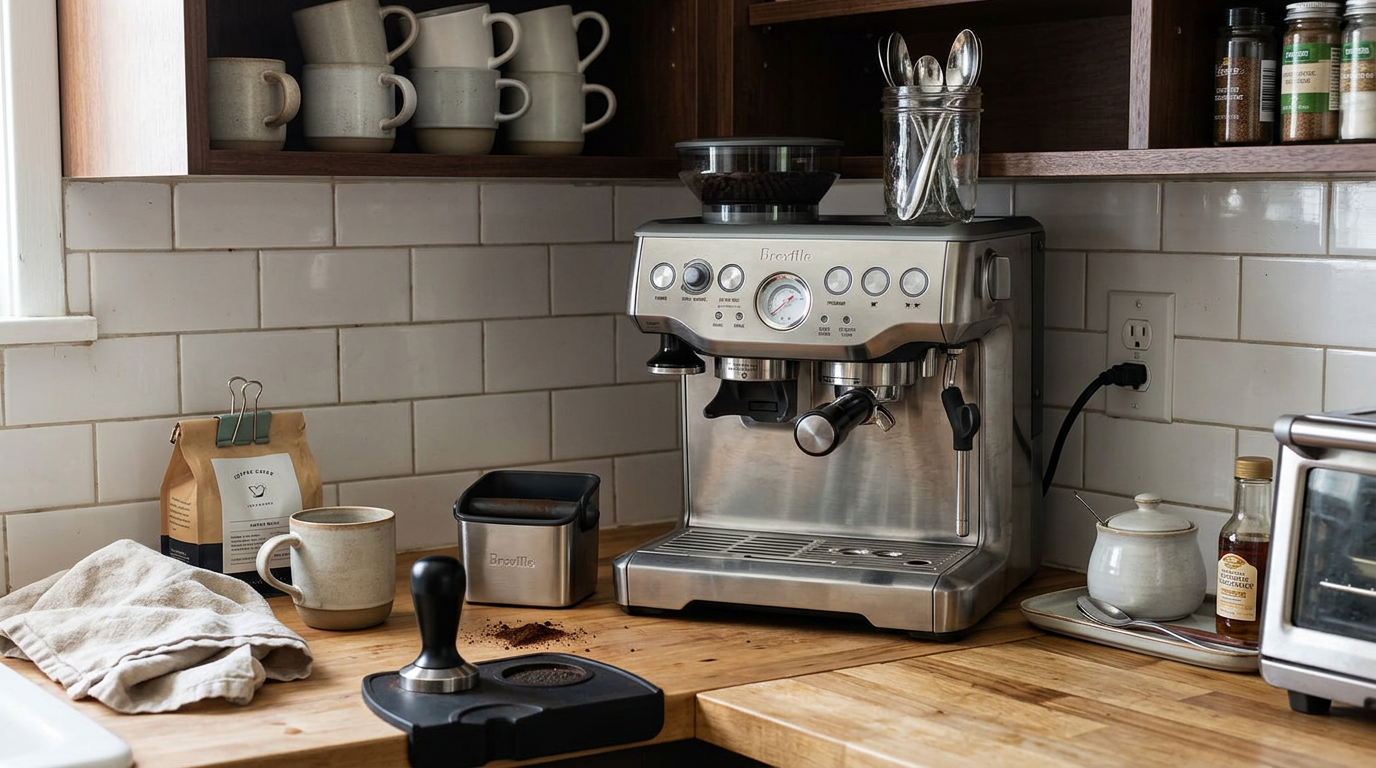
The Breville’s americanos are fuller, but you build each one by hand.
Is It On Sale? Check NowMilk drinks
Milk is where the choice gets personal. One machine makes better milk, and the other makes milk drinks far easier.
Breville: real microfoam
The Breville’s steam wand✕Steam wandA metal pipe that blows steam into a jug of milk. You control the air and the spin, so you can make real microfoam. builds steam within about 15 seconds. After about 40 seconds of steaming, my milk looked like glossy paint, and I could pour a heart by week three.
The catch is time. Two milk drinks took me about six minutes, including the wait between brewing and steaming.
Philips: LatteGo
I tried both with whole, 2% and barista oat milk. Whole milk was the sweetest on both, and oat foamed surprisingly well in LatteGo, though it settled faster than dairy.
Temperature is easier to control on the Breville, because you stop steaming when the jug gets too hot to hold, around 140 to 150°F. On the Philips, the drink comes out at its set temperature every time, which is exactly what most people want.
The LatteGo✕LatteGoPhilips’ two-part milk jug. Steam pulls milk through a small chamber where it mixes with air, with no tubes to clean. jug clips on the front, and the Philips makes a cappuccino or latte macchiato at one touch. Steam pulls milk through a small chamber where it mixes with air.
The foam was creamy and pleasant but not café-smooth, with slightly bigger bubbles than a steamed jug. It’s good for cappuccinos and lattes, and it will never pour art.
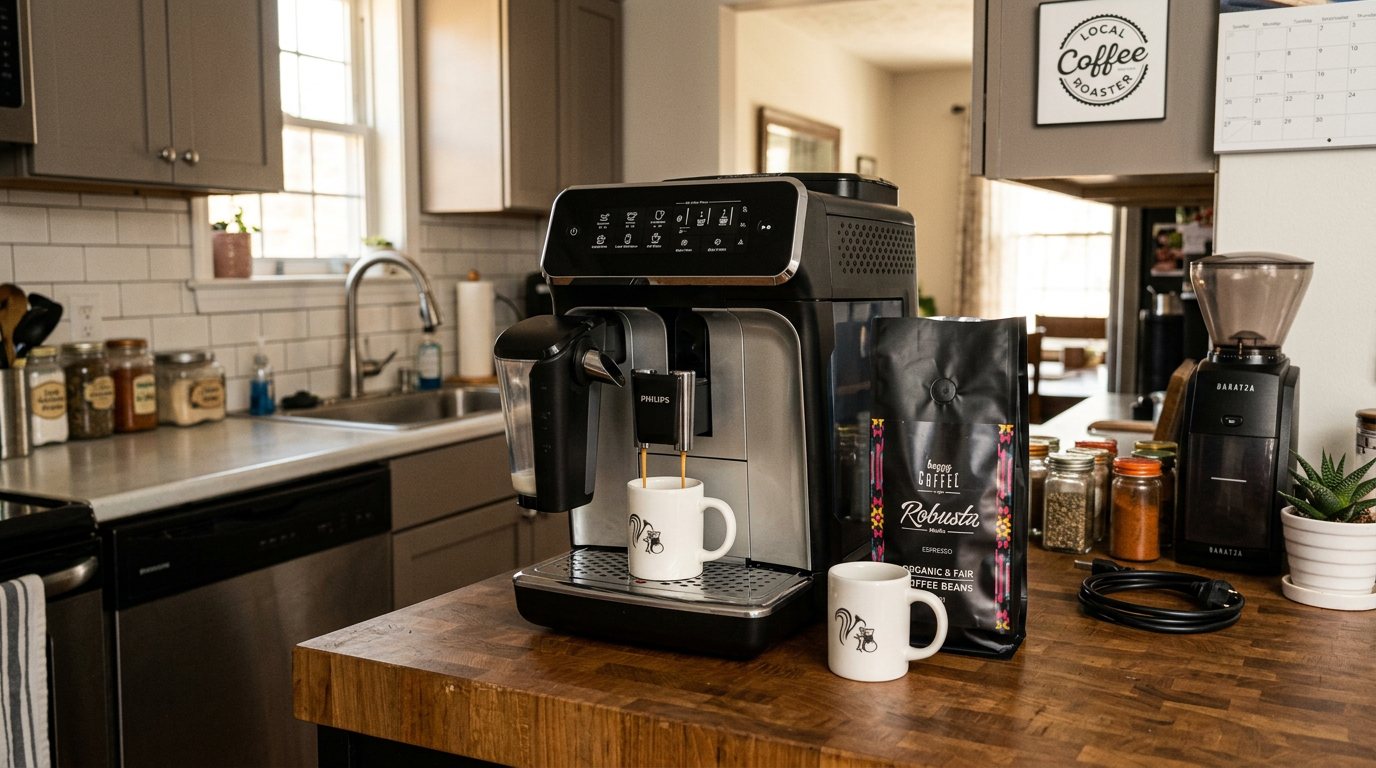
LatteGo makes one-touch milk drinks with no tubes to clean.
| Milk drink | Breville | Philips |
|---|---|---|
| Cappuccino | By hand | One touch |
| Latte macchiato | By hand | One touch |
| Flat white✕Flat whiteA short milk coffee with a double shot and a thin layer of silky microfoam. Stronger and less foamy than a cappuccino. | By hand, best texture | Not on the menu |
| Latte art | Yes | No |
| Two milk drinks | About 6 min | About 3 min |
Cleaning and upkeep
The Philips is one of the easiest milk machines to keep clean. LatteGo comes apart in two pieces, rinses under the tap in about 10 seconds and goes in the dishwasher.
The brew group slides out of the side for a weekly rinse. With the AquaClean filter fitted and replaced when prompted, Philips says you can go up to 5,000 cups without descaling.
The Breville needs more daily attention. Every drink ends with knocking out the puck, wiping the basket and purging the wand, and you backflush✕BackflushRunning water backwards through the group head with a blank basket and cleaning tablet to clear coffee oils from the valve. with a cleaning tablet when prompted.
Both brew groups need a little care to last. The Philips group should be lubricated when the machine asks, and the Breville’s gasket and shower screen should be brushed weekly so coffee oils don’t build up.
My daily hands-on cleaning time
My estimate of hands-on time per day, not counting automatic rinses.
| When | Breville | Philips |
|---|---|---|
| After milk | Wipe and purge the wand | Rinse LatteGo, about 10 s |
| Daily | Empty tray, wipe the shower screen | Empty tray and grounds drawer |
| Weekly | Brush gasket and grinder chute | Rinse the brew group |
| When prompted | Backflush with a tablet | Replace AquaClean, lubricate group |
| Every 2–3 months | Replace the water filter | Descaling✕DescalingRunning a mild acid through the machine to dissolve the mineral scale that hard water leaves in the heater and pipes. if no filter |
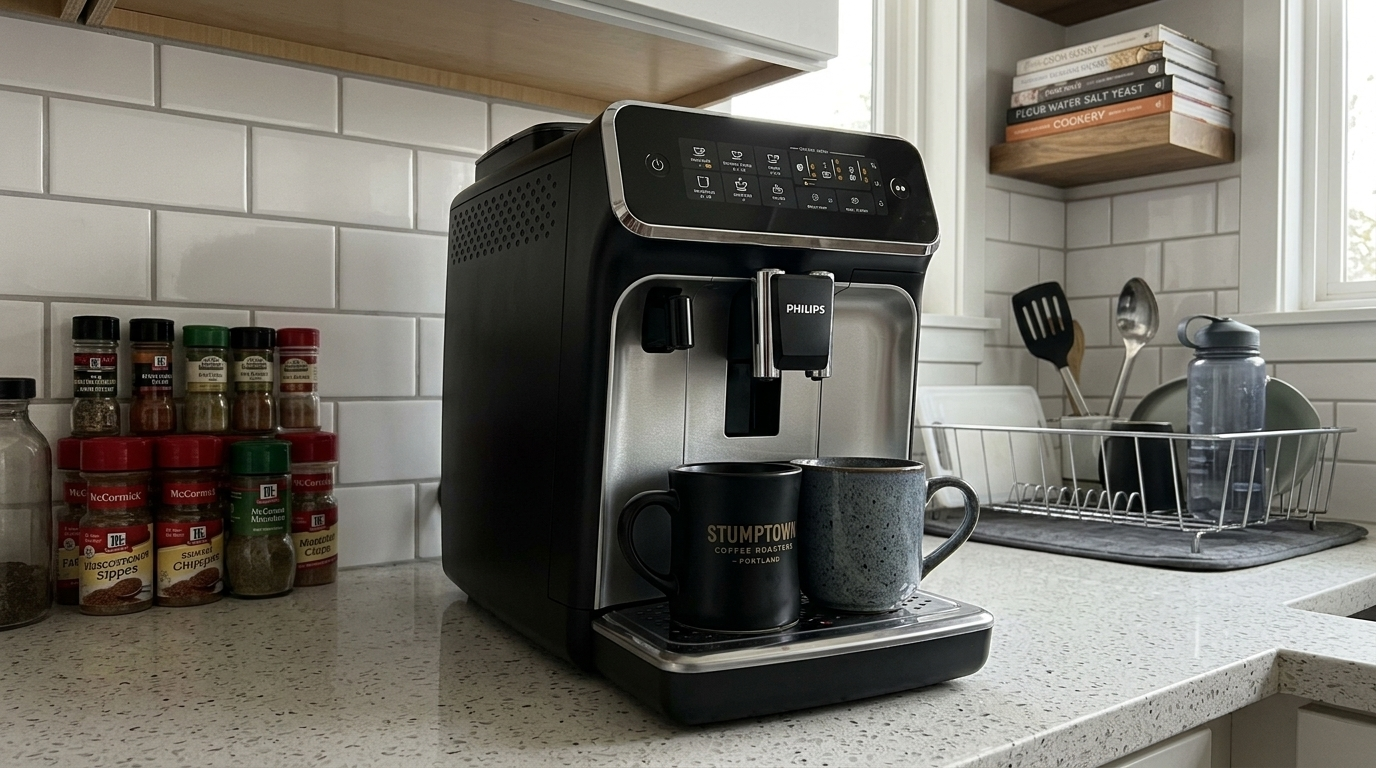
The Philips brew group comes out for a weekly rinse under the tap.
Our tip: Check the Breville’s water tank every morning, because it has no low-water sensor and the pump can run dry mid-shot.
Noise and speed
Neither is silent. The Philips grinds and brews at a normal level for its class, with no sharp whine.
The Breville’s vibration pump buzzes, the steam wand hisses and knocking out the puck adds a thud. It sounds like a small café, which some people love and others don’t at 6 a.m.
| Task | Breville | Philips |
|---|---|---|
| Heat-up | About 1 min | Under a minute |
| Espresso | About 2–3 min with prep | About 1 min |
| Cappuccino | About 3–4 min | About 1.5 min |
| Two milk drinks | About 6 min | About 3 min |
For a single drink, the Philips was twice as fast from switch-on to sip. For a coffee you savor on the weekend, the Breville’s extra minutes didn’t bother me at all.
Water, beans and supplies
The Breville’s tank holds about 67 ounces, and there’s a lid on top so you can top it up with a jug. The Philips 1.8-liter tank lasted about a day and a half with three or four drinks every morning.
Because the Breville uses almost twice as much coffee per shot, it also goes through beans faster. Plan on roughly double the beans for the same number of espressos.
| Bean type | Breville | Philips |
|---|---|---|
| Medium roast | Sweet, chocolatey | Smooth, gentle |
| Medium-dark | Rich, thick crema | Best match |
| Light roast | Finer, a little hotter | Can taste thin |
| Oily, dark | Coarser, more cleaning | Avoid, clogs the grinder |
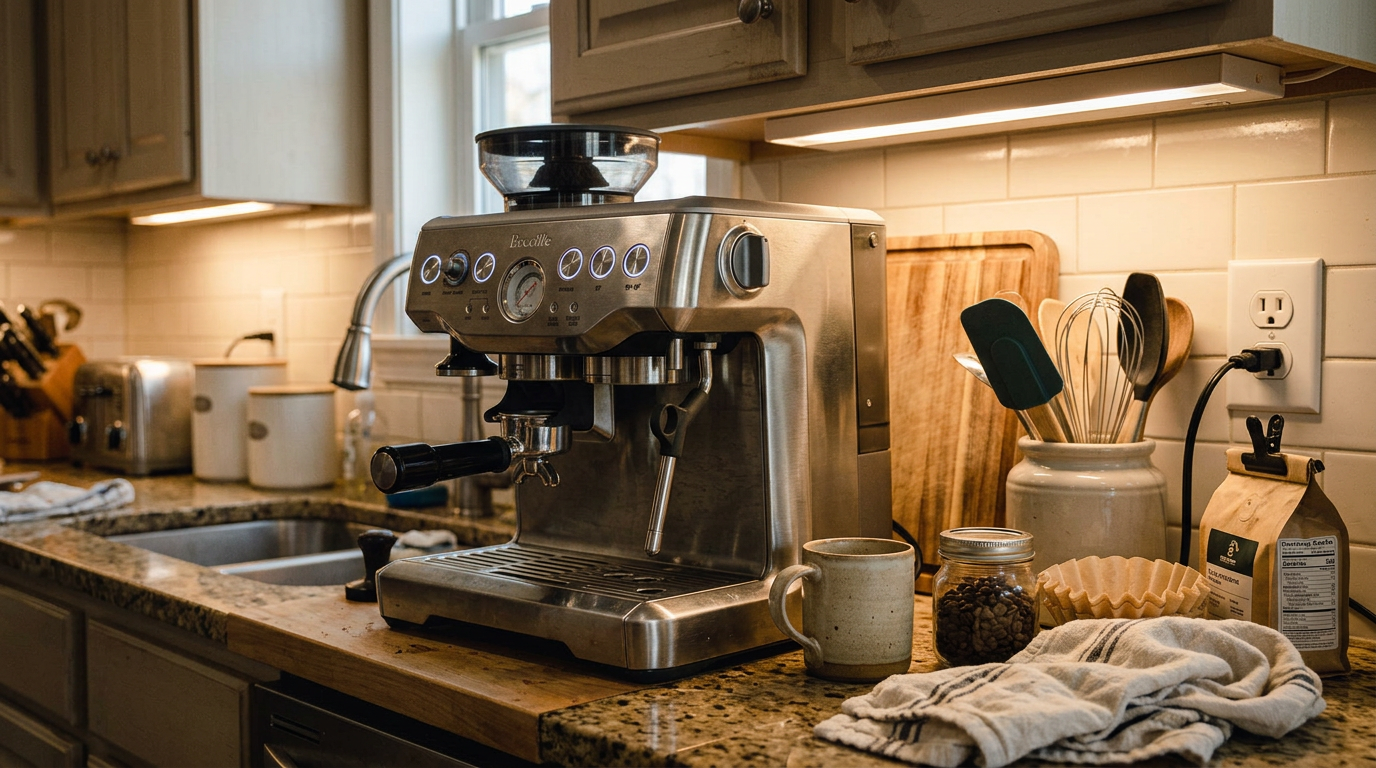
The Breville uses about twice the beans per shot, and tastes like it.
Both machines leave you with a daily pile of used grounds. They make a good addition to compost when mixed with other materials.
Our tip: Choose medium or medium-dark, dry-looking beans for the Philips, because oily beans clump in its hopper and can clog the ceramic grinder.
How four weeks went
A machine feels different on day one and day thirty. Here is how my view of each changed over the month.
| Week | Breville Barista Express | Philips 3200 |
|---|---|---|
| 1 | Inner burr moved, dose dialed in, shots finally sweet by day five | Strongest aroma and smallest size set; everyone used it on day one |
| 2 | Gauge in the espresso zone almost every shot; first decent foam | Americano became the default black drink |
| 3 | First latte-art heart; mornings down to about 4 minutes | LatteGo rinses became automatic habit |
| 4 | Weighing once every few days kept everything consistent | Machine had become invisible, in a good way |
By week four, I reached for the Breville on weekends and slow mornings, when making coffee was part of the pleasure. On busy weekdays, the Philips was the machine my household used without thinking.
That split is the real answer for some homes. If you can only have one, think about which kind of morning you have more of.
Getting the most from each
- Breville: weigh the dose, aim for about 30 grams out in 25 to 30 seconds and adjust one grind step at a time.
- Breville: steam cold whole milk in a small jug, with the tip just under the surface for the first few seconds.
- Philips: use the strongest aroma and smallest cup size for espresso, and the americano button for mugs.
- Philips: keep the LatteGo jug in the fridge and rinse it straight after each drink.
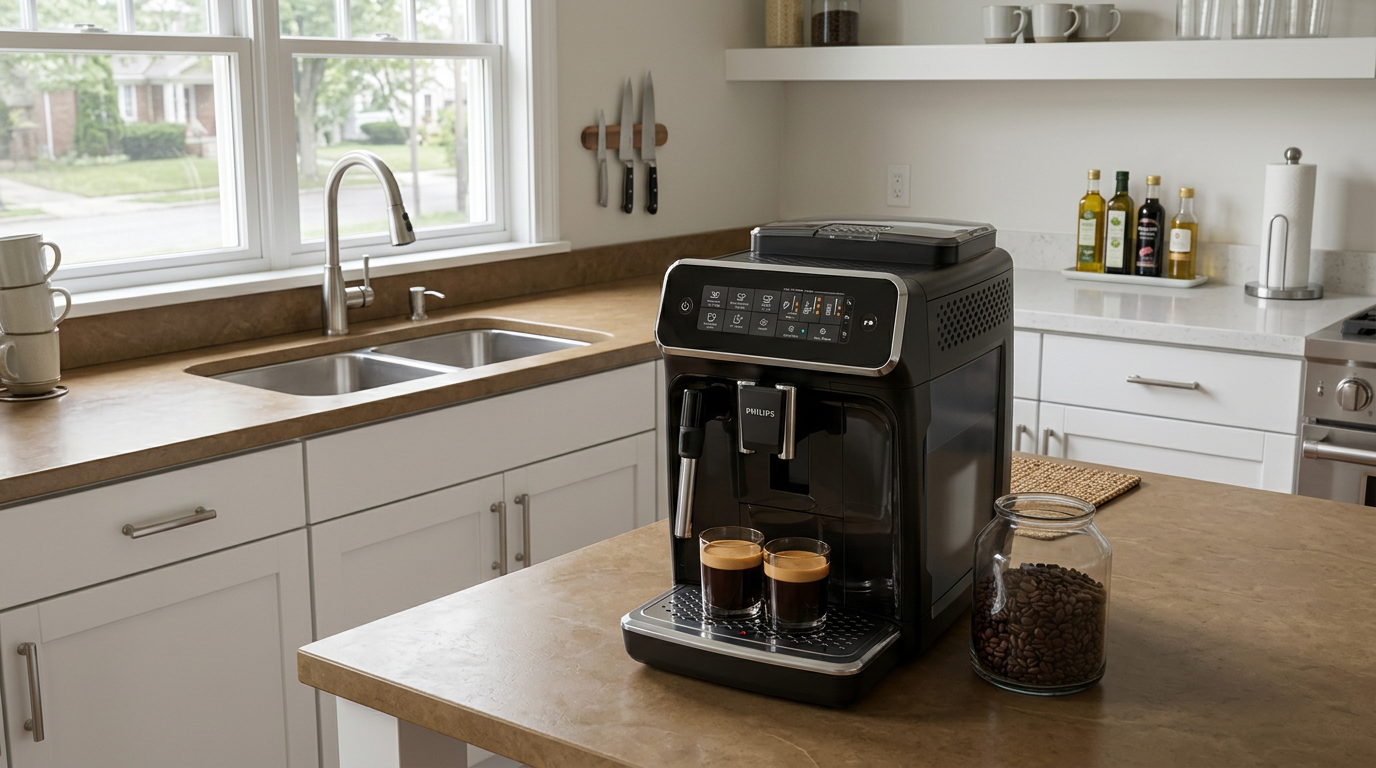
On busy weekdays, the Philips was the machine everyone used without thinking.
Our tip: Give the Breville a full week before deciding whether it suits you, because the first few days are the hardest and the shots improve quickly after that.
Mistakes to avoid on each
Both machines are easy to get wrong in their own way. These were the most common mistakes during my month with each.
| Machine | Mistake | Better habit |
|---|---|---|
| Breville | Leaving the inner burr on the factory setting | Move the upper burr finer once |
| Breville | Turning the dial on a stopped, full grinder | Adjust while grinding |
| Breville | Guessing the dose | Weigh at least weekly |
| Breville | Using pressurized baskets with fresh beans | Use single-wall baskets |
| Philips | Using the largest espresso size | Smallest size, strongest setting |
| Philips | Leaving milk in the jug on the counter | Jug in the fridge |
| Philips | Oily beans | Medium, dry-looking beans |
| Philips | Skipping the brew group rinse | Rinse it weekly |
On the Breville, the biggest single improvement came from the single-wall basket. Pressurized baskets make foamy shots that look good and taste flat once you are using fresh beans.
On the Philips, the biggest improvement was using the smallest size with the strongest setting. That gave the fullest espresso it can make from its small dose.
Switching to the single-wall basket was the Breville’s biggest single upgrade.
Our tip: Tamp level and firm on the Breville, because a tilted puck makes one side channel and the shot tastes sour and bitter at once.
Real-life scenarios
Specs only go so far. These are the situations where one machine clearly pulled ahead during my testing.
Twice the coffee and a manual shot made the Breville’s espresso rich and syrupy. The Philips tasted gentle by comparison.
Espresso, americano and latte macchiato, each at one touch. Nobody needed instructions.
Only the Breville’s steam wand makes microfoam fine enough to pour a heart.
Two LatteGo parts, ten seconds under the tap. No tubes, no wand to purge.
A 15-gram double under silky, hand-steamed milk. The Philips doesn’t have a flat white button and its dose is too small for one.
Press Cappuccino, put on your shoes, pick up your drink. The Philips won every rushed morning.
For busy mornings and mixed households, the Philips won on convenience.
My scorecard
These are my own scores out of 10 after four weeks with each machine. I added learning value and convenience because they decide this matchup.
Breville Barista Express
Philips 3200
Overall, I rate the Breville 8.0 and the Philips 8.0. That tie is honest: one makes much better coffee, and the other makes coffee much easier. Your mornings decide which matters more.
See How Much You’ll SaveWhich one is right for you?
4 quick questionsWhich one should you buy?
It comes down to one question: do you want to make coffee, or just drink it? Answer that honestly and the brand picks itself.
Think about who else will use it, too. A Breville in a house where only one person knows how to dial it in often turns into a one-person machine, while anyone can walk up to the Philips. If none of these is quite right for you, my guide to the best Philips espresso machines covers the rest of the range I’ve tested.
If you are leaning toward push-button, my Philips 3200 vs Magnifica Evo comparison covers the closest rival. If you want a guided portafilter machine instead, read my Ninja Luxe Café vs Barista Express head-to-head.
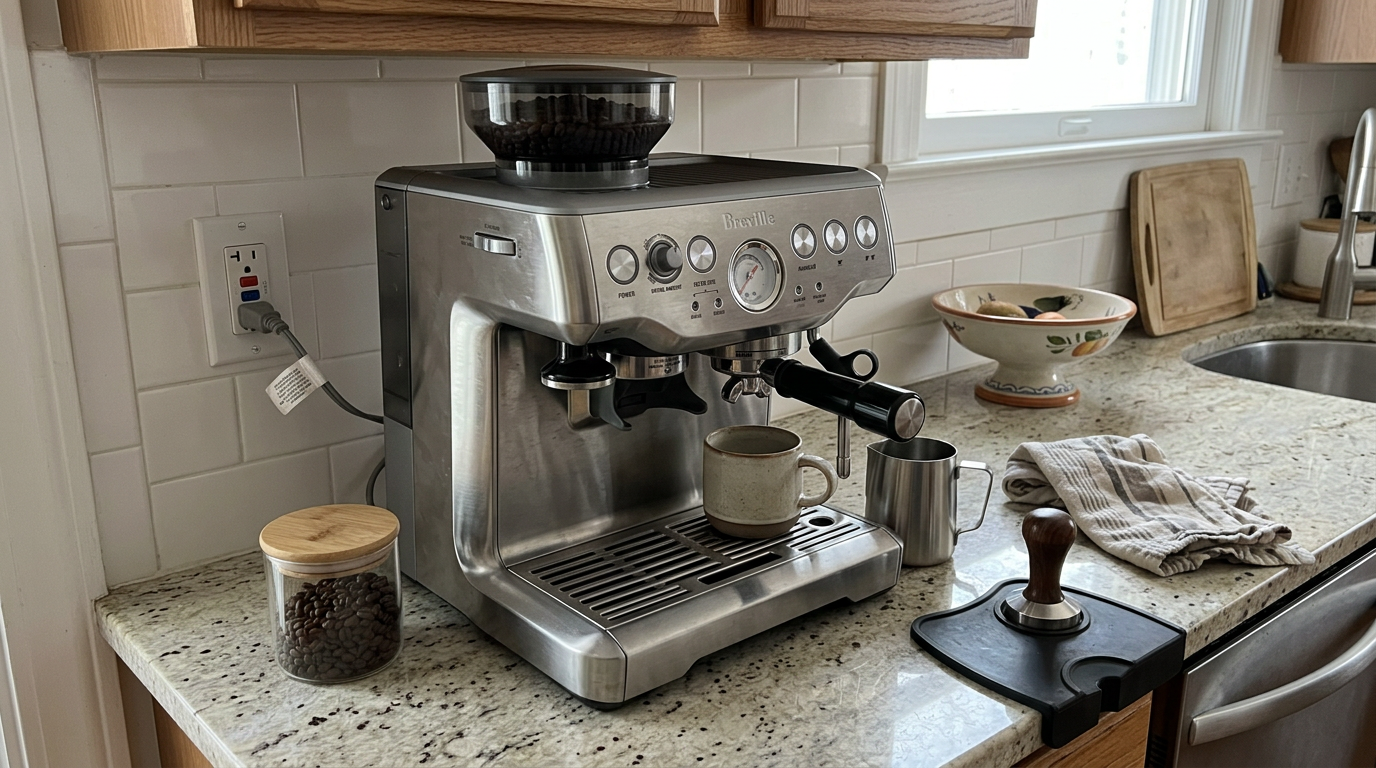
If the cup matters most, the Breville is the machine to learn.
- You want café-strength espresso
- You enjoy learning and tinkering
- You want to pour latte art
- You drink flat whites
- You want one-touch drinks
- Several people with different tastes share it
- You hate daily cleanup
- You want one-touch drinks
- Several people share the machine
- You hate cleaning milk systems
- You like mild, smooth coffee
- You want strong, syrupy espresso
- You want latte art
- You want a flat white button
If coffee quality is why you are buying a machine, my pick is the Breville Barista Express. It used about twice the coffee per shot, pulled far richer espresso and made the only milk I could pour art with. A week of learning buys you years of better coffee.
The Philips 3200 is the smarter buy for convenience. Five one-touch drinks, the easiest milk cleaning I know and a removable brew group make it a machine anyone in the house can use. Just expect gentle, lungo-style coffee rather than café espresso.
Whichever you choose, buy fresh beans and use cold milk. Both reward that with good coffee every day.
Breville vs Philips specifications
From manufacturer specifications and my own testing.
| Breville Barista Express | Philips 3200 | |
|---|---|---|
| Model | BES870XL | EP3241/54 (3200 Series) |
| Type | Semi-automatic | Fully automatic with LatteGo |
| Pump | 15 bar | 15 bar |
| Heating | 1600 W thermocoil | Thermoblock |
| Grinder | Steel conical, 16 settings | Ceramic, 12 settings |
| Dose | About 15.4 g double | About 8 g at strongest |
| Tamping | By hand | Automatic |
| One-touch drinks | None | 5 |
| Milk system | Manual steam wand | LatteGo jug |
| Water tank | About 67 oz | 1.8 liters |
| Water filter | Included | AquaClean included |
| Pressure gauge | Yes | No |
| Dimensions (W x D x H) | 12.5 x 13.8 x 15.9 in | 9.7 x 17 x 14.6 in |
| Weight | About 22–23 lb | About 17.6 lb |
How I tested and compared them
I used each machine as my everyday coffee maker for four weeks, making espresso, americanos, cappuccinos, lattes and flat whites, plus the Philips coffee button and latte macchiato.
I weighed doses and yields, timed shots and mornings, measured milk temperatures with a probe thermometer and foamed whole, 2% and oat milk on both.
I ran every cleaning routine and compared my notes with Breville and Philips specifications, owner documentation and published coffee research.
- Coffee: dose, crema, body and consistency.
- Milk: foam texture, temperature and cleanup.
- Workflow: learning curve and morning routine.
- Ownership: noise, cleaning, water care and footprint.
Breville vs Philips FAQ
Is Breville or Philips better for espresso?
Breville, by a wide margin in my testing. The Barista Express used about 15.4 grams per double, against about 8 grams on the Philips 3200, and its espresso was far richer.
Is the Philips 3200 easier to use than the Breville Barista Express?
Much easier. The Philips makes five drinks at one touch. The Breville needs you to dose, tamp, brew and steam by hand.
Why does the Philips 3200 espresso taste mild?
Its dose is small, about 8 grams on the strongest setting, and its default espresso is about 1.1 fluid ounces. That makes it closer to a lungo.
Which is easier to clean?
The Philips. Its LatteGo jug has two parts and no tubes and rinses clean in about 10 seconds. The Breville needs the puck knocked out and the wand purged after every drink.
Can the Philips 3200 make latte art?
No. LatteGo makes creamy foam for cappuccinos and lattes, but it isn’t fine enough to pour art.
Does the Breville Barista Express need a scale?
I strongly recommend one. Its grinder doses by time, so a small scale is the best way to keep the double at 15 to 15.5 grams.
Which one makes americanos?
Both. The Philips has a one-touch americano button. The Breville makes richer americanos from its hot water outlet, but you build them by hand.
How often does the Philips 3200 need descaling?
With the AquaClean filter fitted and replaced when prompted, Philips says up to 5,000 cups without descaling.
Which is bigger?
The Breville is wider, at about 12.5 inches. The Philips is narrower, at about 9.7 inches, but deeper, at about 17 inches.
Which should a beginner buy?
A beginner who wants to learn espresso should buy the Breville. A beginner who just wants good coffee drinks should buy the Philips.
Can I make a flat white on the Philips 3200?
Not at one touch. It has no flat white button, and its small dose makes a weak base for one. The Breville makes a far better flat white with a double shot and hand-steamed milk.
Do both machines use whole beans?
Yes, both have a built-in grinder. The Breville grinds into the portafilter on demand, and the Philips grinds automatically for every drink.

- Our hands-on Breville Barista Express review
- Our hands-on Philips 3200 Series review
- Breville and Philips product specifications and owner documentation
- A living lexicon for brewed coffee, University of Oregon
- Composting and Coffee Grounds, Cornell University