Breville Barista Express vs Pro vs Touch vs Oracle: which Breville should you buy?
Breville’s espresso line climbs in four clear steps. The Breville Barista Express teaches you with a pressure gauge, the Breville Barista Pro heats in three seconds, the Breville Barista Touch steams milk by itself, and the Breville Oracle grinds, tamps and steams on two boilers. I used each one every day for four weeks, logged every shot and timed every routine to find out which step is worth paying for.
We choose products independently. We may earn a commission through links on this page; your price stays the same. Affiliate policy
Jargon helpNew to espresso? Tap any dotted term to see what it means.
In this comparison
For most people, the Breville Barista Pro is the sweet spot. It heats in about three seconds, steams fast through a four-hole tip, shows a shot timer and made better espresso than the Express for not much more effort. If you want milk drinks without learning to steam, the Breville Barista Touch textures milk to your chosen temperature by itself. The Breville Barista Express is the best way to learn espresso on a budget, and the Breville Oracle is the one to buy if you want café drinks with grinding, tamping and milk handled for you.
The four machines
Specs checked November 14, 2026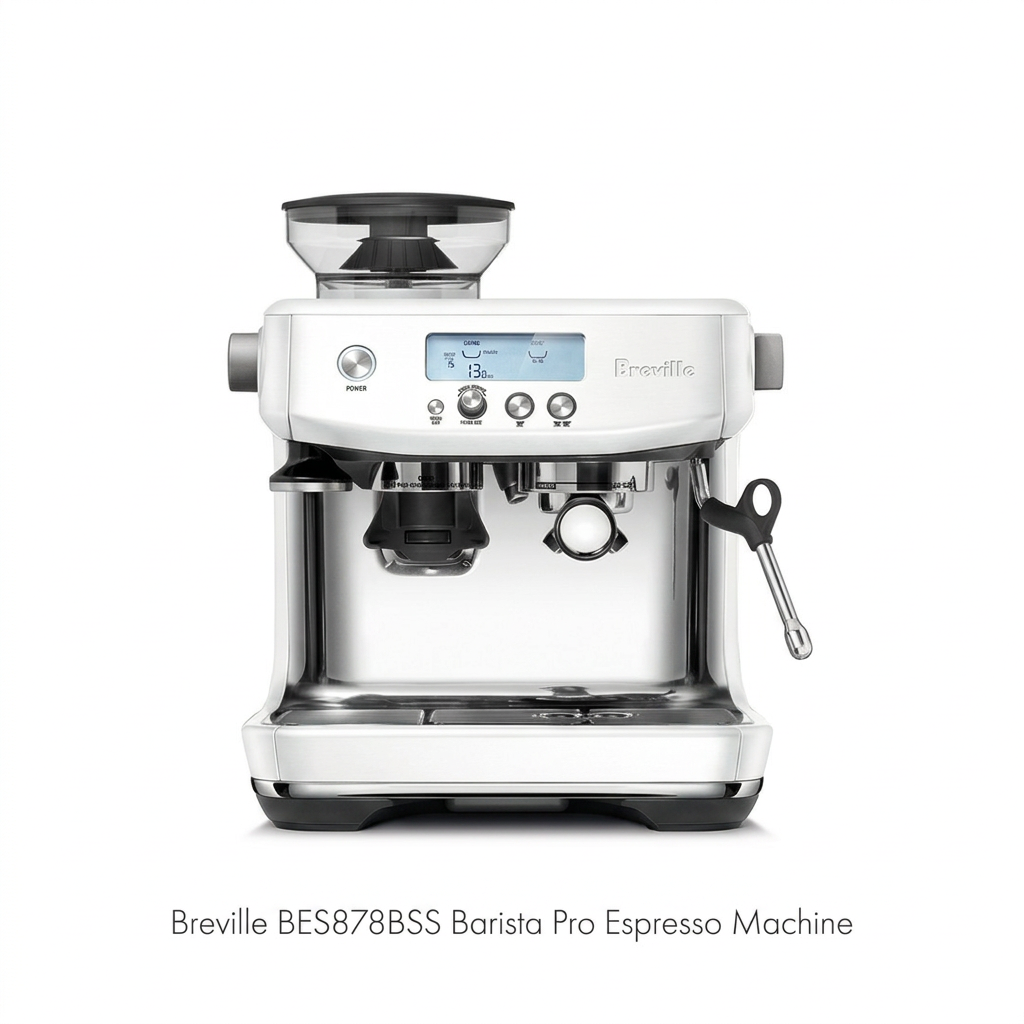
ThermoJet heat-up in about three seconds, 30 grind settings, an LCD shot timer and a powerful four-hole steam wand.
Check price on Amazon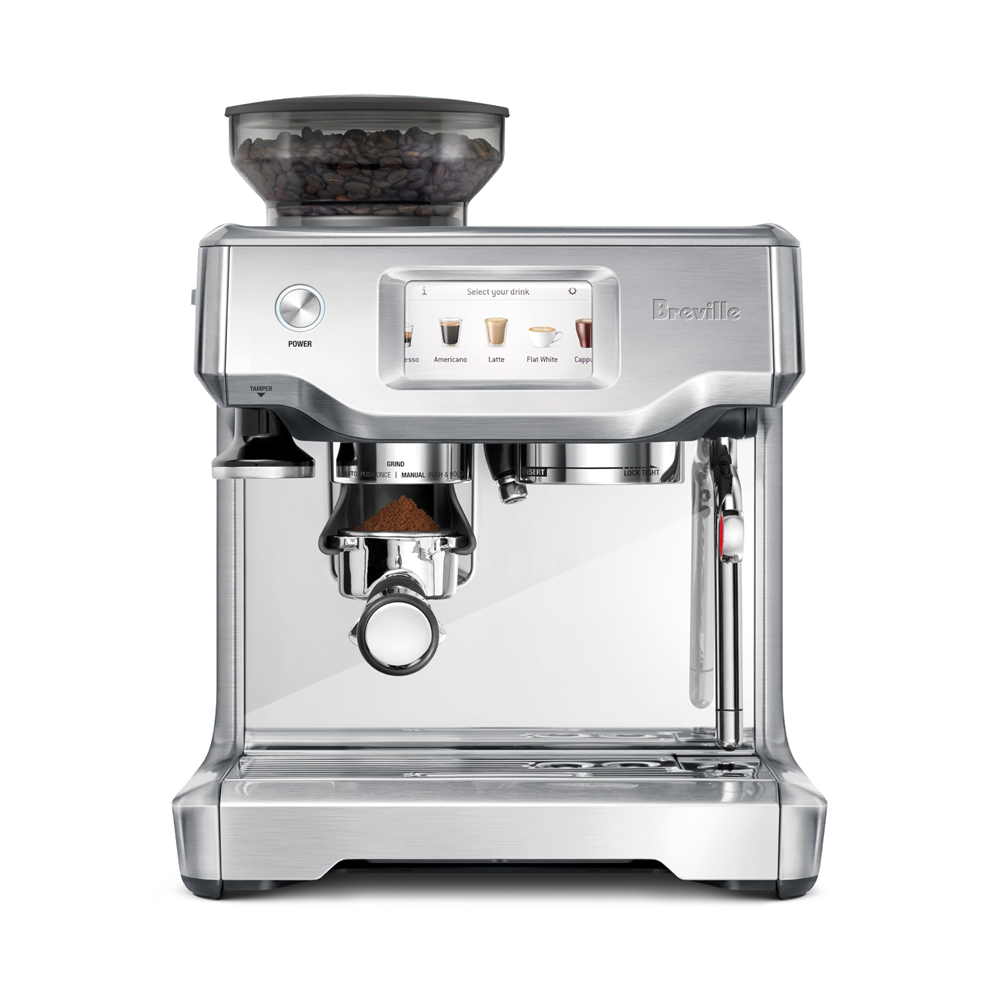
The Pro’s speed with a touchscreen, eight saved drinks and hands-free milk at the temperature and texture you choose.
Reveal Today’s Deal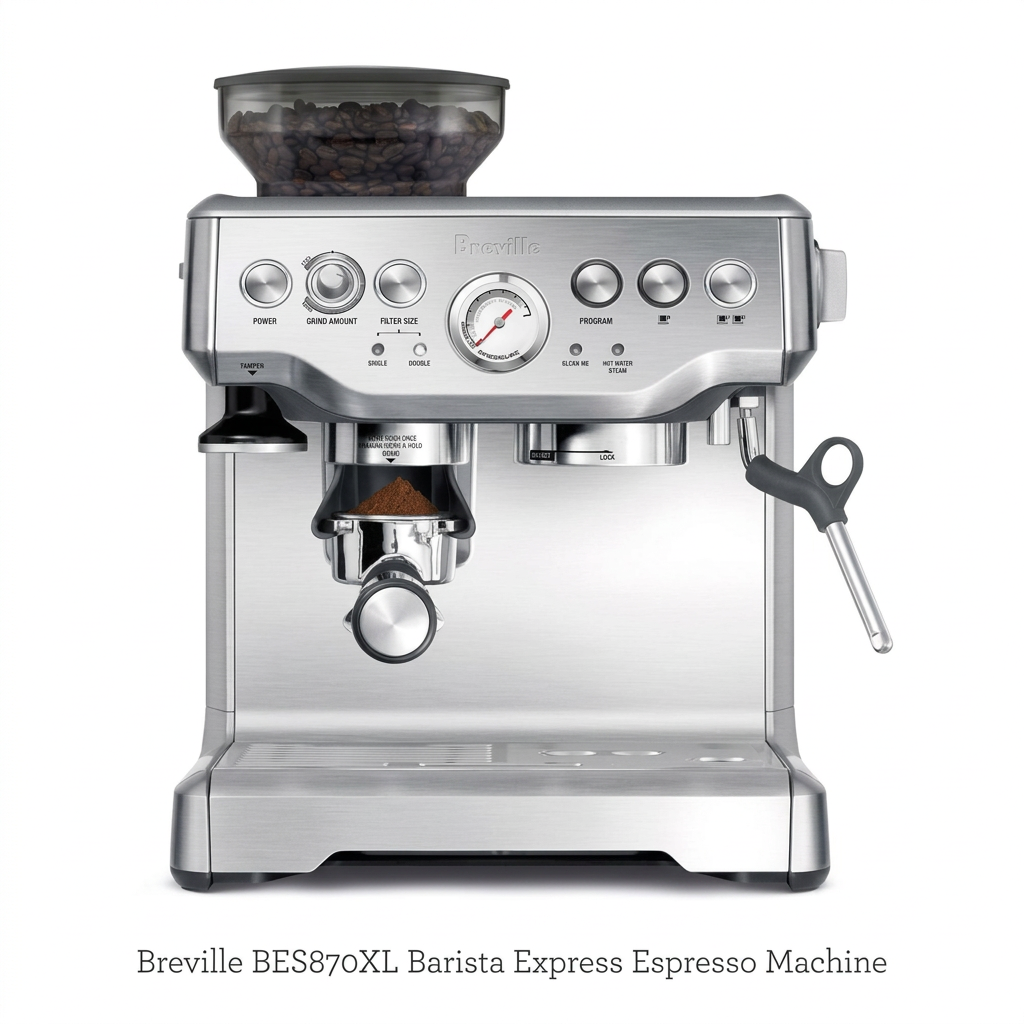
The classic: built-in grinder, 54 mm portafilter, analog pressure gauge and a manual steam wand.
See Today’s Price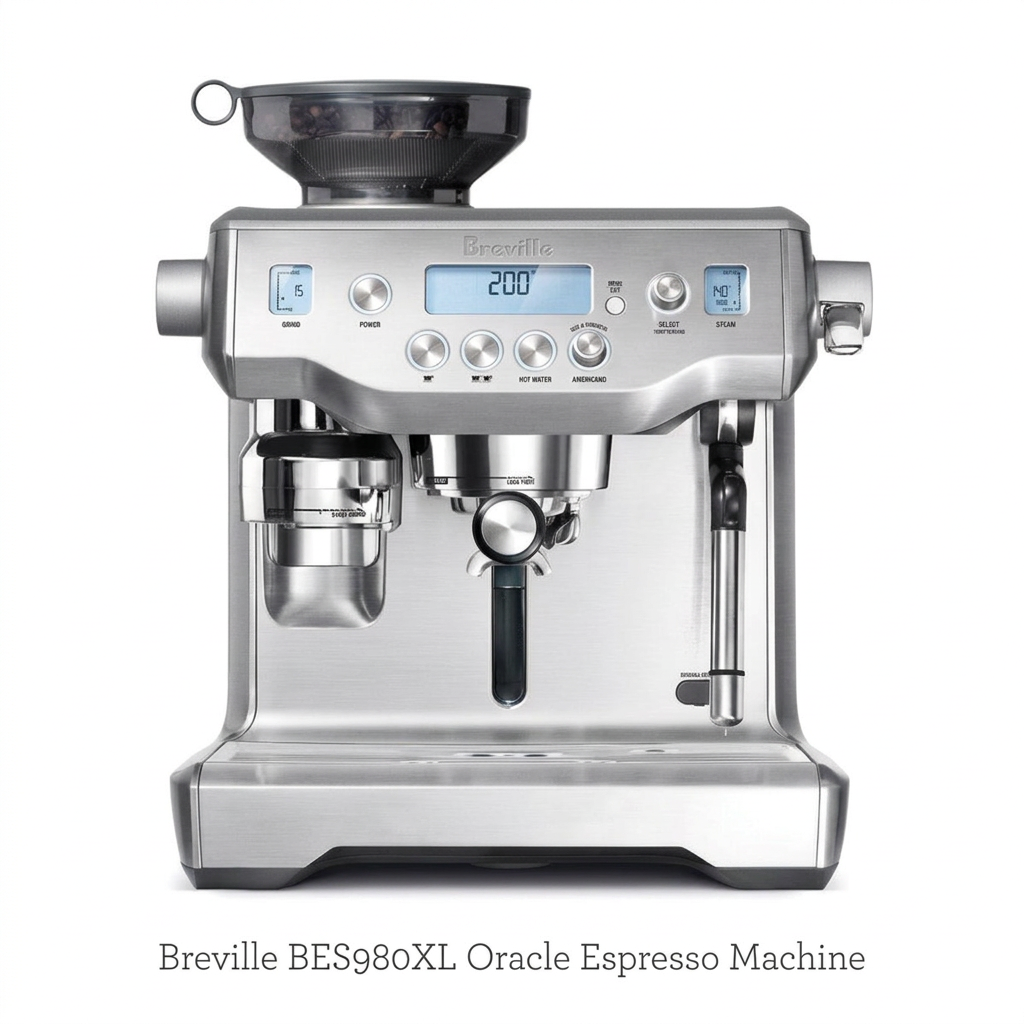
Two boilers, automatic grind, dose and tamp into a 58 mm portafilter, and hands-free milk while the shot brews.
Find Out the Price TodayBarista Express vs Pro vs Touch vs Oracle at a glance
- Buy the Pro if you want speed, control and great milk without paying for automation.
- Buy the Touch if you drink lattes and want the milk done for you.
- Buy the Express if you want to learn espresso properly for the least money.
- Buy the Oracle if you want automated grinding, tamping and milk with café-level shots.
Head to head
The best result in each row is marked, based on my four weeks with each machine and Breville’s specs. Rows where several are equal have no winner.
Keep in mind these four sit at very different price steps. The tally shows strengths, not value.
| Spec | Barista Express | Barista Pro | Barista Touch | Oracle |
|---|---|---|---|---|
| Espressomy scores | 8.4 | 8.7 | 8.5 | 8.9 ✓ Best |
| Milk drinksmy scores | 7.8 | 8.6 | 8.6 | 8.6 |
| Ease of usemy scores | 7.5 | 8.2 | 8.6 | 8.6 |
| Cleaningmy scores | 8.1 | 8.4 ✓ Best | 8.1 | 8.3 |
| Heat-up | Thermocoil, about a minute | About 3 s | About 3 s | About 5 min |
| Grind settings | 16, plus inner burr | 30 | 30 | 45, auto dose |
| Tamping | By hand | By hand | By hand | Automatic ✓ Best |
| Milk | Manual wand | Manual, 4-hole tip | Automatic, set temp | Automatic, set temp |
| Brew and steam at once | No | Almost, fast switch | Almost, fast switch | Yes, two boilers ✓ Best |
| Dialing-in feedback | Analog pressure gauge ✓ Best | LCD shot timer | Touchscreen timer | Gauge and buttons |
| Saved drinks | No | No | 8 ✓ Best | No |
| Water tank | 67 oz | 67 oz | 67 oz | 84 oz ✓ Best |
| Footprint | Medium | Medium | Smallest ✓ Best | Largest, heavy |
| Rows won | 1 | 1 | 2 | 4 |
Barista Express vs Pro vs Touch vs Oracle pros and cons
Breville Barista Express
- Sweet, syrupy espresso once dialed in
- Pressure gauge makes dialing in easy to learn
- Steam wand can make real latte-art microfoam
- Grinder needs an inner-burr tweak out of the box
- Slower steam and a wait between brewing and frothing
- No low-water sensor on the tank
Breville Barista Pro
- Ready in seconds, with near-instant steam
- Strong four-hole steam for fast, silky microfoam
- LCD with shot timer makes dialing in easy
- No analog pressure gauge
- Pre-infusion is capped at 10 seconds
- Portafilter needs a blank flush to warm up
Breville Barista Touch
- Ready in about three seconds
- Hands-free milk stops at your set temperature
- Clean touchscreen with 8 saved drinks
- You still dose and tamp by hand
- Presets all use the same shot settings
- Small drip tray needs frequent emptying
Breville Oracle
- Automatic grind, dose and tamp with a polished puck
- Brews and steams at once on two boilers
- Physical buttons and dials that are quick to use
- Heavy, large body that needs a deep counter
- About five minutes to heat from cold
- No saved user profiles on the screen
Who should buy which machine?
Breville Barista Express
- Beginners who want to learn real espresso
- Budget-minded latte-art learners
- People who like analog feedback
- Anyone who wants fast mornings
- Back-to-back milk drinks
- Push-button convenience seekers
Breville Barista Pro
- Latte and flat white drinkers who steam daily
- Busy mornings with no time to wait
- Light-roast fans who want temperature control
- People who want a pressure gauge
- Those who want hands-free milk
- Anyone who wants one-touch drinks
Breville Barista Touch
- Latte drinkers who want easy milk
- Small kitchens that need a compact all-in-one
- People who like a clean touchscreen
- Anyone who wants automatic tamping
- Black-coffee-only drinkers
- Households making many drinks in a row
Breville Oracle
- People who want café drinks with little effort
- Two-drink mornings that need speed
- Espresso fans who want a 58 mm puck
- Small or shallow counters
- Anyone who wants instant heat-up
- Hands-on barista hobbyists
Design, size and build
All four share Breville’s brushed stainless look, a top bean hopper, a group head with a portafilter✕PortafilterThe handle with a metal basket that holds the ground coffee. You lock it into the group head to brew. and a steam wand on the right. Put them in a row and they look like one family at four sizes.
The Breville Barista Express has a chunky analog pressure gauge front and center, a grind-size dial on the side and a big steam knob. The Pro swaps the gauge for a backlit LCD, and the Touch replaces almost every control with a color touchscreen.
The Oracle is the big one. It adds a second boiler, a motorized tamping arm under the grinder and a heated 58 mm group, all of which make it heavy and deep.
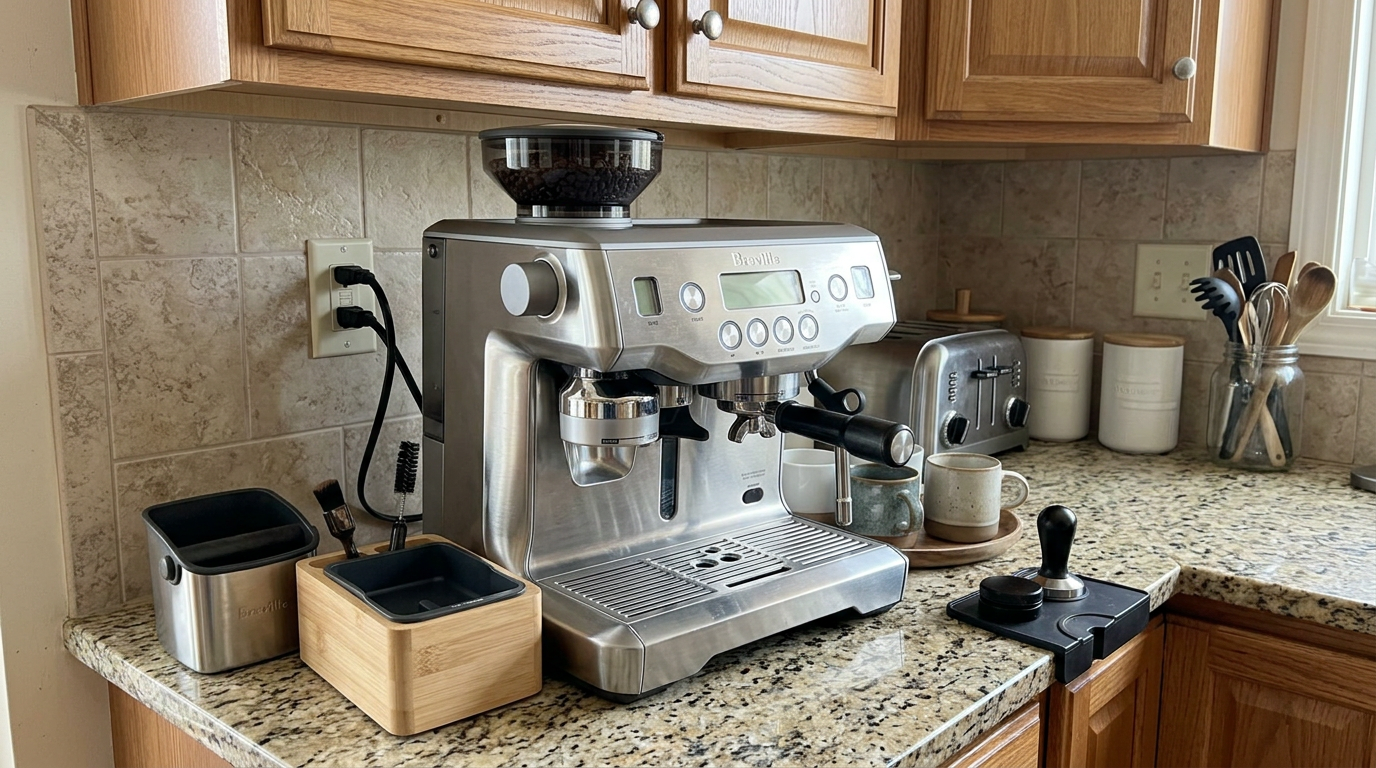
The Oracle is the largest and heaviest of the four, built around two boilers.
Width on the counter
From Breville’s specs and my tape measure.
Build quality is solid across the line. The Express at about 22 to 23 pounds stays put when you lock in the portafilter, and the Oracle feels like a small commercial machine.
The Touch is the most compact, which is impressive given its automatic milk. Its small drip tray is the price of that footprint.
Our tip: Check the height under your wall cabinets before buying the Oracle, because at about 17.8 inches tall it needs more room than the Barista models.
Heating: thermocoil, ThermoJet or two boilers
How each machine heats water shapes your whole morning.
The Express uses a thermocoil✕ThermocoilA heater where water runs through a coiled tube inside a heated metal block. It warms up faster than a boiler but slower than ThermoJet.. It is ready in about a minute, but switching from brewing to steaming takes time while the coil heats up, and back-to-back milk drinks slow down.
The Pro and Touch use ThermoJet✕ThermoJetBreville’s fast heating system. It heats water on demand and is ready to brew in about three seconds.. Both were ready in about three seconds, and steam arrived almost instantly after the shot.
The Oracle uses a dual boiler✕Dual boilerTwo separate boilers, one for brewing and one for steam, so you can pull a shot and steam milk at the same time.. It brews and steams at the same time with rock-steady temperatures, but it took about five minutes to heat from cold.
Time from switch-on to first shot
From my testing; group and portafilter still benefit from a warm-up flush on all four.
There’s a catch with ThermoJet. The machine is hot in three seconds, but the group head and portafilter are not. On the Pro, I ran a blank shot through the empty portafilter for about 20 seconds, which warmed the group, the basket and my cup.
The Oracle solves that with a heated group head, which is why its first shot of the day tasted as good as its tenth. Put it on a smart plug timer and the warm-up disappears.
Grinder and dose
All four have a built-in conical burr grinder, but the controls are very different.
The Express has 16 settings on the side dial plus an inner burr you can adjust. Out of the box, its range was too narrow; moving the inner burr from 6 to 2 gave me the room I needed.
The Pro and Touch use hardened steel burrs with 30 settings. The Oracle has 45 settings, and it grinds, doses and tamps into the portafilter by itself.
Grind settings
More steps mean finer control, especially with lighter roasts.
| Grinder detail | Express | Pro | Touch | Oracle |
|---|---|---|---|---|
| Settings | 16 + inner burr | 30 | 30 | 45 |
| Dosing | Timed, by hand | Timed, shown on LCD | Timed, on touchscreen | Automatic |
| Tamping | By hand | By hand | By hand | Automatic |
| My double dose | 15.4 g | 16 g | 17.5 g | About 2 fl oz shot |
| Dose consistency | Good once set | ±0.2–0.4 g | Good | Excellent |
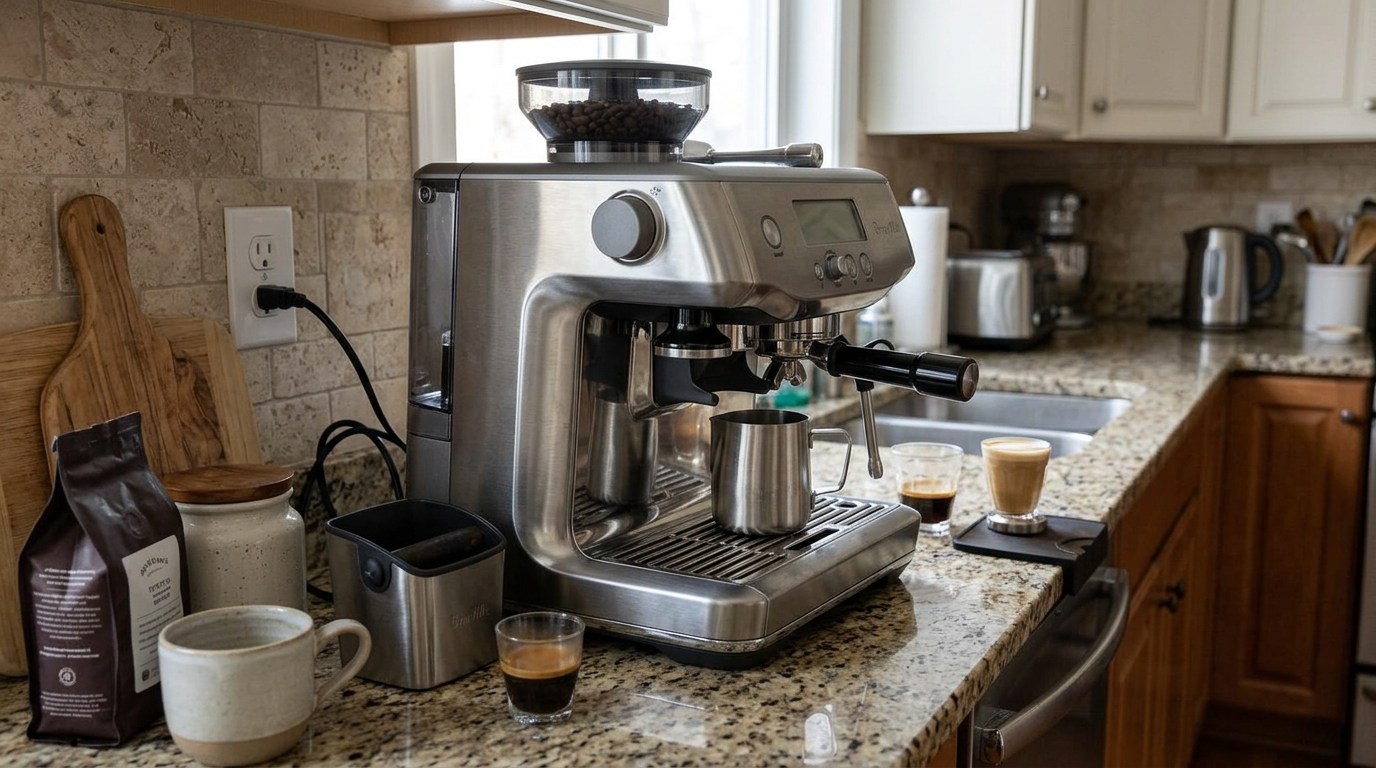
The Pro shows grind time on its LCD, which made dialing in easier than on the Express.
Our tip: Buy a scale that reads to 0.1 gram for any of the three Barista machines, because timed grinding varies by a few tenths of a gram each shot.
Espresso quality
Once dialed in, all four pulled genuinely good espresso. The differences were in body, consistency and how much work it took to get there.
On the Express, 15.4 grams in and 30 grams out in 25 to 30 seconds gave a sweet, syrupy shot with a thick crema✕CremaThe golden, foamy layer on a fresh espresso. It forms when pressure pushes oils and gases out of the coffee.. The pressure gauge sat in the espresso zone almost every time once I found my grind.
On the Pro, 16 grams in and 32 out ran in 28 to 30 seconds and poured like syrup. Its pre-infusion✕Pre-infusionA short soak of the ground coffee at low pressure before full pressure starts, so water flows through the puck evenly. is capped at 10 seconds, so I went half a number finer when I used the full soak.
The Touch’s best shots came from 17.5 grams in and about 40 grams out, a longer brew ratio✕Brew ratioThe weight of liquid espresso compared with the dry coffee. A 1:2 ratio means 16 g of coffee makes about 32 g of espresso. of about 1 to 2.3. At 200 to 202°F with a medium roast, it tasted of chocolate and nuts.
The Oracle’s 58 mm puck, heated group and automatic tamp made the most consistent shots I pulled all month. Most landed between 27 and 31 seconds, and I only touched the grind dial when a bag started to age.
My espresso ratings
My scores out of 10 for body, crema, flavor and consistency.
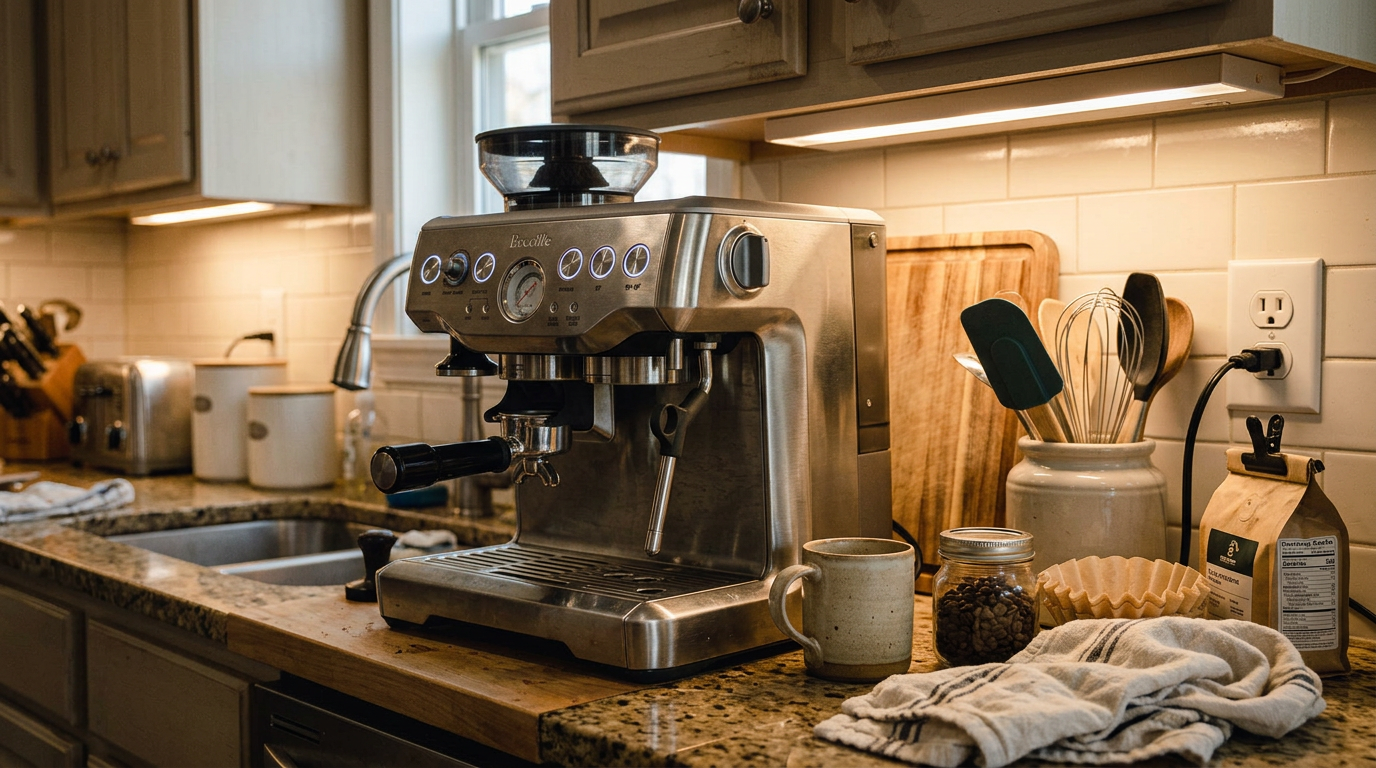
The Express’s analog gauge is the best teacher of the four.
| What you taste | Likely cause | First fix on any of the four |
|---|---|---|
| Sour, thin | Under-extracted | Grind one step finer |
| Bitter, harsh | Over-extracted | Grind one step coarser |
| Fast, pale shot | Dose too low or stale beans | Check dose on a scale |
| Lukewarm | Cold portafilter | Run a blank shot first |
Dialing in: what it’s like on each machine
Dialing in means finding the grind, dose and shot length that make your beans taste their best. On every Breville here, you will do it with each new bag, and the experience is very different from machine to machine.
On the Express, my first properly dosed shot hit 30 grams in 27 seconds and looked fine on paper, but it tasted sour. I kept the dose locked at 15.4 grams, moved the side dial two steps finer to 7, and the next shot was sweet and round.
On the Pro, the LCD showed grind time and shot time side by side, so I could see exactly what changed between shots. Consecutive grinds still varied by 0.2 to 0.4 grams on a fixed timer, which is why a scale matters.
The Touch works the same way as the Pro, but on a touchscreen. I stopped shots by weight in manual mode, because its presets all brew the same shot settings.
The Oracle needed the least work. After four shots, I had a setting that ran close to 28 seconds, and its automatic tamp removed channeling✕ChannelingWhen water finds a weak spot in the coffee puck and rushes through it, leaving the rest under-extracted. The shot tastes sour and bitter at once. almost completely, because the puck came out polished and level every time.
Test shots to dial in a new medium roast
Counted from my own dialing-in with the same bag of beans.
Our tip: Change only one thing per shot, grind or dose, never both, because otherwise you can’t tell which change fixed the taste.
Milk drinks
This is the biggest practical difference across the line, and it’s why the Touch and Oracle cost more.
The Express and Pro use manual steam wands. The Express builds steam within about 15 seconds of switching over, and its single-hole tip made glossy microfoam✕MicrofoamMilk foam with bubbles so small you can barely see them. It feels silky and pours into latte art. in about 40 seconds for a latte.
The Pro’s four-hole tip is far stronger. A 6-ounce latte jug took about 30 seconds, and the foam was just as silky.
The Touch and Oracle steam hands-free. You set a temperature and a texture, put the jug under the wand and walk away, and a sensor stops the steam at your target.
On the Touch, the default milk temperature is 150°F. I lowered it to 140°F, because milk tastes sweeter there, and used texture level 3 for flat whites and 7 to 8 for cappuccinos.
Seconds to steam about 6 oz of cold milk
From my testing with whole milk. The Oracle steams while the shot brews.
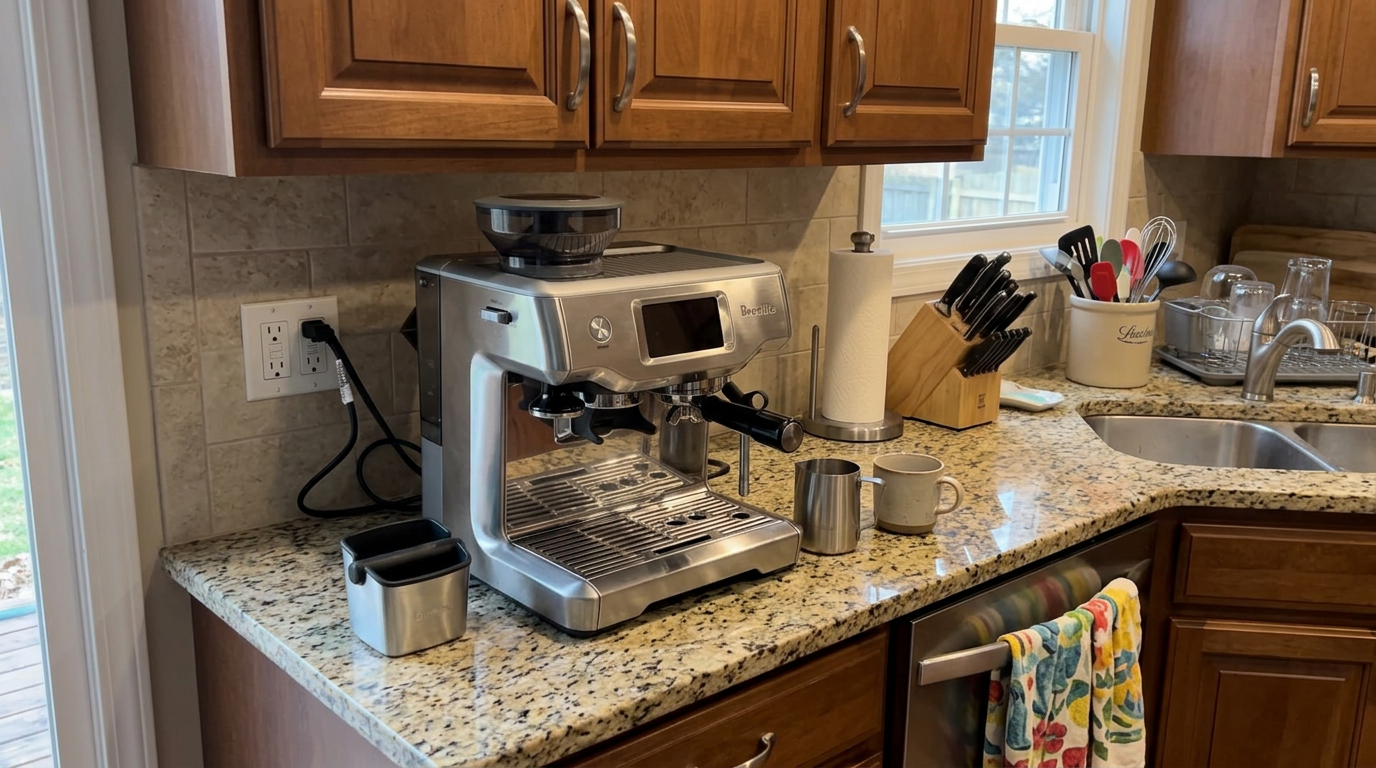
On the Touch, you pick the temperature and texture and the wand stops by itself.
The Oracle’s trick is doing both at once. Two cappuccinos took me about 90 seconds in total, and the boilers never sagged.
On the Express and Pro, you finish the shot and then steam. That’s fine for one drink, but for a household of lattes, it adds minutes every morning.
| Milk detail | Express | Pro | Touch | Oracle |
|---|---|---|---|---|
| Wand type | Manual, single hole | Manual, four-hole tip | Automatic, sensor | Automatic, sensor |
| Temperature control | By hand | By hand | Set, default 150°F | Set, 130–170°F |
| Texture control | By hand | By hand | Levels | Dial |
| Brew and steam at once | No | No | No | Yes |
| Latte art | Yes, with practice | Yes, easiest | Possible | Possible |
Cleaning and upkeep
All four need daily care, because all four use a portafilter and a steam wand.
On the Barista machines, I knocked out pucks, wiped and purged the wand after each drink and emptied the tray daily. The Touch’s small tray needed emptying more often, and Breville suggests a container of at least 30 ounces for cleaning cycles.
The Oracle automatically purges its wand after steaming, but it asks for its own daily care too. A cleaning cycle with a tablet and a backflush✕BackflushRunning water or cleaning solution backwards through the group head with a blind basket, to clear coffee oils. come up regularly on all four.
My daily hands-on cleaning time
My estimate for two people making milk drinks, not counting automatic purges.
| When | All three Barista machines | Oracle |
|---|---|---|
| After each drink | Knock out puck, wipe and purge wand | Knock out puck, wand self-purges |
| Daily | Empty tray, rinse baskets | Empty tray, wipe tamper area |
| When prompted | Cleaning tablet cycle | Cleaning tablet cycle |
| Every 2 to 3 months | Descale, replace filter | Descale both boilers, replace filter |
Our tip: Wipe the steam wand with a damp cloth the moment you finish steaming, because milk bakes onto a hot wand within a minute.
Speed, noise and a real morning
I timed a single flat white from switching on to the first sip on each machine, including warming the portafilter and cleaning up. It’s the number that matters at 7 a.m.
The Pro was fastest at around three minutes, because there’s no wait to heat and no wait to switch to steam. The Touch was close behind; its hands-free milk let me wipe the counter while it steamed.
The Express took about four and a half minutes, with most of the extra time spent waiting for steam after the shot. The Oracle took the longest from cold, because of its five-minute warm-up, but on a timer plug it was the fastest of all at under 90 seconds per drink.
One flat white, switch-on to first sip
My timings with the same beans and whole milk, including cleanup.
Noise is similar across the line. Each grinder buzzes for 10 to 20 seconds per double, and the vibration pumps hum during the shot. The Oracle’s tamping motor adds a short whir, and the Pro’s powerful steam is the loudest hiss of the four.
None of them is quiet enough to go unnoticed in an open-plan apartment at 6 a.m., but none of them is harsh either.
Water, beans and supplies
The three Barista machines share a 67-ounce tank, while the Oracle holds 84 ounces. The Pro and Touch have a low-water sensor; the Express does not, so I learned to glance at the tank each morning.
Drinks per full tank
Rough maths allowing for blank shots, flushes and purging.
Fresh beans matter more on these machines than on any push-button machine. With a manual or guided grinder, stale beans make the dose run fast, and you end up chasing the grind all week.
| Roast | Express | Pro and Touch | Oracle |
|---|---|---|---|
| Light | Hard, needs fine grind | Very good, high temperature | Very good, ~198–200°F |
| Medium | Excellent | Excellent | Excellent |
| Dark | Good, coarser grind | Good, lower temperature | Good, ~190–193°F |
| Oily, very dark | Clogs burrs | Clogs burrs | Clogs burrs |
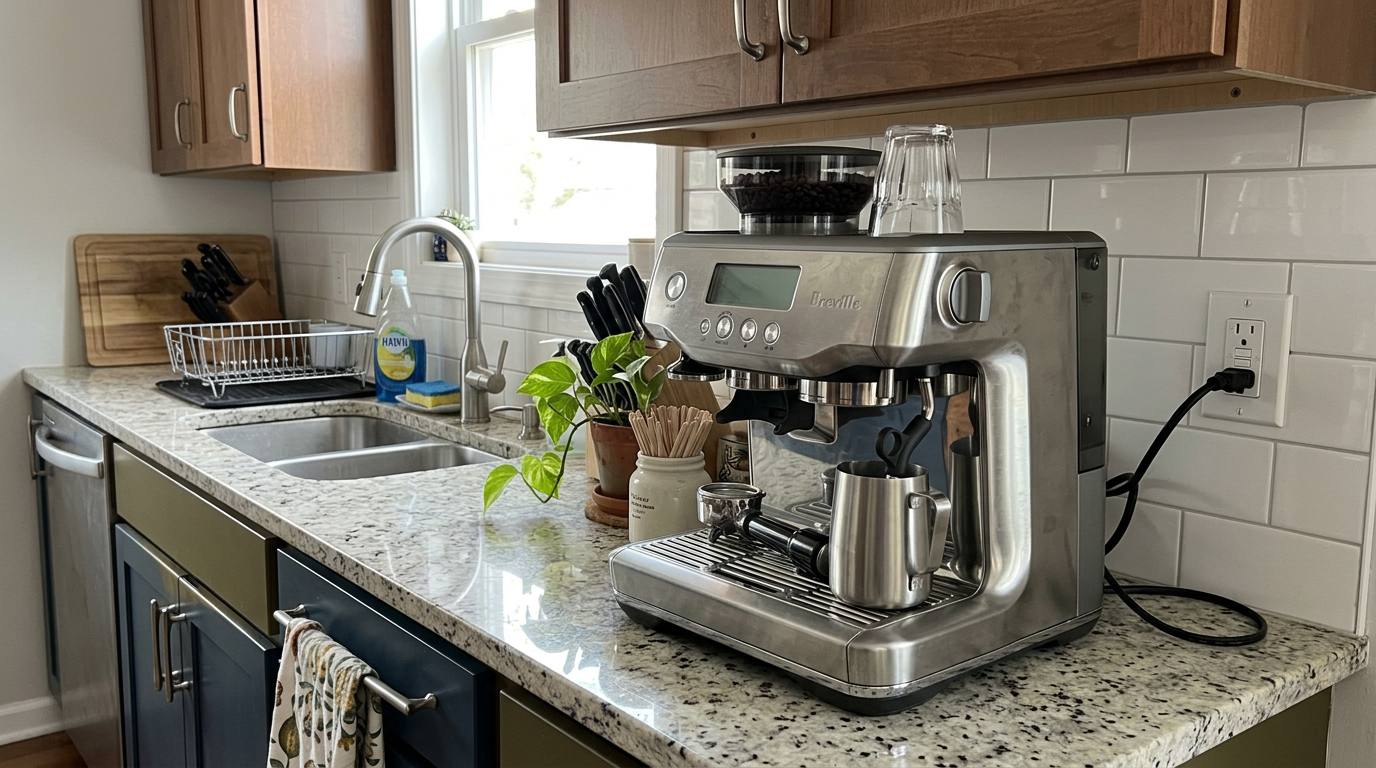
The Pro’s 67-ounce tank lasted two people about two days.
Four weeks with each, week by week
I logged how often my shots landed in my target window each week. It’s the clearest way to see how quickly each machine becomes routine.
| Week | Express | Pro | Touch | Oracle |
|---|---|---|---|---|
| Week 1 | Inner burr, dialing in | Learning the LCD | Setting milk levels | Learning the dials |
| Week 2 | Steady shots | Most shots on target | Flat whites dialed in | Nearly all on target |
| Week 3 | Gauge in the zone | 27–31 s, no adjustments | 28–32 s routine | 27–31 s routine |
| Week 4 | Reliable, still hands-on | Reliable and quick | Reliable, easy milk | Reliable, least effort |
The Express had the steepest first week. Once I adjusted the inner burr and calibrated the dose to 15.4 grams, though, the gauge became a great teacher and the shots were consistently sweet.
The Pro settled fastest of the three Barista machines. By week three, most shots landed between 27 and 31 seconds without any grind changes.
The Touch made milk the easiest part of the routine. My partner, who never learned to steam on the Express, made her own flat whites from week two.
The Oracle was the machine that saved the most time. Compared with my manual routine, two drinks a day saved roughly 45 minutes a week, because grinding, tamping and steaming happen without me.
Weekly time saved vs a fully manual routine, two drinks a day
My estimate from timing each routine during the test.
Our tip: Log your dose, yield and time for the first ten shots on any new machine, because the pattern shows you which way to move the grind.
Common mistakes to avoid
Most of my bad drinks over the month came from a handful of habits. They apply to every machine on this page.
| Mistake | What happens | Fix |
|---|---|---|
| Brewing into a cold portafilter | Sour first shot of the day | Run a 20-second blank shot first |
| Tamping unevenly on the Barista models | Channeling, sour and bitter at once | Tamp level, then polish with a twist |
| Overfilling the milk jug | Foam spills, poor texture | Fill to just below the spout |
| Ignoring the inner burr on the Express | Grind range too coarse | Move the inner burr finer before dialing in |
| Leaving the Touch’s tray to fill | Overflow during cleaning cycles | Empty it daily |
| Skipping the backflush | Bitter, oily taste builds up | Run the cleaning cycle when prompted |
The mistake I made most often was adjusting the grind after one odd shot. One shot is noise; three shots in the same direction is a pattern worth acting on.
The second was steaming milk that had sat on the counter. On all four machines, milk straight from the fridge gave noticeably finer foam, and on the Touch and Oracle, the temperature sensor stopped closer to my target.
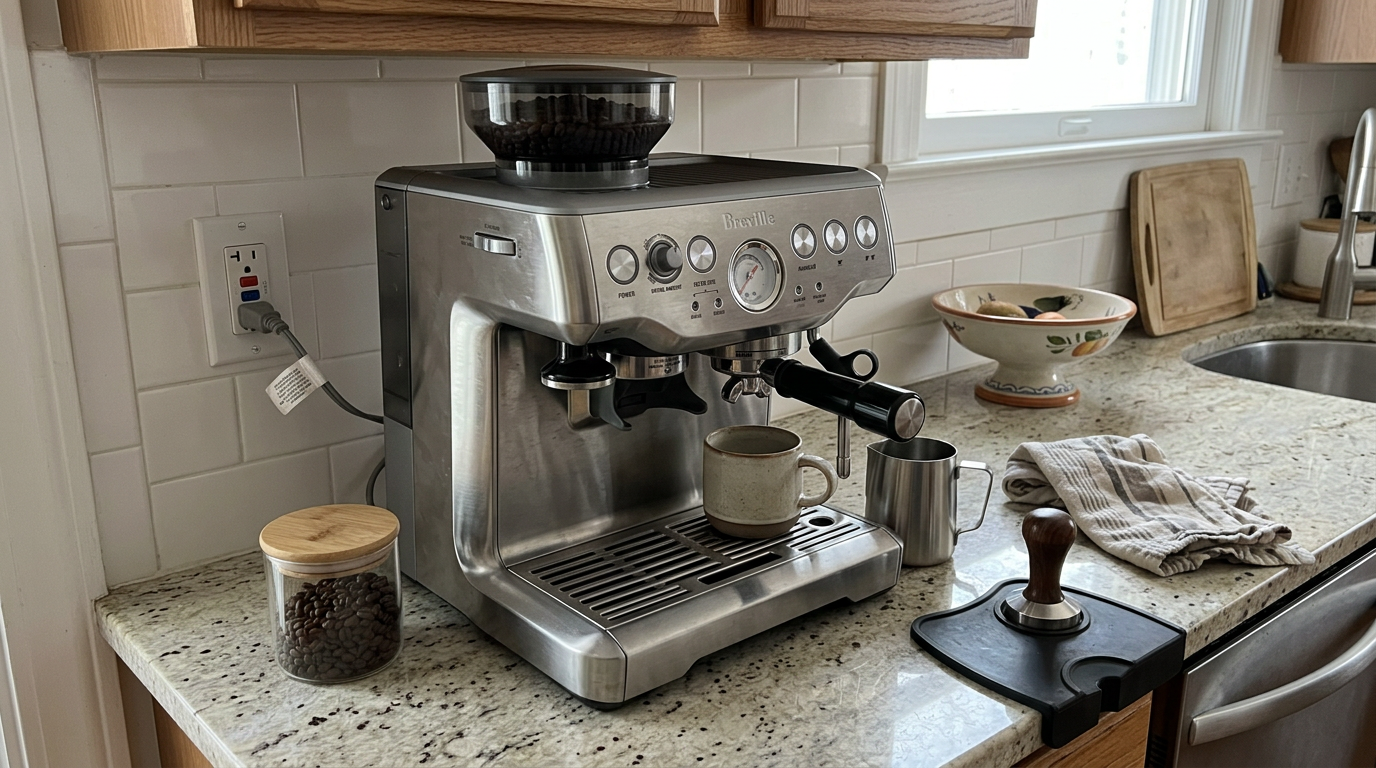
On the Barista models, a level tamp is the habit that fixes most bad shots.
Our tip: Use milk straight from the fridge for every milk drink, because cold milk gives the steam more time to build silky microfoam.
Real-life scenarios
These are the moments where one machine clearly pulled ahead in my kitchen.
The analog gauge showed me instantly whether a shot was under or over, which taught me more than any screen.
Ready in three seconds, with steam right after the shot.
She set her temperature and texture once and never thought about it again.
Brewing and steaming at the same time, both drinks were done in about 90 seconds.
The high temperature setting and 30 grind steps made bright coffee taste sweet, not sour.
The smallest footprint of the four, with automatic milk built in.
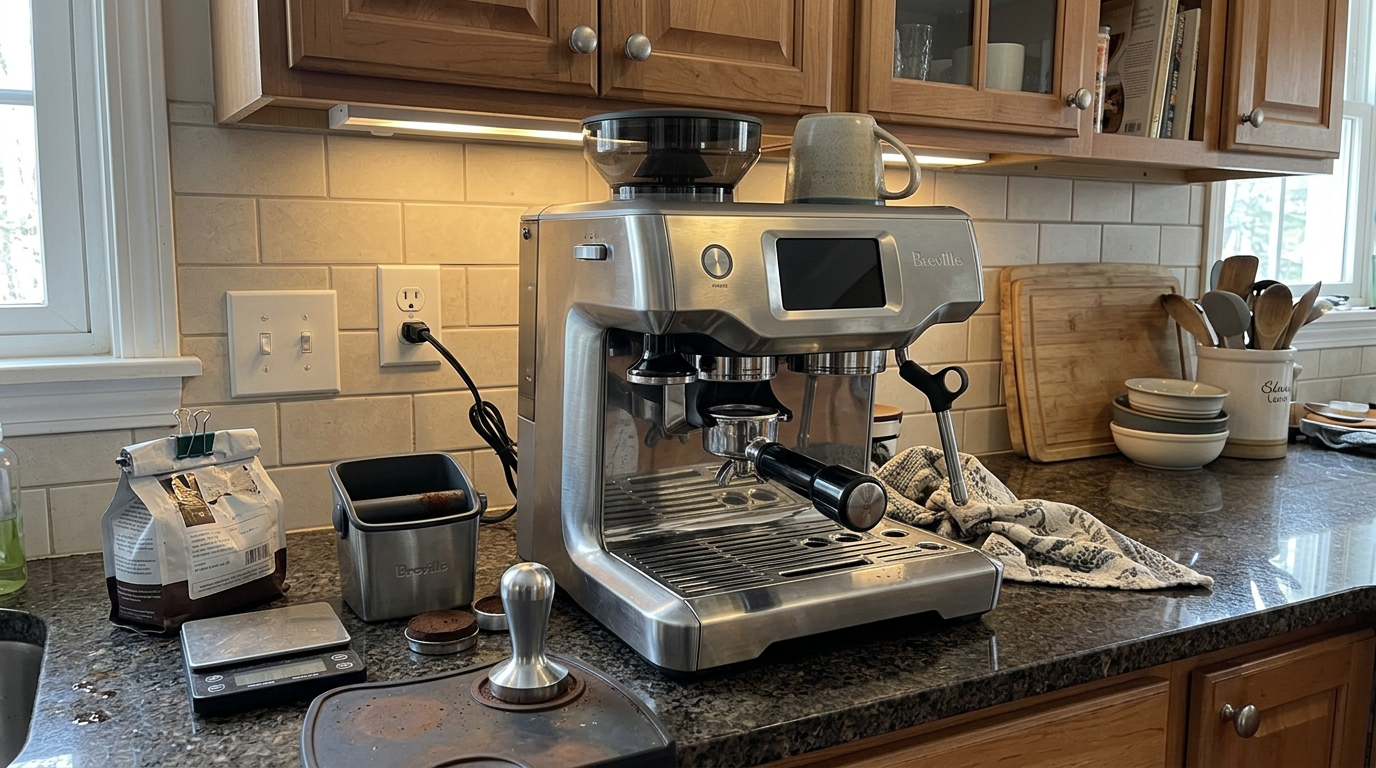
The Touch’s eight saved drinks made it the easiest machine to share.
My scorecard
These are my scores out of 10 from my single reviews of each machine.
Barista Express
Overall: 8.0
Barista Pro
Overall: 8.5
Barista Touch
Overall: 8.4
Oracle
Overall: 8.6
The Oracle scores highest, but it is a much bigger purchase and a much bigger machine. For value per point, the Pro is the standout.
See How Much You’ll SaveWhich one is right for you?
3 quick questionsWhich one should you buy?
Think about the step you most want to skip. If it’s waiting, buy the Pro. If it’s steaming milk, buy the Touch. If it’s grinding, tamping and steaming, buy the Oracle. If you don’t want to skip anything and want to learn, buy the Express. For the wider picture beyond this matchup, see my guide to the best Breville espresso machines.
For a closer look at the most common upgrade, see my Barista Express vs Barista Pro comparison, and for the newest flagship, my Oracle Jet vs Oracle comparison.
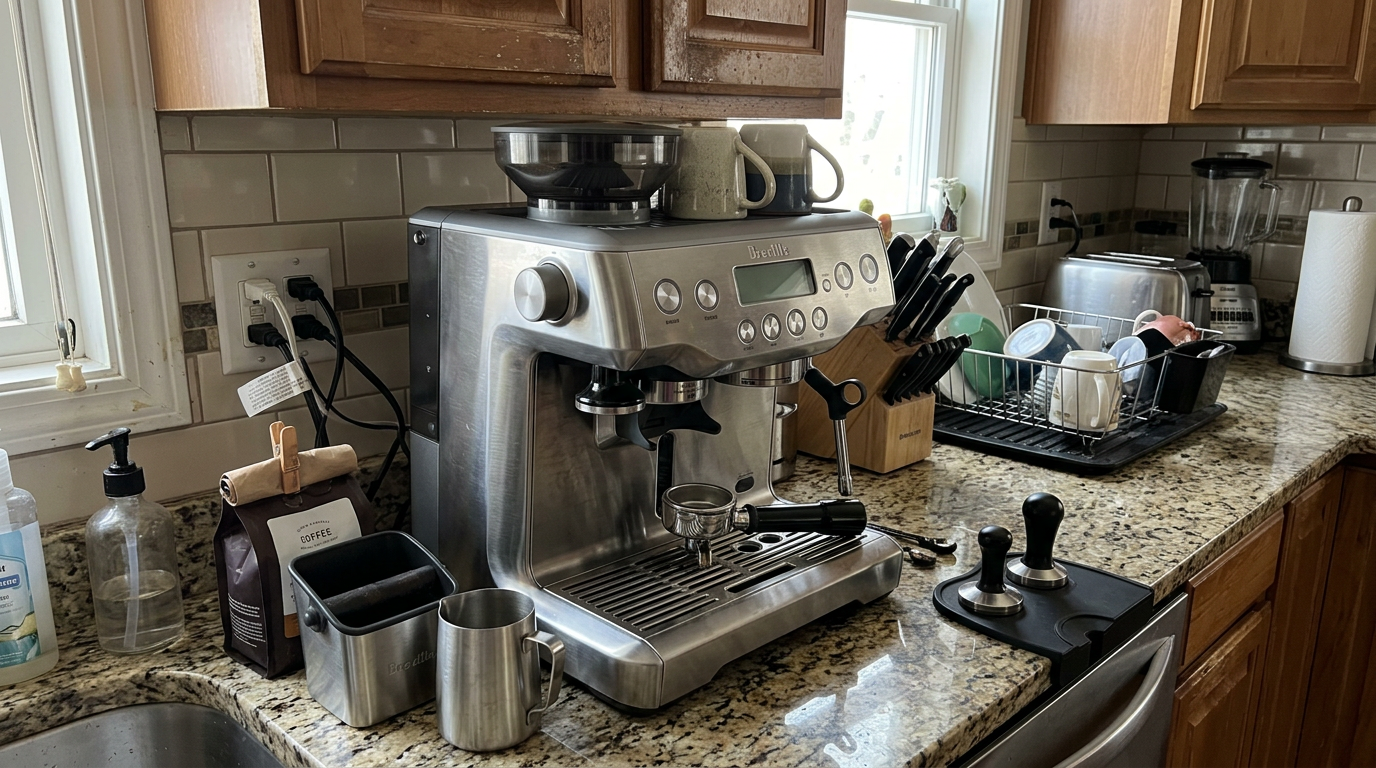
For café drinks with the least effort, the Oracle earns its counter space.
- You want fast mornings
- You steam milk daily and enjoy it
- You want precise control for lighter roasts
- You want a pressure gauge
- You want hands-free milk
- You want push-button drinks
- You drink lattes and flat whites
- You have a small kitchen
- Several people share the machine
- You want automatic tamping
- You make many drinks in a row
- You mostly drink black coffee
- You want to learn espresso properly
- You want the lowest cost of the four
- You like analog feedback
- You want a fast morning routine
- You make back-to-back milk drinks
- You want hands-free anything
- You want grinding and tamping done for you
- You make two milk drinks at once
- You have a deep counter
- You want instant heat-up
- Space is tight
- You enjoy hands-on puck prep
For most people, my pick is the Breville Barista Pro. It’s ready in three seconds, steams faster than any of the others, and its LCD shot timer makes dialing in simple. It made better espresso than the Express for barely more effort.
Choose the Breville Barista Touch if milk drinks are your daily habit and you don’t want to learn to steam. Choose the Breville Barista Express if you want to learn espresso on a budget, and the Breville Oracle if you want café-grade drinks with grinding, tamping and milk handled for you.
Whichever you buy, get a scale, use fresh beans and warm the portafilter before the first shot.
Barista Express vs Pro vs Touch vs Oracle specifications
From manufacturer specifications and my own testing.
| Express | Pro | Touch | Oracle | |
|---|---|---|---|---|
| Model | BES870XL | BES878BSS | BES880BSS | BES980XL |
| Heating | Thermocoil | ThermoJet | ThermoJet | Dual boiler, heated group |
| Heat-up | About a minute | About 3 s | About 3 s | About 5 min |
| Pump | 15 bar | 15 bar | 15 bar | 15 bar |
| Portafilter | 54 mm | 54 mm | 54 mm | 58 mm |
| Grinder | Conical, 16 + inner burr | Conical, 30 | Conical, 30 | Conical, 45 |
| Tamping | Manual | Manual | Manual | Automatic |
| Controls | Buttons, analog gauge | Buttons, LCD | Touchscreen | Buttons, dials, LCD |
| Milk | Manual wand | Manual, 4-hole tip | Automatic | Automatic, simultaneous |
| Saved drinks | No | No | 8 | No |
| Water tank | 67 oz | 67 oz | 67 oz | 84 oz |
| Size (W x D x H) | 12.5 x 13.8 x 15.9 in | 14 x 13 x 16 in | 12.6 x 12.6 x 16.1 in | 16.1 x 14.7 x 17.8 in |
How I tested and compared them
I used each machine as my everyday coffee maker for four weeks, making espresso, Americanos, flat whites, lattes and cappuccinos.
I weighed doses and shots on a 0.1-gram scale, logged every shot time, measured milk temperatures with a probe thermometer, and steamed whole, 2%, oat, almond and soy milk.
I ran every cleaning, backflush and descaling routine, then compared my notes with Breville’s specifications, owner documentation and published test data.
- Coffee: dose, yield, time, body and consistency.
- Milk: foam texture, temperature control and speed.
- Workflow: heat-up, steps per drink and learning curve.
- Ownership: cleaning, footprint and water capacity.
Breville Barista Express vs Pro vs Touch vs Oracle FAQ
What is the main difference between the Barista Express and Barista Pro?
Heating and controls. The Pro uses ThermoJet and is ready in about three seconds, with an LCD shot timer, 30 grind settings and a stronger four-hole steam tip. The Express uses a thermocoil, has 16 grind settings and an analog pressure gauge.
Is the Barista Touch worth it over the Pro?
Yes, if you want hands-free milk. The Touch textures milk to your chosen temperature and saves eight drinks on a touchscreen. If you enjoy steaming by hand, the Pro is the better value.
Does the Oracle tamp automatically?
Yes. The Oracle grinds, doses and tamps into a 58 mm portafilter by itself. The three Barista models need you to tamp by hand.
Which Breville makes the best espresso?
In my testing, the Oracle, thanks to its 58 mm puck, heated group and dual boilers. The Barista Pro was a close second.
Which Breville is best for beginners?
The Barista Express if you want to learn, because its pressure gauge teaches you. The Barista Touch if you want the easiest milk drinks.
Can the Oracle brew and steam at the same time?
Yes. Its two boilers let you pull a shot and steam milk at once. Two cappuccinos took me about 90 seconds.
How long does the Oracle take to heat up?
About five minutes from cold. A smart plug timer solves it.
Which Breville is smallest?
The Barista Touch, at about 12.6 by 12.6 inches.
Do the Barista machines have a water level sensor?
The Pro and Touch do. The Express does not, so check the tank each morning.
Which Breville is best for light roasts?
The Barista Pro or Oracle. Both let you raise the brew temperature, and the Pro’s 30 grind steps give fine control.

- Our hands-on Breville Barista Express review
- Our hands-on Breville Barista Pro review
- Our hands-on Breville Barista Touch review
- Our hands-on Breville Oracle review
- Breville product specifications and owner documentation
- General espresso brewing and maintenance guidance